Chapter One
Podbreze, a Town near Vilna
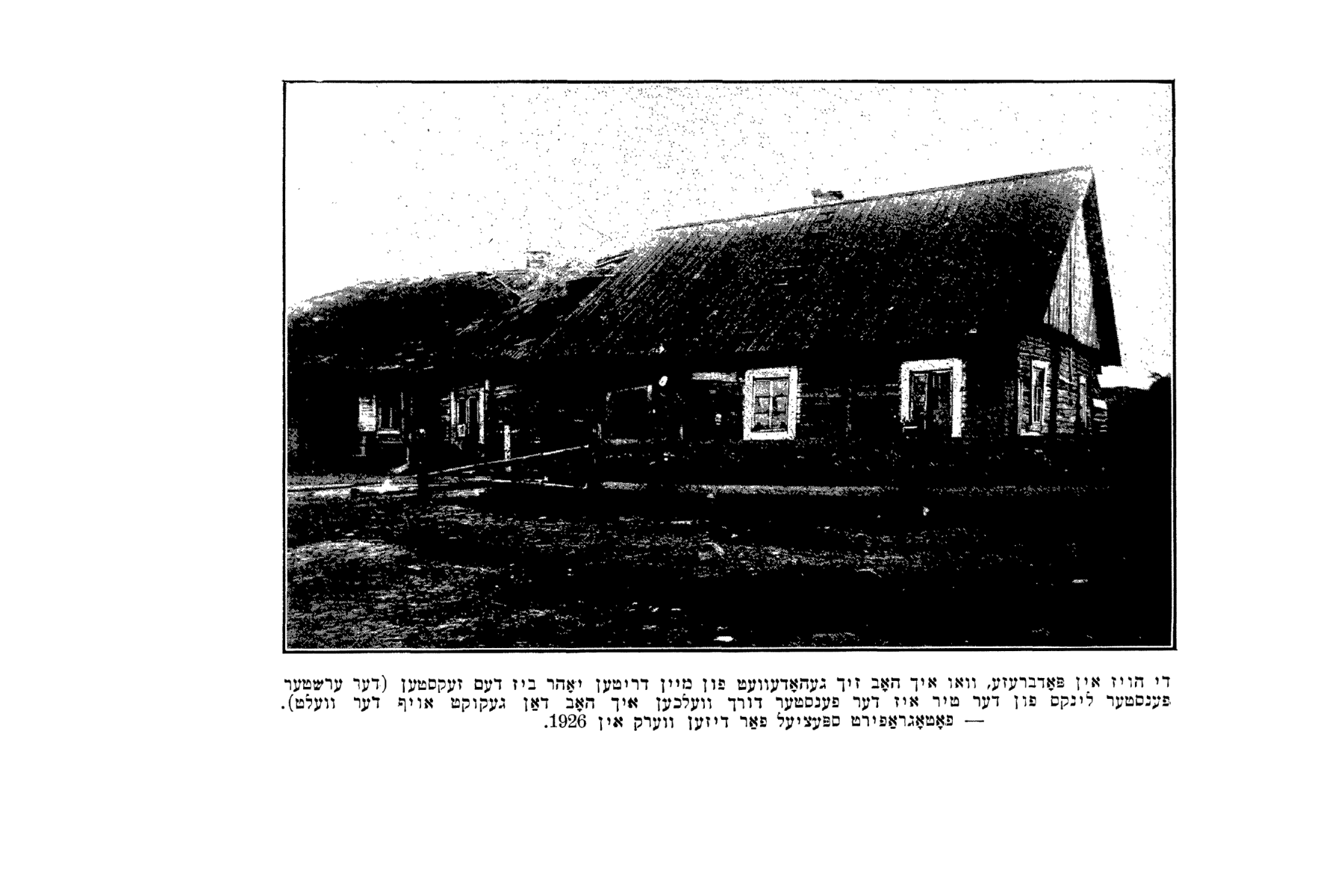
(Photo plate; in the original, between pp. 20–21)
11My first memories take me to Podbreze, a small town twenty-eight versts from Vilna. There I was born, on the Sabbath, the seventeenth of Tammuz, in the year 1860.
I remember the town as far back as I remember myself. When I was five years old and seven or eight months, we left there for Vilna, and I did not see Podbreze again until fifty-eight years later — that is, until 1923. Then I visited it once more.
For all those fifty-eight years I saw it as if before my eyes, with its human figures. If I could draw, I could sketch a general picture of it. The first dwelling that I remember well — a flat where I spent the time from my second year to my sixth — I could paint with every detail.
In the course of those fifty-eight years I used to ask myself now and then: How do I know that I remember correctly? Perhaps the house got tangled in my memory with other recollections, or with stories I had heard? But 12my visit in 1923 confirmed everything. The house had not changed by a hair, and what had presumably been missing for me in it — a locked door that led to another dwelling — turned out to be there too, only smeared over with whitewash. This and many other details showed me that what I remember from my earliest years is a faithful picture.
But the very first thing I find in my memory is a torn old sofa. Its horsehair sticks out. There is a hole in it and I have fallen through. The scene is veiled in a fog; I remember the time when my thoughts could see the scene more clearly. But I remember its shape.
I recall the mood, the childish fright. I do not remember crying; I only remember that my heart felt heavy.
Once, in later years, I asked my mother about it. She could not recall my falling through, but the torn sofa — yes. She named the Jew at whose place we then lived: Moyshe Hendel; and like a shadow I also remember his appearance. By my dear aunt's reckoning I was then a year and a half old. In any case not more than two. To remember oneself so young is no rarity. One only wonders whether something happened that made an unusually strong impression.
I was a “sidn.” That is, I was 13weak on my legs and used to crawl about over the floor, sitting and shuffling along. For that reason I was praised “like a grown-up,” and I began to talk very early. All this my parents used to recount afterward. In my own memory there remains only a picture — not a vivid one — of myself shuffling along.
The next two scenes that I remember distinctly (after the scene with the sofa) took place when I was about three years old.
One of them happened in Vilna. We were still living in Podbreze, but my mother traveled with me to Vilna to visit her father. She herself was born in Vilna, and she had a large family close by there. My father, in turn, was born in Nementshin, a town near Vilna, but on a different side from Podbreze.
I remember a field of cabbage and several gallows. They are hanging Polish noblemen, “miatezhnikes” (revolutionaries). I remember white figures in white robes (kitlen). I distinctly remember how they dangle in the air. I remember how a boot falls from the foot of one of the victims. I remember the marching soldiers with white summer trousers tucked into their boots. They march, and a trumpet is played. This comes before the hanging. I remember my mother’s voice, how she cries out: “Feyge, Feyge!”
In the crush she had been separated from her sister Feyge.
I remember how Aunt Feyge used to send me something from Vilna every week. I remember the talk of her running every week to the Podbreze inn (in Vilna) to send the gifts along with Podbreze travelers.
14The execution of the Polish “miatezhnikes” in Vilna took place in the summer of the year 1863. At that time the famous tyrant Muravyov ruled there with an iron hand. So I was then three years old; yet of my aunt’s gifts I remember kreplekh and a little pot to cook them in. That probably belongs to an earlier time. But about this memory I can no longer speak with certainty.
The second scene, which for me is bound up with the year 1863, is in Podbreze. It is winter. The town is in an uproar and frightened. I stand at the window and look at the snow. Our window faced the market. And I see now the snow-covered marketplace.
My father and other Jews have fled. They are hiding somewhere. An “elder” has come to take recruits. I keep hearing the name “Khovanski.” It was a terrible name. Khovanski was a tall official (chinovnik). Whether he himself came to seize Jews for the army, or whether he was an agent of his — that I did not understand. I understood only that the name Khovanski struck terror into everyone. Khovanski himself I never saw. I used to imagine him as a young and handsome Christian, with red cheeks, with a sword. Perhaps I had seen a handsome gendarme or “uryadnik” (constable) and it stayed with me as Khovanski. Khovanski’s good looks were, in my mind, mixed together with my notion of terror, of Jewish troubles.
In one of the scenes I remember from that year, the central figure is my grandfather on my father’s side. That was the only time I ever saw him. My grandfather had earlier been a rabbi in Podbreze, and then 15he was the maggid (preacher) of Vidz, a town not far from Dünaburg (Dvinsk). Being a maggid in Vidz, he often traveled around to other towns to deliver sermons. Now he had come to Podbreze on a visit, and he presumably “preached” there too. In Podbreze lived his two sons — my father and a younger son, my “Uncle Feyvish,” who kept a shop. A sister of his also lived there, and a nephew, a son-in-law of the Podbreze rabbi.
I remember the to-do that was made over grandfather. His face, too, I do not see clearly now. But his general appearance — yes: not a stout man, with a longish, largish beard. I also remember that he wore a plush cap.
When he came in to us, several townsfolk accompanied him. In my childish way I understood that they were fussing around my father and paying him honor. I remember the part my father played in it as the son of the great guest.
I see my grandfather’s figure now. I see how he sits, at the head of the table, by a wall built of boards — a “separene” (partition) between our room and the dwelling of a bagel-baker woman named Rokhl-Leye.* Grandfather took me onto his lap and gave me a “tsehner” — a big copper five-kopek coin. Someone among those present said to him:
“He isn’t even worth it!”
And he answered:
“If he isn’t worthy yet, he will become worthy!”
His name — “R’ Yankele” — was the pride 16of our family. The most distant relatives and ordinary Podbreze folk used to pronounce it in a tone of reverence; and I felt the meaning of that tone. There was awe in my ears. My father was, of course, called up to the Torah as “ben harav” (son of the rabbi), and as soon as I could grasp what that meant, I held myself to be of distinguished lineage. And if I did not feel it on my own, others reinforced it for me. People used to remind me that I was “a rabbi’s grandchild,” that I must therefore study diligently and conduct myself with dignity. But that no longer belongs to the time when I was three years old.
Of my grandfather’s character I have no notion. From everything I know about him, however, I gather that he knew Hebrew better than most rabbis of that time, and that he took an interest in “melitse” (the art of elegant Hebrew style). What sort of sermons he delivered, I do not know. But I got the impression that he loved the Bible and a fine new interpretation of a fine verse, and that he used to lend color to his preaching.
From him there survives a printed work, a thin little book — a commentary on Ecclesiastes, by the name of “Divrey Khefets” — a sacred treasure, a little book of our family. There also survived from him writings that were never printed. Later, when we were already living in Vilna, his manuscripts used to lie on our cupboard shelf. Some were in the form of bound booklets, some of blue paper ruled into squares; some of white. Later, when I could read them, I saw that they contained separated Hebrew words. And later still I heard from my father that it had something to do with “shmoys hanirdofim” (synonyms).
All this shows me that grandfather was interest17ed in just such things, with which maskilim (enlightened Jews) and the not-old-fashioned rabbis and maggidim then occupied themselves.
About a year after my grandfather visited us, my father’s sister, Aunt Zelde, came to us. She was a beauty, and I remember that my childish mind appraised it with pride: I have a pretty aunt! I also knew that my mother was considered a beauty.
Aunt Zelde came with a grandchild, an infant. With her came a girl of about twelve, a cousin of mine, who carried the child about. The following scene is one of those I see in my memory as a living one.
Close by our house there is a small garden that belongs to another house. My cousin pulls out a red poppy flower (mon-blum) and hands it to the little boy to play with. The mistress of the garden scolds her, and she answers:
“One little poppy! I took no more.”
I remember how the word “monele” (little poppy) made an impression on me. As a name for the poppy flower, the expression was a new one for me. The word used to be in use in Vilna, but not in our town. The girl was a Vilna girl.
This reminds me of another small thing about my first impressions of language: in the home where we lived (a ground-level hut, a cobbled-together little wooden house), three separate dwellings housed four families, including ours. They held eight grown people and several children, bigger and smaller. Among them only one person, a woman named Ite Rayne — the mother of one of the four families — spoke with the guttural “reysh.” The 18difference between her pronunciation and that of everyone else I felt strongly. I hear her voice with its “reyshes” as if it were ringing here now. To us children Ite Rayne was strict. We used to be afraid of her. And her sharp “r’s” lent her “terror” in my mind.
I remember another guest: “Uncle Chaim-Leyb,” a brother of my mother — a young man with a pale face. I remember how he plays with me. He holds out two fingers to me and tells me to pull them apart. I strain with all my might to do it and cannot. I take him for a great strongman. That is all I remember of him, when I call those years to mind.
Another young man I remember from my earliest childhood years is a fellow with a handsome face and full lips. This was a cousin of my father’s, by the name of Bentshke. He studied in the shtetl, and I remember how he sits at our table eating. I always picture him with an earnest, abashed expression, the expression with which a yeshiva student eats his “day” (a meal provided by a host family).
His figure stands in my memory as a picture of very bright, strongly lit colors, wrapped about with fog.
Afterward, when Bentshke was no longer in Podbreze, a commotion arose about him. People whispered; there had been some kind of trouble. Later, already in Vilna, I gradually came to understand that Bentshke had converted to Christianity.
My father used to speak of him with a curse. And my aunts on my father’s side used to mention Bentshke with sighs and groans. I often heard the word “Constantinople,” and I also remember something about a letter that came from him to a 19great-uncle of mine, in Hebrew (Bentshke knew Hebrew well). Nothing more was heard of him.†
Our dwelling consisted of one room. When you came into the “forhoyz” (entry vestibule), it lay on the left hand. On the right hand lived the ritual slaughterer, together with Sender the horse-dealer (his wife was Ite Rayne). Directly opposite the entrance to the “forhoyz” was our dwelling — a small room in which, besides us, another family lived. Of that family I remember only one person: a tall, fat girl, a bit pockmarked, with big eyes. On the Sabbath, when she dressed up, she used to wear a “crinoline” — the only old-fashioned crinoline I ever saw not in a museum but on a living woman. This is not the same kind of crinoline that ladies wore for a certain time, many years later. This one is a trifle compared with the old-fashioned kind.
My father was a melamed (teacher), and two of his pupils (and perhaps three) ate their “days” at our place and took board. Their parents lived not far from the town. I remember the two boys, how they looked, and I even remember the father of one of them.
My mother taught girls to write. Of all 20her pupils I remember one: the tall, fat girl, our neighbor, who used to wear a crinoline on the Sabbath.
Beside our door in the “forhoyz” stood a “stupe” (mortar), in which my father used to pound tobacco. The water stood there too. Once, taking a drink, I poured the water left in the jug into that tobacco-mortar. I was terrified at my crime. My parents afterward did not know who had done it. I kept the secret hidden until later, when we were already living in Vilna; and when I told it to them, they could no longer recall the “deed.”
I remember the children of our neighbors, the families that lived in the same “forhoyz.” I remember the boys and the girls, and how we, four- or five-year-old “cavaliers,” behaved toward our five- or four-year-old “ladies.” I remember that we even knew quite well that there are things one must not do; that there is a boundary to our companionship. The sense of that boundary we, of course, did not understand. We boys used to guard it far more strictly than the girls. I must admit that our “ladies” often used to behave in a way that I cannot set down on paper.
I was an only child. I see how my father sits and studies with his pupils, holding me on his lap. I remember this from that time, when I could not yet read Hebrew. I listen to the words with their translations, I say a few more words after him, and my father is proud of me.
I remember how the first kero21sene lamp was brought into our house — a tiny little lamp, without a glass, made of tin, painted red, like a red ink-pot. The little lamp stands on the table, too, when one studies by it. It is a great novelty. Possibly a candle burned alongside it as well, for I cannot imagine that the little lamp gave light enough.
In the besmedresh (study-house) they then introduced real kerosene lamps, hanging ones, with glass chimneys, with “plates” (shades) on top, and for the town it was a sensation.
I was sent to kheyder (religious school) at four and a half. The first Sunday, when I was led to my alef-beys teacher, I remember as though through a thick cloud. I used to see before my eyes how the angel throws me the kopek. I remember that I used to remember that my first teacher had a white beard. I still remember well on which side of the town my first kheyder stood. My second kheyder was on the opposite side.
My second teacher in Podbreze was a tall Jew with red, sickly eyes. His name was Dovid Doyger. I came to him in the summer when I turned five. I remember his face with complete clarity. I also remember his voice. But him I saw later as well (in Vilna).
He had a wound on his arm, near the shoulder, and he was always busy with it, with a salve and with “karpie” (lint dressing). All this is mixed together in my memory with the studying — reading Hebrew and the beginning of Khumesh (the Pentateuch).
I see a scene in my mind: I had done something wrong, and the teacher had tied me to the bed with a 22narrow, long strap. I sat at the table and studied. And the strap stretched from me to the bed.
A third and a fourth teacher I no longer had in Podbreze.
I remember how a little celebration was made at our place for my first “siyem” (completion of a course of study). What that siyem was for, I do not remember. On the Sabbath, after the prayers, guests came. An older boy named Feyvke, a pupil of my father’s, was one of them. He was the nephew of Rokhl-Leye the bagel-baker, the widow who lived and ran her business on the other side of the boarded-up door, and he was lodging with her. My mother honored him with a cookie and a slice of “retsishnik” (a pastry), and he walks about and chews with relish.
His relishing chewing, and the broad ease with which he goes about the room, vexes me. It is my mother, my house, my siyem, and my cookie. The tastier he chewed, the more I begrudged him.
My father and mother in their young years I remember well. I remember my father’s tall, lean, strongly built figure and his black hair. He had sad eyes and a sharp, long, jutting nose — the look of his mother and her brothers (his brothers, and two of his sisters, resembled him). I have his face.
My mother was of shorter build than he, with dark-red hair and a reddish face that was considered beautiful. Her hair was, of course, covered — on the Sabbath with a wig or a “basten” kerchief; on weekdays with a plain colored kerchief.
23What did I, in those tender childhood years, feel of nature with all its splendor? Podbreze is a small town, almost a village. A few minutes’ walk from our dwelling, meadows and fields already began. What, then, do I remember of it? The answer to this question is a very meager one.
I remember a meadow. And a summer breeze, how it sways the grass with its little blossoms. I remember the pleasure they used to give me. I remember, too, my childish feeling of something mysterious. I remember the chirping of the Podbreze birds.
Of small birds I knew only one kind: vorobyitshikes (sparrows). In Yiddish they used to be called “barabitshikes.” And that there are birds with other colors, brighter and prettier — I did not know. I say “small birds,” because I knew only of the butshan (stork) — the big bird with very long, thin legs, a long neck, and a long beak. When we children would catch sight of a stork flying high up, we would crane our heads and cry out:
“Butshan, butshan, ga-ga-ga!”
When we would see a big company of “barabeytshiklekh” flying and chirping merrily, we used to say that it was a wedding.
Of the little blossoms that grow in the fields and meadows I knew only three kinds: the flower shaped like a yellow round little brush, whose stem has a bitter taste (later the little brush turns 24into a little ball of down. We used to blow it apart with a single breath); the flower made up of white petals with a little yellow button in the middle; and the one that looks like a dark-red knob. They had no names among us. Later I learned what each was called in Russian, and later still — in America — also in English. But in Yiddish there were no words for such things, and we used to call all the wildflowers by one general name: “tsatskes” (trinkets).
Here in America I am acquainted with some sixty-odd kinds of birds and with many dozens of wildflowers. But the birds of my birthplace are unknown to me. I know of them only from Russian books and from English ones; but not from life.
I used to spend a great deal of time playing — with friends or alone. Opposite our house was a well, and I used to play near it, or behind the house, where there was a garden — a few of whose beds were ours. Beyond the garden stretched an empty patch, overgrown with grass, nettles, or wild plants, and a few flowers. There I used to catch bees, beetles (zhukes), big blue flies, and “khayelekh” (the long, hairy creatures out of which summer butterflies come — caterpillars). In the garden I used to gather many green little balls, like peas, of the kind that fall from a certain wild plant. I used to dig a pit and gather them there. At this work I used to talk to myself.
Once I was given a round brass little box. I put a “khayele” into it and shut it. Later, when I opened it and found that it was dead, I was deeply disappointed.
25And another time I buried a live “khayele.” I had “planted” it, so to speak, and the next morning I went to see whether it was sprouting yet.
One of my dearest memories connected with nature is a scene in which my father makes me a little whistle. I see him as if now: young, with black hair, tall, strong, how he springs up to a tree, bends a branch down, and breaks off a piece.
It is Lag B’Omer. It is spring; but in ordinary Yiddish there is no such word. With us it is already called summer. Everything is young and fresh — a delight! Father taps the twig with his little knife, so that the bark should come loose. The twig is fresh and juicy. Father holds the little blade in his hand, and with the little handle he taps as with a little hammer. He moistens the dark-green bark in his mouth and taps once more. At last it begins to move, the bark. Father is happy, and I too, of course. He whittles away. He cuts out a “fayfele” (whistle), he cuts around it, and at last he draws the bark off. It slips off like a little shirt. The stalk remains naked, moist, glistening, and the rest of the work is easy.
When the whistle is finished and gives its first toot, I tremble with joy. But only then do the troubles begin: mine doesn’t whistle. Father finishes it off; he cuts again; he mends it, until at last mine whistles too. I am in seventh heaven!
Father’s whistle is as important a part of the picture of the taste of spring as the fresh sap of the bark. He was a great enthusiast for little knives and considered himself a connoisseur of them. A knife was to him what a horse is to a passionate rider. So it remained his whole life.
26What is my first memory of song? My mother was simply no great singer. She used to sing only an ordinary lullaby, and that softly. I remember her young voice. My father had a strong voice and used to sing a great deal.
The first melody (nign) I can call to mind is a “hopke” (a lively dance tune) that my father and other Podbreze Jews used to sing on Simchas Torah. I can still sing it today. I see them as if now, and I hear their merry voices.
I also remember how in Podbreze they used to sing Eliakum Zunser’s first songs: “Di Blum” (The Flower), “R’ Tankhum,” and “Der Zumer un der Vinter” (Summer and Winter). I distinctly remember how an “akatnik”‡ used to sing them — a tall, handsome young fellow. I remember the head klezmer, the town fiddler — Chaim was his name — a thin little Jew with a white beard. For many years I used to sing over a certain melody that he used to play. But I have long since forgotten it.
How far did I, in those years, understand the role of God?
I used to imagine Him not as a mighty, 27majestic, dreadful being, but exactly the opposite: I used to see Him in the form of a boy. Only the boy sits very high up somewhere. And he wears some strange sort of little cap, a half-round one.
From where such a figure assembled itself in my brain I do not exactly know. But I am sure that it has a close connection to the sound of the word “Got” (God). I remember that the word made no strong impression on me. A short, clipped word. And the boy with the little cap was like that too.
But of the sky I was afraid. On the far side of the sky lay a secret world that frightened me.
Pointing a finger at the sky was forbidden; “an iron cat will jump down and bite off the finger.” And so I used to imagine an angry cat springing down from the sky. In my mind this was tangled together with the divine mystery.
I remember a besmedresh, with an alley leading to it from the main street.
I remember how, on Simchas Torah, my father carries me to the hakofes (the festive Torah processions). I remember my paper “flag” with its little figures, the yellow carrot stuck on the tip of the stick to serve as a candle-holder. In my memory there remains the scene where the candle won’t burn, or some other mishap befell the flag. But the scene at the hakofes itself I do not remember.
I remember R’ Berele, the rabbi of the town, with his gray, thick, round beard, and R’ Lipe, his son-in-law, with a beard black as a beetle. And R’ Lipe’s wife, Beyle Dvose, who kept a food-shop not far from the well. R’ Lipe was a cousin of my father’s. In Podbreze, though, I did not understand that. 28Their kinship I discovered only later, when we were already living in Vilna.
The Jews in Podbreze were like the Jews of all such towns: almost all poor folk. There were only a few well-to-do families. This I came to grasp, or feel, when I was still only a child.
The son of one of the rich families was called “Yakob,” and I knew that this was an “aristocratic” name.
I remember a shopkeeper named Heshel, a Jew with a reddish beard and a handsome face. His wife was not in her right mind. And I remember how various tales were told about her. Once, for instance, she took Shimke, her little boy, who was then a few months old, stuck him into a pot of feathers, and set the pot up high on a shelf. By now Shimke was already a tall boy. He was a couple of years older than I. He was attached to his father, and I held him to be the handsomest boy in Podbreze.
What is my first memory of Christians? More precisely, of my feelings toward them? I saw that they were not people like us; that Jews were one thing and they quite another (when I began to make this out, I cannot determine). I saw that they did not keep the Sabbath, that they had no khadorim (Jewish schools); and I knew that Jews regarded their church as a bad, fearful thing.
The general notion of goyim (gentiles) was, in my mind, from 29the very first somehow bound up with my dim notion of the governmental power. The handsome, terrible Khovanski was a goy. All goyim were terrible. That goyim too were taken for soldiers I did not know. I thought that terrible things were done only to a Jew.
In my memory I also see vividly the following scene: my mother carries a little pot of cooked food to a Jewish recruit and takes me along. The recruit was kept in a private house, where he was shackled in chains. A guard was always beside him. The recruit was thin, tall, with black hair. I remember the sound of his chains and his grief-stricken face. I remember how he smokes a pipe (lulke) — he smoked a great deal, and fasted much, in order to “waste himself away,” so that they would reject him as unfit. I felt a deep pity for him, and I knew that there was some evil power tormenting him. And that power was, in my thinking, bound together with all goyim in general.
When I was five years old, the town was troubled by a “nit-guter” (an evil spirit). It was before Passover. At the matzo-baking the window-panes kept shattering, and no guilty one could be found. So it went, day after day. Podbreze was turned upside down. At last they caught the “nit-guter”: a girl by the name of Lahke. Sitting on the oven with a child on her lap, she had been nimbly hurling little stones into the windows. People did not stop talking about it, and I listened with fear and with dramatic interest.
Out of Lahke grew a likeable, respectable woman, yet under their breath people always used to remark: “That is Lahke the witch.”
30In the house a bustle set in. Ordinary life was thrown into disorder. Every little while I heard the words “Vilna,” “Arye-Leyb,” “Shneyur,” “shenk” (tavern), “podval” (cellar), “melamdes” (teaching), “a finstere parnose” (a wretched livelihood), “Feyge.”
People began to pack.
I was given to understand that we were going away forever out of Podbreze; that our home would now be in Vilna, in the great Russian city where Aunt Feyge and the “other” grandfather lived — that is, my mother’s father.
I remember that part of our journey to Vilna when the wagon was already drawing near the city. From afar I saw beautiful, colored, tall chimneys or columns. But they do not grow up out of roofs — only out of the ground. Many such chimneys or columns — red, brown, green, golden-yellow. So, to my inexperienced eyes, the city looked from afar.
How is the fantastic image to be explained? — That question intrigued me my whole life.
We arrived in the late afternoon. Behind the city one could see little towers with religious images, churches large and small; one could see “kostshioles” (Catholic churches) with green roofs and “sabores” (Orthodox cathedrals) with green or golden roofs. And who can explain the play of enchantment in a child’s brain, when forms and colors mirror themselves through the mysterious haze of a sunset?
Notes (footnotes in the original)
* [p. 15] That was where the boarded-up door had been.
† [p. 19] This only means that the family in Russia never heard from him again. In a later volume of these memoirs, many years on, we shall meet him once more.
‡ [p. 26] A young man who used to sell himself to serve in the army. The Jewish community of every town or shtetl was required to supply a fixed number of recruits, according to the registered number of males. They (the community, or private persons) used to buy some of them, and simply seize others and hold them under lock and key until they “handed them over.” There were special Jewish “khapers” (catchers).