Chapter Three
From Nine Years to Twelve
84Every city has its own particular character. Vilna's spiritual cast, however, stood out with special clarity; and when one calls it Yerushalayim d'Lite (Jerusalem of Lithuania), one naturally means its spiritual life.
Let us note first that Vilna was the capital of six provinces: Vilna, Grodno, Kovno, Minsk, Vitebsk and Mogilev. All these provinces together made up the Vilna okrug (district). That was according to the official division of the Russian Empire. In Vilna there sat not only the Vilna governor but also a governor-general over the whole district, and a "popetshitel" (curator) over all the schools of the district, for example. And among Jews Vilna played a similar role, but over a still larger expanse. It was the spiritual central region of the six neighboring provinces, and of several more as well — Smolensk, Suwałki, Łomża. And in certain respects it was even acknowledged as the focal point of the spiritual Jewish interests of the whole empire.
Interests of the mind and interests of the soul played a great role in Vilna among all classes. A child 85had them around it at every step and turn, and felt them in various forms.
Even in my very early years I knew that this was the city of the Vilna Gaon, and that pious Jews hold the Vilna Gaon to be one of the greatest geonim and one of the greatest men of all generations. Perhaps I knew it through the fact that my grandfather on my mother's side descended from the Gaon's kloyz — in the "Hasidim minyen."
But about this matter I heard from every rebbe I had, from my father and from all his acquaintances, even from the street-folk who came into our tavern. Their city is the Gaon's city — so they looked upon it.
In Vilna there still remained the famous Ramayles kloyz, with its six yeshivas or classes, and several more yeshivas in various quarters. The shul-court had a great many kloyzn, and almost every little corner of the city had its own separate kloyz or kloyzn, and in each of them bokherim kept themselves and studied "for themselves," who "ate days" at the surrounding householders.
The city had lamdonim of renown, and some of them were poskim (decisors). Of R' Tsalel the decisor one used to hear that he is a great erudite and a sharp mind, one of the very great in the world. "Dear heads," "able young men," made themselves heard from all parts of the city.
To see two Jews chanting at each other like turkeys over a Gemara, or one putting forward some new piece of Torah, and the listeners delighting in the insight, making little of it, and through it perhaps a hot debate drawing out — that was a part of the everyday life among us. There were special "sports," Talmudic "scrappers," Jews 86who only sought an occasion to trip someone up in a dispute, to show that his learning is "a sack full of wind."
There were also debaters of dubious honesty — such as were capable of falsifying a Gemara, or even inventing a whole quotation out of their heads. There were also other types. People used to take in and hear so much about such things that a Vilna boy was as familiar with them as an American boy is with the baseball world.
Vilna had then no more than eighty thousand inhabitants — Jews and Christians. It was a poor city. Yet it maintained a great number of "learners," who came to it from other towns and townlets. The poorest woman paid weekly to support a yeshiva, and the poorest family took at least one young man for "a day." Families of quite small means, at whom one "ate a day" each day of the week, were a quite ordinary thing.
In the neighboring camp stood the Vilna rabbiner-shul, a wellspring of modern education, of Russian and "goyishness" for the Jews of Lithuania and White Russia. There they trained Russian teachers for government Jewish schools and "government rabbis."*
In the middle, between the Gemara on one side and modern culture in Russian on the other, stood the Haskole, with Hebrew as the language for modern culture. In the city there were a great number of young men, and men in their middle years, who knew 87Hebrew well.
* In Russia there were two such "rabbiner-shuls" — one in Vilna for the Jewish towns of northern Russia, and one in Zhitomir for southern Russia.
There were a fair number of such who from time to time "enrolled themselves" in Hebrew belles-lettres, and several became famous writers of Hebrew belles-lettres. Householders' young men chatting after davening about the latest number of "Ha-Magid" or "Ha-Melits," or "Ha-Shahar," or declaiming a Hebrew poem — that too was one of the ordinary things I used to see around me.
I knew that Vilna, the city of the Vilna Gaon, is also the city of "Berke Mikhalishker"* — the "great apikoyres" (heretic), whom I used to see in the street. My father used to revile him. But I knew that he held him for a sage, for a great grammarian and a great "master of the language"; and that the more he reviled him, the more it was a sign that he was interested in him.
The following anecdote I heard from my father when I was still less than nine years old:
A pious Jew visited "Berke Mikhalishker." He saw on his table a Midrash. The Midrash was bound in red morocco. The pious Jew asked: "Why in red?" And "Berke" answered: "It was white, but it was caught in so many lies that it turned red for shame."
Kalman Shulman used to spend every day in our tavern, and I knew that he is a great Holy-Tongue author, and that his books are "of the modern ones." He lived in Shloyme Kisin's court, about a minute's walk from us. And less than a minute's walk from us, going along Little-Stefan Street, lived Ayzik Meyer Dik; and in the same court — Moyshe 88Reicherson, the Hebrew translator of Krylov's fables and author of a grammar.
* Adam ha-Kohen Lebensohn.
His elder boy, Hirshke, used to spend time in our tavern, and I knew that his father had written a grammar, or a commentary on a grammar, that he gives lessons in Hebrew, and that he is a great pauper.
"Berl Mikhalishker" I used to see on Daytshe Street, not far from his dwelling, which was not far from my grandfather's dwelling. I used to look at his tall figure with his gray beard, with the green little cap over his eyes, with his famous little stick in his hand.*
Shmuel Yosef Fin was then in his vigorous middle years, and I knew that he has a press (for some books bore his name on the title-page). I also knew — from my father — that he conducts a Hebrew journal called "Ha-Karmel," and that he is a teacher at the rabbiner-shul.
I knew that the two courts where the "genzlarnie" is to be found belong to Moyshe Rozenzon, a mad apikoyres who writes "missionary" booklets in the Holy Tongue. All this I often used to hear from my father, who loved to talk about apikorsim and to revile them — chiefly about apikorsim who wrote in Hebrew.
Eliakum Zunser then lived in Vilna. His songs were uncommonly popular. People sang them in almost every house, in every "workshop," and at every wedding too. The title "poet" people did not yet give him, simply because the public did not yet 89have such a word in its language. As for the Jewish intelligentsia, it was too "assimilationist" and "snobbish" to acknowledge that one can write poetry in Yiddish. And yet educated Jews held themselves great with Zunser, and the public knew it.
* This is the stick about which he once said that he carries it because he is afraid of God.
On an indistinct, general level, we cheder-boys too understood this. We felt that although "Eliakumkel's" songs are in Yiddish, people hold them higher than the other things written in Yiddish.
And even toward Ayzik Meyer Dik's Yiddish tales — of which such Jews as my father used to speak with contempt — even toward them people had an unspoken respect.
For "jargon" tales Vilna was the center. They were printed at the Romms' and at the other Jewish presses Vilna possessed. Such tales used to be read by craftsmen's lads and by women. For a Gemara-boy it was not fitting to read them, and yet there were yeshiva-bokherim who devoured such tales.
Romm's great press was then at the highest stage of its success. Around that time it brought out the famous Vilna Shas (Talmud), and the dozens of books and booklets, pious and modern.
Dvorzhets's press and Fin's press were much smaller than Romm's, but there too they printed books and booklets, and besides them there were a couple more Jewish presses.
Antokolski, a Vilna man, already had a name in the world as a sculptor, and people told "how great he is with the Tsar." And Antokolski's father 90kept a tavern near my grandfather's dwelling, and an uncle of his kept a tavern not far from us.
I cannot give the reader any idea of my upbringing in my childhood years before I make him acquainted with the character of my father, as I came to picture him. Every father has an influence — more or less, direct or indirect — on the upbringing of his child; and with me, up to my fourteenth or fifteenth year, my father's influence on my spiritual development was very great. I can say that on his character depended, at least in part, the direction of my further spiritual life.
First, a few lines about his appearance in those years.
He was tall, not stout. He had black hair and a deeply Jewish face, with dark, melancholy, deep-set eyes, with a long, jutting, bony nose, with a black, not very long, two-pointed beard. He was lean, but strongly built, and he had a liking for physical exercise.
He was a great lover of walking. He used to set off to stroll far beyond the town, and sometimes he would stroll all the way to Podbreze. His brothers were the same.
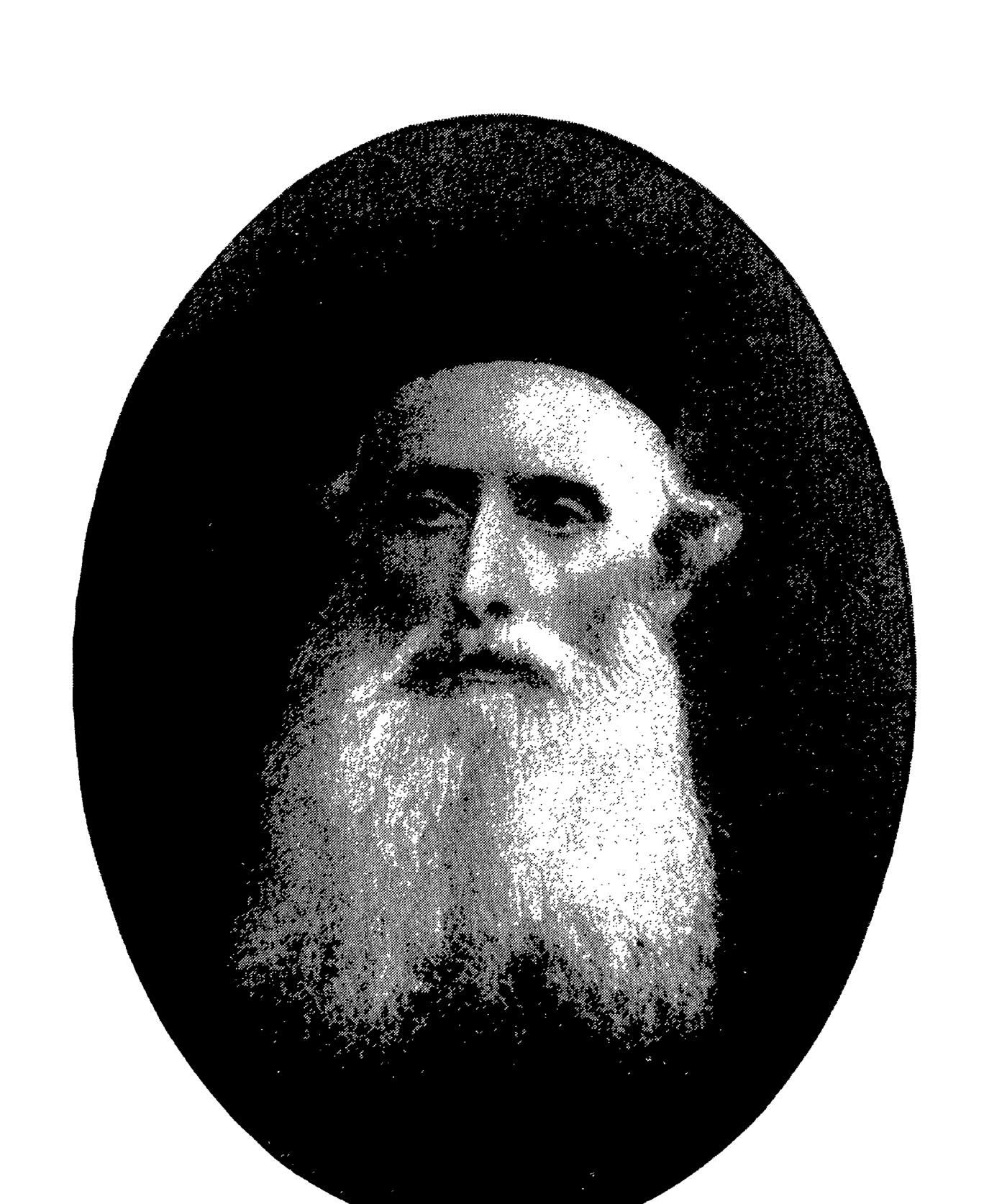
In the original: a photographic plate between pp. 90–93 (pp. 91–92).
Since his father was a rabbi, it goes without saying that he was a Gemara-boy, and once a yeshiva-bokher. Afterward he studied "for himself," abroad, and "ate days."
When I considered my father in the later 93years (before I left Russia), I understood that two opposing strivings worked in him at one and the same time. He was truly pious, passionately pious — pious in the wholly old-fashioned, antiquated manner. And he had no modern education that might rein in his orthodox superstitions, or at least polish them over a little. And yet he had an extraordinary thirst for education, for everything progressive.
Between the two directions a collision took place in his heart. He saw the contradiction; but he could not help himself. Had he had a close friend among the maskilim of that generation — a thinker who at the same time would be a lamden — it would surely have helped him much.
And I can imagine that, with such help, my father would have become a freethinker. But he had no such friends. The people who stood closest to him were lamdonim of the old-fashioned cut, and a couple of them were men of iron character, and toward them he felt the deepest respect.
One of them was his uncle Ezriel — Ezriel Volf — his father's younger brother. Uncle Ezriel lived in Vilkomir, where he held the town weights-and-measures. He was a lamden and an interesting personality. He was also an ardent zealot. He literally burned with religious fanaticism.
Here is an example of his character.
A boy of his did not study in cheder with much zeal. So he has the cobbler called. The boy brings the cobbler, thinking they want to make him a few new little boots.
— Take him to you for five years and make 94him into a good cobbler! — says Uncle Ezriel.
The boy weeps. The cobbler laughs. Uncle Ezriel grows angry, stamps with his foot. That is, he means it quite seriously. The cobbler has no choice; he begins to talk terms, and the boy, with weeping and fresh cries, begs his father at his feet. He comes crawling back, he falls upon his father with persistence. Only then, ostensibly unwilling, does the father relent and place him "on probation."
Uncle Ezriel had several sons, and all of them were lamdonim.
Three of them were rabbis.
His youngest son was, already at twelve or thirteen, known as a world-prodigy (in later years he was the rabbi of Pinsk, one of the well-known rabbis of his time). R' Lipe, the son-in-law of the Podbreze rabbi, R' Berele, was a son of his and later also became a rabbi.
Uncle Ezriel was an orthodox of the strictest sort. He was as far from the Haskole, with its new spiritual movements, as he was from apostasy, and him my father literally idolized. He was his ideal — with his piety and (perhaps chiefly) with his strong, original character.
A second lamden, toward whom my father felt a deep respect, was a former rebbe of his, from Nemenchin. He too had a firm character. He was of those Jews who could thrash a pupil in his parents' house, even when the mother was present.
My father's good friends and close acquaintances were almost all orthodox zealots of the old type. That was the world that had influence on him. Its public opinion he feared.
95And yet he was strongly drawn to the Hebrew — that is, to "modern" — booklets. And he always dreamed of making me into a learned man.
Holding me on his lap, he used to express his dreams in words.
"Bli neyder uvli shvue (without a vow and without an oath)" — he used to say, pinching me tenderly on the cheek — "if God helps me, I'll hire you teachers for Russian, for German, for French, for playing music. But you must be a pious Jew, Alter!"
Hundreds of times I heard these dreams from him.
For practical life he had no aptitude. He was more suited to the kloyz than to the world. A page of Gemara, though, he did not study often. He was far more interested in books that spoke of the human spirit, or of the world in general. He used to study the Rambam. And I remember how he bought the "Sefer ha-Bris" from a bookseller and arranged to pay it off in three installments. He attached himself to the "Sefer ha-Bris," and for whole days he used to talk about its contents.
My father was then about thirty-six or thirty-seven, and I — nine or ten.
Together with another Jew he subscribed to "Ha-Magid," which used to come to our address. From time to time he also used to bring home "Ha-Melits," and sometimes "Ha-Levanon."
He wrote Holy Tongue with "melitse" (florid Hebrew rhetoric), in the old-fashioned cut. But he always used to read new Hebrew booklets, and to seek to imitate their expressions. When one needed to compose verses for a gravestone, one turned to him.
In his way he found a poetic flavor in the Hebrew language. When he used to read a piece 96of Hebrew aloud, his melancholy eyes used to shine with an interesting light.
He loved music very much — feverishly. For a good cantor, or a new melody, he would walk several miles on foot. He himself also sang a great deal, but before the amud (the lectern) he used to lead the prayers only on an ordinary Sabbath. He had a ringing, unusually fine voice, and used to take a very high note easily. Since he was a kohen, he used to "dukhn" (give the priestly blessing), and at that his "be-ahavah" (the priestly-blessing chant) would rise to a startling height and resound through the kloyz. The voice, however, was not cultivated.
When he used to sing more softly, he used to sing with relish; chiefly certain melodies that had feeling in them. I remember them to this day.
On the Days of Awe he used to hire a "place" in the "Old Kloyz," where the most famous cantors used to lead. A "place" there was a bit too dear for him. But he would rather go without eating, so long as he could hear Yehoshua Fayzinger.
When he heard a new melody and it pleased him, he would ask to be taught it, and then for whole days he would walk back and forth across the tavern and sing it, often with a sigh.
When he fell silent out of cares, he would, from time to time, draw his lips together as if to whistle, and let out his breath with a melancholy sound. Or else he would stand for long by the window and gaze out into the street with his melancholy eyes.
"Worries of livelihood" always lay upon him like a heavy burden; but not that alone used to call forth melancholy in him. He was a man of moods in the sharpest sense of the word. When he was merry, 97he used to be too merry. And when he was care-worn, he used to be broken.
Almost every Jew loves a melancholy melody. My father, however, loved it passionately.
For the struggle of life he had little aptitude, and with fate he was no favorite.
Once my father came home from davening very saddened and agitated. And the moment he came in, he sat down on the floor, pulled off his boots, and wept aloud.
In the kloyz he had led the prayers before the amud that early morning. Suddenly one of the householders comes up to him, pushes him away from the amud and says to him: "Go, R' Shakhne, you are a mourner."*
His mother had died.
In just such a way he had learned of his father's death several years earlier, when we still lived in Podbreze.
There remained two unmarried children — a bokher named Avrom and a girl, about 14, named Khane.
Married, there remained three sons and two daughters.
Khane my father later took in to himself. In Vilna she got a position in a paper shop on Yatkever Street. She used to tell me about her mistress, about the customers, about the colored, decorated paper that bookbinders bought for their work.
Avreml (Avrom) studied somewhere or other. From time to time he used to appear in Vilna too for a short while — a quiet, honest, lovable man.
* A mourner may not lead the prayers before the amud.
98In Vilna lived a brother of my deceased grandmother — "Uncle Meyer." He was a well-to-do fish-dealer, a clever Jew. Often, on a trouble-filled evening, my father would go to him for advice over a tea, and used to take me along.
On Saturday nights matchmakers (shadkhonim) also used to come to Uncle Meyer about grooms for a daughter of his, Mikhlye. The uncle used to examine the grooms: he would have a chat with them and give them something to write out (for which special ink and pen and paper were kept ready). He used to inspect the candidate's handwriting, and, for fun, write something himself too, to show that he need not be ashamed of his own script either.
Bodily, my father was a strong man, but that did not interest me. His melodies, his longing, his fervor — these I used to live through, in my nine-to-ten-year-old way, together with him.
I do not know why this is — every time I picture him, in the holiest Shekhina (divine presence) of my remembrance of him, I see him on a Friday night, when we used to walk home from Strashun's little kloyz, after davening.
Friday, "after midday," and Friday evening were altogether the dearest parts of the week for me. His face stands at the center of almost all my dear hours of that time.
On Friday one is free half a day from cheder, and tomorrow one is free a whole day. That is the main thing.
A feeling of freedom, a Gan-Eden (Paradise) feeling...
Of the scenes of that day I recall a Russian with a round red beard, coming with his little wagon 99of sand — two kopecks a sack, red, dampish sand, to strew over the swept floor. That was our carpet.*
* karpet — a carpet (rug).
— Pesók, pesók komu nado? (Sand, sand! who needs sand?) — he used to call merrily with a special melody, drawing out the kamets of "nado" like a long patakh. He had a sense of humor, and he used to add:
— Leipzig sand, Königsberg, Paris, Vienna sand!
Those few words we used to understand, and we laughed at them. And when he and his little wagon had gone off into other courtyards, we children used to go about and shout:
— Pesók, pesók komu nado!
The truly lovely moments used to begin later, when in the tavern the last quart of brandy had already been drawn through the "funnel," and the guest-door was already shut.
By the gate stood a bench, and there women and girls used to seat themselves, all freshly bathed, all in clean-washed percale dresses and jackets. By the bench, in a corner of the gate, a little log was wedged in, to catch the shafts when a wagon used to drive up. There a few boys of the courtyard used to gather; boys free from cheder for a whole night and day.
Here the girls used to play "biksl" — throwing a small iron ball against the pavement, catching it as it bounced, and counting with a girlish melody:
— Te-en! Twen-ty! Thir-ty! For-ty!...
When it grew late, and men with boys 100had already begun to go to kaboles-shabes, the game used to be stopped.
— Enough! Shabes! — someone used to say with a religious, reverent delight.
Often a belated cobbler used to pass by, hurrying, carrying a gleaming, just-finished pair of boots for a customer.
Father comes out all dressed up, and I go along with him.
On Shabes he used to wear a tall hat. Every respectable householder-Jew wore such a one. But he did not always put it on for kaboles-shabes; on the Sabbath day — always. Father himself used to call his hat, for fun, "my veykshaft" — but only for fun. And when he used to put it on, his tall figure used to look a good deal taller. And that agreed with his idea of Shabes.
His Sabbath garments consisted of a black woolen kapote and black woolen trousers; and the boots were always polished to a shine. That was already my work — to polish his boots and mine.
The woolen kapote he always used to put on Friday night too.
Strashun's court (it no longer exists) was a long and narrow one, and it ran parallel to Little-Stefan Street. When one came out of our tavern and took five or six steps, one was already at its gate. The little kloyz was in a corner of its farthest edge. Its windows came out onto Little-Stefan Street. When it was lit with kindled candles in the hanging lamps, and the householders were washed and in their 101Sabbath kapotes, the Shabes was felt in every bone.
The Shabes is only just beginning. It is fresh, like a fresh flower.
My father used to tell me about the neshome yeseyre (additional soul) that comes down on Friday night. But it I felt only later, after davening, at home. In the kloyz it was simply Shabes — lovely for the eye, for the ear and for the heart.
The merry stir of kaboles-shabes and of maariv I loved. But I used to fall to musing, looking at the Jews: at Leybetshke Strashunski, the householder; at a stoutish dealer in hay and oats; at Zalmen the wheelwright, from whom there always came a yawning sound; at the young, sparse-bearded vinegar-maker, from whom there always came a smell of vinegar.
One young man, somebody's son-in-law, had a name for a sharp mind; I used to look at him with admiration. With admiration I also used to look at how Leybel the strap-maker davens, who had a name for being "an artist, a craftsman."
Another of the daveners, a young Jew with a round whitish face, was a scribe; he used to interest me too. For I used to try to write "scribal" letters and could not; and he could. He used to write his mezuzahs or megillahs in the same room where my mother used sometimes to send me with her tsholnt, in Zabieges's (Sapiego's?) court.
I used to see how he sits there, in his dressing gown, and writes with a quill from a turkey. Saturday morning I often used to go there to fetch the tsholnt; to stand and wait with a group of women, girls and a few boys, 102until they would break off the dried-on clay around the "zaslonke" (oven-cover), and take to pulling out the little pots with the "vilke" (oven-fork). Then the scribe did not work, naturally. But he was at home.
At davening I also used to see "our" cobbler, a tall Jew, not a healthy one. "Our" tailor davened elsewhere.
With especially lovely colors my memory paints how we go home from the kloyz.
We go the whole length of Strashun's court. Father chats with someone, and I carry his siddur, casting a glance into it in a mood of contentment and of expectation for the Friday-night supper... We pass Zalmen the wheelwright's wheels and Pines's herring-warehouse. We come to the great gate, we go out onto the little market. Father sings softly, and I cast a glance into the siddur in the same Sabbath mood in which he sings.
This alone I remember so clearly — just set up a stretched canvas, and the picture will spread itself over it of its own accord, a living one...
We go into the house with a "Gut Shabes!"
— Gut Shabes! — answers Mother, all dressed up, in a fresh-washed jacket, a Friday-night good-natured one.
The table with the clear tablecloth, the scoured candlesticks with the blessed candles — the Shekhina rests upon them.
Father walks back and forth, singing inspiredly:
— Sholem aleykhem, malakhei ha-shores...
Just then it seems to me that I can feel the neshome yeseyre.
103It rings in his melody. It gleams in Mother's scoured candlesticks.
One washes, one sits down to the table — Father at the head, at the narrow place between the table and the red sleeping-bench and the door of the cellar; Mother at a side of the table, and I on the red sleeping-bench across from her. Father makes kidesh over the challah. He cuts one of them. He gives me a "meytse" (a morsel). The challah is fresh, a "delicacy"... Tomorrow it will no longer be fresh; and a challah that is not fresh I do not like.
The fish, the lokshn, the bit of meat, the hot, savory tsimes. Tsimes I actually liked when it was cold, as it used to be served the next morning, when one comes from davening. But then the neshome yeseyre is already a cooled-off one.
When the supper is finished, Father bids me bring him a straw from the bed, to pick his teeth. That there were toothpicks in the world, I had not even heard.
Then Father takes to the Midrash, Mother to her taytsh-khumesh, and I to the "Sefer ha-Yashar" in Yiddish — to the details that are in the sedra, with breath-catching tales that are not in the Khumesh. Or Father reads with me the "Yosifon" — also tales, from which the heart fairly trembles.
Fifty-four, fifty-five, fifty-six years ago this was.
Now, sitting at my desk, I muse upon that time. It is all so far, so far, but so clear.
Like a clear-ringing melody from a distant piano.
A divine melody.
104The first year that I remember in the form of a number is 1869.
One January of that year, on a winter evening, while I was undressing for sleep, my mother noticed that I was guarding my pockets from her. She felt through my little coat and drew out of it a "bukvar" — a little book with a Russian "alphabet" and the first steps in learning to read Russian.
— Where did you get this? — she took me sternly to a questioning.
It was not because she held reading Russian to be a sin that she was angry. She herself also knew how to read Russian a little. And I myself would later have been taught a little Russian too. But why had I hidden myself with it? And how had I gotten the booklet? Does it cost money? Then where do I have it from?
She called in Father. At first I did not answer: I stood there angry, threw myself about, wept and would not speak. I was an only son, with a little loop in my right ear as "a segule" (charm); and they called me "Alter" — also as a segule. In short, I knew that they would do nothing to me.
They changed their tactic and went the gentle way. But I still did not "confess." At last they learned the truth without me.
A boy had sold me the "bukvar" for two kopecks, and for three kopecks a week he "taught me Russian." The boy was the son of a carpenter who used to come into our tavern — the same one who made for us the red sleeping-bench. 105The boy was a couple of years older than me (I don't remember his name). But he used to chat with me often. They lived in Shloyme Kisin's court.
Where he studied was a "narodnaye uchilishche," a government folk-school, where Jewish boys learned Russian and arithmetic. I envied him that he learns Russian. And I begged him to teach me too. In this way our arrangement came about.
That this was in 1869 is certain, for I remember how someone wrote that year on my "bukvar," and I copied the figure on bits of paper. That it was in January I know, because I remember how, writing the four-figure year, people said that this is the new year, that "a week earlier it was 1868 and now it is already 1869."
That evening our financial relations were settled. My striving to know Russian did not end with that, however. Wherever I caught a bit of printed Russian, I used to try to read it through. I read through all the little labels on all the bottles in our tavern. I toiled over making out the "patent" on the wall, the "znaki" (signs) on the shops.
My fourth cheder in Vilna was in Shloyme Kisin's court, a minute's walk from Zhirmunski's. The rebbe was 106a great lamden. He was old and weak and held no more than four boys. Therefore he charged no less than eighteen rubles a zman from a boy — a great sum for those times. Even my father's tuition would not have been enough for him to live on, had his wife not been a breadwinner. She was a shopkeeper in Shloyme Kisin's dry-goods shop on Glezer Street, and they lived in a respectable, householder manner, and very tidily. That was the cleanest and neatest of all my cheders.
Eighteen rubles was not easy for my father to pay. He used to complain of it and to console himself with my far-renowned rebbe, with the depth of his learning and with the benefit that I derive from him.
What this melamed was called, I do not remember. This is the only one of all the melamdim I had whose name I forgot. Probably this is because the time I spent with him was the shortest.
(Not counting my uncle Mende's cheder), it was only one zman. He fell ill and could no longer teach.
One of my comrades at this melamed was a boy named "Elke." He was an orphan, and my father was acquainted with his mother, a widow, whom people used to love as a modest woman. He was a handsome boy, with refined facial features, with a pleasant smile, reddish cheeks, and a fine head of curly hair. He was a year older than me and belonged to a higher class — that is, the rebbe taught him separately. Besides an aptitude for learning, he showed a talent for carving and modeling figures.
Once, while he was occupied with his learning, his hands worked under the table on a bit of wax. He learned with diligence and the rebbe noticed nothing — 107and when he had finished the matter, he laid on the table the figures of two little ducks, as they swim by a bowl of water. One holds its beak in the water, and the other holds its little neck raised. It swallows down the water it has taken in its mouth.
"He's growing into an Antokolski," people used to say of him.
The zman we learned together was winter. Once, when Elke and I were standing by the oven, and I had stretched out one hand near the hot tiles, he pressed it against the tile and held it there by force until it became covered with blisters. I took to screaming, and the rebbe ran in and slapped him.
After that winter I never saw him again. A certain time later I heard that when Antokolski visited Vilna he saw Elke's carving, and took him along with him to Petersburg, where he taught him the sculptor's art.*
The cheder was on a second floor, and the window came out onto a tiny balcony that looked out over the courtyard. And when the panes were not covered over with frost, and I was not sitting at the Gemara, I loved to look out through the window.
The courtyard was a large one, and on it stood several buildings, larger and smaller, of brick and of wood. And who the inhabitants were I already knew from before, for almost every one of them used to pass 108by our tavern, and I loved to look and observe.
* In later years I learned that the famous Russian sculptor — the greatest since Antokolski — Ilya Ginzburg, is none other than my one-time comrade "Elke."
Kalman Shulman, the Hebrew writer, lived in one of the meaner houses, right in the middle of Kisin's court. Almost always when he used to come out of his door, he used to have a sad, pensive face. Dressed he was in the modern style, but not like a dandy. His son, who attended the rabbiner-shul and wore a "kazyane" (official) cap — a broad, black one, with a shiny black peak — made on me the impression of a "real goy."
Under the same roof lived a handsome Jew with a fine black beard — a long, a great, a lordly one — one of the most famous beards in the city. He was dressed with rare neatness, and he had a tall, dignified figure, with a proud, lordly gait. But he was a Jew like all Jews — a broker, it seems — and he used to come into our tavern sometimes. I loved to hear him talk. First, he had a fine voice and a fine pronunciation; and second, he used to tell wonderful tales. I knew that his fine tales are not believed; that some of his lies had as great a name as his neat, rich beard.
And that, together with that beard of his and with his remarkable language, used to make on me the impression of a fantasy — as though he were altogether made up.
Eliyahu "Volozhiner" also lived in Shloyme Kisin's court — the famous Eliyahu the scribe, who wrote Torah scrolls for Moses Montefiore. He had several sons, of whom my former comrade from Khatskel's cheder was the youngest, and they all had a talent for drawing or painting. The eldest son once brought up to our rebbe a "mizrekh" that he had painted, and I could not stop marveling at it. But a couple of years 109later I saw how he slaughters hens in the slaughter-room. A younger son went to the Vilna art-school, and I used to see how he carries great pictures that he used to paint with a pencil.
Eliyahu the scribe's father was also a scribe. But he was already too old to work.
A second family from Kisin's court I also remember, chiefly because it had several sons, and because they were all short of stature. I don't know why, but of them I used not to say that they are "nideric (low)," but "korts (short)" — such an impression had they made on me.
In Kisin's court lived also our tailor — a Jew with a flattened nose; and there too lived the cabinetmaker who made our red sleeping-bench and whose boy taught me my first steps in reading Russian.
On the zavulik (lane) that stretched from Shabes Zhirmunski's court to Shloyme Kisin's court, we used to play and run about. It was inhabited only on one side (when one went toward Shloyme Kisin's court, it came out on the left). There stood several one-story little houses with their doors on the street, and there too was the courtyard, where the slaughter-room was. On the eve of Yom Kippur people used to come here from the whole city with the kapores. It used to be a lively world.
The adjoining side of the zavulik was taken up with "geveln" (storehouses),* which in summer were full of apples and pears.
* In southern Russia a "gevelb" is a shop. In Vilna people meant by the word a sklad (warehouse) of fruit. The word has yet another meaning: a vaulted ceiling, and in this sense it is used everywhere.
110The entrance to the geveln was, however, from Zavalne Street. On the zavulik a long "dead wall" stretched there.
One summer, by this wall, we dug out a pit and came through to one of the geveln. The gang took to dragging out apples. My "turn" came. I squeezed in, stuck in my hands, grabbed an apple, and was already close to pulling my hands back, when — a cry of woe! Like fire, a burning took hold of my fingers. Once, and a second time. I tear out my hands, but the hostile force that burns there inside holds them as if with tongs. At last they freed it, but without an apple.
The farther edge of the zavulik came out onto a broad square, which joined the Zavalne Street. There, on Zavalne Street, was the front side of the Vilna "hekdesh" (poorhouse). A bit farther was the Wood-Market, and the "Empty square," where boys used to wage "wars." Farther on was Plater's bathhouse, where we used to go every Friday.
Shloyme Kisin's court stands on the corner of the said zavulik and a second little zavulik. On one side there lived Christians, all Poles, and on the other side gardens stretched.
I cannot be exactly certain when this was. It must, however, have been around the time at which we are holding here. I went off to a "narodnaye uchilishche" and enrolled myself. These schools the government maintained specially for Jewish children — and indeed at the Jews' own expense, for the costs were covered from 111payments that were levied specially on Jews. In Vilna there were several such schools. One of them was on the "Ferd-Mark" (Horse-Market),* a few minutes' walk from our tavern.
There were two classes, and they admitted me to the first. They gave me a thin booklet called "Russkaya Gramota." The teacher — a tall man, with big hair, clean-shaven and in a blue frock with brass buttons — spoke to me in Russian. The boys, all without hats, sat on black-painted "skameykes" (benches). I had never before been in such a world.
I immediately took to longing for home. I knew that the teacher is a Jew, and yet I was afraid of him. By his shaven face I was frightened no less than by his brass buttons, and by his Russian.
And when I came home, I told Father the whole story. I believed that he would be angry that I had enrolled without his knowledge.
* The name "Ferd-Mark" remained from earlier times. By now there was no longer any market there of grain or of cucumbers, berries, wild strawberries, gooseberries and so on (nowadays the place is called "di Halles" — a name that someone took from the famous Paris market of greens, fruit and other foodstuffs). Horses, in my time, were sold at the "Pusten Plats" (empty square), a fifteen-minute walk from there. The old name remained, however, and with it people customarily called not only that market but the whole neighborhood, including even our "Merkl" with the two Stefan-streets. So it was called by the inhabitants of other quarters. For example: in Khatskel's cheder and at my aunt's courtyard the children used to call me "Alter of the Horse-Market."
112I was uneasy in vain, however. He was still proud of me. That a boy of ten should go off alone to a "class" and enroll himself — he held to be a remarkable feat. And if I got frightened of the teacher's brass buttons — he held that to be a natural thing.
To simply remain "in class" one could not. It smacked of a visit from a government official, with stern questions, with threats. So I demanded of my father that the next day he go with me and ask the teacher to strike me off.
The next morning he went with me to the school. That this was winter I know also from the fact that Father was warmly dressed. I see him, as before my eyes, how he stands in his greenish-black overcoat, which was lined with lambskin fur, and with his cap in his hand — a tall, a gaunt man, with a drooping black forelock. The scene took place in the classroom. The boys sat with staring eyes.
Russian my father could not speak. He barely forced out a few words: that I do not want to go, and that he asks the teacher to excuse me.
The teacher had probably understood his request from the expression of his face and from his sighs, more than from his "Russian." And I understood the teacher's answer in a similar way.
— Let him go, if he wishes — he said — but you will receive a povyestke (a summons to come to the police).
The word "povyestke" I understood; and at that I got so frightened that my fear of 113the brass buttons vanished like a toothache before a greater pain.
— Go, Father, home! I'll stay! I'm no longer afraid — I said.
He went off, and I took to feeling cheerful. I became one of the liveliest boys in the class.
The teacher was a son of Shmuel-Yosl Fin's. He used to preen himself and often changed his clothes. Not every day did he wear his official teacher's frock. Mostly he went dressed like a private person, and almost every day in a different coat. Sometimes he used to come in a brown or black frock-coat (swallow tail).
I stayed in the school until the end of winter. After that my father hired me a private teacher, a student of the rabbiner-shul — a short young man, with hard black hair, a hard, not pleasant pronunciation in his Yiddish, and a pleasant smile. Of a "povyestke" we no longer had anything to fear.
Since I had a Russian teacher, I had already done my duty. But they sent Father no povyestke at all. The government did not really care whether children go to the uchilishche or not. It was Jewish intellectuals, concerned to spread education among the Jews, who brought it about with the chinovniks (officials) that they should be strict in this respect. A Jewish school-official used to go around the cheders and frighten the children who did not learn any Russian.
The Russian teacher gave me his lessons 114in the tavern, at the great table that stood beside the sleeping-bench. The street-folk and other customers used to stand around and listen, how he teaches with me. He read with me a Russian chrestomathy (a school-reader) called "Russkaye Chteniye," and translated it into Yiddish. And he taught me a beginning of Russian grammar.
At the same time, a couple of times a week, another young man used to come to me and teach me grammar (dikduk). He too was a "rabintshik," a very poor, ragged and hungry one, with a blue nose. Instead of money, Mother gave him food.
At first he taught grammar with me in a booklet that was written in German, but with the special type of the taytsh-khumesh. Afterward he taught me "Maslul" (a grammar in Hebrew). I felt that he himself did not understand what he was explaining to me. My father noticed this too. He himself knew grammar quite passably, so he used to help out the "rabintshik."
There then appeared a Hebrew letter-writer by Naftali Maskil l'Eitan, under the name "Mikhtav le-Lamed." My father bought the booklet and had it bound for me. Each letter he first studied through with me, just as one studies a chapter of Tanakh in cheder. Afterward I copied the letter out several times, until I knew it by heart.
Father took great delight in the "Mikhtav le-Lamed." He was enchanted by the language and by the "thoughts." And the letters interested us strongly too — chiefly as something new. The language is just like in the Tanakh; but in the Tanakh, after all, one speaks of wholly ancient and wholly foreign things, and here — of present-day ones. A groom writes to a bride, or to her father, or a Jew writes a letter about business.
115Ayzik Meyer Dik lived on Little-Stefan Street, in a small court that belonged to one Natanzon, "a man without a throat," as the boys used to say of him. They told that, on account of a throat-illness, they had cut out his throat and put in a golden one.
Natanzon's court was the third court from Shabes Zhirmunski's. There was my next cheder. The melamed's name was Yeshaye, and since he was from Baltermanke — a townlet not far from Vilna — people usually called him Yeshaye Baltermanzer.
I believe he had the longest beard in Vilna. It was of a brown color, divided into several shades: light-brown, dark-brown, reddish, and a couple of others. One cannot say it was a handsome beard.
Its lower half was very narrow and wrinkled, and it stretched toward the ground like a rope that has been untwisted after it had been twisted too tight.
He was very nearsighted, and his nearsightedness, in my mind, grew together with that unusually long beard, as if the one had a connection with the other.
The first tractate I studied with him was Pesakhim. In this tractate too he was a specialist. Afterward we studied "Bava Metzia" and "Beytsa." I studied with him for several zmanim.
* The name is Yehoshua, but here it is written throughout according to the pronunciation.
116Yeshaye Baltermanzer taught us grammar too — not "Maslul," but Ben-Zev's "Talmud Leshon Ivri," a larger and thicker book. He was no great "master of grammar" either, and he used to teach it with us, as it were, only to discharge a duty. He himself struggled to understand it, and his explanations explained nothing at all to me. The grammar was therefore tedious to me. But the Gemara he taught us with interest. And his explanations of it were clear to me. So I had a taste for the Gemara with him.
He was a faithful, honest melamed, and he worked hard. His voice always sounded worn out, and his eyes always looked tired.
He had a large family — sons and daughters — and in Baltermanke he had a widowed father with several brothers, who used to visit him. Almost all of them — of both families — had short, four-cornered noses, and they were on the whole very alike one another.
Baltermanke had a name for its little cakes, which were made of bagel-dough. Yeshaye's wife used to go about with a basket of "Baltermanzer little cakes." They had a small child, a boy, and when he used to act up and the rebbe used to grow angry, she used to cry out:
— What, isn't it your child? Did I bring him from a Cossack?
No danger, however, lay in her shouting. They had a good life. The whole family lived well among themselves.
I grew attached to them, and used to bring their little boy "good things" from our tavern, mostly a bit of "retshisnik." Mother used to give it to me specially for him.
117The youngest of the rebbe's grown sons was of my age, and we were comrades. He pleased me by his skill at engraving little signatures and "masterpieces." He was good at everything. His name was Yankev; but they called him not "Yankele," as in Vilna one usually calls a boy with that name, but "Yankelke."
The rebbe's elder sister was married to R' Motele, the head of the yeshiva of the youngest "shiur" (study-class) in the Ramayles kloyz. A short time after I came to Yeshaye Baltermanzer she died, and a few months later R' Motele — a little Jew with a sparse yellow little beard — married Yeshaye's eldest daughter. The bride was perhaps fifteen years old. Earlier we had been her father's pupils and had looked upon her as a little girl, almost our equal. We used to say "thou" to her. R' Motele's son by his first wife was considerably older than her. When I saw her for the first time in a bonnet, I burst out laughing, and she grew embarrassed. Her mother railed at me, and sternly forbade me to forget that she is no longer a girl, but a little wife.
Of the boys who studied together with me in Yeshaye's cheder, in Natanzon's court, I remember four. One of them had the rebbe's name — Yeshaye'ske. He was the son of Shimen-Daniel the "borer" (arbiter). His father's occupation consisted in this, that he used to smooth out disputes among businessmen, or give them advice. He had a name for a clever man; and since a brother of his was a wealthy businessman, acquainted with the whole merchant world, then whenever some clash arose, and it did not come to going 118to a "court" (a tribunal), people used to turn to him. Quite old-fashioned people, in such a case, had a "din-toyre." But R' Shimen-Daniel's clients were mostly modern, or less old-world people. And he himself was also a modern, or less old-world, man. He was dressed like a modern householder, and with his gray hair and most intelligent face he made the impression of a sage — so, at least, was my opinion.
Once, when he was on a visit to our cheder, and I had got into a discussion with the rebbe about some family matter, he remarked with a sigh:
— As you see, R' Yeshaye, I can give the whole world advice, and to myself I can give no advice at all.
I remember how he took up my sympathy with these words, and how I thought to myself: how cleverly he speaks! A truly great sage.
His boy was the handsomest in our cheder, and pleasant he was. He had brains. I used to mimic him too and make fun of him. And the boys loved to watch it. But he was not of a bad nature. For a certain time we were "comrades," and shared the good things we used to bring from home. Afterward we would quarrel, and I would "mimic" (imitate) his "greatness at home." Then we used to be on the outs for a few weeks.
A second boy, whom I remember from this cheder and from this time, was the son of a Jew who kept a warehouse of boards, down on the zavulik. Passing by that courtyard, one used to see how they saw a long 119log into boards. The log lies on high supports; one sawyer stands on the log and a second beneath it; and so they saw it, drawing the saw from above downward and from below upward.
This boy I remember because, in the time when we went to cheder together, his mother died. It was a sensation. The rebbe, and chiefly the rebbetzin, fussed over him, sighing as they looked at him. He was the "hero of the day." I believe that that was the chief point of the interest that we, boys, had in the tragedy. The misfortune itself we did not grasp at all. No pity for the orphan did we feel. On the contrary, we even envied him — why is such a fuss made over him; and if we showed him attention, it was really because he was the "hero of the day." I remember a silly question I asked him:
— What do you do when you come home? Do you cry?
And he answered earnestly:
— A little. Mother weeps no more.
A third boy was the son of a wealthy glazier. His father used to take contracts to put in panes in government buildings, in rich private dwellings, or in churches. He used to tell us about it. His mother had been dead a long time. His "aunt," that is, his stepmother, was missing her lower lip (probably from an operation). She used to cover it with a black kerchief, which she wore bound around her face. Her face was by nature very handsome, and she was much younger than her husband. Despite her defect he was deeply in love with her. His boy used to tell us all this.
The glazier's boy knew by heart all the 120words of Eliakum Zunser's songs, and we therefore used to sing them with great enthusiasm. Chiefly I remember how we used to sing his "Railway." There were two melodies to it; we used to sing first to the one, then to the other.
A fourth boy whom I remember was a black, gaunt one, as if dried up. We used to call him "Labudve."
My first zman with R' Yeshaye Baltermanzer was a summer. And I often used to see R' Ayzik Meyer Dik in the courtyard. He used to stroll about, with slow steps, in slippers (house-shoes), a flat little hat on his head, always with a little pipe in his mouth and always with a smile on his lips. The smile was an ironic one, not a friendly one.
We children knew that he writes "booklets." We knew that toward his "booklets" Jews held no respect, because they are written in Yiddish. But we knew that he had also written a Hebrew booklet, and that despite his "booklets" he is regarded as an important person.
His wife was a large, full Jewess. They had an educated son, of about thirty-some years or more, who looked like her, and the son's sons too looked like her. The eldest of the grandchildren went to a gymnasium. And in those times a Jewish gymnasium-student in Vilna was still a rare phenomenon. Modernity the Jews of our city were not yet used to. When a rich family took the fear off its heart and decided to give a boy a "goyish" education, they used to send him to the rabbinical school. From there some used to go on to study to be a doctor. That was already treyf enough, and a sensation enough. But for a son of Ayzik Meyer Dik's — a tall, a blond, a handsome, a clean-shaven one, a real goy — 121no thing at all was treyf enough.
Natanzon, the man with the "golden throat," also looked like a real goy. Not a tall one; with broad shoulders, with a great head of curly dark-brown hair, he looked like a pianist. So I would say today. But then he was to me a picture of a townish Polish squire.
He spoke with a thick, half-hoarse bass, which accorded with the tales about his golden throat. It is possible that he suffered from his throat. But he looked completely healthy and strong.
His wife was younger than he, and she was very handsome, tall, slender, and interesting. That she went about with her own hair goes without saying.
The boys told that there had been "a love" between them before the wedding. That, however, does not mean anything definite. It means only that among Jews one did not use the word "love" or "to love"; that such an expression went only for the squires. When a Jewish groom loved a bride, people used to say that "he wants her," "she pleases him greatly," "he pines for her." Love was the affair only of goyim, and chiefly of squires.
Ayzik Meyer Dik's wife was a moneylender. She gave out money at interest. It seems to me, though, that the money was the son's. I myself used, for a certain time, to come to them with the weekly payment. My father had borrowed a certain sum from them.
Ayzik Meyer Dik I also saw a few times. I also once saw the most famous wit, Matke Khabad. He was a Jew of the middle years, of above middling stature, with a straight 122figure. He had a short little beard and protruding, large eyes. He always wore a long, brown coat, with two buttons at the back, and in his hand he used to carry a thick walking-stick.
In Yeshaye Baltermanzer's cheder I had heard an anecdote about him: he once made fun of a rebbe of his with an irreverent jest, so the rebbe cursed him that he should be obliged to make use of his wits as a "Khabad" ("Khokhme, Bine, Daas") — that is, as a jester.
Once, when I was going home from cheder, along Little-Stefan Street, it happened that I went behind him, and I overtook him and shouted out: "Matke Khabad!"
He took a little swing after me with his stick — perhaps only in fun. But I, in fear, ran faster than he.
In passing, I will tell also about the second famous Vilna wit of that time — about Shayke Fayfer. Him too I saw several times. I had afterward the privilege of getting a pinch from him. He was older than Matke and already blind. Once I was also near him, in Zavel's shul, in our neighborhood. A maggid had been called who came late, and Shayke said something — some witticism about it. What the witticism consisted in I no longer remember. I remember only that he said several times: "He'll come well already," and the people around him laughed heartily at it. Probably it was bound up with a play on words. On the other side, beside him, sat another boy. He gave us both a pinch at the same time, and added some witticism. One of the bystanding Jews remarked to us that we should not cry from the pinch, because when R' Shayke does something one must laugh, not cry.
At that time he was still a chorister (meshoyrer) in the Great Synagogue, and I remember quite well how he used to "fife." That is: sing in his famous falsetto voice.
123When I had finished three zmanim with R' Yeshaye Baltermanzer, my father came to a decision that he would send me to the rabbiner-shul. For such a Jew this would have been a staggering step. We knew already a bit about the rabbiner-shul — that everyone there learned in Russian, and that they sat without hats; that the teachers and the pupils shaved their beards, wrote on the Sabbath and smoked cigarettes on the Sabbath. To send a boy to the rabbiner-shul meant: "to make a goy of him."
Who went to the rabbiner-shul? — I have already said that rich, "modern" families used to send their children there. There were also poor families, not pious ones, "loose" ones, whose sons were "rabintshikes." Further, most of the pupils were former yeshiva-bokherim from other towns, who in Vilna had no one to be afraid of. Often it used to happen that a middling householder would take a "rabintshik" into his home and keep him as a son-in-law; or a Jewish girl, a seamstress, kept a groom at the rabbiner-shul. My private teacher was such a groom. His bride was a seamstress. She lived with her mother, and he lived and ate with them. That was his dowry.
A certain number of the pupils were on "kazyane," that is, in the rabbiner-shul they were given food 124and drink and also shoes-and-clothing — a costume of black cloth with a black, broad hat. The majority, however, lived and ate privately.
The rabbiner-shul consisted of ten classes. In the first eight one was educated to become a teacher in the "kazyane" schools for Jewish children. Whoever went through all ten classes had the right to become a "kazyaner rov" (government rabbi). In the last two classes they studied Gemara in Russian translations. Jewish subjects were also taught in all eight classes. That, however, took up only a part of the time. Beyond that, the pupil received a general education in Russian, with the same course as in a Russian gymnasium, except for Latin and Greek.
Whoever had a diploma of eight classes of the rabbiner-shul could enter any university in Russia. And a certain number of the pupils afterward studied medicine. That was what the wealthier families, who sent their sons there, had in mind.
Only the teachers of Jewish subjects were Jews. The rest were goyim, Russians. Among the Jewish ones were several who are famous in the history of the Haskole and of Hebrew literature — for example, the above-mentioned Shmuel-Yosl Fin and Yehoshua Steinberg.
The rabbiner-shul occupied a one-story house, on the corner of Troker and Zavalne Street, there where Pohulianke begins.
Jewish young men with booklets under their arms, in short coats, some in hats, others without hats, used to swarm there like bees around a beehive. When a pious little Jew used to pass by there sometimes, the place used to draw me like a treyf thing that has a klipe (an unclean shell) in it.
Many of the pupils were rather ragged, and one could see on their faces that they had not enough to 125eat. In the city people used to call them "okraytsikes," that is, that they rejoice when they snatch somewhere a bit of "skorinke" (bread-crust) to eat. And yet I was drawn there.
What I had learned with my private Russian teacher gave this klipe added strength.
My father had said that he would let me go to the rabbiner-shul, and I was still on the seventeenth heaven. But how does he come to such a thought? What will Uncle Ezriel say? What will Elyetshke say? What will the pious Jews say, of Strashun's little kloyz where he prays?
The reader already knows about the conflict that took place in my father's spirit. His "modern" ambitions for me had grown in him, until he resolved to take the startling step.
It boiled; whole days he conducted debates; he kept assuring everyone that his "Alter" will remain an honest Jew — "Just you'll see!" And from the debates themselves he grew more enthusiastic.
This was at the end of summer, at the beginning of the new teaching-year. I was already prepared to enter the first class. And the next morning the teacher was to lead me to that house, on the corner of Troker and Zavalne Street, to which I felt myself so drawn.
Suddenly my father lost his courage. A certain influence began to work strongly on him. It seems that a householder, a learned man, who often used to come into our tavern, played here the most effective part.
A meaning was probably also borne by the fact that it was 126the month of Elul. And if I am not mistaken, he had just then heard a famous maggid. I remember, though not clearly, that he came home from the sermon a broken man.
My father declared that he would first go and consult "with the shul" — with my mother's grandfather, that is. Usually my grandfather's opinion played no role with him. But here it was a special situation. As I understood later, he wanted my grandfather to share with him the responsibility for the great step.
My grandfather said "no," and I remained learning with Yeshaye Baltermanzer.
Around that time, approximately, Vilna was stirred up by a tragedy that struck in a tavern a few miles from the city. A whole family, a Jewish one, was murdered by Christians — a fivefold or sixfold murder, with the aim of robbery. The robbers were caught at once, and all the dreadful details of the bloody scene became known. I remember, for example, how it was told that one of the bandits took a little nursing child by its little feet and gave it such a swing, with its little head against the oven, that the brains spilled out.
The slain were brought to burial in the Vilna cemetery, and one can imagine what went on that day. People said that there was not a dry eye in the city. And that was not much exaggerated.
To the horror and the pity there was added a feeling of another sort: the unfortunate tavern-keeper had had an enemy, a competitor, and people suspected that the latter had incited the murderers against him. The accused denied it. Jews themselves demanded that he swear his innocence before the dead, in the taharah-room (where bodies are purified), where the corpses lay before they were buried.
I stood by the gate of the cemetery while they brought him there (to go inside I, to 127my great regret, was not permitted, because I am a kohen). The crowd was very great, and kohanim too were a fair number; so we all stood outside and watched.
The Jew whom they suspected was led like a criminal — not led, but dragged.
Perhaps someone among the Christian neighbors had said that the tavern-keeper had money, and that from this came the fivefold or sixfold murder. And perhaps he was not guilty even of that much. That he simply "incited" the murderers against his enemy is, in any case, not likely.
It was in 1871 that I was got ready for the rabbiner-shul. In the summer of that same year there broke out in Vilna and in the surrounding districts a cholera epidemic — one of the after-effects of the war between France and Prussia.
The war itself — how far it was reflected in the talk I heard around me — I remember quite well. There also wake up in me a few scenes that were bound up with such talk. For example, among us a neighbor was so enthusiastic for "the Frenchman" that he once took two glasses and knocked them together; and of the one that remained whole, he said: "That's the Frenchman!"
Of the war people talked everywhere, chiefly in the shuls, before davening and after davening. My father used to read the war-reports in the Hebrew newspapers, where the "news" was at least a month old.
Of the Paris Commune and its bloody end I did not then hear, and it is very possible that my father too had no notion of it.
The cholera was the most terrible phenomenon I lived through in my childhood years. Many of our 128acquaintances perished in it. Every Friday at dusk my parents used to take leave of all the customers of our tavern, wishing one another to live to see each other on Sunday in health. And every Sunday someone was always missing from the crowd.
Among the victims was a daughter of Yeshaye's, a girl of about ten. She fell ill and was taken to the hekdesh. I saw her through the window, lying in her little bed, and within a few hours she was dead. That made a deep impression on me.
I saw how people go about healthy and fresh, and how suddenly the illness seizes them, from which most often there was no rescue. They turn pale, they feel unwell, they are taken away — and in many cases one hears afterward that they have died.
A death-terror reigned in the city. It lay on every face.
In various quarters people organized "committees." In a courtyard they set up tables with samovars. They gave tea, and also drops, to everyone who only asked. Every little while someone was brought in from the street, a victim who could no longer walk by himself. One such committee had its aid-station in Khaminski's court, where my grandfather lived. Many fell ill simply from fright, and such people were easily brought to themselves. The percentage of the dead was great, however.
Everyone carried in his pocket a little flask of "drops" with a bit of sugar. When one began to feel unwell, one would pour a few drops onto the sugar and take it into the mouth. Writing these words, I feel the smell of the drops. Wherever one stood and went, one felt it then.
129Yeshaye Baltermanzer had moved to a new lodging — on Yude Mankes's zavulik, in one of the two courtyards of the most famous Romm's press. The great Jewish printing-house and the administration were in the second court. Here was only the Russian department. And it played a quite small role, for the Romms were no publishers of Russian works. They needed Russian type only for such books as a siddur with a Russian translation, or a Russian-Yiddish dictionary; and such editions were a small and incidental part of their business.
The Russian printing-house was on the upper story of a one-story brick building, and beneath it was our cheder. On the same court there was found yet another brick building, which was entirely taken up with private dwellings.
Opposite the Russian printing-house and our cheder a long wall stretched, which belonged to the next courtyard, and in which there were two, perhaps three, windows of the Jewish printing-house. There stood one of the presses, and I used to stand and look through the windows at the machines, how they work. Electric power for such machines had not yet been dreamed of then. Not even any steam was there at the Romms'. The great wheel was turned by two workmen.
A second window came out toward us from the 130stereotype department. There I used to look at a Jew who sat with a little hill of "pap" (papier-mâché paste) on the left side of his left hand and pasted little bits of paper onto the left side of the matrices.
The door to the Russian press opened onto a little balcony, to which a sloping stair led. They did not always work there. Often it was shut, and I used to love to climb up onto the little balcony, to sit there and tell one another certain tales. I and "Yankelke" used to do this quite often.
There were moments when I used to be free — every Sabbath after the meal, when the rebbe was asleep. We used to climb up to Yankele and read tales. There they read me the "Tale of the Two Brothers." A fine tale used to carry me out of myself, and I would retell it to anyone who only wanted to listen.
The deepest impression on me was made by a single tale, which a boy from another cheder told us. The part with which it especially enchanted me consisted of the following:
People are searching for a treasure. They dig and they dig. Suddenly one hears from under the earth a human voice. Someone is singing. And the song is that of a sleeping child. The farther they dig, the higher the voice rings — higher and more beautiful. The digger becomes enchanted. The treasure is no longer on his mind; he wants to dig out the child. He digs farther, but he comes to no end. The melody rings ever more beautiful, but ever farther off.
That is all I remember of the tale. Now, when I recall it, it is very interesting to me. Where did the boy get it from? Does it come from a book?
131On that same little balcony we used sometimes to find a few letters of Russian type. Once, through a crack (I do not remember how), we came upon a little case of scattered leaden letters. We stole out whole heaps of "little type." And we traded with it in cheder. At last the rebbe saw it, and he frightened us that they would arrest us — not for the stealing, but because one is not allowed to keep any "little type." Why, he did not explain to us. It took me a good three or four years to understand: what a strict control the government has over leaden letters, and that it has a connection with the question of a free press.
Of the boys who studied together with me in the cheder at this time, I remember "the big Moyshke" and "the little Moyshke." The big one I remember chiefly because he spoke with "refined intelligence." He said "Shabbes," and not "Shabes," and that is a quite unusual thing in Vilna. He was a born Vilna fellow. Where he got that "shin" from, I do not know. Perhaps his mother was from another region. I too used to grow angry at him; his "aristocratic" "shins" used to be loathsome to me.
The little Moyshke had a fine descant voice, and he was a chorister with the most famous cantor, Faynzinger.
Faynzinger used to lead the prayers in the Great Synagogue often, by ticket. Then there used to be such a crush outside that one had to take a couple of Cossacks to guard the 132entrance. Two Cossacks on horseback in the shul-court! That made a strange impression. But it increased the importance of Faynzinger and of his choir in the eyes of the townsfolk. And Moyshke "the little one" was a chorister in this choir. We, the other boys of Yeshaye's cheder, were simply proud of the fact that he is a comrade of ours. He himself, however, did not put on airs. He was a good, a quiet, a likable boy. We loved him.
The whole town talked about him. People interested themselves in each of Faynzinger's choristers, just as an opera-goer interests himself in every opera-singer.
A third boy I remember because he was the fattest of all. His father was a brush-maker. Like most fat people, he was always good-natured and used to smile often. We used to call him "the fat one," and he himself used to call himself so too.
There was yet another well-fed boy, but smaller in stature than "the fat one." Itshke they called him. He was the son of a fruit-dealer. He was also a merry one and a great laugher. For learning he had no desire at all.
Once, in an evening, he was sitting and "going over" the Tanakh. He chanted the word "tahapukhos" (overturnings) with the Yiddish translation, chanted it again and again in a mechanical fashion, and often fell to musing over it. His mouth already, by itself, ground out the words:
"Tahapukhos — overturning... Tahapukhos — overturning..."
"The fat one" took advantage of one of these moments and turned over several leaves in Itshke's Tanakh. Itshke did not notice it and went on chanting:
"Tahapukhos — overturning... Tahapukhos — overturning..."
133"The fat one" pointed it out to the rebbe, and the rebbe had the guilty one lie down on the bench and gave him a whipping.
— Turned over three times! — I cried out! Tahapukhos turned over, the leaves turned over, and Itshke himself turned over too!
— See that they don't turn you over too — the rebbe threatened me.
Nonetheless my Yeshaye retold it to my father, and my father boasted of it to the neighbors.
This was my last cheder, and I remember almost all the boys who studied there together with me in the last few zmanim. In all, I spent six zmanim with Yeshaye Baltermanzer.
He knew how to engrave little signatures ("Yankelke" inherited the "art" from him), and when a pupil brought him a packet of tobacco to smoke, he used to make him a little signature in return. While teaching, he often used to engrave letters in a bit of stone (mostly Rashi-script), and often he used to hold at the same time in his mouth the long stem of his little pipe. His nearsighted eyes lay almost on the stone, and on what he was carving in his hand; the smoke used to drift through his long, dense beard, and his "teaching" used to come out with a pipe-muffled pronunciation and a heavy, worn-out voice.
The rebbe lived together with another family. The elder son of this family was a pupil in the 134rabbiner-shul, where he lived and ate "on kazyane." When he used to come home in his black woolen clothes, I could not take my eyes off him. He was a tall lad, already grown, with a handsome, round face. And that increased my interest in him. But even had he not had a handsome face, he would still have drawn me to himself. Every rabintshik awakened in me a deep curiosity and respect.
His mother was proud of him. My rebbe used to look at him askance, as at a goy. And I too was in love with him.
— You envy him — you're drawn to apostasy, I can see it — the rebbe once said to me — but you're mistaken, Alter; your father is an honest Jew; he won't make a goy of you.
Yeshaye Baltermanzer's second cheder comes up in my mind almost every time I hear the word "well" (brunem), for in that courtyard I saw how a well is dug — from the first spadeful of earth taken out, until everything was finished. Probably it was a pump, for there were no open wells in Vilna. How they set the pump into the well, I do not remember, however.
They dug it in the middle of the courtyard, and every free minute I had I used to stand and watch. The four-cornered pit grew deeper and deeper, until it became a danger to look down. The digger was let down and drawn up in the same bucket in which the dug-out earth was drawn up. All this I used to watch, spellbound; and when down below water had already 135gleamed, I jumped and shouted with delight.
When I studied with Yeshaye Baltermanzer, I used to buy treats at a nearby stand.
The stand stood "by the yatkes" (the butcher-stalls), there where one comes in from Rudnitser Street or from Dobrovolski's court (a downhill through-court).
It stood almost at the entrance to Yude Mankski's zavulik, where the cheder was. It was kept by a girl, and that was an unusual thing for me, for most stands were kept by married women. So I was one of her "customers." I used to buy from her "mondelekh," "aynbelekh," sometimes an apple or a pear, and she took to giving me on credit —
at first for a groschen, then for a kopeck, and bit by bit my credit swelled to two kopecks. In the end I paid my "debts" punctually — only once it dragged out, and then I was ashamed to show my eyes before her.
From Shabes Zhirmunski's court I used to go to cheder through Rudnitser Street or through Dobrovolski's court. I used to have to pass that courtyard. And so that it should not come to it at all that she might say something to me — I used first to find out where she was looking, and if there was no danger, I would walk on, keeping close to the wall.
Suddenly the stand vanished. The girl had married. I was glad of it. But I was also ashamed. True, I no longer need watch out. But what does one do with the sin? The question pursued me a long while after I had already stopped going to cheder.