Chapter Four
From Twelve to Fourteen
136My mother had more character than my father. And more practical sense, too. She did not have the enthusiasm and the longing that tormented the peace of his soul. From my aunt Feyge and from other relatives and acquaintances I used to hear that my mother is a clever woman. But I also used to hear that she is a "bad one" and an embittered one, and that she "often takes life too hard over nothing."
Toward me, too, she often showed anger. But she was a tender mother to me, and I was not afraid of her wrath.
She could be good and friendly to others, too. And then she is sympathetic and interesting. And when she was in good spirits, there lay in her smile and her speech a clever humor. People attached themselves to her.
I remember her still as a young woman, when on Shabbos she used to wear her wedding dress — a silk one, with wine-colored and black stripes. Later, when the dress was already too old and too old-fashioned, she no longer wore it. But for several more years it hung in the wardrobe 139— a monument to a time when I was not yet in the world. It used to seem to me that this was perhaps a hundred years ago.
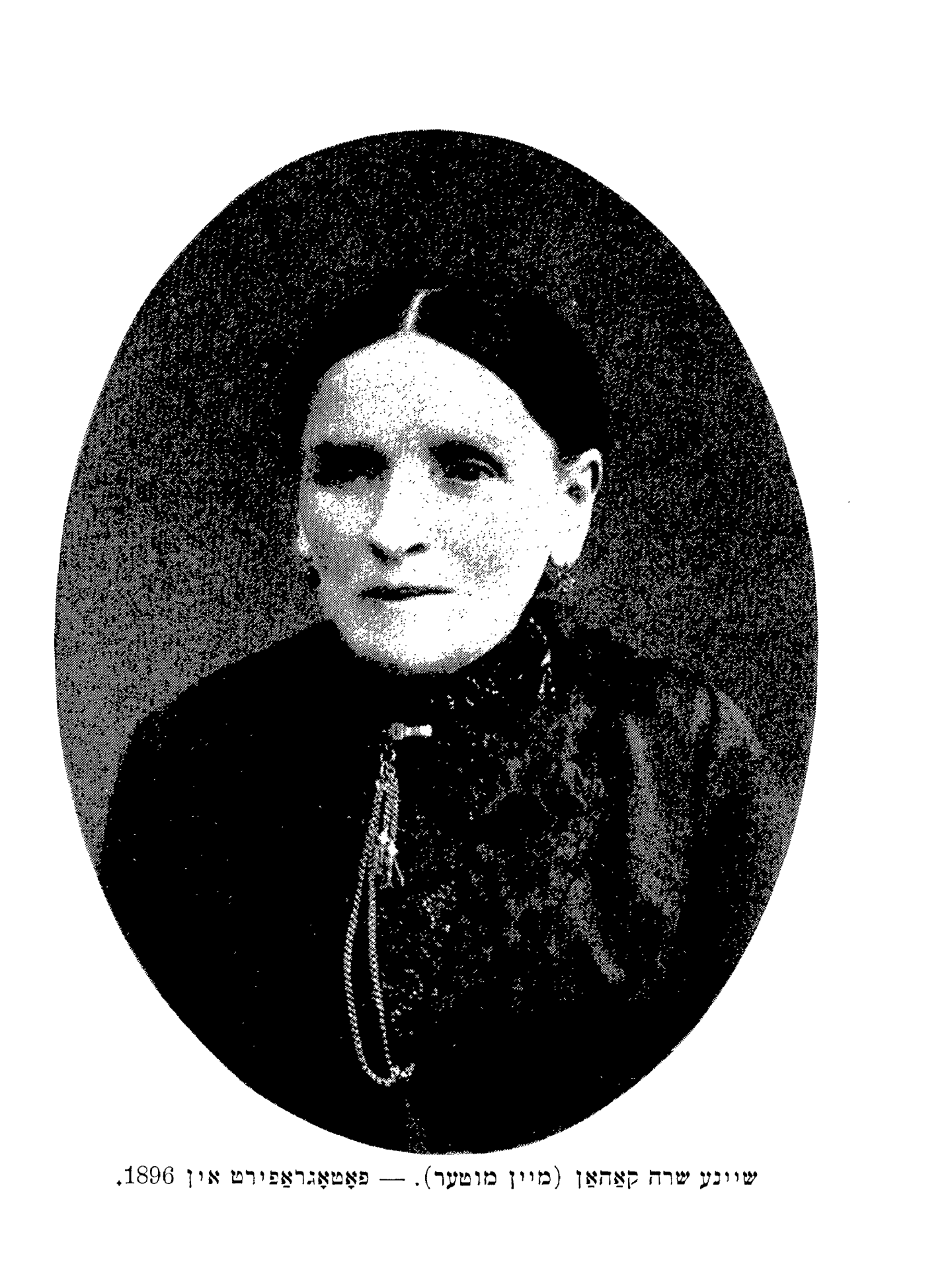
In the original: a plate at p. 138
From her wedding there also remained to her a pair of earrings — many tiny diamond stones laid out in figures and set in silver. From time to time, usually on a holiday, she used to put them on with a matching dress. She had a special little brush for them.
Friday during the day, when I used to come home from cheder, she would send me to buy for three groschen "kvass" (Macassar) oil — a red, thin, scented oil with which she used to anoint her coiffure.
When I was ten or eleven years old, a "chignon" came into fashion — two or three little braids of hair attached behind the coiffure. And she imitated this fashion.
She was pious, but in an easygoing manner. Usually she used to go to shul on Shabbos, with her big "Korben-Minkhe" prayer-book under her arm. And if not, she would daven at home, saying the words quietly, with a serious expression, which to my eyes was full of grace.
Many years later, already long in America, when I used to think of her, she would mostly appear to me in that "holiday prayer-book" guise, with her lips moving with that quiet pious earnestness that was so dear to me.
She could also write Yiddish, and in a good hand. She could write Russian, and German too — a little better than Russian. When she was a girl, her parents sent her to a private school for well-to-do girls, and there they taught her German more than Russian. But they did not teach her much. Her 140former teacher I often saw on the street — a tall, slender old man, in a worn hat and a straw hat. His name was Shrayber. My mother used to speak of him with a tender respect.
Her father, Shloyme the gold-worker, had a white beard, and otherwise I never saw him. He was a passementerie-maker (shmukler), and when my mother's mother was alive, he — more correctly, she — ran a business. He was a quite ordinary Jew. He could not learn, although he liked to play the role of a householder-scholar. In the Hasidim kloyz (the famous kloyz of the Vilna Gaon), where he had a "seat," directly opposite the holy ark, he and other old folk used to sit at a "shiur" (study session) every morning after davening. My father used to say that he doesn't understand the Gemara and falls asleep over it, and I knew that it was true; but my mother used to grow angry at this, and that anger of hers used to be endearing to me.
Besides my aunt Feyge, my mother had a sister — a younger one — by the name of Mere, a beautiful one, with clever black eyes, and a brother, the above-mentioned Chaim-Leib, who now lives in Petersburg. When I was about twelve years old, Mere got married. She took a Vilna young man, who also lived in Petersburg.
One of the scenes that had for me then a sensational significance was the one that took place when the young couple departed for Petersburg. The whole family went to the train station to see them off. But me they left behind in cheder (at Yeshaye Baltermantser's). I, however, ran off alone to the station. The gendarme who stood at the door would not let me 141in. So I stood and wept, until someone took me in.
My mother, her two sisters and her brother, Chaim-Leib, were children of one father and one mother. Their mother had long been dead, and their father was married to a second wife, who was called Malke. With her he had a son, Hertske, a boy three or four years older than me.
Hertske used to tell me many lies. He tried, for example, to convince me that he belongs to a secret society in which he is a general. Once, when he was walking with me across the street, a soldier passed by, twisting his lips, like someone whistling with his mouth.
— He's giving me "chest" (honor) — Hertske explained to me — that is the sign of our society.
I understood that it was neither here nor there. But I kept silent; and, as with all his other lies, I always pretended that I really believe what he tells me. I was afraid of losing his company.
About his "society" he used to tell me some improper things. This was at a time when I had barely begun to understand such matters. These tales of his I did not like to hear. But out of fear of showing that I am still a little boy, I used to listen and keep silent.
Hertske had befriended Gavrielke — a relative of mine on my father's side, who worked at a trade in the same court (Kaminski's), and who was a good bit older than him; they used to 142both "fib" to me (bluff, tell lies). Gavrielke was already a grown lad, and among the "society-folk" of the city he really played a role.
There were certain working-girls who had more or less intimate relations with them. About these secrets Hertske used to tell me, adding five improper lies to one decent truth.
The "society-folk" had their secret language. For almost every "underworld" thing they had a disguised name or sign. These words and signals Gavrielke and Hertske taught me. This meant that they were preparing me to become a "yat" and then a full "society-man." For that they used to wheedle money out of me and teach me how one steals from my father's table-drawer.
Once a working-girl passed through Kaminski's court. Gavrielke began to smile at her and made some of the improper signs.
— A curse on both your hands! — she answered back angrily.
— Do you know what that means in society-language? — Hertske interpreted her words to me — she is telling him where they should meet, in the Zakret woods.
After Mere's departure, the attachment between the two remaining sisters grew ever greater. When a day would pass and they had not seen each other, one of them would come running to the other. My aunt's house was always my house, just like the home of my parents. I literally had two homes at once. Not only was my aunt like a mother to me, but 145her husband, the noble uncle Mikhl, was like a devoted father to me. Their two little girls, Rivele and Khavele, I loved very much. I then had no sisters or brothers, and they were like real sisters to me. Khavele was born when I was studying at Khatskel's, and I used to go to them for breakfast. Rivele was then three years old.
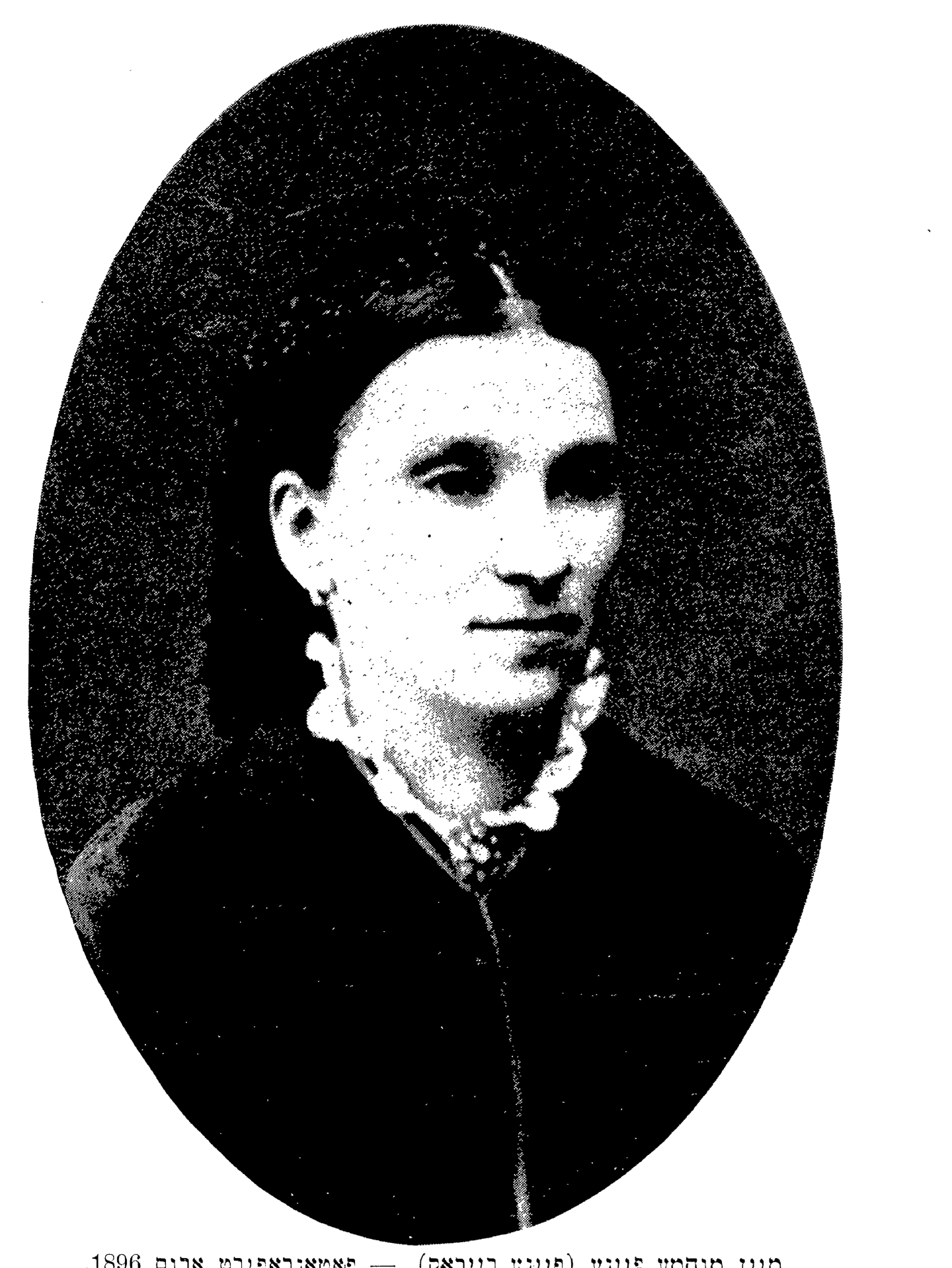
In the original: a plate at p. 144
The uncle used to teach me how to conduct myself. For example: when we were sitting at the table and he asked me for the knife, and I handed him the knife by the blade, he would not take it, and with a smile would wait until I would give it to him by the handle.
When I used to sleep over at their place on Friday nights, on Shabbos morning we would go to daven in the passementerie-makers' little kloyz (on Nitke-Toybes Zavalok). Often he would go strolling with me, and on the way, talking with me about humaneness, would explain to me that one must be both an honest Jew and an honest man.
From my twelfth year on, until I left Vilna — that is, until half a year before I left Russia — Kaminski's court played a role in my life.
These are two courts joined into one. One on Yatkever Street and the second on the "Plats," opposite the city theater. They are linked by a narrow, dark passage. Many used to use them as a through-court to go from Yatkever Street to the "Plats," or the reverse.
146Malke, the grandfather's second wife, died, and the grandfather, who was already an old man, had no one to run his household. Since uncle Mikhl had a huge trade (he had trained a number of workers at his place), it was decided to unite their dwellings and their workshops. As regards the uncle, a religious notion played a great role for him. Earlier, children had "not lasted" with him. And now, that he had two little daughters, he was always uneasy. Lest they too not stay alive with him. Once he became acquainted with a pious Jew, who had a reputation as a kind of "baal-shem." He poured out his heart to him, and the other gave him a piece of advice, a "prescription":
— Change your dwelling. Meshane mokem, meshane mazl (when one changes the place, one changes one's luck).
From the time they moved into Kaminski's court, I spent no less time in that court than at Shabse Zhirmunski's. There was more room there to play and jump. There were also more children there.
We used to play "Hares" (hezelekh). We used to line up in a row, and one of us would count us off with certain words that had no meaning. There were about sixteen or twenty such words, and they went in rhymes. The boy on whom the last word fell was the wolf. The rest were the hares, and the wolf used to chase after them. If he caught someone, that one became the wolf.
The nonsense rhymes with which one counted were of two or three sorts. I remember only the first "verses" of two such "songs":
147"Aynke draynke, drila dru / fiber faber fiber fu."
and
"Sayne zayne / foma zayne / ya ivan / kapitan. / isel zisel / foma zisel."
The last syllable the counter used to draw out and shout aloud. That was the signal. At this syllable the one counted out would run off with a joyful cry, and the wolf would let himself loose to chase after them.
As one of our "sports" one may reckon the walks we used to make to the "smoters" (reviews of soldiers). The smaller smoters (military drills) used to take place at the barracks; the larger ones — at the "New Shops" (Cathedral Square, by the Botanical Garden). And only the big maneuvers — behind the city, far off at Groys Shnipeshok or at Lukeshkes.
In Vilna there then stood the 27th division (a division consisted of four regiments). At that time Russian soldiers wore not flat caps, but "kepi," or "kepes" (from behind the cap was bent outward, and on top it ended with a small round "dno" [bottom]). Below it had a narrow okolyshak (band). And for each regiment of the division the okolyshak had a different color. The first regiment was called "Arkhangelski" and its okolyshak was red. The second — "Troitski" — with a white okolyshak; the third "Ufimski" — with a blue one; and the fourth — "Saratovski" — with a black one. The "pogony" on the shoulders (shoulder-148straps) had for each regiment the same color as the okolyshak. But the number on the pogon was for all the same: "27" — the number of the division. The two little figures remained, for the Vilna boys of those years, engraved in memory as a part of their childhood life.
Red is the favorite color of children, and that was one of the two reasons why the Arkhangelsk regiment was our favorite. The second reason was that it was the first and most important regiment in the division. In our time, its barracks were on the "Little Square," only a few minutes' walk from Kaminski's court, and we used to be visitors there quite often.
There they used to train new recruits and drill a company or a battalion. At the New Shops they used to review a regiment or even a whole division. Then the commanders would already sit on horses, and a military orchestra would play.
The big maneuvers used to take place no more than once a summer, and to them only a few of the boys used to go to watch. The smoters at the "New Shops" were our real "sport." When the soldiers with their rifles passed by, row after row, accompanied by the beautiful trumpets, clarinets, flutes and drums, my heart leapt within me from delight. That was for us both a grand affair and a theater.
We knew the names of all the generals and of some colonels, of all the bandmasters and of several majors. I was quite a scholar in these matters; and if I lacked the name of a general, or some other detail about the four 151regiments of the 27th division, I would not rest until I learned it.
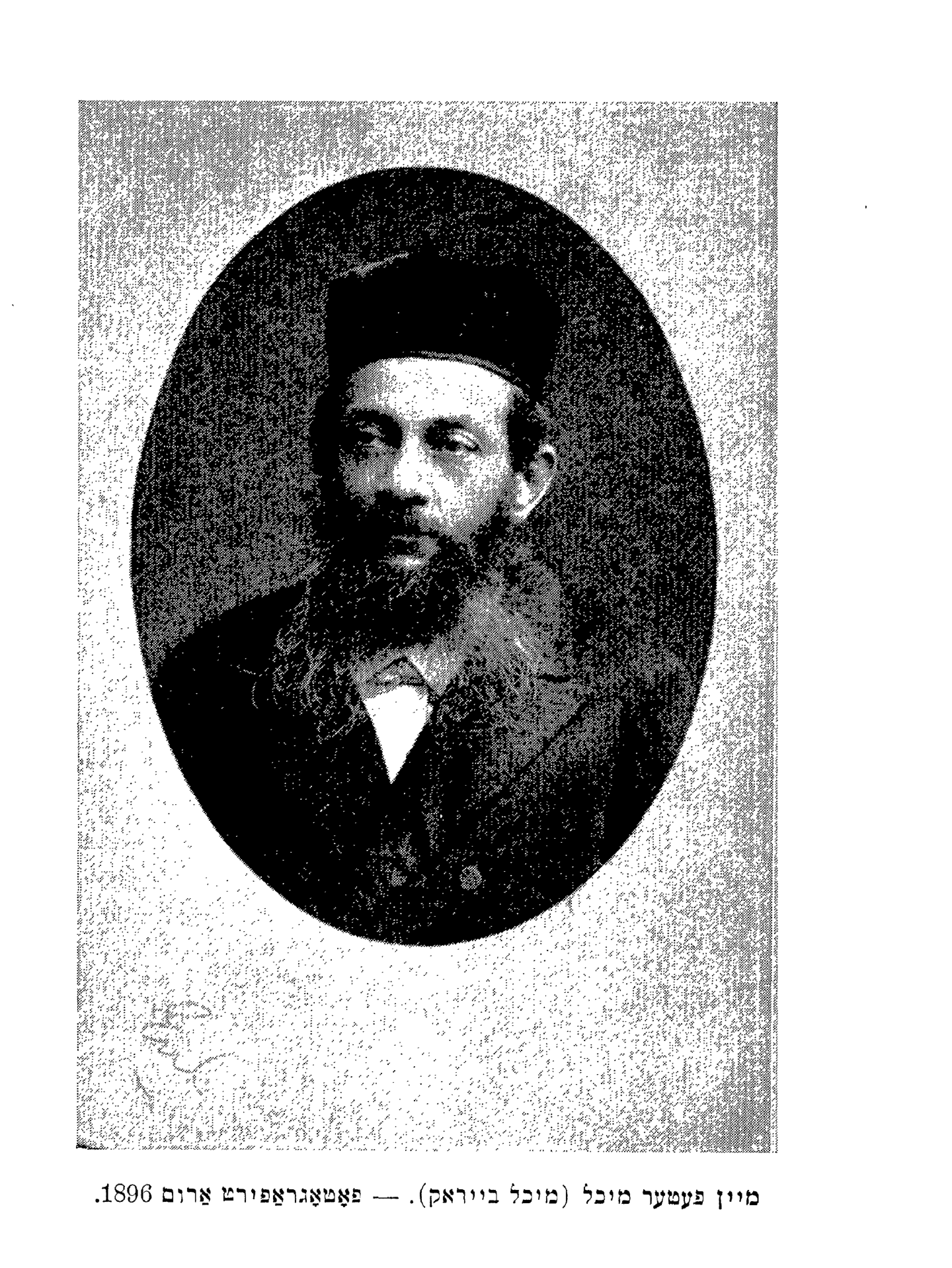
In the original: a plate at p. 150
On the "shul-court" — mainly in the "new" kloyz — there used to gather on Shabbos many Jewish soldiers; so I used to go there specially, in order to get information directly in answer to my questions. For a boy to ask another boy something about military matters, and that one to send him to me — that was a quite ordinary thing.
Only one boy there was who knew these things as well as I, and even better. His name was Natume Khaimse. He always used to hold a child on his arm — his little brother. With the child he used to carry himself around whole days, and with him on his arm he would go to the smoters and even to the maneuvers, as far as the most distant parts of Shnipeshok. We used to wonder how his arm did not give out on him.
Once one of the boys from Kaminski's court made a discovery: a square, by a barracks, where soldiers used to do gymnastics, is empty, and we can climb over the bars there, "swing ourselves" on the "rings," jump over the wooden horses. The square was by Kazimirski Zavalok, near the beginning of Savitser Street. We set off there and began to "work." And from then on we came there quite often.
I was no great gymnast. All I could do was to climb up over a bar, or over a rope. A couple of my friends knew much more than I. I envied them, and so as not to fall behind them, I used to come to that "little place" when nobody knew, and would learn to jump there, or to hang from a high 152bar onto the tips of my feet. No great results, however, did I achieve through this.
The next neighbor to my grandfather was "the Shtraykher" (the dyer), a Jew by the name of Avrom-Dovid Rit, whose occupation consisted of dyeing fur-wares. He had four sons, and the middle two were our friends. They were the nimblest "hares" and the best gymnasts.
With us there also used to play a "sheygets" — the son of the watchman (strazh). But he spoke good Yiddish. His mother kept a teacher for him, and he was preparing himself for the gymnasium — a quite unusual thing for the son of a watchman. His name was Kalikst (Kalye).
My grandfather lived in the court that came out onto Yatkever Street. In the middle stood a pump, one of the best water-sources in Vilna. Dozens of water-carriers used to come here to fill their buckets. And of them alone there was a whole fair. My grandfather lived in a basement dwelling, exactly opposite the pump. So I used to, toward evening, and when I was free from cheder, often stand and look at the water-carriers, how they come with empty buckets, and one after the other go up to the pump and pump; and how afterward they go away, each with a load of water — light, firm and calm, as if the "yoke" with the full buckets were a part of his body.
Friday afternoon there also used to come dozens of poor people for alms. Them, too, I loved to look at. They used to come in singly or in companies-153wise. In every house people used to prepare for them, toward evening, groschens or "half" groschens (half-groschens) already made ready. I knew all the poor folk of them all, and the water-carriers and all the poor people in the city — all from my private observations in Kaminski's court.
On the other side of the pump, in a basement dwelling, lived and had his workshop "the braznik." In a corner of the court lived Libe the cotton-wool maker, and Layzer the "bottle-maker" (that is, he used to buy up empty old bottles and sell them). In another of the dwellings lived Rokhl "the fur-sewer," Ore "the furrier" and Khaye "the iron-shopkeeper." At the entrance from Yatkever Street was Sere the tavern-keeper's tavern, with the door not on the street, but "in the gateway."
There were other craftsmen and dealers. I am speaking all the while of one of the twin courts. With the other court, the one that comes out onto the "Plats," I was little acquainted. It was like a separate world for me.
The next court to Kaminski's, toward "Daytshe" Street, was the round meat-market, where Christian butchers sold their wares — also two courts in one. There we never used to come in (in 1919, when I visited Vilna after an absence of 38 years, I was there for the first time in my life).
My aunt was friendly with all the women of Kaminski's court. But her closest friend was Sere the tavern-keeper. Sere had four daughters. The eldest, a lovely, charming girl, was more civilized than most of the well-to-do girls of 154her class. She was acquainted with pupils of the rabbiner-shul and she could dance. So people "talked" about her. And when she found herself a bridegroom — a young widower — and he found out what people say about her, he balked. But she pleased him greatly, and he finally went to the khupe. The morning after the wedding, right at dawn, Sere came running to my aunt with joyful news. They embraced and bargained, and for joy they laughed and wept (I had spent that very night at my aunt's and I saw the scene). The good news consisted of the following: it turned out that the tales that people had told, that had been ascribed to the bride, were neither true nor flown — an empty libel. The bridegroom was happy beyond happy.
Avrom-Dovid Shtraykher's eldest son went to the rabbiner-shul. A nephew of my uncle's also went there. They were a good deal older than me, and I envied them both their seniority and the fact that they study. I used to listen to their talk and look at their short little jackets. With ordinary Jews they spoke just as we all did. But it seemed to me that their language was nevertheless not the same as ours — it is both Jewish and goyish.
My grandfather had a machine for manufacturing trimming-cord for officers' caps. It was an 155iron table, in which lay four or six pulling wheels. One used to turn a handle, as on a barrel-organ, and from that the wheels would turn. Above, on top of the table, stood "soldatel" (little soldiers). When the wheels came into motion, the "little soldiers" would "march" in a certain manner, and since around each of them was wound a silken, silver or golden thread, through their "march" a coarse cord would be woven around with beautiful threads.
High up, over the table with the "little soldiers," was fastened a large spool, around which the finished cord used to wind. For this, however, it was necessary that the spool, too, should turn. For this purpose one had a device that might date from before Moses' times: at the end of the same spool was wound a stout cord, and to its edge was attached a ten-pound weight. The weight pulled the cord toward the ground, and this force slowly turned the spool around. But the weight gradually lowered itself, and when it reached the floor, one had to lift it, stand on a chair, wind the cord around the spool again and attach the weight to the cord again.
I loved to turn the wheels of the machine and watch how the "soldiers" "march." And the operation with the weight and the cord I went through dozens of times.
So my grandfather's machine ran for many years. Once a mechanic noticed it, who had taken a position at the Vilna telegraph "station" — a young German with a professorial face, with spectacles over a pair of short-sighted eyes, with a pointed yellow little beard and with a telegraph-cap that he always wore 156on one side. He looked at the machine and gave a smile. The result was that he attached to it an "endless" leather cord, and through this the movement of the pulling wheels automatically drove the spool, too. The weight, with the labor that it required, became superfluous. And the whole story cost only ten rubles.
I could not stop marveling — not so much at the mechanic's wit, as at the fact that such a simple thing had not occurred to anyone's mind.
My uncle and my mother were also enchanted.
— A German! A German! — my uncle exclaimed many times with enthusiasm.
The sense of it was that from a German one can expect the greatest wonders. Who walked on a rope? Who showed in the circus unbelievable tricks with horses? All Germans!!
Around that same time the first sewing-machines arrived in Vilna. The city snatched them up. A new trade appeared: "stitching" (shteperay). He who took to buying a Singer machine and working on it made a fine livelihood. Furriers, tailors, quilt-makers brought him work. People scrambled so that he could only take so much.
Many parents gave their boys away to stitchers to learn the "golden" trade. One of them was my mother's stepbrother Hershel, and he used to tell me the wonders of the "stitch-machine."
For long, however, it did not remain a golden trade. In about a few years there were already too many stitchers; and many furriers, tailors and seamstresses 157took their own stitch-machines, or small hand-machines for sewing.
After Passover, when I was already close to bar-mitzvah, my father gave me away to the Plashtshadke yeshiva.
"Plashtshadke" was then the name of the short little street that goes from the "Horse-Market" (the present Halelem) up to a hill that stood almost straight like a wall. Above, on the hill, runs a beautiful broad Vokzal (station) street. The station is only a few minutes' walk from there. But the hill blocked it off, with the beautiful street, with everything. By the very hill was a small fenced-in square, which served as a kind of ox-market, and next to it stood a little kloyz. Right in this little kloyz was the yeshiva.
Over the hill led steps — about fifteen or eighteen. But through Daytsh's court, which is right nearby, one could go up without steps. And yet the said hill was a wall between two completely different worlds. Above drove carriages, walked fashionably-dressed people. The street there was broad, well-paved, tidy; and on both sides stood graceful trees. A short stretch from there stood the beautiful, almost new wall of the station, with a free square in front. And opposite the station stretched meadows and gardens. Below, again, on Plashtshadke and on the "Horse-Market," one saw only mud and peasant wagons, payes-Jews, Jewish villagers, wagon-drivers and peasants. The Plashtshadke mud-158holes had a reputation. In Russian people called the alley so: "Gryazni pereulok" (the Blatiner Zavoulok, the muddy lane). And on it moved villagers, Christian and Jewish, who came into town with their wares, and town Jewish dealers of the old cut — sellers, buyers, brokers, luftmenshn of all sorts. On Plashtshadke and around the Horse-Market were several inns, each with the name of the town whose inhabitants used to stop at it.
Above, on the hill, was the Europe of the nineteenth century. Below it smelled of the Middle Ages.
The Plashtshadke rosh-yeshiva was called R' Elye Oytshe. He was a tall, healthy one, grown like an oak, with hair and a beard black as a beetle and hard as wire; and with hair of the same color and hardness his ever-bristling chest was overgrown. He gave two shiurim — a "smaller" and a "bigger." When he was not studying with his pupils, he used to study alone or converse, or pace about slowly, half asleep. From time to time he would stop at the "shulkhan" (table), crack his fingers on it, and again take to walking.
He was almost always in the kloyz. People said that he takes a drink. Drunk, however, I never saw him. He often smiled; sometimes good-naturedly, sometimes with an angry irony. Favoring a boy, he would sometimes give him a "shtorkh" (poke) with a half-joking abusive word, or "drit-halbn petsh" (two and a half slaps), that is, give three slaps and "take out a pinch in change." Sitting at the shiur, and explaining a deep matter, 159he used to "crack" his fingers on the table, or poke the nearest pupil with his iron-hard finger. His brain worked slowly; but with a superficial p'shat (plain meaning) he was not satisfied. He searched after depth. It did not come to him easily. But he used to get to the bottom of it. Certain matters he used to treat with such "kharifus" (sharpness) that scholars used to come specially to hear how he explains them to his pupils. Wherever there was a commentary on such a matter, and wherever he heard of an interpretation that someone had given on it, he did not rest until he learned about it with all the details, with every little twist.
"He has a heavy head; but he has a hard-working one without limit, and he is a deeply-grounded learned man, a lamdan and a charif" —
approximately so a householder-scholar once said about him in my presence, one of the Plashtshadke dealers, who used to come often into R' Elye Oytshe's kloyz.
When I consider him today, I feel that the dealer's appraisal was not entirely correct. Elye Oytshe's brain was surely a sharp one. His protracted "grounding," a deep one — but it did not work nimbly. By "over-willing" one can perhaps become a lamdan, but not a charif.
The difference between a Gemara-cheder and a yeshiva consisted in this, that a cheder-boy could not "read" (read through by himself a new piece of Gemara and understand its p'shat), whereas a yeshiva-bokher could "read."
Yet some of the new boys in R' Elye Oytshe's smaller shiur were also not yet adept at "reading." And if such pupils could 160pay eight rubles extra a term, the rosh-yeshiva would give them special hours each day, and prepare them for the next day's shiur. My father bargained with him to take me into the special group. But on the very first day R' Elye Oytshe ascertained that I can already "read" on my own, and despite the eight rubles he thereby lost, he told me to tell my father that I "can" manage my place on my own.
A fine young little bokher from a town called Kalielishok, Ashmiener district, and me — he considered us the best pupils of his smaller shiur. He seated us next to himself: the Kalielishker on one side and me on the other. I happened to sit between the rebbe and the big brass menorah that stood by the wall. When he used to immerse himself in a piece of "kharifus," and his brain "stirred" like a bear, his hands would be busy with us. He pulled us and shoved us toward himself, pushed, tore — as if that would ease the birth of the thought with which his brain was going hard into labor. To him we were like the keys of a piano that a composer torments, striving to bring out the musical idea that entangles itself in his brain.
Often he would give me such a shove toward the menorah that I would see the seventh heaven. To prevent this, I used to move myself closer to the menorah on my own. But that didn't help either, because he would give me a pull toward himself and then with his iron hand a shove back.
But after all, for me this was a small matter. The earnestness of his learning, his glowing in-161terest in the matter, and that sharp, deep logic of his, used to give me a high degree of pleasure. He used to intoxicate me with intellectual delight. None of my cheder melamdim had such an effect on me.
Elye Oytshe's dwelling was right by the kloyz. A little hallway, in the form of a quite narrow barrel, was the only partition between them. Together with the dwelling was a food-shop, and the shopkeeper was Elye Oytshe's wife, a beautiful, well-grown, not very tidy little woman.
At the shop or in the kloyz itself one used to see several times a day a dark, charming Jewish woman of about forty years, with small black eyes and a clever, restrained but sympathetic smile. Her name was Rokhl-Royzl. She was a pious one, a "baal-mitzvah-nitse" (doer of good deeds), and — as far as I then took an interest to know — she concerned herself for the "poor bokherim," getting "days" (meals) and money for them. She herself drew her livelihood from peddling. Of the money she collected, she spent not a penny on herself. The bokherim she served like a faithful, strict mother, and at R' Elye Oytshe's she was a kind of minister.
Almost every afternoon, when we were all sitting and studying, "reading" the next day's shiur, she would come in, with a big key in hand, watch how we sway over the Gemoras and listen to our Gemara-voices.
Her favorite was a tall bokher who sat at a "shtender" (lectern) in a corner. He studied literally without cease. Mostly he would not sit, but stand. Stand, shout in a hoarse voice, and 162slap at the Gemara. His face had at that a vivid expression. He was the greatest masmid (diligent one) in the yeshiva.
I studied with enthusiasm and davened with enthusiasm. That was the time of my highest religious fervor. With magidim (preachers), mainly with mussar-preachers, I was then literally aflame.
Strashun's little kloyz, where my father and I mostly davened (except on Rosh Hashanah and Yom Kippur), was too small for a minyan. Quite nearby, on Great-Stefan Street, was a larger kloyz — Epshteyn's — and there every Shabbos the "Novogoroder" magid used to "say." He used to expound little interpretations over the sedra. His sermons contained little mussar. Yet I used to go to hear him often.
More mussar and more fire had the preaching of the "Antokoler"* — a little Jew with a small beard. I used to go to hear him every time he appeared in the city. Once, on an Elul evening, I heard him in R' Shoulke's kloyz, right opposite Romm's house, where there was a yeshiva — Baltermantser's cheder. His sermon was a chain of interpretations, woven through with hot religious imagination. His words, and mainly his peculiar melody, had on me an indescribable effect. My heart melted with piety and with fear. I thought about the former 163stall-keeper woman and the two kopecks that I remained owing her. The place where, a year ago, she kept her stall, was nearby, near R' Shoulke's kloyz…
* Novogorod and Antokol are two suburbs of Vilna. Today they are already, in fact, parts of the city.
Soon it will be Yom Kippur. Sins between man and God can then be forgiven. But sins that one commits against a person — not. Those can only be forgiven by the one against whom one has sinned. So how can I find the former stall-keeper woman, pay her the debt, and beg her to forgive me?
The magid's melody whipped me like a lash, and I listened, swallowing his words and swallowing my tears.
Afterward I repeated the whole sermon with enthusiasm for my father and for a couple of my friends. In R' Shoulke's kloyz good magidim used to come "say" quite often, and I heard them all. The Days of Awe season was a magidim-fair. People preached mussar in full kloyzn. And in that year, of which I speak here, I did not miss a single magid. If I did not hear one in one kloyz, I caught him in another.
In R' Shoulke's kloyz I once, on a midweek afternoon, heard from him the great R' Yisroel Salanter; the famous mussarnik, however, I did not understand. My memory-image of him represents a little Jew with a beautiful reddish face, with a round gray beard, not a tall one, with broad shoulders. I remember his voice, mainly, how it rang at the end, when he closed with the words "Khadesh yomeynu k'kedem!" Whether the congregation sang the said words after him, as he used to demand — that I do not remember.
The then Vilna town-magid was a 164slim old man with a white beard, a great lamdan, a quiet person. Him, too, I understood little; but that was because of his accent. He was from Dubno (the famous "Dubner Magid" had long been dead), and his Volhynian Yiddish sounded to me almost like a foreign tongue.
Good magidim one could also hear in Zovel's shul, the greatest religious center of the Federmark district. There I became acquainted with the preaching of both "Slutskers," two brothers, who were then famous over all Lithuania. One of them was a cripple, and when he used to begin preaching at a new place, he would introduce himself to the public with the following words: "You have heard of Mount Hazeisim (the Mount of Olives), you have heard of Mount Grizim (Gerizim), now you will hear from Mount Harbol" (so Russian Jews used to pronounce the Russian word "gorb" — a hunchback). His brother was a handsome Jew, and somewhat modern. The "Harbol," however, I remember better. Though of the two sermons that I heard from him, nothing remained with me either.
In Zovel's shul Chaim Rumshesker was active. "Say" he used to in the shul proper. But once a week he used to study with a group of artisans and other simple people, and that he used to do in a side room, where one davened during the week.
Chaim Rumshesker was the most interesting figure among all the magidim that I ever heard. Unfortunately, I came to understand and appreciate him only 165years later, and when I could no longer hear or see him. He was a folk-person, and I believe that out of him could have developed a tal-ented belletrist, for he had imaginative power and humor too. His parables were color-rich realistic pictures, and his interpretations and explanations — often very witty — contained many sayings and witticisms, which had more bearing on daily life than on dead tomes. Everything with him was in the form of little scenes that he took from the surrounding world.
I recall, for example, how he gave a parable about a wagon-driver's servant, a coarse lad. The servant makes an unpleasant noise, and the refined wagon-driver cannot bear it. With that he painted such a living picture that I saw them both, as if before my eyes.
— He walks with his big, coarse boots. Klap! Klap! Klap! — he acted out.
The "Klap! Klap! Klap!" he uttered slowly, loud and theatrically. It rang through the whole shul, and at the same time he indicated, with his hands and with his eyes and with a special sharpness in the pronunciation, how the servant strides with his coarse boots.
The parable had in it a piece of humor, and the public laughed aloud. Unfortunately, I do not remember in what the joke consisted.
Eyes Chaim Rumshesker had big, protruding ones. And when he used to depict something, he would so set them that they gave the little scene a wondrous power.
Among the masses he was very popular. Scholars, however, looked down on him from above. "Badkhn" (jester) they used to call him. Nevertheless they used to go hear his sermons.
166Sometimes he would permit himself an expression or even a whole parable that his critics used to hold to be indecent. I remember, for example, how he explained the difference between a "kept-woman" and a wedded wife, and how my father afterward spoke of it with disgust.
He was a tall one, and in the tall top-hat that he always wore, he looked, in my eyes, like a giant. He had a great name, but not like other famous magidim. He was a separate personality, and his fame had a separate character.
The famous Kelmer Magid hypnotized me, but to my regret I had no more than one occasion to hear him. In Vilna he was not a frequent guest, and the sermon that I heard from him was the last one that he delivered on that visit of his. That was in a shul or kloyz near the Green Bridge, it seems. And the entrance-price was three kopecks. I remember well his famous melody and the flaming character of the mussar-attacks that he made on the hearts of religious listeners. I remember the hysteria, from religious bewilderment to terror. The content, however, of his words I unfortunately do not remember. Nor do I have a fully clear picture of his outward appearance: a broad-boned one, with a black beard, not a big one, with grey, not pretty eyes in a broad, not pretty face. So he has remained in my memory. But I am not sure that he really looked so.
It seemed to me that his appearance would have suited better a wagon-driver — just as his faith-fire and 167his mussar-wrath would be a separated, separately-hovering thing.
It came near to my bar-mitzvah, and I had to take to preparing a drasha (sermon). Usually it is the rebbe with whom one studies who prepares the boy. But a rosh-yeshiva does not occupy himself with such things. So the work was taken on by my former rebbe, Yeshaye Baltermantser, with whom I had studied three years.
There is some book — big as a Gemara — from which all such sermons are drawn. So, R' Yeshaye took from there a bar-mitzvah pilpul for me. It naturally dealt with laying tefillin, and it was a weave of interpretations over a Gemara with commentaries; but all that I remember of the sermon is the name "Shaagas Aryeh" and the number 37. It began with a piece from a "daf lamed-zayin (folio 37)" in one of those tractates that one does not study in any cheder and rarely in a yeshiva — "Zevakhim," it seems. R' Yeshaye went over it with me a couple of times. Afterward I repeated it alone several times, until I knew the sermon by heart.
I also prepared myself to read the haftora in shul — the haftora of the Shabbos of my bar-mitzvah. For this I needed no help.
The Shabbos came. The ceremony was held in Strashun's little kloyz — in the above-mentioned Strashun's court, which stood almost opposite Zhirmunski's court. I remember my father's "Borukh shepetarani" and what he said to me when we 168walked home from davening, together with several Jews whom he had invited to the celebration; he told me to take it to heart that from now on I am already a Jew in my own right, no longer a little boy, but a full person!
The celebration took place in our tavern. Since it was Shabbos, the street-door was shut, and no outside people came in. To the big table, which stood by the red sleeping-bench, they added the smaller table. A crowd of a few dozen people gathered: relatives, neighbors, good friends. Yeshaye Baltermantser was, naturally, among the invited. Elye Oytshe — not. Perhaps my father was not closely enough acquainted with him to invite him. Among the guests was also my father's former rebbe.
I delivered my sermon: people gave me the usual compliments; people drank, took a bite, chatted, said Torah, made jokes at my expense, and I became a bar-mitzvah boy.
It seemed to me that what had been until now was one thing, and what was to come is a completely different matter. I am a completely different person.
The next winter a brother was born to me — with my mother's red hair and with her beautiful face. It was on a Thursday evening, for I remember how my mother kneaded the challah for Shabbos, with an expression of stifled pain. Soon the midwife came.
169Another sign that it was Thursday night: as soon as they showed me my little brother, I ran off from home to the "mishmor" (night vigil) that I used to study every Thursday night. The mishmor was in the "Hasidim minyen" (the kloyz of the Vilna Gaon), where many boys used to spend every night studying and frolicking. It was a dark winter night. I remember how I went through "the Yatkes" — not went, but ran. Let the other boys see that I do not skip the mishmor.
When the midwife showed me my red-haired little brother, she said to me:
— Here you have a little brother! Now you are already cheaper. You are no longer an only son!
The same I heard afterward many times. Everyone, man and woman, who came in to give a mazel-tov and take a look at the new mother with the newborn child, informed me that I have nothing now to be proud of; that I had become cheaper.
My brother, however, was a good guest with me. I fell in love with him at once. I caressed him, prattled and sang to him. Since he did not yet have a name, the first week I called him "Brother." Said words of love to him and sang: "Brother, brother, brother!"
They gave him the name Yitskhok, after R' Itsikel Sirvinter, a rabbi with whom my father had studied in his bokher years, and for whom he had a special respect.
That January — 1874 — there came into force the new "ustav" (law) about military service. Previously the kahal of each city or town 170had to supply a fixed number of recruits, and the government did not care how they got them. A rich man bought himself off with money, or used to put another in his place. According to the new law, however, every 21-year-old male had to present himself for the "prizyv" (draft). And buying oneself off, or putting another in one's place, was no longer possible. There were "lgotes" (special exemptions), for an only son, for example.
At the prizyv each one drew a number, and the candidates were examined and reviewed in order, from number one on. So it was possible that the prizyv officials would assign a large number of soldiers before it came to a given number, and all candidates whose numbers were higher would remain free.
About the new "ustav" people did not stop talking. One also often heard the words "new stamp/system" (sistema), and Jews mixed up the word "sistem" with the word "ustav." Everywhere people talked about the new "stamp" or the "new staff." Every family that had a son was anxious. He who could only read Russian had work to read and translate the new "stamp." And such "knowers" were then not many.
In the Plashtshadke yeshiva I was the only one who could "read Russian well." Once, when I came to the shiur, Elye Oytshe says to me:
— I am actually waiting for you. Can you really read Russian? On the contrary, show what you can do! Here is the new stamp. Here, read and tell me what it says here!
He handed me into my hand the new "ustav."
Before I took to reading, he sent out to summon several of the neighbors. Besides the yeshiva bokherim, there 171thus gathered a crowd of older people.
— See to it that you translate well. Don't fool yourself and don't fool the crowd, — he said with his smile, — otherwise you really won't get away with it with me.
I began to read and translate. They were convoluted phrases. A few places I myself did not understand, but mostly the older listeners, from a single word that I translated, understood a whole sentence, and they helped me out. In sum, it went smoothly. R' Elye Oytshe gave me a murderous pinch on the cheek and a shove in the side. That was his compliment for my success.