Chapter Seven
In the Vilna Teachers' Institute
264The tsarist government wished to perpetuate the memory of Muravyov, the governor-general of Vilna. So it erected to him a "pamyatnik" (monument). This was after he had strangled, with gallows, the Polish uprising of 1863. His gallows had stood in the suburb of Lukishki, and the monument was built on the road from there to the great Cathedral Square.
The monument was in the form of a gilt-ornamented little chapel, without a figure.*
Around it they laid out lawns with flower-beds and planted rows of trees. There came out a small park or square with a glittering little structure in the middle.
When the lawns were covered with grass and the trees with leaves; and when the flowers had bloomed, and the sun mirrored itself in the gilded ornaments, the square was very beautiful. In spring and summer people would come there to breathe the pleasant air, though 265a large crowd was never seen there, and Jews almost none at all. From the densely settled streets the square was too far, and densely settled were only Jewish streets.
* Later, when I was no longer in Vilna, they put up to him a larger monument, in another place.
People used to stroll around the monument. But its bloody meaning few ever knew.
Ordinary Jews used to call the square by an old name of their own: "Borekh the scribe's place." Among educated Jews or Christians it was called "by the pamyatnik." With the official name — Georgievsky Square — the public was little acquainted.
Perhaps one in a thousand had any notion that the sparkling little church was a gravestone for Muravyov. And the younger generation did not even know that there had once been a Muravyov in the world.
Muravyov's memory the pamyatnik did not perpetuate.
Past the square run two streets, which cross each other here. One of them is the road that goes from Lukishki to Cathedral Square. The second leads to the Viliya with its green bank. Dwellings, opposite the square, were not on them then. On the one that leads to the river stood a large, low building with few windows.
By the other two sides of the square no streets passed. There were several buildings with sidewalks, and narrow paved lanes for droshkies or wagons. But not many droshkies 266or wagons were seen here. For the most part it was quiet.
The two sidewalks came together, like a "daled," in a corner with no passage, and in this corner stood, also like a "daled," two "blind" walls, without windows and without gates. From above, a pair of tree-branches hung over them. This was the only closed corner of the square. The other three corners were open, and they came out onto the streets mentioned.
The neighborhood is among the most beautiful in Vilna. The Viliya flows not far from there. The green bank is no more than three or four minutes' walk from the "circus." And from the square to Cathedral Square runs the Georgievsky Prospekt, which in my time consisted of two beautiful avenues without any dwellings.
On one of the two quiet sides of the square stood three buildings. In the middle one was the Jewish Teachers' Institute. There I spent four years.
The other two buildings were also educational establishments. One a priests' seminary; the other — the Vilna Realschule. To the seminary belonged the two "blind" walls of the closed corner. The entrance was on another street. The seminarians and their teachers were not seen here. And though I lived in the adjoining courtyard for four years, I never even knew where the gate to the seminary came out and what sort of world was there.
Usually I would take an interest in everything, look at everything and examine it. This mysterious building, however, never stirred my curiosity. I did not even 267know how one got into it. Did not know, and was not curious to know. I was not even sure that it was really a seminary. All I knew for certain was that the establishment had to do with young priests, finished or future.
Quite different was the Realschule. It had its entrance by the square, like our institute. From nine till three there used to swarm and burrow about boys dressed as "realisty," and a certain number of them were Jewish children. It was for us an open world and nearer to the heart as well. It interested me, and what went on in it I knew in many details.
When you went inside the middle gate, you had before you a large paved courtyard; and the first thing that caught your eye was a very, very high pole, at the top with two little iron rings, from which hung four long ropes. This was a swing of a kind — a part of the gymnastics apparatus. The little iron rings could move freely, and with them the ropes. Four pupils would sit down, and each holding on to his rope, they would run apart and, with a leap, let themselves fly through the air, around and around the pole. When the momentum had weakened and the ropes had come down, they would run apart again and again carry themselves off into the air. "Gymnastic steps," this was called.
The courtyard was aristocratically tidy, and the air here was far better than in the middle of town. One breathed with the breath of the planted square. Spring here smelled of orchard and field and of the nearness of the river. When you had come in from the square, you 268saw in the courtyard several buildings: one large and five small. The large building stood at the right hand of the "gymnastic steps." There the pupils studied, ate, slept, lived.
The first room in this building, on its lower story (ground floor), right as you came in from the courtyard, was the gymnastics hall. Here you saw poles, ropes, ladders, swings, a leather-covered wooden horse, and other such apparatus. Gymnastics was regarded as an important part of the institute's training. The future Jewish teachers were to be "humanized" physically as well as spiritually, made healthier and nimbler. So ran the official explanations of the ministry of education when the institute was founded.
On the same story, but toward the square, was the dining hall. Usually the gymnastics lesson came before the meal. It would close with a prescribed march around and around the gymnastics hall. And from there — to dinner. We would march in, line up around the tables, each at his place, sing the "Hamoytsi" (blessing over bread) in Russian in chorus, and set to eating.
Broad stairs led from the gymnastics apparatus to the next story, where one studied. A handsome corridor with four white doors of four classrooms. The floor here too was dark red, always freshly waxed, always glossy. By each of the white doors stood an étagère in the form of a large stand, light brown below and black-polished above, with a shine like a mirror. On one side the corridor had windows to the courtyard. On its other side, by the wall, stood glass cabinets. And when I arrived, there lay books and instruments 269used in studying physics and chemistry. A little later they brought new, larger cabinets. The books were carried off to another place, and into the cabinets they put instruments and figures, ordered from Petersburg, a mass of "specimens" (obraztchiki) of minerals, anatomical models, several plaster heads, busts, maps, and so on. The short wall, at the end of the corridor, was hung with a large geographical map.
And when I saw the corridor for the first time, its shine, its official pride and its scholarly air simply overawed me.
Here the pupils used to walk to and fro, learning their lessons, chatting, debating, longing.
In the evening, when one prepared the next day's lesson, or in the morning, between one lesson and the next, it used to hum here like a beehive.
Here and in the classrooms the pupils mostly went in their weekday costumes, cheap gray cardboard-stiff jackets, with trousers of the same cloth. The jacket hooked up at the top by the neck, and the trousers did not button as usual, but at the sides, with a single button on one side. For studying, and chiefly for doing gymnastics, these costumes were comfortable.
The teachers in the institute always went in their official frock-coats and waistcoats of blue cloth with brass buttons stamped with eagles. This was the "uniform" of teachers and other officials who served in the education department throughout all Russia.
By the entrance to the corridor, up a few little steps, was the "uchitelskaya" — a room for the teachers. There they spent the time between lessons, and there the teachers' council held its sessions.
270When the bell rang for a lesson, the teachers would appear in the corridor with large lean "journals" under their arms. The contrast between their glittering coats and white shirt-fronts, on the one hand, and the gray cardboard jackets of the pupils, on the other, was sharp and striking.
And when the bell sounded, the pupils would scatter, each to his classroom.
There stood rows of "skameykes" (school desks) and a little table for the teacher. The desks were short, for two pupils to a bench, and they were of the same sort as in the gymnasia and Realschules: painted, black on top and brown on the sides, like the high étagères in the corridor. The top board opened, so that it should be easy for the pupil to sit down or to stand up.
And when the teacher came into class, the pupils would fling the desks open and rise to their feet, all at once, then sit back down and shut the desks with a military precision.
On the walls of the classrooms hung large charts — geographical, historical-geographical, zoological, anatomical — and in front stood a large blackboard.
The windows of the first three classes came out onto the beautiful square, opposite the gold-ornamented monument. In May the pupils here would see how spring comes, how the lawns are covered with fresh grass and the trees with leaves and acacia-blossoms. The windows of the fourth class came out onto the courtyard.
On a narrow extension of the corridor was the "aktovy" hall, the largest and most beautiful room in the institute. There the examinations took place and 271all prescribed ceremonies. And there they used to teach us singing. The floor was a parquet. In the middle of the principal wall hung a large portrait of Alexander the Second. There stood a fine long table, with a green cloth, a large mirror-shining piano, and several rows of chairs.
The bedrooms and a room with taps and a long copper trough for washing were on the next story.
There was also a chemistry and physics laboratory, a library, and a "prayer-room," with a reader's desk and an Ark of the Law, where on the Sabbath one would supposedly pray, with one of the pupils in the role of a cantor.
In a farther part of the building was the bolnitsa (hospital).
There was no bathhouse in the institute. There was one bathtub, a copper one, but only for the sick, and it stood by the hospital. Bathtubs were then in Vilna altogether a great rarity. Once in two weeks they would take us to a bathhouse, like soldiers.
When I arrived at the institute, the nachalnoye uchilishche, where the pupils of the fourth class practiced as teachers, was in a separate courtyard, joined by a narrow passage to the large courtyard. Later, however, they moved it into the main building. There was room enough.
The square was about twenty minutes' walk from the Jewish streets. Its character, however, and the character of the surrounding district, made it feel as though it were quite far from there. Therefore, when a pupil went anywhere, people would say that he was going "into town."
272"Into town" they used to let us go on Friday night and Saturday. Then the institute-boys would dress up in costumes of black cloth. The coat had a waist-seam and two buttons at the back, and the trousers buttoned in the usual way. In winter they wore overcoats of a thick black cloth. The cap was of the same cloth as the Sabbath costume — a broad, black one, with a shiny visor. Chinovniks (officials) used to wear such caps.
The pupils were given underwear — a shirt and drawers of genuine but coarse linen. Dress shirts or stiff collars they were not given. Those they bought themselves (if they had the means). Usually they bought only collars, which they would fasten to the government-issue unstarched undershirt. Mostly they would put these on only when they were dressed up in the Sabbath costumes. The whole week, when they wore the cardboard garments, they would let the shapeless collar of the undershirt stick out of the jacket. The government-issue neckcloth was of black satin, in the same fashion as the neck-cloths of officers in the army: a band around the neck and a little apron in front to hide the topmost bit of undershirt. To a dress shirt with a shirt-front it did not go. But a dress shirt only a quite small number of the institute-boys could afford, and those would by then buy "civilian" neckties as well.
The board was not bad, better than most of the pupils had at their parents'. Meat was given every day, and the portions were not small. Very often they gave roast beef. For many of the pupils this was an aristocratic dish, chiefly for those from the smaller towns. The poor 273Jewish housewife of those days could cook a piece of meat, but not roast it.
The food was perhaps not varied enough, and people used to complain that it had grown tiresome. But that anyone complained about the eating itself, I do not remember.
Breakfast consisted of a braided roll (without butter) with a glass of sweet tea. What was given for supper I do not remember.
At twelve o'clock, at the time of the great "peremena" (recess), they gave us large slabs of bread with butter, which we used to order with salt. We used to eat it with great appetite, and as we chewed we would go over the next lesson.
The sleeping-quarters too were not bad: iron beds with good mattresses, and coverlets with sheets of the same white cloth as the underwear — genuine linen, though coarse-ish. The blankets were woolen, and to them were sewn with large stitches white sheets, which were changed every week together with the under-sheets and the little coverlets. Everything was absolutely clean. I do not know whether any of the pupils had at home such a tidy and healthy bed.
When I arrived, in the first class there were twenty-one pupils; in the second — fourteen; in the third still fewer, and in the fourth fewer still. In the year when I finished (1881) there were in all the classes fifty-three.
Teachers there were twelve. In this are counted: the teachers of gymnastics, of penmanship, of drawing, and of singing. There were two teachers of Hebrew 274subjects, and they were naturally Jews (they "rendered" and explained everything, however, in Russian). The teacher of singing too was a Jew, but he held himself almost for a Christian.
There were two "nadziratels" (overseers, monitors), who were day and night with the pupils, twelve hours each, and both of them were Russians.
The "ekonom" (manager of the housekeeping) had to be a Jew, because the kitchen was kosher and in the ordering of the institute's life one had to take the Sabbaths and festivals into account.
The servants, except for the cook, were Christians.
The pupils were not allowed to speak any Yiddish among themselves — strictly Russian. When a couple of them were caught speaking their mother-tongue, they were threatened with punishment.
Those who had somewhere to stay overnight "in town" could leave on Friday toward evening for the whole twenty-four hours. Saturday night they had to come back.
A little later they introduced a still stricter system. Each pupil had a "bilet" — a little book in which the nadziratels recorded how he had studied and behaved in the course of the week. If he did not have good "otmetkes" (marks), they held back his bilet on Friday, and he could not go out. This meant that he was, for Friday night and Saturday, "under arrest."
When I was in my last year, they began to let the pupils out for an hour every day as well. The director had observed that the confinement and 275monotony of their life was not good for their health and spirits. The bilet system, however, he did not abolish.
The first three years of my life in the institute, then, one was not let out the whole week long. In the first days after my arrival, this and the iron discipline weighed on me altogether very heavily.
I was in the seventh heaven at the thought that I was at last an institute-boy; that the handsome corridor, the magnificent aktovy hall, the great dining hall — that all this was "mine." I was filled with the fact that I marched together with those institute-boys whom I used to envy so; that I ate with them, sang with them, had the same teachers as they. But at the same time there lay on my heart an oppressive burden. I felt like a recruit in the barracks. I longed for home.
And had any of the teachers taken an interest, said to me a friendly word, it would have been different. But the teachers held themselves toward us as officers toward soldiers.
The first year, the most unpleasant moods in me were called forth by the teacher of Russian and history. Orlovsky he was called — a very tall figure, with a thin blond little beard, who suffered constantly from catarrh. He wore the newest and best frock-coat, and his gold watch and gold little chain looked finer and costlier than the watches and chains of the other teachers. The fact that every minute he had to use his handkerchief did not spoil the impression he made as a handsome man and a dandy.
We, however, held him for a bad and a cunning man. He never shouted at a pupil; but when one did not answer him as one ought, he would 276lower his eyes sadly, and then we already knew that in the "journal" there would stand a bad "otmetke."
The first time he called on me, I did not please him. Perhaps it only seemed so to me. In any case I grew nervous. I got stuck and could not bring the answer out.
— Sadityes!* — he said in a mournful voice, lowering his eyes.
The pupils who sat by the teacher's little table told me afterward how he set me a "2."
I was sure he hated me because I was cross-eyed. And I took it to heart.
The teacher of arithmetic was then a man not tall, with a large black beard and large black brows. His name was a French one — Marel. A pronunciation he had that was correct, but somehow as if already over-correct. His sharp "r's" rang out like those of a foreigner who has learned well to pronounce the words in the genuine-Russian way, and over-salts it a little.
He had a peculiar gait with peculiar mannerisms. He would set his eyes with the large brows as if in anger, and every word he would call out with a cross precision. When the pupil came up to the board and took the bit of chalk, he would tell him to begin the sum "only from the top and right at the very edge of the board." These words he never left out, and he always uttered them with a comic air of severity. After the lesson we used to mimic it.
* "Sit down."
277We held him for a strict man, and we were afraid of him. In my heart I felt that he was not at all bad. Yet in the general picture of strangeness and severity his manners were a natural part.
A friendly word, as from a father, I heard only from a teacher named Lefin — a hale blond Russian (katsap) with merry blue eyes. He taught us geography and natural science. We thought little of his learning. We believed he had memorized the lessons by rote and knew only what stood in his little book. But we admired the language he brought into his speech. And we held him for a good, likable man.
But even he never spoke with a pupil as with his equal. He would sometimes joke with us; but he did it as a man speaking to another world.
It happened just so that on the fourth or fifth day after my arrival the pupils were taken to the bathhouse. This was always for them an occasion to slip off "into town" for a couple of hours. To the bathhouse one went late in the afternoon, so afterward they would go off somewhere and come to the institute at eight o'clock, for supper.
Since my aunt's dwelling was nearer than Mother's, I let my mother know that she should be there that evening. It was a meeting as if we had not seen each other for a couple of years. My mother kissed me with tears in her eyes. Her joy and pride in me were mingled with the longing she had felt for me those few days.
Then she began to make jokes. She and the aunt be-278gan to question me about what one eats in the institute, how one sleeps, what sort of friends I have, how the institute tailor had taken my measurements for my two costumes.
In certain things I was, at seventeen, still quite a child. I began to boast of the grandeur of the institute. I do not know why, but more than anything I boasted of the piano. Perhaps it was because pianos were owned only by rich families.
I remember the words I said on that occasion:
— I have, after all, seen some pianofortes already; but such a pianoforte I have never yet seen.
Afterward I took it to heart, why I had said it. Where had I seen so many pianofortes? Perhaps I had heard from some window how one plays on such an instrument. A piano I had seen only when it was carried into some rich dwelling, or the one time when I went to learn singing at Nathanson's, the music teacher. Mother and the aunt knew this very well. In their hearts they were surely mocking my foolish bragging.
Every time I recalled my words "I have, after all, seen some pianofortes already," I would eat my heart out.
When I had grown accustomed to the institute life, I no longer longed for home. But for the Friday night with the Sabbath I always waited with impatience. I would literally count the days with their hours.
The first year I spent in the institute, the director was the above-mentioned Gvozda. He was a Latvian, I think. In any case he spoke Russian not like a genuine Russian.
279We used to mimic his Russian. More than anything we used to laugh at how he shouted at a pupil — "Nye gretsya u pechki!" (Don't warm yourself at the stove!). He held this for unhealthy, and when he saw someone at one of the white tile stoves that stood in the corridor or in the classrooms, he would call out these words with a stern air.
In the first class Gvozda had appointed the best pupil as our "tsenzor" (monitor). His role as eldest the boy overdid. Once, seeing one of us warm himself at the stove, he called out to him "Nye gretsya u pechki!" in Gvozda's stern pronunciation, and all.
From then on we gave him the nickname "Nye gretsya u pechki!", mocking how he aped the director.
After Gvozda there came as director a genuine Russian named Katelnikov, and he remained in the post until I finished, and for several years afterward as well.
This was a forceful and interesting personality; though, as far as we boys could understand, not a likable one.
In a school like the institute, or a gymnasium, the pupils receive a systematic education, as it is called. They are taught with a certain system, according to a fixed program, and not as a boy learns who develops 280without a teacher, reading whatever turns up, without a plan and without measure. And to receive a systematic education is indeed very important. The question, however, is on what kind of system it is founded.
Since then pedagogy has made progress. In the world of education there is even today enough stupidity, superstition and falseness; but in those years, and especially in the Russia of that time, all this existed to a far greater degree.
Russia's educational system was copied from Germany; and to all the German faults the tsarist government added special Russian defects of those times. The German system was permeated with a barracks-spirit. But in the German barracks there was far more culture than in the Russian.
The tsarist empire was a land of chinovniks, and those who served in the "Ministry of Popular Education" were made into such chinovniks as the officials of the other departments. By this we mean not only that the teacher strove to "earn" advancement through submissiveness to his superiors; we mean also that in the classroom itself he came to represent the spirit of the tsarist rule.
There were exceptions — likable, honest teachers, who did their best to lead their pupils on the road to light and to progress. But, first, they were no more than exceptions; and second, they were powerless against the prevailing system.
In the institute one taught just as one then taught in all the gymnasia and Realschules. The teachers were mostly of the same cut (they had finished university, each in the special subjects in which he afterward gave instruction). And often a 281teacher from a gymnasium came to us, or the reverse. The teachers' little books were the same, and the manner — the same.
For the most part the pupils "crammed" (zuberevet) — learned word for word by heart. To recite a lesson in one's own words — that was rarely done. Like a machine the pupil would learn the words into himself, and like a machine, like a phonograph, he would render them back out when the teacher called on him.
There were even enough of those who would cram a lesson in mathematics, and when you tried to change the order of the words, or to turn the drawing around (in geometry), they could no longer budge from the spot. With regard to a subject like history, the cramming was the rule; and those who took into themselves the sense, the inner content of an event, and reckoned it over in their own way — such were a rare exception.
The teacher naturally saw this, but it did not trouble him. Most teachers simply demanded this "cramming." They did not put it into words; but when someone recounted the lesson in an independent way, and not in a machine way, they showed displeasure. They often found fault, and a pupil might know the lesson excellently, yet receive no high "otmetke" from them.
It is a fact that most teachers had themselves "crammed" the lessons too. They tried to conceal it. But it was not hard to notice. Usually they would "cram" from a different little book, not the one the pupils used. It often happened, though, that the pupils caught the source from which the teachers drew their learning. There were teachers who would 282rewrite the lesson in their own phrases, and "cram" those phrases. And every year one would hear from them the same expressions with the same words. A teacher of history, for example, did not interest himself in history. He was not well-read in the subject. He had no broad concept of it. And on his lesson he looked as on a "sluzhba"-duty. More than what stood in the little book he himself hardly knew. The schoolbook was for him the only signpost and guide. If the boy said it exactly as it stood there, the teacher was sure it was good. If he used other words, the teacher already lost his feeling of certainty.
But there was yet another cause as well. The tsarist government hated young people who had thoughts of their own. To it that smelled of "kramola," that is, of revolution, of the "new ideas" that had then spread in the Russian universities. "Don't dare to think! Do as everyone does! Walk the beaten path!" — that was the rule; and when a pupil showed an inclination to think independently, he was regarded with suspicion. When a pupil did not hold strictly to the words of the government-issue little book, and showed an understanding of his own, it made a bad impression.
None of the teachers said this aloud. But such was the prevailing spirit. To have thoughts, ideas of one's own, to walk a new path at all, already meant "kramola."
The inspector of the Vilna gymnasium at that time forbade his pupils to wear collars with bent-down points. This already was for him a "new path." Characteristic is the fact that these points he used 283to call "ideas." "Aha! a collar with ideas!" he would say, and he would threaten to take a little scissors and cut the "ideas" off.
Had the schoolbooks been composed with sense, it would have been but half a misfortune. But that is precisely what they lacked. We will take here the schoolwork of that time on history as an example. The same could be said of other subjects — of geography, natural science, and so on, with such an exception as mathematics.
In the seventies and eighties, in all Russian schools there went Ilovaisky's history books: his "General History," "Russian History," "Ancient History," "Medieval History," "Modern History." These little books we studied.
A couple of them came by chance into my hands some thirty-odd years later, and I was astonished. Of the lackeyish spirit with which they were permeated I do not speak here. Even from a lackeyish standpoint they make no sense either. For the pupil it was absolutely impossible to make out any meaning. The most important historical event was honored with a few lines, which gave him no concept of it. In the next few lines there was already a matter of another event or situation, and so on. The historical facts were strung together like dry "little headings" of chapters.
When a boy reads history and finds in it a meaning, he takes pleasure. There is no more interesting subject. In a textbook one cannot, of course, go into details; but one can tell a historical event quite briefly, and yet make it interesting. One need only give the pupil the possibility of understanding it. But the way Ilovaisky wrote history, it was 284dry and senseless and worse than tedious. His language was good, fine even; but with it he only befuddled the pupil's brain. No savor did it put into the lines.
Page upon page was taken up with words about clashes between reigns, about wars and again about wars. No picture before the eyes and no clear concept in the mind could the pupil obtain — neither of the period in question, nor of its people, nor of the truly interesting things that happened among them; not even of the reigns with the wars, over which Ilovaisky had toiled.
In the institute there were a few pupils who had a good memory and simply good abilities, and they would learn Ilovaisky's pages easily and remember them. Sense, however, they found in them none.
Pupils with a poor memory and without understanding would manage such lessons too. They only needed to take in more. What with one took half an hour would take with another two or three hours. The result, however, was the same. And to the teacher too it was all one — so long as one knew the lesson by heart.
One of the "best" pupils in the institute, in my time, was a famous "tupitsa" ("thick head"). It often happens that such a pupil has precisely a bright memory. To him, however, nature had not given that either. The learning by heart used to come to him very hard. He would march about the corridor and gather the words like noodles; and so striding to and fro, to and fro, he would cram until he knew the lesson by heart.
There were a few truly capable lads, who had a good memory too. With them one could have accomplished a great deal, 285but not through such books as Ilovaisky's, and not with such a system as the one that prevailed with us.
Today there exist some schoolbooks on history that give the pupil a clear general concept of the subject, and they are interesting to read. They give him an excellent picture of one or another historical period. He pictures it to himself; he understands it. He lives himself into it. Such a book one studies with pleasure and with real benefit.
And a good teacher does not content himself even with that. Besides the schoolbook, he points the pupils to books where they can read about the subject more fully. Such books are for the boy as interesting as a novel. One need only know how to interest him in it. And after he has read it through, the teacher has a conversation with him about what he has read. When the learning goes together with the reading, and both take place under the guidance of a sensible guide, then a lesson is not an unpleasant and useless duty, but a source of delight and progress.
In the institute one knew nothing of such a kind of learning, and in this it was no different from the Russian gymnasia or Realschules. The teachers would set the pupils the lessons, as one gives out machine-work, and the next day they would only see whether the pupils had fulfilled their duty. That is all.
No closer relations between them existed. And beyond the lesson they took no interest in their pupils' learning.
But to dismiss all our teachers with the same rule one cannot either. There were among them exceptions: Katelnikov, the director, who taught mathematics in the upper two classes; Steinberg, the inspector, 286who taught grammar and the Bible (Tanakh) in all classes; and Lavrov, the teacher of natural science (zoology, botany, mineralogy) and physics, and a little physiology and chemistry.
Katelnikov, the director, ran the institute with an iron hand, and he was a "loyal subject." "Ideas" of a political character built no nest in his brain. But he was by nature a man of independent character and an independent way of thinking and acting; and this showed itself in his work as a teacher and as the author of a textbook.
As a teacher of geometry I believe he was one of the best in Russia. In such a subject one cannot, as a teacher, accomplish much that is new. Everything follows strict logic, and a strict logic is but one. Yet the same truth one can express in various ways. With various means one can make it clear to oneself, and Katelnikov used to do this in his own way, with original means of his own. Into a geometric proof he would breathe, as it were, a new soul. So it used to seem to me.
When we had already finished the whole of geometry and began to go over everything again from the beginning, he did not proceed steadily from start to finish, as before, but divided the whole subject into sections according to such a plan that this itself created a new clarity; it made the subject for us still clearer and more interesting than before.
287I was enchanted. I knew geometry well and loved it. Yet it seemed to me that only now was I beginning to understand it truly.
The textbook he had printed was on mechanics, a subject taught neither with us nor in the gymnasia, but only in the Realschules (in the highest class), and the little book was recognized as the best schoolwork on the subject. It was used throughout all Russia, and I used to see how realisty from the next courtyard came in to Katelnikov to buy the book.
He had an active, restless nature, which constantly drove him to new plans, to new undertakings. And he did not conduct himself as all men of his station did. For example: he never wore a top hat, only a cap — the official cap, with the cockade of the education department — like a plain little chinovnik. Also he never wore a frock-coat; always a uniform. Simply — because a cap and a uniform are more comfortable. The uniform he liked to button up entirely, and then he would often thrust his hands into his bosom. A top hat and a frock-coat were more elegant, more dandyish; but in such things he took no interest, unless he had to go to the theater or perhaps to an important banquet; and then he would put on a black frock-coat with a bared white shirt-front.
He absolutely never carried an umbrella. Not even in the heaviest rain. He had no patience for it.
A temperament he had a fiery one; and a character a masterful one. He was tall, slender, with a powerful, lithe figure, with an interesting dark face of regular features, 288which pointed to a strong will and nervous energy.
I said above that we held him for not a likable man. But what did we know about him, and what did we know of human characters at all?
When I now recall Katelnikov, it grieves me that I never met anyone who could have given me details of his nature and of his life. That he was no three-for-a-groschen shallowness — of that I am convinced.
Yehoshua Steinberg, our inspector, is known as the author of a grammar, as a philological scholar, and also as a writer. In the Hebrew world of the seventies and eighties he was one of the prominent figures.
Today's Hebraists have gone in the philological explanation of the language far further than he. Specialists in this subject tell me, for example, that Steinberg did not know Arabic, and without it a thorough acquaintance with the origin of Hebrew words and with the history of how the tongue developed is impossible. So it is accepted among the philologists of our time. Of his various explanations they say today that they are antiquated, behind the times.
Forty or fifty years ago, however, Yehoshua Steinberg represented the most important and best that had then been accomplished in the said subject, and his grammar was reckoned the last word of this science.
His grammar then existed only in the Russian original, and he taught it to us with thorough-289ness and with love. He also taught us Isaiah — all in Russian — also from a work of his own, a printed one. And these little lessons of his too were distinguished by depth and by a warm interest on his part.
Teaching with us, he would always make changes in his own work, and we would add them to his printed lines.
His every lesson was full of explanations, chiefly philological; but also such as belong to history, geography, or natural science.
He was an important teacher — too important, really. His proper place was in a university. He was by nature altogether more a scholar than a teacher.
The truth, however, is that had he been the ablest pedagogue in the world, his work with us would have been fruitless. We took no interest. And that is too mild an expression. We were ashamed of the fact that we had to study it. We attended and dispatched Steinberg's lessons unwillingly.
In my class there was only one exception, one pupil who loved Hebrew, knew the language, and listened to Steinberg's lessons and words with interest.
Steinberg was so absorbed in his philology, and so absent-minded, that it was easy to deceive him. While the pupil recited the lesson before him, he, Steinberg, would keep his shortsighted eyes on his little table, and often not hear at all what the other said. And when he did hear, the pupil would read aloud 290from the printed translation, and Steinberg would think the boy was saying it himself. This used to happen two or three times in every lesson of his.
He used to set us to make translations from Russian into Hebrew. The following would happen: he calls up a pupil, and the boy comes to the table with his translation. Steinberg looks it over, corrects mistakes, makes general improvements, sets an "otmetke" under the translation, and signs his name. The pupil returns to his bench, and Steinberg calls up a second pupil. The second pupil, however, has not prepared a translation. He had hoped he would not be called on at the Hebrew lesson today. What does one do? He grabs the first pupil's notebook and carries to the table the translation Steinberg has just looked over. He holds the notebook so that he covers with his fingers the fresh otmetke with the teacher's signature. So he lays the notebook down, keeping his fingers on the paper all the while. The absent-minded philologist notices nothing. He sets his shortsighted eyes on the lines, taps with one finger on his gray mustache, as was his way, and reads again.
His own changes, made three minutes earlier, he now does not recognize. He makes a couple of new changes; he scolds the pupil for a new mistake; finds on the page an empty spot, sets a new "otmetke," quite different from before, and again signs his name — in another corner of the sheet.
And when I was in the fourth class, Steinberg fell ill in one foot, and lay abed a good while. When he came back to us, he limped a little.
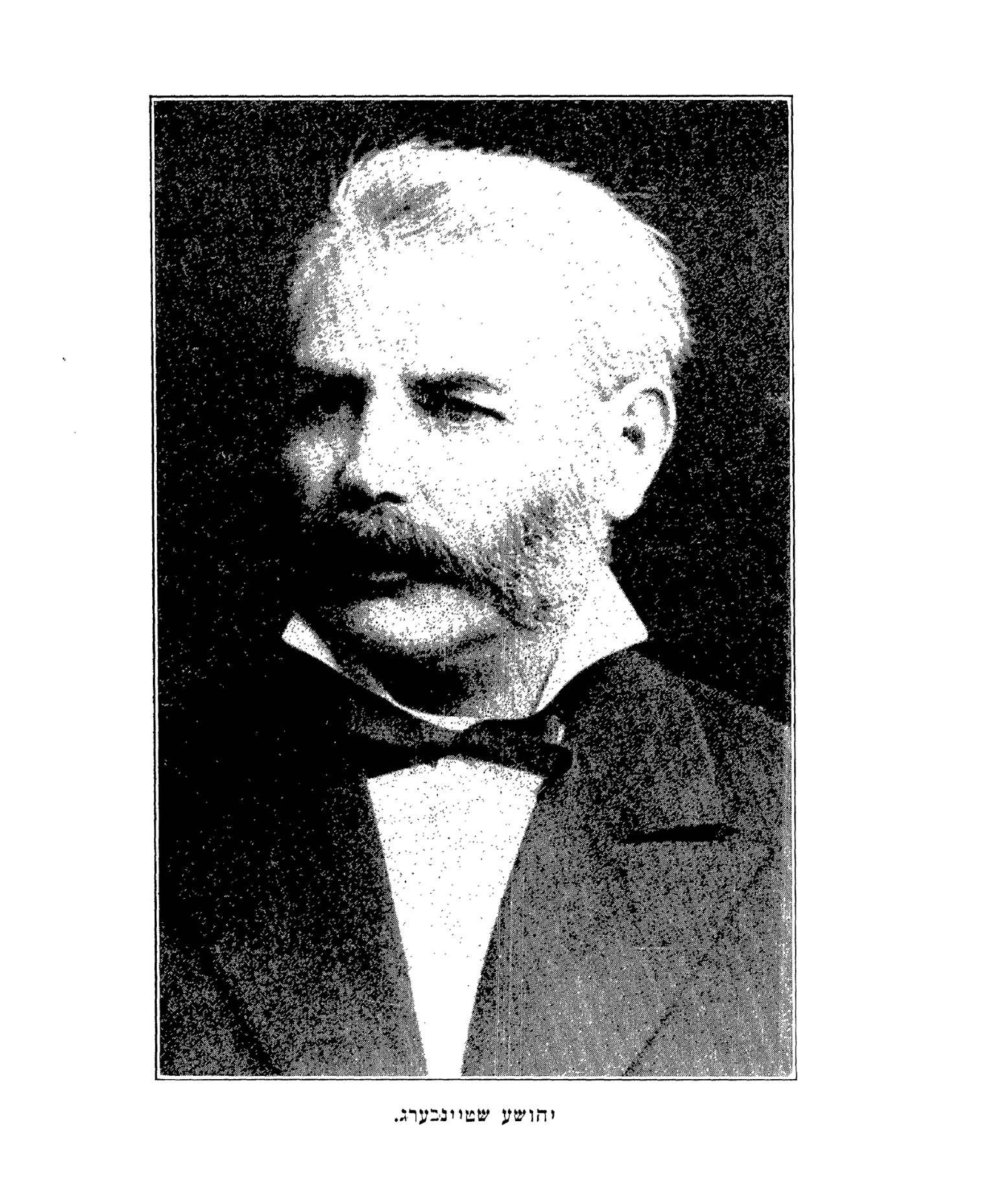
In the original: a plate between pp. 290–291
291Around this time someone in his family died.
Once, when he was in our class, Katelnikov called him out into the corridor. A pupil from another class happened just then to be in the corridor, and overheard the following conversation:
— I have a sad piece of news to tell you — said the director in a jesting tone.
— Of late I have grown so used to sad experiences that grave news can no longer surprise me.
— There has come for you a notice from the Holy Synod that you have been awarded a gift of 500 rubles for your dictionary — the director then explained to him.
The dictionary was from Hebrew into Russian, and it had appeared some months earlier. Since Hebrew is taught in the priests' seminaries and academies, the book was important for the "Synod" (the ministry over the churches).
One of our pupils once received a letter from America. He had a married brother in Boston, and his wife was a native-born American, so to her husband's letter she had added a page in English. We were all convinced that Steinberg knew many languages. About English there was for us no doubt. So the said pupil gave him the Boston letter to read over. We were sure he would convey its contents at once, on the spot. Steinberg, however, put the letter into his pocket and promised to bring the translation the next day. We were greatly disappointed. Did he then 292have to have dictionaries and time to dig out the meaning of a couple dozen English lines?
Among the better teachers I counted Lavrov, the teacher of natural science and physics. He took an interest in his subjects, and taught them to us in the newest ways that then existed. I do not believe he had special abilities in general or as a teacher in particular. Yet in certain respects he brought us great benefit: for example, he took us several times outside the town, showed us certain plants, pointed to their various parts, and gave us to understand everything.
Without such "excursions" botany is a tedious subject. With them he made it, from dead, alive. After every such walk we would for whole days dissect little flowers, examine them, look in the little book, read in other books about the subject. Unfortunately, though, such scientific walks took place only four or five times. The general system of instruction was not adapted to them.
Lavrov had come to us straight from university. And he still looked like a student. Tall, thin, with soft, long, blond hair that fell handsomely from both sides of his head over his forehead. So he too made on us the impression of a radical student. And in truth he was then indeed a bit infected with the "new ideas." He even wrote without the letter "tverdy znak." That letter is quite superfluous, and radical young people had grown used to doing without it. So this was held for a sign of "kramola."
Why this did not harm Lavrov's 293career is a riddle to me. It is very possible that, despite his "radicalism," he was an ordinary chinovnik, and that personally he made on the authorities the impression of a "loyal subject" official. I believe he was a man without character. With the "tverdy znaks," in any case, he soon made his peace.
Unlikable he was not, however. He worked honestly to give us a proper education in his department. With his smile, his general appearance and his manners, he was of the sort that pleases everyone. He had charm with us, and he had charm with the teachers and with the director. This was surely one of the reasons why his harmless "sins" were given no attention.
The greatest number of lessons was given us by a teacher named Dodikin — the teacher of Russian and pedagogy. Under the name "Russian" were counted several subjects connected with the Russian language, such as Slavonic — the mother of Russian — theory of literature, history of Russian literature. All this Dodikin taught us.
On the Russian language itself we were given more hours than on all other subjects — far more than the pupils of the gymnasia or Realschules were given. The aim was "to break our tongue," and to plant in us the ruling language as thoroughly as possible. By the learning by heart they meant to develop our memory. But the special aim in this was to improve our Russian pronunciation.
The whole four years, for instance, we had to 294learn poems by heart. Every day so. Dodikin would take a famous poem of Pushkin's, and every day "set" us a printed page. In this way we learned by heart the whole of "Eugene Onegin," "Poltava," "The Fountain of Bakhchisaray," and countless smaller poems.
This was considered a good means for establishing in us a correct Russian "pronunciation."
The duty of learning poems by heart we all hated; even those who had a good, light memory held it for a burden. And Dodikin was very strict with us. We feared him more than all the other teachers, except Katelnikov, and we used to criticize him constantly among ourselves. About his way of teaching us literature, Slavonic grammar, or pedagogy, we used to mock.
More often than anything he would accuse the pupils of pronouncing certain letters too hard. He used to shout: "Myagche! Myagche!" (Softer! Softer!). And his face would express impatience and anger.
Mostly the pupil did not understand what he meant. A pronunciation is rooted almost from birth. And we feel nothing as to whether we speak hard or soft. Had Dodikin shown us in what the difference consists between the word "chai," for instance, as he pronounces it and as we pronounce it, it would have been easier for us to improve. But that he did not do. He would only shout "Myagche!", and we could not grasp in what his "chai" was softer than ours.
And when we used to talk among ourselves about Dodikin and mock him, we would mimic his "Myagche! Myagche!"
295Yet we learned a great deal from him, and we used to boast that we spoke Russian better than the Jewish gymnasium pupils.
He was dark, with black hair and side-whiskers, with a straight figure and a proud bearing. He wore light-blue eyeglasses, and the dark color of his skin too tended toward a blueness. He was a handsome man of about thirty. In town he had a reputation as a "krasavets" (handsome fellow).
At the same time that he taught with us, he also gave lessons in the girls' gymnasium, and people used to tell that many of his pupils were in love with him. A girl is inclined to fall in love with a teacher of hers (or a priest), even when he is not handsome; but he conquered far more hearts than the other teachers of the girls' gymnasium.
The teacher of history was, after Orlovsky, at first one Turtsevich, a tall, sleepy man. He had a habit of putting his watch into his mouth, and so walking to and fro across the classroom, as if dreaming. We held him for a "good" teacher. That is, he was not a strict one.
He left, and in his place came a teacher named Pravasodovich — a livelier and a stricter man than Turtsevich. He was also of smaller build than Turtsevich, well-fed, blond, with a clever smile on his lively face. He was not an incapable man, but history he taught us in the government-issue manner.
Wohl, the second teacher of Jewish subjects, taught us Jewish history, Psalms, catechism 296(principles of the Jewish religion), the "Guide for the Perplexed" (Moreh Nevukhim) and another work of Maimonides (Rambam) — I no longer remember which.
Often, when I recall him, I also recall Parovasodovich. Wohl had a genuinely Jewish face, with a thick, black beard, whereas Parovasodovich had a Russian, or perhaps a Russian-Polish, face, with light hair and a light little beard. But eyes they both had cunning-clever, and the figures of both were lower than middling and well-fed. Both were no fools, and no dull men; both seemed to be well-read; and yet both taught us in the usual barracks manner.
No printed Jewish history yet existed then in Russian; so Wohl had compiled from German sources a handwritten textbook on the subject.
His "zapiski" (written lessons) we used to copy one from another — that is, among those who studied the same lesson from year to year. Every lesson we would copy out and "cram." And when someone once happened to say a bit in his own words, Wohl would grow angry.
Almost every one of us had his own "zapiski." I was at first one of the exceptions. To copy, to transcribe, is no interesting occupation. So I declined it and put it off.
And when I passed from the second class into the third, in the vacation time, a private pupil of mine offered to do it for me. His name was Halperin, and he was a very likable and interesting boy. I gave him lessons in the free months, and through this we became bound 297to each other. He wrote with large, clear, distinct letters. So I accepted his offer with pleasure. And once I already had my own "zapiski," I set about the matter as one ought (as my nature was in almost everything).
I bought paper at Rodin's shop, went to a bookbinder, and had it bound in a strong, good, handsome binding. Into this book I wrote all of Wohl's "zapiski," not only of the first two classes, but also of the next two.
Of the other subjects Wohl taught us, the Psalms stand most prominently in my memory. We had large, broad Psalters, with the original on one side and the Russian translation on the other. The Psalms he would read out to us, render and explain. To me, however, it used to seem that every chapter was a jumble of words that do not stick to one another.
He kept meaning to print his "zapiski." But he had little energy. Before he could get to it, someone else printed a Jewish history in Russian, and in it made quite broad use of Wohl's "zapiski." That man was a teacher in the Natshalnaye uchilishche, which was connected with our institute. So Wohl complained of him to the director, and the result was a colleagues' court. Wohl pointed out in the printed history whole pages that were taken almost verbatim from his "zapiski."
In his defense the accused explained that he had read the "zapiski," and the indicated passages had probably remained in his memory without his being aware. 298The sessions of the court took place in one of the classrooms. When the judges began their deliberation, Wohl and the accused went out into the corridor. I remember how we watched them walk to and fro, agitated, avoiding coming near one another.
The trial ended as most such trials end: they did not wish to ruin the accused, and they smoothed the matter over with a compromise.
Wohl then finally set to work to prepare his "zapiski" for printing. The book appeared when I was no longer in Russia.
I noticed that Wohl was a well-read man. Often, reciting the lesson for us, he would add interesting details, or make remarks, which his "zapiski" did not contain. This, however, did not prevent him from demanding that we learn his "zapiski" word for word by heart.
Once, in a lesson in which the vessels of the Temple were mentioned, how they were carried in Titus's victory processions, he remarked:
— In Rome there stands to this day the monument set up in honor of Titus's victory, and on it these vessels are engraved. In this way one knows how they looked.
The remark made a deep impression on me. From then on I yearned to be in Rome.
Russian Wohl spoke in a fine literary language, but with a Lithuanian-Jewish pronunciation. And when he heard a Yiddish word from a pupil, he would start as if from pain, exactly as if one had said an indecent thing.
299As second teacher of mathematics, under Katelnikov, was a Russian named Ivan Andreyevich Zyuzyukin (Marel had left when I passed into the second class). In years he was the oldest of all the teachers. He must have been fifty, and perhaps more. Not tall, completely clean-shaven, without mustache, very polite, with a smile on his shaven face, he made the impression of a chinovnik of earlier generations. He used to call forth in us a mixed feeling of love and mockery. And the mockery was partly bound up with the sound of his name, for "Zuzizin" is an echo of "shiker" (drunk).
When he would sit at his little table and look in the journal, and then raise his eyes from the journal, one eye would look much larger than the other.
And when a pupil did not know his lesson, Zuzizin would make such a sad face that we would feel like laughing. His sad face would sometimes smell of a bad "otmetke," but not always.
On the whole one may say that he was a favorite with us.
Once we found out when his birthday was, and we prepared a surprise for him. That day, when he came into class, we stood up and called out in chorus: "We congratulate you on your birthday, Ivan Andreyevich!" From pleasant surprise he turned red as a beet. He bowed this way and that, perhaps ten times. And he remarked with a smile:
— The years do not go backward. Already the 47th birthday.
A year later, the same day, the scene repeated itself. We congratulated him on his birth-300day; he bowed and thanked us. And he said this:
— Yes, the years do not go backward! A year ago I was 46, and today already 47!
Among us there had accumulated a whole jargon of jesting little words and phrases, created out of our institute life, and this remark of Zuzizin's was one of them. When we felt that a pupil was telling a lie, we would call out:
— Yes! A year ago 46 and today already 47!
The teacher of music was the most important figure in the musical world of Vilna. He was the conductor of the orchestra in the Vilna theater, and an intimate at the governor-general's and with the whole Christian aristocracy of the town. The Jewish public could scarcely believe that he had remained a Jew. Russian, however, he spoke badly, and with a strong Jewish accent. And a face he had a genuinely Jewish one.
His name was Eban, and his parents were Kovno Jews.
He was not tall and had a sallow-dark face, black hair and black side-whiskers. Especially handsome he was not. But he dressed himself up so that he was almost taken for a handsome young man.
In high circles he was needed for his music. And a musician too one used to be brought there as a kind of Purim-player. In such a role a Jew is also good. Eban, however, used to carry himself as 301if he had been called there for his own sake, just as if he were a count or a high general.
From the theater and from private concerts he had a fine income, and he lived indeed like a count. What interest he had in teaching Jewish institute-boys to sing, I do not know exactly. It seems to me, though, that the "popechitel" (the head over the educational establishments of the six provinces of which Vilna was the chief town) had asked him to take the post.
In the music lessons the boys of the nachalnoye uchilishche took part together with the pupils of the four classes of the institute. In this way we had a chorus of four kinds of voices: trebles, altos, tenors and basses — together about eighty or ninety singers. Since the pupils of the fourth class were practitioners in the nachalnoye uchilishche, it came about that they learned to sing together with their own pupils.
Eban was an excellent choir-conductor and organizer, and he worked out with us one of the best singing-organizations in the six provinces. As a teacher, however, he had too little patience.
Often, when a pupil took a false note, he would make such grimaces that one could hear it over the whole courtyard. The guilty one he would berate in a comic way. Once, for example, he took to shouting at a pupil of the fourth class: "I'll grab you by your long nose and drag you across the whole hall." And the unfortunate one's pupils from the nachalnoye uchilishche heard it.
At such scenes Eban's comic Russian rang even more comic than usual.
302As a musician he was perhaps too good for us.
He sang with us Russian folk songs and tsarist-patriotic anthems, like "Bozhe Tsarya Khrani," "Kol Slaven," "Slavsya." The melodies are beautiful, chiefly those of the folk songs. Not for nothing did they become popular throughout the whole civilized world.
Only a few times did he make exceptions. Of these there remained in my mind a melody to Lermontov's wonderful poem:
"Across the sky, at midnight, an angel was flying, and a quiet song he sang..."
Eban labored long before he taught our chorus to sing it as he wanted. Chiefly he had trouble with a certain passage, with a half-tone. It all came out shrill; the different voices were hard to sing together. He raged, stormed, made mad scenes, until he finally overcame all the difficulties, and we sang the delicate melody truly beautifully.
In later years, when I would still sing the melody over in my thoughts and recall how he had taught it to us, I felt that he had grasped the poetic words together with the music with an artistic taste.
No Jewish songs were sung with us. Of such things then no one even dreamed. Not only a type like Eban, but even an intelligent Jew who did not fawn on the authorities and did not shun Jews — not he either.
I said that in the musical world of our town Eban was the most important figure. How high he stood in his field in reality, I do not know. He had studied in a conservatory, and he 303was very musical. Of that there can be no doubt.
He had specialized as a violinist; and when an important concert took place for a philanthropic aim, in which the high authorities were interested, he would take part with his violin. Whether his playing had any significance in a larger city, I cannot say. Probably not.
I saw him several times in the Vilna theater. When the boxes and the parterre glittered with military epaulets and buttons, with clear-white shirt-fronts and with low-cut ladies, and he would appear, climb up onto the high conductor's chair, give a stroke with the little baton, and the orchestra would begin to play — it used to seem to me that he was the ruler of Vilna.
The teacher of drawing was my old friend Riazanov, from the drawing-school. His lessons were no more than a ceremony. He would mostly sit down in the pupil's place and draw out for him the whole figure on which the other had been laboring. This meant that he "corrected" his work and showed him how one should draw.
Around him there used to gather usually all the pupils of the class. Sitting and drawing, Riazanov would tell us anecdotes at which we would hold our sides. He also used to tell us about his travels. His descriptions were full of humorous exaggerations. Often he would pepper such a tale with quite indecent details.
Once, at an examination in mathematics, it fell to him to be one of the supervisors. His duty 304was to see that the pupils did not copy from one another; that each should do the work with his own powers. But instead of fulfilling his duty, he himself told the better pupils to help out the weaker ones.
— Quicker! Livelier! — he called to them, whispering the words — the director can come in any minute.
He himself carried little notes from one pupil to another.
For the examinations of the first class each of us had to submit a notebook with drawings. Instead of preparing it myself, I asked my friend Goldblat, the artist, and he drew up for me a couple of things. It was wondrously beautiful, and I handed it to the examiners as my own product. They could not stop admiring it. Riazanov naturally understood that it was not my work. But he made as if not knowing, and helped praise me. I then received the highest "otmetke" for drawing.
The whole four years, at least once a week, there came to us a teacher of penmanship. Calligrapher he was called. He also gave us lessons in geometric drawing, but his chief work was to see that we could teach our future pupils to write. He himself had a wonderful hand. But he held himself for an artist in painting too, and was always dropping hints about the "professors" who had taught him, as if he had finished a high art academy. In truth he had finished a little drawing-school, not an important one. So we always mocked him.
He was tall, slender and thin as a stick. And 305he used to walk importantly, as if he were the most important of all the teachers.
The teacher of gymnastics was a German named Mohr, a former officer of the German army. He held himself with tact, and from time to time would crack a joke. Russian he spoke with a German accent, but without grammatical mistakes. And the accent itself did not sound too sharp either.
His trade he knew well.
The two "nadziratels" who watched over the pupils were one of the innovations the strict and restless Katelnikov had introduced. One of them was named Ruberovsky; the second — Svetavostakov.
Ruberovsky was also the "pismo-voditel," the secretary of the office. He was younger, a bit taller in stature, and far livelier than his colleague. He was a drunkard, but a capable, energetic man. And as often happens with drunkards, he would show his greatest and ablest activity precisely when he was sozzled. He was Katelnikov's favorite, and when drunk he would permit himself to say things for which another would be summarily dismissed. A merry, jolly, interesting fellow.
Svetavostakov looked like a diachok (sexton) of a poor Russian church. A collar and a dress shirt he never wore on his person, and his handkerchief was of a dark-blue color. Mostly he kept his hands behind him, with a pinch of snuff between two fingers of his right hand.
He was an honest, a quiet, a good man — a type of a bygone generation. Though he was old no more than 306forty-odd years. He had studied for the priesthood, and the seminary was as if sealed upon his face, upon his beard, upon his way of dressing, upon his gait, and upon the good, honest smile that often lit up his face.
He used to tell us of his childhood years, and chiefly of his years in the seminary.
Had it depended on him, he would have allowed us all sorts of liberties. But he was a loyal chinovnik, and Katelnikov he feared as one fears fire.
On the whole we suffered no oppressions from the two nadziratels. We loved their company and had friendly feelings toward them.
Tratsky, the ekonom, does not really belong to this chapter. But in speaking of the people who were around us, one cannot pass him over. He was a clever, practical man, and he knew how to get on with capricious superiors, without flattery and without losing his self-respect as a Jew. Us pupils he treated well. We were content with him, and we admired his tact and his sense.
He was a handsome man of about forty, with a thick, round-cropped brown beard, with a clever smile.
He had finished the Vilna rabbinical school, and was an intelligent man. Yet he was quite pious. His house was conducted strictly in the Jewish way, and he prayed every day. But since he was popular with us, we did not mock it.
When I went to the narodnoye uchilishche, he was the "nadziratel" over all schools of this 307sort. He used to record the pupils who had not come for several days, and would visit them, to find out the cause of their absence.
What sort of men were our teachers as men?
When I now put myself this question, I feel that I am unable to answer it. With us they were divided into "good" and "bad," and into such as "know" and such as "know nothing." We were too young and too little developed to have a concept of character.
Besides: what does a boy know of his teacher's life? He sees him only in one role, and that is, to a certain degree, a theater-role.
A teacher in the classroom, before his pupils, does not have his own "I." He is keyed to a certain pitch. He puts on a "pose." His steps are not natural; his voice is not natural; rarely does a teacher hold himself with the pupils absolutely naturally. Less so, of course, when it concerns those times when all around there ruled the spirit of tsarist militarism. For an older man it is altogether not easy to hold himself simply with a boy. Does a mother, then, speak with a little child in her ordinary manner?
The lesson begins. We sit on our benches and wait — some with dread in their hearts, because they have not learned what was set; others with impatience and a wish to be called on and to receive a high "otmetke." The door opens. The teacher appears, in his blue frock-coat with the brass buttons, with his large, thin "journal" under his arm. We spring up, like soldiers, 308and we drop back down, like soldiers. "He" sits down, calls out the names and notes who is absent. At last he calls the first pupil.
If the pupil is not one of his favorites, a cat-and-mouse game begins. The teacher behaves as if he were the pupil's enemy. He wants to catch him not having learned the lesson. And the boy is strained to overcome the danger.
If the pupil is a good pupil, or simply a favorite, he answers freely and merrily, with a tone of confidence. But in a certain sense the scene is all permeated with a theatricality. The good pupil shows off perhaps a little before the other pupils. He puts forward, perhaps, the fact that he stands strong with the teacher. And thereby an unpleasant mood is created among the other pupils.
Everything depends on the character of the teacher, on the character of the pupil, on the character of the other pupils, and on special circumstances perhaps. Absolute simplicity and naturalness exists in a classroom, in any case, rarely.
At home the teacher is quite a different man. When he finds himself in company at an evening somewhere, or when he walks to and fro in his own room, alone with his thoughts and feelings — then he is quite a different being; and then we did not see him; as such we did not know him.
Some of the teachers we loved; toward others we behaved with enmity. Toward some we felt respect; toward others — contempt. But who knows whether our relations to them were 309well-founded? We did not know them, and we did not understand them. And they did not know us, and did not understand us either. They held themselves as though they were a mile away from us.
Educational establishments are usually graded. The universities belong to the highest grade. The gymnasia to the middle, and so on.
The institute officially counted as a "srednye uchebnoye zavedenie" (a middle educational establishment), like a gymnasium. To universities one was not admitted with an institute certificate. But neither was one admitted there with a Realschule certificate. A gymnasium certificate specifically was required. This was chiefly because in the gymnasia one studied Latin and Greek. So in the institute one therefore studied some things not included in the gymnasium course: Hebrew, natural science, pedagogy, and so interesting and instructive a subject as pedagogical anthropology.
In mathematics one went in the gymnasium a bit further than with us. There one studied trigonometry and a little cosmography. But for that, with us one studied geometry and algebra more thoroughly; and in school-education, as a means of developing the logical thinking-faculties, of "sharpening the mind," and at the same 310time disciplining it — for this geometry is enormously important.
The certificate a pupil received when he finished a gymnasium was called (and so it is still called in many lands today) a "certificate of maturity." That is, that one is a complete person, ready to study a profession. But, as already said: the chief difference between a gymnasium and all other middle-schools consisted in this, that in the former one studied Latin and Greek, and in the others not.
I do not agree with those who wave these two ancient languages away with the hand. I believe that for an educational course they are important. On these two languages grew the culture on which our present-day culture is founded. And Latin is, besides, the mother-tongue of several of the present-day civilized languages, and masses of Latin words are used in all civilized languages.
The chief question, however, is, after all, a question of general spiritual development, and not whether the pupil studies precisely this or something else.
What one studies in the elementary and middle schools is a foundation for further development. The school must prepare the pupil for the education he will afterward obtain himself — through reading newspapers, journals, books, and the most important of all books — life itself.
There is an old saying: the task of the school is to "teach the pupil to learn."
Naturally, there are subjects without which an educational course would make no sense. Such are grammar, geography, history, arithmetic, geometry and algebra. Whether one teaches them with a good system 311or with a bad one; whether the teacher understands his trade or not — however badly one may teach these subjects, it is all better than to leave them out altogether. To have no acquaintance with them means absolute ignorance. They are the cornerstone of the foundation. Without them there is nothing to build on.
Later the pupil may forget details of his geography, history, mathematics. But a general concept remains with him always, and of that consists the foundation of his intelligence.
A boy or a girl goes every day to school, where on the walls hang geographical maps. Day in, day out, the eyes have before them a map of Europe, a map of the United States. The child absorbs them into his spirit. And this plays a great role in the educated personality that is later developed in him. He who has never studied geography and never became acquainted with its essentials is, in certain respects, like a blind man.
With reading one can, under certain circumstances, accomplish perhaps more than with learning in school. But that applies to other subjects, to further ones — not to such subjects as those named here.
We take the institute, then, as a place where the pupil was given the foundation of education, the essentials of a training that should prepare him for self-development through reading and life-experience. And as such it certainly stood on the same step as a gymnasium or a Realschule. With regard to the degree of education the pupil obtained, it belonged to the same level.
312I said that officially the institute counted as a middle-school, like a gymnasium. For example: when it came to military service, the government gave the educated young men a certain "lgota," that is, it shortened the time of their service. It depended on what grade of school they had finished; and in this respect an institute certificate had the same force as a gymnasium one. It gave the graduate the same "lgota."
Public opinion, however, held the institute lower than a gymnasium, and socially we too stood lower than the gymnasium pupils. When one of us was acquainted with a gymnasium pupil, he used to boast of it.
A gymnasium pupil was a future doctor or jurist, whereas the institute-boy was condemned to a career as a schoolteacher. And the difference in the "uniforms" played a role in this too: the black castor cloth with black buttons, with the black cap of the institute-boy, could not compare with the glittering uniform with the nickel buttons and the "kepi," with the nickel "emblem" of the gymnasium pupil.
And, after all, when I make the comparison today, I see an important point in favor of the gymnasium pupils even in the question of development. Our barracks-life was a hindrance to our spiritual growth. We were shut off from the world. The gymnasium pupils were free to go about; they saw people. They came far more into contact with reality than we. This was felt in their man-313ners and in their way of speaking. They were "razvyanier" (more developed), more worldly, more daring among people.
313Certain things I remember very well; but figures, names, and dry facts that awaken in me no interest are hard for me to remember. And in a school figures and names play a great role, and it falls to the pupil to study precisely what does not interest him.
I cannot study or read a book that does not please me. At every step I see people who can read through dozens of books to which they are absolutely indifferent, or which even bore them. For that I have no patience. When I begin to read a work and it does not interest me, I must throw it away at once, unless there is a special purpose in my reading, and that purpose itself is interesting: when I have to write a review, for example.
Figures are altogether hard for me to remember. It is also hard for me to occupy myself with them. When I have to add up a column of figures, I fall to musing in the middle and must begin again from the start. For bookkeeping I would be absolutely unfit.
When a subject does interest me, I become absorbed in it. I grow enthusiastic. When a book pleases me, I can hardly tear myself from it. I sit over it till deep in the night. I read it with the deepest attention and notice the smallest detail in it. And I think about it wherever I stand and go.
314Such a book I remember easily and for long. I remember in it details that some readers, who have a far better memory than I, soon forget.
What pertains to understanding, and what has a pictorial character, or what appeals to the dramatic feeling, works on my imaginative power and makes a deep impression on me.
I was born with far more imaginative power than mechanical memory, and with far more temperament than patience. And to have success in a school of the old cut, one needs patience far more than temperament, and mechanical memory far more than imaginative power and understanding.
Of the bad pupils I was never one. I never failed an examination. But of the best in a class I was never one either. With our teachers the main thing was patience and remembering, and with me the main thing was understanding and interest.
In the newest and best works on pedagogy, at the time these lines are written, such a system as the one that prevailed in our institute is sharply criticized and condemned. They condemn the fashion of setting a pupil to learn by heart. It is explained that, instead of bringing benefit, it brings great harm.
"It cripples the thinking-faculty and the imaginative power" — so the best authorities of present-day pedagogy explain. — "It hinders the pupil from developing his spiritual powers. It paralyzes his independence. Instead of accustoming him to rely 315on his own spiritual powers, one accustoms him to rely on 'cramming.' Experience has shown that the old system makes of capable children incapable ones; of clever, thinking children — fools."
The best pedagogues of today point to the fact that an enormous number of the great men of the world, of its geniuses, did not have a good memory. Each of them had other abilities, which are more important than memory. They could orient themselves, grasp and create. And each of them was deeply interested in his field. And because of this enormous interestedness he remembered his special subject too. Interest brings memory — not the reverse.
The teachers of the institute demanded precisely "cramming," demanded precisely that instead of thinking, one should remember.
Just at the time these lines are written, American pedagogues and psychologists are taken up with criticisms against a certain representative of American pedagogy. He represents the mechanical system. He holds precisely of remembering more than of thinking. He believes it gives better, more practical results. With him the main thing is that the pupil should know the bottom line of a sum. The reasoning that leads to this bottom line — that with him is thrown out.
This pedagogical school ruled in America a long time. Now, however, it is under attack. Important books against it have been written in England and in Germany, and the better pedagogues of America are fully in agreement with them.
The old system of our institute mechanized everything, turned it into machine-work. And a boy 316with such a temperament as mine could not endure it.
Against this system my nature protested, revolted. It used to break my mood. I used to feel myself unhappy.
Most of the lessons bored me, but not precisely because the subject itself did not interest me. For there were subjects that could indeed have interested me and which nevertheless bored me. It depended on the way they were taught us and what we were accustomed to in learning.
I will give here a couple of examples.
Geography, while the good Lefin was our teacher, I hated like death. Him I loved, for he was one of the most likable and kindhearted teachers we had. But his subject he gave us in a mechanical manner and often without sense. He used to skip a great deal. Then he would "patch together" what was skipped in such a way that a tangle came out. And in any case one had to "cram" the lesson like a parrot, and for that I had no patience.
Before I came to the institute, when I studied geography myself, I did it of my own will and with my own sense. Then even the cramming was interesting to me. But now the geography lessons were for me like the work a slave receives from the slave-driver.
When we were in the third class, Lefin left us. Then, for a certain time, the genuine Russian geography was taught us by a teacher named Bron-317zev. He happened to be a well-read, developed man — one of the few exceptions we ever had (I did not put him in the list of our better teachers, because he had no regular post in the institute, and in all he was with us only a couple of months). He explained to us the economic relations of various Russian regions, the character of the climate and of the soil, and what relation this has to industry and trade. He made us acquainted with a climatological map.
At first I thought all this was very dry and tedious. But he put into his lessons so much scientific sense, so much juice, that as long as he was with us, it was for me a favorite subject.
While in the fourth class I read through Buckle's famous "History of Civilization in England." I read it with such persistence that more than once I neglected, because of it, to study the lessons for the next day. But to study history, the way Parovasodovich used to set it for us, was for me a thing to be suffered through.
Mathematics I loved, and I was reckoned one of the best mathematicians in the institute. But that pertained to the reasoning of a "zadacha" (problem). Where one had to make a mechanical computation, with a lot of figures, I would lack the patience; and I would fall to musing and get tangled up.
Katelnikov once stopped me in the corridor and said:
— You are a great idler, Cahan! All the teachers say you have excellent abilities, only you have no desire to study. You will study with me, never fear! I will show you how to idle!
318He did not understand me. None of the teachers understood any of the pupils.
The truth is that I was both an idler and a diligent one — it depended on the work I happened to have to do. So I have been all my life. If a thing interests me, I can work literally day and night.
Later, in my independent life, I always had a reputation for untiring activity and industriousness. And my teachers held me for an idler!
There are two kinds of idlers: those who simply have no energy and no working-capacity, and those who have it, but only for work that interests them.
The second kind of idleness is really a natural part of the energetic nature. By an interesting occupation it is electrified, and a non-interesting one has the reverse effect: it repels it. He who can work diligently without an interest in the work is a work-machine, not an energetic man. Such a pupil studies diligently everything one gives him.
The teachers of those times made no such distinction. They divided the pupils into diligent ones (matmidim) and idlers, and when a pupil had no desire for a subject, it was called being an idler. Further questions they did not ask. Questions of temperament, imaginative power, thinking-faculty, questions of character and personality — such things did not exist for them.
In our textbook on pedagogy there was a phrase: "One must keep in mind the child's special 319nature." The phrase occurred in the book so often that we used to mock it. We did not understand its importance. We thought that every time the author did not know what to say — what the educator should do — he wriggled out with the words that it depends on the character of the child, and that therefore one can give no rule. We knew that our teachers did have a rule, namely, that he who has no desire to study is an idler. To consider the special character of this or that pupil — such things never occurred to them at all.
We studied Stoyunin's theory of literature and Yevstafyev's history of Russian literature. This interested me and I studied it with persistence, chiefly Stoyunin's. In later years I convinced myself that the theory Stoyunin expounds has no substance. But then I thought it was correct. And he set it forth so clearly and in such fine language that I was enthusiastic.
Crystallography is a part of mineralogy. It deals with the form of crystals, and how one form passes into another. On this subject much time was spent with us in the second class. It was nonsense, but the subject was interesting to me as gymnastics for the brain. The various forms of the crystals and their changes I would picture to myself as though I had them before my eyes. So I studied these lessons with desire and received high marks.
The "zapiski" on botany I could not endure. But when Lavrov took us into the field, pointed to certain plants and explained how they li-320ve, the subject took on for me quite another flavor. I became strongly interested and immersed myself in a special book about the life of plants. Two other pupils and I got a flowerpot, planted a bean in it, and observed how it sprouts, how it develops.
Later Lavrov taught us botany from a new book. But it was too dry, and too little adapted to our circumstances.
Physics I loved very much, and on every lesson on this subject I read far more than our textbook contained. From the few rubles I used to have giving lessons in vacation time, I bought the famous schoolwork of Ganot (a thick book on physics, translated from the French), and I would often spend on it hours that I should have given to studying the next day's lessons. I could not tear myself away. Every new physical law and "reasoning" I became acquainted with brought me into a remarkable enthusiasm. I would go about as if intoxicated.
Several times experiments in physics were made with us. And then I was happy beyond happy.
Once there came to Vilna a German with a scientific instrument to show various microscopic wonders in a strongly magnified form. In a dark room, on a hanging sheet, he showed, for example, the little creatures found in a drop of water, in a crumb of cheese, and so on. His shows he gave in a hall of the Vilna first gymnasium, and one evening was set aside for the pupils of our institute. So we were led there.
321His Russian was comic, but that did not weigh on my mind. I was absorbed in the things he showed and explained to us; and for several months afterward I was interested in microscopic investigations.
I had bought a silver watch (it had an upper little lid, which opened when one pressed the little button at the edge. That was then a novelty. Earlier the watches opened without a spring. To wind without a key one did not yet know then). And once, on a Friday night, sitting at my parents' by the table, I discovered that with the glittering lid and the candle one could make experiments. The lid can serve as a concave mirror, of which I had learned in physics. So I held it against the flame of a candle, here nearer and there farther. And the trial was a success.
When I saw the candle with the flame down and the tallow up, I jumped for joy. I showed it to Father. But he refused to look. First, my whole experiment looked to him like a desecration of the Sabbath. Second, he never wanted to admit that what is taught in the non-Jewish "little books" has any substance. But I did not let him be, and he took a look.
— Truly a wonder! — he said unwillingly, and he looked again and again.
In the library of the institute there arrived "The Life of European Peoples," by Vodovozova (a woman). This was then a new work, and the 322pupils snatched at reading it. One could hardly wait one's turn. I read the book with the deepest interest, and I remember saying to one of the other pupils:
— Why don't they give us many such books to read? It belongs to geography, after all. Why do they feed us only with dry lessons?
It seemed to me that through Vodovozova's book I became acquainted with the English, with the Spaniards, with the Italians, with the Balkan peoples, and I got quite a new desire for those parts of geography that dealt with the life of the lands.
The pupils often talked about the book. Of the important nations they were specially interested in the English, because much of what Vodovozova told about them seemed to us so strange. They pictured them as strange creatures. We read in her, for example, that when two Englishmen meet, they say: "Fine weather today!" or "It looks like rain." And this seemed to us very comic.
Once a pupil noticed how another pupil, walking along the corridor, suddenly gives a bow and says to himself:
— Fine weather!
The scene passed at once from pupil to pupil, from class to class. We rolled with laughter. We mimicked him, and for a certain time his nickname was "Fine Weather."
I have already spoken of capable pupils, to whom learning came easily, and of incapable ones who 323would with effort overcome all difficulties and "cram in" the lesson well. For the most part the lessons bored them too. But they had patience for them, and I had none. For me it was penal servitude.
There is a type of pupil (and he is found everywhere and in all times) who must learn the lesson so that he gets the highest mark. He has already learned it. He already knows it. But he must learn it again, and again and again, until he will know it "for a five" (the highest mark). The subject begins to interest him. But that does not matter to him. He must learn it "for a five."
When the subject did not interest me, I scarcely had patience enough to study the lesson "for a three."
Once, at one of Parovasodovich's lessons on history in the fourth class, sitting on my bench, I wrote down a rhyme:
"Mala nauki, / mnoga muki."
That is: "Little learning, much torment."
He noticed that I was writing something and not listening, so he came over to me. And I was so absorbed in my rhymes that I did not hear his steps. He grabbed my verse.
— What does this mean? — he asked, turning red with anger — what kind of a wise guy are you? I will show this to the director.
Whether he told the director or not, I do not know. But I was not troubled about it.
324Almost every schoolteacher has his favorite pupils and such as find no favor with him. Some pupils have favor with all the teachers. For the most part these are the capable and diligent ones. But there are others too.
In our class there was a pupil who was a master at flattering teachers. He did it in various ways. For example: he would take into his head the special expressions the teachers used, and when he crammed the lesson, he would bring these words into it. To most teachers this attentiveness was very pleasant. The pupil I tell of here was one of those who always study for an incapable one. We all held him for incapable. Yet he used to get from the teachers the highest marks. The teachers would see that he said the lesson "like water," and that he listened to their every word. Often he would thereby show his dullness. But that did not hinder him. He would always get a high number.
He was very bitter. With the pupils he was not popular.
A second pupil who used to flatter the teachers had good abilities. He could have had good marks without flattery. But he held with the rule that "two are stronger."
325There were also such as got high marks only through their abilities.
Some of the teachers behaved toward me very well. Marel, for example, Zuzizin, Steinberg, Lefin. About Lefin's friendliness to me it is specially interesting for me to recall, for I barely dispatched his lessons. He was not content with me and could not be content. But he forgave me all my sins.
With Dodikin I had no favor. This was chiefly because the verses he set us to learn by heart I could barely know "for a three."
Simply learning by heart was unpleasant to all the pupils, but many of the others would, with such effort, take the trouble, and when they were called on, it would go with them like a chapter of Psalms with a prompter. For that I had no patience, and with me it seldom came out smoothly. A couple of times I would get stuck, stand and wait until I should recall it or the teacher should remind me.
What a moment that was! I stand and am silent, and my heart pounds. The other pupils look at me — some with pity, and some gloating over my misfortune; and Dodikin looks at me through his blue eyeglasses, looks and waits like a cold cutthroat.
When the pupil did not know the lesson, he would say to him: "Sadityes!" (Sit down) in a special tone and with a special pronunciation. In the word would ring vexation, menace and teacherly self-importance.
And in our life among ourselves, when one would say something foolish, or make a mistake, or 326not know what to answer to a question, we would in jest say to him "Sadityes!", exactly as Dodikin used to pronounce it.
I was convinced that Dodikin did not treat me justly.
Once, at the beginning of the year I spent in the third class, my patience burst. When he said to me his "Sadityes!" I cried out:
— You are picking on me!
— Sadityes! — he repeated, barely controlling his anger.
— You are picking on me! — I shouted like a wild man.
— Sadityes!
— Whether I sit or whether I stand, the fact is the same: you are picking on me!
Such "insubordination" no one had yet permitted himself before.
It was a sensation. Dodikin reported my crime to the director, and a teachers' council was called. It was a Friday. The teachers gathered in the afternoon, and sat until late in a single session. The other pupils went off "into town." But me they no longer gave the bilet.
What the teachers' council decided I did not know that evening. The pupils who came in the afternoon to the institute were sure I had been expelled.
The next morning, Saturday, early, when I was walking about the great courtyard with a little book in hand, I hear Lefin's bass voice behind me. The smaller 327courtyard came out onto another street, and he was just then passing through, going from that street to the square.
— What did you need that for, Cahan? — he said. — "It wasn't trouble enough, so the devils pumped him up" — he added a Russian proverb. — Now you will sit three days and nights in the carcer on bread and water, and the whole winter not go out into town.
In this spot I learned my sentence.
When I was led into the carcer, it was the eve of Yom Kippur.
The institute had no special prison-room. My prison was in the washroom of the hospital. There I had to sleep the three nights on the bare floor or in the copper bathtub.
The duty of leading me in there and locking me up fell to Tratsky the ekonom. He had to see that I should have nothing to sleep on and no other food than bread and water. He knew that my friends had prepared something for me to eat. But he made as if not knowing. In the washroom I found a whole mountain of rolls, several "napoleon" pastries, a couple dozen oranges, and a few coverlets to serve me instead of pillows and blankets.
To read in the carcer I took Tolstoy's "War and Peace" — two large, thick volumes — and some other work.
My bed I made on the floor. The bathtub I used as a storehouse to keep the provisions.
I was locked up at night, and no light was given me. Reading was impossible.
When I got up in the morning, it turned 328out that the feast my friends had prepared for me had been gnawed at by the mice.
I began to knock on the door, until one of the servants came up. I told him I had no bread. Since it was Yom Kippur, Tratsky had gone off to the synagogue, and there was no one to turn to. My friends found out. They tried to smuggle in new food. But it was impossible. At last one of them took heart and went to tell the director that Cahan is knocking on the door and complaining that he has been given no bread.
— It doesn't matter! Let him go a little hungry — Katelnikov answered.
Later Tratsky came and brought me bread, and the pupils — new good things.
I set to reading "War and Peace." A large part of the first pages were taken up with conversations in aristocratic society; and since in the Napoleonic period, to which the novel belongs, high Russian society usually spoke French among themselves, these conversations were rendered in that language, and below, in "footnotes," there were Russian translations (in later editions Tolstoy changed this: in the text the conversations now go in Russian).
I remember the strong impression the work made on me. More than anything I remember how I admired Tolstoy's description of how the younger Volkonsky lies in a high degree of fever, and how it seems to him that he hears great sounds. This was probably the first time I appreciated the artistic content of a psychological depiction.
329From my window I could see one of the windows in Tratsky's dwelling. The first day, at the window, sat Tratsky's wife. With a great festival prayer-book or prayer-book she sat. This was the only thing visible from my window. But I was content. The novel gave me such pleasure that I rejoiced I could read it whole days long.
From time to time one or two of the pupils would knock at the door and through it chat with me for half an hour.
The three days and nights were much pleasanter than I had expected.
Since I had begun the "term" in the evening, I was freed also in the evening. At exactly 8 o'clock, when the pupils of all the classes had gathered in the dining hall, I too was led in there. I took my usual place.
In the Hamoytsi song I took no part. Everything looked strange to me. In the three days my eyes had grown so used to the narrow circle of the washroom that in the first minutes they could not see beyond such a circle.
I felt as if everyone was looking at me. I was proud of myself.
Some months earlier the institute had been visited by the Jewish millionaire Polyakov, and at parting he had promised a gift for the pupils: musical instruments. It happened just so that the instruments arrived at the time I was sitting in the carcer. The instruments were intended for organizing an orchestra of the pupils, and the 330list was drawn up by Eban, who had undertaken to teach us to play. There arrived twelve violins, a viola, a violoncello, two flutes and two clarinets. The violins with the flutes were snatched up at once. The other instruments and one clarinet were also somehow disposed of. For the second clarinet, however, no taker was found. When I came out of the carcer, it was the only free instrument, and since I very much wanted to be in the orchestra, I had no other choice than to become a "clarinetist."
Violin-playing Eban taught the pupils himself. For the clarinets and flutes, however, he hired two musicians from his theater orchestra. The clarinetist was a thin young man with a small black little beard. The other — a large, fat man, clean-shaven and smiling, a Jew with a tiny Spanish little beard under his lip.
The thin one, then, was my teacher. Russian he could barely pronounce a word of, and to speak Yiddish was not allowed. So he labored, poor man, and we, his two pupils, scarcely understood what he meant. Even the parts of his instrument he could not name in Russian. "Klapan" (key), for example, he called "klape."
His name I do not remember. I remember only that he was a brother-in-law of "Gedalyeke the klezmer," who was reckoned the greatest violinist in town. Various anecdotes used to be told about this Gedalyeke — about him personally and about the wonders of his playing. Gedalyeke's father too was a klezmer, and his brothers as well; and the sisters had 331married klezmers. This was the most famous family of musicians in the Vilna region.
To bring a good tone out of the clarinet I learned easily; and when I played alone, without an orchestra, it went with me passably. But when I had to take part in the orchestra, it was hard for me to keep to the beat. I would get flustered and fall behind.
I was not the only such one. Eban used to clutch his head, shout; but it did not help.
He had a strong ambition to get our orchestra in tune, for the "popechitel" was interested in it, and above all — the all-powerful Polyakov of Petersburg. He worked with all his might, until he, somehow, had success.
A few words about Polyakov and his visit.
He came of a quite ordinary Jewish family in Dünaburg (Dvinsk). Now, however, he was a contractor for building railroads and was throwing about millions. Through this he had connections in the highest Russian circles and a great influence. When a Russian prince or count was needed, Polyakov would give him a nominal post with him and pay him a high salary. People used to tell that in his anteroom one could always find high Russian aristocrats (exactly such a scene is portrayed in Tolstoy's "Anna Karenina," only instead of Polyakov the name is Bolgarinov). Polyakov was an ignorant man, but that did not hinder him in his role.
How he comes to visit the institute, I do not know exactly. I heard the following: in a conversation with the minister of education, Polyakov showed 332an interest in the spread of the Russian language among Jews. Through this the talk came around to our institute, and he was invited to see what kind of "good Russians" they make of us.
He came to us with his son. David, I think, he was called. The father looked like a man of fifty-odd years, with a red face covered with prickly little white hairs. And his son was a young man with tired eyes and flabby cheeks. Brought to us they were by the popechitel himself. In the company of the director, the party visited all our classes. Eban came too and showed the guests how finely we can sing Russian songs.
And when they had driven off, we mimicked them — the elder Polyakov with his gray little hairs, and the son — with his flabby cheeks. And our merry teacher, Riazanov, mimicked them in his own way.
— What kind of a face is that? — he said, making a strange grimace — both shaved and not shaved! And now the son! (And he puffed out his cheeks so that we held our sides with laughter.)
Years later, one of the well-known Russian revolutionaries told me about life in penal servitude (katorga). Among other things, I heard from him that the fact of their being together did not act well 333on their relations with one another. They grew loathsome to each other. The dearest comrade, a revolutionary, with whom one had set up life in common, became unbearable.
In a certain sense the same thing happened as a result of our forced life always together — in one bedroom, at one table for eating, in one classroom, in one corridor. There were friendships, but relatively few. Bitter quarrels and long poisonous estrangements were not too frequent a thing either, but in the heart one did not love one another.
After vacation time, when one gathered again after a separation of several weeks (in the institute only a small number of pupils used to stay over the summer), the relations would be quite different. The first few days one even rejoiced in one another. Afterward, however, one would again grow loathsome to each other.
There were exceptions. In my class, for example, there was a pupil named Tratsky, from Vilkomir; we all loved him. He was a mild one, a good one. He had toward no one any feelings but friendly ones. And so we all felt toward him too.
He was above middle height and not lean. He used to get up very early and walk to and fro along the corridor, sometimes learning the lesson and sometimes just so. In doing this he had a habit of keeping close to the very wall. He was not older than the other pupils. But in jest he liked to play the role of a grandfather of ours. He would go up to a comrade, take him by the tip of the snout and say: "Ah, you little fool!" (instead of the word "little fool" he used another word, a jokingly indecent one, characteristic of a grandfather).
334So we gave him the name "Grandfather."
His cardboard costume was always too narrow on him, and the cardboard trousers — too short. His fleshy body used to stick out. When he was dressed in weekday clothes, the general impression was of a healthy village lad, not at all of a grandfather. But to his character the name suited. In any case the name expressed our feelings toward him well, and so we called him until we finished.
When we were in the third class, we gave him a grandmother.
A pupil from Grodno, named Sena, with very soft hair of an ash color, used to sit often and muse quietly; play with his soft silken hair and muse. He was the pupil of whom I said above that he knew Hebrew and grammar well. He was a capable man. When he sat musing, he would really look older than all the other pupils. And perhaps he really was older. We used to say that he sits, as he sits, and "grandmothers." Until it occurred to someone — I don't remember whom — to crown him as a "grandmother" to our "grandfather."
Once, on a Saturday night, when the pupils had returned from "town," one of our class, a pupil named Tsilshteyn (a brother-in-law of my former rebbe, Khatskl), took out of a bundle a gift for the "grandmother." The gift was a bundle of knitting needles (with which Jewish women knit a sock), and he handed it to Sena.
The joke gave us material for laughter and witticisms for a whole winter.
There was also talk of buying a pipe for the "grandfather." But whether it was carried out, I do not remember.
335I have already said that sharp quarrels occurred not often. Violent terms of abuse one heard rarely. And to blows it never came. In any case, in my memory there is not a single such case. The usual term of abuse with us was "isporchenny" (corrupted, spoiled).
There were pupils whom the others really held for "corrupted" and indeed called so among themselves. But such were no more than one, at most two, in a class. In general the pupils were honest lads, with decent characters, and they recognized this in one another. One would simply talk about another, point out faults, mock — but that is, after all, a quite usual human trait. There are many truly good people who are great gossips and rabble-rousers.
What goes on in another's heart, one does not know. Perhaps someone carries crimes about in his thoughts, and on his acquaintances he makes the impression of a man who cannot count to two. Sometimes an unpleasant surprise occurs. Such a surprise the institute had while I was in the first class. The event was remembered many years later too.
There began to appear signs of a secret hand that aimed to do sensational damage. For example: along the whole length of the corridor there usually lay a knitted carpet (runner); one morning, when one rose from sleep, it was found doused with ink. This sensation had not yet had time to pass when a new scandalous piece of damage was found.
336Who did all this? What purpose had he in it?
The affair made such a stir that the popechitel himself came and made a speech about it in each class. He appealed to us to discover the criminal. And if the "ugly deeds" did not cease — he threatened — the institute would be closed.
The pupils of the fourth class took the matter especially seriously, for they were already near to finishing, and were the institute to be closed, all their effort would have gone for nothing.
They also made speeches before the pupils of the other classes. They begged us to catch the guilty one, to save the institute.
At their speeches we mocked (it was altogether a fashion to mock the higher pupils). But aroused by the scandals we all were.
The pupils of the fourth class organized themselves into a kind of detective committee and guarded the institute so that the other classes should not notice it.
Once, on the floor of the toilet, by the washing-place, a little heap of scattered lime was noticed. Then it was seen that the gas-pipe was a bit twisted off. The "detectives," together with the ekonom and the director, examined and investigated everything, and they came to the conclusion that the damage-maker had wanted to break the pipe and let out the gas, but someone came in, and he was in the middle of the work, and was forced to stop at once and disappear. They were sure, however, that he believes nothing had been noticed, and that he will try to finish his undertaking.
The "detectives" began to watch the toilet. One 337by one they shut themselves into one of the toilet-stalls and looked through the keyhole of the lock. They took turns. Every two hours another pupil of the fourth class fulfilled the duty. They organized themselves to keep the watch day and night.
But it did not have to be kept long. The second or third watchman saw, at a certain moment, how a pupil comes in, looks around, snatches the gas-pipe and begins to tear at it with all his might. The "detective" flew out of his hiding-place and sprang upon the criminal.
There was a commotion, a nervous excitement, a wild shouting.
The guilty one was a pupil of the third class whom no one had suspected. He was a quiet lad, of those of whom one says that they could not touch a fly on the wall.
He was one of the very few pupils in the institute who had rich parents. The family lived in Rom's courtyard, where the Russian printing house was, and where I had once studied with Isaiah Balmermantser.
Why did he do the "ugly deeds," as the popechitel called them?
He was one of the very few pupils who had failed an examination. And he was sure that that year he would fail again. In the institute, however, one could not be more than five years. When one failed a second time, one was expelled. To avoid the disgrace, then, he resolved to create such a commotion that the institute would be closed before it came to the examinations. Had he not been caught, before 338it was already too late, a dangerous fire might perhaps have broken out. But he was in time for everything.
There were such as liked to play a trick on someone. And sometimes the joke would be organized by several pupils, even by a whole class. For example: a boy got a certain book, from which one of the teachers had created his "own" wisdom — those remarks of theirs that were not in our schoolbooks. The boy told no one what kind of book it was. But we found out. So, when he was sitting and reading it, suddenly someone came in from the corridor and told him that the ekonom is calling him. He went out, and when he came back, he no longer found the book. The verdict was that each of us should read the book through, and that he should get it back only when we had all finished.
The most interesting trick was played on a pupil who too often combed his hair at the mirror. He was in the second class (I was then in the third). He had handsome black hair, thick, soft and glossy, and he used to comb it like a wig. He was an honest and a good fellow. But for a wise man he was not held. And this interest in his hair and in his combing he used to show in comic forms. In the middle of learning a lesson, for example, in the very middle of his diligence, he would suddenly fly up to the second story, where we used to wash and dress, fly to the big mirror, examine his "wig" and comb it over.
In our class too there was a pupil who used to take an interest in his hair, like a woman. He used to have his hair cut not by the barber of the institute, like everyone, but by a "wig-maker" in town. His finely-crop-339ped hair he often stroked and patted. But he did it in a natural manner. It called forth no laughter. But the pupil who combed his hair every while was a source of eternal fun.
Once, while the nadziratel was distributing the letters, the "comber" received a letter from his little town (or from a nearby place).
Several pupils of his class observed him at it; for the letter was a fabricated one. The postmark had been imitated (with an indelible pencil) by one of his fellow pupils.
Those who had organized the "prank" saw how the lad with the black hair examines the unfamiliar handwriting on the address, how he reads the name of the town on the "postmark," how, with an expression of astonishment, he opens the envelope, takes out the letter and begins to read.
At the first line his face is doused with a flaming redness; his eyes are full of astonishment and a nervous curiosity. He reads on. He is flustered, flustered with happiness.
The letter is from a young lady. He does not know her. But she knows him. She knows him well, very well. She has seen him here and there. He pleased her from the first glance. She was at once enchanted. She is mortally in love with him. She cannot control her love. She had to write to him.
In the letter a second letter was enclosed. The writer explains that it is to a girlfriend of hers who lives in Vilna (the address was on the envelope). In the enclosed letter lies the writer's photographic portrait, which she sends to 340her. So when he will be so kind as to deliver the letter to her dear cousin, the latter will show him the portrait.
The scene took place on a Monday, and to go "into town" he would be able only on Friday evening. That means he has to wait a whole week.
A whole week the company did not take their eyes off him.
He went about as if dazed. Usually he learned the lessons diligently. Now he barely patched them together. His hair he combed even more often than before.
Every while he would take out the letter, to the cousin, and feel the "photographic portrait," which lay inside.
He literally could not sleep.
At last he could not hold out. One afternoon he went up to the second story, tore open the envelope, and took out — a little comb!
One of those little combs that have teeth on both sides, and the size of a photographic portrait.
One of the conspirators, who had not taken their eyes off him, saw him go up to the second story; so he quietly followed him. There he witnessed the tragicomic moment.
The next second the whole institute cracked with laughter. And the victim cried out:
— Isporchenny! Isporchenny! (Corrupt ones!)
The details of the affair had been worked out and carried through by a pupil named Yakubovsky, from Brisk. Before he came to the institute, he had finished four classes of gymnasium. He was a capable lad 341and a talented one too, one of those who are good for everything. He played the violin, drew, told interesting anecdotes and thought up interesting jokes. He was a good comrade, and was very popular.
Popular too was a pupil of a higher class than ours. A very, very tall dark-haired fellow from Grodno, named Halpern. His popularity, however, was of a different sort from Yakubovsky's. Yakubovsky did not show that he felt it. Halpern, on the other hand, carried himself as the most popular pupil in the institute. He was a lively lad, and a nimble "gymnast."
He was grown so tall that on the street people used to stop to look at him, and he was proud of it. He was the "sport" of the institute, and to him many of the pupils attached themselves, chiefly the younger ones.
Since he was one of the best in gymnastics, and the tallest in stature, he used to lead the march. That he loved the parade-ground one could then notice in his figure, as well as on his likable, dark-charming face. With his hands clenched into fists, with his arms a bit spread out, with his slender, powerful, long body straight as a string, he would stride with a military fire, going around and around the gymnastics hall, turning this way and that, with the fifty or sixty other pupils behind him, until he would lead us into the great dining hall. He did it with such a manner, as if the dining hall were a fortress and he, with us, his army, were taking it after a heroic attack.
A remarkable "gymnast" too was a pupil who was much smaller in stature than Halpern — a little lad with a child's figure and a child's little face.
342I mean the above-mentioned Belikov. His small body was wonderfully well built, and he was rarely nimble. He used to climb and jump like a cat, and do the most dangerous feats. But not only in gymnastics was he gifted, in studying too. He had an excellent memory and brilliant abilities for mathematics.
Among the good pupils was one Tamarin. He was a class higher than I and two or three years older. Nevertheless we often spent time together. I used to like to chat with him.
Tall, with broad shoulders, with a face neither smooth nor handsome, but not unpleasant; a calm one, with a clever smile, he interested me with his wide reading and his easy humor. He used to read me his "sochineniyes" (compositions), and I would admire them. The other pupils too had a high opinion of him. And he was in general popular, but in quite a different way from Yakubovsky or Halpern. For he was a quiet man, and to companies of joke-makers he had little relation. His humor was not of the sporting kind.
I was sure that his name would be heard in the world. But this kind of prophecy is rarely fulfilled.
Popular in my time too was a pupil named Fas, from Shloyme Kisin's courtyard — a tiny, reddish fellow with a merry smile (the Fas mentioned above among the talented pupils of the drawing-school was a younger brother of his). He too was a good pupil. His popularity,
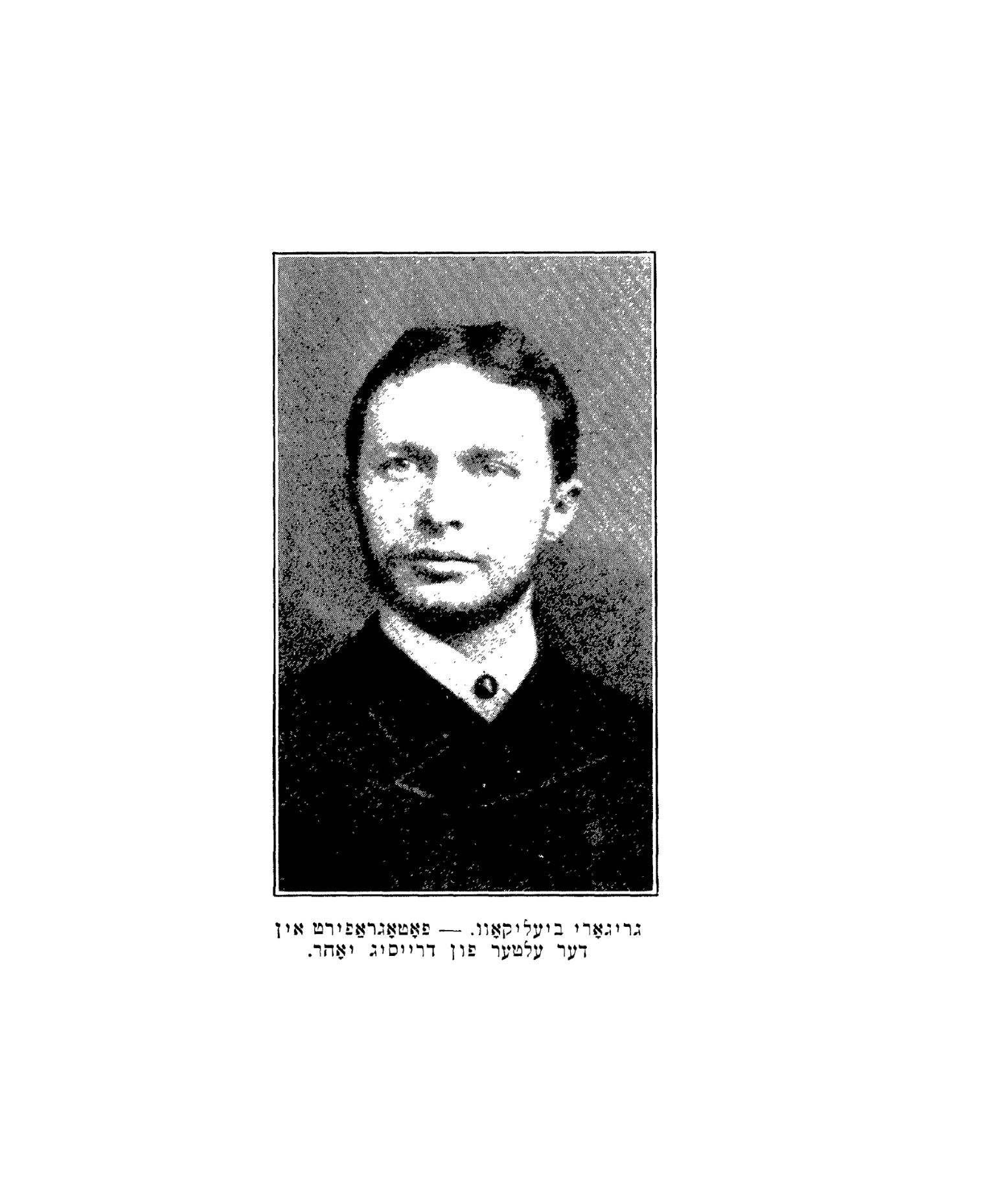
In the original: a plate between pp. 342–343
343however, he owed to his face and his smile no less than to his abilities.
In an earlier place I had occasion to remark of a certain pupil that he was popular with the teachers and unpopular with the pupils. He was a cunning egoist, a chinovnik. He understood how to "earn" his way with the authorities. But in his relations to his comrades he was narrow-hearted, stingy and false.
Another the pupils did not love simply because he had unlikable manners. He was actually an honest man and not a bad one either. But he was a great bore, and often he would arouse hatred simply through a tactless word or deed.
There was a pupil who was both popular and unpopular. People loved his childlike honesty. But his naive, childish sense was a subject over which one used to make merry.
Once one of the pupils proposed a certain game by which one can supposedly find out who is a liar. One takes several straws, all the same length, and gives each pupil one to hold a certain time in his mouth. Then one takes all the straws out of the mouths. Then one sees: if with one the straw has grown longer, it is a sign that he is a liar. The said institute-boy was one of the participants, and his straw came out of his mouth shorter.
The room stormed with laughter.
Some of the pupils saw in this affair a proof that he is not at all honest. I did not 344agree with them. I expressed the opinion that his open-hearted straw only proves that he is foolish and superstitious. And today, when I recall him with various details, I remain of the same opinion. He was an honest and good man.
When he tried his cunning, he was no good at it, and a great foolishness would come out.
There was a pupil who distinguished himself by his indecent talk. He actually spoke little. He was always busy with studying. He had a dull brain, and whole days he would walk about and "cram." Only suddenly he would run up to you, give a gush of his disgusting foul language, and again take to running to and fro, again "cramming."
When Adam Hakohen Lebensohn ("Berke Mikhalishker") died, a memorial service was held for him in the "Taharat Hakodesh synagogue"* — this was a synagogue of "Berlinchikes," of "apikorsim" (freethinkers). In any other synagogue, naturally, no memorial would have been held for the great freethinker. To this gathering they took the whole institute. The memorial address, in Russian, was made by Klyachko, the government rabbi, and the next day the foul-mouthed one mimicked Klyachko's speech in such a way that his listeners rolled with laughter, and the basses among them turned red with shame. But in the middle of orating he ran off and again took to learning the lesson by heart.
* A synagogue for "modern ones," for more intelligent people, "Frenchmen." Ordinary Jews used to call it the "Berlin synagogue" (a "Berlinchik" meant a Jew who wears a short coat and trims or even shaves his beard).
345One of our pupils was a busybody ("cooking-spoon," kokhlefl). In everything he meddled. When something had to be organized, he was a regular party to it. Every piece of news arrived at him, and from him it was spread over the institute.
Once, when he was making order in the "corridor," I asked:
— What are you, a pristav (police commissar)?
Afterward this was caught up by the other pupils, and the nickname stuck to him.
He was one of the best singers in the institute. He quickly learned to read notes, and he used to help Eban organize the choir.
Tsilshteyn, the pupil who brought the "grandmother" a gift, had a fine handwriting, a pleasant voice for singing, and a pleasant style in writing. He was a draftsman, a precise one, a neat one. And the same was felt in everything he did. With him everything was in order, and everything he did neatly at the right time. Calmly he did it too — such was the impression. He had good abilities — easy and somehow also neat.
From his pranks for the "grandmother" the reader could see that he had humor. This showed itself in his writing too.
The winter we spent in the third class, we put out a journal; and his article called forth much laughter and praise.
"Foreign Correspondence" he called it. It was a "report" of the latest news in the second class, and the whole thing was full of a light, 346neat kind of humor. The article had a great circulation. It was read in all the classes.
Of the other contributions to the journal I also remember an article by the naive-honest pupil. He was the most well-read in our class, and he had the most correct Russian language in writing. We used to say that he resorted to too lofty phrases, but in our hearts we had respect for his writing. In the journal he put an article on a social subject, and the language was full of flowers.
The "journal" was a written one, and only in a single copy. One took a notebook, wrote out a title-page (the name I do not remember), and then each "contributor" wrote in his article.
I wrote in a poem, which took up several pages. It depicted a morning in the institute — the scenes when one rises, when one sets to breakfast, how one feels when one prepares for the lessons and while the teachers come in.
In detail I remember only one phrase — about how, after washing himself, the pupil throws his bit of soap into the table-drawer of his "stool."
In its form the poem was an imitation of Pushkin's "Eugene Onegin," which we had learned by heart with Dodikin.
The preparations for the "journal" took a couple of weeks. At last it was finished. Then, one evening, it was "published." We all sat around the title-page, and each contributor read out his work. This meant the journal had "appeared."
Everyone was in a festive mood. We 347regarded it as one of the most important events of that winter.
My poem too had a great "circulation." It was read in all the classes, and I received many compliments. Tamarin praised it strongly, and that was dearer to me than anything.
One of the articles in our "journal" was based on a certain chapter of Pomyalovsky's novel "Sketches of the Bursa." By the word "bursa" was meant a priests' seminary, where the pupils receive government board, a closed establishment, like our institute. Pomyalovsky's work was one of the most famous in Russian literature, and since our life was similar to what is portrayed there, we used to call our institute "Bursa" and ourselves — "bursaki."
More than the first number of our journal did not appear.
I am a creature of moods, and in my quite young years this was felt perhaps even more strongly than later.
While in the institute, I would sometimes be merry and lively, take part in all the jokes and pranks, and sometimes for a few days in a row go about with a heavy heart, silent, gloomy.
When I was in a good mood, I would have more desire to study, and would force myself to prepare well even such lessons as I greatly hated. But often it would happen that this very 348learning under compulsion would spoil my good mood. I would fall in my own esteem and hold myself for the unhappiest man in the world; and often my mood would then stay with me a whole day or more than a day.
Even the subjects in which I was strongly interested often caused me more pain than joy. Geometry, for example. It was one of my favorite studies. I could sit a whole afternoon and evening working on sensible geometric "zadaches" that had no relation to the next day's lesson. Often I would learn by myself the "theorems" the teacher had not yet reached with us. I always kept ahead of the class. Yet if the next day's lesson consisted of uninteresting computations with many figures, I would be too lazy to prepare it. I would put the work off to the next morning, and the next morning I would do it like a martyr.
Sometimes a teacher would drive me out of patience, and that would bring me no good.
About my clash with Dodikin I have already told. Something similar, though in a much milder form, I once had with Katelnikov himself. He called me up to the board and told me to explain the last geometric theorem we had studied. I made the drawing, set the letters and began to explain. The theorem itself I knew well; but Katelnikov interfered in my words, and he, unwillingly, befuddled both me and himself. He tried to crawl out of the tangle, and I stood and waited.
349Since he was proud, he tried to throw the blame onto me.
— Why do you stand and stare like a dreamer? There flies a crow! — he pointed with an angry jest through the window.
I laid down the chalk, went to the window and pretended to look for the crow.
— There it flies! Over there! — he shouted.
— Cheek you have, poor fellow, that one knows already.
After that he seldom called on me, and when he did call on me, he avoided looking me in the eyes. This lasted a good while. His lessons were then very unpleasant to me.
I used to envy the pupils who always had patience and perseverance, those who studied all the lessons with desire, whether they were interesting or not.
I accepted the rule that so it is right; and my nature of having desire only for the lessons that interested me I regarded as a misfortune.
The greatest pains were caused me by Ilovaisky's history textbooks. The brevity, the dryness, the flavorless fine phrases of his little chapters fed in me a feeling that one is tormenting me without purpose and without sense.
At the same time that I tormented myself over the government-issue history book, I would read real history with a passionate desire. In my heart I would say: "There, you do love history after all!" And I would answer myself: "You are only good at reading what gives you pleasure. Reading is altogether a pastime; but one must study; one must not be an idler, and study what one is told..."
As if the word "study" applied only to 350such spiritual work as is bound up with tasteless processes!... But such a concept the other pupils had too.
I knew I had better abilities than certain of our diligent ones. In my heart I called them "thick heads." And at the same time I would place them higher than myself, envy them. And as for the pupils of the higher classes, chiefly of the fourth class, when I was in the first or second, it used to seem to me that they belonged to quite another kind of human being. I would almost forget that they were only two or three years older than I, and that in two or three years I would stand where they now stand. It used to seem to me that they had been born more educated, more developed and higher than I — and that such a level I would never reach.
A remarkable effect the Russian folk songs we used to sing in Eban's choir had on me. The sorrow that rings in them is not a Jewish sorrow. Yet it used to enchant me. Its very strangeness used to enchant me. The mysteriousness of their music became through this deeper and more beautiful. A beautiful, mournful melody always used to shake me up; bring me almost to tears. And here echoed a lament from an unknown distance, a lament together with an outpouring of courage. And Eban would begin to play on the mirror-polished piano, and the chorus would thunder out:
"In the field a birch tree stood," or "By the little river, by the bridge," or "Wake me not, me a young little maiden, too early before dawn."
Then, singing, I would feel that my heart melts within me, and a whole day I would 351sing the melody quietly, or it would sing itself in my brain, like an accompaniment to the loneliness and longing that pressed at my throat.
In the institute there were some pupils of whom one used to say that they "had baryshnyas." That is, that they carry on an acquaintance with gymnasium girls or with other intelligent girls. No indecent relations were meant by it. Absolutely not. He who "had baryshnyas" played the role of a cavalier with them. He used to go walking with them, visit them at their parents' house, grant them "ladies' rights," bring them books to read, and show them attentions in other cavalier ways.
And when one "had baryshnyas," it was no proof that he pleases the fair sex. It only meant that he knows how to become acquainted with girls; that he is not a yeshiva-boy and can play the role of a cavalier.
In town there were householders' daughters, not quite rich, for whom an "institute-boy" was a good match. Into such a house it was easy for our pupil to get. One needed only to have the courage or an occasion for it. And by visiting a girl from time to time, or even often, one took on oneself no obligations. One could pay visits to several young ladies at the same time — today to this one, tomorrow to that one. Usually one regarded it only as social relations.
352What was in the heart of the girl or her mother; how some of them carried on the diplomatic chess-game of drawing this or that institute-boy into the net — that is another question.
When a young man did not let himself be caught, he could "have" as many "baryshnyas" as his heart desired, and not become a bridegroom thereby.
By the word "baryshnya," or "frelin" (when one spoke in Yiddish), was meant a girl who can speak Russian well. There were exceptions, such whose Russian was in a sorry state and who were nevertheless recognized as "baryshnyas," but fluently they spoke the language; a Russian book they could read (more or less), and modern manners, etiquette and customs they knew too. Without that one was a "meydel" (girl), not a baryshnya, and not a frelin.
The boundary between a "frelin" and a "meydel" was a sharp one. Were a pupil to say that he had become acquainted with a "frelin," and by it mean a Jewish daughter who knows no Russian and does not carry herself like an intelligent woman — that would be as unnatural as if one should say "costume" and mean by it a long, old-fashioned kaftan, with trousers tucked into the boots.
A "meydel" in those days did not even wear a hat. A few years earlier, certainly not. When I was in the institute, it had only just begun gradually to come into fashion. To walk along the street with a hat, and with a parasol — that only "frelins" did, not "meydels."
In Vilna there were then some respected householders' families whose daughters dressed 353in the old-fashioned way. There were even some quite rich families of that kind. Into such houses "students" — that is, gymnasium pupils, realisty or institute-boys — did not go, unless they were relatives.
To the title "baryshnya" a frelin who went to the girls' gymnasium was chiefly entitled. So it was understood according to our use of the word.
Girls who had already finished the gymnasium were still then few, and that Jewish daughters should be brought up in this way was still a rather new thing. I do not know whether, at the time I came to the institute, the fashion was six or seven years old.
The gymnasium girls wore brown little dresses with black aprons. That is their uniform. Coats and hats they wore as they wished. Without a hat a gymnasium girl did not go on the street in any case.
A brown little dress was with us the symbol of ladies' charm. The thought of it troubled the institute-boy more than the gymnasium pupil — first, because a whole week he lived like a monk in a cloister; second, because in his black uniform the brown little dresses took far less interest than in the silver buttons of the gymnasium pupil.
With regard to spiritual development the "baryshnyas" were no pride. For example: when their teachers set them to write a "sochineniye" (composition), they would ask their cavaliers to 354do it for them. Did a Jewish daughter feel ashamed that she cannot study a page of Gemara? Just so did a "baryshnya" feel ashamed that she cannot write a "sochineniye." She even flirted with it.
To "develop" a "baryshnya" meant to read with her radical books — not of the truly forbidden ones, but of the "almost forbidden" ones, like Pisarev's works, for example. I do not speak here of the young people who belonged to a revolutionary "kruzhok," or who read underground literature so, but of gymnasium pupils or institute-boys who had never in their lives even set eyes on a "treyf" little book. Among such intelligent young people too it was a fashion for a frelin to distinguish herself with "developedness" and to play the role of a "developer" with her.
One of the most popular subjects on which the cavalier would lead his conversation in such a case was the emancipation, the equal rights of woman. In those times, after all, among the Jewish intelligent young people the woman-question was a chief theme. In those times among Jewish young people the saying arose: "Mantse-tse-patse," that is, that the wife should "slap" the husband.
The "baryshnyas" used to hear from their cavaliers sermons that woman must be as free and as spiritually developed as man, and a minute later they would flirt with their spiritual helplessness before them.
There was already then another kind of "baryshnyas." Not only such as could themselves write "sochineniyes" and were well-read, but also such as showed heroic deeds in the freedom-struggle. Such, however, were then a rare exception. Simply well-read and developed women were naturally a greater number, but they too were still an unusual phenomenon.
355As a matter of fashion, however, the radical idea had by then reached almost all intelligent or even half-intelligent circles. The effect of Russian literature and of the progressive Russian journalism was by then quite great.
I remember a scene of how one of our pupils prepared for a visit to a "baryshnya." A whole week he studied a certain chapter of Pisarev's work — not read, but really studied. With no good abilities did this pupil distinguish himself. The article was for him a hard piece of Gemara. He studied it and read it, knitted his brow, turned his head, sought help from other pupils, and all because he had to have something to talk about with the "baryshnya." In other words — with what to make an impression on her.
He prepared for the visit before all our eyes. For it meant he was going to "develop" the baryshnya. To a kind of holy work he was going. So all wished him success. So we behaved toward him.
I sat not far from him and watched how he toils over Pisarev's explanation of a certain idea found in the French philosopher Auguste Comte. It dealt with the religions of savage peoples. The word "fetish"* kept recurring again and again. I had read that work some time earlier, and I was well acquainted with the content.
* An animal, a tree, a mountain, a river, or a thing, of which the savage believes that in it lies a divine power, and which he serves.
356Now, then, I watched and listened to how that pupil torments himself ridiculously to understand it. In my heart I felt how ridiculous the whole business is. I do not believe, though, that I said it to anyone; it would have been regarded as a "khilel hashem" (profanation of the Name).
Why did he not choose an easier subject? Why precisely this one? Quite simply: in those weeks it was the most popular subject among the well-read pupils of the institute. The subject was at that moment with us in the highest fashion.
It happened just so that on the evening when the said "developer" visited that "baryshnya," there was also there Tratsky, our "grandfather." The next evening, when all the pupils had again come together in the institute, Tratsky depicted for us how the other had "developed" the young lady.
One of the scenes he portrayed was the following: the "developer" notices that the hanging-lamp has given a swing. He draws the young lady's attention to it, and thereby narrows his eyes and says:
"The primitive man would say of this that it is a fetish."
To the baryshnya the word comes out comic, and she bursts out laughing.
— You laugh? — says the "developer" — but it is a quite serious matter. A fetish is no trifle.
The "developer" begins to explain what a fetish is. He tries to convey the idea he read in Pisarev. But he cannot, and he lets himself go simply babbling phrases. It was already too ridiculous, and the good, honest Tratsky hated such a 357sham. Therefore he retold it to us.
I said that the relations with "baryshnyas" were absolutely pure and decent (of exceptional cases one does not speak). Of licentiousness among our pupils one heard altogether little. It used to happen that one boasted of intimate experiences, sins, but rarely — so rarely that no clear fact of the kind can I recall. We were young and bashful. Almost all of us belonged to highly decent old-fashioned families, and to a small world. Such things as masculine boldness and a free manner with women were with us a rarity. And dissoluteness was a private matter, of which one did not boast with us, unless perhaps in the most intimate conversations with the most intimate friend.
I knew of pupils who visited indecent houses. But, first, their number was very small (in our class there was, as far as I knew, only one such); second, it had no — what does one call it — bearing on our morals. On the other pupils his example had no influence. And as for himself, it had no influence whatever on his relations to decent women.
By the way, I can speak of such matters only with regard to my own class, for every class was a separate little world, almost as fenced off from the other three classes as the whole institute was fenced off from "town." Rarely did one of the pupils have an intimate acquaintance and carry on intimate conversations with a pupil of another class.
There were a couple, at most three, foul-mouthed ones 358in the institute. But their dirty talk seldom touched on sexual themes.
The four years we spent in the institute are the years when in the lad the man grows up. In the red, young blood throbs the restlessness that blooms in the fields and sings in the woods. About what kind of adventure, alarm, longing this or that pupil whispered to himself — that was his own affair. Each carried about with him his secrets, fantastic and non-fantastic — mostly such as no other living creature besides himself had any relation to. Almost all had the same kind of secrets, but to each it seemed that he was the only one who has such secrets.
When I came to the institute, my parents lived in Kozlovsky's courtyard, at the fur-dealer's in the cellar. A few months later, I think — after Passover, I think — they moved to Flashtshadke, nearby. At first they lived there in Stroshner's courtyard, in a room they rented from Uncle Meir, and later — in the courtyard opposite. My father then had a kheyder in Vilna proper, not at home, but elsewhere.
Friday night and Saturday by day I used to eat with them, and Friday night I usually slept with them too — on the same red sleeping-bench on which I used to scrib-359ble with my chalk, when I was a kheyder-boy and we lived in Shabse Zhirmunski's courtyard. Very often, however, I would sleep Friday night at my aunt's courtyard. There it was easier for me and nearer to my acquaintances.
So it was also during the seven vacation weeks. I used to eat and spend the night at my parents' on Flashtshadke, and partly at my aunt's in Kaminski's courtyard.
In the winter when I was in the first class, my second grandfather died.
I remember how the sad news was announced, and how I came from the institute, on my way to Kaminski's courtyard. It was an early morning. On the square, by the institute, I met Steinberg, our teacher and inspector. He suspected that I was going "into town" without permission, and he stopped me.
— My grandfather has died; the director permitted me to go to the funeral — I answered, and he let me go.
That this absent-minded man should notice me and bear in mind that it was midweek, when we cannot go out of the institute — that was a wonder to me.
The grandfather's funeral I do not remember. I remember only the mood, the feeling, that now the aunt is the complete mistress of the house and the uncle the Flashtshadke householder over everything, though in truth it had been so before too.
Soon after the grandfather's death I brought his photographic portrait to the institute and made an enlarged drawing of it. It goes without saying, Riazanov had a good share in it. But a large part of the work was mine. When the portrait was fin-360ished, I carried it with great joy to my aunt. I was convinced that it was very "podobno" (like him). But when the aunt took a look, she made a wry face, as if I had profaned the memory of her father. My mother came and she agreed with the aunt that it is not the grandfather. I argued, fumed, begged that one should see how like the grandfather it is. But it did not help.
I had expected the portrait would be set in a fine frame and hung on the wall, over the sofa, but even in a hidden corner they did not want to have the portrait. I laid it out on the stove, and there it lay over two years before I visited it again. And then I myself saw that it has no worth.
I took a knife and cut it into pieces.
That winter I heard Eliakum Zunser for the first time, at a wedding. My parents still lived then in Kozlovsky's courtyard. The wedding was at a near relative of the fur-dealer from whom they rented the room. I had always yearned to hear "Eliakum," as the Vilna Jews used to call him. His songs were enormously popular, and I had heard much of the wonders he shows as a badkhn (wedding jester) and as a singer of his own songs. That one has talent, one would not say of him, simply because regarding artistic things the old-fashioned Jews never used the word. One used to say that someone has a "talent," but by that one meant fully that he can do 361some craft — tailoring, shoemaking, or another handicraft.
In praising "Eliakumke's" jesting and his songs, one used to add other virtues too. People used to tell that he is educated, that he speaks good Russian, German, French. He then lived in Minsk, where he had a business, a dry-goods shop, I think. But the jesting he never gave up, and from time to time he would stir up the Jews with a new song, which one used to sing in every house and at every workbench — not only in the Vilna region, but throughout all Lithuania and in Volhynia and Poland too. The badkhonim of all lands used to entertain the public at weddings with Zunser's songs.
He used to come often to Vilna, for a rich wedding. I had never heard him. But here a wedding was made where I could be a guest-relative (mekhutn). So I turned to the director of the institute and obtained a permission to go there.
The bride's parents were quite small householders. To pay Zunser for the evening would not have been within their pocket. But he was a relative of the bride, and he took no money from them.
I came a good while before the ceremony began. Zunser lay on a bench in a side little room and dozed. So I thought at first. But it turned out that he had closed his eyes so that one should think he sleeps. He lay and thought, prepared the badkhn-verses he would say at the "bazetsns" (seating of the bride).
When the ceremony began, and he started to speak to the bride, to greet and admonish her, his words were built on her name, on the names of the bridegroom and on the names of their parents. Out of eve-362ry letter he made a word, and so he went to and fro, to and fro, again and again, without end. And the phrases came out of him smooth and interesting, very apt. So, at least, was my opinion. And all this he composed in a few minutes, right there, lying and dozing supposedly!... I could not stop marveling.
Later, at the feast and the drashe-gifts, he sang a couple of his songs, which were by then well known and famous. Singing, he beat time with his foot, and in his singing itself the beat was accented with a sharp prominence. This, and the accompaniment of the klezmers, fused into a musical unity that enchanted me. As if before my eyes I see him — neither tall nor stout, with a thin, blond-brown little beard, and a pale-ish face — how he stands and sings, beating with one foot and making time with both hands. The beat of his singing passed over to his listeners like electricity. The whole crowd sang along, without words, and without words kept his beat.
In this consisted the chief secret of his success: in the incomparable beat of his melodies.
Melody, in his songs, is really present little. It was a "recitative," a "singsong," as cantors call it; sometimes a plea, sometimes a "poor thing," sometimes an argument, an explanation. It smells more of agitation and of life-philosophy than of poetry. But a Jew loves this; and the beat, the rhythm, pours into the notes the wine of music. The song sings itself of its own accord. It is hard for you to stop. Once you begin, it draws you to sing, counting the beat with your nerves, further and further.
363My institute costume compelled Zunser's attention. I was the only "educated one" in the hall. He came up to me and we chatted. What he said and what we talked about, I do not remember. I remember only that I gave him enthusiastic compliments, that I tried to speak Russian with him, and that thereby I became disappointed. His Russian was a pitiful one. I saw that he has no modern education. I knew that he knows Hebrew well, but that did not interest me. My disappointment caused me pain. Later, however, it only increased my admiration. That such a man should be able to write such songs!...
In the institute I did not afterward stop talking about him.
That winter Vilna read Dinezon's "The Black Young Dandy," which had just appeared. I heard about the book in my aunt's house. Everyone read it and sighed over the sufferings of Yosef, the hero of the novel. Since he is the hero, he is naturally a likable one, and honest and a good one, and the troubles he endures from the black young man, who is his brother-in-law. Yosef is the angel of the novel, and his brother-in-law — the devil. He intrigues against Yosef, holds back his letters to his wife, and for a long time one thinks he has cast her off.
My good uncle Mikhl took Yosef's anguish so to heart that he lost his appetite for eating and fell ill.
In the time when I was in the first and in the second class, there took place the Russo-Turkish war of 3641877—1878. Every Saturday, when I used to visit my aunt, I had to come out to Abraham David the Shtraykher and read him the war dispatches in the Petersburg "Golos," which was then the largest and most important newspaper in Russia.
At Uncle Meir's there were quartered reservists who had been called up to the war. These were mostly peasants who had already served several years in the army. They had been let go home, but for fifteen years they were still counted in the "zapas" (reserve), and now, when the war broke out, they had to go to the front. In Vilna was the assembly-point of the district, and since in the barracks there was not enough room, they were quartered among the residents. Wherever there was only a bit of free space, a couple of reserve soldiers were put in. At my Uncle Meir's house there was a hall and a dining room. So several such soldiers were put in there. And since there, in a room, my parents lived, I became acquainted with the soldiers.
They had not yet received any soldiers' clothes; and they were not yet cropped and shaved. They looked like ordinary peasants. They slept on the ground.
The group consisted entirely of "Starovertsy" (Old Believers) or "Katsaps." They all wore beards and spoke Russian like "Great Russians," and not like Lithuanians, Poles or "White Russians," who had learned the language in the army.*
* The peasant population around Vilna consists of Poles, White Russians and Lithuanians. There were, however, regions inhabited by "Starovertsy."
They confided to me that they had to 365leave their families and go to war. They did not sigh. And in words they did not express their despair either. But one could feel it in their voices and on their faces.
One of them I remember: a handsome peasant with a very thin flaxen beard. I remember too the quiet, sorrowful tones of his voice. An absolutely ignorant man. He did not know where Turkey is, why there is war, and why he must go into the fire.
Prominently there stand in my memory too a couple of portraits of Turkish officers who were in Vilna in "plen" (captivity). With us there were about a thousand prisoners of war, and by day they used to walk about the town, quiet, sad.
Distinctly I recall the face of a Turkish officer whom I saw on the "naberezhnaya" (leveled bank) of the Viliya, and of a second, who drew my attention by the botanical garden. The first sat on one of the benches of the "naberezhnaya," sat and silently looked at the water. He had a refined, intelligent expression, and it seemed to me that I could read on him the longing that draws at his heart. The second stood and sang quietly. His melody rang to me a bit like Yiddish.
On the "skameykes" in the classroom we sat by the alphabet. Next to my name, which 366begins with a "Ka," sat the name Levin. So I sat with Levin — a pupil from Oshmene, Vilna province — the whole four years on one "skameyke," and the berths in the bedrooms were also assigned by the alphabet; so our beds always stood one beside the other.
According to his officially recorded years, Levin was of the same age as I. But I was sure he was a year or two older than I. We had quite different characters. But since we were after all literally day and night together, we quickly grew used to each other. I was a hot-tempered one. He, however, had a calmer nature. So between us there never occurred any clash, and we were close comrades. Not too close. We never stopped saying "you" to each other. But our relations were always friendly.
We mostly learned the lessons together, and being "in town" he would sometimes come to my parents or aunt, and I would visit with him a couple of families with whom he was a regular insider. Of such families he had a good number, for he was of the kind of people who make acquaintances easily and feel at home everywhere as if in their own house.
On our first vacation, after the examinations, when we passed into the second class, he obtained a lesson for which he was given, besides pay, board and lodging through the summer; and I used to visit him there often. He taught a boy whom he prepared for gymnasium. The boy's sister had finished the girls' gymnasium that summer. And into the house used to come her girlfriends and a
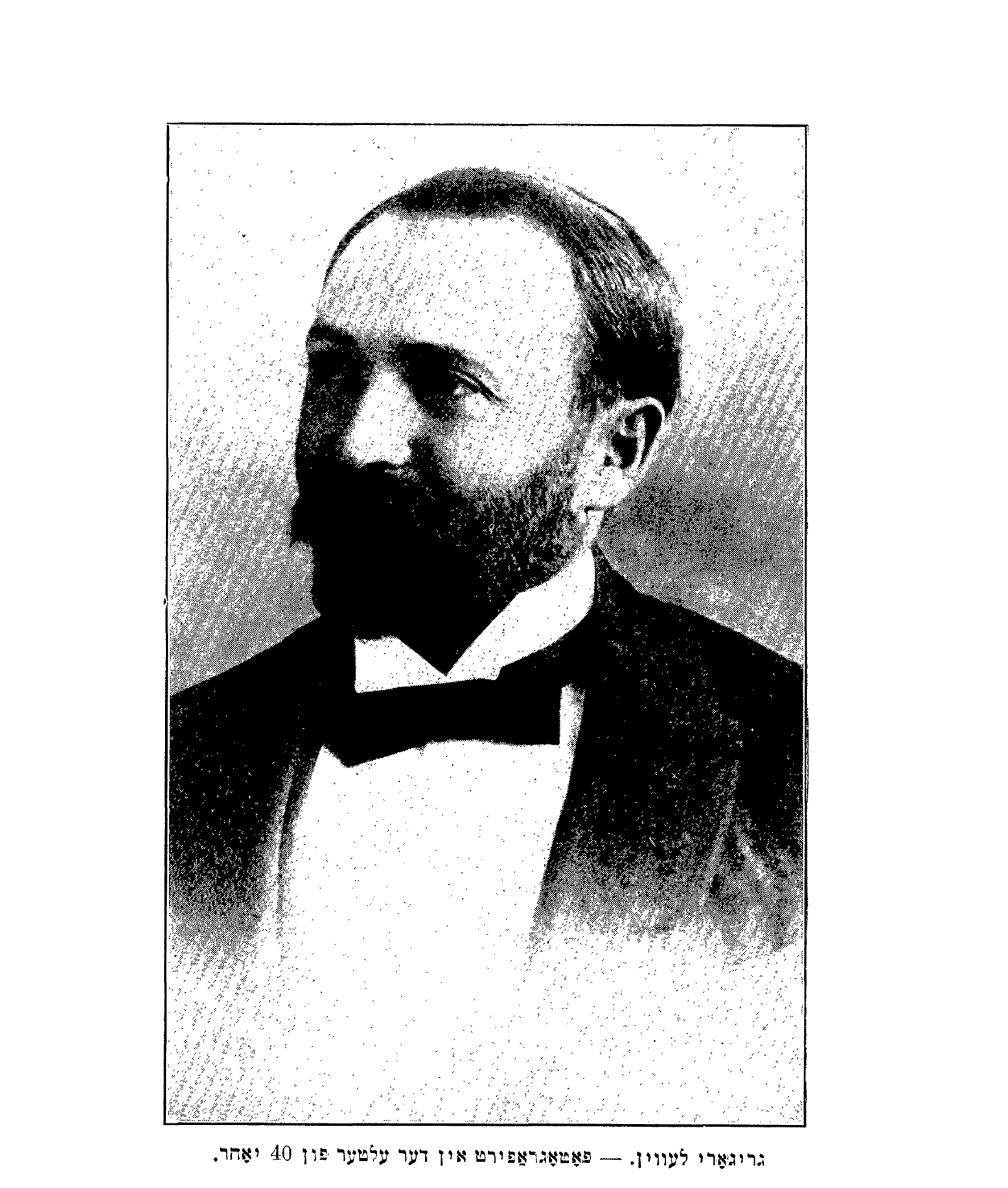
In the original: a plate between pp. 366–367
367couple of gymnasium boys. The father of the family was a well-to-do feldsher named Moshe-Borukh Zak, and he lived in a modern-householder style. He was a cheerful father and a hospitable man. So his daughter's acquaintances always had a warm welcome at his place. I became well acquainted with the family and used to be a frequent guest there.
Sometimes we would all go out beyond the town, usually to Vifleem (Bethlehem, Beys-Lekhem), which was then one of the two liveliest "modern" summer places in Vilna.
The old-fashioned householders who could afford to take a summer quarter used to rent a room in "Ruvele" (Jerusalem). Vifleem is not far from Ruvele. Through a little wood one used to come, by way of Vifleem, to the rails of the railroad, and on the other side of the rails is "Zheliezniza Katka." The second summer place, where a modern crowd used to gather. In Vifleem and Zheliezniza Katka, and beer-halls where Russian and German chansonettes were sung, and around those places were the "modern" summer quarters.
People used to stroll between the rails of the railroad. So the couples or groups used to walk off a couple of versts, rarely more.
A popular spot on these walks was the "Third Kasarke."* The watchman's wife set 368out from outside a little table with little benches. Here one used to sit down and order bread with milk or with sour milk.
* By the word "kasarke" was meant a little hut where a railway watchman lived. His duty was to keep watch over the rails, and when a train came — to put out a small flag as a signal that the rails are in good condition.
On my walks around "Zheliezniza Katka" I often saw here the Russian-Jewish writer Levanda. He had a dacha here. I used to see him with representatives of the older Jewish intelligentsia. He and Bagrov were then the only belletrists who wrote of Jewish life in Russian. That "The Black Young Dandy" or another novel written in Yiddish should be called a belletristic work occurred to no one in those years. As a part of Russian literature it was not counted, neither it nor Bagrov; and even had they had more talent than Turgenev, they would not have been counted in either. Their works were a literary little world of their own, neither Jewish nor Russian; and the aspiration of institute-boys or of Jewish gymnasium pupils was to be acquainted with Russian literature.
Once I was going from the institute together with a pupil of a higher class (I was in the second and he in the third). It was a "tabelny den" (government holiday), and we were free. It happened that we went in the same direction next to each other. When we had thus walked off about twenty minutes and reached the front door of the Jewish hospital, we met two gymnasium girls. It turned 369out that they were my companion's acquaintances — chiefly the elder of them.
We stopped. He greeted them and introduced me to them. The words "I have the honor to present: Herr So-and-so and Fräulein So-and-so" — these words and the whole ceremony were no longer a novelty to me. And yet it used to stir me up every time and bring color to my pale cheeks. Not to speak of when I was introduced to a "brown little dress"!
The elder of the two gymnasium girls was no beauty. But her eyes — black — sparkled with the joy of life. She had a request (bitte) to my companion: the teacher of Russian — our very own Dadikin — had set their class a "sochineniye," and she asked that he write it for her.
— For when did he set you that? — he asked.
— Ketshtirntsm!* — she answered.
* For the fourteenth of the month.
The full word is "s'chetyrnadtsatomu," but in speech it is shortened. Several sounds are swallowed. So she flirted with it.
Several times she found herself a pretext to say the word over again, in order again to flirt with her genuine-Russian pronunciation.
And thereby she flashed coquettishly at the young man with her black, life-loving eyes and smiled coquettishly with her not-pretty mouth.
I understood all this as clearly as I 370understood that not the "sochineniye" is the important thing here, but the fact that she is a "she" and he a "he."
The girl made on me no good impression, neither with her face nor with her coquetry. But she was, after all, a baryshnya! After all a gymnasium girl! So I envied her cavalier the sparkling glances she threw to him.
I was by then already acquainted with three or four baryshnyas, besides the girl I met by the hospital. But my acquaintances — rather, my cross-eyes — used to cause me more pain than pleasure.
I was very sensitive in general; but with regard to this point my sensitivity overstepped all bounds.
When a baryshnya in my presence spoke to another cavalier, I used to think she speaks to him and not to me, because with him the eyes are straight and with me not. And when she spoke to me, I used to be permeated with the consciousness that she is looking me in the eyes, in my unhappy eyes. A fever of shame used to seize me — of shame, dejection and something akin to fear.
It seemed to me that no baryshnya would want to walk with me across the street; and when a baryshnya did walk with me, I used to look for some special reason, some special intent in it.
I was afraid of company. But that only embittered me and gave me an exaggerated daring to become acquainted with baryshnyas and to visit them, and from time to time I received an invitation to an "evening" (party), to a birthday celebration or so, as a 371guest. And in a couple of houses where there were baryshnyas, I used to feel at home and did not have to wait for any invitation.
With my temperament and inexhaustible liveliness I would often be the soul of a company, and afterward I would go back to the institute or to my parents with a wound in my heart — sometimes without a real cause.
In the next higher class above ours there was a pupil who was also cross-eyed, much worse than I. I always avoided him. Once it happened that I had to talk with him (someone had just lent us the same book, and we talked, arranging who should read it first); and thereby my face flamed and my heart pounded, as if one had caught me at a crime.
A certain time after my meeting with the tall, life-loving gymnasium girl, I met her at an "evening," at a family that consisted of a widow with two daughters. The two sisters were not "complete baryshnyas," but Russian they spoke, and a relative of theirs was a pupil of ours; he often brought there a couple of his friends. Once they made a whole "vecherinka," and I, with a couple more institute-boys, were among the invited.
When I came there, I found among the guests the tall gymnasium girl. Of the vecherinka itself no impress remained in my memory. There remained only the following, which took place after the vecherinka:
When one took leave of the family and dressed to go, the cavaliers and the baryshnyas 372arranged among themselves who should see whom home, and it fell to my lot to accompany the tall gymnasium girl. Probably this had to do with the districts where our parents lived, for it was on a Friday night, and I spent the night at home. In any case it was so arranged; and she had nothing against it. On the contrary, she accepted my candidacy with joy. We went walking, and we walked off a good piece of our way, until we found ourselves by the Viliya, on the "naberezhnaya."
We sat down on one of the benches. It was late. And all around it was quiet. No trace of a person. It was a moonlit night. The air was full of silver-shine, and bits of silver sparkled in the river. We sat and talked, and she steered the conversation in a literary direction.
She made merry and flirted without end.
— Give me a hundred kisses! — she said to me, not in Russian but in Yiddish.
She said it in a tone of jest. But she smiled into my face with her coquettish, life-loving smile.
— No! — I answered, a bashful one, a flustered one.
— Give me a thousand kisses! — she jested on.
— No!
— Ten thousand, twenty thousand!
— No!
— A million kisses!
— No!
373I thought she was making fun of me. I did not touch her. And so I saw her home.
Afterward I took to reproaching myself for being such a fool. At first I both understood her and did not understand her. I could not believe it. Did she really mean for me to kiss her — I, the cross-eyed one? No, she had surely been making fun of me... But why then did she want me to accompany her? And why did she go with me far from our way, all the way to the naberezhnaya, so late at night?
For whole days I gnawed my brain over the question. I strained my memory to recall every tone of her voice, every expression of her face while she spoke to me... If she really meant for me to kiss her, she surely holds me now for a "shlimazl"... This thought vexed me more than anything.
And when I became a bit more acquainted with realities, I no longer had any doubt about the sense of that scene.
I found out that my dread regarding my appearance was often exaggerated — that people shy away from me not at all as much as I think. Often, but not always. The sum of it was that my eyes did not stop tormenting me.
There were hours enough when the heart leaped with the joy of life. But most distinctly are remembered hours of painful melancholy. In my blood played various thirsts. I often used to feel a sadness, sharp as a bodily ache. In a higher degree or a lower, so feels, probably, every lad 374— every boy who comes into the years when both the body and the soul blossom.
Such moods are in my memory chiefly bound up with the coming of spring's breath through the open windows of the institute. And — still more — with my summer evenings in Vifleem and "Zheliezniza Katka."
From the lessons I gave in vacation time, I had a summer coat made, a light and a long one, as was then the fashion, and I bought a summer parasol of light pale-blue cloth with a cane handle. This I carried about in my second vacation, and in my third I ordered a linen costume. With it I wore the black institute cap. So dressed, I used to spend almost every evening in the summer places.
Writing these words, I see myself, how I stroll about, sporting with the half-open pale-blue parasol in hand — a thin one, a pale one, with a face that looked younger than I really was, and with blue-ish eyes that caused me so much pain.
I became acquainted with enough baryshnyas and gymnasium boys. But every time a company to which I did not belong passed by, it used to seem to me that their world is forbidden fruit for me, that they are more important people than I.
In me stormed ambitions, aspirations, desires, jealousies, envy in the ordinary sense of the word, and this was bound up with an unceasing consciousness of my defect.
The more acquaintances I had, the more wretched and lonely I felt, and the less 375I thought of myself. Everyone seemed to me greater and more important than I.
I was always restless. It was hard for me to sit still in one place. In summer by day, when there was no sense in going to the summer places, I used to walk about the town. On Broad Street there was a large, covered courtyard where two Italians, brothers, dealt in pictures and in art materials. I became acquainted with the place through "Yankele" Goldblatt, who used to buy there pencils, paints, water-color. So I now used to come in there often in the summer days to visit the pictures that hung on the walls, the articles laid out in glass cases, and the two brothers themselves, with their little beards and Italian faces, who were so alike one another.
Through their covered courtyard I used to go into another large courtyard, under the open sky, and from there farther. I used to walk around the first gymnasium, go into the library, sit and read, again grow restless, again go — over Trosker Street — to Paholianske, past "Zakrete's" wood.
By the first gymnasium was "Goretskaya's" café — the only one I knew of. There intelligent young people used to gather, drink a glass of coffee and read a newspaper. Several of my acquaintances were frequent insiders there. But I had only begun to visit the place when I had already passed from the second class into the third. It was on a summer Saturday by day, in the morning. I felt uncomfortable there, as if I had forced myself into a too-high world.
To the beer-halls and café-chantants of "Vifleem" and 376"Zheliezniza Katka" I was already accustomed, but to "Goretskaya's" place — not yet. I had too little faith in myself, and every new step came hard to me.
On Trosker Street was Schaffner's konditerskaya. Through the door I used to see how gymnasium boys and gymnasium girls savored "pirozhenes" (pastries) there, standing; or I used to stop and watch how by the window one sits and eats "morozhenaya" (ice-cream). Once I saw an officer eat green morozhenaya. Such morozhenaya I had never yet seen.
To go inside was too aristocratic a step for me. The only sort of "morozhenaya" I had eaten while in Russia was the kind that "morozheniki" used to carry about the streets — Russian peasants from Tver province, in red shirts and stiff hats.
They carried their wares in a little keg on their head; walking, beckoning with the hand that was free, and every while stopping to call out: "Morozhenny sakhar!" They would give you some for two kopeks, for three kopeks, or for five kopeks; and a bit of theirs went through all your limbs. What, it seems, could be more delicious?
I used to try to imagine the paradise taste of the "morozhenaya" one gets in a konditerskaya, and could not. Only later, in New York, in Paris, in Berlin, in Vienna, I found out that the costliest "ice cream," "glaces" or "frozen" of the richest confectioneries in the world is like a weekday against a holiday compared with the "morozhenaya" of the Tver peasant in the red shirt.
377The whole time I was in Russia, I visited the theater about a dozen times, not more. I mean the Russian theater. Of any Jewish theater one knew nothing with us then. When I was in the third class of the institute, I heard for the first time that in Odessa there is a Goldfaden, with a Jewish troupe. With us, however, little was said of it, and of the Yiddish plays I had no concept.
A Russian theater had been in Vilna for many years. The building — exactly opposite the entrance on Rudnitsker Street — was already an old one, and as far as I then knew, there had been a time when one used to play there in Polish. Afterward, however, that was forbidden, and one played only in Russian. They put on dramas, comedies, operettas, and sometimes even an opera.
The theater was a municipal theater.
I visited it for the first time when I was already in the institute. My uncle Khaim Leyb, my mother's brother, took me along.
Above it has already been mentioned, in passing, that he had settled in Petersburg. There he had "worked himself up" to a factory of passementerie (shmuklerey), his father's craft. The factory grew, and he became rich. He was strongly attached to his sisters, and used to come often to see them. And every time he came, it was in our family a great event.
Once, then, when he visited Vilna, he took me to the theater. He was dressed like a 378dandy and lived like a lord. In Vilna he stayed at the Hotel "Dagmara," which had just been built, not far from the station, on the main road that leads to the center of town.
He bought tickets for two of the best places in the "parterre" (orchestra). For this one had to have a starched white dress shirt. I did not own such a shirt, but the uncle "organized" it for me from his baggage. His shirt was too big on me, and the black bow-tie would not stay in the collar. But we somehow overcame all the difficulties.
In the theater I sat as if not only the shirt were starched, but I too. I was afraid to make a move, lest it crawl out of my institute waistcoat, and lest a "zaponka" (stud) pop out.
They played the operetta "Giroflé-Girofla." The leading role was played by the actor named Nevsky — the "star" of the Vilna theater, where he used to play in operettas and in dramas.
The theater itself, with the crowd and with our Eban in the role of conductor, was for me no less of a novelty than what took place on the stage.
I looked at the boxes, at the dressed-up ladies, at the officers with the generals; I craned my head up toward the gallery.
It was naturally a Friday night. Otherwise I would not have been free. That night I spent with my uncle at the hotel.
He was still a young man — about thirty-five — though a part of his hair was entirely gray.
379In Petersburg he had learned to speak Russian, but not well. And my Russian language gave him no peace. He behaved toward me with a mixed feeling: with respect and with pride that his sister's son "studies," that I, the "alter," with whom he used to play in Podbrezye, speaks such good Russian; and at the same time he looked at me, first, as at a boy, second, as at a pauper who has never yet been in a theater and must borrow a shirt from him. And this poor boy speaks Russian far better than he! He felt ashamed and vexed.
He tried hard to speak with me in the intelligent manner, and constantly used the word "vpechatleniye" (impression).
The next day he did not let me go from him. He visited my parents and the aunts, and everywhere I had to be with him. At whose place he was for cholent, I do not remember. Probably at the aunt's. A little later, when we walked about the town, he said to me:
— Come, let us go into a good Christian restaurant.
I knew of a Polish restaurant located in the courtyard of the drawing-school, on Broad Street. I had eaten there once or twice with someone. The price of a full meal was twenty kopeks. Of a better place I did not know. When I led my uncle up to the steps, he turned back with contempt. I felt like a whipped one.
Not far from that courtyard is the botanical garden. There, inside, was a café-restaurant, and I used to see how officers or civilian gentry ate there on the 380balcony. But to lead my uncle there never occurred to me. He himself, however, knew of the place, and he took me there.
And when we came there, he ordered several dishes, of which I remember chiefly fish. Cooked in a non-Jewish way, but with a rare taste. The whole meal was delicious in a way that was a novelty to me. The like I had never tasted before. In the evening I told it all with enthusiasm to my fellow pupils.
Later I went to the theater for my own money, but no longer in the parterre, only in the gallery, which was under the very ceiling. Not from every place could one see the stage. One had to come very early and sit long on the steps above by the door of the gallery, sit and wait until they would open. If you had not come early enough and you sat near the door, you afterward could not, inside, grab a good place, and you could not see at all.
Most distinctly I remember how in the Vilna theater I saw Ostrovsky's "Groza" and Spazhinsky's "Mayorsha." I remember too the performances of Gogol's "Revizor," of the French melodramas "Behind the Wall of a Cloister" and "The Two Orphans"; and of the operettas "Périchole" and "Madame Mango."
The most popular actress was an actress named Surevich. She played young roles; and on the stage she looked like a little girl. In truth, however, she must have been fifty years old, if not more; for people used to say that she had in the Vilna theater 381played in Polish, and that was many years back.
Of the other important actresses I remember Melnikova and Taninskaya, and of the men, besides Nevsky — Gorev. He played the most important dramatic roles.
When I saw him in "Behind a Cloister-Wall," I was dissatisfied. He did not speak in a natural manner. He declaimed. I expressed this to a couple of our pupils who had also seen him in the role. They did not agree with me.
— Do you want an actor to talk the way one talks on the street? — one of them argued — it is, after all, a theater. One wants to have beautiful speech. Ordinary speech one can have for free, after all.
So, roughly, he argued.
We turned to Riazanov, then to Wohl (probably their lessons were next). And both of them ruled in favor of my opinion.
In "Mayorsha," however, Gareva fully satisfied me.
Before I came to the institute, the career of the graduated institute-boy was pictured to me in flower-colors. When I had been there a couple of years, I came to look on my future through quite different glasses.
382"What a fate! To be a teacher one's whole life!..." I used to say, talking with my mother.
With saying it alone, however, I was not content. I resolved on an important step: to free myself from the institute, enter a gymnasium and from there a university, for — as already said — with an institute certificate one was not admitted to a university. To get out of the institute, however, was not easy. On entering the institute's class, each pupil's signature was taken that after finishing he would serve eight years as a teacher in a government school. So no one was permitted to withdraw, unless he paid for the board and the clothes given him. But when one studied very poorly and failed twice at the examinations, and under certain circumstances even once, the director himself expelled him. So I resolved to bring it about that they should expel me.
The idea took the form of a finished plan at the beginning of my third year. If I am not mistaken, it was during the three days I spent in the carcer. The plan consisted of the following: at once begin to study Latin and prepare myself for the sixth or seventh class of gymnasium; the "lessons" provisionally to study, so that the director should not suspect that I am deliberately neglecting my study. And when it came to our institute examinations, I should fail and see to it that they should expel me entirely.
The chief thing I lacked was the two classical languages — Latin and Greek. So I at once began to study Latin. I bought Kühner's Latin grammar and began to work, by then not at all like an idler. Usually I used to get up at seven o'clock.
383Now I began to get up at five or even four o'clock. It was winter, and on the courtyard it would still be pitch dark. In the corridor a couple of the servants would then be cleaning the floor, and a little lamp would be burning. It was dark. I used to walk to and fro from one end of the corridor to the other — walk and "cram" by heart Latin words and their meanings, exceptions from certain grammatical rules, and so on. The exceptions were set out in rhymes, so that it should be easier to learn them. And I "crammed" them with great affect, exactly as once, before I came to the institute, I had "crammed" the names of islands or of rivers. When I forgot a word, I would go up to the lamp, look into the book and again set off to and fro and "cram."
Belikov too prepared for gymnasium. I had told his mother that, having such abilities, he need not content himself with a teacher's career, and since she had an enterprising spirit, the idea pleased her, and she infused in her son a desire to take up my plan. So he too used to get up before dawn to study Latin.
Very often our "grandfather," Tratsky, would also get up early, though he studied no Latin. With the lessons he did not occupy himself in those hours either. He would simply walk about the corridor, walking close to the wall and keeping silent (this we used to point to as a confirmation that he is a grandfather. "An old man does not need sleep," we used to say with laughter).
On Saturdays, when I went "into town," I used to meet acquainted gymnasium boys, and they used to examine me in Latin and help out where I needed help.
384A gymnasium boy of the fifth class, named Kramnik, used to spend three or four hours with me every Saturday, and later I was helped by a gymnasium boy named Meylakhzon, of the eighth class, the son of a watchmaker. We used to go walking together, and walking, he would examine me in syntax. The Latin syntax is full of subtle reasonings, and that I loved. As an exercise in syntax Meylakhzon used to give me Russian sentences to translate into Latin.
I bought Kessler's "Latin Syntax" and Kramer's Latin grammar, and the Roman writers Caesar and Sallust, and I spent on them every minute I could snatch. The keen-witted explanations of the grammar were very interesting to me, and I used to study them with special perseverance. I could hardly wait for the Sabbath, to see Meylakhzon and to take the weekly walk with him.
It came to the examinations. Everyone studied whole days and evenings the lessons covered during the whole year. But Belikov and I studied only Latin.
I made quick progress. I felt happy and was pleasantly excited. Soon the examinations will take place, and with me no ordinary excitement. Soon they will call out my name. I will draw a "bilet" and stand like a mute. What will be? — How will the director behave? It was so sweet to picture how I will be freed and become a gymnasium boy...
Suddenly, one early morning, my father comes to me at the institute, and, restless, nervous, informs me that I am up for the "priziv" (conscription, military service).
385I was then a couple of months short of twenty years, and for the priziv one registered at 21, but that used to be in November, and by November I would already be counted as a twenty-one-year-old. That too I had overlooked in my reckonings.
This was enormously grave news. As a pupil of the institute and afterward as a teacher of a government school, I would be free of military service. But if I leave the institute, I will have to register for the priziv.*
* So, it seems, was the reckoning. For certain I do not remember. The point is altogether not clear to me. Now it appears strange to me, for example: why did I not take the priziv question into account earlier? How could I have expected that this should not interfere with my plan?
— Don't play with fire, my son! — my father said to me.
The result was that I laid the Latin books aside and took to preparing for the institute examinations.
I passed them. Afterward I again took up Sallust, Caesar and Kessler's "Syntax." I dreamed of how to overcome the difficulties and yet get into a university. But a firm faith in it I could no longer have. And then there developed in me a new interest, which had on me a great spiritual effect, and which swallowed up my interest in Latin entirely.