Chapter Eight
A Spiritual Upheaval
386At the beginning of the summer of 1880, when I had passed from the third class into the fourth, I made my first acquaintance with the underground literature. It turned out that two of my friends belonged to the Vilna underground "kruzhok" (circle), and they gave me socialist writings — the first I had ever read. Then they introduced me to other members, and I was taken into the revolutionary family. This worked in me an upheaval that had an influence on my whole life.
Earlier I had heard of the struggle for freedom only from the outside. The movement was, for me, wrapped in a thick cloud of mystery.
From time to time Russia would be stirred up by violent news. Now someone had fired on the city governor of Petersburg; now, in the middle of the street, they had stabbed the chief general of the gendarmes; now they had stabbed a gendarme officer. After that the 387secret hand had been raised against the tsar himself, against Alexander II.
In April of the previous year a schoolteacher named Solovyov had fired on him. He had missed. But that was only a beginning. The revolutionaries began making their attacks with dynamite. They mined places over which the tsar was to travel. Near Moscow there was an explosion that tore apart several cars of an imperial train (out of caution Alexander was not on the train that had been announced, but on another, and through this he was saved). That was in 1879. In February of 1880 the world was stormed up by a still greater sensation: a revolutionary had penetrated into the tsar's palace itself, and there, with dynamite, he blew up the floor of the imperial dining room. (This time the tsar was saved by chance: he happened to enter the dining hall ten minutes later than usual.)
An attempt to shoot the same tsar had been made thirteen years earlier (by a student named Karakozov). But that time it ended there. About twelve years went by without attacks.
The secret movement had not ceased. But for a good while the revolutionaries contented themselves with peaceful means of propaganda. Afterward, however, they took up weapons and dynamite.
Every new terrorist deed used to be reported in the papers only in a few short words. To print details about such things the censorship did not permit. But the short notices were enough to let the public know that there existed a secret force that was waging a heroic struggle against the throne. And 388precisely because one was not allowed to speak about this force, people imagined it far greater and mightier than it really was at the time. And in silence they admired it and wished it success.
That in Vilna itself there was a secret organization, the townspeople in general also knew. Some years earlier, during the intermediate days of Passover, there had been a stir over the arrest of a group of Jewish revolutionaries. One of the arrested was the city cantor's son, a cripple. I remember how my mother told of it.
"On the hunchback in Kupertel they found a small loaf of bread (during Passover) with a little book, and in the little book it says: 'Boga nyetu i tsar ne nada' — 'There is no God, and no tsar is needed' (the Russian is not correct)."
I was then still quite a young boy.
"There is no God, and no tsar is needed"…
The first half of the phrase did not surprise me, for I already inclined then toward unbelief. At the second half, however, I wondered: how can one manage without a tsar?
In any case the words ate themselves into my mind. And when I was already in the institute, I would recall them every time people whispered about the revolutionary movement. That phrase contained for me the essence of the revolutionary idea. But how, after all, can one manage without a tsar?…
Later one heard of a Vilna young man named Aron Zundelevich, that he was one of the greatest revolutionaries. His father kept a 389business right in the middle of town, and the family was well known. About his son legends went around. People said, for example:
"Among them (that is, among the revolutionaries) there are also watchmen and a secret police. And when Zundelevich walks in the street, others of their company walk behind him, to guard him from spies."
When I was preparing for the institute, I became acquainted with Zundelevich's youngest brother, Leon. But I saw him rarely, and about his brother we never spoke in those years.
The secret movement interested me little.
The reader has seen how in the institute I used to feel enslaved and downcast. This feeling would at times lead me to thoughts about the despotic character of the Russian government. But such thoughts were, among Jews above all, nothing new. All of them looked upon the government as upon a brutal, cruel power.
There came the three days and nights of the carcer (lockup). Pacing back and forth in my prison, I thought a great deal. In general, without details, I remember one of my reflections of that time: I had been locked up because I had told Dadiskin the truth. For the truth they torment the revolutionaries. They hold them in Siberia and they hang them because they have the courage to tell the truth about the despotic government… That I remember. But to say that in those three days I began to feel a distinct interest in the organized fighters for freedom — that I cannot.
That winter they blew up the tsar's dining hall. I remember how astounded I was by the 390news, and how I admired the revolutionaries who had carried off this "bit of work." I prayed to God that they should not be caught. But this was the admiration and sympathy of an outsider.
By the rails of the railway, not far from the "Zheleznaya Rota" (Iron Company), I used to see several young men and a few "baryshnyas" (young ladies), whom I suspected of belonging to an underground group. It was more than a suspicion. I was sure of it…
They were dressed like everyone; they spoke like everyone; they sipped sour milk at the "Third Kasarka," like everyone. But a certain manner, a certain expression on the face, and the specially intimate way they held themselves with one another — all this testified that they belonged to another world.
Among them were a few former gymnasium pupils, two or three young men who were then still in the gymnasium, a few Realschule pupils and a few gymnasium girls. These were Jewish children. In their company, however, there was always to be found a Christian young man — a very handsome, blond youth, who wore the "forma" (uniform) of the railway school that had been opened that year in Vilna: a black blouse with a large nickel buckle on a broad leather belt, and a similar buckle on the cap.
This group I used to see almost every afternoon or evening that I spent at the summer 391places. Who the Jewish young people were, I knew. I knew their names and who their parents were. Acquainted with them, however, I was not. And the Christian was wholly a stranger to me.
I used to picture to myself the hidden world in which they moved; and they themselves appeared to me as mysterious, uncommon beings. My imagination ringed them about with a life of secrets, danger and courage. They excited my curiosity.
I have remarked above that I felt envious of every educated company with which I had no acquaintance. It seemed to me that I was shut out. But that was all a social and romantic longing. Quite different was my feeling toward this group. Upon the "baryshnyas" with whom the mysterious young men strolled about I looked with altogether different eyes. I regarded them as girls of a higher type. Their strangeness created no envy in me. They belonged to an entirely different world.
Through this group my curiosity about the wondrous movement took on a tangible form, and through this it grew far greater than before.
One day I visited my former pupil Halperin — the one who had copied out for me Wohl's "Zapiski" (notes) of Jewish history. He no longer took lessons from me. He now went to the railway school, to which belonged the handsome blond Christian whom I used to see among the rails, and he wore the same clothes with the same large buckles.
392I noticed at once a change in him. He bore himself like one who has an important secret. He was small of stature, but his not-large body was strongly built and his flesh was vigorous. He was very nearsighted. And when he would look at me with his screwed-up eyes, his face used to give me a special endearment.
He was not a Vilna man, and he spoke with a "non-local" pronunciation — with heavy, very hard "r's." And when he grew enthusiastic, the words would roll out of his mouth like heavy, clumsy wheels. But all that he said came from the heart. And a heart he had — a pure and a warm one.
This time he was reserved, and I came away with an unpleasant feeling. What had become of him? Was he angry with me? Why? Since when?
A few days later he visited me at my parents' home, on Ploshchadka. His cold meeting with me had given him no peace. So he came to smooth it over. He told me his secret: he reads secret literature; he is acquainted with people of the revolutionary world; they are remarkable people! Such as he had never seen before. He feels like one newborn. So he wants to convert me too.
He walked back and forth, screwing up his nearsighted eyes, and talked. A whole institutional speech he delivered to me. But his explanations were not successful ones. In any case, they worked little upon me. A far stronger impression was made by what he told me about the personal 393relations among the revolutionaries. They live absolutely like brothers!
He gave me a secret little brochure (unfortunately I remember neither its contents nor its name), and as a means of agitation it showed more force than everything I had heard from Halperin's mouth. It conquered me even before I had opened it.
A forbidden thing! The publishers are those very people who blew up the tsar's train and his dining room! Those who live among themselves like brothers and are ready to go to the gallows for freedom and justice! The consciousness of this had an indescribable effect on me; and the danger of reading such stuff increased the booklet's magnetic power.
I took the little book in my hand as one takes a holy object. I shall never forget the moment. I felt that I was crossing a boundary of life; that until today I had been one sort of person, and now I was becoming an altogether different one.
I read the brochure, two or three times each sentence. I sought a hidden meaning where there was no hidden meaning. It did not satisfy me. But I blamed myself. I was full of questions.
Halperin told me that the handsome, blond "sheygets" (gentile lad), who strolls with Jewish gymnasium boys and girls among the rails, is called Anton Gnatovsky, and that he is friends with him. He also confided to me that a second friend of mine, the above-mentioned Shaul Badanes, also has acquaintances among the revolutionaries.
I met with Badanes, and I was overwhelmed by his well-read learning. A year's time 394he had been a pupil at our institute. But he had withdrawn. That was a couple of years before. Since then I had seen him little. And during this time, under the influence of the socialists, he had made great progress in his intellectual development. He was not as fiery as Halperin. But he was as truthful and good as he, and with his calm friendliness and calm-earnest idealism he appealed to me strongly. It seemed to me as if both of them were new acquaintances of mine.
Badanes, Halperin and I saw each other very often that summer, and I got hold of various underground writings. Among them was an issue of the revolutionary newspaper "Zemlya i Volya" ("Land and Freedom"). This was the earlier organ of the revolutionary party. Now this party was split into two parties, and each of them issued a separate organ. The more important of them — the terrorist one — called itself "Narodnaya Volya" — "The Will* of the People" — and its newspaper bore the same name. The second party, which was anarchistically inclined and was against politics, issued a newspaper named "Chorny Peredel" ("The Redivision of the Land").
* The word "volya" has two meanings: will and freedom.
Halperin and Badanes got me all the issues of "Zemlya i Volya" (in all, three had appeared). In one of them I found a description of how several revolutionaries, men and women, with pistols in their hands, fell upon gendarmes when they were leading a revolutionary named Vinaralsky 395on the way to Siberia. The bold, though unsuccessful, attack was given in "Zemlya i Volya" with details. I read the description like one spellbound.
Badanes brought me still more underground writings. The secret things I read at my parents' home, on Ploshchadka, or under the open sky. Not far from Ploshchadka, opposite the station, was a meadow with a few trees. There I used to sit or lie and read.
Badanes brought me the two issues of "Narodnaya Volya" that had appeared until then, some proclamations, and a bound issue of the revolutionary journal "Vperyod" ("Forward"), which had earlier been printed in Geneva but which no longer existed. One of the things the book contained was a poem about the "three kings" who tyrannize over the world: "King Cannon, King Capital and King Cross." The general idea was no longer news to me. Yet the form in which the poet expressed it — the three tyrannical rulers — gave the idea as it were a new content.
I longed to read again Chernyshevsky's novel "What Is to Be Done?". Now the book was easy for me to get. About its author I now knew much more than four years before, when I 396had read the work in the Genzlarnye. I knew that Chernyshevsky had been exiled to the farthest regions of Siberia; I knew that in his time he had been the greatest critic and then the greatest economist, thinker and leader of the progressive young generation; and that in his works he had preached socialist ideas.
In later years I came to see that the novel "What Is to Be Done?" has no literary value. But then, in 1880, the person of its author and every word he had written were holy. To say an unfavorable word about a work of his would have been a "khilel hashem" (desecration of the Name). He is the great martyr, the highly honored and beloved teacher of all thinking people. So the radical critics (and there were no others in Russia) saw in "What Is to Be Done?" only great merits. Of Rakhmetov, the hero of the novel, who slept on nails in order to accustom himself to bear suffering, it was said that by him Chernyshevsky meant Karakozov, the student who in 1866 had fired on the tsar. The name Rakhmetov became the expression of a strong character and of revolutionary self-sacrifice.
No open words against the government does the novel contain, and at the beginning of the 60s the censorship permitted it to be printed, in Chernyshevsky's journal "Sovremennik." Later, however, after the author was arrested, his every word was regarded as dangerous literature. Of reprinting the novel as a book there could be no talk. People used to tear it out of the "Sovremennik" and have it bound. In this form it went from hand to hand, until the lines and the pages were 397so rubbed and torn that one could no longer read them.
Then the novel was printed in book form in Geneva and smuggled into Russia. One of these Geneva copies I now got.
This time I discovered in it ideas and enthusiasms that the first time I had not found in it. But I must confess that the profundities I sought in it I did not find this time either. Many passages disappointed me. I did not see what there is here to be carried away by. It seems he talks too much, draws out an entirely ordinary thought over several pages.
From the other "treyf" (forbidden) things I read, I had no disappointment. Everything was clear and inspired me without bound.
Anton Gnatovsky, Halperin's friend from the railway school, lived with a revolutionary named Vladimir Sokolov, a Christian, whose apartment was one of the centers of the secret movement. One day, on a summer afternoon, my former pupil led me there and introduced me.
Sokolov was much older than Gnatovsky. He must have been over thirty. Some time earlier he had been the postmaster in the district town of Oshmiana, Vilna gubernia. Now he occupied himself with private tutoring. He prepared young Christians for the "yunkerskoye uchilishche" (a school that trained officers).
He was not tall, lean, with a dark-yellow face and bluish lips; with black eyes and soft black hair, not very handsome, 398but sympathetic in face and a rarely good and lovable one in his character. From his private lessons he earned well, but his every kopeck used to go to the comrades.
His dwelling was at the beginning of Gnatovsky Prospekt, near the cathedral church, ten minutes' walk from the institute. One came into it up a few little steps, in the middle of a small courtyard, on which it was the only dwelling.
Besides the host and his young boarder, I found there two officers, also from the "kruzhok." Sokolov introduced me to them. He at once took to addressing me with "thou," and I too took to saying "thou" to him. But it did not come easy to me. How does one say "thou" to a wholly strange person, and a Christian besides? And these were officers at that!
With an officer I had in my life never exchanged a word, and never found myself in one room with one. And here I not only sat at one table with officers — real ones, with swords and all the trappings — but they chatted with me as with an agreeable person! What a confirmation that here is a world of equality and brotherhood! And of a difference between Jew and Christian there could here be no talk. I could hardly believe that this was true.
It did not take me long to grow accustomed. In a few days' time I felt at Sokolov's absolutely as at my mother's home.
There I became acquainted with more officers, with a few gymnasium pupils, with a few older people, with a few ladies. Most of those I met here 399were Christians, and all of them held themselves in the same comradely manner.
Sokolov's first name was Vladimir. But he was never called Vladimir, only — by the affectionate form — "Volodya," and instead of "Volodya" he was mostly called "Volodka." The "ka" is similar to the Lithuanian-Yiddish "ke," in Borekhke, or Khaimke. It can express contempt. But it can also express intimate comradeship. In the nihilist language this "ka" meant, first, comradeship, and second, that democratic spirit which looks upon titles and ceremonies with contempt.
If from the start it was hard for me to say "thou" to Sokolov, it was still harder for me to call him "Volodka." But I called him nothing else.
Sokolov never called me by my first name. But he called me "Kahantchik," and every time he uttered the word, I was in seventh heaven.
Sokolov said "thou" to everyone and everyone said "thou" to him and called him "Volodka." But this does not mean that all the members of the circle called one another in such a manner. Most of them, but not all.
I became "on thou-terms" with Anton Gnatovsky, with one of the officers and with two or three others of the Christians. With the rest, however, I remained "on you-terms."
Sokolov's dwelling consisted of three rooms. From the courtyard one came straight into the largest and best of them. There stood a large table, a sofa and chairs. On the middle of the table there mostly stood a large tin can with sugar, and there lay a loaf 400of bread. The second room, also with a sofa, was smaller. The third was a bedroom.
Gnatovsky was at Sokolov's like a younger brother. He lived with him. But he was not his only boarder. Mostly he had besides one or two more. And for dinner and in the evening still more comrades used to come back. Sometimes a good-sized group would gather. They ate and drank — usually only bread with tea. He was always borrowing money. But borrowing was no hardship to him. Among his intimate friends were a few rich gentlefolk's children, and they used to help him out. Incidentally, only one of them did this with the whole heart.
Sometimes an "illegal" person used to stop with him, that is, a revolutionary who traveled about with a false passport and whom the spies were hunting.
There were various types. I noticed such as simply idled and loafed, ate, smoked cigarettes and slept till 12 o'clock "in the interests of the revolution." But Sokolov asked no questions. With him all were good guests, all dear comrades.
His home, and chiefly himself, I took for a model of the underground world, and of the whole world as it would be then, when socialism would be realized.
Life took on for me an entirely new look. Society is built on injustice, and that must be abolished. Countless victims fall — all this must be changed. All must be equal; all must be brothers, just as we are 401brothers at Volodka Sokolov's home. And all must be free. It can be so. It will be so. It must be so… Everyone must be ready to give his life for it.
I divided the world into two parts — into "ours" and "not ours." Upon the "not ours" I looked both with pity and with contempt. When I would meet in the street an acquaintance who did not belong to "ours," I would regard him as a lower creature. At the same time my enthusiasm made me good-natured and tolerant. I spoke with everyone gently, in a friendly way, but always with a mixed feeling of pity and contempt.
A religious fervor glowed in me. I did not recognize myself.
In Tolstoy's story "Family Happiness" is portrayed the kindheartedness and piety that take hold of the heroine when she falls in love and marries. She distributes money about the village. She does good and sees to it that no one should know she does it. She speaks softly. She walks with quiet steps. In just such a way my enthusiasm with the new idea expressed itself. I went about like one in love.
In the first weeks of my conversion to socialism, our ideal certainly made me into a better person.
Some years earlier, when I had thrown off the burden of faith, I had also been in a state of high enthusiasm. But it cannot be compared to the feelings I now carried about with me.
I thirsted to reveal the truth to other people. Every passerby in the street I wanted to stop and cry out to that he lives in error, and to 402explain to him how the world ought to conduct itself. But to propagandize every passerby was, in Russia, impossible. Our "kruzhok" was a secret one, and one of the first conditions was to be "conspiratorial," not to tell secrets, not to talk too much…
I was so inexperienced in the realities of life, so childish, that I took all my new principles literally. All must be equal; all must be like brothers, and my duty is to love everyone equally. All this I interpreted to the letter. If I love my mother more than other women, that means I am sentimental, not a complete socialist. It means that in me there still live the feelings of the bad, unjust world. My mother is a human being — a human being like all human beings. In what is she of higher standing than others, that I should love her more?
I tried to persuade myself that she was no person of higher standing to me. But in my heart I felt that I was deceiving myself; that I did love her more than others. And it seemed to me as if I were thereby committing a crime against my principles. In general, however, I was in a flurry of happiness.
Even with regard to my eyes it became easier on my heart.
On this point one must bear in mind the spirit of the Russian movement at that time. In Germany or in France, when a person became a socialist, the change in him was only a political one; indirectly also a moral one. But beyond that the newly converted remained as he had been: he dressed like everyone, held himself like everyone, lived like 403everyone. In Russia, however, when one became a socialist, the whole person changed. At least, one imagined that so it ought to be.
In the 60s and 70s "nihilism" reigned among progressive young people. The word has various meanings. In general, however, by it was meant that one believes in nothing unless one can prove it; that one mocks all religious, political or social laws and rules.
The nihilist dressed very simply, like a common man, for his ideal was to draw nearer to the people, and his agitation aimed chiefly at the peasant. He strove to mingle with country folk and to spread propaganda among them. Therefore he wore a simple blouse and long boots, and his hair was long.
When someone dressed up, fussed about his appearance, he was held to be an empty person.
The party "Narodnaya Volya" actually gave up nihilism. Its activity was in the city, and it demanded that the revolutionary should conduct himself like all townspeople. Otherwise he would be cut off from the world and could have no influence. As for the active members of the party, this was simply a question of safety. For upon one who went dressed as a nihilist the police at once cast an eye. For "conspiratorial" work such a person was no good. The terrorists therefore dressed according to the fashion, even like dandies, unless someone happened to need to disguise himself as a peasant or as a cab-driver, for instance.
The earlier nihilist spirit, however, remained inwardly. In his morals the Russian socialist was still 404an ascetic. To preen oneself, to seek applause, to worry about the impression one makes on ladies — such things were sharply criticized. Of a socialist it was expected that he should relate to life seriously and philosophically and look upon public opinion with contempt, unless that might hinder his underground activity.
All this became a part of my new religion. And it had an effect on my moods. What does it matter to me that my eyes are not even? Whom does it concern whether I am pleasing or not? I stand above such foolishness!
So I said to myself, and these were not mere words.
In an earlier chapter we saw what a relief I felt when I came to peace [with the thought] that there is no God and no hell. I was freed from the fear that in the other world too I would be punished for my sins. A similar relief I now felt with regard to the world. A mountain rolled off my heart.
I believe that a fine role was played in this by the warm comradely relations I found in the "kruzhok." The heartfelt loveliness of Volodya Sokolov toward me, and the whole spirit of love-of-humankind and mutual trust that pervaded the underground world, as far as I knew it, literally bewitched me. What a difference from the barracks-spirit that reigned in the institute!
I felt a new confidence in myself. And the world became dearer to me.
405Among the members of the kruzhok were two brothers, Abram and Boris Kaspe, who had come from the Homel pro-gymnasium to finish the gymnasium in Vilna. They had an apartment on Novo-Svyat, and I used to come in to them often. Especially close did I become with Abram.
At their place I also became acquainted with another gymnasium pupil, a dark, charming young man named Rabinovich. He was a cheerful, easygoing fellow, and we became intimate comrades. We used to see each other often, and also, at my request, he gave my cousin — Rivke, the eldest daughter of my aunt Feyge — lessons. Without pay, naturally. She was preparing to enter the Vilna "Institute" for girls, and he helped her.
Sokolov's apartment I visited very often, even when the vacation had already ended. It was not far from the institute, and I used to slip over there even in the middle of the week.
From time to time I also used to visit another Christian house. This was the apartment of our librarian, a young man named Abrotchev, the son of a general. His father was a Russian, and Orthodox, and the mother was of German descent and of the Lutheran faith. This, I believe, was the reason the father lived apart. He was then in Petersburg.
406The family lived on Paholianka, and there were then very few houses there. The street was set with trees, and on both sides were open meadows or orchards. Nearer to the town there were several houses, and in one of them lived the Abrotchevs.
Abrotchev had a lot of books, of the sort that "developed" (that is, radical) young people used to read then. Most of them were not forbidden works and they stood on his shelves. But he also had forbidden things, and these he kept in a hidden place.
From his mother's side he had inherited German exactness. Everything he used to write down — in a disguised hand — and keep in the strictest order. In his reserved manner he was an enthusiastic, devoted revolutionary and also an enthusiastic nihilist. Lean, not tall and pale, with a voice that went a little through the nose, he made the impression of a person not of this world. I used to think that it would suit him to be a monk, to stand whole days on his knees and say "paterres" (prayers). Socialism was with him really a religion.
Sometimes I used to spend a good while with him. We would chat. With his few words he used to express much. He was much more well-read than I, and I had from him many interesting things that were new to me.
He put together for me a reading program — of books and journal articles. Some of them he had in his library, some he advised me to read in the city library, and a few I bought.
407I threw myself so into reading according to Abrotchev's program that I used to neglect the lessons in class. I often risked getting a bad mark.
One evening Pravosadovich, who was then the dezhurni,* saw through the door of our classroom how I sat reading. My pose and my absorption interested him, and he came in to take a look.
"What are you reading?" he asked.
"An article in 'Otechestvennye Zapiski'" (a monthly in which the best thinkers and belletrists of Russia then took part).
"Aha!" he said — "Without the 'Otechestvennye Zapiski' you can no longer manage? Better learn your lessons! Journals you will have plenty of time to read when you grow older."
Once, when I got stuck on one of his lessons, he remarked with a poisonous smile: "No time, naturally, to learn the lessons! One must read journals…"
Nevertheless he did not give me a bad mark this time. It seemed to me that, since he had seen me reading the "Otechestvennye Zapiski," he had, unwillingly, more respect for me.
* Every evening a different teacher used to watch over the pupils of all the classes. Such a teacher was called "dezhurni" (the "daily one," the supervisor of that day).
A few of the books that Abrotchev had put into his program I got from a young man named Mikhail Epstein, a member of the Vilna kruzhok, 408who lived on Politsey Street. He was a little older than I, and also more developed. Once I turned to him with a few questions about the socialist movement in Germany. He answered me; but he spoke of the German Social Democrats with contempt. Of all that he said, there remained with me the following words, which are, in my opinion, very characteristic:
"A hundred thousand Social Democrats they already have, and what do they accomplish? Nothing! Give us, in Russia, only ten thousand revolutionaries, and we will make such an upheaval that the bones will crack!…"
When I was in the fourth class, Kotelnikov, our director, having noticed that our shut-in life was not good for our health, began to let us out for an hour each day. I do not know how far he meant by this our health, and how far he introduced it merely because he thirsted for novelties, for changes. In any case the daily free hour was very welcome to us. But instead of using it for walks, I sought out a lesson for every day.
The lesson was at a feldsher's (medical assistant's) home, in Zarechye, near the "Gotchka." The feldsher had two boys, one of them a pupil of our nachalnoye uchilishche (elementary school), and the other a little Gemara-boy, and I taught both together.
Zarechye, however, is a good distance from our institute. So I would not walk, but literally run. I used to come there panting, and instead of an hour I would barely give them a half hour.
Their mother at first asked no questions. 409But finally she gave me to understand that, instead of an hour, I give them a half hour. I explained to her the true reason, and she was satisfied with a half hour.
The first thing I did with the money I earned on this lesson was to buy and have bound Draper's "History of the Intellectual Development of Europe" — one of the works in Abrotchev's list.
Further on Paholianka, a few minutes' walk from Abrotchev's apartment, in a not-deep cellar, was yet another center of "ours." The apartment was kept by Badanes and the above-mentioned Rabinovich. It was on an open square, near the Lutheran cemetery. Directly opposite was a police booth. How little the gorodovoy (policeman) knew what sort of apartment this was can be seen from the fact that he used to set up the samovar for Badanes and Rabinovich every early morning for a few kopecks. And later, when a bit of suspicion fell on the dwelling, and the police inquired of the gorodovoy, he gave the most favorable report about the residents.
Mostly Jewish young people used to gather here. But Christians used to come in too. And one Christian stayed here always.
When these lines are being written, the neighborhood is settled, and Paholianka is a street densely built up with houses on both sides. But then it was a place for strolling, with very few houses. Jews in any case did not live in the neighborhood, and the apartment of which I speak here was an exception. But the Christian neighbors did not regard us as Jews in the ordinary sense of the word.
410This apartment I used to come into very often, and in the winter of 1880–81 I often spent several hours here on Friday nights and a large part of the Sabbath. Often I used to sleep here Friday night.
We regarded it as one of the "conspiratorial" apartments of "underground" Vilna. When I would find a Jewish young man who pleased me as a candidate for the revolutionary ranks, I used to bring him here.
Here several Jewish workers used to come in, and we used to give them "lessons" (without pay) and explain the socialist idea. The workers were all from Malat, a little town not far from Podbreze. Badanes had become acquainted with them through a Malat revolutionary named Grats.
This was the first sprouting of a Jewish workers' movement in Vilna.
In the Russian revolutionary movement the memory of "going to the people" was still fresh — that is, going to the villages to enlighten and teach the peasants. In this consisted the main activity of the earlier party "Zemlya i Volya." This movement ended only with victims for the revolutionaries, and it had been largely given up. But the expression "going to the people" had for us a magical sound, and teaching grammar to a few Jewish artisans, we imagined that we were "going to the people."
In the Paholianka apartment there stayed a young Christian, very tall and slim, named Yantshevsky. He himself was from Grodno. There he had once been caught. After he had sat a while in prison, they let him out "under 411police supervision," and once a week he had to come to the Grodno police office and sign his name, to show that he was there. So every week he would come there to report, and right after signing he would travel off to Vilna. So he did week in, week out.
In Vilna his work consisted in receiving writings from a government printing-house and forwarding them to the secret printing-house of the revolutionary organization.
Down Broad Street, not far from the post office, was the printing-house of the military staff, where Yantshevsky had connections with a soldier who worked there as a typesetter. The soldier used to steal type letters and sell them to him.
Yantshevsky was a good-natured, cheerful youth, and in a mischievous way he learned from us to speak Yiddish. But more than a few words he did not learn. I gave him a name, "Eltchik," and the name pleased so much that within a few days he would not answer when spoken to unless he was called "Eltchik."
On a certain Friday night someone brought Leon Zundelevich to the Paholianka apartment. The same evening I came there with a pupil of my class, named Statkevich, and with a few more "candidates."
That winter the name of Leon's brother — Arkady, or Aron — had been mentioned several times in the papers as one of the chief figures in the first great trial of terrorists of the "Narodnaya Vo-412lya" — "the Trial of the 16." Among other things he was accused of a close connection with Solovyov's attempt on the tsar. I do not remember whether the Friday night I tell of here, when Leon was present, was before this trial or after it. In any case Leon already then showed a great interest in the movement, and a desire to go on the path of his brother who had become famous.
The evening was spent in reading, chatting, debating. We sat thus until late in the night. Then the company lay down to sleep. The apartment consisted of a large room and a small front room. All, except "Eltchik" and two others, stretched out on the floor of the large room, and "Eltchik" with the other two — in the front room.
In the middle of the night we hear a commotion. Some sort of quarrel between a Jewish woman and "Eltchik." The Jewess shouted in Yiddish; he answered her in Russian and she mimicked him.
It turned out that this was Leon's mother (how she learned where he was, I do not remember). She said who she was, and "Eltchik" let her in.
When she saw beds on the floor, she clapped her hands and burst out weeping aloud:
"Just so, exactly so Aron used to lie! Robbers! You have already taken one from me! What do you want? Another one?"
A few years earlier, in the time of nihilism, young people used to imitate Rakhmetov of Chernyshevsky's novel "What Is to Be Done?". If they did not lie on nails, they at least slept on the bare 413floor. That is what Zundelevich's mother meant by the words: "Just so Aron used to lie."
An interesting member of the kruzhok, with whom I became acquainted in the Paholianka apartment, was a Jew already almost of middle years, named Strashunsky. He had a full beard, a blond one, and large smiling eyes. In general he looked like a learned, enlightened Jew of the householder class, and that he really was. But he knew Russian and had long belonged to the secret kruzhok. His wife kept a little shop on Dominikaner Street, and she had no notion what sort of acquaintances he kept.
Badanes also made me acquainted with one Menaker, an interesting fellow with character and with fire. He lived with his parents (his father was really a "menaker," a deveiner of meat), and there various young people used to gather at his place; so I became a frequent visitor at his home.
Every Friday night I used to eat at my parents'. This I took care to keep up. After eating I would go away and sometimes come to sleep at home, sometimes at my aunt's; but often I would sleep on Paholianka, or at another of the comrades'. On the Sabbath, for the cholent, however, I would again be at home.
414My relations with my father had become strained. He was always picking at me with questions about religion, and it was not pleasant for me to answer them. I very much did not want to gnaw away at his heart, and I tried to avoid debates with him. He was a very emotional man and a hot-tempered one. And I had inherited his hot blood. A debate between us, then, would bring no good. Besides: my thoughts were so far from his world that questions about religion seemed to me childish in comparison with the questions that now interested me. But he insisted on debating with me. So as not to offend me, he would cautiously ask me not what I myself believed about God, but what my teacher Steinberg says about God.
Steinberg was a Jew, an "adam ha-kohen" Levinson (Berl Mikhalishker), whom my father held to be the greatest unbeliever in the world. And Steinberg himself he also held to be one of the great unbelievers.
Steinberg taught us only grammar and the Bible. With questions about God his lessons had nothing to do. My father simply used his name. He used it as a symbol of unbelief.
When I would wriggle out of his questions, he would say:
"You no longer care to talk with your father at all? For such a fool do you take him?"
I would answer him, very cautiously; tell him "what Steinberg says," how the world was created.
Once, when he was already very angry, and barely controlled himself, my mother intervened: 415
"Why must you pick at him? Do you want to quarrel with him for nothing?"
"Who is quarreling? What do you want? Can I not talk with my own child?" he answered.
He strained with all his might to be calm. But his patience burst all the same. His anger flared up, and he shot out poisonous curses on Steinberg and on me too.
We became estranged. And so it dragged on for many weeks. I would sit at the table, and he would not speak to me and I would not speak to him. It was very hard for me. I knew how much he suffered from it. I wanted twenty times to make it up with him, and every time I would want to do it, I would put it off to the day after tomorrow.
One day, when I was free, my mother, strolling with my little brother opposite the station, caught sight of me from afar on a droshky with a Christian. The Christian was "Eltchik." We had both come out of the station and seated ourselves down on the droshky. What we had done at the station I do not remember. I saw that my mother was looking at me, and that was not pleasant for me, because I held her to be very clever, and I was afraid she would begin to suspect something. How do I come to be riding on a droshky in the daytime, and with a Christian besides?
We drove off further, and only several hours later did I come home.
I was not mistaken.
"With whom were you riding? Who is that Christian?" my mother asked.
She asked it with a penetrating look. 416
"What do you want? As if it mattered with whom I was! Do you know the faces of all my acquaintances?" I answered.
"Look, old fellow, better watch yourself! Do you want to make yourself unhappy?" she said.
A second time the following happened:
There came a brother-in-law of my father's, and sitting and talking at our home, he noticed that my breast-pocket was stuffed with papers.
"What sort of papers are you carrying about with you?" he asks, and at once thrusts his hand into my breast-pocket.
The papers were of the underground writings, and his thrusting in his hand so inflamed me that I gave him a blow over the hand and pushed him off me.
"One does not climb with one's hand into other people's pockets!" I said with anger.
The relative laughed at me ironically, and my mother made a face of displeasure that I was so impolite.
"What then, mother, is it nice when one climbs into another's pockets?" I said.
Later, when the relative was no longer present, she says with a grieved face:
"You think I do not understand why you became so worked up? You think I do not understand what sort of little books you carry in your pockets? You are seeking misfortune on your head."
I assured her that she was mistaken. I tried to persuade her that her suspicion had no foundation, but my words did not calm her.
The "Trial of the 16" ended with a sentence of death for several of the accused, and ka-417torga (hard labor) for the rest. The death sentence was commuted for all except two — Kvyatkovsky and Preznyakov. Zundelevich was among those whose death penalty was commuted. He was exiled to lifelong katorga.*
* Kvyatkovsky, Zundelevich and one Morozov were those who had brought in the idea that the tsar must be killed.
About Zundelevich's trial and sentence people whispered over the whole town.
"Do you also want to have such an end?" my mother said to me.
The early morning when Kvyatkovsky and Preznyakov were executed, I could hardly sit still; so I slipped over to Sokolov's.
There I found an "illegal" guest — a handsome young man with golden spectacles, whom they introduced to me by a German name. We chatted about the execution and about the two victims. Here I learned some details about the dynamite explosion in the tsar's dining room.
Kvyatkovsky was one of the chief leaders of the terrorists who had made the attacks on Alexander II. He had fallen into the hands of the police before that explosion took place. When they arrested him, they found on him, on a piece of paper, a plan of the Winter Palace; and on this plan, in pencil, was marked a little cross at the spot where the dining hall was. So they guarded the dining hall, but they did not really keep it guarded. In the cellar, under the 418dining hall, where workers and some gendarmes slept, a revolutionary spent every night, and no one had the slightest suspicion of him, until the explosion took place and he vanished. Further details of the story I learned only later, when I was already in America.
"Preparations are being made to free an important revolutionary," they confided to me at Sokolov's, "and from Vilna a part of the work must be done."
It turned out that for this purpose the handsome man with the golden spectacles, whom Sokolov had introduced to me by a German name, had come. The important revolutionary had been traveling from Switzerland back to Russia, and at the border they arrested him. At first the police did not know what an important "pike" they had caught here. They detained him simply because he had no passport, and they put him into the general Suwałki prison, together with vagabonds and thieves. His comrades found out, and their plan was to rescue him before they should learn who he was. For this purpose the man with the golden spectacles came to Vilna. From Vilna he was preparing to travel to Suwałki.
For a certain detail of the plan it was necessary that someone come to Suwałki as a Jewish merchant, and for this role Strashunsky volunteered.
But first one had to have a young man who would be suited to the role of a yeshiva-bokher — to travel to Suwałki and there let himself be arrested as one without a passport. The Suwałki police would put him into the general prison, and there he would 419let the important revolutionary know how to prepare for the conspiracy to free him.
Such a fellow we found among the young people who used to come in to Menaker's.
A short time after Kvyatkovsky and Presnyakov were hanged, the revolutionaries astonished the world with their greatest terrorist deed: they killed Alexander II.
We received the news in the institute Sunday evening, the 1st of March (according to the old Russian calendar).
I was sitting over the next day's botany lesson. We were studying a new schoolbook, "Herd's Botany," and Lozurtsov, the teacher of natural science, had assigned us to review, as the lessons of that winter, forty pages. For me this meant not reviewing but learning anew; for I had then strongly neglected Lozurtsov's lessons. My mind was full of the revolutionary world and of the books of Abrotchev's program, and Herd's schoolbook is very dry. It would thus have come out that in one evening I had to learn forty pages, which had not gone into my head. So I sat and looked at the first page in despair. I thought: "If only something would happen, that tomorrow there should be no lessons!" And, as if by a miracle, my wish was at once fulfilled: there came in a pupil of the first 420class — a tall, dark, quiet fellow named Nevuler, and says in his quiet voice:
"Gospoda, direktor velit vsem zakryt knizhki i vyiti na koridor." (Gentlemen, the director orders everyone to close the books and go out into the corridor.)
My wish was thus granted.
We went out into the corridor — from all four classes. Soon there came out of the teachers' room the director — dressed up, in a black frock coat with a white starched shirt — a tall, firm, interesting man, and speaking in a sorrowful voice, he said:
"Gospoda, zakroyte knizhki; zavtra ne budet urokov. Nash gosudar skoropostizhno skonchalsya." (Gentlemen, close the books; tomorrow there will be no lessons. Our sovereign has suddenly died.)*
* The director had just come from the theater. There the news arrived in the middle of the performance, and they at once stopped playing.
The pupils standing near me began to pinch me. They knew that I was one of "those," and at this moment that was their best reserved "mazel-tov."
The director went away, and we slipped into our classroom. Some pupils from the other classes also wanted to come in to us, because they too suspected that I belonged to the "kruzhok." But my classmates did not let them in.
When we came into our room, a servant was busy waxing the floor. He was a tall, lean Christian, with large mustaches, a former hussar. When one of the pupils told him 421that the tsar had died, he turned his head to us and gave a growl:
"Byla by boloto, a cherti budut!" (Let there only be a swamp, and devils will be found!), and he went on with his work.
His remark astonished us. I saw in it a proof that the Russian people is ready for a revolution. Yet we did not want to speak in front of him. We waited until he had finished waxing the floor and had gone out. Then I declared that I wanted to go "see someone," and all offered to help me in it.
It was near ten o'clock, and the building was locked. The only way to get out was through one of the windows of the dining hall, which came out onto the square. But the windows were too high. So one of the pupils bent down to serve me as a stool. I jumped out, and the whole time I delayed, my comrades stood on watch, to let me in when I should come back.
I ran over to Sokolov's apartment.
Sokolov was not at home. I found there two young men and a young lady chatting about things that had no connection with the great news. Of the tsar's death they did not know. The men were Christians; the young lady — a Jewess. Of the three I remember only Kucherevsky — a tall, healthy, very handsome Little Russian (Ukrainian), with a face that often smiled. I used to think that the revolution did not interest him, that he took nothing seriously at all. But a friend he was, and Sokolov he loved.
422When I conveyed to them Kotelnikov's words, that the tsar had "suddenly ended," they unanimously expressed the conviction that this was a "successful undertaking" of the "Narodnaya Volya." Kucherevsky began to crack jokes, while the other two were excited with joy and curiosity.
We sat, chatted, tried to guess details, to foretell results, and then the door opened and there fell in a tall, slim man, an impatient, a panting one, and from haste and from distraction he fell and stretched himself out on the floor.
It was "Eltchik." He picked himself up and barely got out:
"Ubili — nakonets!…" (Killed — at last…)
But details he too did not know. Sokolov did not come. Nor a couple of acquaintances. For the time being no one knew any details.
I went back to the institute.
When I came up to the building, a window opened and they lifted me up.
It was very unpleasant for me to come with no news.
I conveyed to them the various surmises I had heard, and I firmly declared that "suddenly died" means killed by an explosion.
The next morning, quite early, almost at daybreak, Eban came to us and began to rehearse with us a "panikhida" (requiem) for the dead tsar. The melody he had just composed — a very unsuccessful bit of work.
They put "mourning" on our sleeves, and we were led into the great synagogue, to an "El 423Molei Rakhamim" for the tsar. Eban also came, and he sang with us his "panikhida."
To the synagogue they also brought all the Jewish pupils of the gymnasiums and of the Realschule. Walking through the synagogue courtyard, I met two gymnasium pupils who belonged to our kruzhok. We made fun of our "mourning."
That day the daily paper "Vilensky Vestnik" contained a dispatch from Petersburg with the following details:
The tsar had driven from his Winter Palace to the manège (riding-school). He drove through the Catherine Canal. Suddenly a bomb fell. It shattered the carriage and wounded a couple of passersby, but the tsar it did not harm. He came out and saw a group of people holding a young man dressed as a "dvornik" (house-porter). Not far off lay a couple of wounded people. The tsar went nearer and asked the young man what he was called. The other answered (with a false name).
An officer ran up and asked the tsar:
"How do you feel, Majesty?"
To this he answered:
"I am, thank God, well, but look!" (He pointed at the wounded.)
The arrested man remarked at this:
"Don't hurry yet to thank God!"
(I do not remember exactly whether this last fact was reported that day or later.)
The tsar turned away from him and began to walk back to the carriage. He had gone a couple of steps, and there occurred a second explosion. The tsar was wrapped in smoke and fell stream-424ing with blood. The second bomb had torn off his legs. He cried:
"Home!… Home!… To die! I am cold!… I am cold!"
In a few hours he was dead.
From the second bomb a couple more people were injured. All the wounded were taken for the time being into a nearby stable, and they began asking them who they were. A severely wounded young man refused to give his name. And that same day he died.
Usually the censorship would permit only the briefest mention of revolutionaries. With regard to the tsar's death, however, it forgot this strictness. The papers printed all the details, one sensation after another. One of the first surprises consisted in the following:
In a cheese shop, on Malaya Sadovaya Street, a mine was found. From under the shop it stretched to the middle of the street, and there, under the ground, was an electric machine with dynamite. Everything was prepared to blow up the street. The shop was kept by a couple named Kobozev.
The tsar used to drive every Sunday to the riding-school. But from his Winter Palace there were two ways: one through Malaya Sadovaya Street, the other — through 425the Ekaterininsky Canal. And he used to drive sometimes by the first way and sometimes by the second. Had he driven this Sunday through Malaya Sadovaya Street, he would have been blown up here. But he drove by the Catherine Canal, and there the revolutionaries with the bombs waited for him. They had prepared so that by whichever way he should drive, he would be killed.
It turned out that some time before the first of March the dvornik of the house on Sadovaya Street had reported to the police that the Kobozev couple, who kept the cheese shop, were somehow suspicious to him.
They made the impression of quite simple people. So they were dressed, and so they spoke and held themselves. But, first, the woman smoked cigarettes, and that was for a simple woman quite an unusual thing. Second, young people who looked like students came in to them.
Every dvornik of Petersburg served the police as a spy; so this dvornik kept an eye on the cheese shop. Once, in an evening, he asked Kobozev how the business was going.
"Mustn't complain; today I took in a nice few rubles," Kobozev answered.
The dvornik had watched the whole day and counted how many customers Kobozev had, and he knew that he had taken in less than a ruble. All this he let the police know. And they finally decided to make an investigation. They sent an important official from the sanitary department of the city government, ostensibly to see whether the house was not suffering from 426damp. Kobozev received him with the usual Russian hospitality, asked him to sit and treated him to a little dram. The official looked everything over, and then reported that there was no reason to suspect the Kobozevs. So they were left in peace.
So the next morning, after the tsar had died, the Kobozevs did not open their cheese shop. The dvornik let the police know, and they broke open the door. Then in the room behind the shop they found a heap of earth covered with paper, and under the sofa where the sanitary official had sat there was also a heap of earth and the mouth of a mine.
Tuesday, the 15th of March (it was Purim), we were led into the sobor — the most important Russian church in the city — to swear loyalty to the new tsar, Alexander III. There they also brought the pupils of the Christian teachers' institute, and one of them, who used to come in often to Volodya Sokolov's, swore together with me. But instead of holding three fingers together at it, he held a fig; so I burst out laughing so that I drew the attention of the surrounding Christians. But it passed off smoothly.
The papers printed further details:
Five days before the death of Alexander, the 27th of February, in an evening, they arrested in Petersburg a handsomely dressed revolutionary named Trigoni. In his home they found a tall man with a beard, whom the prosecutor recognized as Andrei Zhelyabov, a revolutionary with whom he had already once had 427dealings. When they asked Zhelyabov what he was doing in Petersburg, he answered that about that he would let them know later. They arrested him, naturally. Four days later, when Zhelyabov heard that the tsar was dead, he sent to call the prosecutor, and when the latter came to him in prison, he declared to him that he, Zhelyabov, had taken part in the conspiracy to kill the tsar, and that he wanted to be attached to the trial.
It turned out that Zhelyabov was the chief leader of the whole conspiracy.
One early morning we read in the papers the following:
From a certain apartment a couple had disappeared. When the police broke open the door, they found there dynamite and revolutionary writings.
A woman who had a dry-goods shop in that house told the following: the vanished woman had come in from the courtyard to her shop, bought a few arshin of cheap goods and gone out — not back into the courtyard, but into the street. Since the shopkeeper had told them she would surely recognize her, the police took her on a droshky and drove around with her the whole day through the densely populated streets of Petersburg. The idea was that the revolutionary woman would probably move precisely through the bustling streets, where it is harder to draw attention. And so it was. Suddenly the shopkeeper caught sight of the vanished woman, and in this way they caught her.
This was Sofia Perovskaya. She and Zhelyabov had lived in the above-mentioned apartment. As was afterward explained, she had gone in to buy the bit of dry-goods as a pretext, in order through the shop 428to go out onto the street and not have to go through the gate, where there was a danger that spies were watching the place.
Soon it was announced that the real name of the young man who had thrown the first bomb was Rysakov; that he was a student of the Gorny Institute (School of Mines).
Rysakov told everything. Then the police went to a certain apartment on Telezhnaya Street. When they knocked on the door, there came from within the sound of a pistol-shot, and then another door opened. There appeared a young Jewish woman.
"Be careful, there is dynamite here," she said.
This was the apartment where the bombs had been made. In the room from which the shot had come, they found a dead man lying in a pool of blood. This was a revolutionary named Sablin. The name of the Jewish woman was Gesya Gelfman.
As is the custom, the police set a trap. The next morning a tall, healthy young worker came up the stairs. He was detained, and it turned out that his name was Mikhailov and that he had an important connection to the conspiracy. A few days later they arrested Kibalchich, the revolutionary who had devised the apparatus of the bomb and made the four bombs with which the terrorists had killed the tsar on the first of March.
Zhelyabov was the chief commander of the conspiracy, but since he had been arrested, Perovskaya took over his role. Sunday, the first 429of March, when she had convinced herself that the tsar was not driving through Sadovaya Street, she stationed four revolutionaries with bombs at four different corners of the Catherine Canal — in case one should miss him, a second should hit him, and if needed, a third and also a fourth. Mikhailov was the third of the four. The name of the fourth was at first not known (his name was Yemelyanov).
The young man who died from the second bomb was indeed the one who had thrown the second bomb — a Pole named Grinevitsky, from Bialystok.
The police caught yet another revolutionary. But they did not know who he was and where he lived. In his pocket they found a key. So they took all the dvorniks of Petersburg, each of them to look at him and his key. The result was that one dvornik recognized him as a tenant of his. He also pointed out the apartment, with a beautiful young woman, and both had vanished. Afterward they learned that the revolutionary was Isaev, and the beautiful woman — Vera Figner; that both belonged to the executive committee of the "Narodnaya Volya" organization, and that both were bound up with the great conspiracy.
In the institute it was not easy for me to get the papers, so I used to run to Sokolov's, and there I used to read the meager dispatches in the "Vilensky Vestnik" and various details in "Golos" and "Novosti," which used to come from Petersburg on the second or even on the third day.
430Sokolov and a couple more of the comrades said that now a revolution would begin. But they said it without conviction, as if merely for form's sake.
In the city everything went on as usual. The police did not become a hair stricter than before. People walked, drove, traded, pushed, quarreled, all as it had been — as though the killing of the tsar in the middle of the street were one of the occurrences of daily life. And if a tsar were to be killed every day, that too would go on in its usual way — such an impression it made.
I wondered, I was disappointed. I asked Sokolov, but this golden man was no great thinker, and all he answered me was:
"Have patience, Kahantchik! One must have patience! Did you expect that Alexander would fall so quickly? What do you know of what they are preparing there in the Center?"*
* Abroad great events were expected, chiefly in America. The "New York Herald" even sent a special correspondent to Petersburg, to be on the spot when the revolution should break out.
By the "Center" he meant the mysterious executive committee of the "Narodnaya Volya." He used to utter the word as a Hasid utters the name of his rebbe.
In the institute many of the pupils were interested in the sensational news, but mostly only as in sensations. And many not even so. The diligent ones, the "grinds," "ground away" at the lessons, and the Petersburg events did not concern them in the least.
431Statkevich and a couple more were exceptions, and we used to stand often and whisper about the Petersburg happenings.
One day, a few days after the death of Alexander II, Yakobovsky, the institute fellow who played the fiddle and was good at everything, brought from "the city" two pieces of news: in the Hotel "Dagmara" they had arrested a revolutionary, and from Nathanson's hotel, on Tikhaya Street, a lady had vanished, leaving behind a passport and a few belongings. Yakobovsky happened to be at the railway station, and there he saw two gendarmes leading the revolutionary. He described how one gendarme walked in front, and the second behind, and between them the arrested man, with a folded handkerchief (patshayle) under his arm.
I ran over to Sokolov's, and there I learned the following:
The arrested man was none other than the handsome young man with the golden spectacles; his real name is Serpinsky and he is a Jew. He had once already been exiled and had escaped.
I also learned that the vanished lady is hiding in our Paholianka apartment, and that her hiding has a connection to Serpinsky's arrest.
She had taken part in the Sokolov conspiracy, but the plan had not succeeded. When our "yeshiva-bokher" was put into the Suwałki prison, 432the revolutionary was no longer there. The gendarmes had found out who he was, and he had been taken away to Petersburg.
This was Nikolai Morozov, the author of the poem about the "three kings." As already mentioned, he, Kvyatkovsky and Zundelevich had brought in the idea of killing the tsar. He himself had also taken part in the attentats.
And the lady who had vanished from Nathanson's hotel and was now hiding in the Paholianka apartment was his wife, Olga Lyubatovich.
When the plan to free Serpinsky failed, she and Serpinsky returned to Vilna, in order from there to travel afterward to Petersburg. On the way Serpinsky noticed that a spy was trailing after him. He hoped to shake him off. But he did not succeed. And when they arrested him (in the Hotel Dagmara), she too was in danger. Therefore she vanished. She did not stay long on Paholianka either. She soon left for Petersburg.
There began the trial of the terrorists who had killed the tsar. The Petersburg papers printed reports with all the details, and I swallowed every word.
The court gave each of the accused a lawyer, but since they did not deny and held themselves firm and proud — all except Rysakov — the lawyers had little to do. Zhelyabov, however, played the role of lawyer too, more 433rightly said — of the spokesman for the group of accused. This was actually his purpose when he had declared to the prosecutor what role he had played in the conspiracy. Without him the trial would have been "too pale," as Perovskaya expressed it. He put the witnesses and the judges questions which it was not always easy for them to answer. For example:
There were read out depositions which the government had wheedled out of an arrested revolutionary named Goldenberg, who in 1878 had shot the governor of Kharkov. Goldenberg had told everything he knew. And when he understood that the prosecutor had tricked him into the sack, he hanged himself in his prison cell. About this nothing had been reported. But Zhelyabov knew of it. So he, according to the principles of jurisprudence, demanded that the government give an explanation why Goldenberg, the witness, was not able to come to court. The judges were in an embarrassment. They had to interrupt the session and confer about what to answer him. And their answer was that Zhelyabov's demand need not be fulfilled.
With the questions Zhelyabov put, with some expressions he used, and with his whole bearing at the trial, he made a remarkable impression. The young generation idolized him.
Those days I absolutely did not learn my lessons, and I had no desire to be in the institute. I used every day, and often twice a day, to steal out and run over to Sokolov's. There came proclamations from the party "Narodnaya Volya" and also from the party "Chorny Peredel." A certain 434number of them we scattered through the streets, and a certain number we distributed — each among his acquaintances.
There came the death sentence, and right after it the news that the Jewish woman Gesya Gelfman would now not be hanged, because she was pregnant (her husband was a revolutionary named Kolodkevich).
The execution took place on the 16th of April (1881). The description of the scene utterly broke me. Zhelyabov, Kibalchich, Perovskaya, Mikhailov and Rysakov — their last minutes under the gallows and on the gallows, how each of them ended his life — did not leave my mind. Chiefly how Kibalchich died. When it stood in the report that he, together with the rope, had several times spun in the air, until he remained hanging a dead man — this scene, for several days, I literally did not cease to see before my eyes.
A short time after the tsar had fallen from the revolutionary bomb, there broke out in Elisavetgrad a pogrom against Jews. In the Russian-Jewish weeklies many details and various articles were then printed. Among Jews this story made a great impression.
This was the beginning of that series of pogroms which led to the start of the great Jewish emigration to America. Then no one could foresee to what events the Elisavet435grad attack would lead. But it made a tremendous impression in and of itself. I must, however, confess that the story interested me and the other Jewish members of our kruzhok very little.
We held ourselves to be "human beings, not Jews." Jewish interests did not appeal to us. For all the troubles of the world there is one remedy, and only one: socialism. That was the rule of rules of all our rules.
To say that the pogrom did not interest us is an understatement. As we shall see, our senseless attitude toward the pogrom-victims went still further.
There came near the examinations. For me this was the last examination. I had to obtain an attestat (certificate) and a teacher's post. But for the teachers' books I had no great love. I was at risk of failing, and that I did not want; so I summoned up strength and studied. Literally day and night I worked. It did not interest me what sort of "otmetki" (marks) I would get. Let it be only 3's, as long as I passed, obtained a diploma and a post and became an independent man.
I passed with 3's.
After the attestat one had to go to the director. I went in to him, and he handed it to me — a rolled-up paper — without ceremony. With me it was 436a great event! After all, four years worked off! For him, however, it was no holiday. And too much love for Jews he did not have either; so he handed me the document just as at the post office they hand you a letter. Not a friendly word said with it. That vexed me.
"Oh, a murderer!" I thought, walking across the great courtyard — "not a spark of feeling has he."
And at once I reproved myself:
"A fine socialist you are, that you concern yourself with such things!"
At the finishing of the institute they left the pupil his black suit and gave him two sets of underwear and 60 rubles in cash. A little money I had from my private lessons. So, in honor of my finishing, I had a suit made of grayish material — a long coat with trousers which were very wide below, after the fashion of that time; and I bought myself a straw hat and a new summer umbrella. My mother said I was "a regular gentleman," and beamed looking at me.
It was decided to found a new underground printing-house in Minsk. For this one needed a man who would rent the apartment and play in it the role of householder, and the choice fell on Grazh, whom I have mentioned above as an acquaintance of Shaul Badanes. He lived in Malat, a little town some six miles from Vilna.
A couple of years earlier Grazh and a Jewish revolutionary named Yoselevich had freed an officer from the "Fourteenth Number" — a prison where 437political prisoners were held. They disguised the officer as a woman and gave him Grazh's grandchild on his lap. Grazh was no coward, and he was ready to do what the revolution required.
It was proposed to me that I travel to Grazh and propose the role to him. And I took on the task with joy.
The printing-house was to be founded by the party "Chorny Peredel." But this does not mean that I belonged precisely to this party and not to the "Narodnaya Volya." The truth is that I did not clearly understand the difference between the two parties. Theoretically I did understand it — more or less — but when it came to practical details, there was a fog in my head. The two organizations were on friendly terms, and to me it was all one — whether the one or the other.
The same was true of our kruzhok as a whole. It sympathized with both parties. The "Narodnaya Volya" was the more active and made itself heard much more; so it interested the kruzhok much more. But it sympathized with both.
There were members who had true convictions in this regard. Their number, however, was small. There were also such as pretended to be convinced "Narodovoltsy" or "Chorny Peredeltsy," only out of fashion. I made no false pretenses. I was too little developed to have a definite opinion in such matters, and I hid this from no one. When people debated party questions, I used to listen with 438the greatest attention. But clearer about such debates I never became.
First I traveled to Sventsyan, Vilna gubernia, where a classmate of mine lived, named Polyak. I brought along revolutionary writings. Polyak gathered a few trusted friends, and we went beyond the town, to a deserted spot, and there we had a reading and a discussion.
From Sventsyan I traveled, on a cart, to Malat. It happened that we had to drive through a forest. On the road a downpour caught us. I was soaked through, and my fine straw hat was wrung out of shape. We stopped at an inn, which was full of peasants and of the smoke of their pipes; the smoke was permeated with a heavy smell of peasant sweat. I could hardly breathe. The peasants spoke Lithuanian and I did not understand a word. There was a turmoil in all my senses.
Finally the rain stopped, and we drove on. When we were a couple of versts from Malat, the rain set in again. From this part of the journey there has remained in my memory an image of three peasants, walking in the terrible rain. They are barefoot. They have shoes, but they carry them in their hands.
Finally I arrived in Malat.
I began asking where Grazh lives, and at this I saw how people looked at me from all the windows. The "dandy," wet as a wet cat, drives into an old-fashioned little town
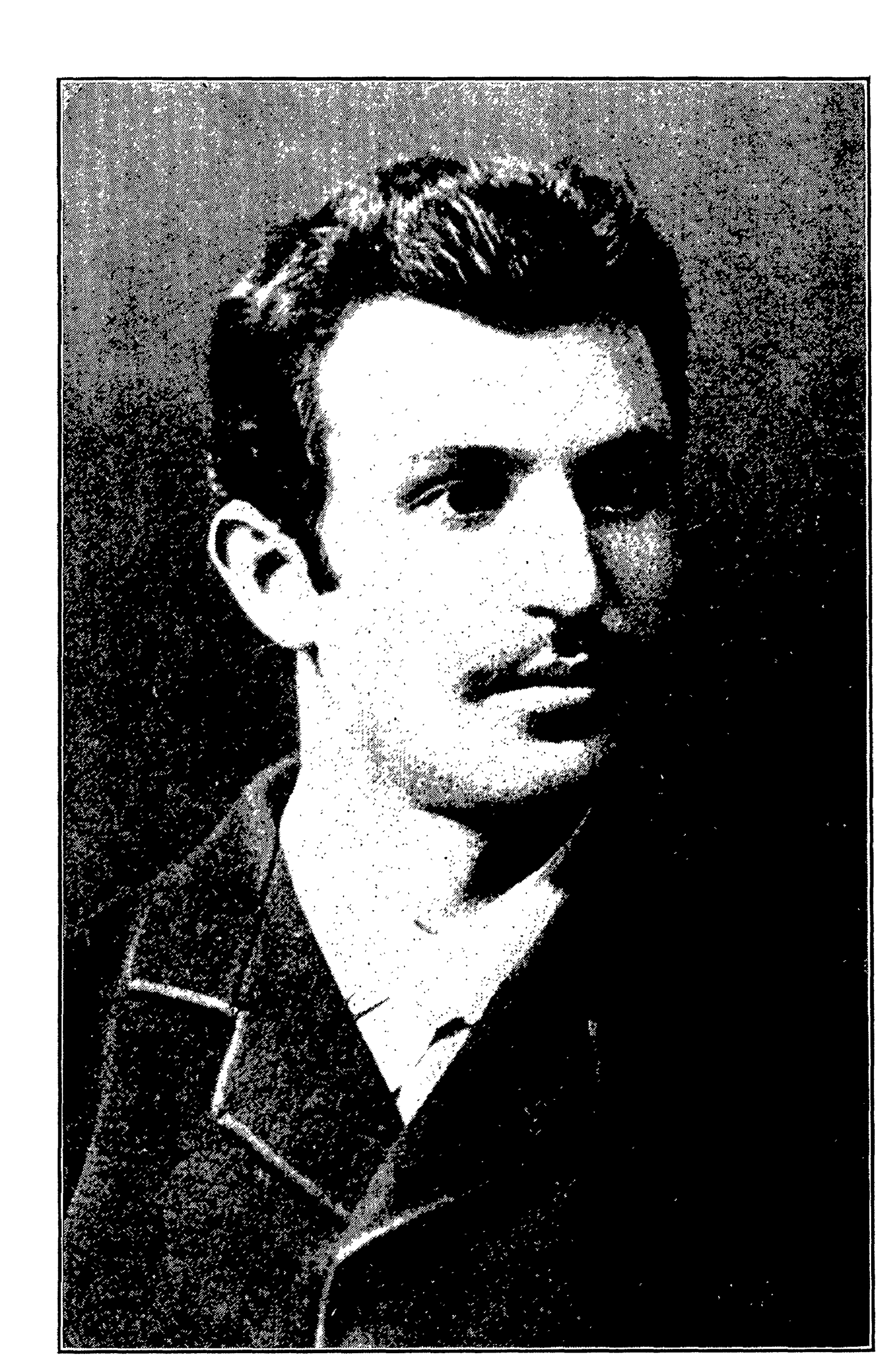
In the original: a plate between pp. 438–439
439in a downpour, and looks for a man who has there a reputation as an apikoyres (unbeliever), and perhaps as a revolutionary!
Finally I found him — a young man with black hair and mustaches, with round, slow eyes, with a mild, pleasant face. I told him what it was about, and he at once agreed.
When I came back home, my "frantovsky" (dandyish) hat had to be rolled out and set right, and the end was that it came out altogether without any shape, in another fashion than before; more rightly said, without any definite shape. And when my mother saw it on me, she simply clapped her hands in despair. My aunt said it was even handsomer than before, but I suspected she did not mean it.
The "naznachenie" (appointment), where I was to have my teacher's post, came from the "popechitel" (curator of the school district). I was sent to Velizh, Vitebsk gubernia.
It was the end of June. I had to go to the post in August. It was necessary to get a little money for clothes, linen, and so on. So it was decided that I should first travel to my uncle Khaim Leyb, in Petersburg, that he should help me out with finances.
My journey to Sventsyan and Malat had made no impression on my parents. They thought I had been at a friend's a few miles from town. My journey 440to Petersburg, however, was for them a historic event. My mother was always accustomed to look upon me as upon a small child, and here I was going all the way to Petersburg! A whole "ya tebe dam"!
My uncle and my aunt came to see me off. I wanted to go to my father and make peace with him. But my heart hardened in me. My mother and my aunt pushed me toward him, and uncle Mikhl begged me. But I, against my will, did not stir from the spot.
My father himself began to pack my things. Then I went up to him, and shamefacedly asked him to see me off. But now he became stubborn. The things he packed, but to the station he did not go.
"Come, old fellow," says my good uncle — "I will be your father. I will take you to the station."
And his eyes filled with tears. This is the same uncle Mikhl of mine who had fallen ill from the "dark young man's" tragedy.
The station was a few steps from us; besides the uncle, I was seen off by my mother and my aunt.
I arrived in Petersburg one early morning. Right at the station one could feel that this was a great city, beside which Vilna is a village. When I came down from the station, a policeman gave me a number and told me which droshky to take (a part of the system for keeping the izvozchiks in order).
The smell of Petersburg is altogether different from the smell of Vilna. It was a hot day, and it seemed to me that it smelled of tar, and somehow as if the thing itself 441had a connection to the greatness and importance of the city. My heart leaped from the consciousness that I was in Petersburg.
"Call out to me the streets we shall drive through!" I gave a self-important shout to the izvozchik — "You will get something for tea."
At every new street he called out the name, and many of the names were known to me from literature or from the newspapers.
Finally I came to my uncle at the factory, on Bolshaya Sadovaya Street. He received me well, but in his hospitality everything had a tone in which one speaks to a child.
At the factory worked a good number of people — all Russians. In the same building was also the dwelling. Then, however, the family lived at a summer apartment in Ozerki, a station on the Finland railway. And in the evening the uncle, with me and with a brother of his wife's, drove off there. There my uncle's wife received me, Hanna Bluma, a quite modern-dressed young woman. I had not seen her for about six years, and in this time she had become more elegant and more grown in appearance.
She spoke Russian better than the uncle, but also far from fully well.
They had three children — two boys and a girl, and with them also lived Verochka, the seven-year-old orphan of my beautiful aunt Mere, who had died a couple of years earlier of consumption. As an orphan, Verochka — a girl with dark little eyes — had stirred in me pity and a special interest. I had with her and with the other children 442spoken in Russian, and I envied them that they could not speak a word of Yiddish.
The dacha was a large one, and everything there was conducted broadly and "European." On Sunday several guests came, and one of them was the famous poet Frug, a young man with a straight, not-thick figure and with a white, light, not-quite-Jewish face. He asked me about our institute. That is all I remember about him.
There also used to come in a medallion-artist named Grilikhes, and a young man who then had a fine name as a contributor to the Russian-Jewish weeklies. As I noticed, my uncle and my aunt loved intelligent company.
The uncle used to introduce me to everyone, saying with pride that I was a nephew of his, and that I had studied to be a teacher.
"A remarkable thing with our Vilna folk," he once said — "they can finish twenty universities and still remain provincial. Those who come from Kiev or Odessa are quite different people. Of them one might think they are Petersburgers."
I prepared to ask my uncle for a couple hundred rubles. But it was not pleasant for me to do it, and I put off the operation from day to day.
Every morning, after breakfast, I drove with him to the city, and in the evening — back to Ozerki.
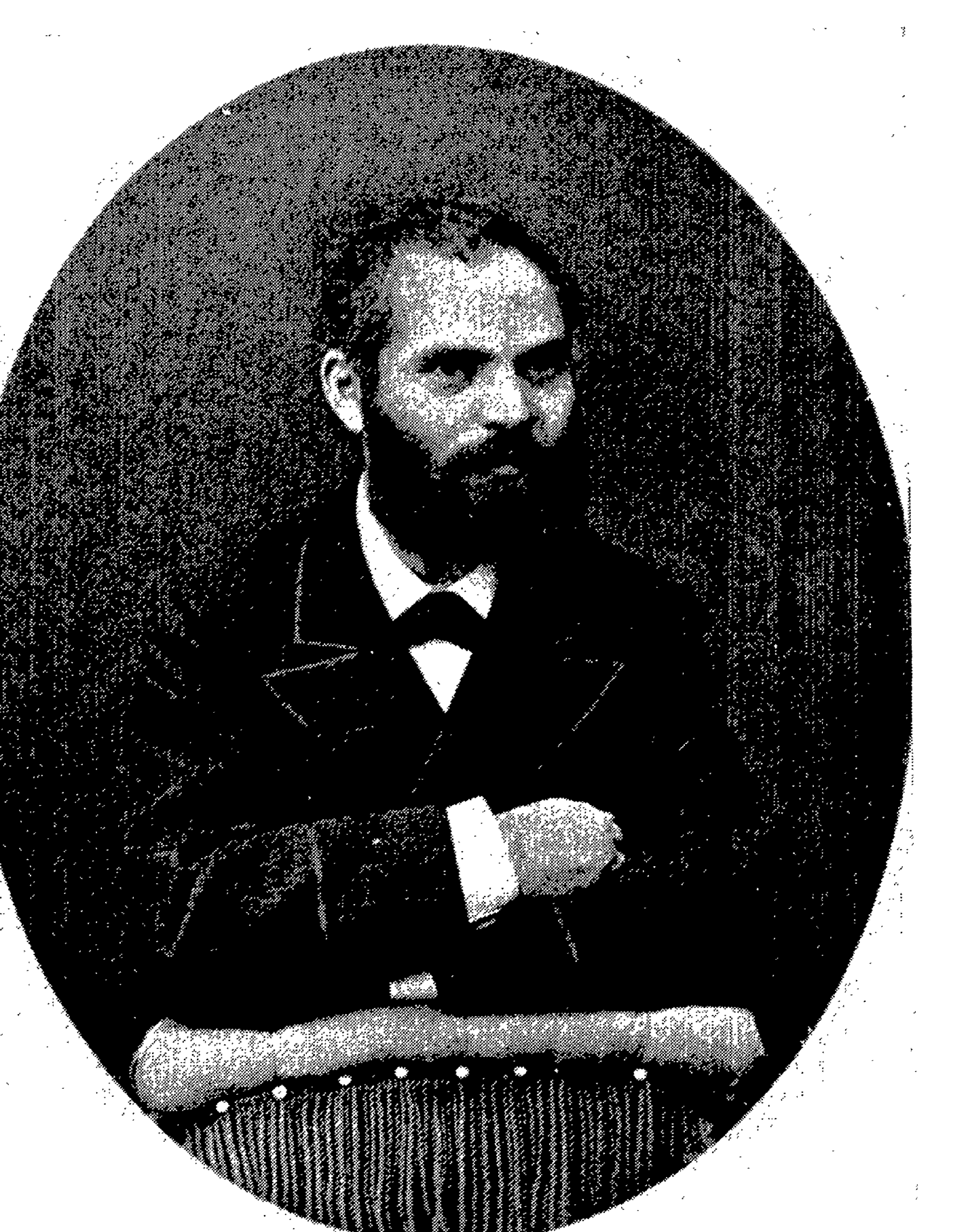
In the original: a plate between pp. 442–443
443In the city he took me to eat at the best restaurants, Christian and Jewish. The best Jewish restaurant in Petersburg was then Karam's, where rich Jewish businessmen used to gather. We were there a couple of times.
One day he says to me:
"I see by your face that you need a few rubles. Why are you ashamed? You are a provincial, after all!"
He asked me how much I needed. And I thought to myself: "If he himself offers me, then let me ask for as much as possible." But what came out, in fact, was even less than I needed.
"A hundred and fifty," I said.
Afterward I wanted to bite off my tongue.
He went with me to "Gostiny Ryad" to buy an "uchitelsky" (teacher's) frock coat. Passing along, we went through various shops of ladies' clothing, all Christian, for which he made the passementerie (trimmings).
Everywhere he introduced me, saying with pride that I was a nephew of his, and that I had passed my examinations to be a teacher.
I remember how I thought to myself: "A provincial, and a backwoodsman besides, and yet he is proud of me!"
We turned about among shops of men's clothing, larger, smaller, until he found an "uchitelsky" frock coat.
When I tried it on, my uncle burst out laughing aloud:
"A regular chinovnik (official)! Live to old age, old fellow! In a frock coat with brass buttons!"
I answered him angrily, that if he would talk to me so, I need neither his frock coat nor his money. 444
He smoothed it over jokingly, and we chose a frock coat that fit me well.
In Petersburg lived a married sister of Sokolov's and a younger brother. Sokolov gave me their address, and I visited them. Sokolov's brother showed me Petersburg, and he spent many hours with me.
The broad streets with their rows upon rows of reddish stone houses; the streams of European-dressed or red-shirted pedestrians; the packed two-decker tramways; the huge churches, palaces, monuments; the bridges and the little steamboats on the broad river; the widely-spoken Russian and the tarry breath — all together made, every hour, deeper the impression Petersburg made on me.
I had heard, or read somewhere, that a great city one imagines greater and grander than it really is, and that when one comes there, one is disappointed. I asked myself: "Are you disappointed?" And I answered myself: "No! Not a hair!"
Sokolov's brother introduced me to a couple of student-revolutionaries, and also to two groups of workers, among whom he conducted propaganda.
One day we spent almost entirely 445on a boat, sailing over the "Neva," and in the evening we ate supper with a group of workers on the bank of the river.
I was enchanted by the brotherly spirit that existed among them, and by the love they showed toward Sokolov.
"Since the masses are already so near to the propaganda, it can no longer last long," I said to Sokolov.
I visited the Ekaterininsky Canal, where Alexander II had fallen. There stood a temporary monument to him. Then I visited the place where they had hanged our heroes.
In the Academy of Arts of Petersburg there then studied my old friend Yankele Goldblat. And with him too I saw myself often. He showed me the academy and explained various pictures. For the time he had spent in the capital, he had made much progress in his art and in general development. And I heard from him many things that were new and interesting to me.
The young Sokolov went with me to the "Aleksandrovsky Rynok," where there were then shops of old books. For my teacher's post I wanted to have a library. Some books I had already collected in Vilna, and here I wanted to buy some more.
We went into a shop and began to look over the shelves. Soon I caught sight of two with old "Sovremenniks" — the journal of which Chernyshevsky had been the editor. I took apart the two bundles and found: a true treasure! Two annual volumes of "Sovremennik," which contained Chernyshevsky's translation of John Stuart Mill's Political Economy with his famous notes to it! In these notes the famous thinker, who was now wasting away in prison in the far regions of Siberia, had brought out his socialist ideas. And various other precious articles the two volumes contained: stories, critical re-446views, serious treatises on political, economic or social matters. And several of them bore names that in the 60s had become holy to the progressive young generation of Russia.
Only one volume was missing, a great pity, but what can one do?
"How much do you want for it?" I asked the shopkeeper in a tone of indifference, as if the two volumes had for me no special value.
"Forty rubles," he answered, also with an indifferent air.
It was clear that he knew the value of the books as well as I.
But forty rubles was also a great bargain. Yet we bargained. I beat the price down a little, paid it, and dragged the bargain off to my uncle's factory.
I had spent three weeks in Petersburg.
When I traveled back home, and the train came near the city, my heart pounded, as if I had not been there for many years. I stood on the little bridge of my car, and looked here and there, like one bewildered.
It was a warm afternoon in July. I came down from the station and took an izvozchik. When the droshky drove up to our house, my red-haired little brother, who was then less than seven years old, was playing with friends in the street. When he caught sight 447of me, he gave a shout: "Ah, my brother!", ran up to me and leaped into my arms.
A few of my kruzhok comrades had that summer kept an apartment not far from the "Zheleznaya Khatka," and I used to visit them there. At the same time I was preparing for my journey to Velizh, to my post. My mother prepared various things and fussed about me, as though she were getting ready to marry me off.
Finally came the day of my departure. I took leave of my revolutionary comrades, and went off home, where everything was ready for the journey.
Our family was not accustomed to traveling about. Seldom did anyone of them have occasion to use the railway farther than the station Vileyka, to which one used to drive in fifteen minutes' time. Vitebsk sounded to them like the name of a far-off little town. And here I had to travel not only to Vitebsk, but still farther! And I was going to become an independent man. To play a role, to wear a frock coat with brass buttons, and a cap with a cockade!…
In their thoughts various impressive pictures painted themselves, and the day of my departure was one of the most remarkable days in their experience.
With my uncle I had long been good friends, and now I showed him the warmest attention. He, my mother, my aunt, the uncle, with all the children — all saw me off as far as Vileyka.
Right in the same car sat Abraham Dov the house-painter's eldest son, Isaak Rita, who about ten years earlier had finished a rabbinical school. His studies at the universities had dragged on, and now he had 448studied to be a doctor at the military medical academy of Petersburg. He wore clothes that were similar to the "forma" of an officer. In the car my aunt chatted with him, and it vexed my mother that he drew the attention away from me. And she sent angry signals to my aunt.
The children turned about me, pelted me with questions which I hardly heard. My mother looked into my eyes and was silent.
Finally the train arrived in Vileyka. Only one minute it stood. People kissed, embraced. My mother wept. My aunt wept. The children sprang about me.
I barely tore myself away and leaped up onto the train.
The train began to move. Through the little window I looked at how my mother stands, pale. I was as if in a fluster.
But I made myself out to be a dashing fellow, waved my handkerchief from afar and smiled — supposedly.