Chapter Two
In the Gathering-Point of the Emigration
25We traveled on. At last we arrived in Brod.
It is the first crack of dawn.
Tiny, yellowish-white brick houses. Along the street walks a young man in a long, long caftan of good brown cloth, with a plush hat of the same color. He is a blond, and evidently of a rich, pious family. Such young men I had never seen in Russia. As it seemed, he was going to the synagogue, to the first minyan (prayer quorum). Everything looked unusual, almost unnatural. Perhaps my half-asleep condition had something to do with the impression the picture made on me. In my memory it is mingled with the taste of the early-morning spring air.
The wagons pushed deeper into the town.
In many places stood ruins of houses, or bare ovens and their chimneys. Later I heard that some years earlier there had been a great fire in Brod, and the people of Brod were too poor to rebuild the houses.
26Brod was once a rich trading town. That was when it was a “free city.” When its trading freedom was taken from it, it became impoverished. After the fire many ruins remained; everywhere were signs of desolation. Here and there a stretch of street looked like a mouth in which only two or three teeth were left. And this heightened the strange impression the town made on me.
In the library of our institute there was a book (put together from several magazine articles) about ancient Roman cities, and in it was an article about Pompeii, the city that lay buried under the earth for over seventeen hundred years, covered over and forgotten. The article told how the city was found and dug out. And so Brod presented itself to me as just such an excavated city.
We drove into the center of town. Not many people were yet to be seen; the populace still slept. The few Jews who did appear looked very peculiar. A water-carrier in a tall hat; a barefoot boy of about thirteen, who ran about with a big basket of bagels, also wore a tall hat; with us such a hat was worn only by a Jew who led the prayers at the reader's desk, and only on the Sabbath. Rabbis were, in Vilna, the only ones who wore tall hats on a weekday. A water-carrier in a top hat, as he goes about with his pails of water, and a barefoot bagel-boy in a top hat! — with us they would have been locked up in a madhouse.
The center of town is a small square with shops on all sides. On one side the shops 27ran behind a row of arches, like semicircular little vaults. Everything was shabby, ramshackle, poor as the poorest little lane of my own town. As I had previously traveled very little (Petersburg and Vitebsk were the only sizable cities I had visited), every new corner made a sharp impression on me; but Brod made an indescribably sharp impression. Almost everything in it was different from ours. And this difference was bound up with the greatest poverty and raggedness that I had ever seen.
The tall, broad, sallow Jew, the Brod smuggler who had joined us on the road, proposed that we drive over to his place. Since we knew no one in Brod, we accepted his proposal.
His dwelling was a horrible one. It consisted of a single room that had survived in a half-collapsed wall — a ruin of the fire mentioned above. On the other side of that house, under the same roof, the floor and part of the foundation had been completely destroyed. There remained a large pit with scattered bits of brick. In my eyes it looked like a robbers' meeting-place.
The family consisted of the tall sallow smuggler, his small, lean wife, and a small, lean girl of about twenty, a niece of the landlady.
We had not slept the previous night; and on top of that we had walked so long on foot. So we now fell asleep like the slain. A few of us had to lie down on the ground, with a bundle for a pillow.
28Later, when we got up, we began to whisper about going to look for some proper lodging. The sallow smuggler and his lean wife had treated us well, and we reckoned them decent and kindly people. Well, their kindliness was indeed genuine. As for their decency, however, we soon learned that we had been mistaken. One of our fellow travelers confided a secret to us — that the landlady had offered him her niece for a few kreuzer — “not in the house, but over there” (that is, in the ruined part of the wall). “Poor thing, a poor orphan; she wants to earn a few kreuzer,” she had said.
One might have thought the girl was not a niece at all. But she greatly resembled the landlady.
All this confirmed my impression that we had fallen here into a robbers' den. Yet, despite the landlady's offer, she and her husband were honest people. So I felt. The struggle for life had simply come too hard to them. They belonged to a world where moral decency is a luxury.
All in all, the episode sharpened my impression that I was in a kind of other world, where all concepts are turned upside down.
We went off to look for lodgings, each separately. As for me, after that experience I had no trust in anyone; I kept apart from my fellow travelers.
I went to a barber-surgeon (feldsher), got my hair cut, tidied myself up a bit, went to buy a hat, and then set about looking for a lodging. I soon found one.
29It was a dwelling on a lower floor, with an entrance straight from the street. The flat consisted of two large rooms, one toward the street and one toward the courtyard. My bed stood in the inner room. And there two more Russian emigrants were also lodging. One of them was a young man named Warhaftig, a lawyer from Kovel, in the Volhynia province — neither tall nor lean, with black hair, with a little black beard under his lip, and with a bass voice. The other I do not remember. The landlady was a widow, and she lived there with her two young sons.
At the window, toward the street, under a glass, stood a large, costly clock. Her husband had been a clockmaker, and that was his “sign.” That, and a certain number of other clocks, was the inheritance that remained from him.
The dwelling the widow kept clean, and everything there was decent and pleasant.
The next day I went off to buy a new suit. For a not-too-expensive “outfit” (garniture) I still had enough money. I bought the cheapest I could get. It was of a very light brown cloth. I thought it would fall apart at any moment. But it looked fine, and it was neatly sewn. At my lodging they told me it suited me.
From Brod I wrote my first letter home — to my parents and to my dear aunt Feyge. I told 30them where I now was, and that I was getting ready to travel to America. I also gave them to understand that the letter about my arriving in Paris I had dictated only in order to reassure them.
I also wrote to Nevel, to my friends Trotsky and Yunovitsh. I told them that I was in Brod, Austria, and was going to America. As a farewell I added the following words: “Go into the stagecoach office and tell Makhover that Lipshitz is the mask of Cahan.” No danger to them lay in my letter now. Since I was going to America, I had nothing to do with the Russian revolution.
One afternoon I am standing at the threshold of my dwelling and looking at the passers-by. I see: along comes the tall, blondish fellow with whom I had traveled on the ship from Mohilev to Kiev — that one who never stopped telling about the position he held with the Kiev millionaire Tereshchenko.
He stopped, astonished. Looking me over from head to foot — me in my new Austrian suit — he said with a smile:
— But you said you were traveling to Berditshev to trade in sugar?
— And you said you were traveling to a position with Tereshchenko in Kiev? — I answered back.
— Faugh, the devil take it! I thought you were a yeshiva-boy!
On the ship he had spoken to me with friendly impudence. Now his tone was quite a different one.
In Brod there were then several thousand Jewish emigrants from Russia. One met them wherever 31one stood and wherever one went, for they were very easy to recognize: by their general look and by their speech. People had gathered there from all the corners of southern Russia. Almost every day new trains arrived full of emigrants.
Brod was the gathering-point of the Jewish emigration. Whoever someday writes an exact history of those pogroms and of the great emigration they called forth will give the town of Brod a place as a historic point.
From there one traveled on: through Lemberg and Krakow, then to Breslau, Germany, and from there, through Berlin, to Hamburg. In Hamburg one boarded a small ship that brought the emigrants to England (to Hull or West Hartlepool); from there by rail to Liverpool, and from Liverpool on a large ship to America (mostly to Philadelphia). These were steamers of a company with which the English Jewish committee had an arrangement to carry the emigrants.
This committee was connected with the famous “Alliance Israélite Universelle” (the worldwide Jewish union), in which Jewish millionaires of France and other European countries took part. The “Alliance” provided the money and controlled the whole movement. The Jews of the various cities through which the emigrants passed received them and honored them like good guests; the great travel costs came from the “Alliance” itself, or from the committees connected with it. In Brod a branch of the Alliance organization of Vienna worked on behalf of the emigrants.
When I found myself in Brod, there came there from Vienna 32the famous writer Karl Emil Franzos. He was a member of the Vienna committee and had come over in the interests of the emigration. I heard a speech of his to the emigrants.
The Austrian government was friendly to the emigrants. It demanded no passports from anyone, and we felt altogether much freer there than in Russia.
The main thing lay in this: that the Austrian government showed little antisemitism — almost none. The Jews there felt much better in their native land than Russian Jews felt in Russia. The Austrian Jews used to speak of Franz Joseph, their emperor, with love. And the Austrian soldier or officer did not frighten them.
All this made a pleasant impression on our emigrants. They felt at home in Brod. The Austrian military they did not take seriously. Even the Austrian gendarme, with his big plumed hat, with the black feather, and with his bare sword — even he seemed to them like a joke. The Russian soldier had looked bigger, fuller, stronger, and more “fearsome” (strashny).
“One of our soldiers would knock such a ‘hero’ down with his little finger,” I would often hear from our emigrants whenever an Austrian soldier passed by.
And yet they would express friendly feelings toward Austria with its army, and curse the Russian emperor with his military might.
Around the Brod barracks Russian emigrants always strolled about, and when there they would 33drill the soldiers, a whole crowd of ours would gather. They would stand and watch, make comparisons, make the same remark a hundred times.
An interesting moment used to come in the evening, when at the barracks they trumpeted “Good night!” to the soldiers. Then several hundred Russian Jews would gather there. The military instruments played with pensive, gentle tones, which spoke to the emigrant's saddened heart. When they would stand thus in the evening shadows, looking at the gleaming trumpets and listening to their mournful melodies, a longing lay upon their faces — a longing for the home they had left, and a fear of the unknown future.
To be accepted by the committee as a candidate to travel to America was no easy matter. There were too many emigrants, and one had to wait long before one was entered on the list; and only then began the waiting to obtain a card for the journey. Many of the emigrants had come to Brod without a groschen; and some simply went hungry. There was a charity kitchen. One managed however one could; slept on the ground, suffered, and waited.
But there were also those who had come to Brod with handsome sums, some even with thousands. But why buy a ticket, when the committee 34sends one free? So most of the rich also waited. And it is a fact that some families ate up as much as a few thousand rubles waiting for a free passage that came to a couple of hundred.
I knew such people. In Brod, too, I knew a few Russian-Jewish families who were beautifully dressed and carried themselves in a grand style, though they had not a kopeck in their pocket. One family, for instance, with remarkable impudence drew a handsome sum from the committee every week, so that they could live according to their “station.” At last the committee shipped them off to America in order to be rid of them.
When an emigrant train was about to depart, many of the emigrants who were staying behind would come to see it off. “Travel in good health! A happy journey!” they would wish them, with envy in their voices. And those at the car windows would answer back with pride and with sympathy: “Stay well, we'll meet soon in America! And perhaps even in Liverpool!”
I set about looking for the intellectual emigrants whom Belkin had described to me — that company of inspired socialists who were gathering to go to America in order to realize their ideal there.
Walking through the streets, I listened to whether people were speaking Russian or Yiddish. If Russian, that meant they were intellectuals.
At first this brought me no results. I stopped a young man who looked to me intellectual, and turned to him in 35Russian: “Excuse me, where do the intellectual young people live here, who are traveling to America?”
— I am an intellectual and I am traveling to America, — he answered me. But he could barely get the Russian words out. It was clear that he did not even understand what I meant.
Then I stopped an intelligent-looking couple. In them I made no mistake. I explained to them what I was looking for, and they showed me where to go. They gave me an address where there then lived a Kiev couple named Kulisher. The man of the family had served as a tutor in the house of the Kiev millionaire Brodsky, of the Brodskys, the famous sugar manufacturers. A part of the Brodskys had, after the pogroms, gone off to Brod and settled there for a time; and Kulisher with his wife and child had come along with them. The Kulishers lived in a separate flat, and at their place many of the intellectual emigrants used to gather.
So I went off to the Kulishers.
The Kulishers had quite a respectable, middle-class flat on the first floor of a brick house, right in the middle of the town. I came up and presented myself as an educated teacher from Vilna. They received me kindly.
Kulisher was a handsome young man with a great golden beard and beautiful long golden hair, and his wife was a beautiful, intelligent young woman, with black hair and lively black eyes. She was holding a child in her arms. At their place there were then a few guests from among the intellectual emigrants, and they introduced us. Soon there came in from the street a young man of 36middle height, with a dark-blond little beard and wearing spectacles. They introduced him by the name Mashbir.
— Mr. Cahan, too, finished an institute — the Vilna one, — Kulisher recommended me.
It turned out that Mashbir had finished the Zhitomir institute, and that in Balta he had been an administering teacher in just such a school (a nachalnoye uchilishche, an elementary school) as the one in Velizh. He was several years older than I, and he had graduated four years earlier. We took an interest in each other.
After the pogrom broke out in Balta — the most terrible antisemitic attack of those times — an emigration party organized itself there, and he became its leader. So now he was in Brod with the Balta emigrants. He and Kulisher had been schoolmates and close friends; so he was staying with him; and here he was the center of the Balta “Am Olam.”
We talked about our teachers' institutes, about his Balta school and about my Velizh school. He was an even-tempered, polite man, and through these conversations I became acquainted with him more closely than with all the other emigrants.
He proposed that I join his Balta circle (kruzhok).
He was no socialist. And, as I understood at once, the other members of his circle were not socialists either. The colony they were going to found was planned along idealistic lines; but in what this idealism consisted, Mashbir himself did not know.
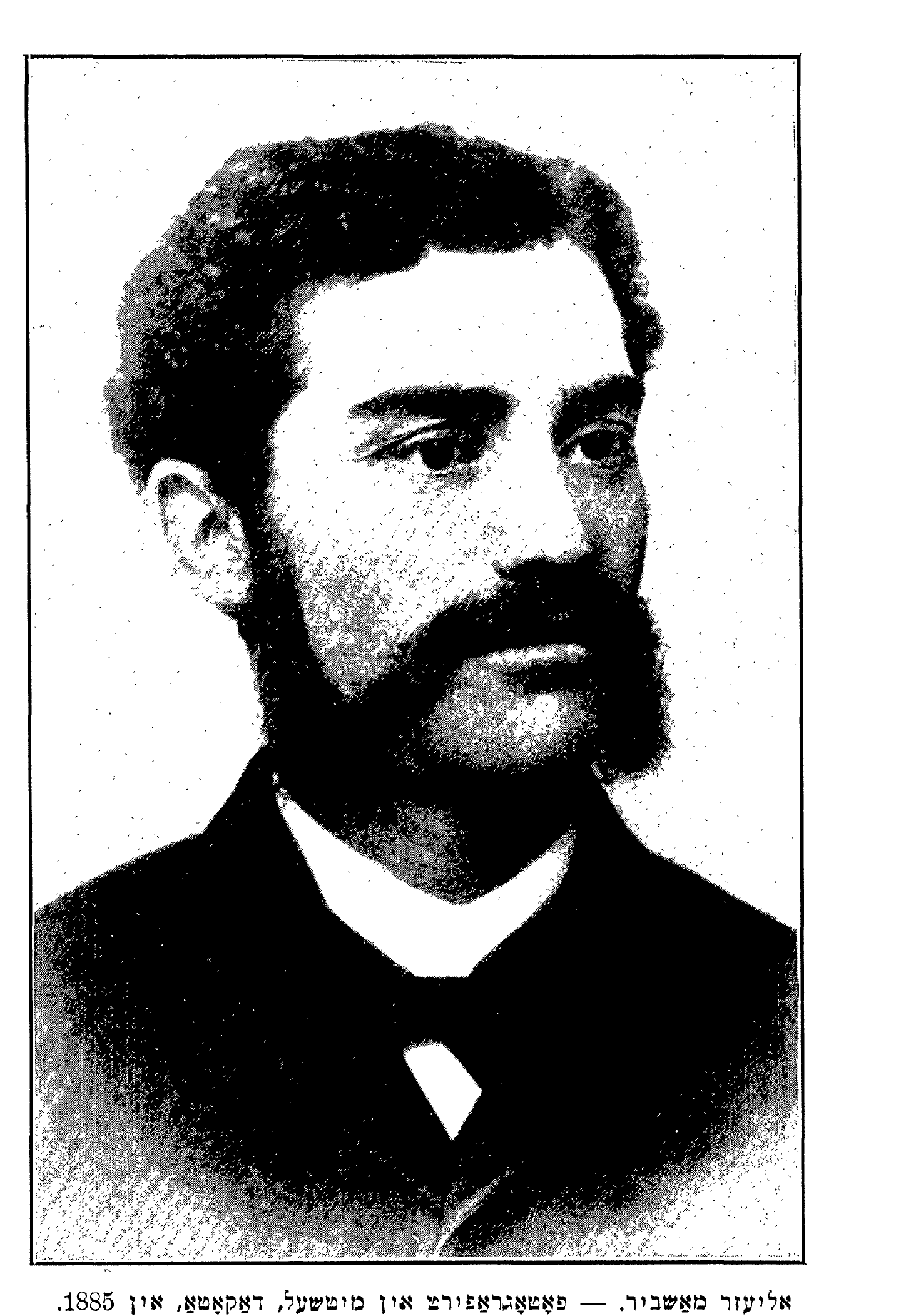
(Photo plate; in the original, between pp. 36–37)
37— Will the colony be a communistic one? — I asked.
To this question he had no clear answer. And the same may be said of most of the other “Am Olam” people. About communism or socialism these emigrant parties had on the whole thought little. They simply meant to found colonies where they would work and lead a fine, new sort of life; begin a new chapter in the history of the Jewish people.
The only “Am Olam” group that traveled with a definite communistic program and tried to realize that program was the first “Odessa Am Olam,” a group that had set off for America a few months earlier. (In America many other attempts were also made to found communistic colonies. In these undertakings, however, mostly Christians took part, and they have no connection with our matter.)
A Vilna group, which had joined the Kiev “Am Olam,” consisted entirely of socialists, members of our Vilna revolutionary circle; but it did not travel through Brod, and I did not yet even know that such a group had organized itself in Vilna. In Brod there were a couple of members of the socialist circle of Kremenchug, but of that, too, I knew nothing at first.
I became bitterly disappointed. The great number of socialists I had expected to find here, I did not find. The number of socialists among the emigrants was, on the whole, quite insignificant. And even those who at home had been connected with the revolu38tionary movement had here in Brod, in the ferment and tumult of the emigration, not themselves known whether their going to America had any connection with socialism or not. Neither did they know, nor did it trouble them; some of them had through the programs become imbued with the nationalist spirit, and they took more interest in what they would do for the Jewish people than in the question of building a socialist society.
Among our Brod emigrants there were even some who belonged not to the “Americans” but to the “Palestinians.” Heated debates used to take place here between the two camps, and also among the various tendencies within the “Americans” themselves. Such debates I heard more than once in Kulisher's house.
I say that I “heard” the debates, for I myself at first took no part in them. I had no courage. I felt that I had no firm opinion.
Besides that: I was a shy fellow, and here I was the only “Litvak,” and in a society of Little-Russian intellectuals I found myself for the first time in my life. They spoke a little differently from me, and their manners too were a little different.
In my heart I held myself high. I am a socialist, and I am traveling not as an ordinary emigrant but as an “underground man,” whom the Russian gendarmerie had twice “searched” and had been about to arrest.
And who are they? They had probably never in their lives so much as set eyes on an underground pamphlet…
The world was, for me, always divided into “ours” and “not ours,” and it was not hard for me to recognize to which class this one or that one belonged. Only a couple of 39words had to be uttered, and one could already understand whether the other had any connection with a revolutionary “circle” or not. If not — and if he was not even a “sympathizer” — he belonged to a lower class.
One of the intellectual emigrants of Brod once began to tell me how he had distributed the “Narodnaya Volya” (the People's Will) in Russia. I felt at once that it was a lie.
— Which number was it? — I asked him.
— The 47th, — he answered.
That was enough for me. The highest number of “Narodnaya Volya” that had appeared up to then was the eighth (the seventh and eighth together, it seems).
I do not believe that in all of Brod there were then to be found a quorum of people who had ever so much as “tasted” the underground Russian press.
In my heart, then, I held myself greater than Kulisher, than Mashbir, and the other educated young people who used to come in to them. But that did not keep me from feeling ashamed before them — ashamed only because they were Volhynians, or Odessans, and I — a “Litvak.”
The days were beautiful; the spring sun shone and warmed pleasantly. So the emigrants went about the streets and through the couple of small parks that Brod possesses; they walked and talked, and some with sorrow in their voices. The intellectual young Russians debated, got heated, shouted, and the Galician Jews looked on curiously.
40In Kulisher's house I first met Nikolai Aleinikov, the leader of the Kiev party “Am Olam,” who was now traveling to America. He was a tall, lean man, with a black little beard, with a truly Jewish face, and with spectacles on his eyes. His Kiev party drew much attention in Brod, and on the street people would point him out with a finger. He was one of the most important personalities in the emigrant party.
Among the emigrants whom I often used to see on the streets of Brod, three figures have remained in my memory: a Jewish dragoon from Russia, who had crossed the border riding his government horse, and two Jewish telegraph operators — one very tall, and one very short, with a hump.
A Jewish dragoon was a rarity in Russia. Jewish telegraph operators, too, were an unusual thing. All three of them used to stroll about Brod in their uniforms; the two telegraph operators always together.
Once, when I was walking along the main street of Brod with an emigrant, my companion stopped to greet a young man who caught my eye with his red hair and his full-blooded face. Together with him went the young man with the hard “r's” (reshn), with whom I had crossed the border. I had not seen him since we left the strange house where we 41had had our first night's lodging. He, too, now had an intellectual look.
My companion introduced me to the red young man, whose name was Spivakovsky; and that one introduced to us the emigrant with the hard “r's.” Earlier I had not known his name. Now I learned that he was called Shamrayevsky.
— But we already know each other, — I remarked in Russian.
Shamrayevsky looked at me in surprise. That I could speak Russian, and in the intellectual style at that — this was for him an unexpected piece of news. For me, in turn, it was news that he too was an intellectual and not a ladies' tailor.
Speaking in haste, Spivakovsky said something about the movement, and about an important personage whom he was going to see concerning Palestine. His ruddy, full-blooded face and the urgent, hasty voice with which he spoke in that moment made on me the impression that he was an inspired, warm-hearted, likable young fellow.
It turned out that he and Shamrayevsky were from Kremenchug, where they had been members of a revolutionary circle.
Spivakovsky is the present Dr. Spivak of Denver, Colorado, and Shamrayevsky — the present Dr. Rayevsky of Liberty.
In later years Dr. Rayevsky described our first meeting,* and I believe it will not 42be uninteresting to reproduce here a part of his account.
On the train Shamrayevsky had sat with old-fashioned Jews and played for them the role of a pious workman. For a certain time he went over into another car, because, being near those Jews, he would have had to pray, and this he wanted to avoid. Afterward he returned to his former car and told the pious Jews that he had prayed in the second car. He describes how in Berditshev the merry company of intellectuals, whom I mentioned above, came in, and how there he noticed me. I made no good impression on him.
Further Dr. Rayevsky tells about me thus:
“He wore a long overcoat, which looked both like an overcoat and like some kind of long caftan. I see him edging up to the intellectuals too, and yet he is not one of theirs and speaks with no one. He looks and listens. Now he looks to me like a poor yeshiva-boy who comes to us in Little Russia to become a melamed, and now he is somehow not that.”
Plainly put: Shamrayevsky suspected that I was in the service of the police. Since he himself was not “kosher,” he wanted to keep as far as possible from such a fellow. He tells how I turned to him about hiring a smuggler together, and how afterward he took counsel about me with his orthodox Jews. They too had seen how I was looking for partners to hire a smuggler, and they told him that I made the impression of a quite honest young man. They advised him to make the deal together with me. The present Dr. Rayevsky 43tells how he spoke with me and how his impression of me changed for the better.
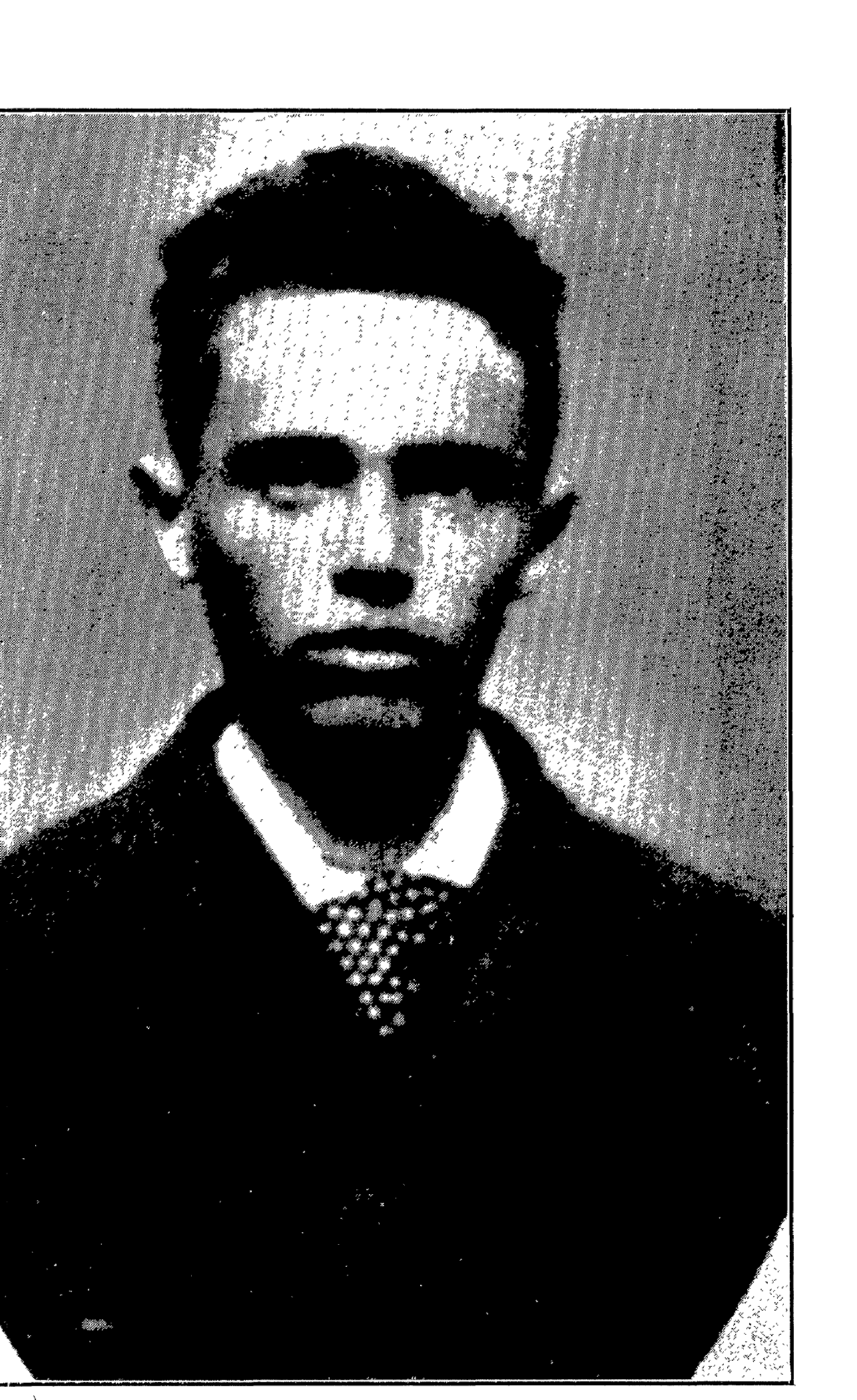
(Photo plate; in the original, between pp. 42–43)
Further he tells how later, sitting in the railway car, already on the way to the border, he envied young Broida, whom I covered up every little while so that he should not be cold, and over whom I watched like a mother over a child. He writes that he wished he had someone who would watch over him too in that way.
About the dwelling of the sallow smuggler, Dr. Rayevsky writes that it made on him the impression of one of the mysterious dens in the novels of Gaboriau.
When we later met on the street in Brod, already as intellectuals, he again had a suspicion of me. And when he heard how I spoke Russian, that confirmed for him that I had earlier played a false role: perhaps really a spy who had come to keep watch on Russian revolutionaries among the emigrants?
I became acquainted with various “Am Olam” people and with emigrants of other groups (Shamrayevsky and Spivakovsky had joined the “Kiev Am Olam”). Almost all of them were from southern Russia. Litvaks were very few. But I had already begun to feel more at home among the “southerners” (yuzhane), and I debated with them day and night.
When my shyness had passed, I displayed so much life and temperament that I became a “real live wire,” chiefly in a certain group. Once an intellectual (from Odessa, it seems) says to me:
44— I thought you couldn't count to two.
I had no idea you were such a lively fellow and such a fiery debater.
There had worked itself out within me a peculiar program, which was not clear even to myself.
It was not what I had imagined from Belkin's description; yet it was beautiful all the same. We would found colonies, we would live not egoistically but in the interests of humanity (others spoke of the Jewish people. I, however, spoke only of humanity). That we would have colonies, of that no one had any doubt.
I had then no definite notion even of socialism itself. All that I was truly convinced of was that one must destroy the power of private property, of thrones, and of religion. I understood Karl Marx's explanation that the capitalist system is heading toward its own self-destruction. But that was a purely theoretical sort of understanding. It had no practical significance for me.
From the journal “Vperyod” and from the newspapers “Cherny Peredel” and “Narodnaya Volya” I was acquainted with the two revolutionary parties and with their debates about anarchism and socialism; but of the practical sides of socialism and of its political programs I knew little.
The upshot was that I enrolled in the Balta “Am Olam.” So what if the other members were not socialists? I would “propagandize them all around”!
Once, in a debate with a couple of the members, I got heated:
— You are a conservative — I said to 45one of them — you don't care that those who toil and create are all being robbed and oppressed.
— Then why are you traveling with us? — asked the other, with a poisonous smile.
— I will propagandize you all around! — I answered back with pride. — I'll have a double job: I'll work in the field with everyone, and in the free hours I'll teach you.
— Nobody's asking you! Who needs you? — the other burst out.
My tactless words made a bad impression. But it was soon smoothed over. My relations with the Balta circle were very good. They treated me like one of their own, and showed me respect.
From home I received the sum of money I needed — about a hundred dollars. Of that I paid two-thirds into the fund of the Balta circle, and that took care of my journey to New York. I waited with impatience for the day when we would seat ourselves on the train.
While waiting in Brod, a fair number of emigrants got married — most of them to Brod girls. Among our wanderers an opinion was widespread that the Galician women were very beautiful. And since in nearly every Galician house emigrants were lodging, romances between young Russians and the daughters of Brod Jews grew like mushrooms.
46The Galician parents, mostly not rich Jews, meanwhile had a chance to marry off their daughters. And such a match was reckoned a settled prospect. The young couple would travel to the land of gold, and would perhaps afterward bring over the whole family… Our young people, for their part, imagined that in the colonies they would found it would be better, with a wife, to keep house. In short, it became a kind of epidemic of getting married. Today acquainted, tomorrow wed.
When I recall the days I spent in Brod, I always see before my eyes the following scene: a Saturday night, about two weeks after I had come there, on a desolate street where all the houses had been burned down, people are dancing and carousing. Klezmer musicians are playing. I am strolling about with another emigrant.
We ask what the dancing means, and someone answers:
— There's a wedding.
— On the street they hold a wedding?
— Yes, on the street.
A couple of fiddlers play for three weddings at once. One wedding is on one side of the street, the other across on the other side of the street, and the third over a ruin beside the second. The musicians stand in the middle of the street and work with all their might. A little farther on, it is the same again.
We go, we look. In one spot I catch sight of an emigrant with whom I am slightly acquainted. He is dancing here with this one, there with that one, merry and sweaty. I stop him.
— What's the celebration with you? — I ask.
— I'm getting married! — he answers.
He gives me a tug and presents me to his bride 47(a beautiful girl), and then he grabs me and drags me into the dancing too.
The emigrants were mostly people who had never before traveled away from home. Longing and loneliness gnawed at the soul. One thirsted for an intimate friend before whom to pour out one's heart.
Such a mood is a fertile field for the flowers of love. Another reason: one was cut off from relatives and friends, and that meant that one was free of the iron rules that hedge round a match. Everything had turned over and become mixed up. A world of anything-goes!
Whether one had truly fallen in love, or only thought one was in love — one asked no questions and got married.
Notes (footnotes in the original)
[p. 41] In a jubilee volume that was issued for the fiftieth birthday of the author of this work.