Chapter Five
Groups and Personalities
115The Vilna group had settled in an apartment of several rooms, at 48 Essex Street, near Grand. They lived in a genuinely communist way. The leader of the commune (komune) was Menaker.
One of the women would stay home and run the household; the rest of the members would go to work in various factories; and everything they earned was turned over to the common treasury.
Among the members were two cloakmakers, ladies' tailors from the old country, who earned quite large wages here — and they gave it all to the commune. The feeling among the members was a truly communist one, a warm-hearted one.
I did not live in the commune. But I visited it often. And when I lost my job in the tin factory, Menaker invited me to live in the commune as a guest for a certain time.
Their apartment was a gathering point, where all sorts of progressive immigrants would assemble, members 116of the "Am Olam" (am olam, "eternal people," the back-to-the-land movement) and others. People would come together there in the evening, as in a club.
As I write these words, there stands before my eyes a young man from the "Odessa Am Olam," not tall, with black hair, a short black little beard, and interesting black eyes. He was one of the most important figures in the "Am Olam" and one of the most interesting types of the immigration. His name was Bakal.
For a certain time he gave lectures in the Vilna commune. Around a large, long, plain, uncovered table the members of the commune and their guests would sit, and a fair number stood around. In the middle, at the table, sat Bakal. He spoke — in a homely, unhurried way and with a scholarly (lamdonish) smile on his lips — and the audience listened. His speech was an Odessa Yiddish, and it was filled with Russian words and expressions. When he was missing a word, he would simply take a Russian word and use it as a Yiddish one. Instead of, for example, "men shtelt di frage" ("one poses the question"), he would say "es yovet zikh a vopros." And the word "yovet" he would pronounce according to the Odessa Yiddish pronunciation: with a kamets instead of a pasekh — just as he would say "tote" instead of "tate" (father) and "kosene" instead of "kasene" (wedding).
It was a peculiar sort of lecture. He had read a fair bit (in Hebrew and in Russian); but a truly educated man he was not, and his lectures were built far more on his own thoughts than on what he had read or learned. He was an observer and a thinker. But he had no system in his thoughts, and his "lectures" too were without a system and, in fact, without a fixed theme either.
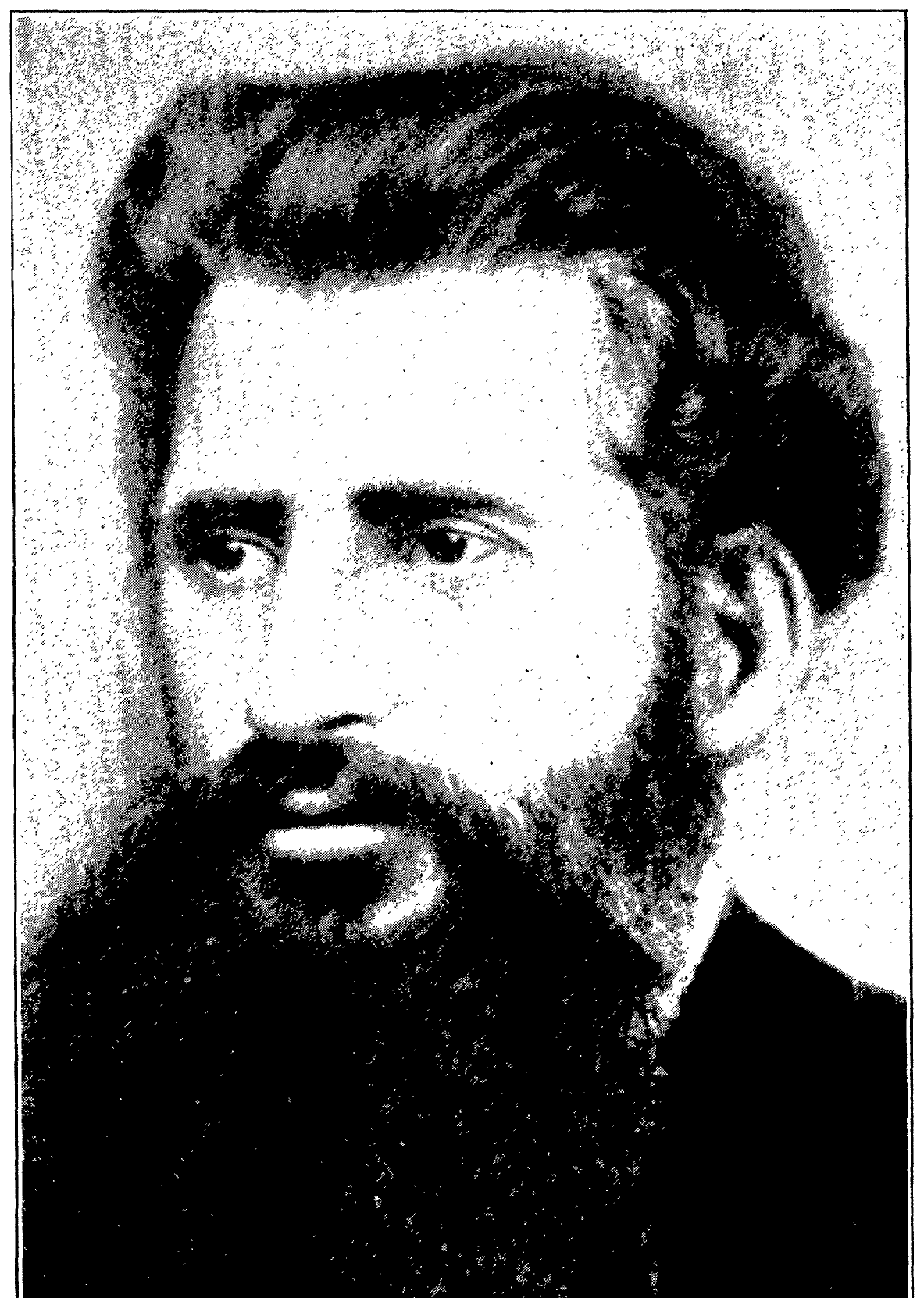
(plate; bound in the original between pp. 116–117)
117Whatever happened to fall into his mind, that is what he talked about. He sat and chatted — "thinking out loud," as Americans call it.
I remember, for example, how once he posed his listeners the following question:
— Why do people laugh when they see someone slip and fall?
And to this question he gave a long explanation, which was grounded in personal experiences and observations.
He was a capable man and a clever man; and his mind was always at work. Much of what he said was interesting. Often he would even express a very grotesque, original, and important thought. But a good deal of his talk consisted of gut-reasoning (boykh-svores) — the kind of "philosophy" that you can hear from any ignorant but clever merchant when he gets to talking about the world.
To his lectures certain immigrants would relate as if they were lofty scholarship. The more intelligent and developed did not hold such an opinion of them. But interesting they were to everyone, and almost everyone had respect for him.
A part of that respect was grounded on the fact that he lived like a hermit (porush). People regarded him as a man who was absolutely free of egoism. In part this was true. But one cannot say that he was always entirely sincere. Honest he was, and spiri- 118a smile, which strongly created the impression that he was somehow not at all like everyone else; a kind of holy man.
But often he would create on some of us the impression that he was a bit of a politician. We would say among ourselves that he was sly, that he knew what to keep silent about and how to speak — as it paid to do. Yet no one ever caught him in a lie or in hypocrisy (tsveyesstve).
All in all, he was an interesting personality. He led a life true to principle and often went hungry. This was one of the causes that brought him to consumption (tuberculosis) and to an early death.
In his last months he spent whole days in Prospect Park, where he fed his body with milk, and his spirit — with reading and thinking.
Little by little I began giving lessons in English. I myself still knew the language only "theoretically" — to put it plainly, very little; nevertheless, some of my acquaintances took me on as a teacher, gladly.
I taught them as much as I could, and at the same time I went on studying the language by myself. I took special pains to know correctly how to pronounce the words that I read with my pupils.
Since the American "r" has a quite distinctive sound (it is even different from that of the English), I set about imitating this "r." With the English "th," which is produced with the help of the tip of the tongue (it 119simply could not be believed that one means it seriously and not as some mischievous mimicry), every immigrant has trouble. But my tongue easily overcame such difficulties.
When my friends among the immigrants heard how I strained to pronounce English words in the "genuine American" manner, it struck some of them as repellent: something as though I were contorting myself, making strange grimaces. But Mrs. Sauce's daughter and her husband took pleasure in my "th" and "r."
I made up my mind that the best thing would be to go to school — not to an evening school, together with other foreigners, but to a regular grammar school, together with American children. This was now possible for me, since by day I was already free. The lessons that I gave were all in the evening.
So I came up to the public school that stands on Christie, corner of Hester (it stands there to this day, only the building is a new one).
I came into the general hall. On the platform sat the principal — an old man with white side-whiskers — Mr. Wright. In my labored English I explained to him that in the old country I had been a teacher in a public school, and here I wanted to become a pupil in such a school, in order to learn the pronunciation thoroughly.
He understood me, and my explanation interested him. He advised me to enter the highest class. Among the little children, in the lower classes, I would be just as much a foreigner as among 120a classroom where there sat boys of twelve, thirteen, and fourteen years; and there he introduced me to the teacher, a Mr. Farrell, a man with hard, black hair and a mustache, in a long black coat.
The principal explained everything to him, and he, Mr. Farrell, gave me a seat at one of the first desks, near his little table. He sat me down beside a boy named First, who was one of the best pupils in the class, and he told him to help me with the pronunciation. In doing so he made gestures at me, as though to a mute person.
About two-thirds of the boys were Christian, and of the Jewish third perhaps half consisted of "Yehudim" (German Jews).
One of the Jewish (non-Yehudim) pupils was Abraham Sarasohn, the son of Kasriel Sarasohn, the founder of the "Tageblat" (at that time he was putting out a Yiddish weekly under the name "Di Gazetten").
Both the Christian and the Jewish boys treated me well; and the teacher too. While I was reading, no one laughed. On the contrary, the boys expressed with their gestures astonishment, as though they were marveling at how well I read English. They did this deliberately, to give me courage. But they really did wonder, too. When I read out the simplest word, they were astonished, somewhat as though I were a cat or a calf, and it was remarkable that I could at all let out a human sound from my mouth.
Mr. Farrell taught the boys to sing, too. But he himself did not sing along. Never. He would only command, look in the booklet with the printed notes, make 121motions with his finger this way and that and count out the beat: one, two, three! one, two, three! And the boys would sing.
I was sure that he could not carry a tune.
— And this "mute conductor" is teaching singing! — I would think to myself. I added this to the list of accusations that I had against Columbus...
Once, while I was sitting and looking at him, with his hard, black hair, it occurred to me that he looked like Eliye Itshe, the head of the yeshiva, my onetime rebbe. To find a resemblance between them was comical. But the more I looked at Mr. Farrell, the greater the resemblance became.
On Fridays a professional singing teacher would come. Then Farrell would go out with me into the general hall and there give me a special lesson in reading English.
When Farrell spoke or read something aloud for the class, I listened to every word, to every sound. I also listened to the pronunciation of the boys. I followed their manners, their expressions. Here the English language sounded to me even stranger, more unnatural than in Liverpool. It seemed to me that the teacher was contorting his lips, doing crazy things. But his friendliness and goodness toward me covered all of it over.
We read McGuffey's fifth "Reader." Once we read an excerpt about the American bird the bobolink. The first words were:
122sounded to me so peculiar, so foreign, that the scene and the tones engraved themselves deeply in my mind.
In later years, when I took up an interest in American birds, I first gave the greatest attention to the bobolink. And to this day, when a spring goes by and I do not see this genuinely American bird and do not hear its pleasant, clarinet-like tones, I miss it for a whole year.
Several times Mr. Farrell told the boys to take a moral lesson (musar) from me. He would ask me something about Russia, and when I would answer him, he would say to them:
— You see, Mr. Cahan knows the geography of his native land well; why then have you no desire to learn the geography of your own country?
Books were given out for free — and a whole mountain of them. In the morning I would go to school with a pack of books, like a boy, and in the evening I would become a teacher. And later in the evening, when I would come home, I would carry on with my "Appleton's Grammar."
In the course of a few months I already understood enough English to read newspapers and books.
In all, I went to school for three months. More than that I could not have drawn any use from it. And "Appleton's Grammar" too had already become superfluous to me. But once you begin something, you don't want to leave it in the middle. So I resolved to get through "Appleton's Grammar" to the end — and kept resolving and putting it off.
Once I took a look into Appleton's last lesson. I made sure that this too was no longer anything new to me; and that I absolutely no longer needed the book.
123In those months the personality of William Frey, the Russian scholar who was mentioned in an earlier chapter, played an interesting role in the spiritual life of our intelligent immigrants. He was one of the most remarkable men I have ever met. Such natures are few in the world.
The reader already knows that he was a communist, and that for him communism was bound up with Auguste Comte's "Religion of Humanity." Comte himself was not a communist. His other followers, too, did not favor communism. But with Frey the two "isms" — positivism and communism — were a twin grown together. And he served them as an inspired devotee serves his faith. In this he displayed a remarkably strong character. He was a moral giant.
His influence on us was great, and although this influence did not last long, Frey's figure remained forever in each of us like a shining star. We all idolized him, and some of us followed him as an inspired Hasid follows his rebbe.
His real name was Vladimir Heins, but in America he gave himself the name William Frey, and that is what he called himself until his death.
He was now living in New York, but only for a few months. He was preparing to travel to the 124"New Odessa" commune, which had been founded by the first Odessa "Am Olam," near Portland, Oregon.
In his youth he had studied at the military academy of Petersburg; afterward he became an officer and a man of science. He took part in a certain scientific expedition, and he rose quickly; but suddenly he threw it all away and went off to serve his communist ideal. In 1875 he came to America with a group of other idealists, and in the state of Kansas they founded a communist colony. There he became interested in the teaching of the French philosopher Auguste Comte; he also studied it thoroughly and became inspired by it. He began to lead his life according to Comte's religion, but in a far deeper religious manner than other Comtists, and to the "Religion of Humanity" he added not only communism but also vegetarianism. He fed himself only on fruit and greens. And in this he was as devout as in his "Religion of Humanity."
He was of medium height, lean, with soft black hair and a soft black beard, with regular facial features, which often took on a childlike expression.
I used to visit him at his apartment (in a poor tenement house on Ninth Street, near First Avenue), and at every visit I would feel as a Hasid feels with his rebbe, although his Comtism did not take hold of me and his vegetarianism aroused in me only curiosity.
Paul Kaplan, who was one of the leaders of "New Odessa" and looked after their business affairs in New York, was living at that time with the Freys.
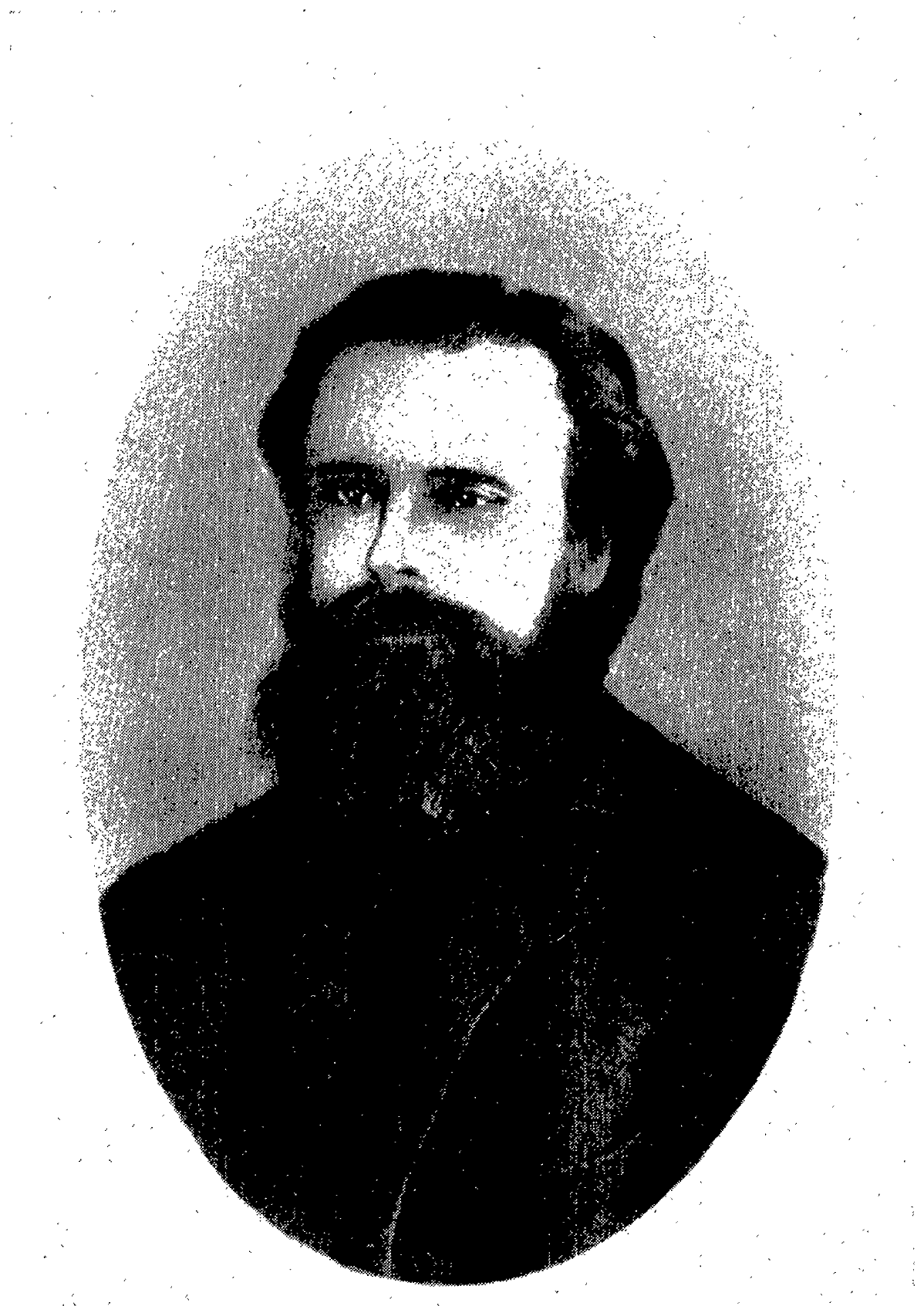
(plate; bound in the original between pp. 124–125)
125Almost everything that Frey did was a part of his religion. He himself would knead and bake a kind of long little rolls from a special sort of flour, according to his theory of preserving one's health. Around these little rolls he would fuss as a pious Jew fusses around matzah shmureh (specially watched matzah). When he ate, he would chew and swallow with a pious devotion (kavone). All of this was for him a sacred occupation, a mitzvah (commandment, good deed).
The chief purpose of his life was to serve humanity; therefore it was his duty to guard his own health as well, for he, Frey, was after all a part of humanity. This was his theory.
He was a fanatic, but an interesting fanatic.
Mrs. Frey, his wife, was also a positivist. She was from an aristocratic family, like him, and in New York she washed laundry, her own and other people's.
She was small of stature, and her face bore the mark of an accident that had befallen her when she and her husband were living in the Kansas commune. Frey was building something and she was helping him. She stood below, and from an upper window he handed her down a beam. She did not manage to catch the beam in time, and it badly injured her nose. But this did not spoil the pleasant, intelligent expression of her face.
They led an ideal life of simplicity, honest labor, and faithfulness to principle. I would sit with them in their home and reflect with reverence: "In Russia they could have lived rich and aristocratic, and here he bakes his little rolls and she washes laundry, and they spend their free time preaching their ideas."
126Today, when I consider Frey as I remember him, I see that he was no man of broad vision. Of course he had no practical conception of the world or of people. To consider a thing from another's point of view was likewise not in his nature. He was very one-sided—but then, so are all fanatics.
His opinions about the freedom struggle in Russia and about the labor movement in America were impractical, simply childish. He was against every kind of struggle. One must not use violent means, even against the worst tyrant—so he said. Nor should one organize and demand higher wages.
"Everything good that we have found was prepared for us by humanity," he used to preach, "and therefore it is our duty to give to humanity as much as possible and to take from it as little as possible; to create as much as possible and to demand as little as possible!"
This is also how he used to speak to the leaders of the labor movement, with whom he was acquainted.
To his positivist idea, as he interpreted it, he was devoted with a fire and a self-sacrifice that characterize only the leaders of great religious movements. He had an iron nature, and upon us he made the impression of an ancient ascetic, or a religious martyr who steps forward for his faith and can let himself be burned and roasted for it.
Some years later, when he was living in England, the wife of Frederic Harrison, the leader of the positivists, said of him: "Before I became acquainted with Frey, I had no 127conception of what sort of man Jesus Christ had been. Now I can picture him to myself."
When he was in New York, he gave a series of lectures (in Russian) for our colony on his positivism. In part his lectures were directed against revolution, for, as has been said, he was against every form of violence. He preached brotherhood and communism; and the principle of non-resistance—of not defending oneself, of offering no resistance—which Tolstoy later preached, was a part of Frey's "faith," just like communism and vegetarianism.
In his hands the Comtean doctrine took on a peculiar character of its own. Just as a musician takes a melody and plays it with variations in his own manner, so Frey did with Comte's "religion of humanity." At his meetings I used to debate with him in the name of materialism and the class struggle; but the crowd sided with him.
With Comte's theory he combined certain parts of Herbert Spencer's theory, and the sum total was an idea: that humanity is an organism—one gigantic being; and that individual people are like atoms (little particles) of this great organism.
Among the explanations and observations that remained in the memory of those who attended his lectures is the following:
"We must not harm our health, for by doing so we harm an atom of humanity; we must not be bad to other people and we must not sin against ourselves, for we are all atoms of the great organism—humanity."
"What right did a Zhelyabov have to lose 128his precious blood for the sake of the filthy blood of Alexander the Second?" he asked.
At that meeting I put a question to him:
— If humanity is an organism, then one must guard this organism against diseases: sometimes one must perform an operation on it, as one does with the organism of an individual person. If a certain limb is so diseased that it is harmful to the rest of the limbs, one must cut it off. That is precisely what the revolutionaries did with Alexander.
To this Frey answered that no one has the right to declare himself the doctor and surgeon of humanity; that no one has the right to perform bloody operations upon it.
Once, when he was criticizing the Russian revolutionaries for their deeds, one of the crowd, a hot-tempered young man, jumped up.
— You are a scoundrel! — he cried out.
But Frey did not even grow angry.
For fun we used to call one another "atom": "Come here, Mister Atom," or "How do you like that, my dear atom?" But toward Frey and his lectures we conducted ourselves very seriously.
Every Sunday morning Frey used to go to Chickering Hall (on Fifth Avenue near Eighteenth Street), where Felix Adler used to deliver his lectures—or more accurately, sermons—for his "Ethical Culture Society" (a society for moral propaganda) *. Frey did not find Adler's theory 129satisfying; but he regarded him as a progressive and useful moral preacher, and in his activity he found a certain kinship to the "religion of humanity."
I too used to attend Adler's lectures. But for me they were nothing more than lessons in the English language (a few years later I used to go listen to sermons in Christian churches as well, with the same aim). For Frey, however, Chickering Hall was truly a temple. The outward form of religion was important to him too.
Two or three times I went there together with him and with his little Willy.
Adler always used to come in when the organ was already playing. Dressed in a long black coat, he would appear through the platform door, and with slow steps, with priestly self-dignity, he would walk to his great chair and seat himself, crossing one leg over the other and laying his arms on the two armrests. Always the same way. His every movement was the same every Sunday.
All ears are strained toward the waves of music that carry across the high, large, decorated hall. All eyes are strained toward the man in the black coat. The organ falls silent. The man in the black 130coat is still seated. A silence reigns. It works on the nerves. The man in the black coat slowly stands up and slowly walks to the edge of the platform. He remains standing. The silence becomes, it seems, even deeper. At last he begins. He begins with a voice that rings with earnestness, with solemnity, with a gravity that carries one off into a festive sorrow.
Frey sits with his Willy on his lap, and his face shines with piety. I sit beside him and from time to time I observe his face. I do not believe in his doctrine, and neither do I believe in Adler's doctrine; but I am proud that I sit beside Frey, and his quiet rapture enchants me.
Some of us became, for a certain time, positivists and vegetarians. For a few months vegetarianism became the "height of fashion" in the Russian colony. Young housewives learned to make various dishes from greens and fruits; all kinds of recipes were devised. Often the food had no taste at all. But people ate it and pretended to relish it.
One of the enthusiastic Frey-ists and vegetarians was a fellow townsman of mine, a young man by the name of Mirsky. For a certain time—in the summer of 1883—we lived in the same lodging (on the stoop of 181 Christie Street). One time he treated me to a soup that he had cooked from ten kinds of greens. It was fit only to be thrown away. But he assured me that it was a delicacy, and that he could feel health coming to him from every spoonful.
One of those who were converted to Frey's religion was Bokal. He became a devoted 131vegetarian and he began to live like a true ascetic (porush), until he fell ill and died, as has already been told.
A few of our immigrants remained Frey-ists forever, that is to say positivists and vegetarians (more or less), but without the communism.
My lodging at 181 Christie Street reminds me of the first article that I wrote in English, for it was there that it was written. It appeared in the "New York World" (Joseph Pulitzer had bought the paper a short while earlier and begun to develop it. No one at the time dreamed that he would make of it such a gigantic force).
In Moscow there had just taken place the coronation of Alexander the Third, the son of the czar whom the revolutionaries had killed. The Russian dispatches in the American newspapers told of the love that the people displayed toward the new emperor, of scenes of devotion and enthusiasm at the coronation. So I sat down and wrote an article in which I explained that this was not true. The article appeared in the "World" on the first page, with a note that the editorial staff had received it from a Russian immigrant and that it was printing it just as it stood.
In truth they had heavily improved my English.
A second luminous personality with whom we often came into contact in those years was Michael Halperin.
132William Frey left a deep impression on the intelligentsia of the Russian colony of those years, and Michael Halperin left a deep impression (though of an entirely different sort) on all the Jewish immigrants of the same times.
If Frey is the greatest figure, then Halperin is the most lovable figure that the immigrant masses of the eighties encountered here. The other American Jews with whom they had experiences for the most part made an unfavorable impression on them. Often through misunderstandings, but often indeed through genuine causes, these American Jews made the immigrant's heavy heart still heavier. Halperin, however, was a living comfort to them, a pillar of light.
Jews would say that Halperin was a "diamond," "a man without gall." But such words cannot express the deep love of humanity of this man.
When we came here he was sixty-one years old. He was a man of medium stature, not lean, with a handsome face on which were poured education, refinement, and tenderness, and which was framed in a white, close-cropped, rounded beard. In general he made the impression of a professor or a musician.
He was born in Petrikov, Poland. The immigrants imagined him to be a child of an aristocratic family; an impression was widespread that he had been born into a family which in those years had already spoken German at home, dressed "German," and sent its children off to study. This was a mistake.
Halperin's father was an old-fashioned Jew—a learned Jew (lamdan). But he was interested in philo-
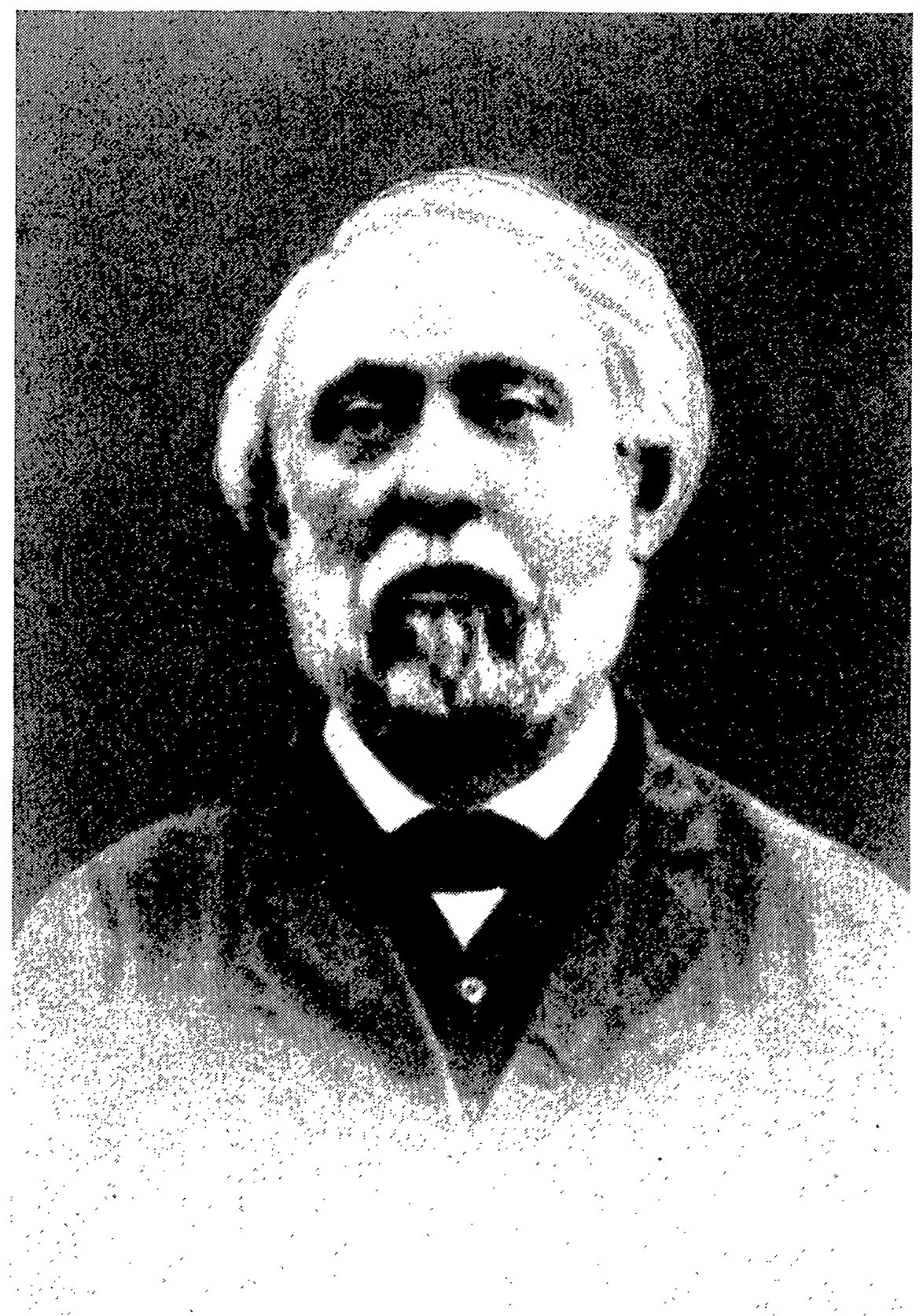
(plate; bound in the original between pp. 132–133)
133sophical books too, and he read the German philosophers in the German language. But in speech he spoke ordinary Yiddish, and he dressed in the ordinary Jewish style of those times.
Michael Halperin spent his childhood years in the Polish town of Tomaszów. Later, when he was nineteen years old, the family moved to Hungary, and at that time he was dressed like the Jewish merchants of Poland in those days: he wore a long kapote (long coat) and peyes (sidelocks).
The young Halperin quickly became acquainted with the Hungarian language and with Hungarian literature. He opened a bookshop, and through it he came into contact with Hungarian noblemen. They took a liking to him and used to invite him to their club. In his biography it is noted at this point that they used to invite him despite his old-fashioned Jewish clothes. That means, then, that even at that time Michael Halperin still wore a long kapote and peyes. Later, however, he began to dress in the European manner.
In 1848, when the revolution broke out in Hungary, he took part in it. The revolutionary government made him one of its secretaries (he had charge of its library and of the press department of its activity). Afterward, when the revolution failed, he fled to Paris; then he lived for a certain time in England. Later he came back to Hungary.
In 1858 he emigrated to America. By then he was already well read in French literature and also in English. These two languages, and German, Polish, and Hungarian as well, he by then already knew thoroughly. He had an unusual memory, and since he had 134read and learned a great deal, and remembered it all well, he attracted attention as an unusually educated man. In New York such men as he were not, at that time, to be found lying about.
He brought his father over to America, and this land became his new home.
Here he occupied himself with literary and journalistic work. At first chiefly with the "Nation," the weekly of the "Evening Post." There he used to write literary criticism and articles on other questions. Later the editors of "Appleton's American Cyclopedia" invited him to become a collaborator with them. And in a short time he occupied one of the most important places on the editorial staff. On the title page of the cyclopedia his name appears under the title "Assistant Editor." Chiefly he served, in the compilation of the cyclopedia, with his erudition and memory. He himself was a living encyclopedia. He used to look through all the articles. When there was some error in a figure or in a fact, it could not escape his eye.
He had two sons, who were also highly learned. They too had remarkable abilities and humanity-loving natures. When we came to America, he was living with his younger son, Louis (the elder son, Angelo, was a professor of paleontology at an American university. He had won a great name in this science).
When victims of the pogroms began to appear in America, they made a deep impression on Halperin. His sympathy for them was so warm that—as he used to express it himself—through it there began in him a new spiritual life. He 135felt the way an enthusiastic convert (ger) feels toward his new religion.
He worked for the immigrants literally day and night, and spent on them a large part of his small fortune.
For a certain time he held, at the immigrant committee, the position of manager. He endured great troubles both from the immigrants and from the wealthy Jews. But he bore it all with love.
To the idea of Jewish colonization he was devoted; in communism, however, he did not believe. Yet this did not hinder him from working for the commune "New Odessa." But his chief activity was bound up with a striving to settle Jews as individual farmers. There was then founded a special society for this purpose—the "Montefiore Agricultural Aid Society," of which he was the secretary and the chief worker. The treasurer was a former judge—Judge Isaacs, and the comptroller—Julius Goldman.
Jewish colonies were founded in various places: in Dakota, in Kansas, in New Jersey. As colonies they had no success. But out of a few of them grew Jewish towns, like Carmel, New Jersey, for example, where one of the streets bears Halperin's name.
I want to bring here a few examples that will give the reader an idea of the character of this rare man.
One of his Jewish farmers comes from Carmel to New York. He comes to Halperin and demands a cow, which he urgently needs for his farm. Halperin answers that he will try, he will see; at the moment 136the necessary sum is hard to come by. The settler (yishuvnik) grabs him by the lapels, begins to shake him, and shouts in the genuine settler's manner: "Let me get a cow! Do you hear? Let me get a cow!"
Halperin barely tore himself away. Later, with a sorrowful expression, he related the story to my friend Kaplan. Kaplan thought that he was grieved by the coarseness with which he was repaid for all that he does for the Jewish farmers. But that was not what Halperin meant.
— One can well imagine how badly he needs the cow, if he lost his patience like that, — he said to Kaplan.
One of the millionaire Jews, from whom Halperin went to ask for money for the immigrants, once treated him coarsely, and afterward begged his pardon. Later Halperin expressed regret about this.
— If he had not begged my pardon with words, he might perhaps have given a larger coin, — he said with naive earnestness.
But one must not think that such naive talk was a sign of little intelligence. Halperin was a clever man, with a practical understanding and with a delicate tact. Here, for example, he goes to the millionaire Jacob Schiff, from whom he wants to obtain a sizable sum of money for a colony. He glances at the clock—
— It is already half an hour till dinner.
— No, — he says, — now is not the time to ask for money. With a rich man one must go to ask ten minutes after dinner, when he is already full.
With the immigrants he used to employ another kind of tact: in order to give support to his educated acquaintances who were in need, he used to devise supposed 137occupations for them, so that they would not feel they were taking charity. To one man, for example, he gave a position as secretary, although he had no secretarial work for him to do. For another he invented some other kind of job at which there was nothing to do; a group of young men he "lent" money for a certain period, so that they could meanwhile learn English and gradually look for some way to earn a living. Some of them cheated him. And he understood this perfectly well. But he made himself out as not understanding.
His son Louis, with whom he lived, was exactly like his father. He lacked, however, his father's practicality. Once a Jew came to them to ask for a dollar. The father was not at home, and the son had only five dollars on him. So he gave it all away. The Jew had expected no more than two or three dollars, but if a man gives five, then perhaps one can get even more. So he makes a sour face: it is too little. Louis Halperin takes two brand-new suits and gives them away to him.
— Unfortunately I have no more cash, — he apologized to the Jew with a pitying face, — go and pawn these. Will that be enough for you?
I was at the Halperins' home only once. He lived on Beekman Place, around 50th Street, a quiet corner, near the East River, which was then a fine, respectable neighborhood. I spent an evening with Halperin. And walking home, I was full of reverence for him.
In the committee I saw him and spent time with him quite often.
Once I happened to draw him into a de- 138bate about socialism; but he had no inclination for it. He did not believe in socialism. And debating about such matters simply did not interest him. He was not a thinker. His rare gifts were suited to the sciences that demanded memory. But he also loved poetry. In his idealism he was a practical man. His boundless love of humanity and his goodness were bound up with a striving to bring benefit on the spot and to find for the needy a tangible result in the ordinary sense of the word. Movements for rebuilding the entire foundation of human life made no impression on him. The colony idea, however, promised help in the near future, and so he was enthusiastic about it; with him this was truly an ideal. And if he helped the "New Odessa" communists, this was simply out of goodness, and also because he looked upon their farm as just an ordinary colony.
I was active in the Propaganda Association. Our meetings were always held in the anarchist assembly hall, at 625 Sixth Street. There I became acquainted with German anarchists. We were planning to put out a Yiddish newspaper, a weekly of which I was to be the editor. I addressed several more Jewish meetings, all at 625 Sixth Street. But no organizational work was done by the 139association, and I did not understand what kind of practical work we ought to do.
Mirowitz was an honest socialist, but not a practical man, and in his head there was the same fog as in mine. The other members were Germans, a few Russian Jews, and a couple of Hungarians, and in their minds there was the same muddle as in mine and in Mirowitz's.
That one ought to organize the Jewish workers, in order to improve their material and spiritual condition — such a thought at first occurred to none of us. It would seem that the affair of the dock-workers' strike had shown how necessary this was, and Mirowitz himself had, even earlier, addressed a gathering of Jewish immigrants to explain to them how shameful it is to "scab." Why, then, did he not go further? Why did he not organize the Jewish tailors? The answer is that such a kind of activity presented itself to him as too everyday, too little revolutionary. And so I, too, felt at the time.
Mirowitz looked upon the American movement through the red spectacles of the Russian struggle. To his first child, a little boy, he gave the name Andrei Zhelyabov, after the leader of the group that killed the Russian czar. Andrei-Zhelyabov-Mirowitz — that was what the child was called. The child was, in fact, a living expression of the feelings and opinions that we all had at the time. After all, what interest could we have in such innocent, lawful things as trade-unions in America? To work for unions smacks of no danger; and so what kind of socialism is that? — such was our train of thought.
Badanes became friendly with a German anar- 140chist, whom he used to see every evening in the same saloon where I had given my first lecture; and through Badanes I, too, became acquainted with him. This anarchist was a varnisher, and he happened to be strongly interested in his union. I remember what a strange impression this made on me. That a revolutionary should talk only about such "everyday," such "lively" matters!
That in Mirowitz's head there was then a muddle, I understood. He was altogether a strange man. For example: he forced his wife to study geography. She was not educated enough. He wanted her to go through, at home, the course of a Russian girls' gymnasium; therefore she had to study the Russian textbooks. At home there was terrible poverty; yet she had to go back and forth over Smirnov's geography and learn by heart the names of islands, rivers, cities. Often little Andrei Zhelyabov would cry; there was nothing to give him to eat. But the father was always absorbed in the movement. An honest, enthusiastic man; but what one must do for one's family, and what one must do for the movement, he did not understand.
I say that I understood how little sense there was in Mirowitz's anarchism. But did I know how little sense there was in my own mind? — In part I felt it. In my heart I thirsted for someone who would make everything clear to me, but for the first four or five years it remained a thirst (I once expressed all this in a letter that I wrote around that time to Doctor Spivak, who then lived in Philadelphia, and
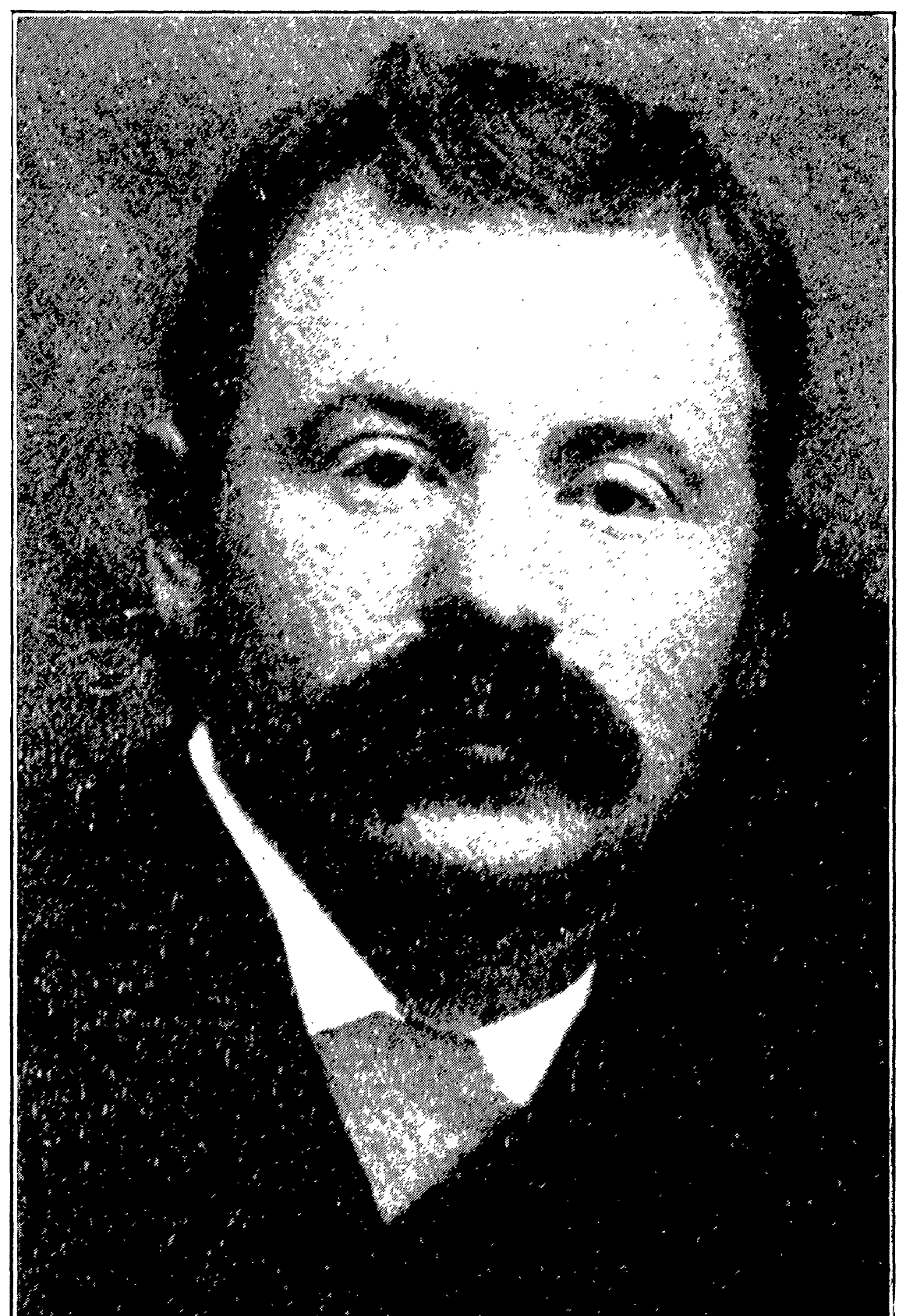
(plate; bound in the original between pp. 140–141)
141which he, a quarter of a century later, printed in the above-mentioned "Jubilee Volume").
The German anarchists, under whose influence I then found myself, were actually not anarchists at all, but social-democrats, Marxists. They were, however, not satisfied with the social-democratic tactics and with the social-democratic language. They demanded a "revolutionary" program, with more revolutionary words.
At first they did not call themselves by the name "anarchists" at all. Their official title was "social-revolutionaries," as opposed to the name "social-democrats." They had left the Socialist Labor Party (which was a purely social-democratic organization) and had founded "social-revolutionary clubs." They attacked the party with the sharpest words, it and its organ, the "Volkszeitung," with its leaders, Jonas, Schewitsch, Adolf Douai and others. They mocked them as "milksops," who want to wage the class struggle in a "dainty-mannered" way.
The same arguments with the same shouts that one hears today from the Bolshevik-communists against the socialists — exactly the same story.
The "social-revolutionaries" became anarchists gradually, and indeed through the very struggle that they waged against the social-democrats.
At first the anarchists in America were only paid men (mostly also Germans). But since they too needed phrases about "revolutionary deeds," the sympathy between them and the social-revolutionaries grew. The sharper the 142enmity between the social-revolutionaries and the social-democrats became, the closer the social-revolutionaries came to the anarchists. They became mixed together in their "clubs," not only as members, but also in their ideas. The Marxism of the social-revolutionaries became tangled up with anarchist principles, which are the opposite of Marxist doctrine. What came out was simple nonsense.
The founders of anarchist theory and tactics were the Frenchman Proudhon and the Russian Bakunin, and both were venomously attacked and ridiculed by Karl Marx. To try to unite Marxism with Bakuninism is like trying to unite a "yes" with a "no."
A year after my emigration to America, the famous Johann Most came here. He became the leader of the local anarchists; and he also considered himself a Marxist. Prince Peter Kropotkin, who was for many years the leader of the anarchists in Europe, was at least free of such a contradiction. He was a complete opponent of Marxism.
I was, therefore, under the influence of the German "social-revolutionaries," and the tangle of socialism with anarchism I took over from them. Had I read the "Volkszeitung" carefully, I would have understood more, and my mind would have grown weary of the muddle. But for German I had little patience. It was hard for me to get used to the long, long German sentences with their word-order, which sounds so wild to us "Yiddish Jews." I did read the "Volkszeitung," but superficially. The fiery phrases of the "revolutionaries," on the other hand, appealed to my 143young heart more than the speeches of the calm social-democrats. Schewitsch and Jonas and a couple of other social-democratic speakers (one of them was a man by the name of Walter, a cigar-maker, a thin man, with one eye closed; and a second — a Hamburg shoemaker by the name of Prost, and a third — also a cigar-maker, by the name of Brisman) I loved to hear; but the anarchist speaker, Kaiser, was for the first while my favorite.
A great role here was played by the revolutionary feelings that I had brought with me from Russia. The brave struggle of our terrorists was for me a sacred thing. To imagine socialism without such a struggle was then hard for me.
The American conditions were naturally quite different from those in Russia. The Russian terrorists themselves had explained this. In their articles and in their programs they used to say plainly that they resorted to violent means only because the government does not permit freedom of speech and the civil rights that one has in a republic, and even in a country that has a king with a parliament.
When the American president Garfield was killed by Guiteau, the newspaper of the Russian terrorists, "Narodnaya Volya," reported the fact in a mourning border, and in doing so it declared that in such a country, where the people elect their rulers, a deed like Guiteau's is just as much a crime as the acts of violence that are committed by a despot.
This was printed in the sixth issue of "Narodnaya Volya," which I received while in Velizh.
The difference between Russia and America I, there- 144fore, understood well. And yet the thought of a socialist movement was, for me, closely bound up with the thought of acts of violence. Otherwise socialism had, for me, no face at all.
When I came to America, most of the local "social-revolutionaries," privately at least, already called themselves anarchists. So I thought that I was an anarchist, or a social-revolutionary. To me it was all one and the same.
To tell the truth, for the first months I did not even clearly understand in what the difference consisted between the "Volkszeitung" party and its opponents. Schewitsch's speeches were just as revolutionary as Kaiser's.
When I used to hear how Kaiser or Nelke attacked the "Volkszeitung," it used to cause me suffering. Had both camps united, I would have been happy.
The saloon and assembly hall at 625 East Sixth Street was one of the chief headquarters of the German social-revolutionaries, and I used to come in there a couple of times a week. There I was known as a Jewish speaker. People treated me there with respect. And this no doubt also had to do with my "anarchism." It flattered my "self-love" and strengthened the influence that the "social-revolutionaries" had on me.
A second center of the anarchists — actually the most important — was at number 50 First Street, near First Avenue. There, too, was a beer-saloon with a meeting room. The proprietor of this saloon was one of the leaders of the anarchists, a tall, exceptionally handsome German, a blond, with a face 145like that of Jesus Christ. His name was Justus Schwab. He was a well-read man and not a bad speaker. Standing behind his "bar," with the clear-white sleeves of his outer shirt rolled up, with his white, strong arms half-naked, he used to serve glasses of beer or brandy, make "l'chaim" with the customers, and at the same time talk about anarchism and socialism. Of his honesty and devotion no one had any doubt. He was one of the well-known types in New York. Travelers from other cities used to visit the "anarchist saloon" and have a look at its famous proprietor.
To Schwab's I, too, used to come, though not as often as to 625 Sixth Street.
On First Avenue, five minutes' walk from Schwab's saloon, there was an assembly place of the social-democrats. There I used to come in rarely.
Of the great social-democratic meetings that I attended in my first year in America, two are painted in bright colors in my memory: a memorial anniversary of Ferdinand Lassalle and a mass-meeting with a ball in honor of the Paris Commune. Both celebrations were held in the Germania Assembly Rooms — a great hall that stretched from the Bowery to Second Avenue (through Houston Street), with entrances and stairs from both sides.
The memorial anniversary was on a Sunday afternoon.
An orchestra plays freedom-melodies; a great choir of powerful German voices sings "Die Freiheit" (Freedom). The hall is packed. It thunders with voices, with instrumental music, with applause. In the middle of the platform stands a plaster figure of Ferdinand Lassalle, decorated with a red ribbon and with red flowers.
146Alexander Jonas, clean-shaven, stands on the platform beside the plaster bust. Jonas's grandfather had been a Jew, and in his face there was a trace of a German-Jewish look. On the whole, however, he looked like a Christian, like a German professor, with a round face, a handsome, a lovely one. Laying his right hand on Lassalle's head, he calls out in his full, impressive voice: "Ferdinand Lassalle!" The enormous hall resounds with applause. The hall is full of festivity — a special kind of festivity, which I had never before attended.
Of the Commune celebration I remember the ball and the red ribbons that dancing couples wore. I also remember the little tables in the next hall, with the festive workers who sat around them, over glasses of beer or wine. I remember a group of Germans with whom I sit and chat. They question me about the Russian terrorists. I answer in "Daytshmerish" (Germanized Yiddish), and I suffer from it, because they barely understand me. I also remember a great, truly black Negro, who spoke good German. He, too, wore a red ribbon, and he sang along to the revolutionary songs.
At one of the gatherings that were held at 625 Sixth Street, a German with a great long brown beard took part in the debates. He defended the "Volkszeitung." In doing so he was interrupted all the while with venomous remarks, with laughter, and with all sorts of hostile shouts. He answered back. When the meeting had ended, I saw him standing at the "bar" and drinking beer together with the man who had interrupted him with the sharp outcries. I was astonished. I 147had thought that after such debates men must be enemies of one another.
The man with the great beard kept a store of books and stationery on Avenue A, around Seventh Street. A few days after that meeting I went in to him especially to talk over the subject of the discussion in which he had taken part. I put questions to him; we chatted, debated. But I did not become any clearer for it. He belonged to the "Volkszeitung" tendency, but he was friendly to the social-revolutionaries as well. I decided, for myself, that this was for the sake of business. But Nelke assured me that he was an honest man.
Notes (the original's footnotes)
[p. 128] Adler's father was the rabbi of Temple Emanu-El, the synagogue of the wealthiest German Jews in New York (on Fifth Avenue and 43rd Street). The younger Adler had also trained to be a rabbi. But he had completed two secular universities, in America and in Germany, and in Germany he had taken a special course in philosophy. After his father's death he was supposed to inherit his position. But in his trial sermon at Temple Emanu-El he did not mention God a single time, and he did not get the position. He then founded the "Moral Society" for people who do not believe in a God-religion. His lectures attracted people who have no faith, but who long for something of the kind that could take the place of a faith. Many of the members of the "Ethical Culture" were wealthy, mostly Jews.