Chapter Six
In a Garret Room on Clinton Street
148My income from lessons had grown. I had acquired a new sort of pupil — people who had time to study in the morning, or during the day. My earlier students had all been workers, and my work as a teacher had been confined to the evening hours; that was not enough. But a "customer peddler" can find a free hour in the morning, or in the afternoon — a couple of times a week, at least. And so a special "trade" developed for me: teaching customer peddlers English. One would recommend another.
I was at that time the only one of our immigrants who was occupied with teaching.
Once, walking into a clothing store on Ludlow Street, I found there a young man from Vilna. Back home we had belonged to entirely separate worlds; but we knew each other.
— What are you doing here? — he asks.
— I give lessons, — I answer.
— Lessons?!
149And turning to one of his companions, he remarked, half in astonishment and half in mockery:
— In America everything is a business!
For those times the remark is characteristic.
As a private teacher I had some curious experiences.
One of my pupils used to take his lessons in the morning, just as he had gotten out of bed, even before he had washed and dressed. Stark naked he would sit down at the little table and begin to read; and as he read he would draw out certain English words with a delicious yawn. By way of refreshment he always kept a little flask of whiskey, and in the middle of the lesson he would take a nip. At our very first lesson he honored me with one too. I answered that I do not drink. He argued with me hard, demanding that I drink. But I would not give in. Still, every single time he would offer it to me again and quarrel with me again. But he never got his way with me.
He carried himself strangely — always puffed up, as if angry. I never once saw a smile from him. He studied well and paid right to the second. He used to pay for the lessons every Friday, even before I had given him his lesson. That was his notion of being a good payer: even before it comes due! On Fridays, when I would knock at the door, he would jump down from bed, almost naked, open the door for me, and the moment he opened it hand me the money.
When he pronounced a word incorrectly and I corrected him, his face would twist up. At first 150I grew angry and began to scold him. He did not shout back.
I studied with him for several months.
Once, when I came, I was told that he was not there; he was ill. It turned out that they had sent him away to an insane asylum.
The story with the whiskey reminds me of another experience I had as a teacher, in which whiskey played a part. This pupil was not a customer peddler, but an expressman, a wagon-driver (bal-agole) from Kovno — a tall, healthy, handsome lad. He had never been able to write Yiddish. But he wanted to know English. He also had good abilities. He lived with a fellow townsman on Eldridge Street.
The first time he took the pen in hand, he looked it over with an odd smile and a wagon-driver's little laugh — as if to say: "Such a whip I've never held in my hand before!" I showed him how to write the letter "A" and he imitated it. Every little while he would stop, look over his work, smile, and shrug his shoulders. He simply could not believe that he could do such a job.
Once, when I came to him, he was dead drunk. He sat down at the table, and I began to read with him. But he soon fell asleep. A second pupil was studying together with him, and that one asked me to go on with the lesson with him alone. I answered that I am not accustomed to having a drunkard at the table. I left. The next morning the expressman sought me out and apologized to me many times over.
— What is one to do, when one is a simple man! — 151he pleaded with me, — you are, after all, an orator; you stand up for us, for the simple folk; you ought not to be angry with me. I won't do it again.
I went on teaching him.
The pupil who studied together with him — a young man of some twenty-odd years — was a brother of the "missis" of the household. He did not drink; but he had such a thick skull that it was impossible for me to knock a single word into it. Once he says to me in a soft, good-natured, quite earnest tone:
— Maybe you are too good to me, Mister Teacher? Back home a rebbe, when he gives a smack, things go better. Hit me! Don't be shy!
I burst out laughing aloud; but his sister backed him up.
— We mean it in earnest, — she said, — slap him, if it won't go otherwise.
Finally he says to me: "Nothing decent will ever come of me. You know what, Mister Teacher, teach me to sign my name, and beyond that there's no need. How much will that cost?"
I tried to explain to him that in order to sign one's name, one has to be able to write a little at all. But he did not understand.
— Do I want to become a lawyer? — he said — just to sign my name, that's all.
Most of the young customer peddlers dressed themselves up. They wore handsome, neat clothes, gold watches and diamond rings; and they carried themselves like 152Americans — or so, at least, they imagined. One of these dandies, a small fellow, a merry one, was the son of a very poor tailor in the Suwałki province. Back home he used to go about in rags, and that was no more than some three years ago. Now he had several fine suits, a mass of brightly-colored neckties, several hats and a large diamond pin for his necktie. He had gotten all of this in the stores, where they gave it to him on credit. Every little while he would run to the barber to trim his hair. He spoke a fluent but wretched English, sang the newest American ditties, told the newest dirty American jokes and the newest bits of "slang." He could barely read English, and at his lesson he would chat with me and crack jokes more than study.
A second customer peddler was poorly dressed. He was very stingy. People said he was loaded with money. Yet he haggled with me over every cent, and when he wrote, it used to seem to me that he begrudged the ink. But he was a strictly honest and truthful man.
A third was something of a learned man and a Hebraist, also a cheerful one. He at once started calling me "thou" (du) and slapping me on the shoulder. I stopped him once, twice; until finally I told him quite sternly that I would not put up with it. Then he gave it up.
A fourth customer peddler took lessons from me not only in English, but also in higher arithmetic, geography, algebra and geometry. We became 153friends. Later he entered college and became a successful doctor.
One pupil of mine was calculating to the cent, but on clothes for himself he did not skimp. He was a handsome lad and he dressed with taste. Of Jewish matters — the "little black dots" of the alphabet — he knew quite little. On my occupation and my ideas he looked with contempt; me personally he used to honor, and despite his stinginess he would give me gifts.
Another pupil, a young man of about 25, was a sodden Talmudist. He used to beg me to let him study a page of Gemara with me, at least once a week.
— There you'll see how delicious it is! Sweet as sugar! — and at this he would kiss the tips of two fingers and make a face of rapture.
To him too I gave lessons in arithmetic; and when I would show him a deep, subtle "zadatche" (problem), he would cry out: "Ai, how deep! May it be st—r—uck d—e—a—d!" But suddenly he would catch himself and burst out: "But this is nothing next to the Gemara
One of my pupils was a married man. He was black as a Tatar, and the little beard he wore looked like a heap of soot. He had a big nose and a hoarse voice. His wife was a beautiful and charming woman. Yet he never showed her a friendly face, and she used to "tremble before his shadow."
154In the autumn of 1883 I got a position as a teacher in an evening school for our immigrants, to teach them English. The school had been founded by the above-mentioned "Young Men's Hebrew Association."
The chief purpose of the society was to organize lectures, literary debates and various sorts of pastimes for Jewish young people who had been born in America (it was a copy of the "Young Men's Christian Association," which already by then had branches across the entire country). Now, however, when masses of Jewish immigrants had begun to arrive, the Association founded a school to teach them the language of their new home. For the premises they did not, in the first period, have to pay. On Worth Street, not far from Chatham Square, stood a large brown brick building belonging to a Christian society that concerned itself with destitute people. This society allowed the "Young Men's Hebrew Association" to use its classrooms in the evening, and so the Association opened several classes there.
The teachers were mostly Christians — a couple of Americans and one German. Two teachers, however, were Jews: I and the principal (a young American man named Tony Gross). A committee of Jewish lawyers — Worly Platzek, Emanuel Kursheedt, Samuel Greenbaum and Mark Ash — all American-born — examined me and engaged me as a teacher for beginners.
With Kursheedt I had been acquainted from before.
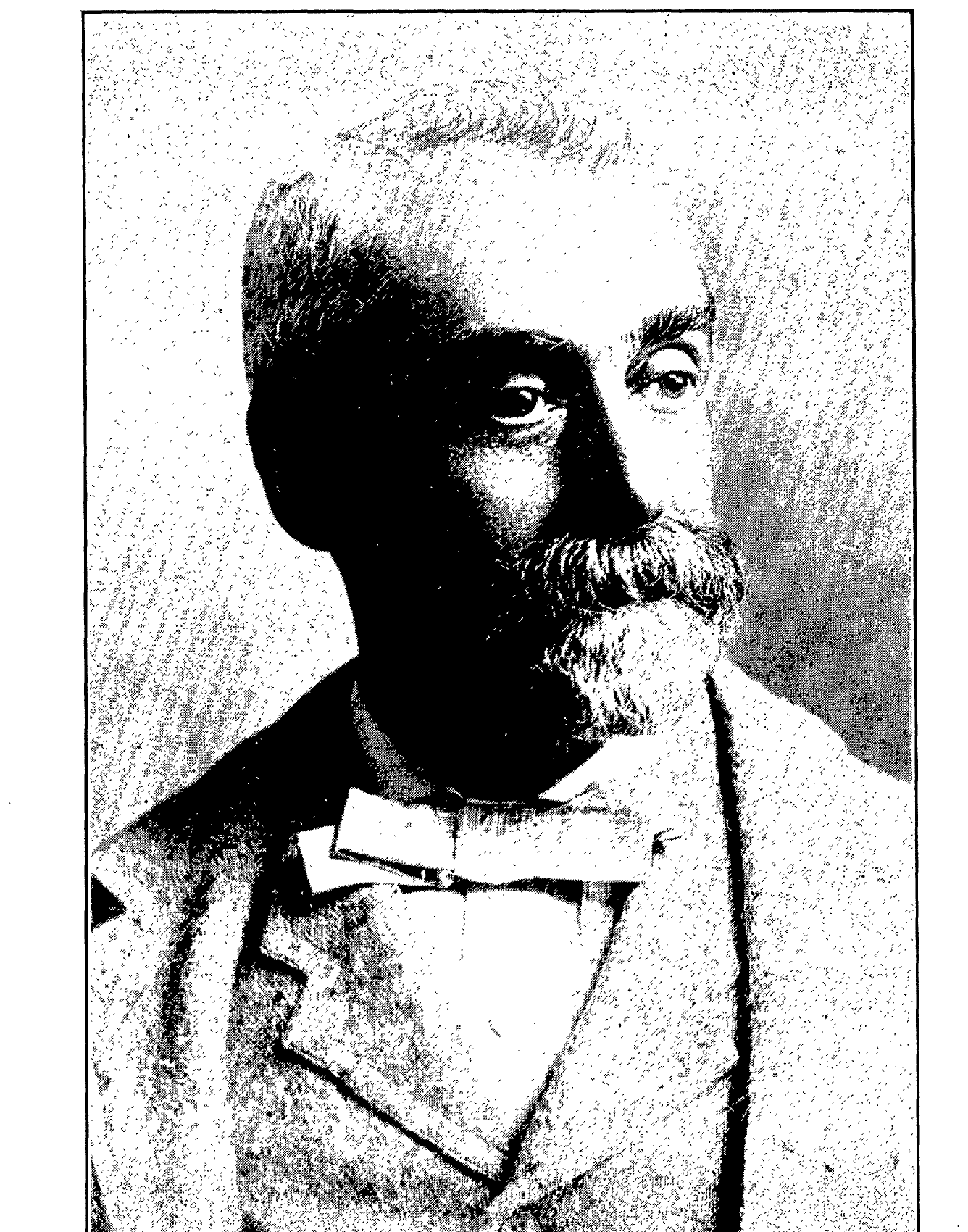
(plate; bound in the original between pp. 154–155)
155He used to invite me often to his office, at number 4 Warren Street, near City Hall, and sometimes we would go strolling together. He belonged to a family that had been living in America already a hundred years. He was an intelligent, well-read man, but English was the only language he knew. To my socialism and to all the intellectual interests of our intelligent immigrants he related with a friendly irony. Smiling a clever smile, he would listen to my talk, correct my pronunciation, and from time to time cry out with hasty words: "Crazy, crazy, crazy!" and at this, as an accompaniment to his words, he would nervously rub one hand against the other. I would set about demonstrating to him that my socialism was not "crazy"; from heat my tongue would often get tangled, and I was never sure that he understood clearly what I was saying. That was how we used to conduct our conversations and debates.
He was the vice-president (later the president) of the "Young Men's Hebrew Association," and it was he who recommended me to the committee as a teacher of the beginners' class. Later he used to come to my class and listen to how I taught the pupils.
Mark Ash, who was much younger than Kursheedt, also took an interest in me. He used to read with me and help me toward a correct pronunciation. He drew my attention to certain sounds in the English language in which foreigners mostly make mistakes. My ear and tongue took such things up easily.
Once an "entertainment" was prepared for the evening school. Mister Ash proposed that I read aloud George Washington's "Farewell Address."
156He assured me that I might appear before an American audience. I obeyed him, and my American listeners applauded me strongly. I asked myself: "Are they applauding me only out of politeness, or really in earnest?" The question tormented me for several days.
Later the whole school of ours was moved to 206 East Broadway. Then two more immigrants were taken on as teachers: Nikolai Aleinikov and Ephraim Brود (Brode).
As principal over us all there was still the above-mentioned Gross. With him too I used to spend much time.
I tried to convert him to socialism. But my work was in vain. I used to visit him sometimes in his home, and there his brothers too would take part in our debate. Their chief argument consisted in the following: "If one could open up everyone's brain and apportion it so that all would have the same measure of gray matter, then socialism would be possible. But as long as there will be cleverer and more foolish, more capable and duller people, there will also be richer and poorer. You can divide up all the capital in the world equally, and in a short time inequality will arise again."
I would answer that socialists will not divide up anything; they will change the system, the economic foundation, in such a way that there can be no poorer and richer. But they would come out with their usual argument, in other forms, but with the same essential point.
The Gross family (an old mother, two unmarried 157sons and a daughter, a girl) lived near our school, in a house that stood on the corner of East Broadway and Jefferson Street, on the site of the present-day Carnegie Library. I dwell on this place because the family was a German-American one, a "yehudim'ish" one (German-Jewish, of the assimilated sort). That such a family should live on East Broadway is unthinkable today. Back then there were many such families to be found there. But their number grew smaller and smaller.
The school now took up my evenings. With my customer peddlers I studied during the day, or in the early morning, as before.
I earned more than I needed. I could afford to take a decent room and to eat in the best restaurant, which was then on Grand Street — Gunst's restaurant, between Essex and Norfolk Street. Gunst was a German. There were as yet no Jewish restaurants or cafés. There were a couple of open boarding houses; but I would not dignify them with the name of restaurant.
Once, walking on the street, I met Paul Kaplan. Frey and his family had already gone off to the Oregon commune, together with other members, and Kaplan had stayed behind for the time being in New York as representative of the colony in the connections it had in America and Europe. He proposed that I take a room in the same house where he lived. And since he was a likeable man and all 158loved him, I accepted his proposal even before I had seen the room.
His lodging was at 213 Clinton Street, a private house of two stories, with an "attic" (the house is long since gone from the world; on its site stands a large tenement). The landlord was a German of middle years, a music critic on the "Staats-Zeitung." His wife was an American German woman, a little younger than he. And their children were all American-born. Kaplan occupied one of the two attic garret rooms (boidem-tsimern) and I moved into the other. The ceiling sloped downhill, and when one wanted to get to the window, one had to bend over. But that troubled me little.
There was room enough left. For the first time in my life I now had such a large, roomy chamber for myself alone. It made me roomy in the heart. In winter a little iron stove burned for me. It was warm. In summer, again, it was cool.
In this room I used to sit for many hours reading English or Russian books, studying English literature. I used to prepare something to eat, so that I would not have to go out and interrupt my reading. On the little stove I used to make myself tea, though for such things I was a lazy one. So I used to sit and read, washing it down with tea and reading and reading; taking a bite of bread or cake and, chewing, going on reading; or, if not, I used to pace back and forth, as far as the crooked ceiling allowed, pacing with the book in hand, reading, or thinking. There I read socialist pamphlets, chiefly German and English, but also Russian ones, which I received from Geneva, as will be told further on.
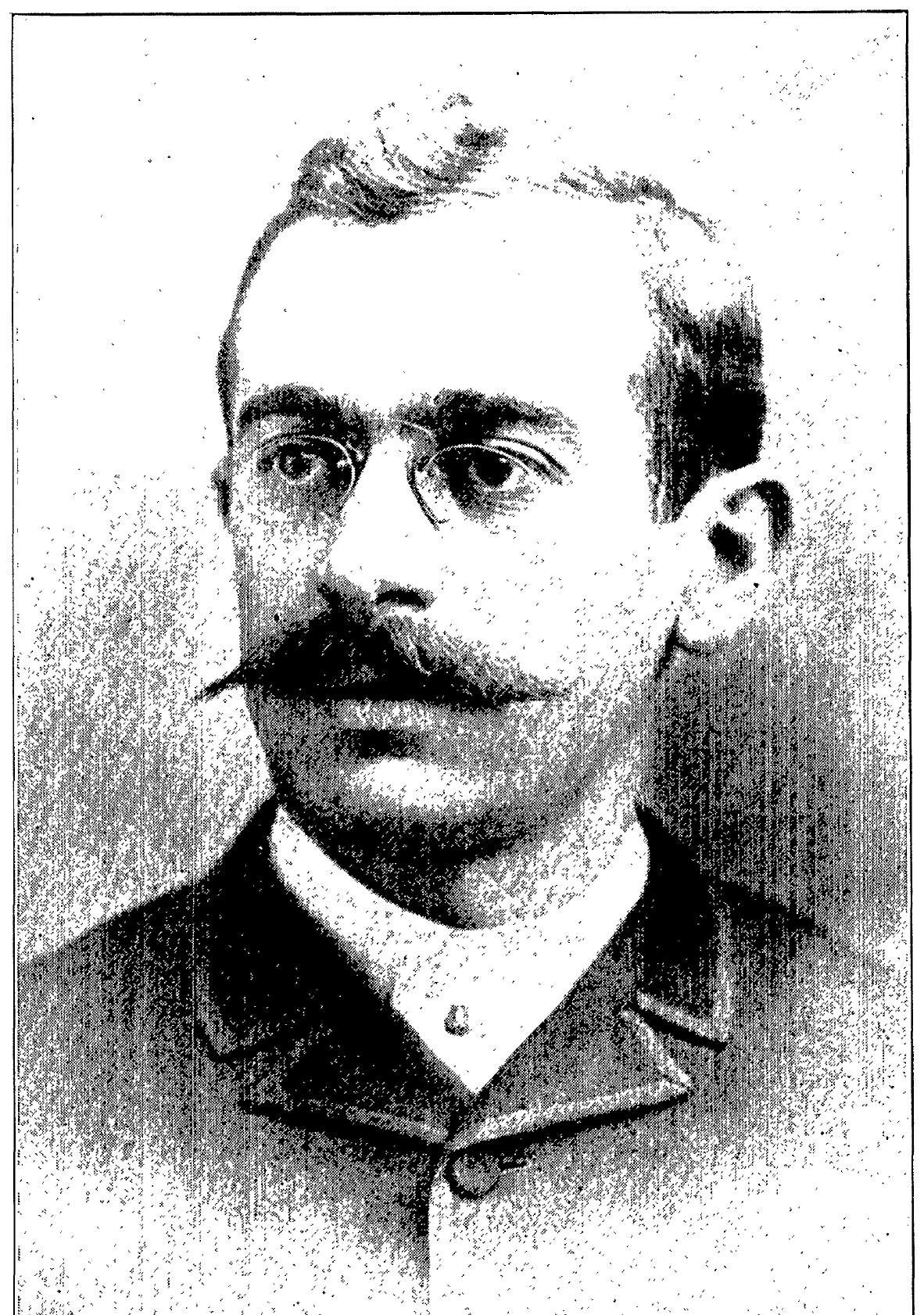
(plate; bound in the original between pp. 158–159)
159More than once I sat up a whole night reading. In the early morning I would wash, dress and run to Gunst's restaurant on Grand Street, where I would order myself an American breakfast. I enjoyed my breakfast, my dinner, my supper, my American neckties; the books and pamphlets that I read; my neighborly life with Kaplan.
A very dear neighbor Kaplan was, a good comrade and a sincere friend, a truly honest man, an earnest, a clever, a tactful one. He was a fair bit older than I. But we quickly grew accustomed to each other, and I felt no difference in years between us.
At this lodging I was visited several times by Edward King — a third interesting man, with whom our intelligentsia became friendly at that time. We became acquainted with him through Frey, his "fellow-believer"; for King too was a "positivist."
He was then still a fairly young man, though a good deal older than us. He was a Christian, a Scotsman (a Scot), grown even shorter than Frey, but stouter, with a handsome, round face, with a bald spot on his head; a lively one, a witty one, with a smooth tongue, almost always a good-natured one. He could sometimes let himself slip into malicious gossip (loshn-hore), always in his witty manner, and sometimes in his mockery a venom could be felt; but his good-naturedness was not disturbed by it.
Once he had become acquainted with us, he attached himself to us for his whole life.
160He was a worker, a type-founder (a caster of printing type). But he was well-read—in history, in the history of philosophy, and in various other subjects; his main interest at that time was "positivism," the philosophy of Auguste Comte. His speech came out nimble and sharp, and in a natural manner, without high-flown phrases and without flattery. Often it sparkled with humor.
He was active in his union and was an important figure in the "Central Labor Union," the central body of the organized workers of New York (its meetings used to be held on Thirteenth Street, between Third and Fourth Avenue).
Once the question came up there of admitting Jews into the unions. Some influential delegates were against them. Their argument was that the Jewish masses come from countries where the worker has smaller needs and is accustomed to lower wages than the American worker. But King fought energetically against this position, and he won.
King also took a noble stand with regard to Johann Most when the famous anarchist came over here. This was right after Most had served eighteen months in a London prison for an article in which he declared that all kings ought to be killed, as the Russian revolutionaries had killed Alexander II. There was a movement that demanded that Most not be admitted into America, and King immediately placed himself against such demands. This does not mean that he sympathized with Most's anarchism, or with his tactics of violence. Quite the opposite: he sharply criticized Most's theories. He simply took his stand in the name of freedom and 161of the principle that in America everyone should be welcome who is persecuted in other countries for his opinions. And he did not content himself with protesting. He agreed to be the chairman of the Most Committee.
Most was admitted. The New York anarchists gave him a reception in the great hall of Cooper Union, and Edward King was the chairman (this was a few months before I became Kaplan's neighbor). I attended the gathering. The hall was packed. I happened to be standing, and standing together with me was Mrs. Frey. When King introduced Most, she said to me with anger: "How is he not ashamed of himself?"
That a "positivist" should be the chairman at a meeting where a reception is being held for an anarchist who preaches terror—this she regarded as a betrayal of his principles.
King began giving us lectures even before we understood what he was saying. The scene of his first lecture, which he gave on Essex Street, corner of Broome, above a beer saloon, I remember quite well. I barely understood him; but the main point I grasped more or less. When he finished speaking, I went up to him to say something to him. My chief aim was to show that I did not agree with him. "Not to agree" is in English "disagree." It is an ordinary word. But when a foreigner needs to say something, it happens that the word everyone uses he forgets, and instead he remembers precisely an unusual one. So it was then with me. I went up and said: "I diverge." "Diverge" means to part ways from one another, like the two blades of a scissors when you open it.
162He understood what I meant, and he began to debate with me. So I stood there and listened; more not understanding than understanding. But I made a face as if I understood him completely.
That evening, when I had gone home, I began berating myself over why I had said "diverge" and not "disagree." Had I known where King lived, and had I not been ashamed, I would have gone straight to him, woken him from his sleep, and given a shout: "I disagree!"
In our little Russian-immigrant world King became something like an uncle. He gave us series of lectures on philosophy. In later years I began to suspect that he was more familiar with the life of each philosopher than with the depths of his philosophy. But the general gist he did know, and his lectures were very interesting and useful to us.
To me, in my attic room, at 213 Clinton Street, he used to come together with his two friends—positivists: one a dark-skinned man (not a Negro, but a Hindu), with a university education, and the second a Frenchman, a well-read shoemaker. The Hindu I used to understand much better than King.
I also used to invite a few Russian comrades of mine; and so we used to spend the evening in my garret room, reading and discussing over glasses of tea, which we used to brew on my little stove.
The scant three years that I lived in the Clinton Street attic are among the best years I spent in America.
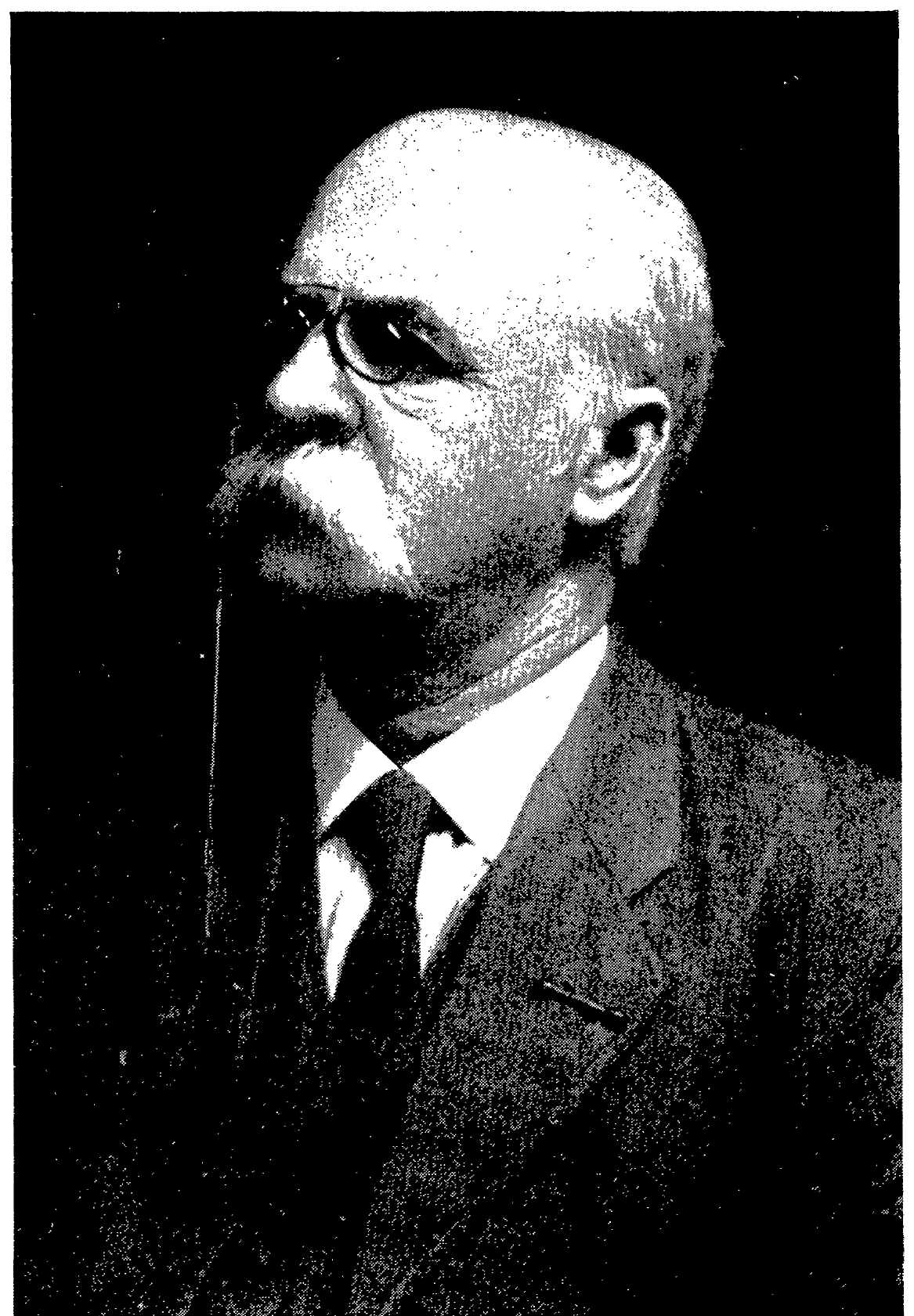
(plate; bound in the original between pp. 162–163)
163The most important person among our intelligentsia immigrants at that time was Nikolai Aleinikov. I have already mentioned him, when we were discussing Brody, where he came with the "Sciver Am-Olom" ["Sons of Eternal People"] group, as its representative. In a certain sense the American Jews regarded him as the representative of all our immigrants. He was in close contact with Mikhail Halperin and with the immigrant committee, and he used to meet with Felix Adler and with other influential American Jews.
Kaplan often met with prominent American Jews in the interests of his Oregon commune. Aleinikov, in turn, was reckoned as the representative of the intelligentsia immigrants who lived in New York. An "Am-Olom" colony was by then already regarded as a thoroughly impractical thing. So that Aleinikov could make a living, he was made the superintendent of the branch that the Young Men's Hebrew Association had established on the East Side—at 224 East Broadway. There was his residence, and it was then the central point of the Russian intelligentsia.
When I sort through, in my memory, the figures of our intelligent Russian colony as it was in the first few years, I see Yakov Peysakhovitch. I have already told about the new spirit that the pogroms awakened in some of the intelligent Russian Jews; how in them awoke the feeling that they were Jews. But seldom did anyone display this feeling 164as sharply as Peysakhovitch. Instead of Yakov, he used to introduce himself to a new acquaintance as Yankel, and his wife he called nothing other than Khaye. No "Yiddishism" yet existed then, and he always used to speak Russian, like all of us. But while using that language, he used to show that he did not forget for a minute that he was not a Russian, but a Jew.
He was from Elisavetgrad, where he had finished a Realschule [a secondary technical school]. There he had witnessed the famous pogrom, the first of the series of acts of violence that led to the great Jewish emigration.
On the first of January, 1883, the intelligent Russian colony celebrated New Year in America for the first time. In Walhalla Hall, on Orchard Street, there was a ball—the first Russian-Jewish ball in the new home.
A part of the intelligentsia, however, celebrated the holiday separately, and this celebration took place in the two rooms where Kaplan and I lived, at 213 Clinton Street. Thirty-three persons gathered—ladies and gentlemen. In my room people drank and ate, and in Kaplan's room people danced, sang, played at "pontoon" [a card game], and gave speeches about Russia and her freedom struggle. While dancing, one had to keep one's head bent, because of the slope of the ceiling. But that only added to the merriment.
Almost all those present made a living from plain 165labor. Intelligent immigrants who had other occupations were still an exception then.
With these two Russian New Year's entertainments there began a long series of balls, which were held every first of January in a large hall. They had a Russian-revolutionary character, and in the life of the Russian-speaking Jewish colony they became an institution. From the surrounding cities and towns people used to travel in to meet the New Year in the Russian way. At these balls acquaintances used to meet who had not seen each other for a whole year, and acquaintances who had not seen each other for years.
More than twenty such New Year's balls we held—with Russian songs, with socialist speeches, with toasts to the Russian freedom struggle, with hurrah-shouts for the martyrs of Schlüsselburg and Siberia, until the number of Russian intelligentsia grew so large, and life changed so much, that the character of these balls changed too. Our old New Year's gatherings became a thing of the past.
A certain time after our first New Year "meeting," Kaplan departed for his "New Odessa" colony in the state of Oregon. Together with him, a few more members of his organization set out. Others had left earlier. With the finest expectations they traveled there: to lead an ideal life of honest land-work, of equality and brotherly love; to show the egotistical, unhappy world a model of how to live. How far their expectations were realized, we shall see in a later chapter.
166There was then in New York a Russian, a Christian of some thirty-odd years, by the name of Papov. Back home he had taken part in the revolutionary movement and had had to flee. He came to America a couple of years before me. I became acquainted with him at the Freys', and he invited me to his place. He lived in Astoria, Long Island, where I visited him several times. The family consisted of him, his wife, and three children. Two of these children were strangers, adopted, and the one child was their own. He and his wife used to talk to me about the difference in the feelings they had for the two strange children and for their own. They used to discuss it quite openly, in the Russian manner. Before the child was born to them, they had thought that there could be no greater love in the world than their love for the two little ones whom they had taken into the house. But then their own flesh-and-blood appeared, and only then did they feel what it means to love a child.
They were hospitable people, and it was pleasant for me to visit them, although I had my doubts about Papov's interest in the Russian revolutionary movement. He was a tangle of sincerity and falseness, a man of no strong character. He longed for home without measure. He never stopped talking about Russia, and in this matter he found in me a good listener, for I longed no less than he.
I say that I doubted his revolutionary enthusiasm. But he stood in connection with
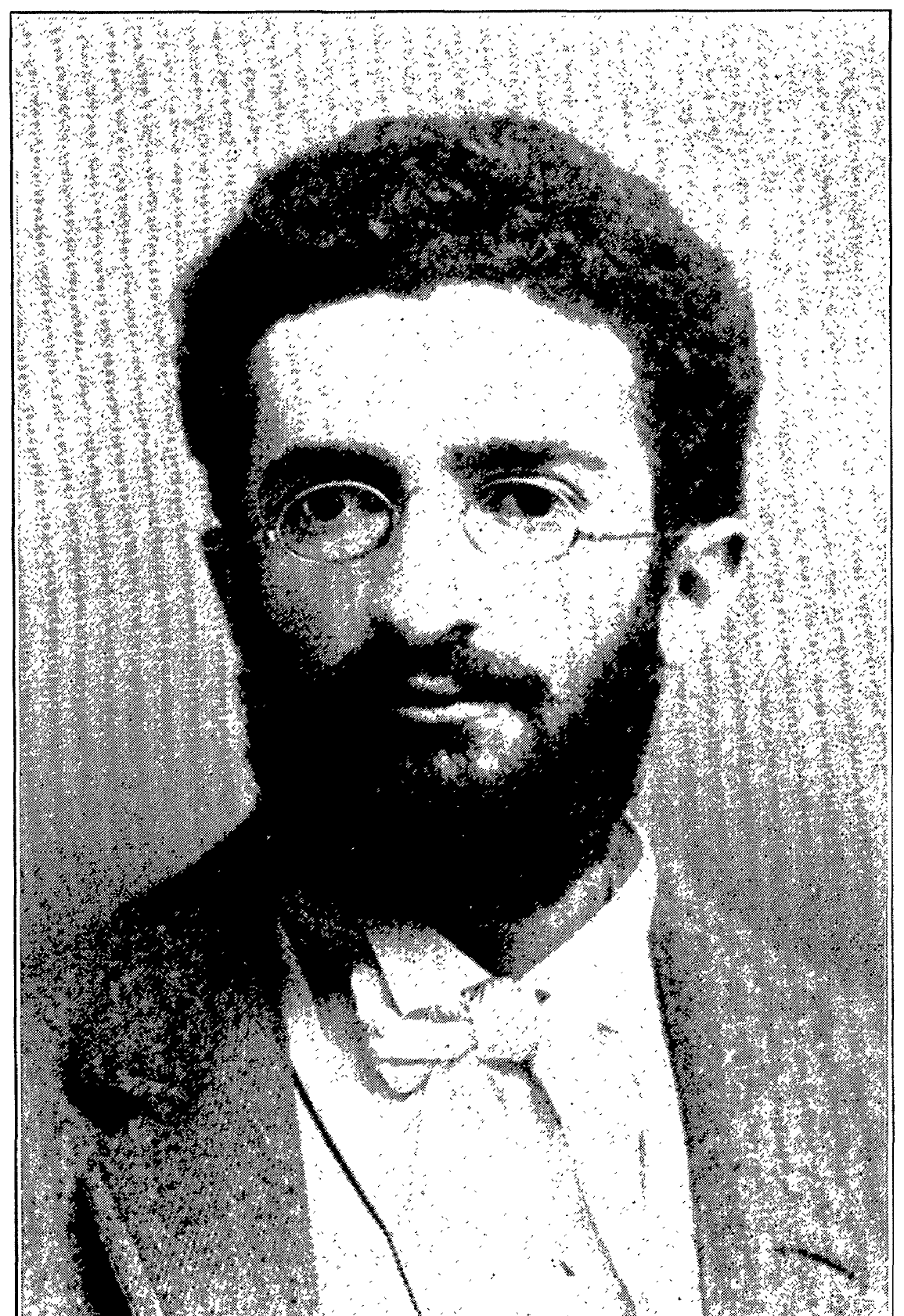
(plate; bound in the original between pp. 166–167)
167important Russian revolutionaries who were in Geneva, Switzerland, and they regarded him as their representative in America. They corresponded with him and sent him the literature that they printed there.
That summer (1883) they sent him from Geneva twenty copies of a booklet of about two hundred pages, by the name of "Kalendar Narodnoy Voli" [the People's Will Calendar]. The booklet had a red "shirt" [cover] and, as a supplement—two pages with photographs.
The leaders of the party "Narodnaya Volya" [the People's Will], their movements and their deeds, were wrapped in a fog of mystery. And for us, their friends, this was the golden fog of a divine presence. While they were hanging Zhelyabov, Perovskaya, Kibalchich, Mikhailov, and Rysakov, a few facts of their underground life floated out to the world. But this only made the mystery deeper. Through my "underground" acquaintances in Vilna and in Vitebsk, and through the revolutionary papers that I read, I knew much more than the general public; but about the innermost group of the "Narodovoltsy," about their main committee ("Ispolnitelny Komitet" [the Executive Committee]), I too knew very little. And now the "Calendar" lifted the curtain a bit. It had been compiled by members of the main committee who had remained free.
Its first and last parts had the form of a calendar, with the names and dates of all the events in the history of the Russian struggle and of those who had taken part in them. Beyond that, it was a revolutionary anthology of reminiscences and articles.
168For one to whom the Russian revolutionary movement was dear, this was a true treasure.
In the first volume of these "Pages," there was mentioned Hessia Helfman, a Jewish girl from Mozyr, Minsk province, who played the role of a housekeeper at the secret apartment where the bombs were made to kill the tsar. What sort of person she was, what happened in her life as a revolutionary—about this no one had previously had any conception. Now I found in the "Calendar" an article with many details about her.
I have also already mentioned how in the winter of 1879 the tsar's dining room was blown up with dynamite. Later it was heard that the explosion had been carried out by a revolutionary named Khalturin. How he had stolen his way into the palace, how he had lived there and brought in the dynamite—that was one of the riddles with which the Russian terrorists in those several years stirred up the curiosity of the civilized world; and in the red "Calendar" that had now arrived from Geneva, the story was told with all the details.
Another article in it contained a Thousand-and-One-Nights tale of how a revolutionary named Grachevsky escaped from Siberia.
On the last page, under a mourning border, there was a short biography of Karl Marx, who died in the year when the calendar appeared.
The photographic supplement contained around 60 portraits of revolutionary heroes who had become famous—martyr figures, which we used to call up before us the way a pious Jew tries to picture to himself the faces of prophets or sages.
169Papov asked me to help him distribute the "Calendar," and I took ten copies from him. An eleventh I bought for myself; and as these lines are being written, it lies beside me on my desk, and I live again through the moment when I first caught sight of it and leafed through it.
That night I sat in my garret room, at 213 Clinton Street, reading the booklet until it became broad daylight.
Every person has in his life certain keepsakes that are especially dear to him. This booklet in its aged, poor binding, which a Jewish bookbinder on Christie Street later made for me, is one of those priceless monuments of my young life.
A certain time after that, Papov received from Geneva an anthology by the name of "Na Rodinye" [In the Homeland], a small little journal, which had the same character as the "Calendar," but with new material. In all, three numbers of it appeared, and each number was, for Russian socialists, full of the most precious reading matter. In "Na Rodinye" I read for the first time biographies of Sofia Perovskaya, Zhelyabov, and Kibalchich, our most precious heroes of that time. From "Na Rodinye" I also learned news about the life of fighters who were then in the penal prisons of Siberia, and various other facts of that sort.
Later there began to arrive the revolutionary journal "Vyestnik Narodnoy Voli" [the Herald of the People's Will], of which there 170appeared in all five numbers. These "Vyestniks" were thicker books than the "Na Rodinye." They contained much reading matter of the same character as the contents of "Na Rodinye" and of the "Calendar," and also theoretical articles. All of this was put out abroad by the organization "Narodnaya Volya."
Other Russian revolutionary groups from Geneva, Zurich, Paris, and London also printed booklets, or brochures. The various groups carried on polemics among themselves. A journal would appear; we would get one, two, or three numbers of it, and then it would vanish. Afterward another group would organize; another little journal would appear and would have the same fate as the previous one. All these publications used to be sent to Papov; and every time he received something new, he used to let me know, and I would go straight over to him.
In those few years new trials took place, all concerning members of the main committee of the "Narodnaya Volya" who had been captured. The legal Russian newspapers again began to suppress news of the revolutionary world. About these trials they reported quite briefly. The details, however, used to appear in the underground press in Russia itself or abroad.
These reports used to be received by us, immigrant-revolutionaries, with hastily beating hearts. Russia's freedom struggle was always our highest spiritual interest.
The greatest curiosity with regard to the death of the tsar was bound up with the Kobozevs, the married couple who kept the cheese shop on Malaya Sadovaya Street.
171in Petersburg. And now, being in New York, I read in a Geneva publication that "Kobozev" had been arrested in Moscow and that his real name was Bogdanovich. Bogdanovich! I had heard of him in Vilna. In that region, in the Toropets district, Pskov province, he had a few years earlier opened a smithy and tried to carry on peaceful propaganda among the peasants. Together with Bogdanovich, also ostensibly as a blacksmith, there worked Solovyov, the schoolteacher who in 1879 fired at the tsar and was hanged for it.
Afterward we read a report about Bogdanovich's trial; and a little later—that his supposed wife from the cheese shop had been arrested in Kiev, and that her real name was Akimova.
In 1883 there also appeared the famous book "Underground Russia," by Stepniak, in an English translation.
In 1878, on a busy street of Petersburg, in the middle of the day, this Stepniak stabbed General Mezentsev, the chief general of the Russian gendarmes. The story rang through the world. Stepniak vanished. Later, being in Italy, he wrote his book, which appeared in Italian. The work was full of remarkable facts and descriptions of the mysterious Russian struggle, and it aroused such deep interest that it was soon translated into several languages. For us, it was an even richer treasure than the "Kalendar Narodnoy Voli."
What could have been more interesting to us than the following, for example: a revolutionary woman, by the name of 172Rina, she describes how she met several times with Sophia Perovskaya during the few days between the first of March and the day Perovskaya was arrested. To us, Perovskaya was literally a saint. Every crumb of news about her we read with feverish interest — above all, about her life during that week when the entire Petersburg police force and a whole army of spies were searching for her with lanterns. Rina begged her to go away, at least for a few weeks, but Perovskaya refused.
"Precisely now it is important to be in Petersburg," she explained, "one must see so many people." Zhelyabov, Sophia's beloved, was already under arrest, and through a general Rina had learned that he would surely be hanged. She tells how she passed this on to Sophia, and how the latter was wracked convulsively with anguish and despair.
From Stepniak's book I learned a mass of details about how Nikolai Morozhov was arrested at the border, and about the unrealized plan to free him; there too I read about the role played in it by his wife, Olga Lyubatovich (the revolutionary woman who later hid herself in the apartment on Podgorny Street, with us in Vilna).
All these "treasures" that used to arrive from Geneva, Paris, or London, I would have bound, and I still have them to this day. Various books stood on my shelves and later went away, to make room for others. These always remained among the dearest things I have ever possessed.
173I bought a full set of Dickens's works. They had been printed from stereotype plates that had once been made for an expensive edition; but that was a long time ago. The plates were already heavily worn, and the letters came out of the press broken and rubbed away. The original edition had been illustrated with many pictures, specially made by a famous London artist. And the plates of those illustrations were also heavily worn.
That is why the set cost so little! The paper was new, and so was the binding. Everything was new except for the main thing — the plates from which the set was printed. But they looked fine and substantial: twelve thick brown volumes — all the works of Charles Dickens! I arranged them on my new bookstand, and my eyes could not get their fill of looking at them. The print was so bad that it was harmful to the eyes. But that did not trouble me. I would sit, literally whole nights, reading them.
I also bought Taine's famous "History of English Literature" in two volumes. These were already excellently printed.
Once, walking along Fourth Avenue, I noticed in the window of a bookstore an encyclopedia of 15 volumes, with a tag on which was marked 18 "dollars" — a very cheap price. I went in and examined the books. I do not remember the name of the encyclopedia; I remember only that it was a popular work. The print was fresh, only the letters were tiny, and the lines close together. But still, an encyclopedia! And cheap too: 18 dollars for fifteen very large, thick books! I did not have the 174sum on me, so I gave a deposit, and a couple of days later I paid the rest. The storekeeper refused to ship the package to me, and onto a streetcar they would not let me on with such a load. So I carried it off myself. It was quite heavy. By the time I managed to reach my apartment, the sweat was pouring off me, and my hands were cut and aching from the cords with which my bargain had been tied up. On my bookstand the fifteen volumes took up a shelf and a half.
I also picked up a couple of dozen other English books; and besides the aforementioned Russian revolutionary writings, which had just appeared, I bought a respectable number of revolutionary Russian works that had been printed in Geneva in earlier times, and also certain socialist pamphlets that had been printed in English, in London or New York.
My bookstand soon became too small; I bought a second one, but it too soon became full. My New York library was already much larger than the one I had left behind in Vilna.
Once, in 1884, I received a printed text from home. I thought it was a letter. But when I opened the envelope, it turned out to be a proclamation, and at the top and bottom were added the following words:
"He has been killed — Sudeikin, the spy above all spies, the bandit above all bandits!"
There was no name, but in those few lines 175I immediately recognized the handwriting of my Vilna comrade Halperin.
The printed flysheet itself was a voice from the Peter-Paul Fortress, where they held the most important revolutionaries before transferring them to the Schlüsselburg Fortress. How they managed to get a proclamation out to the free world, where their comrades printed it for them, was one of the secrets with which the "Narodovoltsy" (members of the People's Will) used from time to time to astonish the country. In the flysheet, the condemned terrorists told how they were being tortured. It was a voice full of pain and heroic courage. The text contained several important details of the terrible life in those stone cells. The heading on the article was: "Ot myortvykh k zhivym" (From the dead to the living), and beneath these printed words Halperin had written: "From Russia to America."
Afterward we heard that at all the Russian railway stations portraits had been hung up of an officer named Degayev, with an announcement that he had shot the spy-general Sudeikin. The government announced a great reward to whoever would catch him. Several months later I found in the "Vestnik Narodnoi Voli" (Herald of the People's Will) a detailed article about the whole story — a remarkable "detective story" from the Russian underground world.
Degayev was at first a loyal revolutionary; afterward he betrayed his comrades and played a double role. Finally he felt pangs of conscience, and as a penance he killed the chief spy. While he was playing his double role, the most important figure in the secret revolutionary organization was Vera Figner — a beautiful, highly educated young woman from an inter- 176esting aristocratic family. She was then the only member of the famous Central Committee of the Narodnaya Volya still at liberty. All the rest the government had already caught (except for two, who had settled abroad). Some of them they hanged, some they "walled up" in fortresses, or sent off to katorga (penal hard labor). For a year and a half Figner was the entire committee. She organized terrorist attacks, founded secret printing presses, and worked to rebuild the weakened organization. Her greatest danger was Sudeikin, a gendarme colonel who was an exceptionally able detective — a handsome, tall young man with broad shoulders — a giant. He was the chief over all the political detectives, and he carried out one pogrom after another against the secret organization.
Degayev was Vera Figner's most trusted man. But he soon fell into Sudeikin's hands — together with an underground printing press (in Odessa). Then Sudeikin visited him in the Odessa prison and so frightened him and turned his head around that he accepted his proposal to be a revolutionary leader and a spy at the same time (exactly as it would be, years later, with Azef). In this capacity he gave away many revolutionaries — among them Vera Figner herself. But his conscience tormented him, until finally he went off to Paris, confessed everything to the Russian revolutionaries there, and proposed to buy off his sins with the death of the dangerous gendarme.
Once a year, every first of March (the 13th according to the American calendar), we would hold in New York a hesped (memorial eulogy) for Sophia Perovskaya, Zhelyabov, Kibalchich, 177Hesya Helfman, and the other martyrs of the Russian struggle. I used to be one of the speakers.
The members of the revolutionary Central Committee who were not hanged were kept in solitude and torment, first in the Peter-Paul Fortress in Petersburg and then in the Schlüsselburg Fortress, on an island not far from Petersburg. There was no hope of ever coming out of there. "Buried alive" — that is what we called them. From time to time there would come, like sounds from the other world, news about them: this one had lost his mind; that one had doused himself with kerosene and burned himself to death; a third had struck an official of the fortress a blow, so that they would hang him for it, and they did indeed hang him. Such news would reach us only a long time afterward, sometimes several years, after the tragedy had occurred. We had no clear reports.
At one such gathering, in a hall on East Broadway, I described how the martyrs walk about in their stone cells — back and forth, back and forth, alone, with no possibility of exchanging a word with anyone at all. Day in, day out, like this; year in, year out. Without end, without a ray of hope, without any notion of what is happening in the wide world.
At 213 Clinton Street there lived together with me for a certain time a young man from Odessa named Moshkovitch. Earlier he had lived in Paris and in Belgium, where he had studied to be an engineer. Afterward he 178spent a certain time in London, and from there he came to New York.
Once, on an early morning, when we were still lying in our beds, someone knocked at the door. At our "Come in" there entered a Christian of about thirty, or thirty-two, with a blond little beard. How astonished I was when Moshkovitch introduced him to me as Leo Hartmann — the Russian revolutionary about whom, a couple of years earlier, the whole world had rung.
In the first volume it was mentioned how, at the end of 1879, near Moscow, an imperial train was blown up. They had expected that the Tsar would pass through there on his way from the south to Petersburg; but on that particular tsarist train the Tsar himself did not in fact travel (there was a large number of his servants and guards aboard, and many of them were indeed killed or wounded). The Tsar — Alexander II — came along some minutes later, on a second train. And there was no second explosion. It turned out that under the rails a dynamite mine had been prepared, to which electric wires ran from a house that stood not far from the rails. In that house there lived a married couple named Sukhorukov. They had settled there a short while before. They talked and behaved like quite simple people. After the tsarist cars were blown up, the Sukhorukovs disappeared. Later the government learned that Sukhorukov's real name was Leo Hartmann, and his "wife's" — Sophia Perovskaya (the same Perovskaya who two years later organized the attack on the Tsar in Petersburg.
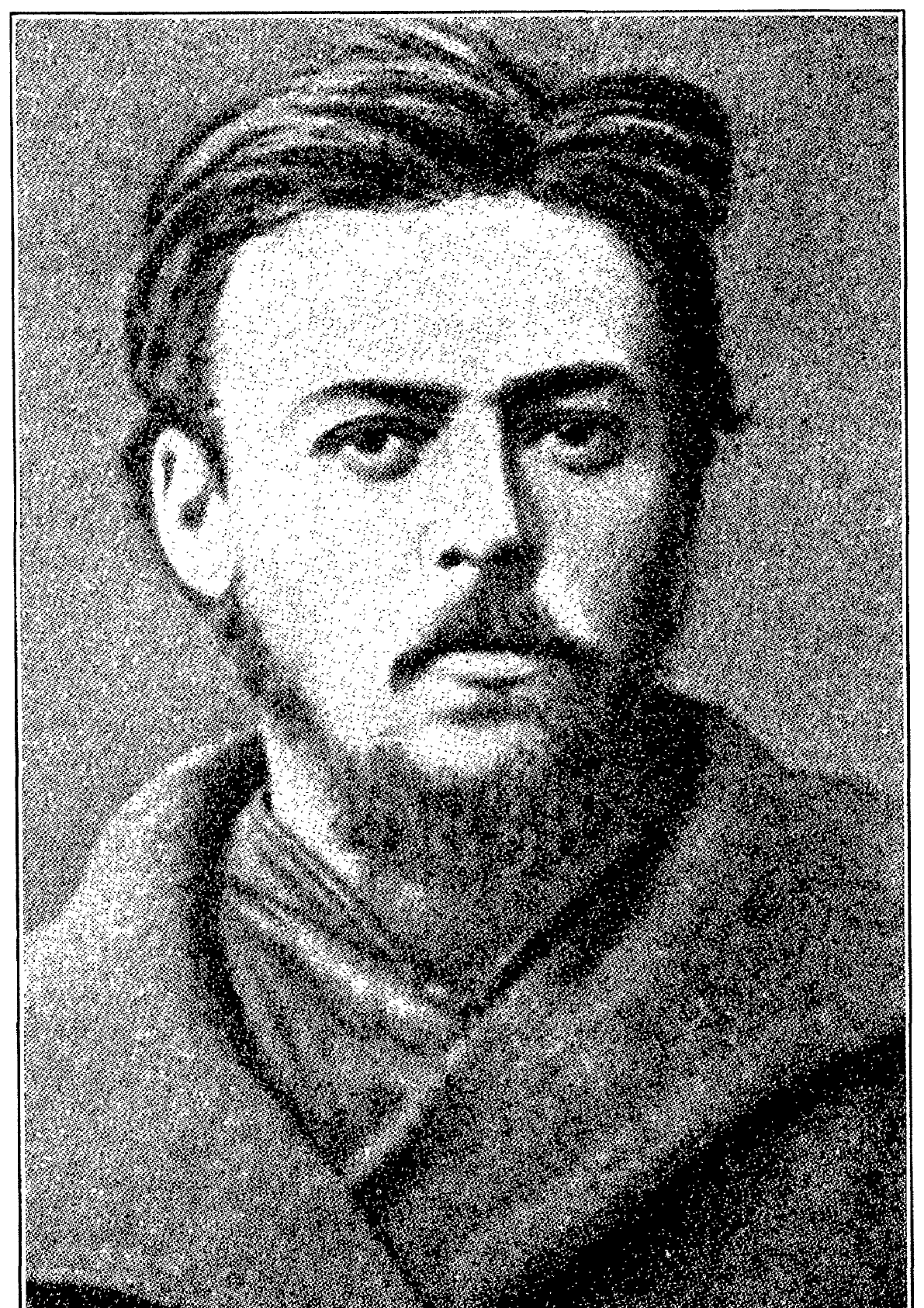
(plate; bound in the original between pp. 178–179)
179In 1879, near Moscow, at the moment when the tsarist train was passing by, it was she who, with a kerchief, gave the signal to detonate the dynamite. And precisely such a signal she gave in 1881, in Petersburg, to those who were waiting for the Tsar with bombs).
Hartmann crossed the border and came to Paris. Since the Russian government and the French had a close diplomatic alliance between them, he was arrested there. It was about to happen that the French Republic, the land of revolutions, would hand the freedom-fighter over into the hands of the Tsar's police. But liberal people of Paris set themselves against this. And it may seem strange to the reader to hear that the man who led the campaign to save Hartmann was none other than Clemenceau — the very same one who, forty years later, at the peace conference after the Great World War, as chief minister of France, showed himself to be a dark reactionary.
Clemenceau prevailed. Hartmann was not handed over to the Russian government; but to remain in France was also not permitted him. They told him to choose the border over which he wished to cross. He declared that he wished to go to England, which was the freest of all European countries; and there he went off. From England he then came to America, where the newspapers wrote many columns about him. In the "New York Herald" — in a Sunday number — there was a whole page about him (the article was written by Shevitch).
Moshkovitch had become acquainted with Hartmann in London. Now, being in New York, the famous terrorist worked as an electrician — a field in which 180he had taken an interest while he was helping to lay the mine to kill the emperor. Through that he had also already become interested in various inventions.
He used to come in to us quite often; and later he lived with me for a certain time. He used to tell me details about the time when he and the other "Narodovoltsy" were digging the mine near Moscow. He also told me about other experiences he had had as a revolutionary. From Sophia Perovskaya he had received, as a keepsake, a black silk neck-kerchief. When he showed it to me, I took it in my hand and examined it as a sacred thing.
Hartmann was a merry man; he loved to repeat a joke he had heard and to laugh at it again and again. Certain English expressions, the way ignorant American masses pronounce them, sounded comic to him. He would repeat them, with laughter, over and over again.
His father had had German parents, but his mother was a genuine Russian woman, and he had probably inherited his character from her. His grandmother on his father's side spoke poor Russian, and Hartmann would repeat to me her mistakes, as for example: instead of "babushka" (a grandmother) she would say "babochka" (a butterfly), and he would laugh merrily over it.
He lived without a reckoning, like a true Russian, and he was carefree and hospitable like a true Russian. When he had money, he lent it out, gave it away, and spent it. When he had only five dollars, he would invite someone to a good dinner and then go 181borrow for the streetcar fare. When he had no work and could not pay his debts, he would be in despair. Once he said to me in a mournful tone: "My reputation is tearing like my shirts. I am a debtor and have nothing with which to pay."
He read little. He was always busy with his future inventions and looking for a partner with money.
He made an electric scarf-pin — an invention to light up a necktie. I tried to go out and sell it in stores. When the first storekeeper saw that my necktie was glowing, he became interested. But when he found out that I was carrying in my pocket a battery — a sizable little bottle, from which a wire ran to my necktie — he burst out laughing.
"Do you really think that a customer will want to walk around with such a nuisance?" he said.
Hartmann himself tried to sell his wares, but he had no more luck than I.
He made improvements in his invention. Then he found a Jew with money, and they opened a factory of electric little lamps. But they had no success. The Jew lost his few dollars.
The memory of those little lamps always brings to my mind the intermezzo from the opera "Cavalleria Rusticana"; for years I went around with the impression that I had first heard that wonderful melody from a barrel organ, on 10th Street, when I was going around with Hartmann's electric scarf-pins.
The opera had not yet been composed then. Later, when I heard it, I was convinced that the intermezzo was that melody. That was a mistake.
182Later Hartmann "kibitzed" me:
— What kind of salesman are you, that in the middle of business you stop to listen to music?
I answered:
— What kind of inventor — to have such a salesman.
Once an unpleasantness arose between us, and we had a sharp exchange of words.
He and Johann Most, the leader of the anarchists, were close friends. So he gave Most the affair from his point of view. I tried to present the matter to Most from my point of view; but Hartmann, the hero of the Moscow mine, Most idolized, and the upshot was that between Most and me, too, a clash arose.
To my spiritual interests in the first three years that I spent in America belongs, I believe, my first acquaintance with the Yiddish and English theater and with the opera.
Yiddish theater began to be performed in New York in 1883. But only a couple of the actors were, more or less, professionals. The rest were young people from Odessa who back home had been "theater patriots," and here they themselves took to the stage. To them were added ordinary people from among the immigrants.
183One of them was an Odessa tailor of middle age, an immigrant named Israel Barski. This was an interesting type. When I met him for the first time, I thought he was a German "Jew" (Yehudi). Cassock-like in appearance, clean-shaven, he looked neither like a tailor nor like an actor. I thought he was a kind of missionary or reverend of a Reform synagogue. But he began to speak to me in genuine Odessa Yiddish. He spoke about my socialist speeches. He was not in agreement with them. He had his own sort of socialism.
For a certain time the "Am Olam" "put out a newspaper" (a handwritten one). Part of it was in Russian and part in Yiddish; and Barski was the editor of the Yiddish section. He also wrote plays.
For a long time his card lay with me — his business card both as a tailor, who presses and fixes clothes well and cheaply, and as a performer, who can entertain well with recitals, declamations, and sketches.
How he acts I never saw. Whether any play of his was ever staged, I do not know. Most often they played Goldfaden's pieces.
These companies lacked women; so the women's roles were often played by young men.
The chief "star" was the famous Thomashefsky, who was then still quite a young lad, and he used to play girls' roles more than men's.
In the winter of 1882 I was for a short time a boarder at Thomashefsky's mother's (on Mott Street, near Bayard, not far from the Bowery), and I remember him quite well as a handsome boy of 16 and as a 184a capricious "star." At his home I also used to see other members of his troupe: Golubok, a boy named Bayarsky, and others. In the theater, however (it was located on the Bowery), I did not see them.
Ever since Spaksini had sung over for me, in Nevel, the songs from Goldfaden's plays, my interest in the Yiddish theater had grown. And yet—to go see these young people perform did not draw me. Why, I do not remember exactly. Partly, probably, because of the contempt that the Russian-Jewish intelligentsia then had toward the Yiddish stage in general; partly because our first actors in America were mostly "amateurs," not artists from the old country; and partly because my free time was taken up with things that interested me far more—with socialist and anarchist meetings, with debates about colonies, about positivism, and so on.
The first troupe of professional Yiddish actors arrived in New York from Russia and Romania in the summer of 1884, and their first performance in America was the first Yiddish theater performance I ever attended.
A week before the performance—almost as soon as they had stepped off the ship—they took part in a concert program at a gathering in Turn Hall, on Fourth Street, between Second and Third Avenue. I gave a speech about the coming presidential elections, and their most important actors—Moyshe Zilberman, Khaymovitsh, Sarf, and Mikhe's Khaymovitsh—performed recitations.
The men wore trousers that were narrow at the top and strangely wide at the bottom, like a bell, the way the fashion then was in Russia, but not in America; 185and with this they drew attention as "greenhorns" (between the fashions of Russia and America there was then, above all, a far greater difference than today).
Their first theater performance they indeed gave in that same Turn Hall. They played Goldfaden's "Di Kishufmakherin" ("The Sorceress"). The leading hero was Zilberman, a handsome young man with a beautiful tenor voice. The second hero was Sarf, a tall young fellow with a robust baritone voice and a pronunciation full of German pretensions. The role of the heroine was played by the above-mentioned Madame Khaymovitsh, who later became the wife of Jacob P. Adler—the famous Sarah Adler. Khaymovitsh was the cashier of the company.
On the stage there was barely room for a few people, and everything was arranged very poorly. In a similarly poor manner was the acting done. Compared with our present-day Yiddish theater, everything was very pitiful. From Madame Adler, who was then very young and beautiful, there later developed a truly talented and brilliant artist; in those days, however, her talent was barely visible. Probably this was because the cheap trash roles of those times were not for her.
The first English play I saw was a sentimental melodrama called "The Silver King." A little later I saw the famous Edwin Booth in "Hamlet." He was considered to be 186the best Hamlet in the world. His brother, Wilkes Booth, had murdered Abraham Lincoln, the president of the United States, and I remember how I used to think: in Russia the brother of such a man would not have dared to show himself before the world, and here he is the king of the stage*.
His acting I do not remember. I remember only his remarkably interesting face and his Hamlet costume.
In those years there was famous throughout the entire world an Italian actor named Tommaso Salvini, who was acknowledged as the best Othello. I saw him in this role (he acted in Italian and the other actors in English). I remember how the theater thundered with his cries of jealousy. I admired him, because I knew that this meant acting wonderfully, but in my heart I pondered: with what, actually, is this so wonderful?
In the winter of 1883–1884 the Russian colony in Turn Hall staged Gogol's famous Russian comedy "Der Revizor" ("The Inspector General") as an amateur performance. Aleinikov played the leading role.
In the Vilna city theater I had seen some ten theater performances. There I used to go to the theater with a feverish interest. But in my heart I often felt a dissatisfaction with the acting. Only a couple of the Vilna actors pleased me. They spoke in a natural style. The others, however, declaimed the words, sang them. As I have already told in the first volume, I could never bear this. "People don't talk that way, after all," I always used to argue. Being in New York, 187and conversing with intelligent immigrants who had seen the Russian theater in larger Russian cities, I learned that the better Russian stage demanded a great deal of naturalness, and not declamation.
The American stage did not please me. Is that how people really talk?—I used to ask myself. At first, however, I used to cast the blame upon myself alone: perhaps I do not understand. Perhaps in English one is supposed to act that way.
In those years a frequent guest in New York was the famous singer Adelina Patti, the most wonderful soprano of the entire nineteenth century. Since she stepped down from the opera stage, there have been other female singers over whom the world has gone mad. In the history of the opera, however, there is no second example of such a worldwide success as Patti's. Caruso was perhaps the most remarkable singer of several generations, but throughout the entire world he never had such a tempestuous name as Patti had over the course of thirty years.
I heard Patti for the first time at the end of the year 1883. The great opera house of New York was then the "Academy of Music," on Irving Place and 14th Street. To the younger generation, or to the newly arrived immigrants, this may sound comical. The "Academy of Music" was in recent years a moving-picture place. And as these lines are being prepared for print, the building is being made ready to be torn down entirely. 14th Street, at the corner of Irving Place, is already reckoned 188long since as downtown, the East Side—a part of the Jewish neighborhood. Forty years ago, however, this was the center of New York, and the "Academy of Music" was the proud opera house of the great American city. In the evening, long lines of carriages used to stretch around that corner. Here one used to see the richest families of the city. Ten or fifteen years later, 14th Street acquired an ugly reputation. Right in that neighborhood, where the "Academy of Music" stands, there was the center of a women's market. At the time, however, when I came down to America, the street was a respectable one.
This was actually the center of the American theater world, for near the "Academy of Music" there were two or three other theaters, and a couple of blocks farther stood the most important drama theaters. New York then possessed barely a tenth of the theaters it has today (of movies we naturally do not speak). First, the city was much smaller, and second, theater life was much less developed. There were still then many American families who held going to the theater to be a sin.
The first time I heard Patti was in the opera "The Huguenots." She played the most important role, and the second important role was played by a singer named Etelka Gerster, a young Jewish woman from Hungary. Miss Gerster also had a wonderful voice, with no less magic than Patti's; only Patti's voice had, besides the rare splendor of its sound, other virtues as well.
189But Miss Gerster did not remain long on the stage. Within a quite short time she lost, through illness, her golden voice. Patti, however, went on singing on the stage for another twenty years.
In 1883, when I heard her for the first time, she was in her true splendor. She was then exactly forty years old, and her soprano voice had its best and finest power, its richest juiciness and flexibility.
It is interesting to note that the first time she stepped out before an audience was indeed in this same New York—when she was a child of seven years. The aforementioned performance was my first experience as an opera-goer. In the Vilna theater I had seen several operettas, but no operas. About Patti I had naturally heard in Russia. For she had visited St. Petersburg a few times, and each time there was a furor over her not only there, but throughout the whole country. The first time I heard about her was when I was ten years old.
After "The Huguenots" I heard her in "La Traviata."
I remember her voice and her pearl-like trilling coloraturas, soft as silk, light as down, and at the same time resonant, with a golden sound, and luminous like the gleam of pearls. As I write these lines, I see her as if before my eyes, lovely, tenderly beautiful.
I remember her best as she sings in "La Traviata." And to this day, when the sad song of the unhappy lady of the camellias is sung or played for me—when she lies sick in bed and thinks of the beloved whom she has lost—I am reminded of Patti in this scene.
190I had three kinds of social acquaintances: with people who spoke Russian among themselves, with people who spoke Yiddish among themselves and knew no Russian, and with such as spoke English, like the Grossmans, Edward King, his two friends, and a few other English-speaking Christians.
A couple of my pupils, those who in the old country had studied Gemara and Hebrew, used to come up to me and we would converse. Through them I became acquainted with a couple of other Yiddish-speaking families. In this way a "kruzhok" (circle) formed around us.
With one of these families I became especially close. The father of the family, a Kovno Jew with the family name Alter, a homegrown maskil (enlightened man), was a very congenial person. He was much older than I. I used to love going about with him and often spent time in his home. Almost all his fellow countrymen, friends from the old country, had become rich, and he had remained a simple worker, a cutter. And since he had a large family, he was a great pauper. One of his best comrades, who had earlier worked together with him, was now a rich manufacturer; and it was for him that Alter worked. About his poverty he used to speak with a congenial little smile.
He understood the world, understood people, and he regarded everything with that same shrewd, good-natured smile, without a drop of bitterness. Often he used to tell a joke, recount an anecdote, or simply make an interesting 191remark about life. Our conversations were very interesting to me. As for my socialism, the idea pleased him greatly. He did not believe, however, that it could be realized.
His wife and children were just as quiet and good as he. Their dwelling was on Division Street, at the corner of Orchard.
On Orchard Street, near that same corner, there was then a tiny little store of cigars and cigarettes, together with a library of Hebrew books, which the storekeeper lent out for reading. The proprietor of the store was a Hebrew from the old country, a man with silver hair and a handsome face. His 192name was Binun. He lived there with his wife, who was much younger than he, and with their three small children. The store, with a tiny little bedroom attached, was their dwelling, as well as their business.
There Jews who knew Hebrew used to gather. They would talk about Hebrew writers or simply converse. Binun used to recite or sing Hebrew songs for them. Alter used to come in there, and through him—I too.
In Hebrew I was a poor scholar. Yet Binun's literary interest, with his customers, and the spirit that existed in this tiny store, drew me to it. And perhaps I was drawn by the attention that I received among them. I was the only "educated" one there; and the maskilim treated me with particular respect. I used to talk with them about socialism, about the Russian revolutionary struggle, about Russian literature, about American life, as I had 193used to come in, were the Aleinikovs, at whose place there was then the central point of the intelligent Russian colony, and several other families. In these places I used to spend time with people of an entirely different class than the maskilim. There we spoke throughout in Russian, and the songs that were sung were throughout Russian, or Little Russian, for these immigrants were from southern Russia.
With these Russian-speaking acquaintances of mine I used, on summer Sundays, to ride out to Prospect Park or to High Bridge. Sometimes we used to spend an evening on the Grand Street Dock, at the river's edge, near the Grand Street Ferry of those days. We would all sing Russian songs, or I used to listen to my friends from Kiev, Odessa, Kremenchug, and other cities of southern Russia sing their Little Russian melodies. The Little Russian music is full of melancholy, and of longing; these melodies used to awaken anew in me the homesickness that used to gnaw at my heart in the first months after my coming to America.
With this sort of immigrant, the Russian-speaking ones, I lived together, conducted Russian meetings together, and spent the time together after a meeting. Even in the troupe that ran Jewish socialist gatherings, we used to speak Russian among ourselves as well.
In their company I felt entirely different than among my Yiddish-speaking friends. The last several years that I spent in Russia, I spoke Yiddish little. Russian was the language of my intelligent "I." I thought in Russian.
I always spoke Yiddish, however, like all Jews, and the language—"the way Mama speaks"—I always loved, and often fought for. Some of my 194Little Russian friends used to treat it with contempt; so I used to debate fiercely with them, showing them how juicy and strong our mama-loshn (mother tongue) is and how one can express in it the most beautiful and delicate thoughts.
Among my Russian-speaking friends I felt more at home; the Yiddish language, however, drew me strongly to itself—much more strongly than in Russia. When I would meet a fellow countryman whom I had known back home, I used to seize upon him and take great pleasure in the Yiddish that I spoke with him.
Such fellow countrymen I met a few of in the first couple of years. Among them were: the carver, with whom they had wanted me to learn a trade; the tailor, who had sewn the clothes for us institute students; and Wolfe Oguz, the forbrezer sbarshtshik (the sweeper/cleaner).
Notes (the original's footnotes)
[p. 186] Later it began to be heard from Russia that Vera Figner's brother was the most important tenor on the St. Petersburg opera stage, and that he even sang often before the tsar.