Chapter Seven
First Lessons in American Political Life
195I observed American life with great interest.
The anarchists, and even the socialists, argued that there was no more freedom here than in Russia. But that is only talk, I used to think to myself. After all, there is no czar, and no gendarmes and no political spies! Speak and write what you please! Elections for president, elections for governor, for deputies who make the laws! But everything is so strange; and some things are ridiculous, wild, or disgusting.
Four or five months after I came off the ship, a stormy electoral struggle took place. It was about a new governor for the state of New York, and the fight was not only between the two great political parties — the Republican and the Democratic — but also between two factions of one of them. Into this internal struggle there intervened the then-president of the United States, 196Chester Arthur, and out of this came a scandal. Arthur was a Republican politician, and before he became president he had been the "boss" of his party in the state of New York. And on his account there occurred within the Republican party of the state a clash between the camps of two politicians who wanted to "run" for governor. President Arthur used his influence in the interests of one of these sides. The other side cried out that, being the official head of the country, the president must not exploit his influence in political quarrels. The Republican organization of the state was split apart by this internal affair. As the Republican candidate there was nominated an obedient follower of Arthur's, a politician by the name of Folger. The candidate of the Democratic party was Grover Cleveland, of Buffalo.
When it came to the election, Folger, because of the split in his party, lost a mass of votes, and through this Cleveland was elected with an enormous majority.
All of this I learned, partly from the German "Volks-Zeitung" and the English "Herald," and partly from Korshedt. Through this political clash I became acquainted with more details of American "politics" than I could have learned from several books.
Some months later I read that on the great steps of the Sub-Treasury (the New York branch of the Washington finance ministry) Cleveland and the president of the United States would deliver speeches at the unveiling of a monument to George Washington. When the day came, I was one of the first who gathered 197at that place. I saw how Governor Cleveland, a tall, broad man with an uninteresting face, unveiled the great metal figure of the first president of the United States. I listened to the speech of President Chester Arthur — also tall, with two white side-whiskers — and to the speech of the famous orator Chauncey Depew, also with side-whiskers. Afterward the crowd ran up over the great steps and into a room where the president was sitting with his friends. A crowd asked him for his signature as a keepsake; so he sat down at a table and began writing his name on cards. I too wanted to have such a card. But I held myself back. How does a socialist come to ask a keepsake from a capitalist president?
A year and a half later, in the summer of 1884, the Democratic party put forward Grover Cleveland as its candidate for president. The Republican party, in turn, put forward as its candidate James G. Blaine. The campaign between them was one of the most remarkable in the political history of America.
There began a series of events and scenes that occur in every "presidential campaign," but for me they were something new; there also occurred things that were a sensation even for Americans. The newspapers were full of it, and I read all of it with thirst. I used to read not only the "Herald," but also the "Sun," and sometimes the "Tribune" and the "World" in addition. I used to come home with bundles of newspapers and read and read. And with reading alone I was also not content. I 198went to the assemblies of the two parties, looked at their demonstrations and at other campaign scenes. I could barely wait to finish my work at school before I would run off to some political meeting or march.
So that the reader may understand my interest in the life of my new home, I will acquaint him with the main features of this campaign, with the first presidential struggle that I witnessed.
James G. Blaine, of Augusta, Maine, was then the most powerful Republican politician in the country. He was clever and shrewd, agreeable in his dealings with people, handsome in appearance, but not very handsome in his moral face. His political career had great stains on it. He had made many enemies; but he had also won many ardent friends and followers.
Four years earlier, in 1880, at the convention of the Republican party, where a candidate for president had to be nominated, he had had the best prospects of becoming the candidate. He very nearly received the nomination, but the opposition against him was too strong. The opposition to the other candidates was also very strong; and none of them could obtain the three-quarters of all the votes that are needed in order to be elected. They voted and voted, and no end was reached.
In such a case it often happens that a third politician is nominated, one who is far weaker than both main candidates — someone who has not dreamed at all of becoming the candidate. Since he is not such a powerful figure, people are not bitterly set against him. And so both sides choose him as a compromise candidate. Such a candidate is called 199a "dark horse" — a horse that had not previously been taken seriously in the races. Such a "dark horse" at the presidential convention of 1880 was James Garfield. He was nominated, and within a few months he was elected president of the United States. As vice-president, the above-mentioned Chester Arthur was elected together with him. Some time later a man by the name of Guiteau shot President Garfield (over a post that he had asked for and not received*. Then Arthur, according to the American constitution, became president of the United States.
Now, then, in 1884, a new president had to be elected, and the Republicans again held a convention. Blaine was now for a second time on the list of those who wanted to become the candidate. It was an embittered, dogged convention, and at last he won. He became the candidate. A stormy campaign began. Everywhere there were to be found many opponents of his. Usually it goes like this: the candidate's political opponents, in his own party, swallow down their hatred of him and work for his candidacy. Here, however, it was not so. The bitterness of Blaine's foes was too great.
200The Democrats, for their part, also had a bitter struggle at their convention. It was indeed about the New York governor, Cleveland. He was regarded as the best Democratic candidate for president. But the strongest Democratic organization of the city of New York, Tammany Hall, hated him, because as governor he had not served its interests as it had wanted (the fact is that he was far more honest than its politicians). The Democrats of other states, however, had no dealings with him; so they were not angry at him.
Politicians want a candidate who can be elected. Then their party gets the power, and it has many government posts that they can divide up among themselves. They also then have great opportunities to make money, directly or indirectly. Good prospects of being elected are reckoned the most important of all the virtues that a candidate can possibly have.
Well, the politicians of other cities believed that Governor Cleveland had the best prospects of being elected as president. Therefore they worked for him. Tammany Hall, in turn, worked at the convention with every tool against him. The Clevelandites triumphed. He was nominated.
In what did Cleveland's strength consist? Chiefly in the advertisement he had received from the fact that he had been elected governor with an enormous majority. This meant that he was very popular. And the reports of his local popularity made his name resound throughout the entire country. Earlier no one had heard of him.
The truth is that Cleveland was elected 201governor with an enormous majority only because at that time the squabbling occurred in the camp of the other party, the Republicans — the above-mentioned internal struggle over President Arthur and his candidate Folger. Because of this enmity many Republicans of the state of New York did not vote at all, and many of them even gave their votes for Cleveland.
We are speaking here, then, of the great number of votes that he received when he was already a candidate. It is remarkable that he had been put forward as candidate for governor precisely because he had earlier received an enormous number of votes (when he had "run" for a lesser post, namely, as mayor of the city of Buffalo. While he was "running" for mayor of Buffalo, the Republican party of Buffalo had split apart — also because of a quarrel. Therefore he was elected mayor with a huge majority. Later, then, when it came to the nominations of candidates for governor, many Democratic politicians began to speak about him, because he had made such an impression with his great number of votes).
He had luck at every nomination. And the politicians simply believed in his luck.
He was a quite ordinary man with little education, even with little money as well. As a boy he had worked in a grocery store. Through his political "luck," however, he always received a huge number of votes, and so he went from step to step, until they now (in 1884) put him forward as candidate for president. And then the same story happened again: because of the great number of enemies that Blaine had, the Republican camp was split apart.
A great number of citizens who had earlier always 202voted for Republican candidates now staged an "uprising" and organized themselves to help Blaine's opponent, Grover Cleveland.
Before we go further, we must note that Cleveland was a man of strong character, and this presumably also had something to do with the success that he had. He was also a cleaner, more upright man than Blaine.
The campaign was so heated, so embittered; it flared up so much that within the parties themselves splits occurred. Newspapers came out against their own parties. The "Times" and the "Evening Post," of New York, which had always been Republican, now did not cease to attack the Republican candidate; the Democratic "Sun," in turn, did not cease to assail Cleveland. Only the Republican "Tribune" remained faithful to Blaine, and the Democratic "World" — to Cleveland. The "Times" and the "Evening Post" agitated for Cleveland, and the "Sun" — for Blaine. A similar reversal occurred with several important politicians in both parties.
The attacks on Blaine were full of poison and of the gravest accusations. The country rang with several letters that Blaine had written to a certain railroad company while he was the "Speaker" (chairman) of the "House of Representatives." The company wanted to obtain great tracts of land and the right to build further lines. So Blaine let it know that if it would pay him with shares, he would be able to "fix" it. There were also other accusations against him. But this was the most important one. The aforementioned letters were held by a man by the name of 203Mulligan, who had earlier been Blaine's private secretary. They were therefore called the "Mulligan letters."
A great sensation was then made by a sports picture that was printed in the New York satirical magazine "Puck." It depicted Blaine trying to outrun his own shadow and unable to. On the shadow was written: "Mulligan letters," the name of the aforementioned railroad company, and words about his other sins. His face expressed strain and despair. Beneath the picture stood: "He cannot beat his record." With the word "record" a pun is thus made here: in sports a "record" means the highest point that the sportsman reaches; in political life, in turn, a "record" means the reputation that the politician has — his good achievements and his sins. The sporting sense of the picture is that Blaine, the runner, cannot outrun his record as a "runner"; but in truth it meant that he cannot smooth over his dishonest deeds. That issue of "Puck" was snatched up like matzo-water (i.e., like something in furious demand).
For the Republican convention, which took place in Chicago, Blaine's enemies prepared half a million such pictures and distributed them there. Dispatches about it flew across all of America.
The Republican "machine" fought Cleveland with all its might. Money poured out without measure.
Since there was nothing to find fault with in Cleveland's honesty, the Republican politicians tried to stain his name in a different way. They published, for example, stories that he had had relations with a certain woman, and that she had 204had a child by him. The Republicans marched through the streets, singing a little song in which the baby cries to its mother: "Ma, ma, where is my pa?" (Mama, mama, where is my father?). Democratic politicians, in turn, marched with little songs about Blaine.
As is the custom, large sheets were hung across the streets with pictures of the candidates and with inscriptions about the blessings that they promise. In the windows of the stores were displayed portraits of Blaine, of Cleveland, and of the lesser candidates. When it came close to the election, people began setting off fireworks; orators on every corner tore their throats out, praising Blaine and attacking Cleveland, or the reverse. The whole city was absorbed and engrossed in the contest between the "Blaine people" and the "Cleveland people."
A great deal of it seemed to me cheap, vulgar, two-faced, or crazy. The worst was the false notes that rang out from the speeches. It reeked so of hypocrisy (tsvuyetstvo = sanctimoniousness/hypocrisy) that it literally disgusted me. I knew that the Americans did not take the orators seriously. I already understood that the whole business was, for many of them, no more than a kind of sport. And this made "politics" still more disgusting in my eyes. But the whole political fair was so curious and so full of color! I was feverish with interest.
I wanted to know everything. I visited dozens of meetings, large and small; some of them were hard to get into, but I did not rest until I obtained a ticket.
The first and most important meeting that was 205held in New York for Blaine took place in a theater on Eighth Avenue. This was "the first big shot" in the Republican campaign, after the Republican candidate had been nominated. As the chief orator for this meeting the Republican politicians had specially chosen a man who was famous for his ability to deliver long, weighty speeches and say nothing at all. The main thing was to smooth over the accusations against Blaine, the way a matchmaker (shadkhn) smooths over the faults of a bride. When the faults are too great and the matchmaker cannot talk them away, he talks the groom's elders' teeth off about anything at all (i.e., distracts them with idle chatter). Just such an orator was a famous lawyer and Republican politician by the name of Evarts, a tall, gaunt man with an old aristocratic face, with an old-fashioned look, with an old-fashioned neckcloth around his gaunt neck.
When the newspapers announced that Evarts would deliver the main speech at the Blaine assembly, I began to worry about a ticket. But for every ticket there were dozens of would-be holders; and my effort was at first in vain. At last I turned to a Christian young man by the name of Collins, who worked and studied in Korshedt's law office, and whose father was an influential politician. Young Collins got me a seat on the platform.
I came while there was still no one on the platform. Soon senators, congressmen, governors of a couple of other states appeared — all lions of the Republican party. One of them was Senator Hawley, of Connecticut, who at the Chicago convention had himself been a candidate to be nominated as president, and my seat was next to his.
206The meeting began. The chairman delivered his introductory speech. Each time he mentioned Blaine's name, an outburst of applause and shouting broke out that went on for several minutes. Hawley was one of the speakers.
Finally the chairman introduced Evarts. The famous orator rose and walked to the edge of the platform. With his lean figure, straight as a cane, with one hand folded behind his back, and pronouncing his words with great ceremony, he spoke for an hour and three quarters. Each time he uttered Blaine's name, there was thunder and uproar. I could not catch all his words. But on the whole I understood his speech, and I saw that there was nothing in it to understand. Not a single idea, not a single clear statement.
The next morning I read the entire speech in the papers. It was exactly as had been predicted: piling up the loftiest English words into long, long sentences, he wove a thick veil around the subject. It was impossible to make any sense of it. He used all his oratorical talent to wriggle out of saying anything. It turned out just as the famous saying has it: the tongue was given to man in order to conceal his thoughts. Evarts, naturally, praised Blaine highly; but this too he did in cloudy language.
Sitting at the great assembly, I saw that the speeches with their hurrahs, with the whole spectacle, were no more than a machine-made ceremony. But it amounted to this: that the people had gathered to express satisfaction with Blaine, enthusiasm for him.
207I attended many smaller campaign meetings. I became acquainted with the campaign in all its details. My American friend Gross used to compliment me for it. He himself was a "Blaine man." And whenever I would speak against Blaine, as well as against Cleveland, he would warmly defend his candidate.
Once, while walking along East Broadway and debating, we stopped at the window of a store where a large portrait of Blaine was on display. He pointed out to me what a fine, clever face he had.
— Yes, he has an intelligent face, — I replied.
— Only intelligent? — he protested, — "It is an intellectual face" (a face of a highly developed, thinking man).
I did not give in to him. From his remark, however, I learned for the first time the difference between "intelligent" and "intellectual."
In that election campaign there was also a third candidate, Benjamin F. Butler, a well-known general from the war between the North and the South, and a former governor of Massachusetts. He had a reputation as a radical. His party was called the "Greenback and Labor Party." Butler was really more progressive than the other two candidates, and he attacked both major parties. But his campaign carried no significance. To the socialists he looked like a watered-down liberal. They declared that he himself did not know what he wanted, and they even doubted his political honesty (the whole thing ended with his selling his influence to the Republicans for 208political advantage). At first, however, many progressive Americans agitated for him.
At that time I still considered myself an anarchist, not a socialist. Therefore, I was against politics on principle. But around Butler had grouped progressive Americans who sought to combat the ruling classes. For that reason I believed that his movement was a good sign of the times.
Mentioned above was an assembly that took place in Turn Hall, on Fourth Street, where four Jewish actors gave recitations and I delivered a speech about the elections. This was in the summer of the Blaine-Cleveland campaign. In this speech I criticized the two great capitalist parties and explained how they exploit the power of the republic against the workers. I also criticized Butler's party. But I said that the fact that such a party existed was a cheerful sign (the Socialist Party had no candidate). "The days of the Republicans and the Democrats are numbered" — I cried out.
The audience consisted entirely of "greenhorns." There was not a single citizen in the hall.
Finally "Election Day" arrived — the first presidential election that I witnessed. I spent almost the whole day in the street, walking about and watching the scenes between the politicians and the voters.
209There was as yet no "secret ballot." The name of each candidate was printed on a separate slip of paper, and these slips the citizen received not inside, not from the officials seated at the ballot boxes, but from the politicians who hung about outside. The ballot slips, or ballots, used to be prepared by the parties themselves. Each party printed ballots with the names of its candidates; and the friends of each candidate handed out his slips on the streets, around the polling places. The politicians fell upon citizens just the way the "pullers-in" of clothing stores fall upon passers-by on today's Canal Street.
Votes were bought and sold quite openly, right in the middle of the street. People bargained over the price the way one bargains over fish at a fish market. Politicians stood on the corners with large wads of money in their hands and did business.
Similar scenes I had seen on the two earlier election days (in November 1882 and in November 1883) that I witnessed in New York, but now the struggle was broader and hotter. Besides that: I now understood the political life of America far more thoroughly, and I saw far more.
It was painful to me to see how corrupt politicians taught our ignorant Jews to sell their votes. We had come from a land where there were no elections. The ballot box, that is, the system of voting and electing officials or deputies, was to Russian socialists a sacred thing, for which our martyrs had laid down their lives. And the Russian Jews did not even have such "rights" 210as Russian Christians did have. Here in America everyone is a citizen, and a Jew is as much a person as a Christian. Therefore the right to vote ought to have been even dearer to us than to the Americans; and in the end our ignorant immigrants were being taught to sell this sacred thing for a couple of dollars!
Most of the politicians of the Jewish quarter were then Christians. But there were several Jews as well. One of them was a saloon-keeper, an American-born Jew, by the name of Charlie Smith, a tall, healthy man, with black hair and large eyes. His saloon was on Essex Street, near Grand Street. Charlie Smith had paved the entire floor of his saloon with silver dollars, which were set firmly into deep round hollows, so that the customers could not steal them out. Through this he became known by the name "Silver Dollar Smith" — a title in which he took pride. He was an assemblyman of his district. When I arrived, he belonged to the Republican Party. Later, however, he went over to the Democratic. He had "changed his convictions," as it was called.
I once witnessed the following scene: in the narrow little alley that runs from Essex Street to Ludlow, near Grand, stood a political speaker's wagon, and the speaker was Charlie. He was preaching about his own candidacy for the Assembly. After he had spoken for about five minutes, he gave a bellow: "Boys, you know that I give a better speech in my saloon than here on the street. Come, boys!" The whole crowd went in with him to his saloon, which was right across from the entrance to the alley, and 211he treated everyone to whiskey. That was his "speech."
At one of the places where people voted in the election of 1884, a crowd was standing and watching with great curiosity. I became interested. Charlie was standing nearby, surrounded by several other politicians.
— You'll see in a moment what's going to happen here, — an acquaintance of mine said to me in my ear.
Soon a young man came out of the polling place, having just cast his vote. Charlie stopped him and searched his pockets. From one pocket he pulled out a ballot slip, and at once he began to beat him. The man screamed, raised an alarm, but the policeman who was standing nearby pretended not to hear and not to see. Charlie had paid the young man for his vote, my acquaintance explained to me, and had given him his ballot. But he had suspected that the man would not vote for him, and so he had marked his ballot. That was why he was now searching him. On him he found the marked ballot.
Everyone knew that the dark souls of the city were tied to the politicians; it was an open secret that all the houses of ill repute paid the police monthly tribute, and that the police shared with the chief operators of the ruling party. It was no secret to anyone, either, that some politicians were themselves owners of houses of ill repute. Many of the politicians were thoroughly mixed up with thieves and other professional criminals; that a thief or a robber should be caught and yet go free was quite a frequent occurrence.
212Most saloon-keepers were politicians. Most aldermen (members of the city council) were tavern-keepers. Every tavern was a political center. The saloon-keepers used to play the role of vote-gatherers. Certain taverns were centers both of politics and of crime.
In that same year, 1884, the New York aldermen sold the most important street, Broadway, to a railway company for half a million dollars in bribes, but this came to light only somewhat later.
I used to compare the New York Board of Aldermen with the city council of Petersburg. In Petersburg, among the members of the Duma (city council) were the most educated and the finest men of the city. And here the aldermen were mostly representatives of corrupt politics and of the underworld.
I pointed this out in several speeches that I delivered during the Blaine-Cleveland campaign in Yiddish and in Russian. I used to explain that under present conditions the right to vote was bound up with unsympathetic phenomena; that the lowest sort of men become powerful through the votes of those citizens who lie about in the taverns, or whose votes are bought for a couple of dollars or for a job. I used to tell my listeners that the idealistic American looks upon "politics" as upon an ugly occupation. I also used to point out that the American millionaire buys up the corrupt politicians and exploits their power for his own ends.
The campaign ended with a victory for Cleveland. He won by a small majority. Everything hinged on the state of New York, and there Blaine fell short by only a few thousand votes. If the 213weather on election day had been finer, it would have been not Cleveland who was elected, but Blaine. In the farm districts of New York State the Republican Party is stronger than the Democratic; but that day a pouring rain came down, and so many Republican farmers did not drive out to vote.
A curious occurrence in this campaign was the following: a short time before the elections, an important clergyman, by the name of Burchard, delivered a speech for Blaine, and this speech, instead of helping Blaine, did him great harm. The clergyman was one of those preachers who have more talent for clever interpretations than for sense. He preached an interpretation about the letter "R." He said that the power of the Democratic Party was built on three "R"s: Rum, Romanism, and Rebellion — that is, liquor, the Catholic Church, and the South (which had rebelled and tried to separate from the United States). With his words Burchard angered Irish and other Catholics, and people were certain that this cost Blaine a great many votes. The three "R"s have remained recorded in the history of American "politics"; and in my memory they are inscribed among the landmarks of the time when I diligently studied my first lessons in the book of American life.
That summer I wrote a long article in Russian about the political campaign. I sent it off to Petersburg to the "Vestnik Evropy" (Herald of Europe), which was then one of the two most important jour- 214nals in Russia (in it Turgenev had, in his last years, published all his works), and when an acquaintance of mine told me that he had seen my article in the "Vestnik Evropy" at the Astor Library, I felt happy. I immediately ran off to the library and read the article over; and the next morning I ran to read it again.
This was not my first attempt in the field of Russian journalism. During the first year that I spent in America, I wrote many correspondences for the "Russki Yevrei" (The Russian Jew), the Russian weekly for Jewish interests, which was then published in Petersburg and which was already mentioned in the first volume. A couple of small correspondences I had sent to this weekly even from Velizh, and they were printed. Thus, soon after my arrival in America, I began to correspond there.
I had hoped that this would be a source of income for me, and the editorial office really did answer me with a letter saying that they asked me to write and that they would pay me. I wrote almost every week, but I received no honorarium. The newspaper made no golden profits, although it was distributed throughout all of Russia. Finally I stopped writing there.
Not long ago, while preparing for these recollections, I leafed through those volumes of "Russki Yevrei" in the New York city library. I saw the correspondences that I had written some forty-odd years ago, and I read several of them through. I was greatly disappointed. They were written clearly, but dryly. Life among our immigrants in 1882 and 1883 was full of color, full of inter- 215esting situations, with characters, incidents, scenes; but none of this did I touch upon.
Had such things made no impression on me? To say so would not be correct. They did make an impression on me, and a deep one; but the editorial office of "Russki Yevrei" had written to me that I should "keep to the ground of facts." Besides that, I was simply under the impression that interesting things belonged to the section of feuilletons, and not to serious correspondences. A correspondence, like a leading article, ought to be earnest and dry, I believed. I wrote merely to fulfill an obligation, without interest. Apart from the interest of seeing my name in print.
A few days before these lines were written — in 1924 — I took out, in the Public Library, the issue of the journal "Vestnik Evropy" in which my article about the Blaine-Cleveland campaign of 1884 had appeared. I read it over. When one compares my correspondences in "Russki Yevrei" with this article, which was written two years later, one finds great progress. The language is much richer and more supple, and the thoughts show more development. To the first half of the article I could still put my signature today. With interesting arguments it is demonstrated there that between the two political parties of America there is no difference of principle; that they are no more than two firms competing over the same business — "politics." The idea is expressed that the real distinction between them consists only in this, that one party holds the power and all the government offices, and the other would want to take this away from it.
216The second half of the article is shot through with that exaggerated socialist optimism from which our movement still suffers, really, to this very day. But today we have a sizable socialist movement, one that has already won several important victories at the polls, whereas back then the socialists had not even put forward any candidates. And yet in that article I "prophesy" that the two capitalist parties will soon collapse. I point to Butler's party as a serious political force and express the conviction that the Republican and Democratic parties will soon be swept off the political chessboard.
When I read this now, those words strike me as so childish! Some forty-odd years have passed, and the Republican and Democratic parties are still the only two powerful political organizations in America. With American "politics" I was already fairly well acquainted by then. But of political life, indeed of life in general, I still understood very little.
In any case, my article stirred up a bit of a fuss in the educated Russian colony, and people congratulated me on the honor of being a contributor to such a journal.
From the editorial office of "Vyestnik Yevropy" I received a friendly letter with a certain sum for the article (I don't recall how much), as well as an invitation to keep contributing. I was on the seventh heaven, and I began jotting down topics, clipping pieces from newspapers, writing out notes — all for my future articles in "Vyestnik Yevropy." But I never wrote there again. My plans changed. The Blaine-Cleveland article was the last thing I wrote in the Russian language. My interest 217had been drawn into English-language journalism, and before I had gotten around to a second article for the famous Petersburg journal, I had begun contributing to the "New York Sun."
The speech I gave in Turn Hall was reported in "John Swinton's Paper" — a radical weekly put out by a brilliant American journalist named John Swinton. Among the words that the report passed along from my address were the following:
"In Russia the sword rules; here in America the dollar rules. To look at, the dollar has no sharp edge; but in truth it is sharper than the sword."
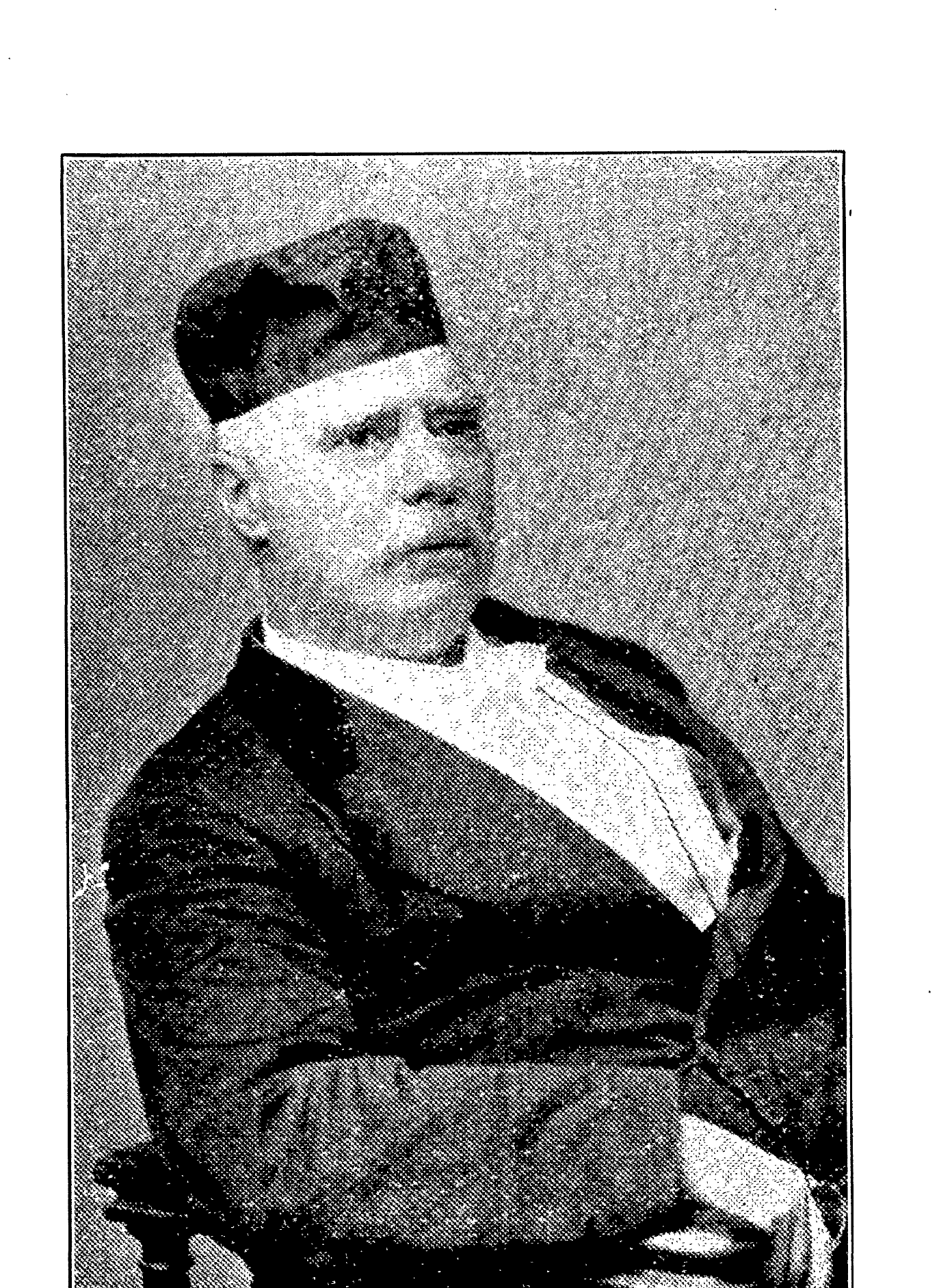
The phrase interested Swinton, and he invited me to his office. He was a man of about sixty, with an impressive appearance, tall, handsome, with closely cropped silver hair, with a pince-nez that he would knock down off his eyes by giving a strong wink. After a while he would put the lenses back on his eyes, speak to you in a hard Scottish accent, look at you like a tiger, and suddenly give a wink and with it knock the pince-nez down again.
He spoke in very short and very forceful phrases, and that was how he wrote, too. He was one of the most remarkable journalists in America. For a long time he had been the managing editor of the "New York Sun," which was then reckoned the best newspaper 218in the country. Its famous owner and chief editor, Charles A. Dana, had the greatest confidence in him. But he was a good deal more radical than Dana, and once he had saved up a few thousand dollars, he left his post and founded a weekly paper of his own. This was then the only English-language publication in America that attacked the capitalists and defended the interests of organized labor; it sparkled with brilliant articles and notes. Swinton's words alone were sharp as spears and witty. He had expected that the workers would read his newspaper. But he was disappointed. He buried in that paper every cent he had laid aside.
A socialist he was not. But he was a courageous radical, truly loyal to the working class, and he remained loyal to it.
I can see him now, the way he walks along the street arm in arm with his tall, elderly, intelligent wife, who was a doctor.
Although he was not a full-fledged socialist, the party nevertheless put him forward as its candidate for state senator, for the district around Rivington Street, which was then inhabited by Germans and by Jews.
I will give here a small sample of his manner of speaking on the platform: he reads out the platform of the Socialist Party; he stops at the demand that no one should work more than eight hours. He gives a squeeze with his eye; his pince-nez falls down, and he throws a fierce glance at the audience:
"Has anyone got anything against this? If there is anyone who thinks that eight hours is too little, let him send me his name. I would be interested to know who that is."
(plate; bound in the original between pp. 218–219)
219Then he reads out a declaration that women are exactly the same kind of people as men and that they ought to have the right to vote; and further he gives a twitch of the eye, again the pince-nez falls down, and again he gives a shout to the audience:
"If there is a man here in the hall who is against this, let him send me his photograph."
I wrote a couple of articles in "Swinton's Paper." Their content, however, I do not remember. I sat with him a few times in his office, talking at length about anarchism and socialism. But with his manner of speaking and with that pince-nez of his he made such a strong impression on me that I simply did not dare to set myself against his arguments.
Speaking about the corruption of American politicians, I noted in passing that in the year 1884 the Board of Aldermen of New York handed over Broadway to a car company for half a million dollars in graft. When this came to light, a whole series of investigations, sensational arrests, and trials began.
Broadway is the longest and most important street in New York, and the corrupt aldermen had granted permission to build a car line along it. Earlier no cars had run on Broadway. Omnibuses used to run — horses with big, beautiful white carriages adorned with gold. Various companies had tried to obtain a concession to lay rails for cars there. For such a concession the city could have received many millions, 220but it did not want to shackle the important street with rails.
Suddenly it is announced that a certain company has obtained such permission, and entirely for free. The president of the company was a man named Jacob Sharp.
This was startling news. People at once began to suspect that graft was behind it. The newspapers took it up. An uproar arose, and the district attorney was compelled to make an investigation. It came out that Jacob Sharp had bribed some two dozen members of the Board of Aldermen for half a million (the concession was worth twenty million). Many of the aldermen were arrested, tried, and sentenced to prison in Sing Sing. All these trials are known in the history of American politics as the trials of the boodle aldermen (graft aldermen).
The alderman of the Jewish Fourth District was then Tom Shiels — a man of medium build with broad shoulders, with an unintelligent face, always in a tall hat and always with a white necktie. He kept a saloon on the corner of East Broadway and Clinton Street. He was indicted too. But he wriggled out of a conviction. Every time I would meet him on the street, even twenty years later, I would recall the sensational trial of the boodle aldermen.
I attended the largest of the boodle trials, and, ostensibly as a reporter, I visited the Ludlow Street Jail, where Jacob Sharp was being held. I saw him strolling about the yard — an old, fat man, with a gloomy face.
221The aldermen were Tammany Hall men, and the affair confirmed the general notion of Tammany as a nest of graft-takers, owners of disreputable houses, friends and partners of all sorts of outcasts and criminals. The business of the boodle aldermen reminded everyone of the affair of the "Tweed Ring" (a Tammany leader and his gang) of 1871, and the expression "Tweed Ring" was heard every day. So I got hold of a little book through which I became acquainted with all the details of the Tweed swindle. Tweed in 1871 was the "boss" of Tammany Hall, and under his leadership the officials of New York and its functionaries robbed the city of many millions. Next to City Hall there still stands the County Court House, where the higher courts of New York are located. On the construction of that building alone the gang stole eight million. The New York "Times," which was then a Republican newspaper, exposed the theft, and the upshot was that several of the gang, Boss Tweed included, were sent to Sing Sing, where Tweed died.
It is remarkable that the sensation damaged the power of Tammany Hall for only one year. At the next election it triumphed again, and again had the city's treasures in its hands.
In the first years that I spent in America, socialist meetings in English were already taking place. They used to be held every Sunday evening, 222and I used to attend them. At first the meeting place was on Broome Street near the Bowery; later on the Bowery in the same neighborhood. I used to come regularly.
I say that they were socialist meetings. In truth one could use that name only in part. There you found people who believed that certain things needed to be reformed in the running of society, in the system of land ownership, in the money system, in the electoral system. Some were in favor of voting rights for women; others of other changes in the constitution. Reformers of various shades used to gather every Sunday evening, and each would preach the particular idea that he held to be the most important. Genuine socialists were very few there, and they were all Germans, and spoke English with a heavy German accent. People debated about everything in the world, but it was called holding socialist lectures and debates. All sorts of "cranks" used to gather there. You saw there men with long hair and women with short hair (both were then a great rarity in America). Everyone who had some plan for remaking the world, everyone who was dissatisfied with American politics, used to come there to pour out his heart. Some did not themselves know what they wanted. They simply wanted to speak before a crowd, and all this was called "socialism." There was never a large crowd there — all told, about two or three hundred people.
The announced lecturer would deliver his sermon — usually in fine, polished English — and then several of those present would put themselves down to 223speak. Each debater would talk about his own pet subject. Rarely did the debates have any connection to the lecture.
At one of these gatherings, when I had been in America less than a year, I gave my first speech in English, and I showed more courage than English. No one understood what I was saying. I had something to say; but I knew the English language too little. I had no right to take the floor at such a meeting. Even when I could already carry on a private conversation fairly well, I too, at first, used to have great difficulties on the platform, and my listeners — even greater ones. The Americans, however, had much patience and politeness. Besides: everyone was beating his own drum, and the others took little interest in what he was saying. So what did they care when a pale, thin Russian-Jewish young man stood up and spoke to them in such a kind of English, which to them sounded like Turkish?
For me the place was interesting not only as a spot where one can debate and where one hears various opinions, but also as a school for practicing English. But little by little the English language began to flow more smoothly for me, and I came to be recognized as one of the most important participants in the debates, until at last I was honored with a whole lecture. This was in 1885.
At first I was the only Russian Jew who used to come there. Later others, too, began to appear, but very few.
224There I became acquainted with several Americans, and with a couple of them I even became friends.
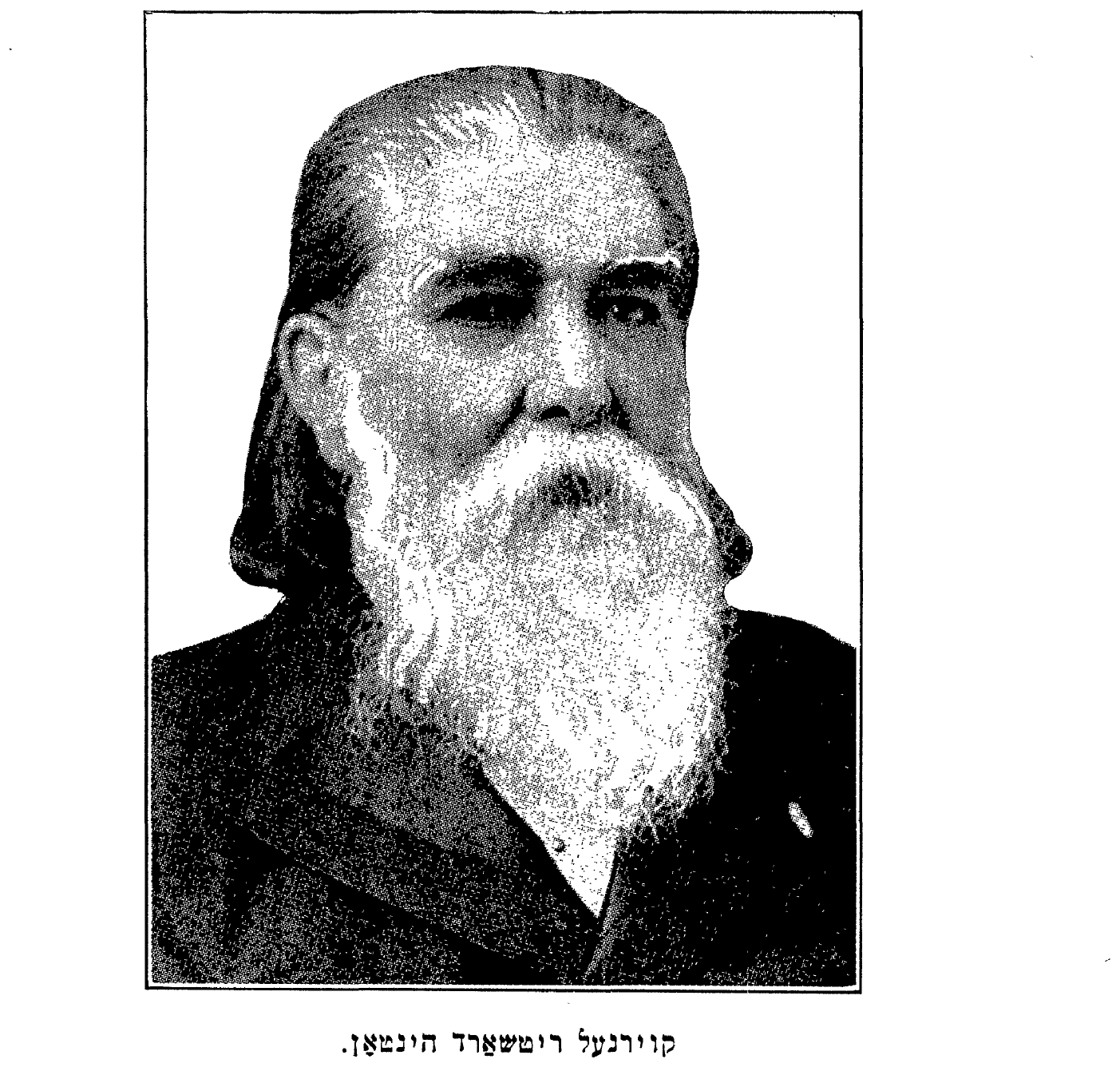
One of them was a native of England. He had already been living in America a long time, but he still spoke with the English accent, and the "h" was often missing from his speech. He had taken part in the American war between South and North and had come out of it with the title "Colonel" (polkovnik). His name was Richard Hinton. We used to call him Colonel Hinton. He was a man of medium stature, with very long hair and a smoothed-out long beard. He had a rich, fluent way of speaking. He had declared himself a socialist before he understood socialism; but later he became more or less acquainted with Marxist theory. He loved the platform and used to speak too long.
A few times John Swinton lectured there, and then the hall was packed.
Once, in the course of the debates, an American woman with a sorrowful, pious face stood up. Her pet subject was the money question. If more money were minted, everyone would have more money — she preached — everyone would then be happy; no one would be poor. I remember her sorrowfulness, the way she cries out: "Shall we keep silent about this? So many tears and so much blood are being spilled! Such poverty, such want, and we do nothing! Let us go to Washington; let us demand that more money be made!"
To the theme of the lecture that was being given that evening, this bore not a crumb of relevance.
I was the next speaker. I already felt quite at home in the English language, so I de-
(plate; bound in the original between pp. 224–225)
225clared, first, that even if more money were made, it would not help; and secondly, that one cannot make as much money as one likes. That woman interrupted me with a shout, almost with a wail, that I had no heart for the sufferings that mankind endures.
After me an American spoke, who put my idea forward in a different way. The "money woman" interrupted him too. They barely managed to calm her down. Yet another speaker, a German, explained to her that when there is more money, it will all fall into the hands of the Vanderbilts, of the Goulds, so that the workers' pockets will be just as empty as ever. Then the woman cried out that people like us were helping the Vanderbilts and the Goulds.
At one of these gatherings a well-dressed American, with fine manners and fine English, gave a lecture against socialism. I was the chief debater against him. And some of those who had applauded him applauded me as well.
These lectures and debates were held on the Bowery, because the neighborhood — today's Jewish East Side — was then settled by Irish, Americans, and Germans, who understood English. In later times American socialists used to hold their meetings much farther uptown.
Notes (the original's footnotes)
[p. 199] A few days after I came to America, Guiteau was hanged. And one of the first scenes that made a strong impression on me was the shouting of the newsboys, who ran about with "extras," calling out that Guiteau had already been hanged. My interest in this was especially great because of the above-mentioned declaration that the "Narodnaya Volya" had made concerning the assassination of President Garfield.