Chapter Eleven
Other American Acquaintances and Experiences
316At the same time that I often visited the socialist club, I was a member of a second club — one that had no connection to any particular political party. The majority of its members were young American schoolteachers. I came into it through one of my fellow teachers at the Christie Street evening school, a Christian named Korlam, with whom I became friends — a young man with a handsome round face and red cheeks. Our classrooms were next to one another, so we often chatted before school hours and afterward; and several times I visited him at his father's house on East 106th Street, which was then a Christian neighborhood and consisted of two quiet rows of small wooden houses. Korlam's parents were German immigrants, but he himself was born in New York.
His friends used to come to him, Irish and "genuine" 317Americans with whom he had studied together at City College.
They had a society that used to gather in one of the halls of "Congress Hall," on Third Avenue, near 18th Street; and Korlam, along with a few of his friends, talked me into joining. I liked the young people and I became a member among them. This was before I became a member of the Socialist Labor Party, and I remained there more than two years.
The club consisted of about thirty members, and all of them, except me, had finished New York City College. All of them, except three (myself and two others), were Christians. And all of them, except four or five, were schoolteachers.
The club was a "literary society," that is, actually, a debating society. And it conducted itself the way all such societies conduct themselves. At the regular meeting, which used to take place every Saturday night, a topic would be chosen for the next meeting. The chairman would appoint which two members were to speak for it and which two against. The purpose was to give the members a chance to practice as speakers and debaters.
But besides debates, there used to be readings of essays, sketches, or poems that the members had written, and after each reading the piece would be criticized. When the official meeting had ended, people would simply spend time together — singing, telling jokes, sharing anecdotes, making merry.
A few of the members were brilliant speakers.
In the debates I took part along with the 318others; only in my case an exception used to be made: instead of the chairman assigning me which side I had to speak on, I was allowed to choose for myself whether I wanted to give my speech for or against.
Once one of the members proposed as a topic the question of whether the capitalist system is a just system or not (officially it read: "Resolved, that the capitalist system of production and distribution is just"). The topic was accepted and the chairman assigned me to the "negative" side — against capitalism.
My friend Korlam protested. "If Cahan wins the debate, that will be no wonder," he said. "He's a specialist on the subject. Let one of us show what he can do with such a topic." He asked the chairman to give him the "negative."
The socialist question interested him and the other members about as much as last year's snow. He did not care whether he spoke for it or against it; only out of friendship to me, he wanted nothing other than to have the floor against the present order.
I gave up my place to him; but I supplied him with material (a few socialist pamphlets in English and my own explanations, of which he took notes). The upshot was that he won the debate. For his opponent had not braced himself for such arguments, and did not know how to prepare. Incidentally, Korlam really was a capable young man and one of the best speakers in the club.
The club therefore officially "ruled" that the capitalist system is built upon injustice. But this was only for show, exactly like what was 319"adopted" after every other debate. Social questions did not concern the boys. In Russia such young people would have been intensely interested in matters of this sort. Some of them would even have been ready to go to Siberia or to the gallows for it. The circumstances there were entirely different and the intelligent young people entirely different. I knew this, naturally, and yet the difference always lay on my mind, and the indifference of the boys to serious questions struck me as unsympathetic.
I once explained to them the difference between the two countries in this respect. The dramatic side of the Russian struggle interested them at once. Questions about the Russian nihilists began to fly. I told them, and they listened with such deep interest and with such admiration and sympathy for the revolutionaries, that we sat that way the whole evening and held no meeting at all.
This was in October, or the beginning of November, 1887. In any case it must have been not long before that Friday, the eleventh of November, when in Chicago they hanged the four anarchists. For on the morning after the tragedy, Saturday night, the 12th of November, there was a meeting of the club, where I had an entirely different sort of experience, and I remember that this was a short time after that Saturday night.
I went to the meeting with the aim of explaining there the fourfold execution according to our point of view — to prove that it was a bloody class vengeance. I had hoped to arouse sympathy for the hanged men.
Before the meeting opened, I heard two of the members making merry over the Chicago anarchists. One of them pointed with his finger 320at his neck, showing how the rope is drawn tight; and he mimicked the four victims as they strangle and stick out their tongues.
It went dark before my eyes. The whole club became repugnant to me. My plan to try to arouse sympathy here for the hanged men now seemed comical to me. I quietly left the hall, and stopped coming there.
When Korlam asked me why I no longer went to the meetings, I gave some excuse, but finally I came out with the truth. Then he and other members apologized to me and so heartily begged me to come again that I gave in.
In American literature at that time the most important place was held by William Dean Howells and Henry James. Both were realists, and at that time in America it was a fashion to boast about them. When some important personage came from Europe, and American reporters came to interview him, they would, among other things, ask the guest whether he was acquainted with "our writers, Howells and James." Yet in that club there was not a single young man who had read the works of these two authors. With the English classics they were well acquainted. But Howells and James at that time represented "the new word," and of that they knew nothing.
I was already well acquainted with Howells's and James's works; and when I tried to talk about them with the members of my club, they did not even know their names.
In Russia such a thing would have been impossible. That a 321young man who had finished university should not even know the name of the best and most important novelist — that, in Russia, one could not imagine.
Again a great difference between the educated young people here and the educated young people of Russia!
But the two differences were closely connected. The deep interest with which Russian students related to literature was a part of their interest in social questions; for Russian literature was a part of Russia's struggle for freedom. To criticize life the Russian censor did not allow; so one criticized the belletristic "tales." But in the form of literary criticism, one delivered criticism of the real social life of Russia. For the "tales" were pieces of life. This was one of the reasons why the interest in literature in Russia took on a more serious character than in other countries.
In America, however, there was at that time no struggle for freedom and there was also no censorship. Political and social questions were openly discussed in America in newspapers, magazines, books, and on the platform. The seriousness with which one related to literature in Russia therefore did not exist in America.
Speaking of the debates that took place in the club, I remarked that the members did not interest themselves in social questions. This does not mean, however, that they did not interest themselves in American politics. Every boy was a hot supporter of one of the two great political parties — the Re- 322publican or the Democratic (most often it was the party for which the boy's father had voted).
Every year, at the end of summer, when the campaign for the elections flares up, they would get caught up in the political collision, each on the side of his party. In the club, however, they would not bring in these party quarrels, except in the innocent debates.
Many of them intended to study law (some had already done so); and a lawyer usually dreams about a political career. They hoped someday to be members of the Washington Congress, and since the hall where they used to gather happened to be called "Congress Hall," they would sometimes make the following pun in their speeches: "Let us hope that Congress Hall will be for us a preparation for the Hall of Congress."
Even those who were not planning to study law also interested themselves in politics. Every American interests himself in it from his youngest years on.
One cannot say, however, that the word "politics" had the same meaning for the boys as for a Russian intellectual. In Russia one took the word in its serious, social sense. It was a question of tyranny or freedom, and when a student occupied himself with politics, he risked his life. The word had the smell of martyrdom. It had a holy flavor. In America one knew nothing of this. For the young American, politics or "politics" was a "game," a sport, and chiefly a means to make money — directly or indirectly — to gain influence and power. So it is in all republics or monarchies that have parliaments, but nowhere are the prospects 323for a career so closely bound up with "politics" as in the United States.
The boys of the club were well acquainted with everything that was going on in the political world of New York and Washington — with the names, the present and the past of every important politician. They were full of names and of facts, of anecdotes and of figures — all about congressmen, senators, assemblymen, aldermen, "leaders"; about their fights, intrigues, prospects, victories, defeats.
The Jewish and the Christian boys of the club had among themselves the most intimate comradely relations. They often used to visit one another. Of antisemitism I did not notice the slightest trace in that club. And this is characteristic of those times in general. Antisemitism did exist in America then, but to a far, far lesser degree than at the time these lines are being written.
The greatest source of Jew-hatred in Europe is competition in business or in the professions. There are other causes too, but this is the most important one. The Americans, however, had nothing to fear from Jewish competition. The Yankee is himself a shrewd businessman and to outdo him is not easy. Secondly, the number of Jews in America was then small and the number of Americans who came into contact with them was on the whole small. Most Americans simply did not know what a Jew looked like. As for the hostile feelings that are grounded on a dif- 324ference in religion, America is a land of all kinds of faiths; the population is a mixed one and politicians are, through their chasing after votes, accustomed to conceal such feelings. From a religious antisemitism the Jews therefore certainly did not suffer.
In his heart the Yankee is always proud of the fact that he is a "genuine" one. He considers himself the only true American. Socially he is mostly set apart. But in this respect the Irishman was no more of an aristocrat than the Jew. On Catholics the "genuine Americans" were on the whole accustomed to look askance, ever since those times when they lived in England, and the English bitterly fought the Catholic religion. Yet in the rich American societies there were for a long time Jews to be found, rich ones naturally.
The "snob" antisemitism or "aristocratic" antisemitism came to America from Europe as a fashionable thing, just as new fashions in clothes or hats come from Paris. The more wealth spread here, the more in the local "high windows" people imitated the customs of the royal courts on the other side of the sea; and just as there one does not admit the Jews to "high" society, so here too one gradually excluded them.
In 1877 they did not admit the millionaire Jewish family Seligman into the rich summer hotel at Brighton Beach, and several years later they shut the doors of the winter hotel "Laurel House" in Lakewood to the Jewish millionaire Straus. There was yet another such case in those times. But the "fashion" had not yet spread far.
In the first years that I spent in 325America, the American millionaires were not large in number, and they were still relatively new in their role. They had not yet had time to develop their "snobbish" tastes and pretensions. Therefore one could still find a few Jews in their "highest" society then. No new ones were admitted, but from the earlier times a few Jewish families remained, who were still admitted.
One of those who took part in the immigration committee when I came to America was a rich Jewish lady, a writer, who belonged to the very top cream of the money-aristocracy. Her name was Emma Lazarus. She often visited our immigrants in their camp on Ward's Island; and yet this did not disturb her role as one of the "Four." It is true she was of the Portuguese Jews, that is, of the oldest Jewish families who came to America (many generations ago), but today even a Portuguese Jewish family would not be admitted to the "400."*
It is interesting that in the southern states, where the sense of pedigree of the white Americans was always more developed than in the northern states, antisemitism made itself felt even less than in the North. Jewish families were there everywhere socially intermingled with the greatest Christian "blue bloods." In some cases Jews were even elected as governors.
The Christian young people of the literary club that 326I belonged to in 1887 were of course not of the aristocratic "400." They belonged to plain, not rich families. But today even such boys would be permeated with antisemitism, unless they were radicals; and those boys were not that.
I began to write in the daily newspaper, the "New York Sun," which then stood at the highest peak of its name and influence. It was regarded as the model of American newspapers, and journalists from all over the country used to read and study it. I dreamed of becoming an English writer, and the "Sun" was at the forefront of my hopes. The fact that four years earlier I had had an article in the "New York World," I did not count as a beginning of my journalistic career, for that article was written before I had a good acquaintance with the English language. Now, however, I felt entirely different, and I resolved to make a real attempt.
So I wrote up an article in which I depicted little scenes of life in the Jewish quarter, and with that I went off to the editorial office of the "Sun," which was located near City Hall.
American newspapers did not then have such gigantic buildings and such lavish offices as now. The editorial office of the "Sun" was located in a small brick building. I went up to the second floor and 327I went into the general editorial room. Near the door there was a low wooden partition with a little gate. Between the door and the partition stood a small table and a couple of chairs. There was barely free space enough for three people to stand. A boy received me, took my manuscript, and asked me to wait. With a pounding heart I watched from a distance what he was doing with my little papers. He carried them over to a handsome middle-aged man who was sitting at a desk by one of the windows. The man glanced at my headline and began leafing through. I saw how he grew interested, how he started leafing through again from the beginning, how his attention grew. At last he rose and came out to me. He greeted me and introduced himself as Erasmus Darwin Beach (he was the chief manuscript reader of the Sunday "Sun." There were as yet no official Sunday editors then; but he essentially played the role of such an editor). He sat down on the little table, and, speaking in a pleasant manner, he asked who I was and what I did.
— We will print this next Sunday, — he said, — bring us more such things.
I almost embraced him.
I was already about to leave; but Mister Beach stopped me:
— Excuse me, you use a word in your article about which I want to ask you. What does "ghetto" mean?
I was astonished. I had thought that an intelligent person who did not know that word simply did not exist in the world.
One encounters that name in the history of the Middle 328Ages, or in descriptions of Rome or Venice even of our own time. But if one does not have any ghettos in one's own country, one may forget the word.
One must admit, however, that Mister Beach was not a well-read man in the European sense of the word. The average type of journalist in America was, in general, a different one than in Europe.
Today nearly every American city has a Jewish quarter, and some of these quarters are themselves whole cities. The newspapers so often have occasion to mention them that they need every word with which one can designate a Jewish quarter. Today every American already knows what a ghetto is. By it he does not mean a quarter where Jews are forced to live and which is the only quarter where they are permitted to live. Such a thing naturally does not exist. He uses the word to designate streets that are chiefly settled by Jews.
Beach was well known in the newspaper world of New York. For he was one of the most important figures on the "New York Sun," one of Dana's favorite collaborators.
My article appeared the next Sunday, with quite few changes. I was in seventh heaven.
In my article I had given an example of the Americanized Yiddish that is spoken in America. I had put together a long sentence which consisted almost throughout of English words that our immigrants had already by then taken into their language. Part of the sentence was: "I'll scrub the floor, clean the windows and polish the stove."
These words drew so much attention in the editorial office that the very same issue of the "Sun" con-
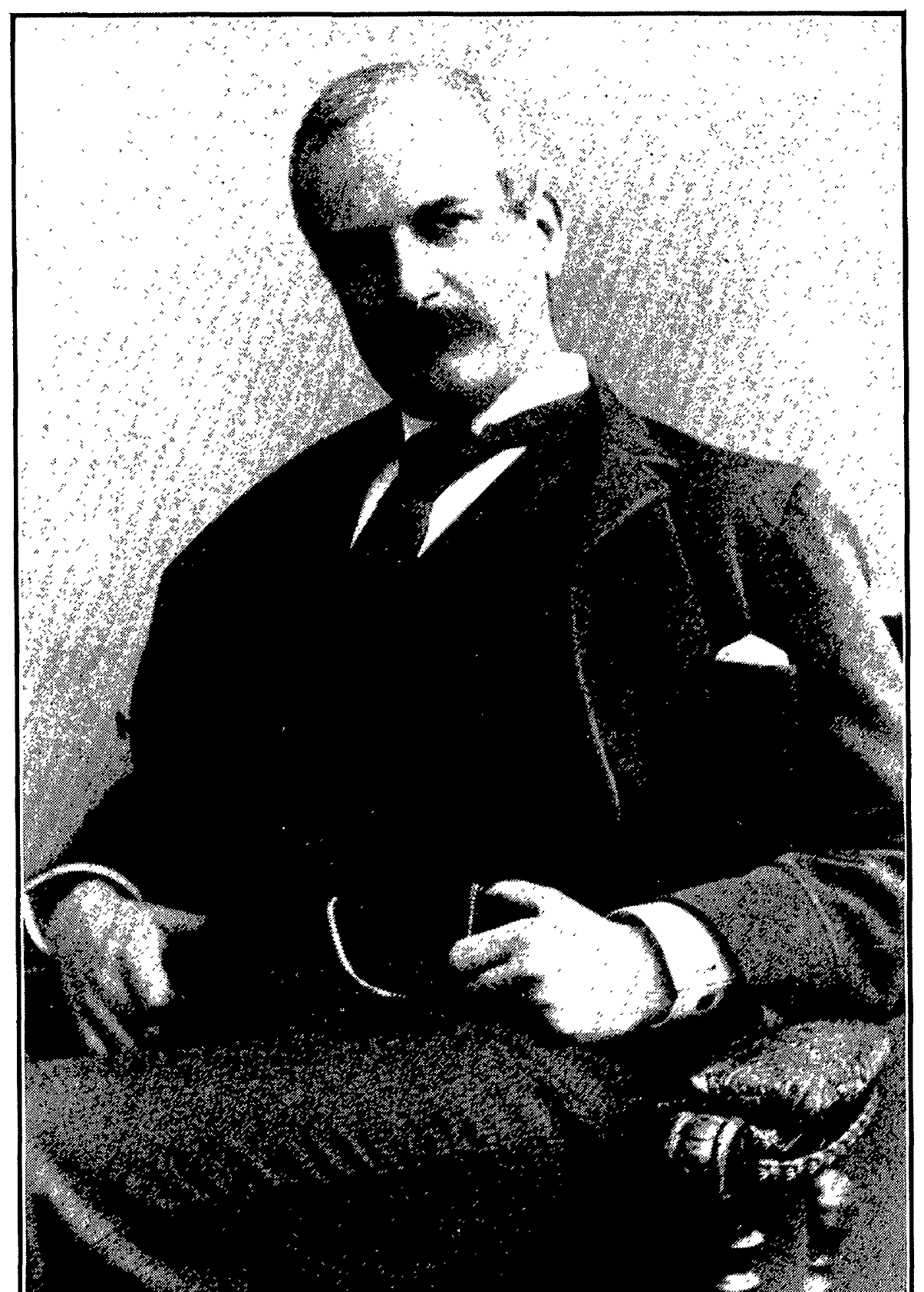
(plate; bound in the original between pp. 328–329)
329tained an editorial about my description, and there the mentioned bit of American Yiddish was cited.
I wrote further articles, and they accepted them all, all except one.
Almost every time I came to the editorial office, Beach would draw me into a conversation. He would talk with me about Russia and our revolutionary movement, about the Russian writers, about my acquaintances in America, about the Jewish immigrants, about the evening school where I was a teacher.
He introduced me to two of the other collaborators, and through them I became acquainted with a couple more. When I happened to meet them at a free time, they would ask me to sit, and we would chat.
I also wrote some articles for the "Star" and afterward for the "Press" — two daily newspapers that have long since ceased to exist.
I had already become "well greened in," and I had read the American newspapers with relish over the course of four or five years. But about the newspaper world of America I had until then known quite little. Now I began to become acquainted with this world, and I learned many things that were a novelty to me.
I had already noticed that the American journalist belonged to a different type than the European one. In Russia, for example, when one needed an editor for an important newspaper, one would take a learned man, a professor from a university, who was well acquainted with political questions. The other collaborators too were mostly educated people. Here, I noticed, it is quite different. Since I had become a frequenter of the editorial office of the "Sun," I had 330learned that very few American journalists had finished university, and many of them had not even attended high school.
America already had outstanding journalists then. But educated people were very few among them. They understood how to run a newspaper for a large public, and a good number of them were brilliant writers. But they had taught themselves this in a practical manner, as one used to learn almost everything in those times in America. One would become a lawyer, a doctor, or an engineer with little education. And yet there were some remarkable talents in every profession. So it was also with the newspaper trade.
A couple of years earlier I had read a stenographic report of a lecture about journalism that Charles Dana, the chief editor and proprietor of the "Sun," had delivered for the students and professors of Columbia College. Among other things Dana said that American newspaper editors think very little of collaborators who come to them from the colleges. They believe that newspaper work must be studied in a newspaper office and in life; that a man of studies knows books, not life. And a newspaperman must know life.
"The best collaborator on our newspaper cannot spell correctly, — he said, — but his mistakes can easily be fixed, that is a trifle. What matters is that he has an eye to see and a sound sense to understand what he sees."
When I had read Dana's lecture in the "Sun," it made a strange impression on me. Now, that I had become a little acquainted with an American 331editorial office, I saw Dana's assertion with my own eyes, so to speak.
I once chatted about this matter with one of the "Sun" collaborators — a man already in his middle years. He himself was a living confirmation of Dana's words. He openly told me, almost boasting, that he had gone to school quite little. In his life he had had all sorts of occupations: he had worked for his father on the farm, been a typesetter, a druggist, an actor, and even a cowboy in the West. He had always had a desire to write. But before he latched onto a job as a newspaper reporter, he again had to work for a couple of years as a typesetter.
Now he was a good reporter and feuilletonist. He idolized Dana.
Speaking with me about Dana's mentioned lecture, he said:
"He is certainly right. A man who spells correctly and knows grammar can be hired for a few dollars a week. But sense, skill, and the ability to write interestingly — that is a much costlier article."
In later years Columbia College introduced a special department to teach journalism. There one studies the profession in a practical, genuinely American manner; and that is absolutely not the European manner. In the eighties, however, even such courses did not yet exist either. Life itself was the only such course.
The five years that I spent in America gave me a goodly bit of experience. The average immigrant lives here a life that is far richer in experiences than his life in the old home. On top of that, I was full of curiosity, full of a thirst to 332observe. And so I had already earlier understood American journalism, taken in general. I saw its bad sides; but I could also appreciate its merits.
Still, the experiences that I now had as a "free lance" (not a regular collaborator) on a couple of New York newspapers made my acquaintance with American journalism far richer. Every day it would seem to me that my eyes were opening anew, that I understood better both its strong points and its weak ones.
I did not make any great fortunes from my English articles. The price for a column in the "Sun" (a long and a dense column of about twelve or thirteen hundred words) was eight dollars (the columns in the "Star" and in the "Press" were a bit shorter, so the price was smaller). An article would run two or one and a half columns. My pieces could be printed only on Sunday (in the "Sunday Supplement"), and it was also not possible to have something there every Sunday. When there were more important things, my article would be set aside. And sometimes it would happen that it was already set in type, only "crowded out" (pushed out by more important reading matter). In such a case they would pay me, but I would rather have forgiven the payment, if only to see the article in the newspaper.
My name did not appear on my articles. So it is usually done in American newspapers even today. And in those years the fashion was even more widespread. Only the name of a famous writer or journalist would be seen in the newspaper.
333A competition was then flaring between Dana's "Sun" and the "New York World," of Joseph Pulitzer.
Since Pulitzer had come from St. Louis and bought up the newspaper, it had kept on growing. He put ever more life into it, and it never ceased to seethe with him. He would fasten onto some wrong, some injustice, a suspicion against an official, make of it an "issue," and begin to storm. In his hands the newspaper blazed with sensations. But it had many things that were really interesting. The ordinary news was written with color, with details that make an impression. And often a news report would appear in the "World" that other newspapers did not have. It had one "beat" after another.
One felt that in the editorial office of the "World" there sat an "unrest" that kept watch over every collaborator, over every word that was written, over every turn that was made. One felt that the newspaper was ruled by a force that electrified it with nervous energy.
Earlier the "Herald" used to be the liveliest newspaper in America. Bennett, its editor and proprietor, worked according to the principle that a newspaper must not only print news, but also "make news," create sensational happenings that the public would want to read about. He spent millions on sensational expeditions (to seek out, for example, a famous traveler and explorer who had gotten lost in the wild regions of Africa). In order to be the first at the telegraph, on the battlefields of the Russo-Turkish War, when an important piece of news was expected, Bennett's correspondent, MacGahan, telegraphed dozens of pages from the 334Bible. In this way he had the right to sit at the apparatus the whole time, and when the news arrived, he could be the first to telegraph it.
By now the "Herald" too was rich and mighty, but the "Sun" occupied a very important place, and it kept on rising; when suddenly there appears a Hungarian Jew and begins to turn things upside down. Dana suffered greatly from Pulitzer's success, and his hatred of him had no bounds. He attacked him in various ways. He would cry out that Pulitzer was poisoning American journalism, that he was making it too sensational and cheap.
To call him "sheeny" or even "Jew" would have been against American customs, against the rules of decency; so he thought up a witticism: "Hungry Joe" (the hungry Joe, or Joseph), that is, that this Joseph Pulitzer had too great an appetite; that he wanted to grab ever more; but in truth this meant "Hungarian Jew."
Pulitzer, naturally, did not mean the Haggadah, but the dumplings. With the uproars he made about the dishonesty of certain officials, about wrongs against the public, he had in mind nothing more and nothing less than circulation. But Dana, with his attacks on Pulitzer, also did not mean the Haggadah. Pulitzer had not invented American journalism, but found it. He took it as it was, and as such he developed it further.
He was a lean, sickly man, with a genuinely Jewish face, and with a genuinely Jewish nervous temperament. His mother was a Christian, but his father was a Jew, and his character, just like his face, he had wholly inherited from him. He was born 335with a Jewish enterprising spirit, with a Jewish fire, and with a rare capacity for work; and in America all this took on American forms.
He had an enormous success. "The World" grew as if on yeast. People talked about it all over America, and everywhere American editors imitated it. Pulitzer quickly became a millionaire and one of the most important personalities. But his eyes were weak, and his tireless activity and toil had no good effect on them. Together with success and wealth there grew in him a great tragedy — complete blindness.
At the time about which I tell in this chapter, the competition of the "World" against the "Sun" was at its highest stage. My acquaintance reporter from the "Sun" would talk with me about this every time; when he would begin to talk about the "World," it would seem to me that I reminded him of it, because I am of the same people as Pulitzer. This reporter idolized Dana, and Pulitzer was hateful to him. But I did not feel any antisemitism in him. Americans are very tactful, and they look at everything from a practical standpoint. With them such a conversation comes out quite differently than with a European Christian.
My material situation was not a brilliant one. My two trades brought me few blessings.
If I had given myself wholly to American journalism, everything would have gone in a different way.
336In it there were already then various branches that paid well, and I could have built a good career in them. But in order to have success, it is necessary to throw oneself into the thing with all the energy and all the enthusiasm one possesses. I did not do so. My greatest interest and enthusiasm lay in the socialist movement. The role that I then took to play in the American section was perhaps a special driving force toward that.
However the story goes, my articles for the "Sun," "Star," or "Press" I wrote with interest and ambition, but not with a full interest and a full ambition. They were for me a side matter.
A second cause was my notion that in the capitalist press a socialist may write only certain things. The editors of the mentioned newspapers would propose special "assignments" to me. But I would often refuse. This one must not do, and that post simply not for a socialist, although the themes from a socialist standpoint were fully kosher. Today socialists have quite different notions about this; and when I now recall which "assignments" I used to hold back from, it strikes me as naive.
I did not want to refuse simply. So I would think up excuses. But this hindered me in developing my possibilities in the editorial office.
A third cause was the fact that I had no practical eye to see where my best journalistic opportunities lay. I worked on articles that were not at all worthwhile for me, and did not notice open doors through which I could have entered into far more important circles of American journalism, come to a name and to a fine income.
337The result was that my income from writing was neither regular nor sufficient. I received compliments from the American editors, but I could not live off my articles.
My private lessons could no longer provide me with a satisfactory livelihood either. The pay was small. Besides that, the lessons themselves became such a burden to me that I would neglect them, or give them up entirely. Here is one example of such an experience:
I had a lesson with the family of a storekeeper who lived on Hester Street. A boy of his was weak in grammar and arithmetic, so he took me on as a supplement to his school. Someone had told the father that I was an artist at "fixing up" thick heads, so he invited me. We settled on three lessons a week, at sixty cents apiece. I taught there several weeks and everything went smoothly. The storekeeper would slip up into the house to hear how I was teaching with his son, and he would simply glow with pleasure. Out of enthusiasm he would butt into the lesson and try to show that he had once studied grammar back home and that with accounts, too, he was no cripple. I could not bear it. A couple of times I told him quite plainly that he should not interfere.
But this did not bother him, and he kept on interfering.
Still, for that alone I would not have given up this lesson. But once the following story happened:
I used to teach the boy in the parlor. Standing there was a rocking chair, upholstered in black camel hair; the rocking chair was on springs.
338While I taught with the boy, I would either walk back and forth across the room, or rock in the rocking chair. Once, while I was sitting and waiting for my pupil to work out a problem that I had explained to him, I rocked myself so hard that the spring snapped. I told the lady of the house right away and offered to pay for the damage. I assumed they would not accept my offer, for they were quite rich. But I was mistaken. The storekeeper sent for a repairman, and a new spring was put in. When I came the next time for the lesson, I was handed a bill (for two dollars, I think), which he deducted from my pay.
I felt disgusted. It was not the two dollars, of course, that bothered me. It felt to me as if someone had slapped me in the face. The penny-pinching coarseness that lay in it irritated me without end. I wanted to explain to the master of the house what a "refined" person he was. But I did not do it. I simply never went there again.
That is only one example. There were various other cases. I would give up a lesson on account of the character of the pupil, or on account of special circumstances that surrounded the lesson.
The evening school was more interesting to me. But it was open only in the winter months.
In winter, when I had a regular income from the evening school, things were not so bad. The most essential needs were taken care of. But in summer it would sometimes happen that there were very few lessons, and when there was no income from articles either, things would get quite tight.
339At borrowing money I was never any artist. I was ashamed to. And my wife was no expert at such things either. There were times when she, too, had lessons; but it would happen just then that I had too few. There were weeks when she covered the entire household expense with her lessons.
When I earned tolerably well, and a decent sum found its way into my hands, the first thing of all we would do was lay in dinners for a whole month. On Canal Street, not far from the Bowery, there was then a cheap Christian restaurant where we used to eat; there we would buy thirty "commutation" tickets (at a cheaper price).
It happened not infrequently that I would visit a pawnshop. I used to pick out ones that lay as far as possible from the neighborhood where our acquaintances lived. One was on Grand Street, near Pitt, and another still farther toward the water. When I would come there in the morning, mainly at the end of the week, when the workers' wages had long since been spent, I would find there a whole crowd of children, mostly Irish, each with a little bundle to pawn. Sometimes I would have to wait there a good while before my turn came. So I would stand and observe the various scenes.
In one of the two pawnshops they would take as a pledge such trifles that I would be astonished: a shirt, a pair of drawers, an old spoon — not a silver one — and even two pairs of socks. I once noted down for myself a pledge such as a petticoat with two holes. The pawnshop keeper was a tall old Yankee with a white beard. He used to wear a white smock. His 340name was Roach*. At first I believed that the name suited him, but, firstly, he was too tall, and, secondly, he had such a pleasant smile that I gave up the comparison. The children used to sit on the counter in groups. They would tug him by his smock and shout: "Mister Roach! Mister Roach!" and shove the pledge in his face. And he would smile quite good-naturedly and go about his business, as though it were not he they meant. For many pledges he would lend up to ten cents, or even up to five. But into that same pawnshop expensive things were also brought. I once saw there a genuine sealskin coat and valuable jewelry.
Once, in a free moment, I asked him how it could pay the firm to take such a pledge as two pairs of socks or a pair of drawers. He answered me:
"The pair of drawers will surely be redeemed. With the five or ten cents we are safe, and mostly I know the customer."
I got to talking with him, especially in order to gather material for an article, and I learned interesting things. Sometimes the pledges came on account of the drunkenness of the housewives. Sometimes they pawn a pair of drawers, or two pairs of socks, simply because there is nothing for bread. But sometimes because there is nothing for a drink of whiskey. Jews I never used to see in Roach's place.
Such an economic condition, in which I found myself, was then no exception among our intelligent immigrants. Many of us still worked in factories, on shirts, cigars, or in some 341other trade. Their earnings were small. The immigrant who had been a craftsman back home earned a great deal more in America, and he lived like a lord compared with us.
There were a few who had studied here in America to be a doctor or a dentist, and they began to earn good money. Another had attached himself to a factory. Then there were several half-intelligentsia, or quarter-intelligentsia, who in Russia had been businessmen, or had worked for someone else in a business, and in America they went straight into business. I mean such people as were mixed in among us. All these were an exception. They grew quite quickly in their material situation, and they quickly separated themselves from the Russian intelligentsia and from its socialist interests. We looked at one another with contempt. We regarded them as bourgeois, and they regarded us as paupers, "tramps."
On the evening of the 31st of December some of the bourgeois would remember Russia and come to our socialist New Year's ball, but only a few, and their number grew smaller with each year.
Some acquaintances advised me to study law. Apart from the question of getting ahead in life, there was this consideration: in the public life of America lawyers play the most important role, and the socialist movement needs to have its own lawyers. So my friends, mainly my American comrades, believed that as a lawyer I would have success both in my private interests and in the interests of the movement.
In the Jewish quarter there were plenty of lawyers, but with one exception they were all American- 342born, with whom most of our Jews could not make themselves understood. The single exception was Eliezer Mashbir, the leader of the former Balta "Am-Olam," with whom I had come to America together. The first couple of years he worked in America on shirts. Then he enrolled in a law school, and now he was already a graduate. He had opened an office and had a large practice*. In the quarter I was known much better than he. Thousands of people knew me as a speaker at the socialist meetings and as a teacher in the evening school. And since Mashbir had immediately begun to earn good money, everyone predicted that I would surely have a good practice.
In September 1888 I enrolled in the law department of Columbia College. The "Dean" (director) and most important professor of this department was Dwight, an American of the old cut, a man of some fifty years, with small, thin side-whiskers and a clean-shaven upper lip, and with a shrewd American smile. Jews in the courses were not many, and of the Russian immigrants I was the only one.
Most students were genuine Americans, German-Americans or Irish-Americans — all American-born. Some belonged to well-known rich American families. Some of them were graduates of universities and quite refined people. Others made on me the impression of being little educated. For no examination was then required before one obtained the right to study law.
343But even the educated ones also looked to me raw, little developed; and at ideals they laughed, not at all like Russian students. They were of the same type as the boys of my literary club.
With a few of the students I became more closely acquainted than with the rest, mainly with one who was much older than I — a lean man, with shiny steel-colored hair at the temples (his name I do not remember). We sat next to one another, and before the professor appeared on the platform, we would sometimes quietly quiz one another on the lesson. After the two hours that we used to spend in the classroom, we would often go together and talk.
Our intimate acquaintance came about through a pamphlet, which contained a speech by Ingersoll, and which I had with me, sitting at the lecture. It turned out that he was an atheist, an ardent adherent of Ingersoll. An American atheist already counts as a radical too. To such a person you may already be a single-taxer, a socialist, and even an anarchist. In any case, that is the truth about those times.
The first thing we studied was Blackstone's old English work, a great, very thick book about "common law," and Parsons's three thick volumes about the laws pertaining to contracts (that is, to every agreement, whether written or not, and in general to every material relation between one person and another). The content of these books was sensible. As far as I could remember the little bit of Gemara that I had studied as a boy, this reminded me of the Gemara. Mainly it was Blackstone's work that had this character. Many passages in it have a philosophical sense.
344Simply as a book to read, "Blackstone" would have been interesting to me. As a course of study, however, it was foreign and tedious to me. I used to complain: what should it matter to me that Mr. Brown and Mr. Smith have a quarrel between them over a debt? What is it to me? And how can it interest me? The intricacies of the various cases, which were brought as examples to explain this or that juridical principle, did at times interest me; any genuine inclination toward such study I did not have. But I studied with a forced eagerness.
We were then living in the yard of number 9 Attorney Street, on the first floor of an old private house, where we had three tiny little rooms. There I would prepare the lecture, and on the next morning, riding on the Third Avenue elevated, I would leaf through it again (Columbia College was then around 47th Street and Madison Avenue).
In college, when the professor would question me, I would answer him — always correctly. For that minute I would become interested and even answer with warmth. I also used to take part in "moot courts," in mock trials — also with interest. But in my heart I always felt that I was dancing at someone else's wedding.
When one studies law in college, one is usually at the same time connected with a law office, where one 345learns the profession in a practical manner. My first experience of this sort was not a pleasant one. I entered a large law office, but I fled from there at once.
To this law firm, which consisted of American Christians, I was recommended by an acquaintance of mine, an East Side businessman, a Jew by the name of Aronson. The lawyers were just then looking for a young man who knew Russian. Such a student they needed for a certain case. Aronson told them about me, and they asked him to bring me. The firm was an important one, and I reckoned that for me this was a good chance.
The chief lawyer of the firm received me in a friendly way, and he explained to me the following:
In a certain case of his there is a packet of Russian and German letters and various documents; so he wants me to read it all through, give him a report, and afterward translate the papers that he will point out to me. What kind of case it was he did not tell me at first.
They gave me a large desk in a fine, bright room, and I set to work. I read and read. All that I could make out was that here it had to do with something about a bankruptcy of a Russian businessman with a Jewish name, who had, while in Russia, bought goods from a Swiss watch firm.
The papers contained various details with various figures. From each letter I noted down the essential point.
I worked a whole day (Thursday), and there still remained some for the next day. Friday, when I had finished my reading and the noting of the letters with the papers and the little papers, and had brought them all into a certain 346order, I delivered my report. In doing so the chief lawyer made various remarks. At one point the story became difficult for me. I put a question to him, and to this he answered me that the man against whom the lawsuit was going was an immigrant; that he had just come to America with a lot of goods; that he, the lawyer, had received a cable about him from Switzerland, and as a result, he had had a search made in his dwelling and had taken from him all the goods that he had brought with him. The accusation was that he had fled with the merchandise to America, with the aim of not paying for it.
When I understood what was going on here, I sprang up.
— That means you want me to play the role of a spy for you! — I exclaimed — Is that what you need me for?
The lawyer was dumbfounded.
— But I was told that you want to study law, — he answered.
— Yes, but not to be a detective.
— But the man is a robber!
— But I am no detective.
He absolutely could not understand me. One must note that the word "spy" had in Russia a far worse meaning than in America. To be a spy or a sыщик (detective) was in Russia the most shameful thing one can imagine. In America, however, to be a detective is a business like all businesses. In Worcester, Massachusetts, the most important newspaper was called "The Worcester Spy" (der Worcester shpyon). That a lawyer should be ashamed to have a man arrested who 347were accused of misappropriating someone else's goods — that, to the other lawyer, was incomprehensible.
In short, I left in anger, and my friend Mister Aronson later told me that that lawyer had wondered what sort of "lunatic" I was.
My first thought was to throw over the whole law business, but afterward I changed my decision. I thought to myself: one need only find a lawyer who is a man of principle, and then there will be no reason for me to stop studying law. I soon found such a lawyer. He was an American socialist by the name of Edward Sering, who used to come to our meetings at the socialist library. His law office was at 25 Chambers Street.
Here I again made a mistake, but of an entirely different sort. Principles he did indeed have, but no law business at all.
Sering was a man of some thirty-odd years. His parents had been wealthy and had given him a good upbringing. He had graduated from college and was well read. He loved poetry, and of Shakespeare's works he could recite dozens of pages by heart. He was, however, not a practical man, and no weighty lawyer either.
Often he would burst out in a childlike laugh, and when he would read aloud some serious thing, his face would already be too serious. Sometimes, when he would become inspired, his tongue would get tangled.
From his parents he had inherited a fair bit of real estate, but a large part of it he had already sold or mortgaged. That was his only source of livelihood. When I was associated with his 348office, he still had several "lots" there, where now lies the bustling Jewish district of Harlem. The "lots" were great boulders of rock. Today they would have been worth a fortune. But back then the whole district was empty, and people would offer quite small sums for them. Later, when he sold them, they were blasted apart with dynamite, and on their site great tenement houses have long stood.
He shared his office with a friend of his, a tall, strikingly handsome American of some sixty years, by the name of White. Mister White did have a bit of practice — mostly among captains and owners of small ships.
There I brought a secondhand desk. And there my office came to be. At this desk I used to write my law papers and my articles, and read my law books and socialist pamphlets.
It turned out that Sering had absolutely not a single client, and the whole office was so troubled a place that there was not even an office boy. As for a typewriter with a typist, there was nothing at all to speak of.
To me, however, people soon began to come — Jews, naturally. They would come to me — at home or in my office — to draw up an agreement or some other document; and little by little they also began coming to me with cases. The cases were handled for me by Sering, and we were partners.
Almost as soon as I had begun to attend law school, I began to earn money from law, and my income grew quickly. I soon became convinced that Sering knew law only theoretically, and that he had no practical sense whatsoever; in short — that he was for 349me no partner at all. I came, however, to the conclusion that until I would finish studying and have the right to practice on my own, it would be better to remain with this honest, idealistic man than to associate myself with a clever, successful lawyer who has no other god than the dollar. As for the law business that I bring in, I had, first of all, hoped that Sering's neighbor would help us out; and secondly, I relied on myself alone. I will study out every case, inquire, work tirelessly, and see to it that Sering carries it through in court as it ought to be.
Very often we would spend whole hours talking about socialism or about literature. I could notice that our neighbor, the old American, did not think much, either of Sering or of me. On his old American face was poured out an expression that said: with such daydreams you will not go far in the law business.
So the winter passed. It was already 1889. My material circumstances had improved so far that we could already afford a better apartment. My wife found fine rooms in a brand-new house on Henry Street — and there we moved in.
But Mr. White's prophecy, that I would not go far in the law business, was destined to be fulfilled.
George Goldfogle, who in later years became known among the Jewish masses, mainly as Tammany Hall's candidate against the socialist congressman Meyer London, was the direct cause of why I suddenly gave up the profession. It was such a story:
The proprietor of an East Side jewelry store had 350a contract with a watchmaker who worked in his store, and he broke the contract. The case was a quite simple and a quite clear one. There could be no doubt that the worker would win. He came to me with his complaint, and Sering officially became his lawyer.
The trial took place in a court on Clinton Street, where Goldfogle was then the judge. The witnesses were heard; and among the other lawyers who happened to be present there, there was no question that we had won. This was on a Friday. About a week later, the next Friday at midday, when I returned to the office from the street, Sering says to me with one of his childlike laughs:
— There was a boy here from the other side. He asked us to agree to a request to postpone the judge's decision. But he didn't hit the spot! He thought he would drive me into the sack. But I refused to agree.
— A boy from the other side came to ask to postpone the decision? — I asked again in astonishment, — how can that be? The case has surely already been decided. There must be some other thing here.
Sering's sing-song expression vanished. He wanted to consult with his neighbor, but the latter was then not in the office.
— Yes, it may be that I made a mistake here, — Sering said like an honest little boy.
I went straight to the lawyer of the other side, and he explained Sering's error to me. It was not he, the lawyer, who had sent to ask that the case be postponed, but Goldfogle, the judge.
351According to the law, a judge of a district court had the right to postpone his decision on a case for no more than one week. When a week goes by, he already loses his right as judge in the case. But when both parties agree that he may postpone for another week, he may do so. This used to happen quite often. Goldfogle, then, had sent his boy to both lawyers to ask permission to postpone the case for a week, because he had had no time to look over the papers.
It is understood that in such a case a lawyer would gladly fulfill the judge's request. To pick a quarrel with him is, naturally, not worth one's while. Even to a second lawyer one usually does such a favor as well. Sering, however, knew far more of Shakespeare than of law, and of the practice of a district court he had absolutely no concept. So, to him it came out that the boy had come from the opposing lawyer to play him some kind of trick.
Goldfogle's office was on Broadway, a few blocks from our office. I went up to him, to explain the mistake. Goldfogle was then fairly young and slim, with black hair, with a white, longish face. He received me proudly and coldly, and when I began to explain the mistake, he cut off my words.
— The decision has already been sent off to court, — he said majestically.
From his tone I understood that he had decided the case against our client.
If he had done that, I reasoned, it simply means that he had taken revenge on us. After all, he had not yet looked over the papers.
My prophecy was fulfilled. Monday morning 352it turned out that he had really decided the case against us — only because his request had not been granted.
The story made a painful impression on me. So this is what they call justice? — I cried out. — So upon such judges as these I am to be dependent? I could not calm myself. If earlier I had had little interest in the law profession, now it became to me absolutely unbearable. I felt that I could not be a lawyer. The sympathetic old Mister White advised me not to give up the occupation on account of Goldfogle's conduct.
"Life contains greater injustices than this," he argued with me, "one must look upon such things philosophically. You have a good future before you. Don't throw it away on account of such a trifle. You will regret it."
But I had resolved to leave the law business, and my wife, who was as outraged by the Goldfogle story as I was, gave me courage.
That same week I moved my secondhand desk from Sering's office to my home and — out of lawyering!
If Sering had been a different type, with more practical understanding and with more practice and skill in the law business, this experience of mine with Goldfogle would not have come about. He would have understood right away why the boy had been sent to him, and everything would have ended differently. I believe, however, that even then I would also not have remained a lawyer. Law as a course of study did not draw me to itself, and the business tricks and "politics" with which the profession is bound up were not to my heart.
353Some of the best people in America are lawyers; I do not mean specifically the lawyers who take part in our socialist movement. There are other fine lawyers too. And intrigues with "politics" are today to be found in every occupation. Here it was mainly a question of temperament. My temperament was absolutely not suited to this profession. The best proof of this is the fact that several years later I again tried to study law and again threw it over in the middle.
Had I had a liking for the profession, the Goldfogle story could not have had such an effect on my lawyer-career.
354Our narrow material situation troubled us only when there was nothing for the rent or simply nothing for food. When the sharper form of want would pass, we would forget about it. There were springs of intellectual interest that brought rich sunbeams into our economically poor life. A new book, a meeting, an encounter, was more important, far more important, than the earnings. When the next Sunday evening an interesting gathering was expected at the socialist library or at the literary club, or a new kind of mass meeting on the East Side; and when a new little book had arrived from underground Russia, or I had had a pleasant experience at the editorial office of the "Sun" or the "Star," or when the Socialist Labor Party had bought up an English weekly and made it into its party 355organ — then our attention was fully occupied. The young blood streamed, the mind worked, and in the heart it was lively. Who cared whether next week there would be something to eat or not?
At the time when I left the law school and Sering's law office, I found a special interest in Spencer's work. Earlier I had only read through his "Social Statics," which had been important to my debates with myself or with others about anarchism. Now I delved into other works of Spencer's. I took to reading him — more correctly put, studying him — as though I would have to take an examination on it.
This was actually also a result of my debates about anarchism.
In Boston there then came out twice a month a small sheet by the name of "Liberty," which preached a "philosophical anarchism" with a biting criticism both of our socialism and of the anarchism of Johann Most. Its editor was an interesting American by the name of Benjamin R. Tucker. A little more about this periodical we will speak when we come to my first visit to Boston. Here I mention "Liberty" only because it was the chief cause of my interest in the works of Herbert Spencer. The supporters of "Liberty" considered themselves Spencerians. Actually their "Bible" was Spencer's "Social Statics"; but they were enthusiastic about his whole philosophical system — about everything he had written. And he had written a great number of large works and many smaller ones.
I was firmly convinced that, as far as concerns his criticism of socialism, his arguments had 356stand on Canal Street, near Allen, took his business card. On this card I obtained books at half price. My friend's family name was Friedman, and at the said book firm I used to come so often that I became known there. "Hello, Mister Friedman!" — the clerks would greet me.
Once, when I was sitting in a streetcar with an acquaintance of mine, one of these clerks happened to come in.
"Hello, Mister Friedman!" — he says to me.
My companion was taken aback. Whether he suspected me of leading a double life, I do not know. In any case, I straightaway explained to him what the matter was.
Notes (the original's footnotes)
[p. 326] It was a list of four hundred New York families who counted themselves as the aristocracy. The words "four hundred" were therefore taken into use like the word "aristocracy."
[p. 340] Roach is the name of a "Preussel" (a kind of insect).
[p. 342] He died in 1923. The last several years of his life he was completely blind.