Chapter One
How the "Arbeiter Zeitung" Came to Be Founded
9In the eight years that I had spent in America, the number of Jewish workers here had grown greatly. The number of progressive immigrants had grown as well. A need was felt for a progressive press — in other words, for a socialist press; for the progressive people of the Jewish quarter were socialist in their sympathies, and to their class belonged the intellectual leaders of the Jewish artisans.
In the second volume I told about the propaganda union of 1882. It set about collecting a fund for a Jewish newspaper; but this led to no results. The movement was too poor. Mention was also made of the two socialist weeklies (private undertakings): "Di Naye Tsayt" (The New Era) and the "Folks-Zeitung," of which the first lasted only a month, and the second — about a year. Later, already10close to the time at which we are dwelling here, the Jewish anarchists founded a weekly paper by the name of "Vorhayt" (Truth). It too had a hard struggle for existence and lived about a year.
In 1889 the radical immigrant population was without a press. The only newspaper that the Jewish immigrants then had was "Di Gazeten" of Kasriel Sarasohn, an Orthodox weekly which was written in a kind of "Ivri-Taytsh" (Hebrew-Yiddish).
The Jewish socialists often discussed among themselves the question of creating a newspaper that would represent their point of view. But they did not have the means for it.
Finally, at the beginning of 1890, such a newspaper was founded, and it was destined to play an important role.
As these lines are being written, the "Forverts" has already existed for over twenty-nine years, and has long been the largest Jewish newspaper in the world and a tremendous influence in Jewish life; and the "Forverts" is in fact a continuation of the newspaper of which I shall tell here. The seven years that will be dealt with in this volume are a prologue to the 29 years of the "Forverts."
The first step that led to the founding of that newspaper was taken by the anarchist organization, which some time earlier had put out the "Vorhayt." Since it was not able by its own forces to create and maintain an organ, it turned to the Social Democrats *11with a proposal that both parties should, with joint forces, found a "nonpartisan" newspaper.
To the reader who, through these "Pages," is already acquainted with the abyss that lay between the two theories, the proposal will seem strange. How is it possible for such sharply opposed parties to put out a single organ? — he will ask. And yet, when the anarchists called a convention for this purpose, organizations responded — trade unions, societies, and party groups — from both directions. The moods and ideas that found expression in this will become clear to the reader from the further events. For the moment, the only thing that is important for us is the fact that to the call of the anarchists there responded Social Democratic organizations as well as anarchist ones, and that delegates to the nonpartisan convention were elected in New York and in several other American cities.
The convention, or tsuzamenfohr (gathering), as it was called, took place in the week of Christmas, 1889, in New York, on Grand Street (on the side that is12toward Broome Street), in the block between Essex and Ludlow, which used to serve as a market for vegetables and groceries. This was the first convention of radical Jews in America.
It happened at the time of my keenest interest in the "Workmen's Advocate" and in the American section of the Socialist Labor Party. In the Jewish movement I then took part only as a speaker at mass meetings from time to time, and occasionally as a lecturer at a Russian assembly. I was not a member of the Jewish party group. Therefore, I was not a delegate to the convention.
I visited it — partly out of curiosity, but chiefly with the purpose of seeing J. Fin of Boston, who was one of the delegates, and of repaying him with attention for the hospitality he had shown me three or four months earlier, when I had visited him in Boston.
The sessions took place in a small, half-dark hall, and the delegates numbered 47. They represented 31 organizations (a certain portion of the delegates were "fraktsye-men," that is, factionists). They sat crowded together, and along the length of the room a rope was stretched — the boundary between the delegates and the public. Compared with our conventions of today, it was quite a wretched assembly.
Instead of two parties coming together with the purpose of uniting in one joint undertaking, what one found here were two bitterly hostile camps.
The leader of the Social Democrats was Louis Miller, who has already been mentioned in the second volume, and the leader of the anarchists — R. Lewis. Among the other Social Democratic delegates were13: Morris Hillkowitz (Hillquit), M. Zametkin, Bernard Weinstein, and S. Sussman. Among the delegates of the anarchists were, besides Lewis: Frenner, M. Katz, Zolotaroff, and the poet Edelstadt. Joseph Barondess was a delegate from the Knee-Pants Makers' Union.
The anarchists then stood at the highest rung of their fanaticism. They believed in that wild program which, thirty years later, was adopted by the spokesmen of the Third International. Everything that was done in the labor movement to achieve some immediate improvement they condemned as "palliatives," as remedies that help only for a little while and serve as a dangerous compromise with capital. They demanded that one set about a revolution at once.
America was then still far further from socialism than it is today. Very few of its inhabitants had the slightest notion of what it even was. Yet the anarchists demanded that an immediate social revolution be preached here, and not only preached, but that one should also "do something" right away. They spoke of throwing bombs, just as the Russian terrorists had done in their struggle against the Czarist government. The situation in America was naturally quite different from that in Russia. As we have already seen, the Russian revolutionaries themselves had declared that to use violent means in America was a crime. But the anarchists ignored this distinction.
They demanded violent means. Trade unionism they condemned as a means of blinding the worker's eyes and drawing him away from the revolution.
On the very first afternoon when I visited the convention, I heard flaming words in this vein from an anarchist speaker. This was the above-14mentioned Frenner, a delegate from Philadelphia, a young fellow, a handsome one, with an honest face and a ringing, warm voice. He was the best speaker among the anarchists. He sprang up onto a chair and, with his ringing voice, wildly attacked the Social Democrats and the unions.
"Down with all unions! — he cried — down with all the palliatives that lead the worker astray!"
I was by then already completely free of my former anarchist confusion; therefore, Frenner's outcries struck me as crazy. But the sincerity and enthusiasm that rang in his tone almost moved me. I regarded him as a hot-headed child. The conference interested me greatly.
In my conversations with the Social Democratic delegates I expressed astonishment that they were taking part in a convention together with the anarchists, and how they could take part at all in deliberations where the matter at hand was putting out a newspaper jointly.
It turned out that the leaders of the Social Democratic delegates spoke in the same vein among themselves at their "caucuses," or private assemblies; that their aim was to demand at the convention a separate, purely socialist newspaper and to try to win as many delegates as possible for their plan.
The next morning I came again.
Before the convention the members of the two camps had been personally friendly with one another. They used to meet often, hold Russian meetings together. This convention had been called with the purpose of uniting them entirely as the publishers of one newspaper; and the result was that here, for the first time, the two camps began to revile one another.15With almost every minute that the debates went on, the bitterness grew sharper.
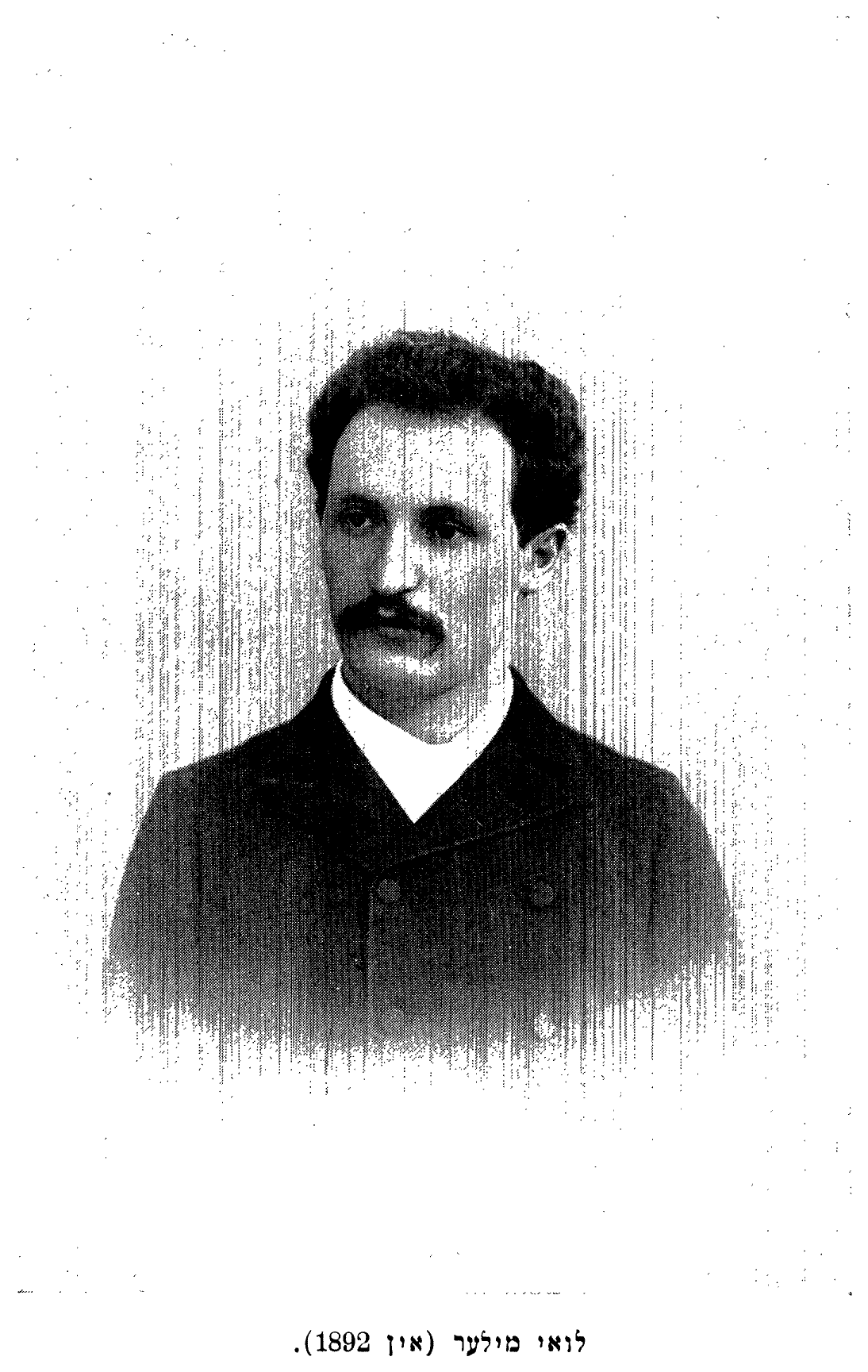
(plate; bound in the original between pp. 14–15)
Louis Miller spoke against the proposal that a joint newspaper be put out, and R. Lewis and Frenner bitterly attacked him for it. It ended with a wild scene of mutual accusations and sharp expressions, and in this confusion the convention broke apart.
That which was supposed to be a unification conference served in truth as the first bitter clash of people who had become blood-enemies to one another.
[טאָפּיק] Social Democratic conferences. — Morris Hillkowitz. — I become greatly interested.
The Social Democrats went off to hold a conference about putting out their own Social Democratic newspaper, and, at their invitation to take part in the deliberations, I went along with them. A few of our Social Democratic comrades did not go along with us. They went off together with the anarchists, as supporters of a nonpartisan newspaper (Zametkin went off with the "nonpartisans").
We went off to a private house, on Norfolk Street, where there lived a family by the name of Weinman, a widow with several sons, of whom three were active members of the Social Democratic group. There we spent several hours, considering the prospects for a Social Democratic newspaper and various means of putting together the necessary fund. I16became interested and took part in the further conferences as well.
Many such meetings were held. We came together almost every evening.
It was decided that the future newspaper should be called the "Arbeiter Zeitung" (Workers' Newspaper). I would have liked some more original name. But under the circumstances that then existed, this name was considered the best.
The most important member of the group, besides Miller, was a quite young man who had come to America two years earlier — the above-mentioned Morris Hillkowitz *. He was a Riga Gymnasium student, an educated man, a capable one, a clever one, and a refined one. He knew both Russian and German well. At these deliberations I became acquainted with him for the first time. We became friends and used to see each other very often.
At first I took part not as one of the group, but rather like a distant relative. My chief ambition then had to do with English journalism and not with Jewish journalism. The Sunday editors of the "Sun," "Star," and "Press" had predicted for me a future as an English journalist, and similar compliments I received from the editors of the "Workmen's Advocate," Busche and Lucien Sanial. I did not yet have any definite striving toward English literature; but on my part in the American press I had laid great hopes.17Still, the question of how to spread socialism and general culture among our Jewish masses had always interested me. Therefore the future "Arbeiter Zeitung" now interested me, and I was drawn to help out with it. At first, however, this was no more than an interest in a thing on the side, a "Sabbath" interest in an undertaking of our party.
I had a close acquaintance with Jewish life and experience with American journalism. I had a clear, definite notion of how a weekly such as the "Arbeiter Zeitung" ought to be put out, and I expressed my convictions at our conferences.
Miller and Hillkowitz were indifferent to my explanations. They were simply not acquainted with the matter. In the first place, they had not received a genuinely Jewish upbringing and were not as familiar with Jewish life as I was. The spirit of our masses was foreign to them. In the second place, they were younger and "greener" than I. Miller had come a couple of years earlier than Hillkowitz, but he too was not yet well acquainted with the English language, and still less with journalism according to the demands of American conditions.
The relations between them and me had the friendliest character.
A sister of Miller's, Sasha, a rarely beautiful and likable girl, who used to come in to us often at home, fell ill and died; and Miller, my wife, and I spent many hours at her sickbed. It fell to me to keep watch over her when her soul departed.
From then on Miller and I used to see each other often. With18party matters our acquaintance at first had nothing to do; for he was absorbed in the Jewish and Russian movement (he and Stoleshnikov had put out the Russian weekly "Znamya"), whereas I had given all my free time to the English section and the English organ. Now, then, we came together not only as personal friends, but also as active participants in the Jewish movement.
I looked upon him and upon Hillkowitz as inexperienced and not very Jewish people who wanted to put out a Jewish newspaper. They, for their part, in turn, looked upon me as a convert (ger) who comes into their little world with opinions of his own. But the relations were truly pleasant.
Almost every day I used to resolve, bit by bit, to detach myself from the whole undertaking. But my interest would flare up again, chiefly because of the struggle with the anarchists. And through this struggle the relations between Miller, Hillkowitz, and me grew ever warmer. We used to visit each other often, and when I had a pupil (a son of the Odessa cantor Minkowsky), whom I was tutoring for college, Hillkowitz, as a former Gymnasium student and an expert in Latin, helped me out by giving him special lessons in this subject.
Many mass meetings were held, at which we Social Democrats had to conduct discussions with people from the public who sympathized with the anarchist clamor about a nonpartisan newspaper. I was one of the chief speakers at these meetings, and this drew me ever deeper into the struggle.
19It had already been decided who was to be the editor of the newspaper. That was Philip Krantz, the editor of the London "Arbeiter Fraynd." His real name was Jacob Rombro; and so he used to sign himself beneath the articles and correspondence that he wrote for the "Voskhod," the Russian monthly for Jewish affairs. Miller had become acquainted with him the previous summer, when both of them were in Paris at the International Socialist Congress, Miller as a delegate of the United Jewish Trade Unions of New York, and Krantz as a delegate of the Jewish movement in London. Krantz had then accepted Miller's proposal to come to America to edit a Social Democratic Jewish newspaper. This took place, then, several months before the Jewish convention in New York opened.
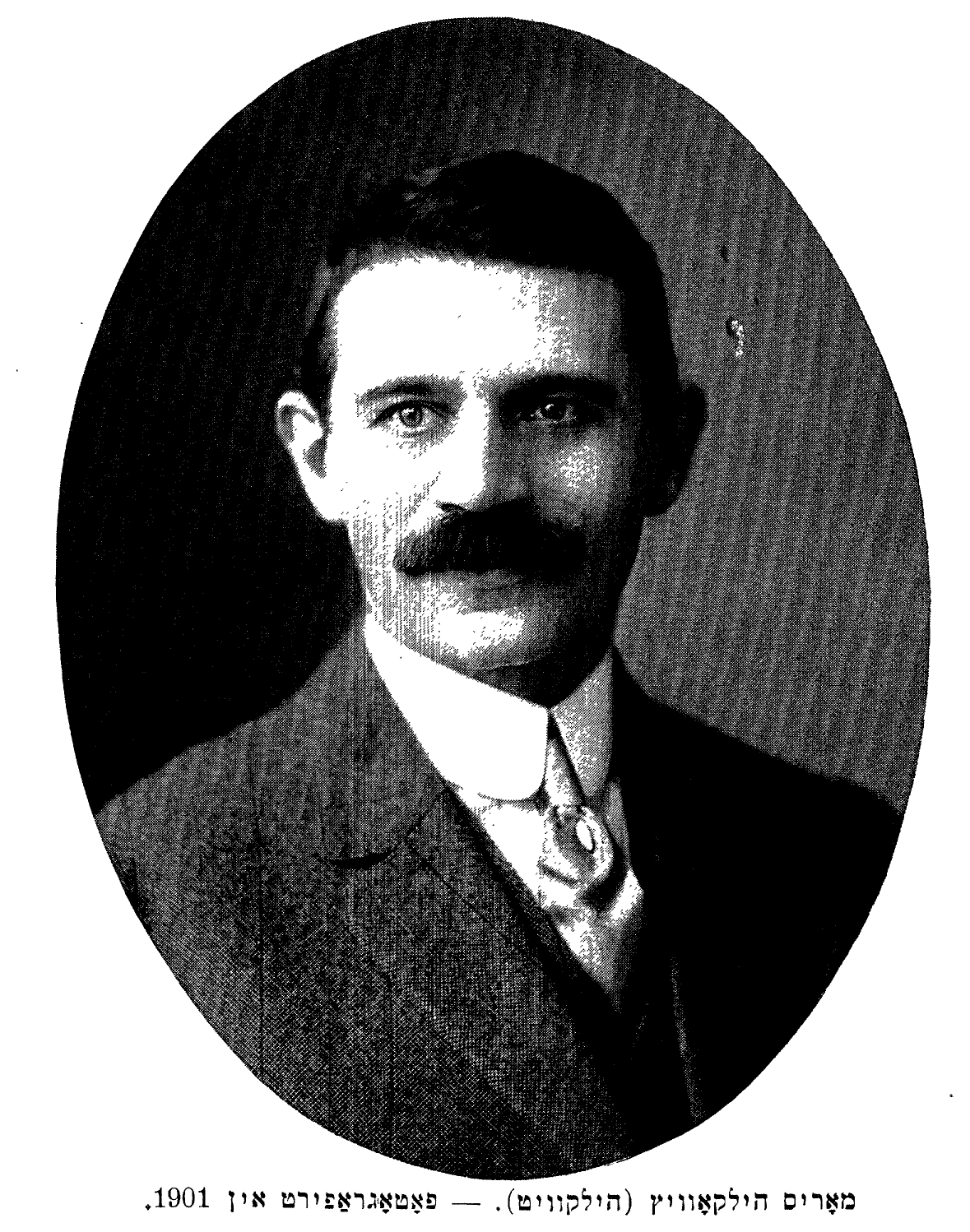
(plate; bound in the original between pp. 18–19)
The arguments of the anarchists about a nonpartisan newspaper had made an impression. The word "nonpartisan" has a magic ring. The more developed workers understood that the demand made no sense. But the broad masses knew only one rule: that nonpartisanship, unity, is finer than partisanship, division and squabbling (among us the "nonpartisan ones" were called "pareve lokshen" — neither-meat-nor-milk noodles). Under these circumstances Krantz had a special significance for the Social Democrats, for the London "Arbeiter Fraynd" was a nonpartisan newspaper (or, more accurately, a two-party20one, for the group that published it consisted of Social Democrats and anarchists). It thus meant that even the editor of that nonpartisan newspaper was himself in favor of a partisan newspaper.
Krantz had a good name. The Jewish Socialists and anarchists of London were fond of him. It must be noted that the anarchists held a majority in the "Arbeiter Fraynd" group; and yet they had accepted him, the Social Democrat, as their editor. All this was known in New York.
Besides that: the London "Arbeiter Fraynd" was a sacred object among the Jewish anarchists and the "nonpartisan ones" of New York. Everything that is far away is enchanting. And in that far-off little world, in London, Krantz was respected by both parties. His name therefore had a magnetism here. So, when we came to the public and explained that this very Krantz, the one whom both sides over there had chosen to lead their nonpartisan "Arbeiter Fraynd," would be our editor — this would be a powerful advertisement for the "Arbeiter Zeitung." So the Jewish Social Democrats of New York reckoned.
When I became acquainted with all these particulars, I grew interested in the London "Arbeiter Fraynd." I was curious to see what sort of newspaper it was — how Krantz edited it. The Weinmans had a bound annual volume of the "Arbeiter Fraynd," and one evening I spent in their parlor reading through this volume. When I had finished, and they asked me my opinion, I answered that it was not written popularly enough; that our masses would not understand such articles and would not be interested in them.21That the "Arbeiter Zeitung" had to be written in a quite simple Yiddish and in a genuinely Jewish manner the Weinmans already knew was my opinion. So now I expressed the hope that, when Krantz came, he would agree with me. In any case, I remarked, one must not speak of such matters now; we had to display complete unity of opinion.
The "Arbeiter Fraynd" was a dry little newspaper. Nearly all the articles, except the feuilletons, were written in the language of people to whom the genuine spirit of the Yiddish tongue is foreign. Krantz (like Miller and Hillkowitz) had gone to kheyder (Jewish religious elementary school) very little. He spoke Yiddish well. His written language had a clear, simple style. But it lacked the genuinely Jewish expression, the sap of our tongue. The only contributor to the "Arbeiter Fraynd" who was a real Jew was Morris Vintshevsky (he still lived in London then. He had once been the editor of a Hebrew newspaper, and among readers of loshn-koydesh (the holy tongue, Hebrew) he was known as an excellent writer. He also wrote Yiddish brilliantly and had a fine Jewish humor, but for the most part this humor of his too demanded a certain degree of development in the reader. For the quite simple Jewish workers his language was a little too elevated).
I was also deeply convinced that if the "Arbeiter Zeitung" were to be published in the same manner as the "Arbeiter Fraynd," it would have no success. Around the "Arbeiter Fraynd" stood devoted, enthusiastic adherents. Their number, however, was small. My opinion was that we here in America had to create a newspaper that would speak to the hearts and the minds of great masses.22It was easy to see that Krantz was no journalist. I knew that he was an educated man, but I understood (and later my opinion was confirmed by my personal acquaintance with him) that his abilities suited a professor, a scholar, better than a newspaperman; yet I hoped to be able to convince him that the newspaper had to be conducted quite differently from the "Arbeiter Fraynd." Under the above-explained circumstances he was the most suitable person to be editor. And so I supported him with all my strength.
I believed then that I would give the "Arbeiter Zeitung" only a short time, until it was set on a firm footing. Meanwhile, however, I worked for the enterprise literally day and night.
All our active comrades who sympathized with us organized themselves under the name "Arbeiter Zeitung Publishing Association."
I drew up a leaflet in which the purpose of the newspaper was explained, and it was adopted by the Association. We printed it and distributed it in masses at the meetings of the Jewish unions and at various other gatherings. The most active of us, chiefly Miller, Hillkowitz and I, went around the unions giving speeches, agitating for the future newspaper, asking that people contribute23to a fund for it. The three of us and a few others busied ourselves with this every evening. Straight from the evening school I would run to these meetings or to a conference of a committee.
The orators of the anarchists came after us. At every gathering where we spoke, they took the floor immediately after us. They attacked our Social Democratic declarations, and chiefly our wish to found a "partisan" newspaper. They demanded support for their plan to have a newspaper that would be published by both parties together.
It was not easy to dispel the fog that the word "nonpartisan" had brought into people's minds. I remember how I used to argue: Freedom of speech? Naturally that is a sacred thing. But by it one means that every party must be free to publish its newspapers, journals, writings, free to present and to preach its ideas. It does not mean, however, that two opposing parties should, like two cats in one sack, publish one newspaper, and thereby each of them be hindered in its agitation. That would be precisely against freedom of speech.
To this, at a certain meeting, someone shouted at me:
"Aha! You are afraid that your arguments will be knocked down! If you are sure that you are right, you ought to want to publish a newspaper together with your opponents."
— Let the opponents knock down our arguments in their own newspaper — I answered.
— Separate! Only separate! The workers must be together, not separate, — they shouted at me.
— Certainly! In the unions they must be united,24and politically too. They must all give their votes for the same candidates, for their own workers' candidates.
— Aha, politics! Votes! The ballot box! Down with it! Down with the votes! Down with politics! Long live the social revolution!
And the hall would split: some applauded the "imminent revolution"; others shouted: "Long live Social Democracy!"
Such scenes took place everywhere. There were also formal, fiery debates. Nor was there any lack of comical occurrences.
Here, for example, we are sitting, members of the "Arbeiter Zeitung Association," at one of our weekly meetings, at 125 Rivington Street. Suddenly there is a knock at the door. The "doorkeeper" opens it, and a minute later he comes back with a report: two young men demand to be admitted as a committee.
— A committee from whom? — asks the chairman.
— From the people, they say, — answers the "doorkeeper" with a smile, — that is what they say: "We are a committee from the people."
They are asked to come in. Two anarchists appear: Traf and Strohl. In their speeches they declare that the people are incensed against our plan to have a partisan newspaper; that the people demand unity against the common enemy, capital; that the people command us to publish a "nonpartisan" newspaper together with the anarchists.
The struggle grew, and I was drawn into it ever deeper and deeper. Very often it would25fall to me to visit several unions or societies in one evening, and everywhere to debate with the anarchists and with other "nonpartisan ones." Everywhere I would advertise the fact that our editor would be Philip Krantz, the editor of the London "Arbeiter Fraynd." I used to explain with great pride that, although the "Arbeiter Fraynd" was a nonpartisan newspaper, Philip Krantz nevertheless agreed with us that Socialists cannot go together with anarchists.
We used to mock anarchism, and the anarchists used to shout that we were holding back the social revolution. They used to attack our "treacherous" political struggle and the parliaments in which the Social Democrats take part. They used to demand "unity," and we used to answer that with people who preach such nonsense we cannot go together.
"Since we are holding back the revolution, and we are traitors to the working class, then how can you unite with us? — we used to ask in jest. This only shows that you do not mean what you say."
Curse-words and abusive words used to fly.
In the unions we had the upper hand. The most important representatives of the unions were members of our Association.
The "Association" engaged a couple of special men to go around the various unions after money; chiefly an intelligent German Jew by the name of Kaffenheim busied himself with this. He was very important to us, for he went not only to the Jewish unions but also to the German ones, and since the German unions were then almost all Socialist, he did not come away empty-handed from any of them. With26Kaffenheim there used to go our treasurer, Sussman, or some other member of the Association. If I am not mistaken, in this way a sum of over eight hundred dollars was put together.
We also held a theater benefit. It was decided to go around the shops selling tickets. The comrades expressed a wish that I should do this work. In the narrow circle of the organized Jewish Socialist organizations of the East Side I had not been active these last three or four years; but among the broad Jewish masses I was well known.
I accepted the proposal, and I asked that a companion be given to me. To this Joseph Barondess offered himself, who at that time had still been only a short while in America and was still very little known in the movement. He was then working at "jerseys" (knitted blouses of that kind).
This was a short while before Purim, near to spring. Earlier a snow had fallen and had melted; the streets were wet, muddy. Barondess was young, inexperienced, and his grasp of the revolutionary struggle often took on strange forms. In the shops where we came in, he would venture to tread on the jackets with his wet shoes, and in one place he actually did so. As he did it, he winked at me merrily. I explained to him that if he did not stop, I would go alone. He answered me with a childish laugh that the jackets and coats are the property of capital, and that therefore it is a mitzvah (good deed) to tread on them. I took him27to task, to show that this is not what revolution means, and I won the debate.
In a few shops the bosses refused to let us in. But these were exceptions. For the most part they behaved politely toward us. Many of the workers were not yet acquainted with our movement. But a goodly number were indeed acquainted with it, and they received us with joy, bought tickets from us and promised to make collections for our fund.
So we went from shop to shop. As we were passing through Clinton Street, we met Bernard Weinstein, together with a man of about 32, a stout, well-built one, with broad shoulders, with a large healthy face and dark-blond mustaches. I understood that this was our guest Philip Krantz, for that day his ship was due to arrive, and I knew that Weinstein had gone to meet him. We stopped for a few minutes, and we became acquainted. Later in the afternoon we saw each other again and spent a couple of hours together.
He was a simple, very pleasant man. He spoke with everyone in a friendly way. His smile and above all his cheerfulness was engaging. When we became more closely acquainted, he would often play a prank like a merry boy. In his cheerful moments he used sometimes to speak of himself as "Yankele Khokhem" (clever little Jacob) *.28In a serious conversation, however, he never spoke of himself, never boasted, never pushed his "I" forward, never sought compliments.
He was only a couple of years older than I, but I looked younger than my years; therefore the difference seemed to be greater than it was in truth. Among ourselves we always spoke Russian. Between us the warmest relations quickly developed; but on the question of how the newspaper ought to be published, there was an abyss between us. Each time I laid my opinion before him, he heard me out in a friendly manner, but as though I were speaking of a matter in which he had no interest. Perhaps he did not want to suffer my meddling in his affairs.
The newspaper was due to come out in a couple of weeks' time, in the week of Purim.
In my conversations with Miller, Hillkowitz and Krantz I had, among other things, expressed an opinion that the "Arbeiter Zeitung" must have a special sort of feuilleton, one that would have a genuinely Jewish character. Since they were little acquainted with the Jewish spirit, my remark made no impression on them. I did not, however, stop thinking about it, until I arrived at the following idea: the feuilleton ought to contain a humorous discourse about the questions of the day in the form of a weekly sermon, just as a maggid (itinerant preacher) preaches on the weekly Torah portion. The form itself would call forth a friendly29Jewish smile, and it would draw attention to the newspaper. And so it occurred to me that the feuilleton ought indeed to be called "Di Sedre" (The Weekly Portion). To this it presently fastened itself, too, that the signature ought to be "Maggid." On this spot the name "Der Proletarisher Maggid" (The Proletarian Preacher) was born in me.
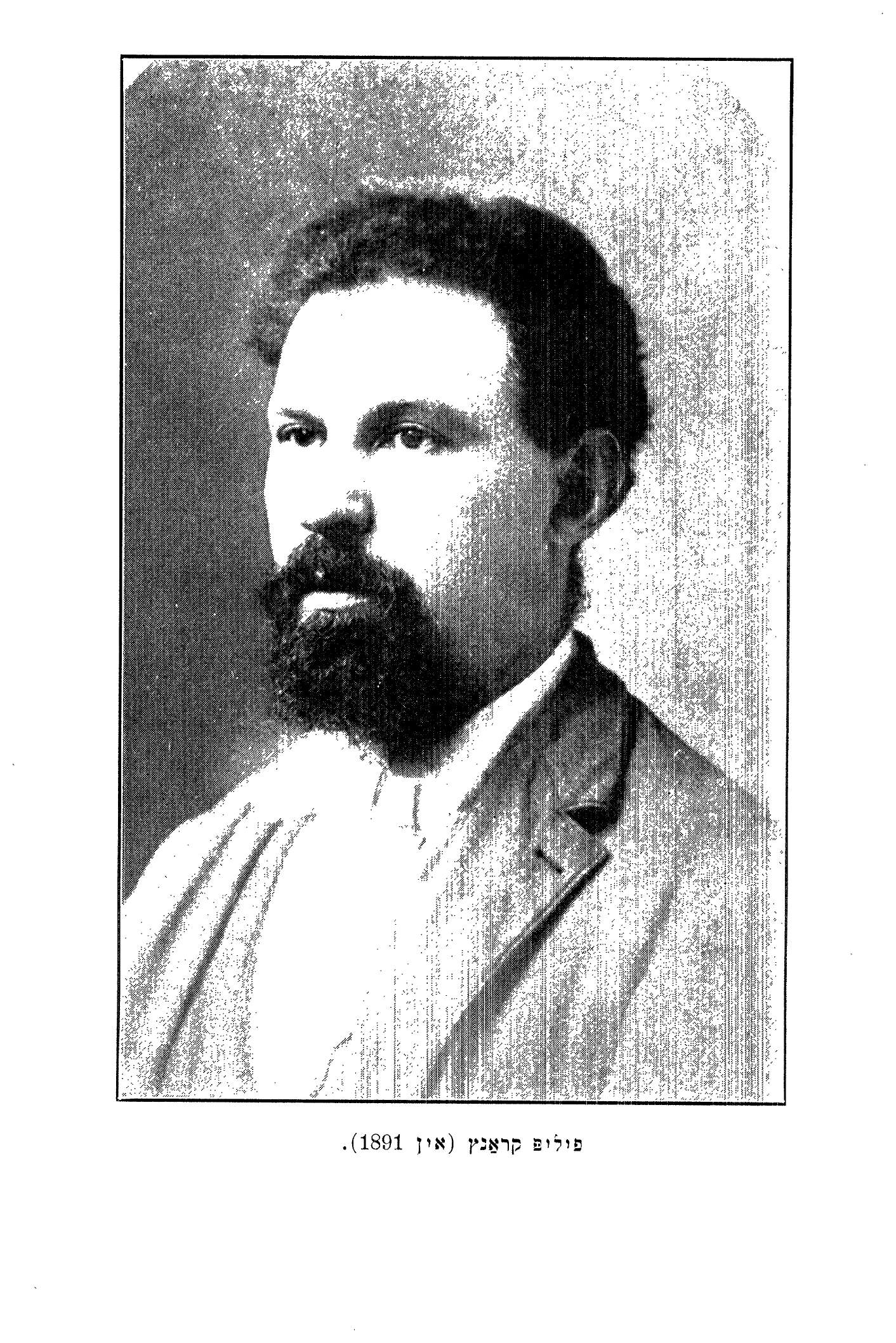
(plate; bound in the original between pp. 28–29)
I set about writing such a feuilleton at once. I calculated that in the week when our first number would appear (the week of Purim) the portion "Ki Tisa" would fall; so I took a Pentateuch, opened to the portion "Ki Tisa," and wrote a revolutionary "sermon" upon it.
When I read this aloud to Hillkowitz, he was delighted. Now he understood what I had meant, and Jewish though he was so little, he nevertheless appreciated the significance such feuilletons could have for a newspaper like ours. Krantz and Miller, too, were greatly pleased by the Sedre.
Every new thought that occurred to me concerning the newspaper drew me ever deeper into the undertaking. I gave myself over to it with the greatest energy. I could think of hardly anything else.
In the "Workmen's Advocate" I wrote, in those days, only a single article — a detailed explanation about the coming "Arbeiter Zeitung" and our struggle with the anarchists. The editor asked me to take part as often as before. But I put this off. For the "Sun" I likewise did not write.
The "Arbeiter Zeitung" was now my chief interest. Teaching was for me a source of livelihood. But every free minute I devoted to the agitation and to preparations for the new newspaper.30Now, some thirty-odd years later, I can say that this was one of the highest enthusiasms of my life.
The "Sedre" was not the only department about which I thought and thought again.
I was not the editor, and yet day and night I pondered various means of how to make the newspaper as lively, as interesting as possible, to give it the possibility of having a true success. Krantz, the editor, always received many of my plans only politely; but this did not cool me. On the contrary: it kindled in me all the more a lust for struggle, a desire to prove that I was right. I thought of serious but lightly written socialist articles, popular scientific articles, and other "features" that should be comprehensible and attractive to our worker masses. They have no education, but they have power of imagination, and many of them are capable and have a thirst to know and to understand. All this must be kept in mind in a newspaper like ours — I thought to myself — one must teach them. One must make them acquainted with scientific socialism; but one must also make them acquainted with general science. Yet dry science cannot be given to such readers. The "bitter pill" must be coated with sugar. One must give them articles that should be as interesting to them as a gripping tale, and that should make them acquainted with a little science, or simply with the world (one must remember that in those years the Jewish folk masses were still less developed, far less, than today).
I began to search for material for such articles. I went off to the Astor Library, took a31whole mountain of popular-scientific books, travel descriptions and other popularly written works. I leafed through them, read them and made notes. I also looked through the latest numbers of several journals.
Just then there happened to be printed in one of the great American journals ("Scribner's Magazine") a portrayal that fitted my purpose exactly. The article was by the famous traveler and explorer Stanley, whom the "New York Herald" had sent off into the wild regions of Africa to search for a lost traveler. There was described a bloody festival among a certain savage tribe in Africa. The chief ceremony of the festival consists in this, that a slave is slaughtered.
The unfortunate one is stretched out on the ground, bound, and his feet are tied to a stake that is driven into the earth. On the other side, a little farther from his head, a branch of a tree is driven in. The branch is bent down to the slave's head and his hair is tied to the end of the branch. The branch pulls the head of the victim, and through this his neck is stretched taut. Then the ceremony begins.
A slaughterer, who wears upon himself a crown of feathers, holds a heavy sharp knife in his hand. He leaps and dances, brandishing the knife over the naked victim. He is skilled and nimble in his trade. He waits with impatience for the great moment. His dances and his glittering knife awaken in the crowd a blood-thirsty enthusiasm. At last the slaughterer gives a swing with the knife over the unfortunate one's neck and with a single blow hacks it through. The bent-down branch springs back together with the severed head. From the force the head is hurled up into the air and blood spurts as from a fountain. The festive crowd flings itself about like a mass of madmen. There comes a running and32a snatching. People snatch pieces of flesh, they lick the blood. After that the feast begins.
I felt that this story would greatly interest our readers and that it would be a good beginning to acquaint them with the life of savage peoples.
I set about describing the scene at once. My rule was always that when one writes Yiddish, one must avoid all those words and expressions which educated people use, but which the ordinary Jewish readers — those who have not gone to school — do not understand. One must write in the simplest Yiddish, as the masses speak — I always used to argue. And on this spot I wrote up the article about the bloody festival.
When it was finished, I showed it to the three aforementioned comrades. Miller and Hillkowitz at once saw how important it is to have such a sort of reading-matter. Krantz, however, expressed no opinion, and he returned the article to me.
The affair vexed me greatly. I did not show it. But in my heart I resolved not to be a contributor to the "Arbeiter Zeitung." It was impossible for me to say with certainty why Krantz did not take the article from me — whether because he thought nothing of it, or because it displeased him that I was taking too active a part in the newspaper. Perhaps for both reasons.
Of one thing I was convinced: Krantz did not understand what significance such an article could have for the "Arbeiter Zeitung." He is absolutely no journalist, and it is a sin against my work.
It vexed Miller and Hillkowitz that Krantz did not take the article from me, and they understood33how I felt about it. They sought to calm me. Krantz, in turn, remained highly friendly and close to me, as though nothing at all had passed between us. And when Krantz was in such relations with someone, he had a great deal of magnetism in him. And so I kept my feelings and resolve hidden from all of them, and for the time being went on with the preparations.
The nearer we came to the appearance of the first number, the more Miller and Hillkowitz became convinced that my opinions were right, and they supported me more and more. Our relations grew ever closer, and despite my conviction that Krantz would never be in agreement with my journalistic ideas, and despite my firm resolve to withdraw little by little from the undertaking, I was drawn into it more and more.
For the editorial office and the business office we rented two rooms, at number 31 Henry Street, on the stoop. The printing shop was toward the yard and the editorial office together with the business office toward the street. These were two quite ordinary dwelling-rooms. From this one can picture how large the whole enterprise was. In the printing shop stood several type-cases (of typesetting machines nothing was yet known then) and a table with a large flat stone, on which the foreman (Rosenson was his name) used to set up the pages.
As business manager Morris Hillkowitz was elected. As he himself now relates with a smile, his entire "office" was in his breast pocket. For the bookkeeping an ordinary little notebook was enough. The salary of the editor was seven dollars34a week, and that of the manager — five dollars. There was a third employee, an "expeditor," who occupied himself with distributing the newspapers to the stands and to the post. This post was held by Bernard Weinstein (the then secretary of the "United Hebrew Trades"). These three and three typesetters were the only paid employees. Beyond that, everyone tried to do what he could without pay.
When the typesetting of the newspaper was begun, many of our comrades were on strike from work in the shops, and entire days they lay about at number 31 Henry Street. They handled every leaden letter and with pious curiosity watched how the typesetters, the editor and I, his helpers, worked.
The masthead of the newspaper — the words "Arbeiter Zeitung" — was made for us by the aforementioned Christian comrade, the Russian revolutionary, Staleshnikov. He was a talented draftsman. Earlier he had worked as assistant to the architects who built Carnegie Hall. And when he brought the heading "Arbeiter Zeitung," everyone was delighted. But not I. To my taste, the letters were too "lean." I argued that they had no Jewish character. Hillkowitz laughed that I took to heart the life of such a trifle. But I could not rest. And indeed I carried my point; not at once, but several weeks later.
The preparations were made for a newspaper of four pages. When Krantz set about reckoning up his material, he looked around and saw that one more column was needed. Then he remembered my article about the savages of Africa, and he asked me for the35manuscript — not because he had suddenly changed his opinion of it, but simply because he lacked matter for two or three columns.
I answered that I did not have it with me and that I was too lazy to go home after it. But Miller and Hillkowitz pressed me, and after a few minutes of arguing, I went off and brought the manuscript.
That evening, when the type for the first number was "broken" (that is, when the pages were set up), there was a fair at 31 Henry Street. The two rooms were full of comrades who had come to see how the long-awaited baby was being born. At the great flat stone worked Rosenson the foreman, two typesetters and Krantz. Krantz indicated where to place this or that article, and he helped a little in arranging the type. Miller also lent a hand at it. Both of them had worked a little in printing shops in Europe — Krantz in France and Miller in Switzerland. They were therefore more or less acquainted with the trade (today the typesetters' union would not admit any outside person to the type; but then it was not so strict).
Besides the two aforementioned articles — "Di Sedre" and the article about the savages of Africa — I had written up a short feuilleton, although I put no signature upon it. The feuilleton consisted of "parallels" — short little chapters that ran in pairs: scenes of luxury among the rich and scenes of toil and misery among the poor.
This Krantz took from me at once (chiefly for the same reason: he lacked matter36to fill out the number). I gave the little feuilleton a name: "Two Worlds in One World," and he changed the "headline" to: "Two Worlds in the World." I believed that my "headline" was better; but I made no objections. I expected that the feuilleton would be set as a feuilleton, but he set it as a piece of news on the first page. He had the "headline" made small ("pica") and he placed it in the middle of the page among various pieces of news.
I shrugged my shoulders. But Miller, who was fully in agreement with me, gave me a wink that he would fix everything. And he really did "fix" it. As he was standing at the stone and helping to set up the pages, he made use of a minute when Krantz was occupied with another part of the newspaper, and took my feuilleton out of the middle of the page and set it at the very top, as the beginning of a column. To have a larger heading set up would have been too much. We had to content ourselves with the small "headline." And so the little article was printed in the first number of the "Arbeiter Zeitung."
Krantz never mentioned this, neither to Miller nor to me.
At last the four pages were locked up and they were carried off to the printing. The press-machines belonged to the printing shop of an English newspaper.
The number was printed on Thursday night, the 6th of March, 1890. I and a goodly number of other comrades found ourselves in the press-room, and several waited outside, although it was snowing. At last we lived to see the long-awaited moment. The noisy, creak-37ing press-machine threw out a four-page sheet with the heading "Arbeiter Zeitung," and at once a second, a third, a fourth. Our hearts danced with joy; there came a snatching and a running. We carried out several copies for the comrades who were waiting outside.
That night many of us did not sleep.
In the week when these lines are being written I have spent several evenings leafing through and reading the first three years' run of the "Arbeiter Zeitung."
When I looked through the first several four-page numbers, they reminded me of the feelings of an immigrant who visits his native town after not having seen it for many years. What had looked great and mighty to him in his childhood years now makes upon him an impression of smallness and poverty. But the poor, small old home is dear to him, because of the memories which it awakens in him.
The first number opened with an article under the name "Our Program." These were the statements of principle of the newspaper. In a pleasant, dignified language were expressed the fundamental ideas of socialism. The article had no signature, for it speaks in the name of the whole "Arbeiter Zeitung Publishing Association." I remember, however, that it was written by the editor, Philip Krantz. Further, on the first page there is a little news, written from a socialist standpoint. One column begins with the aforementioned feuilleton "Two Worlds in the World." On the second page there is a leading article, signed by Philip Krantz, and my Sedre "Ki Tisa," signed "Der Proletarisher Maggid." The38point of this feuilleton was bound up with the "machtsis ha-shekel" (half-shekel), with the fact that the Torah commands the giving of half-dollars. This is interpreted in terms of the capitalist system. From every dollar that the worker earns he receives only fifty cents, and when he comes home, the landlord tears off the half-shekel. The capitalist order I call the "machtsis ha-shekel system."
Then there is mentioned the great vote that the Social Democratic party of Germany had received a short time before at the elections. This was a great victory against Bismarck, who had introduced the law to suppress the socialist movement. This victory is brought forward as proof that the workers are beginning to unite against the "machtsis ha-shekel system."
Since the newspaper appeared in the week of Purim, I also speak of "hamantashen."
In conclusion, the "sermon" passes over to the then czar Alexander the Third and the Russian revolutionaries. There is expressed the hope that the freedom-fighters will honor him with a "hamantash" in honor of Purim, just as they honored his father, who was killed precisely on the day of the Jewish Purim, in 1881. The feuilleton closes with the words: "uva le-Russland goyel" (and a redeemer shall come to Russia). Then comes the signature "Der Proletarisher Maggid" (in the later Sedres I used to end: "uva le-proletarishke goyel").
On the third page is printed the aforementioned article about the bloody festival among the savage tribe of Africa. Under this article I signed myself "David Bernstein."
Notes (the original's footnotes)
[p. 10] In those years the Jewish socialists of America mostly called themselves "S o c i a l D e m o c r a t s" — the name of their comrades in Germany and in some other countries. The word "socialist" then had a general ring to it. Some years earlier most anarchists had also called themselves "Social Democrats." But afterward, instead of the word "Democrats," they began to use the word "Revolutionaries." They thus called themselves "Social Revolutionaries," in order to set themselves apart from the "Social Democrats" (see Volume 2, page 141). One must bear in mind that the Jewish socialists then found themselves under the influence of their German comrades, and in Germany the word "Social Democrat" is used much more than the word "socialist." The official name of the socialist party is "Social Democratic Party."
[p. 16] Later he changed the name Hillkowitz to Hillquit.
[p. 27] His Jewish name was Jacob. His mother's name was Beyle Reyze, and in a jesting tone he also liked to call himself "Yankel Beyle Reyzes," as people used to call him in his kheyder years.