Chapter Three
To Chicago and Back in New York
84The "Arbeiter Zeitung" was founded in March 1890. The next winter, close to Christmas, I received an invitation to come to Chicago. A short time earlier a "Jewish Socialist section of the Socialist Labor Party" had been founded there. There was also a Jewish cloakmakers' union there. The wish was that I should remain in Chicago for two or three weeks, hold several lectures, speak at mass meetings, and help organize the Jewish men's tailors.
I had never been in Chicago before. Since we founded the "Arbeiter Zeitung," I had often been in Philadelphia, Boston, Waterbury, Hartford, New Haven. In all these cities we had "sections," and I used to come there to lecture. Further "West," however, I had never yet traveled. Chicago was by then already the second-largest city in the country. I was curious to take a look at how it appeared, and above all to become acquainted with the "Middle West." So I accepted the invitation with joy.
Of such luxury as a sleeping car nobody in our movement yet knew anything in those days. More than that: in order that it85should cost as little as possible, I chose the cheapest and slowest line that then ran from New York to Chicago — the West Shore Line, which departs from Hoboken. The journey lasted thirty hours. During those thirty hours I did not close an eye.
This journey was a great event for me. That is why I remember it with all sorts of details. I remember, for instance, a young American who sat beside me from Hoboken to Buffalo. I drew him into a conversation. But whatever I tried to talk with him about did not interest him, and whatever he tried to talk with me about did not interest me. He kept chatting about business, chiefly about lumber. Finally I looked about me and saw that it ought, indeed, to interest me. It is a piece of life, and life is always interesting. So I began to listen with attention. But most Americans do not speak much unless you first put questions to them. So I had to put to him such questions as he would be able to answer and would want to answer. I asked him about various branches of the lumber business. So we talked ourselves into things, and then it was already easier to pass on to other matters — to life in Buffalo, to the theater, to the difference between the Buffalo newspapers and the New York newspapers. He asked me about Russia, but again about lumber — what kind of timber grows there? And what kind of business is made with it? To tell him that I did not know, and that the little I had learned about Russia's timber in a special textbook on Russian geography, in the third class of the Vilna Institute, I had also forgotten — that I did not want to admit. So I tried to dodge about. Finally, out of desperation, I hit upon a plan: to tell him86about the secrets of the revolutionary movement, about the underground Russia. That ought to take an American's fancy, I thought to myself. And I had indeed hit the mark. He listened like one enraptured.
We became so friendly that he even let himself go and told me intimate things about his own life as well.
Of antisemitism he had no notion. He had, in general, never known any Jews. In the smaller American cities a Jew was then a rarity.
I also remember the boy who sold oranges, apples, and candy on the train. I remember his voice, I remember his figure, but not his face.
I remember the general impression made on me by the car with the dark-red plush seats, with the scenes that could be seen through the little windows. I remember the loneliness I felt when I found myself a good distance from New York. I remember how everything seemed alien to me; those 30 hours made almost as deep an impression on me as my journey across the sea when I traveled to America. Having spent eight and a half years in America, and suddenly to feel oneself again like a greenhorn. I was homesick — not for Vilna, but for New York.
When I came to Chicago, the city made an unpleasant impression on me.
It was then a very smoky city. One swallowed smoke and one spun with smoke.87In my memory there has remained a city of railroad stations, with muddy train-yards, with countless, smoke-spewing trains, and streets without end and without number, built up mostly with wooden houses and with wooden sidewalks. The sidewalks were high above the street. When the streets had to be regraded, the sidewalks had to be raised accordingly. From the street one went up onto them by two or three little steps. From beneath these sidewalks great mice or rats would often peer out. That is how the Jewish quarter then was, and that is how more than three-quarters of Chicago was.
The most important parts of the city, the "business section," were quite different. Chicago already had by then several gigantic skyscrapers, and a few of them were as tall as the then-highest buildings of New York.
In these business streets the crush and traffic were almost as great as in New York. But even there it smelled strongly of smoke. When you put on a white collar, within an hour it had turned black.
The city was enormously large — new and gigantically large. It spread out over many miles in length and in breadth; and a large part of it was not yet built up at all. When you went off some distance from the center, you rode on a streetcar block after block after block and saw no houses. Everything was divided up into avenues and streets, with street numbers or street names on the corners, but rarely anywhere did a house stand. Only street signs with street lanterns and real estate signs without end.
A large part of the United States was then only just in the midst of being built up; and Chicago, although it was already the second-largest city in the country, was a model of the then half-finished cities. America88was built hastily; dozens of great cities sprang up almost overnight. This is one of the things in which America is quite different from Europe; in this respect I found in Chicago the genuine American spirit, the gigantic American resourcefulness.
Chicago had then a million-and-two-hundred-thousand inhabitants. New York had more, but not a great deal more. Brooklyn and the other parts of Long Island and Staten Island were not then yet reckoned to New York City. Of a "Greater New York" people then only dreamed. The difference between New York and Chicago, in the size of the population, was therefore much smaller than now. The politicians of Chicago let the world know that Chicago was as large as New York. They added figures so that their population should come out larger than in truth. And about the future they were certain (so at least they wrote) that Chicago would overtake New York and would be the largest and most important city in America.
In the first dispatch that I sent from Chicago to the "Arbeiter Zeitung," I described how the city looks. The dispatch is to be found in number 1 of the second annual volume (of the first of January, 1891).
About the Jewish quarter that dispatch contains the following lines:
"The streets are so wide and so marked through with the track of wheels in the mud that they look like the great highways that stretch through a little town in Lithuania. There is no stone pavement, and the wooden paving is covered over with heaped-up, churned-up89mud. The sidewalks are big, broad, wooden, half-broken, as in some out-of-the-way Russian town. The houses, mostly wooden, low, far from one another and in the midst of swampy mud, in which there stand wagons without horses or horses without wagons.
"That, at least, is how four-fifths of the strange city looks. But you often see how a new little wooden hut is being torn down in order to build up in its place a five-story brick building, such as the one that was not long ago built up on the next block...
"For the present the city looks like a camp, in which wooden huts have been knocked together for the time being, to live in... and in time they will fling all this down and put up great, dark, and cramped tenements, as befits a great capitalist city."
90Today, when Jewish socialists invite a speaker, they prepare for him a room in a good hotel, often in the best one the city possesses. But when one travels from New York to Chicago without a sleeping car, there can already be no talk of any expensive hotels. The comrades had prepared for me a room with a family from Yelisavetgrad, where one of our active members was a boarder and a bridegroom. The father of the family was a fiddle player, and the bride of our comrade also played the fiddle. A brother and a sister of hers played other instruments. In the evening the whole family would play together as an orchestra.
The house was located near the corner of West 12th and Halsted Street. Nearby stood a little church; and to this day, when I recall that Chicago of mine, the bells ring in my ears that I used to hear every morning.
The leaders of the Jewish "section" were Peter Sissman and Abraham Bisno. They and their close friends were the most important and most active members both of the cloakmakers' union and of the Socialist section. One must, however, also reckon in the name Goldstein. So was called a member who was not a cloakmaker, but an insurance agent. He was the secretary of the section.
The most prominent personality among them was Peter Sissman, a handsome young man of about 22, with black hair, with intelligent eyes, with a general appearance of an interesting young Italian. No Italian91nizations. The socialist Jewish section was a kind of intellectual club of the cloakmakers' union.
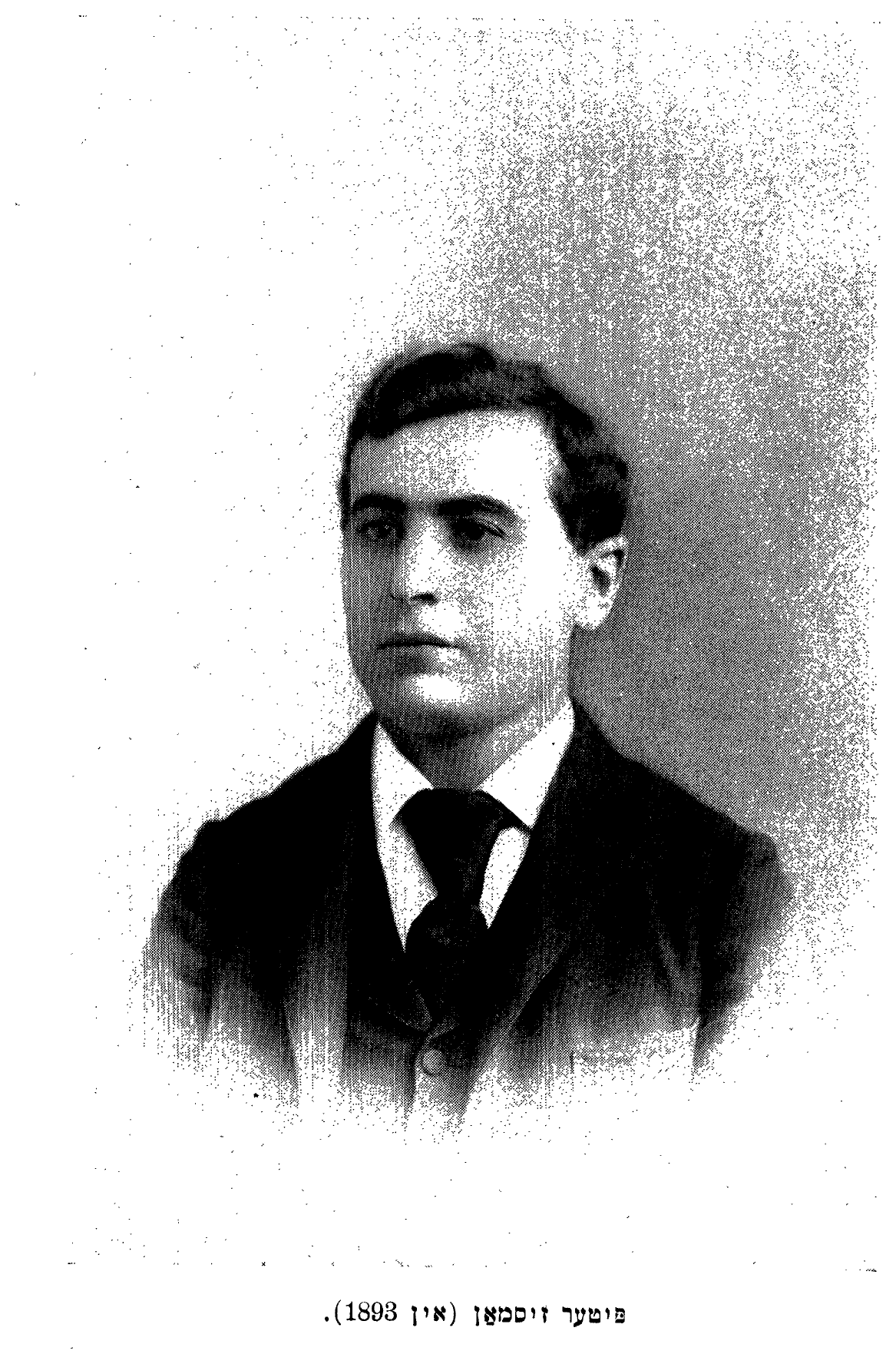
(plate; bound in the original between pp. 90–91)
Since the cloak trade was not "busy" at the time, Sismann used to spend whole days with me. I liked him very much. He was a capable young man with a fine logic, clear as crystal, and an honest, warm-hearted, agreeable person besides. Clever, without slyness, without tricks, without underhanded ploys.
Here is the report that was sent in by our Chicago comrades to the "Arbeiter Zeitung" about the meetings I addressed there, which was printed on January 2, 1891:
"A new life has entered the Jewish quarter. With every meeting, more public and more enthusiasm. Chicago has never yet seen such Jewish gatherings. The last gathering of the section took place in the great hall of Metropolitan Hall. For more than two hours Ab. Cahan held the great mass of people in inexpressible enthusiasm. The enthusiasm cannot be described. Stormy applause and cries of jubilation, all the 'hurrahs,' made the hall ring. The fiery, witty speech on the theme 'What do we want?' sowed fertile socialist seeds in the thoughts and hearts of those assembled.
"Besides this meeting, Comrade Cahan delivers scholarly lectures. Many intelligent people attend the meetings, and interest in socialism is growing. Next Tuesday Comrade Ab. Cahan will speak on the theme 'Scientific socialism as a philosophy of the history of mankind.'"
The Chicago cloakmakers were well organized.92The tailors there I organized in the course of the two or three weeks I spent there. The meetings were called together by the socialists and by the members of the cloakmakers' union.
Besides the correspondence pieces I sent from Chicago to the "Arbeiter Zeitung," I sent from there my usual weekly articles: "Di Sedrah," the articles about peoples, and other articles.
The intelligent Russian-Jewish families in Chicago lived at that time in a separate district, not in the great Jewish quarter. In my first Chicago correspondence there is a remark that the members of these families worked at neckties, which they made at home, and that they read Russian books, which they obtained from the city library. The fathers worked in factories, or had no occupation at all. For the most part the family lived off what the children earned.
Peter Sismann introduced me to a few of these families, and he took me to their "New Year's ball." I described this ball in my second letter from Chicago to the "Arbeiter Zeitung."
"We Russian intellectuals of New York have had far greater New Year's balls. But on the other hand the Chicago ball was a masquerade, and to such a degree we in New York have not yet attained," — I remark in my correspondence, half in jest. The Russian colony93of Chicago was smaller than in New York; therefore its members lived closer to one another.
Rent in Chicago was then much cheaper than in New York. Consequently, they had more rooms and larger ones. This made possible a greater hospitality (just as in a small town). This hospitality was one of the features of Chicago life at that time that struck my eye.
Of my visits to the Russian-Jewish families, the following scene, which concerns me personally, has remained vivid in my memory. I and Peter Sismann and a few others of the comrades were guests at the home of a certain Solomon, an older man, a respectable householder-type Jew from the old country, who in Chicago too lived like a householder from home. It was Saturday night and we were sitting, drinking tea from the samovar and chatting, exactly as in a Mohilev or a Vitebsk. In the middle of our conversation the householder's son comes in and says to me:
"Mister Cahan, there is someone here, an acquaintance of ours, who would very much like to make your acquaintance. He is a good Hebrew, an intelligent man, and he reads the 'Arbeiter Zeitung.' He wants to meet you. But he is a coalman, and he is all smeared with coal and dirt, so he is ashamed to come in."
I asked that the coalman be told he should not be ashamed and should come in.
A minute later there appeared a Jew in his middle years, with a beard, all fitted out in black like a chimney sweep from home. He stopped at the threshold of the room, looked me over with a smile94from head to foot and said: "So this is the proletarian preacher? Pfui, what do you know! I had pictured some Jew with a great black beard, with big, round, roguish eyes. And here it's quite a young man, almost a mere boy, some little gymnasium student from home. How do you like such a preacher?" (I was already over thirty years old at the time. But, as I have already noted, I looked a good deal younger.)
We became acquainted. He was quite an interesting man.
In Chicago I delivered a few English lectures. Our party had a sizable American branch there at the time. Its leader was a socialist by the name of Thomas Morgan, one of the best-known personalities among the Chicago radicals. He was an Englishman, but not with the usual English temperament. A capable man of the people with peppery humor in his speeches.
The audience I spoke before consisted mainly of older Americans, men and women. My first theme was "Darwinism and Socialism." This subject I chose for many of my American lectures in that period. The reason for it was explained in the second volume. The usual American argument against socialism consisted in this, that nature is full of struggle, and that socialism, which wants to abolish competition, struggle, is an unnatural thing, against Darwinism. So in these lectures I would explain the essence of Darwinism, and with many examples, indeed from Darwin's own work, demonstrate that the struggle for existence is in nature often bound up with union95— that unity is one of the weapons in the natural struggle. The lecture had, in Chicago as in other cities, a great success.
The popularity of the "Arbeiter Zeitung" was clearly expressed at its first anniversary celebration, which took place about six weeks after my return from Chicago. The festivity was at Cooper Union, and the crowd was so large that it drew the attention of the American press. In the "New York World" there was printed the next morning a long report in which it is stated that "at least ten thousand people had to turn back, because there was no room in the hall."
Third Avenue around the hall was black with people who pressed to get in. From the crush in the struggle to be let in, several windows were broken. In those years such a great Jewish mass at a meeting and such an eagerness to get in were quite an unusual phenomenon. Inside, every seat was occupied, and not only were the "aisles" packed with people standing, but the platform too. There was barely room to seat the speakers.
In the report, as it was printed in the "Arbeiter Zeitung" (number 11, second year of issue), the following speakers are listed: Jonas, Ab. Cahan, Zametkin, Saniel, Hillkowitz, Miller, and Mrs. Graie (a young German speaker who very often used to appear at our Jewish gatherings).96The enthusiasm of those present was indescribable. Miller was the chairman, and he was received with an ovation. He spoke about the success of the paper, and almost every word of his was greeted with cries of hurrah and with thunderous applause. As the first speaker he presented the editor, Philip Krantz. Krantz was greeted with warm applause (in the speakers' list his name is missing through an oversight). He had almost never appeared before a public. He was not accustomed to the platform, and now, in this hubbub, he became so confused that it was hard for him to utter a word. So Miller prompted him with a short speech; like a prompter, word for word, he prompted him; and he, Krantz, repeated after him.
The other speakers too the crowd received with enthusiasm. The hall did not cease to thunder with applause. It was a rare festivity.
When it came to me, Miller said approximately the following:
— "Now I will present to you the one whom we have chiefly to thank for the great success of the 'Arbeiter Zeitung.' It is an open secret that, more than anyone, the one to credit for it is Comrade Cahan."
The heartiness with which I was received at this anniversary celebration was for me a special source of satisfaction.
In the report of the "Arbeiter Zeitung" it is mentioned that "Ab. Cahan congratulated the public on the great victory of the tailors' strike." I did this with a parable:
The day when the Russian army in the Russo-Turkish War took Plevna happened to be the Tsar's97birthday. So the Russian commander sent the news to him as a birthday present. This happened to fit our anniversary celebration exactly, for precisely on that day a tailors' strike had ended with a great victory for the union. So I told the story about Plevna and exclaimed: "So now I have the pleasure — as a birthday present for the birthday of your 'Arbeiter Zeitung' — to give you, workers, a mazel tov on this brilliant victory of yours!"
The effect was tremendous.
In the spring and summer of the year 1891 events occurred in the cloakmakers' union that stormed up not only this union, but the whole Jewish labor movement, and on account of which I spent many evenings at the union, often day and night.
For a certain time in the course of these months the struggle between the "Barondessists" and us, "Arbeiter Zeitung" people (meaning by that chiefly Miller and me), broke out into the open and took on sharp forms. As regards these clashes, the story in Rosenberg's "Reminiscences" is strongly colored with the hue of his party-feeling at that time, and these chapters of his contain a fair bit of incorrect passages.
Thirty-five years have passed. The party feelings of that time have long since been stilled — at least in the one who writes these lines. Today one would98be able to tell the whole story from a purely impartial standpoint, in the light of the uncolored truth. But to relate these events with all their details would take up far more room than one can use for that purpose in such a work as these "Pages." This is not, after all, meant to be a history of the cloakmakers' union. I will therefore content myself with a brief overview of those events.
Monday morning, the 13th of March, 1891, a part of the picket committee of the cloakmakers' union came to a cloak contractor by the name of Greenberg, who kept a scab shop in Jamaica, Long Island. In the clash between the committee and the scabs an iron stove was overturned and glowing coals spilled out. In the process, a four-year-old child of Greenberg's had a little hand burned, and — as Greenberg later declared in court — the pickets doused many of his unfinished jackets with vitriol.
As a result several members of the union were arrested, and also the manager, Joseph Barondess, who was accused of having given the vitriol to the pickets.
I was present at the hearing in the Jamaica court. Barondess was let out on bail. But right there on the spot a detective arrested him again — on another charge which came from a New York cloak firm, Popkin and Marks.
At this firm there had been a strike some time before, and the union had won. At the settlement the firm had to pay a hundred dollars as wages for the week that was struck. The actual wages amounted to a good deal more. Popkin99but bargained for one of a hundred dollars. Since the check had been made out in Barondess's name, Popkin now lodged a complaint of "extortion" (that is, that Barondess had squeezed money out of him by threatening to call off the strike). Barondess sat in jail for several days, and then bail was again secured for him.
For the others who had been arrested, bail was also secured — with great difficulty. Two of them, Torchin and Goldstein, sat in jail for a considerable time.
Of all those arrested over the Jamaica affair, only one was convicted — a gaunt, pale young man, not tall, by the name of Frank Reingold, who was sent away for five years and nine months to the state prison of Sing-Sing.
After that I was present at Barondess's trial (on the 2nd of May, 1891) in the criminal division of the New York Supreme Court. The jury found him guilty, and the judge — Van Brunt was his name — sentenced him to a year and nine months in Sing-Sing. An appeal was filed, and Barondess was meanwhile released on bail.
Dr. Levin mentions a mass meeting which "the New York Federation of Labor convened to protest the verdict. The gathering took place in Cooper Union on the 6th of May, 1891, and thousands of people stood outside, because there was no longer any room inside." The list of speakers, according to Dr. Levin, contained the names: Samuel Gompers, George McNeill, and Ab. Cahan.
"Gompers, who was the chairman — Dr. Levin goes on to say — declared that not only had the 'sweaters' united to destroy their organized workers, but the Department of Justice of the Washington100government had served these shameful sweaters." Dr. Levin further brings the following words that Gompers spoke about the jury: "Who are the men who convicted Barondess? Every one of them belongs to the capitalist class. They are manufacturers, saloon-keepers, businessmen. Not a single cloakmaker was on the jury."
I personally have a rather faint recollection of this interesting gathering and of the speech I delivered there.
During the time that Barondess was in jail, a committee from the union turned to me with a request that I should visit the union often and keep the organization going until he was set free. And at a meeting of the United Jewish Trades a resolution was adopted in which the same wish was expressed. I took the duty upon myself.
In some of the works in which those weeks are recounted, it is asserted that I occupied the position of a "provisional manager" of the union. That is not correct. In the business of the union I did not meddle. I even rarely visited the office. My activity was bound up only with the gatherings, in Golden Rule Hall, 125 Rivington Street. Almost every evening, and often by day as well, meetings were then held there, each section of the union on a separate floor. And I used to go from floor to floor and deliver speeches — explaining the situation and encouraging the members. A salary as "provisional manager," or simply for the work I did for the union, I naturally did not take. For such work none of us ever took a single cent.101At that time no open struggle had yet broken out between the Barondessists and us. The relations between Barondess and me were quite friendly then. As proof, the fact may serve that when he was released on bail he asked that I should spend the evening with him. In order to avoid reporters and to be able to discuss the situation undisturbed, he asked that we should go to a hotel. So we did, and in that hotel we spent the night.
At the gatherings of the cloakmakers, I and our other speakers (L. Miller and Zametkin, it seems) were received with the warmest applause. The "Arbeiter Zeitung" was then working for Barondess, for Reingold, and for the union in general. As these words are being written, there lie before me excerpts from articles that were printed in it then about this matter. One such article, under the title "A Mistake" (that is, that the manufacturers are making a mistake if they think that with the arrests and trials they will destroy the union), is by L. Miller. On the same page is found my appeal for money (for lawyers, bail, and so on). Philip Krantz is named as the treasurer of the fund. On the same page is found a short poem by the poet Morris Rosenfeld, with the heading: "Courage! Courage!", which I had specially asked him to write for that issue.
When Barondess was sitting in the Tombs, he printed in the "Arbeiter Zeitung" his "Diary from Prison" and "Letters from Prison," with a call to the workers to be united.
We were convinced that the whole trouble had come about because of the anarchist notions concerning "revolutionary" methods in the present-day struggle with capital. In private conversations we used to warn the union leaders102against this. In public, however, we naturally never mentioned it.
There was a question concerning support for Reingold's wife, since the trials and appeals alone demanded large sums, and money did not come in as quickly as it was needed. So I proposed to the executive board of the cloakmakers' union the following plan: to print stamps with Reingold's picture and sell them for ten cents. The "Arbeiter Zeitung" would print a large picture of Reingold and an appeal that people should buy the stamps. I was sure that such stamps would sell in masses. And my plan was adopted. Someone suggested that I should travel to Sing-Sing to see Reingold, to assure him that his wife was being supported and that no one was ceasing to think and to work for his liberation, and meanwhile to see that his life in Sing-Sing should be made easier. I accepted the suggestion.
To Sing-Sing I traveled with an American German who had "pull" there. He was the proprietor of a meeting-hall building, which was situated on Fourth Street, between Second and Third Avenue, on the same block as "Turn Hall," only on the other side of the street. At his place many radical German organizations, socialist unions, and other progressive societies used to meet. Together with us there also traveled a well-known member of our party, also an American German, on whose account the hall-keeper was glad to make the journey.
When Reingold was brought out to me in his prison clothes and he caught sight of me, his eyes filled with tears. I conveyed to him103greetings from the whole union, assured him that his wife was being supported and that they would work with all their strength for his liberation. He told me about his sorrowful life in prison.
After we had taken leave of him and he was led back to his prison work, we were shown the various sections of the great prison. Among the prisoners who worked in the hospital I saw the former alderman Jaehne, who had been convicted in the famous bribery affair of 1884 (see the second volume, page 219—220).
Reingold's picture was printed in the "Arbeiter Zeitung" on the 5th of June, *1891. The "Reingold stamps" were to have been made by a committee. The undertaking, however, was neglected. The union was occupied with its own worries, and certain anarchists ridiculed and attacked the whole plan. Later the same anarchists accused me of having made the whole visit to Sing-Sing only in the interests of the "Arbeiter Zeitung."
Someone persuaded Barondess to go off to Canada. Afterward he came back. And then the person who had put up the bail for him withdrew it, and he was put into the "Tombs" prison until the appeal should be decided. After that, bail was again secured for him.
Signatures began to be gathered on a petition104to the governor that he should pardon him. And he was set free.
Reingold too sat for only a short time (several months). Him too the governor pardoned.
The struggle between the socialists and the anarchists came about only then, when Barondess was already free. To the Barondess question was added a question concerning a compositors' strike at the anarchist "Freie Arbeiter Stimme." Out of this strike there was born an anarchist compositors' union as an opposition to the compositors' union of the United Jewish Trades. There came to be a whole series of opposition unions, with an oppositional "United Jewish Trades."
As a result of the Jamaica affair, with the Barondess trial, and of this bitter party struggle, the cloakmakers' union was weakened and for a considerable time lost its substance.
A word about my activity in the other unions. In ordinary times I used to be as frequent a guest at the other Jewish workers' organizations as at the cloakmakers'. At the men's tailors' — even more often.
Speaking of the founding of the "United Garment Workers," that is, the federation of all the tailors' unions of America*, Hertz Burgin says in his "History of the Jewish Labor Movement" that "Ab. Cahan was the chief speaker." At the New York tailors' union I used to105deliver socialist agitational speeches the whole time ever since I had helped found it (see the second volume, page 227—228). In the years when I occupied myself with the American labor movement far more than with the Jewish one, I was often called to a Jewish union meeting, and I always used to go. More than anything, I used to receive such invitations then from the men's tailors, from the cloakmakers, and from the cap makers.
All this is about the few years before the "Arbeiter Zeitung" was founded. When it was founded and I devoted myself entirely to the Jewish labor movement, I addressed the meetings of all the Jewish unions far more often than before.
Notes (the original's footnotes)
[p. 103] This was for us the first halftone picture (a picture that is photographed onto lead by means of an etching, so that it comes out almost like a photograph). It was then still a new invention.
[p. 104] Later the place of the United Garment Workers union was taken by the "Amalgamated Clothing Workers of America." The United Garment Workers union still actually exists, but it consists entirely of overall makers. The real industry of men's clothing is organized by the Amalgamated.