Chapter Four
My First Journey to Europe
106In the socialist organizations and unions the question was raised of sending a delegate to the International Socialist Congress, which was to convene the coming August (1891) in Brussels, Belgium. The result was that the United Jewish Trades and the Jewish branches of the Socialist Labor Party elected me as their delegate (it is interesting to note here that the Cloak-makers Union was among the organizations that contributed toward my journey).
When our Jewish comrades in England learned of this, they invited me to visit them.
They asked that I set out earlier, so that I might stay with them for three weeks before the congress.
I accepted the invitation and departed in July.
To travel second class was still a luxury for us in those days (today, who even speaks of first class!). I traveled steerage. But for eight dollars107the steward gave up his little bed to me, and the whole time brought me meals from second class.
From that journey there remained in my memory the religious singing that I used to hear every morning from several Swedish passengers. Before breakfast, when I would still be lying in my little bed, they would sit around a table and recite psalms to a melody (from my first voyage on the sea, to America, there remained with me an image of Swedish passengers, dancing up on the deck; and now once again a scene with Swedes).
My neighbor was a police captain from Camden, New Jersey, a tall, healthy, handsome young man of middle years. He was traveling as I was, steerage, with a special arrangement with the steward. Lest I think, God forbid, that he could not afford to travel second class, he assured me again and again that he was doing this only so that as much money as possible would be left him to spend in Europe. He was a cheerful young man, and he told me interesting tales of police life.
The ship arrived in Liverpool. I wanted to look over the city and visit the place where I had stayed eight years before, when I had traveled to America. This, however, was impossible. The train was waiting for the ship, and I had to take it.
By this train I crossed over to London. When I came to the station, I asked one of the officials how one obtained one's baggage, and he answered me in such English that I did not understand what he was saying. The plain108London public speaks with a twisted pronunciation. It is like the difference between the Yiddish of a Pole and a Litvak. Where a Litvak says "ey," the Pole says "ay." Just so are the proper English sounds twisted in the Londoner's mouth. Instead of "pay" he says "pie," instead of "great" — "grite." Besides this he says, for example, instead of "go" — "gao."
My London comrades could not know the hour when I would arrive, and I had had no time to send a telegram from Liverpool (today one sends a wireless message from the ship; but in those days such a thing was imagined only in fantasy, and even had there already been a wireless telegraph, it would not have been for our pocket). And so no one was waiting for me.
A lodging had been prepared for me in the house of a comrade named Avrom Gold, one of the most active members of the Social Democratic group in London.
When I appeared there, a hospitable commotion arose. Several other comrades gathered. I heard that same English Yiddish as ours, only with a different pronunciation. We Yiddishize the English word in the American manner, and they — in the English. All in all, I felt as though I had come here to a lecture in Philadelphia, or in Hartford.109Among the most active members, besides Gold, there was then a young man named Shayer, a Warsaw man, with a Hasidic warmth, and a composed young man named Rosebery, who was the secretary of the group.
A married woman socialist boasted to me of her uncircumcised little boy. And several times she held him up so, that I might convince myself of it.
I have already mentioned above that the most important force as a writer in London then was Benedict, or Morris Winchevsky, as he was already known through the "Arbeiter Fraynd." His real family name was not even Benedict. His father's family name was Novakovitch. And in Hebrew literature the young Novakovitch was known as "Ben-Netz." Benedict, or Ben-Zion, was his first name. The comrades usually called him "Zeyde" (Grandpa) — on account of his feuilletons "The Beaten Thoughts of a Mad Philosopher," in which he would pretend that he was speaking with his grandchild.
He was altogether the most distinguished figure in the Jewish movement there, both among the anarchists and among the Social Democrats. He had already lived in London several years, and he had a good position as a bookkeeper in the office of one of the American bankers, the Seligmans. Among the active socialists he was the most prosperous householder. In London, for an immigrant to get hold of a tolerable living was much harder than in New York; and the Russian intelligentsia who lived there then often went hungry.
I will remind the reader that, although personally I was110not acquainted with Winchevsky, I had heard a great deal about him, not only in New York, from Jewish socialists, but also in Vilna. For Osip Tsilshteyn, with whom I had finished the institute together and served as a teacher in Velizh, is a cousin of his, and my teacher Khatskel was a brother-in-law of Tsilshteyn's.
In one of the letters that Tsilshteyn received from him from London, when I was still in Velizh, there was such a passage: "If you only knew what a delight it is to read Shakespeare in the original!" These words made a special impression on me; and now, when I had come to London and reckoned on seeing Winchevsky, they did not depart from my mind.
We became acquainted. We often saw each other at meetings, and twice I spent the night in his lodging — more accurately said, stayed up a whole night, talking.
Winchevsky had then not yet declared clearly to which party he belonged — to the anarchist or to ours. "Our people" assured me that he was more inclined to the socialist direction. But in the struggle between the two sides he strove to remain impartial.
When I was introduced at my first London meeting, the crowd received me warmly. Someone cried out: "Three cheers for the proletarian preacher!"111And the cry was greeted with thunderous applause and friendly smiles. This was a pleasant surprise for me. I had not at all reckoned that in London the name should be so popular.
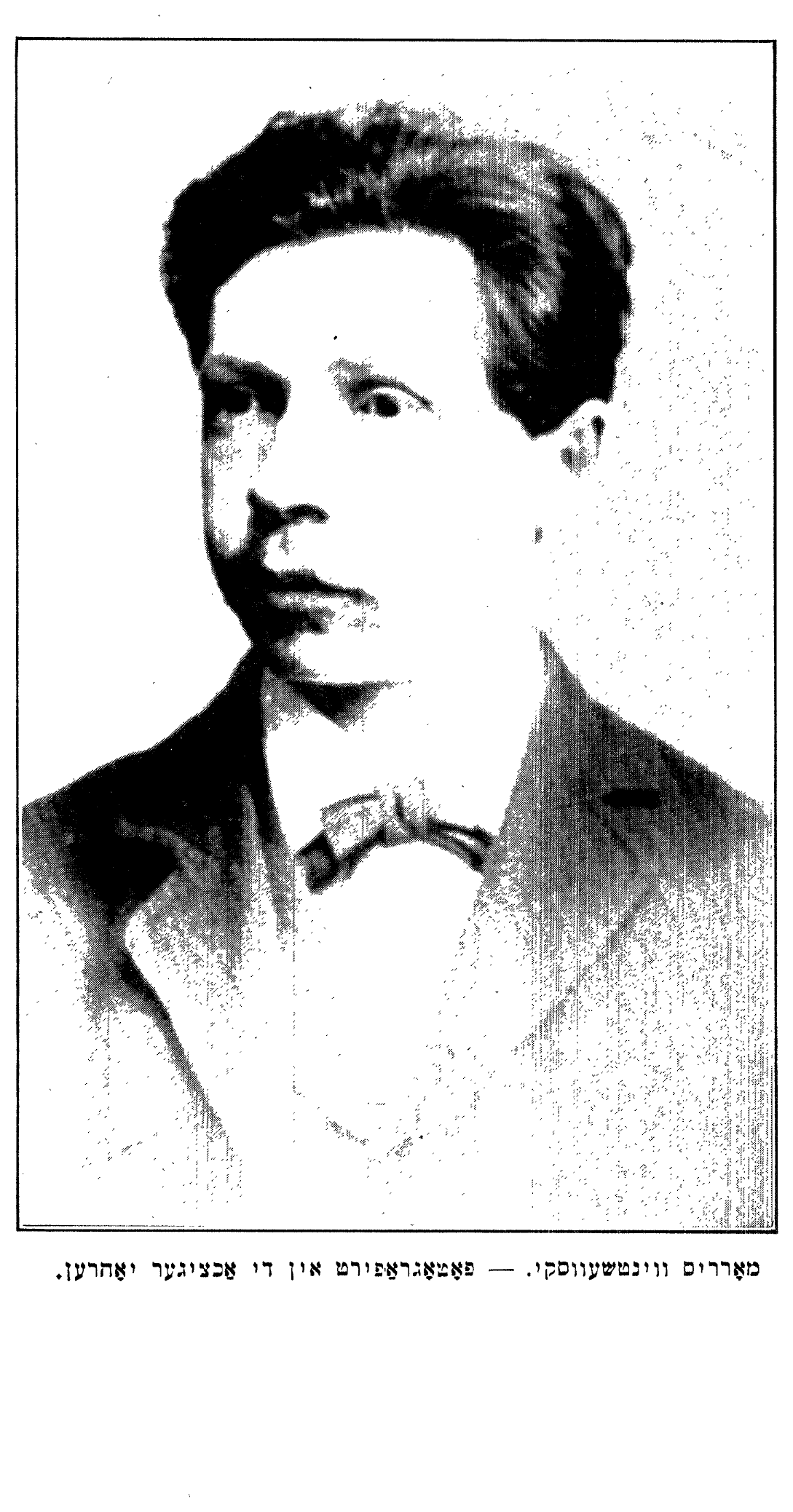
(plate; bound in the original between pp. 110–111)
In number 34 of the second year's volume of the "Arbeiter Zeitung" is printed Rosebery's correspondence about the first four meetings that I addressed in London and about my visit at that time in general. The date on the correspondence is: "London, August the third, 1891." The letter contains, among other lines, the following:
"It is now in the Jewish quarter of London as in a kettle. Wherever one goes and wherever one stands, one hears only talk about Ab. Cahan, the orator of New York, or the 'maggid' of the 'Arbeiter Zeitung.' The impression that Comrade Cahan has made on the Jewish workers with his first four speeches in quite large halls is very great. 'Since London is London we have never yet heard such a thing' — I heard from some. 'Today fifty years of life have been added to me,' — said others. What human pen is able to describe the enthusiasm of the great mass, the resounding applause and the long hurrahs and bravos the whole time that Comrade Cahan held his speeches!
"As there was little time, the floor for the debates was given only to anarchists. To the speeches of eight anarchist critics the orator gave answers which were so apt, witty, clear and logical, and often there burst from his lips such flaming remarks, that the resounding cries of jubilation rang out through the hall every little while. All the intelligent socialists express their112respect for our American comrade and their admiration for his speeches and activity."
In the same correspondence there is also found the following:
"A strong impression Cahan made when, in the course of the debate, he read aloud from the program of the Russian revolutionary party 'Narodnaya Volya.' I showed with this that these great revolutionaries, the martyr-heroes who went to the gallows, did in fact believe in a parliament and political rights; that their terrorist attacks were for them a means to obtain a parliament and political power for the people. This was truly a strong argument against the anarchists, for they used to argue that a true revolutionary would not occupy himself with such things as parliament and politics, and yet they preached terrorism and idolized the Russian terrorists as models of revolutionaries.
In the same correspondence it is reported that S. Yanovsky challenged me to a debate, and that the debate would take up two evenings — one evening the anarchist theory would be debated, and the second the anarchist tactics.
Yanovsky had earlier lived in New York. Afterward they brought him over to London, to be the editor of the "Arbeiter Fraynd," which was now a purely anarchist organ. We were acquainted from America; and so he visited me at my lodging, at Gold's, and there he called me to the debate.113In the debates — "official" and "unofficial" — which I often had with the anarchists of New York, Philadelphia, Boston, Chicago and several other cities, I used to employ parables, in order to bring out the illogic of their arguments. In London I thought up a whole new "set" of parables. The anarchists used to mention these examples with anger, or even with abuse. Chiefly they were annoyed by one of these parables — a story about a bridge, which I gave for the first time in my debate with S. Yanovsky.
Yanovsky presented the anarchist principle against voting, against the rule of a majority over a minority. He vividly depicted what a tyranny it is when a certain number of people are compelled to conduct themselves against their own will, only because a greater number wants it so. In the name of freedom and of the highest justice, he cried that one must permit everyone to act according to his own wish. Let the majority act as it wishes, and the minority — as it wishes. No coercion! So demands the ideal of absolute freedom.
When it fell to me to answer him, I said approximately this:
"Let us see how far this fine-sounding abstract principle can be carried out in life. Let us try to picture the matter in a practical, concrete manner; not merely with words, but by a clear example. To consider the matter more easily, let us take a small society, of a hundred people. So it will be more convenient, that we should not have to get tangled up with large calculations. Let us picture that these hundred live in a little town, in which there is found a114small body of water. A question arises: what should one do with the water? Now, sixty say that one must fill it in, because it is not a healthy water, and besides it is a danger: children could drown. The remaining forty, in turn, argue that to fill it in would be a loss; they are convinced that one must build a bridge over it. According to the Social Democratic principle, one would then vote, and the sixty would win. One would fill in the water, and with that it would end. According to the anarchist principle, however, everyone must act according to his will. That is, the sixty would fill in the water, and the forty would build a bridge over the filled-in water.
When I brought out this point, a deafening applause broke out in the hall, together with laughter. From the anarchist side, in turn, voices were heard: "This is buffoonery! He is a comedian, not a debater."
When Yanovsky again had the floor, he threw himself upon me for why I give such a parable; his argument was that people are not mad and that one would somehow come to terms. To this I answered: "When one comes to terms, that means, in our Social Democratic language, that it was 'unanimously adopted,' that there is no difference of opinion. About such a case there is nothing to say. One is speaking of such a case where one cannot come to terms. Then the anarchist principle demands that everyone should act according to his will. Well, I have given your minority an opportunity to act according to its will. Life is full of such cases, where one cannot come to terms, and where to yield to each side is impossible. When you say that one would somehow115you have prevailed, that is to say, only because you shut your eyes to the argument that reality presents against your principle."
In connection with this I gave a few more examples, of which I remember one that I have actually already mentioned in the second volume. Three passengers are sitting beside a little window in a train; one wants to open the window, because he feels stifled; and the others demand that the window be kept shut. They are too cold. Are you going to keep the window both shut and open?
Again the crowd burst out laughing, and again the anarchists were angry.
Before I finish with this matter, I want to remark that since then changes have taken place in anarchist theory and tactics, in most of the principles over which we used to argue with them. But in certain respects we, too, have changed, also coming closer to reality.
While I was in London I delivered a series of lectures and agitational speeches at larger and smaller gatherings.
[טאָפּיק] Stepniak. — Madame Stepniak. — Serebryakov.
At that time several of the old Russian revolutionaries were living in London. Among them were a few of our famous heroes: Prince Kropotkin, who had escaped from captivity in a wondrous manner;116Stepniak (Kravchinsky), the author of "Underground Russia," who in 1878 had stabbed General Mezentsov, the chief general of the Russian gendarmerie (see Volume 2, page 171); and a few others.
Stepniak was the first of them with whom I became acquainted. As I was on my way to him, I tried to picture what this heroic, world-famous man looked like.
When I came to his lodgings, I was received by a man with broad shoulders, with hard, black, slightly curly hair and beard, with a short, broadish nose. At first glance he did not look handsome, but when in my mind I tied his appearance together with his heroism, that unhandsome face became uncommonly striking and interesting. It seemed to me that he looked even more heroic than I had pictured him in my imagination. "For such a man, just such a figure is fitting," I thought to myself.
His wife was a Jewish woman, also a revolutionary — a beautiful, interesting woman, with black eyes, with a Jewish look about her.
That was not my only visit with them. I called on them several more times, and once Stepniak visited me, at one of our gatherings in the Jewish quarter. The feelings he stirred in me were quite different from those I had had toward Leo Hartmann. Stepniak was a far more important man, with more development and with more character. Through closer acquaintance Hartmann lost in my eyes. Stepniak, however, gained by it. A few times the Stepniaks invited me to dinner. I remember how he used to sit and smoke a117cigarette from a cigarette-holder, gazing with melancholy eyes and saying nothing. He was a Little Russian (a Ukrainian), and that brooding silence is a Little Russian trait; but in truth his heart was heavy.
I do not believe that he felt abroad as he had at home. Besides that, the struggle for a living was no easy one for him. He lived by his pen, and that was no easy bread.
I became acquainted with Kropotkin on a later visit to England. This time, besides Stepniak, I met a Russian terrorist by the name of Serebryakov. At home he had been an officer in the navy. And when Zhelyabov, Sofia Perovskaya, Vera Figner, and other revolutionaries of the "Narodnaya Volya" founded a circle of naval officers in Kronstadt, this Serebryakov was one of them. For an officer to take part in the revolution meant putting his life at stake. Where a civilian was exiled to Siberia, an officer was sentenced to death. Among these naval officers the famous Sukhanov was the central figure, and he did indeed pay for it with his life. Serebryakov escaped.
I became acquainted with him in the London library. He made the impression of such a good, mild man that I simply could not believe he had been one of those terrorists. When I was in London, Serebryakov was suffering greatly. Many of the Russian immigrants in London, Paris, Zurich, or Geneva often went hungry, and in this regard he did not belong among the more fortunate.
Serebryakov's wife was also a Jewish woman, and so was Kropotkin's.
118[טאָפּיק] Socialism in England. — Hyndman. — Karl Marx's daughter and her husband.
Among the English the socialist movement was at that time very small. They had, however, already begun to put out a weekly newspaper ("Justice") and had branches in several cities. The founder of the movement was the famous Hyndman, an enthusiastic Marxist.
He was a highly educated man, and at the time when he was converted to socialism, he had been a "broker" on the London exchange. For a long time he sustained the entire movement. He put into it everything he possessed. By the time I came to London, he was already poor and was living in a flat of two small rooms. But he was dressed like a banker. He never used to go out into the street without a top hat, a long black coat, and gloves. That, together with his long, broad, black beard, made a strange impression on me. It was hard for me to grow used to the thought that this was a comrade of mine.
In private conversations he used to display a weakness that did not befit a socialist. He used to drop hints, for instance, about the aristocrats with whom he was on friendly terms. He would say in a boastful tone: "My friend Lord So-and-so told me..." or: "When I dined at Lord So-and-so's..." Yet he was, after all, a truly devoted socialist; and although in his conversations and in the party quarrels in which he took part he did not make the impression of a clever, tactful man, he was nonetheless an uncommonly capable119man and a fine thinker. He was one of the most important and most interesting personalities in the socialist movement of Europe.
In the second volume I mentioned Karl Marx's daughter, Eleanor Marx-Aveling, and her husband, Edward Aveling, and the speeches they delivered during their visit to New York. In London I became acquainted with them and used to see them very often.
I was a frequent caller at their home, and a few times it happened that we spoke at the same gathering. She was full of life and very interesting in company. Once, standing with me before a group of our Jewish socialists, she put her arm around me with such love and was glad to speak of herself as a Jewish child.
She and her husband made a living from writing, and she had to work very hard. Since she knew several languages, she made translations from German, from French, from Italian, and sometimes even from Norwegian. Some of Ibsen's works she translated from the original into English, and these were included in the generally accepted series of his dramas in the English language. The English translation of the famous realistic novel "Madame Bovary," by the French writer Flaubert, is also hers.
With an air of regret she once confided a secret to me, that she often had to write original works under which others sign their names. There120are people — people with far more money than talent — who wish to acquire a name in this way through someone else's literary work; and out of poverty she was forced to sell to people of this sort not only her work, but also her name as authoress.
Once, when I came to them, Mrs. Aveling led me to a basket and showed me five young kittens that her cat had had a few days before. The eldest was a "gentleman." "And do you know what name I gave him?" she said with a smile — "Abraham! I gave him your name."
Three or four days later, when I came again, she told me with a sad smile that "Abraham" had died.
When I became better acquainted with her husband, I did not like him. And from the comrades I learned that in the movement, too, he was held in little respect. Her, however, everyone loved and esteemed.
Chatting with me, they once told me how they had become acquainted. Before Aveling entered the movement, he had occupied himself chiefly with natural science. Once he gave a public lecture about flies. When he had finished his lecture, a man with a big gray beard came up to him and said to him: "Young man, you have a fine career ahead of you as a man of science." When Aveling asked who he was, he answered: "Karl Marx."
"My father used to find time to attend all sorts of scientific lectures," Mrs. Aveling remarked.
"He followed everything, everything interested him."
A certain time after that lecture which Aveling had121given, he and Eleanor Marx met in the library of the British Museum. He began to pay her attention. When he learned that she was Karl Marx's daughter, he told her how he had become acquainted with her father. There, in that place, an intimate friendship gradually formed between them. He was at that time a married man; but he did not live with his wife.
A few times they took me to the theater. I do not remember what connection he had with the theater world. But he used to get free tickets, even for a whole box.
[טאָפּיק] Impressions of London. — Neither America nor Europe. — At an English meeting. — Hyndman's. — Lesner.
The life of the Jewish immigrants in London was both very similar to and very dissimilar from Jewish life in America. With us the dollar was at that time not yet as free as it became later, but in comparison with the English worker the American worker was then "well off." Everything in England was poorer. It seemed to me that there everything in general looked different from in America. Because of the soft coal that is used there, the smell of London was then more like the smell of Chicago than of New York. But London differed greatly from Chicago in other particulars.
The London fogs (mists) arrive in the later months. When I was there, the sky was clear. But the sun did not shine as golden-bright as122in New York, and that added to my impression that everything there was poorer and more drab than in America.
The fact that the same language is spoken in both countries did not diminish the difference, but rather enlarged it. The same English, yet an altogether different pronunciation! It feels sharper than a different language. When I was for the first time in southern Russia, the Yiddish there grated on my ears more than a foreign tongue. In that same unpleasant manner the London English sounded to me.
The people on the London streets look different from the people of New York. Different figures, a different general impression. And the street scenes are different too. Omnibuses, packed with passengers on top. An endless chain of mountains of people stretches on and on without end. That, in my mind, was the most striking feature of all the bustling London streets. And of such sights we in New York then knew nothing. Today we have something similar on Fifth Avenue, in the summer months. But thirty years ago one did not see this even on Fifth Avenue.
The whole of life there was different from in America.
That I was in Europe, in that part of the world where I was born and grew up — this I did not feel in London. For England is altogether different from my native land, altogether different from all the other countries in Europe. In the second volume I told how strange Liverpool looked to me when I visited the city on my first journey to America. Now England was much more comprehensible and familiar to me. But a part of that nine-year-old123impression had remained. That England belonged to the same Europe as Russia was hard to believe. Neither America nor Europe.
I often visited the editorial office of "Justice." Hyndman, who had founded the newspaper and had earlier been its editor, had a few years before handed over the editorship to an English socialist by the name of Quelch. I used to spend much time with him, with Taylor, the secretary of the party, and with other English comrades.
When I would chat with my English acquaintances, I would almost forget that their accent was different from in America. When I would hear that same accent from others, it would sound unpleasantly comical to me.
The English comrades invited me to deliver a lecture. The meeting took place on a Sunday evening, in the hall of the party on the "Strand." My theme was the development of the trusts in America — a subject that was then still almost new.
The meeting was exactly like such meetings used to be in America. The same character of the questions and the debates after the lecture, the same general impression.
One of those who took part in the discussion was a stout man with a red face and blond hair. He spoke poor English, with a heavy German accent, and it was easy to see that he had learned the language in the United States or Canada. It was clear that this was a German who had emigrated to America. He was with my lecture124very dissatisfied. He defended the American capitalists.
After him the floor was taken by an intelligent American socialist named Wilshire, who had settled in London some time before. He defended and praised my lecture and added facts to prove that American businesses were passing into the hands of the trusts.
I closed my lecture with a declaration that the trusts give a hint that America is moving toward socialism — that competition is being abolished, that businesses are being unified. The trusts are not the bad thing, I argued, but rather the fact that they belong to capitalists. My last words were: "Remove their present owners, let them become the property of the people, and instead of a misfortune they will be a blessing!"
The American who took part in the debate repeated these words of mine and remarked that they ought to be hung up on every street corner and in every street car. The German laughed venomously at him and interrupted him often. The American answered his remarks politely and patiently. A back-and-forth developed between them. The Englishmen listened with smiles. It struck them as comical to see how the genuine American criticized America while the immigrant, who spoke a broken English, defended it. Finally the German lost his patience, and with an angry shout he stormed out of the hall. A burst of laughter went up.
— Probably got rich in America, — the American debater then remarked in a conversation125with me. — Perhaps a saloon-keeper and a politician somewhere in St. Louis or Cincinnati."
Among the socialists with whom I had become acquainted in London was an old German with a long, white beard. Lessner was his name. He had been a tailor, and some years earlier he had worked at his trade. By now he was already too old. His wife kept a boarding house, and they lived not badly.
When Karl Marx settled in London and founded his German "Communist Club" there, in the forties, Lessner was one of the members. Now, in the conversations I used to have with Lessner, he would, in his honest, naive way, boast of the friendship that had existed between him and Marx. As a keepsake the famous thinker had given him a copy of his "Das Kapital." And so Lessner gave me, as a keepsake, a photograph in which he was taken holding that very book in his hand.
When I visited him, his wife treated me to German dishes, and he told me about Karl Marx and his life in London. He passed on to me dozens of little stories and anecdotes — about the author of "Capital," about Friedrich Engels, and about other members of their group.
My greatest pleasure in those days used to be to climb up in the morning onto the upper part of a bus (omnibus), ride far, and, sitting thus on the roof, watch the street scenes. One day I would ride on one bus, another day on a different one. I also126loved to go strolling through the various neighborhoods. In this way I became acquainted with the great city of London.
I also often used to spend a few hours in the British Museum, or visit my new acquaintances, Jews or Englishmen. In the evening the meetings would begin, with the lectures, with the mass gatherings. Almost every evening there was something new: a meeting, a lecture, a clash with an anarchist, a gathering of comrades in a private house.
After I had spent a few weeks in London, I set off for Paris.
The short voyage across the English Channel is famous as a difficult crossing. Rarely does a passenger escape seasickness there. I felt healthy and cheerful, as I always feel at sea.
The moment we reached the French shore, the shore of the European mainland, I was pierced by an awareness that on this earth I had been born. The earth on which I now set foot, stepping down from the ship, was for me a continuation of that earth on which Podbrezye and Vilna stand. When the train began to move, I could not help being mindful that every second was bringing me nearer to Vilna. I then had no hope of ever being there. But the feeling that I was on the same earth, and was coming nearer and nearer, was a feeling of delight.127Exactly ten years had passed since I had left home. In those times America was much farther from Russia than it is today. Earlier it used to seem to me that I would never again be in Europe. And now that I was indeed in Europe, a new longing for my old home awoke in me. While in London I had longed for New York. Sitting in the train that was carrying me to Paris, I longed for Vilna.
In Paris I arrived at five o'clock in the morning. I got out of the railway car with my travel bag in hand. I was hungry and thirsty. I went into the first café I caught sight of. When I asked for coffee with cake (I could babble a little French; reading I could do much more), I was handed a bowl of coffee with a large spoon, as though it were soup. It struck me as comical, but interesting. The coffee was weak, but warm and tasty, and the famous Parisian white bread pleased me. As I ate I said to myself that I was in Paris, in the famous world-city in which revolutions had taken place and which is described in novels. But that was only in my mind. My heart spoke of another city. It did not stop insisting that I was on the same earth on which Vilna stands.
As I write these words, the feeling of that early morning comes to me with a remarkable distinctness.
I forgot to mention that before I had set off for London, my London comrades had received a letter from Paris from the Jewish socialists there. They had asked, namely, that on my way to the congress,128I should stop in Paris and give a speech for the Jewish workers there. The address to which I should drive was that of one David Gordon. And so, after breakfast, I took a "fiacre" and drove off to that address.
It was a fine early morning. The sun lit up white buildings, gray buildings, not at all like the London walls. In my eyes Paris was much more similar to Vilna than to London. The Frenchmen I saw on the streets — the cabmen, the workers — were dressed a little differently than such people dress in Russia. And yet they made an impression on me as though they had much more in common with the population of my native land than with the inhabitants of England.
Everything confirmed my feeling that I was on the same earth where I had been born. So it seemed to me.
We drove across a bridge, one of the many bridges that could be seen on the river Seine. Over the water went little steamboats — some with passengers, others with freight. One could hear the voices of those who collected the fare from the passengers for the crossing. Over the cobblestones of the street that runs along the bank, droshkies and freight wagons rumbled. Housewives with baskets could be seen. It was cheerful. One felt the life of a great city.
The address I had brought me to a small building on a quiet side lane, not far from the river. There David Gordon and his wife received me.
It turned out that he was a Vilner, and that I remembered him as a gymnasium student.129With them I lodged during the week that I spent in Paris on my way to Brussels.
David Gordon was a witty young man, and his wife — a good-natured, lively one. He worked in a steel factory, toiled hard and earned little. But in their home it was always cheerful. Every little while he would crack a joke and she would laugh.
They lived on the ground floor, without stairs, on a small courtyard. As it was summer, their door was usually open, and the little courtyard was like a part of their dwelling.
Gordon's sister Yeva, who lived elsewhere, often used to come in to them. She too was a lively, merry one. She had a fine voice, and most of the time she would come in singing.
At the Gordons', on the wall, in a corner, hung a small photographic picture of a Russian revolutionary, a Christian named Koshintsev; and Madame Gordon confided to me a secret, that this was Yeva's betrothed, and that he was sitting in a French prison for a terrorist conspiracy which he and several other Russians had organized in France against the Russian government. The relations between Yeva and Koshintsev, however, were no secret. She herself spoke of him as of her betrothed. She told me how she visited him in prison, what sort of person he was, and when he expected to be free.130She took me to show me Paris.
The Paris streets at first made no impression on me. In New York and in London the crowds were bigger and the stores looked richer. An impression was made on me by the great bare, beautifully paved squares, the magnificent lawns and the huge flower-trees, which stretched through the middle of the city — endless courts, squares, broad avenues, open park-stretches. In New York there is nothing of the kind; almost everything is built up. And then New York was only Manhattan — a narrow strip of land between two rivers, and almost every street was private property, valued according to the price of "real estate." London had more free space, more squares. But such great free expanses, as an ornament — that London too did not have.
No city is so well advertised as Paris. Dozens of its streets, and almost all its squares, monuments, parks, museums, one knows from history and from novels. French history and French literature are read and studied in all languages. Besides that, the Paris streets are mentioned in the belles-lettres that is written in other countries. Rich people or artists travel to Paris. "Heroes" and "heroines" of novels visit Paris.
The names were well known to me. Many of the streets, squares, museums I had always craved to see. Now, then, I had the opportunity to fulfill my wish. Some of them disappointed me; some — not. On the whole the city greatly interested me.
The interest grew when I saw the famous great boulevards in the evening. The cheerful groups at the little tables that stand outside on the sidewalks and the cheerful throng that streams past —131all this was for me a thrilling novelty. It breathed with carefreeness, with a free spirit, which is foreign both in New York and in London.
In the Latin Quarter, the neighborhood of students, literary men, artists, intelligent poor people of all kinds, Yeva Gordon introduced me to several of the Russian revolutionaries who lived in Paris at that time. Among them I found my Vilna circle-comrade, the handsome blond Pole Anton Gnatovsky. Here I learned that in 1887 he had taken part in the conspiracy against the Russian emperor Alexander the Third. The attack had been prepared in the very same manner — with bombs — and in the very same month and day — the first of March — as the assault on Alexander the Second. The five young people who stood ready with the bombs, however, were seized before they could use them (one of them was Ulyanov, an older brother of Nikolai Lenin). They were hanged. Gnatovsky and a few other revolutionaries, of those who had taken part in the preparations, escaped.
On the way to Gnatovsky's, Yeva Gordon told me that he lived together with one Charles Rappoport, who had lived in Vilna for several years after my departure.
We found them both at home; only Rappoport was busy washing and dressing himself.
Anton Gnatovsky had changed little in those ten years. Only grown a little fuller, — fuller and even handsomer. We sat and chatted about Volodya Sokolov and other mutual acquaintances. Anton told me that Sokolov had married his (Anton's) sister, and that the handsome Little Russian Kutsherevsky132had married a Jewish girl named Krumholz (in my time she had been considered the most beautiful young lady in the city). About his present roommate Anton told me that he was a capable man and well-read, and that he had played an important role among the radical young people of Vilna.
I became curious to see this Rappoport. At last he came in. Not a tall man, with a beard which was entirely white with soap-lather. From his face and hair he had rinsed and wiped off the soap. About the beard he had forgotten.
Gnatovsky and my companion burst out laughing aloud, and, mimicking him, they explained to me that his absent-mindedness was a famous matter.
We talked further about my old home. Also about America, about Paris and about the revolutionary movement. The strongest impression, however, was made on me by what I heard about Vilna. It seemed to me that in those ten years everything had changed, that it was an entirely different city with different people. I had never felt so distinctly how life streams past. I left in a heavy mood.
Yeva Gordon took me to a Russian revolutionary named G. We went into a very poor house, climbed up to the fifth floor and came into a little room. We found a young brunet, a thin one, a pale one. Hunger lay upon his face. On the little bed lay a wretched mattress, a meager one, like the lodger himself. My companion asked G. to make tea. He answered with an angrily ashamed expression that he had no tea and no sugar. Then I offered133to go and bring tea with sugar and pastries. But G. would not let me. With an expression of shame and grim stubbornness he shook his head and said that "there was no need." The more I pleaded with him, the angrier his face grew. I had to obey him.
In Paris there were then a fair number of Russian revolutionaries who had fled the country, and G. was not the only one who went so hungry. Those who used to receive money from their parents would mostly share it with the others. But the number of those who had no means was too large.
I can never forget G.'s starved face. In America we knew of no educated Russian immigrants who found themselves in such a state. Almost every one of us had found work in a factory. There, on the other hand, there was no work to be had; and, secondly, it rarely occurred to any of the intellectuals to go looking for such an occupation. That an educated man should hire himself out at a factory as a common laborer — to such an idea people in Europe were not accustomed. David Gordon was one of a very small number of exceptions in this respect. The few Jewish workers that Paris possessed were artisans from the old country, mostly cap-makers.
My lecture took place in a cellar, a sklep. All in all there must have been about a hundred and fifty people, perhaps even fewer; and the workers were a minority. The rest were students, mostly revolutionaries from Russia.
To such an audience I was not accustomed to speaking in Yiddish. In America and in England I had addressed masses of Jewish workers, and here the majority consisted134of educated Russian Jews who had grown estranged from the Jewish language. I understood that here one ought to speak in Russian and not in Yiddish, and that is what I wanted to do; but the leaders of the society demanded that I speak specifically in Yiddish. The moment I began my speech, I felt that it sounded to my listeners like a joke. This disturbed me. I felt like throwing it away in the middle.
The "Bund" had not yet been born at that time, and of a specifically Jewish workers' movement nothing was known in Russia. Here and there revolutionaries had drawn in small groups of Jewish artisans and tried to develop them. But this had no significance, and even these Jewish artisans the revolutionaries tried to develop in Russian.
My theme was the Jewish workers' movement that had been created in America and in England. This was something new, of which Russian socialists had no conception. The matter was foreign to my listeners and interested them little.
All this I felt, and I did not speak in my usual manner. My speech was not a successful one.
Applause I received in plenty. But it was scant comfort to me. After the lecture some of the revolutionaries expressed their wonder at how one could even hold a speech in Yiddish. They asked me about the "Arbeiter Zeitung" and our Jewish unions and about the Socialist Labor Party of America. They did this in the manner of a grown man asking a child about his school — as though the only thing one could take seriously were the revolutionary movement in Russia. Only one young135man spoke about our movement with a genuine interest. This was a member of Plekhanov's Russian Social-Democrats, the party that was convinced that the redemption of Russia could come only through the workers' movement.
In Paris there then lived the famous Pyotr Lavrov, the spiritual leader of the Russian freedom-fighters. In the second volume mention was made of the open letter (a whole book) that Plekhanov wrote to him under the title "Our Differences of Opinion." Plekhanov's influence had by then grown strong. But the respect for Lavrov was still great. Radical Russians who visited Paris would come to him as Hasidim come to their rebbe.
I knew that people gathered at his place every Thursday evening, and that on other days he had no desire to receive guests. But I longed precisely to see him when no other people were present. I wanted to have an undisturbed conversation with him. And so I let him know that a Russian socialist, who was traveling as a delegate of the American Jewish workers to the Brussels Congress, wished to have the pleasure of becoming acquainted with him and of interviewing him; as a result, he wrote me a little letter full of warm hospitality and asked me to come to him on a certain early morning.
He lived in a small apartment on the third or fourth floor, in a poor house on rue (street) Saint-Jacques. I came to him on a Monday forenoon.136When I rang, the door opened, and on the threshold stood a tall, stately gray-haired man, in a linen dressing-gown — an aristocrat from head to foot and a scholar from head to foot.
He led me into the parlor and asked me to sit. The walls were covered with books, and the few little rooms that could be seen from there were also full of books.
We had a long conversation — about Russia and about America. Our Jewish movement interested him. He put one question to me after another. The Jewish unions, their radical spirit, our interest in the Russian struggle — all this drew from him expressions of satisfaction and sympathy.
On taking leave, he asked me to come to his "jour fixe" (a fixed day in the week when one receives guests), Thursday evening, and to visit him once more as well on an early morning, when I would be traveling back from the congress.
At the moment when he was accompanying me on my way out, there came to him a handsome, tall, finely dressed young man. Later I learned that this was a nephew of Loris-Melikov, the former chief minister of Russia, who had influenced Alexander the Second, a few days before his (Alexander's) death, to sign a constitution. The visit was a secret one.
In a similar manner there used to come to Lavrov other liberally-inclined persons who had important connections in Russia. Often the guest would leave with him a larger or smaller sum for revolutionary writings.
When the famous writer Turgenev was alive (and, as is known, he too lived in Paris), he used to see Lavrov quite often, also in a137secret manner; and the influence of the revolutionary thinker can be discerned in a number of Turgenev's works.
On the day when I visited Lavrov, I met on the street a young man whom I had known in Vilna. When I had been at home, he had been a yeshiva student. But he had taken a strong interest in the revolutionary movement, and I had seen him several times in Solomon Menaker's house. Now, then, in Paris, I met him on one of the streets of the Latin Quarter. He stopped me. I take a look: a man with a deep-brunette face, with gray eyes — that yeshiva student, but without the yeshiva-student's figure. In those ten years he had changed. Instead of the former "study-house dweller," I saw before me a man with a reflection of self-worth and intelligence upon his dark face. I recognized him at once. But his name I had forgotten. He reminded me. Shulman was his name.
It turned out that he had already spent several years in Russian prisons, and five years in Siberia. He had been arrested in Vilna, where he had wanted to send off a crate of printed matter at the railway station. The crate was too weak for the load, and the leaden letters began to spill out. He managed to flee. But he was caught.
Thursday evening, when I came to Lavrov, I found Shulman there. He helped the old scholar receive the guests, and he played the role of a kind of private secretary to him.
The parlor was tidied up and lit festively, and Lavrov was decked out. Besides him and138Shulman, I found two Russian-Jewish girls. Afterward still more guests arrived — a few women and a few men. Shulman and one of the girls bustled about the samovar and served tea with pastries.
Lavrov's income was very limited. But the honor, the Thursday evenings, had to be maintained, and it might even have come about that he had to pawn something. He was a born aristocrat, and this "jour fixe" was sacred to him. To some of the Russian revolutionaries who lived in Paris the evening was also sacred. For toward Lavrov they felt the highest respect and love. And there were also those who would wait a whole week for the little glasses of tea with which he would honor them.
Lavrov did not cease to pay attention to the ladies. I had already heard before that he was a "great cavalier." Now this was confirmed. To one young lady he gave a compliment, to another he told a gallant joke. But he did not neglect the men either. His hospitality was a fine, a noble one. He seems to be speaking with someone about a book, but his eyes are watching whether this one has enough sugar in his tea, whether that one likes the pastry.
The evening left a very pleasant impression upon me.
The Louvre museum always interested me, and on this visit of mine to Paris I visited it139three times. The first time I was taken there by Gordon's sister. As I went there, I had mainly in mind the Venus de Milo*.
I had heard so much about her majestic beauty. The strongest impression upon me was made by the feeling she called forth in Heinrich Heine, who fell at her feet with tears of wonder and rapture in his eyes. I believed that these hymns of praise and tales were greatly exaggerated, or dressed up in a poetic manner; and that if she is really so wonderful, one must be a connoisseur of sculptural work in order to be able to appreciate her. The ordinary person who has seen the Venus de Milo speaks of her with delight simply because that is the fashion. Everyone says she is rarely beautiful — so one repeats it. So I reasoned to myself.
As we walked toward the Louvre, I said to my companion in jest: "My first duty, naturally, is to see the Venus de Milo. Let us look her over, let us become enraptured, and go on."
The statue is in a separate room at the end of a long corridor on the lowest floor. It is fenced off with a silken cord, and on the ground lie140there a few little pieces of marble which had broken off from the figure (so, at least, it is believed) before it was dug out from underground.
We went in. I looked the figure over and said: "Well, I am already enraptured; we can go on now." I did not see what all the fuss was about here.
We went up to a higher floor, where there are treasures of famous ornaments, crowns, all sorts of other precious rarities; we walked through the long, long halls where hang the pictures of the greatest world-famous painters of all times and lands. Walking thus and looking at the walls, I felt that I wanted to see the Venus de Milo once more.
In the Louvre one must spend whole weeks. Every hall is full of marvelous things, and there are countless such things. And if one wants to take in the pictures properly, one cannot dispose of a painting with a single glance.
In one of the enormous picture-halls I sat down beside a man who was sitting on one of the sofas that stand facing the paintings. He held an open book on his lap, and it turned out that the book was an English one. At first he looked not into the book, but at the picture that hung opposite him. Then he carried his eyes over to the book. It was not a catalog of the pictures, but a novel. I put a question to him about the painting. We fell into conversation and he explained to me:
"Merely to take a look and walk away has no sense — he said — I do this: I sit and look until my attention grows tired. Then I read a few pages,141then I look again at the picture, and so on. In this way I study the Louvre."
He spoke with an American accent:
— And how long will this take you? — I asked him.
— I am here now for the fourth time, and each time I spend a few days here, — he answered.
It vexed me that I could not do as he did.
A quite different impression was made upon me by a second American. I caught sight of him in one of the halls where ancient Greek vases stand. When I was passing through that hall, he was almost stretched out on the ground, with a notebook in hand. He was lying by the lowest shelf of a large cabinet, looking at the vases and at his catalog and writing in his little book. His head and figure seemed very familiar to me. Then it turned out that this was indeed an acquaintance of mine from New York, a genuine Yankee, whom I had met among the Henry-Georgists. He was making notes in his little book so that he could afterward, in America, tell what he had seen. But he did this in a hurry. He looked the vases over only for form's sake. He merely jotted down what kind of vase it was, from which century and from which place.
As for myself, I was indeed enraptured by some of the pictures, but only by some. Further, a strong impression was made upon me by the whole mass of pictures and vases — all together. The fact that each one of them is reckoned a work of art, and that all these old treasures are gathered together in these halls and corridors, astonished me and filled me with reverence. Many of the vases really had a rare142grace. I was able to appreciate it and I admired them. But the main thing for me was the thought that all these vases were made more than two thousand years ago; made by those ancient Greeks about whom I had studied and read. Ancient Greece, through them, suddenly became a living country for me.
I wanted to swallow it all. But I had no time to take a good look at the paintings, the vases, and the other works of art.
I made a special point of looking at the paintings by Rubens, by Rembrandt, by Van Dyck, by Velázquez, and by other celebrities. The several paintings by Raphael that the Louvre possesses bewildered my brain. I thought to myself: there is, it seems to me, nothing here to be enraptured by. But the world holds him to be the greatest painter, so it must surely be wonderful, only I do not understand it. And so I accepted the verdict of the world. I was filled with enthusiasm by the fact that everyone else was filled with enthusiasm.
I burned with a thirst to understand and to know. But some of the paintings really did make a deep impression on me.
On my way back I again visited the Venus de Milo, and this time I felt her divine beauty. The tall figure is suffused with a sublime pride; her expression conveys an enchanting remoteness and strangeness; a holy serenity.
The next morning, early, I ran off again to the Louvre. I had no time to look at the paintings, but the Venus I did visit. A few days later I was there again, and this time, besides the Venus, I looked at many of the other statues,143and I spent a good deal of time on the topmost floor of the Louvre.
I also visited the Cluny Museum, on the Boulevard Saint-Michel, where I saw various curious things from life in the Middle Ages.
I also went to see Napoleon's tomb, and I visited Père-Lachaise — the cemetery where the victims of the Commune of 1871 lie.
With my acquaintances, new or old, I used to meet in this or that café, on the Boulevard Saint-Michel, or in a little square nearby, which lies near the university (the Sorbonne) and is called the Place de la Sorbonne. This is the central point of the Latin Quarter. The cozy or cheerful conversations around the little tables on the sidewalks, and all the life around me, drew me to them. In one such café I became acquainted with a group of foreigners who were delegates to the same congress to which I was traveling. A few of them were from Romania. Some years earlier they had studied in Paris, and now they were leaders of the socialist movement in Romania. One of them was Nadezhda, who had once been one of the well-known personalities in Romania.
In these cafés I also became acquainted with two Russian Jews, doctors, who practiced medicine in southern Russia. One of them, a town doctor back home, had traveled for the summer months to inspect the public-health departments of the Berlin, Vienna, and Paris municipal administrations. So now he was in Paris. He was a talkative man with a fiery temperament. He burned with a thirst for the144Parisian life, and his merry talk sparkled with interesting remarks.
The spirit of this quarter, the spirit of learning, art, and love, could be felt everywhere here. The very air cried out that this was Paris. Once, when I and the temperamental doctor were sitting at a little table on the Sorbonne square, a scene like this took place at a neighboring table: a party of young French students was chatting merrily and sipping black coffee. Suddenly they caught sight of a beautiful young woman driving past in an open carriage; they began to sing to her playfully. At once she ordered the coachman to turn the horse toward them. She drove up and jumped down right into the middle of their table. There was a cheer of "hurrah," a merry uproar, a more-or-less decent bit of mischief. At last the woman too sat down, and they handed her something to drink.
— Do not think that these young people can do nothing but carouse, — the doctor, who knew Paris well, said to me. — When they make mischief, they make mischief, and when they study, there are no more diligent, hard-working students in the world. The misfortune with us Russians is that we are one-sided. A student of ours is either too serious or an incessant idler and good-for-nothing.
I have said that, while in Paris, I felt myself nearer to my native town. It turned out that Yeva Gordon, the Vilna woman, had back home145been a friend of my cousin Reveka, the elder daughter of my aunt Feyge. She told me that after Reveka had finished her studies in Vilna, she had spent several years in Geneva, Switzerland, where she attended the university. To me this was news. It had so happened that for several years I had not written home, and had received no letter from there.
My life in America was so different from the life of my parents that I could not write to them about my experiences. As a rule one writes only out of obligation, and that was hard for me to do. Besides, one could not then write openly to Russia about activities such as mine. There came a certain time when I had no desire to write. I put it off from week to week. So several months went by. And by then I already had to find excuses for why I had kept silent so long. So I would put it off again, again and again. And the more time that passed, the harder it became to explain, and the harder it became to begin to write.
I was strongly attached to my parents. I always longed for them. I regarded myself as a criminal. But I had no courage to sit down and write a letter to them.
On this matter year piles upon year, until one grows accustomed to bearing the burden of pangs of conscience. It is not pleasant to remind oneself that one is committing such a crime, so one tries not to think about it.
The connections between the Russian Jews and the American ones were not then as developed as they are today. I was certain that my parents heard nothing of me.
I used to picture how my little brother was growing up, and how my mother believed that he was an only son to her —146that I had died. In such moments I used to feel the deepest pains of self-reproach. I used to make myself a vow to write home the next day; and the next day, after all, I would not write *.
If they had been in need of my support, and I had been able to give them support, it would have been different. But they were maintained by my rich uncle, Khaim-Leyb, of Petersburg, while I myself lived from hand to mouth.
The fact that I did not even know that my cousin had spent several years in Switzerland made an indescribable impression on me. It showed me, in a startling way, how far I had grown estranged from home. I was astonished. And here was Paris! I was so near to them — so near and so foreign!
That same day I sat down and wrote a letter to my parents and to my aunt. My chief motive in writing was a pure one — the deepest love for my parents, for my brother, for my
This was terrible for me to hear. With a painful irony I reflected that I had been so absorbed in my sympathy for all of humanity that I had acted like a murderer toward my own mother.147aunt, to my uncle, to their children. I poured out my heart to them. But once I had gotten started writing to them, it gave me pleasure to boast to them that I was in Paris, that I was making a great journey. I sent them my London address and explained that from Paris I was traveling to Brussels, and that within a few weeks I would be back in London.
Among the acquaintances I made this time in Paris was a young couple by the name of Grigoriev. The husband was a Christian, a Russian. He had taken part in the conspiracy to kill Alexander the Third together with Gnatovsky, and he too had fled. Here in Paris he had married a beautiful, educated Jewish girl by the name of Tanya Borshtsh. It turned out that she was a stepdaughter of Trotsky, the steward of the Vilna Institute (Trotsky's wife had died after I had left home, and he had then married Tanya's mother, who was a widow. All this was news to me. It seemed to me that wherever I turned, I met signs of great changes that had taken place in Vilna during the ten years of my absence. Such things made an enormous impression on me. Earlier, it had seemed, nothing in Vilna ever changed, and since I had departed everything was vanishing. It was becoming an entirely different town, with a different life).
It turned out that Madame Grigoriev and my cousin Reveka had both gone together to the Vilna "Zhenski Institut" (a gymnasium for girls on Troker Street), and that they had been close friends.
I was a guest at the Grigorievs' a few times. Tanya's sister, a plump but charming148girl, who studied at the University of Paris, used to come to them. We talked about Trotsky, about Reveka, about Vilna in general, and about the revolutionary movement.
Grigoriev (that was his revolutionary name; his real name I do not remember) was in love with his wife, and she with him. They lived like a pair of little doves. But one could see that he longed for Russia very strongly.
Once I invited them to the Opera. They were performing Meyerbeer's "Robert le Diable." When we were driving back from the Opera, he looked sad. I remember how I reflected: perhaps the music had stirred up his longing for Russia.
Notes (the original's footnotes)
[p. 139] Venus, among the ancient Romans, was the name of the goddess of women's beauty and of love. She used to be represented in the form of a beautiful female figure, carved out of marble. Various such figures have survived, and each of them bears a particular name, according to the place where it was found, or where it is to be found today. The Venus de Milo (or Milos) was found on the Greek island of Milos, underground, in 1820. It is reckoned the most beautiful of all the Venus figures, and of all marble figures in general. It is believed that it was made approximately four hundred years before the birth of Christ.
[p. 146] Later my younger cousin Khave told me the following: when she was already married and living in Riga, she used to come once a year to Vilna to visit her parents. And in the course of each such visit she would spend at least one night at "Aunt Sarah's" (my mother). And each time my mother would then take out a packet of letters from the chest of drawers, unwrap it, and read them aloud to her. These were the letters that she had once received from me — from Velizh and from America. As she read, she would say: "Who knows whether he is even alive. Perhaps even his little bones are no longer in this world."