Chapter Five
The Brussels International Congress
149At last the week of the Brussels Congress had arrived. I left Paris a day earlier.
At the station a whole group of Russian revolutionaries came to see me off. For them the Congress was a great event. From Russia itself, naturally, no delegate could be sent, and the Russian organizations that had been formed abroad did not, even then, send any representatives either. The title "delegate," in connection with an international socialist congress, had a magical ring in their ears. And on top of that, I was a delegate from mysterious, far-off America. In short, on that early morning, while I stood waiting for the Brussels train, I was — in the eyes of the revolutionaries who had come to see me off — a personality to be envied.
One of them even rode with me to Brussels, not as a delegate, but simply as a spectator. This was150Rubanovich, who later became known as an important figure in the Socialist-Revolutionary Party — a tall, handsome man, with black hair and beautiful, dark, intelligent eyes, and a small black beard. He was an agreeable man, and through this journey we became friends.
When we drew near the Belgian border, Dutch delegates began to appear in our car. Beside me sat one of the English delegates, and I was chatting with him. A young Dutchman with a thin neck leaned over toward us and asked us to speak more softly. He spoke good English, but with a bad accent.
— You come from a free country, you know nothing of danger, — he whispered into my ear, — but we, when we return to Holland, may perhaps be persecuted. We must be careful.
Then he explained to me again:
— I have to be especially careful; I am a schoolteacher, and I could lose my position.
Beside him sat an older man, tall, very interesting in appearance, with long grizzled hair and kind, gray eyes. This was the leader of the socialist movement in Holland, Domela Nieuwenhuis*. The younger man waited on him as a devoted disciple waits on a beloved rebbe.
We arrived in Brussels on Saturday afternoon. At the station we were received by a committee of the local151comrades. The chairman of the committee was an elegant young man by the name of Vandervelde*. He and the other members of the committee, whom we recognized by the red badges they wore, took us off to a hotel.
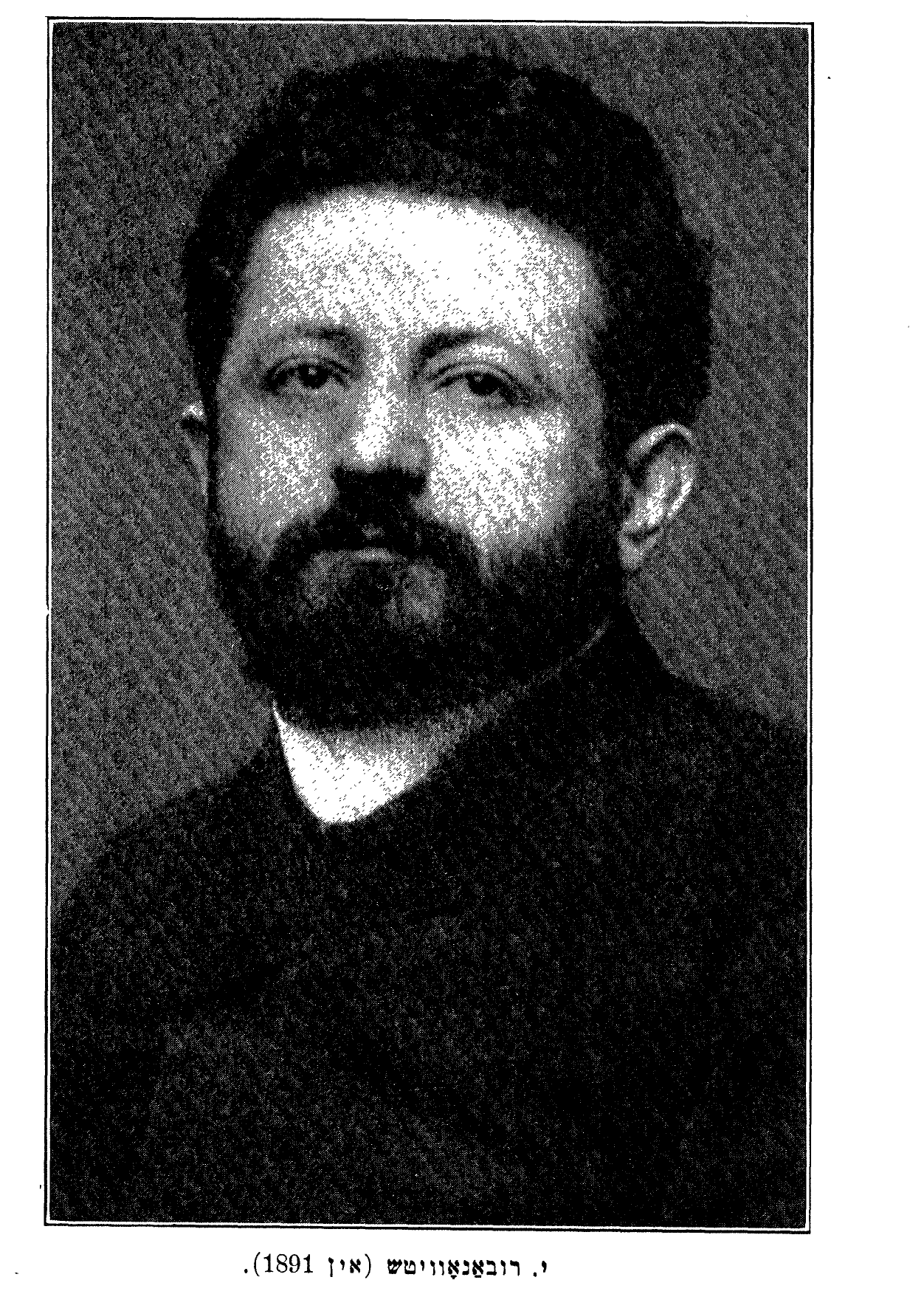
(plate; bound in the original between pp. 150–151)
Brussels is an old city. Its most important streets are broad and beautiful, and the cafés with their little tables on the sidewalks recall Paris. That, however, is the newer part of the city. A little farther on, the streets are narrow and twisting, and they climb uphill. It smells of antiquity. In Brussels there are several quite ancient monuments. The town hall (city hall) stands on a small square, which is hemmed in by buildings from the Middle Ages. When I found myself on the town hall square, it seemed to me that I had been carried into the twelfth or thirteenth century. The place makes an unforgettable impression.
Later the delegates who had already arrived gathered in the "Maison du Peuple" (House of the People), the center of the socialist movement and of the cooperative movement in Brussels.
In front of the "Maison du Peuple" was a small square, a little plaza, large as a courtyard, with a few benches and tables. I sat down there. Soon the German delegates began to arrive. In the socialist movement Germany was the most important country. Just as from Jerusalem the Torah of Moses went out among the Jews over the whole152world, so the socialist Torah from Berlin spread over all the other countries. Every piece of news that occurred in the movement in Germany was regarded as an important piece of news for all socialists. August Bebel, Wilhelm Liebknecht, and Paul Singer were for us not only the leaders of the German Social Democrats, but also the most important personalities in the world.
On the little square by the House of the People a commotion arose. It was announced that the German delegates were coming. Soon they appeared: tall, hale men with broad shoulders, all in big, black, soft hats with wide brims (we used to call them "Social-Democratic hats"). I had seen Liebknecht in New York, so I recognized him at once. Together with him came Bebel and Singer. My heart began to pound. I listened to their voices, studied their faces, their clothes. So feels a Hasid when he finally has the privilege of seeing the rebbe for whom he has been fired with devotion for years.
The German delegates were present in considerable number. Then delegates from other countries appeared. The little square grew packed. Delegates also sat or stood around the "Maison du Peuple" itself, or in the street nearby.
From there the street ran downhill, and it came about that this little stretch of the neighborhood was set apart. The whole area, the secluded one, was now taken up with delegates. It hummed as in a beehive. I heard around me various languages. One man called out to another in Italian, in Romanian, in Greek, in Hungarian. It seemed to me that I saw with my eyes, heard with my ears, and felt with all my senses how the workers of the whole153world were united. Karl Marx's call had been fulfilled; upon my hot, impressionable nature the scene had a stirring effect.
I will bring here a few lines from the correspondence that I sent off that evening to the "Arbeiter Zeitung." They reflect the mood in which I wrote it. The correspondence was printed in number 36 of the second volume, under the heading: "The Brussels Socialist International Workers' Congress. First letter from our delegate, Comrade Ab. Cahan."
After the date — "Brussels, Saturday evening, August 15, 1891" — come the following lines:
"The International lives and flourishes! The red banner of socialism flutters over the united workers of the whole world! No mouth can express, no pen can paint, the magical picture now presented in front of the 'Maison du Peuple,' the House of the People of the Brussels socialists, where the International Workers' Congress is holding its first two sessions.
"The air is permeated with a divine enthusiasm, with a feeling of brotherhood, of courage and thirst for the fight for freedom.
"The hum and din in all the languages spoken anywhere in the civilized world mingle together into an inspired sound, which kindles the heart with a revolutionary fire, drives every nerve to the holy war, and rings out like a voice of glad tidings of the swift victory, of the paradise time of the worker's liberation.
"Dear readers of our 'Arbeiter Zeitung'! Dear unfortunate workers! If, in the long hard hours of torment and misery, a dark thought should fall upon you — that who knows, perhaps your hopes in socialism are an empty dream — if your consolation is ever marred154by such notions, carry your thoughts over to the International Workers' Congress. Then your doubts will be set aside. The bright future will come nearer to your eyes. And your soul, just as my soul, will be eager to do something, to turn mountains over, only to be together with these brave comrades and, together with them, to arrive at our awaited redemption.
"But enough of indulging the heart and trying to express what my weak pen is incapable of uttering. I only wish to say that the comrades who did me the honor of letting me represent them — I thank them for the heavenly pleasure, for the paradise minutes that the Congress provides me.
"The writer of these lines was received with particular warmth as a delegate from America and chiefly as a representative of Jewish workers."
From America there were six delegates. Four of them were from our Socialist Labor Party, and two from the "Socialist Labor Party, Cincinnati tendency," which had split off in the split of 1889 (see Chapter 13, Section 5, Volume 2). Our delegates were: Lucien Sanial, McGuire, a young German from the West, and I. With Sanial, the French socialist who edited the "Workmen's Advocate," the reader is already acquainted; McGuire was an Irish-American. Of socialism he knew little and was not even a member of our party. He was, however, the leader of a German union, which consisted almost entirely of socialists, and they esteemed him as an honest man and a faithful representative; and so they sent him to represent their union at the Brussels Congress. The young155German (I do not remember his name) was a member of the Socialist Labor Party. He was traveling to Europe in any case, so he was given a credential.
Of the two delegates from the "Socialist Labor Party, Cincinnati tendency," only one actually came from America. This was Hoehn, the leader of the socialist movement in St. Louis*. The other was a proxy delegate. He lived in Vienna, and the leaders of the Cincinnati group had sent him a credential and money for expenses, with a request that he represent them. His name I do not remember.
The presence of delegates from the Cincinnati faction irritated Sanial. With his French temperament he did not stop seething about it. He waited impatiently for the moment when the Congress would open. When those two delegates announced their party, he would protest. He would declare that in America there was one party, not two; that their organization did nothing but harm; and that if the Congress recognized it, it would demoralize the American movement.
I advised him not to do this. I expressed the opinion that such a step would not be popular; that the delegates were in a high mood, and that the prevailing spirit was a spirit of brotherhood and not of fratricidal struggle. But he would not listen. They must be driven out, no two ways about it!
Personally he had nothing to object to against the two delegates. They were both very congenial156people. Their role, however, as representatives of a rival party in America, he absolutely would not recognize.
His combative temper broke into my happy mood that afternoon. I wanted to embrace all the delegates, all the socialists, no matter which faction they belonged to. And he kept on seething and talking of protests. Sanial, however, was a very lovable man, a noble and a warm-hearted one, and I had the highest respect for him.
The real work of the Congress began Monday morning. The hall of the "Maison du Peuple" was packed with delegates and with spectators. The platform was decorated with red banners, and all the delegates wore red badges. That I was a delegate I felt with every beat of my pulse. And as I could see from the face of Comrade Sanial, who could have been my father, he felt as I did. He was so inspired, so flustered, that he spoke French to me and English to the French. In his exalted mood he completely forgot, in the first few minutes, about the two delegates from the "Cincinnati tendency." But soon he recollected himself, and his face lit up with a thirst for battle. I appealed to him again. But he grew angry with me.
— Where is your loyalty to our party? — he asked in agitation.157The first session was opened. The committees had all been appointed beforehand. On the platform sat the president with his secretaries and translators. Of all the languages, three were recognized: German, French, and English. One was permitted to speak only in these three tongues, and from each of them the speech was translated into the other two. The most important translator was Karl Marx's daughter, Eleanor Marx-Aveling. All three of these languages were her mother tongues.
The names of the countries and of the delegates were called out. When it came to the United States, Saniel rose, and, speaking in French, he protested in a heated voice against the admission of the delegates of the Cincinnati faction. He was soon interrupted, however: "Enough! Enough! We don't want to hear such things!" From every side of the hall came shouts that he should sit down.
Saniel was a fighter. He outshouted them all. But it did him no good. A motion was adopted almost unanimously that the two delegates be recognized; and it was declared once and for all that no local party squabbles would be permitted to be brought in; that delegates from every socialist party, from every socialist faction, were welcome.
A delegation of anarchists arrived. They demanded to be admitted to the congress. Their leader was a small, gaunt Italian with blue eyes. When he delivered his speech, he positively blazed. His name was Merlino. He made a very good158impression, but to admit an anarchist delegation would have made no sense. The fact that the congress had admitted various factions of socialist parties was no contradiction. Those were all socialists. They all belonged to the same movement, recognized its principles.
At this session our delegate Saniel was the chairman. The chief speaker against the admission of the anarchists was August Bebel. They are against the fundamental principles of socialism, he said. Their aims are the opposite of ours. Our task is to build; theirs — to destroy. So how can we and they take part in the same congress?
About Merlino personally, however, he expressed the highest opinion, and he related that several times, when Merlino had been in danger from the police, German and Austrian Social Democrats had hidden him and given him a chance to save himself. But to admit him and his comrades to the congress — that he would consider an absurdity, he declared.
Before I had departed from New York, I had sent to the bureau that organized the congress a letter in which I demanded that one of the points of the agenda be:
"How should the organized workers of all countries relate to the Jewish question?"159The question was placed as point 4. As soon as I arrived in Brussels, I had a small pamphlet printed, which contained all the important facts and figures about the Jewish labor movement in America, its unions, strikes, victories; about the enthusiastic participation of the Jewish workers in the celebration of the First of May, and their connections with the Socialist Labor Party. I distributed the pamphlet among the delegates, and it aroused interest in them. Some of them had had no idea that such a phenomenon as Jewish labor unions was at all possible. They were under the impression that a Jewish worker was altogether a rarity. There were even some who thought that all Jews were bankers, manufacturers, merchants; that there were no poor Jews at all in the world. Several of the delegates came up to me with my pamphlet in hand, expressed pleasant surprise at our movement, asked questions about our unions, about America in general.
The Jewish "point number 4" and my pamphlet were reported in the Belgian and other newspapers. Reporters and newspaper correspondents came to me. Among the latter was a London journalist, a stoutish man, not tall, with a pointed little beard, finely dressed, a dandy. He was a Jew, and he took a particular interest in the question I had put forward on the agenda. He interviewed me. When I was walking to my hotel, he accompanied me. I saw that he had some special intention in this. At first I did not understand what it consisted of. Finally he came out with an invitation from the Brussels rabbi to dinner.160"He desires the honor of making your acquaintance," he said.
— Then let him come to my hotel! — I answered proudly.
— He is a representative of the Brussels Jewish community, and you are a guest — the journalist answered — so he is inviting you to his home. He simply wishes to show you hospitality, and he is interested in the point that you have placed on the agenda of the congress.
The journalist explained this so earnestly, with such warmth, that I accepted the invitation.
At that time few Jews lived in Brussels, and almost all of them were businessmen, a fair number of them wealthy. The rabbi was one of the Reform kind. An elegant present-day "reverend." Dreyfus was his name (later he became the chief rabbi in Paris). He lived in a fine, richly furnished house; he was still quite a young man, with very black, glossy hair and a very black beard.
In the course of our conversation the London journalist gave the rabbi to understand that I had prepared a resolution which I would propose at the congress when it came to point 4. At first in half-words, and then openly, the rabbi explained to me that my resolution disturbed him. The Jews have so many enemies! And now, when one hears of a socialist movement among the Jews, my resolution would incite the antisemites. Such being the case, it was desirable that I bear in mind the danger, and that in my speech I use the greatest caution.
We had a polite debate. I saw that he was absolutely unacquainted with our standpoint.161His uneasiness struck me as comical. "Are the Jewish bankers trembling for their skins?" — I said afterward to Rubanovich, when I told him the story.
I said above that the delegates took an interest in my pamphlet about our Jewish unions, their strikes and socialist enthusiasm. As regards point 4 of the agenda, however, only a small number of them showed a friendly interest in it. And some even expressed dissatisfaction that such a point had been put in at all. Why had I needed to bring in the Jewish question? Who does not know that for socialists such questions do not exist? Among those who spoke out in this sense were the leaders of the German Social Democracy, and that meant the leaders of the congress. Among them was the Jew Paul Singer, who was chairman at several of the congress's sessions. And a similar opinion was expressed by Victor Adler, also a Jew, who was the leader of the socialist movement in Austria and also one of the most important personalities at the congress*. They asked me what I expected the congress to do with regard to point 4, and I showed them the resolution which I had prepared. My resolution declared that162the congress warmly greets the organized Jewish workers of America and that it condemns antisemitism. In the details were included the chief facts and figures from my pamphlet and some facts about various forms of persecution of Jews.
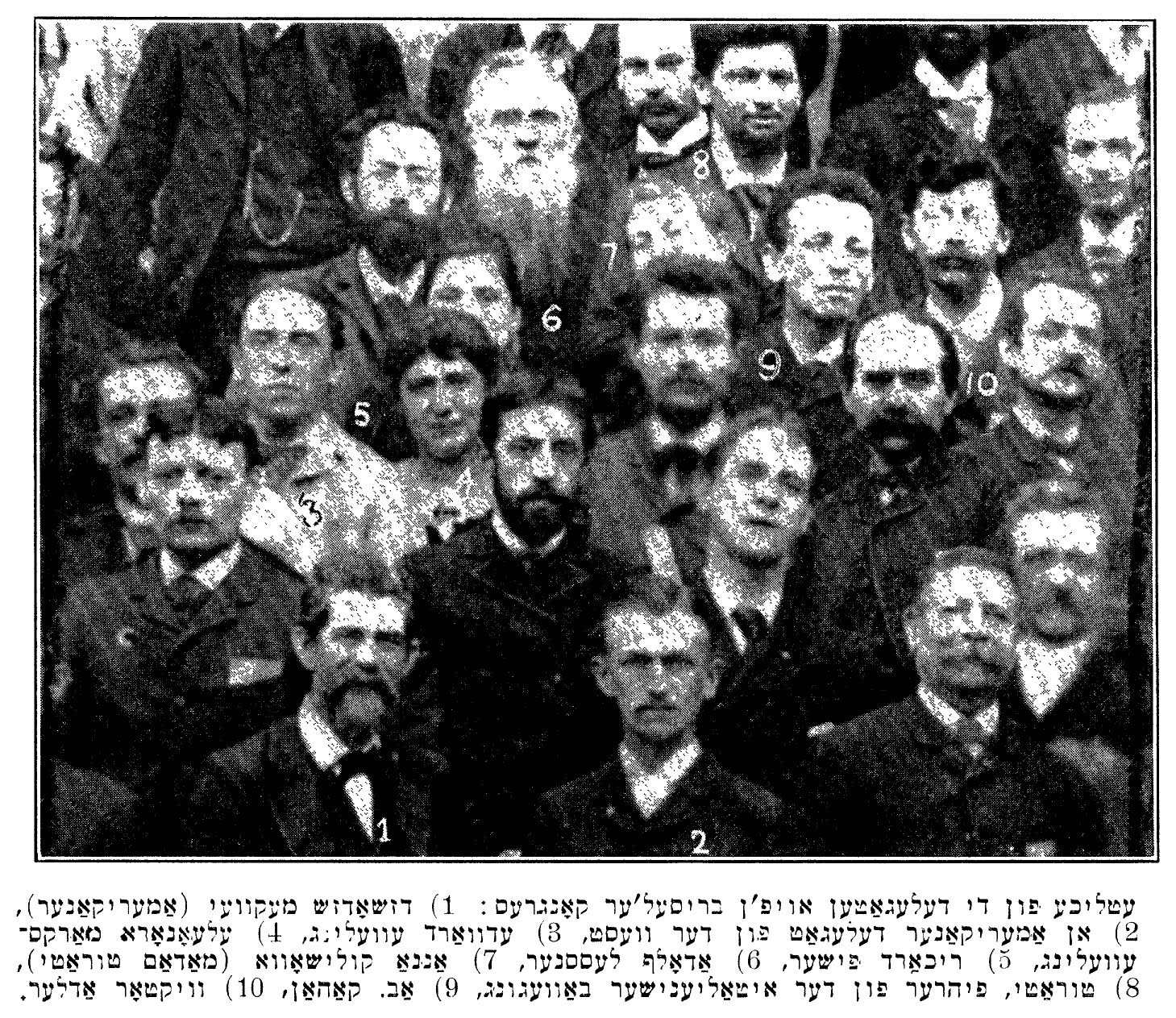
(plate; bound in the original between pp. 162–163)
Paul Singer and Victor Adler expressed the opinion that the whole affair would do more harm than good. But I did not agree with them, and I held to my own view.
Adler invited me to supper at a restaurant, and there, speaking about my point 4, he strongly advised me to withdraw it. He was a rarely clever and a rarely lovable man, and, speaking to me as a Jew to a Jew, in a friendly, witty German, he tried to explain to me why he considered my "point 4" a tactlessness.
— A tactlessness — I said with an ironic smile — the Brussels rabbi says exactly the same, only from quite a different standpoint.
Paul Singer also came up to our table (I was almost convinced that Adler had arranged with him that he should then "just happen" to find himself in that restaurant too). We chatted, debated. The gist of their explanation consisted in the following:
The enemies of socialism maintain that socialism is a Jewish product; they point out that Karl Marx was a Jew, Lassalle was a Jew, and here Paul Singer and Victor Adler are Jews too. The antisemites say that the whole movement is kept up by Jewish money. So, were my resolution to be adopted, the opponents of the socialist parties would point their fingers at it: "There, you see! — they would say —163the socialist congress takes the Jews under its protection! It is a little Jewish synagogue!"
— In Vienna the antisemites are powerful, and we socialists are the most dangerous force against them — said Adler. — If your resolution is adopted, they will meet us with shouts that their assertions have been confirmed, that the whole socialist congress was nothing more than a Jewish market. The word "market" the antisemites used to use about everything connected with Jews — just as with everything that Jews do, they imagine it to be trade, sharp dealing, or usury.
I answered that socialists are not accustomed to be frightened off by the lies and slanders of their opponents; that we must fulfill our duties regardless of any obstacles. In short, I did not give in, and point 4 remained on the agenda.
When it came to point 4 at the sessions of the congress, I, as the author of the point, was the first given the floor.
Excerpts from the speech that I delivered then were printed in Belgian, German, and French newspapers. And a part of them was afterward reprinted in Russian, in the fourth book of Plekhanov's quarterly journal "Social-Democrat." In a note the editorial board of the journal asks me to send it the whole speech. I do not remember whether I did so. I believe that I did, for among my papers there lay for many years a Russian translation of the speech, and this was, it seems, the original of the copy which I had sent off to the editorial board of the164"Social-Democrat." The journal, however, never appeared again anyway.
Of my speech, only a short extract was printed in it, and in it a few places are somewhat muddled. One can see that words are missing. Of the other reports again, which were all printed in daily newspapers — I have not a single one*.
This speech, however, is bound up with one of the most vivid experiences of my years, and I remember it in all its details.
I spoke in English, and my words were translated into French and into German. Here is their essential content:
"I come here not as a Jew, but as a worker — as a representative of Yiddish-speaking workers. I have the honor to be a delegate of the United Jewish Trades of New York. People ask me why I have placed the Jewish question on the agenda. Surely I know that for socialists there is no Jewish question. For them all peoples are equal. For them there exists only a distinction of classes, of workers and capitalists, of the robbed and their robbers. To this my answer is: I know that quite well. If not, I would not have come here. But for socialists there is also no question about militarism; we are all against it. And everyone knows this as well as one knows that you are against antisemitism. Yet circumstances have compelled you to discuss165the militarist question. The same can be said of the Jewish question.
"I demand equality on all important questions.
"The Jews are persecuted. Pogroms are made against them. They are insulted, they are oppressed. Exceptional laws are enacted against them. They have been made into a separate class of rightless people. These very rightless people wish to fight together with all other proletarians, and they ask for a place in the ranks of Social Democracy. The antisemitic Russian press attacks the Jews and strives to create the impression that everyone hates us, even workers. Therefore I demand that you declare to the world that this is a lie, — that you are enemies of all exploiters, Christian as well as Jewish; that Jewish workers are as dear to you as Christian ones.
"I ask of you words of comradely greeting to the organized Jewish workers of America, of England, and of the whole world. Drive back antisemitism! Declare to the world that you condemn every form of persecution of the Jews!
"Give the proper answer to the slanders that antisemitic newspapers spread about us. By doing so you will give the Jews the courage to take part in the struggle for the liberation of the proletariat."
After the speech I read out my resolution. I had, however, written it not in the form of a resolution, but as a part of my speech, and therefore it was not printed among the resolutions.
My speech was interrupted several times by applause. I therefore hoped that everything would go smoothly and that my resolution would pass. But I was mistaken.
166After me the floor was taken by the leader of the Belgian Socialist Party, Jean Volders, a man of some thirty-odd years, or perhaps forty, with blondish hair, not stout, above middle height, with a genuinely Belgian-Dutch face. After a short speech he proposed a second resolution, and, as became clear to me afterward, all of this was the result of a private consultation with the leading spirits of the congress. Paul Singer and Victor Adler took a lively part in it. Volders was chosen as the proposer of the resolution for two reasons: first, as the leader of the party in Belgium, where the congress was taking place, and where the socialist movement was already very large at that time, he played a specially important role. And second, the number of Jews in Belgium was small, and antisemitism played no role there. With respect to the Jewish question Belgium was therefore an impartial country, and the standpoint of such a socialist as Volders had to be taken as a purely principled standpoint.
"Sympathy with oppressed Jews is self-evident — said Volders (I take the report from Plekhanov's "Sotsial-Demokrat") — socialists stand up for all the oppressed against the oppressors, for the exploited against the exploiters. The oppressed and exploited of all countries are among167themselves bound together with the bond of brotherhood. The roll of socialist martyrs who fell in the freedom struggle of Russia contains too many Jewish names for anyone to be able to suspect us of unfriendly relations toward Jews.
"The antisemitic movement is sustained solely by bourgeois parties, and it springs, among other things, from the envy which Christian exploiters feel toward Jewish exploiters (applause). For oppressed Jews there is only one way: to enter into the socialist ranks."
Here is the resolution that Volders proposed:
"Taking into consideration that workers' and socialist parties of all countries have always declared that for them there exists no national hostility between peoples and no national enmity, and that there can be no other struggle than the class struggle of the proletarians of all peoples against the capitalists of all peoples;
"Taking into consideration that the only way to the liberation of the Jewish workers is their union with the socialist parties of the workers of the countries in which they live, —
"The congress declares that, while condemning the agitations against Jews as a cunning means which capitalist and reactionary governments employ for the purpose of introducing a split among the workers, and of dragging the socialist movement away from its proper goal, —
"It considers it superfluous to take up the question which was brought in by the representative of the Yiddish-speaking groups of American socialists, and passes on to the next questions of the order of the day."
When Volders had finished reading his resolution,168in a certain corner of the French delegation there arose a commotion. Several delegates clamored for the floor, and the chairman barely calmed them with a demand that they first let the resolution be translated into German and into English (Volders had read it out in French).
After the translations were made, there rose a tall, black-haired and black-bearded man in his middle years, with broad shoulders, a big man, strong as an oak. He belonged to the French delegation; he himself, however, was a Greek. His name was Achiriademe. He was a lawyer in Paris.
He spoke about Jewish bankers, about Jewish exploiters, and he shouted and grumbled both against my proposal and against Volders's.
— If there are antisemitic agitations, then there are also philosemitic (Jew-friendly) agitations against other peoples, in favor of the Jews, — he argued. After him a Frenchman by the name of Ranier spoke. Concerning his speech we find the following in Plekhanov's "Sotsial-Demokrat":
"While condemning the persecutions which are aimed against Jews, he (Ranier) finds, however, that there exists a S e m i t i c q u e s t i o n, which is a part of the general social question. Here the "Sotsial-Demokrat" brings Ranier's words: "I mean, namely, the question of Jewish banks, a sharp question, which will in the end destroy us all.""
Other delegates spoke. Some in the sense of Achiriademe and Ranier, others against them. I again had the floor. Speaking in a tone of astonishment and indignation, I asked:169— Where did the delegate Achiriademe dig up the word "philosemitism"? Where has he seen Christians being oppressed in the interests of Jews? Will he perhaps tell us about pogroms that Jews make against non-Jews? Or about special privileges which are given to Jews and which other inhabitants do not have? And what does this have to do with the question about bankers? A banker is a banker whether he is a Jew or a Christian. What does this have to do with the Jewish question?
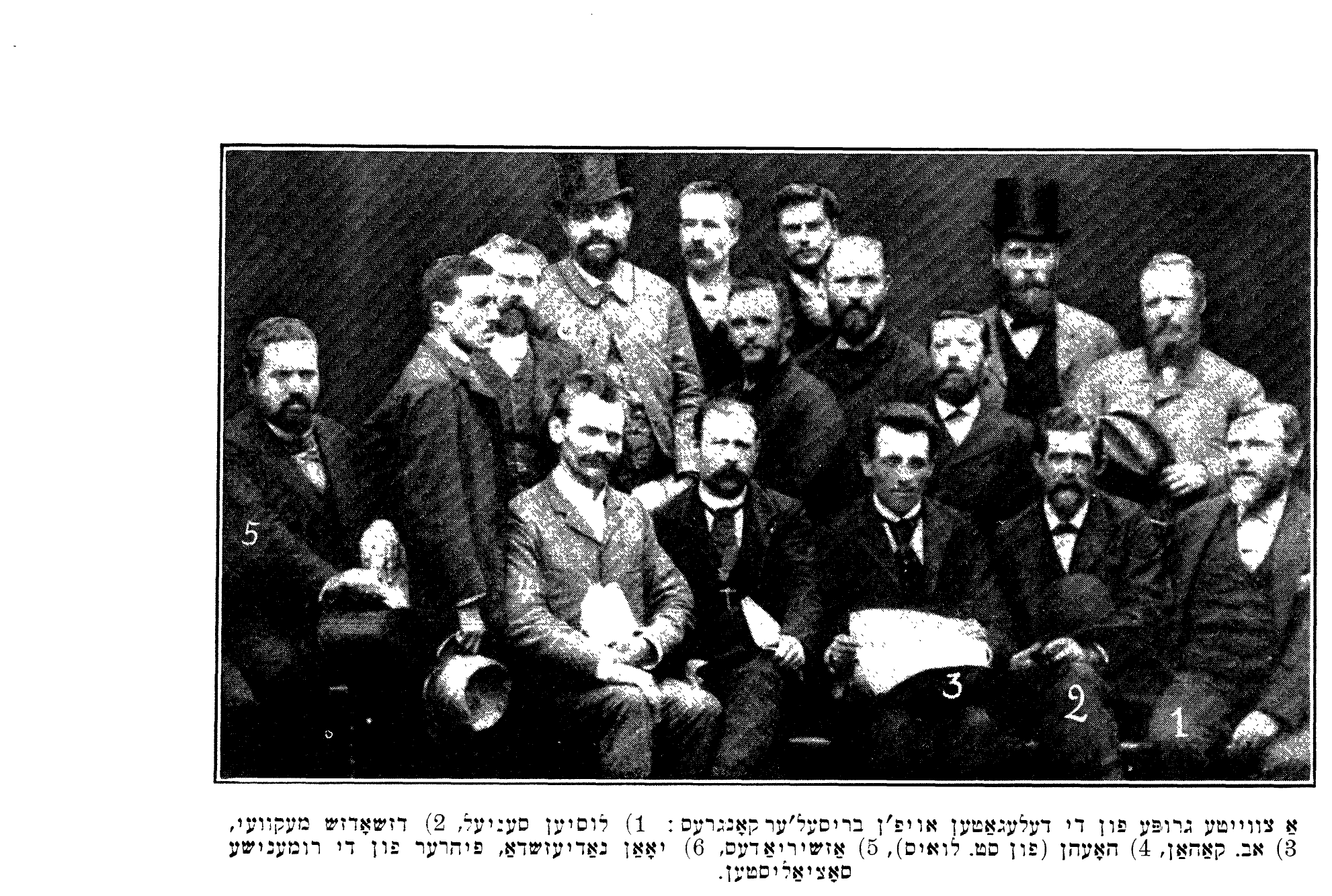
(plate; bound in the original between pp. 168–169)
— It already has a great deal to do with it! — Achiriademe interrupted me.
There arose a commotion again. Near the platform there then stood Rubanovitch, and his friendly words to me gave me courage. I appealed to the congress: not to pay any attention to such un-socialist opinions as those of Achiriademe and Ranier, and to adopt my resolution.
When I reached my place at one of the great long tables at which the delegates sat, there came running up to me the old German leader, Wilhelm Liebknecht, and, speaking to me in English, he said with agitation:
— With your getting heated you are harming even your own proposal.
— And are people like Achiriademe allowed to get heated, then?
— No one takes speeches like his seriously. If you had not muddled the porridge, such people would have had no opportunity.
The debate continued. There was an uproar again, and as a compromise Volders's resolution was finally adopted with an amendment from Achiriademe, that is, that the congress condemns b o t h170a n t i s e m i t i s m a n d p h i l o s e m i t i s m.
I was crushed. I simply could not believe it. I had come with a heart full of international love. If anyone had told me beforehand that at an international socialist congress there could be room for such speeches as those of Achiriademe and Ranier, I would have laughed.
It must be noted, however, that the French delegates who spoke more or less in an antisemitic sense were not representatives of full-fledged socialist parties. The socialist movement of France was then divided and fragmented, and there were three full-fledged socialist parties, of which only one — the "Parti Ouvrier" (Workers' Party), the party of Jules Guesde — was a genuinely Social-Democratic one, like the German or the Austrian. The name "socialists" was borne in France also (and is borne to this very day) by liberal organizations of small and middling businessmen and farmers, who had nothing to do with socialism. It was often hard to make out who was really a socialist and who only bore the name.
Concerning the doctor Ranier, who spoke about a "S e m i t i c q u e s t i o n," we find in the mentioned article from Plekhanov's "Sotsial-Demokrat" the following interesting remark:
"To the credit of the French proletariat it must be noted that Dr. Ranier does not belong to the Workers' Party. He was sent to the congress by "a group for studying social questions," and one can see that with the theory of present-day socialism the group is still little acquainted."171As for Achiriademe, he too was not a delegate of the French Workers' Party. Whether he belonged to one of the other two socialist organizations (the "Vaillantists" and the "Allemanists") I do not remember. In them, however, there were in any case enough hotheads who understood socialism little.
By "philosemitism" Achiriademe and Ranier meant the connection that great Jewish bankers had with governments which do business with them, or Jewish railroad companies, or other companies which receive concessions. This, among these "socialists too," was called "a special movement in favor of the Jewish people." This is what they set forth as a counterpart to pogroms and Jewish rightlessness. Ranier's argument was the old antisemitic argument, that the Jews want to grab the world into their hands.
The article in Plekhanov's journal criticizes the position of the congress toward "Point 4" quite sharply. It sets forth interesting arguments not only against Achiriademe's amendment and Dr. Ranier's speech, but also against Volders's resolution. First, it strikes down the argument that, since socialists have always condemned race-hatred, the congress need no longer take up the Jewish question. Socialists have also always been for the equal rights of woman — says the article — yet this did not prevent the congress from adopting a resolution which demands of the socialist parties of all countries that they put into their programs a demand for full political rights for women.
The writer of the article brings the words that Paul Singer172said at this congress, while the matter under discussion was the woman question:
"This demand — said Singer — is already to be found in our program; there are, however, countries where it is not yet put forward. Therefore such a resolution is a fully proper thing."
The author of the article in the Russian "Sotsial-Demokrat" therefore remarks *:
"Almost exactly the same could be said about the Jewish question: although we socialists have always been for the equal rights of all people, no matter to what nation or religion they belong, yet, since there are countries where the parties that are hostile to us strive to push workers onto the antisemitic road, it is therefore a proper thing to recommend to all socialist parties that they emphasize in their programs a demand that everyone be given full civil rights and political rights, no matter to what nation or religion one may belong. And we, socialists of all countries, must do this with a special interest, because we know how much the international socialist movement is indebted to the Jews for its successes, and what base interests work upon the governments and parties which incite Christians against Jews."
Concerning Achiriademe's "philosemitism" the same article says that to put it on the same line as antisemitism would have a sense only then, if there existed such a country, where Jews, as Jews, would have173more rights than Christians, and where Christians would be oppressed and persecuted for the reason that they are Christians. As to Roniger's fear that the Jewish banks will "ruin us all," the author of the article remarks: "If the banks do this, they will do it as banks and not as banks that belong to Jews" — that "the bank question is an economic question and not a national one."
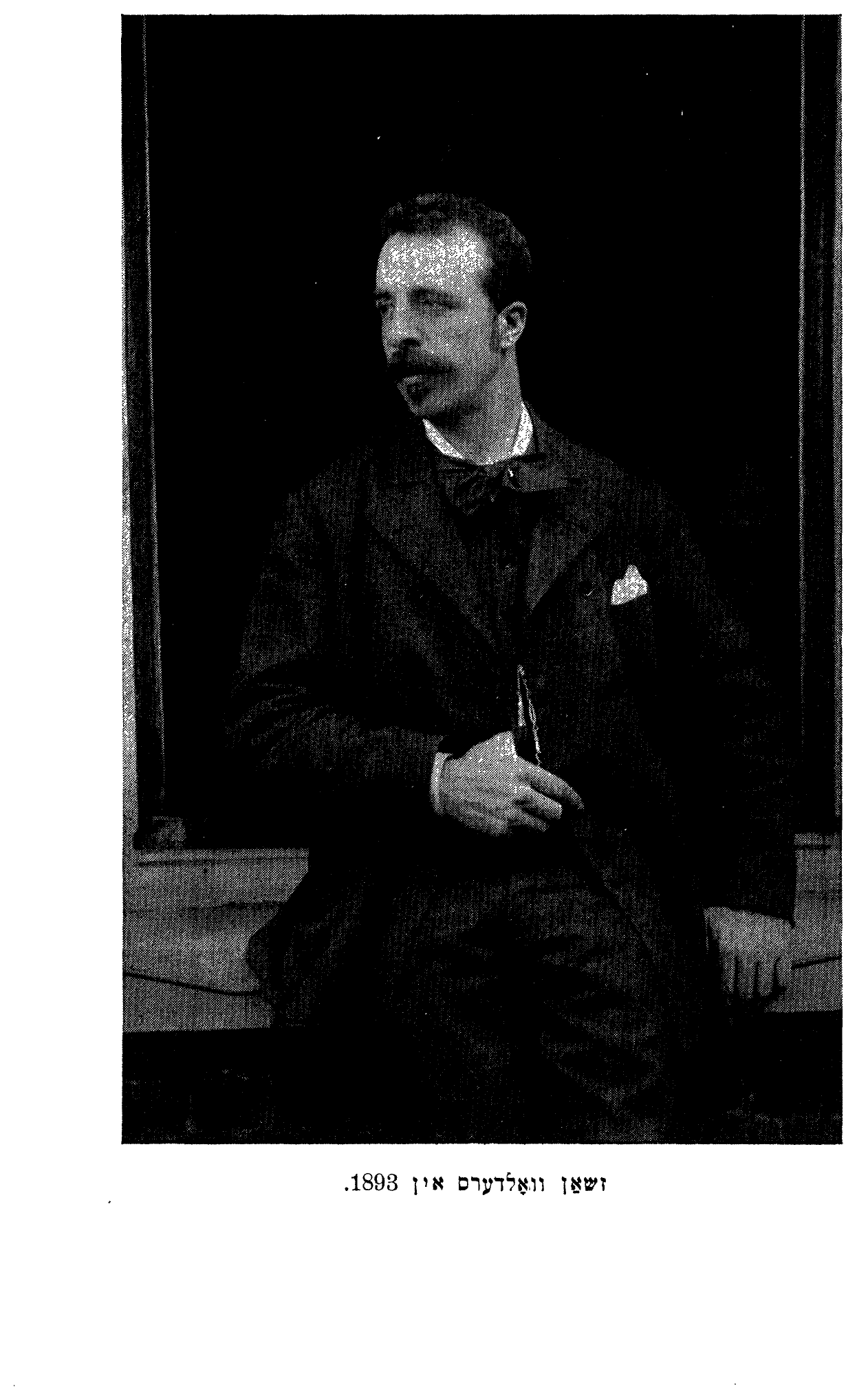
(plate; bound in the original between pp. 172–173)
Interesting and acute are the following lines in that article:
"In demanding that women should have the same political rights as men, the congress naturally had in mind Jewish women as well as others. If so, then what sort of face does this demand wear with respect to Romania, for example? It appears that at the very time when, for the Jewish women of Romania, the congress demands full civil rights, it does not consider it necessary to protest against the rightlessness of the Jewish men of Romania. Why does the congress display such partiality toward the fair sex?"
Before I left Brussels, I received two letters from Jewish representatives — one from Budapest and a second from Munich — and a third letter, I no longer remember from where, was forwarded to me in London — all concerning my "Point 4." The Budapest letter was written in roughly the same spirit in which the Brussels rabbi had spoken to me. The Munich one launched into a pilpul against socialism, and the third letter (from the editor of a Jewish weekly paper) asked that I send him details of the congress debate over the Jewish question.
My speech was afterward discussed in the nationalist174Jewish press in various languages. It was also spoken of in the socialist press.
The congress went on with its work. As usual at such congresses, each of the first resolutions was discussed for many hours, and a whole packet of questions was left for the last day. These were then "railroaded" (rushed through on the express train), as one puts it in America.
[טאָפּיק] Women students from Vilna. — Iglesias. — In Ghent. — The Carmagnole. — Isaac Hurwitz. — Like ships that meet on the sea.
One day Vandervelde, the young chairman of the arrangements committee, comes up to me and tells me that two young ladies, students, wish to see me. "They say they are from your city, from Vilna" — he explained to me.
I went out, and there presented themselves before me two Jewish "young misses," who were then studying at the University of Brussels. One of them was named Sengal; she was the daughter of a wealthy, well-known Vilna family. Her father kept an apothecary-supply warehouse (wholesale drug store). They had learned that I was a man of Vilna, and the fact that a countryman of theirs was a delegate made a great impression on them. It was a whole point of pride for them. We became acquainted. I introduced Rubanovich to them, and they invited us to their place for tea.
We chatted about various things. When I happened to talk with the women students about Vilna, it175turned out that we had very little in common. No mutual acquaintances at all. In part this was perhaps because they belonged to a wealthy family, to a different social circle than mine. But only in part. The main thing lay in the fact that I had been away from Vilna ten years and they — only one year. Once again I felt how swiftly the current of life runs. It seemed to me that I belonged to a different generation.
I told them about America, and Rubanovich about Paris and the Russian revolutionary movement. His wife — a Christian — had been one of the most important fighters of the "Narodnaya Volya," a member of the famous "Executive Committee"; and he was intimately acquainted with all the prominent Narodovoltsy who found themselves in Paris.
One of the congress scenes that made a deep impression on me was the following: a Spanish delegate by the name of Pablo Iglesias stands and speaks before the congress in his mother tongue, and although almost none of the other delegates understands a word, they nevertheless listen with strained attention, and in the great hall there reigns a stillness that is suffused with enthusiasm and enchantment.
I have already explained that only in one of the three accepted languages — German, French, and English — could one deliver a speech before the congress (this restriction was a practical necessity, for the translation of every speech into two languages took up too much time as it was). But Iglesias was generally known and beloved, so an exception was made and he was permitted to speak in Spanish. He was pale, with blond hair, with a blond beard and bright blue176eyes. When he grew animated, those eyes of his shone with a rare radiance, and his teeth gleamed like white flames. His pale face glowed as upon an inspired corpse; his voice rang with unearthly tones. He spoke with passion.
When he had finished, there broke out a resounding applause, which was repeated again and again. Then someone translated his speech into the accepted languages. From that hour on, Iglesias became one of the most prominent figures of the congress.
The people of the Belgian city of Ghent (one of the oldest cities in Europe) invited the whole congress to their city for a day. In Ghent the socialist movement was strong, and the cooperative institutions were large. When we came down from the station and marched to the Ghent Folk House, the sidewalks were packed with workers' families, and many walls were decked out with flags in our honor. Lucien Sengal was in such an exalted mood that he kept pressing my arm to him every little while, and as he marched, he kept turning to the right and to the left and shouting to the crowds: "L'Amérique vous salue! L'Amérique vous salue!" (America greets you).
This was a day of banquets, concerts, and speeches. At the main banquet, in the daytime, one of the German delegates delivered an overlong and tedious speech.
"Where is Iglesias? — the German leader, August Bebel, asked of those who sat near him — let him speak. Him I understand a good deal better."
When we returned to Brussels, they177photographed us. A couple of hundred of us lined up and seated ourselves on the steps of an old courthouse building, not far from the "Maison du Peuple," and they took us twice. In the museum of my personal history, the two photographic groups are two precious monuments.
The two pictures that were given here on page 162 and on page 169 were taken out of those two large photographed groups.
An interesting mental image has remained with me from the banquet that we had in Brussels before our departure. Seated together with me was one of the German Social Democrats, a German Jew by the name of Worm. He had once been a teacher of the German language to a Russian count. He had thus learned a little Russian, and he now made several attempts to speak with me in that language, but without success.
The delegates grew warmed up, partly from wine and partly indeed from good spirits. They all took one another by the hands and began to dance the revolutionary "Carmagnole." Worm danced and sang with fire. I can still see, it seems, how his long hair shook in time to his movements.
In the Swedish delegation there was a woman by the name of Sachs (not a Jewish one). Speaking to me in German, she inquired about Isaac Hurwitz ("Yitskhok Eyzik"), with whom she had become acquainted during the several weeks that he had spent in Sweden *. A remark that she178made, sitting across from me at the table, engraved itself in my mind.
"It is so touching — she said with feeling — when one recalls that here we are all together like a family, and soon we shall scatter and most likely never see one another again. It is so sad."
In my mind her remark was afterward bound up with an English novel, "Ships That Pass in the Night" (ships that meet on the sea by night), by Beatrice Harraden. The ships meet for a while and then part again; they never see one another more. The novel depicts how a young man and a young woman become acquainted at a boarding house in Switzerland. They grow mutually interested, but they are together only a short time; they part and never see one another again.
Parting creates melancholy moods. A scene of farewell when a train or a ship departs is a tragic scene.
179Before we dispersed, an Englishman made a proposal: that the English and French delegations should together visit Waterloo and there shake hands. Waterloo is the site of the historic battle where Napoleon the First suffered his final defeat at the hands of the English and the Germans, chiefly the English. The little town lies near Brussels — about an hour's journey from there. Many Englishmen travel to see the place. They go there out of a patriotic interest — to see the spot where their nation won a historic victory. And so the English delegation proposed that the representatives of the two nations should travel over there with an international-socialist interest; that on the spot where their grandfathers had had their bloody collision, they should shake hands and stage a demonstration of the brotherhood of peoples.
The French delegates answered the proposal with a malicious silence: that they should, together with Englishmen, visit the field where their nation had been vanquished by the English! "What a tactless proposal!" — I heard from a couple of them.
This was a second painful surprise for me. One would think — what could have been more beautiful and more natural than the proposal of the English comrades? And yet the French delegates rejected it. Does it then mean that they are first of all Frenchmen, and that the principle of international brotherhood is no more than an empty word with them?180This, together with the failure of my Jewish resolution, lodged itself in my memory like two stains upon the splendid congress.
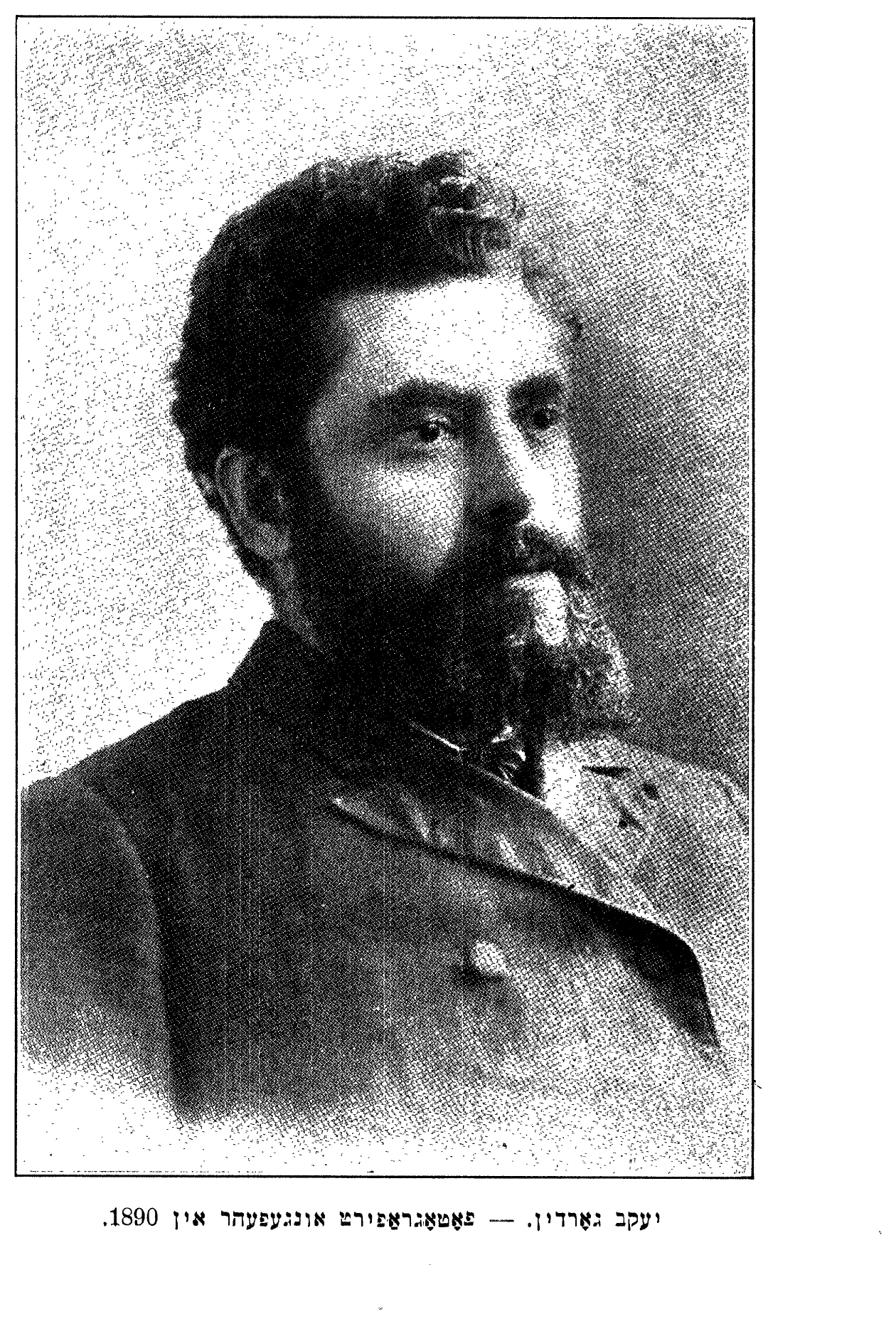
(plate; bound in the original between pp. 179–180)
The French delegates were naturally afraid of the bad impression that the report would make in France. But there were among them such men whose own feelings, as Frenchmen, were also against the proposal.
Some ten or fifteen of the English delegates then traveled to Waterloo on their own, and I traveled along with them.
When we arrived there, Belgian "guides" pestered us. As I have already remarked, many Englishmen come there, and some of the inhabitants make a living off of them. As a result, the Belgians of that region have taught themselves to speak English.
I and three of the English delegates took as a "guide" a tall man with a large black mustache. He spoke English very fluently, but we could not understand a single word. His voice sounded as though it were choked with sand, and his pronunciation was so strange that, had I not known he was speaking English to us, I would have thought it was some other language.
A little later his daughter helped him out. She had been born in Waterloo and had never once traveled away from there, and yet she spoke English almost like a native Englishwoman. She had always found herself among the travelers who come from England to see the region where their country had won the great victory over France.181We drank milk and ate black bread in an old house with punctured walls. We were told that Napoleon had spent the night in this house. They pointed out to us the holes in the walls and explained that these were from the cannonballs that had flown from the enemy armies.
I was not sure that all of it was true. Many things that the "guides" recounted were indeed true; but they had embellished them with fantasy, so that the story should come out more interesting.
An old man stood with an outstretched hand. He wore the clothes of a soldier in Napoleon's army. He assured us that he was over a hundred years old and that he had taken part in the famous battle. It was not absolutely impossible, for he looked very old. Yet I had my doubts. My English companions, however, believed him at once. They wanted to believe him. They craved to be able to tell at home that in Waterloo they had seen a man who had taken part in Napoleon's battle.
One of the Englishmen was a handsome young fellow of about twenty-two. As we were about to take leave of the "guides" to travel to Paris, and from there to London, the Belgian girl, who had spoken English with us, drew him into a conversation. We stood at a distance and waited. We saw how both their faces shone. "Ah, he won't be traveling with us today after all!" — one of the Englishmen spoke up. And he had guessed right. Instead of traveling along with us, our young comrade took his leave of us. He remained in Waterloo for a few days.
182From Brussels I traveled back to Paris for a few days. And from there back to London. There I came to a great mass meeting, which had been arranged for me — straight from the railway station to the meeting.
In London I found a letter from my parents and my aunt, and in it there was a greeting from my brother.
The voyage back to America I now made second class. I had a berth in a large cabin, where, besides me, two other passengers were lodged. One of them was an Irishman of eighty, a tall, robust old man with milk-white hair. He was traveling to a son whom he had not seen for forty-five years. He spoke very little, but smiled often, with a kind, wise smile. My second cabin-neighbor was a young Englishman who lived in New York and was now returning from a visit to his parents. All three of us became friends. The Englishman and I waited on the eighty-year-old man as on a grandfather, and he used to thank us with his lovely smile.
The young man I tried to make into a socialist; but he took no interest. This struck me as odd. It had seemed to me that every person who is congenial to me ought to take hold of socialism. But I said to myself: not all people183take an interest in social questions. This young man is an honest, good person in his personal relations to other people; but his human interest does not go further than personal relations. And I remember how I thought to myself: this is probably why there are many people who can take an interest in the public at large but not in the individual; they can give up their lives for all of humanity, and yet, should a single human being die of hunger, it might make no impression on them at all.
On the same ship there traveled two "champions": a "boxer" and a "bicycle-rider." The boxer was a "featherweight" — light, small, scrawny. He was light as a feather, and stiff and nimble as a spring. He was the featherweight champion of England; he was now traveling to box in America. The bicycle-rider was a tall, lanky fellow with red hair and large freckles on his face. Bicycles with small wheels did not yet exist at that time. A bicycle then still consisted of one large wheel and a second tiny one. Professional bicycle-riders used to have frequent races. The one who traveled with us had won all the races in England, and now he was traveling to a race that had been arranged in Madison Square Garden, New York.
I became interested in his profession and began to question him about it. In this way we became acquainted. We used to treat each other to beer at the bar. He introduced me to the boxer.
I tried to make socialists of both of them, and again without success. It did not interest them.184Traveling with them were still more sportsmen from England. Each champion brought along an entire entourage, and I became acquainted with the whole group.
In the evenings they used to settle themselves on the hollow "deck," telling each other stories and singing. I and my cabin-neighbor, the young Englishman, often used to sit with them. I loved to listen to their stories. Under the influence of the night, of the splashing of the waves, and of the throbbing of the ship, I used to feel as though I were in a dream-world. To this day a song they used to sing sometimes rings in my ears: "Sailing Merrily Home." They pronounced it in the London manner: "sailing" instead of "sailing." Under the effect of the sea and the night I felt poetry in their singing.
This voyage back from England to America I remember with a special vividness, with many details. Besides the passengers who have been mentioned here, I can count over still five more in my memory — three men and two women — whose faces stand as if alive in my thoughts.
A couple of days before the ship was due to arrive in New York, the crowd took to betting on the number of the pilot-boat that would come out from New York to meet our ship. One shouted "7," a second "12," a third "22." The money was deposited with the "purser" of the ship. It was lively. At last a small sailing vessel appeared. On its sail a large numeral was written. It was an "8."
We drew near to the shore. One could already see trees and grass.185The day was then a very beautiful one, the sky was bright blue, and the sea clear and lovely (in this I have always had luck so far — when I come back from Europe, the weather is fine). It was the beginning of autumn, the most beautiful time of year in New York. The heart sang with joy. The passengers began to make ready, to spruce themselves up. They took off their travel-coats. They came out on deck in hats and fresh clothes.
I had liked Europe very much; but now, coming back to New York, I felt strongly that New York was my home.
Had I traveled as a delegate to the same congress before the "Arbeiter Zeitung" had been founded, the journey would have been talked about only among a small number of people, in the inner circle of our movement. Now, however, through the "Arbeiter Zeitung," my journey had become an event in which great masses of people took an interest. People talked about my traveling; people read my correspondences, people read the reports. And so, when I came back, I was the center of public interest. When I appeared at meetings, I was greeted with a special friendliness.
Notes (the original's footnotes)
[p. 150] Earlier he had been a clergyman at the royal court. In later years he passed over from the socialists to the anarchists and became their leader.
[p. 151] As these lines are being written, he is already a gray-haired man. He has long been the chief leader of the Belgian Socialist Party, and for the last couple of years he has been the foreign minister of Belgium.
[p. 155] He has long been a member of the Socialist Party and the editor of the two socialist weeklies — an English one and a German one — that appear in St. Louis.
[p. 161] Both of them belonged to wealthy families, and both of them gave their property, directly or indirectly, to the party. Singer was a member of a large coat firm in Berlin, and Adler, who had a great inheritance from his Prague parents, had in his young years practiced medicine in Vienna. Both of them, however, gave up their private occupations and devoted themselves entirely to the movement.
[p. 164] In the "Arbeiter Zeitung" I did not send the content of my Brussels speech on the Jewish question. As the reader will soon see, the affair took such a turn that under the circumstances of that time I did not consider it advisable to publish the details of the debate.
[p. 172] The article is a part of the section "Internal Review," and goes under the name of the editorial board, without a signature.
[p. 177] He came to America a short while after we had founded the "Arbeiter Tsaytung." He was from Minsk, where he had played an important role among the radicals. In Minsk he finished the gymnasium. Later he studied at the university, until he was arrested and exiled to Siberia. When he came back, he trained as a lawyer and began to practice in his native city. He soon became one of the most important lawyers in Minsk. But he again became embroiled and was in danger of being arrested once more. Then he fled to Sweden, where he stayed for a certain time, and it was then that Mrs. Sachs became acquainted with him. From Sweden he went off to America. In New York the intelligent immigrants from Minsk received him like a precious guest. They told us about his great abilities and the high role that he had played among the progressive people in their native city. He at once began to play an important role in the Russian-speaking colony of New York.