Chapter Seven
An Eventful Summer
231At the beginning of the summer of 1892, I settled in Boston for a certain period. One of the reasons for this was a wish to work in the rich Boston library on my planned work about Darwinism and socialism. I also wanted to become better acquainted with the genuinely American part of our movement. For Boston was then still the capital of American culture, the capital of "Yankee-land"; and our party had a respectable American branch there. My most important work for the "Arbeiter Zeitung" could be done from there just as well as in New York. As for a livelihood, in the summer months the evening school of the C.Y.C.* was closed, and I had been promised private lessons in Boston.
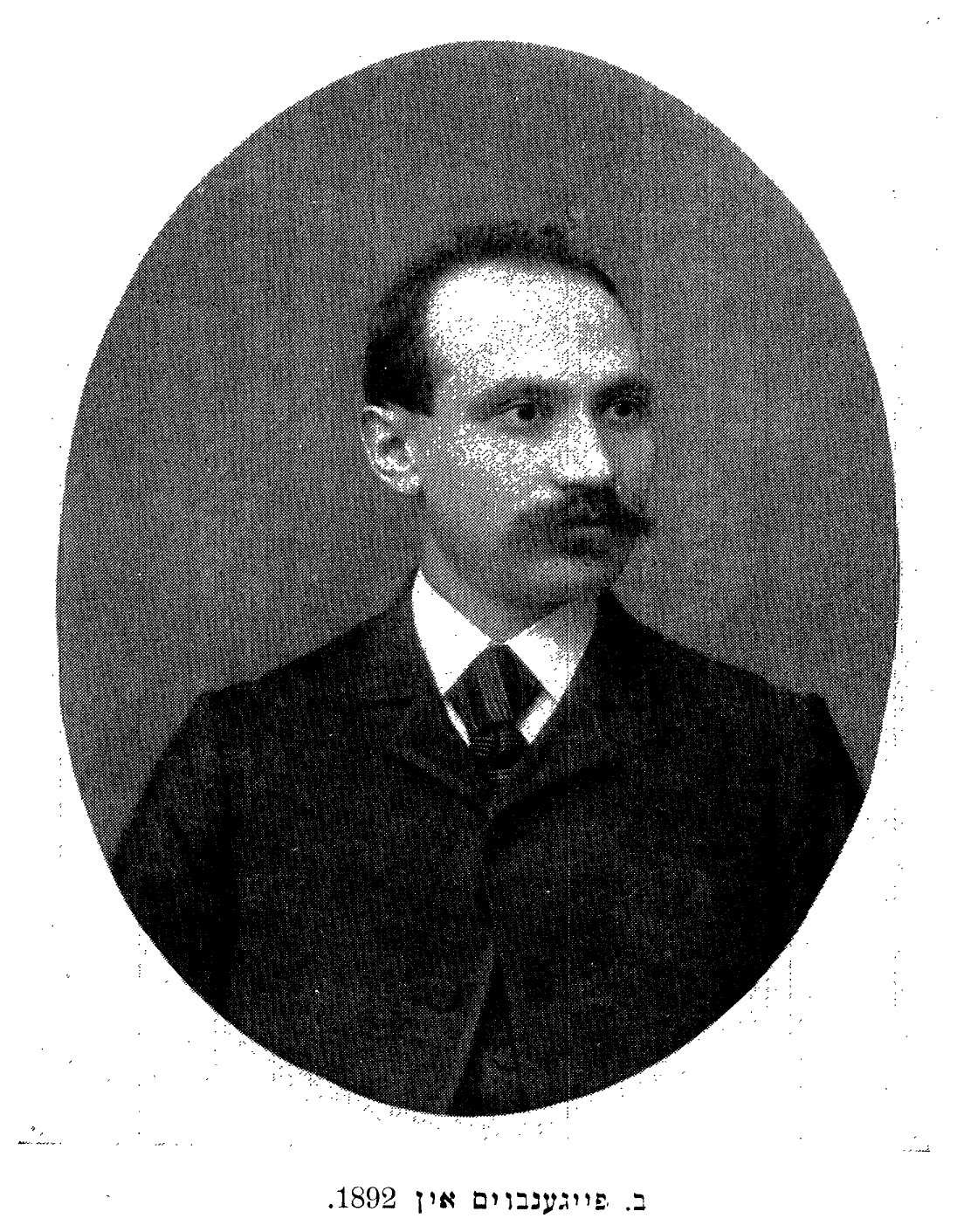
(plate; bound in the original between pp. 230–231)
I took a room in a two-story wooden house, a few steps from Washington Street, the most important street in Boston. The house was kept "on a lease" by a Mrs. Merrifield, an elderly American woman, who was one of the best women speakers in our party. She rented out furnished rooms. So I rented from her a232large room with two windows and settled in there. One of our New York comrades, a carpenter, had a short time earlier made me a cabinet for my books, as a gift, so I brought the cabinet over to Boston together with my books and got myself set up.
The handsome building of the Boston library, which now stands on Copley Square, did not yet exist then. The Boston library was at that time on Boylston Street, near Tremont. It was about an eight- or ten-minute walk from my lodging. I used to spend many hours a day there. I read through a good number of books there, and I copied out whole mountains of extracts from them.
I had lessons enough. They usually used to begin late in the afternoon and end late in the evening, except for Saturday night and Sunday evening, which I left for meetings. In a few places I had entire classes, with several pupils in a class.
My main food then consisted of Boston baked beans, which reminded me of a Vilna cholent of beans. I ate Boston beans three times a day. On Saturday night or Sunday morning it is an old custom among the Yankees of New England to eat baked beans with brown soft bread, a kind of cake. Mrs. Merrifield used to treat me to this.
She was an honest, good woman, Mrs. Merrifield, with a nature that strove toward ideals, and with a handsome middle-aged face, which was framed in beautiful silver-white hair. Educated she was not. A genuine American man or woman from the New England states, who has never gone to school233and cannot even write down an address, is a great rarity. Mrs. Merrifield was such a rarity. But socialism in its main principles she understood.
Her power as a speaker was an inborn ability in her. She spoke much more smoothly and grammatically than one could have expected given her lack of education. True, there were "high" words that she did not always insert where they fit, and such words she particularly liked to use. On the whole, however, this was not strongly noticeable.
Her speeches with her used to come from the heart. One could see that she believed in them. And the simple public of Boston loved to hear her. When she would stand on the Boston Common* and speak with her ringing voice, and her white hair glistened in the sun, it was pleasant for the ear and for the eye.
Boston was then a center of education, literature, and spiritual movements of all kinds, religious and social, beautiful and strange. In no American city was an idealist or a "crank" with some sort of theory so esteemed as in Boston. Toward Mrs. Merrifield's socialism her lodgers behaved with respect (although this did not prevent some of them from disappearing without paying the few dollars they owed her).
In an American furnished-room house the "roomers" are mostly strangers to one another. One can live234for years under one roof and not exchange a word with one another. Mrs. Merrifield's "roomers" were usually like one family. This was owing to her lively, friendly, sociable character.
Two of the "roomers" were ardent spiritualists. And Mrs. Merrifield too was a spiritualist. Sunday morning, and sometimes in the evening, they used to go to a meeting where they spoke about how the souls of the dead visit their living relatives or friends, or where the "dead spirits spoke to those present."
A "medium" is such a person who has within himself a "power to call up the voices of dead spirits." And a "materializing medium" is a person who can call up the spirit entirely, so that "one sees him" as he floats through a dark room. That these "mediums" were swindlers, men and women alike, had by then already been proven dozens of times. But it did not help. Every Sunday in Boston most of the meeting halls were occupied with spiritualist gatherings, and among the believers were many people of high education, some famous scholars even. So it was in America and in England, and so it still is, in part, today. But then Boston was literally full of spiritualists. With regard to this insane superstition and swindle, Boston was then a world center.
One Sunday, when Mrs. Merrifield had dressed up to go to a "materializing séance," I asked her to take me along.
— I would do so with pleasure, if you believed in it — she answered me.
— Take me along; if I see that it is all true, I will believe — I declared.235— In order to see, one must first believe — she responded quite earnestly — he who does not believe cannot see the spirit.
When I used to argue with her about the many swindlers who had been caught in the spiritualist business, she always had one answer: just because there are some swindlers, must one therefore not believe in the honest "mediums"? For every one false "medium" who is caught, there are ten honest "mediums." They are not caught, because they really do call up spirits.
One of the "roomers" was a great drunkard. He lived at Mrs. Merrifield's with his wife. Both were young and both handsome and both decent. He was a good earner, but his weakness was a great hindrance to his business. From time to time he used to go away to a sanatorium, where they used to break drunkards of their failing. But it did not help.
The wife used to speak of his habit as if it were an ordinary illness. They lived like a pair of doves, never having a cross word. And when he used to take to drinking and come home dead drunk, she used to caress him.
A certain acquaintance of theirs, a young Englishman, also a handsome young man, used to come in to them. He was always handsomely dressed, and he used to tell interesting stories, anecdotes. The drunkard's wife used to sit with him often a whole afternoon or a whole evening, mostly in an airy hall that came out with its windows toward the street — a kind of enclosed veranda.
Mrs. Merrifield did not interfere. But finally she had a conversation with the young woman about it. When the young man who was enslaved to the bitter236drop found out about it, he assured Mrs. Merrifield that he could trust his wife and that he was grateful to their young friend for keeping her company. Finally Mrs. Merrifield made a compromise: the friend should spend much less time with the drunkard's wife than before, only every other day, and no more than a couple of hours at a time.
In Mrs. Merrifield's house there then lived the wife of an American socialist, also a handsome woman, though a very stout one. Her husband lived elsewhere. But he used to visit her often. She was much younger than he. A year or two earlier they had lived together, also at Mrs. Merrifield's. Once a traveling socialist agitator stopped at the same house. A romance was knotted together, and the stout young woman went off with the agitator. Her husband suffered terribly from it. But he regularly sent money to the woman in love, and he never spoke a bad word about her. Later the stout woman returned, but she refused to live with her husband. So he moved out and gave up to her the room that they had formerly occupied. Now, then, he supported her and used to visit her often. He used to sit and gaze at her like a downcast lover, and she used to behave toward him like a daughter toward a father.
One of the "roomers" — a middle-aged man from Canada, was very pious, and he used to bring a verse from the Bible to bear on everything. He knew the Old and the New Testament by heart. Socialism, he used to say, is a fine idea; you have a sign of it, that the Bible accepts it. And he used to set about reading aloud verses which confirm, in his opinion, everything that we socialists put forward in our program.237Mrs. Merrifield used to explain to him that what he says is "unscientific." She believed in scientific socialism, although her notion of what that actually is was quite a foggy one. Still, as said, she understood the main points of socialism.
Into Mrs. Merrifield's house there used to come various American comrades who did not live with her. And with three of them I became closely befriended.
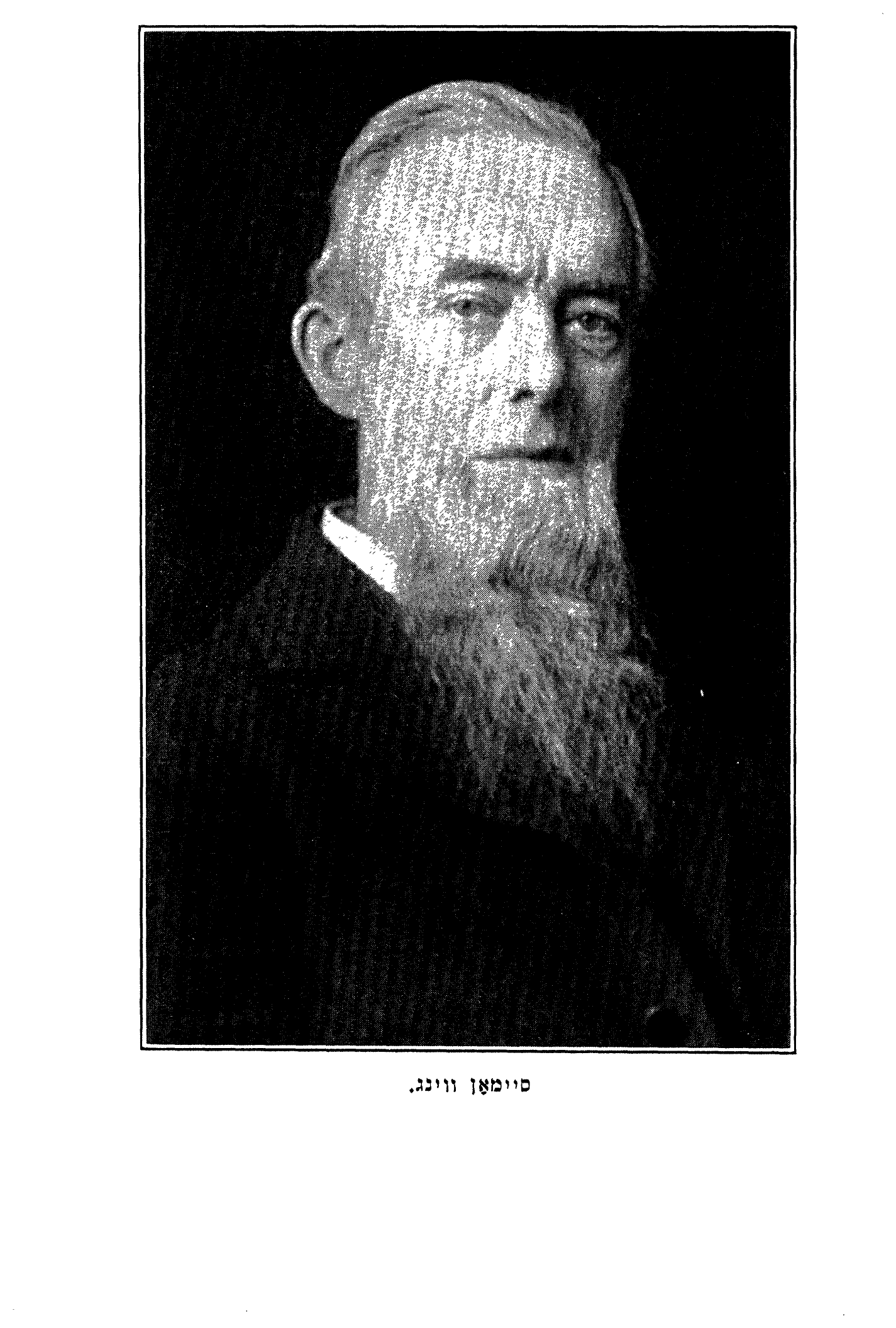
One of these Yankees was a tall, thin man with a gray beard — a living picture of Uncle Sam. His name was Simon Wing. He dealt in articles used in photography, and he had invented a new kind of camera. To socialism he was devoted with his whole heart, and when I used to explain to him the Marxist theory, he used to listen as a pious Yankee listens to a sermon from his minister.
A class for political economy was founded, and I was the teacher. Simon Wing was one of my pupils. He used to come to the lectures in the greatest heat and in pouring rains. Sometimes the class would gather at his office, sometimes at my room, and sometimes at the house of another American comrade.
Once I expressed admiration that he kept up our lessons so faithfully.238— I am already an old man — he answered me with his genuine Yankee pronunciation, through the nose — little time is left to me to learn. Young people can put things off. I must make use of every day.
At the end of that summer, our party nominated him as its candidate for President of the United States. This was the first time that it had put forward a presidential candidate of its own. As vice president there was nominated Charles Matchett, an electrician from Brooklyn, also a Yankee.
The number of true Americans in our party then in America was very small, and for these two posts we wanted to have genuine Americans.
Some wag translated the name of our presidential candidate into Yiddish, and it came out "Shimshon Fligel." And the joke was taken up. The point was that it is altogether unbelievable that there exists a socialist with a genuinely American name; that it is probably only a Jew after all.
Among the women members of the American section of Boston was a Mrs. Avery (her full name was Martha Moore Avery, and so she usually used to call herself). She was a speaker, and since she had more education and a great deal more ambition than Mrs. Merrifield, she gradually began to play a larger role than she.
She was younger than the socialist woman with whom I lived. She had dark-brown hair, with a healthy figure and a healthy, not-unhandsome American face.
She used to speak with ceremony and with oratorical239manners, and she began to acquire a reputation as a fine speaker. The first impression she would make was that she was an educated lady of the higher American society, capable, developed, with a beautiful oratorical talent. But once one had heard her a second and a third time, one would come to realize that all of this was a mistake. One would find out, upon inquiry, that she was an ordinary middle-class woman, with little development and little ability, and that she actually had nothing to say. To me her speeches were very dull, and her oratorical airs and oratorically drawn-out tones were a burden to me.
(plate; bound in the original between pp. 238–239)
She was no fool, however. And since our movement was poor in forces, chiefly in American ones, and since before a strange audience she could make an impression from the platform, her role grew. At first I overestimated her social connections. Once, in a conversation with me, she gave a hint about her relatives, as though they belonged to the most important families; so I took it that she was really from the highest circles.
In that same conversation of ours the talk came around to the Jews, and — I do not remember how it came out — I remarked:
— The prominent American families presumably place the Jew next-door to the Negroes.
— It is almost so, — she answered with an embarrassed expression, as though she were one of the most prominent families and had to admit the truth *.240The "Common" is taken up on Sundays with various open-air meetings. All sorts of religious gatherings are held there; people preach, people pray. But not only religious meetings are held there. Political, half-political, and all kinds of other gatherings also take place. Every "crank" who wishes to speak before an audience plants himself down and preaches. And if he provides himself with a good spot from the beginning of summer, he can have it every Sunday. In the very middle of the park an orchestra plays. The park is fairly large, and in those days it was still somewhat larger than today. In its various parts various groups gather, each around its speaker.
It goes without saying that our socialists did not fail to provide themselves with a spot on the Common for our agitation. No Yiddish or German speeches were held there. English throughout. That summer I was, among the American comrades of Boston, the most active agitator on the Common. There I would explain socialism in a practical manner, adapting myself to the American way of thinking. With parables, with explanations, with jokes from daily American life I would try to convey241our ideas in such a way that to the American they should be clear and interesting. The speeches were a success. A large audience would gather, perhaps the largest of all the gatherings on the Common. The comrades would boast that my speeches drew the public away from the music and that my voice shouted out over the orchestra. After the lecture I would invite the audience to put questions or to carry on a debate with me. And then the liveliest interest would begin. When I would honor a debater with a well-turned parable or witticism, there would be a crash of applause and merry laughter. And this would draw new people. On the Common I became a popular figure.
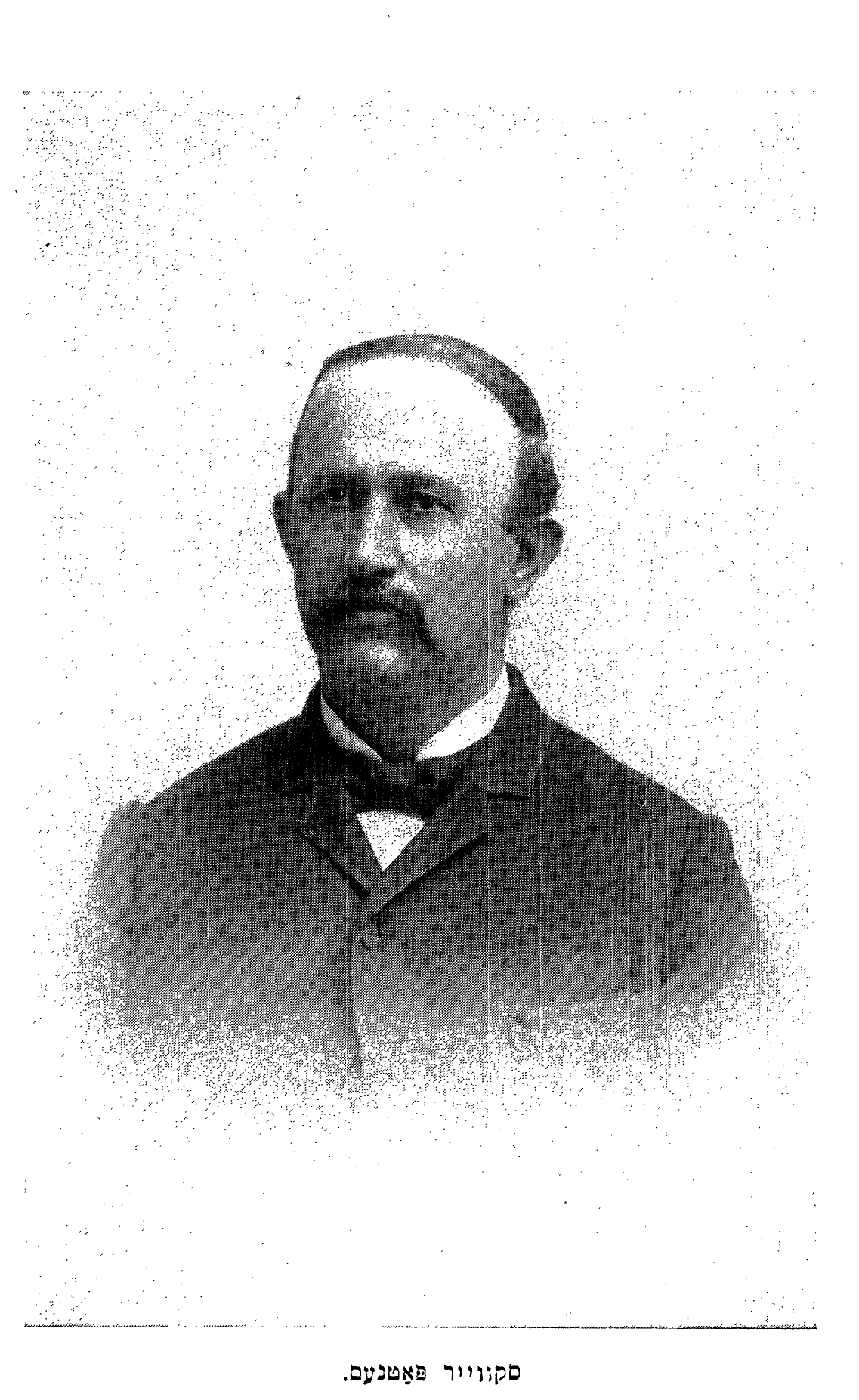
One of our Yankee comrades, Squire Putnam, a worker in a machine shop, who lived in Somerville (near Boston), had thought up a "patent" — a small bench that could be folded together in such a way that one could carry it under one's arm. When it was set up, a "platform" came out. It was upon this very "platform" that I would deliver my Sunday speeches.
Putnam was a devoted socialist. From his Christian religion he did not renounce. He used to go to church. His enthusiasm for our ideal was greater than his religious enthusiasm. In God, however, he believed, and of the world to come he was afraid.
Several times he invited me to his home on Sundays for dinner. After dinner he would take his "patent" and we would drive off to the Common.
We became so closely acquainted that he confided to me the most intimate things of his life.242His wife had died, he had been left a widower with small children; so he had taken into his house the daughter of a poor priest. And so he told me about his feelings toward her. Later he married her, and she was indeed a good wife to him and a faithful mother to his children.
The priest of his church once called him in to reprove him for occupying himself with socialism, but he stopped him.
— On these questions I will ask you not to debate with me — he said to him — speak to me about religion, but not about political and social matters.
Later Putnam was our candidate for governor of Massachusetts.
His business affairs improved. He opened a shop of his own. His activity in the movement, however, was never weakened. He died a devoted socialist.
Among the American comrades with whom I became acquainted at that time was a young priest by the name of Herbert Casson. He preached in several little towns around Boston. He had no permanent church; so he delivered his religious sermons wherever it happened to come about. He was very poor and he lived like a hermit, in a little hut, in a wild region somewhere, "like a child of nature," as the saying goes. From time to time he would travel about and deliver socialist lectures. Once he spoke at our Sunday meeting on the Common. The speech was a brilliant one, but his socialism sounded to me like a mixture of all sorts of kinds.243He was a thin young man, with clever blue eyes and a thin pale face. He made the impression of a starved holy man *.
(plate; bound in the original between pp. 242–243)
Every time I recall that summer with the speeches I used to deliver on the Common, the following little story comes up into my mind: I was walking along Washington Street. I needed to break a five-dollar bill, and to this end I went into one of the stores there.
— I will do this for you with special pleasure, Mr. Cahan, — says the storekeeper, an American.
I ask him from where I have the honor of being acquainted with him, and he answers:
— Oh, I am one of your Sunday listeners on the Common.
There was no doubt in my mind that he was a socialist. So I asked him what he could do for our campaign.
— Do you really take it seriously? — asks the storekeeper with a merry smile.
— What do you mean? — I ask.
— Do you really take it seriously? — he laughed.
In short, the whole of socialism was to him nothing244more than a joke. It was simply interesting to him to hear our speeches. To vote for such a thing and even to work for it — that seemed to him already too comical.
I had enough other proofs as well of how far the ordinary American was from our thoughts and political interests. But in those days such proofs would make a scant impression on me. I both did and did not take notice of them.
The talk of the Washington Street storekeeper doused me as if with cold water. But the feeling did not remain long. I took to arguing with myself that Mrs. Merrifield and Simon Wing, and Squire Putnam, and Mrs. Ivory, and the man whose wife had gone off with the agitator, and some thirty or forty other members of the Boston section of our party were also genuine Americans. So a beginning had already been made, and the farther on, the larger the number of American socialists would grow.
I used to see J. Fin often. He was still working at his sewing machine as a coat-operator. At work his mind would often weave out interesting thoughts, which he would then express from the platform or in an article for the "Arbeiter Zeitung."
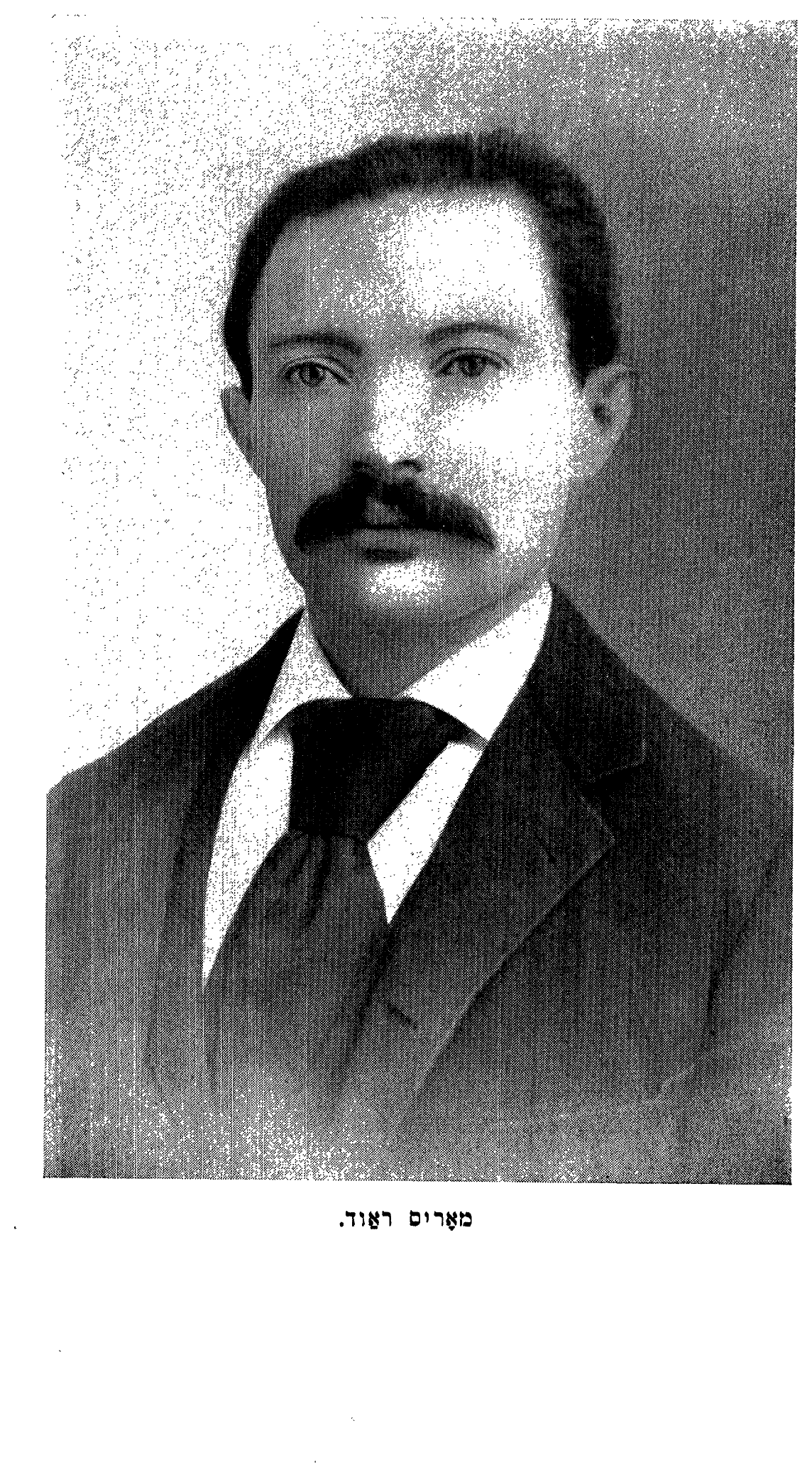
Among the Jewish socialists of Boston a prominent place was then taken, besides Fin, by a young man named Morris Rode, also an interesting person, though of an entirely different type.
Fin had learned his operating in America. In the old country he had been at the Gemara, and the Gemara was sealed upon his face. Rode, again, had been a tailor from the old country — a village tailor.245He had come to America an ignoramus. He could not even write Yiddish. Under the influence of the movement, however, he developed quickly, taught himself to read English, and became a well-read man.
In 1892, when I spent those several months in Boston, he was already capable of understanding a scientific book. Of grammar, however, he still knew little, and at writing he was likewise no great hand.
He took lessons from me, and was my most important pupil. To study with him was a pleasure. Everything that required understanding he would grasp very easily. Only with writing it was all troubles. "My fingers are good for nothing more than tailoring," he would say with a smile. He had barely taught himself to write his own name.
He was a good, refined man by nature, and to the movement he was devoted with body and life.
In that year great struggles took place in America between workers and capitalists. In the summer of 1892, when I spent time in Boston, the whole country was seething with the Homestead strike. Homestead is a little town near Pittsburgh. It had been built up by the steel king Carnegie and was entirely settled with Poles, Hungarians, and Czechs, who worked at the steel "mill" there. The company had made a lockout, and the workers were246organized for the struggle. The capitalists had fenced the factory around with a high fence and brought over from Chicago and from New York several hundred detectives from the Pinkerton Detective Bureau. The workers met them with stones and with pistols. A real battle took place, in which twelve persons fell. Then Homestead was declared to be in a military state. The governor of Pennsylvania called out the militia and the little town was placed under a great watch. The newspapers of the whole country were full of the story. At the same time a great, bitter struggle was also taking place between strikers and the representatives of the capitalists in Coeur d'Alene, Idaho, the state of silver mines and lead mines.
The manager of Carnegie's steel mills was one by the name of Frick. It was he who had directed the struggle against the strikers. He had made himself notorious as a merciless slave-driver and his name was hated among the workers. Through the bloody clash between his "Pinkertons" and the Homestead strikers the rage of the workers against him had become even sharper.
On a certain afternoon there is a hasty knocking at my door. At my "Come in" Mrs. Merrifield flies in, radiant, aflame, and cries out: "Frick is shot! Frick is shot!" (Frick has been shot, Frick has been shot!).
It turned out that the attack on him had been made by Alexander Berkman, a young Jewish anarchist, whom I had seen a few times before at Jewish meetings in New York (both times I had seen him in the company of Emma Goldman). He had only wounded Frick.247his shame, and afterward the trial over him, were among the greatest sensations of those few years.
(plate; bound in the original between pp. 246–247)
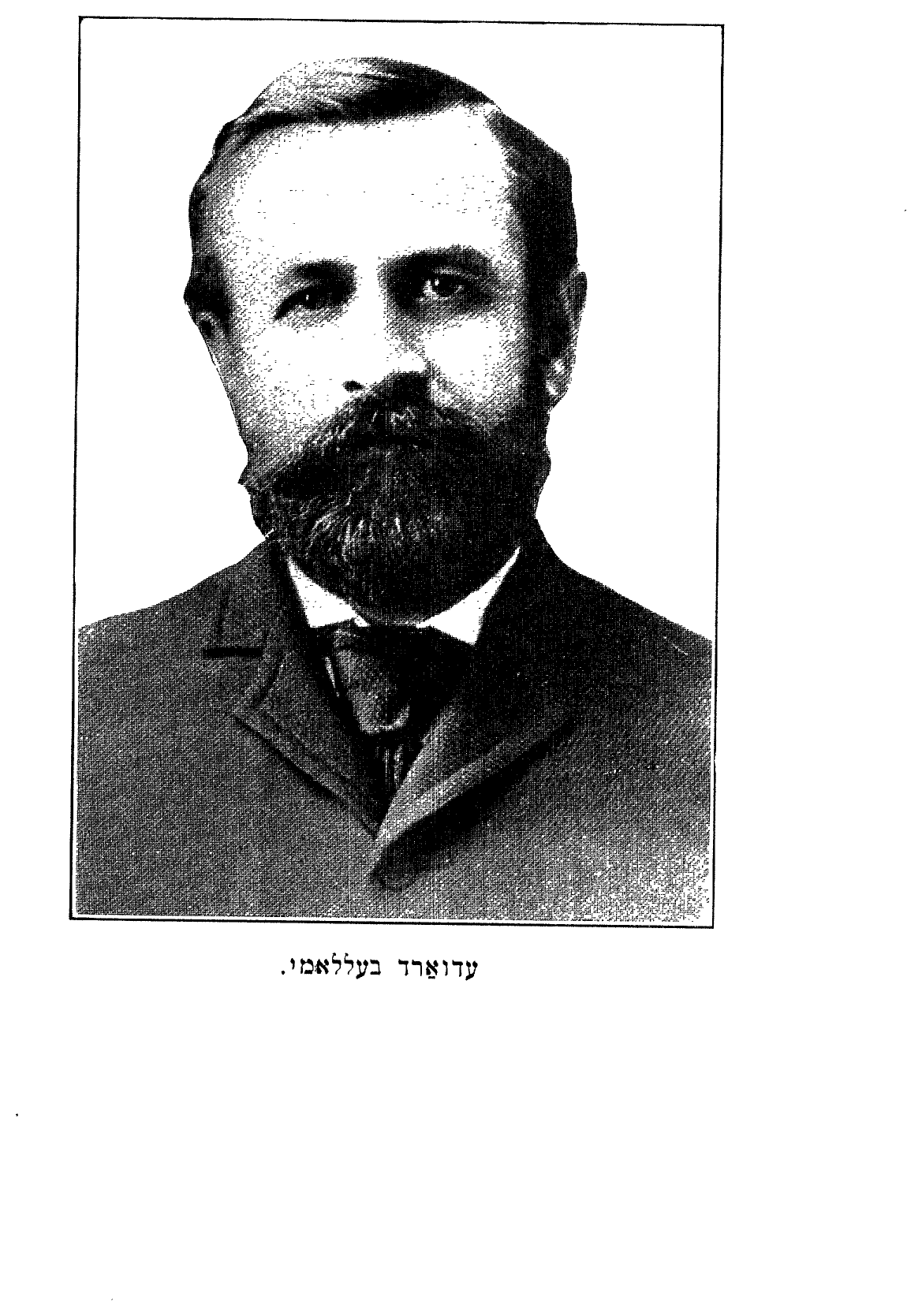
Not far from Boston there lived in those days Edward Bellamy, the author of the world-famous novel "Looking Backward," in which the life of a socialist society is portrayed. He often used to slip over to Boston, and it was there that I became acquainted with him. Our meeting came about under the following circumstances:
Under the influence of his novel an entire movement was founded, to which he, Bellamy, gave the name "Nationalist." The word did not have its usual meaning here. It had no connection with the question of a person's loyalty to his nation. By "Nationalism" Bellamy meant a social system in which all the factories, mines, railroads, telegraphs, ships, and shops belong not to private persons but to the whole n a t i o n — that is, to the community. Put more simply, by Nationalism he meant socialism. The word "socialism" is taken from the word "society," and for the very same idea he took the word "nation." But it was not only in their names that the two movements differed. Bellamy did not believe in any class struggle, and his program had no connection with the labor movement, whereas for us socialists the class struggle, the trade unions, are the essential thing.
His Nationalism was a peaceful agitation in which all classes were meant to take part — capi-248talists just as much as workers; capitalists even more so, for after all they have more power and more means, and so they can do more for Nationalism.
This makes the difference between his movement and ours quite great. The ultimate goal, however, is the same: a society in which there is no possibility of private ownership in manufacturing, transport, and so on.
Whoever has read Bellamy's book knows of the lovely things that he paints as part of life in a socialist society. In passing I would like to remark that certain parts of his fantasy have already been realized. For example: he describes how a citizen, without so much as a glance at his newspaper to see what opera is being performed that evening, goes up to the wall and opens some little door, and without leaving the house he hears the opera. The book was written in 1888, when the wonders of our present-day "radio" were unknown. Bellamy simply imagined it.
When Bellamy began to write his novel, the socialist order was not even on his mind. He knew very little of socialism. He was simply writing a fantasy of how people live in a happy world. But the writing itself got him interested in the idea. And the deeper he penetrated into the novel, the closer he came to a socialist picture. When he finished his book, he himself did not feel its significance. And when the book had an enormous success, he was astonished. Of socialist theory he knew almost nothing even then.
"Looking Backward" was at once translated into all languages, and in every country it sold in249hundreds of thousands of copies. This very success made him into a socialist. And since the name "socialist" was unpopular, he thought up a more "respectable" name.
Besides this: as an American, he immediately took up the socialist idea in a practical manner, setting aside the whole of socialist theory. His thinking ran along the following lines: one must bring it about that everything be done not by private persons but by the community; and so every step that is taken today by the community has a connection with this idea. For example: a small town gets its water from a private company; but it resolves to introduce its own water pipes. Thus this is an important socialist fact for Bellamy.
The socialists underscore every bit of news that bears on the class struggle, because they believe that through this struggle will come the worker's liberation from capital; such occurrences do not interest Bellamy at all. He is interested, however, in news such as, for example, that this or that town has introduced municipal lighting; or that here and there a movement is afoot to have municipal streetcars.
A most important matter for Bellamy was the question of the "trusts," for to his Nationalism, just as to our socialism, it was important that competition be abolished, and the trusts do indeed abolish competition.
What is a trust? — Companies that compete with one another come to terms, deciding that the struggle does not pay them; that unity is better. The trusts grow. Thus, this means that one comes ever closer to "Nationalism" — so he argued.250He began to put out a weekly with the name "The New Nationalist," and there one found all sorts of reports about the growth of the trusts and about new municipal undertakings.
The paper was edited with talent. It was interesting and rich in content.
To us socialists it used to seem strange; yet it was interesting to us. Of workers and their struggle there was very little in it. The paper was more interested in the one who buys the goods than in the one who makes them. Its public was chiefly a public of customers. As a customer one pays too high prices, because the private companies make great profits — so Bellamy argued. — If the city or the whole country were to run the industry themselves, everything would be cheaper and better. Thus, one must abolish the present system and introduce Nationalism. In this consisted the essence of the idea to which he came while writing his novel.
Through his book, his paper, and his influence, "Nationalist" clubs began to organize themselves. The first such club was founded in Boston, and its members were of the "high windows." To it belonged some of the best-known and richest persons in Boston, representatives of the oldest families. The president of the club was Edward Everett Hale, an aristocratic clergyman who was famous throughout the country as an orator and writer.
To the meetings people used to come dressed up as if for a banquet or a ball — the ladies in décolleté and the men in "full evening dress."251— How do you like that sort of socialist movement? — we used to ask one another in jest. In our hearts, however, we were glad of this "silk stocking" socialism. We saw in it a good sign of the times. In any case, we hoped that the Nationalist clubs would lift the curse that lay upon the socialist movement; that they would serve as an advertisement for our party.
After the first club, a second and a third were founded in Boston. Nationalist clubs also sprang up in Washington, in New York, and in several other American cities.
The whole movement, however, did not last long — about two years. It was merely a thing of fashion. One of the Nationalist clubs in New York actually consisted of our own socialists and of a few liberals who used to come to our lectures. To enter our party they did not want. But the Nationalist clubs were "respectable." They even smacked of "the upper crust" — and so they enrolled. And we, in turn, enrolled in the interests of our party. We also used to attend the meetings of the other Nationalist clubs and take part in the debates, or even give lectures.
In the summer of 1892, when I was living in Boston, this Nationalist movement was in its full bloom. Once I received an invitation to give a lecture at Nationalist Club Number Three, and afterward at Number Two. The secretary of Club Number Three had heard one of my lectures at a socialist meeting, and it had interested him.252From this had stemmed the invitations that were sent to me.
The money question was then on the order of the day. There was a great stir over the matter of gold money and silver money (whether the value of a commodity should be measured only in gold, or in silver as well. In other words: whether only gold coins should be recognized as the true ones, or silver coins too). Certain economists, political reformers, preached that silver money should have exactly the same significance as gold money. And they had a great mass of adherents. This is not the place to explain precisely in what this idea consisted. I shall content myself with the following:
The "silver people" argued that the "gold system" is a source of great economic troubles. Gold exists in the world in small quantity, and since gold alone is money (silver coins being no more than checks upon golden ones), this means that there is t o o l i t t l e m o n e y.
Further: when there is too little of a certain commodity, there is a dearness upon that commodity. Thus this means that gold is too dear.
This, in turn, means that gold is too d e a r; and, speaking conversely — every other commodity is too c h e a p: too little money is given for it. The farmer must sell his products for a small price. Secondly, this gives the money-dealers (the bankers) the chance to flay the hide off those who must borrow money (farmers, shopkeepers).
So argued the "silver people." They therefore demanded that silver too should be recognized as true money and not only as checks. They demanded that anyone who had a bit of silver should be able, by weight, to receive a silver coin for it; that the government should freely strike him a dollar or a half-dollar253from it. Through this there would now be money enough, money would become cheaper, and every commodity would become dearer. The farmer would get a better price for his vegetables, hens, or milk. And one more thing: if the farmer owed money on a mortgage, he would be able to pay it off more easily, for the silver dollar would have less value. If he owed a thousand dollars, for example, it would mean only 700.
It was chiefly a matter of the interests of the farmers; for, first, many of them had heavy mortgages on their farms and, second, they complained that the market price for their products was too small. Thus the silver movement spread through the great farming regions in the Middle West and West.
Since the demand was that silver should be freely converted into silver coins, the demanded system was called "free silver." Owners of silver mines were naturally pleased with the movement.
Various books and pamphlets appeared on the subject. And hundreds of ignoramuses with glib tongues delivered speeches about "free silver."
Out of this silver movement grew a political party that made the impression of being radical. It was called the "People's Party," or the "Populist" Party. Its foundation was the fact that the farmer received only forty cents a bushel for his wheat. If money were to become cheaper, he would get a higher price. That the higher price would have a smaller value, this they did not want to understand. One thing, however, did have substance: with the value of 700 dollars a farmer would be able to pay off a mortgage of a thousand.254Since the "People's Party" attacked the bankers of Wall Street together with the railroad companies, it made upon many radically inclined people the impression of being almost a socialist party. And since the Populist Party was free of the unpopular name "socialist," it was for a certain time very popular.
On the silver question I gave a lecture in English, at a gathering of the Socialist Party. I explained the general money question according to Karl Marx's "Capital," and I analyzed a book by Professor Taussig, who was then regarded as an authority on the silver question. I pointed out how ridiculous the silver plan was as a "redemption."
It was through this lecture of mine that the secretary of Nationalist Club Number Three became interested in me. He had attended it, and after the meeting he introduced himself to me, and we became acquainted. He was a man with broad shoulders and large black side-whiskers. He limped badly on one foot and walked with a crutch. His name I do not remember.
He invited me to give a similar lecture at his club, and afterward I received an invitation to Club Number Two.
This "Nationalist" was close to Bellamy, and at his suggestion the author of "Looking Backward" invited me to dinner. I found neither a tall man nor a stout, fair-haired one of some thirty-odd years or forty, but with a pale, delicate, almost womanish face and with the speech and manners of a bashful man. We talked about the movement, about our socialism, and about his "National-255lism." He explained to me frankly that he had become acquainted with socialism only after he had already all but finished writing his "Looking Backward," and that he did not believe our movement could meet with success in America.
(plate; bound in the original between pp. 254–255)
Socialism, he said, is an ideal of eternal peace; therefore one must also come to it through peace — that is how he put it. I replied that one cannot always come to peace by way of peace, because those who hold power do not give up their power willingly, and these holders of power are the ones who destroy the peace.
Our debate was conducted in a most friendly tone. In part it took the form of jest. But it was an altogether serious one. We discussed various questions, and I spent several hours with him.
I never saw him again. Some years later he brought out a work titled "Equality," which is in fact a continuation of his "Looking Backward." Reading this book, I saw that when he wrote it he was already far better acquainted with socialist theory than at the time of our conversation. "Equality" is much more thorough and serious than "Looking Backward." And for that very reason its success was not a great one.
A few days after my visit to Bellamy, I received from B. Weinstein, the secretary of the United Hebrew Trades of New York, an official notice that I had been elected as a delegate to an inter-256national labor conference in Pittsburgh. The notice was news to me, and the whole conference was news to me.
The plan was Lucien Sanial's. It consisted of the following: America is a land of immigration. Workers come here from all the countries of Europe. Therefore one ought to establish an international bureau, which would serve as a point of connection between these immigrants and the labor movement in their old homeland. When a French immigrant, for example, did not belong here in America to the union of his trade, the bureau would work upon him from over there with the help of his friends and comrades back home. Conversely: when a European international bureau gave an emigrant from there a letter to the American bureau, he was to be brought here into the union of his trade, shown friendliness, and influenced in the interests of the socialist labor movement.
The plan made no impression on me. I did not believe that practical results could be expected from it. Still, if the Pittsburgh conference were to bring us into contact with representatives of the great unions, that in itself would be useful. Let them hear our speeches. Let them learn about the socialist character of the European labor movement and about our ties with it. It was in this sense that I spoke at a small gathering of the American comrades in Boston — a farewell meeting before my departure for New York.
On the day I came to New York, a letter from the Jewish comrades of London was received for me at the address of the "Arbeiter Zeitung." The257letter contained an invitation to visit them again, this time on a special visit with a program of agitation speeches and lectures for a month's time. To be in London again was of interest to me. Apart from the wish to see my newly acquired friends and acquaintances, I was drawn by the British Museum with its world-famous library. I hoped to find there important materials for my work on socialism and Darwinism. I therefore accepted the invitation, and before we set off for Pittsburgh I provided myself with a second-class steamship ticket to England.
To Pittsburgh there traveled, besides myself, Lucien Sanial, Ernst Bohm, Waldinger, and a couple of other delegates, and together with us — S. Sussman, the man who had until then been the leader of our New York shirtmakers and an active member of the "Arbeiter Zeitung Publishing Association." He was now traveling to settle in Pittsburgh.
We traveled by day. For many hours we dragged along in unbearable heat, tormented by dust and sweat.258The better I came to know him, the more I became convinced that he was a great "utopian," a dreamer. But I also became all the more convinced what a dear human being he was, what an idealistic fire flamed in his heart, and how ready he was to sacrifice himself for his ideals.
As we chatted in the railway car that was carrying us to Pittsburgh, he told me some interesting details from his life's story. He was born in Paris, and his father had taken part in the revolution of 1848. He — Lucien Sanial — was then a boy of thirteen, and he had climbed onto the barricades, playing at revolution, yet taking it altogether seriously. Some years later he studied at the Paris Polytechnic, where one of his teachers was a brother of the philosopher Auguste Comte. The teacher became attached to young Sanial. He invited him to his home, and there he introduced him to his famous brother. Sanial became well acquainted with him and grew enthusiastic about his "Religion of Humanity."
Later, when the war between North and South was raging in America, Sanial was a contributor to the Paris newspaper "Le Temps," which was then more free-spirited than it is today, and the editorial board sent him to America to have an interview with President Lincoln. He had at the same time a secret mission from the Paris radicals, who wished to overthrow Napoleon's nephew, Napoleon the Third, from the French throne and establish a republic. The mission consisted in this: that Sanial was to find out from Lincoln whether he would support such a movement and recognize the French republic.259What Lincoln answered him I do not remember.
Sanial never went back to France. He remained in America, where he married an American woman and had several children with her. His first visit to Paris, since he had emigrated, was, it seems, at the time when the two of us traveled together through Paris on our way to Brussels.
We arrived in Pittsburgh. The smoke-blackened city with its hilly little streets made a bad impression on me.
At the conference there had gathered delegates from various unions, from various parts of the country, mostly Americans or Germans. I remember chiefly one of them: a miner by the name of McBride. The whites of both his eyes were sprayed with the blue spots that one often sees in those who work in the mines.
When Sanial set forth his plan, this McBride, listening, often smiled with a venomous smile. It was easy to see that Sanial's explanations and the whole socialist speech he delivered struck him as comical. As for the other American delegates, they behaved as though Sanial were speaking Chinese to them. Some looked at him with curiosity; others sat the way one sits in church while the priest delivers a difficult sermon.
When Sanial had finished, McBride took the floor. He ridiculed the plan. Then I spoke. I answered McBride's speech with sharp words, but he did not even260listen. There were other speeches. Sanial answered all the opposing arguments.
Nothing came of the plan. Through the help of the socialist delegates a resolution about a bureau was indeed adopted, but it went no further than the protocol.
Since Homestead is only twelve American miles from Pittsburgh, I went over there.
I still found the militia there. I had a conversation with a couple of the soldiers who were guarding the town — two young fellows armed with rifles and pistols. But they did not even clearly understand what the matter here was about, and why they had been brought over to guard the little town against the workers. All they knew was that it was a strike. They themselves sympathized with the strikers.
"We are workers ourselves," they said to me, "if our own trade were to call a strike, we would naturally not scab," one of them remarked. "But here we are members of the militia and we have sworn to be loyal; we must keep our oath."
I walked through the little streets where the strikers lived. Most of the inhabitants were of Slavic peoples, and with some of them I was able to converse in Russian. Their want and dejection were heartrending.
In Pittsburgh there was already by then a Jewish quarter of shirtmakers, dressmakers, iron workers, peddlers. There was then a strike among the dressmakers, so I delivered a speech for them about the strike. S. Sussman founded a Jewish section of the Socialist Labor261Party, and there I delivered a speech. I also delivered a speech at a gathering of American workers.
Soon after I returned from Pittsburgh to New York, I boarded a ship that carried me off to Liverpool, and from there I traveled by rail over to London.
There I again delivered lectures and speeches and again conducted a debate with an anarchist. This time I was challenged by a Christian, an Englishman by the name of Mowbray, who was then the leader of the English anarchists. The debate therefore took place in English, and the audience consisted of Englishmen and of Russian Jews. I gave him roughly the same arguments as those I had given S. Yanovsky, with the same parable about the bridge, and with a few new arguments and examples.
I also visited Leeds and Manchester. Everywhere, after the speech, anarchists would put questions, or take the floor to speak against the lecture; I would then answer them all.
In Manchester, after my replies, a young man ran up to the platform, gave me a slap, and fled. An uproar broke out. The socialists blamed all the anarchists in the affair, and the latter answered that among anarchists the individual alone is responsible for his own deeds. The young man had attacked me not because I had assailed him with anything, for I did not even know who he was. Nor had I insulted his party. The worst262what I used to do to her was to give an example that showed how ridiculous her theory was. My speech roused his party bile, and he could find no other outlet than a physical insult *.
In England there is a custom whereby the newspapers put out posters with big words to advertise the articles in the latest issue. Such posters the "Arbeiter Fraynd" used to put out every week. When I came back from Manchester to London, I caught sight, in the Jewish quarter, at a newspaper peddler's, of a poster on which the largest line read: "Ab. Cahan Slapped by a Worker."
I often visited the Stepniaks and the Avelings. At the Avelings' I was several times to dinner or supper, and once we went to the theater. Mrs. Aveling used to tell me about her father. She described for me, for instance, how Karl Marx had been very popular with the children of the neighborhood in London where they lived.
"As soon as he would appear on a bench in the park near our house, children would come to him from all sides. We used to wonder where they came from. And my father would sit and chat with them. They would show him little knives and other things, and he263would enter into their interests as though he himself were a child."
I had it in mind to translate the Communist Manifesto of Karl Marx and Friedrich Engels into Yiddish, and it was my wish to obtain from Engels a preface to my translation. When Mrs. Aveling heard of this, she offered to introduce me to him.
He lived in his own house, and on a certain evening we (she, her husband, and I) drove over there.
In the article I afterward wrote about this visit in the "Arbeiter Zeitung," the following lines are found:
"A rather tall man, still quite healthy and lively, with a clever, energetic, and dashing expression on his face..."
I marveled at his vitality and nimbleness. Every little while he would leap into another room, now for refreshments, now for a book or some newspaper, and standing or sitting, he spoke in a cheerful voice, often with a witticism. It was hard to believe that this was a man of over seventy. The room where we sat, and the next one, were filled with books and with newspapers in all sorts of languages. He knew many languages. All the socialist and trade-unionist newspapers from every country he used to receive and read, and everything he read he264remembered. He read Russian and Yiddish for me — a few lines in our "Arbeiter Zeitung."
"You think I can't read the holy tongue? — he said to me, pronouncing the words 'loshn-koydesh' with the accent of a German Jew. "Not for nothing do the capitalist newspapers say that I too am a Jew."
In my pocket I happened just then to have Bakunin's history of the International, in Russian, a book I had bought at a Jewish bookstore in London. When he heard about it, he asked me to show him the book. I showed it to him, and he read through the title page.
At this he recalled that he too had once had the book, but that it had disappeared.
On a little table lay a handsome, richly bound album. Mrs. Aveling opened it for me. The album contained the photographs of all the socialist members of the Reichstag — a gift that Engels had received from the comrades of the Reichstag for his seventieth birthday.
In a corner stood a large old leather chair, a soft armchair. Suddenly Madam Aveling gives me a push, and I fall into the leather cushion. She burst out laughing, and Engels smiled merrily.
— My father died in this chair, — she explained to me.
In those years Engels was occupied with his work on the third volume of Karl Marx's "Capital," of which the manuscript had been left in a not entirely finished state. This was a great undertaking, and on top of that he had to carry on a265correspondence with dozens of comrades from various countries. He was busy many hours every day, and the work on the third volume went more slowly than he wished. When Eleanor asked him how the work was going, he made a face of dissatisfaction with himself, almost of despair.
Eleanor addressed him as "du," and altogether spoke to him as to a father, and he treated her as a daughter. He brought out bottles of beer, and we drank a toast to the social democracy of the world. He poured me a second glass. I declined.
— You surely know, Comrade Engels, that the Jews are not drinkers, — I remarked.
— Yes, that is really a pity, — he answered with a smile, — if the Jews drank a little more, they would be better still.
I spoke with him about the preface to my translation of the Communist Manifesto. He at once promised to write it down and send it to me as soon as he had time. In doing so he spoke of the Communist Manifesto as though Karl Marx alone had written it, without his, Engels's, collaboration.
On taking leave, he brought out six photographs of Karl Marx and gave them to me as a gift for me and the nearest comrades in America.
Of the English comrades, the one I became most closely friends with was Hunter Watts, one of the most active members of Hyndman's "Social Democratic Federation." Him too I often visited. He lived then a few steps from the great, impressive Parliament building. The apartment was furnished and run266in the English bourgeois manner, with comforts and with servants. He was a commission agent or broker, and he used to buy and sell whatever happened to come his way. All day long he used to wear a top hat, as almost every English businessman wore then. In the evening he would take it off, put on an ordinary derby hat, and spend nearly all his time at meetings.
In his house, too, I used to feel as if I were at home. His family consisted of himself, his wife, her unmarried sister, and his two little children. He had a little girl and a little boy. The boy was about three years old, one of the most beautiful children I have ever seen. His name was Jack, and when he would come in to greet me, he would hold out his hand and say "Good evening, Mister Knohan." The "k" with the "n" do not go together in the English language, but otherwise he could not pronounce my name.
Before leaving London, I visited the famous poet William Morris, who was a "revolutionary socialist," that is to say, almost an anarchist, and who edited the weekly "Commonweal." Some time earlier I had heard that he had changed his opinion regarding parliaments and elections — that he was now in favor of taking part in the political struggle.
When I came to him and caught sight of him, I was disappointed by his face: his reddish countenance with the white beard reflected no poetry. He looked rather like a businessman, like a miller or perhaps a dealer in timber. With his talk he made a far better impression on me.267He treated me to wine; he himself lit a pipe, and with his hospitality he soon made me feel as if we were quite close acquaintances. I wanted to get to the question of elections as quickly as possible, so as to be able to report in the "Arbeiter Zeitung" that William Morris too was now with us (a blow for the anarchists!); but I had no courage. I turned this way and that and got tangled up. He understood at once, however, what the matter was, and he helped me out:
— Yes, I have changed my opinion about that — he said — I believe it does no harm for socialists to take part in the elections.
I very nearly threw myself upon him to kiss him.
I remember how I rode home: happy, picturing to myself the effect it would have when I reported the interview in the "Arbeiter Zeitung."
From England I did not, this time, travel to other European countries. When my appointed time came to an end, I returned to New York.
Notes (the original's footnotes)
[p. 233] A park right in the middle of the city for strolling and for holding speeches. Such a park is found in almost every city of the New England states. In some places it is called "the Common," in others — "the Green."
[p. 239] She remained in our movement several years. Afterward she became a professional speaker against socialism. While she was still a socialist, she found herself for a certain time under the influence of an American-born Jew, a cigar-maker by the name of Goldstein. Goldstein was a better speaker than she. When he was a socialist, he was sincere and true to the movement. Later he converted to the Catholic religion, and she did the same. Then they both became official propagandists for the Catholic Church and against the socialist movement. They traveled about from city to city, challenging socialists to debates, or simply delivering speeches, and each time attacking our Jews and our party in the most bitter manner. This was their sole occupation and livelihood.
[p. 243] Later he took up working as a journalist. He became a regular contributor to the Sunday edition of the "New York World," where he wrote sensational, far-fetched, cock-and-bull tales. His socialism went off with the smoke. I once met him, well dressed, with a contented face. When we spoke about our movement, a cynical look flashed in his blue eyes.
[p. 262] Thirty-two years later, in Detroit, Michigan, a middle-aged man told me at a banquet that he was the anarchist who had insulted me in Manchester. He assured me that he had long been thirsting for an opportunity to apologize to me. He is rich; long since no anarchist, and no other kind of "-ist" either.