Chapter Eight
From October 1892 to July 1893
268In New York I found a pleasant surprise. At the ship I was told that during the time I had been in London, my brother Itzik had come to me. He had not been brought to the ship, so that the meeting with the comrades should not disturb the intimate scene of my meeting with him. When I left home in 1881, he was a child of six or seven. I had been deeply attached to him. Various memories of him had lived on in my mind — moments of my playing with him, scenes at home in which he had been the center. In my thoughts his little childish voice still rang, his words. I saw before me his eyes, his bright, life-filled smile. He had red hair ("yellow," they say in Vilna), just like our mother, and altogether he resembled her. He was a beautiful boy, and his smile was a hearty one, full of sunshine.
When he arrived, B. Weinstein took him from the ship and looked after him.
The headquarters of our Jewish movement was269in the Jewish "Labor Lyceum," a two-story house at 96 Delancey Street. There were the editorial offices and printing shop of the "Arbeiter Zeitung." On the ground floor was a café, the property of the Jewish branch of the Socialist Labor Party, and on the first floor was a hall for assemblies. In this assembly hall my brother was waiting for me. Two of our comrades were sitting there together with him. When I came in, they went out. We were left alone. We kissed each other.
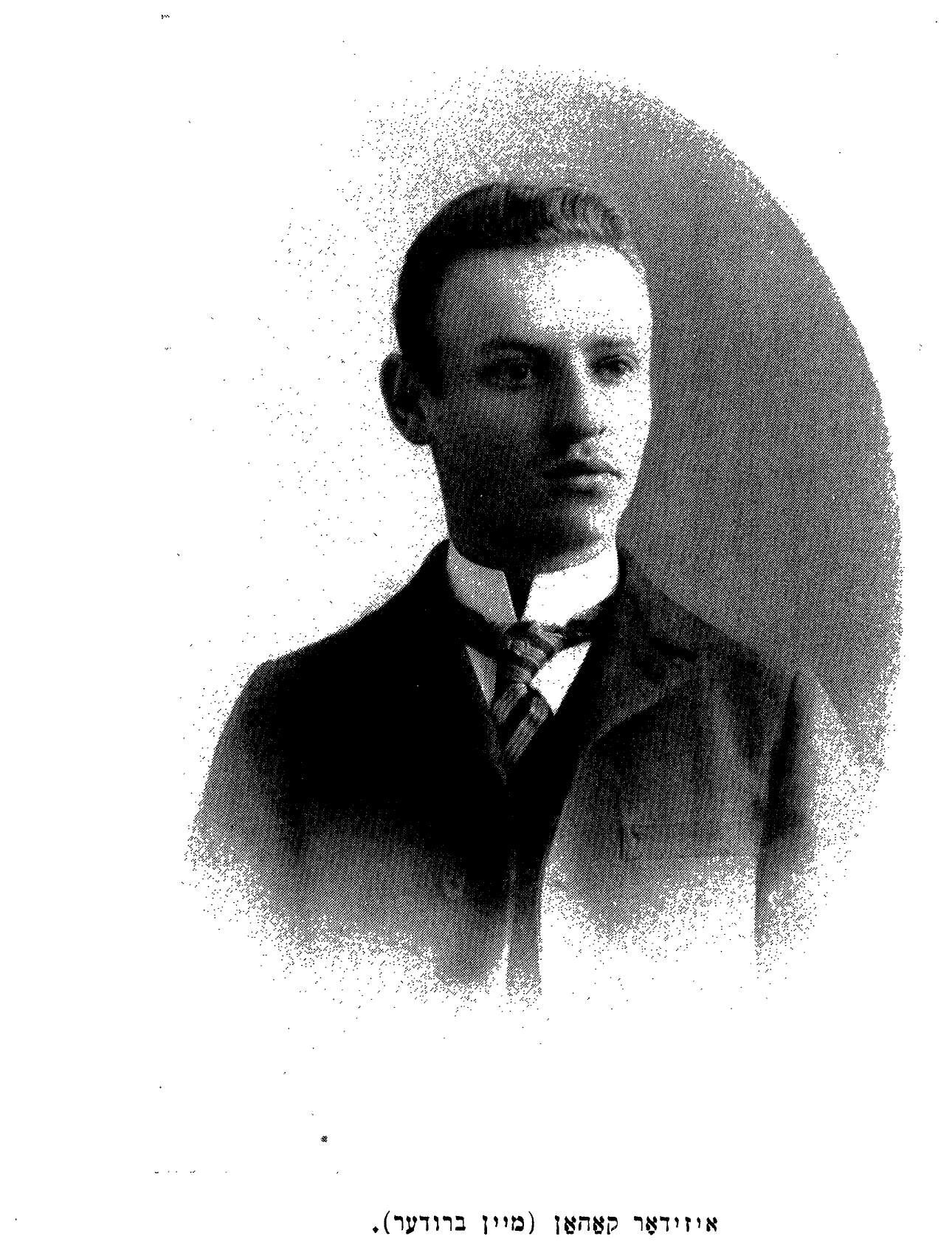
(plate; bound in the original between pp. 268–269)
I have a good memory for faces. But my brother's face had changed greatly, and I did not recognize him. The red hair was the same, and the blond coloring and the general features of his figure were also the same, but the expression, the essence of his appearance, had altered. Yet that is not the main thing: you leave behind a little boy of six or seven, and to you comes a young man of seventeen or eighteen. Instead of a child you have before you a fully grown man. It is an altogether different being. It is impossible for you to feel that it is the same one. For all those eleven years I had carried that little boy in my memory, and that little boy is no more. The one who stands before me is unknown to me. I must persuade myself that this is the same one, and I cannot.
As for my brother's memory of me, he had completely forgotten my face. Only a haze had remained to him.
From agitation he was pale. His frightened, embarrassed smile looked strange to me. My heart was pounding hard. We were both ashamed.
— Do you recognize me? — I asked him.
— No, — he answered, very bashfully.270I took courage and began to speak to him as to a brother, began to ask about our father, our mother. But I could not speak. Tears choked me.
A few minutes later I went out with him into the street, so that we should not be disturbed. We walked about like that for half an hour and talked of home.
Since while walking one need not look into each other's eyes, it was easier for us to speak. When we came back, my heart was full of love for him, as though I had always been together with him.
It was hard for him to say "thou" to me. I compelled him, and to that he grew accustomed. But he always avoided calling me by my name. I believe this was because at home I had been called by my pet name "Alter," and here no one called me that.
I began to call him "Isaac," in the Russian manner, and so it remained with us.
Of the letters we received from home, soon after his arrival, I remember only my aunt Feyge's. She compared our meeting to the meeting of Joseph with Benjamin.
Our parents were poor, and they had given him no education. I had studied a bit of Gemara, and from the Gemara I myself had passed over to "Russian booklets." He, however, had studied no Gemara. And as for Russian booklets, with regard to him they had been afraid, lest these bring him to the same "misfortune" as me. He went to cheder, and studied a bit of Russian. At twelve years of age they took to providing him with a271trade. For a certain time he studied with a jeweler, and afterward he was in a sugar and tea business belonging to a wealthy relative of ours.
The first year I did not let him go to work, although he was eager to "make a living." I wanted him first to learn good English; and I myself was his teacher. When he would pronounce an English word incorrectly, or forget something, I would lose my patience; but at once it would grieve me and I would take to caressing him. He had a flexible pronunciation, and he quickly learned to read, speak, and write English. When he had been in America a few months, he spoke English far more fluently than Russian.
He was a lively youth and a warm-hearted one. He became ever dearer to me. I grew attached to him. He was musical and had a good musical memory. Sometimes we would sing together our father's melodies — those we had both heard from him. These melodies would bring us both into a mood of longing. It struck me as strange that he knew the very same melodies. He had heard them from my father, from the very same father. These melodies would sharpen in us the feeling that we were brothers.
A couple of weeks after I had come from England and met with my brother, I had a second272surprise, though of an altogether different sort: R. Lewis, the chief leader of the Jewish anarchists, declared himself no longer an anarchist but a social democrat. He did this publicly, in a lecture in Russian, and also in an open letter in the "Arbeiter Zeitung." He renounced his former faith entirely and declared himself convinced that our standpoint was the correct one.
The news was a sensation in the little world of our movement. Lewis's declaration was a death-blow to the Jewish anarchist movement. But I must here tell the truth: among ourselves, in the inner circle of our party, we rejoiced little over his reversal. We had never taken him seriously. In personal relations he was an agreeable man. But he never made the impression of one who could hold convictions. His anarchist fervor used to strike us as comic. I personally had always believed of him that he was wrapped up in the anarchist movement as a sporting matter and through the influence of personal connections. In the anarchist groups there were to be found enough serious and inspired people, who truly believed in the possibility of absolute freedom and of an imminent revolution. R. Lewis, their leader, was not, however, one of them. The fact that he had now become a social democrat had a kind of unpleasant aftertaste. But war is war. Since this was a blow to the enemy, we made a great affair of it. We arranged a large Jewish assembly, at which he came forward as a member of our party. I also want to remark here that in the later years he cast off the whole radical movement, and, as we have seen above273in A. Rosenberg's "Reminiscences," he became a quite cheap democratic politician in Chicago*.
A certain time later a second anarchist leader, one by the name of Girzhdanski, also declared himself a social democrat. Girzhdanski was the best anarchist orator in New York, and although he was not as active as Lewis, his turning-over was also a great blow to the anarchists (he too, in later years, went over into very conservative ranks). And from Philadelphia it began to be heard that at Frener's, the darling of the anarchists there, the revolutionary fire had also greatly cooled.
Burgin expresses the opinion that all these cases of sobering up were the direct result of Berkman's shot. Berkman had had the courage and the willingness to sacrifice himself to do what he preached, and then it became clear how foolish was the anarchist "propaganda of the deed" (propaganda through acts of violence); and once people had already opened their eyes and seen how stupid the anarchist tactic was, they also came to perceive how stupid the anarchist theory was.
There still remained, naturally, anarchists. Among the leaders there remained Zolotarov, Michael Cohn, J. Merison (all three later became doctors); and of the "rank and file" a certain number also remained. As a movement, however, anarchism in the Jewish quarter then lost all substance. And the anarchists who remained true to their ideals made great changes in their program. From their former274"dynamite anarchism" it became an innocent abstract theory. I am speaking here throughout of the anarchism of the Jewish quarters. To Johann Most and Emma Goldman, for example, this has no relevance.
I again took up editing the "Arbeiter Zeitung." Around that time I began to print sketches by I. L. Peretz, under the signature "Fly." They ran under a general heading, "Little Tales for Big Children," which he himself had supplied.
In Warsaw Peretz had been friends with a brother-in-law of Feigenbaum's, and through him the manuscripts arrived. In an editorial note that I wrote about these tales, I announced them as "true pearls, which would shine in the literary crown of any language."
A specially strong impression was made by his story "Whence Comes the Little Twig with Which He Plays for the Devil." Later we printed longer works of his. I used to read his pieces aloud to the comrades and point out the lofty talent that lies within them.
On account of these stories I carried on for a certain time a correspondence with Peretz. We wrote to each other in Russian. He knew Russian well, only in one respect, I remember, he would insert Polish words instead of Russian ones. Instead of the word "vyrezka" (clipping), for example, he wrote "vyemka." In one of275his letters he grew angry that we had been late in sending his honorarium. "Your compliments are agreeable to me," he wrote to me, "but with compliments alone I cannot live."
That we had worked at the "Arbeiter Zeitung" almost for nothing, or altogether for nothing, of this he was probably not aware. America had always been imagined by our countrymen back in the old home as a land where dollars roll about over the streets. There is a Jewish newspaper in America — surely it must be coining gold.
The first stories that we received from Peretz remind me of a congenial group of educated Americans who had settled in the Jewish quarter and with whom I became friends. I translated a few of the shorter pieces by Peretz in order to read them aloud to them. One of them, an interesting American by the name of James K. Folding, had a fine literary taste. And it was him in particular that I had in mind. I wanted to show him what talents are appearing in our language.
Folding, a certain Charles B. Stover, and my old friend Edward King had settled at 146 Forsyth Street, and several other young American people often used to come in to them. The group was interested in the University Settlement movement, which was then still a rather new thing*.276The first University Settlement was founded in the Jewish quarter (26 Delancey Street, near Christie). I want first to say a few words about my acquaintance with this institution, and then we will pass on to the aforementioned group.
The neighborhood was already a Jewish one by then; but there still lived there a fair number of Irish and German families (now Jews and Italians live there). I once asked the director, or the head-worker — Herman Robinson was his name — why precisely the Jewish quarter had been chosen, and his answer was:
— One reason is that the Jewish children are interesting. They have intellectual interests. To work among them is a pleasure.
The president of the Settlement was Seth Low, the then-president of Columbia College, one of the most distinguished citizens of New York and Brooklyn (he himself lived in Brooklyn). He had a reputation for being a refined, intelligent, and liberal man. He was a leader of the "Citizens' Union" — a New York society which declared its task to be that of seeing to an honest, clean city government, and of combating corrupt politicians. Later, when Brooklyn, Queens, and Staten Island were united with New York,277he was elected as the first mayor of "Greater New York."
At the University Settlement on Delancey Street I was twice invited to give a lecture (in English). One time I was asked to speak about the essence of socialist theory. Seth Low was present, and after the lecture he put several questions to me. For the second lecture I proposed as a theme the freedom struggle in Russia, and it was accepted. I made a comparison between the University Settlement workers in America and the first Russian revolutionaries, the "Narodniks," who had "gone to the people." The "Narodniks" were educated children of the gentry, who settled among poor, ignorant people with the aim of developing them, and the same can be said of the young men and women of the University Settlements. But here the similarity ends. The former were socialists and revolutionaries. They fought for freedom, and in this struggle they staked their lives. Here in America the circumstances are entirely different. To wage such a struggle as was then waged in Russia was not necessary. Still, if the Settlements had been socialist, an entirely different kind of work would have been done in them. The Russian "people-goers" preached against the rich just as much as against the Tsar; whereas the "University Settlements" are themselves maintained by the rich. They do not want to remake the world. They are content with its inequalities and injustices.
I brought out the difference in a polite, friendly, but clear manner. I criticized the Settlements openly; and the educated Americans listened to me attentively and also in a friendly way. What I278told them about the Russian people-goers interested them without end.
After the meeting a large group of theirs surrounded me and again questions and answers began.
I visited them a few more times, chatted with them, looked over the various "clubs" that they conducted, observed the children who spent their free time there.
In one of my conversations with Mr. Robinson, the head-worker, I asked him about the difference between the boys of the various nationalities who come into his Settlement, and his answer was:
— When an Irish boy comes in, he takes straight to boxing gloves. A Jewish boy, on the other hand, straightaway starts a debate with whoever it may be.
Socialists chiefly saw the comic side of the movement: manufacturers or bankers give money with the aim that workers, from whose toil they grow rich, should in their poverty conduct themselves "prim and proper." But I at once recognized that through the University Settlement a certain sort of good work is accomplished, that among the workers there are thinking and progressive people, and that through their contact with the masses some of them come to socialism.
The several educated Americans who lived at 146 Forsyth Street had no connection with the University Settlement on Delancey Street. They criticized it. They did independent settlement work, and one may say that they were the true founders of the movement in the Jewish quarters.
The above-mentioned Folding is a grandson of279the American writer Folding, who was a literary partner of Washington Irving, and together with him composed several works. Folding, the grandson (he bore his grandfather's first and middle name — James Kirke) had finished a university in America and also in Germany. He knew German and French, was well-read in the best works, and had a deep love of literature and art. In America one does not meet such depth at every step even today. In those years he was still rarer. His father, too, was an educated man. Their family descends from the Dutch immigrants who founded the city of New York.
146 Forsyth Street is an ordinary poor tenement house right in the middle of the Jewish quarter. On the top floor of this house Folding had a dwelling of several rooms. On his floors there were no carpets; and the furniture was a simple one. Yet everything reflected cleanliness and the grace and taste of an intelligent, refined life.
To these rooms of his there used to come boys from poor Jewish families, and Folding used to read with them and explain literary matters to them. And here, indeed, these boys used to do their "homework," learn their lessons from school (some of them later became well-known personalities, as for example: the now-famous sculptor Epstein, who is in England, and Dr. Henry Moskowitz, who is well known in New York as a public worker. When they were still boys, I used to see them in Folding's rooms).
I became friends with Folding and used to visit him often. We used to chat about Russian literature, with which he had become acquainted through280German or French translations. We also used to talk about the social question. Socialism appealed strongly to him, although not its theoretical Marxist side.
Stover and King lived on the "stoop." Stover was more energetic and active than Folding; but for that reason he interested himself less with literature and art.
On the other floors lived Jewish families, and their children used to often visit the ground floor or the top floor, where they were always welcome.
Around Folding and Stover there clustered several other educated young American people. One of them was named Goodale, a tall, handsome young Yankee. He settled in a tenement house on Eighth Street, with the same aim with which Folding and Stover lived on Forsyth Street.
With American radicals I also used to meet at our American Liberal Lyceum, at 64 East 4th Street, and at one of Bellamy's New York clubs. This was "Nationalist Club Number Three," but there were actually no Nationalist Clubs "Number 1" and "Number 2" in New York. When they were founded, they consisted of rich people from the high windows, just as in Boston. With them, too, this was a fashionable affair. And the fashion held even less in New York than in Boston. Of the two clubs nothing came. But "Club Number 3" consisted of281quite ordinary people who liked to hear a radical word. The lectures, which used to be held on Sunday afternoons in an assembly hall on West 23rd Street, were always well attended. A good part of the audience here consisted from the beginning of English-speaking members of the Socialist Labor Party, and the lecturers were for the most part also ours (I used to lecture here quite often). A good number of the club members were indeed members of our party. To the club belonged other Americans as well, and most of the club members who at first did not belong to our party later joined it. Little by little there came a time when "Nationalist Club Number 3" was a "Nationalist" club only in name. In reality it was a branch of our movement. And finally it ceased to use the name as well. It officially became a branch of the Socialist Labor Party.
Among those who used to often visit the Sunday lectures of "Nationalist Club Number 3" was Daniel De Leon, with whom we became acquainted in the second volume. There we saw him as a member of the Henry George movement. Later we met him in the editorial office of the "Workmen's Advocate," when Lucien Sanial was the editor. Already then he had shown an interest in the socialist movement. Now, in 1892, this interest became noticeable in him still more clearly. In the short speeches that he gave, taking part in the debates after the lectures of "Nationalist Club Number 3," he little by little began to express himself as a full-fledged socialist. And when he was invited282to give a lecture, that lecture was an outstanding socialist address.
He was, above all, a brilliant speaker and lecturer. He was a highly educated and capable man, with great oratorical power, and one of his addresses was always rich in content, clear as crystal, strictly logical, and interesting. In appearance he was a handsome man, with a fine black beard and fine black hair, though somewhat sprinkled with gray, with an interesting face and a very interesting head.
In the United States he was a foreigner (he was from Venezuela, in South America), and he spoke English with a slight accent, except that he often pronounced the "h" in the Spanish manner — like a "kh." He was, however, a complete master of the English language, and listening to one of his lectures, one would altogether forget that he was not a native-born American or Englishman.
I do not recall whether he came over to the Socialist Labor Party together with the whole "Nationalist Club Number 3," or a little earlier. In any case he became a member, and for us he was a great gain. In our movement we had not had such an important force since Schewitsch. And if Schewitsch was far more talented as an agitator and speaker on the great solemn occasions, with more power of imagination, with splendor and poetry in his language, De Leon was more important as a lecturer.
His first lecture for the American branch of our party took place in the large hall of our Labor Lyceum, at 64 East 4th Street. His283theme was the "Marxian Theory." He had reread Marx's chief work, "Das Kapital," for the first time a few days earlier, and this lecture of his was, in a certain sense, his examination as a lecturer on theoretical socialism.
It was probably the best address on Marxist ideas that New York had ever heard before. Everyone was enchanted.
At this meeting a trifling thing occurred that I would often recall later.
After the lecture, as was customary, the "floor was opened" for the listeners who wished to take the word, and at the end the lecturer answered them. In doing so, De Leon twisted the name of one of the debaters: instead of Goldenstick he called the debater Goldenstink. An old American, who was one of the listeners, thought that he had simply made a mistake, and he corrected him. Then De Leon gave a laugh and twisted the same name again, in yet another manner.
The incident made an unpleasant impression. It was simply not believable that a man in his middle years, and so educated and developed, should pull such a childish prank. But since the best and most important people have their faults and now and then commit a foolishness, no great matter was made of it. On my enthusiasm for De Leon it had no effect.
I led him to our Jewish meetings, and everywhere introduced him as our new speaker and lecturer, as a highly educated and gifted man.
I remember how I led him from meeting to meeting at the cloakmakers' union. The organization had284taken over all the floors of 125 Rivington Street. Each section on a separate floor. We went, then, from floor to floor; everywhere I introduced him, and he delivered a short speech. I had heard that he came from a wealthy family, and I used to mention the fact in order to show that he could have had a wealthy career, but that he was devoting himself to the labor movement. I remember how, before one of these Jewish meetings, at 125 Rivington Street, I asked him about his parents, and his answer was that several members of his family were judges.
In the winter of 1892–1893 he gave lectures in New York and in other cities, all at gatherings of the Socialist Labor Party. His popularity grew quickly. He also attended all the business meetings of his branch and the general meetings of all the New York branches. Everywhere he took part in the discussions. Together with his popularity as a speaker and lecturer rose his role and influence in the party itself.
[טאָפּיק] In many cities. — Hanford. — A Jewish policeman. — A few hours behind bars. — Dr. Krauskopf. — Walter Vrooman. — Goodale's uncle. — Feigenbaum's trial.
That winter I also visited Philadelphia, Boston, Hartford, New Britain, New Haven, Rochester, Syracuse, Newark, Elizabethport, Baltimore, and Chicago. I mostly spoke and lectured in Yiddish, but in some places in English as well. In Philadelphia, for example, on a Sunday afternoon, I gave a285lecture at the Central Labor Union there. In the debate an intelligent American worker by the name of "Bess" Hanford took part. This is the same Hanford who later played an important role in our party. And when he had already become famous as a socialist speaker, he publicly recalled on many occasions that Philadelphia lecture of mine. He used to explain that with the answers I gave that Sunday to the arguments he had raised against our ideas, I had converted him to socialism.
Through a lecture that I gave that winter for the Ethical Culture Society of Philadelphia, the chief leader of that society, Mrs. Weir, was converted to socialism.
That winter I also gave a lecture for the Ethical Culture Society of Rochester. I stayed there with the Jewish socialist Morris Berman, who is now also very active in our party. With regard to that meeting at the Rochester Ethical Culture Society, Comrade Berman relates how the chief leader of the society, a wealthy Jew by the name of Solomon, had prepared a series of arguments against me. He had written them down in the form of questions about my address. When I had finished, he stood up and read them aloud. I asked him how he could have known in advance what I was going to say, and I showed that most of the "objections" he had prepared in advance did not fit my address at all.
Solomon conceded that he had made a mistake, and he also conceded that socialism is a deeper matter than he had thought.286Chicago I visited that winter in February. The next month, at the end of March, when I was in Philadelphia, I was arrested.
In Philadelphia there was at that time a Jewish policeman, an ignorant fellow from Hungary, by the name of Casper, a broad, strong man, with black hair and a pockmarked face. A few years earlier he had arrested, at a meeting, the leader of the anarchists, Frener, and one of our most active comrades from Philadelphia, Meyer Gillis. The accusation against them was that Frener had called the crowd to a revolution and that Gillis had supported him and made a collection for the revolution. They were sentenced to prison and served eight months.
Casper arrested me after I had given a speech at a meeting of the Philadelphia shirtmakers during the time of a strike. The whole story was ridiculous. At that meeting it did not even come up to mention the word "revolution"; my speech consisted of an ordinary explanation of how important it is for the workers to hold firm and to remain true to their unity.
The gathering ended. I went out of the hall, and accompanied by several comrades and union men, I set out in the direction of the railway station. When I had gone a few steps, Casper fell upon me and seized me with both paws, as though I were a dangerous criminal. Together with me they also arrested two of the leaders of the shirtmakers' union, Levin and Sulansky.
We were brought to a station house and locked287up in cells. But soon we were taken out on bail.
In the morning I was brought before a police judge by the name of Devlin.
— What is the charge? — he asked.
— This man incited strikers to make a riot — Casper answered.
I tried to explain how ridiculous this was. The judge, however, would not let me. My innocence I would be able to prove at the trial, he said, and he placed me under five hundred dollars' bail. The story made a commotion in Philadelphia. At Casper the Jews then looked as upon a kind of pogromist.
Who it was that ordered Casper or "talked him into" arresting socialists was never clearly shown. It was said then that Jewish manufacturers had done it in order to get rid of the leaders and speakers of the Jewish unions. There was also an opinion that he had carried on his socialist-baiting in the interest of the Republican politicians of the Jewish quarter.
The decent Jewish population of the Jewish quarter, not to speak of the organized workers, hated the bullying Jewish policeman. He had terrorized the district. When the story of my arrest became known among the American and German Jews, it made a bad impression on them too.
The Reform chief rabbi of Philadelphia at the time, Dr. Krauskopf, expressed an opinion that Casper ought to be moved from the Jewish quarter to another district; that it was a shame that such a creature was allowed to disturb freedom of speech. Dr. Krauskopf even took it upon himself to do something about it.288My old acquaintance, Walter Vrooman, who in the second volume of this work was mentioned as a socialist "boy orator," was now the "head worker" of the University Settlement in Philadelphia. When he learned of the story, he set things in motion. The society that maintained his "settlement" was made up of intelligent, liberal-minded Americans, and some of them were well-known, influential men in the city. Thus he hoped, with their help, to free the Jewish quarter of Casper.
One man took a special interest in the affair, a certain Goodale, an intelligent American resident of Philadelphia, an uncle of the young Goodale of the American group, of 146 Forsyth Street, New York. When the young Goodale heard about my arrest and about the Casper terror, he described the whole story with indignation in a letter to his uncle. The elder Goodale then went in to the judge, Devlin, and showed him his nephew's letter.
"Cahan is a representative of sympathetic movements in New York," he said. "We ought to be proud of such men. And in the end, when he comes to Philadelphia to deliver a speech, he is actually arrested. The policeman Casper terrorizes the Jewish quarter. Such police are a disgrace to Philadelphia."
The Philadelphia Goodale had no connection with politics; but he was finely dressed and had an interesting, dignified appearance; thus his words and the letter of his New York nephew made an impression on the police judge. The result was that the police judge "quashed" (annulled) the case against me and the two union leaders.289We had expected that the police judge would see to it that the higher police officials investigate the Cospar affair and send Cospar packing. But that did not happen. And the efforts of Dr. Krauskopf and Wrumen also came to nothing.
The politics of Philadelphia are too corrupt, and those who stood behind Cospar had too strong a hand in the game. Instead of being punished, Cospar grew even more brazen in himself. When he heard what people were preparing to do against him, he laughed it off. — "I will exterminate every socialist in Philadelphia," he boasted to a Jewish restaurant-keeper, "I will not rest until I send them to the gallows."
A short time later he arrested yet another of our New York speakers, B. Feigenbaum.
He charged Feigenbaum with having raised a stick against him.
This case came to trial, and it was shown how ridiculous Cospar's accusation was. The jury could in fact see that for themselves, comparing the broad, healthy frame of Cospar with the weak, intelligent man whom he accused of having wanted to strike him. Feigenbaum was acquitted. The Cospar terror was nevertheless continued, until the Jewish policeman himself fell into trouble.
America was then living through hard economic times. There was a fair bit of unemployment. But even earlier, when there was enough employment, the290Jewish worker in America also lived in poverty and want. The big wages, the fine dwellings and the good clothes which many of our workers enjoy today only began to appear in later years. At the time at which we are now standing, the average worker would have regarded such things as a luxury. As I have already remarked in the previous volume: compared with the life of a craftsman in our old homes, our workers here lived well, but when one measured it by the present-day American standard, their existence was quite a miserable one.
The New York tenement houses were built wretchedly, one hard up against the other. Air and light were had only by those rooms that opened onto the street or onto the yard. Many of the rooms were absolutely dark. In summer, in the heat, it was impossible to breathe in them, and thousands of people would have to spend the night on the roofs.
The reader has surely heard about the sweating-system that then prevailed in the Jewish needle-trades — how one worked for a contractor, in the very rooms where the contractor lived with his family, in dreadful cramped quarters, in stifling air and in filth — in a nest of diseases. None of this is exaggerated by a hair.
And this life was reflected in the character of our unions and of our whole movement.
One of the most important questions was often not how big the wages were, but whether the worker would get any wages at all. To hear of a contractor who had run off at the end of the week with the wages of his workers was quite an ordinary thing. Therefore it was also quite an ordinary thing to hear of workers from a shop291who had seized the bundles of goods for the wages owed them, and of contractors (or manufacturers, for whom they had done the work) who went to court demanding that their property be returned to them.
Today, when a union settles a strike and makes an agreement with the manufacturer, the agreement is kept. In those years one mostly had to deal with petty contractors or small manufacturers, men without financial responsibilities. They were ready to sign whatever agreement you wanted. For there was nothing to be taken from them. The document was not worth the paper on which it was written.
Another thing: small shops are impossible for a union to control. It may resolve that one is not to work more than ten hours, and people will work twelve or fourteen, and not a rooster will crow. Workers who were ready to break the rules of the union were always plenty. And so it was impossible to keep watch.
The sewing-machines were driven by "foot-power" — put more simply, with the feet — and an operator with sick feet was as ordinary a thing as a boss who had run off with the wages.
The operator had to have his own machine. When he went over to another shop, he would take his machine with him. In jest the sewing-machine was called the "katerinke" (hurdy-gurdy), and one of the sayings that one would often hear at our agitation-meetings was about how the operator "lugs his katerinke from shop to shop."
When the contractor had sewing-machines, the operator would have to pay him rent for the machine. Among the points that used to be put forward at the292strikes was a demand that the bosses should give the workers machines and take no rent for them.
In the big strikes one used to demand that the manufacturers be held responsible for the wages of their contractors.
Many complaints of the workers against the contractors had to do with the manner in which the boss or his wife treated them. For example: at the settlement of a strike of the knee-pants makers' union, which I once attended in the lower hall of the meeting-building that was then located at 165 East Broadway, a finisher-woman cried out to the committee:
— Let it be written in that the missus is not to fight with the broom!
And in another place a demand was made that "the missus" should not force the finisher-women to help her make Sabbath.
In the old home, in those years, the proprietor of a workshop treated a worker like a "boy" and a working-girl like a "servant"; and since the tailor-shop in America was for the most part also the boss's dwelling, the contractors here often conducted themselves in the old homely manner.
From time to time I had a contractor as a pupil, and I used to give him his lessons at his home, that is to say, in the shop. In this way I became acquainted with a dozen shops and with the dreadful conditions under which the work was carried on. In a little room around a glowing iron stove, in which the pressing-irons were always "roasting," among mountains of bundled goods, in heavy air, a group of people toiled — ten, twelve, or even more hours one after another, and often some of293them would stay there for the night — sleeping on the bundles. And in a next room, which was also full of goods, of machines and of workers, was the kitchen, and the contractor's little children scampered about.
It is often told how our movement destroyed this sweat-system. That is true. There are, however, some misunderstandings connected with it.
For example: it would be a mistake to think that all the workers, or even a majority of them, wanted to be freed from this system. The fact is that a great, great number of them preferred it to large, roomy, bright factories with electrically-driven machines, with good, healthy air.
First of all, in such a factory one had to work on the Sabbath, and a great number of our workers did not want to do that. Secondly, in such a factory one would have to be dressed neatly and in the modern fashion, with a white collar and a necktie, with polished shoes, and to this the middle-aged and older Jewish immigrant-workers were then not accustomed. And the better craftsmen, the tailors from the old country, were mostly of this sort.
We have seen above how the sweat-shop was bound up with the habits of the old-fashioned craftsman of Russia, Lithuania, Poland, Galicia and Romania. The tailor who came over to America from these regions had in fact been raised in the old country in a sweat-shop. From childhood on he had worked day and night in a workshop that was at the same time the proprietor's dwelling.
"Habit breaks iron." A great number of our workers were afraid of a modern shop.
In the struggle against the sweat-system the manufacturers294and their contractors were thus not the only ones who had to be fought. There was yet a more dangerous enemy: the homely habits of the workers themselves. While against the former the union fought with strikes or with the threat of a strike, against the "inner enemy" it fought with the enlightenment-work, the educational work, which it did with our help. Thanks to our activity the union was not only a combat-organization, but also a culture-spreading center. The speeches and the lectures that we used to hold for the workers, the "Arbeiter Zeitung" which we published for them, the personal acquaintance which the less developed workers made through the union with more developed workers, the socialist workers' holidays which we used to make for them, and — speaking generally — the world of progressive ideas into which we brought them — all this gradually civilized thousands of them, educated them, made them into modern people.
The number of those who felt the need of better shops, of better working conditions, grew ever greater. The sweat-system gradually lost its ground. We destroyed it with our educational work as well as with the union-shop, which we helped organize.
At the time at which we stand in this chapter, in the years 1892 and 1893, the orthodox "Tageblatt" still had more readers than the "Arbeiter Zeitung." Many of the tailors who used to run to hear Miller, Hillkowitz, Zametkin or me, would come to the meeting with a "Tageblatt" in their pocket. And our unions still had no firm character. But the effect of our activity — and by "our"295I mean here not only my party, but also all the other immigrants who helped organize and build the Jewish labor movement — the effect of our activity was felt quite strongly.
Max Fein, who was then the leader of the knee-pants makers' union, and one of the most active people in our socialist movement, remembers a remark that I made on this matter in the course of a speech which I delivered when I returned from London in the autumn of 1892.
"Our unions are weak," I said — "they do not hold out long. Here a union grows up and becomes big and strong, and there it is weakened, and one must build it up again. But when one union is weakened, another becomes strong. Our worker-mass has within it an inner force, a born energy, which works ceaselessly. All that is required is energetic socialist educational work."
Notes (the original's footnotes)
[p. 273] In December 1918 he committed suicide.
[p. 275] Educated, university-trained Americans settle in a poor quarter with the aim of implanting an intelligent, refined life in the children, of giving them a place where they can spend their time in a respectable manner and thereby keep them away from bad company. Instead of running about the streets and befriending corrupted children, perhaps criminals, they have the society of respectable, educated people, who accustom them to reading good books, discussing interesting matters, and to having sports and other pastimes in a respectable way. The movement began in England, and from there it came to America. Some of the young Americans who took part in it had been radically inclined from before, or they became so through their settlement work itself.