Chapter Nine
My Third Journey to Europe
296The international socialist congresses were held at that time every two years. The next congress was therefore set to convene in August of 1893, and Zurich, Switzerland, was chosen as the site of the congress.
The United Jewish Trade Unions again elected me as a delegate. The National Executive of the Socialist Party also gave me a mandate. On the 19th of May a farewell mass meeting was held, where, besides me, the following spoke: Miller, Zametkin, Feigenbaum, and the former anarchist leader, R. Lewis.
I had resolved that on this journey of mine I would see my parents. Since traveling to Russia was impossible for me, we arranged to meet in Vienna, where there then lived the elder daughter of my aunt Feyge, Rebecca (she was married, and her husband, Max Ramm, had a fur business there). It so happened that Vienna fell along the route I had marked out for my journey to the congress: London, Paris, Brussels, Berlin, Munich, Vienna, Zurich.297The plan was that there my parents, Rebecca's parents, Rebecca's younger sister, and I would come.
(plate; bound in the original between pp. 296–297)
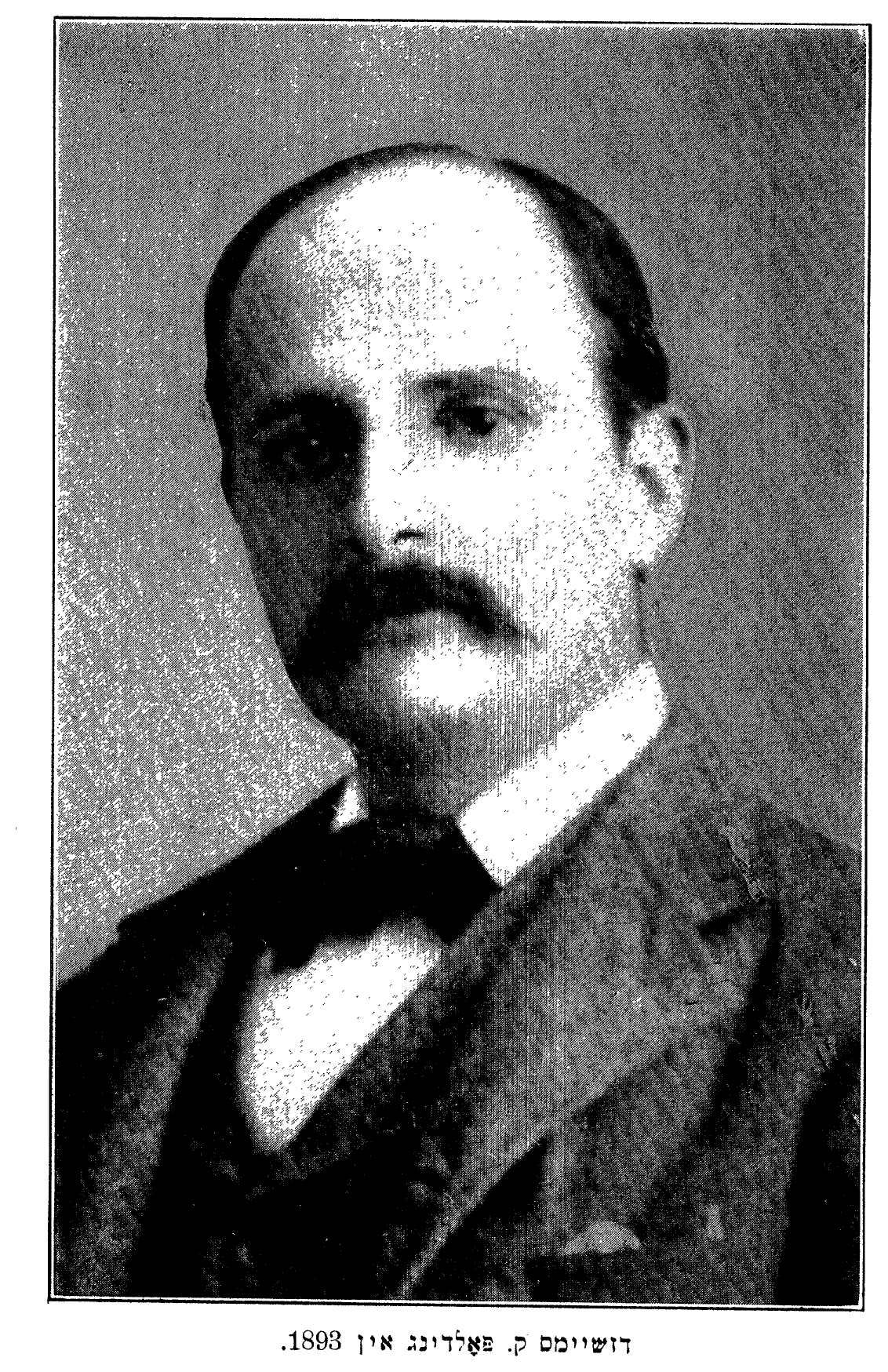
When my American friend, James K. Fielding, of 146 Forsyth Street, heard that I was traveling to the Zurich congress, he resolved to come along with me. He wanted to see the socialist congress and, while he was at it, also to visit various countries in Europe, where he had already spent a good deal of time before. We therefore made the journey together.
Arriving in London from New York, I again delivered several speeches and lectures.
The Jewish Social Democrats of London then had a club with a meeting hall. On Saturday nights young people would come there to dance, and this was a source of income for the club. The outside visitors would supposedly register as members; for by law a club was open only to members. I once sat beside the cashier at the door and observed the scenes at the entrance. There comes in, for example, a girl. She tosses down two copper coins, calls out "Jacobs!" and goes on into the hall. That is to say, her name is Jacobs * and she supposedly registers as a member. The young men and the girls were more poorly dressed than a similar crowd in New York, and they carried themselves a bit differently too: plainer, with less pretension.
On this visit of mine I became more closely acquainted with M. Baranov. I had met him on my previous visit, and in my memory he was298recorded as "the silent Russian revolutionary." He used to sit in a corner with a pipe in his mouth, smoking and keeping silent. I knew that he was from southern Russia and that he had taken part in the Russian revolutionary movement. This time I learned that, besides smoking a pipe, he could also express an opinion and make a sharp joke; that he was a well-read man and could write.
Our Jewish comrades, the Social Democrats, of London had decided to bring out a weekly paper of their own. The "Arbeiter Fraynd," which under Philip Krantz's editorship had been a nonpartisan paper, had long since become a purely anarchist organ (with S. Yanovsky as editor). And so our comrades were preparing to found a purely Social Democratic weekly. They invited me to their conferences on this matter, and I took part in all their deliberations. Baranov was chosen to be the editor of the paper.
From London I traveled with Fielding to Paris. There I now spent only a few days. From Paris we went off to Berlin. We traveled by way of Brussels, where we stopped for a few days. I visited the "Maison du Peuple," where two years earlier the socialist congress had taken place; the wonderful medieval square where the Town Hall stands, and other places that I had visited here in 1891. I had spent only one week of my life in this city, and yet it now awakened in me a feeling of longing. Perhaps I am too sentimental about such things, and perhaps everyone feels this way. Places that are bound up with your past are graves of your years gone by. The main thing was the fact299that two years before I had lived through here some of the strongest experiences of my life. I felt the longing most sharply at the "Maison du Peuple," where the Brussels congress had taken place. Two years before, the place had boiled with delegates and spectators, had blazed with party life, with debates, with enthusiasm. Now the place looked empty, desolate, forsaken.
Fielding and I visited John Walders, the leader of the Belgian socialists, who at the congress two years earlier had introduced the resolution on the Jewish question. He received us with a sincere warmheartedness. I introduced him to my American traveling companion, and when I told him that Fielding was descended from the first Dutch immigrants who had settled in New York, he became greatly interested. The inhabitants of Flanders, which is a large part of Belgium, belong to the same people as the Dutch and speak the same language. Walders was a Fleming; and so it turned out that he and Fielding belonged to the same people. He declared that Fielding had a genuinely Dutch face.
Late in the evening we went off to the train that was bound for Berlin. Walders accompanied us, and we took a warm leave of him.
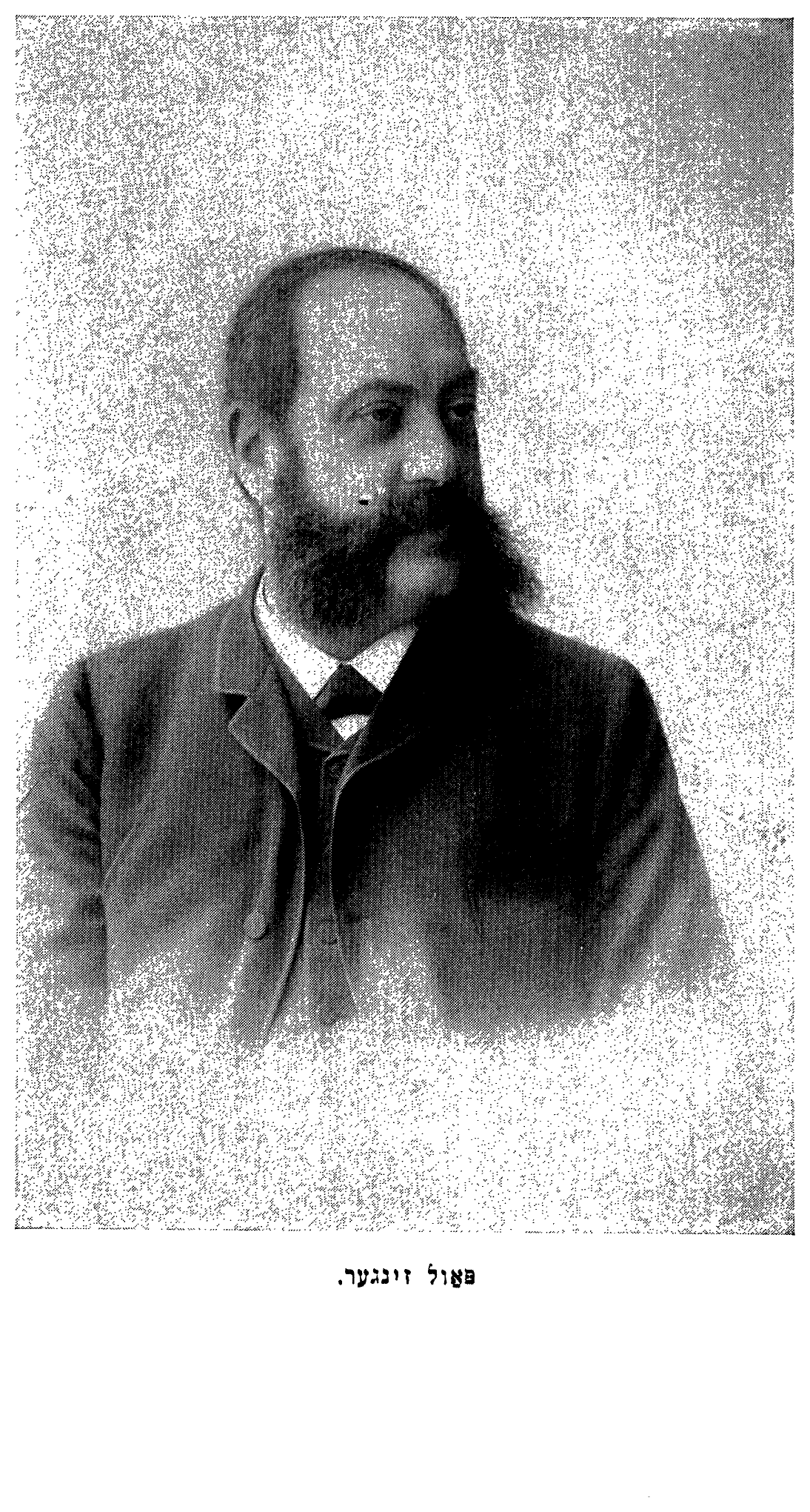
According to a letter that I received in Berlin from my cousin Rebecca, it was still several days before my parents would arrive in Vienna, and I spent those few days300in Berlin. I visited August Bebel, Paul Singer, and Wilhelm Liebknecht, the three principal leaders of the socialist world, with whom I had become acquainted at the Brussels congress. I had an interview with each of them for our paper, and among other things I spoke with them about the antisemitic movement, which was then strongly organized in Germany under the leadership of Stoecker and Ahlwardt. In Bebel's house I met and had a conversation with Dietz, the publisher of socialist works and a Reichstag deputy.
Singer invited me to dinner at his home. He provided me with a ticket to the Reichstag and introduced me to others of the socialist leaders. The German parliament was then still in the old building — on Leipziger Strasse.
It happened that I was in the Reichstag during an important debate. Bismarck had then brought forward a bill to enlarge the army, and the Socialist Party fought it hard. Looking down from the gallery, I saw how the deputies were seated according to their parties, each party a representative of a particular class. I thought to myself that these groups of chairs and little tables were like a map of the various economic and political interests in Germany.
I remember the figure of the well-known socialist Vollmar with his crutches, a representative of Munich, who had been an officer and had been wounded in the French war of 1870. I remember with what joy and reverence I gazed at Bebel, Liebknecht, and Singer when they came in.
Bebel delivered the most important speech that day.301From time to time capitalist deputies interrupted him, and he answered each of them sharply and wittily, calmly and powerfully.
(plate; bound in the original between pp. 300–301)
Beside me on the gallery sat a company of richly dressed Germans. One of them was a very stout, red-faced man.
"That fellow is ready for a fight, in any case" — he said to my friend when Bebel, with a deft joke, had answered one of those who had interrupted him.
In Berlin I had a letter to a Russian student by the name of Buchholz. A sister of his, a Russian student, was married to Dr. Konikow, a Jewish socialist in Boston. Madam Konikow and her brother were the children of a Christian father and a Jewish mother — Germans who had settled in Russia. Through Buchholz I became acquainted with a group of Russian students, and together with them I went to socialist assemblies.
You come into a great, great beer hall, you sit down at a little table, you order beer, and you listen to the speaker. Beside the chairman sits a police commissioner, and before one begins to speak, one must shout "Hoch!" for the Kaiser.
The socialist speeches sounded too cold to me. I wanted them to speak with more fire, with finer words. But the German comrades had long since outgrown this sort of oratory. Besides: a German does not get inspired as quickly as a Jew or a Roman. The German speeches were to the point, with facts and with logical conclusions. Once, when one such speech pleased me greatly and I began to applaud heartily, my Russian companion held me back.302— It's all right for you, you are an American. But we are here as if on sufferance. Your applause will draw attention to our group, and they will expel us from Berlin.
The German police then diligently helped the Russian police, and for Russian revolutionaries it was in Berlin almost as unsafe to live as in Petersburg.
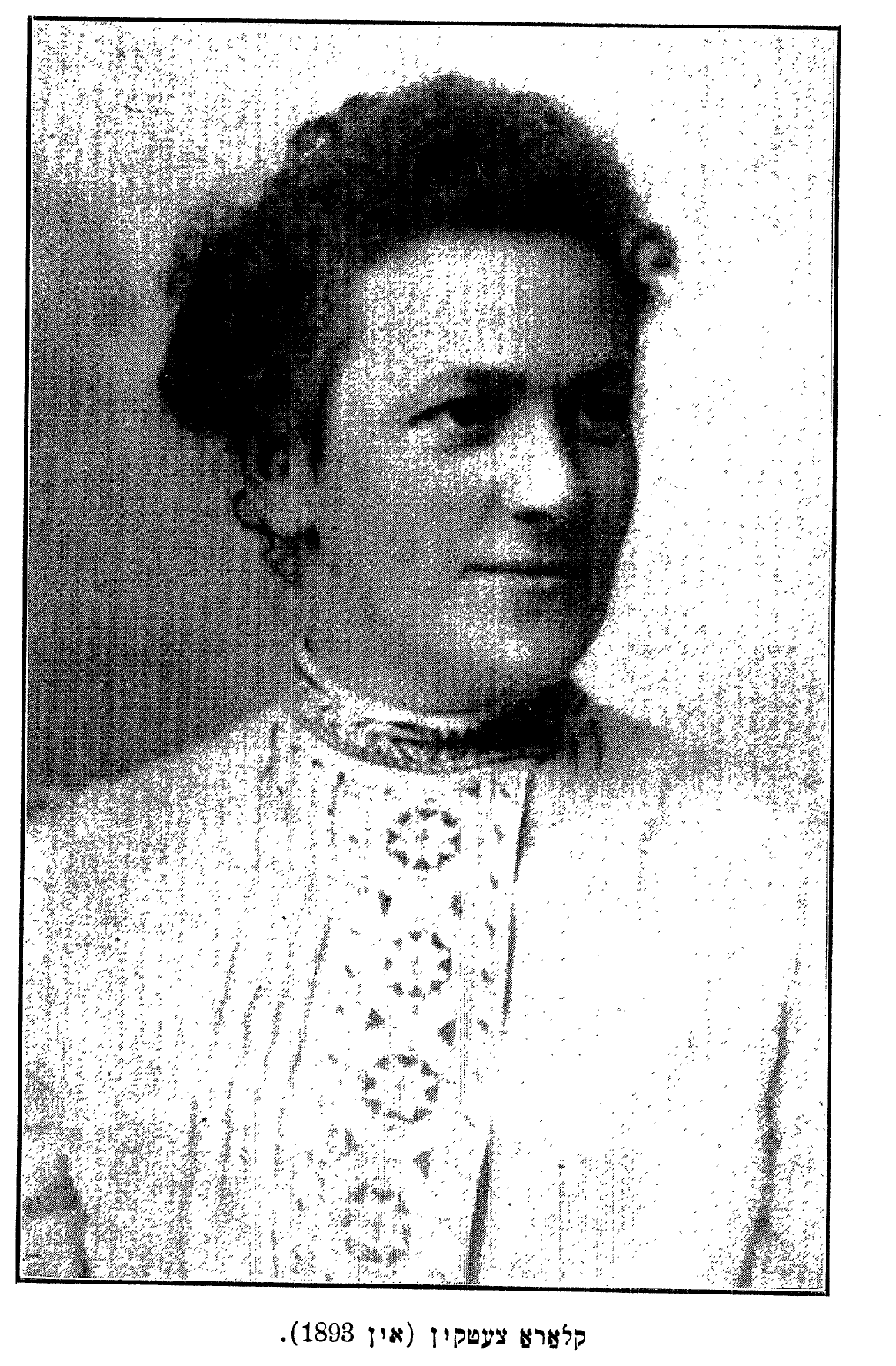
One of the meetings that I attended at that time took place on a Sunday afternoon. It was addressed by Clara Zetkin. A blonde, thin woman, not tall, with a sympathetic face and a sympathetic voice. Her husband, who was then already dead, had been a Russian Jew, a revolutionary. After the meeting I became acquainted with her personally. I later visited her, and she gave me her photograph for our journal "Tsukunft." Bebel, Liebknecht, and Singer too gave me their photographs for the "Tsukunft," and they all later appeared in the journal.
On a Saturday night one of Buchholz's comrades took me to a meeting of Russian students — quite an innocent group, a Russian library society.
A few things at this meeting struck me as comical. For example: a handsome young man with a fine black little beard rises, and with grave manners, and in a fine Russian, delivers a speech. He looks down significantly at the table, examines his fingernails, lifts his eyes to the chairman, and speaks in a weighty tone like a lawyer arguing before a judge. And what is he speaking about? A member had borrowed a book from the library, and it is already more than a month that he has not yet303returned the book. This speech lasted some twenty minutes.
The very ceremony of delivering a speech gave them pleasure. In Russia one was not even permitted to hold a meeting about a library.
Every day I would go to the post office to see whether there was a letter from my cousin. Finally I found there a postcard: my parents, my aunt with her younger daughter, had already arrived in Vienna.
My heart began to pound rapidly.
That same evening I set off. Fielding accompanied me to the station. He himself stayed on for another day. The next morning he was to travel to Prague. He was a great lover of Wagner's music, and in Prague there was then a famous Wagner conductor with his orchestra. His plan was to travel from Prague to Zurich. So that we might be able to meet up in Zurich and put up at the same lodging, I gave him the address of the well-known Russian revolutionary Paul Axelrod, who lived there at that time and whose lodging was my Zurich center of operations.
I set out in the evening in an ordinary second-class car. Sleeping cars were then a rare thing in Europe. I arrived in Vienna in the early morning, at a station that lies not far from Leopoldstadt, where the Jewish quarter is.304I was distraught. I forced myself to be calm; but it was a manufactured, a nervous calm.
I wanted to show myself to my mother in my finest suit. And for this I had prepared in advance. I had had this meeting in mind while in London and afterward in Berlin, and in each of these cities I had had suits made for me. The London outfit was a brown one and the Berlin one a gray. The brown one was too heavy, too warm. But it was the handsomer, so I chose it.
At the European stations there are special little rooms where one can wash up and change clothes. So I rented such a room. I dressed without haste, with slow movements, deliberately, so that I would be composed.
When I was ready, I left my baggage at the station and set off after the address. It happened that I had to walk about ten minutes. On the way I met a tall man, with handsome black side-whiskers, whom I knew from New York. He was a Viennese; but he had lived in America, around Second Avenue, where he was a "macher" in the lodges of "Brith Abraham" (the first Jewish lodges in America had been founded by German, Austrian, and Hungarian Jews). I used to meet him now and then in the cafés on Second Avenue, and once I had a clash and a debate with him over the question of why, upon joining a lodge, one had to declare that one believes in God. He was now in Vienna, presumably on a visit. He did not notice me, or perhaps pretended not to notice me. I was glad that I did not have305to pause, my whole being was absorbed in the meeting I was about to have.
(plate; bound in the original between pp. 304–305)
I walked along a large, broad, lively street, and then through a smaller and quieter lane.
I reached the number that was marked down in my address-book. I went in through the gate and climbed up to the second floor, stopped at a door, and gave the bell a pull.
The door opened a little, just a crack. I caught sight of a young face. It was Max Roms, Rebecca's husband.
— Alter! — he called to me softly, with a friendly smile. He too was from Vilna, and he knew me.
He spoke to me in Russian, and all very quietly: — They have lain down to sleep. They are very tired from the journey. We mustn't wake them. The surprise would be too great. The best thing will be for you to go out for a while, until they wake up by themselves, and I will prepare them.
I went back down. From the narrow street I came into a broad one lined with trees. There I went into a café and ordered breakfast. I remember how they set newspapers down for me, in the Viennese fashion. I remember the taste of the cold glass of water that they brought me with the coffee. I had no appetite. But I forced myself to eat, and the coffee tasted good to me. I leafed through the German newspapers, read a little, not knowing what I was reading, and went on leafing. A waiter-boy brought me a fresh glass of water before I had even finished the first glass. That is the custom in the Viennese306cafés. And I remember how this drew my attention.
A minute or twenty went by, and I forced myself to sit longer than I needed to. I must control myself — I drilled myself — I must not be agitated when I go up to them.
At last I went back. I climbed the stairs again, again gave the bell a pull, and again Max Roms appeared. This time he opened the door all the way. I heard a commotion.
Soon an old woman appeared, not a tall one. At first glance she seemed unfamiliar to me; but I saw at once that this was my mother. I flung myself at her, and she at me.
— My son, I don't recognize you! — she cried out in a wailing voice, without tears.
For all my resolve to stay calm, I forgot myself. I was confused and nervous.
— It's no one else! I'm not deceiving you! It's the same one! — I shouted, in feigned anger.
In the background stood a tall Jew with a big gray beard, with frightened black eyes — my father. And right beside him stood a woman, a little younger in appearance than my mother, a plumpish one with weepy eyes. This was Aunt Feyge. After I had kissed them and embraced them, I went into the second room.
In a bed lay Rebecca with a baby, a week old. Leaning on a sofa between two windows facing the street sat a young little lady. When I caught sight of her, I burst out laughing aloud: — How do you like her? Khavoke!
This is my aunt's younger daughter. When I307had gone away from home, Rebecca was fourteen years old and Khavele eleven. No change at all had taken place in them — so it seemed to me. Both sisters had gone from little girls to married ladies, and one of them was already a mother; but to me they looked exactly as I had left them. I could not believe it. To see Khavele as a married lady struck me as very comical. I burst out laughing with an exaggerated, nervous laughter.
My father, my mother, and my aunt had aged greatly in those twelve years. I was painfully surprised. I looked at them again and again. And they did not stop looking at me. My mother nestled up to me, put questions to me.
In ten minutes' time we had grown accustomed to one another — with the exception of my father. He was somehow ashamed before me all the while; as though it were hard for him to recognize his son in me, his "Alter."
I took a room in a hotel not far from there (the Hotel "Donau") for my father and myself, to sleep in. We all ate together at Rebecca's lodgings, and all the rest of our group spent the night there too. By day we used to pass many hours together, and I visited the Viennese socialists. Late in the evening I would come to my father at the hotel.
The first evenings the two of us — my father and I — slept little. I would go over from my bed to his, and so we would lie and talk. The feeling that I was lying beside my father, as in the days when I308was a child and we lived in Shevakh Zhirmunski's courtyard, gave me a special pleasure.
I did not stop putting questions to him, chiefly about his past, about his childhood years, about his father, his mother, his sisters and brothers, about everything that had any connection to him and to his family. He answered my questions with interest, but bashfully. The first few evenings that we spent together, he held himself as though I were a stranger — like a stranger who belonged to a higher, mightier world than his. Little by little, however, he grew accustomed to me, though still not completely.
Before I had gone away from Vilna, I had seldom taken an interest in my father's inner life and in his past. I believe that in their younger years all sons and daughters are this way. One loves one's parents, one is attached to them, but one does not take an interest in them. Now, however, that I was already thirty-three years old and understood the world and myself a great deal better, and took an interest in people in general — now my father awakened a passionate curiosity in me.
[טאָפּיק] Eleven days together. — Victor Adler. — Among the Austrian comrades. — Dr. Ellenbogen. — I take leave of my parents.
My mother soon felt as though we had never been parted at all. She called me "Alter," as though I were still going to kheyder. With her too I had intimate conversations; but we were seldom309alone. Once I went walking with her specially, so that we might be eye to eye. The famous Viennese garden, the Prater, lies not far from that neighborhood, and I took her there. But our time went by more in mute expressions of love and longing for the past twelve years. She simply did not know what to say first. She pressed herself to me, stroked me, made jokes; asked about my life in America, urged me to take care of my health; every little while urging me to be a father to my brother.
Often I would sit with my mother and my aunt together. We would pass whole hours that way. My aunt was the merrier and the more worldly one, so she would make more jokes, tell about Vilna, recall the years when I was still a child.
Once, at Rebecca's lodgings, I sat writing a correspondence for the "Arbeiter Zeitung." The gist of the content consisted of a conversation that I had had in Berlin with Paul Singer and with August Bebel about anti-Semitism. My father sat beside me and watched me write. When a couple of pages were finished, he asked: "May I take a look?" "Why not?" I answered, and I handed him the manuscript. I knew in advance that for him it would be Turkish. My language was then just as plain a "Jewish Yiddish" as it is today. But it was not about that manner of writing that the matter turned here. The subject was foreign to him. The article contained several expressions that were well known to every American Jewish worker who read the "Arbeiter Zeitung," but to an old-fashioned310Jew like my father. Today even such a Jew would have understood expressions like these. But not then.
I pretended to be absorbed in my writing; in truth my pen did not stir. I waited to see what would happen here.
— I will tell you the truth, I don't understand it, — my father said with a smile, handing the manuscript back to me.
— Let me read it over, — says my aunt, — I'll see whether I understand it.
— Read, read, aunt! You certainly won't understand it, — I answered, laughing.
She tried to read and — she had a good deal less success than my father.
Then I explained to my father what it was about and translated for him the few words with which he was not acquainted, like "class struggle," "economic interests," "feeling of competition"... Then he understood everything. He saw that I was against the enemies of the Jews, and that, naturally, pleased him. It was a pleasant surprise for him; for according to the conception of such Jews in those times, every freethinker is something of an enemy of Israel.
My conversations with my two cousins and with Rebecca's husband had quite a different character. Rebecca had attended the gymnasium in Vilna, and she had spent several years at the University of Geneva. Khavele had studied less, but she was clever in a modern way and intelligent. She spoke Russian excellently. And the same goes for Max Roms as well. He is a thoroughly intelligent311person, and a likable one too. Their company was a delight to me.
Rebecca and Khavele had been raised on my hands, as the expression goes. I had spent almost no less time in their mother's house than in my own mother's house. They had grown up before my eyes, and they were to me like sisters. And so it would happen that right in the middle of a serious conversation with them I would feel like laughing. With whom am I talking here about such important matters? It seemed to me that they were still children.
A couple of times I went walking with them in the Prater — with each of them separately. We talked about their lives, about my life, about America, about Vilna, about Riga (where Khavele lived).
Not far from our lodgings there was a small park, with a beer hall and a café. There we would all spend a couple of hours after dinner, sitting down at one of the tables under the open sky, ordering beer or coffee, sitting and chatting. I felt myself in the very bosom of my old home life.
Since my father had to go to pray every morning, I hired an under-sexton from a Galician synagogue, and he used to come and take him there. The big, strange city frightened him, and he was afraid that he might lose his way.
Once I took them all to see the two famous museums of Vienna: the picture gallery and the museum of natural science (I myself had already visited them before). The two large, beautiful buildings are312twin buildings. They are built in the same style, and they stand opposite one another in a beautiful park right in the middle of the city.
My father walked about through the large, magnificent halls, looked at the pictures through his fist, and out of admiration he smacked his lips. At the pictures of naked women he would grow ashamed, lower his eyes and look on further, or he would make a grimace and spit. My mother and my aunt marveled and criticized in their womanish way.
As we were walking like this from one hall into the other, I hear my mother say to my aunt behind me: "He leads us around as though he had lived in Vienna. He knows everything, he understands everything, and everything on his own! And he hasn't cost us a single groschen!"
I had looked over the city before I took them to see the museums. I had visited the Viennese socialists, and partly with their help and partly on my own I had walked through the most important streets and seen the most important buildings, cafés, shops, and the two world-famous Viennese churches.
Vienna made a strong impression on me. The famous Ringstrasse, which runs curved like a ring, with the impressive palaces that stand on it or beside it, I marked down in my mind among the most remarkable things I had seen in Europe. I could not decide for myself which city is more beautiful — Paris or Vienna. "The tall, slender officers with their gold-and-blue or gold-and-red uniforms and the charming, beautifully dressed Viennese women lend to the lively streets a grace and a piquancy,313which the boulevards of Paris do not possess" — such, roughly, was my impression.
(plate; bound in the original between pp. 312–313)
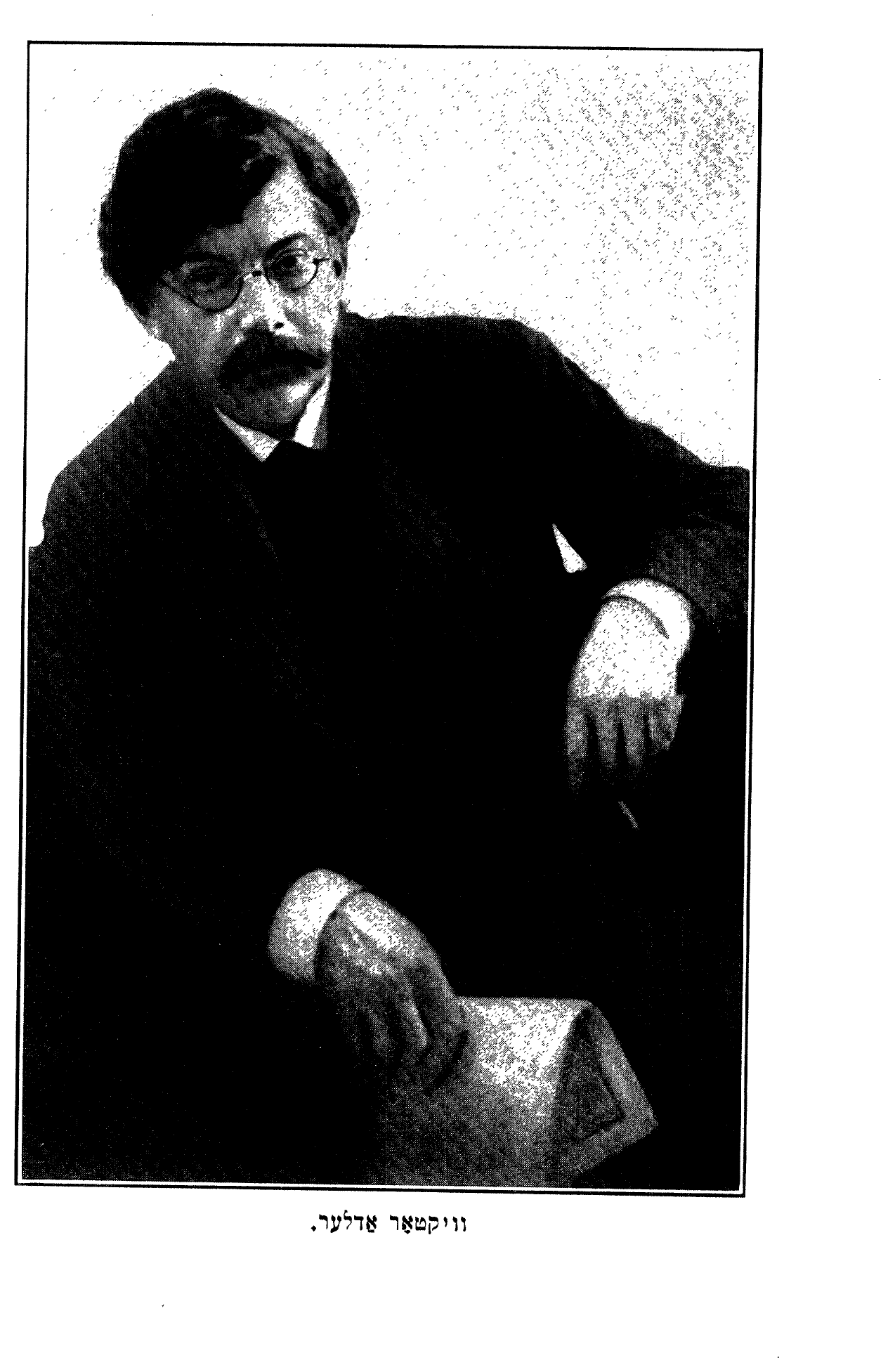
Victor Adler, whom I had come to know at the Brussels congress, received me very warmly. I have already said that he was the founder of the Austrian socialist movement. I want to add that he was its head and its heart.
He immediately began speaking with me about "Point 4" of the Brussels agenda. Again he tried to demonstrate that one ought not to raise the question. And in case I intended to bring it into the discussions of the Zurich congress, he assured me that there was no hope that it would be permitted.
He gave me one of the important Viennese comrades as a guide, and that man showed me the city and various centers of the labor movement.
I visited a couple of socialist mass meetings. Their general character was the same as in Berlin: little tables, at which the workers sat with glasses of beer or something to eat. On a platform — a chairman and a police commissar and a speaker. Among the audience waiters went about, took orders, and brought what was requested. Everything as in Berlin, only the workers looked poorer. Compared with American workers they looked downright poor. Many of them sat at the meeting in green linen jackets, without white collars — just as at work.
At one of the Viennese gatherings an anarchist took part in the debates. He spoke314in veiled terms, and the speaker's replies were veiled as well. But everyone understood. Besides, the question was a theoretical one. It had nothing to do with the political life of Austria. I very much wanted to take the floor. A debate with an anarchist — that was a daily sport for us in New York, and I felt myself to be a specialist at it. But here, after all, one had to know German well. Apart from that: for a foreigner to take part in a socialist meeting in Austria was then just as risky as in Germany. The police barely tolerated their "own trouble."
At the first of the two meetings the main speaker was Dr. Ellenbogen, an Austrian-Jewish Social Democrat, a fair-haired young man, not tall. I had likewise come to know him in Brussels, and here at the meeting we greeted each other and chatted a while.
Before I would go out in the evening, I would tell my father that I would come to the hotel late and that he should not wait up for me. After the gathering I usually went off to a socialist café, and there I spent a good deal of time. I would come back to the hotel very late (as was the custom in Vienna, when one came home after ten o'clock, I would have to pay the house-man ten kreutzer of "key-money" because he had opened the gate for me). I would always find my father waiting up for me. He would ask me about the meetings. He already felt more at home and freer with me, though still not as much at home and free as my mother or my aunt. I would explain to him everything about the meetings that could315be explained. Once, after such a conversation, he said to me:
— I will tell you the truth: what you do does not please me. Since you have already left the Jewish way, then a doctor would be a good deal finer.
He could not grasp what it meant to be a Jewish newspaper writer and a speaker. To write in Hebrew — that had a flavor for him; after all, he was something of a reader of "Hamagid." But to write in a Yiddish newspaper — that struck him as strange. It was the same with my speech-making. That one should stand and deliver a "sermon" in Yiddish, speak to workers, and on top of that get "all worked up" — that did not sit right with his good sense. That I was a speaker he had heard already back in Vilna, and, according to what I was told, he had taken great pride in the name I had. But he was also ashamed of it.
My mother, too, grimaced at my occupation. Once she says to me with her clever smile:
— In America, after all, there is no longer any Tsar; are you still not satisfied? What more do you want?
— I want there to be no poor people in the world — I answered, pressing her to my heart.
— As if one could have whatever one wants! — she went on smiling.
We spent eleven days together. At last the time came to part. We all gathered at the railway station.
It was the middle of the day. The train, on which they all were to depart — my parents, my aunt, and Chavele — was ready. Only a few minutes remained. We stood and talked. The316mother did not step away from me. She kept holding me by a hand, caressed me, and looked into my eyes. At last a signal sounded that one had to board the cars. My mother pressed herself to me and began to cry out:
— My child, I will never see you again!
She wept quietly and would not let me go. All around there reigned a nervous haste, an uproar, and still she would not let me go.
They could barely tear us apart. I took leave of my father, of my aunt, and of Chavele. The train departed.
I, Rebecca, and her husband went back to their lodging. Rebecca was left with a sharp feeling of desolation. And the same was upon my heart.
It was then that I was suddenly seized with disgust. Just as before the city had enchanted me, so now it had become for me a source of dread. I longed to forget about it as quickly as possible.
That same evening I set off for Zurich. I had already ordered a bed in a sleeping car in advance. This was my first sleeping car in Europe. In America I had already ridden in a sleeping car four times, it seems: twice to Boston and twice on my second journey to Chicago and back from there. The beds in Austria were put together in a317peculiar manner, the way someone who is not a craftsman knocks together a sukkah.
In the early morning we arrived in Munich. I remained there only a couple of hours. I came out of the station, looked over the city; took a bite in a café and returned to the station.
The further journey went through the Bavarian and Swiss Alps. We came to places where clouds hung below us. Over mountains and valleys they hung. Then we reached the famous lake, Lake Constance. Nature here looked to me alluring and full of mystery.
The conductor of the train, which carried me from the Swiss border, was a man of small stature, and it seemed to me natural that this should be so. The country is a small one, and so, I imagined, its inhabitants must also be small — a sort of toy state with a population of living little dolls. So my fancy painted it for me.
At last I arrived in Zurich.
I have already said that in Zurich there then lived the famous Russian revolutionary Paul Axelrod. He had a kefir business there. But he occupied himself with the Russian revolutionary party more than with his kefir. His house was the center of all the Russian revolutionaries, and since now in Zurich they were preparing to hold a socialist congress, his place was a regular fair. Axelrod's closest party friends were Plekhanov and Vera Zasulich*.318They too now lived in Switzerland, but in another region. And so, for the week of the congress, they were staying at Axelrod's. It turned out that my American fellow traveler, Folding, had arrived in Zurich a couple of days earlier than I. Axelrod had immediately provided him with a room in a pension (boarding house) for the two of us. And so Axelrod gave me the address of the pension.
A large part of Zurich lies on hills, and in those parts — on University Street — our lodging was located. The Tonhalle, which had been taken for the congress, was a quarter of an hour's walk from there. The boarding house was occupied mostly by students from Ticino, the Italian part of Switzerland. They spoke good German, however, and Folding too spoke German passably; so at the table we would chat in this language.
Among the delegates from England was Morris Winchevsky, as the representative of the Jewish movement there. His lodging was not far from ours. We saw each other often and would go to the congress together.
I have said that at the Axelrods' there was a fair. The fair, however, was too big for their lodging. In honor of the congress a fair number of Russian students had gathered in Zurich, mostly Jewish ones, from Swiss cities — from Bern, from Geneva — and some had even come from Germany and from France; and in Zurich itself there also studied a fair number of Russian Jews. All of them were drawn to the Axelrods, and to invite them all was impossible for them.319The most important guests at their place were, naturally, Plekhanov and Vera Zasulich. But there were always a dozen or so other revolutionaries there as well. And the apartment was not a large one. So it was always cramped. To me Axelrod showed a warm hospitality. In the first place, I was not "just anybody," but a delegate — a word that rang among the Russian students like a lofty title; in the second place, I was a rare sort of delegate, an emissary of tens of thousands of Jewish workers from far-off America; and Axelrod was never estranged from Jews; in the third place, in his eyes I was the Cahan who had brought the Jewish question before the Brussels congress. It vexed him greatly that that congress had responded so unfriendlily to my proposal. In short, he always cordially asked me to visit him often, and each time he received me as a good guest.
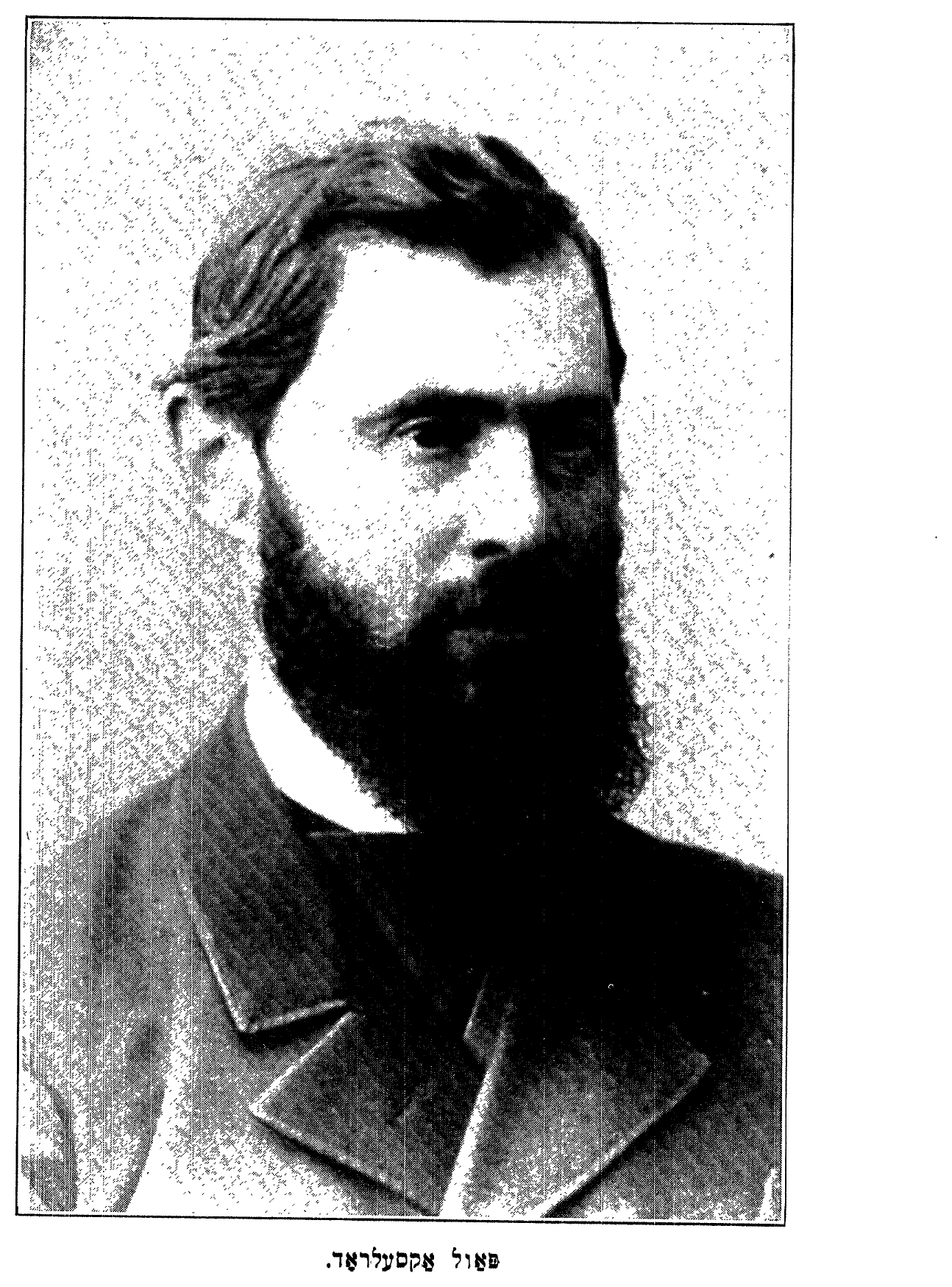
(plate; bound in the original between pp. 318–319)
The Russian revolutionaries who had come there envied me and Winchevsky. The congress was for them a great holiday. In Russia a gathering of a few people would be an underground affair, and here delegates from all over the world come together, and everything is open, frank, and free, and we two are kinsmen, delegates equal with all the delegates.
From the Russian movement several delegates also came to this congress (Plekhanov from the Russian Social Democrats and three representatives of the Polish socialists: Mendelson, his Christian wife, Dembski, and Jodko). But they lived abroad anyway, and they had been elected in secret.
There were no "real" delegates from Russia. I and Winchevsky were "real" delegates, and320Russians we were too, so they envied us and showed us attention.
A couple of evenings I spent at Axelrod's together with Plekhanov, Vera Zasulich, and other Russian revolutionaries. My meeting with the first two was a great event for me. Vera Zasulich had in 1878 stormed Russia with her shot at the Petersburg city-governor Trepov. She was one of the most famous women in Europe, and the intelligent young generation of Russia idolized her. As for Plekhanov, he too had long been known in revolutionary Russian circles. He was the first to deliver a revolutionary speech in the middle of the street (in Petersburg).
In 1879, when a secret gathering of the most important Russian revolutionaries took place and their party was split, he was one of the delegates. When he heard that there was talk of politics and of violent acts with political aims, he withdrew in anger. He was then anarchistically inclined and was against political activity, and he was then one of the founders of the party "Chorny Peredel," which is mentioned in the first volume (page 394). Later he changed his views about politics, and in the last several years he had grown into the thinker and leader of the Social Democratic tendency in the radical Russian world.
In the second volume (pages 291–292), I mentioned his book, "Our Differences of Opinion," which he wrote as an open letter to Pyotr Lavrov. Since then he had taken Lavrov's place as the spiritual leader of the Russian revolution.321Vera Zasulich was then in her younger middle years. She was very poorly dressed and carried herself with a remarkable simplicity. She was not a beauty, but goodness and idealism were poured out over her face. As she spoke, she often gave a smile. With it, her nose would crinkle up. But then her loveliness would shine all the brighter.
That evening Plekhanov was sitting beside her, and once, when she had become absorbed in talk and lost in thought, he ate up her preserves as a joke, in order to show that she was distracted and noticed nothing.
The talk came around to Jewish humor. Plekhanov remarked that he found no flavor in our jokes; that when someone tells him a Jewish joke, he does not see what there is to laugh at (in passing I want to note that his wife was a Jewess and that his best and closest friends were Jewish revolutionaries). Someone among the Jewish students — I think it was Axelrod's brother-in-law — then turned to me, saying that I, as a representative of the Jewish socialists, should rescue the good name of Jewish humor.
I made the usual test: I told two well-known Jewish anecdotes. One anecdote runs as follows: A rabbi was in the habit, at the bathhouse, of putting on his socks inside out. As was the custom, the rebbetzin would hand them to him inside out, expecting that before putting them on he would turn them right side out; but he would always forget. And the rebbetzin would complain about it. Finally, before he left for the bathhouse, she herself turned his socks right side out; and it just so happened that this time322the rabbi remembered, and he turned the socks inside out. When he came home and his wife saw that he was wearing them inside out, she cried out: "I already turned them right side out, and they're still inside out!" To this the rabbi answered in astonishment: "Just look — you turned them and I turned them, and they're still inside out!"
I told this to Plekhanov (in Russian, naturally) and he roared with laughter. The Jews who were present were in seventh heaven.
The second anecdote was about an absent-minded melamed whose wife had sent him to a neighbor woman to borrow two raw eggs. The neighbor had two eggs, but already without their shells. "What will you carry them in?" she asks. The absent-minded melamed takes the yarmulke off his head, makes a little hollow in it, and she pours in an egg. "And where will you keep the other one?" she asks. He turns the yarmulke over, and she puts in the second egg. Carrying the yarmulke with the egg this way, the melamed comes home. His wife says to him: "You good-for-nothing! I told you to bring me two." Says he: "Here's another one!" — and with that he turns the yarmulke upside down, so that the second egg too is spilled out.
I presented the anecdote with a soft hat instead of a yarmulke. Plekhanov laughed so hard that he could barely come to himself. There were no nationalists in the room. Yet I was received with such applause that it looked like an ovation to a man who had rescued the Jewish honor.
323[טאָפּיק] At the congress. — American delegates. — Merlino again. — I get the floor. — De Leon. — Bernard Shaw. — "Di Yunge."
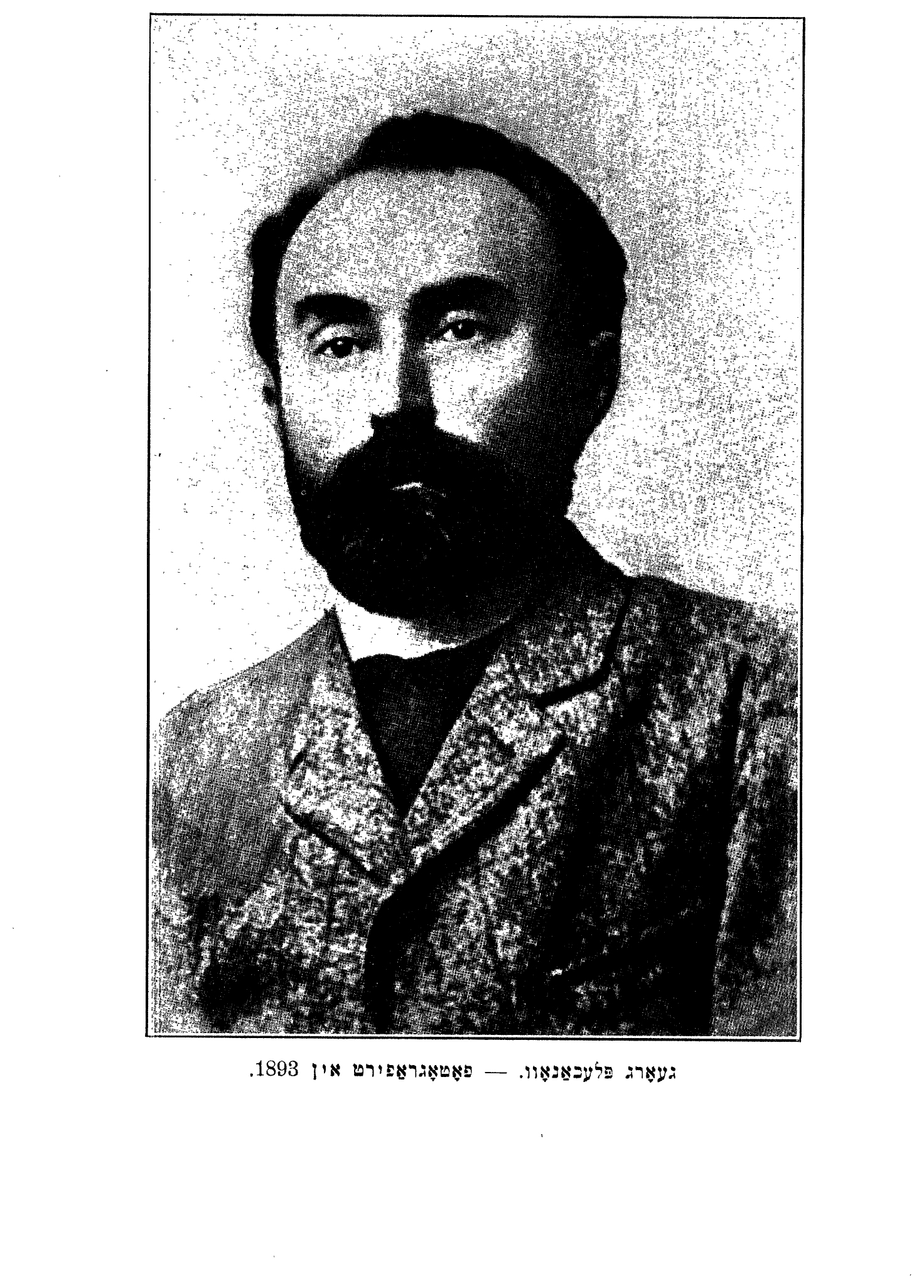
(plate; bound in the original between pp. 322–323)
The great hall where the congress held its sessions was large and beautiful. The platform was decorated with red flags and busts of Karl Marx, Friedrich Engels, Ferdinand Lassalle, and a famous Swiss personage. The gallery was packed with Russian students and with Swiss workers.
In general the congress had the same character as the Brussels one. About twenty nationalities were represented; but speaking from the platform was permitted only in three languages: German, French, and English. The German Social Democrats once again played the leading role; and on the platform the daughter of Karl Marx, Eleanor Aveling, was once again one of the chief figures.
From America there were then four delegates: Sanial, De Leon, Hoehn of St. Louis, who had now already come as a delegate of our party, and myself. We sat at one table with the delegates from England.
Once again delegates from the anarchist movement presented themselves; once again Merlino and several comrades of his. There began the same debate that had already been gone through at the Paris congress of 1889 and at the Brussels one of 1891: should they be admitted or not? They were given the floor. And the fiery Merlino once again delivered a speech.324In favor of their admission a couple of German delegates spoke out, from a group that was then known by the name "Di Yunge" (the Young ones). They regarded themselves as far more "revolutionary" than the leaders of the Social-Democratic party. Their chief leader was a pale, thin, tall Jewish young man by the name of Landau. He and a few others delivered fervent speeches in favor of the anarchists; but a majority of the speakers declared themselves against their admission. Once again respect was expressed for Merlino personally, and it was once again pointed out that his party is the opposite of the Social-Democratic movement and that it would therefore be nonsense to take them into a Social-Democratic congress. In this sense one delegate after another spoke.
My name was called out. I went up onto the platform and delivered a speech in English. I said approximately the following: One cannot make out any sense of what the anarchists want; one can only understand what they do not want. And the clearest thing in this respect is two points: they are against voting and against representation. They are against delegates. They do not believe that anyone can represent anyone but himself. These are the only two things that one can understand in anarchism. What do we see here? Anarchists — that is, people who are against every representative system — demand that they be admitted as representatives of their anti-representative party. A certain Jewish comrade of ours in America (I had in mind J. Finn of Boston) had shown in an article that "communist anarchism" is nonsense, because communism is the opposite of anarchism. Therefore, he said, communist anarchism is as much a contradiction as325warm ice cream. The simile fits even better the question we are now considering: for the word anarchism excludes every notion of congresses and delegates. Yes, the wish of the anarchists to take part in this congress is warm ice cream.
The Englishmen laughed. There were not many English delegates. But of Germans there was a great host at the congress, and when a German delegate by the name of Motteler translated my speech into his language, there burst out a laughter that resounded through the hall. Eleanor Marx-Aveling then translated my speech into French, and again the hall cracked with laughter.
When I returned to my seat, De Leon asked me in a cold tone:
— When did you hand in a slip asking for the floor?
He suspected that I had not handed in any slip at all and that I had "pulled" my way onto the platform.
— I handed one in — I answered him just as coldly as he had asked.
The truth is that I had not in fact submitted my name in writing. It was also true that I had a "friend at court" — Eleanor Marx-Aveling. From a distance I had given Madam Aveling a sign that I wanted the floor, and as soon as the delegate who was then standing on the platform had finished, I was called up. De Leon had submitted his name in writing. But so had many others as well, and each had had to wait his turn. No one at the international congresses yet knew De Leon at that time, and before his turn came it was already "the end." So he was326vexed that I had gotten the floor and drawn attention while he had not.
Our relations became strained because of this. Ordinarily he used to be merry and often told a joke, sometimes even an indecent one. Now we hardly spoke at all. But he did not want to fall out with me, for in America he was still new to the movement. His name and his power had only begun to grow. In short: by the next morning he began to speak to me in a jesting tone, and the relations between us once again became as usual.
One of the English delegates was a tall man with a red beard. This was Bernard Shaw. He was not yet famous then: even in England little was known of him — almost only in socialist circles, and those were still small there. He was one of the founders and leaders of the non-revolutionary, non-Marxist socialist society "the Fabian Society," which still exists today. As a writer he then took part in a weekly paper, where he used to print critical reviews of music. That he would become a world celebrity as a satirist and dramatist no one had yet dreamed.
A short time before the Zurich congress he had become one of the editors of a new daily paper in London, an evening paper by the name of the "Star," which was printed on red paper. Two days after the debate about the anarchists had taken place, he comes up to me with a bundle of his red newspapers and gives me one. I take a look: he has a report of the debate there, and he gives my speech in a jesting327tone. He says there that the day had been so tedious that even such an unsuccessful joke as "boiled ice cream" had also called forth laughter. Afterwards he spoke with me about his report and made fun of his own joke-making.
The above-mentioned Iglesias, the Spanish delegate, who had made himself so beloved at the Brussels congress, was also present in Zurich. He did not ask for the floor. But De Leon proposed to him that he should indeed deliver a speech, and that he, De Leon, would translate it (I want to remind the reader that De Leon was from Venezuela; therefore his mother tongue was Spanish). Iglesias accepted the proposal. He spoke perhaps five minutes. De Leon's translation, however, lasted some twenty minutes. He would perhaps have gone on speaking, but the German delegates interrupted him.
— Now that's a translation for you! — one of them cried out with a bass laughter. Others took it up, and De Leon had to stop.
I have mentioned "Di Yunge" and Landau, their leader. Our anarchists in America used to point to the attacks that Landau makes in Germany on Liebknecht and Bebel for their "non-revolutionary" tactics. So now, being in Zurich, I had a conversation with Bebel about the matter.
The essence of Bebel's answer to my question consisted in the following:
The complaints of "Di Yunge" are naturally childish; in them there is far more fire than sense; but one should not be angry at them. On the contrary, their abuse is328useful. If there were no criticism, we would fall asleep. If everyone were in agreement, the movement would become petrified. With their attacks they call forth interesting debates. And that brings benefit.
The answer was a surprise to me. But I recognized its rightness, and it confirmed for me Bebel's name as a clever man.
[טאָפּיק] Sergei Schewitsch. — His complaint. — The settlement.
Once, walking along University Street on a sunny day, I met face to face our highly esteemed, dear Sergei Schewitsch, who had left America three years before. The encounter was for me a most pleasant surprise.
His tall, strong figure, his handsome, interesting face were the same; only the black hair and the black beard had already become grayish. His suit too was a gray one. My greeting rang out with the deep respect and love that I and all our Russian comrades in America had felt toward this gifted, interesting man. And he too was gladdened by our encounter. Even more than I had expected. He told me that he had come to Zurich (from Munich) partly indeed because he had read that I was one of the delegates. And he soon explained what he meant: he had come to make a demand of the executive (executive committee) of the German Social-Democratic329party, that its main organ, the Berlin "Vorwärts," should retract the slander it had made against him.
This was the story: a year earlier, a notice had appeared in the Berlin "Vorwärts" about Schevitsch, in which he was accused of being a spy for the Russian government. This accusation was based on the fact that he, Schevitsch, had openly visited Russia and had not been arrested there. Schevitsch sent a statement to the editors of "Vorwärts," but his letter was not printed. The New York "Volks-Zeitung," the German organ of the New York socialists, mocked the accusation and spoke with high respect about Schevitsch. The editors of the Berlin "Vorwärts" received the New York "Volks-Zeitung." They had surely seen this article, but it had no effect on them. They did not retract the accusation against Schevitsch. And so now Schevitsch had come specially to Zurich, where all the leaders of the German Social-Democratic Party were gathered, with the purpose of demanding justice. He could in fact have done this in Berlin; but here in Zurich, he knew, there would be delegates from New York, where he had carried out his socialist activity and where he was well known as a man, as well as a socialist. For him Lucien Sanial was important, as one of the older New York socialists, but for him the American delegate was especially important, who was himself a Russian, who was interested in the revolutionary Russian movement, and who was well acquainted with Schevitsch's relations to the Russian revolutionary groups of America.
Schevitsch's case was taken up at midday,330between the morning and afternoon sessions of the congress. The gathering took place on a small platform that was surrounded by green curtains. Ordinarily this was used as one of the committee rooms. Now, however, when all the other delegates had gone off to lunch, Schevitsch's complaint was deliberated here. For this purpose there had gathered here the members of the "Vorstand," or executive committee, of the German Social-Democratic Party, Schevitsch, and the American delegates. Wilhelm Liebknecht was present as a member of the "Vorstand," and as chief editor of "Vorwärts."
The secretary of the "Vorstand" was then Richard Fischer (his picture is found in the delegate group on page 162). He called the meeting to order. Schevitsch stated his case. Speaking with self-dignity, briefly and clearly, he demanded that the American delegates be heard. He said approximately the following:
— The comrades in Germany have known very little of my socialist activity. My activity was in America. When the editors of "Vorwärts" heard something about me, simple decency required that they should first inquire of the comrades in New York, and not at once come out with a disgusting accusation against a comrade, having absolutely no grounds for it. Here are the representatives of the American movement — Comrade Sanial and Comrade Cahan — with whom I worked together for many years. I refer especially to Comrade Cahan, because he is himself a Russian revolutionary and he knows what the Russian colony of New York thinks about this matter.331Sanial and I said that the accusation which "Vorwärts" had made against Schevitsch was ridiculous and scandalous. Sanial spoke of Schevitsch's high merits in the American movement, and De Leon, who had become acquainted with Schevitsch at the time of the Henry George campaign, spoke in the same tone.
I described how highly Schevitsch is esteemed in the Russian colony of New York, and I explained that it had been possible for him to obtain a Russian passport in a respectable manner.
Schevitsch's family occupied a high position in Russia (it was a baronial family from the Riga region, and Schevitsch's brother was a governor). In Russia itself Schevitsch had taken no part in the movement. He had in any case spent very little time there. And so, for his relatives, through their friends in high places, it was not difficult to obtain a passport for him. Schevitsch had traveled to Russia in the interests of his inheritance, and the Russian government knew this. About the purity of his socialist activity there could be no question. All this I explained to the "Vorstand."
Then Wilhelm Liebknecht took the floor, the editor of the Berlin "Vorwärts." He was a hot-tempered man and often his anger outweighed his practical sense. He was an educated man and a talented one, and he was devoted body and soul to the struggle of the working class. But in worldly matters he often showed more temperament than tact. On this occasion he spoke like a capricious child: "What was written in 'Vorwärts,' he will not retract," — he declared with anger, —332"there is no ground for it; there is not enough proof that Schevitsch is innocent." So he ended, and he sat down with an angry look on his face.
When Liebknecht had finished, August Bebel took the floor. I remember how he began:
"Now, I am of the opinion"...
He immediately declared that he did not agree with Liebknecht. I glanced at Liebknecht and I saw how the cloud on his face was dispersing.
Bebel's statement consisted of the following: "We in Germany know nothing of Schevitsch's activity; this activity he carried out in America. There they were connected with him over the course of years. Here we now have American comrades and they say that the accusations against him have no ground. Our duty, therefore, is to accept the opinion of the American comrades. We have no right whatsoever to leave a stain upon Comrade Schevitsch. I believe, however, that Comrade Schevitsch will be satisfied when we give him an official document with a statement that the accusation against him which was printed in 'Vorwärts' is unfounded and that we accept the opinion of our American comrades about him. A couple of years have already passed, and I do not believe that it is necessary for him that the statement be made specifically in 'Vorwärts.' Should he ever find it important to publish this document of ours, he can do so at any time."
— I am completely satisfied, — said Schevitsch, — I only ask that a copy of the333statement be prepared for Comrade Cahan, so that the Russian comrades of America can see it.
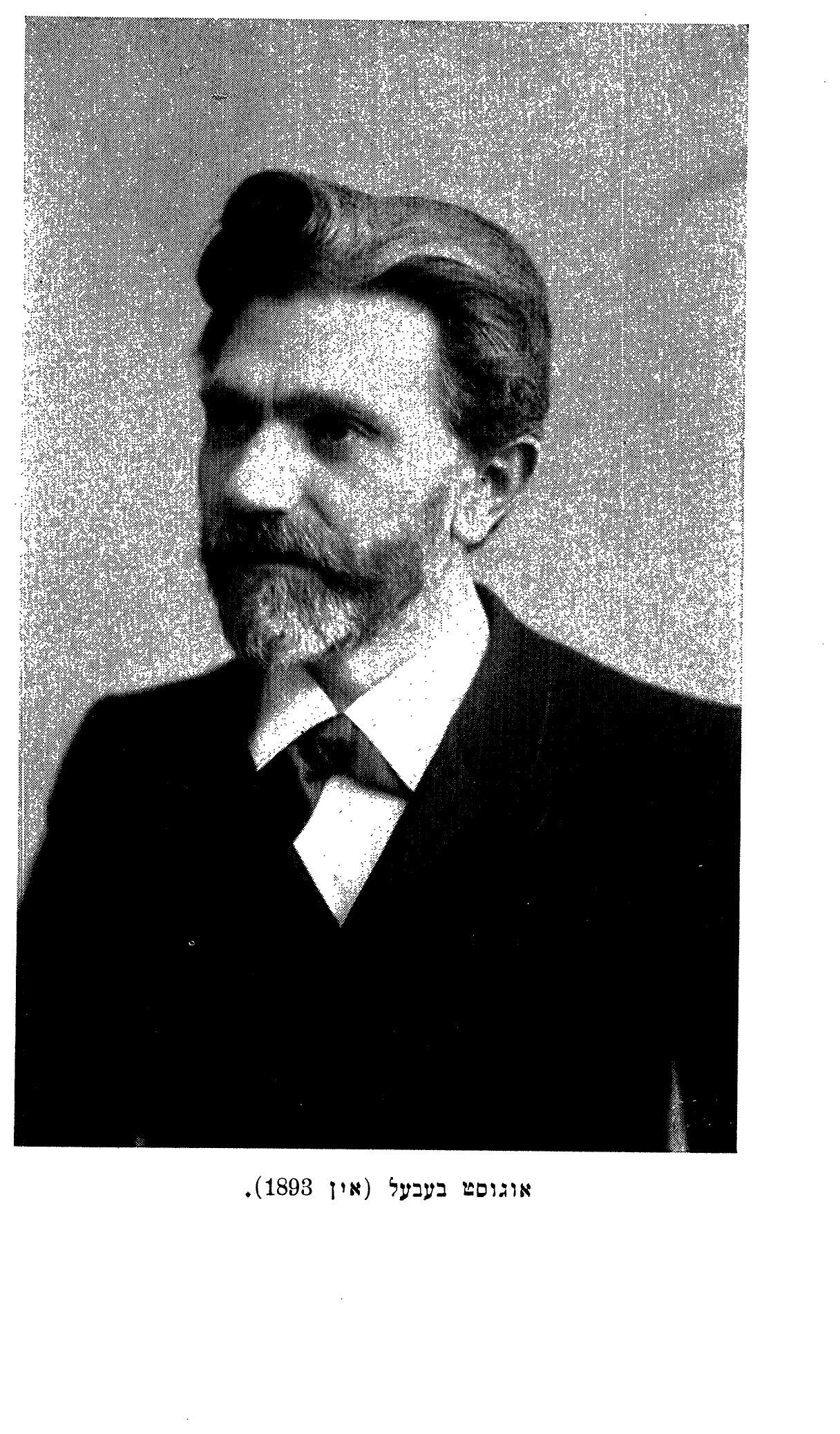
(plate; bound in the original between pp. 332–333)
It was decided to draw up three copies, one for Schevitsch, a second for the "Vorstand," and a third for me. All were to be signed by Paul Singer, as chairman of the "Vorstand," and by Fischer, as secretary.
— Make ready also a fourth copy for me — De Leon spoke up, and his wish too was fulfilled. It was agreed that Singer, Fischer, Schevitsch, De Leon, and I should meet that evening in a certain café for supper, and there the document should be written up and copied.
In the café I found, besides the mentioned comrades, a couple of other comrades. I especially remember the presence of Victor Adler. He chatted there with me at length about the Jewish movement in America. He tried to demonstrate to me that he could speak Yiddish, and he demonstrated that he could not.
[טאָפּיק] A reception for Engels. — The French delegates. — I give a lecture in Zurich. — Zhitlovsky. — "Vorwärts."
The congress lasted a week. The last few days it began to be heard that Friedrich Engels was expected. He was then just then in Switzerland on his summer quarters; so the German comrades tried to persuade him to visit the congress. At first he firmly refused. He did not want to have the ovations that they were334preparing to make for him. But the German delegates sent him messenger after messenger, until he finally consented to come on the last day of the congress, when the work would already be finished.
On the last day, in the middle of the forenoon session, when I was standing with someone in a corner of the hall and chatting quietly, we heard a buzzing and a commotion; and soon a stormy hurrah-shout broke out. I take a look — I see: old, gray Engels, with his tall figure, with his white beard and military mustache, stands in the middle of the platform. All the delegates had risen, and most were shouting and applauding. I say "most," for the French delegates remained silent; they had risen unwillingly and they stood and looked with calm, dissatisfied glances.
I applauded and shouted hurrah with all my strength and from my whole heart.
When the hurrah had stopped, Engels gave a short speech in German, which he afterward himself translated into French and into English.
"The movement which this congress represents is a natural result of economic and historical development, — he said, — men cannot create such a thing; but if there was indeed one man who helped to bring all this to life, it is he!"
At this he pointed with his hand to the bust of Karl Marx.
There was again a storm of applause.
The French were, from the whole affair,335agitated. Why is an ovation being made precisely for Friedrich Engels, the German? They had in mind the impression that this would make in France. There they would say that the congress was a German one and that the socialist movement was a German one.
The conduct of the French made a bad impression on me. It reminded me of the fate of my Jewish resolution at the Brussels congress and of the fate of the English proposal that Englishmen and Frenchmen should travel together to the battlefields of Waterloo. Such feelings at international congresses!
The Zurich congress ended with a banquet. In the middle of one of the tables sat Engels, and beside him Eleanor Marx-Aveling with her husband, on one side, and Paul Singer, Bebel, and Mrs. Liebknecht, it seems, on the other side. I went up to greet Engels, with the purpose of reminding him about the introduction to my Yiddish translation of the Communist Manifesto, which he had promised me two years before. He recognized me at once. He asked about the Jewish workers of America. At that moment, however, when I was preparing to remind him of his promise, Bebel turned to him with some remark. He became absorbed in a conversation and joking with Bebel and with other delegates. I did not want to disturb and "crawl into his eyes"! And I had no further opportunity to speak with him. And so I never did get from him the introduction to the Communist Manifesto. The translation I made, and it was printed without a preface.336Friedrich Engels often corresponded with the well-known German socialist Sorge, who had spent many years in America (he had lived in Hoboken, New Jersey, where he gave music lessons. He was a close friend of Karl Marx, and to him Marx had handed over the leadership of the First International, in the sixties). In one of his letters to Sorge, Engels wrote about the impression that I had made on him. After Engels's death, all his letters to Sorge were printed in a book, and there this letter too is found. It was pleasant for me to see that the opinion he had expressed about me was a very favorable one.
When the congress had ended, I did not travel back right away. I spent a couple of days in Zurich with the Russian students, and I was invited to give a lecture (in Russian) about our movement in America. At the meeting many students were present and also some well-known Russian revolutionaries. One of those present was Vladimir Burtsev, who later became famous as a historian of the Russian revolution and also as a "detective" against the Russian spies and provocateurs.
As Burtsev told me years later, among the listeners of that lecture of mine there was also present Azef. The world had not yet then heard of him. Probably the revolutionaries too still knew very little of him. That he would acquire an accursedly-famous name as chief leader of terrorists, who was at the same time also the greatest spy against them — this was then still wrapped in the mists of the future.337At this meeting I also became acquainted with Dr. Chaim Zhitlovsky. When we got to talking, it came out that his wife was none other than the squire's daughter, Vera Lobova, of Sivets, the estate that I used to visit while I was living in Velizh. She had become acquainted with him in the Vitebsk circle, where he had been a leader. This was several years after my departure from Velizh. Now the Zhitlovskys were living in Bern, the capital of Switzerland. I arranged with him that I would come over for a visit to them. Zhitlovsky gave the impression of a highly educated and well-read young man, and I was told that certain segments of the young Russians studying in Switzerland recognized his leadership.
At that meeting I also made the acquaintance of a Russian-Jewish revolutionary by the name of Helphand, a stout, powerfully built young man, who drew attention with his abilities as a thinker and writer. Under the name "Parvus" he had put out writings in German, through which he had earned a name in the German movement.
Zhitlovsky and Helphand questioned me about our movement, and we had a bit of a dispute about the way the "Arbeiter Zeitung" was being put out. Zhitlovsky did not at all care for my installments. A sharp, though friendly, debate developed about European journalism and American journalism. I expressed the opinion that the European socialist press was too "heavy" and too dry for the working masses, and they attacked American journalism.
338A group of Russian students, men and women, had got together to travel to "Rigi Kulm" (that is, to the summit of the famous high Swiss mountain Rigi), from where one sees a magnificent sunrise. One climbs up, or one rides up, to the highest point. Very early, when the sun begins to appear, one sees there a marvelous scene of nature. It is one of the most remarkable sights that travelers see in enchanting Switzerland. The party invited me to come along, and I accepted the invitation with pleasure.
First one had to travel by rail as far as the old town of Lucerne. When we were already seated in the car, and some of our group were leaning through the open windows taking leave of friends, I remembered an important letter that I had forgotten to send off. I took the letter out of my pocket and held it in my hand.
— Give it to me, I'll send it off, — said to me a young Russian who was standing on the platform, beside my window. He was a fair-haired fellow, with a barely sprouting little beard, and he wore a white, Little-Russian–embroidered shirt.
I handed him the letter and thanked him. At that, someone introduced us:
— This is Vladimir Burtsev, and this is Abraham Cahan, from America.339The word "tovarishch" was not yet used in Russian in the sense of comrade or "khaver." More precisely, it had only in those few years begun to come into fashion. When I saw this word for the first time (in Plekhanov's above-mentioned journal "Sotsial-Demokrat," where I was referred to as "Tovarishch Cahan"), it sounded to me like an inexact translation from the German.
When we arrived in Lucerne, we took a boat with a boatman, and we ferried across one of the several lakes that lie in that region. After that we went on foot for a couple of hours. We strolled over interesting historic spots. At last we came to the mountain Rigi. To go up to the summit on foot takes some seven or eight hours, and everyone had prepared themselves for the walk. The trip can, however, also be made on a special railway. The wheels of the cars are made with teeth, and the rails too are toothed. Such a railway was a rarity then (today there are already three of them in that same region, on three giant mountains), and the trip itself by the railway had a reputation; so, I wanted to go through the experience. I took leave of the party, and we agreed to meet up the next day before dawn above on the "Kulm."
The railway ran alongside a deep abyss. When one tries to look down, one's head begins to swim. The passengers were from various countries, and in my car various languages could be heard.
The trip lasted a couple of hours. Quite at the top, on the "Kulm," there is a large hotel, and there I spent the night.340Around four o'clock in the morning I was awakened by a bell. This was the call to the sunrise. A notice on the wall had warned me to wrap myself up well in blankets, because outside in the early morning it is very cold. I did so, and I ran out. On the highest point stood a platform. From there one watches the sunrise. Right beside it stood the party with whom I had taken leave the evening before. They had walked the whole night and had only just reached the summit.
More people had gathered — some who had spent the night in the hotel, as I had, and others who had come on foot, as my friends had. It was still dark, but soon a gleam of day began to show. We looked down. In a great, great abyss lay several lakes spread out.
The giant valley was bit by bit filled with colors, as if with milk, which here and there was tinted and here and there was like watered silk. The colors kept changing. A play of colors took place that astonished my power of imagination. Such splendor, such grandeur, I could never have pictured to myself.
The panorama changed and changed. I stood as if spellbound. Around me cries of admiration rang out in several languages at once.
Suddenly, from a corner of one of the surrounding mountains, the sun appeared. It seemed to leap out. The expression "magic picture" is used so often that it sounded to me too everyday for this scene.341On the way back we all went on foot. This walk too lasted some three hours. On the way, halfway up the mountain, we stopped at a farmer's and ordered black bread with milk. We were not lacking in appetite.
I had been getting ready to travel over to Bern, in order to see Madame Zhitlovsky. But I received a telegram saying that I had to hurry with my coming to Paris and London, and I had to travel back to Paris at once. Folding had gone off there already earlier.
On the train I heard, among the passengers, a Russian conversation. A Russian lady was chatting with a man who spoke Russian with an Armenian accent. We became acquainted. When the Armenian went out into the corridor, the lady said to me:
— I heard how you took leave of your friends at the train. From their words I understood that you had been a delegate to the International Socialist Congress. That was pleasant for me to hear. You are going to Paris, and I am going there too. Perhaps you could introduce me there to Lavrov?
Her words at first surprised me, for she had traveled from Russia (from Tiflis) and afterward had to travel back to Russia. Why, then, would she tell a complete stranger of her wish to see Lavrov? Such imprudence was a quite unusual thing. But I felt that the woman was absolutely honest, that she was simply not a cautious person.342Many Russians are like that. Secondly, she did know that I was a congress delegate; so, she was convinced that I could be trusted.
— Yes, I became acquainted with him two years ago, — I answered her.
— Could you take me up to him? I have a letter for him from Tiflis.
Soon the Armenian came back in, and she gave me a sign that one must not speak about such matters in front of him. When he went out again for a while, she told me that her traveling together with him was no more than a coincidence, though in himself he was a quite honest man.
When we came to Paris, all three of us put up at the same hotel — on the "Place de la Sorbonne" — which was familiar to me.
That same day I took her off to Lavrov. With the letter that she brought him, he was greatly delighted.
I saw my Vilna friends again: I visited Lavrov two or three times. He again told me to come whenever it was more convenient for me, and not necessarily Thursday evening, his fixed "guest time."
A short while earlier the first volumes had appeared of his work "Opyt istorii mysli" (An Attempt to Write the History of the Development of Thought).343This was his greatest work, and the volumes that had appeared by then were only a beginning. He had it in mind to write several more. He gave me the printed volumes (two, it seems) as a gift.
I saw my Vilna friends again: Anton Gnatovsky, Charles Rappoport, David Gordon (whose sister Yeva was already in America by then, where she had married Philip Krantz) and the other Russian socialists with whom I had become acquainted in Paris two years earlier.
On this visit of mine to Paris I saw an automobile for the first time. It was a large, closed, luxurious carriage. It looked like a railway car. The word "automobile" was not yet used in English then. In America there were as yet no automobiles at all. People wrote about it as a French invention, and when they began to introduce them, a year later, they at first called them "horseless carriages" (carriages without a horse). Children used to laugh at them and shout to the chauffeur: Get a horse! Get a horse! (Why don't you hire a horse?)
One of the little things that come to my mind when I recall this visit of mine to Paris is connected with a Russian-Jewish restaurant on a lane called Rue Platrel, near Boulevard Port-Royal. I sometimes went there to eat a Jewish meal. The clientele consisted of Jewish students, and the whole spirit of the place was an intellectual-Jewish one, not in the New York style, but in the homey style. And everything that had the taste of my old home had a magnetic effect on me.344A Jewish woman student was sitting in this restaurant and talking to another Jewish woman student, one younger than herself.
— You are not a good one, — she said to her, slowly moving her head this way and that. As she did so she kept her eyes half-closed, with an expression of half-jesting, half-earnest moralizing.
She did not make a good impression on me, but her whole character was so steeped in home that the picture has stayed with me in my mind — one of the thousands of reality-sketches that gather in one's memory.
With Gnatovsky I spent many hours.
I went off to London. Again speeches and lectures. On this visit, on my journey back to America, I had my third London debate with an anarchist. This time my opponent was an English Jew by the name of Samuels, who had taken Mowbray's place as the soul of the local anarchist group. At this debate Madame Stepniak was present, and the Russian poet Minsky, who was then in London on a visit and was staying with the Stepniaks.
Folding came. We went off back to America. We made the journey in second class on a steamer called the "Majestic," which was then the fastest in the world. It belonged to the "White Star Line," which now has a ship of the same name, but a much larger one.
Folding was a well-read man and was greatly interested in good belles-lettres and poetry.345He himself had written a couple of fine stories. In me too there had grown, at that time, a special interest in literature. So, on the ship we talked a great deal about the subject. I told him about a couple of themes that I had for stories, and he advised me to write the stories up in English and try to place them with an American journal.
I remember the mood in which I found myself traveling home. I felt happy with my public role and happy with my meeting with my parents. I admonished myself: you must know how to value your happiness. You must conduct yourself with tact, keep your temper in check. I pictured to myself how this happy life of mine would go on. Here I would come home to New York. The comrades would receive me with the heartfelt friendliness that they always show toward me. I would throw myself once more into the "Arbeiter Zeitung" and into my activity as a speaker and lecturer. The comrades are so good to me. Everywhere I am met with joy. What am I lacking?
It was in this spiritual state that the ship brought me to New York.
Notes (the original's footnotes)
[p. 297] As has already been noted above, among the London masses the "ay" is very often pronounced "ai."
[p. 317] Plekhanov, Zasulich, Lev Deutsch, and Paul Axelrod founded Russian Social Democracy.