Chapter Ten
In the Years of the American Crisis
346I returned to New York in the first days of October. It was a beautiful day. A good number of comrades were waiting for me on the "pier." After we had all greeted and kissed one another, a comrade named Steven Cooper — who played an important role in the board of directors of the "Arbeiter Zeitung Publishing Association" — said to me: "We have trouble. There has been a clash within our movement itself."
In the three and a half years that the "Arbeiter Zeitung" had existed, our inner unity had never once been disturbed. The comrades had the best of feelings for one another. And suddenly, an actual clash!
What it was all about we shall see later. For the moment I only wish to say that at that moment I regarded the matter as a trifle. I thought it was merely a temporary misunderstanding.347And yet I felt as though a cloud had appeared over the sunshine of my mood.
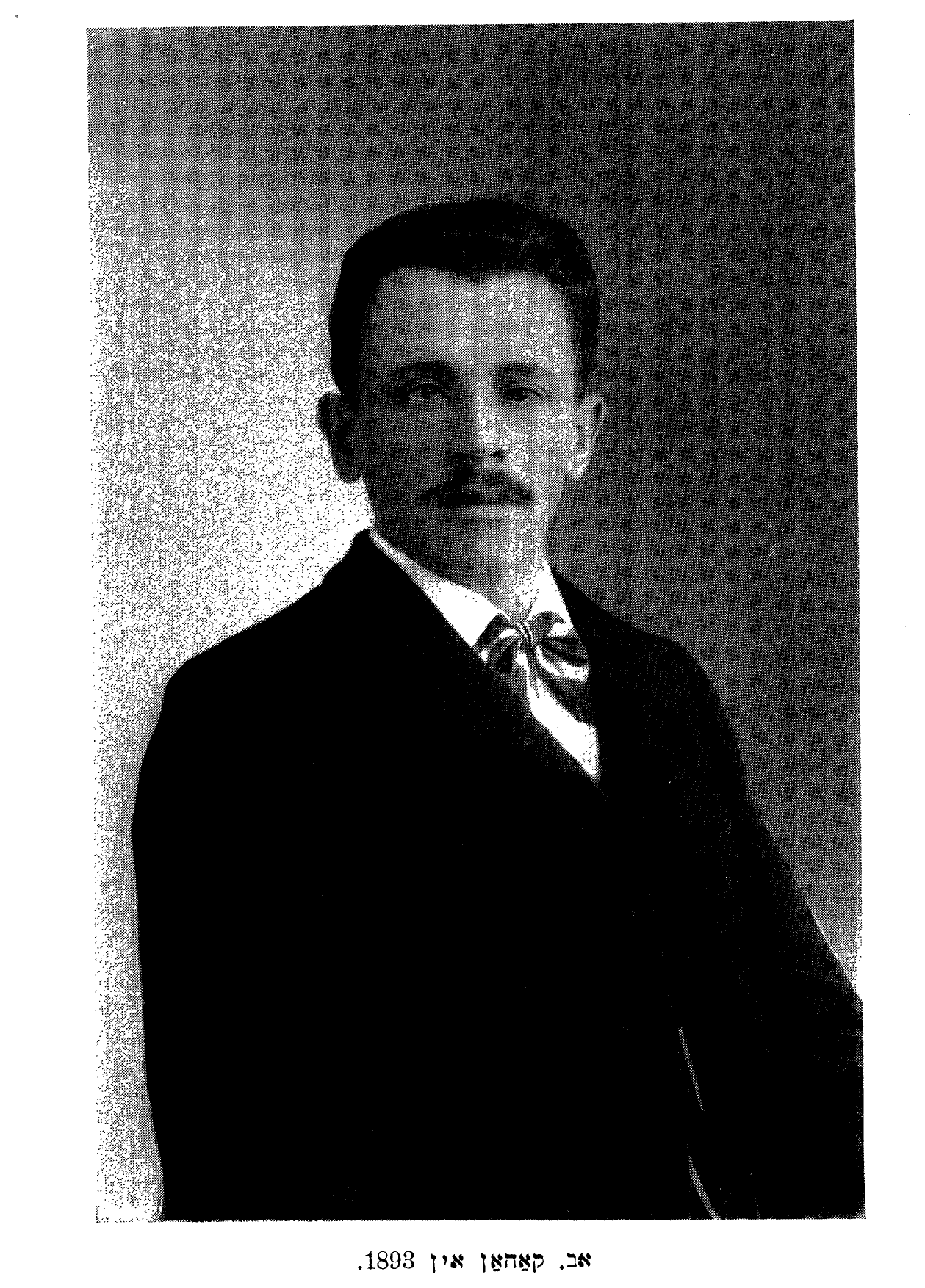
(plate; bound in the original between pp. 346–347)
The economic crisis, which had begun to make itself felt even before I had left for Europe, had grown much worse in those several months. I found terrible unemployment and want. The "Arbeiter Zeitung" was printing appeals with headlines such as "Hunger riots in the Jewish quarter; help! help! help!" and articles in which the crisis was explained from a Marxist standpoint.
When we were in the midst of the great Homestead strike of 1892, I mentioned Pinkerton's detectives. Now, in 1893, this same Pinkerton declared in a public statement that, because of the crisis, his firm was very busy; that many capitalists were turning to him for detectives to protect them against the hungry. Rich people were uneasy, nervous.
It goes without saying that this was an advertisement. By it he meant to frighten the rich, so that they would turn to him for detectives. But what he related in this statement was true.
Some of the millionaires contributed to the relief funds. Carnegie, for example, the king of the steel magnates, promised to give as much as all the other Pittsburgh capitalists together would give, on the condition that it should not cost him more than half a million dollars.
The legislature of the State of New York adopted a resolution that the government should give a quarter of a million dollars for the unemployed. And the legislatures of other states did the same.348The "United Jewish Trade Unions" organized a relief committee with a headquarters, or "relief station," in our Labor Lyceum, 91 Delancey Street, where the editorial offices of the "Arbeiter Zeitung" were located. The place was always full of the needy. They distributed food, took in donations, and organized relief work in the tenement houses.
The secretary of the trade unions was then Yankev Milkh (earlier it had been Bernard Weinstein), and he was the manager of the relief station. Taking part in this work, together with the trade unions, were the socialist sections.
The anarchists held a mass-meeting, at which they condemned all of our relief work. They demanded that the workers be called to an uprising. They were not content with their mass-meeting. They also put out proclamations with bitter attacks on us.
In his "History of the Labor Movement," Herts Burgin gives the following extract from the writing that the Jewish anarchists then put out to the unemployed of New York:
"In this leaflet we do not wish to speak of the capitalists... Here we wish to condemn our so-called true friends, the representatives of the people, the priests of freedom, who have their temple at 91 Delancey Street; we mean the social democrats...
"We must condemn them... We must tear off them the beautiful mask in which they show themselves to us and to the world... Away with such swindles from the field of the social struggle!
"Down with swindlers and humbug!"349The anarchists tried to disrupt the meetings that were called in the interests of the unemployed. At the largest such meeting, a brawl broke out between the social democrats and the anarchists. Our people began to protest against one of their speakers, and from that it started.
This was on the 9th of February, 1894. All day long there had been a great demonstration of the unemployed through the rich streets, and at the end of the demonstration the mass-meeting took place. The Socialist Labor Party and the United Jewish Trade Unions took part, together with the Central Labor Union. The following speakers were announced: the president of the American Federation of Labor, Samuel Gompers; the president of Columbia College, Seth Low; Daniel De Leon; Ab. Cahan; Stanley Coit; and Henry Weismann.
The clash arose over Henry Weismann, a German-American labor leader who played the role of a revolutionary anarchist and of a reactionary union politician at one and the same time. He was a man of some thirty-odd years, not tall, with a handsome, clever, round face, and he was a good speaker in English, as well as in German.
It must be noted that the reactionary leaders of the English-speaking unions used in certain cases to help the anarchists in their fight against us. For we demanded that workers should not go along with the corrupt politicians, but should work for an independent workers' party (the socialist one), and among the reactionary union leaders there were "fixers" of the corrupt capitalist parties. The anarchists, however, were350against a political workers' party. They railed against every sort of political activity; chiefly, however, against ours; and for the American union leaders, who were tied to capitalist politics, this was a support against our agitation. As for Henry Weismann, he was, as I have said, both an anarchist and a politician of the Tammany type, like these union leaders. He was an anarchist of the same cut as Garside, and he confused the anarchists' heads even more than Garside. And so they took him under their wing. He stepped forth against us. That was enough for them.
To the great mass-meeting he came to speak in the name of the Central Labor Union, where he represented the German bakers' union. When he appeared, several of our people began to shout: "Faker! boodle-anarchist! grafter!" The anarchists defended him, and a tumult broke out, in which fists came into use.
I wrote articles and appeals for help about the crisis; also pictures and scenes. On the first of January, 1894, for example, the "Arbeiter Zeitung" printed a sketch of mine of a "bread-line" on the Bowery, where a long row of people would stand for many hours, waiting for a piece of bread. I also described a scene of wretched paupers huddling close to one another, having neither home nor food.
The news page of the "Arbeiter Zeitung" was full of the crisis. One article on such a page bore the headline: "Hunger is growing, the millionaires are uneasy."351At that time a well-known American Protestant clergyman named Parkhurst was very active, attacking the police and exposing its corruption. He began his campaign by showing that it took regular wages from houses of ill repute. As a result of his investigations, several of the most important captains and inspectors of the New York police were officially charged. Now, during the time of the crisis, Dr. Parkhurst came out against the district attorney (prosecutor) Nicoll, because he kept postponing the cases against these tavern-keepers. To this Nicoll replied quite openly: "Now is not the time to drag the police into court. That would give them a bad name. The country is now unsettled, and the police have to protect the capitalists from attacks. If they were now to lose their good name, it would be dangerous."
Parkhurst's investigations and attacks on the police made him one of the most famous men in America. People used to make fun of his investigations. "Sin-sniffer" they used to call him. But in their hearts they had the highest respect for him.
We socialists, too, used to mock his "sin-hunting." But he was a strictly honest man, and he carried on his fight because with his whole heart he hated corruption. It was not the houses of ill repute that were the chief cause of his anger, but the fact that the police were almost an open partner in this business.
He also took an interest in the "sweating system," and in the company of B. Weinstein he visited several sweat-shops. Once Weinstein352brought him up to me at 91 Delancey Street, into the tiny little room where the editorial offices of the "Arbeiter Zeitung" were. We fell into conversation.
"I am not a socialist," he said to me, "absolutely not, but I see that you are honest people and true idealists, and I have respect for you."
The labor movement of New York chose a committee to go to the mayor, to demand that the city do something for the unemployed. The mayor was then a Tammany man named Gilroy. The members of the committee were: James Dailey, as the representative of the Central Labor Unions; James O'Neill, as the representative of the "Knights of Labor"; Daniel De Leon, as the representative of the Socialist Labor Party; and I, as the representative of the Jewish unions.
In the conversation we had with the mayor, De Leon set out to show him that the working class creates all the wealth of the land. To this Gilroy replied, quite politely, that now was not the time to occupy oneself with general political-economic questions; the matter at hand was to do something practical on the spot.
I thought to myself that the mayor was right. He was indeed a Tammany man, and De Leon indeed represented the Socialist Party; but there was, after all, no sense in speaking of the injustice of the capitalist system on such an occasion. At first I did not say so, but on coming out of City Hall I expressed my opinion. De Leon grew angry. But he smoothed it over at once, and we went in to eat lunch in a restaurant (on Park Row near the Brooklyn353Bridge), which was then well known, but which has long since ceased to exist.
The conversation that took place between us in this restaurant had an effect on my further relations with De Leon, and through him on my relations with the "Publishing Association" that issued the "Arbeiter Zeitung"; but this matter belongs to a later chapter.
That year America was seething with Coxey's Army. A certain Coxey, a horse-dealer from the West, set about organizing throngs of the unemployed with the aim of marching with them to Washington. His goal was to demand of the president and of Congress that they do something to put an end to the crisis. Coxey was half idealist and half adventurer. He believed in the silver remedy, of which I have told in connection with the summer I spent in Boston. "General" Coxey, as he was called, held the view that if silver coins were recognized by the government as real money, exactly like gold, the farmers would get higher prices for their products. Business would improve. There would be more work in the factories, and the crisis would cease. He expressed this idea in an appeal that he put out to those who could not find any work — an appeal that they should gather around his banner. He declared that he would come to Washington with an enormous "army of the unemployed," and the newspapers were full of him every day.
The number of people who came to him, however, was quite small. At first only a few hundred; afterward his "army" grew a little larger; but no354significance it never attained. The result was that the newspapers began to make fun of it, and it fell apart. By the time it reached Washington, it had a thoroughly pitiful appearance.
That winter I made an agitation tour, and on this trip I encountered part of the "Coxey Army." It was a pity to look upon it.
[טאָפּיק] The "Tsukunft." — Morris Winchevsky. — A. Liessin. — "Bontshe Shvayg." — A lecture tour. — Frank Gessner. — "Rafael Naaritzokh." — The "Abend Blatt."
At a party convention, or convention, of the Jewish sections of the Socialist Labor Party, which took place in Newark in the New Year of 1894, I was unanimously elected editor of the monthly journal "Tsukunft" (at the same time I remained editor of the "Arbeiter Zeitung"). The journal did not belong to the "Publishing Association," as the "Arbeiter Zeitung" did, but to the Jewish socialist organizations; and the proprietor was actually the convention or "party day" of the Jewish movement, which used to gather every year in a different place.
Under the previous editorship the "Tsukunft" had not appeared regularly. It was called a monthly journal; but it came out once every two or even three months. Since I took over the editorship, the "Tsukunft" appeared punctually on the first of every month. So it continued for the entire three years355that I edited it. I conducted it as a monthly devoted to popular-scientific articles, journalism, literature, and literary criticism. I demanded of every contributor that he keep our masses in mind. I was convinced that to provide popularizations of science and very popularly written articles on political and social questions was our most important duty; that in this lay the most important part of our work.
From London there emigrated to America Morris Winchevsky, who was well known among the Jewish socialists of America through the London "Arbeiter Fraind." Upon coming here, he wrote several articles in the "Arbeiter Zeitung" and in the "Tsukunft." In the number of the "Arbeiter Zeitung" of February 1894 he began to print his feuilletons "The Battered Thoughts of a Crazy Philosopher," which had first made a name for themselves in Hebrew (he had written them in a Hebrew newspaper that came out in Koenigsberg, Germany, at the end of the seventies), and later in Yiddish in the "Arbeiter Fraind."
A month later I published in the "Arbeiter Zeitung" a poem, "Gazing at the Stars," by A. Liessin. This was his first printed poem. His real name was Abraham Walt. When his manuscript came to me and I saw talent in it, I accepted the poem for printing. But since he was then still living in Russia, I believed it would be more practical to sign a disguised name. Walt is close to "Wald," and Wald is in Russian "lyes"; so I gave him the name Liessin, and so it356remained as his "pen name." Under this name he became famous.
That same winter I. L. Peretz sent me from Warsaw the manuscript of his "Bontshe Shvayg." The feuilleton appeared in the "Arbeiter Zeitung" of the 9th of March, 1894.
In the spring of that year the National Executive Committee of the Socialist Party sent me out on a lecture tour in Yiddish and English. I visited Cleveland, Pittsburgh, Toledo, St. Louis, and Chicago. Except for Chicago and partly Pittsburgh, the meetings were arranged by the German comrades of those cities, and for the most part I in fact stayed with them. Taking a room in a hotel was at that time not yet a quite ordinary thing for a socialist speaker.
In Pittsburgh the American comrades already had a branch, and a Jewish branch had been organized there by the above-mentioned M. Sussman, who two years earlier had moved there from New York. I held there two English lectures and two Yiddish ones. At that time there was going on there a strike of Jewish workers who were employed at "cheroots" (long thin cigars). The leader of the strike was also Sussman.
In Pittsburgh I visited the great glass factories, steel factories, and other establishments of American big industry. These factories I afterward described, with socialist agitational commentaries, in correspondence to the "Arbeiter Zeitung." I explained, for example, how glass is made, and in doing so I brought out the357idea that, since in such great factories thousands of people work together, this means that the work is done s o c i a l l y, in other words — in a socialist manner; only the fruit of the labor is distributed not socialistically; thus this is a contradiction that must be removed.
In Pittsburgh we then had an interesting comrade by the name of Frank Gessner, who had influence among the American workers there. His parents were Germans; he, however, had grown up in America. He spoke like a genuine American and understood well the American character and local life in general. He was then one of the most important personalities in our American movement. He drew his livelihood from a position he held as editor of an English trade organ (of the glass workers, it seems) in Pittsburgh. He wrote well and spoke well.
It was he who led me through the great factories. Walking about the city in this way, we talked about the movement and about various other matters. He criticized De Leon's tactics. "Too much vinegar, too much vinegar!" — he said, making a wry face and laughing at the same time. He was a born humorist, and his speech was filled with a peculiar wit, which expressed itself in his face as much as in his words.
— I said that to De Leon himself, — he confided to me, — he didn't like it. Ha! — ha! — ha!
Speaking to me in this way, Gessner stopped several times, closed one eye, and burst out laughing aloud.358Such a habit he had. His laughter, however, was good-natured.
When I returned from my trip, a special mass meeting took place, at which I related what I had seen in the socialist movement among the Americans. Our movement among the Americans was quite small. Our party, however, had made a beginning in several cities, and it seemed to us that the beginning was a very promising one.
In June, 1894, there began in the "Arbeiter Zeitung" my tale "How Rafael Naaritzokh Became a Socialist." The chief purpose of the series was socialist propaganda. It contained, however, a good deal of belles-lettres. It had a great success.
In the "Arbeiter Zeitung" of the 27th of July, 1894, there is an announcement, above which stand the words: "A daily paper to the Arbeiter Zeitung, its name is 'Abend-Blatt.'"
The announcement takes up nearly a column, and it explains the necessity of having a daily socialist newspaper in order to combat the reactionary "daily Tageblatt," which works in the interests of manufacturers, sweat-shop bosses, and capitalist political parties. The announcement was written by me, after the "Arbeiter Zeitung Publishing Association" had decided to bring out the daily newspaper. The name "Abend Blatt" was also mine.
In the following numbers of the "Arbeiter Zeitung" there was printed a coupon and an appeal regarding support to help found the new newspaper.
359[טאָפּיק] A stormy workers' struggle. — Eugene V. Debs. — Governor Altgeld and President Cleveland. — "Revolution"?
In the summer of that year the country was stirred up by a great workers' struggle, and then for the first time there surfaced the name Eugene V. Debs, who has since become so popular and beloved. The American railroad workers had gone out on strike, and Debs was their president and leader. In the "Arbeiter Zeitung" of the 13th of July there is his portrait from that time — a picture of a young man.
The struggle began at the factories of the Pullman Company, which manufactures and runs all the sleeping cars of America. From there it spread among the railroad workers of many states. The center of the struggle was the state of Illinois.
In the same number of the "Arbeiter Zeitung" of the 13th of July there is an article about the letters that Governor Altgeld of Illinois wrote to the President, Grover Cleveland, and that Cleveland answered him. Cleveland had sent United States soldiers to protect the scabs and even to take the place of the strikers. Altgeld protested. It was over this that they had a correspondence. According to the Constitution of the United States a president may not send any United States soldiers into any state unless the governor of that state turns to him for help (each state is in internal matters a self-governing polity with an army of its own — the state militia; and as long as it360feels that it can manage without outside help, one may not meddle in its affairs). Governor Altgeld had not turned to the President for military help. Therefore, he asked, by what right does the President send soldiers of the general army into Illinois.
To this Cleveland answered that he was sending soldiers to protect the mail, which is carried over the railroads, so that the mail could run regularly. The mail does not belong to each state separately, but to the united government of the United States. Therefore, this supposedly meant that the President was not meddling at all in the internal affairs of Illinois, but in an affair of the general government.
A mail car was attached to every train, to hundreds of trains, which never carried any mail matter at all. And with this pretext they all were guarded with soldiers of the United States army.
The "headline" over the article in the "Arbeiter Zeitung" was:
"It smells of revolution! President Cleveland sends United States soldiers. This kindles a fire of insurrection among the workers."
"Twelve thousand five hundred miles of railroad stand still. Trains for miles on end in flames."
"The whole state of California in the hands of the strikers."
"All the unions respond with a resolution about a general strike."
The United Hebrew Trades adopted a resolution of sympathy for the strikers, and a great demonstration was organized. The same number of the "Arbeiter Zeitung" has a long lead article with my361signature. The headline of the lead article is "Revolution?".
I begin with the remark that several American newspapers speak of the great railroad strike as a real revolution and as the greatest internal struggle since the war between the North and the South. I explain that one ought not to be hasty in giving it the name of revolution, and that under the present circumstances America is not capable of a social revolution. The strike is a sharp class struggle, but for the time being the American masses still have no relation to socialism. Private property is something holy to them. But if the present struggle between capital and labor, I say, is not itself the beginning of the social revolution, it is proof that things are not far from it.
With this strike the whole country seethed. The capitalist newspapers devoted many columns to it, and the "Arbeiter Zeitung" was naturally full of it. We too printed large pictures about the strike. One picture portrayed how the American artillery guards a railroad station; another picture — how the police shoot at strikers, a third — how soldiers shoot at strikers.
With the name Debs, which rang of socialism, the man who bore that name still had no conception of it. He made on us, however, the impression of a truly honest and devoted workers' leader. We were accustomed to attack every American workers' leader who showed no sympathy toward our movement, or at least to doubt his sincerity. Quite different was our attitude toward this American workers' leader.362he had won our highest respect. When we spoke of him in a friendly tone, it was not solely because of the struggle with which he was then connected; we felt that way toward him personally as well. He bore himself with a kind of courage in which one could sense the inspiration of an idealist. With his speeches he set fire to the hearts of his listeners.
Governor Altgeld also won our respect. He was not content with his protest against Cleveland's stance. He issued an appeal for support of the strikers of the Pullman Company. None of this actually surprised us, for a year earlier, in June 1893, that same Governor Altgeld had freed three of those who had been condemned in the Chicago anarchist trial: Samuel Fielden, Michael Schwab, and Oscar Neebe, who had been sentenced to 15 years (see Volume Two, pages 248—249 and 278—279), declaring in doing so that the verdict had not been a just one. The American press attacked Altgeld.
He was one of the most remarkable men who ever appeared in the public life of America. He was no socialist. Simply an honest and courageous man. For his brave deeds he suffered much. He was ruined.
When a member of an idealistic party sacrifices himself for his ideal, he is a hero; when a man fights and sacrifices, alone, without a party, without the moral support of an organization, simply because his convictions drive him to it, his heroism is a double one. Such heroism Altgeld displayed.
He was ruined and no one even363knew of it. No one looked back. This remarkable personality was soon forgotten.
It will be interesting to the reader to know that in Altgeld's private law office there then worked a young lawyer by the name of Clarence Darrow. This is the same Darrow who today, as these lines are being written, is one of the most famous orators and fighters for truth and justice in America.
The citizens of New York were that summer interested in an investigation into the corruption of New York city officials and politicians. A committee of the Albany Senate (the Senate of the parliament of the State of New York) conducted in New York a public hearing, at which many accused persons and witnesses against them were brought. The chairman of this committee was Senator Lexow, and therefore the committee became known as the "Lexow Committee." The majority of the Senate in Albany consisted of Republicans, while the government of the city of New York was in the hands of the Tammany politicians. The Republicans wished through the hearing to show how corrupt Tammany was.
The corruption of the New York police had then truly reached unbelievable degrees. Disreputable houses were open everywhere and the police were a partner in all these businesses.
The most repulsive district of the city was then Eleventh Street, right in the very middle of the Jewish quarter.364In the disreputable houses the windows were lit at night with red lamps, and from then on stems the expression the "Red Light District" (the quarter of red lights). Eleventh Street was the center of that shameful district, and the proprietors of the disreputable houses and the "cadets," or "alphonses," as one calls the repulsive creatures who live off the shame of the women whom they enslave, ruled there with unrestricted power. It was literally a danger to pass through that street. Men would simply be seized in the street and dragged into the "red light" houses, and sometimes robbed and even beaten as well. To cry out to the police made no sense. Even when a policeman stood right there, he too would not intervene, unless he helped to beat the victim, or dragged him to the station house on false charges.
The Lexow Committee summoned to its investigation police captains, police inspectors, and various other important officials. The New York newspapers were full of reports and pictures of the investigation. I attended many sessions of the investigation.
The lawyer whom the Lexow Committee engaged for its inquiry was a New York attorney by the name of Goff. At the sessions of the hearing he played the role of a prosecutor.
I was present when great police inspectors were caught by the hand, so to speak, with proof that they received regular salaries from houses of prostitution. Goff put questions to them, and they thrashed like fish in a net, denied, contradicted themselves, got tangled up, stammered nervously. A few of them confessed to everything.
A Democratic state senator by the name of Resch, a365Tammany man of Second Avenue, was brought to the pillory of shame as a lawyer and bribe-broker of all the prostitutes of the Bowery and of Second Avenue. The more he tried to refute Goff's proofs against him, the deeper he fell. He came down from the witness stand red, frightened, crushed. He had scarcely the strength to leave the hall.
That afternoon the "Evening World" had a caricature drawing, on which was depicted how Resch comes in to a barber. When he sits down in the chair he is a handsome, healthy young man. When he climbs down from the chair, his face is entirely cut up, bloodied. In the role of the barber stood, in the picture, lawyer Goff. Beneath the picture was the caption: "A Close Shave" (the barber had, poor fellow, cut him up). Similar caricatures and reports one had every day.
I used to present this Resch caricature at our meetings and to show that under present-day society corruption is an entirely natural thing; that the sort of corruption which Lexow was investigating is child's play compared to the robberies and other crimes through which men become millionaires. "The whole capitalist society ought to be taken to the barber!" I used to exclaim.
Through his activity at the Lexow hearing Goff became famous, and the Citizens Union (the organization of respectable citizens which combated Tammany Hall) put him forward as its candidate for "Recorder," the highest judge of the criminal court General Sessions. Tammany put forward a man of its own for the same position; he was defeated. Goff was elected.
366We wrote much about an anarchist sensation with which France and the whole world were seething. The president of France, Carnot (a grandson of one of the important personalities of the French Revolution), was stabbed to death by a young Italian anarchist by the name of Santo Caserio. We printed Caserio's picture and the details of his trial.
When Caserio was condemned to death, he cried out: "Long live anarchy!", and when he was laid beneath the knife of the guillotine, he cried out: "Courage, comrades! Long live anarchy!" In our articles we spoke of the young man with great respect; but we pointed out how childish it is to believe that through the murder of a president one will bring nearer the liberation of the working class.
In connection with that same sad story we heard for the first time, from Paris, the name of Jean Jaurès, who later became, among socialists and other progressive people of the world, so great and dear. His name is mentioned in the "Arbeiter Zeitung" (in the issue of the 31st of July, 1894) as the name of a deputy who in the French parliament spoke about the anarchist deed not as a defender of the government, but as its opponent.
It was then still fresh, the story of the367famous Panama Canal swindle. France had tried to build the Panama Canal between North America and South America, and this enormous undertaking turned out to be a vast nest of thievery and graft. And so Jaurès connected the anarchist deed with the Panama swindle.
"Robberies of this sort are guilty of such deeds as Caserio's," — he said, — "the corruption of capitalist rulers calls forth a protest among honest people; it brings them to despair."
In our movement there then took place a long debate over the question which, thirty years later, namely in 1924, stood on our agenda. The question was: whether the Socialist Party should go together with an independent political party of the American unions. I then (in 1894) wrote a series of four articles about the question. The sum total of my opinion at that time on the matter consists of the following: the duty of the Socialist Party would indeed be to go hand in hand with a political party of the American unions. This is, however, said for when the American unions mean it seriously. Unfortunately, though, they are too deeply sunk in capitalist politics, and their leaders are themselves boodle-politicians. Every time they speak of a workers' party, they mean only to exploit their influence over the workers in order to get votes for the Republicans or Democrats, and through this to obtain political advantages for themselves personally.
Since then more than three decades have passed. Since then the circumstances have partly changed, but not as we had imagined.368A story which strongly interested us socialists and all other radicals was connected with the name of Hugh Pentecost. This was an American clergyman who in the course of several years had shown sympathy with anarchism and given lectures of an anarchist character. He did not preach any direct uprising or the use of violence, as Johann Most did. His anarchism was of the "merely theoretical" sort.
He was married to wealth. His wife was the daughter of a cannon manufacturer by the name of Gatling (the inventor of the Gatling gun). Mrs. Pentecost was a good singer and a beautiful woman, and Pentecost himself was also handsome, both in face and in figure. He was a brilliant orator, and Mrs. Pentecost used to sing after each lecture. The hall used to be packed at each of their gatherings. So it went on for about four years. Suddenly these lectures stopped. Pentecost began to study law.
Then, in the year 1894, at which we are stopping here, the newspapers printed a sensational report that Pentecost was renouncing entirely his anarchism and his attacks on the capitalist system, and that the District Attorney of New York (Colonel Fellows) had appointed him one of his assistants. In Pentecost's new declaration, as it was conveyed in the newspapers, the capitalist system is presented as a good and just one.
This was for us an unpleasant surprise. Pentecost had preached anarchist ideas, not ours, but we all esteemed him. Now, then, he had turned about and gone over to the enemy. We condemned him as a traitor. The press, again,369sharply criticized Colonel Fellows for why he was taking such a man into his office.
After that there was printed a report that Pentecost was resigning from his post as assistant district attorney. We then explained this as the result of the attacks which the capitalist newspapers had made on Colonel Fellows. We thought that Colonel Fellows was forcing him to do it. It turned out, however, that Pentecost had withdrawn of his own accord.
He was a man of no firm character; and the truth is that he renounced his earlier opinions under the pressure of his wife's family. In the substance of anarchism he had really begun to doubt. But that the capitalist system is a correct and just one — such an opinion he never held. And so, when there arose an uproar and he was put forward as a traitor, he resigned from the post that Fellows had offered him.
Later he began to show interest in the socialist movement. He did not become active as a member of our party; he did, however, help in our agitation, and every one of us was convinced that he meant it with his whole heart.
That summer I again visited Washington. I gave a lecture in English and an agitation speech (at custom-tailors') in Yiddish.
In Washington there then lived Colonel Hinton, the Englishman with the long beard and long hair, with whom I was closely acquainted through our American section in New York. He had obtained an important post with the government; and it was clear that he had shown himself to be a loyal member of the Democratic370party, which was then in power. I met him on the street, and he urged me to come and visit him. To do so I considered a sin. I regarded him as something of an apostate. That he was not a man of strict principle I had always known. But he was a friendly, a warm-hearted comrade; in short, I committed the sin and visited him.
In New York he had lived poorly and had dressed poorly. Here he occupied a large, beautiful, and beautifully furnished house, with menservants and maidservants. He and his wife were well dressed, and at the table a good bottle of wine was served.
— This is how one ought to live — he said to me — every man will live this way in a socialist society. This is a sample of socialism, where all will work for the government and everyone will live decently, comfortably, and beautifully.
I recalled the words of Walter Vrooman, our former "by-orator," who once said to me: "I hope to have a great, rich estate with many menservants and maidservants. I will live like a monarch; and while a lackey is pulling on my boots for me, I will say to him: 'Do you see? You are a slave to me. Why? Because I am rich. Such a system is no good! It must be abolished! Do you understand?'"
Hinman probably sensed that in my heart I was laughing at his remark; so he tried to repair the impression.
— I am as true to my socialist principles as ever — he said — the government knows that I am a socialist. It needs me for my expertise in371irrigation (how to drain swampy places), and for that it pays me. That is all.
[טאָפּיק] At the "Arbeiter Zeitung." — Stereoscopic pictures. — S. Feskin. — D. Magidov. — B. Gorin. — Z. Libin. — A. Kaspe. — A strange Jew. — A socialist alderman.
I went on with my series. I printed articles about the Jewish Inquisition and other "pictures." Under the heading "Worth Knowing," I gave articles about tobacco, about glass, about "the first mirror in the world," and other subjects. Most of these articles I wrote myself. A few I commissioned from contributors.
To my several pen names I added another that year: Ben Sholem (my father's name was Shakhne; but at the Torah scroll he used to be called up as "Reb Sholem"). I wrote an article about how the Russian Czar Paul was strangled. I began a series under the title "Short Lessons on the Beginnings of Socialism."
That year Miller and I introduced lectures that were illustrated with "stereoscopic pictures" — pictures on little glass plates, which are greatly enlarged by a stereopticon.
To the "Arbeiter Zeitung" and the "Zukunft" I acquired as contributors S. Feskin and D. Magidov, who often wrote popular articles about natural science.
B. Gorin used to write sketches and longer stories for us. From Z. Libin we used to receive feuilletons.372Little by little, however, he began to write short stories, and his popularity grew rapidly.
A. Kaspe had returned from Russia, where he had finished the natural-science faculty of the University of St. Petersburg. Some time after he came to New York, he took up the study of medicine. I invited him to write popular-scientific explanations for the "Zukunft." And he gave the journal several articles about chemistry.
When I recall the efforts I made then to increase the number of contributors to the "Arbeiter Zeitung" and to the "Zukunft," there comes alive before me the figure of an intelligent Russian Jew who brought me an article.
I had met him as a pupil in the evening school. He was of middle age. He was poorly and not too tidily dressed. His coat was thoroughly stained and his collar not too clean. But his little black beard was always nicely combed, and he held his head proudly upright. At first I thought he was a haughty man. He carried himself as though it were an honor to America that he had come here. And when I first told him to read, he did so with such an air, as though he were the teacher and I the pupil. When I had a conversation with him, I learned that I had been mistaken. He was a soft, a downcast man, and very polite. Too polite, even. He spoke Russian to me, and every moment he would give a little bow and say: "Izvinitye, pozhaluysta!" (Excuse me, I beg373you). Russian he spoke superbly. His "r" sounded like a "g," but that was just what made his pronunciation a genuinely Great-Russian one.
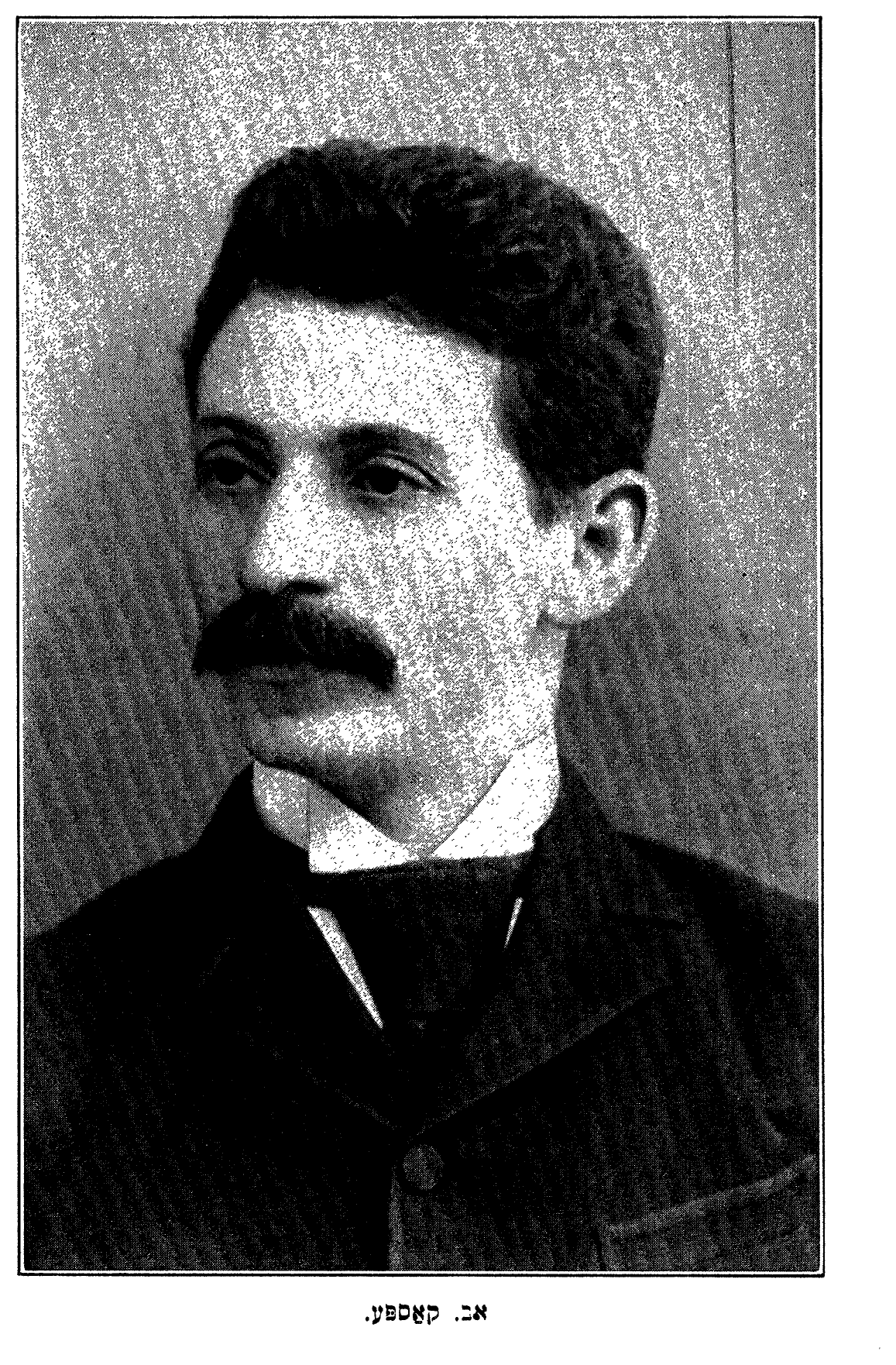
(plate; bound in the original between pp. 372–373)
Once he asked me whether I would print an article of his in the "Arbeiter Zeitung." I asked him to show me what he had written, and he brought me a feuilleton. When I came home and began to read the manuscript, I burst out laughing aloud. His Yiddish was a comical hodgepodge of Russian expressions translated word for word into Yiddish. One phrase came out in such a form that in Yiddish it had an indecent meaning. But one could see that in Russian he would have been no bad writer. When in my thoughts I translated his outlandish Yiddish back into Russian, I felt that the feuilleton contained a quite tolerable humor. I improved the language. In some places the humor then lost its flavor, because it was bound up with the Russian language. But it still remained a readable article. When he heard, however, that I had made changes, his face expressed pain.
— But back home in Russia things are not done this way — he said, somewhat like a frightened man, and he apologized to me ten times over for saying it.
— But this Yiddish is no Yiddish at all — I answered — to print it like this would have been impossible.
— Is Yiddish even a language? — he said with a submissive smile — is there even, in Yiddish, a "what one may do" and a "what one may not do"? So long as one understands what is meant. That is all one ought to demand.374With him it was a question of conscience: a man with self-respect must not allow an editor to alter his language. Such was the notion he had. He asked me to return the manuscript to him, and he would try to write the same thing over in good Yiddish; and if it still would not do, I should show him how to improve it, but he must do it with his own hands. He had made me curious. I wanted to become better acquainted with him. But I never saw him again. Another pupil, who knew him a little, explained that he had gone off to another city. In New York he had been unable to find any employment, and he had suffered greatly.
That year (1894) there came over from Russia a young man by the name of Abramowitz, an intelligent, a likable fellow. He made a good impression on everyone. He held a lecture for us in Russian, and he often used to spend time with us at the Liberty Lyceum. Afterward he went off to the West, where he changed his name to Leonard. He settled in Minneapolis and there became an influential lawyer, and began to play an important role in American public life. In the socialist movement he always remained active.
That same year the socialists won their first victory at the elections. Our party elected a member of its own, one Matthew Maguire, as alderman in Paterson, New Jersey. He was elected with 895 votes against 886. In those days, however, this was a great victory.
375[טאָפּיק] Opera.
In the few years to which this chapter refers, I often went to the opera. By now it was no longer at the "Academy of Music," at the corner of 14th Street and Irving Place, where I had first heard Patti, but at the Metropolitan Opera House, which had been built on Broadway, between 39th and 40th Streets. From Europe there had then come several great singers, men and women. Among the foremost were the Polish tenor Jean de Reszke and his brother, the bass, Edouard de Reszke. Both of them were world celebrities. And Jean de Reszke was probably the greatest singing artist in the world. From Paris there had also come a famous baritone by the name of Lassalle (Jean de Reszke had, properly speaking, also had a baritone voice. But he had "broken it over" into a tenor). There would also come over the Italian Tamagno, who is reckoned one of the three greatest tenors of our time. Jean de Reszke's voice was not so powerful and singularly beautiful as Tamagno's; but it was beautiful, and the main thing was how he used it. He was an artist through and through. For several years he was the central figure of the New York opera.
From Paris there also came Emma Calvé, a mezzo-soprano singer, who had made herself famous chiefly in the leading role of the opera "Carmen," and the Italian singer Scalchi, who had the most beautiful and richest contralto in the world.
The Australian singer Melba was then376at the highest stage of her career. Patti was no longer young, and Melba was then the queen of the world's opera, and she sang several seasons at the Metropolitan. Nordica, also a famous soprano, likewise took part. To them must be added the Polish singer, Madame Sembrich. Some years earlier she had been reckoned the most beautiful coloratura soprano next to Patti; now, already in her later middle years, she was still a wonderful singer.
America itself had a marvelous singer, with one of the most beautiful and most singular voices in the world. Emma Eames was her name. Her voice used to enchant me, chiefly in the role of Micaela, in "Carmen."
This was truly a remarkable company. So great a number of wonderful singers all at once the New York opera never had again in later years. It had a Caruso and several other brilliant artists. But so many musical rarities in a single company — never.
Through this company New York became, as if all of a sudden, a musical city. This was felt especially among the Germans, the Jews, and the Italians (the last had then begun to come to America in great numbers). Poor people stinted themselves of food in order to buy a ticket for the opera. This was at the very height of the crisis, when masses of people had no employment. I knew of Jewish musicians who pawned something in order to go and hear the de Reszkes and Melba.
My enthusiasm for the opera I had to thank my wife for. From my father I had inherited377a passionate love of music. I have a good ear. And a beautiful melody, a well-executed choral singing, or orchestral music has an intoxicating effect on me. My musicality, however, is not a developed one. In this respect my wife stands far above me. She knows more and understands more deeply. She has an inborn musical sense of a high degree, and she has always followed almost everything that took place in the musical world — in the opera, in the concert halls, and almost everything that the best critics wrote about it. She has a fine, intelligent taste and connoisseurship. The better music is a kind of religion to her, and she goes to an opera or to a concert just as a devoutly religious person goes to synagogue or to church.
Of the operas which we heard in those years, the ones I liked most were "Faust," "Carmen," and "Cavalleria Rusticana," which was then still a new work.
When I heard the intermezzo from "Cavalleria Rusticana," I believed that this was the melody with which a barrel organ had once enchanted me while I was going around selling Hartmann's electric scarf-pins. This was a mystery, and I carried it about with me until this year, when I inquired of my Italian comrade Sacerdoti, in Milan. He made an investigation, and old music connoisseurs explained to him that from the barrel organ I had probably heard a certain other melody, to which the intermezzo is somewhat similar.