Chapter Eleven
"De Leonism"
378De Leon's influence in the Socialist Labor Party grew quickly. A few months after our return from the Zurich Congress, he was already a complete ruler over it.
The more power he acquired, the clearer it became to some of us that this was a very harmful power. And, as we shall see, the future fully confirmed this opinion.
I am speaking here not only of the Jewish division of the movement, but of the whole party.
In the "Arbeiter Zeitung Publishing Association," a clash had developed precisely at that time, which split it into two hostile sides: the side of the board of management and a side that fought against it. The leader of the second camp was Louis Miller.
The conflict broke out while I was in Europe, and from the beginning it had a personal character.379Soon, however, it took on a matter-of-principle character as well. Still, had it been confined to the Jewish movement, it could have been settled. Miller demanded certain reforms. His demand was a just one, and insofar as it was practical, it would sooner or later have been carried out. As for personal animosities, those could have been "smoothed over." But just at that very time a bitter conflict broke out in the general party over De Leon. This — partly through my connection to the anti-De Leon struggle in the general party — became bound up with the dissensions in the "Arbeiter Zeitung Publishing Association," and our family peace in the Jewish quarter met the same sad fate as the peace in the entire socialist movement. De Leon brought in a spirit of internal quarreling, which worked upon the movement like consumption.
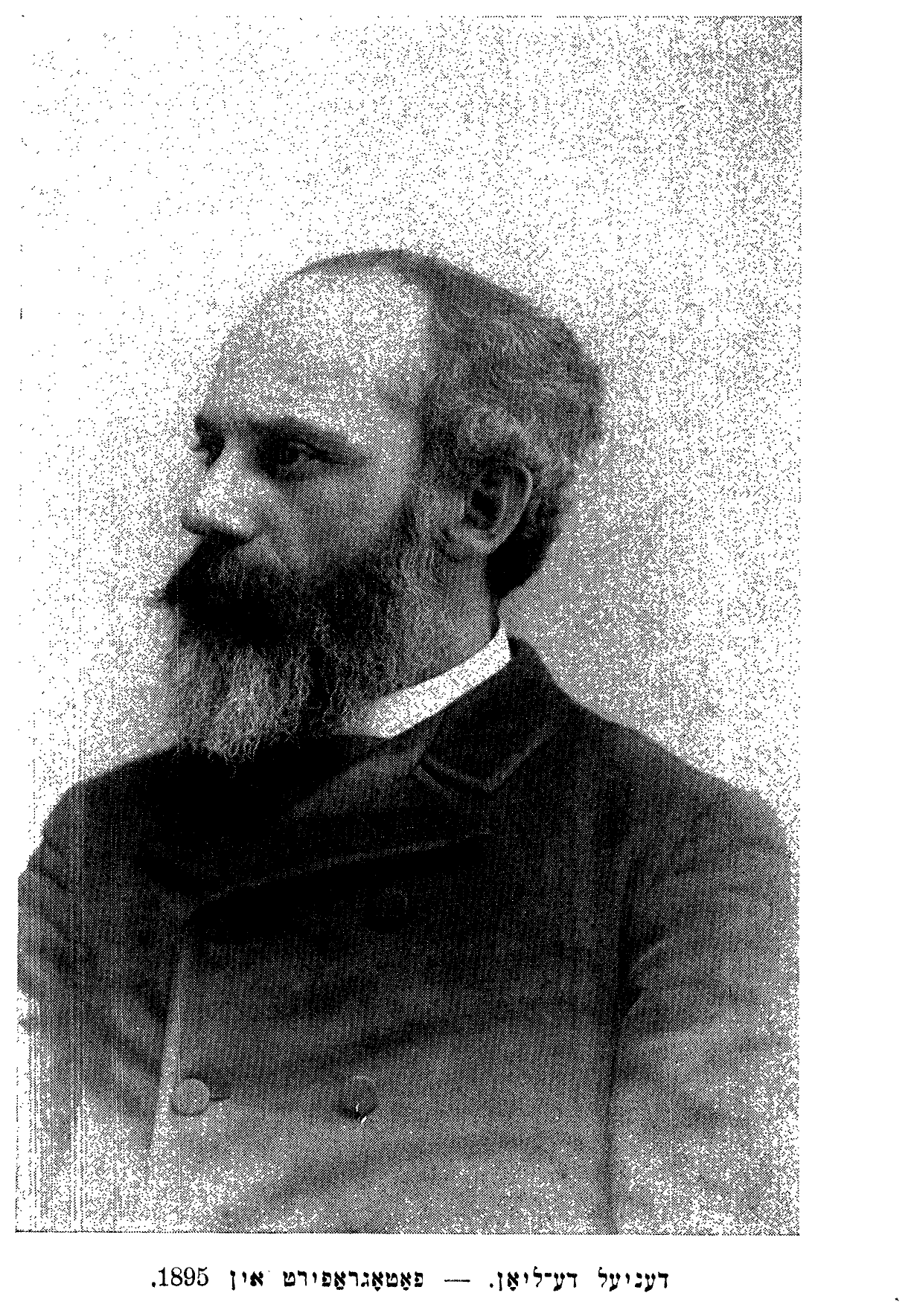
(plate; bound in the original between pp. 378–379)
In the beginning the trouble in the "Association" was a purely local matter. It had nothing to do with the De Leon spirit. But this local trouble soon became entangled with the whole De Leon tactic.
The board of management — that is, in effect, all the influential members of the Association — took De Leon's side.
At certain important moments of the clash it was partly a matter concerning me. I therefore believe that it would be best if I first relate what is to be found on the subject in Burgin's "History of the Jewish Labor Movement," and only then let the reader hear what I have to recount about the affair.380In investigating the matter, Burgin heard out both sides and also bystanders. I do not agree with everything he says, and his account is missing important moments. But insofar as he obtained the facts, he renders them absolutely impartially. For one who takes an interest in those several years of our movement and in the circumstances that led to the founding of the "Forverts," his version is an important contribution. And the same can be said, in general, of his entire work.
On page 373 (and further) we read the following:
"For various reasons, mostly personal, misunderstandings arose between some leaders of the Publishing Association and the editorial staff, and still later, disputes began in the Publishing Association between the supporters of the board of management and other members of the Association.
"The question was how to combat 'Gompersism' (that is, the conservative spirit of the American unions, insofar as it made itself felt in the Jewish unions). The board of management rather held to the opinion that one must combat every union in which the Gompers spirit prevailed, and as an organized group the board of management was able to carry through this line. It demanded, for example, of the United Hebrew Trades that it take a stricter stance toward the non-socialist unions. The opponents, in turn, who did not agree with such union tactics, accused the board of management of using its power for narrow party interests and harming the interests of the movement."
Further, Burgin recounts the clash381between Louis Miller and the board of management.
"Miller was at that time a trained lawyer and as such had a law office. Now then, a certain Jewish union in Brooklyn sent in to the 'Arbeiter Zeitung' a resolution protesting because he was neglecting one of their cases. The notice was printed in the 'Arbeiter Zeitung.' Miller wrote up a statement from his side; the board of management then also inserted a statement; but at Miller's request the then business manager of the 'Arbeiter Zeitung,' A. Ortman, took the notice out of the type before it was printed. Then the board of management sent one of its members to the printshop, and he put the statement back in. It was over this that a whole uproar began between the supporters of the board of management and its opponents *.
Under the heading "Daniel De Leon's Tactics and Methods of Struggle," Burgin writes:
"As we mentioned in an earlier chapter, some Jewish members of the Socialist Labor Party were already dissatisfied with the growth of De Leon's influence in the party. De Leon was, by his character, a man of an unbending, fanatical nature. According to his conception, a union must be socialist, and if not, it ought not to exist at all; an individual person could, according to his notions, be either a socialist or a faker; this or that person could be either with him or against382him. De Leon recognized no middle ground. Incidentally, he was relatively new in the socialist camp, and he was suffused with the fanaticism of a fresh convert.
"His stance toward the non-socialist unions was a very hostile one. The Jewish theoretical leaders of the movement came to recognize that with such a policy one could drive the masses away from socialism. They understood that if they were always to hold to this policy, they would never bring the Jewish movement closer to the American labor movement. They did not want to follow De Leon, who, however, had a strong influence over the board of management of the Publishing Association.
"Above all, the sections in the provincial cities were dissatisfied with this policy. In New York one could still find, among the workers, enough socialist-minded people to found a half-socialist union. In the provincial cities, however, it was harder to find such workers. Most of the workers were still 'raw' people, who first had to be agitated, to have explained to them the necessity of a union. And because of the hostile stance of the Socialist Labor Party, the socialists had no access to the workers.
"All these grievances and complaints were brought before the Jewish party day (convention) in Newark, New Jersey, on the 30th and 31st of December 1893 and the first of January 1894.
"At the party day the disputes, which until then had been smoldering in secret, came out into the open. Miller and others accused the Publishing Association of an attempt to steal away the newspaper from the organizations that had founded it with their contributions.383"As we already know, among other questions the question was deliberated there concerning the stance toward unions and also the relations in the Publishing Association. On the union question it was decided to approve the resolution that had been passed at an earlier party day (that members of sections must belong to their unions).
"The main debate was provoked by the question concerning the relations in the Publishing Association. The accusation against the board of management was led by L. Miller. For the first time he came forward with the public charge that the board of management and its supporters were a clique. As proof he brought the fact that the board of management had refused to give an exact report on the financial condition of the newspaper.
"The board of management defended itself, saying that it had not done so because the publication of such a report would have harmed the business of the newspaper.
"Among other things, the convention, after heated debates, passed the following resolution:
"In consideration of the fact that the practical executive work in the Jewish movement in New York lies, through certain circumstances, in the hands of only a few comrades, the party day recommends to all socialists as well as all socialist associations that they join the 'Arbeiter Zeitung Publishing Association,' in order to be able to take part in the executive work."
Under the heading: "Cahan's Struggle Against De Leon and the Boston Party Day," Burgin recounts:
"The Newark party day did not, however, eliminate the squabbles among the Jewish members of the Socialist Labor Party. On the contrary, the squabbles had384taken on a more concrete character, a character of a difference of opinion over the organizational form of the press.
"The opponents of the board of management and the Publishing Association put forward ever more sharply the demand that the 'Arbeiter Zeitung' be issued not by a 'Publishing Association' but by the entire labor movement, through delegates of organizations, in the same manner as the 'Zukunft.'
"On the side of the opponents stood Ab. Cahan. The relations between Cahan as editor of the 'Arbeiter Zeitung' and the 'Arbeiter Zeitung Publishing Association' had already, for a short time before, not been of the best.
"Their mutual relations became still more hostile because of De Leon. De Leon's influence in the party, as we have seen, kept growing. Ab. Cahan, as well as some other party members, maintained that his growing influence was harmful to the labor movement.
"At a joint meeting of the 2nd, 3rd, 4th and 5th assembly districts (at 142 Delancey Street), Cahan wanted to carry through a resolution against the influence of Daniel De Leon and against the place and manner in which he edited the English party organ 'The People.' Cahan pointed to plainly disagreeable traits of De Leon's character — to besmirch an opponent, to use every means to bury him, and so forth. Cahan's opponents in the Publishing Association partly supported De Leon on purpose, so as not to allow Cahan's role in the movement to become still greater (so maintained the opponents of the board of management).385"Cahan's resolution was therefore rejected. This alienated Cahan still more from the Ass'n.
"The fact that even Cahan, the editor of the 'Arbeiter Zeitung,' had come out against the 'Arbeiter Zeitung Publishing Association' further increased the number of its opponents. And the next convention of the Jewish organizations, the convention of 1894 (Christmas 1894 and New Year 1895, in Boston) was even stormier than the Newark one.
"Until then, despite the squabbles, all the Jewish socialists had worked for the 'Arbeiter Zeitung.' All the members of the Association, without distinction of which side they belonged to, had even helped to create a daily newspaper — the 'Abend Blatt,' to combat the harmful influence of the capitalist newspaper 'Tageblatt.'"
"On the union question — Burgin recounts — Ab. Cahan was then partly in agreement with the board of management, for he was one of the first agitators and organizers of the workers in the tailoring trades."
This remark is built on a misunderstanding. The fact is that precisely because the unions were dear to me, I was against a tactic that would have harmed them (in the second volume, pages 433—435, we saw how, through a similar union question, a split came about in our party. And already then I had spoken out against the line that attacked the non-socialist386unions). And it is also a fact that with regard to unions the harmfulness of De Leon's tactic was not at first felt. My attention was then taken up with De Leon's role in the whole party. Specifically toward the Jewish movement my struggle against him at first had no connection whatsoever.
I was then still very active in the general party. I often used to give lectures in the American (that is, the English-speaking) section of New York. I was a member of the national executive of the party and, as has already been mentioned, I made a lecture tour through several states for the executive committee.
By nature I have little interest in business meetings. Yet in the business meetings of the national executive committee, of which I was then a member, I took a lively part in those bygone years. I used to spend many hours at the American Labor Lyceum (at 64 East 4th Street* among the English-speaking comrades. And at that time a series of stormy occurrences took place in which De Leon was the central figure and with which people in the Jewish movement were little acquainted.
L. Miller was already a lawyer then and knew English. To the American movement, however, he still had no connection at all. And Morris Hillquit was, in those bygone years, simply not active. From time to time he used to write an article in the journal "Zukunft," or in the "Arbeiter Zeitung," but at the meetings people would387to see him — neither in the Yiddish press nor in the English.
Since Burgin's history is concerned with the Jewish movement, there is very little in it about this side of the matter. For me personally, however, it mattered more than anything else.
As for my own role, then, in the split that began to develop within the Jewish movement, it would be impossible to make it clear if the reader were not acquainted with the character of De Leon's rule over our movement in that period. This rule had so powerful an effect, and its influence left such deep traces, that a word came into being — "De Leonism" — which remained in use for some twenty years.
De Leon was much older than I, and at first I had respect for him. I helped make him popular. Our Jewish "sections" were by then an important part of the Socialist movement; so I would bring him to Jewish gatherings of the party and of the unions and present him to the masses. I explained to everyone what an asset he was to us, and I saw to it that he should be invited to give lectures and speeches and that he should be shown the greatest attention.
Certain traits of his character made an unpleasant impression at once. At the meeting where he delivered his first lecture on Marxist theory, we saw how he twisted the name of a debater in an indecent manner so as to insult him. Later I noticed that he was particularly fond of twisting names and making fun of this person or that. I still paid no388attention to it. Our relations were thoroughly pleasant and close.
When I was together with him at the Zurich Congress, a couple of clashes occurred between us. Each time a certain sort of pettiness on his part came to light. But I still attached no weight to it. When he departed from Zurich (he returned to New York earlier than I), we parted as friends. And later, when I came back to New York, we had dinner together that very same day (at the "Café Boulevard," on Second Avenue and Tenth Street).
It was mentioned above how De Leon and I went to eat lunch at a restaurant after we had visited the Mayor of New York. At that lunch the talk turned to the Italian anarchist Merlino. De Leon called him "Mambrino," a name that is mentioned in the famous novel "Don Quixote," where it is connected with a basin. I corrected him, but he called him Mambrino again. He began making fun of him. I explained that Merlino was a likable man and that he commanded respect not only among anarchists but among socialists as well. De Leon laughed and said that I was too sentimental. Later, in the course of that same conversation of ours, the talk turned to Edward King.
"Oh, that windbag!" he exclaimed. I was astonished.
"Comrade De Leon, I must ask you not to speak that way of this man, for whom all of us from the Russian colony have nothing but respect. He is one of the finest men in New York."389"Eh, Cahan, Cahan!" (that was how he used to pronounce my name) "you are still quite young," he answered.
These trifles have no direct bearing on the events of which we spoke above. They do, however, bear on a portrait of De Leon's character and on the story of how hostile relations developed between us.
The trouble in the American section of the party began on account of a socialist by the name of Charles Sotheran — a tall, stout, cheerful, good-natured Englishman. He would give away his last cents to the Socialist party. His private occupation consisted of catalogue work for libraries. He was a specialist at it.
Everyone loved him, and at first De Leon too was one of his warmest friends. He, De Leon, once said to me about him: "Oh, he is true as steel" (he is solid and loyal as steel).
But it so happened that this story came about: Charles Sotheran was the editor of a journal, or anthology, that was put out for a picnic on behalf of the movement; and in this journal, in the notices, he left out De Leon's name through an oversight. De Leon then became his enemy and began to persecute him.
Sotheran was the author of a book about the famous American journalist Horace Greeley. So De Leon gave a lecture in which he tried to prove that the book was anti-socialist, and in doing so he attacked Sotheran personally. I was at the lecture and took the floor in the debate. I said roughly the following: "One may390perhaps debate with Sotheran regarding the theoretical side of his socialism; but he is, after all, a good socialist, truly faithful to the movement, and his book contains a great deal of good material. His theoretical errors, on the other hand, can do the party no harm. In any case, even if one were to agree with De Leon's critique of the book, one can in no way be satisfied with the tone he uses concerning Comrade Sotheran personally."
This short speech I delivered without bitterness, and our friendly relations still held.
But in his persecution of Sotheran De Leon went further.
As editor of our party organ "The People" (so the former "Workmen's Advocate" was now called), he wrote a disgusting notice against Sotheran. He mocked him and held him up to ridicule. He did not call him there by name. But many recognized whom he meant, and everyone was indignant.
It must be noted that Sotheran was then a member of the National Executive Committee of our party. The matter was taken up at a general meeting of the party, which was held on a Saturday night, in the American Labor Lyceum (at 64 East Fourth Street). It was a large meeting. I took the floor. In polite but sharp terms I criticized De Leon's disgraceful attack. "If one may treat a member of the party's National Executive in this way in the party organ itself, then this is a lawless world, where one can do anything one pleases!" — I cried out. In the course of my speech I reminded De Leon that he had said of Sotheran that he was "true as steel."391"It is not true" — De Leon cried out.
He was sitting a few rows behind me, so I turned around to him and said:
"If this is not true, then you are a liar, and you know it!"
An uproar broke out. Many of those present were incensed by my word "liar." The chairman declared that my speaking time was already over, and he began banging with his gavel. Then the above-mentioned Meyer Gillis, who was present at the meeting, made a motion that my time be extended, and this carried. I continued in the same tone. I spoke of Sotheran's loyalty to the party and of his likable character, and I pointed out how unsympathetic and dangerous to our party were De Leon's persecutions for personal reasons and his methods in general.
Gillis, who some time earlier had moved from Philadelphia to New York, was a member of the "Arbeiter Zeitung Publishing Association" and of its board of management. But he was in agreement with me. In the hall there were also several German comrades, on whom De Leon had made a bad impression, and they supported Gillis's motion to extend my speaking time. I believe, however, that a majority was at that moment against it. Still, many of them voted that I should be allowed to go on speaking. There are always people eager to witness a good show*.392Among the comrades who supported Gillis's motion that time were two Germans — warm friends with each other. Their names rhymed: one was called Sauer and the other — Bauer. One was almost never seen without the other. They were regarded as a kind of spiritual twin, and their pet-names suited this exactly.
They were simple, honest, deeply devoted socialists, not without a certain sense of humor, and they were generally well-liked. In the anti-De Leon struggle, which developed quickly, they were always on the anti-De Leonist side, and everyone who remembers that struggle also remembers the part of this likable "twin" in it.
The meeting over De Leon's Sotheran article ended without direct results. But at this meeting, through my open stand against De Leon's methods, there began the struggle against him, which from then on grew and spread. My speech that evening was the first shot against De Leonism in the long series of battles which dragged on for several years and which were finally crowned with a victory.
After the meeting that has been told of here, the Sotheran affair was specially taken up393by the American section. I had a hand in it. But so that it should not be said that the whole affair stemmed from me, I was not present at that meeting.
De Leon was called upon to explain why he used so many words of abuse and indecent twistings of names in "The People," and why he attacked a member of the Executive Committee. In his answer he tried, ostensibly with a tone of mockery, to make the whole question into a trifle. "Who says that I meant Sotheran in this article?" — he said with a smile — "Why, some say that I meant Thomas Wakeman" (a freethinking American lawyer who had for a long time been the president of the "Liberal Club." He was no socialist. But he stood close to us). De Leon began to read the notice in question, phrase by phrase, and at each phrase he tried to show that it could apply to Wakeman, not to Sotheran.
In the middle of his reading an American comrade by the name of Ebert sprang up.
"Wait a moment, Comrade De Leon!" — he protested — "Why, you have just skipped a line and a half here."
It turned out that while De Leon was reading, Ebert was holding a "People" and following along. The words that De Leon had skipped consisted in this: that the man whom he had attacked had a couple of times left the party and rejoined it. Wakeman had never been a member of the party. Therefore these words did not apply to him. They applied only to Sotheran. That is why De Leon had skipped them.
The scene made an unpleasant impression on394everyone present. But no one had the courage to adopt a resolution against De Leon.
A couple of weeks later, on a Friday night, a business meeting of the American branch took place, and I was present. "The People" of that week contained a notice regarding a certain meeting that De Leon had addressed on Union Square. The meeting had been poorly attended. So De Leon printed a notice like this:
"A rumor spread that Terence Powderly, who happens to be in New York just now, would be one of the speakers; and this kept the masses away."
Powderly was the founder of the "Knights of Labor" (a federation of trade unions), which for a good while had enormous power in the United States. Samuel Gompers founded his "American Federation of Labor" later, as an opposition to the "Knights of Labor," and Gompers was successful. The "Knights of Labor" then gradually lost their significance. But in the early years they played a great role, and Powderly was one of the most popular men in America. Later another man was elected to his place. But the organization by then had no substance left. At the time of which we are speaking here, Powderly lived in Washington, where he held a government post. With the labor movement he was no longer connected; but his name was still well known.
I took the floor and said the following: "De Leon is a good speaker. Usually he draws a crowd. This time his meeting was not well attended. But this can happen to the best speaker in the world. Comrade De Leon, however, found it necessary to explain in 'The395People' why his meeting was not well attended. And how did he do it? He says that a rumor spread that Powderly would come and that this kept the masses away. Everyone understands that such a rumor did not spread and could not have spread. What has Powderly to do with a socialist meeting? It is simply ridiculous, but that is not all. Had it been announced that Powderly would speak, a large crowd would precisely have come. First, many of his followers would have come to hear him, and second, even socialists would have come too, out of curiosity. It is a childish excuse. Anyone can see that it is not true. With such methods one only makes 'The People' into a laughingstock."
Alexander Jonas, who was sitting beside me, took the floor after me. He criticized De Leon's methods as an editor in general.
When De Leon had the floor to answer, he began like this:
"Does Comrade Cahan deny that Powderly is a scoundrel?"
"What has that to do with the question?" — I asked.
"Aha, he admits that Powderly is a scoundrel! Further: does Comrade Cahan also admit that when a scoundrel is announced as a speaker, decent people ought to withdraw from such a meeting?"
"The question is not whether one ought to withdraw" — I answered — "the fact is that one does not withdraw."
"Aha, Cahan admits that one ought to withdraw from a scoundrel, and yet when one writes this in a socialist organ it does not please him."
And this cheap, childishly-spiteful piece of trickery drew applause! I was astonished. The hands396had dropped at my side. Jonas laughed bitterly: "Well, what can one do?" — he said to me.
The victories that De Leon had won drove him ever further, until he lodged a formal charge against Sothern with a demand that he be expelled from the party. He drew up a long series of particulars (accusations). One of them read: "Misappropriation of party funds." Put simply, it meant that Sothern had taken party money.
The charges were heard by the Executive Committee, which consisted mostly of German workers (I was no longer a member by then). They were chiefly interested in the "misappropriation" point. That the honest Sothern should be accused of such a thing was astonishing news to them. De Leon, however, placed this accusation at the end, and one first had to sit through venomous speeches about other "crimes" of which he had charged Sothern.
At last they came to the final and gravest accusation. De Leon took up the pose of a prosecutor, full of solemnity, full of wrath, and began to thunder. The essence of his "wrathful" speech consisted of the following:
On Sunday evening the American branch holds lectures at Number 8 Union Square. After the lectures come debates. On such-and-such a Sunday Sothern took the floor as one of the debaters. He delivered a speech that was thoroughly "populist," not socialist. With this speech Sothern took up twenty minutes. The hall costs six dollars for three hours;397that is, then, that Sothern had stolen seventy cents from the party.
Some of the members of the Executive Committee were outraged by this childish accusation. Sothern was not expelled. He himself, however, stopped attending the meetings. De Leon had driven him out of the party.
"The People" was full of poison and of gall, full of disgusting attacks on likable people.
Many of the comrades could not bear this. An anti–De Leon tendency arose.
De Leon had befriended young Pacht, whom I mentioned in the second volume. This Pacht — a German of some thirty-odd years, with the figure and face of a boy, an educated man, a talker, a thinker — was a better person than De Leon, and he had more tact than he. And yet he supported him. This was always a riddle to me. That in his heart he had no respect for De Leon — that I knew. Once, for example, half in jest, he said to me in De Leon's presence that De Leon was no Christian at all, but a Dutch Jew; and that his real name was actually Von-der-Löwe (De Leon being a Spanish translation of "Von-der-Löwe"). De Leon took this then as a joke. A couple of days later, however, he took the trouble to prove to me that he was not a Jew*. After all, I was never convinced whether he was a Jew or not.
398[טאָפּיק] I bring the De Leon question before the Jewish comrades and fail. — De Leon's character. — His power and his methods.
The Sothern affair had literally not left my mind. The party was my world, my life. And here I saw how, out of a sanctuary, it was being transformed into a web of intrigues and lies, into an inquisition of wild fanaticism and senseless persecutions.
The Jewish comrades were not yet acquainted with the true character of De Leon's role. All that I have recounted above about his deeds had taken place in the English-speaking part of the movement, and that was to them like a separate world. I was the only one who belonged to both worlds — to the American and to the Jewish.
About the Sothern intrigue the Jewish comrades had a quite general and vague notion, and it interested them little. And when they heard that
It is very possible that De Leon belonged to this Jewish De Leon family, and perhaps his name was translated into the Dutch manner: Von-der-Löwe.
In Holland and in its colonies there were Portuguese Jews, and De Leon is a Spanish-Portuguese name, which many Jews bore.399I was fighting De Leon, it made a bad impression on them. They knew only one thing: De Leon is the leader of the party; everyone applauds him, and I am fighting him.
De Leon did not sit with folded hands. He did what he could to influence our Verwaltungs-rat against me.
Into our Jewish Labor Lyceum, at 91 Delancey Street, two brothers used to come, English Jews, who idolized De Leon. So now they worked among our Jewish comrades as De Leon's agents. When I tried to prove to the members of the Verwaltungs-rat how harmful De Leon was, I met with a hostile attitude.
With one member of the Verwaltungs-rat I came, through such a conversation, into a sharp exchange of words.
I resolved to bring the De Leon question before the meeting of the four Jewish districts, of which Borgin tells. I wanted to put through a resolution against De Leon's tactics. I expected an opposition. I even doubted whether I would get a majority. But I could not calm myself.
When I left the house, walking to the meeting (it was a Friday evening), I said to my wife in English: "I am going to ride for a fall" (that is, I am going to ride under such circumstances that I will surely break my neck. But I am ready for anything).
At the meeting of the three Jewish districts I recounted the Sothern affair and demanded a resolution against De Leon's methods. At this several members of the Verwaltungs-rat jumped up. Most sharply against me spoke a comrade by the name of Pruslin, a member of the Verwaltungs-rat. Others also attacked me. My proposal was defeated.400Miller fought chiefly the "clique," as he called the few members who controlled the Verwaltungs-rat together with the whole "Arbeiter Zeitung Publishing Association." For me, on the other hand, the most important point was "De Leonism." But the name "clique" was not an invented one either.
During the time when we, the speakers and writers, the heads of the movement, were occupied with our work with the pen and on the platform, the members of the Verwaltungs-rat took the whole internal power of the newspaper into their hands. We, the speakers and the writers, paid little attention to the internal organization of the "Arbeiter Zeitung." In this way the control gradually slipped out of our hands.
The members of the Verwaltungs-rat were honest people. But power is sweet. They let no new members into the "Association." It became a closed body, and the aforementioned group was a complete ruler over it.
At first, however, this question interested me little. The De Leon question took up my whole interest, my whole being.
Energy, ambition, and a thirst for battle De Leon possessed without limit. In the greatest blizzard he would not fail to attend the business meeting of every assembly-district organization of the party. Thus he would go from meeting to meeting, from one end of the city to another. When only five members were present, he was the sixth. As an addition to the power he had gained through his popularity as a speaker and lecturer, he built up a power over the internal "politics" of the401party. He became its complete "boss." And he was one of those people who can never forgive an opponent. Whoever, even in the smallest way, showed unfriendliness toward him, or whoever was not prepared to submit to his absolute rule, that one was already marked as a criminal, and sooner or later he had to leave the party.
De Leon always kept by him a little book where he used to record the "sins" of the members on whom he had cast an unfriendly eye. If anyone failed to vote on a certain election day, it was noted by him in his prosecutorial notebook. If anyone had not paid his dues for several months, it was recorded by him; if there was a rumor about someone that he did not conduct himself well in his private life, he gathered up proofs about it.
I used to say that he reminded me of Robespierre, and that young Pacht reminded me of the young Saint-Just, who was both Robespierre's disciple and his master.
"The People" was full of abuse and revilings. The word "faker" he used right and left. If he had accused someone of some crime and hurled the most disgusting words at him, and it then turned out that the whole affair had come about through a mistake, De Leon would refuse to retract the accusation.
"We never take anything back," — he once said to Bernard Weinstein, when the latter showed him that a certain comrade, whom he had bitterly attacked, was absolutely innocent.
The word "loyal" he used as often as the word "faker." This supposedly meant that one is loyal to the party. In truth it meant that one402is loyal to him. So it was, literally. And in this sense he divided the world into the "loyal" and the "disloyal." The Verwaltungs-rat of the "Arbeiter Zeitung Publishing Association" consisted of the "loyal," and those who were against them were the "disloyal."
I want to remark here that he never attacked me personally in his newspaper, although I was the initiator of the open struggle against him and was one of his bitterest opponents. Whether this was because, for the beginning of his popularity, he had me to thank more than anyone, or simply because to use abusive words against me would not have paid him — that I cannot determine.
When a report would come to him about a lecture or speech of mine, and there were compliments in it for me, he used to print it all, never striking it out, as he used to do with friendly words about other opponents of his. I mention this fact as one of the proofs that my struggle against him was not called forth by personal feelings. My personal feelings De Leon did not offend.
Even Alexander Jonas — the old, much-respected Jonas — he used to abuse, ridicule, insult in various ways. Me — never.
He spoke only of a "compromiseless policy" and poured brimstone and pitch upon the whole world. He abused and reviled every union leader in America as a grafter, a faker, a swindler.
Little by little he began to demand that an opposition union be founded against every union that does not accept the socialist program and the socialist tactics, that is to say, his tactics. He wrote article after403article and delivered lecture after lecture about it. In this way his organization "The Socialist Trade and Labor Alliance" was worked out as an opposition to the unions. It was both harmful and ridiculous. His opposition had as much significance against the American unions as the opposition of a fly against a locomotive.
The only effect this could have was to make havoc in the socialist ranks. If we tried to win the workers of America, he turned them from friends into the bitterest enemies. And many socialists understood this. Thus the insane plan drove them away from the party or led them to a struggle within the party itself.
De Leon gradually went so far that he organized scabbing during strikes.
Young Pacht supported De Leon's union tactics, and this is especially strange when one recalls that in the "split" that came about in the Socialist Party in 1889 (three years earlier than De Leon appeared in the socialist movement), this same Pacht was one of the chief fighters against the "Rosenbergians," who demanded that the non-socialist unions be attacked (see the second volume, pages 435 and 437).
Did De Leon himself believe in his tactics?
I believe that he did. This educated, capable, and clever man had a quite childish notion about the world and about people. In this respect one may say that he had no more practical sense than Johann Most. But Most was more likable than he. Most did not have a crumb of bitterness in him. And also not a crumb of power-thirst. He was sincerity and earnestness404alone. He simply lived in a dream. When he called on people to buy rifles and to throw themselves at once into a social revolution, at a time when in all of America one could barely find a few hundred genuine American socialists, it sounded so naive that one could only smile and marvel at the fiery spirit and the spirit of self-sacrifice that ruled him.
De Leon had none of this sort of naivete. His tactics were the tactics of a man burning with a thirst for power; and when he would stand on the platform and thunder against his opponents and against the capitalists, there was no charm in it. His very voice, which had in it an unpleasant screech, rang with cunning and intrigue.
In a financial sense he was no doubt honest. About that I never had any doubt. But he was permeated with egoism of other kinds.
With his Robespierre-like intrigues and entanglements he drove the movement's best people out of it, one after another, one group after another. Those who had helped him drive out his first victims became, a short time later, his own enemies, and that means his victims as well.
So it went, on and on, until at last he was left all alone, a forsaken man, a powerless one. But that belongs to later years.
There are whole mountains of jokes and anecdotes about him, jokes that are facts.
He never ceased boasting of the victories of his party and of the defeats of his personal opponents in the movement. In doing so he would carry on intrigues and play tricks of the same childish sort as those that405we have seen in his struggle against Sotheran. For example: in a certain place, in a far-off district, where formerly only a single socialist vote had been cast, the party receives two votes. De Leon comes out in triumph: "Socialist vote doubled!" On another occasion he had a headline with the words: "We stand firm as a rock," and beneath the headline you see that in such-and-such a place there were two votes last year and now again two votes!
Anyone who was simply not with his party, and chiefly with him, that man he treated as a common thief and outcast. He might be the most important and finest personality. Here is an example: Peter Kropotkin had been giving lectures in New York about anarchism and against Marxist theory. When the capitalist press attacked this noble freedom-fighter, De Leon wrote a notice with the English saying "One hog bites another hog" as its heading. The Russian colony and thousands of other radicals were outraged; but De Leon mocked them together with Kropotkin.
I used to think to myself: does the man really not notice how ridiculous he makes himself? No, he did not notice it! And there were always enough other people who did not notice it either.
[טאָפּיק] Miller's accusation against the board of management. — The "clique." — The "Abend Blatt" appears. — The editor is Krantz.
I will return to the "New York Party Day," where Miller openly accused the members of the board of management406of the "Arbeiter Zeitung Publishing Association" of being a clique. In the resolution which I quoted above from Burgin's "History," this is rendered briefly. The resolution itself was a disguised one. The word "clique" they did not want to bring into it. The idea is nonetheless expressed. This is done with the phrase: "Through certain circumstances the practical executive work lies in the hands of only a few comrades." As a means to that end, the resolution recommends that all socialists join the "Publishing Association." But to join the "Publishing Association" was always difficult. The current members admitted no new candidates. The "Publishing Association" remained a closed organization.
Miller's word "clique" became very popular.
Preparations were being made to bring out the "Abend Blatt." The question was who should be the editor. A few months earlier such a question would not have arisen. Philip Krantz was respected as a man. As a journalist, however, he carried little weight even on a weekly paper; and here it was a matter of a daily. A few months earlier the whole Association would have regarded me as the natural and only candidate. To me, back then, they had left the question of what name to give the daily paper. In those few months, however, much had changed. The majority of the influential members of the "Publishing Association" were now against me.
On a certain evening, in August or September of 1894, I was sitting at a desk at 91 Delancey Street, doing my editorial work. The editorial office was in another room, a smaller one. This was the business office407(the business manager for the last several months had been Krantz). In the editorial room, however, one could not work during those few days. They were busy repairing the ceiling. So I sat at the business desk and wrote.
Presently in came the committee of the "Arbeiter Zeitung Publishing Association," which had been making the preparations for the "Abend Blatt." The committee consisted mostly of members of the board of management, with whom I was on strained terms. In the room, besides the desk, there stood a table, and they seated themselves at it. They talked, whispered among themselves, made calculations.
At last a sub-committee came over to me and officially offered me the candidacy. I answered that I would not accept, and that I was preparing to withdraw from the "Arbeiter Zeitung" as well.
For several days there was a commotion over the same question. They talked with me and argued, debated about De Leon and about Miller. Sharp words flew. I stood by my decision. I did not accept the nomination for editor.
Krantz accepted, and on the 14th of October (1894) the first issue of the "Abend Blatt" appeared, under his editorship.
I continued my activity as editor of the "Arbeiter Zeitung" and of the "Zukunft." I regarded this as a temporary thing. I had firmly resolved to give it up soon and to become a "private citizen."
But instead of withdrawing from the movement on account of "De Leonism," it was on account of De Leonism itself that it became ever harder for me to leave it. The number of comrades who408had begun to fight him grew ever larger, the struggle grew ever broader, and I was drawn into it ever deeper. Miller became a bitter opponent of De Leon's "Trade and Labor Alliance" and of De Leon in general.
It became a question of getting the "Arbeiter Zeitung" and the "Abend Blatt" into our anti-De Leonist hands. Of surrendering our press to the "clique" we could not even think. And so the quarrel dragged on until it came to be a matter of founding an anti-De Leonist and anti-"clique" organ.
At home I was writing English stories. I became ever more interested in this work. I had success, but from the inner struggle in our socialist movement I still could not tear myself away.
[טאָפּיק] "From a Word a Quart." — "Two Matches." — Engels's death. — Baranov comes to America. — An operation. — The 5th "Arbeiter Zeitung" birthday.
My rising interest in literature was bound up with the English language. Yet it was reflected in my work on the "Arbeiter Zeitung" as well. This can be noticed when one leafs through the issues of the period of which we are speaking here.
In January and February of the year 1895 there runs an original realistic story of mine under the name "The Two Matches," which takes up eight issues.
On the fifth of April of the same volume-year there begins to be printed a translation of mine of one of the best409short stories in English literature, "Her Intelligent Son," by Thomas Hardy; and in the issue of the eighth of June of the same year there begins to appear my translation of Naumov's remarkable story of Jewish life in Russia, "In a Forsaken Little Town." The original was in Russian and it had appeared in the Petersburg journal "Vyestnik Yevropy," which was then the most important literary journal in Russia. I was so enthusiastic about the story that I was not content with merely translating it. I delivered two special lectures about it.
My interest in literature was reflected in the "Arbeiter Zeitung" in an indirect way too — in the new kind of feuilletons, for example, which I printed under the name "From a Word a Quart." In them were expressed half-belletristic thoughts about human life, and, in passing, I gave in them sketches and little pictures as well. The first feuilleton under this name appeared on the 17th of May, 1895. The theme was "An Ice-Box." The second was on the theme "Misfit." Another such feuilleton bore the name "Kitten," and after that there was a feuilleton "Again the Kitten." These articles had a great success.
In the month of August of the same year there are articles about the well-known dancing schools of the Jewish quarter. They are signed by a "Hester Street Reporter." That was my signature.
I took to visiting various places in the Jewish quarter with the aim of studying the lines and colors of our life in America. The purpose was a purely literary one. I was then preparing to write an English novel, and these investigations were bound up410with this plan. But in the meantime I rendered the observations in articles, which called forth a broad interest.
I wrote about Jewish life in various forms, and when I read these articles now, I find in them a bright reflection of the literary inclinations that were growing in me around that time.
In the innovations that I introduced into the "Arbeiter Zeitung" in the same year, one notices again a striving to create articles that would attain the double purpose: to interest as many as possible of the general reading public and to give the readers important knowledge.
In January of the year 1895 I announce a series of articles on how the famous American millionaires became rich. In the announcement Vanderbilt, Gould, and Astor are named.
A second series is announced (at the beginning of March) under the "headline": "What is worth seeing in Boston, Philadelphia, Chicago, and other great American cities?" To the same class of articles one may reckon a series on the theme "The First Jews in New York," where I told about the first Jews who settled in the great American city.
Among the agitation articles, in January of that year, there was one of mine under the name "Trusts and Unions," where I advise the workers "to learn business from the capitalists." The capitalists are united, organized (they have "trusts"); and they understand business better than the workers. They prove this by the fact that they make far greater fortunes with their enterprises than the workers make with theirs. Therefore the workers must do as the capitalists do and also be united. Here411a union of manufacturers is called a "trust"; the union of workers is called a "union."
A second agitation article bears the name "Which world is an empty dream — the socialist or the capitalist?" The main idea here consists of the following: the capitalist world is built on such a system as cannot sustain itself, for it, the capitalist system, destroys its own foundation. I explain that hired labor and competition are the two feet on which the capitalist system stands. And I show that when these two institutions become strongly developed, they will be destroyed of themselves, for they are a contradiction one against the other; the whole capitalist system is built on a contradiction that cannot hold. It turns out, then, that the wild, strange beast called capitalism presses upon its own feet.
That winter I translated the most important passages of Max Nordau's famous book "The Conventional Lies of Our Civilization."
In a mourning frame in the "Arbeiter Zeitung" of the 9th of August, 1895, it is announced that Friedrich Engels has died, and in the same issue are my personal reminiscences of him.
M. Baranov had then come to America. A short time earlier he had been in Argentina. So I invited him to write his impressions from there. These articles of his are found in the same volume-year. They had a great success. From then on he became412a steady contributor to the "Arbeiter Zeitung" and afterward also to the "Abend Blatt."
At the beginning of that summer Louis Miller traveled to Europe on private business. He visited various countries and sent in several correspondences from there. While in Vienna, he had an interview with the city's antisemitic mayor, Lueger, and he described this in a letter to the "Arbeiter Zeitung."
On Sunday, the 3rd of March of that same year, 1895, the "Arbeiter Zeitung" celebrated its fifth anniversary. The roster of speakers in the announcement was: Alexander Jonas, Ab. Cahan, Morris Winchevsky, B. Feigenbaum, and M. Zametkin. The participants in the concert were: Sigmund Magulesca, Sabina Weinblatt, Reza Karp, and the entire Choristers' Union.
The report about the anniversary celebration was printed in the "Arbeiter Zeitung" of the 10th of March, and there it is announced: "Comrade Cahan was unable to be present, because he is in the hospital, where they are performing an operation on his eyes. His brother asked the chairman to convey a greeting in his name."
At the beginning of the year 1895 I suffered for a certain time from an inflammation in one eye. I went to see Dr. Greenig, a German Jew, who was one of the best-known eye doctors of that time. While he was examining me, he suddenly asked:
— Why are your eyes not even? It is simply a crime in America to go about with eyes like that. It is, after all, such an easy operation.
— It is not on my mind, — I answered.413— A crime, a crime for a modern man to go about with eyes like that! One, two, three, and it gets fixed.
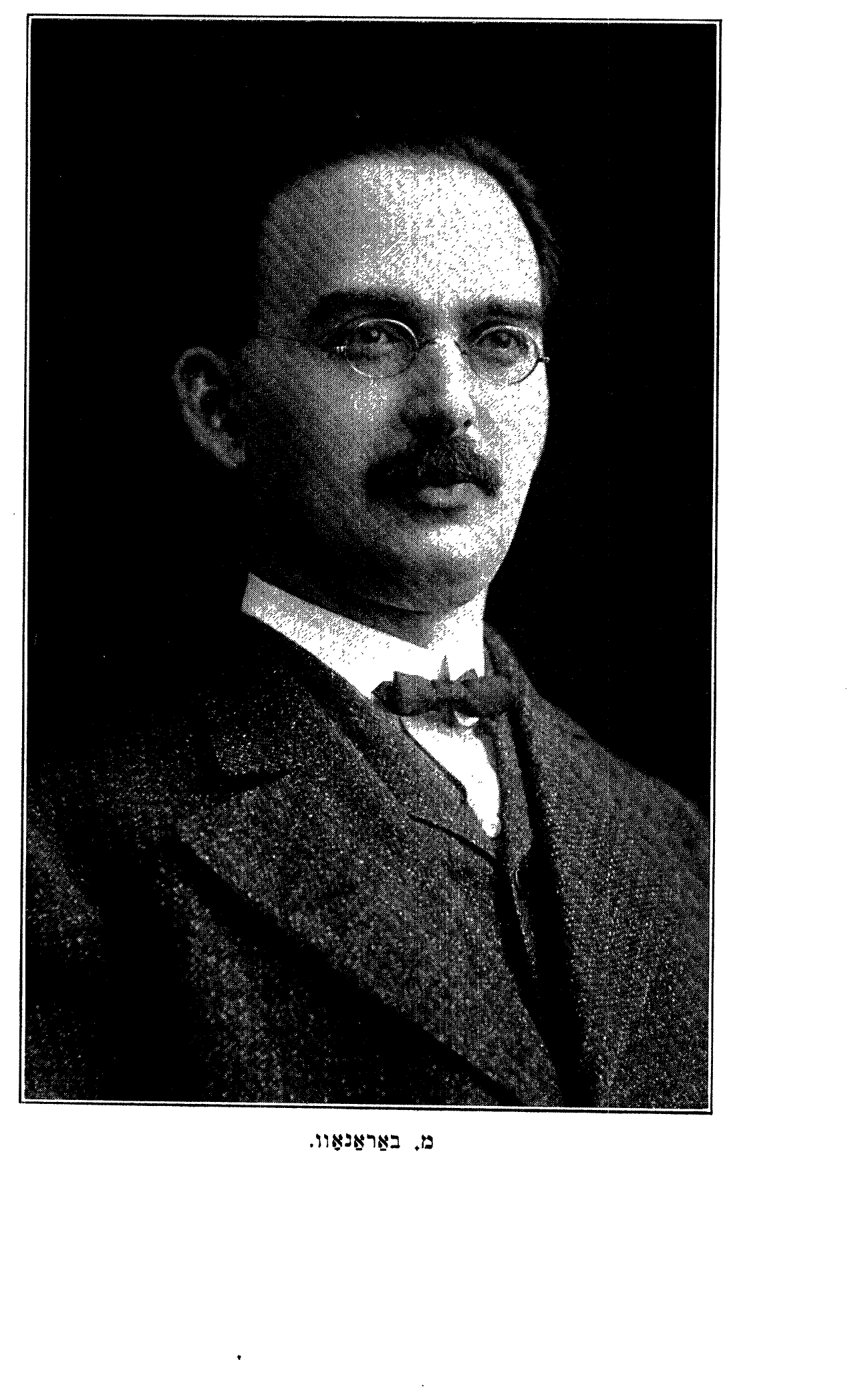
(plate; bound in the original between pp. 412–413)
I went off to Mount Sinai Hospital, with which he was affiliated, and he performed the operation. They put cocaine into the eye, and the whole affair lasted no more than a few minutes. In the hospital, however, I had to remain a few days.
I deliberately chose the week of the anniversary celebration, so that I would not have to take part in the festivity. The relations between the majority of the "Arbeiter Zeitung Publishing Association" and me were already so strained that it was not pleasant for me to meet with the members at such a celebration.
Around that time Winchevsky settled in Boston, where he began to put out a weekly newspaper under the name "Der Emes" (the announcement about it was printed in the "Arbeiter Zeitung" of the 9th of March). The Publishing Association regarded his enterprise as an unfriendly step. To treat him officially as an enemy it had no cause at first; but little by little "Der Emes" began to combat the Association quite openly, and the Association too came out against him openly.
Miller and I conducted our struggle against the "Association"414the whole time only internally; we avoided "washing the dirty linen in the street." Winchevsky, however, fought the Association before the outside world. In his "Emes," in an article under the heading "Polish or Polished Off," he attacked it with insinuations that could be construed in the worst possible way. The article raised a storm.
The "Abend-Blatt" mocked the article; it said that Winchevsky did not know what he wanted, and hinted that he was merely seeking a sensation for his "Emes."
In the same vein Jacob Milkh wrote in the "Emes" itself. Just as Winchevsky had demanded free criticism in the "Abend-Blatt," so Milkh demanded free criticism in "Emes," and sent him an article with the title "Free Criticism or Mere Criticism," in which he explained that Winchevsky was simply picking quarrels with the world for no reason. Milkh belonged to the "Publishing Association," and Winchevsky printed his article in order to show that in his "Emes" "free criticism" was permitted.
Winchevsky also came out against De Leon's methods, and this criticism of his was distinct and clear. Winchevsky knew English from London, and he had become acquainted with the American side of our movement as soon as he came over here. His opinion of De Leon was the same as mine. With regard, however, to his attacks on the Association, I and most of the other oppositionists were in agreement with Krantz and with Milkh, that "he was picking a quarrel" with the world for no reason.
The abyss between the two camps — the oppositionists and the Publishing Association — kept growing. It would415have been more accurate, however, to speak not of two camps, but of three, for Winchevsky stood then as an independent leader of the struggle, with a camp of his own.
De Leon then openly supported the "Association" against the opposition, and the "Association" supported De Leon against his Jewish opponents. The opposition called the administrative council "the clique." De Leon called it "the loyal ones." They were loyal (faithful) to the party — that is what it meant.
Among the occurrences that took place in New York around that time (the 9th of December, 1895), and that have remained in my memory, is the following: in Cooper Union a great assembly was held, where the main speaker was Allwort, the leader of the antisemitic movement in Germany. Theodore Roosevelt, who later became president of the United States, was then police commissioner of New York, and in order to keep order at this assembly, he specially picked out several dozen Jewish policemen, all of them Jews. They let the antisemite speak, but of antisemitic scandals there could be no talk. The Jewish population applauded Roosevelt's step on this occasion as a clever and good ruse.
From the 28th of December 1895 until the 1st of January 1896 there took place in Webster Hall, Eleventh Street near Fourth Avenue, New York, a Jewish socialist "party convention." There they had hoped to come to unity. But the opposite came about: the split grew even wider.
At this convention B. Feigenbaum took a sharp stand against the "Arbeiter Zeitung Publishing Association,"416and for a couple of days he was actually the leader of the whole struggle. He spoke with great bitterness against the "clique," and he demanded changes in the management of the "Abend Blatt."
Winchevsky, as the representative of the "third camp," gave up his independent role at this convention. He became one of the general opposition against the "loyal ones," one of its leaders.
Krantz had ridiculed the delegates to the convention, chiefly those who had come from other cities, in the "Abend Blatt" as "provincials" who come to New York to remake the world. The majority of the convention was incensed.
I kept myself like an outside observer. I was convinced that we would never again attain the festive mood of the first four years, unless De Leon should lose his power over the Socialist Labor Party; and that was a far-off matter. I resolved to withdraw into private life and devote myself to my literary aspirations in the English language. I only waited for Louis Miller to return from Europe. Then I would "hand him over the keys of the trade," as I used to put it, and would help him as an outsider.
The leaders of the "Arbeiter Zeitung Publishing Association" sent a committee of two to me, with expressions of respect and compliments, and appealing in the name of the movement, they asked me to talk things over with their whole group and help put an end to the split.
I refused to negotiate with them, unless a conference of both sides should take place. They conceded this, and such a conference did take place.417"The convention rather resembled a court, where the accused was the 'Publishing Association'" — so we read about the Webster Hall party convention in Burgin's history — "it (the Association) admits no new members; it gives no accounting of its finances; it drives away the intelligentsia. Its tactic is not to go by the straight road; it lets itself be led by the nose by Daniel De Leon; its system is a system of seizing power. The 'Publishing Association,' for its part, put forward accusations against Cahan and Winchevsky. Cahan it accused of conducting himself capriciously as an editor, and Winchevsky it accused of undermining it only because they would not put him forward as an editor."
They sat through a whole night and more, and came to nothing beyond mutual accusations and quarrels. Feigenbaum made a proposal that the dispute be handed over to an arbitration court, to be appointed by the party. I explained that to hand the question over to the party meant to hand it over to De Leon, for he had the party in his pocket; that this meant "complaining to the devil about his mother-in-law." But the words "arbitration court" or "court of conciliation" have an alluring ring, and the convention adopted Feigenbaum's proposal.
I at first declared that I would take no part in the arbitration court.
Two German-American members of the party, who were present in the hall, appealed to me to recognize the arbitration court, and they conveyed to me, in Alexander Jonas's name, that he too advised me to do so. The two comrades assured me that the split distressed De Leon and that he and Hugo Vogt wished with their whole heart for peace. They even gave me418to understand that De Leon himself wanted to give up his tactic of venom and gall and squabbles. I did not believe it. I made fun of it.
But many of our Jewish oppositionists were strongly in favor of it. And so I gave in.
The arbitration court was organized on the 9th of January, 1896. De Leon, Jonas, Sanial, Hugo Vogt, and Henry Kuhn (the party secretary) were appointed as the judges.
There took place 18 sessions. I was at once convinced that no just and reasonable decision could be expected. Jonas and Sanial were our friends, and they meant well. But De Leon and Vogt and Kuhn were a majority, and they worked in the interests of the "clique." I cannot say that Hugo Vogt here directly meant to harm the opposition. But he, just as much as De Leon and Kuhn, associated with that side far more than with ours, and my relations with De Leon, Vogt, and Kuhn were not friendly ones: I would not even greet them; and so I never had any opportunity, through private conversations, to set forth openly and clearly what we thought and how we felt.
The good Jonas always comforted me. He hated De Leon and had no trust in him; he believed, however, in the sincerity of the other members of the arbitration court, and he dreamed that through this arbitration court a better situation would come about in the whole party.
The Socialist Labor Party printed a statement about the founding of a "Socialist Trade and Labor Alliance" — an organization solely for socialist419unions. Miller and I saw in this an opposition to the other unions, a series of clashes with them, and — as I have already explained — an obstacle to our agitation among the American workers. Jonas, too, regarded it this way, but Sanial supported the "Alliance."
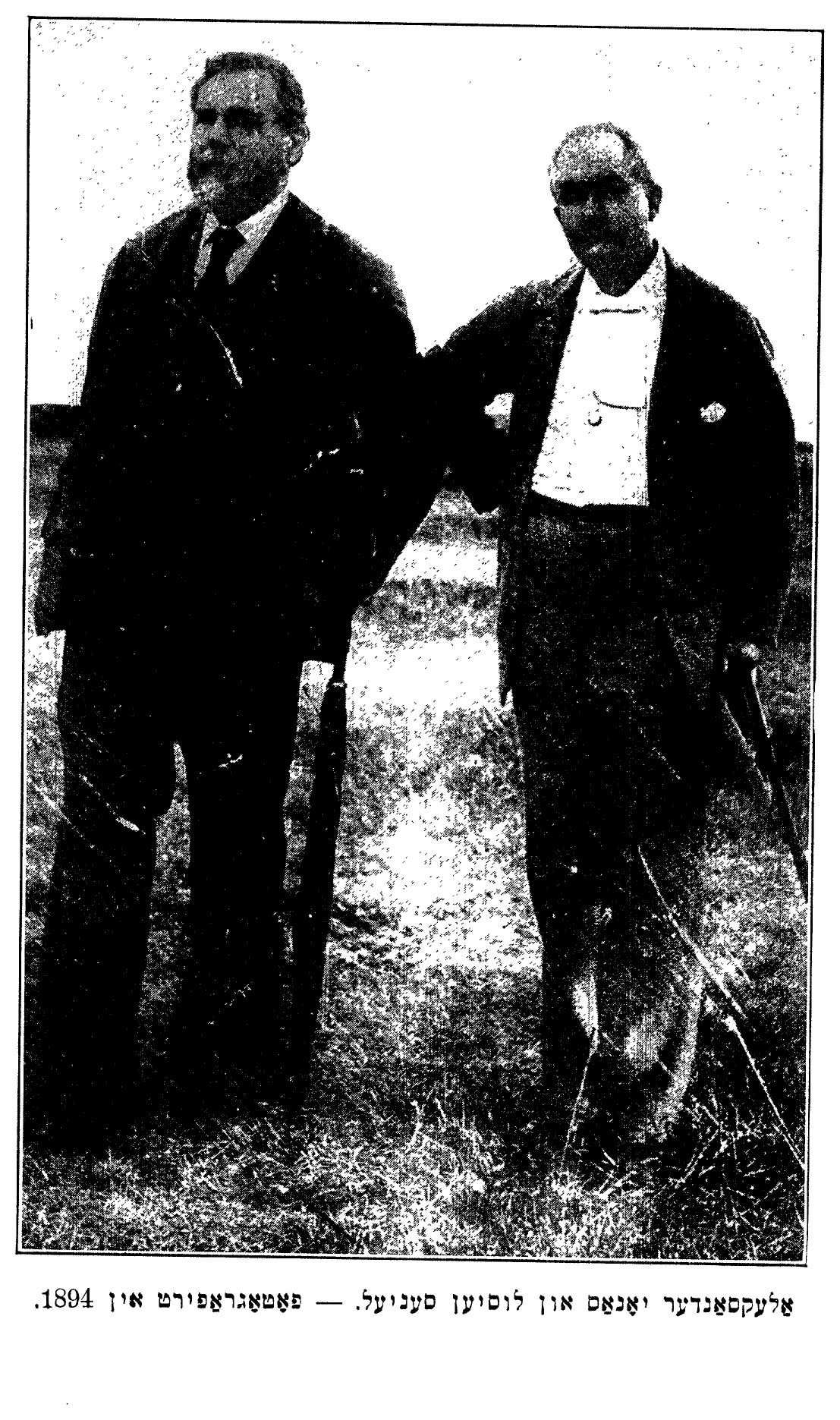
(plate; bound in the original between pp. 418–419)
Fundamentally taken, the plan had originated with Sanial. About "compelling the unions to swallow socialism" he used to speak even before De Leon had become a socialist. With him it was only an expression of that sort. He was a hot-tempered man, but the most peaceable man in the world. He could not have hurt a fly; and he had no conception of what sort of deeds De Leon would carry out with his "Alliance."
During the first six months of that year (1896), that is, in the time when the hearing before the arbitration court was going on, I worked for the "Arbeiter Zeitung" as always. Besides serious articles, I wrote my new feuilletons "From a Word a Quart." Under the name "The Hester Street Reporter" I described the "fortune-tellers" and card-throwers of the Jewish quarter. I finished the translation of a French novel, "The Last Love," by Georges Ohnet, which I had begun in the previous year, and I started to translate Emile Zola's novel of workers' life — "Germinal."
At the same time I had written, in English, a novel of Jewish life in America; and in January of that year (1896) the above-mentioned book firm Appleton and Company, one of the two most important publishing houses in America, accepted it. Before it was printed, I, with the permission of420the firm, gave it to the "Arbeiter Zeitung" in a translation which I made myself. In English the novel was called "Yekl." In Yiddish, however, I gave it the title "Yankel der Yankee."
Above, mention was made of Sergei Stepniak, the old Russian revolutionary whom I used to visit in London. In the "Arbeiter Zeitung" of the first of January of the year at which we now stand, there is a eulogy of him by M. Baranov. Stepniak lost his life through an unfortunate accident. As he was in the act of crossing the railway tracks, not far from his home, in Chiswick, London, a train came along and ran him over.
In the same month (on the 14th) the "Arbeiter Zeitung" reported a piece of news, that a German professor by the name of Roentgen had discovered a kind of ray by means of which one can photograph the bones of a living person, or coins, for example, while they lie in a leather purse. It was stated, moreover, that Roentgen had given this the name X-rays. These are the "X-rays" which today play such an enormous role in medicine.
The decision of the arbitration court was a compromise, by which our side was bitterly disappointed. The judges washed clean the "Arbeiter Zeitung Publishing Association" of almost all the accusations. Having no documents before me, I must again make use of Burgin's history: "Concerning Cahan, the decision reads that the editorial side of his work is good. As for his conduct, it explains itself by the fact that he is nervous and has a hot421temperament. Concerning the 'Emes' and Winchevsky, the court decided: 1) the editor and the publishers of the newspaper are guilty of spreading and sowing distrust; 2) Winchevsky is little acquainted with the circumstances and is unsuited to have under his supervision the editorial management; therefore the 'Arbeiter Zeitung' Publishing Association had the right not to agree to the convention that Winchevsky should be appointed as second editor; 3) Winchevsky, however, as a talented writer, is a valuable contributor."
The decision was that I should remain editor of the "Arbeiter Zeitung" and Krantz of the "Abend Blatt." The newspaper "Emes" should cease to exist, and Winchevsky should be appointed as a contributor to the "Abend Blatt."
I immediately resigned from the "Arbeiter Zeitung."
A couple of weeks earlier a banquet had taken place to celebrate the anniversary of the "Arbeiter-Ring Society." The Arbeiter-Ring as an order did not yet exist then. There was merely a single organization, a small society of socialists who had come to the conclusion that radical, free-thinking people ought to have their own lodges for their mutual aid — support for a member when he falls ill, and for his wife when he dies.
The Jewish orders required, upon joining, a whole ceremony with a declaration that one believes in God.422This, naturally, could not be agreeable to our comrades, and there began to be talk of founding a society for self-help, which should be free of all these things and which should be bound up with the socialist movement. In this manner the "Arbeiter-Ring Society" was founded.
The most active in this were two cloakmakers, Sam Greenberg and Harry Lasker, and M. Goldreich, who had been one of the founders of the cap-makers' union and of the "Arbeiter-Zeitung Publishing Association." To these three there afterward attached themselves several more comrades, among them a good acquaintance of mine, a union man by the name of A. Besker (see "The History of the Arbeiter-Ring," by A. S. Sachs, page 74). The society was founded on the 4th of April, 1892, and the anniversary celebration of which I am speaking here took place in the spring of 1896 (it may be that I am mistaken about the date, but so it comes out by my reckoning, at the time these lines are being written).
The gathering was a small one. It consisted of the founders and of several more comrades, and the mood was a warm-hearted one. I remember the gist of the speech that I delivered. It bore upon the word "ring," and the main idea consisted in the following:
A golden ring is a beautiful thing that chains together the hearts of a couple. The "Arbeiter-Ring" chains together the hearts of workers. But out of pure gold one cannot make a ring; it does not hold together. One must mix in copper, so that it should have more solidity. The "Arbeiter-Ring Society" is founded upon free thought and idealism. But with idealism alone one cannot live under capitalist rule. Should a worker fall ill, let him not be helpless. He must be provided with material support. This very mutual423material aid is the copper that is mixed into the golden idealism of the "Arbeiter-Ring Society," so that it should have solidity. And so it is with our whole movement: our socialist idealism goes together with a practical struggle to improve the material condition of the worker.
In later years, when the "Arbeiter-Ring," as an order, had already become a tremendous power, with hundreds of branches and with many tens of thousands of members all over the country, I once, on a certain occasion, as the speaker at the opening of one of its conventions, expressed the same idea.
Around that time I again visited several cities. I delivered lectures and speeches in English and Yiddish.
While in Rochester a second time, I spent several hours in the local insane asylum, which is an institution of the State of New York.
The bride of one of our comrades had lost her mind, and she was being kept there; so he asked me to visit her. I fulfilled his request, and the visit left upon me an indescribable impression.
The comrade's bride, who had known me quite well, now did not recognize me. She sat with an angry, embittered expression, looking and saying nothing. She was small of stature, with a beautiful figure, dark and charming, with black hair and black eyes. Her cheeks now glowed and her black eyes burned.
— How are you? — I said to her, — I bring you a greeting.
— Surely you know me, — I went on.424She did not answer.
I uttered her betrothed's name. But she still did not answer. She did not understand what I was saying. All my words were in vain.
In the same room there were about a dozen other deranged women. An elderly Irish woman rocked herself in a rocking-chair and sang "Mary Contrary." Without cease she rocked, and without cease she cried out the words. Another Irish woman — in her middle years — stood and combed her hair. Her hair was gray and long, and she first combed it downward, so that it should hang over her face, and then gave her head a toss backward, laughing out loud the while, and then combed the hair over her shoulder. After that she again threw the hair forward, again flung it back, again a strange laugh, and again combed the hair over her shoulder.
My companion, one of our comrades, pointed out to me a Jewish girl, explaining that she was "almost well."
I went up to her and asked her whether she spoke Yiddish.
— Of course! — she answered.
She spoke with a Lithuanian accent. She was from Kovno, not tall, a blonde, with a pleasant smile.
She spoke about the institution and about herself. She told how a few weeks earlier there had been a fire there and how the patients had been rescued. She spoke absolutely like a sane person. Pointing to the woman who rocked herself and sang "Mary Contrary," she mimicked her: "Mary Contrary, shmary."425— Just as you see, whole days the same thing! — she said, — from that alone one could go mad.
— And what is the matter with you? — I asked.
— Nothing, they will let me out soon, — she answered, lowering her eyes in shame.
— Still, what do the doctors say?
— Nothing, — she continued, all the while looking at the floor, — when the moon shines, it seems to me that something is dripping.
— Dripping from where?
— From the moon, from my dress, — she answered, pointing to her dress, even more ashamed than before, — it is nothing, it will pass; I am already better, they will let me out soon.
I spent several hours in the institution. I went away a broken man.
Notes (the original's footnotes)
[p. 381] This occurrence took place in September, while I was in Europe. This is what the aforementioned Steven Cooper had in mind when he came to fetch me from the ship and whispered to me a secret, that "we've got trouble" (see the beginning of the tenth chapter, of this volume).
[p. 386] We used to call it "the American Labor Lyceum," so that it should not be confused with our Labor Lyceum at 91 Delancey Street.
[p. 391] A couple of years later an American comrade came up to me at a meeting and said to me the following words: "Comrade Cahan, do you remember that meeting where you called De Leon a liar? Do you remember what an uproar broke out? Well, I was one of those who were terribly incensed at you then. I want to confess to you now that I grabbed a chair then and wanted to go at you. That is how wild I became. They barely held me back. Since then I have come to learn that you were right that evening, and that you were right in your whole struggle against De Leon. At first I did not understand him."
[p. 397] There were, in general, rumors going around that he was a Jew. He was actually born not in Venezuela proper, as he told me several times, but on the small island of Curaçao, which lies near Venezuela but which does not belong to that republic, but to Holland. Curaçao is a Dutch colony, and the natives speak a kind of Dutch jargon, which is interspersed with Spanish words. In the encyclopedia one finds that a good number of Jews settled there a couple of hundred years ago, and that almost all the businessmen of Curaçao are Jews. Among the names of such Jewish families is found the family name De Leon (we used to call him De-li-on, or Dilion, in the English manner).