Chapter Thirteen
The First Months of the "Forverts"
459The first issue of the "Forverts" appeared on the 22nd of April, 1897.
With great difficulties we put together a sum that was barely enough to make a start. Everything looked poor, beggarly. There could be no talk of buying a press of our own. We had to print the "Forverts" elsewhere. For the sake of convenience we decided to have the editorial office, together with the typesetters' shop, near the place where the paper would be printed. And since there were no large printing houses in the Jewish quarter, we could not have the editorial office together with the business office, which naturally had to be in the Jewish quarter.
On East Broadway we rented a store and hung out a sign, "Forverts." This came to be exactly opposite the place where the "Forverts" building stands today. Now Seward Park is there, which did not yet exist back then. Back then, opposite the present "Forverts" building, there stretched a sidewalk with460a row of houses. There, then, we had our first business office. The editorial office and the printing shop, however, were on Duane Street, near the corner of Park Row, not far from the present Municipal Building and the Brooklyn Bridge. We chose this block because the place where the paper was printed was nearby. From the business office to the editorial office was about a ten-minute walk.
There, on Duane Street, we rented a "loft" or "floor" in a building that was occupied with warehouses. The floor we divided into three parts: for the typesetters, for the news writers, and a private "office" for the editor — a long room, but so narrow that when two desks were placed in it, there was room for only one person to pass through. One of the desks was for the editor and the second for one of the staff. The window of this little room looked out onto Duane Street. The news writers had a large, airy room facing the yard.
The partitions were made of new, unpainted boards, and to this day I remember the smell of fresh wood that used to permeate me when I sat at my desk.
My salary as editor was 15 dollars a week, and even that was not always there.
The first several months Jacob Gordin, the playwright, was an inside staff member with us, and he used to sit at the desk that stood next to mine. By then he had written for the stage, among others, "Siberia," "The Russian Jew in America," "Two Worlds," and "The Jewish King Lear." And he already had in mind the content of "The Jewish461Queen Lear" ("Mirele Efros"). His earnings from the theater, however, were still very small back then. For the "Forverts" he used to write feuilletons. For example: when the body of General Grant was brought to New York and he was laid to rest in the just-built "Grant's Tomb" on Riverside Drive, he described it. He also wrote for us sketches and articles on the history of the drama. Miller, Winchevsky, and Zhemetkin took part as outside staff members.
On Sundays the "Forverts" used to appear in the form of a little journal, in "mably-form" (magazine form), as it is called today — much smaller than that daily "Forverts." Among other contributors, my wife took part in it with translations of good Russian stories of Jewish life (she also translated a few literary pieces for the "Zukunft"). Z. Levin then wrote his first sketches and they appeared in the "Forverts." Among the news writers and inside staff members were Z. Kornblit and William Kaiser.
A short time after the "Forverts" was founded, Liessin came from Russia. He visited our office on Duane Street — a young fellow, a handsome fellow, with a face like a fresh apple, and in a brand-new American suit. When he became acquainted with the causes of the split in our movement and with the details of the conflict, he joined our side. He was an important force for us. He continued to write poems; but he also began to give leading articles for the "Forverts," and they drew attention.
462Before me now lies a bound collection of the Sunday "Forverts" from the first several months. They are in a smaller format than the daily "Forverts" of that time, as has already been said above. The first issue is a May issue, although the date is the second of May. As a front page it has a drawing in which it is depicted how the labor movement storms the fortress of Capital. By the fortress stands a girl and calls on the multitudes to take the fortress. The girl holds in her hand a sword, on which is written "Social Democracy." At her call the Goddess of Liberty arrives with a great flag bearing the inscription "Forverts." From above, over the goddess, there is a line "8-Hour Working Day." On the fortress is written the word "Capitalism." From above, from the fortress, millionaires look down; they shake their fists, they are wild with rage; they are in despair.
In order to give the reader a notion of the "Forverts" of those months, I will acquaint him with those Sunday issues.
An issue had 16 pages, or more correctly, little pages. For each page is smaller than a quarter of a present-day "Forverts" page. Three or four of these little pages used to be filled with advertisements and with the table of contents. The reading matter of a Sunday "Forverts," then, took up about two and a half pages of a present-day "Forverts." With some twenty present-day dense "Forverts" columns you could fill the entire contents of a Sunday "Forverts" of that time.463First comes a story by the name of "Doctor Vorobeitshik's Match," a story of Jewish life, by R. M. Ginn, translated from the Russian by Anna Cahan (the story is an excellent one and the translation is in the simplest and most natural Yiddish; it runs in four installments, of two or one and a half little pages an installment).
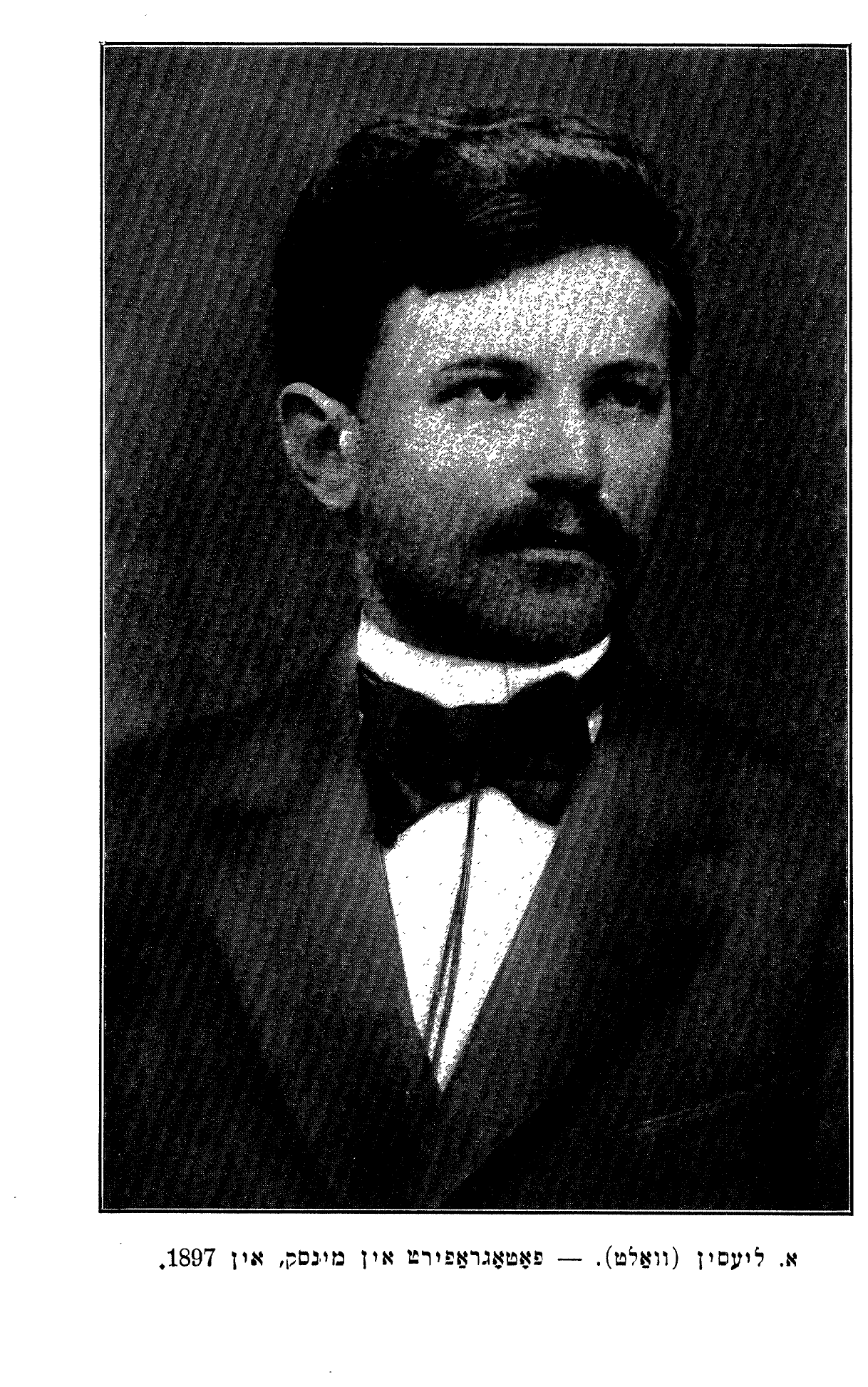
(plate; bound in the original between pp. 462–463)
Then come three interesting sayings, taken from other languages, under the heading "Short and Sharp." The sayings are:
"The longest road in all the land Is from the heart to the mouth and from the mouth to the hand."
* * *
"Here lies a stingy rich man buried, Wicked at heart and corrupt; The only good he ever did Is that he died."
* * *
"To speak wisely is very hard, To keep silent wisely much harder still."
The next article is a popular-scientific one, written by Dr. Ab. Kaspe. The heading is: "What is Burning?" and under it a smaller subhead: "What Takes Place in It?"
Dr. Kaspe, at my invitation, wrote popular-scientific articles every Sunday. He used to propose the themes to me and I would choose such as were popular and interesting for the public.
The next article bears the name "Shoddy." It was written by Alexander Jonas. The article was in English and was translated in the editorial office. Jonas was then without employment and I knew that his material situation was a strained one. De Leon did not stop persecuting him, and he, Jonas, found himself in a difficult position. He had464an inheritance in Germany and used to receive certain sums from there. But there was some sort of holdup, and during those months he was very hard-pressed. He never complained and was always dressed very neatly and tidily. He was a very modest man, a gentleman in the best sense of the word. I learned of his situation through a German writer who was a good friend of his. It made a terrible impression on me.
Our Alexander Jonas should know want! Our highly esteemed and much-beloved comrade Jonas! This was for me the most ghastly example of a victim of De Leon.
I invited him to write for us from time to time. We did not have enough money for even the poorest wages for the regular staff, but to invite Alexander Jonas — that we did with the greatest joy. It was an indescribable feeling. Alexander Jonas!
He brought me his first article, and then he sat down next to me, took a little piece of paper and wrote:465"Could the 'Forverts' give me 12 dollars in advance?"
When I had read it over, everything went dark before my eyes. That Alexander Jonas should have to write such a little note!
I had no money on me, and the other comrades in the editorial office had none either. We borrowed, and I gave him the sum.
"I hope that before long my circumstances will improve; I expect money from Berlin," — he said with a bashful smile, taking leave of me.
His expectations were fulfilled. His situation improved. Rich he never was. He lived in a furnished room, on Waverly Place, where I used to visit him. I also used to visit him in a certain café, on the corner of Broadway and Eleventh Street, where he used to spend his evenings with his German friends, mostly literary men, artists, and scholars (the café was located next to the famous Grace Church. Later the building of the café was torn down and in its place was erected an extension of the church, which had earlier been smaller).
That article of his begins with the following lines:
"Worthy Editorial Board! With great pleasure I will fulfill your wish to write something in your paper from time to time. Today I will point to an article that the local 'World' — a paper that always seeks to flatter the workers — carried on the morning after the Grant celebration (the above-mentioned parade that was made when the body of General Grant was brought to New York). This particular article leads up to many important thoughts. In it466is called "shoddy." It looks fine, but it has no substance; it crumbles at once. And so it is with the whole capitalist civilization. It is civilization only in appearance. Inside, it is worm-eaten.
Next comes a poem, "To the Forverts," signed "A Socialist."
After that comes an article, "Our Holiday," by M. Winchevsky. He depicts the wretched, workaday life of the worker: May is springtime. Nature has flowers and little birds, but the worker takes no pleasure in them; he has heard of them, but in his tenement dwelling he does not see them. Addressing the workers, Winchevsky says:
"The beginning of May means rent to the landlord for you; spring means for you the worst time for consumption. Flowers are for you things that wither like the roses that once bloomed on your wife's cheeks. Little birds are for you prisoners in cages, who sing of troubles, of duty, with despairing trills. And you look at your little children as they sleep huddled together in a single bed, and you think that they are surely dreaming of things that in reality they will never have or obtain, of things that in reality they can never do and may never do — and then... and then you say: this little girl, a fresh, sweet, dear springtime on two little feet, with her little eyes, which seem made for seeing, wanting and having — this little girl, what is she growing into? When she grows from spring into summer, will she be in a kitchen or in the gutter? Will she work without pleasure, or take pleasure without work? Will she hire herself out or sell herself? And when she reaches her autumn, what kind of fruit will she have ripened? And when her winter comes? You shudder to think of it."
Then the writer says that this is how the worker feels467day in, day out; but today, on the first of May, the worker rises with a feeling that the first of May is not a day like all the others. It is a holiday. "Eight million class-conscious men feel with one heart, think all with one mind; the proletariat of the entire civilized world is drilling itself for battle." The article closes with the words:
"Today is the first of May! The struggle is no longer far off; we need only arm ourselves, we need only drill ourselves, we need only organize the victory."
The next article, which takes up two pages, is the beginning of a series of articles by Jacob Gordin on the history of drama. Then comes an article: "A Few Words on Political Economy," by M. Zametkin. The article takes up a page, and a few lines carry over onto the next page. The remaining space in that column is filled with jokes. Then comes an article: "Literature and the Stage" (about Thomas Hardy's novel "Tess of the d'Urbervilles," as it was dramatized and performed), written by me. Speaking about Thomas Hardy and about English literature in general, I say:
"Present-day English literature is full of talented rubbish. Men and women of great ability, who could have been good for something worthwhile, squander their powers on old wives' tales, on tangled intrigues, on childish foolishness. But there are also serious belletrists in England who respect their talent; and the greatest, the most talented of these is, without doubt, Thomas Hardy. He is reckoned in England and America to be a realist; in France or in Russia one would find among his realistic pictures a good many that do not even begin to be true to life.468But everywhere one would be enchanted, and one is indeed enchanted by all his works."
I point out that "Tess of the d'Urbervilles" was the literary sensation of 1892, and then I say a few words about his last novel, "Jude the Obscure." Of it I say:
"A truly brilliant work, which startled the bourgeois hypocrites of England, because certain scenes between women and men are portrayed there realistically."
I tell how, because of the sensation, his "Tess of the d'Urbervilles" was put on in a theater in New York, with the famous American realistic actress Mrs. Fiske in the leading role. Then I say:
"Hardy is perhaps the only good novelist in England (we are not speaking here of America), in these times, who builds his novels for the most part upon an important, in any case interesting, idea. His stories are not only artistic pictures, but also pictures in which there is something to ponder.
"The content of 'Tess,' which we can here, naturally, render only in brief, is a good example."
Then comes the excerpt, in which I render the essence of the theme and of the plot.
At the close of this article I tell about the German theater at the Irving Theatre, where the famous German actress Sorma was then performing. I tell that the former president Cleveland came to the performance with his wife, and I end with the words:
"Sorma is the greatest actress who has performed in New York this season. The best theater in New York, and that means in the whole country, is the German theater at Irving Place" (now there is a Yiddish theater there).469On one page a portion of a column remains, and the space is filled with a clever Yiddish joke and with a clever poem by S. Wolfson (this is the same A. L. Wolfson who today writes his "Merry Songs" in every Sunday "Forverts." Back then "S" stood as the first letter of his first name, either through a printing error, or because he often used to disguise his name. He was an anarchist at the time, and he was afraid that if the "Forverts" knew who the writer was, it would not want to print his poems). The poem is in the same spirit as his present-day "Merry Songs." Here it is:
Ani Maamin (I Believe)
On a little white donkey, they say, the Messiah will come; drums will beat stormily and trumpets will blare. And for me there is no doubt at all that trumpets will blare; yet I doubt whether by donkeys the Messiah — our deliverance — will come.
Then a series of feuilletons by the "Mad Philosopher" begins.
That is the whole issue.
I wanted to put in lighter pieces of general interest, in order to draw in the great broad public. I mean such pieces as the ones I had the previous year in the "Arbeiter Zeitung," under the title "The Hester Street Reporter," and which truly had success with the masses. But we were so poor, there was so little space in the Sunday "Forverts," that we could barely cram in the serious, instructive material, which represented the essence of our task. There was literally nowhere to turn. I470also had other disruptions, far more important ones, but about that in the following volume.
My "weekly portions" used to appear in the Saturday "Forverts," and my feuilletons "From a Word a Quart" mostly on Wednesday. The daily "Forverts" took up almost all of my time. Still, I also wrote in the Sunday issue — often two or even three pieces in a single issue. About literature in almost every issue.
In the advertisements of this issue we find that on Thursday, May 20, at the Windsor Theatre, as a benefit for Jacob Gordin, "The Wild King" would be performed. A furniture store begins an advertisement with a letter from Eugene V. Debs about the socialist system, from which the advertiser concludes that if you need furniture, carpets, oilcloth, you should buy it from M. Mandel of 83 Essex Street. Rokeach's Parisian Patchouli Soap is announced. There is also advertised I. Lifshitz's Union Print Shop, Alexander Harkavy's appeal about his Yiddish-English dictionary, Paley's photograph studio, a café and lunchroom, several lawyers and a doctor, Meisel Cohen, of Brownsville.
As the agent of the "Forverts" in Chicago is given Jacob Litkin, and his address: 507 South Jefferson Street.
As our Boston agent is advertised J. Friedland, of 316 Hermon Avenue.
As Philadelphia agent — A. Goldberg, of 754 South 3rd Street.
Among the advertised lawyers are found: L. E. Miller, with an office at 154 Henry Street; Morris Hillquit, with an office at 320 Broadway; and N. Aleinikov, with an office at 87 Nassau Street.
An interesting advertisement is the following:471"Underground literature, issued by the Jewish Socialists in Russia:
"'The Jewish Worker' — organ for the interests of the Jewish workers in Russia, issued by the 'Group of Jewish Social Democrats in Russia.'
"Second and third issues already appeared.
"Price per copy 10 cents.
"'The Town Preacher,' a popular pamphlet, price 5 cents.
"'A Speech for Purim,' price 5 cents.
"To be obtained at the office of the 'Zukunft,' 132 East Broadway."
In the same issue is advertised the next issue of the "Zukunft," also several socialist pamphlets by Ab. Cahan, Feigenbaum and Winchevsky, all to be obtained at the office of the "Zukunft."
In the following Sunday issues we see an advertisement of a furniture store, on a whole page, an advertisement of sewing machines and a few other business advertisements. Among the smaller advertisements are found the announcements of the aforementioned lawyers and of several doctors, among them Dr. S. and Anna Ingerman and Dr. Himovitch.
There is an advertisement of N. Chaimovitch's clothing store, of 113 Canal Street, and also an advertisement of Shmukler's café, at 276 Grand Street.
The income from the advertisements had no significance.
Novels are also advertised. They ran in installments, which used to appear in booklets — each week a booklet. These booklet-novels were mostly472trashy tales. And in those several years they were snatched up like water for unleavened bread.
Sapirstein, who later founded the "Morgen-Zhurnal," made a fine business as the publisher of these booklets. Some of these booklet-novels, however, belonged to the better literature. In the "Forverts" of May 30, 1897, for example, we see an advertisement of two such booklet-novels, from the publisher S. Kantrowitz, of 54 Ludlow Street — one is "Don Quixote," by Cervantes, translated by Alexander Harkavy, and the other is "Anna Karenina" by Tolstoy (the novel is only announced as a forthcoming item, and the name of the translator is not given).
Not infrequently the translators used to wreak havoc. They used to skip dozens of pages and in their place insert many pages with their own trashy material. With Alexander Harkavy's translation, naturally, that does not happen. He did everything faithfully and truly.
I have mentioned that I often used to write about literature. One article (in installments) of that sort was under the title: "The New Aristocracy."
This was an interesting excerpt (with my explanations) from a new novel, "With the Procession," by Henry B. Fuller, of Chicago, one of the new American realists of those times. From it I translated a large, interesting scene from the life of the newly risen American rich men (the word "allrightnik" did not yet exist back then).
I also rendered the content of Bellamy's new book "Equality." Several times I wrote notes under the title "The Week," the same sort of notes that I printed for a certain time every Sunday in473"Abend Blatt," during the several months that the soda-water peace lasted between the "loyalists" and our oppositionists.
In a couple of issues there ran a propaganda feuilleton of mine, under the title "Sosye and Basye" — a little tale about two poor seamstresses. One of them had inherited a few dollars and bought a sewing machine, and the other came to work for her, and she, the proprietress of the machine, exploited her. It is a parable through which the Marxist idea is brought out of how the capitalists piled up their fortunes through inherited plunder, and how, by means of machinery, the capitalist is able to rob the workers. This feuilleton was signed "Sotsium."
For several issues there ran a translation of Korolenko's story "Yom Kippur." At first the translation was done by Z. Kornblit. But he left the "Forverts," and I did the second half.
I also popularized Karl Marx's ideas about unions, class struggle, and revolution, following his little book "The Poverty of Philosophy." These articles were signed "D. B." (David Bernstein).
On July 4th one finds an article signed "Liessin." The article is about Bakunin, and it takes up two pages. There also begin to appear poems written by Liessin after he had already come to America. One poem of his is called "The Tinker." Another poem of his, under the title "Yom Kippur in Synagogue," runs in two installments — the first of August and the eighth. Together the poem takes up three and a half columns.
At my invitation, Boris Bogen, now known as Dr. Bogen, wrote a series of articles about how twenty thousand Jews were driven out of Moscow.474He himself had been a Muscovite and had witnessed all the scenes that had taken place a couple of years earlier. Masses of Moscow Jews then came to America, together with their Moscow rabbi. So I asked Bogen to describe those experiences of his for the "Forverts."
Translations of Russian stories were then made for us from time to time by S. Rusianov, who is to this day an active member of the "Forverts Association."
Leon Kobrin's name begins to appear in the "Forverts" on the eighth of August.
Of Jacob Gordin's sketches I find in those issues of the Sunday "Forverts" a sketch with the title "The Unnoticed Tear," a fantasy with the title "The New Man," "The First Push" (a sketch which he calls an "etude"), a sketch with the title "Spoiled," and "Happiness, an Old and Eternally-New Fantastic Story," and other sketches of his.
From the pen of Z. Levin I find in those issues of the Sunday "Forverts" a feuilleton under the title "To My Friend" (by "friend" he means his cigarette). A couple of his stories appeared in the Saturday issues. One story of his about a pious family, where the daughter has to go to work on the Sabbath and the mother wakes her, supposedly quite unwillingly, made an impression.
A few articles or notices have a bearing on our criticism of De Leon's policy. For example: in the notices in the issue of the 13th of June it is reported how Karl Kautsky writes about De Leon's methods; how he sharply criticizes De Leon's abuse and his habit of latching onto words.
From L. Miller there is an article in several installments, under the title "Socialism and Utopia." This475article conveys the contents of the famous open letter that Eugene V. Debs wrote to the workers of the railway union. Debs had proposed to them a plan for how to create a socialist society in America on the spot — to found a socialist colony. Miller speaks of Debs with much respect, but he points out how dreamy the plan is.
I had to work hard, for the number of co-workers that the editorial board could employ was too small. But no one gave that any thought. Each of us was ready to work for the "Forverts" day and night.
I received invitations from American magazines to send them stories, sketches, articles. But I had no time for that. My name had become known in the American literary world, and my interests demanded that I appear as often as possible in the magazines and bring out a new novel. The literary director of the Appletons used to argue to me often that I ought to "make hay while the sun shines" ("strike the iron while it is hot"). But I did not do this. I gave all my time and energy to the "Forverts" and the "Forverts" meetings. My work in English literature I put off for later, when the success of the "Forverts" would already be assured.
[טאָפּיק] Differences of opinion about the tactics of the "Forverts." — Debates. — A scene in a Boston theater. — "Free Press." — The tailors' strike.
In my editorial work, however, not everything went smoothly. I met with obstacles, and often they would476drive me into despair. This mood would pass, however, and I would again work with zeal. So it was for the first three or four weeks. But the situation in this respect grew worse and worse.
What did the obstacles consist of?
I had a definite conception of how the "Forverts" ought to conduct itself, but not all the members of the press association were in agreement with me. The matter concerned our attitude toward the "Arbeiter Zeitung Publishing Association" and its "Abend Blatt" (*. I was convinced that the best thing was to ignore them as far as possible; to answer their attacks as little as possible and to devote all our strength to building up our newspaper. M. Winchevsky, W. Lief, and other comrades held the opposite opinion: they believed that one had to "give it to them" precisely. At the meetings of our press association many speeches were held about the question, and a goodly number of the comrades supported Winchevsky's opinion.
They used to argue: with so much effort we have achieved our aim, lived to have a "Forverts," where one can attack De Leonism and the "clique," and now the editor comes and says that this is precisely what he does not want to have.
I used to answer: yes, at last we have our own organ; that is why we can afford to ignore them. We can explain to the masses that we are against squabbles, mud-slinging, and union-breaking; and give a model of such conduct: avoid abuse and work faithfully for the unions. It was not for cursing that we created the "Forverts," but in order to have a477socialist newspaper that would be controlled by the movement and not by a clique, and that would build up unions, not destroy them.
One of my chief arguments consisted of the following:
The reasons why we had split off we had already explained to the public enough; and if from time to time it should be demanded again, we would do it again, but calmly, with dignity, without abuse. Let us put out a good popular newspaper, a rich one in content, an interesting one; let there be something to read and let people want to read it. That, and not attacks and abuse, is the road to success. The public does indeed love a fight; when two people come to blows, passers-by stop to watch. But that is no solid foundation of popularity. Fights become ugly. They win a newspaper no respect. Pouring out venom and slinging mud are De Leon's methods, and he will not last long. Those who long for sharp attacks and frequent attacks are at heart De Leonists, and the "Forverts" was founded as a weapon against De Leonism.
If we will have a better newspaper than the "Abend Blatt," we will win; if not — no. For two socialist newspapers there is no room. If we have success, the "Abend Blatt" will vanish of itself.
This standpoint I used to explain at every meeting. I used to try to demonstrate the power of silence, of not answering. But those who were in agreement with Winchevsky took little interest in such arguments.
As a second argument against Winchevsky's and Lief's demand I used to explain that the broad public478does not understand the "Abend Blatt" attacks in any case. And it will not understand our counter-attacks either. Our socialist little world is a tiny one — I used to say — therefore the reasons for our party squabbling can interest only a small number of people. The great Jewish masses do not even know that there is a De Leon in the world. With our cursing against him and against the "clique" we will thus not arouse the kind of interest that a street fight calls forth. We will take up space with incomprehensible reading matter, and incomprehensible reading matter drives readers away (for me this point was one of the most important. But the comrades grasped it least of all. In it lies, in fact, one of the chief questions of how one ought to put out a Yiddish newspaper. Many write in such a manner that only a small number of readers can understand them. They write for a little circle, and beyond this little circle they have no interest).
I will bring in here a scene which will show the reader how far my conceptions differed from the conceptions that Winchevsky and his adherents had. The scene took place some time earlier, at a large gathering with speeches, stereopticon pictures, and a concert in a Columbia theater in Boston, on Washington Street, corner of Castle Street. In the concert there took part Madame Kalish, who at that time was not yet on the English stage. The stereopticon pictures were connected with a lecture of mine, and Morris Winchevsky was one of the speakers. The chairman was Hyman King. At a certain moment I found myself in the highest gallery of the theater. I had to arrange the pictures there, for there stood the stereopticon,479and I had to hand the operator the slides so that he should put them in in the correct order. I was sitting and sorting the slides when I heard a commotion. I look down: I see Winchevsky trying to speak and the public not letting him. I listen: he is speaking about De Leon and he mentions Alexander Jonas. But the public does not want to hear. There is a hooting, a laughter, a tumult.
The theater was full of people who were absolutely unfamiliar with our party struggle. They did not know who De Leon and Jonas were. And, when Winchevsky spoke, his listeners could not understand what it was about. They became impatient. From this the disorder began. They did not let Winchevsky speak. Afterward, when a speech was held which the public did understand and which interested it, the disorder ceased. And the undertaking was a success in every respect.
Winchevsky and his adherents, with regard to the question mentioned, demanded that I should at least let others write attack-articles against the "Abend Blattists." But I permitted this only in the section "The People's Tribune," as letters to the editor, but not in the leading articles.
Many comrades were in agreement with me, but not all. The dissatisfied ones said that I was "capricious," that I wanted to rule like an emperor — the very same charge that had been heard against me from the "clique." But in truth this meant that I had a firm conviction about the tactics that the "Forverts" ought to practice. I did not give in.480What lay between Winchevsky and me was not a mere difference of opinion. There was something more to it. Outwardly we were on good terms, but not in our hearts. I will not go here into any personal particulars. I will confine myself to the following remarks:
Winchevsky's arguments I (and not I alone) did not take at all seriously.
He made, for example, a whole to-do over the principle of the "free press." By this he meant that everyone should be free to express his opinions in the "Forverts." This principle was dearer to him than anything else, he used to say. I, on the other hand, believed that these were fine-sounding words that had no practical substance. I used to explain it the way I used to explain it to the anarchists before the founding of the "Arbeiter Zeitung": by "free press" one means that every person, group, or party should have the right to put out a newspaper according to its convictions. But that does not mean that every newspaper must be free for everyone to write in it as he wishes and about whatever he wishes. In a newspaper one makes a little room for letters to the editor, which are printed in a "Voice of the People" or in a "People's Tribune." That is all. Beyond that, however, the paper is devoted to preaching the ideas and carrying out the policy of its own party, and of no other. If an opponent wants a place for his ideas and cannot content himself with a "Voice of the People," he is free to found a paper of his own. That is what is meant by "free press" throughout the whole civilized world, the socialist world included. Every socialist newspaper serves only its own ideas, only its own tendency, only its own party. If every party is free to have such a newspaper, that is what is called "free press."481And when Winchevsky came out with his attacks in the "Emes," many people asked themselves: what does he want? What is he picking a quarrel about? What does he have in mind here? So spoke not only the "loyal" ones, but many of our own as well. His present agitation for the "free press principle" in the "Forverts" aroused a similar feeling.
Louis Miller took almost no part in these debates. One could imagine that on the question of attacking the "Abend-Blatt" he was, in his heart, in agreement with Winchevsky: for by nature Miller liked to assail an opponent with the sharpest words, to level against him the most violent accusations. In this case, however, he expressed himself little at our meetings. People explained this by his relationship to me. We were close friends, and he did not want to obstruct me.
But Winchevsky and Lief did not let up, and they had followers.
The truth is that there was then no unity among the "Forvertsists." In the first three and a half years of the "Arbeiter Zeitung" there had existed within the "Publishing Association" a warm friendship among the contributors. We all held the same opinions, and our enthusiasm for the cause showed itself in our feelings toward one another. In the "Forverts Press Federation" such a spirit also existed, but only among the "rank and file." Of the leaders one could not say the same.
The self-sacrifice of the workers, men and women, among the members was great; they gave away482their last cents for the newspaper. But among the prominent, influential members there was no unity.
The conflict over the tactics of the "Forverts" with respect to De Leon, the "Abend-Blatt," and the "loyal" ones was not merely a theoretical one; it was a practical question, one that touched the very foundation of my editorial work. And this practical matter was interwoven with personal threads. With each day it became clearer to me that as editor of the "Forverts" I would not be able to fulfill my duty. By the time the newspaper was a month old, the truth had already become a burden to me. It impelled me to resign. To resign, however, was impossible. It would have been a help to our opponents. So I worked at the paper, but against my will. I waited for a favorable moment, when I would be able to leave.
I said above that, working in my narrow little editorial room, I used to feel the smell of fresh boards. For the first couple of weeks this was a pleasant smell to me. Afterward, however, it became mingled with the taste of a heavy heart.
A great strike of the men's tailors (Brotherhood of Tailors) broke out. I had been the first to organize them (in the year 1884), and ever since then they used to turn to me as to one of their own. Besides that: their union was one of those that had founded the "Forverts," and it was now their fighting organ. To abandon them in the midst of their present strike was therefore impossible for me.
483[טאָפּיק] De Leon wants to expel nine "Forvertsists" from the party. — He fails, and under the name "reorganization" he expels three hundred.
The Socialist Labor Party was for us what his religion is for a religious person. "When one is angry at the cantor, must one then not say amen?" One may hate not only the cantor, but even the rabbi of the town, and that still does not mean that one has ceased to be a Jew. In just such a way we felt with respect to the Socialist Labor Party. We were embittered against De Leon with his union-wrecking "Trade and Labor Alliance," with his "machine," with his intrigues; but the party was our party. We could not imagine ourselves without it, just as a pious Jew cannot imagine himself without a synagogue.
Such a feeling was held by all the Jewish socialists, and even by people who only sympathized from afar with the socialist movement. If the leaders of the "Forverts" had been left cut off from the Socialist Labor Party, the "Forverts" would have been regarded as a congregation without a synagogue. Such was then the general conception.
It was to be expected that sooner or later De Leon would begin to plan to expel us altogether from the party. And so indeed it was. He accused nine of us, the most active "Forvertsists" and leaders of the opposition, of "treason." A committee that was appointed to hear the charge (grievance committee) found us "guilty" and brought in a recommendation that we be expelled484from the party. But the recommendation had to be voted on by the members of all Greater New York. So the constitution of the party required. De Leon could have ordered the grievance committee to expel us without ceremony and to declare, with some little pretext, that this was kosher. But to go so far he did not yet dare at that moment. He reached such a point a short time later; but at the time of which we are speaking here — not yet.
When the recommendation was submitted to all the party sections of Greater New York in a referendum, they voted it down.
Max Fein, who was one of the nine, tells the following about the hearing before the "grievance committee":
"The whole trial was a ludicrous affair. They invited us for form's sake, and with the formality of a Russian court they took up the first one for cross-examination — Cahan.
" — What is your name? — asked Waldinger, the chairman, an old American German, an underling of De Leon's.
"This brought us all to the end of our patience, and Ab. Cahan answered him that this was none of his business.
"I bring this fact here in order to characterize how they treated us, the accused. They asked Ab. Cahan what his name was! Cahan was then very popular among the non-Jewish contributors, because he was one of the best English-language speakers among the few that the party possessed."
To this I want to add that until a short time earlier485Waldinger had been one of my warmest adherents in the American movement; and as the reader recalls, he traveled with me and Lucien Sanial to the Pittsburgh conference in 1892. We used often to be together at other conferences or meetings. As a member of the "grievance committee," however, he spoke in a cold, official tone, as though he did not know me at all. The whole ceremony was both ludicrous and scandalous.
When De Leon had suffered his defeat in the referendum, he resorted to a "trick."
The following lines are again from Fein's recollections:
"He ordered a special meeting of all the party members for the 26th of July, when all the 'Forvertsists,' members of the party, were on the first excursion of the 'Forverts,' and no one could come to the meeting. There he made a motion that all the districts of downtown (that is, of the Jewish quarter) and others, where the opposition had the majority, be expelled. And so we were left without a party. This was a dangerous moral blow for us. The Socialist Labor Party was something that we had nearly all held sacred. It was the bearer of the socialist idea in America. Now they had thrown us out of it. True, the tactics of the party were destructive; it is correct that it drove the American workers away from itself, and its leaders were tyrants. But it was nevertheless the only labor party. We felt as though we had been condemned to a moral gallows"...
To Fein's account I want to add here the following486detail: officially, we were not expelled. The job was "done" with yet another "trick." If De Leon had proposed that we be expelled, he would have suffered the same defeat as in the referendum. But he did not demand that at all. He ostensibly made a quite different proposal, namely, that the districts which were not "loyal" be "reorganized." That is to say, he supposedly meant to make them kosher, to make their members into better socialists. He explained certain details of his plan, and to many naive members of the party the proposal sounded quite innocent. And so they accepted it. The rest De Leon already did by himself.
Under the innocent name "reorganize," this is what was done: when an oppositionist came to a meeting of his branch of the party, his membership card was taken from him and he was given no new one. The secretary of each branch sat at a little table not inside the meeting hall, but outside, by the door. When the oppositionist came up, his membership card was demanded of him. He thought he would be given a new one. But no new one did he receive. Officially, he was not expelled at all. He was driven out "unofficially."
This is what was called "reorganizing" the branch. In jest we used to call ourselves "the reorganized." And the word came so into use that instead of saying "he must be driven out," for example, we used to say among ourselves: he must be "reorganized."
It went off without a hitch. They expelled not only those nine, but all the oppositionists — everyone who was a member of a press club or simply a friend of the "Forverts." Since the party referendum487would not allow De Leon to expel his members, he expelled some three hundred members by a trick.
[טאָפּיק] Eugene V. Debs becomes a socialist. — His "Social Democracy." — Hourwich. — We become members of the "Social Democracy."
Then a question arose among us: what to do next. Some were in favor of waging a vigorous fight against De Leon and his machine, and of appealing to the National Executive of the Socialist Party. But other comrades declared that, first of all, nothing would come of it, because De Leon held the National Executive in his pocket, and second, that one could now manage without the Socialist Party, because around that time another socialist party had just been founded, the Social Democracy of America (Social Democracy of America), with Eugene V. Debs as its chief leader.488Debs has been mentioned in this volume, when it was a matter of the great Pullman strike in the time of President Cleveland. At that time he was not yet a socialist. But he soon became one. In the Joliet Prison, not far from Chicago, where they had locked him up, he read through several socialist pamphlets and became acquainted with our idea.
He came out of prison an enthusiastic socialist, and with his humane, people-loving nature and with his power as a speaker and his influence he was a great gain for the socialist movement. He did not, however, wish to enter De Leon's Socialist Labor Party. First of all, he was with his whole soul devoted to the American unions, and De Leon's union-breaking "Trade and Labor Alliance" could rouse no other feeling in him but wrath; second, he was simply too warm-hearted and sincere a man for De Leon's methods to be able to attract him. In his character he was exactly the opposite of De Leon. De Leonism disgusted him. And so he, and a group of his followers, founded a separate socialist organization — the "Social Democracy."
Just at the time when we had been left without a synagogue, a new synagogue was founded, and with such a fine cantor at that!
In the "Forverts" of the eleventh of July, 1897, there is an article with the title "The Social Democracy." Under this heading stand the words: "Its principles, declarations, and provisional demands." And under that, in smaller words, stands: "Adopted at the special con-489This I have already explained in detail on two occasions in the second volume (pages 86—87 and 305). And Debs's plan was essentially the same as the plans of the communist dreamers about whom I speak there.
For us, the founding of Debs's organization was an indescribably joyful piece of news. His program could not satisfy us; but we expected from him a rapid development in our direction, and we saw in it the beginning of a full-fledged socialist party that would take the place of the "Socialist Labor Party."
Like every hot-blooded idealist who has just been converted to socialism, Debs at that time had certain dreamy and even quite naive notions about the movement. As he himself has a golden nature, he believed that almost every capitalist could be made into a socialist, and that in this way socialism could be brought into the world. One need only have an opportunity to reach his mind and heart. And so he490a year hence the Social Democracy would triumph in the presidential elections and introduce socialism in America.
We spoke of such letters and speeches with a smile. We called them "utopian." But our own notions about America and about our movement were, at that time, still naive enough as well.
In any case, we had the highest respect for Debs, and he was very dear to us. We were certain that in time he would understand our movement, and the world in general, better, and that he would become a good Marxist socialist.
On the 31st of July, 1897, all our press clubs held a convention. To this convention there were admitted M. London, Professor Isaac A. Hourwich, and J. Barondess, as delegates from a branch of the "Social Democracy of America," and they brought in a proposal that our opposition should join the new party.
"Two questions stood on the order of the day —491Miller, Winchevsky, Hourwich, and I also spoke in favor of having the oppositionists whom De Leon had not yet expelled expel themselves from the Socialist Labor Party, and the convention adopted our proposal.
We became members of the "Social Democracy of America."
[טאָפּיק] I leave the "Forverts."
In a few weeks the tailors' strike came to an end, and I resolved to resign at once. Just then there happened to occur a special clash between me and my opponents in the "Forverts Press Federation" over an article. The details of this dispute I do not remember exactly, but Meyer Gillis and other comrades who took an active part in the meetings of the federation at that time relate the following about it:
M. Zametkin had written a lead article with sharp expressions against the clique and against De Leon, and I refused to run it as a lead article. "If you absolutely insist on having it, I will run it in the 'Folks-Tribune'" — I declared.
The question was brought before a meeting of the federation. A heated debate took place. I did not give in, and among other remarks I said: I am leaving the "Forverts" anyway. The article will not turn stale. Wait a few days, when I will no longer be in the editorial office, and you will be able to print it however you wish.492At the next meeting (it was in an afternoon) I tendered my resignation. So as not to give any occasion for debate and in order to make an end at once, I declared that I was ill in the eyes and that this compelled me to leave my post.
Everyone understood that this was a pretext (for a certain time I really did have trouble with my eyes, but that was long past by then). Lief rose and said so openly. He demanded that I stay. I had no right to leave the newspaper for which we had all fought and sacrificed so much, he argued. But I did not take back my resignation.
Several of the active comrades — Gillis and others — came to me (my wife and I were then living in a tenement house on 5th Street, near First Avenue) and appealed to me not to leave the "Forverts." I explained to them that under the existing circumstances it was impossible for me to build up the newspaper, that my editorial work was only a waste of effort and time.
I did not change my decision. I left the "Forverts."
In my heart it was not festive.
The seven years since the "Arbeter-Tsaytung" had been founded had left deep feelings in me, from which it was not easy to part.
The life of a public servant can bring much happiness, but the cup of happiness is rarely free of poisonous drops. In every communal man there are times when his role is to him a source of vexation and sharp pains. Public life draws one like a magnet; at the same time it drives one as though with whips.
Notes (the original's footnotes)
[p. 476] We already know that the "Arbeiter Zeitung" no longer existed by then. But the official name of the body that published the "Abend Blatt" remained the same.