Chapter One
The Beginning of My Literary Career
13The third volume of these "Bleter" (Pages) ended at the moment when I left the "Forverts." Before I go on to tell what happened next, it is necessary to relate how my literary career began. But this happened before I left the "Forverts." The first two chapters of this volume therefore belong to the same period (1895–1897) as the last chapters of the third volume. But only the time is the same. The events are entirely different, and most of the persons mentioned are different as well.
A serious interest in literature — not merely as a reader, but also with a desire to create something myself — began to develop in me through my work on the "Arbeiter Zeitung."
When I used to write for the English newspapers, in the eighties, my contributions consisted mainly of articles about the life of the Jewish "East Side," or of other immigrant quarters. These articles had no connection with belles-lettres. If I dreamed then of producing something in the form of a story, it was on a14quite indistinct level. In any case, it never came to any realization.
As for my participation in our English party organ, the "Workmen's Advocate," it consisted entirely of supplying socialist commentary, editorial notes, and theoretical socialist treatises. With belles-lettres this work had nothing to do. The article I wrote for the "Workmen's Advocate" under the title "Realism" (see the second volume, page 421) was of an abstract, somewhat philosophical character. It was not connected with criticism of any particular literary work.
Later, when I threw myself into the "Arbeiter Zeitung," my whole attention was taken up with my duties as a journalist, agitator, and popularizer, and with my scientific interest in the relationship between socialism and Darwinism.
In English too, in the first few years of my association with the "Arbeiter Zeitung," I wrote little; and when I read good belles-lettres, I did so only as an intellectual pastime. My interest in literature at first had a "bourgeois" (literally, a balebatish — householderly) character.
When I read the works of Dickens, Thackeray, George Eliot, Hawthorne, Howells, James, and others, my imagination would catch fire. I would see the portrayed persons and scenes as though before my eyes. Thanks to the alert, temperamental, and emotional nature that I had inherited from my father, I would respond to every vivid portrait, to every color-rich description. Often this would carry me into rapture. But all this would afterward be forgotten, like the effect of a powerful theater performance. My chief in-15terest lay in subjects that belonged to a wholly different intellectual world than literature.
I often read poetry. Among the first books that I acquired in America were full sets of the great English poets (they are still in my library now). I had my favorite poems in the works of Byron, of Shelley, of Wordsworth, and of the American poets, and I used to read them again and again. Reading them, I would lose myself in reverie, as at a musical concert. One goes to a concert once a week or once a month. It is a holiday. Just such a holiday it was for me then to read a poem or a talentedly written story.
A wholly different interest was the one I had in the movement during the first four "Arbeiter Zeitung" years. With me this was one of those enthusiasms that are not confined to a holiday or Sabbath, but that pervade you through every day, almost every hour. It was then always a holiday for me. I can say this without exaggeration.
In those years my wife took more interest in literature than I did. She drew my attention to the psychological-artistic depth of Tolstoy's writing.
We had both read his "Anna Karenina" while still in Russia — I in Vilna and she in Kiev. The novel had appeared a year or so before our departure for America — at the time when I was in the last class of the Vilna Teachers' Institute. It caused a stir. Every intelligent person rushed to read it. I read it through too. But to appreciate such a work, one must be older than we were then. In 1888, six years after our coming to America, when16My wife read the book a second time, and it took on a wholly different meaning for her. She spoke of it with great enthusiasm and made interesting remarks about it. Then I too reread the novel a second time. I came to see its images with new eyes. But it was all still a sideline interest with me (see the third volume, page 211).
I read with diligence the works of the American realist writers Howells and James. Howells's novel "The Rise of Silas Lapham" pleased me so much that I bought it at a time when its price was beyond my pocket. (This book is also one of those that have remained with me from those years.) But all of this did not lead directly to literary aspirations.
For the "Arbeiter Zeitung" I often wrote feuilletons, and some of them had a certain connection — though a very remote one — with belles-lettres. In those feuilletons (the "sedres" — weekly portions), when I read them now, I find here and there a sign of belletristic imaginative power. For the most part it shows itself there in a crude, sometimes even a vulgar, manner. But the kernel is there nonetheless.
Once the idea occurred to me for a feuilleton in the form of a belletristic little tale. It dealt with a young man who used his sleeve in place of a handkerchief so often that he was given the name "Motke Arbel" (Motke Sleeve). I wrote the little tale as a "sedre" (installment), and I continued it17the next week and a third week. The "sedre" caught on. This was in 1892. If someone were to bring me such a sketch for the "Forverts" today, I would return the manuscript at once. And yet, there was in it a certain trace of observational interest.
In New York there was at that time a Russian revolutionary, a Christian from South Russia by the name of Zhuk. He had a strong inclination toward literature, and he was well acquainted with everything that was then appearing in Russian belles-lettres. I read him "Motke Arbel" in a Russian translation, which I made for him improvised, looking into the original. When I had finished, his verdict was: "It is a very slight thing. But it is not bad. I had no idea that you have a talent for belles-lettres."
I began to "bite my fingers." And through this I began to read the works of important belletrists with a new attentiveness.
Chekhov was then beginning to be recognized as a literary force in Russia (he had begun to appear in newspapers and journals when I was already in America). Zhuk was the first from whom I heard his name. He lent me a volume of Chekhov's stories, under the title "Khmurye Lyudi" (Gloomy People). I found in them no proper tales. Just bits of life. It seemed to me that there was nothing at all to write about; and yet I felt that in each sketch Chekhov draws me into a corner of life; that it was reality and naturalness of a new kind.
That volume of stories made a revolution in my mind.
I then reread Tolstoy's "Anna Karenina"
18for the third time, and once again I found in the novel a new flavor. It became clearer to me, deeper, incomparably more interesting; as though earlier I had seen the people and their souls from afar, and now I had drawn very close to them.
I also then reread for a second time several of Tolstoy's shorter stories, and others of the famous works of Russian belles-lettres.
Every person finds from time to time that he understands people better than he did some years before; and up to a certain age this is true of everyone. Life is the best book, and from it learns even one who lives in a remote village; and I had lived these last years in a fairground of types, of various natures, tastes, interests, and I had observed everyone and everything. Everyone and everything stirred my curiosity. So now in the better literature, chiefly in the Russian, I found new treasures. I can say that I truly became acquainted with Russian literature only at this time, when I had already been some ten years in America.
This awakened in me an interest that reached the degree of a passion, as though I had discovered in myself a new sense.
When I look today through the issues of the "Arbeiter Zeitung" of those years, I notice in them signs of this new hunger in me.
James K. Folding, my American friend (see the third volume, page 297), was a warm lover of literature, and this brought us closer to-19to each other. When we traveled together to Europe, our conversations were often taken up with belletristic writers and their works. He gave me the desire to write in English sketches of Jewish life in America (see pages 344 and 345 of the third volume).
My observations of life took on a direction with which every belletrist is well acquainted — a belletristic direction, if one may call it so. Earlier, when I would see an interesting thing, it would simply interest me. Now I had already begun to appraise the scene or the person from an artistic standpoint. The question always clung to me of whether what I saw had any value as material for a story.
I began to observe more, to observe more closely. I began to notice things that earlier might not have drawn my attention.
I better appreciated the beauty of literature, and I better grasped the beauties in life — the poetry that is often to be found in the most prosaic reality.
In the third volume (page 358) my "Rafael Naritsh" was mentioned, a propaganda work in the form of a story. A large part of it has a purely belletristic character. And this was the chief cause of the success that the little book had in America and also in Russia (where it was read "underground").
This was, in fact, my first success as a belletrist. I received warm compliments; friends, and even some foes, spoke of "Rafael Naritsh" with words of praise.
My plan to prepare a scientific work on20Darwinism and socialism was pushed aside. I began to feel that literature drew me more than scientific investigations.
Around that time there arrived for me from I. L. Peretz, of Warsaw, the first packet of short little stories, which had not yet appeared anywhere, as was told in the previous volume. I read them through and was enchanted. I published the stories in the "Arbeiter Zeitung" and wrote about them.
Jewish literature was then only just being born. The Yiddish language, as a literary language, was still very poor and crude, and intelligent Jews who then read Yiddish stories or articles were an exception. The expression "Yiddish literature" still sounded almost like a joke.
When I was at the Zurich Congress, I had a conversation with a Bulgarian socialist who spoke Russian well. We talked about Russian literature, and he said, among other things, approximately the following: "We Bulgarians regard Russian literature almost as our own. We too have talented people. But the Bulgarian language has no significance in the world; Bulgarian writers are not known in other countries; so we are drawn to the literatures of the great countries — of France, of Germany, of England, but chiefly of Russia, for to Russian our tongue is a near relative."
A Romanian delegate then joined our conversation, by the name of Dobrodzhanu (Gherea), a Russian Jew, a socialist, who had settled in Romania and21there had become recognized as the most important critic in Romanian literature. His real name was Katz.
Together with him, a second Romanian delegate (a real Romanian) took part in the discussion. On the whole they said about Romania the same that the Bulgarian had said about Bulgaria: there are talented writers; there is also a wish to develop Romanian literature. But educated people are not accustomed to take it seriously. Almost every intellectual in Romania speaks French, and the general impression there is that true literature must come from France.
I remember this conversation of ours, and I remember how we spoke about the Jewish press in America. Dobrodzhanu said about Jewish writers approximately the same that he and the other two delegates had told about their mother tongues. And I agreed with him.
Such, then, was the general opinion among intelligent Jews.
When, therefore, I speak here of my literary aspirations, I mean a wish to write stories in English.
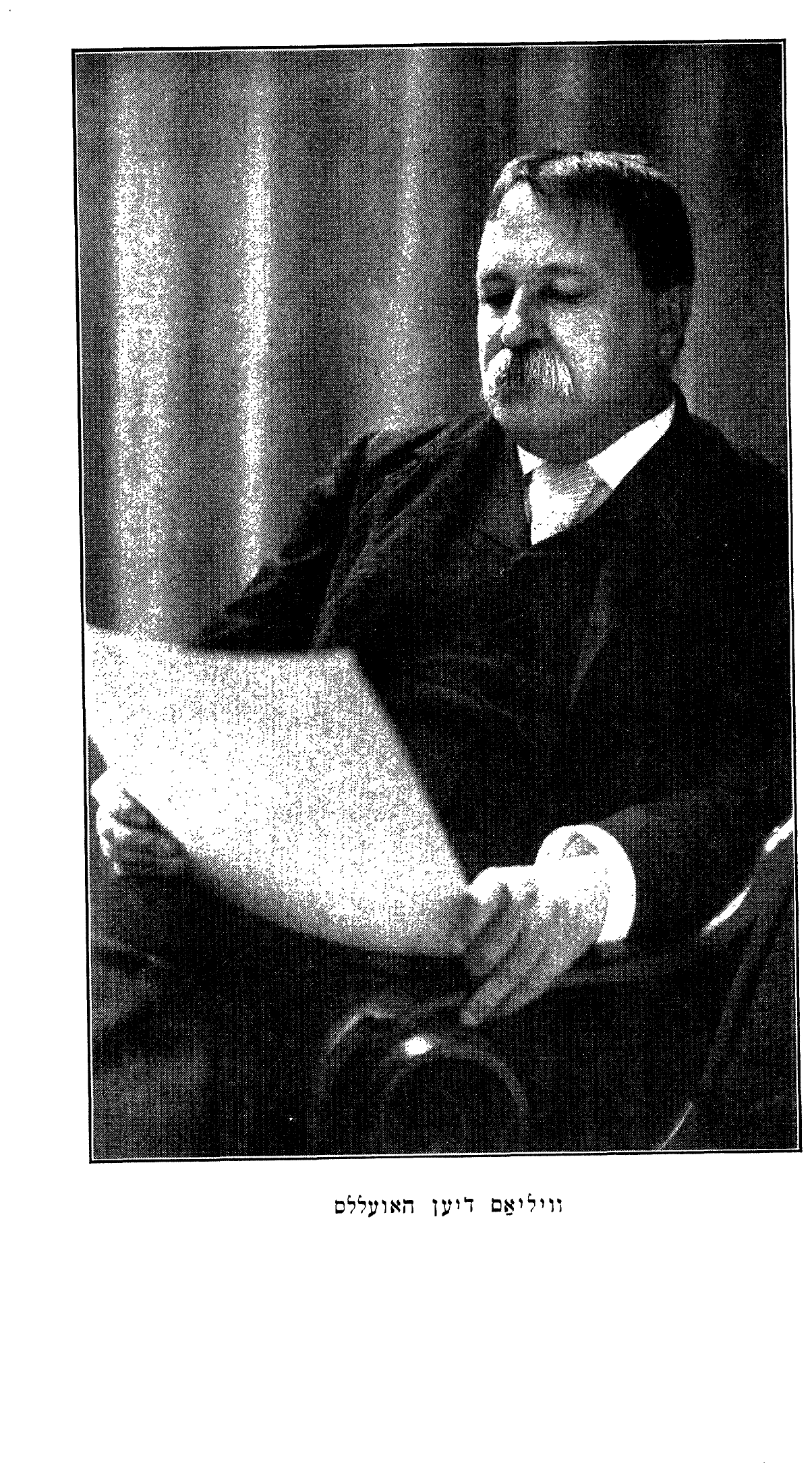
William Dean Howells was the greatest American writer of that time, and he was a realist. He depicted real life. For Russian literature he was full of enthusiasm. In the literary feuilletons that he used to write in "Harper's Weekly," he often mentioned Tolstoy and pointed to his greatness. Once, discussing other writers, he ended the article with the following words:
22"I wish to close with a name, which is the name of the greatest of all literary artists: Tolstoy."
His own novels were the only American works that, by their artistic direction, stood close to Russian literature. Henry James too was counted a realist, but I thought more of Howells.
His middle name, Dean, is a word that means: high priest or director; and it used to be applied to Howells's rank among American writers. "The Dean of American literature" he used to be called.
I read his writings with relish even before I myself began to dream of belletristic activity (see the second volume, page 320). And now my interest in them grew greater. His most important novels I reread once more, and every new thing of his I read as soon as it appeared. I did not read it in a library, but in no other way than buying the book. The latter I always used to do. A Howells library accumulated for me.
He understood the inner little world of a person, and he wrote with a rarely rich and beautiful, yet simple, language. An educated lady once wrote to him:
"You understand American women so well. You penetrate so into our hearts that one wants to protest that you give away our secrets."
These "secrets" never had with Howells any connection with such matters of sex as the moral censorship of American public opinion keeps behind the curtain — a censorship that was then incomparably stricter than today. Such questions Howells does not touch upon. To go23against public opinion he never permitted himself.
I believe that Howells is to this day one of the two most important writers in all of American literature. His chief failing consisted in his mildness and Puritanical prudishness. He was not a fighter. To set himself against the half-religious, unofficial but nonetheless mighty moral law he was not able. He was always afraid that his pen might commit some indecency.
He was an unusually soft man, kind-hearted, tender. And as a belletrist he was too tender. This hindered him in his art. But there were great virtues in his writing. He created real people, "Americans of flesh and blood."
Despite his high position and influence, he felt as though forlorn, because all around him reigned the cheap trash-literature of novels that end with a mechanical "happy ending." He envied the European countries. And whenever there appeared in America a writer who depicted reality, he would rejoice over him. He would rejoice above all over new American talents, and he used to help them come to public notice.
Once, when I came into the café that our comrades used to frequent (a few steps from our editorial office), the proprietor, a comrade of ours by the name of Goldstein, handed me a visiting card of Howells's with a few words written on it in pencil:
24"I wished to have the pleasure of becoming acquainted with you."
To Goldstein he explained that our quarter interested him, and that, strolling through the Jewish streets, he had heard that there was a Jewish socialist newspaper. So he would like to meet its editor. He had been to our editorial office, at 91 Delancey Street; but he had not found me, and someone had advised him to look for me in the café.
The card stirred me. William Dean Howells wishes to become acquainted with me!... In my mood at that time it was a most pleasant surprise.
I wrote to him at once, and he invited me to his home.
The address was on 17th Street, between Second and Third Avenue — there where on one side runs the little park — a beautiful spot, a quiet and a dignified one. One afternoon I walked over there. My heart was pounding. I am going to Howells's!
The house in which he lived was a two-story, brown-colored private brick dwelling. One felt a tidy freshness and at the same time a proud age, an American well-establishedness. I gave a pull at a gleaming brass knob of a non-electric little bell. A genteel servant girl opened the door.
I found an American man of some fifty-odd years, neither tall nor lean, clean-shaven, with a full grayish mustache.
I began with a short speech that I had prepared beforehand. Approximately so:
— I cannot tell you how pleasant it is for me to
(plate; bound facing printed page 25)
25make your acquaintance. I feel so not only as the socialist editor whom you have honored with your visit, but also, and chiefly, as one of your enthusiastic readers and admirers.
— You have read my works? — he asked, in a tone of surprise.
— Every line that you have written, — I answered.
He grew a little embarrassed and looked me over, as though he could not believe his ears.
We got to talking. It turned out that, according to his notions of the time, a socialist editor was a kind of "walking delegate," a labor leader of the ordinary American type. Such people had no conception of literature, and certainly none of works like Howells's.
We talked about Russian literature, about English, about certain of his novels, about the socialist movement. Much of what he heard from me was new to him. He became greatly interested.
This was in 1892. He soon went off somewhere, and before I had occasion to meet him again, a good while passed.
In 1894, a few months after I had returned from my third journey to Europe, there appeared a new work of Howells's, a socialist fantasy by the name of "A Traveler from Altruria" (a traveler from a country called Altruria, a land where instead of egoism there reigns altruism: love of mankind, equality, and brotherhood — a so-26cialist society). For me this was an indescribable surprise. Up to the time when I became acquainted with him, about a year and a half earlier, his works had shown no interest in social questions. He used to describe the life of the higher circles, and he himself lived as one who belonged to that same world. I saw that he was a very refined man. In the conversation I had with him, he had spoken of our movement as a detached observer, as a writer who is interested in it simply because he is interested in everything in the world. And here he was dreaming away about an "Altruria"!
Although the story is a fantasy, it nonetheless contains talentedly drawn sketches and types of American reality.
I found especially interesting the character of the source from which Howells drew his socialism. The man who had converted him was none other than the former president of the United States, Rutherford Hayes. Hayes, in turn, had received his idealistic ideas from Bellamy's novel "Looking Backward." The fantasy had made a strong impression on Hayes. He fell to thinking and came to the conviction that the capitalist world is built on injustice, and that a true civilization would be possible only when Bellamy's ideal was realized.*27I translated portions of "A Traveler from Altruria" for the "Arbeiter Zeitung," and in the preface to my translation I explained what a place Howells occupies in American literature.
All of this is connected with my further acquaintance with Howells, who played an important role in my literary career.
Howells then lived on 59th Street, between 5th and 6th Avenue, directly opposite Central Park. On 6th Avenue, half a block from his residence, there was a store of newspapers and stationery, and the storekeeper was a Jewish young man. Howells was a customer of his, and he liked to draw him into a chat. When my articles about "A Traveler from Altruria" had *28printed in the "Arbeiter Zeitung," the newsdealer told him about it, and read out to him several passages from my article about the work. Howells told him that he knew me, and that I had made a good impression on him.
To that storekeeper my brother used to come, and through him I learned of the conversation.
A year later I reworked "Motke Arbel" into English. I gave it the name "A Providential Match" (a destined betrothal).
I took the manuscript to the journal "Harper's Monthly." But it was sent back to me. Then I took it to the editorial office of the journal "Short Stories," which had begun to appear a short time earlier.
In about a week I received a letter saying that the story would be printed, that I would receive the check when it appeared, and that the editor wished to see me.
The editorial office was then on Lafayette Place, near the Astor Library of that time. I came. I was received by a tall, slender, young American — the editor. He proposed that I write more stories.
I was in seventh heaven.
— But we can pay you only twenty dollars — he said.
I agreed. Had he offered me five dollars, I would have agreed too.
I had thought of writing belles-lettres only in29English. But the desire to create something was so great in me that, before "A Providential Match" had been printed in "Short Stories," I set about writing a new story in Yiddish for the "Arbeiter Zeitung." This was a longer piece, under the name "Di Tsvey Shidukhim" (The Two Matches). It began to be printed on the 14th of January, 1895, and ran in eight issues, that is, eight weeks.
My English story appeared in "Short Stories" of February, 1895 (while "Di Tsvey Shidukhim" was still being printed). Once, when Howells's wife was standing on an elevated station, waiting for a train, she looked over the covers of the various journals and noticed my name on "Short Stories." She had heard the name from her husband; so she bought the issue and brought it home.
Howells read the story through, and when he was out on the street, he went into the aforementioned stationery store and asked the storekeeper to convey to me that he wished to see me and would write to me. In a few days I received from him an invitation to come to him for tea one afternoon.
When I visited him, he said to me:
"I have read your story in 'Short Stories.' It is, of course, not a serious thing. But it convinces me that you must write. It is your duty to write."
When I had heard similar words from Zhuk, my head was turned. One can imagine now what effect the compliment from the "Dean of American literature" had on me.
30I had then just finished a second story for "Short Stories" — a little tale that takes place in a New York sweatshop, and which I named "A Sweat-Shop Romance." This story appeared in the issue of June, 1895.
The three stories — the two English ones and the Yiddish one — I did not hold in my hand for thirty-one years. I read them again in 1926. All in all, that reading was an interesting experience for me.
"Di Tsvey Shidukhim" (The Two Matches), which is much longer than the other two, is the most important and best of the three. There is no comparison. Only its ending is weak. (By then there was already talk of my leaving the "Arbeiter Zeitung," where the story was being printed from week to week. So I finished the thing in haste, in a "slapdash" manner.)
One more thing I now dislike in the story: its half-humorous tone. This is mostly a cheap tone. Still, I would print such a sketch with pleasure today as well. I believe that the persons are alive, full-bodied; the relations among them, the conversations, and the spirit that is felt around them — all is natural and full of life. Such an impression it makes on me today, at least. When it ran in the "Arbeiter Zeitung," there were heard warm praises of it.
"A Providential Match" is the weakest, though in English it came out better than in Yiddish. As an editor, I would not accept it for printing today. As for the story "A Sweat-Shop Romance," it is partly satisfying to me today and partly absolutely not. The depiction of the sweatshop with its few workers is full of life, I believe. But the story ends like all the tales that are printed in the Amer-31ican journals. At the very moment when the young man in love comes up to the door where his beloved lives, he hears a crash at the door. It is a betrothal (tnoyim). The bride is none other than the girl with whom he is in love, and just at the moment when he prepares to open the door, a plate is broken, and his beloved is betrothed to his rival.
How such a childish ending fell into my mind, I cannot understand. I see here the influences of two different literary worlds in one: of the conventional American literature and of Russian literature.
Notes (the original’s footnotes)
[p. 26] That a former president of the United States should sympathize with socialist ideas was an almost incredible phenomenon. I rejoiced, but in the wine of my joy lay a fly. Hayes had become president without any right to it. His election took place in 1876. He was the can- didate of the Republican party. The Democrats argued that in truth their candidate — Samuel Tilden — had been elected. The Washington Congress appointed a commission to make an investigation, but the Republicans on the commission had a majority, and the upshot was that masses of Democratic votes were disqualified in four states, and Hayes was declared president. The Democrats did not cease to protest and to accuse the Republicans of fraud. Hayes's term as president ended in 1881. When I came to America — a year later — the "New York Sun," which was then a Democratic paper, never mentioned the name Rutherford Hayes without the words "Fraudulent President." It should be noted that the word "fraud" here applies to the leaders of the Republican politicians, and not to Hayes personally. Personally he was a highly decent man. Still, the expression "Fraudulent President" greatly annoyed me now. If such good fortune does happen, that an ex-president of the United States should believe in our ideal, must he have just such a stain upon him!