Chapter Two
"Yekl"
32In the first volume it was mentioned that my novel "Yekl" appeared. Here I shall tell the particulars.
Howells's friendly words came to me at a time when I was downcast from our powerless struggle against De Leonism and from the support it had received from the "clique." Howells's encouraging words were a welcome balm to my pains.
I set to work at once. I drew up a list of several themes that had come into my mind, and I consulted Falding. Of my several plots, the one he liked best was the following:
Yankel, a young Jewish immigrant, a blacksmith from the old country, becomes bewitched by American life. He becomes an "American" according to his notion of the word. He is a healthy, handsome young man, and out of him sprouts a bit of a prizefighter and a hero in the dancing schools. In a Lithuanian town he had left behind a wife and a child. The three years that he has been here alone, his life has been rich in new impressions, new experiences. He feels33himself not at all like the Yankel of his old home. In the life of Gitl, his wife, on the other hand, no great events had occurred in those three years. She is the same old-fashioned little wife of a blacksmith in a backward, neglected Jewish town, just as he had left her.
In the dancing classes a Jewish girl named Mamie falls in love with Yankel. From home a letter comes to him that his father has died, and partly out of superstition (he is afraid his father will come to strangle him for his sins), partly because Gitl and the child have nowhere to be, he must bring them over to America. The money for it he borrows from Mamie. When Gitl comes over, the abyss that the three years have created between them is felt. At home he had loved Gitl; here he cannot bear the "greenhorn" — because of this abyss, and because of Mamie. Now he feels especially that Mamie is dear to him. She is closer to him than Gitl, in any case. A series of scenes develops between them. It ends with a divorce.
The theme presented a characteristic situation in the life of our immigrants. The Jewish quarter was full of "Yekls" who, within three years, had become estranged from their "Gitls."
I set about writing the story. My lodging was then on Sixth Street, on a corner of an "alley," a tiny little lane, near Third Avenue. I usually wrote at night, for I then found myself in the midst of our struggle with the "Publishing Association," and the days along with the evenings I spent at meetings, conferences, in conversations, discussions.
There came out a short novel — some thirty-odd thousand words.
To have it copied over on a typewriter was then for me34too great a luxury. I copied it out myself — with ink and pen, in clear letters, on short, good, smooth sheets of paper. If on a page there were a few corrections, and it did not look clean and neat, I copied it over entirely.
When everything was ready, I brought the manuscript to Falding and asked him to read it through.
"I could not tear myself away while reading it," he said when I called on him a few days later.
Falding has the character of a genuine American. He does not talk too much, and when he says something, his words are weighed and measured. About my story, however, he spoke with enthusiasm.
I carried the manuscript off to Howells. A few days later I received a letter from him: "I have read your novel; come to dinner, we will talk about it."
He received me with a warm welcome. It was in his study.
"Well, it is a splendid thing!" he said in an earnest tone. "It pleases me very much."
At dinner were his wife and their only daughter. (He also had a son, a married one.) In the house everything looked "genteel," in the American manner, and one felt the perfume of spiritual nobility. Mrs. Howells carried herself with American refinement of manner, but with American tact and with genuine hospitality. When her hands were not occupied, she held them folded together and drawn35to her heart, as if she felt cold and were huddling herself.
At the table she told, among other things, how, while in Berlin, she had once seen on a tram a thin American woman who wore a little shawl around herself.
"She sat straight as a violin string, and huddled into her little shawl," she said, imitating it with her movements, "I thought at once that she was from Boston. Only a Boston woman sits like that in her little shawl. And it turned out that I had guessed right."
When Mrs. Howells told this, I thought to myself that she herself sat exactly like that American woman whom she had met in Berlin.
Their daughter, Mildred Howells, who also wrote, only from time to time threw in a remark.
At first I sat as if bound. But their hospitality soon freed me of that. I began to feel as if among good, old acquaintances.
At the table we chatted about taste and worldly matters, and a little about literature, about the Russian writers, and about socialism. I remember an amusing remark that Howells then made:
"You Marxists are always talking about economic interests as the foundation of everything that is done in the world. Well, a man with a wife have the same economic interests. Therefore Mrs. Howells has a great interest in everything I write. And if something does not please her, she tears it down mercilessly," he36finished with a cheerful smile. "Mrs. Howells is my strictest critic."
About my manuscript he mentioned at the table only in passing, with a light compliment. And at that his wife smiled at me maternally, as if she were glad of the fact that she had "discovered" me — such was the expression that this smile carried.
Only after dinner, when we had returned to his study, he and I, and they had brought us coffee there, did he begin to speak about my novel. I do not remember the words. I remember only that from his speech a warmth passed through my blood. I was abashed and could not say a word. With words of praise he pointed to various scenes, to this character, to that one. He remembered almost every line of the novel. He expressed joy that "American literature has gained an important power," as he put it, and as we shall see, he afterward said the same thing in an article in an even stronger form.
He advised me, however, to change the name. My title had been "Yankel the Yankee," and that did not please him. The consonance of "Yankel" and "Yankee" made an impression on him as though it had been specially contrived.
"That suits a vaudeville, but not a story such as yours," he explained.
I began to enumerate other Jewish names. When he heard "Yekl," he said that it would sound well. Not "Yekl the Yankee," but simply "Yekl." And so it remained. I therefore had to alter the name throughout the whole story.
37Before leaving, I wanted to take my manuscript with me. But he would not allow it. He explained that he would recommend it to editors of well-known journals, and that to seek a firm that would print the novel as a book would be the next step.
"But I believe that it will not be easy to place," he said. "Our editors have their own notions about literature. One cannot blame them. They must keep in mind the reading public, and the taste of the great mass is not the same as yours or mine."
I was already about to take my leave of him; but he detained me.
"Wait, I want to show you something," he said.
He went over to a beautifully carved desk and took out of a drawer a letter. It was from Turgenev to him. Turgenev had praised a work of Howells's that he had read, and spoke in friendly terms about their meeting. The letter was written in excellent English; only one word — "physiognomy" — was used in it not in an English manner.
Howells then told me how he had met Turgenev in Paris, and how he had corresponded with him. He was very proud of the letter.
Howells's novels used to be printed then in "Harper's Monthly." At the same time he used to write his feuilletons in "Harper's Weekly." The editor of "Harper's Weekly" was then a journalist by the name of38Nelson. Howells had given him my manuscript. About three days later Nelson sent the manuscript back to me at home, by a special messenger, and together with it he sent me a letter in which it was explained why he could not print it. The main point consisted in this, that life on the Jewish East Side would not interest the American reader.
I showed the letter to Howells. He looked it over and, with a sad smile, made a gesture with his hand.
"Just as I told you, Nelson is a fine fellow; but he is an editor, and he seeks the best for his weekly as he understands it. It is not a question of literary worth; it is only a question of success with the readers."
Howells sent the manuscript off to the editorial office of another journal — I do not remember the name; I remember only that the chief say there was held by a woman. She too sent the manuscript back — not to me, but to Howells; and he showed me the letter she had written him. She spoke quite openly:
"You know, dear Mr. Howells, our readers, men and women, want a novel about richly dressed cavaliers and ladies, a love that develops between them on the fields while they play golf. How can a novel interest them about a Jewish immigrant, a blacksmith who became a tailor here, and who comes to loathe his ignorant wife?"
Then he sent the manuscript off to "McClure's Magazine." This time I went myself for an answer. I was received by a man named Phillips, who was a partner in the business and actually the real39editor, for McClure at that time was mostly traveling about.
We had a whole debate about literature in general and chiefly, naturally, about my novel. His argument then sounded to me strange, but today I understand it differently.
"You portray only Jews," he said. "Whoever reads your novel might think that in America there are no other people but Jews."
When I recall those words, I believe that his real meaning was that a novel in which the characters are Jews — no one would want to read it.
His second point consisted in the following:
Art must be occupied with beautiful things, and in my novel no beautiful things are presented: a dancing school on the poor East Side, ignorant people, a man who is unfaithful to his wife. What has that to do with art?
I brought him examples from Russian literature, where in the finest works the life of poor, unwashed peasants is portrayed.
"Ah, but around the peasants stretch beautiful landscapes, splendid fields and forests!" he argued.
"Do you believe that a flower is more beautiful than a beautiful peasant soul?" I answered.
"Does your Yekl have a beautiful soul, then?"
Such, more or less, was the course of our dispute.
He sought to give me encouragement. He said that I had talent, and he advised me to use the talent for art — that is, that I should write about "beautiful things."
In short — I got the manuscript back. "Short Stories" were excluded. This jour-40nal printed only short pieces, each in a single issue, without continuations.
From all these letters and explanations I became astonished and downcast. My courage was chiefly disturbed by the conversation with Phillips, who had sought to give me courage.
"But he talks like a savage," I afterward complained to Howells. "In Russia such an editor would be impossible."
Howells laughed cheerfully and comforted me. He spoke about the special circumstances under which American journals exist, about the great circulation they must have here, and so on, and so on. My complaint was nothing new to him, for from the unfavorable conditions under which belles-lettres were written and printed in America, he himself had also suffered enough. Although he had the greatest name, trashy novels sold far better than his best works, and the reviews that used to be written about his writings used to show clearly enough that the critics had quite raw notions about literature. The journals where his novels were printed paid him a large honorarium, because his name was an ornament for them. But when a work of his appeared as a book, the success was mostly not great. The public wanted to have sensational romantic tales with much "action" and with a happy ending, and a majority of the critics supported this taste.
Phillips's words reminded me of certain impressions I had received when the famous Russian painter Vereshchagin held an exhibition here of his war paintings (see the second volume, pages 424-428).
In the American newspapers I found a sharp cri-41tique of why he occupies himself with painful things. Art is bound up with aesthetics, the connoisseurs explained, and aesthetics deals with beauty, with objects that afford pleasure. Art, therefore, must afford pleasure, not suffering. But Vereshchagin's pictures afford only suffering. What pleasure can one have when one looks at a mass of wounded soldiers, with arms or legs shot off, with bandaged wounds through which the blood soaks the canvas? It oppresses the heart. Therefore it is a crime against art!...
Then, when I read this critique in an American newspaper, I was astonished. A clipping containing this art-criticism had been put away by me. So now I looked it up and read it over again. Now, then, I saw how a similar notion is expressed about literature — that in a novel one should write only about ladies who wear beautiful and rich clothes, about cavaliers who drink champagne and ride in carriages.
In my mind I also connected this with certain things I had noticed on the American stage. American actresses want to play only such roles in which they can wear beautiful, costly clothes. To be dressed on the stage like a poor woman is something the actresses hate.
In fact, such plays were not performed at all. In later years certain changes occurred in this respect. From time to time one sees today a piece of poor life on the stage. But back then they put on almost only plays about aristocratic society.
In American literature it was the same.
42About poor people one used to write only either comic things, or wild melodramatic mysteries, detective tales, in which one hunts for murderers, robbers, kidnappers. The better literature was occupied with the higher classes.
As I have already noted, Howells himself wrote chiefly about high society.
How, then, would I be able to break into American literature? But I was not in despair. Howells believed so strongly in my talent and gave me so much courage that I was sure of myself.
And yet I began to doubt whether "Yekl" would ever see the world.
Howells had gone away for a certain time. In his absence I began to translate "Yekl" into Yiddish. The chief reason was my impatience to see it in print — if not in the original, then at least in a translation. And once I began to think about it, I had already become interested to see what impression the novel would make on our Jews — on the same human world that it portrays.
I printed the translation in the "Arbeiter Zeitung" (Workers' Newspaper) under the name "Sotsius." Under my own name I usually wrote serious articles in Yiddish, and the signature "Sotsius" I used to use for half-belletristic feuilletons. The novel I called in Yiddish not "Yekl," but "Yankel the Yankee."
I knew that Howells was right, that the title sounds like a contrivance. That this "Yankee" should rhyme exactly43be called Yankel — that now sounded to me like "a machine-made coincidence." True, in real life such coincidences are not seldom met with. But in literature one feels, in such a case, that the author has contrived it deliberately for the sake of the wordplay: "Yankel" and "Yankee."
For our readers, however, it was a felicitous name — so I reasoned — and to renounce it my heart would not let me.
The story had success in Yiddish at once. From various sources letters came to our editorial office: that so-and-so believes he is meant; that such-and-such a woman is convinced that she is the Gitl about whom it is told. People imagined that the whole story was a picture of their own life, or of a life with which they were personally acquainted.*
Compliments were also heard from a portion of the Jewish intelligentsia. People from whom I was politically estranged expressed enthusiasm for the depth and for the descriptions of the scenes. Others among our intellectuals, however, had an unfavorable opinion. Their criticism — chiefly when the book had already appeared in English — consisted in a declaration that I ought to have chosen a more important and more sympathetic type than "Yekl" — that I ought to have shown the Ameri-44cans a finer specimen of our quarter — an educated, interesting idealist, for example, who sacrifices his own advantage for the common good. In a discussion with one who expressed this opinion, I answered that I had written the novel not with the aim of advertising our Jewish population, but of carrying through a definite artistic theme, and to this theme the Yankel-the-Yankee type was suited; that the question in belles-lettres is not what sort of persons a writer presents, but how he presents them, and whether they have a natural connection to the artistic plan of his work. I was sure that my theme touches on a situation which reflects our immigrant life in a characteristic manner, and that this has far more significance than to glorify the Jewish people.
As soon as Howells returned to New York, he invited me to him. He gave me courage anew. He assured me that with all beginners it goes hard like this; that sooner or later my novel would be printed, and that then many gates would open for me. But the hope of having the novel printed in installments in one of the great journals he finally gave up. He began to think about the great book publishers.
When he heard that I was printing the novel in a Yiddish translation, his face expressed unpleasant surprise.
"Why do you do that?" he asked. "Publishers do not want to print a thing that has already been printed."
But he soon comforted me. He said, namely, that the fact that the novel was running in a Yiddish newspaper45an American book publisher would not take into account.
"From his point of view it does not mean that the book has appeared," he explained with a smile.
A few days later I received a letter from him in which he told me to propose the novel to one Ripley Hitchcock, who was then the "Literary Adviser" at the firm R. Appleton and Company, one of the two most important book publishers in America. But since I needed the manuscript for my translation for the "Arbeiter Zeitung," I worked several days and nights almost without stopping and made a copy. I copied out half a book. To write more I no longer had strength. I went about as if with cramped fingers.
Then I went off with the manuscript to the Appletons and inquired after Mr. Hitchcock.
I was received by a tall, slender brunet, a man of middle years, with a very intelligent face. This was Hitchcock. Howells had already spoken with him about my book. I left the manuscript with him and he promised me that within about a week I would have an answer. Usually, when a stranger leaves a manuscript with a publisher, it is given to a reader who is specially employed for this purpose. If he likes it, it goes to a second reader; and finally to the "Literary Adviser," or to the publisher himself. In most cases it does not get further than the first reader. The author gets his manuscript back together with a printed card, which is sent to all46such victims as him — namely, that he is thanked, but that his work cannot be used. Here, however, Hitchcock himself set to reading at once. He had actually begun to look over the first pages even before I had taken my leave of him.
The firm accepted the manuscript.
Before it was sent to the typesetters, I took it home with me for a few days, ostensibly to look it over; but in truth to finish the copy that I needed for my translation into Yiddish.
The translation began to be printed on October 18, 1895. The original was accepted from me in December. The publishers brought out new novels twice a year — in spring or summer and in autumn. My book was set for the spring. But there came a delay and it appeared at the beginning of July, 1896.
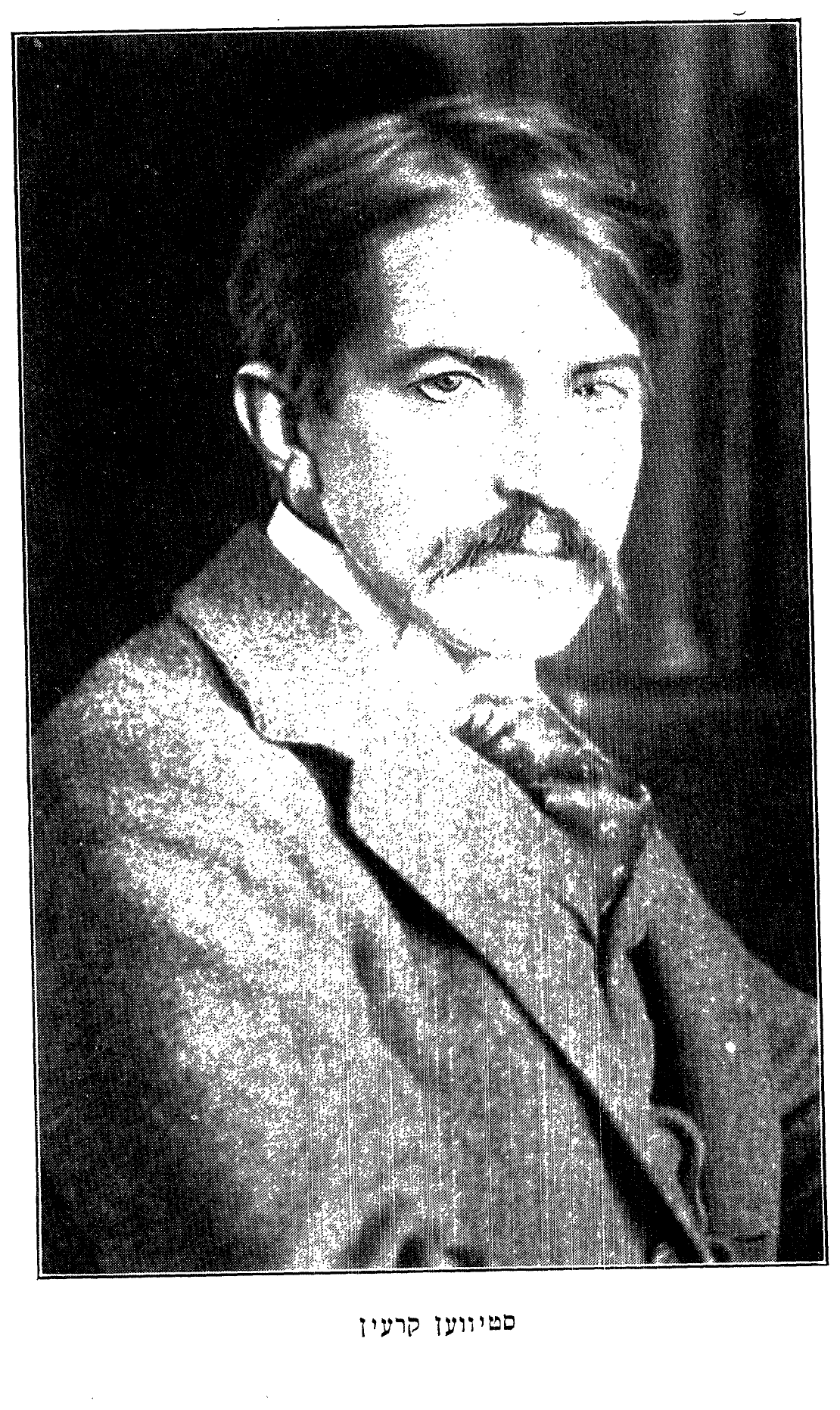
About a scant year earlier the Appletons had printed "The Red Badge of Courage" — a novel in which is depicted the war between the Northern states and the Southern states over the Negro question — by a young American named Stephen Crane. The book caused a sensation in the literary world of America and England. In this connection the following is interesting: Stephen Crane had sent the manuscript from publisher to publisher, in New York, in Boston, and in Chicago, and everywhere it was rejected. Then Crane became acquainted with Howells. Howells read his work through and was delighted, and Hitchcock printed the book on Howells's recommendation. At first the story attracted no attention, but in Eng-47land a well-known critic wrote an enthusiastic survey of it, and other London critics also praised the novel greatly. The result was that then in America too people began to write and talk about it. "The Red Badge of Courage" really points to a wonderful talent.
The Appletons brought it out in a special format which they had designated for a series of higher literary works. My novel "Yekl" they brought out in the same format as one of that series. At the same time they brought out, also in the same format, a second novel by Stephen Crane: "George's Mother."
The first review of "Yekl" appeared in the "New York Times" of Sunday, the 12th of July. I have that article before me now. First the gist of the whole story is given. Then the critic says:
"This is the frame of a strongly impressive new story. But the charm, the reality, and the literary worth of the book stem from the character-pictures, from the 'local color' it contains, and also from the fact that it opens up for Americans a slice of life of which they have no notion, although it lies at their very door. The story takes place in the packed streets of the East Side of New York."
After this comes a goodly extract from the book — my general description of the Jewish quarter in New York — and then the critic says:
48"Yekl and the other characters of the book, and the life they lead, are painted vividly, with a talent for graphic pictures, with a keen sense of humor, and without a hair of preachiness. The author knows the Jewish quarter excellently, and he presents it with the truth of life. He does not seek to make sensational effects. Nor does he seek through the book to carry on propaganda for some movement. He paints a picture of life."
The critic of the "New York Sun," which was then a morning paper and one of the most important in America, compares "Yekl" with certain descriptions of the East Side (of German worker families) found in the novel "The Golden House" by Charles Dudley Warner, a well-known American writer. He also compares "Yekl" with the East Side portraits (of Americans) in Crane's "George's Mother." He asks a question: "How is it that with Warner the people of the East Side are always sorrowful, always troubled, while Cahan's East Siders have cheerful, merry moments; they are not always careworn. They often give a frolic, a laugh?"
"As regards the conversations in 'Yekl'," says the "Sun" critic, "we must say that they are far more interesting to us than the conversations we find in Warner or in Crane. With Warner the poor women talk chiefly about the pay they get for sewing shirts or trousers. With Cahan, however, they talk about other things too.
"Mr. Cahan renders in English the figurative phrases of the Yiddish language as they are used in daily talk, and they are often very interesting. Mr. Cahan also gives us the English words which the East49Side Jews have taken into their mother tongue, and he shows us how they pronounce them."
The critic also wonders how "Yekl" obtained a divorce from his wife, despite the strict laws of the state of New York in this respect. But he thinks that presumably this too is correct.
"We are prepared to believe that the realism of the novel holds on this point as well," he says. "Every reader will feel that Mr. Cahan has here accomplished a wonderful work. His work is doubly remarkable, for one must remember that he came from Russia and only began to become acquainted with the English language a few years ago."
As regards the divorce, the critic was simply not acquainted with this little corner of life in his own country. When both parties are agreed, to obtain a divorce in New York is as easy as in Paris. One party files against the other a complaint of infidelity; proofs are brought; the accused does not come to defend himself, and the judge issues a divorce.
Such an arrangement is against the law, but such divorces are an everyday occurrence.
An unfavorable review, though expressed in quite refined, delicate words, was contained in the "Mail and Express." The writer gives me a few compliments, but he says that I use too often words of the American popular speech, whereas for literature a worthier language is demanded. He says in conclusion:
"Mr. Cahan has here found a new material, a new gold mine, and if he has not worked this mine as successfully as would have been desirable, he may in the future perhaps do better work, if only he has the desire for it."
50The content of the novel he does not consider. The question whether the characters and the scenes are alive and whether the plot has an artistic interest — such questions he does not touch upon. He speaks only about the external form, and it does not please him.
Other critics praise my style, and precisely for its simplicity and naturalness. Howells, who was himself the greatest master of the English language, was delighted with the English of "Yekl," and he did not stop giving me compliments for the "naturalness and for the genuinely English plainness and juiciness" of the language, as he expressed it in a letter to me. Other well-known American writers expressed the same opinion.
Reviews appeared in various newspapers in various cities. Some of the critics praised the novel greatly, others dismissed it with a wave of the hand. Some regarded it earnestly, as an artistic portrayal of an immigrant life; a few others, on the other hand, spoke about this life itself in a half-jesting tone.
Those who wrote about "Yekl" unfavorably mostly had the same objection as Nelson of "Harper's Weekly," or Phillips of "McClure's Magazine": that I depict uneducated, poor Jews who live in dirty tenement houses and wear cheap clothes, and saints they are not either. When one writes about such people, that is no literature, because firstly it is not aesthetic, not beautiful; and secondly they do not represent the true America.
51given praise for things that have no significance. They simply rambled on into the blue. I saw that they had no conception of literature as a depiction of real people and of real life; they praised me chiefly for the "plot," the story. But there were also those who understood the novel the way the "Times" critic had understood it, and they wrote in the same vein as he.
One of them was the critic of the "Chicago Record," an important daily newspaper with a large circulation. He begins:
"A picture of life, painted in living colors, a great work of realistic art — that is 'Yekl.' Here you have real life, with men and women of solid flesh and red blood — human human beings with all their human failings.
"What Israel Zangwill did for the ghetto of London, and what Stephen Crane did for the poor quarters of New York, that is what Mr. Cahan does for the ghettos of our metropolis, New York. The book has within it a charm bound up with the writer's intimate acquaintance with the life he depicts. His style is interesting and piquant. His descriptions are distinguished by their completeness. 'Yekl' is a drama of the life of the masses.
"So varied, so manifold is life in its comedies and in its tragedies, that the literary possibilities have no limit. In a very short time we have received two remarkable novels of the poor quarters, but they are absolutely different one from the other. In 'George's Mother' Mr. Crane painted a picture of the East Side of New York. As his central figure he took a young American who has been raised52in a row near the city and who afterward sank into the swamps through his comradeship with idlers and criminals on the Bowery. The colors were laid on the canvas with a broad brush. In "Yekl" the reader penetrates into the Jewish sweatshops of Hester Street, among the Polish and Russian Jews who speak a foreign tongue and live in a stifling air. It is an entirely different world from "George's Mother," and yet it is the same world. The hearts are ruled by the same feelings, and minds are governed by the same instincts. The people differ one from another only because their past and the world that encircles them are different. But they have a common ground beneath their feet, and it is in fact hard to show where the boundary lies between them.
"Mr. Cahan is very delicate in his dissection of the characters. He is true to life to an unusual degree. He is an artist. It is in fact quite unusual to see that a foreigner, such as Mr. Cahan, should have so mastered the English language. To say that his English is excellent, vigorous, and direct, and that it strikes right to the point, would give a very faint idea of the grace and dignity by which his style is distinguished.
"'Yekl' is a tragedy, but its darkness is again and again pierced by rays of a sun-shining humor."
When I showed Howells a clipping from the "Chicago Record" containing this review, his face was bathed with the sunshine of joy. He was in seventh heaven.
"You see, Cahan: when one writes a good thing, connoisseurs (mevinim) are sure to be found for it!" he said. And53our critics, the older ones at least, in fact understand quite well. But since they mostly have to write about romantic stories, they have worked out a romantic sort of criticism. When, however, they catch sight of a real piece of artistic work, they understand it, and then they speak in altogether different words.
I do not, of course, remember exactly how he expressed himself. But the sense is conveyed here correctly. And I heard the same thought from him on later occasions as well.
One critic (of the New York "Commercial Advertiser") sarcastically pointed to the "dialect" that I bring into the conversations. I had represented the way that Yekl, for example, pronounces English words, and I had also rendered, in a literal English translation, characteristic Yiddish phrases, such as, for example, "der shvarts yor veys im" (the devil knows) or "a nekhtiger tog" (no such thing — literally "a yesterday's day"). All this is what the writer of the "Commercial Advertiser" meant by the word "dialect," and he criticized it sharply. He complained about the custom in general of giving "dialect." "One writer shows us how an Irishman speaks English; a second — how a Scotchman; a third gives us the pronunciation of Negroes. All this is hard and unpleasant to read," he said. "And as if we had not had enough dialect, along comes Mr. Cahan and honors us with a new kind — with the manner in which Jewish immigrants speak English, and with special expressions from their Jewish tongue."
A couple of the other critics, on the contrary, praised me for my "dialect" phrases. They add interesting touches of life-color to my descriptions, they said.
I must, however, confess that later I came54to the conviction that the critic of the "Commercial Advertiser" had been right in this respect. To show how a foreigner speaks English is sometimes necessary, but only sometimes, here and there. As for special Jewish expressions, which sound strange in a literal English translation, this has, on the whole, no significance. It creates nothing more than a cheap comic effect.
In my later English stories I avoided such "dialect" phrases.
A weekly journal by the name of "Examiner," in its issue of August 27, 1896, devoted a good deal of space to "Yekl." The writer had a peculiar conception of the book. According to his interpretation, I had written it with a special aim: to agitate for new forms of immigration. Among other things he says that I describe everything true to life and accurately, but that, since it deals with ignorant people, and the hero does not conduct himself morally, one cannot say that the book is pleasant to read. Yet he has nothing against me, he says, for my aim was not to write history but to express a certain idea.
His opinion here is, then, exactly the opposite of the opinion of the critic in the "Times," who had declared that in "Yekl" I do not preach sermons, do not preach ideas. But further on in the article he says the same thing as the "Times" critic, namely: although I have an idea in mind, I do not preach but paint a picture; I do not state opinions and do not preach.
Who he was I never knew. But he, it seems, did know me. He had seen me at a socialist meeting, and he describes the impression I made on him.
"For many years" — the critic begins — "Mr.
55Cahan has been a practical writer. Yet, as a belletrist, he must be counted among the young, for "Yekl" is his first novel. He was born in Russia. He came to America not very many years ago and settled on the East Side, among his countrymen. Here his superior intelligence and undaunted energy at once made him a well-known person and one of the welcome participants in the clubs and debating societies of the East Side. That Mr. Cahan is a speaker of rare ability we can personally testify, for we were present when, on a certain evening, he addressed a large meeting. His magnetic youthful appearance, his rich resonant voice, and his vivacity at once brought him into contact with the hearts of his hearers. He electrified the thousands of faces that were gathered around him. Under the effect of his oratorical power a thrill of enthusiasm passed through the great Cooper Union. We remember how we left the meeting with admiration for the young man personally and for the abilities he had shown. Only one thing we regretted: that his rare talents are devoted to the dreamy and disruptive interests of socialism. For Mr. Cahan, like many of the Russian Jews on the East Side, is a socialist, and he lets no single opportunity pass to propagate his theories with his tongue or with his pen.
"In the course of several years he was the editor of a newspaper that is published in the Jewish language, and he was able, through his bold explanations of political situations, to exert a great influence on the public opinion of the Jewish quarter.
56"Taking into consideration Mr. Cahan's character, as we have just described it here, we were astonished by the fact that in his novel we found no trace of it. On the contrary: we find in the novel that he has especially held back his personal convictions. From the platform, on which he always feels as much at home as in his own house, he has this time descended, and he has bravely placed himself in the position of a man who is absolutely impartial, of a realistic novelist, of a literary painter who seeks only to present the facts and the movements of a certain kind of life, without any concealed wish to convert his readers and to make them believe in this or that interpretation of life. More accurately put: with his novel he leaves the reader free to draw his own conclusions, to judge according to his own understanding. All that he does is this: he lays before the jury all the evidence that he has, and the verdict he leaves to it."
In the "American Hebrew" the review of "Yekl" was unfavorable. There are no beautifully painted "word-pictures," the critic declared. He found no merits at all.
Some time later the same journal contained a note that Zangwill in London speaks of Abraham Cahan's "Yekl" with great enthusiasm.
In the third volume of "Bleter fun mayn lebn" (Pages from My Life) it has already been mentioned that my wife was that summer in57Kiev visiting her mother, and that for the time being I had settled in a furnished room, with a family by the name of Rankin.
One day Rankin says to me:
"Did you see? On all the elevated stations great posters have been put up, that Howells has discovered a great new writer. My heart tells me that they mean you."
(The advertisement was about an article that would appear in the "New York World" the next Sunday.)
When Sunday came (July 26, 1896), it turned out that Rankin had guessed right.
The "New York World" of that day devoted a whole page to an article by Howells, and the article dealt with Stephen Crane's novel "George's Mother" and with my novel "Yekl." Above, over the article, across the whole page, there stood a line with the following words:
"The great novelist greets Abraham Cahan, the author of 'Yekl,' as a new star of realism, and he says that he and Stephen Crane present the true pictures of the East Side life."
Concerning my work Howells says there, among other things, the following:
"Since Mr. Cahan is from Russia, and since non-realistic works are not regarded in Russia as literature, his tale is naturally a strictly realistic one. It is no more realistic than the tale that Mr. Crane has written. It is no more true and no less true to reality than Crane's books. The two writers have the same principle about art, but the beautifully colored foreign material that Mr. Cahan uses appeals more strongly to the imaginative faculty of58the reader. Crane's frequent laughter sometimes has a bitter ring to it. In Cahan, by contrast, one sees that he himself takes pleasure in the comic happenings in his tale. At bottom, however, Cahan's tale is not a comic one but a tragic one. What could be more tragic than the divorce of an unhappy poor immigrant woman? Though the reader soon has the consolation that she afterward marries a man who suits her far better than Jake "the Yankee." Jake, in turn, marries an Americanized Polish girl with whom he used to spend his time before his wife arrived.
"The story is told very vividly. One sees that the writer had an artistic pleasure in it. His feeling for character and his feeling for human nature are delicate and deep. I am convinced that in Cahan we have a writer, a born foreigner, who is an honor to American literature. He is already thoroughly American. He looks at the world from our standpoint. He sees things with American eyes, and in addition he possesses the broad and rich observational power of the Jewish race. In the facts of the tale there is much that causes us pain; but, as we read, we feel that the writer has given us the whole truth; that circumstances created the people exactly as he depicts them. If we do not like the results that these circumstances have brought forth, that is, after all, not the writer's fault. He has merely lifted the veil that hides the unhappy from the happy. The life with which the writer is well acquainted lives before our eyes.
"'Yekl' is a charming book, and the pleasure that it affords us comes not only from the fact that this work is so good, but also from the fact that it promises us59further good works in the future. An author who has been able to create such types as Mrs. Kavarsky (Gitl's neighbor), Jake's wife, Mamie, and Fanny the preacher-woman, with the scenes in the sweatshop, in the dancing-halls, and in the little rabbinic court (besdin) chamber where the divorce is granted — such an author has obligated himself, by the excellence of what he has already accomplished, to accomplish much that shall be still better."
Howells's article was a sensation. It was reprinted in many cities of America. Suddenly I had become known in American literature.
Reporters from various newspapers came for interviews with me. A "syndicate," which supplied articles to dozens of American Sunday papers, sent to me a writer of theirs and also an illustrator. They spent a couple of hours with me. The result was a large illustrated article about my life and my literary work, which appeared in Sunday papers in every large city in the land.
All this took place a short time after I had left the "Arbeiter Zeitung." Then, when I found myself in the very heat of the struggle against De Leonism and the "clique." On the day that "Yekl" appeared and the publishers sent me six copies, as is the custom, in New York (in Grand Central Palace, which was then much smaller than60today) there took place a convention of the whole socialist Arbeiter Partei (Workers' Party) of America.
Our opposition wanted to push through a resolution against De Leonism. So I spent whole days at the convention.
I had close acquaintances among the American delegates from the various cities, and I tried to influence them. De Leon, in turn, tried to draw them over to his side. With some delegates he had success; with some — I. There were a couple who gave us the impression that they were on o u r side, and gave De Leon the impression that they would vote according to his demand. Of these I remember chiefly a Boston socialist by the name of Brophy — a tall Irish-American, with a black mustache and weighty, calm manners. He was quite a simple man, but, by his appearance and bearing, one might think that he belonged to the higher circles. At that time he wore a white summer suit, which suited his tall figure, and this summer suit increased the aristocratic quality of his gait and air. I had been acquainted with him since the summer I spent in Boston (in 1892), and here, at the New York convention, I at first believed that I had "won him over." But he whispered with De Leon as often as with me. Finally he tried to make peace between us. But I would not hear of it.
Our resolution was watered down with amendments.
The convention ended, our struggle flared up still more strongly. I was occupied with it literally day and night.
61Miller was in Europe, and the whole duty as leader of the opposition fell upon me.
I received invitations from journals and newspapers to write sketches, articles. One newspaper proposed that I write my own life story. One journal asked for an article about the difference between European literature and American. But more than anything they asked me for sketches. I was, however, absorbed in the struggle of our opposition, and all the invitations, except one, I neglected. I waited impatiently for Miller's return from Europe.
On the 22nd of September of that year a literary club held an evening, to which they had invited as special guests Stephen Crane, the well-known writer Hamlin Garland, and me. There was as yet no "Greenwich Village" as a quarter of literary men, painters, musicians. But several literary groups had their clubs, and one of them conducted itself in the "Greenwich Village" manner — what one would call today bohemian.
The club that invited me was called the "Lanthorn Club" *. It was located on William Street, far downtown, in a large attic, which the members had tidied up and decorated in an interesting fashion, and hung with drawings and paintings. The furniture and62The whole appearance of the place smacked of "artistic temperament" and of artistic "freedom from ceremony."
There had gathered a crowd of some forty or fifty American literary men, journalists, painters, sculptors. They drank brandy and wine and had a bite of "sandwiches," made speeches and joked. The speeches were interspersed with compliments to Crane and to me. (Hamlin Garland was late.) They "kibitzed" us about our next works. It was merry and interesting.
The president of the club was a writer by the name of Irving Bacheller. (A couple of years later he became famous through a novel by the name of "Eben Holden," which had an enormous success. But by then his name was already known too.)
The little world with which I had now come together was new to me. The Americans with whom I used to spend time earlier were mostly socialists, quite different people with different interests. Folding was interested in literature, but he himself wrote little. In such a company as this one, a company of professional writers, I had never before found myself.
When it fell to me to reply to the compliments, my speech was a very short one.
"All I can tell you is that you are a 'bunch' of the most interesting 'boys' that I have ever met," I said. "I believe that this is the best speech that I can make for you, and I do not wish to spoil it with further words."
I sat down.
(plate; bound facing printed page 63)
63A thunder of applause and of friendly laughter broke out. The truth is that I was simply so flustered that I could not bring out more than those few words. But they thought that I had deliberately made such a speech, and they made a "hit" of it.
Crane was then no more than twenty-six years old — thin, pale, with an interesting, intelligent look. The talent of a gifted person is not always reflected in his face. Crane's talent was indeed visible in his figure. We became acquainted at the club, talked about his works, about my novel, about Howells, about Hitchcock. Our conversation was at first an exchange of compliments. Afterward we passed to a serious talk about literature. Most clearly I remember how he complained about the critics, that they want one to write only what they call "pretty stories." I also remember how he said:
"When I drew Howells's attention to some of the stupid reviews, he laughed at me for taking them seriously. Most of the reviews are after all written by young girls or young people, almost boys," he said to me. "Whoever happens to be at hand, the editor gives him a review to write."
Around eleven o'clock Hamlin Garland arrived, who was then one of the best and most advanced writers in America. His book of short stories, under the name "Main-Travelled Roads," consisted of sketches that would have made an impression in Russia, for they had the radical-Russian character, and they were interesting and vivid.
So that the reader may have an idea of the charac-64ter of his writing at that time, I shall here briefly convey the content of one of the tales in his "Main-Travelled Roads."
An American of the North returns from the war (between the North and the South). Before he went off to the front, a parade had been held with him and the other recruits. Speeches were made about patriotism, about heroic self-sacrifice for the fatherland. The volunteers were escorted with music, with hurrah-shouts. Now, after a couple of years of mortal danger and all kinds of sufferings, he comes back lonely, sick, worn out, and he finds his wife in want and in troubles. Where are the parades with the hero now? No attention, no interest!
Such a sort of tale was then in America quite an unusual thing.
Garland is from the West, and at that time he lived in Chicago. So he gave the club a short lecture about the new literary movement in that city, chiefly about the writer Henry B. Fuller. Afterward Crane read aloud the manuscript of a new short tale of his.
Garland, Crane, and I and a couple of others sat for a good while and chatted.
A few days later I spent an evening with Crane on the East Side. I did not see him again. He was weak in health. He left New York. Afterward he lived in Germany, and there he died, in 1900.
In the New York newspaper "Press" there was printed a two-column report about the aforementioned gather-65ing in the "Lanthorn Club," and especially about me — about my past and my connection with English literature. The "headline" of the article was: "Realists in the Lanthorn Club — Garland, Crane, and Cahan are the guests."
"At the first dinner of the season in the Lanthorn Club" — stands in the first line of the report — "the guests were the three representatives of realism in literature, of whom there is now so much talk. They are Hamlin Garland, Stephen Crane, and Abraham Cahan, the author of 'Yekl.'"
In England, some ten months later, a separate edition of "Yekl" appeared, published by the firm William Heinemann. In the London daily newspaper "Daily Chronicle" there appeared, on the 7th of May, 1897, a review of the book. The writer begins his survey with the following words:
"Mr. A. Cahan is that rare bird, a novelist with a pair of eyes in his head, a writer who notices what is going on in the world, and 'Yekl' is a tremendously interesting rendering of his observations in the form of a novel. The depiction has been done simply and without superfluous words, and is very convincing and impressive."
After he conveys, more or less in detail, the content of the novel, he closes with the words:
"Mr. Cahan's tale of the New York ghetto is a fresh and genuine piece of observation. The book is unusually interesting."
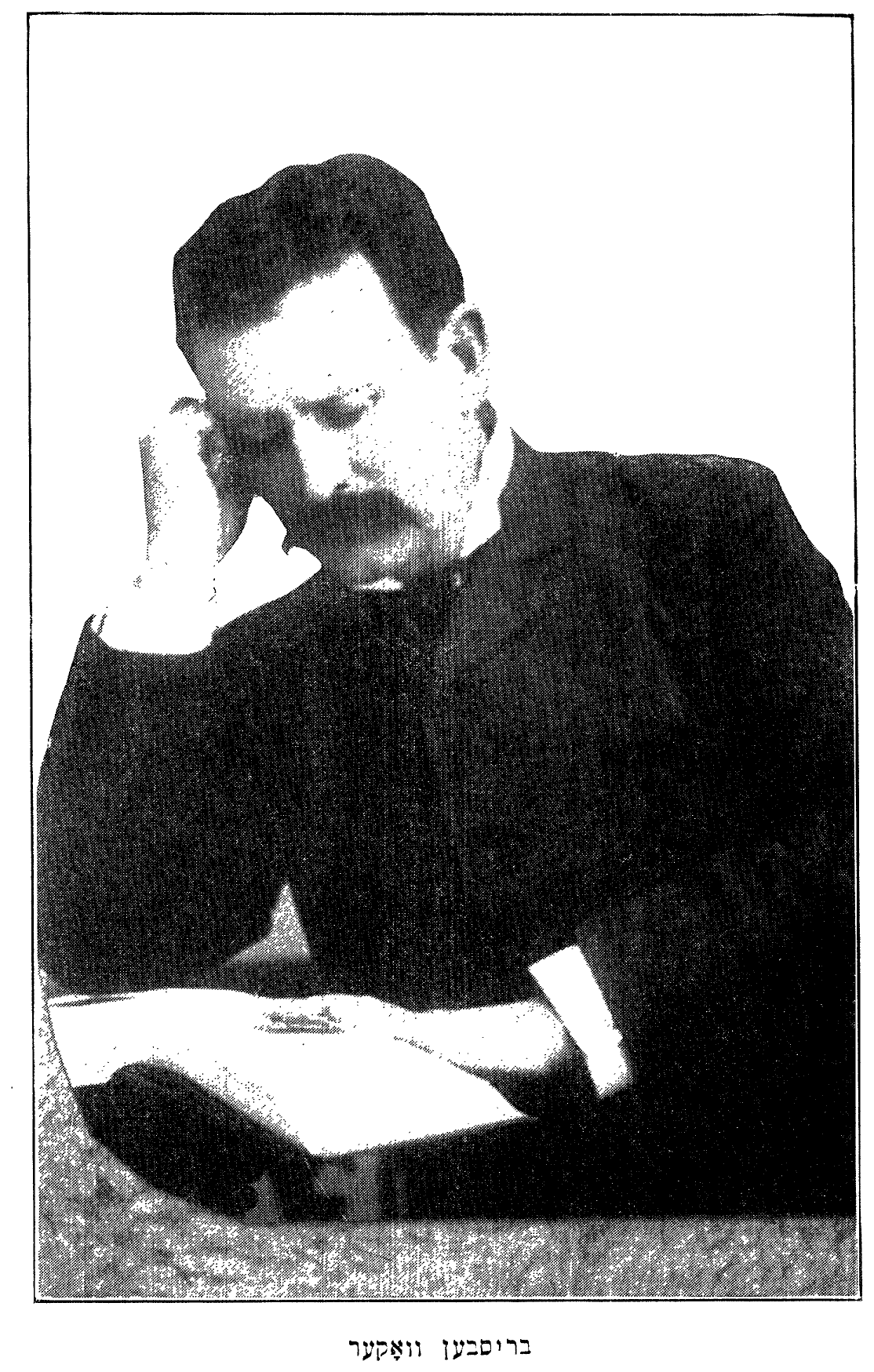
66I said above that I had neglected all the invitations to write sketches, except one. The exception was an invitation from the "Cosmopolitan" — a monthly which had a short time earlier been bought by a rich man by the name of Brisbane Walker. This Walker was under the influence of Bellamy's theory, and he led a high-moral, idealistic life. Once, for example, a ragged fellow attacked his fifteen-year-old son with a knife and wounded him. The poor boy did not even know young Walker, but, seeing his rich clothes, he felt a hatred toward him. The poor lad was arrested, but Walker and his son refused to testify, and the guilty one was set free.
"I can understand the lad's feelings," Walker said. "He is poor, the poor thing, and when he saw a richer boy in fine clothes, it provoked him. The social system in which we live is an unjust one. It is to blame, not the wicked boy."
Walker had earned his wealth in the West. Now, when he had bought the "Cosmopolitan," he set about developing it with energy. He had great success. The journal quickly became one of the most important in America.
On the front page Walker had set up the communist principle: "From each according to his abilities and to each according to his needs." This did not, however, mean that the journal preached communism or socialism. Walker simply wanted to create a good, successful journal, and the communist motto he had set up merely67as an idealistic statement of principle. Rarely did an American even know that it was a communist principle.
I set about writing a tale for the "Cosmopolitan." I did it in the late night hours. The theme was one of the several that I had prepared together with "Yekl," before I had decided which of them I would choose for the novel.
It dealt with a young intelligent couple of our New York immigrant world. The young man works in a factory and barely earns a living. He is downcast. He would like to lighten the yoke of the rent, and he makes his wife a proposal that they take in a boarder (a lodger). They love each other, and in their family life they are happy. She would do everything possible to help her husband, but the thought of a boarder is not pleasant to her. She is a tidy person. She was raised in a respectable household. So she does not want a third person to be tangling around in the house. But the husband presses her, and she yields. They take in an acquaintance of theirs, a young man who is studying medicine and makes a living as an insurance agent. He prepares his lessons at home, and often he is in the house while the married young man is in the shop. He is absorbed in his medicine and in his collections. But he is not careworn. He is full of zest for life and hopeful, whereas her husband always looks tired and downcast. Between him and the young housewife a romance sprouts forth.
The title — "Circumstances" (umshtenden) — my wife recommended to me.
I doubted whether Walker would accept the tale. It ends so sadly, whereas all American68tales that were printed in the journals had a "happy ending," and in this respect the "Cosmopolitan" was no exception. But Walker accepted the manuscript at once. I congratulated myself with the thought that my name was already so important that even a tale with a tragic ending would be taken from me. But I was mistaken.
A week after Walker had accepted the manuscript, I received a second letter from him: I was to write a second tale, which should be a continuation of the first; in it should be depicted what became of the couple.
I considered the life and the conditions that had surrounded the three persons of "Circumstances," and I sat down to write. I represented how the couple meet again afterward. They make peace, go to live together again, but it is no longer the same. Their former happiness is already broken. I gave the tale the title "The Torn Thread."
I sent it off to Walker and got the manuscript back with an explanation that I had not understood him: he had expected that in the second sketch the sad story would have a happy ending, whereas with me it turns out that the torn thread can no longer be mended at all.
So worked the mind of every American editor and of almost every American belletrist. So Walker probably thought that my mind too worked that way: if the first tale ends sadly, the second would presumably smooth it over.
I was afraid that he would not print my first tale either. But it was after all printed. How the editorial office explained this contradiction is, for
(plate; bound facing printed page 69)
69me to this day a riddle. I wrote to Walker and he replied to me. From his reply I could make no sense. I spoke with Howells about it, and he laughed.
"Walker is an editor," he said.
"Circumstances" was printed in the April 1897 issue of the "Cosmopolitan." From the third volume of these "Pages" the reader knows that the tale appeared when the "oppositionists" were already working openly toward a new socialist Jewish newspaper.
As we shall see, I later had several more tales in his journal. We became more closely acquainted. We spent time together several times and had long talks about literature and social questions. In some matters his opinions seemed to me peculiar. But that he is a man with a fine spirit and with a broad, progressive outlook — this I felt throughout.
A few weeks later the "Forverts" appeared, with me as editor. Several months after that, in August 1897, I withdrew from the "Forverts."
This brings us to the time to which the end of the third volume belongs.
Notes (the original’s footnotes)
[p. 43] There is in the novel a scene, at night, where it is portrayed how the ignorant, superstitious blacksmith is frightened of his dead father and recites the Kriat Shema (the Shema prayer) in trembling. Exactly such a scene is found in a certain Yiddish story by another writer, which was later dramatized. But it appeared (in New York) three years after my novel had been printed in the "Arbeiter Zeitung" and, in English, in book form.
[p. 61] "Lanthorn" is an old-fashioned English word. Today it is "lantern," a lamp.