Chapter Three
I Become Acquainted with New Little Worlds
70I left the "Forverts" with a feeling of mental exhaustion. I was in the sort of condition in which doctors advise a patient to go away for a few weeks, to drive out of his head everything that has disturbed his peace.
The first question was that of daily livelihood.
My pocket was empty. "Yekl" had brought me no material results. The enthusiastic reviews and the whole stir that the book and Howells's article had aroused helped the sales only for the first few weeks. The Americans who buy books had the same opinion and the same taste as Nelson and Phillips. The "immoral" love-story of a poor Jewish immigrant did not interest them.
I do not believe that this had anything to do with antisemitism. Novels about the Irish also had no success. The American reader — and that means chiefly the American woman reader — wanted to have stories about aristocratic Americans. On immigrants they looked down from above. Today it is still so as well, but no longer to the extent it was in those years. What71As regards the reader's attitude toward matters of sex in literature, the public today is certainly far more developed.
If the interest that my book had aroused had filled me with dreams of large incomes, I had already sobered up from them. It had become clear to me that with novels or stories of Jewish life, and with realistic depictions in general, I would make no economic fortunes. This did not diminish my interest in literature, but my finances were in such a sad state that writing was for the time being impossible. The honorarium from "Circumstances" (fifty dollars, I think) had long since been spent, and over the last several months I had written no other sketches in English.
To many of the invitations I had received from magazines I had not replied. So they sent me no new ones. The first publicity boom was over. I should have written something and sent it to the editorial offices. But to sit down and create belles-lettres was now hard for me. For such an occupation I have to be in an easy frame of mind, entirely free of worries about bread.
"When it rains, it pours," they say in English. Just when I was so much in need of a regular income, even if only for the most necessary things, just then I had to lose my position as a teacher in the evening school, which I had held for eleven years.
The work in the evening school used to begin in October and end in April, and the appointment to the position had to be renewed every year. In all the eleven years I had never had any difficulty about it. The "trustees," the school directors of the district, used to put my name forward themselves. This time, however, they had passed over my name. I went to make inquiries, and at first I could not get at the truth.
72They gave me various excuses. Finally the assistant principal of the evening school, a handsome blond young man by the name of Straubenmiller, confided the truth to me. We happened to meet in the Astor Library, at the same table, and chatting quietly he let me in on a secret:
"One of the trustees, a year or two ago, before the elections, saw you on the street when you were delivering a socialist speech from a wagon."
That season was already lost. They had not dismissed me in the middle of the season; but for the future they no longer put my name forward.
The only thing I could turn to before I would be in a condition to occupy myself with belles-lettres was writing articles for the English newspapers, as in earlier years. So I did. I wrote up an article and carried it up to the editorial office of the "Sun."
Erasmus Darwin Beach was no longer there. His place as chief copy-reader for the Sunday numbers had long since been taken by someone named Hewen. Hewen accepted my article, and I was then almost certain of an article every week. But that was little. So I wrote up another article and went off to a second editorial office.
I had chosen the "Evening Post," because it was for a more intelligent class of reader, and on Saturdays it printed such articles or feuilletons as those I had written for the "Sun." The newspaper had then73found itself in an old building on Fulton Street, near the corner of Nassau. An elevator took me up to the top floor. There they showed me where the editorial office was. An office boy took the manuscript from me and carried it into the next room. About five minutes later a young man came out, not tall, with a blond little beard, with a very friendly smile on his face.
"I am very pleased to make your acquaintance, Mr. Cahan. I have read 'Yekl,'" he said, and invited me inside.
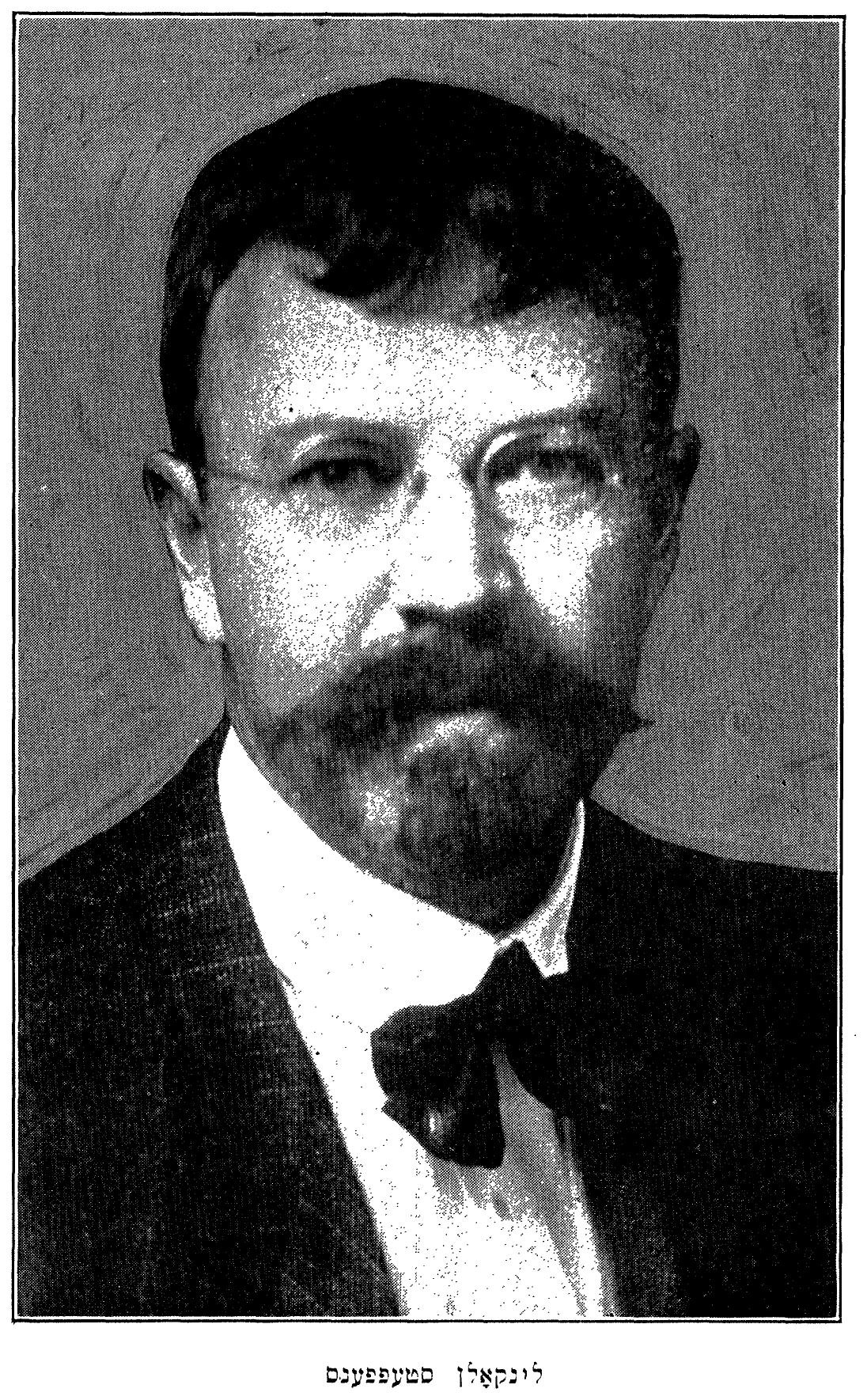
He introduced himself as Lincoln Steffens, assistant to the city editor.
The city editor — Mulholland — was also not tall, a man with a serious face. Steffens introduced me to him.
Steffens had finished university in California, and afterward he had studied in Germany. He was greatly interested in literature. He wanted to talk with me about my literary work and about literature in general, so he asked me to wait a while, so that he could go with me; and meanwhile Mulholland would look over my manuscript.
Mulholland accepted the article. Steffens told me it would be printed tomorrow, and he dressed to go.
We went down to the street. We walked along for a while. He asked about my literary74self, and introduced me to his wife and to her mother.
In the "Evening Post" I printed a few more articles. As I wanted to enlarge still further the source of my interim income, Steffens recommended me to the editorial office of the "Commercial Advertiser." This was the oldest newspaper in New York. It had been founded in the time of the French Revolution, and its founder was the author of the famous dictionary, Noah Webster.
The newspaper was read by the oldest and wealthiest American families of New York and the surrounding regions. Its circulation was small. It had some advertisements, which paid well, but not enough to exist on. Its proprietors, however, were great millionaires, the Huntington family, and they kept it up for the sake of influence and prestige and also as a kind of sport.
In the Jewish neighborhoods one never used to see the newspaper. In the genuinely American streets one did indeed see it, although there too it did not sell heavily. But people regarded it with respect.
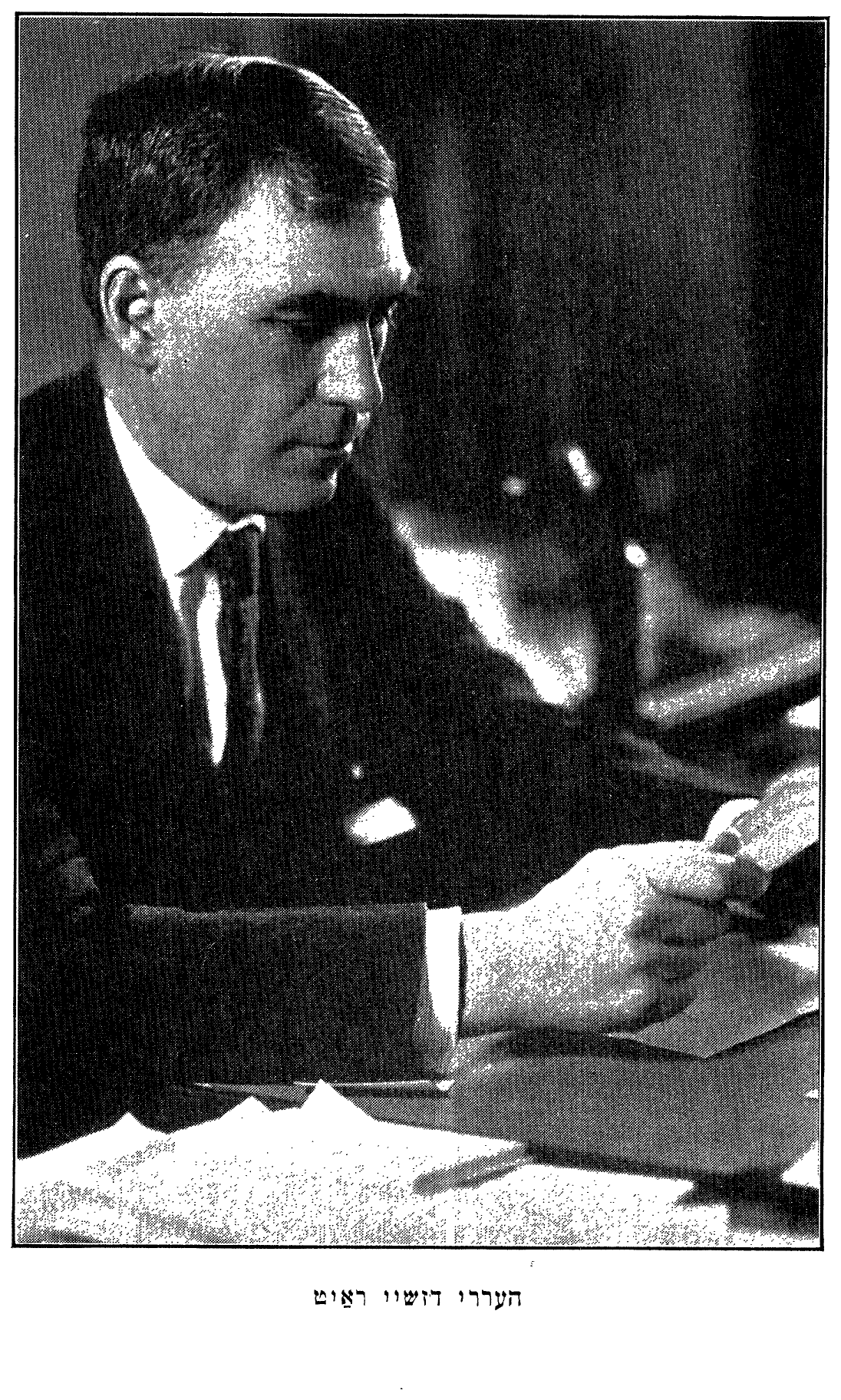
Steffens's connection with the editorial office was through an American journalist by the name of Norman Hapgood, who was a close friend of his. This was a young man with a genuinely American face, on which lay the seal of a university education. Ordinarily, on an educated American the education is not easy to notice. Between a professor and a businessman there is, by their bearing, but a slight difference. There are, however, exceptions, and Norman Hapgood was such an exception.
(plate; bound facing printed page 75)
75He was the dramatic editor of the "Commercial Advertiser," and his theater reviews had begun to draw the attention of the intelligent classes.
The "Commercial Advertiser" was then located in an old building directly opposite the General Post Office, downtown. I climbed up two high flights of stairs (there was no elevator) and came into a large, very long room, in which stood a long, long table and several desks. In the corners, from a distance, still more desks could be seen. On a higher floor the editorial office had a few smaller rooms, and in one of them Hapgood had his writing desk. I went up to him. After we had become acquainted and had a short talk, he led me back down to the general room. He took me into a tiny little room with a glass door and introduced me to the chief editor, a tall brunet with a Scottish accent — Harry J. Wright.
Hapgood went back to his work; Wright and I remained chatting for a good while. He made a very good impression on me. The result of this conversation was that Wright asked me to describe the Jewish holidays of Sukkos and Simkhes-Toyre, which had begun that very evening. I brought the article the next morning, and it appeared that afternoon.
It was near the time of the city elections, and they had a special importance. The matter at hand was the choosing of a mayor not for the old city of New York, as always, but for "Greater New York" (an enlarged New76York), that is, for New York, Brooklyn, and the little towns around Brooklyn, in Queens County and on Staten Island.
A law had been passed about uniting all these places into one, under a common name: "New York," and on the first of January this change was to come into force. The elections for mayor were to take place at the beginning of November, as usual. This time, then, it turned out that the first mayor of the united city was to be elected.
Tammany put forward as its candidate Robert A. Van Wyck, of New York, and the Republican party Benjamin F. Tracy of Brooklyn. The "Independents" — an organization of citizens who fought the corrupt politicians — put forward Seth Low, also of Brooklyn. He had once served two terms as mayor of Brooklyn, and was now president of Columbia College and of the University Settlement (see the third volume, page 276). He had a reputation as a most honest, intelligent man and as a faithful public servant.
The Republicans alone seldom have a chance of electing a mayoral candidate of their own in New York. So the "Independents" turned to Republican leaders, that they should put forward no separate candidate and should support Low — to fight, with combined forces, the corrupt Tammany and not allow it to seize power over the united city. For Republican politicians, however, it is more important to have a candidate of their own, even when they have not the slightest prospect of electing him. For with a candidate of their own they can make compromises, political deals with the Tammany politicians. So they refused to go with the "Independents" and put forward Tracy.
There was a fourth candidate as well. The famous77Henry George ran again this year as a mayoral candidate, but now only as the representative of the "Single Taxers." The socialists no longer adhered to him. The enthusiasm with which he had been received in 1886 (see the second volume, pp. 257–268) was now lacking.
From strain and from disappointment he fell ill and died before the elections.
The "Single Taxers" immediately put forward in his place his son, who happened to have the same first name as well (Henry George Junior).
The "Commercial Advertiser" was a Republican newspaper. So it agitated for Tracy.
"Tonight there will be a big Tracy meeting," Wright said to me. "Go over there and write me a character-sketch of Tracy."
"But I am a socialist," I remarked.
He did not understand what I meant. When I explained to him that we consider it not a fine thing for a man who belongs to a certain party to write for a candidate of another party, this interested him.
"I only want you to describe how he looks," he explained, "how he delivers a speech, what kind of impression he makes, and also to give a few strokes of the meeting. Write as you wish."
The next morning I brought the article. It was not favorable to Tracy, and they did not print it.
"I only wanted to see how you write," Wright explained to me. "Belles-lettres is one thing, and writing for a newspaper is another."
"Political articles or descriptions I cannot write for your newspaper," I said. "I am a78socialist. I can give you other things."
He heard this out with a smile. He remarked that on American newspaper editorial staffs there are leading-article writers to whom it falls to write against their own political convictions. A Democrat, for example, writes for the Republican party, or vice versa.
"That is not regarded as hypocrisy," he said, "but if you are strict in such matters, that is very fine."
I afterward brought descriptions of various neighborhoods, types, scenes, and he accepted everything.
The elections ended with a victory for Tammany. Seth Low had many more votes than Tracy, but Van Wyck had more than Seth Low. The two together received enough votes to defeat Tammany. But being separate, they split the anti-Tammany vote, and the corrupt Tammany became master over Greater New York.
As for Henry George, he polled fewer than 27 thousand votes — a quarter of Tracy's.
So I was now writing for three newspapers: the "Sun," the "Evening Post," and the "Commercial Advertiser."
One time, when I came up to Wright, he said to me: "We are making a change: Steffens is becoming our city editor."
Then he added: "And he wants nothing other than that you should become a member of our staff. I promised him I would talk it over with you."
(plate; bound facing printed page 79)
79This was for me as if wished for. Writing for various newspapers, looking for topics, and often spending a good literary theme on an ordinary newspaper article — that is not a pleasant occupation. I wanted to have a fixed income. Only in such a way would my head be free of worries about livelihood, and I could turn to belletristic plans. That was one of the reasons why Wright's proposal was welcome to me.
A second reason consisted in the following: ever since I had begun to write stories in English, it had become ever clearer to me that my acquaintance with the world was a limited one. I knew the socialist movement, the Jewish labor movement, and the Jewish world in general. But I thirsted to come into contact with various classes, various trades, to look into various corners of the great, many-colored American world, and a connection with an American newspaper, as a regular reporter, was a good means to that end. True, the "Commercial Advertiser" was not a very widely circulated newspaper, but it conducted itself like all the American daily papers. It had money and connections enough, it came out large and handsome, and it was a member of the "Associated Press," together with the most important and most widespread newspapers.
So I accepted the proposal.
On a certain Monday, in November 1897, Lincoln Steffens became the city editor of the "Commercial Advertiser," and I became one of his reporters.
In the second volume it is told how, a short time after my coming to America, I enrolled myself in a80ordinary public school, in order to learn the English language and all the other school subjects, in English, together with American children. I wanted to become, all over again, a schoolboy, only in the American manner. A similar feeling I had now, when I arrived at the "Commercial Advertiser." I wanted to go through all the experiences of an American newspaper man.
To explain my mental state in those days more accurately, it will be better to say that only then, when I was already a member of the inner staff of the newspaper, did I feel how little I was acquainted with life and how important it was for me, as a writer, to become acquainted with it in a broader way.
Steffens asked me: "What sort of work do you want to do?"
And my answer was:
"Give me assignments that will bring me as close as possible to life."
"If so," he responded, "go to police headquarters. We have a reporter there, but if you want, I will give you the job. There are reported all the dramatic happenings of the city."
In connection with this he explained to me that at police headquarters there is such a little window, and as soon as something is telephoned there, a short report appears.
"Good, I'll go there," I said.
For the non-American reader the following explanation will perhaps be in place:
The word "reporter" does not have, in American journalism, the same sense as in European. It has81a far broader sense. It includes, among other things, what one calls in France, Germany, or Russia a "feuilletonist." Although, as we shall see, there are special feuilleton writers in America too.
In a New York, Philadelphia, or Chicago newspaper the name "reporter" embraces the most varied grades of newspaper work, from a short, dry notice to a most talented depiction or illumination. A reporter in America plays, on the whole, a different role than in Europe — a far broader role.
American newspapers are conducted differently, entirely differently, than the European ones. They are much larger, and they give much more space to sensational and, above all, to worldly happenings. A murder, a robbery, a divorce trial, which in a European newspaper would be dispatched in a few lines, in an American newspaper often takes up several columns.
You read, for example, a report about a great tragic fire, or about a stormy meeting of unusual political importance. Such a report is an article of many columns, and then it is probably written by more than one reporter. But if it consists of only three or four columns, it is mostly the work of one hand. Either way, the character is the same, and most of the time there is no name of the writer on it.
When you read it, you see that one part is written with color, vivid and beautiful, and another part consists perhaps of a brilliant communication and interpretation of facts. It contains perhaps a lively characterization of persons, peppered perhaps with grotesque humor. Or you find in the report an analysis of a delicate political or psychological situation.
82And all this is created by people whose occupation is designated by the name "reporter."
To be able to write is not yet enough. The reporter must be a "judge of news," have a "news-sense" ("a nose for news," as the American expression has it). When someone is such an adept, and in addition has talent as a writer and skill in the trade — then he is a first-class reporter.
In my time such a reporter received a higher salary than some of the department editors or than the theater critic.
In the reporter columns of the great American newspapers there is much of that force and charm which one usually associates with the name literature.
Special feuilletons are found in the American press chiefly in the evening papers and the Sunday supplements. And those who write them are mostly former reporters, or — very often — such as work in both fields at the same time.
Police headquarters was then on Mulberry Street, near Houston. The daily papers had special offices there — in a few small old buildings, which stood directly opposite the police.
The chief reporter of the "Evening Sun" was then an immigrant from Denmark by the name of Jacob Riis. In the journalistic world he had a reputation as a brilliant writer.
A few months earlier Steffens had been the police reporter of the "Evening Post," and then he was83had become friendly with Riis. So he gave me a letter to him.
Riis was neither tall nor stout, a man of some forty-odd years, with a blond mustache, with spectacles. He spoke with a slight Danish accent. Steffens introduced me to him as a writer, as the author of "Yekl," and as a man "with ideas."
We spent about half an hour together, and we did not take to one another. To me, too, Riis made the impression of a man with old-fashioned notions. At the same time I felt that I had made a bad impression on him with the opinions I expressed in the course of our conversation about literature and politics. I saw that my socialism did not please him and that my low opinion of certain American writers pleased him still less. I felt that he regarded me as a youth with great pretensions.
He conducted himself politely, however, and he showed and explained to me everything pertaining to my work. He introduced me to the reporters of the other newspapers and to all the officials of police headquarters, from the "chief of police" down to some of the clerks.
The duties of a police reporter had a double character: one part of the work pertained to the police itself — to the "politics" that goes on among the officials or in regard to them. If, for example, new men are appointed to important posts, if inspectors or captains are sent to new places, if someone gets a higher or a lower post, if someone is punished for a dereliction or a crime — the police reporter must report all this in his84newspaper. The second part of the work consists in keeping watch on the police "bulletins" and reporting the various sensational happenings reported in them: a murder, or another great crime, a suicide, a tragedy, a fire — every unusual occurrence in the life of New York that is reported to police headquarters, the reporter must report. If necessary, he must dash over to the place where the thing happened, look it over, question, investigate, and describe it; or telephone to the editorial office, so that the city editor can send someone else there.
I was chiefly interested in the second part of the work. But the first part too. Everything interested me.
On the first day that I spent at police headquarters an important meeting of the police board was to take place there. Riis led me down to the hall where such meetings were held. Everything was new to me.
At this meeting the then "chief of police" proposed a new way of drilling the policemen. For this purpose he recommended a former general of the army. Smoking the police club like a rifle, he showed how the general teaches the policemen in the military manner. He spoke of it with enthusiasm and with reverence. It was comical but interesting.
After the meeting Riis says to me: "To write this up and send it down to the editorial office is no longer possible. The time is too short. This has to be telephoned."
85At the word "telephone" I turned cold and hot. Up to then in my life I had never held a telephone in my hand.
To today's reader this will seem ridiculous. And even at that time it was ridiculous too. True, telephones were then less widespread than today, much less; but in thousands upon thousands of offices and in the wealthier homes they were already a common thing.
When I came to America, in 1882, the telephone was still a relatively new invention. Being in the last class of the Vilna Teachers' Institute, in 1881, I had learned about it in a new textbook of physics. Katelnikov, our director, had set up a trial telephone between his apartment, which was in the building of the institute itself, at the other end of the long courtyard.
Through this telephone I heard from him a few words.* But in general use, in Russia, telephones were not yet known. Only on coming to New York did I see a real telephone, in the office of Emanuel Kurshedt (see the second volume, 154–155). But I myself had not used such a telephone until the day when I had to report to the "Commercial Advertiser" about the police meeting.
86In the circle in which I moved, there were no telephones. At the "Forverts" editorial office we did not then dream of such a luxury, and in the office of the "Vorhayts" Arbetskeit, or "Di Fifl" — likewise not. I do not think it would be an exaggeration if I were to say that the whole East Side then had only a few telephones.
It also happened that at the very time when my name was more or less known in American literary circles, I was, as regards the use of the telephone, absolutely "green."
Suddenly, then, I had to telephone. How does one do it?
I set off in search of a telephone, and as for what would come of it later, let one worry then. Nowadays there is hardly a drugstore (apothecary) without a telephone. Back then a drugstore that did have a telephone was no longer any ordinary thing. But to my luck I soon found a drugstore, and indeed on Houston Street, a few blocks from Mulberry.
So, I now had a telephone. But what does one do with it?
I naturally knew which was the "receiver" and which the "transmitter." But I did not trust my own powers to handle the instrument. Out of desperation I asked the druggist to speak for me. The druggist was friendly, but he was an Italian (that neighborhood was already then part of the Italian quarter), and he had a genuine Italian accent, with hard "r's" that cut me like dull knives. Some of my own English words I could scarcely understand myself. But every second was precious and there was no time to despair.
87In short, I dictated my report to him word by word, and he repeated it into the telephone. He became so enthusiastic about the job that he shouted the words out loud, ringing. On this occasion we "sang off" some ten minutes — at a third of a column.
But I had to learn to "swim on my own." So I confided in my secretary about one of the other reporters of the "Commercial Advertiser," and with his help I practiced a few times. I called him on the telephone from a drugstore and chatted with him a few minutes. In short — I became quite a "master" at the telephone. Every morning I would telephone Steffens to ask whether he needed me at the office. If not, I would go to Police Headquarters, and come into the editorial office only at around a quarter to three.
One time, a few weeks after the report that the Italian had telephoned for me, Steffens says to me:
— Today I have an "assignment" for you that has nothing to do with Police Headquarters. It is an interesting matter to describe. On the "Palisades" today they are going to blow up the famous rock, "Indian Head" (the head of an Indian). Travel over there.
The "Palisades" are great cliffs on the New Jersey side of the Hudson, not far from Hoboken. This particular rock had a slight resemblance to the head of an Indian, and so it was given that name. It was famous. The passengers who travel on the ships across the Hudson would look at this remarkable rock with curiosity. Because of a certain88practical purpose it had been decided to destroy it.
When I arrived at the spot, I found there reporters from all the other newspapers of New York, Newark, and the surrounding towns. One had to walk across fields and through thorns. Finally we reached the spot.
When all the preparations were ready and the signal was given, there sounded a crash that echoed for miles around. The great, enormous rock stirred, like an aged giant lifting his head; and it fell down.
It was already around one o'clock. Of writing up and bringing the article to the editorial office there could be no talk. There was no other choice but to telephone. By then telephoning was no longer anything new for me. But to dictate over the telephone a description of such a scene — and from me an interesting account was expected — that is quite another story. A dread fell upon me. I ran to look for a telephone.
All around stretched fields and woods. The nearest houses were a good way off from there. The other reporters had vanished, as if into water. I ran like one poisoned and asked where one could get a telephone. I was directed to a store. I came in and grabbed at the instrument. I ring up, I want to call my number; I hear that someone is speaking. I shout: "Shut off! Keep off the line!" (Stop! Get off the line!) But the other does not answer. He goes on speaking, as though I did not exist in the world at all. I listen. The man is speaking about the very same event, the destruction of the "Indian's Head," and in rounded, polished89It was a "party wire" (one wire for several locations together), and a reporter from another New York newspaper was telephoning in his report. The wire was therefore occupied. I remained standing there.
And the minutes were flying. I ran out, grabbed a farmer with a horse-and-wagon and told him to drive me to the nearest place where one could get a telephone with a free line. I do not remember how long it took; I only remember that from the wagon I switched to a streetcar and arrived at Fort Lee. There I got a telephone.
I called up the office. One of our reporters went into the telephone booth of the editorial office, and I began to dictate to him my description of the scene that I had witnessed forty minutes earlier.
I had dictated about three-quarters of a column. I was afraid that the reporter who was taking down my report in the booth would not record my words correctly, that it would come out tangled and there would be nothing to print. I felt very ill at ease.
From Fort Lee I crossed over on the ferry. I came to 129th Street, and by the Ninth Avenue Elevated I rode downtown.
When I got downtown, I bought the "Commercial Advertiser" on the street, and how great was my joy when on the first page I saw my "story"! I snatched it up to read — it is there! Everything is just as I dictated it! I did not believe my eyes. Could these really be the words that I had drummed in over there, at Fort Lee, three-quarters of an hour before? I read on — again90my words. Just like a miracle, by my life!...
When I came up to the office, Steffens paid me a compliment on my description.
I was in seventh heaven, chiefly because of the fact that I had not written the article — but telephoned it.
I went on going to Police Headquarters. When there was something interesting in the bulletins, I would investigate and describe it; and when at Police Headquarters itself there was something important, I would report that too. Often I would deliver it over the telephone, but more often with the pen.
Around three o'clock I would come into the editorial office. Then the paper would go to press, and we would spend a certain amount of time chatting.
I was a "cub" reporter, that is, a beginner. My first regular salary was a very small one — fifteen dollars a week, it seems, if not less. (A beginner today gets at the "Forverts" 70 dollars a week. That is with us today the lowest salary. Thirty years ago, 70 dollars was considered a high sum even for the best reporter of an American newspaper.) But the sum was raised within a short time, and soon raised again — up to 25 dollars a week. That was my regular pay. But from the start I earned more than my salary. I did extra work, for which I was paid separately. These were half-belletristic feuilletons or articles about literature, which used to be printed in the supplement to the Saturday91number. All together I had, according to our customs of that time, quite enough to live on from the newspaper. And besides that I had from time to time a handsome honorarium for a story in a magazine. All in all, my income was much greater than before.
Many of the articles that I wrote for the "Commercial Advertiser" used to go on the page next to the literary page. There used to be printed various articles and feuilletons by various writers. In Steffens's time this page acquired a special character, and it attracted attention.
Usually a city editor is in charge only of the news of the city. Steffens had a say over various other articles as well. Half-belletristic feuilletons, and even short stories, were also under his editorship. He was in fact a kind of managing editor, although he did not bear such a title.
The work at Police Headquarters interested me greatly. In the fires, murders, suicides, and unusual occurrences of other kinds that used to be reported to the police, I would often find interesting material. I used to describe them for the newspaper and also make notes for myself.
The police bulletins are a kind of exchange of dramatic events. For me they were a treasure of opportunities to observe and study life, a stream of themes. I seized upon them like a fish to water. I wrote newspaper reports. But for me every such report was material for belles-lettres. My newspaper work had for me an artistic interest. This often made itself felt in my writing; and some of92my articles used to be reprinted in the newspapers of other cities. Then there would arrive at the editorial office clippings that contained these descriptions.
Through this work there grew in me the sense of color, of dramatic content. In the most prosaic things I would often see a poetic side.
As a "news-gatherer" I was not one of the best. The artistic possibilities of an occurrence interested me more than its worth as news.
The occupation of an American reporter is a many-sided one, and not an easy profession. There is a great deal to learn, and I learned. But I was more skilled at observing and describing than at getting news. Wherever a good writer was needed, Steffens would send me — to the greatest trials, to the most sensational scenes. The best news-gatherer in the editorial office was a young American man to whom writing came hard and who limped a little in his grammar.
Jacob Riis was an excellent writer. In his writing one could feel an artistic interest. But, as I soon learned, he mostly saw not with his own eyes, but with the eyes of an assistant of his. A Jewish young man by the name of Max Fischel worked for him as an "errand boy" (a boy for running errands). Max Fischel, who had been born in America to Hungarian-Jewish immigrants, was little educated. He himself never wrote. He could hardly write at all. When there appeared93a bulletin about a fire or some sensational occurrence, Riis would send him to the place where it had happened. Coming back, Fischel would tell him what he had seen and found out, and Riis would then write it all up. Riis hid this from no one. It was regarded as quite a natural thing. It was said that Fischel brought him only the dry facts. In truth, however, he gave him not only the body of the article, but the soul as well.
The best that Riis created was built upon Fischel's power of observation, Fischel's understanding, and Fischel's artistic sense.
This simple, almost unlettered boy had imagination and a poetic feeling. He tells Riis, for example:
"I was walking through Mulberry Street in the middle of the night. It was dark. From afar I saw a baker coming along, carrying a large basket of bread on his back. The baker is all white with flour, and the basket is white. The baker and his burden move through the dark night like a white mountain through a sea of blackness. It was interesting."
Fischel says this in passing; he himself perhaps does not know that what he is saying is a fine touch in a description. But Riis records it, and with him it becomes part of a portrayal of the reported event.
Or Riis describes how a murderer looked at the moment when he was caught: with what expression he gazed; what impression he made on the detectives; how one detective was himself nervous from the sensational scene, and how he strove to conceal his agitation. All this Riis describes, and he is praised for his power of observation and94for his content-rich writing. In truth, however, in such a case a compliment often came to him chiefly for his beautiful language, and for his appreciation of the interesting material that Fischel used to supply him. For the content the compliment should mostly have gone to Fischel, of whom no one had heard.
Talent Riis certainly had. He was in fact an artist too, but more in a romantic vein, whereas Fischel's eye used to notice the beautiful and interesting in the depths of reality.
Once, at a great fire, watching how the smoke billowed and curled up from the burning building, I noticed that through the smoke the sun could be seen, like a great, pale-golden coin set in a milky mass — so it looked. The contrast of the yellow sun against the white smoke was interesting to the eye. I recorded it, and afterward I described it in my report. I was sure that no other reporter had noticed this part of the scene.
When the "Evening Sun" came out, I found exactly the same thing in Riis's report of the fire. But Riis had not been at the fire. Max Fischel had been there. His eye had noticed how the pale-yellow sun shone through the mass of milk-white smoke. And he had appreciated the artistic value of it.
Once, in my notebook, I recorded as a theme for a sketch: "The Eyes of Jimmy McAllister." I sketched out a little tale about a writer who has a great name, but who has only a beautiful language; the imagination belongs to another, a certain acquaintance of his, a young man who cannot write at all.
95With another man's eyes sees Jimmy McAllister, the famous author.
By the theme I meant Jacob Riis and Max Fischel. But I never wrote up the story. It is one of the many themes that I recorded in those days.
Many of the quieter happenings with which I became acquainted through Police Headquarters were richer in content, with a deeper meaning, than some of the screaming tragedies. Very often the following would occur:
The reporters of the other newspapers paint up some detail sensationally. And the truth is not at all as they present the matter. In general one can say that the reporters report the truth. The editorial offices demand it of them. But often it is touched up in the journalistic manner. It is "fixed" so that a better "story" comes out. This applies chiefly to smaller things, not important ones, but piquant occurrences. In reports of this very sort I often used to notice that the unadorned truth is in fact more interesting, and sometimes even more sensational, than the embellished fact. In the very plainness of the matter there sometimes lies an inner sensation.
Once, when I was reading the morning newspapers, I found there a report about a poor old man who had died of hunger, holding his fiddle in his hand. The report presented him as a talented musician who had played day and night on his instrument until he expired, with his stiffened fingers on the strings.
96The matter interested me, and, although it had no connection with the "Commercial Advertiser," which was an afternoon paper, I went over to the place where the man had died. I wanted to know more details about him. Why had a talented musician lived in such poverty? How does it come about that such a man should die of hunger?
I saw the dead man's room; I saw his fiddle; I spoke with the woman with whom he had lived. And what came to light?
The dead man was, poor thing, quite a wretched fiddler. He could barely scrape out a tune. In the last years of his life, however, fiddle-playing had been his only pastime, and in him there had developed a passionate desire to play well. But from his fiddle there used to come a screeching in the ears.
He was an honest and kind-hearted man, very lovable. His landlady and the neighbors had respect and pity for him. So they never protested against his screeching, never disturbed him. On the contrary: they used to pay him compliments.
That he died at the moment when he was holding the fiddle in his hand; that he expired with his fingers on the strings — all that a reporter made up. He died in bed, and the fiddle was hanging on the wall at the time.
The relations between the landlady and the neighbors and the unfortunate old man were very interesting, and the whole story, without the embellishments, made a strong impression on me.
As news the story no longer had any significance. Yet I have written it down here. I told the truth. I presented the touching tragicomedy97of the occurrence. And there came out a far more interesting thing than the over-salted and over-peppered journalistic sensation.
Once there came a report that the police had caught a great thief. The newspapers presented him as a poet-thief. I went to see him in the Tombs. I had a long conversation with him. It turned out that he was quite an ignorant man; that the tale about his poetry stemmed from a nickname that thieves had given him, because he used to make indecent rhymes. From the conversation, however, I learned that the fellow had fine abilities, and that in his "underworld" way he was a thinker with an original humor — but precisely not of the poetic cut. In our talk he made several remarks that showed that, had he had a good upbringing, he would have been an interesting personality. In the underworld he was, at any rate, an interesting personality. But to present him as a poet made no sense.
In the editorial office of the "Commercial Advertiser" I met an intelligent, university-educated, young American who was known as a "gentleman tramp." This was a man with a thirst for strong impressions, an interesting adventurer. He had mingled with many tramps. Together with them he used to steal "rides" (traveling without a ticket) on freight cars and go through the various experiences of the American tramp life. His nickname among the tramps was "Cigarette." He was a thin and98not a tall one. From a little distance he looked like a boy. He introduced me to an interesting tramp and also to an interesting night-burglar who had already served several terms in prison.
Through my work at Police Headquarters I came into contact with all sorts of criminals and other "citizens" of the underworld. I had conversations with them themselves, or about them — with detectives, police captains, ordinary policemen.
It seemed to me that every day opened up for me a new little world, a new depth, a new picture, a new piece of psychology.
At the same time when it would happen that I had conversations with people of the underworld, I would sometimes have an opportunity to interview some of the most important personalities in the country.
On a certain day I had, in the morning, together with other reporters, a conversation with President McKinley, and in the afternoon with a murderer. To meet with McKinley I was sent by Steffens. This was, naturally, not part of my work at Police Headquarters. But Steffens used to give me various other "assignments" as well.
The conversation with McKinley took place on the ferry that runs from New Jersey to New York. The President had come that morning from Washington, and the tunnel that today unites New Jersey with New York did not yet exist. The Pennsylvania Railroad did not yet have a terminal in New York either, and one had to end the journey with the ferry.
There was a whole crowd of reporters. I, however, had a few special questions, and the other reporters gave me the opportunity to put them to him. Usually in such a case one reporter (mostly one99of the older ones from a large newspaper) as the spokesman, but the others also throw in a word, also put a question. Besides that: the reporters were always friendly toward me, and often they themselves asked me whether I did not have some important question in mind.
Through my police work itself it often happened that I had to speak with prominent people. Sometimes out of the interview there would develop an interesting side conversation that had nothing to do with my interview.
Once, when I visited a young clergyman, he recognized me as one of the speakers he had heard at a socialist meeting in Boston, when he was still a student. It turned out that he was a socialist at heart, only he had his own "patent" on socialism.
I met with representatives of the most diverse classes, with the most diverse types and under the most diverse circumstances. To all these encounters I would go with a passionate interest.
Stories for the magazines I did not write in the first period. My new acquaintance with life itself then occupied my mind more than the themes that I had for pictures of life. But soon I again began to write stories for the magazines.
I used to visit the editorial office almost every day. Sometimes I would come there at nine o'clock, before I went to Police Headquarters. This was mostly when I had something to write for the first edition. Usually not important news, but a kind of feuilleton.
100Around three o'clock, when the last and most important edition was finished, I would come again to the editorial office, unless I happened then to be on a "story" too far away somewhere.
Then I would talk things over with Steffens about the work, or simply chat with him and with the other co-workers.
When I had spent a few months at Police Headquarters, I came to believe that it was no longer necessary, neither for the newspaper nor for me. I wanted to have general "assignments." I wanted to come into contact with occurrences from an unrestricted field.
Steffens agreed with me, and he sent to Police Headquarters another man — a "news-gatherer" who worked more with the telephone than with the pen.
When he telephoned about something interesting, and I happened at that moment to be in the office and free of other work, I would go over to the proper place.
From then on my work consisted of "general assignments."
But to divide a reporter's work strictly is not easy. It happened that I met with all sorts of people, came into contact with all sorts of phenomena. Sometimes the job in and of itself would not interest me. But I looked at everything as a study of life, and the study was interesting to me.
The newspaper was a member of the "Associated Press" — the largest and most powerful news agency in America, and today the richest in the world. Already in those years to become a member of it was a difficult thing. It101cost something like a hundred thousand dollars, and even with that sum it was not easy to get in.
The reports of the "A.P." (A. P. — so is the "Associated Press" called in the editorial offices) come in on very thin, yellow paper, which is called "flimsy" (very light). We, however, used to write on white, somewhat thick sheets, with soft, thick, black pencils. Mostly the pencils were of paper, of the kind that one unwinds. This used to spare one the work of sharpening.
When one must hurry, it is better to write with large letters and with widely spaced lines. For that it is more convenient when the sheet of paper is large. The hand can spread itself out freely.
Notes (the original’s footnotes)
[p. 85] He sent his son, a boy of about twelve, into the teachers' room to speak with him through the instrument. I asked the boy to let me hear how his father spoke to him. Then young Katelnikov said to his father: "Cahan wants to hear how you speak to me," and he handed me the "receiver," which I immediately put to my ear. Then I heard the words: — Tell Cahan he should go at once to the little book and learn the lesson. Otherwise I will punish him.