Chapter Four
New Friends
102Inwardly the editorial office was different from all the others. This distinctive character was given to it by Lincoln Steffens — in his department, at least; and it was the most important one. He brought about a whole revolution in the city department (the section for city news). He dismissed two-thirds of the former reporters, and in their place he took on men of an entirely different type.
In those years there were very few educated people among American newspapermen. There was a deeply rooted feeling that a man who had a university education was unfit for journalism (see the second volume, pages 330–331). Steffens himself had been a "university man," and the new reporters whom he took on were mostly of his class. He assembled a group of educated young men, college boys with literary ambitions. He himself aspired to a literary career, in the better sense of the term, and he surrounded himself with intelligent boys of the same sort.
103It was the only American editorial office that had a "city staff" of this kind.
Afterward others came in from the same class. Not all of the new ones stayed, and Steffens did not dismiss all of the old reporters. But the general character of the city staff — that is, of the liveliest and most important department of the newspaper — was radically changed.
One of the reporters who had remained from the previous city editor sat directly across from me. When I arrived, and felt myself a stranger, I thought he was a real big shot (takef) in the office. When we got to talking with each other, I learned that he felt much more wretched than I did. He was afraid that they would "fire" him (dismiss him). He complained to me about his luck. He firmly believed that he had talent, but that his talent was not recognized. On the second or third day of our acquaintance he told me that he was married, but that he had separated from his wife, and he told me about her.
His intimate confidences astonished me. An American who talks that way, even with good acquaintances, is a rare exception. He was a sentimental, troubled (far-tsore-ter) man, with a whining character. He felt the need of a friend to whom he could pour out his heart. He himself called himself a "misfit" (lo-yutslakh, a ne'er-do-well).
He was a blond fellow, thin, neatly and tidily dressed. I noticed that every day of the week he came in a different necktie. To me this was a novelty. I did not even know that such a "fashion" existed. I would104have imagined that a millionaire changed his neckties so often. But that a poor reporter should do so — that was a discovery to me. Every day, when I would greet him, I would take a glance at his necktie. On Monday he would appear in one of the neckties he had already worn the previous week. Altogether he owned six of them.
I also examined the neckties of the other coworkers, and I saw that they changed them too, though not everyone every day.
I had had only a single necktie, so now I bought a couple more and also began to change them.
One time, on a Monday, when the reporter who sat across from me came to work, he found a letter from Steffens — a notice that this was his last week. That was how it was done when someone had been "fired." He showed me the letter.
— I expected this. I am a "misfit" — he said.
A second reporter, one of those who had remained from before, never took the pipe out of his mouth. At first, before I had grown used to him, it was hard for me, because of his pipe, to understand what he was saying. But his little pipe hung beneath a long, dark mustache, as is the fashion among the Little Russians (Ukrainians). His appearance, however, was different.
He used to speak with gusto and laugh with gusto. He often used to drop hints that he was descended from English lords and that his father had once been very rich. He was a cheerful young fellow and a good comrade. In our free time we used to sit and chat. He used to tell me about his childhood years in Canada, and I — about my own105childhood years in Vilna. One of my little tales of the Vilna institute, the story of the camel (see the first volume, pages 338–340), interested him so much that he reworked it in the English manner, and it was printed as a genuinely American feuilleton. Steffens did not dismiss him. We worked together for about four years.
Some time after I arrived, there appeared in the editorial office, as one of the reporters, a young man of whom it was said that he belonged to the American aristocracy — a handsome youth, a little muddled and a little wild, but energetic and interesting. It was said that he intended to found a newspaper, and that he had come to learn the profession for that purpose. It turned out, first, that he was not at all as rich as people thought, and second, that the reporter's occupation interested him chiefly as an adventure.
The young intelligentsia with their literary ambitions gave the paper the interesting character that Steffens had in mind. But with them alone he could not manage. Trained journalists were needed — men with experience and with special aptitude for the work. So he had to keep on a few of the old ones and also to take on a few new, capable newspapermen of the ordinary sort. One of them was a gloomy man of middle years, with thin hands and long, thin fingers, with a thick blond mustache that hung down over a broad mouth. He spoke whiningly; for that reason he drank a great deal. When he was drunk, he would speak even more whiningly. When he would come from an "assignment" in such a condition, he would sit down106with an angry expression and do his work. When he wrote, the fingers holding the pencil would twist about as if his hand were "falling off his feet." But that was how he wrote when he was sober too. He used to trace out each letter separately.
He was a brilliant gatherer of news, and he wrote well too.
I once worked together with him on a criminal trial (this was about a year later; he was already working at another newspaper by then), and he took down the witnesses' answers almost word for word, as if stenographically. When I watched how his fingers darted about, scrawling out each letter, it seemed to me that he wrote very slowly. How he managed to write down every word that the witness uttered, and to add explanations besides, was a riddle to me.
He smiled rarely, but when he did smile, his face would become as lovely as a child's.
One reporter among those who had remained was of German parentage. But he could not speak a word of German. He was a red-haired young fellow full of energy. When he came back from an "assignment," he would not walk in but fly in. Then he would plop down at his desk and begin to work at full tilt. At finding news he was a far greater hand than at writing. Whenever it was necessary to investigate facts, to dig out details — especially when that required flying about from one end of the city to the other — he would be the one to get the job.
He was an honest, open-hearted fellow.
— Ah, if only I could write as well as I107can find news! — he used to say to me with his pleasant smile.
Each department had its editor, all under Wright, the editor-in-chief. Several of them sat not far from me, and the impression they made on me by their outward appearance is part of my memory-picture of the first days I spent at the "Commercial Advertiser." Steffens, with whom I was already closely acquainted, had his desk next to my chair (he had given me the spot on purpose, so that we could snatch a chat in a free minute). Next to him sat his first assistant, a cheerful brunet by the name of Lachausse (his parents had been French), and his second assistant and copy reader (manuscript reader), of whom I remember only that he had a wooden leg.
Next, what caught my eye was Chapman, the "telegraph editor," a robust, broad-shouldered Englishman who spoke with a strong London accent, and Flynn, the "make-up editor" (the one who puts the paper together), a blond young man of tall figure, who was always so stiff and straight that he reminded me of the saying "as if he had swallowed a stick." The London crowd "drops" the "h" in speech — just as our Jews from Berdichev or Grodno do — and one of the first jokes I heard in the editorial office was about Chapman's London English.
— He drops so many "h"s when he speaks — said108someone teased him — that a boy must keep running over with a broom to sweep up, to clean up the place.
This was indeed nothing more than a joke, for Chapman pronounced his words correctly, like the London intelligentsia. He never dropped any "h"s.
A third editor, who had his desk not far from me, was Allen, of the "society column" (the department that deals with "aristocratic society") — an American with an athletic build and a clear, white, friendly-smiling face — a dandy, of course.
Besides Steffens, from the very first days I had frequent dealings with the literary editor, because he often used to ask me to write reviews of new books. His name was Cooper — a man with an intelligent face, a thick dark-brown beard, and spectacles, a well-read and educated man, who wrote in a pleasant style and had a remarkable ability to read fast. He used to read several lines at a glance. A book of three or four hundred pages he would read through in less than an hour.
Later there came to Cooper, as an important collaborator in the literary department, Professor Harry Thurston Peck of Columbia University. He was a professor of Latin. For the "Commercial Advertiser," however, and often also for one or another of the magazines, he used to write about current literary matters and also feuilletons on other subjects. From this he earned more than at the university. He used to come every Thursday, always with a flower in his lapel, sit down, and finish his article for the supplement to109the Saturday number. He used to dictate the article to a stenographer, and while dictating he would smoke incessantly and blink his eyes. In his own field — Latin literature — he was a true scholar. With regard to belletristic works, however, in which the subject was contemporary people, he was very superficial. In such matters he held the same opinions as the ordinary American reader, and he wrote chiefly about contemporary fiction. He had a smooth style, used to dictate whatever came into his mind, and afterward forget himself what he had dictated.
Once, in a conversation with him, I spoke ironically about a certain successful novel that had a "happy ending," although it came out unnaturally. To this Professor Peck remarked that a cheerful ending is an artistic ending, for "art must lift the reader's mood, not depress it."
Such words were to be heard in those days from all American professors.
Wright, the editor-in-chief, seldom showed himself to the collaborators of the "city department." When he did show himself, he was very courteous with everyone. He was altogether a good, refined, quiet man.
With me he used to speak mostly about literary matters. Sometimes he would invite me into his room, where we would sit for a long while chatting. He used to take pains to show me the splendor of Tennyson's poetry.
The editorial office consisted of one large, long hall,110and of several small rooms on the same floor and on the next. Two-thirds of the great hall was in half-darkness, and some of the collaborators almost always worked by electric light. Here was the entire city department. The reporters used to call it "the shop" (the workshop).
When I think back on the "shop," there ring in my ears the sharp sounds of the telegraph instruments, the metallic clicking tap-tap-tap of the typewriters (writing-machines), the twinkling clatter of the "ticker" that shows the prices on the stock exchange, the soft buzzing of the telephone switchboard behind me, the muffled, impatient cries of "Copy! Copy!", the running of a copy-boy. I sit and write amid this manifold din, and it seems to me that I am cut off from the whole world, and that the other collaborators too are far separated from one another — little boats floating in a sea of sounds, each one apart.
Around a quarter to three, when the paper had already gone to press, the more intellectual group, Steffens included, would gather around the center of the long table and chat about literature. Almost every day it was so.
I was older than the rest. But that played no part with them. What did play a part was the fact that I was the author of English books, and that my stories were printed in the most important Ameri-111can magazines*; and perhaps still more the fact that I held firm convictions about literature.
These young men understood that with regard to this subject America was a backward country, and they were thirsting to come out onto the right path. Of books and writers they would never tire of talking. But they had no opinions. They wandered about lost. In the American magazines and in the literary criticism in the newspapers they could not find any definite standpoint.
In America the greatest success at that time was had by novels about knights of the Middle Ages, about their heroism, dangerous adventures, surprising occurrences, intrigues, sensational tangles. These foolish tales used to be written in a fine language; the books used to be handsomely printed and handsomely bound, and the critics used to take them seriously, as literature, as works of art.
The poetry that one found in the magazines, and sometimes even in a newspaper, stood far higher than the fiction. To a poem one gives only a small space. It is inserted to fill up an empty margin of a page. So one can permit oneself a poem such as only the more intelligent readers will appreciate.
That the above-mentioned sort of novels was no literature — that my intelligent colleagues both did and did not understand.
Howells, of course, had a clear standpoint, but they could not understand what he112stood for, and his cautious, modest realism was not interesting enough for them. They sought something stronger.
The literature of England could not satisfy them then either, for there too the romantic school then prevailed, and finely written, childish adventure tales were regarded as the model of literary art. Hardy stood much nearer to a literature of life than other English writers of that time, but his two best works were condemned by English critics as immoral. And this only confused them. George Moore is far more realistic than Hardy; his novels are strong and full of life; but he was then little read in America. Kipling was then at the highest rung of his success, and they used to speak about him with enthusiasm. Still, when I would make fun of his romantic, blood-and-patriotism stories, they would listen to my words.
My firm convictions and clear taste with regard to literature, my passionate interest in works of art, and the heated speech with which I used to express my opinions — all this was no ordinary thing in an American conversation about literature. About such matters one speaks in America in a light, indifferent tone. But I used to take it so seriously and deeply. So my words made an impression on my "shop" comrades. In the afternoon conversations at the long, black reporters' table I used to be the center.
I must say, however, that although my "shop" colleagues had no convictions of their own and were drawn toward something other than the "classic" English works, in them, with the conceptions that had been rooted in them113at the colleges, it was not easy to part. So debates used to arise between us. When I would say that Thackeray, for example, talks too much, and that his works contain far more feuilleton-work than painting, or that Dickens is a very talented weaver of impossibilities and follies, this would be a painful surprise to them, as if I had profaned a sanctuary. They used to argue with me, to wrestle with me, and I would answer with fire. My voice would ring out over the whole editorial office. Collaborators from other departments would come running together. The composed, respectable Americans used to feel uncomfortable. But my heresy used to excite them. They would listen with the deepest interest, and little by little, little by little, they came to agree with me.
Steffens used to stand without a jacket, smoking his little pipe, listening with earnest attention, and from time to time taking the little pipe out of his mouth to make a remark.
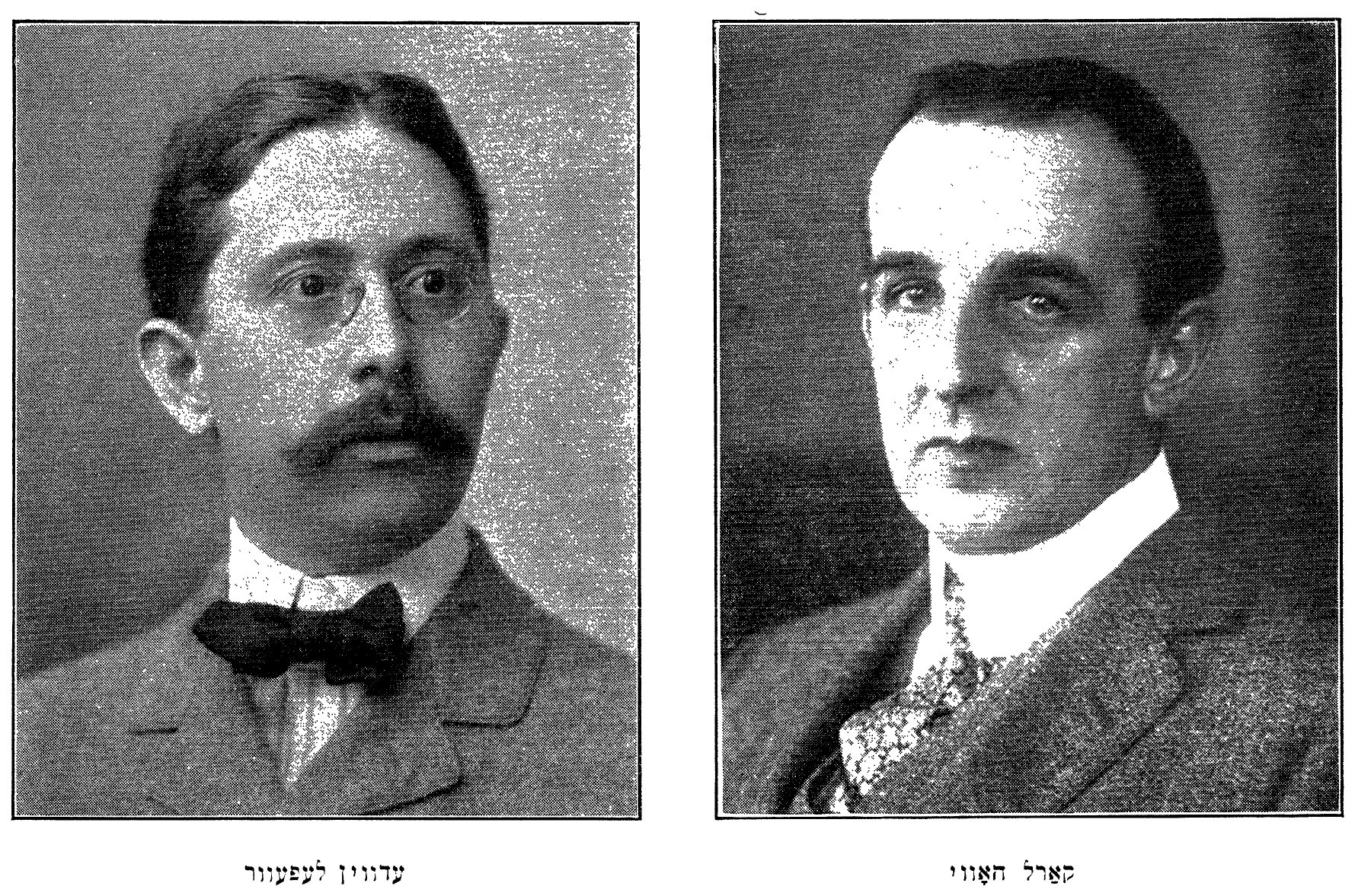
Carl Hovey, who was the most extreme among us in his views — a tall, tall Yankee with blue eyes — used to fight against me with ferocity. As if it were now, I see him as he sits on the big table, also with a little pipe in his mouth, his long legs tucked under him, while we stand and debate.
One Saturday, when Hovey had received his salary, he went from the editorial office not straight home, but first to Brentano's bookstore. He bought "Rudin," in an English translation, because it was one of Turgenev's works that I had praised highly.
The dollar and a half that he paid for the book was a large sum for him. His wife was114an aristocrat from the South, and they lived beyond their means. He once confided to me that he often came to the editorial office without a cent for lunch. He had needed the dollar and a half for food or for rent.
On Monday, when he came to work, he came over to me and shook my hand. He had read "Rudin" through. He was enchanted. He had glimpsed a new world. All the belletristic works that he had read before suddenly became cheap in his eyes.
The next Saturday he bought a second volume of Turgenev, and so on, until he had read through all of that writer's important works, and then he took up Tolstoy, whom I had presented as a greater artist than Turgenev.
Something similar, in another fashion, happened with the other collaborators of the more intellectual group. A stout young collaborator, with red cheeks and pale eyes, who had finished an American university and also the University of Oxford, England, was provoked by my "heretical" opinions about Robert Louis Stevenson. He protested with a sharp word. I retorted with a still sharper one, and we fell out. A few days later he came to apologize to me, and we became good friends. He admitted that during those few days he had read a great deal, looking for arguments against me, and that the more he looked, the more proofs he found against his own opinion. This young man, however, did not stay with us long.
(plate; bound facing printed page 115)
115We used to spend time together. We used to visit one another, and we became acquainted with each other's families.
A couple of these young men wrote sketches to send to the magazines, and they used to ask me to read over the manuscripts and give my opinion.
The literary group was a kind of intellectual aristocracy within the editorial office, a kingdom within a kingdom.
When we used to stand or sit at the long table and get heated about literature, one of the non-literary reporters would often stand by as well, stand and listen with envy, like a pious artisan beside a group of learned men (lomdim) discussing words of Torah (divrey toyre).
One of my new friends was Edwin Lefevre, a financial reporter, with black eyes and black hair, a lively young fellow who had been born in Panama of a Spanish mother and an English father. He used to take no part in our debates, because his work was on Wall Street, from where he used to send in reports about the state of the stock exchange, and he came to the editorial office seldom. Once he brought me a manuscript of a story of his. I read it through. I was astonished. He had a genuine talent. We became more closely acquainted, and through our common interest in literature we became intimate friends.
In all the departments of the editorial office taken together, about forty men worked. I had thought that I was the only Jew among them. Once my attention was drawn to an unfamiliar man who had sat down at one of the desks. He116interested me, because I was now seeing him for the first time, and he held himself like a man at home there. The chief cause of my curiosity lay in the fact that he looked like a Jew. I asked who he was, and I was told that this was the "political reporter" (so they called the collaborator who took care of the news and the "politics" of the city government). His name was the kind one meets among Christians as readily as among Jews. I thought to myself: "One must wait until he gives a smile." I watched him as he wrote. A little later someone came over to him. The political reporter gave a smile, and then every doubt of mine vanished. Afterward I learned that he was an American-born German "Yahudi" (a Jew of German extraction). He sought, however, to conceal his Jewish descent.
Once, in an intimate, open-hearted conversation, one of the literary young men told me that on a certain occasion, when the two of us and a couple of others were sitting and chatting, I had used the expression "we Russian Jews," and that this had made a good impression on my listeners.
— Usually, when one speaks with a Jew, one must avoid the word "Jew," and you yourself speak of yourself as a Jew — he explained to me.
The political reporter was a capable newspaperman. But literature did not interest him, and he did not belong to our group. Besides that, he always avoided me personally. This reminded me of the Cossack pupil at the institute, whom I used to avoid because I too was a Cossack (see the first volume, page 371).
117about a year, on the "Commercial Advertiser," at the "copy desk" — that is, as one of those who read and corrected manuscripts — there worked a young man by the name of Fitts Duffield. He was an uncommonly handsome, quiet fellow, and with manners that bore witness that he had been brought up in a refined family. His family belonged to the upper crust in the state of Ohio. Once, when the conversation turned to Jews, he remarked that one of his great-grandfathers had been a Jew. He had been congenial to me even before, but from that moment on he acquired a special charm in my eyes.
Steffens and I often used to eat lunch together. On holidays, when the paper was finished earlier than usual, the whole literary group would go to eat lunch together.
Very often the two of us, Steffens and I, would go strolling together. I used to visit him at home. From time to time I would bring my wife to them for dinner, and we would spend the evening there.
Mrs. Steffens too had a university education. She had finished college in the United States and had also been at a university in Germany (that was where they had become acquainted). Her mother, Mrs. Bontecou, lived with them — an intelligent, well-read lady of the old style. Steffens behaved toward her as toward a mother of his own, and often joked with her as a son jokes with a mother. Other writers and journalists of the educated class used to come to them.
An interesting, cheerful fellow Steffens was,118a witty one and yet with a serious interest in serious literary matters. He did not say much at one time. Later — as we shall see — he became known as a journalist throughout the whole country, and then he also made a name for himself as a lecturer. At the time, however, at which we are now dwelling, he had as yet no connection with the platform, and in private conversations he would listen more than talk — uttering a few words, often a joke or some such interesting turn of phrase, smiling with his round gray-blue eyes, and then puffing again at his little pipe. When he said something, his fair-skinned face would take on a pleasant smile, as though lit up by the wit.
He was clever, gifted, interesting. He liked to give a little jab, and in his quips one sometimes felt a touch of venom. But he was a good person. And as a friend he was a loyal and a warm one.
He wrote in short, vigorous, humorous sentences, just as he spoke. Here and there clarity was lacking. But this was the obscurity of a talented man. His speech was like his writing: short, clipped phrases, uttered too quickly and often not clear enough. And it was the same with his handwriting: tiny little strokes, hard to read.
He was from California, half of German descent, half Irish. The name Steffens is a German one.
In the years of which I tell here, he used to give much attention to his clothes. He liked to dress smartly, and this was for him a kind of matter of principle. He often used to say: "One must be well dressed. That is very important."
In our conversations I would from time to time try119to talk about socialism, or about the social question in general. But for that he had no patience: "Oh, let's rather talk about literature," he would stop me.
That phrase remained especially fixed in my memory, because some three years later I recalled it under interesting new circumstances.
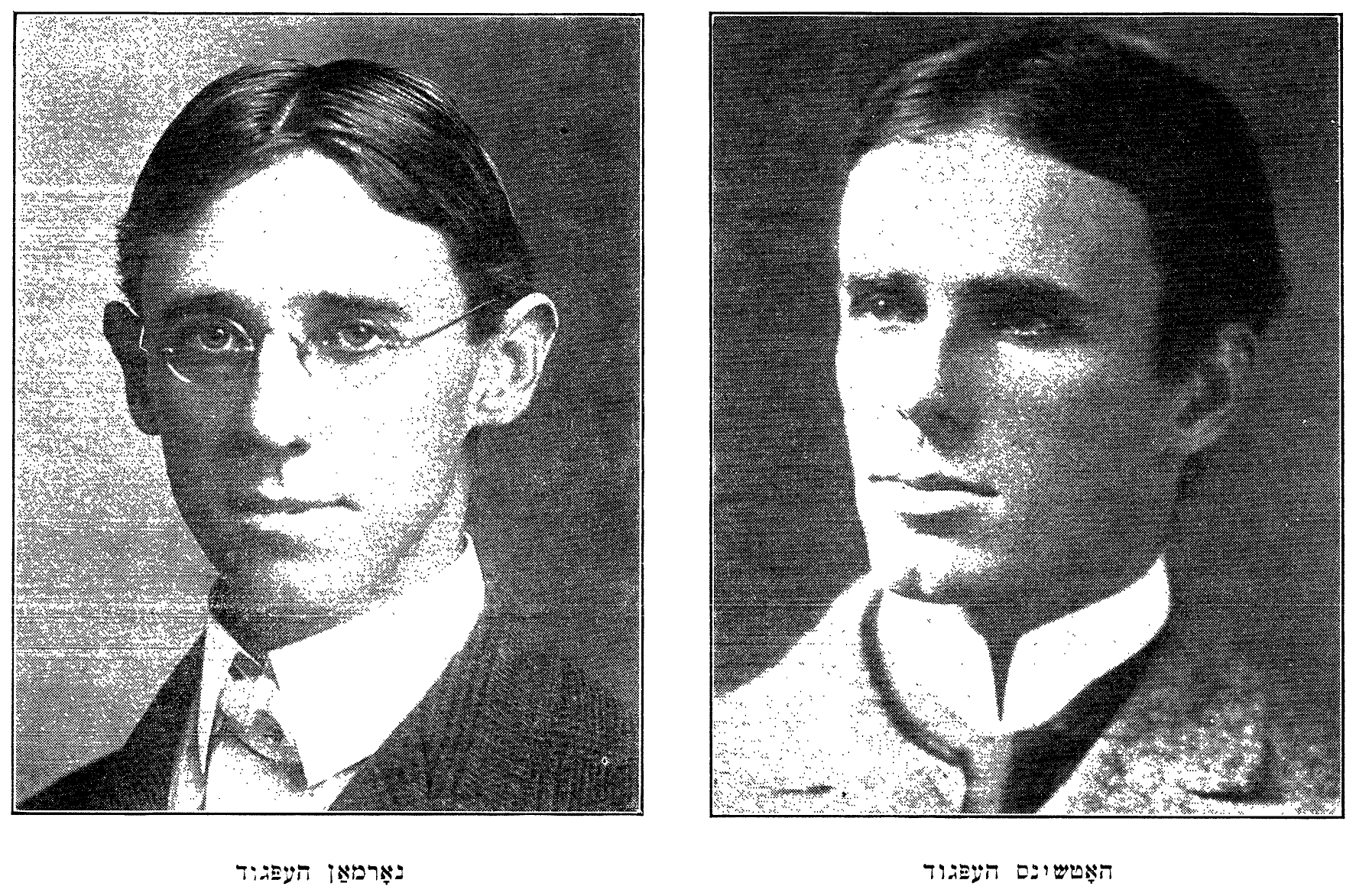
A younger brother of Norman Hapgood, the dramatic editor, also worked as a reporter under Steffens. His first name was Hutchins. But we used to call him by the abbreviation: "Hutch." I became closely befriended with him. Of all the Americans whom I have ever known, he stands in my mind nearest to the type of an intelligent Russian. Not in the outward side of his character. In that he was a genuine Anglo-Saxon, a genuine Yankee. I mean the inner cast of his personality.
He was a stranger to bitterness and to calculation and to ambition — a sincere, temperamental fellow, and a bit hot-tempered. Truly cultivated and with a genuine love of good books, he wrote in an original style, which was not always easy, but always interesting and sincere.
He was not tall, sturdy, with broad shoulders, with a full-chested bass voice that suited his figure, and to which his hearty, life-loving laughter rang almost like a counterpoint.
He hated ceremonies, just as a Russian120nihilist of the 1870s, or like a sincere artist of the Montmartre quarter in Paris. In later years, when New York developed its own Montmartre quarter, in Greenwich Village, Hutch became one of the central figures in the most radical group of that district. In the several years, however, that I spent with him on the "Commercial Advertiser," radical ideas interested him as little as they did Steffens. His character, however, was always a nihilistic one.
Steffens gave him a seat at the long table, opposite me. We would often, in a free moment, chat, and often also spend an evening together, sometimes with Howe along.
To our literary group there also belonged a co-worker by the name of Edwards. We used to go to American theaters together as well, and several times we spent time at the Harvard Club, of which Hutch, his brother, and Howe were members.
In the Jewish quarter I introduced Hutch to some of my Jewish friends and acquaintances. The intellectual life and the depths of the Jewish district interested him. It was a purely human and artistic interest, and to me that was very congenial in him. So I set about leading him around, showing, explaining, introducing him to our interesting people, and serving as interpreter between him and them.
He began to write sketches and interviews from our quarter for the "Commercial Advertiser." I too wrote from time to time on such themes, but often I would leave it to him. It was121interesting for me to see how warmly and beautifully he wrote such articles.
One of the well-known Jewish personalities to whom I introduced him was Eliakum Zunser, the famous badkhn (wedding jester) and folk-poet (see the first volume, pages 360-363, and the second volume, pages 406-407). Zunser had already been in America for several years, and at that time he kept a print shop on East Broadway near Rutgers Street. There we visited him. I reminded the poet about the wedding where I had heard him in Vilna, in 1878. He began to sing the songs that I had heard from him then. I sang along with him, and at the vivid recollection of the old days, in the old home, a sentimental tear probably glistened in my eyes — for so it was recorded in Hutch's notes.
Later he gathered together all his articles about the Jewish quarter and published them in a book under the title "The Spirit of the Ghetto."
A certain time after my arrival at the "Commercial Advertiser," there appeared in the editorial office a slender young woman with reddish hair and an interesting face, an intelligent and capable one. Her name was Neith Boyce. At first she worked as a reporter; afterward as a copy reader (manuscript reader). She spoke little, and took no direct part in our discussions. With her few words in conversations with this or that one of the intellectual aristocracy, however, she would utter an opinion on literary questions, and she was regarded as a member of the group.
Between her and Hutch a romance developed, and they married. Then my wife and I122visited a few times, and a couple of times we went to the theater together.
Hutch's parents were wealthy, and they traveled most of the time. The summer months they used to spend in Egypt. Once, when they were passing through New York, we spent an evening with them at their hotel.
Hutch's older brother, Norman, who wrote the theater criticism for the "Commercial Advertiser," was taller and slimmer than Hutch. In character too he was different — calmer and less of a nihilist. I said above that his articles attracted attention. He acquired followers among the educated classes both for the content of his critiques and for his style, of which it used to be said that it had "aristocratic calm and an aristocratic charm."
As for his opinions, I was often not in agreement with them. But that he had fine abilities, and that his mind was fruitful with interesting ideas — that everyone had to acknowledge.
Once he asked me to see a performance in his place. The performance was one of the most important of that season. They were playing Shakespeare's "Macbeth," and the leading role was held by the Polish actress Modjeska, who was then world-famous. She spoke English with a trace of her Polish accent, and yet she was reckoned the best Shakespearean actress in the English language. I saw her that evening for the first time, and I was greatly disappointed.
The next morning I wrote up a re-
(plate; bound facing printed page 123)
123view in keeping with my convictions. When Norman Hapgood read through my manuscript, his eyes went dark. To tear down Madame Modjeska! That would simply have been a khilel hashem (desecration of the [Holy] Name). It would have created an unpleasant sensation. And he himself in fact thought very highly of her. He had once seen her in "Macbeth" before, and in that play she had pleased him greatly too. But he was a mild, refined person, and he did not want to offend me; so he only said that here and there my critique would have to be made "a little softer." Since no name was signed to the critiques, this did not bother me.
When the newspaper came out, I found that my unfavorable critique had been transformed into warm songs of praise. He never again asked me to write critiques.
Some time later Norman became the chief editor of "Collier's Weekly," which was then the most widely circulated and richest weekly magazine in America. He himself wrote the lead articles for the magazine, and they at once won a reputation.
Howe was an entirely different type from Hutch. Also capable, also with a deep love of books, but not as dreamy as he. The Yankees have a reputation as people with practical sense and instinct. In that respect he had a genuinely Yankee mind.
He was a good thinker, and, inferring from his talk about literature, I used to imagine that in such a124country as Russia, a good critic would have come out of him.
For a good while we worked together in the criminal courts (he on the general news, and I on the big trials), and often we would spend many hours in conversation — mostly about literature.
I was a frequent guest at his home. His wife, the daughter of the proud, hospitable South, was a hospitable hostess.
My friendship with Lefevre began a year or two later than with Steffens, Hutch, and Howe. My acquaintance with him developed independently, through the manuscripts that he showed me. His sketches were bound up with a subject of which the magazines are always fond: Wall Street, the stock exchange, and, as already said, he really had talent. So the magazines took them from him.
He resembled his Spanish mother in his face, and in certain respects in character too. A talker, a lively one, a cheerful one, he was by his nature nearer to a Frenchman, an Italian, or a Jew than to an American or an Englishman. With him it was easier to become acquainted than with the others. And with our shared interest in belles-lettres, our acquaintance quickly developed into a close friendship.
His first book, "The Woman and the Bonds," is one of the most talented volumes of short stories that appeared in those years in English.
In Russia, Germany, or France, an important belletrist would have come out of him. Here too he attracted attention. His talent, however, as an artist125soon became mixed up with his activity as a stock-exchange journalist and with his humor. He acquired a reputation as a writer of light humorous stories of speculator life on Wall Street. To write serious artistic works never ceased to be his ideal. But he kept putting it off.
For the cheaper things they paid him high prices. But that was not the main reason that held him back from writing better stories. For he made money enough without that too — even while he was still working at the "Commercial Advertiser." Being on Wall Street, he himself took up playing the stock exchange, and thanks to his abilities and his personal acquaintance with the big speculators, he had success at it. He would have forgone the large sums that he was paid for his light Wall Street tales and devoted himself to artistic works. But these tales were popular, and he could not withstand the magnetism of a growing name. These light humorous Wall Street tales, and not his truly good stories, were the source of his popularity.
Once he confided to me a secret, that he was going to marry his secretary. The wedding soon took place, and my wife and I used to visit them.
Among my good acquaintances at that time was a young writer by the name of Norman Duncan. He was from Canada — a thin man, with black hair, with an intelligent face, which reminded me of a bashful yeshiva student who used to eat a "day" (a regular weekly meal) at my aunt Feyge's.
When I became acquainted with him, he worked as a reporter on the "Evening Post." I126met him in that editorial office, — back then, when Steffens was the assistant city editor there.
Once — this was several months later — Steffens gave me an assignment to describe the Syrian quarter, on Washington Street, not far from the Battery. Steffens had once described the quarter for the "Evening Post," and he had there become acquainted with a couple of interesting Syrians, so he gave me their addresses. I spent several hours in that district, and Duncan happened to be there too just then.
I wrote up an article about the inhabitants of that quarter* and intended to write another. The quarter awakened no particular literary plans in me. Duncan, however, set about writing a story about their life in New York.
He wrote a little tale about a dreamy Arab fiddle-player, and one of the better magazines printed it.
It had no significance as a picture of life, as a portrait of a human being. It was a fantasy. Instead of an Arab, the same musician could have been a Tatar or an Indian. But the language sparkled with mysterious colors. The little tale had much enchantment in it.
In the office of the "Evening Post" people were astonished. With his work for the newspaper, he had attracted no attention whatever. It had not seemed127credible that Duncan had written the story. He was a poet, and no one had noticed it before. Afterward he wrote other stories.
He took an interest in my belletristic work, and we ate lunch together several times.
He was not a great talker. He liked to think more than to talk, and to dream more than to think. And that showed in his stories, which had in them a poetically dreamlike character. His characters were wrapped in a golden-silvery mist, through which no flesh and no blood could be seen.
His name grew. His career, however, was cut short by an early death.
Several members of our then "Commercial Advertiser" group later became known in American literature and journalism. Howe became the editor of an important magazine; the Hapgoods became known as publicists and feuilletonists. Steffens became famous for a certain sort of writings, of which I shall tell in a later chapter; Lefevre made a name with his stories. To these one must add a young co-worker, Roy Rolfe Gilson, who attracted attention with stories in the better magazines.
The real-estate editor was an American by the name of Ferris, a tall, handsome, middle-aged man with a black beard. Nearly a year had gone by, before128I became acquainted with him. And we became acquainted in the following manner:
Once he came up to me and introduced himself. In doing so he made a statement that was a surprise to me.
"I have heard that you are a socialist," he said. "I too am interested in socialism, so I want to have the pleasure of having you to dinner next Sunday."
He said that he would also invite a few of his friends, men of the real-estate business, who were also interested in the socialist idea.
Before this I used to see him only from a distance. I used to think that he resembled Schewitsch (see the second volume, pages 88-89, and 102-103). On Schewitsch's face there was spread the aristocrat and the educated man, whereas Ferris had the look of an intelligent businessman. His interest in our movement was a pleasant surprise to me.
The next Sunday, around one o'clock, I was at his home (in Brooklyn). Besides him and his family, I found several guests. After dinner we had a cozy discussion. Ferris and his friends had read a couple of socialist works. They had questions. I answered them. We debated not only about socialism, but also about Henry George's "single tax theory," of which one of the guests was an adherent.
From then on Ferris would often come over to me in the editorial office, and we would chat. I brought him a few more books and pamphlets about socialism.
He was the only person in a "shop" with whom I used to talk about this subject.
129Among my brightest "Commercial Advertiser" memories is a scene connected with the Dreyfus trial. It took place in the long editorial room, on Saturday, the 9th of September, 1899.
For the first time I heard about Captain Dreyfus in 1895. It was a Sunday. We were then living on 5th Street, near Cooper Institute. My wife was reading the Sunday edition of the New York newspaper "Press," and I was sitting at my old desk reading a book. In the "Press" there was a description of how they had declared Dreyfus a traitor and, with a military ceremony, torn his epaulettes from his shoulders. Marching the forced march, under the rolling of the drums, he held his head high and cried: "You are condemning an innocent man!"
My wife drew my attention to this article.
"I feel that he is innocent," she said, and I answered that, since there were no details, one could not yet know.
American newspapers then printed far less European news than today. The details of the Dreyfus story reached us slowly. Little by little, however, we became acquainted with the story. There, in France, one disclosure was made after another. The great intrigue was uncovered; there unfolded the bitter struggle between the forgers and intriguers on one side, and the united forces of truth and justice on the other.
130It was already clear as day that Dreyfus was absolutely innocent; that the guilty one was in fact an officer by the name of Esterhazy.
Then, when the case had stirred up the world, the American newspapers too were full of it. It was a world sensation.*
On that aforementioned Saturday, the 9th of September, 1899, came the conclusion of Dreyfus's second trial (in Rennes). Dispatches were flying. Every minute one could expect the decision.
I was sitting beside the telegraph editor, in a fever of impatience, restless.
Most of the co-workers had only a vague notion about the trial. But they knew that all Jews regarded Dreyfus as a martyr, and that my heart was pounding with impatience and dread, waiting for the verdict. They showed sympathy for my feelings.
Finally one of the two telegraphers handed the telegraph editor a yellow sheet of paper, on which he had just typed up, on his typewriter, the last dispatch from Rennes. The telegraph editor read it through and, with a look full of compassion, handed me the paper.
The verdict was "guilty," but with a recommen-131dation to "mercy," and the sentence was ten years' imprisonment.
Steffens and several of the others expressed regret.
"You will probably go to see your Jewish friends," Steffens said to me.
I went off to Harris's café, on 141 Division Street, where our comrades used to gather.
Notes (the original’s footnotes)
[p. 111] As we shall see further on, during the time of my connection with the "shop" a second book of my stories appeared, and from time to time a piece of mine was printed in one of the most important American monthly magazines.
[p. 126] Some of them were really Arabs from Syria. Some, however, were from Egypt and from other Arabic-speaking regions. In religion they were all Christians. Some Greek Catholic, some Roman Catholic, and some Protestants.
[p. 130] De Leon's "Abend Blatt," chiefly its editor, Philip Krantz, held to the opinion that Dreyfus was guilty. The "Forverts," on the other hand, took the correct position: it showed the deepest sympathy for Dreyfus and the sharpest indignation against the intriguers.