Chapter Seven
Literature
189A few weeks after I had left the "Forverts" (see the end of the third volume of "Bleter fun mayn lebn" [Pages of My Life]), I received an invitation from the Boston journal "Atlantic Monthly" to send in short stories. Such a letter was very welcome to me then. But to set to work right away I could not. I was simply confused, agitated. And a little later, when I was already at the "Commercial Advertiser," and once again in good spirits, I still could not bring myself at once to belles-lettres. My new experiences as a reporter and editor literally swallowed me up. And so I did not get straight to writing a sketch. I kept putting it all off.
When something interests me, it takes up my whole attention. I had themes for sketches. But to set about writing belles-lettres I kept putting off. Whenever the bulletin window of police headquarters pointed to some interesting occurrence somewhere, I would run there, look, ask around, get to the bottom of it, and take notes. And later, in my free190hours, I would go there again now and then, although this no longer had anything to do with my duties at the newspaper.
In those days I was more an observer of life than a writer. For the newspaper I wrote many little sketches, but they were in the form of reports, shot through with bits of color, with a stroke here, a stroke there. This work of mine I regarded merely as material for future literary activity. It interested me beyond measure.
But the "Atlantic Monthly" was one of the oldest and most important journals in America (a few years earlier its editor had been [William Dean] Howells). To have a story in it would be important for my further literary career. And so I finally summoned up my strength and set about writing something for it. The result was a story under the title "A Ghetto Wedding" (a wedding in the Jewish quarter).
The story takes place at the time of the great economic crisis of 1893. A couple in love resolve to marry, despite their bad material circumstances. Of a "free wedding" — a quiet wedding, in a private apartment, and without a banquet served — the bride will not hear; but if they were to make a "respectable" wedding, there would be nothing with which to buy furniture. She ponders, and reckons, until she hits upon a plan: they will make a "respectable" wedding. And furniture? That the relatives will buy as wedding presents, as is customarily done: close relatives and friends inquire beforehand what such people need to have in the house; they consult among themselves and send in — this one a bureau, that one a set of furniture, and so on. But if one were to make a "free wedding," and almost no one191were invited, there would be no wedding presents. In short, bride and groom bought only a few pieces of furniture, the most necessary ones, rented a hall, made all the preparations for a wedding "in proper style," sent out invitation cards, and with the fullest confidence awaited the gifts.
It turned out that they had reckoned without the landlord, and the landlord in this case was the crisis. The very same hard times because of which the young couple had nothing to spend on furniture kept the relatives from coming to the wedding. Most of them had long been out of work, and had pawned their own belongings. And how does one go to a wedding without a present? So they did not go.
At the supper stood long tables with long rows of plates and knives and forks. Musicians played; there was a badkhn (wedding jester), but no crowd. An empty, long banquet hall with empty benches and gleaming empty plates.
The tragic effect of the scene is depicted, and the impression it makes upon the bride. At the end it is shown how, after the supper, the dejected young couple goes home, into their empty rooms.
Again a sad ending, then. I had strong doubts whether the story would be accepted. I had doubts even before I wrote it. But the theme interested me, and to build the story up otherwise than I have rendered it here would have been impossible. Its tragic ending is its artistic essence.
I had a pleasant surprise, just as with "Circumstances." Not only did the editorial board of the "Atlantic Monthly" accept the story, but the letter that I received from them about it contained words of genuine enthusiasm.
192And after the story appeared in the journal (in the February number, 1898) I received several letters from other persons of the American literary world, all with compliments for the "Ghetto Wedding." One such letter was from Howells, a second from Stephen Crane, and the rest from writers with whom I was not personally acquainted.
New invitations arrived from several journals. Walter H. Page, who was then editor of the "Atlantic Monthly," asked me to send him more pieces.
I set about writing a second story for him. The plan consisted of the following: Asriel, an old Jewish immigrant, a wealthy widower, but a coarse man, has long lived in America and has an only daughter, American-born. He travels to visit his old home in a little town somewhere in Lithuania. While he is in his birthplace, a bridegroom is brought there for the daughter of the town's wealthiest householder — a young illui (prodigy of Talmudic learning), a handsome lad and a lively spirit.
Asriel is a simple, uneducated man, but a Jew with character and with pride. In his birthplace he had belonged to the poorest class, and now he is an ignorant man with American ways, with American enterprising spirit, and with the brashness of an American immigrant of his type. The refined householder, in turn, who wants to take the illui as a son-in-law, is a refined householder in the old-country sense193of the word: not only a rich man, but a learned man too, a fine Jew. He is the highest personage in the town.
Asriel takes a fancy to snatching away the son-in-law from this distinguished family. A kind of "auction" takes place. The question is who will give the larger dowry, and — it goes without saying — Asriel outbids the other.
He brings the illui home to his American girl. Comic situations arise. But the "greenhorn" is a piquant boy, and a handsome one too.
The young man begins to learn English. The girl teaches him to pronounce English words. At first she mocks him. But she becomes interested in him. His abilities, his dashing manner, his handsome face, and his youthful good cheer in fact conquer her on the spot. There is a wedding.
The imported son-in-law Americanizes himself and develops. And Asriel looks about him and sees that the bridegroom whom he had brought down from his old home is not at all such a "bargain" as he had thought. When he had hired the illui from the refined householder, he had pictured to himself that the lad would be an ornament for him, in the old-fashioned sense of the word. He would boast of him before the other Jews of his Orthodox New York synagogue. He would have in him a son-in-law learned in the Torah for the rest of his days, and as good as a Kaddish (a son to recite the mourner's prayer) when he, Asriel, would already find himself in the other world. It turns out altogether that the young fellow has become in New York an "un-Jew" — an "enlightened one," a "modern man," an apikoyres (heretic)!
There is in the story a scene in which Asriel takes his son-in-law for a walk while the young man goes into a Christian restaurant. Nearer to the end of the story there is such a scene: it is late at night, the young man finds himself in the company of cultured Russian194immigrants and a couple of Christians, all progressive, thinking people, and his wife comes to call him home.
She loves him, Asriel's daughter, but she is not satisfied with him. She is too little educated, and to her notions and taste he goes about in some strange way. He does not associate with the sort of young people of her world — with costume peddlers, storekeepers — but rather with people who read books and talk only about books, apikorsim (heretics), some kind of philosophers.
It came out far longer than a short story. I had hoped that Page would perhaps print it in installments. But he explained to me that for stories meant to run in several installments a different sort of literature is required (he did not say it outright. But I understood that he meant a novel of the "higher" American life, or of sensational events), and he made me a proposal: to print "The Imported Bridegroom," together with the "Ghetto Wedding," along with a few more short stories, in a book.
As has already been mentioned, the "Atlantic Monthly" belonged (and still belongs today) to the famous publishing firm Houghton, Mifflin and Company, and Page was then the "literary adviser" of the firm's publishing house, as well as the editor of its journal.
I tried sending the manuscript to a couple of other editorial offices. Both wanted to accept it, but both on the condition that I shorten it greatly — one (the "Cosmopolitan") to ten or twelve thousand words, and the second (the "Scribner's," I believe), to fifteen thousand. Both wanted to print the story in two installments.
195I decided to publish the story, according to Page's plan, in a single book together with several other stories. The question was to which publisher I should send it — to the Appletons or to the Boston firm. Since it was from the latter that the proposal had come, and since, besides its famous publishing house, it had a famous literary journal, the lot fell upon it.
The book appeared under the title "The Imported Bridegroom and Other Stories." Among the smaller stories it contains, besides the "Ghetto Wedding," "The Providential Match" and "A Sweatshop Romance."
The first two stories in the collection ("The Imported Bridegroom" and "The Ghetto Wedding") are incomparably better than the other two. The last two I would not include today in a collection of mine. The difference between the two pairs stems from the difference between my literary conception in 1895 and in 1898. Incidentally, "Yekl," which appeared in 1896, is just as far from "A Providential Match" as "The Imported Bridegroom" is.
A year after "A Providential Match" appeared, I wondered how such a childish thing could have come from my hand. Why I included it in my volume of stories is a riddle to me now as well.
The reviews were all favorable.
196Before me lies an old clipping from the Chicago "Record," of April 21, 1898, which contains a survey of the work. The critic says that the stories are "full of color, of humor, and of Jewish melancholy." That they are "simple and natural and reveal a deep acquaintance with human nature." The book shows that in its author we have "a writer with fine promise," and that the "literary world will follow his future with interest."
In the October issue, 1898, of the literary journal "The Bookman," the critic (Marcosson) devotes, on account of my book, a whole article to matchmakers — how they developed — and he remarks that I have "in a wonderful way presented the most interesting entanglements that arise in the Jewish matchmaking of America." He also says that I have "brilliantly brought out the new conditions in America, where matches are not concluded in the old-fashioned manner, as in the old homes, where the matchmaker still plays his old role."
Characteristic is a review which was written specially by a "Jew" for "Jews." It appeared in the "American Hebrew" of December 9, 1898. It made on me the impression that the writer was the same as the one who had torn down "Yekl." Now, however, he had changed his tone. Of "Yekl" he had said that there were no "word-pictures" in it. In my new book, there are indeed "word-pictures" — he explained. — And that I "am improving greatly in my art, and that I will be likely to become famous."
197I shall here give the content and character of a few more of the stories which I wrote in those years and which appeared in the American journals.
The "Century Magazine" stood then at the highest level. A saying went around: "The Episcopal Church is the most correct church and the 'Century Magazine' is the most correct journal." That is to say, that the "highest" families of America belonged to the Episcopal Church and read the "Century Magazine."
The most important writers took part in the "Century Magazine." Just at the time of which I speak here, Howells was associated with "Harper's," but earlier he had written in the "Century." The editor of the "Century" was the poet Richard Watson Gilder.
In this journal I had a story in the November issue of 1899. The name of the story was "The Apostate of Chego-Chegg" (the apostate woman of Chego-Chegg).
Chego-Chegg (an invented name) is a village on Long Island, an hour's train ride from New York. It is inhabited chiefly by Poles, Polish farmers or Polish workers from the nearby factories. When their American neighbors hear them speak Polish, it seems to them that every word ends in "ego," "engo," or "chengo." That is how it sounds to them, and therefore they have given the little town the name "Chego-Chegg."
There a young couple is found, of whom the198man is a Pole, a Catholic, and the wife a Jewish daughter. She fell in love with him back home. She had herself baptized, and they traveled off to America. Here she longs for home, and also for the Jewish life.
Not far away there is a place where Jews live, and one of them, a young man, a learned fellow, a bit of a "crank," often passes through "Chego-Chegg." He gets into conversation with her and learns that she is a baptized Jewish daughter. And although she holds a baby in her arms, he becomes interested in her. They begin to talk about her returning to the Jewish faith and marrying this immigrant. She comes to New York to consult a rabbi. She asks him how she should convert.
The rabbi answers her, in a humorous tone, that, as he sees, she is no scholar, for according to the Jewish faith she was never anything but a Jewish child and has nothing to convert to. The Jewish God is not the sort of businessman who allows a customer to regret a transaction. Once a Jew, it is settled! Has she had herself baptized and lives with a goy? — that means that she is sinning! Let her repent and live again as a Jewish child! That is all that is asked of her.
And what about her little girl?
The rabbi answers her that with the little girl there is even less trouble than with herself, for the girl has not even sinned. The girl did not have herself baptized with her own knowledge. According to Jewish law she too is a Jewish daughter. When a father or a mother is a Jewish child, the children of the marriage are also Jews. Speaking half in jest, the rabbi changes the girl's Christian name to a Jewish one that sounds similar.
When the apostate hears that her daughter is not a "shikseleh" (little gentile girl) at all, but a Jewish child, she weeps from199a joyful surprise, kisses her child and calls it by its Jewish name.
Jewish women take an interest. They cluster around her. They prepare her for the great change. In America, however, she cannot marry anyone else. The law does not recognize any questions of religion and knows only one thing: she has a husband, and if she were to marry a second one, that would be "bigamy" (having two wives or two husbands) — a crime for which one is punished with five years in prison. And so she and her Jewish bridegroom will travel off to England, where no one knows them, and there they will marry and live as the Jewish God commanded.
In the house of one of the interested Jewish women there is a commotion. The steamship tickets are ready. Everything is prepared for the journey. The steamer must depart that same day. Now the whole company, with bride and groom, will travel to New York, to the ship. There is a tumult, a nervous hurrying, a trembling. The apostate's husband is in the factory, at his work, but walls have ears... what if he finds out?...
Suddenly — a cry of woe! Through the window one sees the "goy" approaching.
He had sensed that his wife was not the same as always. She was somehow confused, inhospitable. Especially strong had this impression been that morning, when he was getting ready for work. He could not rest in the shop.
He threw it down in the middle of his work, and now he is going home to see what she is doing.
The women signaled to one another that all should be quiet. They held their breath. But the200apostate herself behaved strangely. Instead of also holding her breath and being anxious lest the plan be disturbed and she be unable to get to the ship, she suddenly cried out that she had not the heart to leave him! And, to everyone's astonishment, she went out of the house and off home with her husband.
He is indeed a goy, and she is indeed an apostate woman, an accursed one, a damned one. But she loves the goy, and she is accustomed to him. She cannot leave him.
— An apostate stays an apostate! — the women cried, with curses.
In part I had made use of the theme (about an apostate woman who longs to return to the Jews) two years earlier in the "Commercial Advertiser." But the dramatic side of the story was not there. It was only a very short, unworked sketch.
In the "Century" the story was illustrated by a Jewish painter named Loeb, who was reckoned the best artist in this field. He made several pictures — all very talentedly painted. The last takes up a whole page. It depicts how the young Pole walks ahead and his wife follows him. They are going home.
When the story was printed, I received from the editor a special letter, in which the following words were found: "Your story is one of the most remarkable that I have ever seen in a journal. Splendid artistic work, by you with the pen and by Loeb with the pencil."
The story was mentioned in the literary notes of several newspapers, and people of the journal-201istic and literary world greeted me with it.
A few days after the story appeared, I met Samuel Hopkins Adams, who was then the most important staff member on the "Sun" and one of the most talented journalists in New York. We were together on an assignment in Mott Street, in the Chinese quarter. It was the funeral of a Chinese man of high rank, and the ceremony took place in the Chinese temple.
I had been acquainted with Adams from before. We had worked together on the Kennedy case. I knew that he was one of the most talented newspaper men in New York, and about me he knew only that I was a reporter on the "Commercial Advertiser."
Now, when he met me on Mott Street, his first words were:
— Hello, Cahan, why didn't you tell me what sort of a customer you are? I read your story in the "Century Magazine."
He spoke with warm compliments, and I repaid him with praise for his brilliant pictures of the military camp where the American army had been assembled when it returned from the war.
— Ah, that is quite another kind of work, — he replied, — that is newspaper work; but your story is art.
One paper — a weekly — not only did not praise "The Apostate of Chego-Chegg" but attacked it. That was the "American Israelite" of Cincinnati, the202English organ of Rabbi Wise, the founder and director of the Cincinnati Rabbinical College (rabbinical school). This paper fell upon me with abusive words, because I had written such a story. Its argument consisted of the following: according to the law of the United States the apostate woman may not marry anyone else, and in my account it comes out that, according to Jewish law, she may. That is to say, that the Jewish religion does not recognize her legal marriage. The Jewish law teaches people to break the laws of the land, it means.
For a "Jewish" paper this was characteristic. The "Jews" were always afraid lest it be said that they were not loyal to America. The "American Israelite" said that "Cahan is ready to sell the Jews for the price that is given him for a story."
The writer of the attack declared that what stands in "The Apostate of Chego-Chegg" with regard to Jewish law is not true. In other words, that I had invented the law in order to be able to put together my story, in order to obtain the few dollars.
The fact is that before I sat down to write, I had a conversation with two Orthodox rabbis. From them I had ascertained the true law. And the Cincinnati "Jew" denied the law "in the interests of Judaism."
It would never have occurred to a Jew of ours to grow uneasy over such a matter. And Americans would not have given the subject any attention either, for thousands of American couples evade the marriage and divorce laws in order to become free to marry someone else, and in their hearts hardly anyone is opposed to it.
In the aforementioned literary journal "Bookman"
203there was a note in which astonishment was expressed at why the "American Israelite" believed that my story could harm the Jewish name. The editorial board found that, on the contrary, it set the character of the heroine in a good light, since it does after all come out that the Jewish woman (the apostate) remains true to her husband. The note also contained several friendly words about the story as a piece of portraiture.
The editorial board received some letters about the question. A debate took place.
A moment after the "Apostate" had been printed in the "Century," another story of mine appeared in "Scribner's Magazine," which belonged to the same class as the "Century." The name of this story was "Rabbi Eliezer's Christmas" — a light, half-humorous little tale.
An old, pious Jew, named Reb Eliezer, receives a Christmas present from an American social worker. The gift is welcome to him, but how does one deal here with the Christmas? A gentile holiday, and what a gentile one at that! The birth of "Yoizel" (Jesus) himself. Reb Eliezer arranges with the social worker that she should give him the present after Christmas. But he is uneasy, and he goes to inquire whether she is "good money" (offended).
In 1899 the journal "Everybody's" was founded, which afterward played a great role for a long time and achieved the highest circulation of204all the journals. The editor turned to me to send him stories from time to time. I sent in a story called "Marriage by Proxy." That is, a wedding which takes place without the bridegroom. Instead of him, a representative of his comes to the ceremony. Above (page 147) I told how I had seen such a bride, when her American husband came to receive her. As has already been remarked, such proxy marriages were not a rare thing in Italy. So it was according to Italian law.
Now, then, I also made use of the aforementioned scene for a literary purpose. "Marriage by Proxy" was written in a lighter tone. The story appeared in the December issue of 1900.
In the May number of "Cosmopolitan," 1900, I had a story called "The Daughter of Reb Avrom Leib," in which it is depicted how a widower marries off his only daughter. His joy and his sorrow in the matter are portrayed. Reb Avrom Leib is a cantor, and the story is carried through scenes of the various Jewish festivals: Shabbes Nakhamu, Erev Yom Kippur, Simkhes Toyre, the blessing of the Hanukkah candles (in the synagogue).
In August 1901, I had a story in the "Atlantic Monthly," under the title "The Chego-Jewess of the Catskills." In the Catskill mountains I meet a cultured Georgian (man from Georgia in the Caucasus). He was raised in the Caucasus mountains, and he is a brilliant rider. On horseback, galloping through the American mountains, he feels just as at home. I speak with him in Russian. Thus, when205we become acquainted, and he tells me an intimate occurrence of his life.
A story of mine appeared in the journal "Cosmopolitan" of March 1901. The name was "Dmitri and Sigrid." Dmitri is a Romanian officer, who had to flee from home because he gave a slap to a superior officer. And Sigrid is a girl from Sweden. Both are detained at the immigrant station because they have no one to go to. The officer really has no one, and the Swedish woman keeps waiting for relatives. By day they sit together in the "detention pen" — a large room where the detained immigrants pass the time. They cannot make themselves understood to each other. But he becomes interested in her and she in him. The fact that they are both miserable and despairing has much to do with the development of this mutual feeling. At first they speak in the language of glances, smiles, signs. Then they find a means: she has a Swedish-English and English-Swedish dictionary, and he a Romanian-English and English-Romanian one. By means of these two dictionaries they find, as it were, the necessary words, and this is for them a most interesting pastime. So they sit for hours on end, digging up words. So they carry on a conversation. He points out to her in his dictionary the English word he wants to say, and she points out to him in her dictionary her answer. In this way it goes on, until he points out to her the word "love."*206Soon her relatives appear and take her away. Later they let him out too. But he does not have her address.
He gets a job. He becomes a photographer. He learns English. He does not stop searching for his Sigrid.
Once, riding on the elevated, he caught sight of her through the window in the train that was on the other side. He wanted to run out; but the trains were already gone, in opposite directions.
Once, a year later, he saw her: she was sitting on a "stoop," with a baby in her arms.
He went up to her. She recognized him too, and she too could already speak English.
They got to talking. He became bitterly disappointed — not only by the fact that she already had a baby, but in her herself. Before he had been able to converse with her, he had thought that she was an intelligent girl, for in Romania, when a girl can use a dictionary, she is an intelligent one. Now, when they had chatted, he sees that she is a quite simple, ignorant, and uninteresting woman. He feels as if doused with cold water.
For some years a certain play ran in America which had a great success. In this play there is a scene where a young man and a girl speak to each other in two different languages, become acquainted, and declare their love through dictionaries. This play was written a good while after "Dmitri and Sigrid" had appeared.
In March 1891, a story of mine, "The Fate of Count Brantzeff," appeared in a new journal with the207name "Ainslee's." I also had sketches in the "Commercial" and in the "Boston Transcript," and articles in such journals as the "North American Review," "Atlantic Monthly," and others.
In the course of those several years I received several invitations from literary clubs of various cities to come and give lectures about literature, readings from my works, or at the dinner of a "dining club" (a club that gathers on a certain evening for a meal together and, after eating, to have a discussion or hear a lecture). One such invitation came from Baltimore, a second from New Haven, a third from Philadelphia, a fourth from Boston.
A reading from my works I also gave for the well-known American lecture society "Chautauqua." These lectures take place in Chautauqua, Pennsylvania, in the summer season. A large crowd gathers, with the double purpose of spending their time on vacation and learning something. Lectures are held on various subjects. People run from lecture to lecture. The place looks like a fair.
From Chicago I received an invitation from a literary club, which desired to have a debate between me, as "representative of the realist school," and a certain professor (of literature, I believe), as defender of the romantic school. I accepted the debate. For certain reasons, however, it was postponed, and I heard nothing more from the secretary of the club.
Lectures about literature and readings I held in208in the course of the late nineties, [I] also held [them] for various literary American groups in New York, and several times (in Yiddish, or in Russian, and once in English) for our immigrants.
To a talk about literature for a small group of intelligent American Jews I was once invited by my friend from my "greenhorn" years, Manuel Kurshedt (see the second volume, pp. 154-156).
Once, in 1899, I received through the city post a letter signed: Tan Bagerow. The name was unknown to me. The contents of the letter consisted approximately of the following:
The writer was himself a Russian author, and he was now here in America for a certain time. He was interested in my literary activity and would like to meet with me.
It turned out that this Tan Bagerow was a well-known Russian revolutionary (he had been the last editor of the "Narodnaya Volya"). He had spent three years in the Petropavlovsk fortress and afterwards some ten years in exile in the remotest regions of Siberia. He had come here together with a second Russian revolutionary, Vladimir Yavelson, of whom I had already heard. I knew that he had been connected with the group of Zhelyabov, Perovskaya and the other famous terrorists of the "Narodnaya Volya." Yavelson had been exiled together with Bagerow. During the time they spent in Siberia, both of them had occupied themselves with research about the
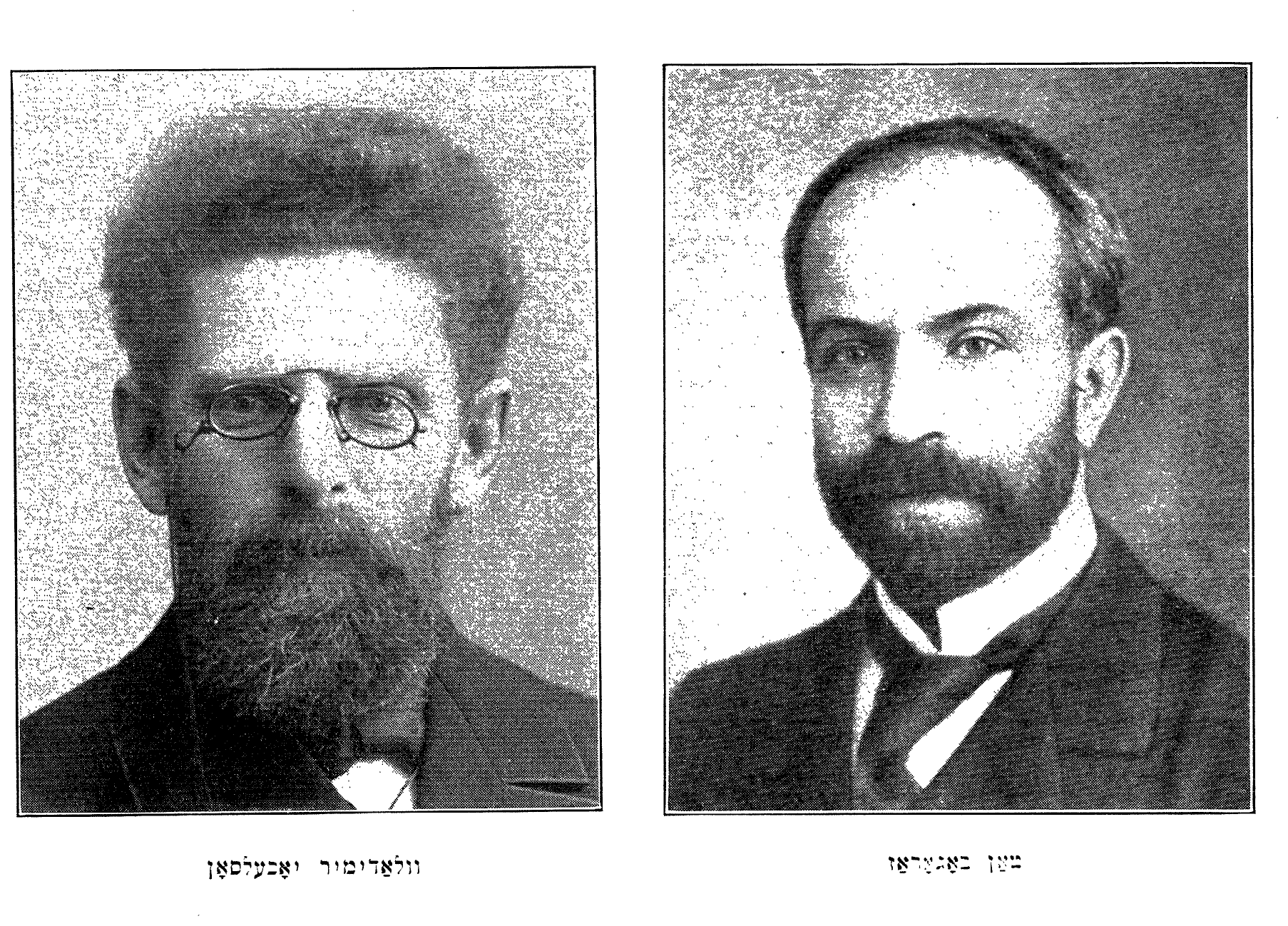
(plate; bound facing printed page 209)
209life of the half-wild tribes who dwell in the coldest Siberia and who are in many respects similar to the Eskimos of Alaska, North America. They became scholars in this field, and the National Museum of New York invited them to write treatises about their specialty. Both, Bagerow and Yavelson, were of middle age; the first with black hair, with black eyes, with the appearance of an Arab type; the second with a thick blond beard, with a very sympathetic smile, with the general appearance of a good-natured German doctor or professor.
With Bagerow I spoke chiefly about literary matters. It turned out that he read English freely and understood the language thoroughly. He was a man of the world, a capable and talented person, and in the ten years that he had spent in far-off Siberia he had read and studied a great deal; among other things, he had taught himself English and read through many English books. He had written up a series of stories of the life in the Siberian region where he had been exiled.
He spoke about my stories and expressed regret that no one was translating them for the Russian journals. He himself was connected with a couple of the best journals in Petersburg, and he was certain that they would print my stories with pleasure.
His name in the literary world was Tan — an abbreviation of Natan, his first name.
Once Bagerow told me about his beginnings — how he had been the editor of the newspaper "Narod-210naya Volya," how the spies had searched for him in Bern, in the city, in Petersburg, and how they had finally seized him in the street. He had struggled with them. They tied him up and tore the coat off him, and dragged him away to a prison. By the standards of those times and the charges against him, it looked as though he would never again set eyes on the free world.
— Tell me how you felt — I asked him — what was your psychological state, when you believed that the white world was already cut off from you forever?
He looked at me, gave a smile and said:
— Only a writer of fiction, who is interested in the human soul, asks such questions.
Not all those who have lived through what Bagerow lived through remember the details and are able to convey them well. Not everyone is so impressionable, and not everyone has such an artistic temperament as he.
We were walking along Second Avenue, and he told me his story. His recollections made a deep impression on me. When I came home, I wrote it all down, and the notes are among those I have always kept.
"At first I really felt that this was death" — he began — "no hope, no expectations. Slavery and loneliness forever, forever... A living grave in the real sense of the word.
"The first three days and nights I sat almost the whole time on my cot in a state of melancholy. When they brought me to the interrogation, I refused to answer questions, and when I came back into my little cell, I again felt my despair-211despair. Afterwards, little by little, other feelings and other thoughts began to appear. The mind worked without cease. Fantasies developed — all about our movement. I used to picture to myself an uprising, a revolution!
"I had pity on myself for losing my life, for having to pay so dearly. But I had no crude, egotistical dreams. I used to think that our struggle was too hard a struggle; that to defeat the Russian government, as the Zhelyabovs had imagined, would not succeed. The Zhelyabovs had believed that they were the embodiment of a great historical event, that a historical upheaval was soon coming. But we, the younger ones, could no longer think that way. We had seen how all our fighters were seized, how the whole wonderful organization 'Narodnaya Volya' was destroyed. We had tried to rebuild it, and we did not succeed. So I would sit on my cot and ponder how the liberation would still come. I was convinced that it would come. And I used to picture to myself how it would be.
"At first I felt that my present condition meant death, that everything in the past was cut off. Everything that had been was marked for me as 'the time when I was alive.' I believe that people who have never been in such a condition cannot understand this well. It used to seem to me that I had been extinguished. Do you understand?
Extinguished, the way one extinguishes a candle.
"In this condition I spent about three months. Then, little by little, I again began to live. The past was no longer so vivid. I began to feel that here, in prison too, there is a life,212a certain sort of future. I used to ponder: how strange, I now find myself behind the scenes of the world. That, after all, is the secret. Is there then also a 'behind the scenes' here too? Must one then also peer here behind the curtain in order to know what will be further on?
"Suddenly you remember that you have a stomach that wants to eat.
"Or: you stand and tap with your finger on the wall to the comrades who sit in the other little cells. You tap signals to them, and with this signal-language you converse with one another. You do this, and it seems to you that you are really talking with them. You talk, you live.
"From the moment when you feel like this, the questions begin: what will they do with me? Will they exile me to the Schlüsselburg fortress? Well, there too one can live, after all. And with that the philosophizing begins, that in any case human beings are like flies, like worms; that everything is nothing more than a mixture of chemical materials, and you are nothing more than a drop in a sea. So what is there here to regret?
"Something presses you and presses you and presses you... It seems to you that you have grown smaller on the scale. A terrible ache. One would like to make an end of it through suicide, the way one puts an end to a toothache by pulling the tooth out.
"Thus it drags on for several hours and suddenly it stops.
"It often used to happen to me that I would rise in the morning and feel in a good mood. I want to sing, to make jokes with myself. I walk back and forth a-213round my lonely little room, and in my heart it is bright. A delight to be alive in the world...
"This can last a whole day, sometimes two days or even more. Afterwards an entirely different mood comes on."
My novel "Yekl" had by then already been translated into Russian, by Dr. Joshua Rubinow of New York. But the translation appeared in the "Voskhod" — a journal for Jewish interests, with which the broad literary world of Russia was little acquainted. So the goal was that my stories should appear in the general Russian journals. To this end my wife, on Bagarow's advice, began to translate my "Imported Bridegroom." Bagarow praised her translation highly. He sent the manuscript to the editorial office of the journal "Zhizn" (Life), and it was printed in the issue of the month of August, 1900. Bagarow wrote an article about my literary activity in America, and it appeared in the same journal. Afterwards my wife translated several others of my stories. They appeared in "Zhizn" or in "Mir Bozhy" (God's World). (Both were among the most important periodicals. In both, the most distinguished writers of Russia took part).
Some of my stories were reprinted in other journals or newspapers.
It began to be heard that my work was attracting attention in the best literary circles of Russia. This was for me a source of the greatest satisfaction. Russia is, after all, the land of the highest literary devel-214opment, and there my literary work is recognized. What could be more pleasing? And the fact that they were being read in my beloved Russia naturally afforded me a special pleasure.
Bagarow was actually the first who advised me to write my memoirs.
— Why don't you write "Zapiski russkago emigranta?" (Memoirs of a Russian Emigrant) — he once said to me. — Set forth in pictures your experiences in America. That would be tremendously interesting for the readers of our better journals.
This was, then, in 1899 and in 1900. I had then in mind to carry out that plan some day. But I had no definite idea about it.
Once I received from Russia a letter and together with it a journal ("Russkoye Slovo," I think). The letter was addressed to me as a teacher, and contained expressions of respect and praise for me, both as a writer and as a teacher. At first I did not understand who the writer was, and when I glanced at the signature — "Revmund" — I did not know who it was. But further on it was explained in the letter: when I had been a schoolteacher in Velyusha, Vitebsk province, in the winter of 1881-1882, he had been one of my pupils. I recalled him: a little boy, a slender one, with a dark, charming face, with brown little eyes, full of life, earnest; he had been one of the best pupils in my class. Now, then, he had read my stories in the Russian journals.
Eighteen years already gone by! It was interesting to me beyond all measure. But at the same time I215felt a sadness in my heart. Eighteen years already! A new century had already begun. I was already forty years old. Forty years! The words used to ring to me like the title of an old man. Now it is my title. It seems to me I still feel so young. But for Rivkind the words have the same meaning that they once had for me...
Further on I learned from the letter that Rivkind also writes stories (the journal that he had sent me contained one of his pieces). That little boy is thus already a grown man, a writer, and he addresses me in such a tone, as though I really were an old man!...
In those several years it often happened that I was at the Harvard Club, at the Yale Club and at a number of other clubs. American acquaintances, members of this or that club, used to invite me there to dinner, and often a whole group would take part in the dinner, all people of the literary profession. A number of these invitations came from my friends of the "Cosmopolitan Club," who had graduated from Harvard College and were members of the New York Harvard Club. The other encounters came about through club members who were connected with the literary world. Some acquaintances with writers I made in private houses — at Howells's, at Hitchcock's, in the studio of two painters and in the dwellings of my colleagues from "Cosmopolitan Advertiser." On this occasion I met the two well-known poets from Canada, Bliss Carman and Richard Hovey, with a216writer of short stories, Jessie Lynch, whose name was then well known in the journals, with an old poet and critic by the name of Stoddard, and with a good number of other literary men.
Once I was at a "lunch" at Howells's house. There were gathered older literary men, a few poets from Boston, a few editors and a few belletrists from New York.
I must tell the truth, that after every such gathering I used to go home with a heavy heart. The literary world of America is today, in many respects, quite a different world than then. It is today far more congenial, broader and not so "Tory"* as in those years. In Russia the literary world stood then, spiritually, far higher than in America. I mean not only the fact that Russian literature itself, as an art, stood higher than the American or English. I mean also the moral spirit that reigned in it and among its representatives — it was a highly idealistic spirit. The Russian writers were, throughout, if indirectly, bound up with the struggle for freedom and progress, and many of them, counting in several of the greatest, led a martyr's life. To boast of aristocracy was for them impossible. Aristocratic pride was a disgrace. Real aristocrats, like Count Tolstoy, fraternized with the common people and conducted themselves with sincere humility.
Exactly the opposite was the spirit among the American217writers, young or older, whom I happened to meet. To dinner they all used to come dressed up in "tuxedos," with stiff, white, puffed-out shirts, and in their conversations I not seldom used to hear "snobbish" boastings.
One of the most successful writers in those times was Richard Harding Davis. He had a fine style and his stories read smoothly and pleasantly. But his writing was chiefly devoted to the "snobbish" arrogance of the "high windows." A millionaire of recognized society was in his works always the most capable, the nimblest and strongest fellow and also the greatest dashing hero. When in one of his stories a millionaire young man meets an ordinary bandit, you can be sure that the bandit will suffer a defeat. The millionaire is for him always a hero, an athlete. He is proud but noble, fearless, mighty. He resembles the knights of the Middle Ages, as they are usually portrayed in trashy novels.
He, Richard Harding Davis himself, was a great man of vanity. Among the writers anecdotes used to circulate about his insolent self-importance.
Among the literary men with whom I associated some were very congenial people. By nature they were simple, sincere, kind-hearted and truly democratic. But they were surrounded by snobbery. Literary men and artists pushed into rich society, and a few of them were indeed reckoned among the aristocratic "400" of New York.
Howells. This noble soul, who had become enthusiastic for the socialist ideal, was too tender and too weak to set himself against this tendency. O-218stead of trying to defeat it, he was defeated by it.
Once, in a conversation with me, Mrs. Howells, speaking of her husband, remarked: "When we lived in Boston and he was a society writer"... (a writer who depicts high society).
From him himself I never heard such a remark. And when I used to converse with him about socialism, I used to see that his interest was a sincere and an earnest one. It is true that in the novels with which he had earned his high standing he had almost throughout painted the life of the Boston aristocracy, and not as an artist who relates to it critically, but as one who himself belongs to it. Later, however, he began to write works of another kind. I mean such a novel as his "Annie Kilburn," where he mocks an aristocratic lady who held a picnic with the aim of bringing together the rich with the poor, and the picnic itself she had let a line be drawn, in order to fence off the two classes one from another. When Howells did indeed become interested in socialism, his writing especially changed in certain respects.
One of the congenial exceptions in regard to "snobbery" was the belletrist Robert Herrick of Chicago, with whom I became acquainted through "Hutch" Hapgood. "Hutch" and he had gone to college together, and at the time of which I tell here, Herrick was a professor at the Chicago University and a writer.
219An editor of an American journal introduced me in a Broadway restaurant to William Archer, that music critic and writer from London, who was then on a visit to New York. We talked about literature in England and in America.
The name William Archer goes, in my memory, together with the name of the famous Viennese actor, Sonnenthal. He had given guest performances in New York, in the German theater (Irving Place Theater). I saw Sonnenthal several times and he literally enchanted me.
I had with Archer a conversation about Sonnenthal's acting in Hauptmann's "Fuhrmann Henschel" (Drayman Henschel), and I remember his expression: "He simply got into Henschel's skin."
I spent a few hours with Sonnenthal. He told me about the years when he had been a tailor, how he came to take an interest in the theater.
William Archer was the editor of a collection of Ibsen's works in an English translation. He was a warm devotee of Ibsen and he did much to make him popular in England.
Some of the translations in his collection were made by Karl Marx's daughter, Eleanor Aveling. I talked with him about her work, and he expressed himself highly about her abilities and about her personality.
220In August 1898, Tolstoy turned seventy years old, and a group of American literary men and public figures celebrated the birthday with a banquet and with speeches. I was invited as one of the speakers. Among those present there was only a small number of the well-known American writers. Of the truly great personalities in the literary world there were very few representatives. Howells, Tolstoy's greatest admirer in America, would certainly have been present. But he was not then in New York. Among the participants who played a great role I remember only the poet Richard Watson Gilder, the editor of the "Century Magazine."
The fact is that in those times Tolstoy was, among the American reading public, of scant repute, even among the intelligent. About Turgenev they knew far more and esteemed him far more. To speak of Turgenev as one of the greatest artists of our time was, among educated Americans, a "correct" thing. As for Tolstoy, however, the average educated American had then only begun to hear his name. Some of his stories had already appeared in English, and people had written reviews, and some critics had even spoken of him with admiration.
The English critic Matthew Arnold, for example, had written an enthusiastic article about "Anna Karenina," and when "The Kreutzer Sonata" appeared in an English translation, the little book made a sensation. True, this was on account of the character of the story in regard to questions of sex and on account of the fact that the Washingto-221n Post Office Department had refused to take the book in the mail. But it is also true that some English and American critics, speaking of him in connection with the "Kreutzer Sonata," had spoken with warm words of praise. The average intelligent reader, however, was not carried away by Tolstoy. And the broad public had heard that there is a great Russian writer Tolstoy, but they read him very little.
When Tolstoy had just finished his great novel "Resurrection" ("Voskreseniye," "Tkhies Hameysim," resurrection of the dead), the "Cosmopolitan" bought the right to print it in an English translation in America, at the same time that it was being printed in several other countries in several other languages. The owner of the journal, the above-mentioned Brisbane Walker, had believed that the name Tolstoy was great, and that it would draw readers. The novel ran in "Cosmopolitan" from month to month. Suddenly it ceased to appear. The editorial office had thrown out some passages which it held to be indecent, and Tolstoy protested against it. Walker published a statement, and in it he remarked that in any case he was disappointed in the novel.
The successful American writers thus posed as aristocrats, and to celebrate the birthday of Lev Tolstoy was not an "aristocratic affair." I believe that to a Turgenev festival they would indeed have come. It is interesting to note that in the banquet several American radicals took part — a few Henry Georgeists, half-socialists, freethinkers, who had with literature no connection222as representative people, and because they knew that in Russia literature is bound up with the struggle for freedom and progress. There were also several American adherents of Tolstoy's teaching about a religious life.
When Zangwill entered the banquet hall, his lean figure and impressive Jewish face drew general attention. He was led up to the toastmaster and given a seat beside him. The toastmaster introduced him, and he was received with an ovation. In the speech that he gave he explained that he had not even had time to wash himself. He told a couple of good jokes about why he was not wearing a tuxedo, spoke a bit about Tolstoy, a bit about literature in general. The speech was full of interesting witty remarks, and every little while it called forth a ringing laughter.
We were introduced. He expressed himself very kindly about "Yekl." The "Imported Bridegroom" he had not yet read.
In the course of that visit of Zangwill's I saw him quite often. I took him to show him the Jewish quarter. Once, when he had tickets to a223performance, he invited me to go with him. At this performance, between the acts, the talk came round to his place in the English literary world. He gave to understand the fact that when the English critics speak of him alone, they do not spare him any "bouquets"; but when they reckon up the most important writers of England, they put into the list some nobodies, while they forget him.
— My works are looked upon as something esoteric* — he remarked.
— Do you not believe that this is because Jewish life is regarded as something exotic**? — I asked.
— That too.
— Perhaps there is a drop of antisemitism in it?
— Probably.
With the above-mentioned Loeb, the painter, Zangwill was closely acquainted and friendly from London, and now, finding himself in New York, he lived for a certain time in Loeb's studio. There I often visited him.
Zangwill made on me the impression of a born idealist, although his idealism had then no definite forms. The Jewish question had in his thinking, in those years, not yet taken on any clear form. He was an absent-minded, a negligent man, and this absent-mindedness added a specially congenial touch to his good-hearted character.
On his journey through America he read through224my second book, and I received from him a letter in which he spoke with enthusiasm about the stories "The Imported Bridegroom" and "A Ghetto Wedding." He pointed especially to the passages where Asriel visits his old home after he had not been there for some thirty years, and to a few scenes in the "Ghetto Wedding." "They touch a high plane of poetry" — he wrote me about these passages.
Zangwill had dramatized his famous novel "Children of the Ghetto," and it was staged in New York. The play was received by the critics with songs of praise. The editor of the journal "Forum" wanted to have an article about the play, and Zangwill advised him to order it from me.
I accepted the invitation and wrote up the article. It appeared in the number of December 1899.
Once I found in my box, in the office of the "Commercial Advertiser," a letter from the managing editor (administering editor — assistant to the editor-in-chief) of the New York "World." His name was Caleb M. Van Hams (and perhaps I have an error in the name). He asked me to come up to him at the office (a short time earlier I had, from the so-225day editor of the same newspaper received a proposal to print several chapters of my novel "The Imported Bridegroom." He wanted to make a sensational feature of it, and on Howells's advice I declined). When I came up to him, he offered that I should write for the newspaper short little stories of New York life; about the various quarters, each day a story. His plan was to print these sketches as feuilletons on the literary page.
Such an invitation from a newspaper like the "World" was not only a great compliment, but important in a material sense as well. It turned out, however, that he meant sentimental cheap little tales, decorated with the "local color" of the various quarters.
When I explained to him why I could not accept his proposal, he listened with a peculiar curiosity. In part my explanation puzzled him, and in part he regarded it as childish talk. Such an impression his smile made upon me.
Around the same time, or a little later, I received a letter from the "Hartford Courant," the most important newspaper of Hartford, with an invitation to come there for a few weeks. The editor's plan was that I should describe for the newspaper various scenes in the city and in the surrounding places. He had heard of my work, and he had probably also read my pieces in the journals. The invitation was interesting to me as a new kind of experience. But the plan was not realized — why, I do not remember.
I also received other invitations regarding sket-
Notes (the original’s footnotes)
[p. 205] The idea of conversing with the help of a dictionary I took from my personal experience with the steward of the ship on which I traveled to America as an emigrant in 1882 (see the second volume, page 61).
[p. 216] A snob is a person who considers himself an aristocrat, fawns upon aristocrats, and looks with contempt upon those who do not belong to the higher classes, and above all upon anyone who is poorer or plays a smaller role than he.
[p. 223] Something that only a small number of people can understand, or take an interest in.
[p. 223] * Something that belongs to a foreign, unfamiliar, unusual, strange world.