Chapter Eight
Changes
226In 1901 Steffens left the "Commercial" (the Commercial Advertiser). When he was gone, the paper lost all interest for me. I too wanted to leave it. From writing stories for the magazines I could now earn a far larger income than from my position at the paper. But a writer cannot work the way a newspaperman does. With me, many weeks would sometimes pass before I felt myself in a mood to create. Besides that: my mind was then occupied with a certain literary plan, for which it was necessary to have a free spirit. To work on serious belles-lettres while one's head is taken up with worries about earning a living would have been impossible for me. It was important to have a fixed, regular income.
So I resolved to stay on for a few more months. My salary, together with the "extras" for the Sabbath "special stuff," was completely enough to live on. My evenings were mostly free. And free hours arose during the day as well. The main thing was that I should be free of economic worries.
A short time later the "Commercial" passed over227to developing the upper floors on Dey Street, near Park Row — a minute's walk from the old editorial office.
The new city editor was a man of an altogether different type from Steffens. He was a good "news man," but in the ordinary sense of the word. Under him the paper simply took on a different character. Everything that Steffens had introduced vanished. As a result, the charm that the work had held for me earlier vanished too.
I wrote the same sort of articles as under Steffens. The new city editor did not interfere with me. He knew from the editor-in-chief that I was given a free hand; and personally we were on the very best of terms. With me, however, it was only a question of weeks until I would leave.
In the evenings I would work on my own things. I wrote out a short story and had it printed in "Ainslee's Magazine." A second story, the aforementioned "Dimitri and Sigrid," I also had printed in "Cosmopolitan."
Steffens had concluded a contract with "McClure's Magazine." His work consisted of visiting certain American cities, investigating their corrupt governments, and describing them.
228visited in the world. He was full of enthusiasm for the aboriginal life that he had found there, and for his new work. Conversing in this way, we strolled along Broadway. In his speech I sensed a new tone. He spoke with enthusiasm about the capitalist robberies. His words rang with an interest in social questions and with a wrath against the great social injustice that he had begun to feel.
"The deeper you dig into the investigation of corruption, the more convinced you become that capitalism is the source of all evil," he said. "When one makes investigations into the real criminality of politicians, one sees that the real criminal is a corrupt capitalist. And often it is one of the 'noblest' philanthropists. Little men with great influence and without a speck on their names turn out to be true swindlers who rob the city, the state, or the United States."
In short: what I had not been able to accomplish with my efforts to interest him in socialism, his own observations as a reporter for "McClure's Magazine" accomplished.
In the city governments he found such thievery and swindling that he became a critic of the whole social order. Earlier he used to laugh off such questions as tedious matters. Now they became for him the most important and most interesting subject.
When his articles began to be printed in "McClure's Magazine," they made a sensation. He became famous. People used to call him "King of the Muckrakers" (the king of those who love to stir up229in the muck; the king of the "sin-seekers"). But through these "muckraking" articles "McClure's Magazine" gained a circulation of over a hundred thousand.
Other magazines also introduced such a "feature." "Muckraking" became the reigning fashion in the journalistic world of America. Like all fashions, it lasted only a certain time (a few years). On the whole, however, it never quite died out.
To see how someone's mask is torn off is something people always love. But Steffens's critiques were honest, earnest, and true, and they accomplished much good.
He portrayed the types of corrupt "bosses" in Philadelphia, Pittsburgh, Cincinnati, and other cities. All these articles were later printed in book form, under the title "The Shame of the Cities." When the book came out as a work of literature, it too made an impression. The types are, as it were, alive; the descriptions are full of power.
Once, some time later, I visited him. The household was being packed up. The family was in the midst of moving to another apartment. After the first minutes of greeting, we got to talking, and as he talked he went on packing his books. Every now and then he would stop, so as to be able to talk better. We chatted that way for a good while.
230in keeping with his radical ideas, a monthly with the name "The American Magazine."*
Chatting in this way, I asked him: "Will the new magazine have some new innovations in its literary section?"
He answered me that it would, and he mentioned a few particulars. But soon he interrupted himself:
"Ah, let's rather talk about socialism."
I reminded him of a similar but exactly reversed answer that he used to give me a year or so back, when I would try to talk with him about socialism. He used to stop me then and say:
"Ah, let's rather talk about literature."
He burst out laughing, and we talked about the socialist movement.
Ever since I came to the "Commercial Advertiser," my wife and I had spent my vacation (two weeks in August) traveling to the Catskill Mountains. Earlier we had known nothing of such luxury.
In the summer of 1901 we spent the two vacation weeks in Hunter, at the "Alpine" Hotel — not in the little town itself, but on the far side of a little stream.
231My greatest pleasure there used to be watching the birds, and as an aid to this I had two books about American birds and an opera glass (binoculars). With the magnifying glass in hand I would stroll through fields and woods and try to recognize the flying creatures by their song, their colors, their manner of flight, the build of their bodies, the shape of their beaks.
Often I would wander quite far that way, listening to the various bird calls, following this or that bird and straining to catch sight of it through dense branches or bushes. It was an enchanting "sport." This interest had begun to develop in me a year or so earlier, ever since we began going to the "country" on vacations. But here, around the Alpine Hotel, I spent whole days on it. From about five in the morning I would already be out strolling with my opera glass — that way until breakfast, and again after midday, until dark.
It was not just a sport. It was literature for me. Ever since I became steeped in the magic that lies in writing belles-lettres, not only people had taken on a new interest for me. The sky and the earth, the fields and the woods, their colors and their music, now had an altogether different flavor for me. A tree, a meadow, a wildflower, a whole expanse of wildflowers, a horse-and-wagon on the road — I saw it all with new eyes. In everything I made discoveries. In the Catskills I discovered the birds. It was as if I had just now looked around and seen that they exist in the world.
The company at the hotel was a pleasant one: a few intelligent young Jewish people, school teachers, and a couple of intelligent Christians — a woman writer and a teacher232from a military academy. It was cheerful, and the mountain air was a delight.
Suddenly, one early morning, after breakfast, news arrived that a young Polish man named Czolgosz, an anarchist, had shot President McKinley in Buffalo, and that the president was dying. Czolgosz had been arrested.
There were still a few days left until the end of my vacation. But I could not sit still. I pictured to myself how the city was seething. I wanted to know the details. I wanted to see the comrades.
In that senseless act of violence I saw a confirmation of how senseless the whole of anarchism is, which we used to fight so hard. I left at once for New York.
The president died. The papers were full of it. A tremendous agitation reigned, not only against the anarchists, but against the socialists as well.
Czolgosz told the police that he had attended anarchist meetings; that he had heard Emma Goldman speak, and that they had influenced him. So Emma Goldman was arrested. They held her for a certain time and released her.
One day, when I was sitting at my work in the new office of the "Commercial Advertiser," one of the office boys comes up to me with a slip of paper on which was written the name Stoleshnitski. This was a Russian, a socialist, one of our best comrades in New York (see the third volume, page 18 and page 34). I went out to him. He confided to me a secret:
233revolutionary. He calls himself Allemand. But that is not his real name. Come with your wife this evening to Dr. Ingerman's house.
I really ought to have mentioned Dr. Sergei Ingerman in the third volume, for he played an important role in our Russian colony. He was the leader of the Russian Social Democrats in New York.
He himself was from Odessa, but he had studied in Switzerland, and there he became friends with Plekhanov and became an ardent follower of his. He often used to give lectures among us (in Russian). A little while after him, his wife, Anna Ingerman, also came to America — likewise a doctor, and likewise a Russian Social Democrat.
That evening, then, my wife and I came to the Ingermans (on 112th Street near Lexington Avenue). The guest was introduced to us: a tall man, in his middle years, with a blond beard. He was introduced to us as Allemand. But it was at once explained to us that this was none other than the famous Leon Deutsch ("Allemand" is the French translation of the word "Deutsch"). Already in the 1870s he had played a great role among the revolutionaries of southern Russia. He was one of the oldest members of the first Russian groups, one of the two principal figures of the famous Chernigov conspiracy. Later he was one of three revolutionaries who, in a remarkable manner, escaped from the Kiev prison in 1879. Later still, in Switzerland, he took part, together with Plekhanov and Axelrod, in the founding of the Social Democratic group, out of which afterward grew the socialist labor movement in Russia; and still later, in Russia, he was again arrested.
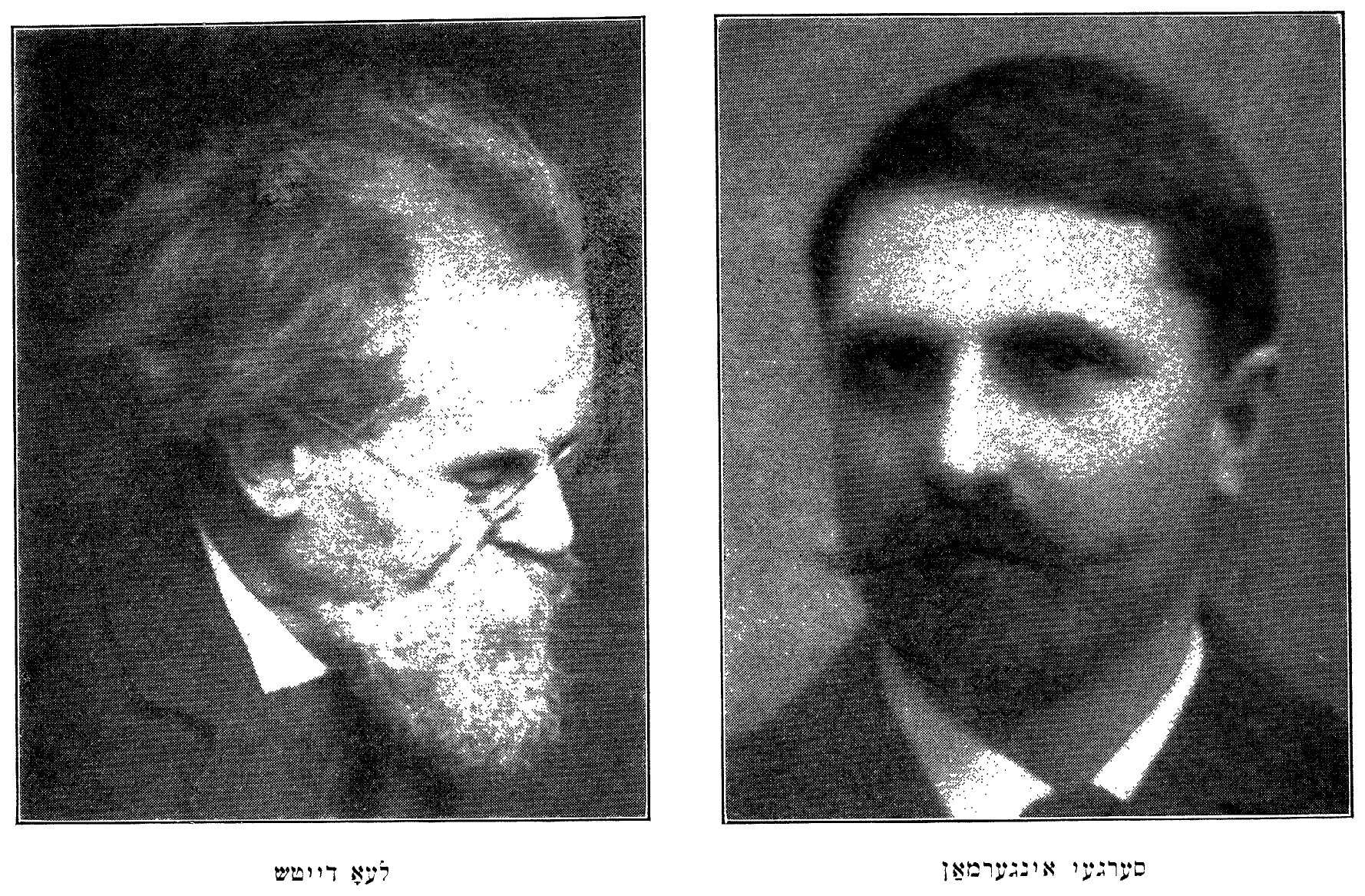
(plate; bound facing printed page 234)
234He was sent to penal servitude (katorga), where he wore himself out for several decades. From the penal servitude he was released to live under police surveillance in Siberia. From there he escaped, and by way of Japan he came to America. Since he stood on the closest terms with Plekhanov, and Ingerman always corresponded with Plekhanov, he had Ingerman's address.
It was an unusually pleasant evening for me. One of the first things I said to Stoleshnitski when he came to invite me concerned a certain man named Yevolenko, whom I suspected of being a Russian spy. I warned Stoleshnitski that Yevolenko must not learn about the guest.
Afterward I brought Deutsch together with Miller. My wife expressed the opinion that under the circumstances Deutsch ought not to remain in America. The uproar over President McKinley's death was still fresh. The hatred against the anarchists, and, on their account, against the socialists too, was strong. To the American masses there was actually no distinction; and here had come a Russian revolutionary, an escapee from Siberia; a Russian revolutionary, to the Americans, meant a bomb-thrower. People might declare Deutsch a dangerous anarchist, and who knows, perhaps they would send him back to Russia… So my wife was uneasy.
We agreed with her idea, and Miller set about persuading Deutsch that he must leave as soon as possible. A short time later we escorted our dear guest to the ship.
A few days later Yevolenko came to me,235ostensibly after a book. The pretext was too obvious. As we were chatting, he suddenly let drop:
"Perhaps you don't think that Deutsch was here? In front of a comrade like me, you keep your guard up."
The tone in which he said it only confirmed for me that he was an agent of the Russian secret police. For him it was important to cable to her that Deutsch was here, so that she should see that he was not asleep on the job.
Yevolenko was thoroughly mixed into the revolutionary Russian colony. He took part in everything, and all the important members of the colony used to visit him. He would be invited, honored, give money for the movement, and pose as a devoted, active socialist. Not much respect was felt for him. He was regarded as a hollow man and a bit of a bluffer. But whenever I would say that to me, too, he made the impression of a spy, people would answer me that I was taking him too seriously. Yet, with each passing day, my suspicion grew stronger. The suspicion developed into a complete conviction — as we shall see further on.
Finally I lost my patience with my reporter work. I went in to Wright, the editor-in-chief, and resigned.
"I expected this," he said with a friendly smile. "It is no occupation for you."
I arranged with him that I would write for the Saturday supplement of the paper. But that was not enough. So I began again to write for the Sunday supplement of the "New York Sun," and made an236arrangement with a syndicate of several newspapers from other cities. I wanted to arrange my affairs so that I would have enough to live on from articles that have nothing to do with real literature. Literary works I could then write with a free spirit, independent of the question of earning a living.
At first I spent many free hours walking about the city and gathering material — for belletristic purposes as much as for my journalistic work.
I jotted down a number of themes in those weeks from my observations on the broad, sun-drenched Second Avenue. It had then an altogether different character than today. On it, and on the side streets, there were still then a great number of Germans, but mostly older people. The newer inhabitants were for the most part Jews from Hungary, intermingled with Jews from Bohemia and from the city of Vienna. Russian and Galician Jews had also already begun to filter in. Its character, however, the avenue and the whole district took on from the German-speaking Hungarian, Bohemian, and Viennese Jews. It was still a German-speaking street. The intelligent Galician Jews mostly spoke German too.
There was a fairly lively café life. The character of the food and of the café was copied from the Viennese cafés, and the system and customs — likewise.
We were then living near Second Avenue — first on Fifth Street, then on Seventh.
237We often used to spend time in a café that was located on the corner of Second Avenue and Fifth Street. "Café Central" it was called — a name the proprietor had taken from a famous Viennese café, where he had been for several years a doorman (or a waiter).
In that neighborhood I had German acquaintances among the socialists. And I used to meet with them either in the café or in the socialist Labor Lyceum, which was located near the avenue.
The "Café Central" was the hub of the crayon agents — young men who would seek out customers for firms that enlarged photographic pictures. The enlarged portrait they would supposedly make for nothing. You "only" had to buy a large "gilded" frame. And taken together, this already paid off both for the firm and for the Jew.
These crayon agents used to gather here mainly during the day. In the evening an altogether different crowd would assemble.
One of the types I noticed here was a cracked German who liked to make peculiar pronouncements. But he was an interesting fellow, with original ideas. Just then I had received a letter about feuilletons from the editor of the "Boston Transcript" (a newspaper for the educated classes, with a large literary section twice a week). I portrayed the curious German in a sketch and sent it off there. "Herr Franklin" it was called.
Another Second Avenue type a syndicate took from me. There I portrayed a German musician238of about thirty-some years. He is an enthusiastic, deeply absorbed composer, but he earns no living from his works. He gives music lessons. His chief interest in life, however, lies in his own compositions. For hours on end he sits in the landlady's parlor and plays on her piano. And whole nights he often sits in his room, writing music and reading books about music, which he borrows from public libraries or from private people.
Lessons, too, he does not have enough of; he lives in great poverty. His free time he spends in a café where German musicians, German literary men, a few theater critics of the German press, and a few actors of the German theater gather. The company regards him as a fool, but a likable person. He has a few followers who believe in his talent and would want to help him, only they themselves barely have enough for a cup of coffee. He talks mainly about Wagner. Every minute he runs over to the piano in the café, plays a few bars, and explains their "philosophical-musical" meaning, as he puts it. From this comes the name people gave him: "Wagner the Second."
One day "Wagner the Second" leaves home for an invitation to a wealthy German house, where he expects to obtain a good lesson. He is all dressed up. He walks along the avenue in a hurry, and yet with great dignity. From one of the nearby houses a German girl comes out with a dog. The skirts of the musician's old but clean coat draw the dog's attention. It gives a leap and — and in the coattail a tear appears in the shape of a "D." The music teacher is in despair, and the girl is no less in despair than he. Almost with tears in her eyes she apologizes to him and239begs him to come inside with her into her mother's house. He obeys. The girl sets about mending the tear. He obeys.
In this way they become acquainted. Out of the acquaintance comes a romance, and out of the romance a marriage. The girl's mother, the widow, keeps rooms, makes a living, and the girl has a position somewhere. The two of them idolize the musician. They pamper him, they provide him with everything he needs. While he plays on his piano or sits over his notes, not a fly may flit by.
In the sketch, which appeared in the newspapers of several American cities, the "sketch" was only roughed out. There the comic side was brought out more than the more serious and truly interesting side of the character. I had in mind to rework the same thing and make of it a finished portrait, with a slice of the life under the special Second Avenue circumstances of that time. But this plan was never realized.
On Second Avenue, between Ninth and Tenth Streets, there was a house in which old Americans lived — two sisters, it seems. The house was a low one; between two larger ones, they looked shabby. They had inherited it from their parents even before there were Jews in those quarters, or immigrants at all. Now they were the only Yankees in the whole district. On the corner of Ninth Street there was now an Austrian-Jewish café, and the old American women were very displeased about it. They rarely came out of the house. They lived as in a cloister, as if they wanted to shut themselves up in the past, when on that street no foreigners yet lived.
I heard interesting particulars about their life. Afterward I became acquainted with an-240other facts of this sort — about old American families who had remained in other parts of the rapidly growing Jewish quarter.
On East Fifth Street, for example, there stood an old house that was almost always locked up. Only once a year an American old man of about eighty would come there with two young companions. They would spend a few hours there and then lock the house up again. From time to time a servant would also come to air out the rooms.
When the "boom" in real estate began, and the price of a piece of land in the city rose as on yeast, Jewish speculators began to seek out such owners and offer them a price for their plot. The two sisters mentioned and the eighty-year-old man for a long time would not hear of it. But in the end the property was sold.
I used to spend a great deal of time in the immigrant quarters — in the Jewish and the Italian, and in the Greek, which was then beginning to grow; also in the Armenian, Swedish, Syrian, Bohemian; and sometimes in the Polish quarter of Brooklyn. I would stroll about, visit the cafés there, the stores, strike up conversations with all sorts of people.
I had no special purpose in it; I was driven by a general interest in the many-colored life of New York, and the thought that someday I would put it to use as literary material. Besides that, it was241a pleasant pastime and "exercise," good for the health.
Through the old Jewish quarter, downtown, I used to stroll quite often.
Among the pictures I jotted down there in those months was a family with whom I became acquainted through Katzenellenbogen's Hebrew-book shop on Canal Street. This is the same Katzenellenbogen, my fellow townsman, who is mentioned in the second volume (page 374). In his store various people used to gather, and I would visit him quite often.
The family in question consisted of a man with a wife and a daughter, a girl of about fifteen. They were from Odessa, and they had come to America not at all the way immigrants usually came in those days. They had traveled second class. They were well dressed, and they had brought along several large trunks of belongings. Back home the man had inherited a large business. But his father's death had begun to bring him down "with the lining hanging off" (left him in ruins). So they were advised to salvage what they could, sail off to the "golden land," and start a business here. And so they did. At least up to the point of starting a business in America.
Coming to New York, they took an apartment of several rooms and a servant, and they began to live in their homeland manner. The man hired a teacher of English. But he had no patience to learn. So he taught the teacher to play cards ("écarté"), and he used to lose handsome sums to him.
242The wife hired an Americanized immigrant woman to lead her about and show her the streets. She called her "my companion." The "companion" afterward lived with them, ate and drank there; they took her to the theater, spent money on her. The wife did learn English. She found herself a girlfriend here, who would speak English to her while she answered them in Russian.
They were good-hearted people, and whoever among their acquaintances needed money would "borrow" from them.
They had relatives here, and the relatives reproached them for squandering their money; that for the first while they ought to live frugally and look to buy a business. So they tried to economize. They moved into a smaller apartment and made an attempt to live without a servant. But this was impossible for the wife. Besides: if she happened to see on Grand Street some dress or rag that she liked, she bought it. The house was full of the finest food, and every evening there were guests.
Once the wife walked on foot for thirty blocks in order to save a five-cent streetcar fare. But on the way she spent three dollars on a fan to cool herself off.
Acquaintances, too, borrowed a handsome sum from them. The end was that they were left without a penny and had to be shipped back, somehow or other, to Odessa, where they had well-off relatives.
Among the types I encountered around the same time in the Italian quarter was a peddler of Italian storybooks. Standing beside his cart he would himself recount tales, which used to draw listeners, and when a crowd gathered,243he would assure them that the tales in his little books were even more interesting than the ones he had told them. In this way, too, he would persuade them to buy his wares. Another of his methods consisted in telling them the beginning of a romance, and when he came to the "right place," he would say:
"What happened next you will find in this wonderful book."
I found a translator, and through him I had a conversation with the storyteller.
He was an interesting, nimble young man, with a productive imagination, with flowery phrases in which there often appeared a passable little bit of poetry.
A nearby tailor, a Jew who had taught himself to speak Italian from his customers, characterized the storyteller to me as the greatest liar he had ever seen.
"There isn't a true word in him," he said, "and you ought to hear what cunning lies!"
He gave me a few examples, and they too were interesting, also with a spark of poetry.
For a certain time I worked on a longer story under the title "Penny and Her Suitors" (Penny and Her Bridegrooms). I wanted to portray a certain type of unmarried girl, various types of men who courted her, and her experiences with each match. I worked on this thing in free, indeterminate hours — from time to time. I believed that in time I would take the work up in earnest and bring out a finished literary piece, which244I would be able to publish as a separate book. But the plan was never carried out.*
Among English-speaking writers there is an expression "pot-boiler" (a means to have something to cook in the pot). This refers to cheap work that one does only for the sake of a living. I therefore set aside three days for "pot-boilers." The remaining time, I reckoned, I would devote to real literature. I hated the "pot-boilers" like poison.
Edwin Lefèvre used to visit me often. One day he says to me:
"Throw away the 'pot-boilers,' Cahan. I'll lend you a little money, and write what you ought to write."
He lent me five hundred dollars, which was then a much larger sum than today, and along with it he gave me to understand that when it ran out, he would lend me more.
I set about writing a novel. But the five hundred dollars gave me no rest. Sitting at my writing desk I would always remember that I had borrowed money; that a week had already gone by, two weeks, three weeks, and I had still, it seemed to me, accomplished nothing. In such matters I am a bashful, reserved person. Rarely did I borrow from anyone at all. The three figures — 500 — pursued me like a shadow. If245I had been freed from the "pot-boiler" trouble, I had taken on in its place a five-hundred-dollar trouble.
Lefèvre is a friendly man, a cheerful one. Whenever he came to see us, he would joke, as always. He had taught himself a few Russian words, and with them he used to greet us. More than anything, he liked the word "chechevitsa" (lentil — in Russian). Its sound struck him as very comical. He would say:
"Hello, Cahan! Hello, Anyuta! Hello, chechevitsa!"
He used to tell me about his literary plans, and I would tell him about mine. That his five hundred dollars lay upon me like a burden and disturbed my thoughts — this he did not suspect.
Notes (the original’s footnotes)
[p. 230] It still exists to this day, but under a different editorship, and it is published in an altogether different spirit than the one in which it was founded. As these lines are being written, it is the most widely circulated monthly magazine in America.
[p. 244] A few years later I translated and adapted the story into Yiddish, and it was printed under the name "Penny's Bridegrooms."