Chapter Nine
Back in the "Forverts"
246On one of my walks in the Jewish quarter, during the time of which we are speaking here, I happened — on my way to the "Forverts" — to meet two "Forverts" comrades; and the result of that encounter was that I returned to the newspaper. I became its editor once again. First, however, it is important that the reader become acquainted with my relations to the "Forverts" during the barely five years that had passed since I left it, and with what happened to the newspaper during that time.
For the first four years, more or less, I stood absolutely at a distance. With L. Miller, who was the central figure in the "Forverts Press Federation," and with A. Liessin, who was the most important writer on the paper, I used to see one another from time to time. We were on friendly terms, as ever. But I was never present at the meetings of the "Federation," and I did not set foot in the editorial office. The clashes within the "Press Federation" (see volume three,247pages 475 to the end of 482, and 493 to the end) were still too fresh in my memory. In the first months I wanted to be as far as possible from the movement. A few months later, however, the sharpness of those unpleasant experiences had already dulled. I began to long for the comrades — not for the De Leonists of the "Abend Blatt," but for those with whom I had fought De Leonism together and together founded the "Forverts." Finally I began to visit the editorial office, and little by little I became a frequent guest there.
From Duane Street, where we had founded the "Forverts," and where I had been its editor for over five months, the newspaper had afterward moved somewhere on East Broadway, and then to Christie Street, not far from Canal. The editorial office on Christie Street I remember clearly, for there I already used to come quite often. It was located in a yard. Earlier there had been a little synagogue there, a one-story building, a small, wretched one, with a "skylight" (panes in the roof). I also remember quite clearly the room where the typesetters worked, and I remember Reznik, the foreman of the typesetters at that time, who works in the "Forverts" to this day. I remember how he used to walk around with a little string and measure the length of the type of the various articles. At home (in Minsk) he had been in the revolutionary movement, and from there he had been exiled to Siberia. While working over the "Forverts" pages he used to tell me about the famous revolutionaries with whom he had become acquainted in Siberia.
Among the other typesetters who worked here then was a young man by the name of Frenk, and he still works for us today.
Among the inside contributors in the editorial office248there were then Max Pine, Elizavitch (who later qualified as a doctor) and M. Katz, who in the years of our wars with the anarchists had been one of their leaders, and a young man by the name of Kaiser.
I had first seen Katz in the week of Christmas 1889, at the convention of Jewish socialists and anarchists on Grand Street, out of which our "Arbeiter Zeitung" grew (see volume three, pages 11–15). He had come down to America when we were in the thick of the fight, and he had immediately joined our opponents. So we became "at odds" before we had become acquainted. Here in the "Forverts" editorial office, on Christie Street, I met him close to 1900 — that is, we had been here "together" for about ten years, although we had never been acquainted.
Once, coming into the editorial office of the "Forverts" and seeing how he sat under the glass roof and worked, I felt the humorous side of our official enmity.
"Katz," I say to him, "I think it is already time we stopped being at odds."
We both laughed and shook hands. In this way we officially became both "acquainted" and "good friends."
When I left the "Forverts," Miller was at first the editor. Afterward the editors kept changing. For a certain time Zametkin occupied the post, and then again Miller took over the control. When I used to visit the editorial office on Christie Street, Miller was the editor.
He was in fact the one who set the tone even then, when249the official editor was someone else. He practiced law (a lawyer). In the "Forverts," however, and in the "Forverts" society, he always played a leading role.
Liessin wrote editorials and also polemical and other articles. He was one of the very few Jewish writers, both in America and in Russia, who possessed both talent as a poet and capacities as a thinker. He made a name for himself both with his poems and with his publicistic prose.
As for myself, at first I did not write for the "Forverts," even when I was already visiting the editorial office. Little by little, however, I began to write as well. I believe that the first thing I printed in the "Forverts" since I had left the editorial office was a eulogy for an interesting Jew, a well-known Talmudist and Hebraist of the old maskilim (enlightened scholars), an elderly man by the name of Dabzevitch. Some time before his death I had visited him, and printed a portrait of him in the "Commercial Advertiser." His whole life he had spent studying and researching the Gemara and the Tanakh. His work had a scholarly significance. But his work did not pay, and so he lived in want. He used to write at a wretched little table, and instead of the drawers of a writing desk he used the paper bags in which his wife used to bring home the goods from the grocery. When I visited him,250beside him lay a whole row of such little bags, each with a separate inscription.
So, when I learned that he had died (in January 1900), I wrote up a eulogy, and it was printed in the "Forverts."
Among us in the movement, people were not yet accustomed to eulogies for such people. I mean people who were neither socialists nor trade unionists, but simply honest fighters for the truth.
A little later I wrote for the "Forverts" a series of feuilletons under the title "The Diamonds of the Quarter." I did all this without payment, naturally. I did not want to be drawn into the quarrels and the "politics" of the movement. And therefore at first I did not put my name on the articles.
Contributors and friends of the "Forverts" used to gather in a restaurant kept by two brothers named Herrick, at 141 Division Street, near Canal. "Herrick's Café" was what it was called. About a year after I had come to the "Commercial Advertiser," I began to visit this café quite often, mostly in the evening. Sometimes I would come in with my wife, sometimes with my American friends. Often, when I used to work in the Criminal Court Building, which was about a ten-minute walk from there, I would come over to eat lunch. There I used to meet Liessin and other acquaintances from the movement or simply from the East Side. During the time of the "Malino case" I used to come over almost every day (the café still exists today as well, although those owners have long had no connection to it).
251With Miller I used to see one another quite often outside the editorial office as well. My wife and I used to visit the Millers almost every Sunday evening, and they us as well.
With Liessin I often used to stroll through the streets and chat, debate. Often we would spend whole hours that way. About the "Forverts" and the movement, however, we rarely spoke. The same was true of the conversations I used to have with Miller. Although I had often by then visited the "Forverts" office and even sometimes written for the paper, I was little acquainted with the inner life of the "Forverts" society. I knew in a general way that the newspaper led a harried existence.
About the American socialist movement, about the relations within De Leon's party and within the party with which the "Forverts" was associated, I knew more.
One afternoon at the beginning of November, 1900, when I came into the office of the "Forverts" on Christie Street, I found B. Holtzman there. He was a comrade with whom I had become acquainted in London, where he had been one of the group that put out the local Social Democratic periodical (see volume three, page 298). He was a quiet man, with an honest smile. Now that he was living in America, he had joined the "Forverts" side and from time to time printed in it an article on a political or social subject. The "Forverts" was then about to move to Suffolk Street, near Division.
On that particular afternoon he explained to me that252he was now the editor, and he had asked me to write for the newspaper.
"If you could give me some sort of series of articles," he said, "it would be a great favor for me." I was then very busy, and I could not immediately begin to write something for him. But I wanted to fulfill his request, so I promised him to do it in a few weeks' time.
A few days later he visited me. He pleaded urgently that I let him announce a series of articles by me.
I gave him permission, and that evening I began to search through my notes, in case I might find some suitable theme.
Looking through various pages and slips of paper in this way, I came upon a few lines that referred to the old Ezriel from my "The Imported Bridegroom" and his disillusionment with the son-in-law he had brought over.
As I write these lines, the note lies before my eyes. It is written in English, on the manuscript paper on which we used to write for the "Commercial Advertiser." It contains the following:
"A disillusionment like Ezriel's, but instead of an Ezriel — a Jewish worker, a simple man, but with a deeply religious nature. Socialism takes the place of his religion. He is happy with his son-in-law, because he is a 'comrade.' But the son-in-law throws away the movement and laughs it off. And his own son, whom he had hoped to raise as a socialist, grows up into a Tammany man (Tammany Hall politician). A tragedy."
I had jotted down this theme a few years earlier. I had reckoned to use it for a253English story. But the plan had not yet been carried out, and now it occurred to me to use the theme for the "Forverts." But Holtzman had asked for a "series of articles," not a sketch. Thinking over his request, I hit upon the idea of presenting a whole group — to portray a few other former socialists, and also a few others among the truly faithful, like the disillusioned father-in-law.
In this way the plan for "The Neshome Yeseyre" was developed.
"The Neshome Yeseyre" was printed once a week in the Saturday numbers of the "Forverts." The beginning appeared on November 17, 1900, and the conclusion on January 19, 1901. I believe that during those weeks the "Forverts" moved from Christie Street to 32 Suffolk Street, and soon afterward to 183½ Division Street.
The articles I used to write — or more accurately, dictate — in the editorial office. Every Thursday I used to come and dictate to one of the comrades.
The series had a great success. With regard to the language I heard remarks more or less like this: "In the few years that Cahan has been writing only English, his Yiddish has become not worse, but better."
This reminds me of the following scene, which took place at the annual New Year's ball (the first of January, 1901) of the Russian colony:
We were sitting at a long table — the playwright Jacob Gordin with his close friends on one side, and I with my wife and several of our friends on the other side, not opposite, but nearer to the other end. Gordin and I had long been on no good terms. We had not seen each other for a few years. I254do not remember how it came about: at the table he gave a speech in which he attacked the "Forverts." When he had finished, he sat down. But he soon rose again for a moment.
"I must make a remark," he explained, "what I said does not apply to a certain series of sketches that is now appearing in the 'Forverts' under the name 'Neshome Yeseyre.' They are very good."
He sat down again. His remark was greeted with stormy applause, which had a special relation to the fact that Gordin had made it in spite of our unfriendly relations.
On a certain evening two comrades came home to me with two packages — a large, handsomely bound Century Dictionary, with a stand for it. They explained to me that it was a gift from the "Forverts" society, an expression of gratitude for the "Neshome Yeseyre."
I declined to accept the gift, and I asked the two messengers to convey to the Press Federation my warmest greetings and gratitude.
"Tell them that if I accepted the present, I would feel as though I had been paid for the articles," I explained to them. "The friendliness of the comrades is the best reward for me."
The economic situation of the "Forverts" was a wretched one. Once, on a hard summer evening, Liessin brought me to Suffolk Street. He explained to me that the comrades who had to do with the management of the "Forverts" were holding negotiations about selling the newspaper.
255It was a question of a quite small sum — about 500, in any case not more than 1,000 dollars. Those who were against the sale had called a meeting for that evening, in a hall on Suffolk Street, between Grand and Hester. So Liessin asked me to be one of the speakers.
Miller was not at the meeting. As far as I remember, he stood aside from the whole affair. My impression was that he did not believe the paper had any possibility of existing.
That evening I also heard many details of the situation. The "Forverts" was over its head in debt. The printer was owed so much, and they had so long kept feeding him with promises, that he absolutely no longer trusted them; and not seldom an issue of the "Forverts" was held up and delayed for the sake of fifty cents.
Comrades had again and again given of their last. Again and again they had pawned their watches and rings to save the newspaper. But now it looked as if it would no longer be able to drag on. Even Liessin and the others who had set themselves against the plan to sell it also doubted whether it would be possible to keep it up. But how, after all, can one let it come to that?
The "Forverts" was the only organ of the Jewish workers that led them along the right path. The "Abend Blatt" busied itself entirely with grinding the petty kernels of the fratricidal war (Bruderkrieg), and, as we shall soon learn, there too a split had occurred.
As for the "Tageblatt," it was Orthodox, hostile to progress and hostile to the union, always. I remember a commotion about the position of the "Tageblatt" against the bakers'256workers at the time of a strike, and fiery articles by Miller and Liessin which saved the strike. The Jewish working masses knew that the "Forverts" was their faithful friend and guide. But this did not bring it any great number of readers. And the income from advertisements was very small.
So it had come to selling the "Forverts." The plan, however, was called off. At the Suffolk Street meeting there were comrades who had money, and they lent the newspaper as much as was needed to save it from the sale.
People went on toiling and sacrificing, and of giving up the "Forverts" there was no longer any talk.
When the "Forverts" was working at 183½ Division Street, two typesetting machines were bought and a small motor to drive them. This saved several typesetters and made the financial burden lighter. But it came hard to pay for the machines. So the comrades summoned their strength, imposed a tax on themselves, made new collections. The need was so great that there were not even desks, and the contributors wrote on boards laid across barrels.
From 183½ they moved to 185 Division Street. This was a small two-story little house. But it was more comfortable than the previous one.
The socialists who had remained with the "Abend Blatt" were also not long united. As the reader could257see in the third volume of these "Pages" (chapter eleven), De Leonism contained within itself a destructive poison, which little by little was bound to ruin its own power. A certain time after our "split," among the De Leonists too there came a "split." A part of those who had fought us while we were in the opposition now themselves organized an opposition against De Leon. They split off from those who had remained faithful. Among them was the editor of the "Abend Blatt," Philip Krantz, and its most important contributor, B. Feigenbaum. At the historic meeting when we had marched out and gone off to found a newspaper of our own, they had stayed with the De Leonists (see volume three, page 443 and page 446). Now, then, they too had left them.
De Leon attacked and abused these new anti-De Leonists, exactly as he used to attack and abuse us — even more sharply. Since it was his nature to mock an opponent and think up some nickname for him, he gave them the name "Kangaroos" (an animal that has short front legs and is expert at leaping from one place to another).
Once, on an early morning, when I was sitting in the Astor Library looking for something in old journals, in came Feigenbaum, N. I. Stone, formerly a prominent De Leonist, and another one of the "Kangaroos."
When they caught sight of me, they greeted me cheerfully, as if to say:
"Now we can be friends again! We too are now against De Leon!"
A split also occurred in the general Socialist Labor Party, and in connection with it the most important258role was played by Morris Hillquit *. He led an uprising against De Leon, and then there was founded the Socialist Party, in which those who were associated with the new "split" were finally united with Debs's "Social Democracy."
Since Hillquit had withdrawn from active participation in the Jewish movement, he had read a great deal and had above all made great progress in his development. He was now a brilliant English-language orator. Some time after I had left the "Forverts," he again began to work for the movement, but no longer in its specifically Jewish sections, rather in its English-speaking and German-speaking branches.
The number of those dissatisfied with De Leon grew larger, until it came to an outbreak. In this Hillquit was the most important force. The clash thus led to the founding of the Socialist Party (at a convention in Indianapolis, on July 29, 1901).
De Leon remained with the "Socialist Labor Party." It was very much weakened, and it grew ever weaker and smaller. But with its last strength it continued to attack and besmirch the leaders of the Socialist Party and of the trade unions. His "Socialist Trade and Labor Alliance," which he had founded with the aim of breaking up the American Federation of Labor and the independent workers' organizations, was a bitter failure. He went quickly down the road to complete oblivion.
259I sympathized with the Socialist Party. A member, however, I was not at first. I attended a few of its great mass meetings. I was one of those present at a banquet for Eugene Debs and at an intimate little gathering at which there were Hillquit, George Herriman of California, who then played a great role in the party, and a few more American comrades. One of them was Professor Herron, a former clergyman. He had joined the party, and through his influence his mother-in-law, Mrs. Rand, gave a great sum to found the socialist Rand School.
A few times I gave lectures for the party in English on the theme "Commercialized Literature." In this probably consisted my whole connection to the party in those several years.
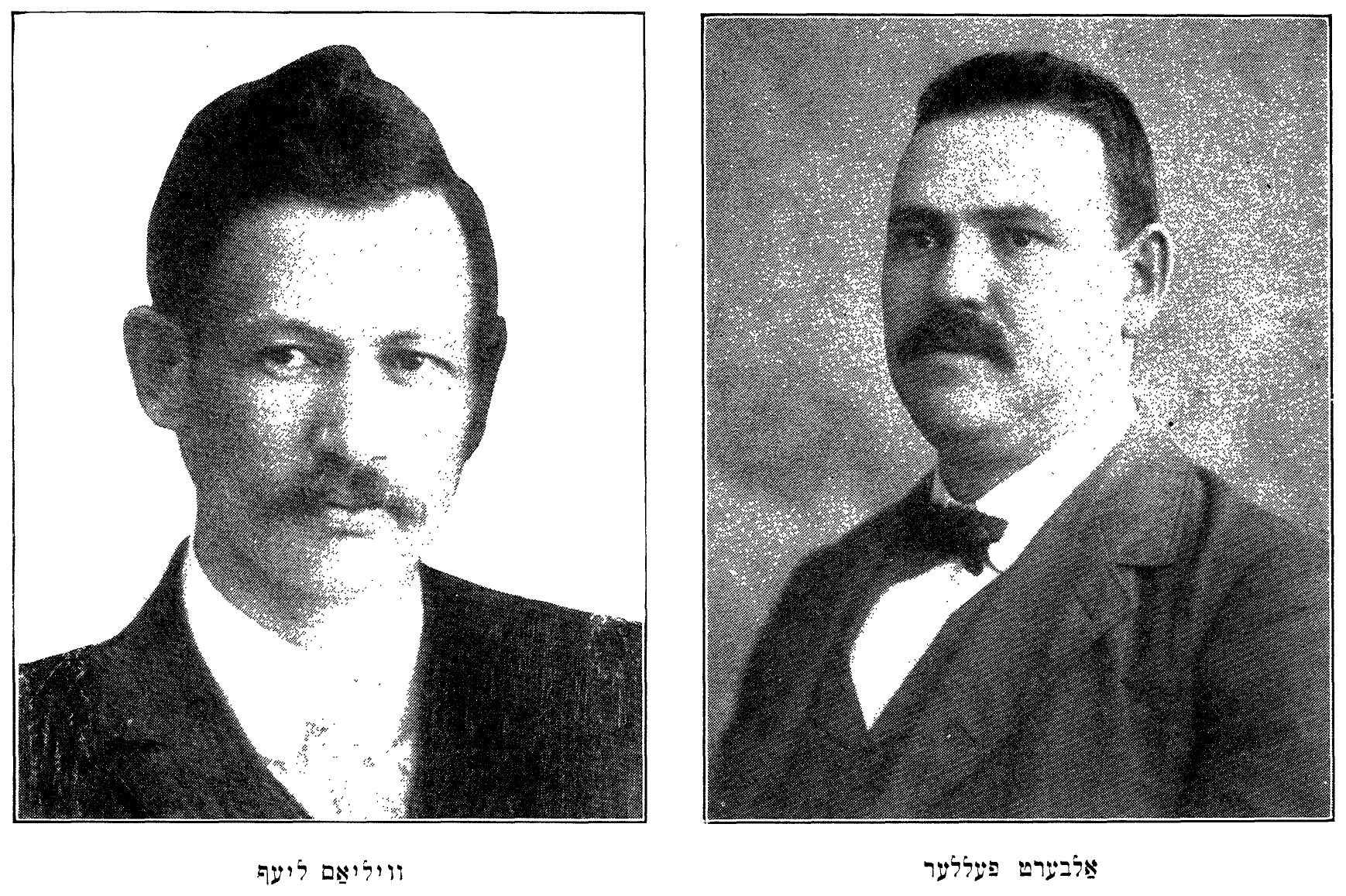
The two "Forverts" comrades mentioned above, whom I had met in the Jewish quarter, were William Lief and Albert Feller — the first a pale, lean young man, with a smile at which the eyes used to narrow, and the second a tall, red-faced young man, with a merry smile and a full-chested voice.
Lief was mentioned at the conclusion of the third volume of these "Pages." He had been one of the active members in the struggle against the De Leonists and in the founding of the "Forverts." Feller had entered the "Forverts" organization later.
260Lief and Feller were now the advertising agents of the newspaper, and in an unofficial way they were in fact the managers of its business (the official manager was a comrade by the name of Feldman, a quiet man. It is interesting how Feldman became manager: he had a little money, and since the "Forverts" was constantly in need, several hundred dollars were borrowed from him, and as part of the deal it was arranged that he should become the manager).
The "Forverts" was then located in the small, two-story house at 185 Division Street. I used to come in there sometimes, though not as often as on Christie Street, for that place lay off to the side and was farther from the "Commercial Advertiser" and from my apartment than the Christie Street editorial office.
After the "Neshome Yeseyre" I also wrote a few more articles for the newspaper (all without honorarium).
My meeting with the two "Forvertsists," however, did not take place in the office, but on the street — it was at the beginning of March, 1902. We greeted each other and got into a conversation about the "Forverts." They said that the prospects of the newspaper would be quite good, if only there were a definite editor, one who would have authority and put life into the newspaper.
They asked about my literary activity, and I told them briefly how I divided my time between "pot-boilers" and literature.
Then Lief asked: since a part of my time was in any case devoted not to literature but to bread-and-butter articles, why should I not, instead of that, edit the "Forverts"?
261"The circumstances are now entirely different," Lief remarked.
That was an allusion to the time when I had left the "Forverts," because Winchevsky and indeed he himself, Lief, had hindered me from carrying out my policy (see the conclusion of the third volume).
"If I were sure," I answered, "that I would not be occupied at the newspaper for more than two hours, and if I were to get a guarantee that no one would absolutely interfere in my editorial affairs, I would be ready to take it on. I must have an absolutely free hand."
"All that will be guaranteed to you," they both assured me with enthusiasm. "The comrades will do everything you demand."
"You want to be free at two o'clock? You can be guaranteed that you will be free at twelve o'clock," said Feller. "When the comrades hear that you are ready to spend in the office only a few hours each day, they too will be highly satisfied. It will become a whole new world."
A few days later, when I saw Miller, he asked whether it was true that I was ready to re-enter the "Forverts." I explained to him my circumstances, and my plan to give the first half of the day to the "Forverts" and the rest of the time to literature.
I felt that the plan did not please him. He had been the ruling power in the "Forverts" — whether he himself was editor, or another. If I were to become editor, the situation — in spite of our friendship — would change. So, of the news he was not enthusiastically262able to be. That was an entirely natural feeling on his part. But he comported himself very tactfully. He spoke with a warm friendliness toward me, and he too assured me that I would have an absolutely free hand and that I would not need to be in the office longer than the noon hour.
Many of the comrades, among them A. Liessin, received the news with genuine joy. From all sides I was assured that everything would be as I wished.
To the two conditions mentioned I added a third: that the "Forverts" should be enlarged from six pages to eight.
This was a far more difficult point than the other two. The paper barely managed with six pages, and I was demanding that it be enlarged by a third! But I explained that with six pages it would be absolutely impossible for me to accomplish anything.
I was assured that this condition too would be accepted — that everything would now go on a broad scale, and that new sources of income would be born.
As for my personal interests, both material and spiritual, the proposal presented itself to me in a favorable light: instead of having to wear out my brain on the "pot-boilers," which were a burden to me, I would spend the same hours on pleasant and noble work as editor of a socialist newspaper. Besides: the "pot-boilers" had a connection to literary work, but a cheap connection; and with that they acted as a hindrance to my literary moods. At the "Forverts" my activity would have an entirely different character from my literary work. It is another world, with another spirit, with an263other language. After a few hours of this occupation I would come home and take up an English story or novel with a free head and a calm conscience.
But would the head really be free? The question stood in the background. I had doubts. And my wife — in our conversations about it — underscored the doubt. She was convinced that my accepting the proposal would be a false step.
"Have you forgotten the party squabbles and how they embittered your life?" she said. "You have won yourself a name in the literary world. You can have a fine future and a calm spirit; do you want now suddenly to tear that up and throw yourself again into the movement with its internal 'politics'? It will not go as smoothly as you think. Clashes will develop that will be worse than the 'pot-boilers.' Serve the Socialist Party as an ordinary member, and give yourself to literature."
That, more or less, was how she used to argue.
"The truth is that you are drawn there," she would often say, and she would remind me of my own maxim: that the best thing is to be a "Sunday socialist," that is, to come to the meetings once a week, as an ordinary comrade, take part in the movement and give contributions, but not to hold any position in it.
In my heart I felt that she was right. The truth was indeed as she said: I was drawn to it. I used to apply to myself a parable from a schoolbook that I had taught with my pupils in the years when I gave lessons in English: a horse that had served some years in the cavalry afterward worked for a baker. Once, when he264was hauling a wagon of baked goods, a squadron of dragoons rode past with music. On hearing the military trumpets, the horse began to prance and gallop in its old, cavalry manner.
Lief came almost every evening to the Café Central to see us. Again and again he assured us that my work at the "Forverts" would not hinder my literary career.
On a certain evening he brought the news that the "Forverts" Association had unanimously elected me as editor, and accepted all my conditions.
I wondered to myself how the comrades could undertake to enlarge the newspaper to eight pages.
A great role here was played by the season. It was before Passover — the best several weeks for advertisements in the Jewish quarter, and — as I learned later — the news of my arrival as editor was used as a help in getting advertisements.
The enlargement of the newspaper by two pages was now important for the advertising agents, because they needed the space; and what would be after Passover, let God worry about, they probably thought. But this was only "one side of the coin." They and the other comrades wanted to have me in the interests of the "Forverts" in the best sense of the words. Besides: they believed that with me as editor not only would new life come into the newspaper, but it would also become easier to get money for it.
265William Lief writes the following about the same events:
"The five years that Ab. Cahan was not at the 'Forverts' were hard, bitter years of unceasing struggle for existence. Twice during that time the 'Forverts' was on the verge of being sold: once to Mr. Sarasohn, the publisher of the 'Tageblatt,' from which it was saved at the last minute by a meeting on Suffolk Street, at which a comrade Goldberg, now a shirt manufacturer, lent the 'Forverts' eight hundred dollars. Looking at him, other comrades at that meeting brought together notes for close to another twelve hundred dollars, and Sarasohn did not get the bargain, for which he had offered four thousand dollars.
"The second time the 'Forverts' was supposed to be sold to the 'Kangaroos,' those who had made the second split in the 'Abend Blatt.' This time it was saved, to a certain degree, by the stubbornness of the writer of these lines, who, together with the comrades Winchevsky, Feller, Elizavitch and one other, was empowered to carry through the deal. The match was already on the point of being concluded. Our committee was very accommodating. The 'Kangaroos,' after long haggling, agreed to give fifteen hundred dollars cash, in order to redeem checks that were circulating in the market, and for which Feller and I could have been held legally responsible. They categorically refused, however, to pay or take upon themselves the several266weeks' wages that the few employees of the editorial office and the business office had coming. Our committee went out into another room to confer. Winchevsky said to give in. Two others, who had wages coming, sided with him. Feller was indignant at the whole attitude of the 'Kangaroos' and gave me a kiss. I got a headache and declared that we must put it off until tomorrow. It was already half past 2 in the morning. We went out into the street. Miller, who lived four doors away from the socialist club-room where the conference was held, was standing leaning out through his open window and waiting to hear news of the deal.
"We told him what it was about.
"'How much do you need to inflate the "Forverts" and to save your and Feller's skin?' he asked.
"'About a thousand dollars,' I answered him.
"'Go to sleep, and see me tomorrow at midday.'
"I went to sleep.
"Miller kept his word halfway. Through the kindness of the theater manager Edelstein and the famous actors Kessler, Adler and Thomashefsky, he handed us the thousand dollars, but not to 'inflate' the 'Forverts,' rather to prolong its death-agony.
"In such a perpetually moribund condition, where a later crisis dragged it out of an earlier one, the 'Forverts' found itself when Cahan came back to take over its editorship.
"And it was not only financial crises that the 'Forverts' lived and bore through the five years that Cahan had been away from it. The editorial crises were267easily even worse, because they drove away a great number of comrades who had at first grouped themselves around the 'Forverts.' Since there was no permanent guideline, one time one group, another time another group of its close friends and founders, would seriously put to itself the question: what is all this worth?
"Editors came, went away, came back and went away again, when they wanted to, or when they had to. Miller, Zametkin, Peskin, Elizavitch, the advertising agents, the manager, the foreman of the typesetters Reznik — all had edited the 'Forverts,' sometimes out of necessity, and sometimes according to their momentary desire.
"Ab. Cahan in the first few years did not come near the 'Forverts.' The next two years he used to come from time to time into the office on Division Street, near Suffolk, sometimes to dictate a small item, sometimes to point out something in an English newspaper that would suit the 'Forverts.' On these visits of his he used to inquire about the 'Forverts,' and we hid nothing from him. But we used to stress that what the patient lacked was mostly a doctor who would strengthen its blood; that weight it would gain by itself from that. We often used to drop him a capricious hint that he would be the right doctor, that the nurses would heed his words, follow his orders, and that the close relatives would stop curing it with 'grandmother's' remedies.
"Cahan used merely to answer us with a smile, as if to say: 'I know, I know, you told me that five years ago, when I once, against my will, became editor for you.'"
268"On a Wednesday afternoon Feller and I were walking on East Broadway, up toward Canal Street. We were walking on the side of the street where there were then the ruins of the houses that had just been torn down to build the park that now lies opposite the 'Forverts' building. We met a comrade Cahan coming toward us, on his way to the 'Forverts' office. We stopped for a while. One word after another, and we began earnestly to argue with him that he ought to come back to the 'Forverts.' We explained to him that the newspaper was not living through any sharp financial crisis just now, although it could happen so, as it might indeed happen. That, in our opinion, another thousand of circulation would balance the income with the expenditure.
"It was the first time, in many conversations that I had had with Cahan about coming back to the 'Forverts,' that I felt that it might be that our words would not be in vain. A longing could be noticed in Cahan's voice. Feller and I no longer went on our errand toward Canal Street, and Cahan no longer went toward the 'Forverts' office. We turned back and forth, around the torn-down ruins, and argued. At last Cahan said to me:
"'Lief, I am afraid you are making a mistake. The comrades are the same as they were; I am not. I have been out in the wide world, I have found out that we, socialists, have no patent on honesty and knowledge. The outside world is more tolerant toward us than we toward it. It seeks to understand us. We do not know our own movement, because we do not want to know the outside world. You and your comrades are saturated with a little-synagogue spirit (kleyzl-gayst, parochial sectarianism).'"
269If the "Forverts" remains what it is, it will not go far. The broad public will not draw near to it, because it does not concern itself with all the life-interests that interest the broad masses outside of their daily economic struggle. I tell you, Lief, it is as important to teach the public to carry a handkerchief in the pocket as to carry a union card; to have respect for another's opinion is as necessary as to have an opinion of one's own.'
"So, or more or less so, Cahan spoke to us for a long, long time. I felt that we were near our goal, that Cahan was again with us.
"'It is not I who am making a mistake, but you, comrade Cahan,' I answered him. 'I am sure that we all want the same as you, only we do not know how to give expression to our inner desire, which is not clear to us. We need someone who will express all this for us in words, translate it into deeds. Let me at the next meeting propose you as editor of the "Forverts," and you will see that we are both not making a mistake.'
"'I will think it over,' was Cahan's short answer. 'An editor must have the whole unrestricted power; our public cannot yet digest it. Good night.'
"On our way back we met, at the door of the 'Forverts' office, comrade Liessin.
"'You should not have let him go, you should have brought him straight into the office,' Liessin told us, when we recounted to him our conversation with Cahan.
"On Thursday, a week later, a meeting of the 'Forverts' Press Federation was held. We had announced the meeting in a secretive way, not telling its purpose. I do not know whether there were five
(plate; bound facing printed page 270)
270men of the administrative council when we confided our hope of getting Cahan back.
"The meeting, at 42 Suffolk Street, was the most packed since the Sarasohn incident. And remarkably, on everyone's face I read that he knew the secret. So that when I began to explain the purpose of the gathering, I started not with the hope and possibility that Cahan should again become editor of the 'Forverts,' but with the question of what we must do in order to make it possible for Cahan to be able to run the editorial office freely and unhindered. Only when I had already finished did I recall that Cahan had not yet accepted, that he must first think it over. I explained this to the gathering.
"Liessin, Max Pine and others enthusiastically greeted the hope, and a resolution was unanimously adopted to call upon comrade Cahan to take over again the editorship of the 'Forverts,' and to assure him that the Federation would grant him the full power to run the editorial office according to his views.
"And so far did the comrades go in their enthusiasm for the new prospects that had shown themselves for the 'Forverts,' that they gave 'full power' to the committee that was to see Cahan, to make all arrangements, without even consulting any longer the administrative council — a thing that had never before been allowed. Although without the official knowledge of the Federation such things used to be done quite often. Even the young comrade Lusker, who was a stickler about such matters and strictly guarded the privileges of the membership, also consented to the 'full power' proposal.
"And Cahan became the editor of the 'Forverts.'"
Notes (the original’s footnotes)
[p. 258] As this was already the name of Morris Hilkowitz, according to an official change made through the court.