Chapter Eleven
Light and Shadow of a Success
298At the meetings of the "Forward Association" there often took place heated debates about my policy. Rarely did anyone defend my new manner with his whole heart. I had friends enough among the members, but even my warmest supporters defended my reforms only halfheartedly.
My news features were a great success with the public. With the comrades, however — not so.
It almost always fell to me to debate one against all.
I used to speak out of the deepest conviction. But it helped little. Often I would feel that my arguments did have an effect, that in their hearts they were inclined to agree with me. My standpoint, however, was not a popular one. As the story goes, most of the speakers used to speak against me. In a friendly way, but against me all the same.
For all that, when it came to the vote on a "vote of confidence" (a declaration of trust), they would299all the votes, except two, be in my favor, and the two were from comrades who had no influence. "The Gentile is unkosher (treyf), but his penny is kosher" — I used to say, — "you do not like my policy. But the circulation that it brings is welcome." I used to say this in a tone of jest. In my heart, however, I knew that it was really so.
I had seen the effect that success has on human nature. The comrades were proud of the growth of their "Forverts."
The enlargement had made an impression. It was talked about everywhere. Power began to be felt. As the organ of the Jewish workers, the newspaper began to become a strong weapon. A few words in the "Forverts" now had quite a different meaning. And that was the best argument for me. Besides that: power, in and of itself, has a magic.
The criticisms against my course continued, and for the most part they came from the heart. And yet, if one were to propose to the comrades that the newspaper return to the old ways, they would not allow it. A few months later I had a living proof of this.
Taken in general, the European conception of the press is different from the American one. The essence of a European newspaper is political news and political leading articles. The press there exists chiefly for public (communal) affairs. What happens with the individual300person — his tragedies, curious happenings, romantic clashes — all this is treated very briefly in a respectable European newspaper, as if unimportant. In the American press, on the other hand, the fundamental principle is that everything which interests the reader, whether it concerns the community or the life of the individual, belongs in the press.
The great American newspapers have as much political reading-matter as the best European newspapers, even more. But they also have a great deal of news with masses of details of the worldly sort.
The news page in the "Forverts" had always been an American one, even during the four-and-a-half years of my absence.
Our Jews, however, like to read many articles — not only on Saturday or Sunday, but in the middle of the week as well. And the article section of the "Forverts" had been excessively European, taken up throughout with social questions. So, I now Americanized it.
This was absolutely necessary — first, because our readers are in America, and the hunger for life makes itself felt in them in a thousand ways; second, because the American press is far richer, more developed, and not so dry as the European, and its special influence on the Jewish masses is in this respect a great and important one; and third, because our masses for the most part had no education, and that itself is an important reason why a part of our articles should be of the American type.
In the debates about my system, I used to hear, more often than anything, the accusation that I "lower myself to the masses, instead of raising them up."
301To this I used to answer: "If you want to lift a child up from the ground, you must first bend down to it. If not, how will you reach it?"
Among Jewish newspaper writers there was felt the influence of our Gemara (Talmud) world, in which the aggadot (legends, homiletic tales) have no value. The main thing is a "difficult piece of Gemara." But the Jewish masses are not Gemara masses, and the aggadot of life are no less important to them than theoretical Gemara.
Once, at a "Forverts" mass meeting in Cooper Union, I brought into my speech the following parable, which I had specially devised as an argument for my policy:
Once upon a time there was a town in which there were no songbirds — so I told. — But the inhabitants longed for birds that sing. So a Jew announced that he had a remedy (segule). He knew of such a Holy Name (Shem ha-Meforash) by which one could make the birds that cannot sing become singers (mnaggnim).
He tried to use his remedy. But it had no effect, for every time he caught sight of a bird and began to recite the Holy Name, it flew away.
Then another Jew gave a piece of advice:
— Scatter some seed! Let the little birds have something to peck at, and they will not fly away so quickly. And while they are busy pecking, then recite your Holy Name!
Everyone understood at once what I meant: it is hard to attract the reader to our socialist articles. Give302them light, interesting reading-matter to "peck" at. That draws them to the "Forverts." And then they read the serious socialist articles as well.
The outside audience applauded the parable strongly, and a few of the comrades it won over to my standpoint. Two openly declared to me that my parable had convinced them that I was right. The others remained with their own view.
How far the fanaticism of some socialists went can be seen from the following fact:
On Sunday, the 6th of April, 1902, I had in the "Forverts" an article with the heading:
Books for the Blind.
What a writer for the "Forverts" saw in a library for people without eyes.
The article ran in two installments — Sunday and Monday. As was mentioned above in this volume, I had written the original for the "Commercial Advertiser" (see page 8). My English clipping was translated for the "Forverts" by A. Frumkin.
There it was told how the blind read the raised letters, feeling them with their fingers; how they come for the books, and so on. There was also given a conversation that I had had with a woman blind from birth, my questions about how she pictures the world, people, buildings, streets, colors, forms; about the feelings she has in connection with this, and the answers that she gave me.
This article had been reprinted from the "Commercial Advertiser" in dozens of other American newspapers, and a few of them ran leading articles about303the matter. A great majority of the "Forverts" comrades praised it too. But there were also some who shrugged their shoulders. "How do such things belong in a socialist newspaper?" — they asked.
Most vividly I remember a letter that I received about this article from Lawrence, Massachusetts. The writer, a warm socialist, protested in a tone of indignation. How did I permit myself to print such things in a socialist newspaper? What connection did they have with the class struggle? "Tell the workers how they may become seeing," — he chided me — "we don't need to be told about the blind. The people are blind enough."
I printed the Lawrence letter in the "Forverts," to show how fanatical and how narrow-minded some of our socialists were.
Justice requires that I note that all the "Forverts" comrades laughed at the Lawrence letter.
The comrades behaved toward me very amicably, and that gave me courage, although direct moral support I received from them little. My agitation for tolerance sounded to them like a heresy (apikorses) against our movement. The old methods were too closely bound up with their conception of "revolutionary socialism."
The rule (though an unwritten one) was: he who is not with us is against us. Him we must treat as an enemy, as a bad person. If not, then it is not "revolutionary."
304Once, at a gathering of socialists, I remarked in a speech:
"Do you then think, comrades, that all who pay dues in our party are saints? Do you really believe that a card of the Socialist Party is a certificate of moral elevation? And do you really believe that all who are not socialists are scoundrels? If so, then what do we need them for? Why do we trouble ourselves to convert people to socialism?"
To this one of our most important speakers answered me that socialism purifies the human being and makes him purer and better.
"If so" — I responded — "it means that socialism as an idea is mightier than the force of economic circumstances, than the force of inborn character, and than the effect of upbringing. And that is, after all, the opposite of Marxism."
Around the same time a certain banquet took place, at which there were present many liberally inclined inhabitants of the East Side, Jews and Christians, socialists and University Settlement people. The toastmaster was Edward King (see the second volume, pages 159-163). I was one of the speakers, and when King introduced me, he gave a short speech in which he said, among other things, the following:
"Cahan is liberalizing the socialist movement. As I hear, he has taken off from the 'Forverts' the chains of party fanaticism. He puts into it a general-human interest and a general-human sympathy,"
305His words were for me the best compliment.
One of the sources from which I used to draw courage and enthusiasm for my work was a certain kind of letters or oral remarks that I now received more and more often. I mean letters from acquaintances and strangers, which expressed the thought that under my editorship the "Forverts" had acquired a soul (neshome), that earlier it had been dry, dogmatic, and that I had put into it "sap, feeling, and life."
Once the poet Imber, the author of the Zionist "Hatikvah," comes up into my little editorial room and says to me:
— Cahan, I have just come from Philadelphia. And, you know, I saw there how old Jews with beards and earlocks (peyes) read the "Forverts."
There was present one of my comrades, and he repeated this to other comrades. Later one of them reproached me with it:
— What have we lived to see! — he said — Fanatical old Jews are now reading the "Forverts" too!
— I am proud of that — I answered.
Imber used to come up to me quite often, sometimes to ask for a drink and sometimes simply to have a chat.
He always said "thou" (du) to me, and that was how he spoke with everyone. Once, in the Central Café, on the corner of Second Avenue and 5th Street, he says to my wife:
"Give me money for a little glass of brandy, Mrs. Cahan,"
306"Why do you address me with 'thou' (du)?" — she responded.
"Listen, foolish one! — he answered — When one speaks to God, one says 'thou' (du) to Him, so why should I say 'you' (ir) to a human being?"
We burst out laughing, and she told them to give him brandy.
Around the same time an acquaintance of mine from Philadelphia, an American Jew, told me the following:
— A few days ago I am walking along the street and looking into a book that interested me greatly. Suddenly Imber comes toward me. I began to praise the book to him and advised him to read it. "I don't read books" — Imber answered with pride — "I write them!"
The number of readers began to grow on the spot. When I arrived, the circulation of the "Forverts" was very small. The then manager, Feldman, showed me the books. In the middle of the week, about six thousand copies were printed. On the Sabbath, when the "Tageblat" did not appear — about a thousand more. The average in the books was 6,500.
In the first two months of my leadership it had already risen to eight thousand, and by the end of the fourth month the circulation reached nineteen thousand.
Such a growth in those years was an unheard-of307matter. The manager and Lief did not stop talking about it with Feler. Feler once, in the presence of several comrades, threw himself upon me and began to kiss me.
There were comrades to whom the growth was not to their taste. A scene was described to me in which Feler expresses his joy at the great rise, and a certain comrade shouts at him for why he shows his enthusiasm.
The reader will ask: when we had just founded the "Forverts," the resistance to my policy took away from me the interest in the newspaper, and I left it: why did I not feel that way now?
The answer is: the "Forverts" now, under my editorship, immediately began to grow. It was clear that with my policy it would be built up. That, and my struggle against our socialist fanaticism, were for me an indescribable source of interest.
I literally glowed with enthusiasm for the work that I was now doing.
I have already said that, instead of being in the office only until midday, as we had agreed, I never went home earlier than nine or ten in the evening. I used to read over literally every line that was written, and make changes wherever they were required; and much, even in the news, I wrote or dictated myself.
And my literary plans? I used to say that I would take them up a few months later. I would first set the "Forverts" on a firm foundation. Then I would go home at one o'clock (ein Uhr), and devote much time to English literature.
308But those few months stretched out and out.
The meetings of the "Forverts Association," where they used to deliver the old speeches against my policy, no longer irritated me now. On the contrary, they interested me greatly. First, as already noted, the comrades behaved very sympathetically toward me, and despite their opposing speeches, they would vote for an expression of confidence in me. Second, I felt that little by little I was overcoming their fanaticism.
The debates used to give me pleasure. To prove to the comrades how correct my standpoint was, was for me an intellectual delight (taanug).
I used to wait for these meetings with impatience.
Vintshevsky was at heart friendly, and outwardly really so too. Earlier, when I was not at the "Forverts," he used to send in two articles a week. When I again became editor, he at first refused to take part in the newspaper. But a few days later he sent in an article.
Zametkin, on the other hand, who had earlier been one of the inside staff and for a certain time an editor, resigned the moment I was elected, and for a long time had no connection with the newspaper.
Louis Miller and A. Liessin supported me.
I have already said that the serial columns (sedres) of mine from the former "Arbeiter Zeitung" I had now reintroduced in the "Forverts." But I did this in a new manner.
309On one of my visits to the Hebrew-book store (sforim-store) of my countryman Katzenelenbogen, on Canal Street near Allen, I once noticed a set of Midrash and a set of Eyn-Yankev (Ein Yaakov), both with a Yiddish translation. This was new to me. Earlier I had never once seen Yiddish translations of these sacred books (sforim).
From the first volume of these "Pages" the reader knows that my connection with the Hebrew and the Gemara language had been cut off very early. To read Midrash or Eyn-Yankev in the original was almost impossible for me. Now, then, they opened up for me. Midrash and Eyn-Yankev in Yiddish! It was almost unbelievable.
Together there were nine volumes, it seems. I set about them.
In them I found curious parables (mesholim), legends, foolish and clever, wild and poetic, some beautiful fantasies, some original, interesting ideas, a great deal that was naive, a great deal that was nonsense. Here and there a saying that would be worth repeating today too.
When I again became editor of the "Forverts," I recalled these volumes of Midrash and Eyn-Yankev, and I sent to buy them.
I leafed through, in the Midrash, the sedre (weekly Torah portion) that would fall in the week when I would begin to edit the newspaper. There I found legends, little tales, and into them I "read in" the questions of the day. There came out a new kind of "sedre." The next week I likewise, in the same manner, with the help of a sermon, wrote up a new sedre, and so on regularly, every week.
I believe that as "sedres" — as feuilletons of this special type — they stood higher than my sedres of ten years before. Much in them was crude. Much, however, was interesting. With the general public310they took strong hold, and for the most part with the more intelligent reader as well.
Sometimes a "sedre" of mine would be read aloud on the Sabbath in the synagogue, from the reading-desk (bime). This used to happen when I had "preached into" (aribange-darsh-net) the Midrash some current event, such as a strike, for example, and the synagogue consisted of workers.
A few years after I had come back to the "Forverts," we conducted a rent strike against the landlords. (A strike for lower apartment rent.) It was an interesting movement, and I took a personal part in it. I went through the streets, visited the scenes, gave speeches at the meetings, and wrote about the struggle in the newspaper.
Once, in the course of this struggle, the Midrash for that week's sedre contained an interesting tale that fit exactly with the rent strike. So in my feuilleton it came out, as it were, as though the Midrash were really speaking about our rent strike. This "sedre" of mine was read aloud in several synagogues, and from various parts of the city comrades came to the "Forverts" editorial office with enthusiastic reports about it.
The "sedre" used to appear every Sabbath, and every Wednesday I would give "From One Word, a Quart" (Fun a vort a kvort), the kind of feuilleton that I had introduced in the "Arbeiter Zeitung" in 1895 (see the third volume, page 409).
The feuilletons "From One Word, a Quart" had a half-humorous character, and at the same time a serious content — a psychological-belletristic one. For example: the second feuilleton, after my return to the newspaper, makes a "quart" out of the word "benken" (to long, to yearn). I tell how sharply I too had longed for home the first311year that I had spent in America. Then I say that now (in 1902) I have already been twenty years in America, and I no longer long for home; but I do still long for that time twenty years ago, when I used to long: I long for that longing.
The further it went, the more this character of the feuilletons developed. Ever more serious became the psychological-literary reflections that they contained. They always touched a general-human chord. They always appealed to the masses just as well as to intelligent readers.
I wanted to know what kind of impression the new "Forverts" made on the public; how the various articles were received; what was good, what needed changing, and what further news features it was advisable to introduce. To this end, in the first period I often spent two or three hours on the street, in barbershops, or in restaurants. Chiefly this was my "job" on Sunday before noon. In the barbershops it is crowded then, and it takes a long time before one's turn ("next") comes. So one can sit and listen to the conversations, and sometimes one can join in with a few questions. In this way I would sit for half an hour here, half an hour there.
I would also stop at newspaper stands and draw the sellers and the buyers into a chat.
Since I had not taken part in mass meetings for several years, and during this time many new immigrants had arrived, people did not know who312I was. Sometimes people did recognize me, but that too did no harm.
I also used to take observation walks with the purpose of writing a special kind of feuilleton, which I called "Passing By" (Farbeygeyendik). Walking through the street, to the office or from the office, I would jot down various little scenes or types. Several times I got up very early to see what goes on then in the Jewish streets, how the stores are opened, how the market gathers on Hester Street, how poor people search in the garbage barrels; how tailors run at six in the morning to work; how an hour later new types appear, new pictures, new scenes.
In this way I would put together notes that appealed to our readers — often in a deeper and more delicate manner than that which usually interests them in a newspaper.
Once, for example, I specially observed the poor Jewish streets late in the afternoon, when the sun is setting. A "sunset" is a beautiful sight. Almost all poets describe it. Usually with them it goes together with fields and forests or with the sea. But there is also a magic in the sunset among the tenement houses. When one looks from afar at the rows upon rows of poor windows and fire escapes,* which are hung with rags, it seems to you that they are dipped in gold and have swooned away (farkhalesht). The impoverished everyday quality gives way to a poetic dream-image.
313About such a feuilleton, friendly letters used to arrive from the readers.
Or I described a Jewish hurdy-gurdy man (katerinshtshik) without legs, sitting in a little cart that is pushed by a hunchbacked man. The hurdy-gurdy man plays a deep Jewish melody (nigun), a sorrowful one. The women, hurrying past with their baskets, suddenly stop, as though the melody had struck them in the heart. They cannot go any farther. They stop, full of pity (rakhmones), and throw pennies into the beggar's plate.
Some observations had a social meaning.
A few years earlier the Jewish quarter had suffered from the "red-light" plague — from the indecent houses, which the corrupt Tammany Hall administration openly protected. Then the outcasts, with the help of the police, terrorized certain Jewish streets, chiefly Allen Street (see the third volume, pages 363-365). Now this plague took on a new form. Special little houses of that kind were no longer seen on the East Side.* But if the disease had disappeared from the outside, it had spread on the inside.
In many of the five-story tenement houses, among respectable Jewish families, there settled corrupt314women, and conducted their trade there. There were landlords who would not let them in. But there were enough of those to whom they were more welcome than respectable tenants, for they paid rent punctually (and often an especially high price), and the housekeeper used to get a good "tip" from them. So he would make himself "not seeing."
To hear that a worker's family moves out of an apartment because of a neighbor of this class was nothing new. But to move to another apartment is not an easy thing, chiefly for a poor family. So one would, unwillingly, remain living in the same place.
There were, naturally, thousands of families who would never let such an uninvited guest over their threshold. But there were also others. With time, unwillingly, one becomes acquainted and gets used to it.
Some of these indecent women kept themselves apart from the neighbors; others, however, behaved as though their business were quite a respectable one, and pushed to form relationships.
From such a "next-door woman"* it is, in a pinch, easier to borrow a dollar. And it not seldom happens that, as a person, she is in fact a good-hearted, friendly woman, even a likeable one. People told of respectable women who, through such a friend (khaverte), learned to earn an "extra dollar."
In some places prostitutes lived with their children, and in the same apartment they would receive "guests." And such children would befriend the children of the respectable families.
315"Tenants" of this sort were found chiefly on the streets that run parallel to the Bowery and not far from it: Eldridge, Forsyth, and Christie. Twenty or thirty years earlier, parts of these streets had not been respectable. Later the houses of shame were removed from them, and the district was thoroughly inhabited by morally upright, self-respecting Jewish families. At the time of which I am telling here, however, in the respectable tenements themselves there appeared disreputable people (psules).
Christie Street is a continuation of Second Avenue, and through it I used to go to the editorial office and back from there. Often — when I would go to lunch in our café on Second Avenue — I would make the same walk four times a day. When I had no special reason to hurry, I would walk, look, observe everything that drew my attention, and often jot down a note in my little book.
One afternoon, walking back to the office from the midday meal, I noticed in a certain place on Christie Street a scene between the proprietress of a grocery store (shpayz-krom, food shop) and a woman who lived on the stoop above the grocery.*
The place was on the same block as the house where I and a few of my Vilna countrymen lived316the second summer that we had spent in America, and where I had written my first article in English (see the second volume, pages 130-131). Almost every time that I would pass by there, I would take a look at that house. Nineteen years had already gone by. The housekeeper, a German with a thick, long beard, was still the same, only instead of a reddish-brown color, his beard now had a white one...
That the woman on the stoop was not a respectable one was easy to see from the beckoning glances that she threw, through her open window, to the men passing by. The grocery woman ("groserke"), on the other hand, had quite a respectable appearance. A woman who keeps such a store will not occupy herself with "crooked" (linke) business. Yet these two women chatted quite amicably. By the woman on the stoop the window was open, and she sat with her head leaning out. The grocery woman, in turn, stood by the door of her store, with her head tilted upward.
Chatting in this way, the prostitute looked over every male who passed by, and from time to time gave a "professional" wink. The grocery woman would each time pause a few seconds, and if the "professional lady" had not caught a customer, they would quite comfortably continue their conversation.
I stood on the opposite sidewalk (trottoir) and did not take my eyes off them.
After a few minutes the prostitute caught a "pike" (a sucker). With a satisfied smile she let down her window and disappeared. The grocery woman remained standing by her door.
Soon the stoop window rose again. The prostitute, now already in a kimono, again317appeared, with a little beer can in one hand and a coin in the other. She handed this to the grocery woman and again disappeared. The grocery woman called over a little girl from the street (by the look of it, this was her daughter). The little girl brought a pint of beer and carried it up to the woman on the stoop.
I specially inquired, with the help of an acquaintance who lived on that block, and the report was that the "groserke" was a thoroughly respectable and decent woman.
"People have already grown so used to it that one quite forgets who is who" — was my acquaintance's explanation (pshat).
I wrote about the incident. It caused a bit of a stir, and more or less effect it presumably had. And perhaps not.
Before I go further, I must note that scenes such as the one described here have long been a thing of the past in New York.
With the growth of our circulation it began to be noticed that we could accomplish more for the organized workers in the time of a strike, that people listened more to our word.
We also began to play a role in the broad, wide world. We exerted more influence on public opinion. Every line of the "Forverts" acquired more substance (mamoshes). Every reader knew that the line he was reading was also being read by many other people, and, not318unwillingly, he came to regard it with more respect.
This was felt in various ways — in our cultural work as well as in our trade-union activity.
Just around the time when I came back into the "Forverts," Jewish literature began to bloom out in Russia and Poland. The stories of Abraham Reisen, Sholem Asch, and H. D. Nomberg began to appear. With Peretz's early works we were already acquainted. Now, however, his talent was in its true development.
The "Forverts" received this birth of Jewish literature with enthusiasm, and specimens of it it brought to the Jewish public of America.
About this matter M. Asherovitsh had an article in the 25th-anniversary jubilee number of the "Forverts."
He tells there how alien I had been to Jewish literature in the five years that I was not with the "Forverts."
"Only when he came back to the 'Forverts'" — says Asherovitsh — "did Jewish literature reveal itself to him. The co-workers of the 'Forverts' knew that Comrade Cahan was strongly interested in literature in general, and they very much wanted him to take an interest in Jewish literature too; so, wherever they came across some good Jewish story, or a poem, they would bring it to him — here, see what beautiful things are now being created in Yiddish!
"But most of the things that were brought to319him, he did not take. 'From true literature it is still far' — he used to say.
"Once a Hebrew anthology (zamel-bukh) was obtained, in which a new story by a Jewish writer in Russia had been printed. 'Whose story it was — Reisen's or Sholem Asch's — that I cannot remember' — Comrade Cahan tells me. — 'I only remember that when A. Frumkin, who was then a co-worker at the "Forverts," read the story over for me in Yiddish, I was simply astonished. This is literature — I said — this is how one writes among civilized people!'
"The story was at once translated into Yiddish and printed in the 'Forverts,' and after that Comrade Cahan wrote a large article in which, for the simple readers, he interpreted the story in such a way that all should understand and appreciate it.
"Soon things began to arrive, more and more, from Russia — Sholem Asch's 'The Cantor with the Choirboys' (Der khazn mit di meshoyrerim), Abraham Reisen's 'Quiet Steps' (Shtile trit) and 'The Little Free-Loan' (Dos gmiles-khesedl), and a new world opened up.
"About every talented Jewish story I would announce in the 'Forverts' that we would reprint it and afterward give a critical explanation of it. And this used to interest the public greatly.
With my American friends I would always talk about these Jewish stories, and they would listen about them with great interest.
"Well, what kind of a pearl do you have today in your newspaper?" some of them used to ask me when we would get together.
"Liveliness, vividness, and naturalness — that the editor of the 'Forverts' always demanded of a320writer" — we find further in Asherovitsh's article — "this he sought in it, and when he found it, he began to fondle it as one fondles the holiest of holies (kodshe-kodoshim). He was not content merely with debating about it in a narrow circle. He carried it out into the street (through the 'Forverts') and served it up on little plates for the broad masses, for the simple people."
Here Asherovitsh tells how I used to make all my explanations about literature also with the lightest words, so that the simple people could understand me.
"The editor of the 'Forverts' is not content" — he says — "with simply tossing off the words 'objective' and 'subjective.' He wants the simple reader to understand him, so he elucidates with a parable" (here Asherovitsh brings the parable with which I once explained these two words).
The "Forverts" grew, and together with it grew its influence on the Jewish masses, and through this the works of the Jewish writers were carried out into the street, into the Jewish shops. In the tenement houses people began to talk and debate about this or that story by this or that writer. A new thing by I. L. Peretz, Sholem Asch, T. D. Nomberg, Z. Libin, Abraham Reisen, or Yona Rosenfeld, was an event. People talked about it and also about the criticism that the "Forverts" printed.
"In order to bring the Jewish reader still closer to Jewish literature, there was introduced in the 'Forverts' a 'Literary Club' — a special section in which the readers themselves expressed their opinion about the printed stories that they had read (in the 'Forverts').
"Through all this it became possible that the Jewish lit-321literature should become beloved among the Jewish folk-masses in America."
It also became possible that through the "Forverts" itself a group of talented belletrists should grow up in America. But that was a little later.
In his memoirs ("Episodes from My Life") Abraham Reisen tells about the first reviews that I wrote about his works in 1902. He was then in Warsaw. He corresponded with a Kovno friend, Dr. Klebanov, who had already lived several years in New York. Dr. Klebanov wrote to him that a couple of his pieces had been reprinted in the "Forverts," and he promised him — to make a surprise before long.
"A couple of weeks later" — writes Reisen — "I received in a sealed envelope two clippings from an American Jewish newspaper. They were two reviews of my two stories. The first — a review of my story 'Shtile Trit' (Quiet Steps), and the second of 'Gmiles Khesed' (a charitable loan).* The name of the critic was Ab. Cahan.
"Ab. Cahan was for me as a writer at that time still an unknown name. I had indeed heard something of a socialist A. Cahan. People among us told about him that he was a great orator, and that he spoke only on the street. He would climb up onto a wagon — and so322the legend goes — and he begins to speak. And soon the workers gather around him, the green Jews, young and old, and in such a manner he converts them — with his simple speeches — to socialism... And since America is a free country, he may do it frankly and freely. (Reisen further says that he heard this from Jacob Dineson in his little room, where Dineson used to tell various tales to his friends.)
"But from the tone of the reviews" — Reisen continues — "although they were written very popularly, so that everyone could understand, I noticed that this Ab. Cahan was after all a literarily cultivated person, and if the style of the articles was not everywhere too literary, his opinions were nonetheless quite new in Jewish literature, which back then still knew little of realism. Even Bal-Makhshoves was at that time still writing more general articles than criticism; and if criticism, it was more about poetry, as for example a review of M. Warshawsky's songs, or Morris Rosenfeld's; and even in his articles about Mendele Mokher Sforim, in which he had already revealed himself as the future great critic, he still spoke more about Jewish life than about Mendele's realism and art in general...
"But the virtue of Ab. Cahan's articles lay in this, that in considering my stories he did so not from a Jewish, but from a human standpoint. This happily surprised me. With that he struck me strongly. 'Reisen,' — he wrote, among other things, — 'shows in the story "Gmiles Khesed" that he is a connoisseur of people.' On the whole he praised the story very highly.
"As for the story 'Shtile Trit,' which he made famous at that time among the Jewish readers in America — as I later learned with the years323later — about 'Shtile Trit' he wrote with high enthusiasm. Above all he admired the conception itself. Such themes — he drummed into his then-current 'green,' and perhaps also 'yellow,' readers — such themes cannot just occur to anyone. One must have a great power of imagination. True, in the story 'Shtile Trit' he also found faults. Above all he did not like that I laugh too much at the hero, so that instead of humor one gets the impression of mockery, of ridicule... Cahan's remark already pained me a little, and all the more because I felt that it was not entirely unjust. The story 'Shtile Trit,' regardless of the fact that the theme really pleased me greatly and carried me away strongly while writing, was written and published too hastily, although it did make quite a strong impression.
Later I was no longer the only one about whom critics wrote in American newspapers. The 'Forverts' also reprinted Sholem Asch's stories and Nomberg's, and Ab. Cahan wrote enthusiastic articles about them. Not to mention Asch, who himself had already begun to write for the 'Forverts' and even to receive an honorarium.
"But I was then the first who had the merit of attaining that honor."
Here Reisen says that in Warsaw at that time one could not yet afford to found such a newspaper, where one would write reviews 'not only about books, but about a single story by a young writer.'
He further tells that in those years he received no honorarium from us for the reprinted articles.
"To send my stories myself I only began years later, from Cracow" — he says — "but324who then demanded an honorarium? With the four reviews that Ab. Cahan wrote about me, he had already rewarded me enough. In Yiddish they were then the first reviews about me at all."
The growth of the "Forverts" went too fast relative to the capital it had. If it was ever a fault that "the bride is too beautiful," we now suffered from this fault.
The fast-growing circulation did not increase our profits, but reduced them. A simple reckoning:
Now that, instead of six pages, we put out eight, and the income from advertisements was still small, the enlarged circulation was — financially — no gain, but a loss. The paper cost more than what was earned back (the price was 1 cent a copy). In time the circulation would have brought in advertisements too. But it does not come all at once. It turned out, then, that the more pages we sold, the more we lost.
Not only did the paper have few advertisements, but the prices it was paid for those it did get were too small. On top of that it often had to throw out an advertisement because of a strike or because of some other conflict between a business and a union.
The following incident occurred a month or six before I again became editor:
The "American Tobacco Company," the great tobacco trust, had an advertisement in the "Forverts" of325two cigarettes ("Tolstoy" and "Volga"). The advertisement brought the "Forverts" several thousand dollars a year, which for it then was a whole fortune. But the trust did not keep union men, and the Cigar Makers' Union declared its goods "non-union." So the "Forverts" threw the advertisement out.*
The costs of typesetting also increased greatly. Since two more pages had been added to the paper, the compositors too had to be paid much more.
As we have seen, I arrived before Passover, the best time for advertisements in the Jewish quarter. Lief and Feller, the advertising agents, were in need of space, and the two added pages were just what they wanted. After Passover, however, when the whole mass of Passover advertisements fell away, the burden was felt with all its weight.
And in the midst of all this a misfortune occurs: the electric motor that drove the two typesetting machines gives up the ghost. The enlarged work was already too much for its strength.
We needed to have a larger motor, and we needed to have another typesetting machine.
We were in debt up to our necks. And the debts grew even faster than before.
The situation used to remind me of a child that grows too326fast and thereby contracts consumption. In a financial respect, the "Forverts" was a baby that had suddenly begun to grow fast.
For a private business, when it begins to rise and lacks capital, there is a natural remedy: one takes on a partner with money. And in such a way a partner is found very easily. But the "Forverts" is a socialist newspaper, communal property, and it cannot take on partners. (There did indeed appear Jews with money who offered themselves as partners. I remember one of them. He was so far from our movement that it was impossible to explain why we could not take him on.)
The eight pages were not reduced. But we were forced to remove a column from each page.
It is reckoned that a business collapses because it grows too fast and has no capital to enlarge the business — to lay out for raw material, for machinery, and so forth. Regarding the "Forverts," the possibility of such a tragedy occurred to no one. After all, a communal institution, a socialist newspaper with a growing circulation and with many devoted friends who would help it. And as we shall see, it really did struggle through, and better times came for it. Meanwhile, however, it was very hard.
There were comrades who blamed me for the critical situation.
— Were it not for Cahan, we would have struggled along and somehow existed, as we existed before — they argued. — What is the need for a large circulation? The capitalist newspapers have still larger ones. And what327benefit do the workers have from them? The best newspapers have few readers...
This argument is not exaggerated by a hair. On the contrary: in it there are still missing a few words that are even more ridiculous than those I have brought here. And it was not just anybody who said it, but a comrade with a name — chiefly with a name as a devoted socialist.
The relations of the comrades toward me were of the most friendly, as before. An unpleasantness arose between Miller and me, but that had no connection to the financial difficulties of the "Forverts," and at the time had no significance at all.
We did not quarrel. It came about without words. On a certain Friday afternoon he came up to me in the office and began to tell me something — about a certain lawsuit that he was then conducting as a lawyer. It was clear that he wanted the story to be published in the "Forverts," and I was against it. I explained to him that I had no time now to listen. He took offense, and went away.
So a coolness arose, and he withdrew himself. We did not speak. He hindered me in nothing. He did not, for the time being, take the side of those who were against my policy. And his articles in the "Forverts" he wrote as before.
Above, the De Leonists were mentioned, who328had left De Leon and the "Abend-Blatt" a couple of years after we had split off from them and founded the "Forverts." I also mentioned that De Leon had given them a name, "Kangaroos" (jumpers, jumpers-over). A few months later they founded a separate newspaper — the New York Jewish "Folks-Zeitung." That is, that there then existed three daily Jewish socialist newspapers: the "Abend-Blatt," the "Forverts," and the "Folks-Zeitung." The editors of the "Folks-Zeitung" were Kranz and Feigenbaum. But this newspaper did not exist long. In all about a month and seven. A little later it was "revived," but this time it did not hold out more than a few weeks.
As for the "Abend-Blatt," it went under in 1902, a few months after my return to the "Forverts."
The "Kangaroos" had a certain sum of money for a newspaper, and they had friends from whom they expected to get more. So some of our "Forverts" comrades began to conduct negotiations with them. The idea was that, instead of making another attempt to put out an organ of their own, they should rather help the "Forverts" get on its feet.
Their representatives — Dr. Julius Halpern, Dr. Kaspe, and Dr. Ortman — came to a meeting of the "Forverts Association." They were ready to come to our aid. But they demanded control over the "Forverts," and they set themselves against my course. They expressed their condition briefly and sharply: if we wanted their financial support, I had to submit to their control, change my policy, and make the paper "more socialist," as they put it. The assembly was a stormy one, and329the result was that I absolutely refused to be editor of the "Forverts" under such conditions.
I left. Again comrades from all sides tried to persuade me. But it had no effect.
I left, but with an entirely different feeling than five years earlier. Then, in 1897, on leaving the "Forverts," I "breathed freely" (see the third volume, last page). This time I parted from the newspaper with a deep chagrin that I did not have the possibility of continuing my work of building it up. I felt like someone torn away from an interesting book. But to edit the "Forverts" under the restrictions that the "Kangaroos" wanted to impose on me would have had no sense.
My wife then proposed that for a certain time I should settle in a small town, and there occupy myself with my English literary work, and that meanwhile she should take a furnished room in New York. In this way our expenses would be very small — about ten dollars a week — and that I could earn with one column in an English newspaper. So I would be able to devote myself entirely to my literary work.
I went to Mr. Wright and arranged that I should send him pictures of the country and other articles for the Saturday supplement of the "Commercial Advertiser."
330And that already amounted to more than I needed for myself and my wife.
For a few months at least, this was a secure income, and I could work on my literary projects with a free head.
I went off to Woodbine, the Baron Hirsch colony in New Jersey.
The well-known Dr. Barim Bagin was then the principal of the local Baron Hirsch Agricultural School. So I settled in with him.
It was autumn; it became winter. I wrote a great deal,* read a great deal, and walked about a great deal.
At the Bagins' I stayed about three months, and afterward I moved into Dr. Yaffe's house. The Bagins I used to visit often. Bagin used to show me the work the children do on the farm, which is connected with the school. I used to chat with the teachers, with the boys, with the inhabitants of the town, with Dr. Sabsovich, who was the mayor of Woodbine and the administrator of the Baron's whole property there.
In Dr. Yaffe's house his old father often used to come in — one of the most capable Jews I have ever seen. From his home he was both a scholar (lamdan) and a modern educated man, and he was always keeping at learning something. When he had finished Latin literature, he took up Greek, then Sanskrit. When he was done with Spinoza's works, he began to read Kant's.
331He had a wonderful memory and wonderful abilities for grasping a subject and penetrating into it. What for the average person takes months, his mind used to master in a few days. With this haste he had gone through Shakespeare's works in the original before he had learned how to pronounce the English words. He simply pronounced them in the Yiddish or Russian manner. And in this way he could recite hundreds of pages of Shakespeare by heart. An Englishman or American would not have begun to understand a word.
Every time I saw him, I used to "kibbitz" him: "Well, what kind of new literature or philosophy are you taking up now?" And he used to answer quite calmly, without a trace of boastfulness, as though he were telling me what time it was:
— The Arabic literature of the 11th century.
He himself was from Vitebsk, but in his young years he had emigrated to southern Russia, and there his family grew up. The Vitebsk pronunciation had remained with him, and when we used to sit and chat, I almost always remembered that his hard r's were Vitebsk r's.
At the edge of the town there was a little wood, and there the air was so rich and so delicious that, breathing, it used to seem to me that I was drinking a magic potion, from which I grew with every second stronger and more zestful for life.
One of my pleasures was to visit the chicken farm of the agricultural school — to see how the chicks are hatched with the help of artificial warmth. A few miles from Woodbine there was an enormously large chicken332farm, one of the largest in the eastern states. I visited it a couple of times. Tens of thousands of chicks, all white. Like a snow-clear cloud-mass they wriggled and rolled about.
I used to visit nearby farmers, a couple of Jewish ones and a couple of American ones. Not far from Woodbine there are other Jewish colonies — Carmel, Alliance, those that were founded with the help of Michael Halperin (see the second volume, page 135); I visited them once.
On the way there we drove through an abandoned village — a group of empty houses, from which there had begun to sprout interesting legends, fantastic ones.
When I had been away in Woodbine about four months, a committee from the "Forverts Association" visited me. The committee consisted of Ch. Rayevoski,* Marcus Yaffe (no relation of the above-mentioned Yaffe), and B. Kazovski. The "Forverts" then had two editors, and Rayevoski was one of them. (One part of the paper was edited by Liesin.) Yaffe was the chief manager, and Bikovski — the manager of the "Forverts" office in Philadelphia, which lies relatively not far from Woodbine.
They called my attention to the fact that the reforms which I had introduced had not been removed; that the "Forverts" was still being run according to my ideas; that the "Kangaroos" had a part of the control; but that compromises were being made and one got along as333best one could. People had wanted to abolish all "light articles," but the old "Forvertsists" set themselves against it, even those who had earlier fought my system strongly. So now the association had sent this committee to me to invite me to write for the newspaper.
They added that Miller had asked them to convey to me that he had voted for the proposal "with both hands."
The result was that I began to send articles to the "Forverts" — two lead articles and two or three other articles a week.
The state of New Jersey is famous for its mosquitoes (komarn), and in those years they were fought much less and were far more active than today. So, when it grew near spring, I decided to move to a region where one is free of them. I had made up my mind to spend the summer in the country too, and, if necessary, even longer — until I should carry out the literary plan that I had sketched out for myself.
In the middle of April — before Passover — I moved from Woodbine to New Milford, Connecticut — a small town of about seven thousand inhabitants, all American. There I found a good place on a hill, in a fine, large building that had earlier been a private school for rich boys. Now there was a summer hotel there.
Since I had come there a couple of months before the334vacation season, I was for several weeks there the only boarder.
New Milford is beautiful as a small town. The surrounding region is beautiful too, and the hill on which the summer hotel stood lies at one edge of New Milford. The nature all around is interesting. Fields, meadows, little woods, farms, a little stream. And on the other side of the town, a little farther past the railroad station, runs the Housatonic River; and along its banks — again meadows, again fields, again pictures of nature.
The hill on which the summer hotel stood was a garden full of trees, wildflowers, and birds. Various kinds of birds adorn and enliven the whole region.
This is part of a great valley where the Connecticut tobacco farms are found, and one such farm, not a large one, lay below, beneath the hill on which my boarding house stood.
Here I began to study birds with a new diligence (hasmode). Four hours a day I used to devote to it. I bought a pair of rubber boots, and by five before dawn I would already be roaming, with an opera-glass in hand, over meadows and fields, through swamps and woods, on this side of town, on that side of town. And late in the afternoon again.
The inhabitants of New Milford thought that this was my specialty, and, speaking of me, they used to call me "the birdman" (foygel-man).
A paradisiacal pastime! The American birds are not such gifted musicians as the European nightingale or canary. But there are many other kinds here that are worth hearing. The mating-cries of the American "thrush" or of the red-breasted335"grosbeak" speak to my imagination more than the whole concert of the nightingale or canary (perhaps that is because with the European song-birds I never became closely acquainted), and from some American birds one gets indeed a whole melody, a magnificent one.
Sometimes a simple call is enough to give you an intoxicating delight.
You stand beside a stretch of little flowers — yellow, white, violet. It is still very early. The field is steeped in dew; and there, a few steps from you, stretch grassy swamps and puddles covered with water-lilies. From a tree somewhere, not far off, there comes a drawn-out "kro-kro-a-a-a"! A minute later the same thing again. A gentle, a pensive, a philosophically mysterious cry...
You listen, and you too are carried away into mysteries.
You know that the "kro-kro-a-a-a"! comes from a black bird that has red "epaulettes" on its wings — a quite ordinary creature with a quite ordinary cry. And yet it rocks you into a heavenly dream.
In the early morning or at dusk all the little birds let loose at once. Is that a choir or an orchestra? You recognize each voice, and they are all dear to you, each one separately and all together.
I began to interest myself in birds several years earlier, when I started going on vacation in the Catskill Mountains; but on vacation I used to go in August, and some kinds of birds no longer sing then, or they disappear entirely. The best time336to study birds is in the spring, when they build their nests, and when the future mothers brood the little eggs, and later, when the young are born and rear themselves. In Woodbine I was there when the spring had begun to show itself. There I saw only a few kinds, mostly such as had been there all winter too.
In New Milford I felt for the first time the true taste of spring.
In the bird-books you have read (and seen the pictures) of kinds that you have never yet seen in reality. Some of them are richly colored, and their song is beautiful too. When you recognize such a bird, your heart trembles for delight.
In the second volume (page 121) it is mentioned how, being a pupil in a New York school, I once heard the children read about a "bobolink." Live bobolinks I saw and heard for the first time here, in New Milford. And with what joy I recognized them! They do not have rich colors; but they are nonetheless interesting, and they have tones as if from a clarinet. Like one hypnotized I ran after them. But by the middle of June they have already fallen silent.
I became acquainted with some fifty-odd kinds of American birds. Many of them are richly dressed. Some sensationally beautiful; others truly beautiful. One kind in flaming-red feathers; a second in magically blue ones; a third in golden-yellow; a fourth has a bright-yellow breast. Not all kinds can you see in the same place — so I used to go from one spot to another, until I became acquainted with the region for five miles around.
In my native land the birds had been strangers to me,337I knew their names — from Russian literature — but what this or that one looked like and what kind of song it sang, of that I had no notion.
I interested myself also in the little flowers. Every month some new ones appear, and some of the earlier ones disappear. What a variety of colors and forms! You look into your flower-book. You read about the various blossoms that appear in April, in May, in June. It is May. You have already seen all the little flowers of the month except three. You walk about bent over and search. You cannot rest until you have caught sight of them and convinced yourself that you are not mistaken. Your neck aches from stooping like that. But you cannot give up. It is just such an obsession as searching for a little bird...
Beside the hotel there was a garden of greens. In the morning I used to stand and watch how the proprietor plants sweet corn (kukuruze), squash, potatoes, turnips (riben), carrots, peas, poppy. Then I used to go over several times a day to see how it grows.
I loved to watch how they work on the tobacco farm, there, beneath the hill, how the broad leaves begin to appear.
From the main building I moved into a separate house, which stood a little off to the side, also in a magnificent corner. There it was quieter for me to write, read, walk about, and think.
My two windows were covered with a screen (a wire mesh). At night my lamp used to draw in countless "summer birds" (butterflies/moths). Some338used to force their way through the dense wire mesh and fall onto my writing-paper or book. A whole snow of little wings, summer-birds, would fall upon me; at first this used to annoy me. Afterward it became interesting to me.
Almost every American town of several thousand inhabitants has its newspaper — mostly a weekly. New Milford was no exception. So I became acquainted with the editor. It happened by chance. Once, when I was at the post office, I heard an American make an anti-religious remark to someone. In a genuinely American town this was an unusual thing. So I became interested. We got to talking, and the next morning, Sunday, I was at his place for dinner.
He used to visit me often and I used to come often into his print shop. Sometimes we would go walking together. He used to tell me about the inhabitants, about the surrounding farmers. And he introduced me to some of the New Milford householders (balebatim).
In the town there was a private school for girls from wealthy parents from various cities. The editor introduced me to three of the teachers. In this way a group formed among us, and we often used to spend an evening together.
The newspapers come there from New York the same early morning. One day I read over a dispatch that in Kishinev, Russia, a terrible pogrom had taken place. Several dozen Jews had been murdered, and the victims had been subjected to dreadful atrocities (negishes). This was339at the end of April, when I had been in New Milford about two or three weeks. The next morning still more astonishing details arrived about murders, about violated women, about pregnant women who had been cut open and stuffed with feathers and with nails; about torn-apart Jewish infants.
I went about like one bewildered. I suddenly felt myself forlorn in New Milford. With the next train I went off to New York to see Jews, to talk about the horrors of Kishinev.
Several days I spent thus in New York. Whole days I talked with comrades about the unbelievable slaughter, about Krushevan, the murder-mad Ashmedai.
I wrote a lead article for the "Forverts" about the pogrom. Some of the comrades praised it. Others, chiefly the "Kangaroos," said that it was too Jewish.
Marcus Yaffe and other comrades began urging me to take over the editorship again. I would not hear of it. I was fully content with my position as an outside contributor and was absorbed in my belles-lettres.
I returned to New Milford.
When the hot days arrived and the vacation season began, the hotel gradually filled with guests. All except two women were Christians. The "summer-boarder" life blossomed forth. There were a few piquant types, situations, relationships, scenes, intrigues.
Some of the guests also interested themselves in birds.
(plate; bound facing printed page 340)
340birds, and one woman knew more about the subject than I. So a few times we put together "bird-parties" — setting out to observe the flying creatures together.
For a couple of weeks my wife came to me. I stayed in New Milford until the end of summer.
Afterward I returned to New York. We settled in a large furnished room, again on 17th Street, by Stuyvesant Park.
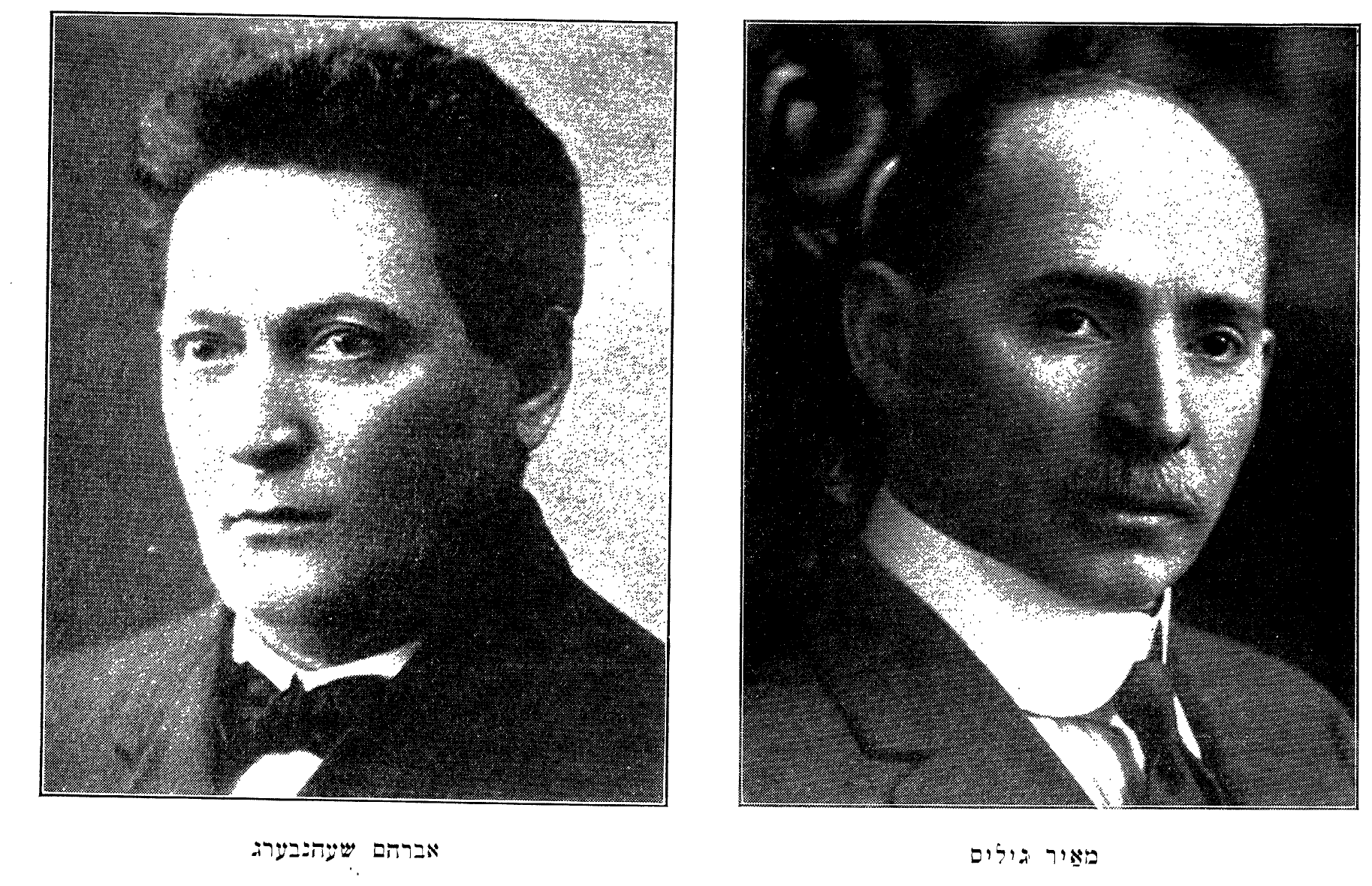
Comrades again raised with me the question of my becoming editor again. Various members of the "Association" approached me about it. Among them was Joseph Barondess, who was then the labor editor of the "Forverts." I also remember a long conversation that Meyer Gillis and Schoenberg had with me about the matter.
I had absolutely no desire to step into that role again. The enthusiasm with which I had worked a year earlier for the building-up of the paper had cooled. Writing for it was very pleasant to me, but only as a contributor from outside. From the standpoint of my personal interests this placed me in the best position. We lived very modestly, and it was enough for us. I was free of "pot-boilers"; for literary work in English enough time remained to me. And remaining outside, I was far from internal party conflicts, in a calm frame of mind for my belletristic tasks.
In the association there were now some341of the "Kangaroos," and they were hostile to my direction. They were "more socialist," "more revolutionary," as they used to call it. To me, however, that meant more dreamy and farther from a path that leads to real results.
They all assured me that the moment I entered the editorial office, the moment the standpoint of the "Kangaroos" disappeared, no one would have the power or the will to hinder me. But this was no longer for me the most important question. I simply was not now drawn to take upon myself the responsibilities of an editor. A free frame of mind and much free, peaceful literary work — that had again become the ideal of my personal life.
No financial luck did I expect from my literary career. Money could be made only from writing stories, novels, or plays of a cheaper sort, and of that sort of literature I could not even think. I would sooner have begun again to study law or taken up business. The sort of literature, again, that had enchanted me brought in a quite modest income.
Stephen Crane drew no great earnings from his writing, and Frank Norris's pen (another talented young writer who in those years won a great name) also brought no significant income.
Today literature finds itself in America in far more favorable circumstances than then, and yet what do we see? Only trash-writers live richly. Theodore Dreiser, again, in the course of the first twenty years of his literary activity — already with a great name — earned very342little. Only after his "American Tragedy" appeared and that work became a sensation throughout the theater world and the moving-picture world, which bought from him the right to use the murder-novel for their purposes — only then did he see a large sum.
A quarter-century before the time when these lines are written, from the sort of literature that interested me, and moreover from literature about Jewish life, one could get more name than livelihood.
But my wife and I did not demand much. Writing belles-lettres and articles for the journals, and from time to time bringing out a book, I would have had enough. And such an occupation would for me have been a source of the highest spiritual satisfaction.
I was ready to write for the "Forverts" my whole life long. That was a source of spiritual satisfaction of another sort. But to take upon myself the duties of a "Forverts" editor — that had quite another meaning.
I was not at all drawn to the editor's chair. And yet I was drawn. I said above that the enthusiasm for building up the "Forverts" had cooled in me. But not entirely. From minute to minute the magic would let itself be felt again. The brilliant success of those months when I had introduced my reforms tempted me.
The end was that I again allowed my name to be put forward to the "Forverts Association." I was again elected unanimously, and again with "absolute full power" (with an absolutely free hand).
I again threw myself into the newspaper
(plate; bound facing printed page 343)
343with body and soul, and from then on my activity as the leader of the "Forverts" was no longer interrupted. One may actually count in also the year that I spent in Woodbine and in New Milford, for, with the exception of three or four months, I sent in several articles every week the whole time, and the reforms that I had introduced were — taken in general — maintained in my absence too.
Now I took up the building-up of the "Forverts" with a new energy, with new plans, and with new themes for the contributors and for myself.
Notes (the original’s footnotes)
[p. 312] Iron balconies for saving oneself from a fire (sreyfe).
[p. 313] East Side (Mizrekh-zayt). The east side of the city of New York, more accurately, a certain part of it, which is densely settled with Jewish immigrants and was for a long time almost the only Jewish quarter. Today there are several large Jewish quarters in Greater New York.
[p. 314] A woman neighbor who lives with you door by door.
[p. 315] If a house has several steps in front, these steps are called a "stoop" (the word stems from the times when New York was a Dutch city and was called New Amsterdam). "To live on the stoop" means, in American Yiddish, that the apartment is on the lowest floor toward the street, just where one comes up the few steps. Often, in the old buildings, there are apartments, and sometimes a shop, under the "stoop" too.
[p. 321] The first was printed in the "Forverts" of July 15, 1902; the second in the "Forverts" of July 22, 1902.
[p. 325] It is interesting to note that the De Leonist "Abend-Blatt" refused to throw the advertisement out. Its explanation was that the cigarette-makers' union did not belong to De Leon's "Socialist Trade and Labor Alliance"; therefore it was no union at all.
[p. 330] About the literary work in English, with which I occupied myself after my return to the "Forverts," will be told in another volume.
[p. 332] The same one with whom I crossed the border together in 1882.