Chapter Thirteen
The "Forverts" in Its Own Home
379I worked for the "Forverts" with energy and with a deep interest. We had excellent, easily written, serious articles and light reading matter on various secular topics. A. Liessin was then an active contributor. Miller, Vintshevsky, S. Peskin, and others often wrote as well. I also acquired new contributors.
Once a cloak operator by the name of Gonikman sent a letter to the "Folks-Tribune" (People's Tribune). The letter was written with sense and clarity. So I invited the writer to the editorial office and made him a contributor. To write clearly and sensibly was a rare merit. I used to receive letters or articles that were written in a beautiful language, or even in a language that displayed high education. But clarity, and above all simplicity and ease, were not common qualities. And that was what I sought more than anything. Sometimes I would thereby make an enemy. An intelligent, cultivated fellow brings something in to be printed. I look it over — it is380written turgidly, with foggy phrases. The public will hardly digest it. I do not accept it. Why not? A debate develops. I explain; but my words fall on deaf ears.
Simplicity and clarity, to the writer in question, are called "wateriness." If an article reads easily and everything in it is plain, one can learn nothing from it, he argues. He goes away angry.
But this plainness and clarity, which I demanded of every writer, was one of the most important causes of our success.
The newspaper was very popular, and its popularity kept growing steadily.
In the "Forverts Association" by no means were all content with my "ways." Besides the old members, who believed that under my editorship the "Forverts" was not socialist enough, there were now also "Kangaroos" who criticized me even more sharply. And members who were still new in the country, Bundists from the old home, were even less content with me than the "Kangaroos." Their conceptions of the labor movement, which they had brought from the old home, did not fit American conditions. But they could not see this. The "Forverts" could not please them. It was not "revolutionary" enough for them.
Once again frequent debates took place about my policy.
Vintshevsky often picked quarrels. There were also a few others who often used to take the floor against me — a kind of official opposition. On the whole, however, this did not disturb the general spirit of peace and comradeship
(plate; bound facing printed page 381)
381comradeship. And the next morning, after a heated meeting, I would go on without all those debates and do my work according to my convictions.
The circulation kept on growing.
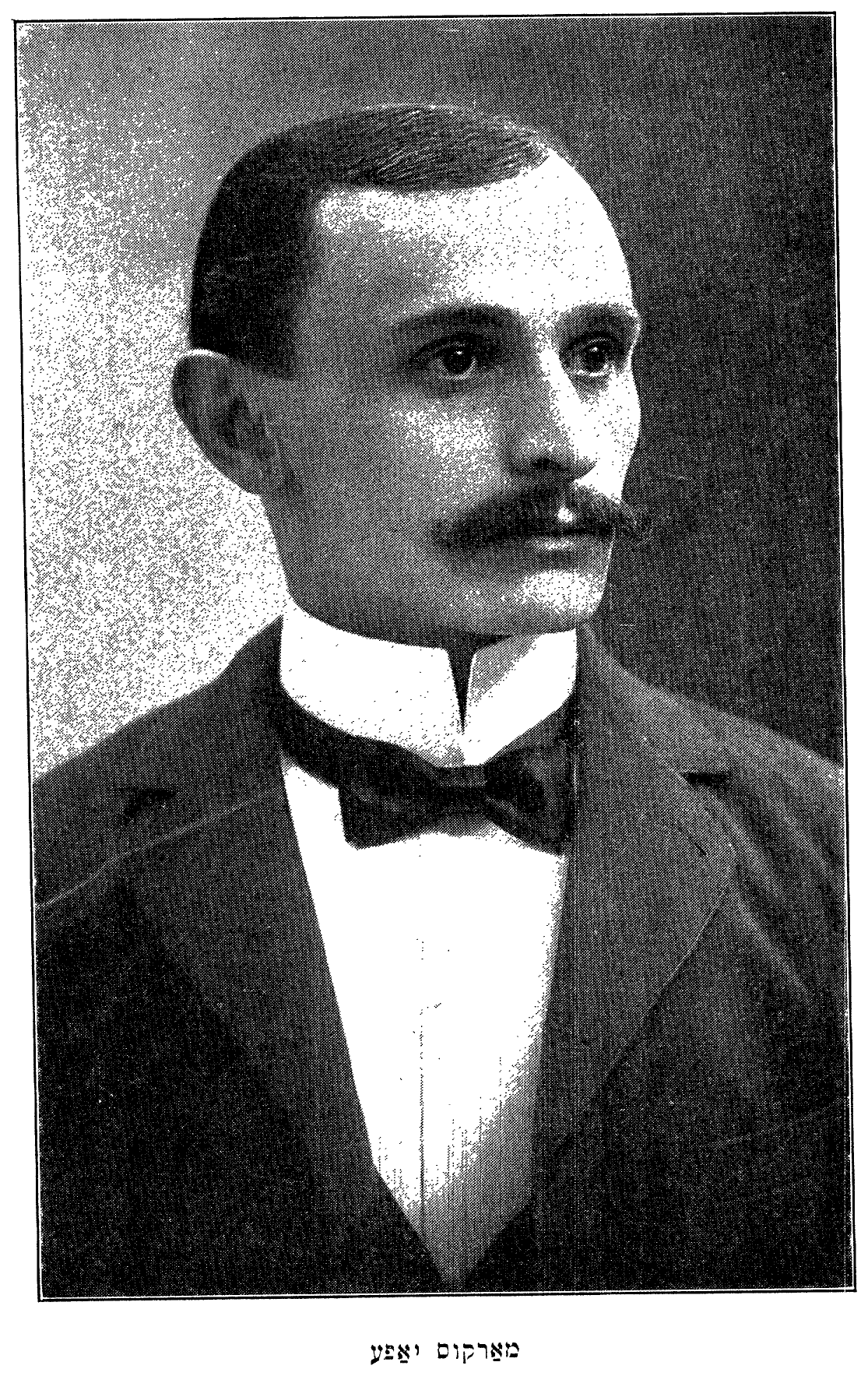
Through manager Yaffe's enterprising spirit and business courage, the "Forverts" bought a building of its own — at 175 East Broadway. I say "business courage," because despite the steady growth of the circulation, the business was still burdened with debts and was always short of money. The building was bought by Yaffe with borrowed cash at high interest, and on large mortgages.
Vintshevsky once remarked at a meeting: "If I were told that Yaffe had bought up the Brooklyn Bridge,* I wouldn't be surprised either."
Among the comrades an anecdote survived, that in a certain month, when there was nothing with which to pay the rent to the landlord, Yaffe found a "remedy": to buy a building.
The building became our property on the 19th of February 1904. It only remained to make certain changes in the building, to adapt it to the needs of a newspaper.
On the 23rd of April, 1904, on a Saturday night, we celebrated the seventh anniversary of the "Forverts" with a banquet, which took place at 206 East Broadway. The festivity was held in honor of the success of
(plate; bound facing printed page 382)
382the newspaper, as much as a kind of anniversary celebration. The report about it appeared in the "Forverts" the following Monday. There it is explained that the banquet was arranged "to celebrate the remarkable success and growth of the 'Forverts.'"
It is also stated there:
"The 'Forverts' has reached the highest level on which a Jewish newspaper has ever stood. From two years ago until today the number of 'Forverts' readers has increased fivefold. In other words: today five times more copies of the 'Forverts' are sold than two years ago. The 'Forverts' has the largest number of readers that a Jewish newspaper has ever had anywhere in the world.
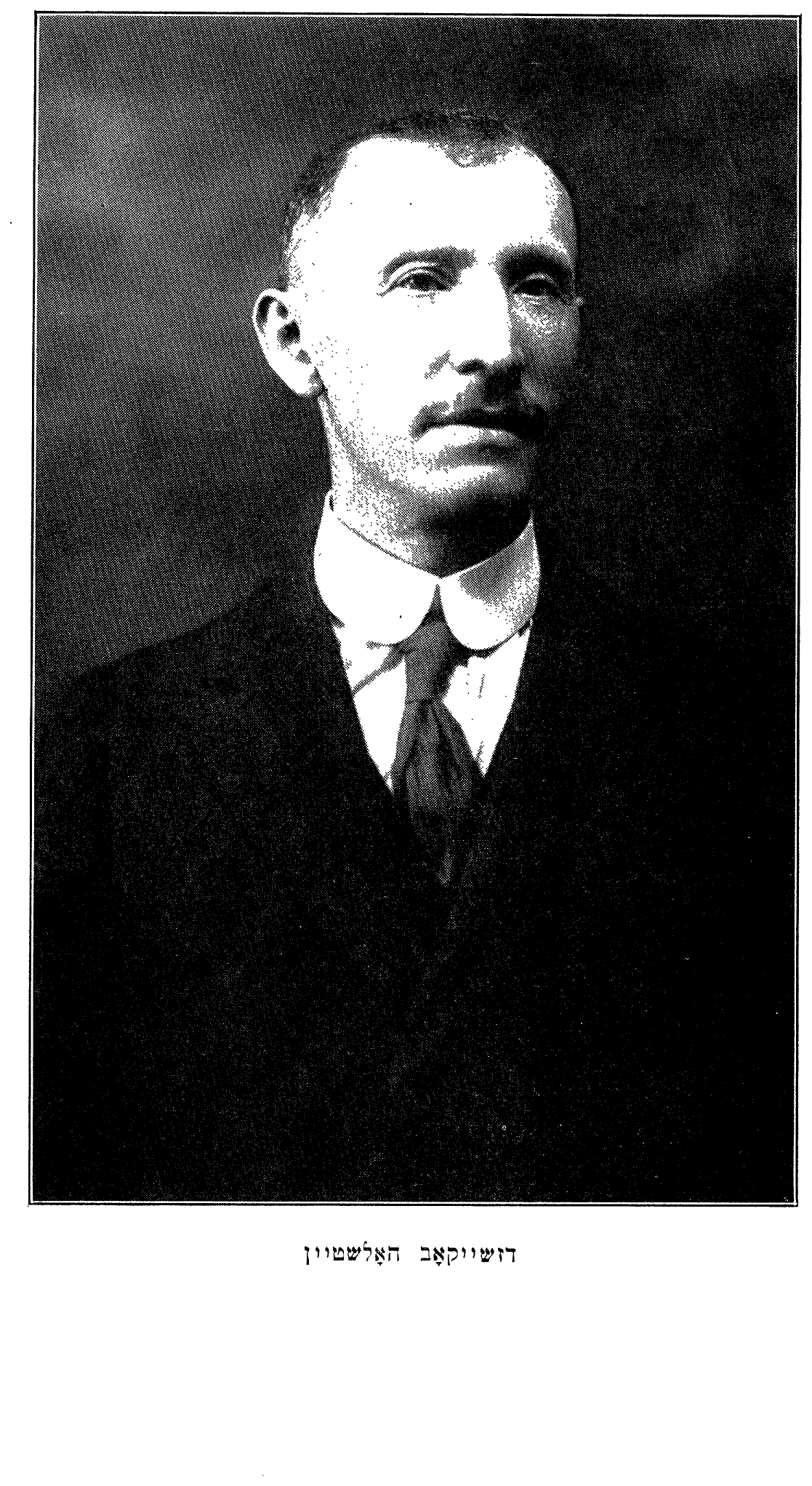
"President Holstein, in the name of the Association, expressed warm satisfaction with the editorial board and management."
At the banquet the Association gave me, as a gift, a silver "loving cup" (a love-goblet), and Yaffe — a gold watch. On the cup a beautiful "vignette" is engraved, in which stand the words:
Presented by Forward Association to Abraham Cahan April 21, 1904.
The gift always stands on my desk, a dear memento.
For the First of May we then prepared, under my editorship, a "journal number of the Forverts" of many pages with rich content. By letter I asked Paul Singer, one of the chief leaders of the383the Social Democratic Party of Germany, to send us a greeting for this number, and he fulfilled the request.
I also received for the number an article by Karl Kautsky.
Louis Miller had in this number an article about the rent strike, which was then in full swing. Among the others who took part were Liessin, Vintshevsky, Yehoash, Z. Libin, Yehuda Steinberg, and Z. Lesch (Z. Levin).
I had three articles in it: "The Three Most Important Points in Socialism," "Great Artists Among the Ancient Greeks (Realism in Stone and Realism in Literature)," and "An American Who Died for Free Speech."
There is also an article there by Ben Hillel under the title "How a Person Sees" (a chapter of science explained simply).
The "Forverts" of the 11th of May already appeared in our own home. That was the first number that bore the address 175 East Broadway. The building was a three-story brick structure, but still a home of our own. The fact that it stood near Seward Park, in the very center of the old Jewish quarter, and in its finest spot, gave it much significance. We were very proud of it.
On Sukkos, 1904, Gordin put on a drama by the name of "Tohoras Hamishpokhe" (the purity of family life). These two words the "Tageblatt" (Daily Paper) often used in its384attacks upon him. It accused him of preaching dissoluteness, of undermining the foundation of tohoras hamishpokhe (purity of the family). In the "Forverts," on the other hand, during the year-long battle it had been pointed out many times that this "prudish" outcry was permeated with hypocrisy. Such expressions as "tohoras hamishpokhe tsvuyokim (hypocrites)" were then met among us quite often.
So, when it was announced that Gordin had written a play by the name of "Tohoras Hamishpokhe," people understood at once that in it he was tearing down the hypocrisy of the false "sin-criers."
The new play was put on at the Thalia Theater on Friday evening, the 2nd of September. "Forvertsists" went to the performance as to a holiday of their own. The theater was full of our comrades and of other radicals.
As has already been remarked, the relations between Gordin and me were now much better than before. We still did not speak, and into the editorial office he did not used to come, but we kept ourselves like "friends at a distance." With regard to the "Tageblatt" we were all in one camp.
I had not seen a Gordin play for some five years, since his "Shkhite" (Slaughter). I went to see his "Tohoras Hamishpokhe." That in itself was regarded as a sign of peaceful relations. I sincerely hoped that the new drama would be a success and that I would be able to praise it.
To my regret, and to everyone's regret, this time Gordin did not succeed at all. "Tohoras Hamishpokhe" is one of the weakest things he has ever385written (up to that time, at least). About this almost everyone had one opinion. Besides the usual faults of Gordin's plays, this play had enormous faults simply as a piece of theater. It was actually not a stage piece at all, but a series of sermons. Instead of presenting the "tohoras hamishpokhe" hypocrisy in images and dramatic action, he expressed his idea through speeches, which he put into the mouths of the actors. Socialists applauded the speeches as speeches, not as the words of characters in a drama. As a play the piece was tedious and it fell flat.
In my articles about literature I often used to explain the difference between art and agitation, between an idea when it is embodied in images, and an idea when it is explained with words. In this case we had a striking example of agitation that is given out as art.
It was very unpleasant for me. I had no desire at all to write about the play. It vexed me that once again I had not sent someone else. But not to write, after everyone had seen me in the theater, would have been as bad as telling the truth. So I resolved to write an open-hearted, sincere criticism in a friendly tone, to show that this time386My mild, polite, and amicably worded criticism led, in our little world, to a whole chain of stormy incidents and upheavals.
My article appeared on Sunday, the 4th of September.
It begins with a few lines about the difference between hypocrisy in our old home and the kind of hypocrisy one encounters among our immigrants in America. The previous year's battle with the "Tageblatt" is mentioned, and its attacks on everything that was progressive.
Coming to the new play, I say that its idea — its aim of tearing off the mask from the tohoras-hamishpokhe hypocrites — is not brought out in it through portrayals, but explained in speeches; that a drama must first of all be a drama, and that this new piece was not that; that the actors had nothing to play; that, instead of acting, they delivered "agitation speeches," as though they were not on a theater stage but on the platform of a mass meeting; that the idea Gordin took for his theme was not painted but spoken out.
That is with regard to the "positive" characters, the sympathetic ones. As for the hypocrites, I express the opinion that they were "presented in a manner which we must unfortunately reckon among the cheapest work for the stage"; that the role of a coarse political ruffian is in the play "a quite ordinary caricature; not a sign of a living person, a grimacing at every word, at every step. The same is true of the role of the hypocritical, unctuous East Side reverend, who speaks only of Jewishness and moral purity. Also a caricature instead of an image."
387I explain that the play has no dramatic development whatsoever, and that for that reason it cannot win the interest of the spectators.
I give a parable with a sculptor who undertakes to express a thought through his art, and who creates a figure that is no figure and has no face. The sculptor writes upon his statue with words the thought he wanted to portray through sculpture. Gordin's play portrays nothing at all; so he put into the mouths of the actors speeches that explain what he wanted to depict.
The only thing that turned out well in the play, I say, are the jokes, and the one "hit" is made by Mogulesko; "to him too the dramatist gave no portrait. But he created a role for himself."
I close with the remark:
"The agitation speeches were applauded without end, and in that lay the expression of the power that was represented in the theater — the power of light against darkness. That is a great power, and the fact that this time the author did not succeed makes no difference... Those who fight against the skullcap-bluffs are united... We are all united in the expectation of much better work from Gordin's pen, and in the hope of a chance to help make a success of it in every respect."
Among the ardent admirers of Jacob Gordin my article raised a storm, and Miller was one388of those who showed sharp indignation about it. He regarded my criticism as a sortie not only against Gordin, but also against him, Miller, as the leader of the anti-"Tageblatt" campaign. In truth I had had absolutely nothing of the sort in mind, and my criticism did not contain the slightest trace of such an insinuation. As I said, I had at that time no bad feelings toward them at all.
Miller, however, was incensed. He wrote "A Criticism of a Criticism," and he sent me the manuscript through a comrade.
When I took a glance at the first page and saw what it was, I returned the manuscript to the messenger.
"Tell him that I very much regret that I cannot accept it," I said. "We have a rule at the 'Forverts' that criticisms of theater criticisms are not printed."
Miller knew that I had instituted such a rule. A few times before, when others had written criticisms of plays and it was proposed to write counter-criticisms, I had given the same answer. In one case I myself did not agree with the critic, but once his article had appeared, I did not permit a counter-criticism. That is how it is done everywhere. If one were to allow counter-criticism of plays, a debate would in every case be drawn out, and the critic-writer would lose interest in his work.
Some of our comrades became uneasy. People did not want to have clashes in our ranks. Prominent members of the "Forverts Association" appealed to me in the name of domestic peace (sholem-bayis).
389I answered that even if I made an exception and printed Miller's article, the matter would still not end there. To let his counter-criticism stand without an answer I could not. And the friction would in any case be increased.
Miller let me know that he was "declaring war."
Things began to boil. Miller was considered a great hand at waging wars, and, as has already been said: once he took up a fight, he knew no bounds. If he was a friend, he was a warm friend; if he set about combating you, he would stop at nothing. (It has already been mentioned how he tore down Gordin's "God, Man, and Devil" with six articles. The "Tohoras Hamishpokhe" is much weaker than "God, Man, and Devil." About this everyone had the same opinion. Yet Miller was ready to fight for this play with all his might.)
That summer and autumn Jacob Gordin edited a monthly by the name of "Dramatic World" (the publisher was Michael Mintz, the husband of the actress Keni Liptzin), and Miller printed his "Criticism of a Criticism" in this periodical, in the issue of the 15th of September, 1904 (this was its third number. The first had appeared on the 15th of July).
I read the article through then. And now, twenty-three years later, I have read it again. It contains no abuse. The sharpest expression is that I have "a very narrow, one-sided conception of the drama." My name is not mentioned in it. There is talk only of "the 'Forverts' critic."
390As an introduction the editorial board of the "Dramatic World" gives the following statement:
"This impartial criticism was rejected by the editor of the 'Forverts.' They also did not want to give it a place among the 'People's Voices.' On account of this criticism, at the author's request, we are taking out our reply to a Brownsville intellectual concerning the personality of the critic of the 'Forverts.' It will be printed in the next number of the 'Dramatic World.'"
Then comes Miller's article. Here are all the important passages in it:
"The critic says that he expected Gordin to paint his ideas, and since he did not paint them but spoke them out, therefore the play is a failure. In other words, the critic declares that since Gordin did not give what the critic expected, but what Gordin wanted, therefore the drama is a failure.
"This is a new standpoint in the criticism of a drama. If this standpoint were correct, one could annihilate not only every play by Gordin, but by every writer, every painter, every artist.
"A drama, like every work of art, is not treated from the standpoint of a critic, but from the standpoint of the author himself. The first question a critic must ask himself is what the author wanted to express in his work. The second question is whether he succeeded. When an author succeeds in attaining the goal he himself set, the task is fulfilled and the work is a success.
"The critic of the 'Forverts' assumes that Gordin wanted to paint a picture, in which, through characters and391through types, through life-actions and life-truth, certain of our ideas, thoughts, and feelings about Sarazon and his skullcap would be carried through. The critic thinks so, not because the play itself demonstrates that this was the author's aim. On the contrary, that, in the critic's opinion, the play does not demonstrate at all. He thinks so because, in his opinion, a drama must be written this way and not otherwise. Painted, the critic thinks, must the author's thoughts be in a drama, and not spoken. The critic thereby shows that he has a very narrow, one-sided standpoint about the drama.
"Not all dramas must be pictures in which certain thoughts are expressed by 'painted' types and characters. The greater part of the dramatic works of art of all times know nothing at all of such paintings.
"Shakespeare's Hamlet contains in it not a single type, no life-character, no life-picture, nothing that would in the least recall real life, the realistic reality.
"I grant that the characters in this drama are not brought out as well as in other Gordin dramas, although (and this the critic does not relate) they are far better than in those dramas (Gordin's) which have the greatest success on the Jewish stage. Neither 'Solomon the Wise' nor even 'Truth' can boast of such types as the apothecary, or even the unfortunate old man of 'The Other Side of the Sea.'
"It is an injustice to approach in such a way a work which, from its first lines to its last, is devoted not to the idea of art, but to the fight for justice and progress in the Jewish quarter.
"It is tasteless to make reproaches to this work392for being a work of momentary struggle and not a work of eternal art.*
"When a painter wants to paint struggle, he is welcome to do so. But when someone thinks that the time is not for the brush, but for the cudgel, then the single demand you have a right to make of him is that he wield this cudgel rightly and forcefully...
"As for his right to use such a cudgel, that has been recognized not only by the best dramatists. It has been shown that at certain moments the brush is simply ridiculous, that a strong word under a strong accompaniment can do more shaping work than the finest artistic strokes of painting."
"Not suspenseful?" he asks — that is a demand which true realistic criticism must recognize least of all. Real life is very seldom suspenseful. The best dramas still less so. That a drama should be suspenseful is demanded by the managers, who enjoyed their artistic education in the box office.**393Miller ends with the following lines:
"For the sake of peace I want to say that I would not have undertaken to give a criticism through the 'Folks-Tribune' if it were a question only of the correct understanding of a work of art and nothing more. But unfortunately this question has in our quarter a far greater and deeper significance than the success or failure of a drama. On this question there arose that giant storm which so beautifully purified the moral atmosphere of the quarter. The 'Forverts' has no right to disturb the work of many, when so many sacrifices have fallen, because its critic has shown that it is better to paint a struggle on the stage than to fight on it."
I had, of course, demanded that Gordin devote his play not to "the idea of art," but to the idea of tearing down hypocrisy, which he himself had taken for his theme; not that he should "paint struggle," but that he should paint hypocrisy. It also begged to be answered that if "the pen is mightier than the sword," an artist's brush is mightier than a thousand cudgels. A few more remarks begged to be made. But I wrote no reply.
It happened just so, that three or four weeks after I had rejected Miller's article, the yearly elections for editor were due to take place. (The last time I had been elected was at the beginning of October, after my return from New Milford.)394I began to hear that Miller was agitating strongly among the comrades against my re-election.
In the "Forverts" of Monday, the 3rd of October (1904), there is a notice:
"Important special meeting this Thursday, October 6, at 83 Forsyth Street, Room 3. Order of business: editorial elections."
For this meeting Miller prepared himself strongly; he prepared to make a strong attack on me and to put forward Vintshevsky as the opposing candidate. And he agitated among the comrades, collecting votes against me.
The evening came. The meeting was the largest the Association had ever had. The number of members was then some seventy-odd, and almost all were present. People neglected important private duties and came to the assembly.
Miller, Vintshevsky, and a third comrade, who was friendly toward me (I do not remember his name), sat together.
Miller's attack consisted chiefly of a declaration that I was making the "Forverts" "too Jewish," too nationalistic, and that under my editorship it was no socialist newspaper. He expressed this in the form of a resolution, which he proposed to the assembly.
He delivered a fiery speech. His language was bitter. From offensive expressions it was, however, free.
In my reply I pointed out, among other things, the fact that Miller himself had written a lead-395article, in which he defended my reply to the young man who had asked whether he should say Kaddish (see above, page 282).
When the resolution was put to the vote, only eight votes were cast for it. All the remaining members raised their hands against it.
Then Miller demanded that the elections be postponed — on the grounds that to nominate candidates and vote for them the same evening was illegal. But he was reminded that he himself had a few times been nominated and elected editor the same evening, and his "motion" (proposal) was voted down.
Vintshevsky did not run as a candidate. A "recess" (intermission) was called, and a committee was sent to seek out Zametkin.
"We will wait the whole night, if need be!" someone cried out, and his words were greeted with stormy applause.
Zametkin lived quite far away. The committee was ready to ride to his home. But they found him in a café, playing chess. He did not accept the nomination. His answer was that he was not a candidate, and that the "Forverts" already had an editor — Cahan.
I was thus the only candidate. They voted, and only two members voted against me: Miller and the comrade who sat beside him and whose name I cannot recall. Vintshevsky did not vote at all. Then everyone raised their hands for me, five of the eight who had396previously voted against my "too Jewish" editorship included.
The comrades from Philadelphia had arranged with one of our New York friends that they should telephone them the result of the vote. And they waited all evening for the news. When the result was reported to them, an enthusiastic "Hurrah" was heard over the telephone.
A few days later the fourth number of the "Dramatic World" appeared. It contained three long articles against me (one of them was in the form of a reply to the above-mentioned "Brownsville intellectual"). In all three articles Gordin settled accounts with me "with a full hand." He portrayed me as the most ignorant, smallest, pettiest, and worst person.
The number actually contained a fourth little article — "A Voice from the People" — which was also against me. Almost the entire number was taken up with my humble self.
I ignored all of it, did not answer with a single word.
This was the last number of the "Dramatic World." It appeared no more.
Around the same time Miller advertised a mass meeting against the "Jewishness" of the "Forverts." He was the chief speaker. He bitterly attacked my editorship. After that he gave similar speeches at other mass gatherings — everywhere venomously criti-397cizing my editorship, and everywhere attacking me for my "Jewishness."
After the evening on which the elections took place, Miller and Vintshevsky, at the assemblies of the Association, conducted themselves toward me with a sharp hostility and venom.
Thus several months passed. Then Miller stopped coming to the meetings.
Notes (the original’s footnotes)
[p. 381] The oldest of the great bridges that join old New York with Brooklyn.
[p. 392] The words "and not" are missing here, in the printed article. It is clear that this is a misprint.
[p. 392] * The theater managers used to advertise trashy plays with the words "highly interesting" or "very suspenseful," and we used to laugh at these advertisements. In my criticisms I always used to show that natural artistic portrayals are far more interesting than cheap melodramatic sensations. As the reader can see, the word "suspenseful" is here used by Miller in such a sense, as though only trashy works were interesting. It sounds as if someone were to say that fresh food is no good, because in dishonest advertisements those same words are used about rotten fish and spoiled eggs.