Chapter Fourteen
New Echoes from the Old Home
398The "Jewish Workers' Bund of Russia and Poland" was founded in the same year as the "Forverts" — in 1897. Our sympathy for it was reflected in the "Forverts" ever more clearly.*
Our Jewish labor movement here in America is older. The "United Hebrew Trades" (Fareynikte Yidishe Gewerkshaften) were founded nine years before the "Bund" — in 1888. And individual Jewish unions we had a few years earlier still. But a labor movement in Russia, in those times, and a labor movement in America were two altogether separate phenomena. There it smelled of dangers and sacrifices, of which the American labor struggle knew almost nothing.
The "Bund" was a part of the Russian revolutionary movement, one of its finest divisions. There began to reach us reports of secret Jewish gatherings in the forests, of struggles that399Jewish artisans were waging against the Russian police and its spies; of secret Jewish printing-shops which the czar's ablest detectives could in no way discover.
The Jewish worker, who at home had always been downtrodden, suddenly began to display a splendid self-respect and an astonishing heroism.
The name "bal-melokhe" (artisan), of which one used to be ashamed, was illuminated with a halo of revolutionary daring and martyrdom, of which intelligent Jews were proud, and of which intelligent Christians spoke with rapture. People who had been accustomed to regard the Jewish masses as a mass of cowards suddenly saw in them a crowd of dashing youths, with a high ideal in their hearts.
When the brave Russian fighters of the 1870s and 1880s had in their ranks Aaron Zundelevich, Leon Deutsch, Sofia Ginzburg, and other Jewish children, one could say that they were exceptions, and that in any case they were Jewish intellectuals — more Russian than Jewish. But here the czar's gendarmes had before them courageous hosts of Jewish common folk.
A Jewish shoemaker fires at a governor, and hundreds of other Jewish shoemakers, tailors, brush-makers, smiths, chimney-sweeps, hold revolutionary demonstrations, print and distribute revolutionary proclamations, organize strikes; attack policemen and gendarmes and tear from them arrested comrades; stand up bravely against pogromists.
There would reach us numbers of the "Arbeiter Stimme" (Workers' Voice), the "Bund's" underground organ. It was very badly printed, hard to read. But in its400technical clumsiness itself there lay a holy thing. The indistinct letters bore witness to the difficult circumstances and dangers under which the work was done.
We used to imagine how the newspaper was set and printed, how it was distributed and read. To underground Russian writings we had long been accustomed. But Jewish ones of that kind were almost a novelty, with a new sort of magic.
Bundists came over to America. Some had fled from prison, or had barely escaped arrest. Others had simply come to seek a piece of bread in America. The "Bund" was dear to them all. No, "dear" is too weak. It was literally sacred to them, for the first few years at least.
The number of Bundist immigrants grew. Organized groups settled down here with the aim of collecting money for the "Bund."
How far we agreed with the details of the "Bund's" theory, and how far its leaders agreed with certain details of our American tactics — that we shall see on later pages. The Bundists and we were Social Democrats, and we admired their movement. And so the "Forverts" became the American organ of the "Bund." This came about of itself, in an entirely natural way.
We made the American reader acquainted with the "Bund's" activity. We agitated for it, printed the reports of the Bundist immigrant groups, and — what is perhaps the most important — helped them401to collect support for it. When one leafs through the "Forverts" of those years, one meets in hundreds of issues the call: "Help the Bund!" with lists of money collections.
On the other hand, the Bundists who came over became active in our unions, in our Jewish party branches, in our "Arbeiter Ring" (Workmen's Circle) branches.
At the end of May 1902, a report arrived that on May 18 a Jewish shoemaker by the name of Hirsch Lekert had fired at the Vilna governor, von Wahl, and wounded him. Afterward there was a notice that Lekert had been hanged.
A few particulars became known: on the first of May the Vilna Bundists had held a demonstration. Many of the demonstrators were arrested, and, on von Wahl's order, they were brutally flogged. And so Lekert resolved to settle accounts with von Wahl. He lay in wait for the governor at the circus (in the Vilna "Manège"; see the first volume, page 265), and there he fired at him.*
Before the first of May, police wagons with mounted men rode about the city — a warning that if a May demonstration were held, there would be a flogging. The demonstration took place all the same. In it several hundred Jews and a small number of Christians took part. On a few courtyards there were402The name Lekert became, among the Jewish workers of Russia, a martyr's name. Songs were composed about him, and they were sung in every Jewish town and shtetl.
Here among us in America, at every Jewish workers' meeting people rose in honor of the name of the brave Vilna shoemaker. A special meeting was also held in his honor.
In the middle of September, some three and a half months after
The committee of the "Bund" issued a proclamation which condemned von Wahl for his tyranny; but it did not call for revenge. The proclamation pointed to the coming revolution, which would take revenge for all the murders of the government. But there were young people with hot blood who were not satisfied with so mild a vengeance. They were ready to repay von Wahl on the spot. Under the leadership of a young chimney-sweep there was founded a "boyevoy otryad" (fighting group), and to it belonged "Hirshke the shoemaker." For Dr. Mikhailov, too, the affair did not pass off smoothly. A Bundist summoned him, ostensibly to a sick person, and there they did to him what he had ordered done to the victims of von Wahl's tyranny,403Lekert's execution, his widow came to New York. She came with her child, who had been born after her husband's death.
She was brought to us in the office, where I and my colleagues had a conversation with her.
She was quite a young woman, no more than twenty years old — not tall, thin, with black hair. A report of our talk was printed in the "Forverts" of September 20, 1902.
The young widow told how, after the flogging, her husband and his comrades had often spoken about taking revenge on the governor. She had thought they were saying it just so. That her husband had taken upon himself to shoot von Wahl — that she had not suspected. She knew that he was active in the movement. She also knew that he had once already been exiled to another town and had fled from there. But that he was preparing to shoot at the governor — that had never entered her mind.
Afterward she noticed a revolver in her husband's possession; but he gave her some excuse, and she calmed down.
"Last Friday Hirsch came home later than usual," she told us further. "The next morning, Saturday morning, he got up late, about 11 o'clock. He washed himself, put on clean linen, ate a little something and went off into the street. He never came home again.
"I was very uneasy, because Hirsch almost never spent the night away from home. By about eleven o'clock he would always be home. I asked my mother: 'What can be the matter with Hirschl?' He said: 'He must probably be spending the night at an acquaintance's.'
"All day Sunday I lay in bed; I was404weak and not well. But when it came to ten, eleven in the evening, I could no longer sit still in the house. I went out with my younger sister into the street to look, perhaps he was coming.
"I stood for a long time. It was already past midnight. The street was quiet. Not a soul was to be seen. My heart trembled more and more. I thought that they had picked him up somewhere in the street and arrested him. Suddenly I hear a noise. The noise kept growing louder. There came running up certainly as many as thirty policemen, and at once they entered our courtyard. At first they did not notice me and my sister. Then someone came up to me and asked: where does so-and-so live? (they named my father's name). I thought nothing else but that a spy had recognized Hirschl, that he was the one who had fled from another town, and that they had come to arrest him. But since he was not at home, and there was nothing 'treyf' (forbidden) in our house, I led them in. They asked me and my parents where my husband was; I answered that I did not know. They took us all away to the uchastok (police station). There I noticed some strange commotion. They had brought many people. Then I heard Hirsch's voice.
"The next day at noon they let me out. As I was leaving the police station I learned everything.
"They let me in to him only the following morning after the trial, about a week and a half later, so that I might take leave of him.
405"The gendarme colonel himself sent for me."
The scene of their meeting she was unable to convey, for it was almost a mute scene. It took place in the presence of a gendarme officer, and the conversation was more between the gendarme and Lekert than between Lekert and his wife. The gendarme apparently wanted to take advantage of Lekert's agitated state in order to draw from him the names of his helpers. But Lekert gave the same answer as always: he had done everything alone; he had had no helpers.
Lekert's wife was soon to become a mother.
"When... the child... is born — Lekert said wonderingly to her, when she visited him — you should give it a name after me... You should look after your health and my child... Mother-in-law," — he said to his wife's mother, who was also present — "mother-in-law, I beg you to take care... to look after her... not to let her cry..."
Before parting, he kissed them both. The women wept, but Lekert did not. He looked pale, but calm.
"We thought — Mrs. Lekert went on telling — that they would hang him that same day, or the next morning. That they would pardon him we did not hope... As soon as I came home, the lawyer Eliashev sent for me. He proposed that I submit a paper and beg for clemency. He submitted the paper in my name. Hirsch knew nothing of it."
406On account of the paper the carrying out of the sentence was postponed. Eliashev traveled to Petersburg and telegraphed that there was hope. But von Wahl's coming to Petersburg ruined everything: the lawyer was refused.
"Hirsch did not know why they had postponed hanging him — she went on telling. — He asked that I be let in to him once more. He wanted to learn from me the reason. But precisely on that account he was refused.
"The execution took place in Snipiszki, where we lived, not far from our house, in the field. But none of us knew. Only some hours later did we find out. Two acquaintances came and told us..."
To the question of what was said in town about the event and about Lekert in general, the young widow explained that older Jews were greatly angered at her husband, because "he had done it." They thought that now it would be worse for the Jews. But everyone was vexed that the governor had not been shot dead altogether — even the police themselves, for since he had come, she had had neither day nor night.
The Poles felt great pity for Lekert. Quietly many of them prayed to God for him in the churches. Some Poles, of the most prominent, sent for the widow. They wanted to give her support. But she did not go; for the people were unknown to her.
407In the summer and autumn of 1903 bloody pogroms took place in various Russian cities, and in some places the Jewish workers, under the leadership of the "Bund," or of the "Bund" together with the "Poalei Zion," fought bravely against the pogromists. They came out against the hooligans with pistols and with iron bars. In some places they drove them off entirely. In others they at least reduced the number of victims. Wonderful examples of heroism were displayed. In some places Christians bravely helped the Jews against the pogromists.
The "Forverts" printed every piece of news about such events with big "heads," on the front page. Often it would turn out afterward that the number of those killed had been exaggerated. But for that reason the later reports contained details which it was more horrifying to read than the exaggerated first figures.
More exact reports about the self-defense would reach us much later than the notices about the pogroms themselves; for about the Jewish self-defense groups and their fight with the hooligans, the Russian government would either not allow dispatches, or would send false news. From many of these reports it would appear as though the Jews had actually been the pogromists and their Christian attackers had defended themselves against them. Bit by bit, accounts would reach us from Jewish sources, at first again with exaggerations. With time, however, we would receive official reports from the "Bund," on which one could fully rely.
408An enormous impression was made by the pogrom in Homel and the Jewish self-defense there.
Here are a few samples of the pogrom news in those days:
"Homel — a sea of Jewish blood!" — we find in very large letters on the front page of the "Forverts," October 2, 1903.
"For three days the murderers murdered and robbed. From the villages they are bringing Jewish dead.
"Were it not for the Minsk and Homel valiant young men, hundreds more would have fallen.
"Jews save the honor of their women."
October 4 the front page of the "Forverts" contained:
"300 Jews slaughtered!
"Terrible slaughter in Mohilev-Podolsk. All the roads covered with dead and wounded.
"Jews barricaded themselves around the synagogue and in the streets. They sold their lives dearly. The rabbi proclaimed on Yom Kippur morning that they should defend themselves; about 100 Christians also fell."
On the 5th of the same month we find:
"Terrible pogroms also throughout the whole Mohilev province."
October 14:
"Cry of woe from Homel!
"400 Jewish families without bread.
"A pogrom prevented in Novo-Vileysk.
"Christians from Kapust come to Shklov to protect Jews.
"American Jews, help your unfortunate brothers!"
An interesting piece of news was printed in the "Forverts" of October 19:
409The "Bund" calls upon the Jews of the Caucasus to follow the example of Homel and to be armed:
"Let Jews carry weapons, just as the natives of the Caucasus carry daggers, revolvers and knuckle-dusters!"
The lead article in the "Forverts" of October 6, which bears my name, has over it the headline "The Bloody Plague." There it speaks of the pogrom-slaughters.
When one leafs through the "Forverts" of those months, one comes upon (in the issue of November 21) a picture of Pinchas Dashevsky, the Jewish student who shot at Krushevan, the instigator of the Kishinev slaughter.
An appeal for support came from the pogrom victims of various cities, and the "Forverts" collected support for them. It had begun this even earlier — for the victims of the Kishinev slaughter. As early as the middle of that summer, workers used to come to us at the office, each with his contribution.
The Jewish working public responded in a splendid manner. They would come straight from the shop. In our office a special clerk used to sit for this purpose, mostly two clerks, and sometimes even three.
A long line of people would stretch out. They would beg that one take from them the dollar or two, or fifty cents.
"I am coming from work and I have to make supper; please, take my dollar," — they would appeal.
There were cases of unemployed people who pawned something in order to bring a contribution for the victims in the old home.
410In the issues of the "Forverts" of January 20 and 21, 1904, a report about the Homel self-defense was reprinted from the underground organ of the "Bund," the "Arbeiter Stimme" (Workers' Voice) (number 35). The headline over the article in the "Forverts" was:
"Jewish arming against pogromists. What is told about it in the underground Bundist organ. — How Bundists organized their self-defense and with weapons drove off the Homel pogromists."
On March 12, 1904, the "Forverts" began to print a detailed report about the Homel self-defense, written by its leader. The original (in Russian) appeared in the "Bund's" Russian organ "Vestnik Bunda." The Yiddish translation ran in four "Forverts" issues, at two or three columns per issue.
For one who is interested in the history of the "Bund," how far it used to make itself heard among us in America, and how we worked for it, it is perhaps not superfluous also to point to the following reports that appeared in the "Forverts":
On January 18, 1904, there is an article in which it is told how a secret printing-shop was founded (in Bobruisk).
On January 21, 1904, — a report about the founding (in New York) of the society "The Friends of the Bund," at Dr. Kaplan's residence, 230 East Broadway. The following alphabetical list is given of those who took part: Dr. Girzdansky, Jacob Gordin, Dr. Hil, Dr. Haimovich, Dr. Zolotarov, Dr. Yanisov, Meyer London, A. Liessin, Dr. Mintz, S. Pollak, Dr. Faerenberg, Ab. Cahan, Dr. Kaspe,411Dr. Kaplan, Dr. Rayevsky, Dr. Romm, Stamm, Dr. Stein.
It is reported that the meeting was attended by the two delegates of the "Bund's" foreign committee. Probably hidden under this title were then Arkady Kremer and Berg, who were at that time in New York, as will be told further on.
On February 24, 1904, the "Forverts" contained an appeal:
"Help the Grodno strikers of Shereshevsky's cigarette factory!"
The appeal was based on a notice in number 160 of the "Latest News from the Bund."
We also kept on friendly, and more than friendly, terms with the Socialist-Revolutionaries; but to the "Bund" we stood closer. At first, in 1902, light debates would come up among us over the question of who deserved more sympathy and support from our side — the "Bund" or the Socialist-Revolutionaries. One day, for example, the "Forverts" contained a signed lead article by Miller (he was still with us then), which expressed the opinion that among us there could be no distinction — that every party which fights against the despotic Russian government deserves our admiration and support; and the next day there appeared a signed lead article by S. Peskin, who believed that the "Bund" ought to be especially dear to us.
A similar discussion once took place at a meeting of the "Forverts Association." The "Bund" had among us far more adherents.
412The fact that it was a Social-Democratic organization, like our American "Social-Democratic Party" (later "Socialist Party"), whereas the party of the Socialist-Revolutionaries was founded upon another theory (an anti-Marxist one) with another program — that was an important reason, but not the most important. The "Bund" was specifically a Jewish party, whereas the Socialist-Revolutionaries were a general party. True, their leaders were mostly Jews; but they were not revolutionaries as Jews. Apart from that: the "Bund" was not only a Jewish party, but a party of the Jewish masses. Its secret meetings were meetings of Jewish artisans, of the same public as the one that read our "Forverts," listened to our speeches, took part in our unions, and voted for the candidates of our party; the sympathy was a natural one.
And the new immigration streams brought into our ranks ever more and more recruits from the "Bund" itself. Our movement in America became bound up with the "Bund" by more and more threads.
I personally also had a special sympathy for the "Bund." But that does not mean that I would have subscribed to the whole theory which its leaders preached. But of that, more later.
The Russian Social Democrats, whose organization had been founded by Plekhanov, put out a Russian organ by the name of "Iskra" (the "Spark"), and among Jewish socialists of Russia there used to take place heated and not seldom bitter debates between "Iskraites" and "Bundists." We personally were little interested in these polemics, and the long, densely set, barely readable and413very dry articles of the "Iskra" did not attract me. In general, however, I was acquainted with the "Iskra" direction, and I believed it to be too dogmatic. Liessin took more interest in the matter, and he wrote about it in the "Forverts" — as a Bundist.
In Russia a fierce struggle used to take place between the "Bundists" and the "Poalei Zion." Debates and quarrels also went on among two or three different Zionist-socialist factions. From them, too, I was far removed. I could not understand why they mixed together their Zionism with their socialism. And the fact that they were split into various factions and busied themselves with theoretical "hair-splitting" (pilpulim over unimportant theoretical details) used to seem strange to me (incidentally, I saw enough theoretical "hair-splitting" among our own Bundists and Iskraites too).
As for Zionism, my attitude was this: to the Zionists I would express respect for their ideal, but I would explain their idealism as a dream that would never be realized.
For example: in an article which was printed on September 1, 1904, and bears my name, I say: "Of Zionism one naturally cannot hold much. But those who are true to it deserve our respect for their fidelity to principle." And in a lead article (about the Zionist congress of that year), which is also signed with my name, there is a sentence: "In the Zionist movement there is a mass of fine people, honest Jewish enthusiasts... But to the realization of their ideal it is much farther than to socialism."
Such a friendly tone toward Zionists was then, among Jewish414socialists an unusual thing. Incidentally, it was a part of the general tolerance for which I agitated.
In the article of September 1, 1904, I express the opinion that Jewish colonies in Africa (Uganda) might perhaps be practical, but that this has nothing to do with the soul of the Zionist ideal.
In the lead article of September 3 there is a sentence:
"Before Jews will live to have their own gendarmes or to rot in their own prisons, there will no longer be any Jewish question in the world." That I would not write today. Without police a city cannot be run, and under their own police the Jews of Tel Aviv feel much, much better than under the police of an antisemitic state.
In a later lead article (February 4, 1904), honoring fidelity to the "Bund," and fidelity to the socialist movement in America, I say: "Our holy land has been made holy by the martyrdom of Russia's freedom-fighters. Siberia is our holy land."
The "Bund" groups grew, and the money-collections for the "Bund," with the help of the "Forverts," brought ever greater results.
Finally the "Bund" began to send us special emissaries for the same purpose: to agitate among415America for the "Bund" and to collect financial support for it. One after another they came, all its most important leaders.
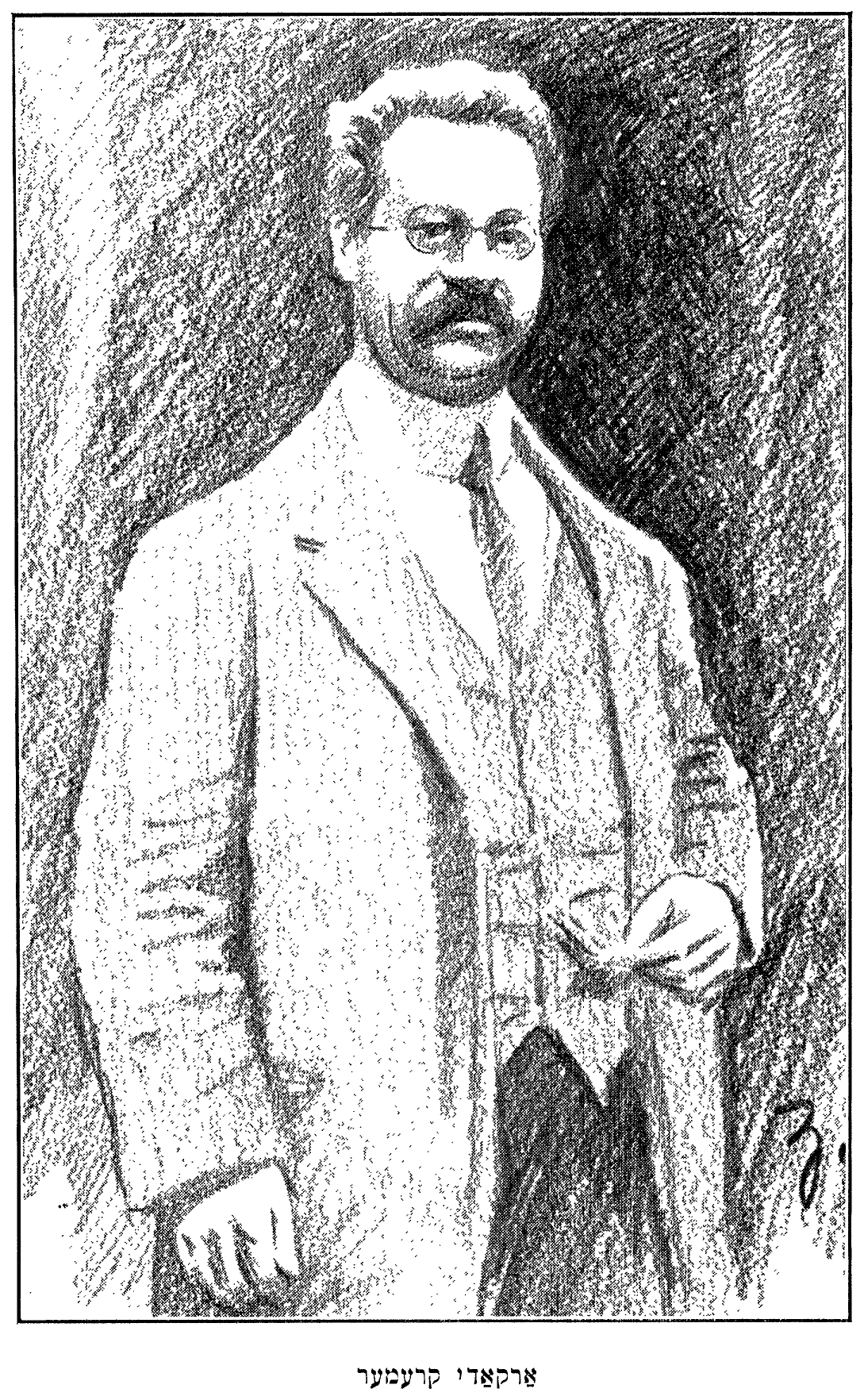
The beginning was made by the founder and chief leader of the "Bund" — Arkady Kremer, or "Alexander," as he was known in the underground Russia. When it was announced (in intimate circles) that he would visit us, I became greatly interested. Bundists felt reverence for him, and among them there circulated little tales about his strong character and practical sense. All this aroused my curiosity. But the main reason why it was interesting to me to meet him was another. I was under the impression that I knew him from Vilna.
The first time I heard of Kremer, as a socialist leader, was in 1894 or 1895. From a description of his appearance and character and a few other details, it occurred to me that this must be the younger brother of a certain Kremer with whom I had been together at the Vilna institute (he was two grades higher than I.* The younger brother was then still almost a boy. He was a pupil in the third grade of the Vilna realschule, which was located in the building next to the institute (see volume one, pages 266-267).
In my memory there is imprinted a picture of how the young Kremer stands on the square, opposite the realschule, and416I, together with a couple of other institute students, look at him through a window. He stands with his little coat "v nakidku" (worn not on the sleeves) and talks to a few of his comrades. We cannot hear his voice. But the expression of his dark, charming face and his eyes makes an impression on me, and I remark:
— Parnishka s kharakterom, vidno (a lad with character, one can see).
That he was a brother of our Kremer we knew. Incidentally, he resembled him a little.
Several months before the founder of the "Bund" came to New York, his wife, Patti, came. She used to visit our editorial office, and I used to chat with her. She said that everything I remembered about that "realschule student" and his brother fit her husband; that it was "the same one." But she was not absolutely certain.
Finally he came. This was in December 1904. It was the same Kremer. He was now twenty-six years older. But his appearance had not changed by a hair.
He came together with a second Bundist, who in the secret movement was known as "Ezra" (Berg) — a fairish, tall man. Kremer was darker, of somewhat shorter stature, more solidly built and with a reflection of more character in his face.
Berg was a speaker, and it was for this purpose that Kremer brought him along. Kremer himself gave no speeches; he spoke little altogether, and when he had something to say, he uttered it in short phrases, to the point.
I soon became convinced that such things as public attention, honor, applause, inter-
(plate; bound facing printed page 417)
417interested him at all. He was entirely taken up with the purpose of his visit.
His name as a man of character and practical good sense was confirmed. Bundists used to ask me: "Well, how do you like our Alexander?"
— An important personality — I would answer, and they would walk away with beaming faces, as though it concerned their own father.
Meyer London (see volume three, page 490) and I used to go with Kremer and Berg to various meetings. Berg would deliver a speech, and after him we would speak. Kremer never took the floor. London helped the "Bund" a great deal in America. I, too, worked for it, but not as much as he did.
He used to neglect his law practice and travel about with the delegates.
As for my own part together with Berg, I best remember a meeting at the Minsk Society.
The organization was not a Bundist one, and on the whole had no connection with the socialist movement — a landsmanshaft (hometown association) for mutual aid, which consisted mainly of small businessmen, professional men, insurance agents, and so on. Within it there was also a considerable number of workers and socialist-minded businessmen, but they were a minority.
All this had been explained to Berg before he went to the meeting. Nevertheless, before the society he418mainly spoke about the "Bund's" role in the class struggle. He spoke in a strong, ringing voice, but the speech itself was very dry, and the words "proletariat," "class struggle," "revolutionary," did not stop echoing across the hall.
His listeners sat at first like curious people, then a bit like bewildered ones, and finally like martyrs.
And with such a speech he expected to awaken in this audience an interest in the "Bund" and a desire to support it!
When he had finished and I received the floor, I began to tell about the heroic deeds that the Bundists display in the struggle against the pogromists. I depicted their self-defense, how they had saved Jewish lives and the honor of Jewish daughters. I portrayed how these heroic young men and girls beautify the Jewish name.
The members of the Minsk Society immediately became interested. They listened with the deepest attention.
The society afterward gave the "Bund" quite a handsome sum. True, it would not have let the delegates go away empty-handed even if no speeches had been delivered at all (for among the most influential members we had friends); but if a speech did help in this, it was naturally not Berg's dry, tedious lecture about the tasks of the proletariat and the role of the "Bund" in the class struggle.
That Berg's speeches were out of place at such meetings, Kremer came to understand. So, at least, it seemed to me. We knew that in the "Bund," in Russia itself, Berg was not one of the most important419orators. We had heard praises of others who played a much greater role in the "Bund." But those were lecturers. They used to deliver serious lectures, whereas Berg, it was said, had been successful there as a "people's orator." I was astonished. Could workers really like to hear that sort of people's orator? But I used to give myself an answer:
Russian conditions are quite different from ours; therefore orators there count for something else. At a secret meeting, in a forest, one cannot use the oratorical methods that suit a free platform in a republic. All this I understood. Yet it always seemed to me that precisely at a secret meeting, in a forest, or in a private home, where one must beware of the police, precisely under such conditions an orator must not bore. And yet there, at the secret meetings, people would be inspired by orators for whom, among us, one would have had no patience. The truth was: that under Russian conditions even a bore could inspire.
People used to tell us that there in Russia one demands serious, scientific speech, and not light agitation. But I used to interpret the meaning differently:
At a free meeting the orator must be an orator. If not, the audience will drift away. But at a secret meeting, where it smells of Siberia, the very fact that one is gathered together is a source of ardor. The most ordinary words then ring out as if they were Sabbath words. The most tedious speech has an effect. An empty and boring sermon is listened to with attention. In the caves of Spain, where the Marranos used to gather to pray, a cantor with a hoarse voice could inspire just as well as a Pinye Minkowski.
420But all this is only one part of the question. It bears on the entire propaganda system of the "Bund," on the written one just as much as on the oral.
The "Bund's" periodicals, pamphlets, leaflets, and leading articles were mostly written in an unpopular language, too dry and too difficult for our public. I used to argue with our guests, the Bundist leaders:
— But you are a mass party. Do you really think that the Jewish masses understand your hard, scientific idiom?
I would take a Bundist, one of my close friends, and give him a chapter to read through. Most of the time it would turn out that he did not understand it. When the "Bund" began publishing its daily "Folks-Zeitung" in Vilna, I made such a test a few times with their leading articles, and the result was always the same.
One of the answers that I used to be given consisted of the following:
The Bundists in the old country are divided into small secret groups, each group with an expounder or teacher. The expounder studies the pamphlet or the leading article with his group, the way a melamed (religious teacher) studies with his kheyder (class). The pamphlets and leaflets need not be popular at all. They are written not directly for the masses, but for the group teachers.
This explanation persuaded me little.
We already had enough Bundists here from the old country, and I had convinced myself that the broad Bundist public understood the pamphlets, the leading articles, and the lectures but little. Whether with a teacher or without a teacher,421but for them it was a sanctity, and when a language is holy, it appeals to the heart, whether the mind understands it or not.
A Catholic blacksmith hears how the priest prays in Latin, and the incomprehensible words inspire him.
The success of the "Bund" stemmed from the response it found in the h e a r t s of Jewish artisans far more — much more — than from the efforts the organization made to drive into their m i n d s the scientific expressions of Marxist theory. These efforts were fruitless.
Bundist leaders used to say to me: "If we had writers who could explain a matter in a popular way, we would surely be glad of it. But we don't have them. Our leading articles, for instance, must first be written in Russian, and then translated into Yiddish (it is a fact that the most important leaders of the 'Bund' could not write any Yiddish. Mark Liber at first could not even speak Yiddish fluently. He taught himself in the 'Bund' itself, and his "goyish" Yiddish actually remained with him. Something similar can be said, to a certain degree at any rate, of Kremer and Abramovich*.
But I doubt whether, in those years, a truly popular manuscript would have had a chance of being accepted for printing by a Bundist editorial board. It may sound like a joke. But it is the truth that when an article was written in an unpopular manner, this was regarded as part of its scientific quality. If the public could understand it easily, that meant it was "too watery."
422In a conversation with Kremer I once tried to show that the methods which suit the labor movement in Russia do not suit America. "The workers here have entirely different prospects and aspirations, entirely different feelings and thoughts," I argued — "many of them are indeed in difficulties, but masses of them earn well and save up money and cease to be workers. It happens to me not seldom to deliver a speech at a strike that is being conducted against a former listener of my speeches. A few years earlier he was a proletarian and used to go on strike. Today he is a manufacturer and people strike against him."
Kremer of course understood this well, and he also understood well that the conditions of the American movement are on the whole quite different from the conditions of the Russian movement. And yet I felt that he looked down upon our movement from above.
A similar impression I received from almost every one of the other important Bundists who visited us.
In Germany, many years ago, there was a millionaire who strongly sympathized with the socialist movement and supported it with large sums. But he himself took no part in the movement. The German socialists used to call him "Gold-Uncle." When the Bundists began coming to us for support, it used to seem to me that to them we were no more than a "golden uncle," and that beyond that they hardly considered us socialists at all.
In part this meant that they came to their own Russian comrades, immigrants, who two or three years earlier had been members of the "Bund" in the old country. But in two or three years a change comes over the immigrants. Some of them already begin423to "work their way up," and their old-country proletarian character has already evaporated. Others, again, have simply ceased to be workers, taking positions as agents of insurance companies, or perhaps have bought a little stand or a little store — having become "golden uncles," then, and in time even that does not remain. A former local Bundist, a brave fighter, gradually becomes a manufacturer in America, keeps scabs, and fights against the union...
It is understood that this was not a rule, but neither was it a rare exception.
I, for my part, used to regard the Bundist delegates as people who occupy themselves too much with doubtful theories. Their special "Bund" dogmas, with their mixture of class struggle and Jewish culture, were not convincing to me. I also used to raise objections to the "class struggle" between a Bialystok or Berdichev artisan and the pauper-like employer for whom he works.
To me the most important thing was the fact that the "Bund" had lifted up the spirit of the Jewish artisan — and although I was not carried away by the theoretical part of Bundism, I did see that its practical side does much good. The Bundist workers who came to us were more developed than the workers who used to immigrate earlier.
All these differences of opinion (and perhaps differences of feeling as well) did not prevent our two sides from being on the warmest personal terms. I used to reflect: the educated children of well-to-do families, the leaders of the "Bund," lead a life of danger and self-424to help them achieve the purpose of their mission was for me no difficult matter.
In the "Forverts" many articles were written for them by Liessin and by S. Peskin, but I too agitated for them enough — with the pen and on the platform.
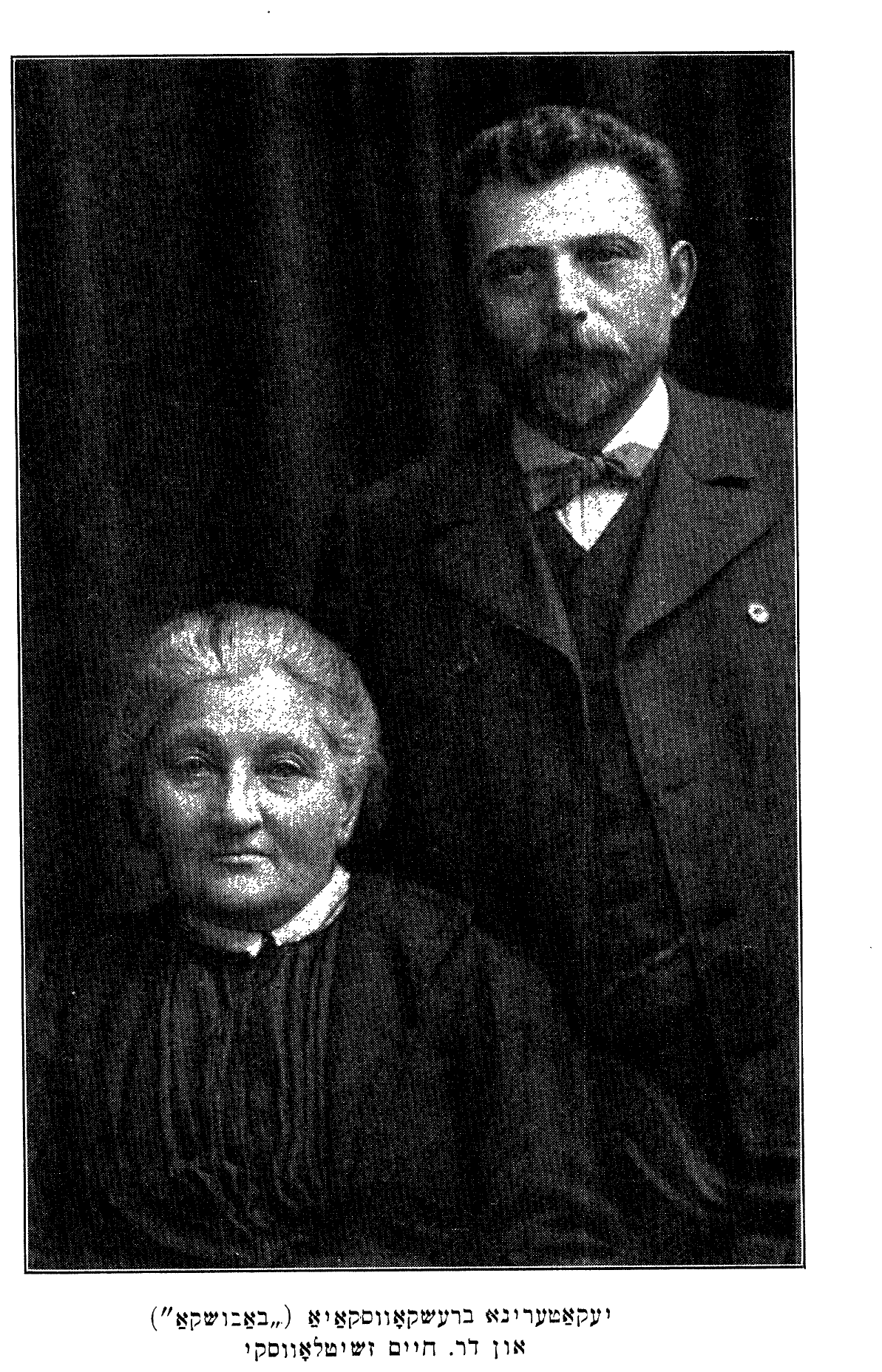
Kremer remained in America until July. A few months later (on the 12th of November, 1904) we received two other guests — delegates not from the "Bund," but from the Socialist Revolutionary party. These were the famous old revolutionary Yekaterina Breshkovskaya and Dr. Chaim Zhitlowsky. I went to meet them at the ship.
In the second volume of these "Pages" (pages 167, 168, and 169) it is told about the revolutionary little book "Kalendar Narodnoy Voli," which I obtained when I had been a year in America. There it is mentioned that the "Kalendar" contained a supplement of sixty photographic pictures — portraits of Russian fighters for freedom, and how holy they were to me. One of the sixty photographs was of Yekaterina Breshkovskaya. Now, twenty-one years later, when I heard that this Breshkovskaya, one of those precious people, was coming to New York, I prepared to receive her with a feeling of indescribable interest and reverence.
(plate; bound facing printed page 425)
425hair, without a trace of resemblance to that portrait. But this white-haired Russian woman was very likable, and she was, after all, Yekaterina Breshkovskaya.
She immediately began addressing me as "thou," and in this there rang both a freedom from empty ceremonies and foolish customs — the spiritual freedom and sincerity of the nihilists of the 1870s — and a tone of motherliness. Her "thou" was dear to me.
She was not tall. And her ruddy Russian face was lit up with a pleasant smile. I felt as though we had been acquainted for a long time, as though she were really the "Babushka" (grandmother) of us all.
With Dr. Zhitlowsky I was already acquainted from earlier, from 1893, when we met in Zurich (see volume three, page 337). In the eleven years his face had changed a little. But I recognized him at once. A blond man, with a full, neatly trimmed brown beard and smiling eyes, he gave the impression of a learned merchant. In the eleven years his reputation had grown. He was known as one of the most important theoreticians of the Socialist Revolutionary party and at the same time as a leader of radical Jewish nationalism.
About the "Babushka" and her revolutionary past we printed a series of articles in the "Forverts." Afterward I had with her a long series of interviews. Every afternoon I would come up to her quarters, and in the course of a couple of hours she would426Siberia, and so on. Pacing about the room, she spoke like a teacher delivering a lecture to her class. Often with her hands clasped behind her back, and mostly with a light shawl over her shoulders, her head bent a little and with a beaming face, as though smiling, she would march to and fro and tell her story. And I would sit at the table and take notes — with half-words and with all sorts of self-invented stenographic signs. In this way I wrote down every word that she said.
Her voice had in it a pleasant ring, into which her Russian r's would lend the charm of a heartfelt cordiality.
From time to time I would interrupt her with a few questions. She would answer me and then go on again with the thread of her narration. Sometimes my question would call forth in her a stream of new recollections, which she would relate at length. Then we would return to the earlier subject, and she would continue. It concerned the 1870s, the first struggles of the Russian populist propagandists. I was well acquainted with this subject, and it was very interesting to me. About people whose names had always been dear to me, I now heard masses of details from their comrade and fellow fighter. They became more alive, more real.
I never grew tired of asking and listening about them.
These interviews lasted twenty-four days. She gave me an invaluable biographical material, which belongs to the history of the Russian freedom struggle. Every day the "Forverts" would print the re-427year the interviews had to be interrupted. She had to go on a tour, to visit other American cities, to deliver speeches there about the Russian struggle and to collect money for it.
These interviews ran in the "Forverts" from December 6th to December 30th (1904).
To Boston I traveled with her. There her agitation was energetically assisted by the well-known American public worker Isabel Blackwell Stone. She arranged meetings for her, public and private, and made her acquainted with wealthy, liberal-minded Americans who sympathized with the Russian struggle for freedom. With some of them the Babushka spoke in French; with others through an interpreter. A few months later she already spoke English herself, and needed interpreters less.
The largest meeting in Boston took place in the historic Faneuil Hall, which is known as the "cradle of American freedom," because there were held the first mass meetings of the American Revolution against England.
The Babushka spoke in Russian and I afterward translated her speech into English.
Dr. Zhitlowsky had begun to give lectures (talks, papers), and they drew a large428He gave a series of talks about Marxist theory (from an anti-Marxist standpoint), about philosophy, biology, Jewish history, literature, and other matters. Most of these talks he delivered in New York; but he also gave lectures in many other American cities.
Around him there formed a group, which consisted chiefly of anarchists (the warmest friendship toward the Babushka was also shown by an anarchist woman — the well-known Emma Goldman). The non-anarchists of the circle were people like Dr. Kaplan or Dr. Elsberg, socialists who belonged to no American party at all, though they always voted for our party. Russian Social Democrats, or we, members of the Socialist party, had no connection with Dr. Zhitlowsky's circle, because he was a theoretical opponent of ours.
Dr. Zhitlowsky was no anarchist. As he once expressed himself in a conversation with me, his convictions lay between socialism and anarchism, but not exactly in between. He drew the three dots of a segol (the Hebrew vowel point) and said that if two of the dots stood for socialism and anarchism, he found himself at the third dot.
The anarchists and the other members of his group were attached to him as Hasidim to a beloved rebbe. We socialists also respected him. But his theories did not win us over. I do not mean only his lectures about Marxist doctrine. I mean also his lectures about Jewishism (Yiddishism), and about certain other429programs, but they could make no impression on us. I regarded him as a man full of knowledge, of uncommon abilities, and of a noble character, but with a very unrealistic view of the world. He reminded me of the impractical Jewish lamdonim (learned men) whom I had known in my native town. On the other hand, the "Forverts," as I conducted it, was strongly displeasing to him.
He used to come up to us at the editorial office, and we also used to meet at mutual friends. In company he was a cheerful, agreeable man, always a gentleman; we used to spend a quite pleasant evening together.
Later his opposition to the "Forverts" grew sharper, and he even made the "Arbeiter Ring" (Workmen's Circle) a proposal that it found a daily newspaper for the purpose of combating the "Forverts." Nothing came of this, for to put out a daily newspaper is not part of the "Arbeiter Ring's" role. And besides, an overwhelming majority of the "Arbeiter Ring" consisted of our warm supporters.
With time the anger at the "Forverts" on his part partly subsided, and gradually we again began to meet. We became "reconciled to not being reconciled." I must remark that he always conducted himself decently and courteously, truly cultured; often even with a sympathetic friendliness, even in the sharpest parts of his writing against me.
A Homel Bundist, who among us called himself Ibrahams in the American manner (his real name was430Yeshaye Golovchiner) tirelessly collected money for the "Bund." He worked day and night. With a portfolio under his arm, he used to go about from society to society, from private house to private house; and he hardly allowed himself to eat a meal at the "Bund's" expense. He was a chemist, so he found a laboratory where he would work a few days for his own livelihood, and then again throw himself into the work for the "Bund." His devotion and his self-sacrifice called forth a high respect toward him. Each of us was glad to help him.
Ibrahams used to remind me of an emissary of the Socialist Revolutionaries — a money-collector who used to work with a similar devotion and with a similar energy. This was the well-known revolutionary Mendel Rosenbaum. He was slimmer and blonder than Ibrahams. A lean man, with a pointed little beard, with a little stick in one hand and a portfolio in the other, he used to appear and disappear and appear again, moving and overturning mountains, without noise, without complaints. In Russia he had been in the very thick of conspiratorial work and had gone through great dangers. He had visited America earlier than the Babushka and Dr. Zhitlowsky. When they came, he had already gone back to Europe. Later he came again, and then he remained in America.
A likable guest of the Bundists was Dr. Moisei Gurevitch, who had earned a name through a brave revolutionary speech that he delivered at431ration of sincerity; and the "Bund" was to him the same as to Ibrahams — his whole life. He too remained in America.
We dwell here at the stormy two years that are known as the "first Russian revolution" and its aftershocks. So that the younger reader may more easily understand how these great events of our old home were reflected in the "Forverts" and in our movement, I shall first enumerate the most important moments of that historic chapter.
As a prologue to the revolution served the war between Russia and Japan, which ended in such a bitter defeat for the Russian government. (In passing, we wish to mention that the American president, Roosevelt, ended the war with a peace between the two warring sides. The peace was concluded in Portsmouth, New Hampshire, not far from Boston, with the Russian prime minister Witte on one side, the Japanese prime minister on the other side, and President Roosevelt as mediator.) As in every war that the Russian government used to wage, here too the incapacity and rottenness of the entire tsarist system showed itself. This432first reached its climax on Sunday, the 9th of January (the 22nd by the new calendar, 1905).
The Petersburg workers organized a demonstration to the tsar, demanding bread and freedom. The demonstration took place on the appointed Sunday, under the leadership of a priest by the name of Gapon, who had an interesting but dubious career. They marched to the palace, and their march ended with soldiers firing on the marchers, and many fell. The white snow was drenched with blood and strewn with dead bodies.*
The day became famous as "Red Sunday."
Everything grew quiet, but only for a short time. New disturbances began. Uprisings began to be heard of. One of the most dramatic and interesting took place on the great battleship "Potemkin," near Odessa. This was in the summer of 1905.
The revolutionary spirit made itself felt ever more strongly, in various forms, not only among the working class, but among almost all classes. But the workers and the radical intelligentsia played in it the most important role.
A relatively small strike in Moscow gradually grew into a general strike throughout the whole country. In Petersburg the railway workers organized and went out into the struggle. And since the telegraphs were in their hands, they433sent dispatches all over Russia that people should strike.
In the course of three days the capital of Russia was in the hands of a workers' committee. Then for the first time the word "Soviet" began to be heard throughout the whole world. The official name of the workers' committee was: "The Soviet of Workers' Deputies." It consisted of delegates from every factory in Petersburg, and its power during those days was absolute. Khrustalyov, the chairman of that committee, had more power over Petersburg than Nicholas. His control was so great that Nicholas's prime minister, Witte, had to conduct negotiations with him about letting trains pass.
Here it is worth noting that Leon Trotsky, who later became famous throughout the whole world as one of the two most important leaders of the Bolshevik revolution and of Soviet Russia, was then one of three vice-chairmen under Khrustalyov. A little later, when the government regained its courage and power, it arrested Khrustalyov. Then Trotsky became the chairman of the Soviet. Afterward he too was arrested and exiled.
The great general strike lasted three days, and although it did not end in any direct victory specially for the workers, it did end in an enormous historic victory for the entire Russian population. Nicholas felt the power and the danger that stood before him, and unwillingly — on Witte's advice — he gave a constitution. The Duma was founded.
434the military itself fired on workers' meetings. Rivers of blood were spilled. But the Duma at first remained merely a Duma. This Duma, although it was not such a parliament as the English one, for example, was nevertheless a parliament, and played a great role in the development of the further events. It represented an enormous change in the political life of the Russian people — an enormous step in the direction of freedom.
After this there began a series of so-called "punitive expeditions." The government sent out regiments, battalions, or companies, and people simply bathed in blood. The most terrible military massacres took place in Moscow and in the Baltic regions.
It is needless to say that in those days the "Forverts" was full of the echoes of our old home. We, Russian revolutionaries, friends of Russian freedom, used to go about here excited with interest, expectation, and enthusiasm. When you leaf through the "Forvertses" of those years, you see that almost every day the front page had an enormous headline relating to the news from Russia — at first concerning the war, and later about the revolution.
We literally lived with the Russian freedom struggle. We held countless agitation meetings and lecture meetings. The first anniversary after Red Sunday, the 22nd of January, we celebrated with a great demonstration and with speeches at435Cahan, Dr. Ch. Zhitlowsky, Meyer London, S. Polak, and Alexander Dembsky).
The "Forverts" that day was taken up with this demonstration. Besides holiday articles about it, it contained a great poem, "Red Sunday," specially written by Morris Rosenfeld for that issue.
New dear guests began to appear among us, special emissaries seeking support — representatives of the various revolutionary parties. There, in Russia, it was felt that a great revolutionary struggle was unfolding, and great means were demanded. Support was needed for the revolutionary movement, and support was needed for pogrom victims.
A series of meetings began, conferences in honor of the guests, banquets, mainly with the purpose of collecting support. Old comrades, who here in America had for years been estranged from our movement, appeared again. The stormy Russian events had awakened in them their dormant interest. Some of them had in the meantime grown rich; so now they responded to our appeals with an open hand.
The "Forverts" was at the very center of all these money-collections and meetings.
I turned to the readers, asking that they lend us the letters they received from the old home, letters in which relatives described for them the great happenings, how they showed themselves in the town from which the letter was writ-436took part in the war, or from their parents. Many of these letters contained exceptionally interesting material. We printed the content-rich letters in the "Forverts." And this had a great success. Now, then, we did the same with regard to letters about the pogroms and the revolution. We received masses of such interesting letters. In some of them lay little scraps of red banners with revolutionary inscriptions, or a red "badge" with which people had marched through the streets of Odessa, Kiev, or Petersburg. We also received photographic pictures that had to do with the revolution — a picture, for example, of a large group holding a banner with the inscription "Da zdravstvuyet revolutsiya!" (Long live the revolution!).
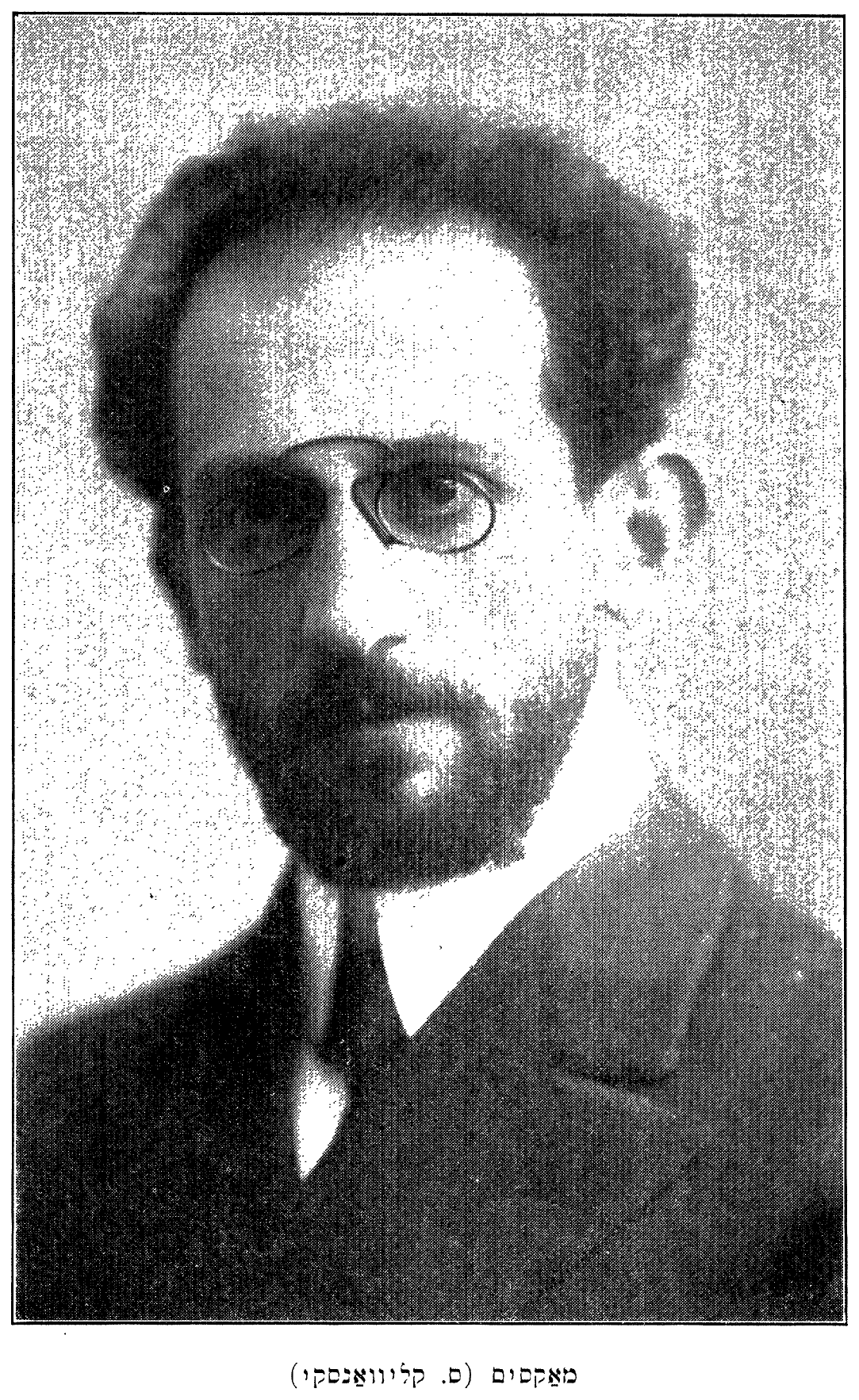
A sensation among us was the visit of the Bundist Maxim, "the hero of Riga," as he used to be called. In the revolutionary days of 1905 he won the attention and admiration of the Riga railway workers against their own will. Earlier they had been antisemitically inclined; they did not admit any Jewish speakers among them. When Maxim came to one of their meetings as one of a committee of the "Bund," they at first refused to give him the floor as well. But he took the floor himself. He spoke despite their hostility, outshouting all the counter-cries; and the upshot was that they listened to his words and acknowledged his leadership.
Afterward he stirred up the city with the fearlessness with which he led a Bundist demonstration, not halting before a host of dragoons,
(plate; bound facing printed page 437)
437which had come out against him. For a certain time he was the real ruler of Riga.
Various legends circulated about him. They reached America. About his heroism and about the remarkable role that he played in Riga, the "Forverts" reported in various issues, in January 1906.
This role of his, naturally, could not last long. The government took hold of him. His life was in danger. But he saved himself nimbly, and on the 20th of April (1906) he came to New York.
The commotion that the news caused among us, and the ovations with which he was received among us, are needless to describe.
Before me lies a brief description of his appearance, which then appeared in the New York "Times":
"A young man of about 27, with a high forehead and piercing black eyes. He is dressed simply, but very neatly, and he has a handsomely trimmed, dark brown beard and mustache. If you met him on the street, you would say that he is a professor."
The "Times" reporter meant an American professor. For a Russian professor, Maxim looked too neat. He had specially spruced himself up for the meeting with the American newspapermen. He was always tidy and well dressed, but not so spruced up as he was for the American reporters.
Maxim was the best of the agitators who came to us from our old home. He spoke with a ringing voice and with fire; popular, clear, and with apt turns of phrase. And on our platform his oratorical talent developed quickly.
(plate; bound facing printed page 438)
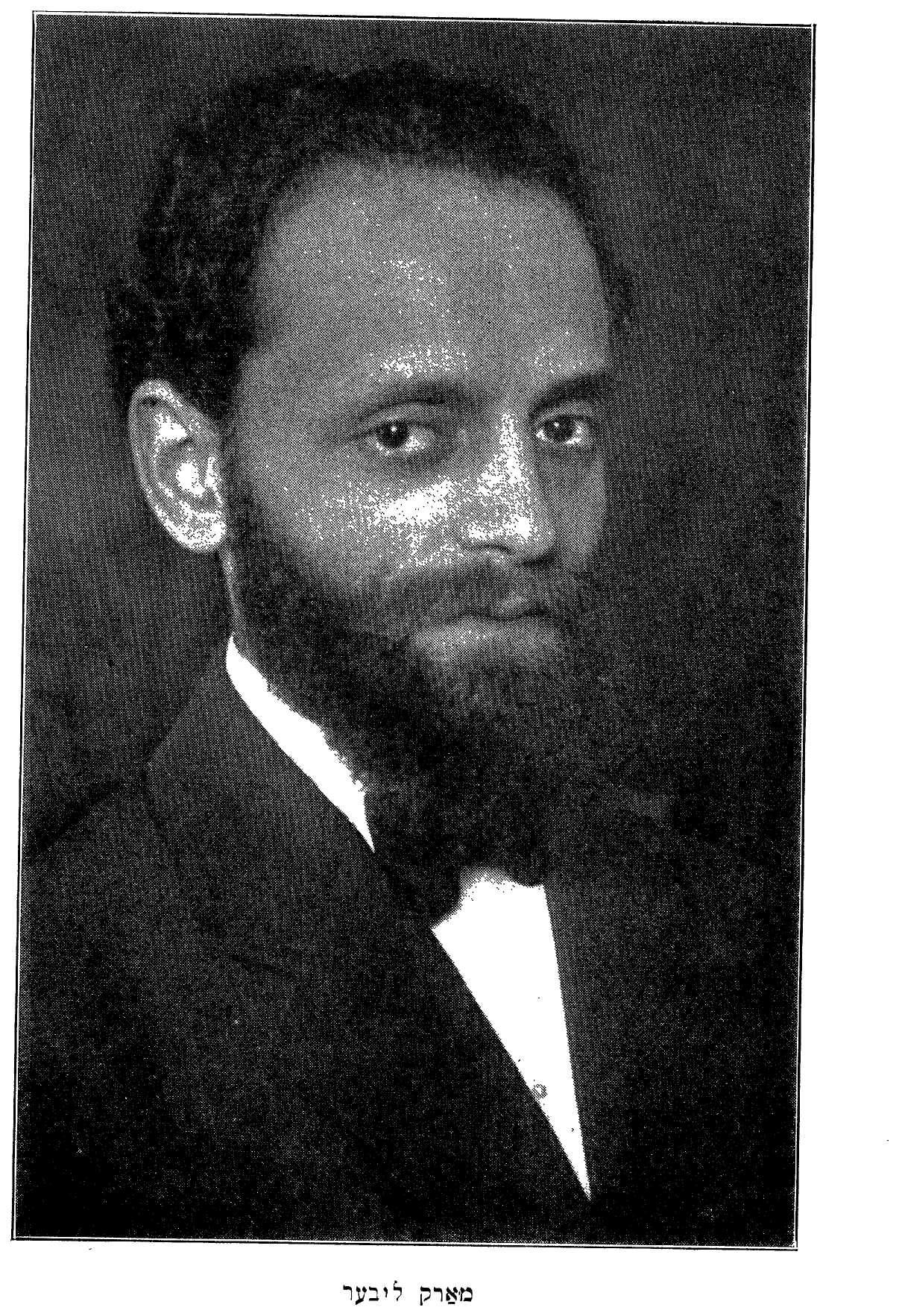
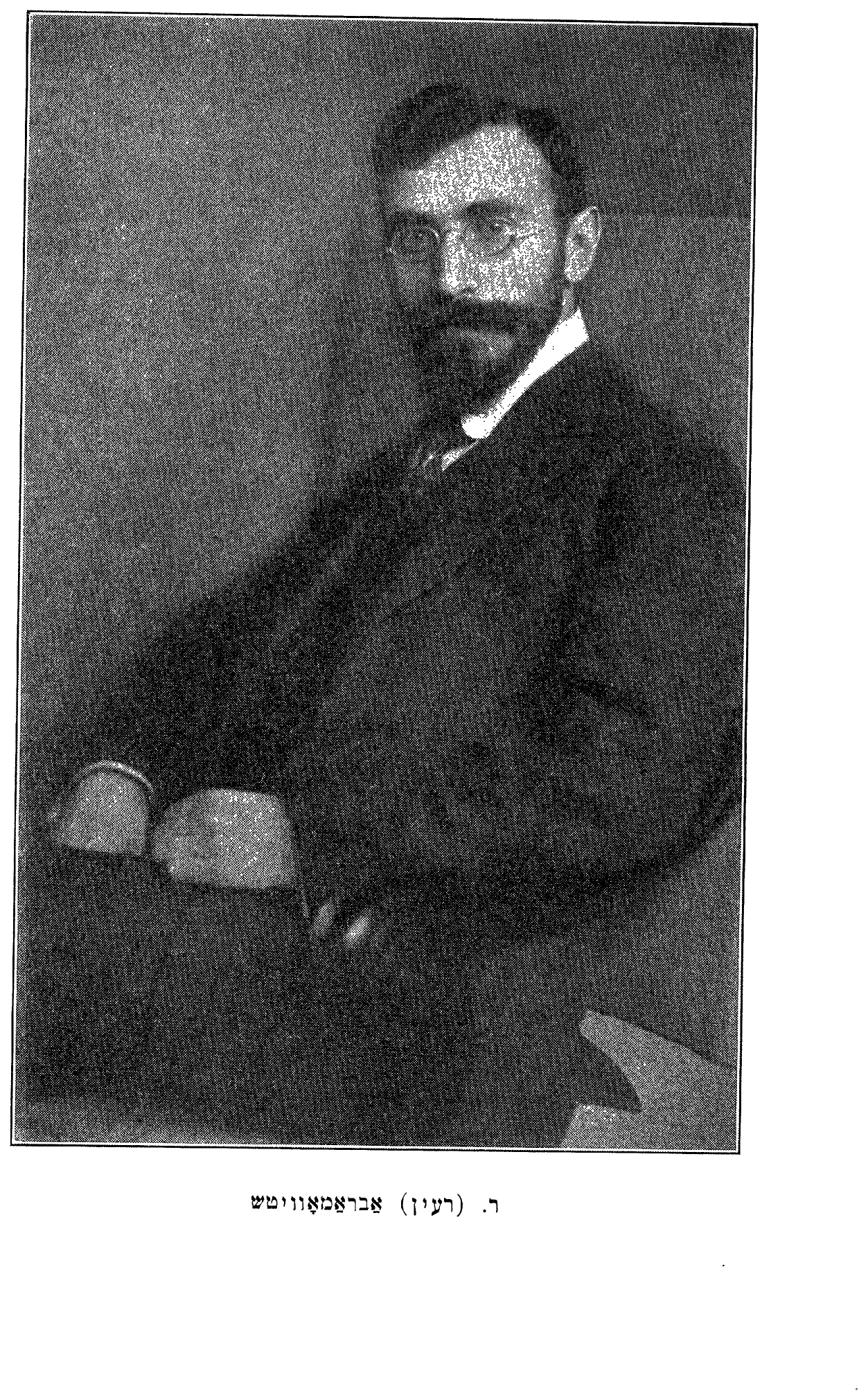
438The greatest praise as lecturers we heard from the newly arrived immigrants about Mark Liber and R. Abramovitsh, both important members of the Bundist Central Committee. Liber came to us on the 8th of November, 1906. His first appearance was in Webster Hall (as speakers, to greet him, there were announced Meyer London (as chairman), Ab. Cahan, Morris Hillquit, and Dr. Gurevitsh).
Liber gave a series of lectures among us — some in Yiddish and some in Russian. He explained the theory of the "Bund" regarding Jewish culture, regarding the class struggle, regarding the revolutionary movement, and he also spoke on other themes.
As a lecturer he was excellent, but the theories that he preached were already too theoretical, too dry. The "Bund" had brought something new into the socialist movement among Jews; it recognized that the Jewish workers were not only human beings, but also Jews. But it did so on the foundation of a cold cultural theory, without a spark of Jewish feeling.
When one says of someone that he is a "sentimental socialist," it is no compliment. One means by it that he does not understand the scientific essence of socialism, that his socialism is only a sentimental idealism. As for the one who writes these "Pages," he must confess that in his Jewishness he is chiefly a Jew of feeling. Of theoretical Jewishness he thinks little.
The Poale Zion were more openly Jewish than the Bundists. They did not mask their Jewish feelings. Their theory, however, was a tangle of longing for a439Jewish home in Palestine with local politics in Russia.
Liber was a pale, somewhat sickly man of some thirty-odd years, with a highly intelligent face and protruding eyes. He made the impression of something like a saint, like a young Hasidic rebbe. And this accorded with everything I had heard about him. He lived for the "Bund" and was ready to die for it. He was very sensitive and very strict about the smallest detail of his theory. If you reported his words not absolutely with the same words as he used, he could no longer rest. Every "dot" was as important to him as the main point.
Some ten or eleven years later, in the time of the Kerensky revolution, when Liber played such an important role in the Soviet, he had already become far more practical and broad-minded. Everyone then portrayed him as a brilliant parliamentary orator and statesman; and as for his character, in the time of the Bolshevik upheaval his reputation was fully confirmed as a man with a strong, fearless spirit. At the time when he visited America, one could also see that this was a man who could go into fire for his convictions. But he did not then show any practical conception of the world. Yet he was also not one to climb too far into impossibilities.
The Bundists literally idolized him. I gave speeches at many of his gatherings, but Meyer London especially devoted himself to him. He traveled around with him to other cities, and in New York itself he devoted many evenings to his gatherings.
The "Forverts" of November 24th, 1906, gave on
(plate; bound facing printed page 440)
440its front page a line with the largest letters: — "Support the Bund in the great campaign of relief." And in smaller type: "The Central Committee issues, through Comr. Mark Liber, an appeal to the Jewish workers and all progressive citizens of America." A gathering was announced in the Manhattan Lyceum for November 24. As speakers, besides Liber, were named: Ab. Cahan, Meyer London, and Dr. M. Gurevitsh.
R. Abramovitsh visited us a year later. He too made the impression of a man with a strong will. He too was absolutely devoted to the "Bund," and he too was a brilliant lecturer. On the whole, his lectures, in a theoretical sense, were no more convincing than Liber's. In a personal conversation, however, he seemed to me more worldly.
Incidentally, I heard little of his lectures then. I was ill.
It was toward the end of 1907. Comr. Abramovitsh visited me several times. We chatted. I found in him a highly developed and sympathetic socialist, a tactful, clever, and very agreeable man of culture.
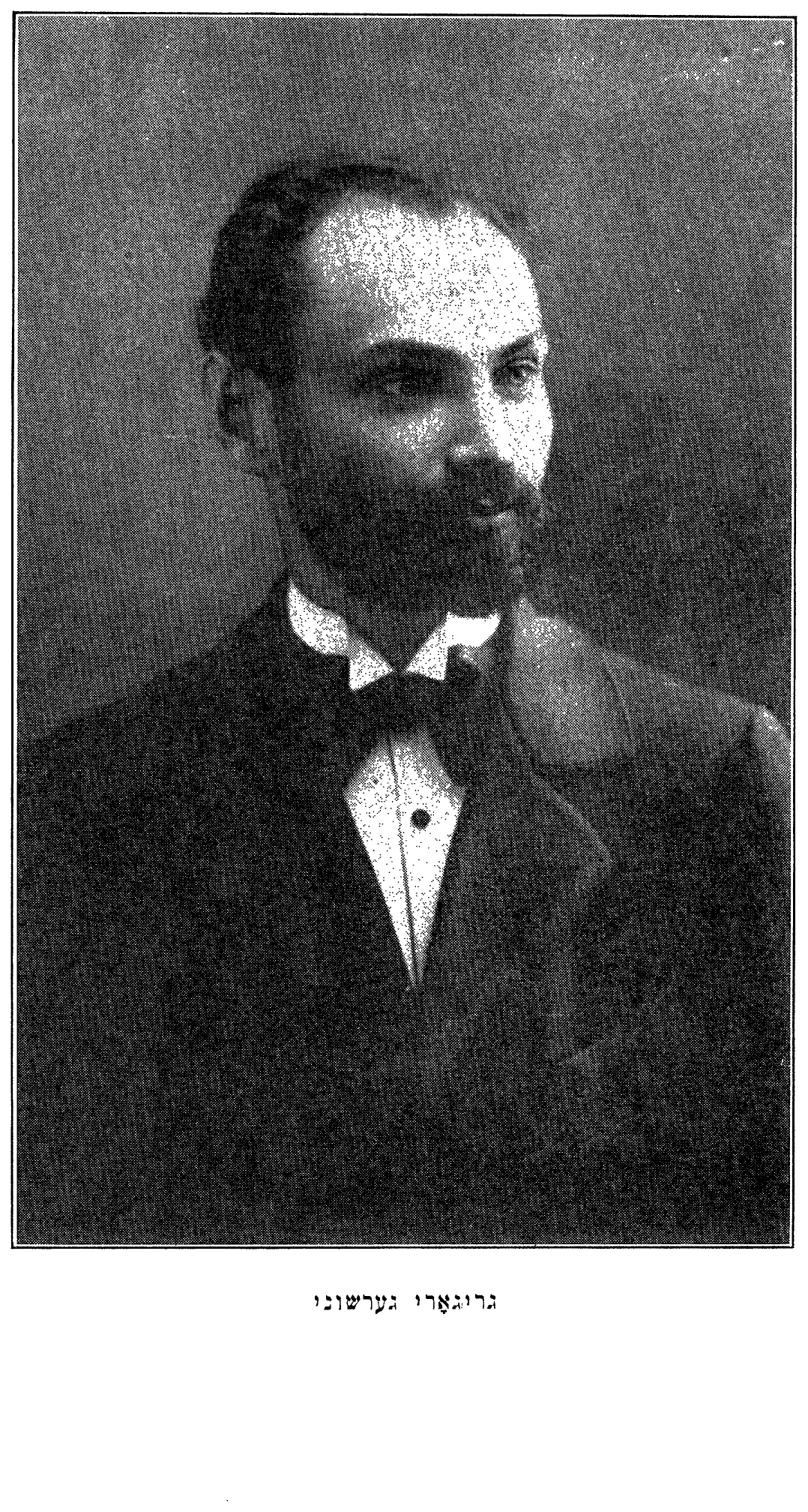
The greatest sensation we had was when there came to us Grigori Gershuni, the Shavl and Minsk Jew who had organized the new terrorists. For about a year Russia had been seething over him. And we, in America, took an interest in every detail of his remarkable revolutionary career. In April 1904441I printed in the "Forverts" a series of articles about the death of Minister Sipyagin and of a governor, in which Gershuni was accused; about Gershuni's arrest and about the death sentence to which he was condemned. The death sentence was afterward commuted to fifteen years of penal servitude, and he was put into the famous Schlüsselburg fortress, where for over twenty years Nikolai Morozov, Nikolai Lopatin, Vera Figner, Frolenko, and the other revolutionaries had endured torment — those who were to us like saints. In the second volume (pages 166–177) it was told how we used to deliver eulogies over the heroes of 1881 and with what feelings we used to recall the martyrs of Schlüsselburg. When the reader leafs through those pages, he will have a conception of the feelings that the news about Gershuni evoked in the older members of our Russian colony.
From Schlüsselburg, Gershuni was transferred to a prison in distant Siberia.
Then, suddenly, in November 1906, a dispatch came to America that Gershuni had escaped.
On the front page of the "Forverts" of November 29 there is a line in very large letters: "Is Gershuni Coming Here?"
And beneath it: "The famous Jewish hero on a ship from Yokohama to San Francisco?"
We were not sure that the dispatch was accurate. Then a telegram arrived from San Francisco to Dr. Kaplan, the secretary of the Socialist-Revolutionary groups in New York, that he had indeed arrived there. It was also reported that from the Siberian prison
(plate; bound facing printed page 442)
442comrades had smuggled him out in a barrel of sauerkraut. He fled to Japan; from Japan, across the "Great, or Pacific, Ocean," he came to San Francisco, and from there to New York. He reached New York in the evening, on the 11th of December, 1906.
In Jersey City, on the other side of the Hudson River, where the train was due to arrive, a great crowd was waiting for him.
He was met with stormy hurrahs. There was a crush, an enthusiastic shouting, a wild leaping and throwing of hats.
We caught sight of a tall, handsomely dressed young traveler, with a blond little beard, with a fine, worldly-intelligent face.
Taking from his head the gray travel-cap that he wore, the guest exclaimed: — Tovarishchi (comrades)! Such a reception I have never had in my life. To such a welcome I am not accustomed. In Russia I was accustomed to being met at a railway station by gendarmes and spies.
We had to go up at once onto the ferry (the foreboat) to ride with him to New York. There was a running, a pushing. On the ferry, Gershuni and the reception committee barely made their way to a bench. The large, brightly lit ferry was packed with our Jews. But there were Americans there too.
The following lines I reprint from the report that appeared in the "Forverts" of December 12:
"Gershuni stood up on the bench and called out: Comrades, let us show the Americans that we are people of sense; let us not disturb them."
"The committee asked Comrade Ab. Cahan to stand on the bench and explain to the Americans who443our guest was. Comrade Cahan did so, and when he finished, there broke out an applause and hurrah-cries from the Americans, as much as from our Jews.
"Then an interesting scene took place. A beautiful American woman, richly dressed, with a face that showed education, took from herself a red flower and asked that it be handed to Gershuni. 'Ask him,' she said, 'to receive from an American woman the first flower of New York; I am very sorry that I have no finer flowers and more.'
"Gershuni's answer was: 'Tell the American lady that first we will settle accounts with the Russian revolution, and then, when Russia is free and she comes to us, in a free Russia, we will repay her her kindness.'
"Again applause, hurrah-cries. Carried across the breadth of the Hudson, the ship was transformed into a meeting hall. Through the darkness twinkled thousands of flames from other ferries and from the New York buildings. The night on the water was a still, calm one. The ferry glided farther and farther, again and again resounding with hurrah-cries.
"Americans, among them some who work on the ferry, pushed up to the guest and begged permission to shake his hand."
The following characterization, which was part of the report, was from my pen:
"A tall-figured, handsome man, an educated one, a finely bred one, with character and with dignity — such an impression Gershuni makes. His face, chiefly when he speaks, is lit with a clever, agreeable smile. In his eyes shines a soft, humorous expression, and the blond,444but truly Jewish face is lit with an expression that tells you of energy, and of amiability; both of a deep seriousness and of worldliness and zest for life.
"Those who know him from Russia describe him as a man who dresses like a dandy and is the soul of every company. At balls he is an excellent dancer; among bicycle riders he was, while still in Minsk, a champion, and in the movement — the most active, the most capable, the most heroic, the most remarkable."
I was among the newspapermen before whom Gershuni told the story of his escape. And the following lines are the report that I wrote up for the "Forverts."
"Gershuni first told, quite briefly, how he had been confined in the historic Schlüsselburg fortress and how he was afterward transferred to Moscow and from there to distant Akatui, Siberia.
"'About escaping we had thought from the first day that we arrived in Siberia,' he then continued, 'we discussed various means. Finally we began to think about the food that is prepared for the prisoners. The comrades decided that I should be the first to be freed.
"'On the other side of the road, opposite the prison, there stands a two-story house in which the officials live. The food that the prisoners prepare for later is put into a cellar in that house. Just then we were occupied with packing cabbage into barrels. The barrels of cabbage we used to carry across the road to that house and put into the cellar. Naturally, when we carried the barrels, we were guarded by a strong convoy of sol-445diers. We decided that I should be packed into one of these barrels, and we did so.
"'We took a barrel an arshin wide and no more than an arshin and a half high. It reached me only to here (he pointed to the golden watch-chain that hung from his vest). When I sat myself inside, I had to fold myself together truly threefold. It was terribly uncomfortable. Very often it happens that an official tests the cabbage by thrusting a sword into it. So that I should not be harmed in this way, an iron plate was put on my head, and over the plate was laid a thick piece of leather, and on the leather the cabbage was heaped.
"'Into the barrel I went in a single shirt, for in trousers it would have been impossible for me to fold myself together. I had a little knife with me, in case I should need it. The most important question was about breathing. So two holes were made in the barrel. Into my mouth were placed the ends of two rubber tubes, and the other ends came out through the holes.
"'I was in a quite ordinary frame of mind, a wakeful one. Lying in the barrel while they were getting everything ready, I was interested only in the practical side of the matter: "Now they're knocking down the leather," I reflected quite cold-bloodedly, "and now they're pouring the cabbage on from above."'
This was at half-past eight in the morning. The barrel was finally lifted and, under the guard of eight soldiers, carried into that house, on the other side of the street. To put it into the first cellar was dangerous, because the wives of the officials are great fanciers of fresh cabbage. So one of them might perhaps446have wanted to reach in his hand. But in the first cellar there is a second cellar. So they lowered me down there. The lower cellar is simply a dirty pit that no one comes near. From this pit we had dug out a tunnel. This we had done beforehand. The foundation was broken anyway; so we dug the stones still farther apart and from there dug onward.
"'In all, I had to be in the barrel for half an hour. Had I had to remain there a few minutes more, I might perhaps have suffocated. Breathing was so hard for me that not all the impressions I received reached my consciousness. A night earlier, one of our people had sneaked into the cellar; but I had begun to cut the leather with my little knife before he set to his work of freeing me.
"'I could not spread my hand out wide. So I made only a very small cut. Suddenly, through the slits I had cut, a mass of cabbage came tumbling down, and the tubes fell out of my mouth. I was left entirely without air. Out of desperation I gave myself a heave, tore open the leather, and got out.
"'Through the tunnel we both crawled. We lay with held breath. Above, officials were moving about, who could have spotted us at every second. We were sure that all was already lost. But what is not possible in any country is indeed possible in Russia. Our Russian officials, when they walk, keep their eyes to the sky. Not far from there, our people were stationed, who were to give the signal for when we might rise and go447off. But the signal was still not to be heard. For half an hour we lay there thus in raw wounds.
"'Finally the signal was given us. We gave ourselves a heave and began to walk, although on the way the windows of the officials look out. I went off a stretch of road and entered the mountains. There a wagon was already standing with a good team of horses. Once the Siberians used to detain escaped politicals for money and hand them over to the government. But now they are loyal to us. They take payment from us, but they will never betray us.
"'Everything had been arranged excellently. I flew like a whirlwind. On the 27th of October I escaped, and by the 4th of November I was already in Nagasaki, Japan. But I shall never forget the 36 hours that I spent on a ship. There a Russian comrade received me, and several Japanese socialists. The Japanese government treated me very finely. From Nagasaki I came to Tokyo, from Tokyo to Honolulu, and from there to San Francisco.'"
I saw Gershuni several more times. Reporters came, and I served as interpreter between them and him. But I wanted to have a longer conversation with him, eye to eye, and this took place on the third day after his arrival, the 13th of December.
The Socialist-Revolutionaries had for him448rented two furnished rooms on the stoop, at 17 Fifth Avenue (as his secretary, one of their circle was always with him — a young man by the name of Levin); so I visited Gershuni there around midday and invited him to come and eat with me. He accepted the invitation and we went into the Brevoort Hotel, which is right nearby. I ordered a private dining room.
The answers that he gave to my questions made an enormous impression on me. I prepared the interview for the "Forverts," where it appeared in the issue of December 14th. It took up more than four columns. I reprint it here:
— Comrade Gershuni, — I began, — this time I want to ask you to describe for me the strongest moments of your life.
— The strongest moments of my life? — the revolutionary repeated with great interest and a little surprised. He reflected somewhat, and then, raising his head, he said:
— The strongest, the most intense of all the moments was the one when, suddenly, quite unexpectedly, when I had so long prepared myself for death, I was told that the death sentence had been commuted to penal servitude.
He spoke in a clear voice that rang with interest in his own recollections.
"Minister von Plehve was very reluctant to set up a gallows. He was afraid. So he tried whether I would sign a petition that I be 'granted' my life. He sent his people to me twice to persuade me to do it. I, naturally, both times449refused them. Three weeks passed thus. I was sitting in the Peter-and-Paul fortress. The hangings were carried out in Schlüsselburg. So I waited for them to transfer me there. Since the 'holy' week of the 'Great Easter' was due to begin, during which hanging is not permitted, I reckoned that it would take place on the last day before it. That day fell on a Wednesday, and a day earlier — Tuesday — I spent the whole day expecting that during the night I would be taken to Schlüsselburg, so as to be put to death there the next morning."
"Do you remember how you felt then? — the writer asked.
"I felt quite calm. There is a saying that 'to know your misfortune for certain is a piece of luck.' I was so sure that I would be hanged that I awaited the end in the most composed manner. Besides, it is no misfortune at all. To die for the revolution is truly sweet. And I had reckoned on this from the first moment that I became a revolutionary. I had not imagined it otherwise at all.
"In prison I had long accustomed myself to the thought that soon I would die, and it did not trouble me. The only thing that was a little unpleasant to me was that hanging does not always succeed for the executioner. Sometimes one tears loose from the rope, or one suffers torment before being strangled. I could get all the books that I asked for. So I obtained several books by German scholars about the death of the hanged, about the psychology of the last minutes, and so on. One German professor calculates how high the gallows must be, how long the rope, so that one should die on the spot. All this I read with a cold-blooded interest, as if it were a quite ordinary,450everyday matter. I was allowed to have a slate with a slate-pencil, so as to be able to pass the time writing and measuring. So I used mostly to sit and draw a gallows with a hanged man on it, according to the explanations of that professor.
"It was, then, Tuesday evening, the 16th of March. I was sure that after they had called out the names of all the arrested, to see whether all were present, they would come into my little cell and take me to Schlüsselburg. I was sure that this was my last evening in the world.
"In the corridor, outside, a deathly silence reigned. I sat and listened quietly and waited for them to come in at any moment. And indeed: soon steps were heard — important steps, as of a chief. The steps came up to my cell. Aha! They're coming now! I thought. Remarkable how calm I remained. The door opened, and I was astonished. Instead of a gendarme officer, whom I had expected, in came none other than Baron Osten-Sacken, the judge who had been the presiding officer at my trial.
"How does he come here? — I thought. — 'Something new, no doubt.' The presiding judge had a troubled look:
"'Mr. Gershuni,' he said to me with a voice that almost trembled with agitation, 'I have brought you a supreme pardon. You are granted your life.'
"In that minute I had no other feeling than a desire to give him a venomous answer. But his face had such a solemn, troubled expression (he felt like an angel bringing me life), and he held himself so politely altogether,451that I had not the heart for it. I only said:
"'You know, after all, that I did not ask.'
"Soon after Baron Osten-Sacken went out, the commandant of the fortress came in to me. He congratulated me.
"'I have one request of you,' I said. 'Telephone the news to my brother.'
"This was my Petersburg brother. In Minsk I have another brother. The Petersburg one is no revolutionary, but he had conducted himself like a true citizen. He had visited me before I was offered the chance to sign a petition for pardon. And when he heard from me that I would not hear of it, he did not press me. Do not forget that he is, after all, a brother, and not a very young man either. So it would not have been unnatural had he wished me to save my life. But he took the matter bravely, like a thinking man and a true citizen.
"When the commandant had left me, for the first time I clearly pictured to myself what kind of change was taking place with me; and then, for the first time, I became agitated. Do you understand my state? In the course of three weeks I had prepared myself for death, and I assure you that to die is much simpler and easier than one thinks. I was therefore fully prepared. And here, suddenly, I am told outright that I shall remain alive! It is as if you are riding on a train going at full speed, and out of a clear sky it stops short. That is how I felt."
"Were you nervous? — the writer asked.
"Nervous!" — Gershuni answered, — "A cold452sweat broke out on my forehead. I did not sleep the whole night."
"Was your heart glad?"
"No. What kind of joy is it when there stands before you a solitary life in a fortress without a term?"
When Gershuni came to the question about the second intense moment in his life, he said:
"That was when I had already spent a year and a half in a solitary cell, in Schlüsselburg, and I was suddenly told that I would be transferred to the other section of the fortress, where Lopatin, Morozov, Frolenko, and the rest of the heroes of twenty-two years ago were imprisoned. The year and a half I had spent in absolute solitude. I was cut off from the entire world. I had no conception of what had happened in Russia during that year and a half. I was buried alive in the full sense of the expression. Suddenly the commandant comes in to me, a kindly fellow, a good-natured one, somehow not at all as usual. To come alone into a cell he was, properly speaking, not permitted. He had to be accompanied by gendarmes. But this time he told the gendarme to go away. I saw at once that there was something new here.
"'I have requested,' he said, 'that you be transferred to that prison where you will be together with the others. There is a great deal of news with us in Russia,' he added with a shining face, 'we have a constitution.'
"'Aha! — I said — Japan must have given us a good drubbing!'
"'Yes, given us a thorough drubbing.'
"'Well, and von Plehve?' — I asked.
453Here the commandant bent down to my ear and said:
"'They tore him to pieces. The one who threw the bomb has already been sitting in Schlüsselburg for several months.'
"'They didn't hang him?'
"'New times, my dear friend. Gone are the old years.'
"For a few hours the commandant chatted with me thus. He told me everything that had happened in the year and a half."
At this point the writer interrupted Gershuni with a question:
"By the way, Comrade Gershuni, I have been told that von Plehve was with you several times in Schlüsselburg and that he had conversations with you."
"Several times he was not — Gershuni answered — only once. He came in and asked: 'Do you wish to tell me anything?'"
"'You? — I answered sternly — I have nothing whatever to tell you!'"
"As if poisoned, he ran out. Then it vexed me that I had been so hasty in driving him out. It would have been very interesting to have a long conversation with him. But let us return to my story. When the commandant left me, I was terribly agitated. I shall never forget that moment. Picture to yourself: one works for a holy cause and one does not know when it will be fulfilled. Years and years may yet pass. For the time being, our ideal is perhaps no more than a dream. And there, in that prison, right here in Schlüsselburg, sit people454with that very same dream for twenty-two years already. And suddenly you hear that the dream has been realized. In Russia the revolution is blazing. The government was forced to grant a constitution. And soon, within an hour, I shall see myself together with those old comrades of the "Narodnaya Volya" (People's Will), whom I had so idolized my whole life. With this one feels that your own work for Russia's freedom has also not been lost. Oh! how I felt then!
"In a few hours' time, at three o'clock (it was the 15th of September, 1905), a gendarme officer came in to me and told me to take my things. I was led across into a large courtyard, and from there into the old prison."
"Do you wish to see the elected starosta (foreman) of the prisoners? — the officer asked.
"Who is the starosta now? — I asked.
"Karpovich * — he answered.
"He led me to Karpovich in a cell. We fell upon each other's necks. We kissed, and he at once, through the wall, with signals, knocked into the other cells: 'In an hour's time Gershuni will be with us together at the exercise yard.'
"In an hour's time I was led out into the yard. From all sides, from all the little gardens, prisoners with white hair and white beards came running to me. (Here, in the fortress, they had turned that white.) They had no right to do this, but the gendarmes did not dare to disturb them. The scene,455What took place here I absolutely cannot describe to you. You can imagine what an agitation it was.
"Vera Figner, for whom I feel a special respect, I no longer found. She had already been taken back to the Peter-and-Paul Fortress, in Petersburg. Later I had flowers sent to her from the Butyrka prison. I received a letter from her. She wrote that when she was brought back to the Peter-and-Paul Fortress, she was placed in the cell where I had earlier been kept, and there she found my name, which I had scratched into the wall.
"The most terrible thing, when I was awaiting death, was the thought of my parents, who now live in Lodz. My brother wanted to bring them to Petersburg to see me before my death. But I did not allow it. Only after the sentence had been changed did I see my father. We had a long conversation. He understood me well."
Notes (the original’s footnotes)
[p. 398] An organized Jewish Social-Democratic party" in Russia, with an organ — "Der Yidisher Arbeiter" (The Jewish Worker) — is mentioned in the previous volume (page 471).
[p. 401] A few days before these lines were written, I spoke about the event with A. Litvak and with a Bundist who in 1904 had been a member of the Vilna "Bund" organization. They gave me the following:
[p. 402] [continuation of the footnote on page 401] mounted Cossacks rode up, and when the workers kept on marching, they fell upon them and beat them without mercy. About forty of the marchers were arrested, and the next morning the men were flogged until they bled. The Asiatic scene took place in the courtyard of the "Pozharne" (fire brigade). Present at the flogging was the police town-doctor, Dr. Mikhailov. He examined each victim and ruled how many lashes he could endure. After the bloodbath they were let go. One of those punished, a young Pole, showed the police officials the flogged part of his body and cried out: "Here! Drink my blood!" — and he was flogged a second time.
[p. 415] One must not confuse this Kremer with the above-mentioned Kremer, who founded the "Halevi Singing Society," and with whom I as a boy went to kheyder (religious primary school) together.
[p. 421] Later, out of Abramovich there developed a brilliant popular writer in Yiddish.
[p. 432] In this demonstration there marched shoulder to shoulder with Gapon the Jewish revolutionary Pinchas Rutenberg, who later became famous and about whom I shall, I hope, tell in the next volume.
[p. 454] He shot the brutal Minister of Education Bogolepov in 1901.