Chapter Fifteen
A Few of the Contributors and a Few of the "Pictures"
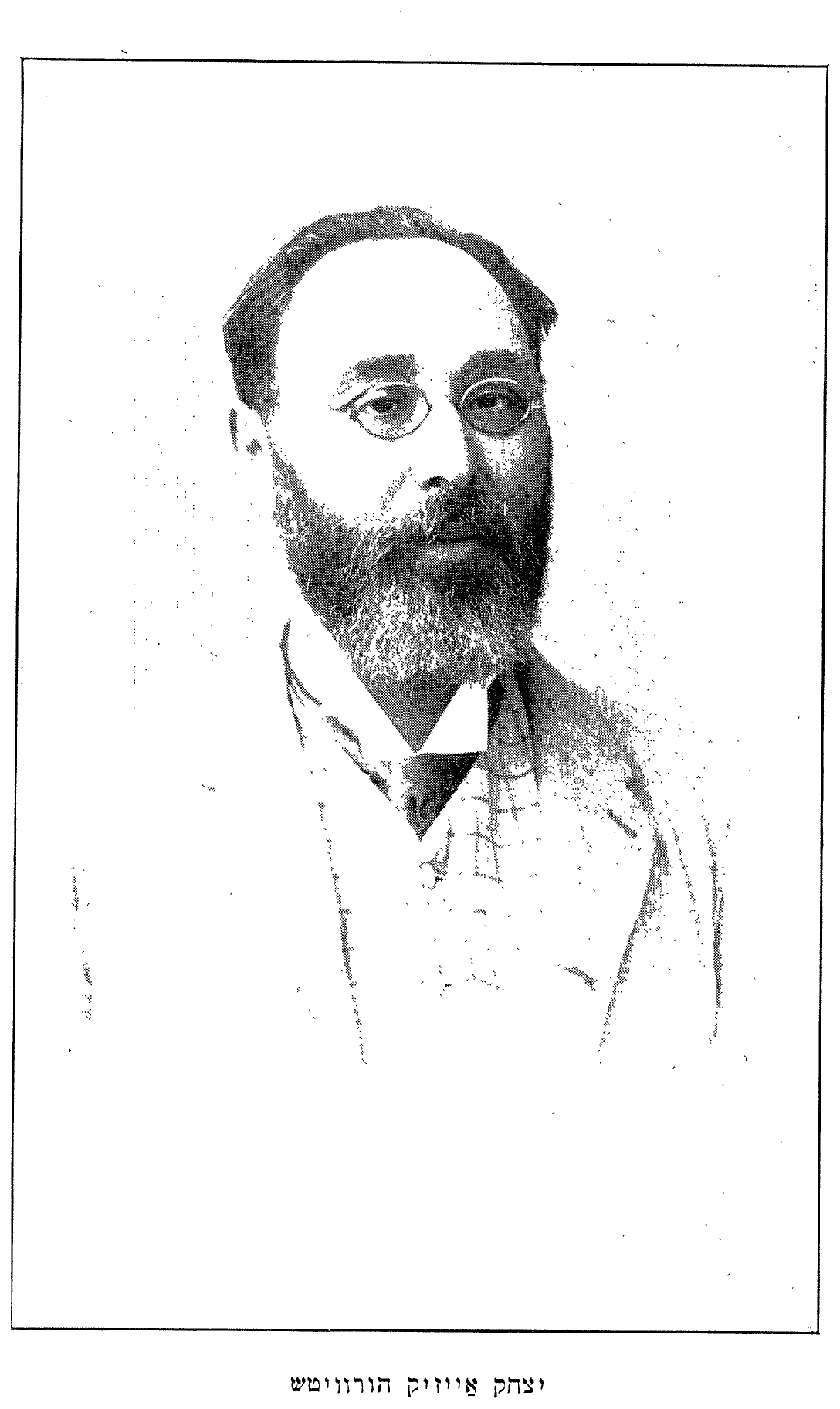
(plate; bound facing printed page 456)
456One of the most important personalities who took part in the "Forverts" in those years was Yitskhok Ayzik Horwitz, with whom the reader is already acquainted from the third volume (page 177 and page 490). He was one of the most educated men among us, and, as a writer of serious articles, he was an important force. He knew a great deal, had something to say, and expressed his thoughts in a clear, intellectually rich manner. He had only begun to write Yiddish in America, and for a long time he wrote his Yiddish in Latin letters. Later he taught himself to write the Yiddish alphabet, but in his handwriting he never caught the true Yiddish cut. A manuscript of his would look "the way a Gentile writes Yiddish." The language itself, however, was even more Yiddish than that of any of us. We write, for example, "oykh" (also), and he would deliberately use "oykhet." There was in this a slight hint of irony, as though the whole business of writing Yiddish struck him as comical. Later, though, he became fully accustomed to his Yiddish as a language like all languages, and there came to be in457him a peculiar style of his own. In this idiom he would express his thoughts on the most serious political and social matters.
For a long time he did not belong to the Socialist party. He was a skeptic (epikoyres) on some important parts of Marxism, and also on our whole political program. Yet he was nonetheless a socialist, a revolutionary from the old country.
He had actually begun writing for the "Forverts" even before I came back to the paper. When I was once again editor, he was for a long time in Washington. Then, at my invitation, he began to write in the "Forverts" a weekly "Letter from Washington."
Later, in the spring of 1906, after the first Russian Revolution, and when it became possible for some escaped revolutionaries to return home, he visited his old home, Minsk, where in his young years he had played such a great role as a revolutionary leader of the stirred-up younger generation. He stayed there a good while and was even a candidate for the Duma. He was not elected.
On the way, traveling to Russia, he wrote for the "Forverts" "Little Letters from the Road," and afterward, when he came back, he continued to work at the "Forverts."
I remember a conversation I had with him when he had returned from his journey. I asked him about the feelings with which he had come into his native city after an absence of sixteen years. Such a subject always lay on my mind. I had458never stopped longing for my Vilna; and when he traveled to Minsk, I envied him.
In answer he told me how he had met one of his closest friends of former years. In fact he found only one such friend, and the meeting was a warm one. But it soon became apparent that very little held them in common any longer. In those sixteen years the one had been drawn into one world, and Horwitz into another. The Minsker had developed new acquaintances, new friendships, new interests, which were foreign to Yitskhok Ayzik.
A short time later I too made ready to travel to Russia. My wife was then on a visit to her family in Kiev, and they were already expecting me. But a circumstance arose on account of which my journey had to be postponed.
Among the contributors who arrived since my return was Morris Rosenfeld, the poet. He used to write in our former "Arbeiter Zeitung." There appeared all the poems that he created in 1890 and 1891 (see the third volume, page 230). Afterward he was for several years connected with Orthodox newspapers. There he would often write in an Orthodox spirit, and not seldom poems in which he mocked socialism and us. In 1901 he came into the socialist "Abend-Blatt." He began with a fervent penitential poem, and with a vow-declaration that he would now "no longer enslave his pen to the capitalists," that he was a child of the people, belonging
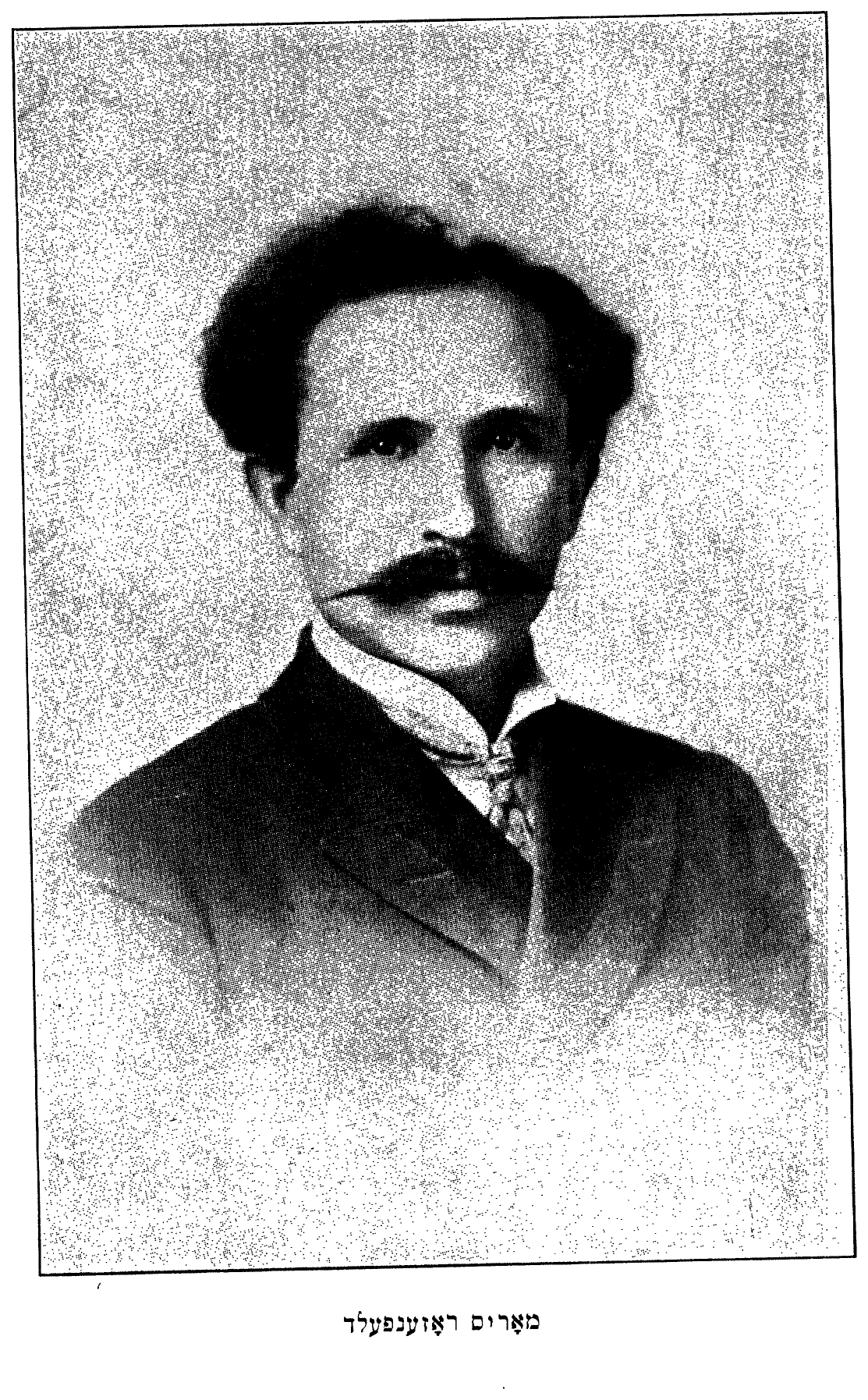
(plate; bound facing printed page 459)
459to the people and would remain with the people. But he soon returned to the "Tageblatt," and his first appearance there then took the form of an enthusiastic poem in honor of its editor and three of its most important contributors.
Once, when we met on the street, he assured me that he was always drawn to the socialists and to the organized workers, and that he would like to work at the "Forverts." This was in 1904. Naturally I did not take his declaration seriously. No one paid any attention to his heart or his standpoint on political or social questions. He was Morris Rosenfeld the poet, and only as such was he regarded — a gifted fiddle-player who can play all sorts of tunes on his instrument and at all sorts of weddings.
I believed that such a frivolous, irresponsible person with such a talent ought to be kept in check; that we ought to take him under our wing. He was already famous by then, not only among Jews but also among Christians. His poems had already begun to be translated into various languages.
There could then be no question of his making a false impression on the public or of fooling himself. Everyone knew him. Everyone knew both his talent and his character. I believed that in our hands his power would be put to proper use. It would simply be a pity if his wonderful gift were to be lost on unsympathetic ends.
I expressed this to the comrades. There was a difference of opinion, but not a sharp one. I took him in.
He wrote for us feuilletons in prose, so460good as poems. His feuilletons, though much in them was naive and crude, contained a great deal of talented material: here a strong bit of humor, there such a well-turned witticism, sometimes a little vignette, sometimes a venomous attack (these attacks of his had to be controlled more than anything, for he had an insatiable appetite for settling accounts with his pen against those he regarded as his personal enemies).
The poems he would often write at our place in the editorial office. On Friday, for example, he would come in, sit down at the common table, and set about building his verses. With his black, curly head of hair bent down to the paper, with his cheeks glowing red from an author's excitement, he would sit like that, think, count out the "meter" on his fingers, and write, until — in a very little time — his poem for the Saturday issue would be ready.
Then he would come in to me in my little room and read it aloud. As he did so, he would wink at me every moment with his small black eyes, look me right in the eyes, almost until our foreheads touched, and give me a nervous, mischievous nudge in the arm, as if he were crying out: "Deep, isn't it? A well-turned line, eh? And this one, how do you like it?"
And the more the line pleased him himself, the stronger would be the tug that he would give his listener's arm.
Sometimes it would happen that the thought of his poem was a false one, or simply not a felicitous one; or it would occur that between one verse and another there was a glaring contradiction. In such a case I would call his attention to the fault, and he would461sit down at once and correct it; or he would write out a different poem, according to the idea pointed out to him.
He never haggled. Writing came very easily to him; and when he held the pen in his hand, he would picture an image to himself, whether this one or that. To him it was all the same. The imagination simply did the work. While he wrote, he saw the thought as though before his eyes, and for that moment he believed in it. If he was told that one must say exactly the opposite, his imagination would already have begun to paint the "other side of the medal," and he would see it just as vividly as before he had seen the first side. While he was in the act of creating, he was sincere. He thought not with thoughts, and not with settled feelings of justice, truth, human happiness, but with a momentary imagination and with momentary feelings — feelings pure and simple.
He had a flaming, nervous temperament, with very little education and absolutely no capacity for holding an opinion. He had once studied a little Gemara, knew a little Hebrew, and could read German. Once he declaimed for me for half an hour straight from Schiller's "Bell." But of education he had almost none at all. He was ignorant and undeveloped. Later he wrote several English poems. They came hard to him, but they came out beautifully.
He worked with us about ten years (with a pause on account of illness, and later on account of a trip to Europe, where he was everywhere received with honor and with fanfare). He left us (in 1913) because we refused to print the wild attacks he made on various personalities of the Jewish quarter.
462At the beginning of 1906 I invited M. Baranov to work with us on the "Forverts." He was mentioned in two places in the third volume (pages 297-298 and 411-412). When we split off from the De Leonists and their "Abend-Blatt" and founded the "Forverts" in 1897, he remained with the "Abend-Blatt." He was a withdrawn person, not a public man. He was no orator, and at meetings one saw him very rarely. Thus he took no part in our party quarrels. His sympathies, however, were with the "Abend-Blatt," and he wrote in it.
If he did not mix into our political disputes as an orator or as a meeting-goer, he nonetheless gradually began to take part in them with his pen. He printed in the "Abend-Blatt" feuilletons in which he attacked the leaders of our opposition.
He used to write with a remarkably clear style, with short, firm sentences, and with a cutting humor. These feuilletons of his would make an impression. He was a born satirist. Very often his attack would contain his original wit, sharp as a spear.
Since he had immigrated to America, in 1895, he had qualified as a dentist. He practiced his profession and built up a good practice. But he never had any liking for it. He was a man of books, an educated man (in the eighties he had been at the University of Kharkov) and a great reader. In his free hours he would read a great deal, and his articles for the "Abend-Blatt."
463Later, when the new struggle against De Leon began — the struggle of the "Kangaroos" — he left the "Abend-Blatt." But he did not join the "Kangaroos," and when they founded their "Folks-Zeitung," he took no part in it. His talented pen remained without a newspaper.
When I was already back at the "Forverts," I often thought of him as a desirable contributor.
We had long not seen each other. In his attacks against the leaders of our opposition and against the "Forverts," he used to thrash me. He would attack them all except me. After I had left the "Forverts" (in 1897), this was natural, for by then I was no longer active in the opposition or in the movement at all. But he did not attack me even when I was still active in the opposition.
Still — we belonged to two hostile camps, and we had become estranged from one another. We never met. When I again became editor of the "Forverts," and he was without a newspaper, I longed to ask him to write for us. But the other "Forverts-ists" could not forget his bitter attacks, and his name was treyf (unclean) to them.
The hatred was purely political. And it stemmed from the venomous attacks that he used to make on our side. He was a true socialist and a highly honest and noble man. So, when about four years had passed, and I believed that the old bitterness had already much weakened, I wrote him a letter. This was in April 1906. We
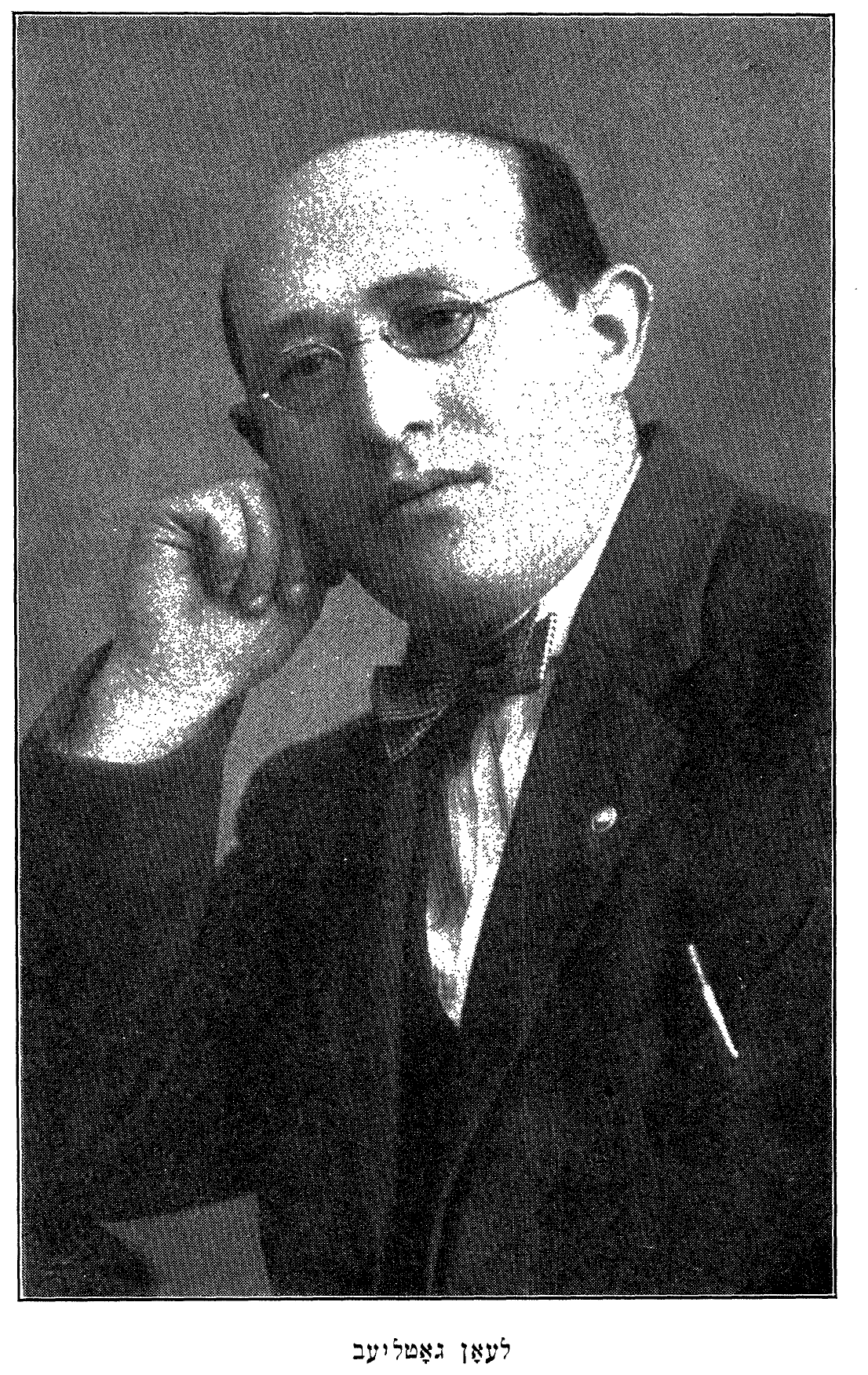
(plate; bound facing printed page 464)
464met in a café, and he became a contributor to the "Forverts." His first article appeared on the 31st of April.
Many of the comrades were indignant. Baranov in the "Forverts"! It caused a great commotion. Had the "Forverts Association" adopted a resolution against his contributing, his connection with the paper would naturally have been impossible. But no such resolution was adopted.
At first he contributed irregularly, but he soon began to write regularly, twice a week. One of his first articles was about Maxim Gorky, who was then in America, and about his famous, sensational visit.*
Baranov at once became one of the most important forces among us. His brilliant articles and feuilletons grew in popularity. Those against whom he would set himself with his sharp wit would become his bitter enemies. But among the general reading public he won many adherents, and many even of those whose party or group he used to attack would also read him with the deepest interest — read, and laugh in spite of themselves at his venomously witty barbs.
For eighteen years he was bound to our paper — until his death (he died on the 24th of November, 1924).
Not seldom it would happen to us, under one of his sentences,465to append a note that we did not agree with him — a "reservation" he would call it — or else to drop the sentence altogether. But as a socialist he was always a true one, and everything he wrote came from his heart with him.
He was a good, soft person, only quick-tempered and hot-headed. When he would boil over, it would take the form of explosive humor. And he would fly into a rage the moment he took the pen in his hand — such an impression his writing would make.
B. Feigenbaum gradually began to take part in the "Forverts," and finally he became a regular contributor. He used to write part of the editorials and other serious articles. In the movement there were no longer any party differences between us. True, he was to the left of me (in those years we did not use the expression "left" or a "leftist"), and he was not satisfied with my "journalistic policy." But he had long since thrown off De Leonism, and he was active in our party.*
As the reader already knows from the third volume of these "Pages," in his very young years he had been a sharp "Gemara head," with a brilliant memory. Later his rare abilities developed under the influence of new movements. His mind was a466source of interesting thoughts. This could be felt in him both as a speaker and as a writer.
Apart from questions of political or social content, his favorite subject was religion. And his articles and pamphlets against God, the Torah, and the Gemara were very popular. The younger generation of freethinkers used to see him criticize as an apikoyres (heretic) who could not free himself from his old heretical passions.
In 1905 a young man came into the editorial office who revolutionized a new depth in the Yiddish journalistic world. He had grown up in America and had finished college here in New York. His parents were from Russia, from the Minsk province, and he had been born there. But he had come to America as a child, and he did not know a word of Russian or Polish. Yiddish, however, he spoke and wrote just like all of us, and he was also well acquainted with Hebrew and with Gemara. At the same time that he studied at college ("College of the City of New York") he would go in the afternoons to the New York yeshiva Rabbi Yitzchok Elchanan. His name is Hillel Rogoff.
He was an excellent logician, and his Yiddish was as clear as his logic. With this, and with his thorough acquaintance with American history and with American political life, he became with us an important contributor for serious articles.
As these lines are being written (at the beginning of 1928), Rogoff is still bound to the "Forverts" — one of the most important members of our editorial family. And to this day he remains the only one of his deeply Yiddish kind of writer. No other American-raised young man has come up in the New York Yiddish journalism.
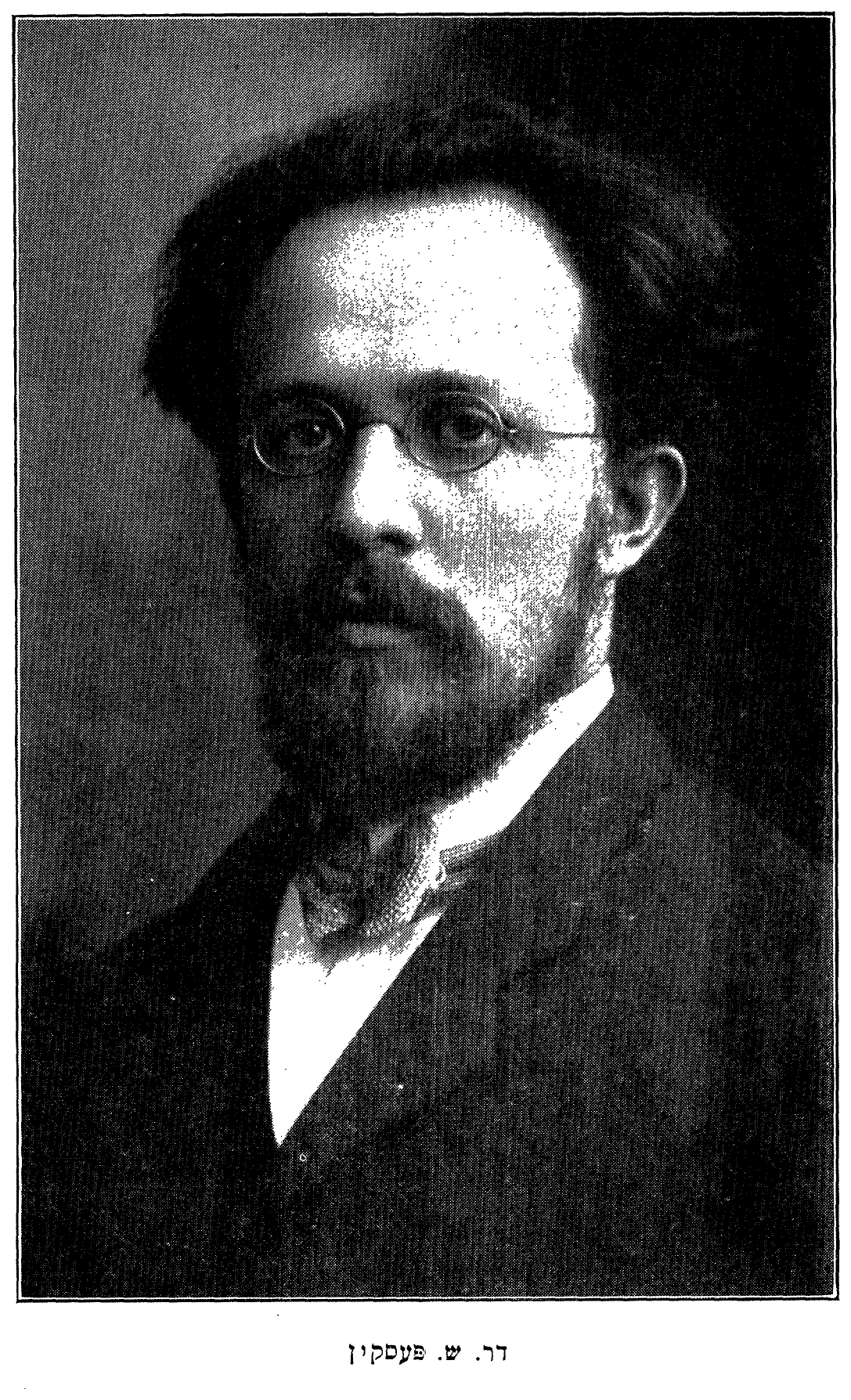
(plate; bound facing printed page 467)
467In 1904 Miller left the "Forverts" entirely (the reader will find more details about this in the next chapter). A. Liessin's editorials, with their substantial content and their brilliant language, appeared sometimes regularly, twice a week, and sometimes irregularly. When he became active, he would, besides editorials, also write other articles — on political-social questions or on Jewish matters. During an election campaign his pen would always work diligently. But sometimes in ordinary months as well. When one leafs through the "Forverts" of 1909 and 1910, for example, one finds there many of his articles. He was strongly nationalist-Jewish in sentiment and at the same time a true socialist and Bundist.
From time to time a new poem of his would appear, a lyric poem, in a splendid melodious Yiddish.
An active contributor of editorials and other serious treatises was Dr. S. Peskin. He was among the first comrades with us who recognized the importance of Eduard Bernstein's innovations in socialist thought. He used to express these new ideas in the "Forverts."
Dr. Peskin is a serious thinker. He would always interest himself in works on social questions, and he always read a great deal. He has a clear style, and an article of his always had important content.
A part of the editorials and other serious treatises were by me. Literary criticism and theater criticism were always from my pen. In addition
(plate; bound facing printed page 468)
468also belonged a section "Literature and Life" — which in those years I used to conduct once a week.
In the spring years of Yiddish literature the "Forverts" was the only periodical in the world that concerned itself with literary criticism. The first critical articles or critical notes about the young Yiddish writers of the old country appeared in the "Forverts" (see what Abraham Reisen tells about this matter, on pages 321-324, in this volume).
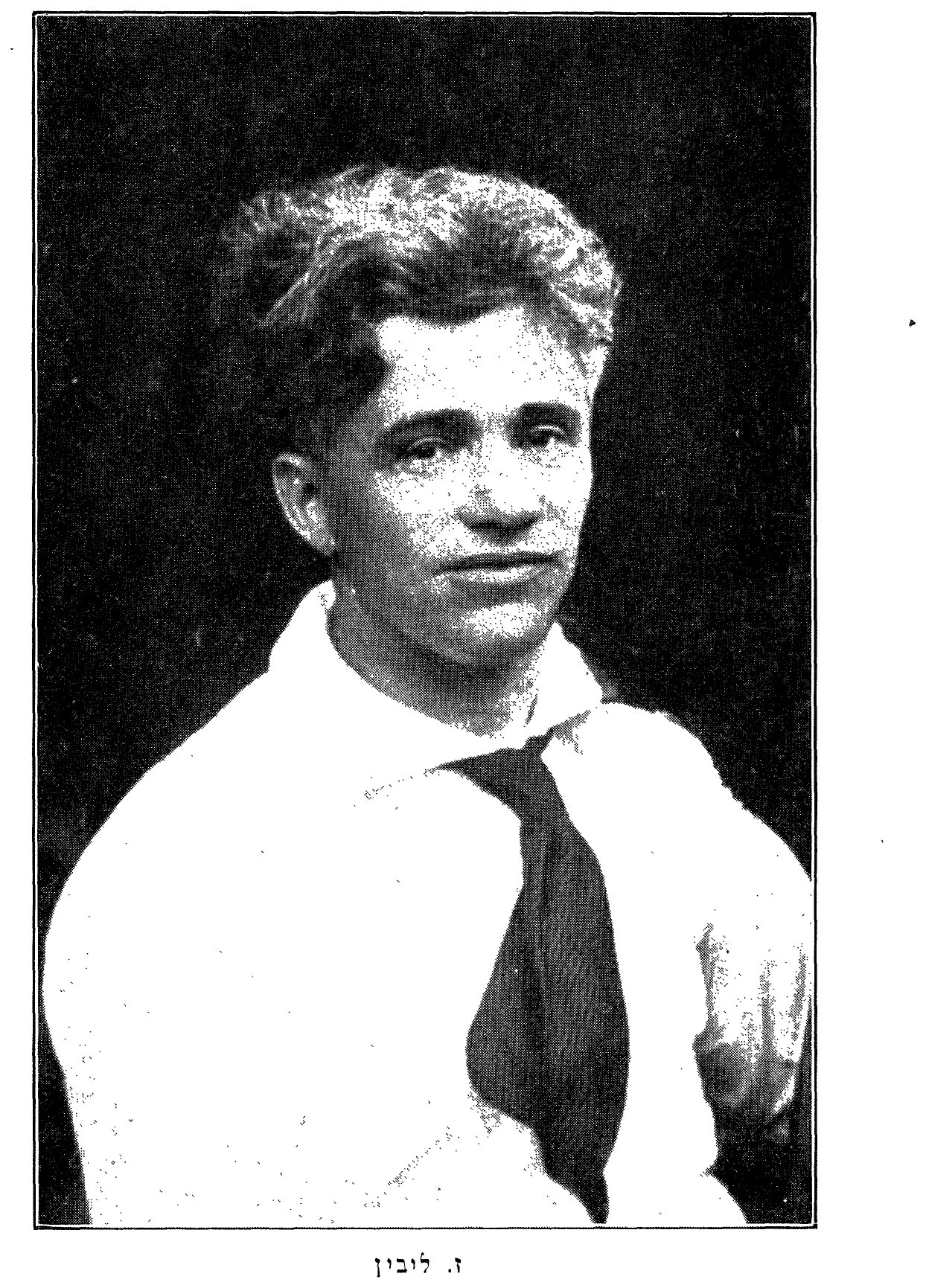
The most talented writer of Yiddish sketches and short stories in America was Z. Libin, who was mentioned in the third volume (pages 371-372), and he was our contributor. His peculiar, good-natured humor and tragicomedy gained his stories a great popularity. They are not merely versified little tales. A great number of them belong to the treasures of Yiddish literature.
Later, when Bal-Makhshoves had already written his critical surveys and had become acquainted with Libin's work, he expressed the same opinion about them.
Libin began his career as a writer in the "Arbeiter Zeitung," when I was its editor. Once, in 1893, when I was looking for something in my paper-basket (wastepaper basket) among the discarded papers, my attention was drawn by a strangely-looking handwriting. I smoothed out the few stitched-together little sheets and tried to read them. But this was a hard undertaking. The "lameds" were too tall and twisted at the top, and the "long nuns" reached too far down and were also469twisted. A "lamed" from one line had curled together with a "long nun" from the line above; and the remaining letters were simply not legible enough. All in all, the writing looked like a heap of scattered hay. That itself aroused my curiosity.
I read the little sheets through as they were. It was a feuilleton. I liked it and I printed it. (Libin is left-handed, and that is the main cause of his odd handwriting.)
He was an intelligent young man from the old country (Horki, Mogilev province). In New York he was then working at caps (hats). He wrote further feuilletons for the "Arbeiter Zeitung," and afterward sketches and stories. He developed quickly. His sketches would be read aloud and retold in various Jewish homes. Later he began to write for the stage. His talent shows itself in his plays too. They also contain much humor, and a good number of them were successful. From an artistic standpoint, however, his stories stand much higher.
As these lines are being written, Libin is still a contributor to the "Forverts," and his sketches and feuilletons are very popular.
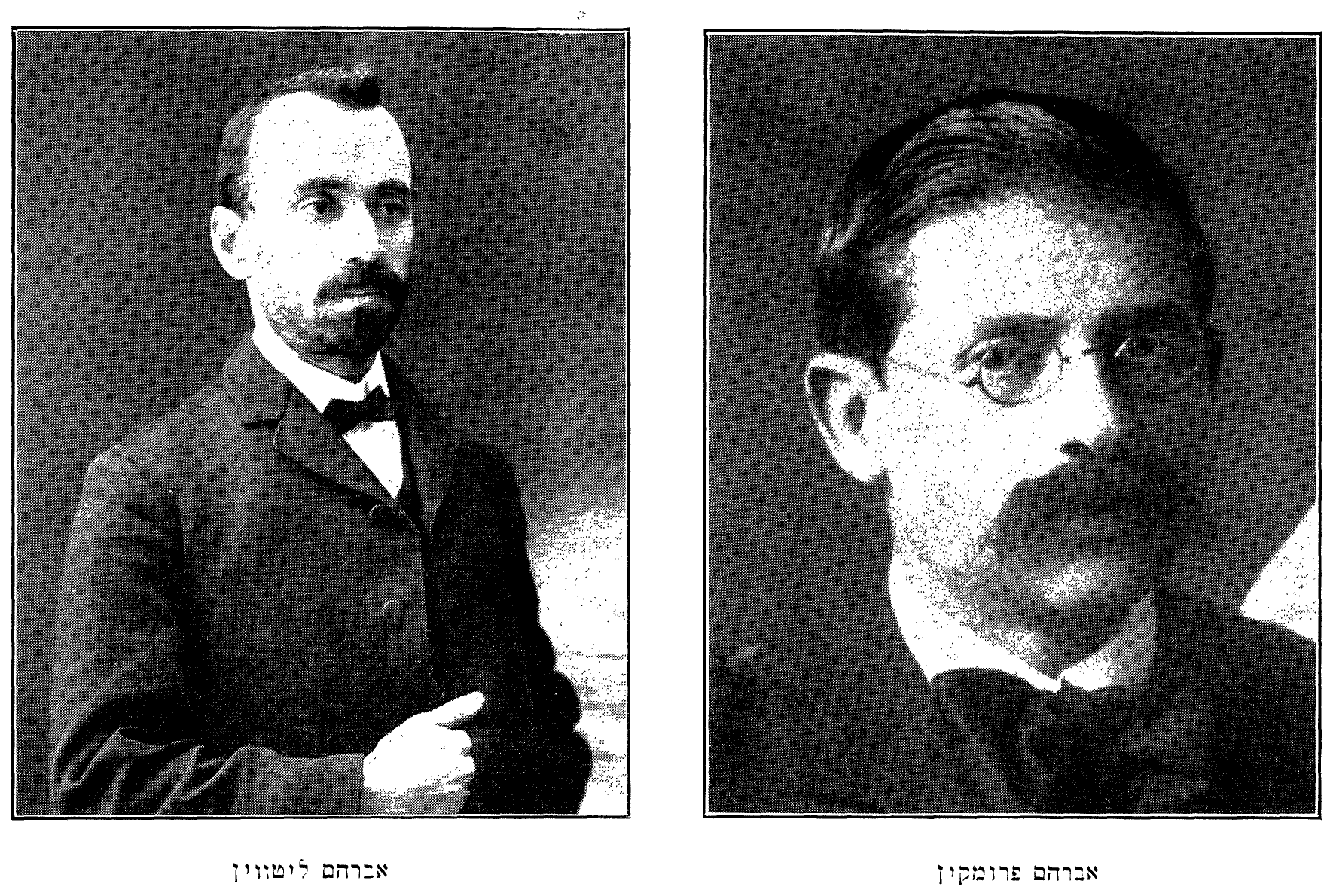
In the course of the first decade of the new century there also took part in the "Forverts," for a longer or shorter time: A. Litvin, H. Burgin, L. Kobrin, B. Gorin,* Yoel Entin, S. Eliashevich, Karl Farenberg, Israel Friedman, A. Voliner, and — in Philadelphia — S. Frenovits.
(plate; bound facing printed page 470)
470Litvin was a contributor while he was in New York. Afterward he returned to Russia, and from there he sent us important correspondence. He thoroughly investigated many corners of Jewish life in our old home. As a result, his correspondences contained many valuable descriptions of Jewish types, customs, and folk-tales.
In the summer of 1906, right after the slaughter of Jews took place in Bialystok, he visited the city, and on the 27th of June the "Forverts" contained a remarkable report of the bloody occurrence.
Litvin later returned to New York, and for a certain time he continued his contributions to us.
Sholem Asch and Abraham Reisen, in those years, printed in the "Forverts" all the stories that they then created (Reisen his poems too).
Burgin and Entin wrote various articles; sometimes editorials. Burgin was connected with the "Forverts" for several years without interruption.
The "Forverts" did not restrict itself to printing stories by the talented writers of the old home. It also strove to develop new Jewish talents in America. As a result of this work of ours, several sketch-writers appeared: David Bron, B. Botvinik, M. Adershleger, Yitskhok Blum, and others.
Z. Levin held himself at a distance for several years. Afterward he again began to write sketches for us. With this began the most important chapter in his literary career.
M. Olgin, in the course of a few years, sent us correspondence and articles from Russia and afterward from471Vienna and from Geneva. Finally he came over to America and became an important inner contributor at the "Forverts."
Zivion (Dr. Hoffman) began his contributing to the "Forverts" from Germany, where he was then studying. Afterward he too came to America, where he continued his contributing (he is still with us today — one of our most important writers).
S. Frenovits, who is also with us to this day, had in the "Forverts" many interesting depictions of the life in Philadelphia.
A "picture"*, which has played and still plays an interesting role in the life of the "Forverts," is the "Bintel Brief" (Bundle of Letters). It has now existed with us for nearly twenty-three years.
I had, in fact, begun the feature two years earlier. In 1903 I began to think about plans for how to interest the public not only as readers of the "Forverts," but also as writers for the "Forverts." Talking with the contributors, I would express to them the following idea: the "Forverts" must be a living newspaper, that is, not only that the articles472must be interesting to read, but also that much should come to it from life itself. In this connection I would often bring up the saying: "Life is more curious than invented tales." So I had a wish that the "Forverts" should receive stories from life itself" — dramas, comedies, or curious occurrences such as were not created at a writer's desk, but in the apartments, in the factories, in the caps (shops), — everywhere where life plays its own plays. I would often remind my colleagues that the strongest theater-pieces are performed not on the stage, but in the real world, among real people. So there developed in me the plan to try to draw out of reality as many interesting occurrences as possible.
But how does one do this? It is a hard task — perhaps harder than writing up an interesting drama or comedy.
In 1903 I turned to the readers, that they should send us interesting "true romances." A few such romances did come in, and I gave the feature a name, "True Romances Sent in by Readers."
Some of them were really interesting, but their number was relatively small. The main difficulty consisted in the fact that the readers could not judge well what I meant by "interesting." Each one thought that what had happened to him and was interesting to him was already interesting to everyone. And often this is in fact correct. The only question is how the event is conveyed. Most often the most interesting part would be skipped over. What we used to get had no value.
473I was disappointed. But I did not give up the hope of developing the "picture."
In 1904 I broadened the theme still further. Instead of asking the readers for interesting romances, I asked them for interesting plain "true occurrences" — events of every sort. I believed that this would make it easier for the readers to select experiences that would really be interesting. These "true occurrences" ran for a certain time and had success. There were even weeks when the feature had very great success. Mountains of letters would come in. But out of several dozen such, one could hardly select one. The above-mentioned difficulty was still great.
I wrote explanations. I pointed out that absolutely every person has had in his life many highly interesting experiences, and that such experiences ought to be interesting to everyone; that this is the true wisdom of the best literature. But the broad public did not understand exactly what was meant by it. Masses of letters would come in about experiences that had not a crumb of significance from any standpoint. Finally I was forced to discontinue this feature too.
Several months passed. On a certain day in January 1906, Comrade Gotlieb tells me that there had come into the editorial office three letters that did not fit into any feature — neither into the "From People to People" (so I had named the column in which the readers would write their letters about the movement or about other communal matters), nor into the news, nor into the reports from unions and other organizations. All three letters had a private character, not a public one, and474I looked over the three letters, and my answer was:
— Let us print them together and give it a name, "A Bintel Brief" (A Bundle of Letters).
In doing so I explained: the name itself will probably draw people, it will be read. An interesting "picture" could come out of it.
When I read through the three letters, it turned out that two of them were very important, precisely by their content — that they could serve as an example to explain what we mean by interesting true occurrences, by "good living material, supplied by life itself."
A woman from Eldridge Street had wanted, through the "Forverts," to turn to a neighbor of hers, to ask her to return a clock. Once, when she had to go out into the street, the neighbor watched the house for her. When the housewife came back, she noticed that the clock was gone. Afterward she learned that the clock was in a pawnshop (a place where one pawns things). She did not consider the neighbor a thief. Yet she suspected that she had carried off the clock to the pawnshop, because her husband was out of work and the family was in great need.
In her letter to the "Forverts" the woman wrote that she understood her neighbor's situation and had pity on her. But she was afraid that her husband, too, might lose his work, and then she herself would have to go to the pawnshop. So, if she [the neighbor] would return to her the "pawnshop" ticket (the slip from the establishment where things are pawned), she would pretend to know nothing. Let her leave the ticket somewhere in her house; she will find it. She asks her to keep coming to her home. She assures her that she will be a good guest, as always.
475Such a sort of letter would never have occurred to the woman to send us, had the "Forverts" not all along shown the public that it considers such worldly matters, things of human interest, important and fit for a newspaper.
The letter reflects a piece of workers' life better than the most talented belletrist could have done it. I was delighted with it. Here we had an excellent example for the readers of what we meant.
One of the other two was also very interesting: a reader tells how a Jew sold him his recitation of the grace after meals for a couple of cents. For two cents he agreed that he would say the after-blessing and the mitzvah (good deed) would belong to him, to the buyer. The third letter was about another matter.
I printed all three letters and wrote an explanation of what made them interesting, and asked the readers to send us more such letters about interesting events or observations.
The letter was printed on the 20th of January, and — really: with the help of the explanations it called forth an enormous interest. Through our friends in the unions and the Arbeiter Ring (Workmen's Circle) we received frequent reports about how the public was responding to the "Forverts"; so we now received from many places interesting news in regard to the three letters, chiefly to the story of the clock.
Afterward I wrote other explanations, and yet others — all pointing to the sort of letter that we wanted for the "Bintel Brief." And remarkably: the letter about the clock had, as it were, opened the public's eyes; as though they had answered us: "Now we already understand what you want." Various interesting letters began to come in.
476"The second Bintel" was printed on the 29th of January. The further it went, the more letters came in, until it became a regular daily "picture."
Under each letter I wrote an explanation of the situation, or event, presented in the letter, and along with it also advice as to how the reader should act.
In this way the "picture" developed. Along with it the following began to be noticed: most of the letters that came in to the "Bintel" were about family affairs: about love, jealousy, relations between husband and wife, about husband and children — in short: about the most intimate phenomena of human life. This was natural. Everyone writes about what lies closest to his heart.
The result was that we would compose the "Bintel Brief" from letters that reflected the most interesting corners of the human soul. And the interest of the public was enormous. The "Bintel Brief" became indescribably popular.
Letters would come in whole packs. Among them a great majority still consisted of such as could not be used. But the number of letters worth printing grew greater and greater. Explanations were again demanded as to what sort of letters we wanted, and I wrote such explanations again and again. But in part the "Bintel Brief" itself was the best teacher for the readers. Reading it, they felt more clearly what we meant by our demand that they should describe to us interesting personal occurrences and experiences.
One must, however, note the following. The writers of the letters had in mind not the "Forverts" readers, but477themselves. They wrote in order to get advice from us, or simply to unburden their hearts. But many of them understood what we had in mind, that is, which sort we regarded as interesting.
All the letters Comrade Gotlieb would read through and sort — he would throw away the worthless ones and set aside those that were usable. In this way I would compose a "Bintel Brief" out of two or three letters, and would add the answers — our interpretations and counsel.
Often the "Bintel" would consist of a single long letter, sometimes of three solidly-set columns in a row, or even more — that much space we would give over to a letter that was especially interesting.
Many American newspapers have a "picture" where girls or young people turn for advice on matters of love. But the question is mostly expressed in three or four lines: "She" is keeping company with a young man who is no breadwinner; should she go with him to the theater? Or: should she allow so-and-so to give her such a kiss? Or: a girlfriend of hers is flirting with her beloved; should she break off relations with her, or pay it no attention? And the answer too mostly takes up only a few lines.
In our "Bintel Brief," by contrast, we began to print whole letters. Some of them, as said, were long and detailed. The woman writer, for example, pours out her heart, tells facts and details. Very often such a letter contained a complete picture of the situation it dealt with, and very often a deep psychological portrayal, whether of the writer of the letter, or of the person against whom the writer (male or female) has a grievance.
478True, the complaint is usually one-sided, for the letter represents only the side of the writer (man or woman). But often the other side shows through that single side as well. And very often you see in the lament precisely the facts together with the feelings.
And our reply, too, would be a detailed one — running to many lines; sometimes to a whole column. I have said that it is mostly a matter of matchmaking (shidukhim) or love affairs, romantic relationships, jealousy. But masses of the letters are of another sort of content. The most varied relationships intertwine in the most varied situations and feelings.
People, especially the little-educated, have a need for an opportunity to pour out their burdened, pain-stricken hearts. In our great immigrant mass this kind of need is a very sharp one. Hundreds of thousands of people are torn away from their homes, from those near to them; lonely souls who thirst for a chance to unburden their heart and to awaken some interest in themselves, to hear an opinion and a piece of advice about what oppresses them. It is just this sort of opportunity, this sort of occasion, that the "Bintel Brief" (Bundle of Letters) created.
From time to time letters reach us from Christians, who have heard of the "picture." They cannot find such a department anywhere, they say, and they have need of a friend before whom to unburden the heart and from whom to hear an opinion. Some of such letters from Christians are from Christian girls who are in love with Jewish men, or with whom Jews are in love.
Many of the letters are badly written, and in order to make them printable one must rewrite them. Many letters479are evidently written not by the persons whose hearts are poured out in them, but by others, whom they ask to write down what they tell them.
There even developed a special occupation — writing letters for the "Bintel." Signs (shilden) appeared: "Letters written here for the 'Bintel Brief.'"
Often the professional "Bintel writer" would let himself go with his own "melitse" (florid rhetoric), and that, naturally, we would cross out.
Very often a woman or a man comes to us and asks that someone in our editorial office write a letter to the "Bintel" for her or him.
Through the "Bintel Brief" many mothers have found their lost sons or daughters, whom they had not seen for twenty or twenty-five years. Twice it happened that, through the "Bintel Brief," a married couple discovered that they were in fact sister and brother (in one such case the mother visited the editorial office of the "Forverts" with a baby in her arms, a little girl who was at one and the same time her daughter and her niece. Her brother was the father of the child, and they themselves had not known this beforehand).
Various other astonishing discoveries were made through the "Bintel Brief." A mother who had lost her child when it was a few months old, or perhaps a couple of years, and twenty-some years later found the child through the "Forverts" — such occurrences happened, in the twenty-three years, without number. This is by now almost an ordinary thing. Yet they always arouse a tremendous interest.
480Take, for example, a mother who once lost a little boy of hers. She had left him in an Italian household where she had been living, and the Italian family moved away elsewhere, and she lost their trace. The Jewish boy grew up as an Italian. He thought that the family were his parents. Later, however, when he was already a married man, he learned by chance that they were not his father and mother at all, and that he was in fact a Jew. He could find no rest. He felt himself drawn to his unknown parents. He confided his secret to a Jew, and that man advised him to turn to the "Bintel Brief." He did so, and within a few days his real mother, the Jewish mother, fell upon his neck with passionate kisses and with weeping for joy.
Or take the following occurrence:
An intelligent young woman had had a child without being married. She had carried the baby off to a German institution, a Catholic one, where they take in abandoned infants. A little door opens; you lay the baby in, just as you put a letter into a letterbox. The little door closes — and after that the mother can never again see the child.
Several years went by. One day a letter arrived at the "Bintel Brief" from the state of Texas. The letter was written by a young man who had been raised as a Catholic. A rumor had reached him that he was of Jewish parents. He began to long for a mother whom he had never seen in his life. He was advised to turn to the "Bintel Brief." To us he481written. We printed his letter, and — the mother turned up.
They began to correspond. On his body there were certain birthmarks. The mother became convinced that this was her son. She traveled over to him, in Texas, and we received from them a letter full of happiness.
These are only a few of dozens of occurrences. Many of these reunions take place in the editorial office of the "Forverts." And often — when the readers know in advance that tomorrow a mother and a son who have not seen each other for many years are to come together — a crowd waits out on the street, beside our building, to see the happy mother with her recovered child.
Yes, such and other sensational happenings are a fairly frequent thing in the "Bintel Brief." But it is not in these that lies the chief source of its enormous success.
The essence of the "Bintel Brief" consisted, and always consists, of the quiet tragedies of human souls — truly remarkable pages of the "book of life," as I used to express it in my articles or notes about the "picture."
Many themes have been taken from the "Bintel Brief" by writers of dramas, or writers of sketches, for their works. A world of literary interest lies in the "Bintel Brief."
In closing, I want to give a few examples of the quieter letters that the "Bintel Brief" printed in the first few years of its existence. I will also give here a few of the quiet life-dramas that the "Bintel Brief" reflects.
482A man married a woman against his will. The girl was in love with him to the point of madness, and he simply did not have the courage to refuse to go to the wedding canopy (khupe). Yet, at the last minute, he wanted to say no, for he loved another, although he did not know where she was. But the bride swore to him that at any time the other woman should turn up, she would give him a divorce (get) and set him free. All this took place in Russia. They married and went off to America. Here, when they already had two children, the other woman turned up, and his love for her instantly flared up again. What is he now to do?
Or take a quite simple case, which occurred in the first months of the "Bintel Brief's" existence.
A girl, not very young, but not ugly either, had for a fiancé a plain, honest man. She considered herself a person of higher pedigree (yikhes) than he, and more educated. In truth she was absolutely ignorant; she could only read the light things in a newspaper. With that she held herself in high regard. He was a man without affectation, a sincere, sympathetic man of the people. And his friends were just as plain and just as honest people as he. So, she would torment him, saying that he must not be friends with such young fellows. She wanted to "cultivate" him, she would say, "make a man of him," and she wanted that when they married they should have an "intelligent," "fine" home with "fine" company.
The end was that, with her "intelligent" coquetries and with the fact that she held him back from his comrades, she wearied him, and he left her.
483Then she took to running to our office and weeping to me for ages that I should write to her fiancé in the "Bintel Brief" and bring him back to her.
The words "Bintel Brief" became such a familiar expression that people used them, and use them, as a part of our American Yiddish.
"A remarkable story — go ahead and put it in the Bintel Brief," or "It's a Bintel Brief story, I swear" — such words are commonly said about an interesting happening of family life or some tangle of a touching, romantic character.
Masses of Jewish women who could not read learned to read because of the "Bintel Brief." And cases were told where, on account of the "Bintel Brief," people moved to another apartment because there a relative or a friend who could read the "Bintel Brief" lived as a neighbor.
The first two or three years I used to answer all the letters in the "Bintel" myself. My secretary, Leon Gottlieb, would read them, select the ones that were worth printing, correct the language, and then hand them over to me to write the replies. I used to do the work with the greatest pleasure. For in these letters one sees a rare panorama of human souls. I had a literary interest in the work. Later it began to demand too much time, and over the course of three years the replies were written by B. Feigenbaum. Today we have a special staff member to read and sort the letters, and a second one to write the replies.
484In the summer of 1909 the "Bintel" contained a letter from a Jewish worker (a children's jacket maker), who told how, from his work with his feet at the sewing machine, one of his legs had become diseased and had to be amputated. He therefore turned to the readers to give him money for crutches. The letter, together with our note beneath it, called forth an indescribable wave of sympathy for the unfortunate worker. Donations (nedoves) began to stream in. There came incomparably more than was needed for crutches. A quite handsome sum was collected (in the "Forverts" of August 21, 1909, a lead editorial appeared about it).
Through the "Bintel Brief," living "little bundles of letters," as we call them, began to appear in our editorial office — people with wounds of the soul, people seeking advice, an answer to a question. Writing is not easy for them, or they do not want to entrust their wound to the public; and to confide their secrets to an acquaintance they do not want either. So they come themselves. There are also enough intelligent people who would rather talk things over in a personal conversation.
Some of these visitors ask that their "bundle of troubles" be put into the "Bintel Brief." No names are mentioned in any case.
In this way a special information bureau was founded at our place. I used to receive all these visitors myself. But this work developed so much that for it we have a special person, an intelligent, experienced, tactful one.
Yet it often happens now that I too receive such visitors personally.
The most interesting life-dramas are, in this bu-485reau, disclosed. Here is an example that comes up in my memory at this moment:
Many years earlier, in the old country, two intimate study-house (besmedresh) comrades, on parting, gave each other their hands and swore eternal faithfulness. Their oath they wrote down on paper — a kind of spiritual contract. This happened when one of them was leaving for America. Twelve (or more) years later the second one also came over. The first was by then already married and rich. He received his youth-friend with enthusiasm. But to help him with money he was too lazy. His wife was better than he, and she used to support her husband's comrade in secret. In this way they used to see each other secretly, and a romance developed between them. The wife came first to the editorial office. She told everything. She asked for advice on how to free herself from her "stingy, bad husband," as she called him. Afterward all three came to us — for a kind of "din toyre" (rabbinical adjudication).
I spent a few hours with them. Afterward they came a second time. The wife made a very good impression. The guest did too, and their love was a true love. The married couple had no children. So she wanted to free herself from her husband. She was ready to leave without a cent, to work and help her beloved "get on his feet in America."
The end was that the husband freed her through the court.
Here is a "sample" of another kind:
A man of middle years had lived for over twenty years with a woman who had always hated him. She loves to have and to raise children, and she needed him only as her provider and as a father to the children that she wanted to bear. He loved her, and de-486spite all this he bore all her insults. But finally his relations toward her changed. Now, when he is already a man of forty-some years, he has felt within himself self-worth as a man, and a romantic interest in younger women. He wants to free himself, but the wife will not allow it. She hates him as ever, and she tells him so as openly and as sharply as ever, but to give him a divorce she refuses.
The American immigrant world is full of upstart rich men (gvirim). It is so, deep down, in other countries too. But nowhere is there such a crop of them as in "Columbus's land" (medine), where new fortunes spring up like mushrooms.
These mushroom-millionaires — most of them ignorant people who have suddenly begun to throw hundreds around and to play an important role — are a grateful theme for jesters. And with no one did this sort of jesting suggest itself so much as with us in the Jewish quarters of the American cities. It simply begged to be mocked. So it occurred to me to print a series of such drawn caricatures.
The question was what to name the series. The words "upstart rich man" are too serious. Something was needed that would have a humorous (katoves) ring. I tried to coin a name. "Well-off" means in American Yiddish "well situated" (nishkoshe in maymed), "a man of means" (nogid), "well-to-do." So I first tried out in my thoughts the word "well-offnik." But this487I at once discarded. It does not sound interesting. It lacks the "snap."
On the 13th of September, 1906, I printed a little agitational tale, in which I depicted how two immigrants come to America, a rich one and a poor one, and how here everything turned upside down: the rich Jew (Azriel is his name), who is not adapted to American conditions, becomes poor here. But the second one, who in the old country had been a servant at Azriel's, "works his way up here." He becomes a manufacturer, and Azriel is one of his workers.
When Azriel came to America, he was fat, with a big belly, while his servant was thin and gaunt. But here it became the reverse: Azriel is now thin and gaunt, and the other one has a big belly.
At our place a young Romanian Christian named Neaga used to draw caricature pictures from time to time. I gave him the content of the little tale and asked him to illustrate it with four pictures, which should show how, bit by bit, the figures of the two immigrants had changed. He did so, and over the four pictures with their captions I placed the heading: "Where did Azriel's belly disappear to?" — that is, Azriel's belly in America had passed over to his former servant.
Looking at this in the "Forverts," I remembered my plan about the upstart rich men. I again began to think about a name.
I remembered the expression "he is all right"*, as our immigrants use it in a certain sense.
488when one says of someone that "he is all right," it can have the same meaning as: "we have already got him provided for," or: "with him one need say nothing more."
At this point the word "a l l - r i g h t n i k" came together in my mind, and I at once felt that this was just the thing one needed; that in it lay the right sort of satirical fun that was called for here.
I then asked Neaga to depict how a plain, ignorant Jewess comes to Hester Street all decked out in fat and honey (i.e., dripping with finery). Beneath this picture I wrote about a dozen lines, in which it is told that earlier she used, indeed, to stand on that very Hester Street with a peddler's pushcart, but that now she already lives in a rich uptown district. And she comes here to show off her ladylike clothes. But when she catches sight of an open barrel of herring, she forgets where in the world she is, and climbs with her fine gloves into the herring barrel (the idea is taken from Zangwill's "Children of the Ghetto").
Over the picture I wrote in large letters:
"A Gallery of All-rightniks."
And so it went on further.
The first "gallery" appeared on October 5, 1906.
The second gallery (October 9) was foun-489ded upon the Azriel caricature. It is depicted how two potbellied "all-rightniks" stand on the street and chat. They stand quite close to one another, yet a little boy can pass between them. The caricature bears the heading "A Living Tunnel."
On January 8 appears a caricature of how an "all-rightnitse" (a female all-rightnik) goes to have her photograph taken. She has a mustache; she covers it with her hand and demands of the photographer that he take her without the mustache, but in such a way that her hand should not show in the picture.
On January 14 it is depicted how "Mister Koylitsh," an all-rightnik, buys pictures for his new dwelling. He does not consider their content or worth as works of art, but only their length and breadth. He measures them only by the yardstick (arshin). He has so-and-so much room on the walls for pictures.
On January 30 there is a caricature of how Beyle, the former chickpea-seller, "is, poor thing, learning to dance." She is fat and no longer very young. It is a hard job. She reflects that earlier, when she sold boiled chickpeas (arbes), her life was easier than now, when she is an aristocrat.
On February 4 a caricature depicts how the newly rich Mister Nivelshik pretends that he does not recognize his former boss (balebos).
On February 11 the "Forverts" had a caricature of how an all-rightnitse learns to nod in an "aristocratic" American manner.
One caricature was a picture of how an all-rightnik wipes the sweat off himself after the hard labor he had in signing his name on a check. On another sits an "all-rightnik" by the name of "Beryl Tsimes." He specially took a teacher and learned to make490his signature. But he can do it only exactly the way he learned. The signature must be just so big. But what does one do when a check happens to come along where there is less room? So poor Beryl has no other choice but to finish his name on the table.
With another caricature it was depicted how an all-rightnik sits in the opera with "plain little earlocks" (i.e., crude tufts) over his ears.
Most of the themes I gave myself. But for some of them the idea came from someone among the colleagues in the editorial office, or from several of us together.
The "picture" had an enormous success, and the word "all-rightnik" became so popular that it entered our folk-speech.
Such an expression had long been needed.
A Jewish playwright, Abraham Schomer (a son of the novelist Shomer — Sheykevitsh), wrote for the famous actor Mogulesco a play by the name of "Di All-rightnikes," and it ran for a long time. Other playwrights put the word into the speech of their characters. On the vaudeville stage songs were composed on the theme "The All-rightnik."
It is already over twenty-two years that the word has been in use. It has remained in the language — a natural part of our American Yiddish.
In our immigrant world there has long been developed a special plague: husbands who run away from their491wives. In the old country, when a man runs away from his wife, it mostly means that he is also running away from his parents, relatives, from the whole little world in which he was born and grew up. In America the immigrant is mostly an isolated person. For him his new home is a lawless (hefker) world. And American cities are big and seething. The country is a vast one, and there are many cities. Go now and look for the runaway! In that human abyss it is easy to vanish.
Letters used to arrive from agunes (abandoned wives, unable to remarry), helpless women with children. Some would come into the editorial office with weeping, that we should find their husbands for them. We did not believe that we had a moral right to print such letters. It would mean meddling in family affairs and forcing a man to live with his wife whether he wishes to or not. But we used to put the question to ourselves: yet what is one to do with a man who deserts a wife with children? Is he not obliged to support them? And when the wife is already old or sick, or helpless in some other way, is it not just that he should maintain her, and not abandon her on the waters, even when there are no children?
Yet at first we did not have courage enough to say yes. And when we did once try to insert a letter or a notice that a man who had left his family was being sought, we used to do it reluctantly. On the editorial pages we actually never used to put such notices. Sometimes we would publish it as a piece of news, or in that department of the advertisements which we call "Personals."
Once the following happened:
A young man came, accompanied by a woman, and brought us a picture of a man. The woman re-492lated that the picture was of her husband, who had run away from her and left her with tiny children. Her escort was an acquaintance of hers, and he helped her arouse sympathy in us.
It was a heart-rending story. So we printed the picture of her husband in the "Personals," and below it an appeal to the man that he should take pity on his little children and send support for the family.
The next morning there was an unpleasant sensation: it turned out that the whole story was a trick by a worker who had quarreled with his boss and lost his "job." In order to take revenge, he had obtained the manufacturer's photograph, brought along a woman as the manufacturer's supposed agune (abandoned wife), softened our hearts, and led us "into the sack" (i.e., completely fooled us).
The manufacturer came to us with his real wife. He threatened a lawsuit. But we gave him full satisfaction with an explanation in the "Forverts" about the whole swindle.
The temptation to print such letters was very great, simply because of the feeling of pity that some of the deserted women used to arouse in us. They used to write in the "Bintel Brief" in the name of the children. The children get up in the morning, for example, and cry and ask: "Where is Papa?" "Papa, why did you leave me?" "All children have a Papa, and I do not." They would insert the pet words with which the father used to caress the child, and the child would appeal: "Am I no longer your dear little baby?" Or the letter reads, for example: "But you gave me a name after your mother, and Grandma, may she rest in peace (oleho hasholem), is so dear to you."
493At some of the women it was truly heart-rending to look. I remember, for example, the figure of a thin, short woman who used to stand for whole days beside my room, silent, without a word. One had to be made of iron not to feel the tragedy that was poured out over her face.
It goes without saying that one cannot always condemn the husband. Many women were the real guilty parties in the tragedies — wives with poisonous characters, who embittered the life of their husbands and literally drove them out of the house. In one case the complainant was a very pretty young woman, and from her first few words one could see that this was a wife with a sharp tongue (mayne-loshn). She turned to me personally and began to speak with angry, insolent words.
"Listen, missus," I said to her, "you are a pretty woman. And from a pretty woman a husband does not run away without a cause."
The result was a rebuke (toykhokhe) directed straight at my address.
But in general, in most cases, there was pity for the deserted women.
On a certain day I resolved to change our rule. Comrade Gottlieb tells the following about it:
"Once I told Comrade Cahan that four pictures of runaway husbands had come in at once. Such pictures we did not used to print. But the pity was very great. To my surprise, Comrade Cahan says: Four pictures is something else. We will call it 'The Gallery of Vanished Husbands.'"
And at this point the new "picture" began.
494In the "Forverts" I published an explanation, which consisted roughly of the following: We do not meddle in family questions. We are absolutely against forcing a man to live with a woman against his will. We demand only, in the name of justice and pity, that when a man leaves children behind, he should not shake the yoke off himself of supporting the children.
Debates began again among the comrades. Many were dissatisfied with the new "picture." They argued that it does not befit a socialist newspaper to print such things. I used to reply to that, and the "picture" was kept up. Once a week we used to print a whole gallery of runaway husbands — several pictures, and beneath each picture the name of the vanished family man and a few details about him.
The women would now come, each with her picture in hand, and ask that their pictures be put into the "Gallery."
A large part of the runaways used to respond through this gallery, and in many cases they came back — some with declarations of love to their wives.
We were cautious. That case with the worker who had submitted a false picture of his boss had served us as a warning. At first we used to investigate each one before we printed it. We used to send someone to visit the agune and find out whether what she related was correct.
The "United Hebrew Charities" of New York acknowledged the importance of this "picture" and passed resolutions of thanks to us. They began to assist, and finally they founded a special "Desertion Bureau" (a bureau concerning de-495serters), which occupies itself with searching out the vanished husbands with the help of our "Gallery." This bureau still exists to this day. It has connections all over America.
We print the pictures that the agunes bring in. But we first send each such woman to the "Desertion Bureau," and they investigate every case. So that there should be some check and some responsibility, the pictures must come through this bureau.
In connection with this department, interesting scenes sometimes occur. For example, a man comes in with his own photograph and explains the following:
"I want to tell you in advance that I am preparing to run away from my wife. She is such a shrew that it is impossible to live with her. She embitters every minute for me. I have no strength left. I have taken all my pictures. Rather than have her bring a picture of mine, I bring it myself, better."
"Yes, but what about the children?" I ask, or my secretary.
"The children I will support," he answers. "I have pawned my two suits and I will leave money for them, and as soon as I get work somewhere, I will send them money."
We made inquiries, found that what he said was correct, and we promised him not to put his picture in the "Gallery."
I remember also a reverse case. A woman comes in with a packet of pictures — larger and smaller ones, and she turns to me.
"What do you need so many pictures for?" I ask her with a smile.
"Dear Mister Editor," she answers, "I496can already see by his face that he is preparing to run away. He would have taken all the pictures, so that I should have nothing to bring here. I know him already... So why should I wait for him? I have headed him off on the road. I know that he will come to you."
About the "Gallery of Vanished Husbands" many sayings were also created, and witty songs, which are sung on the stage. Some call it the "Rogues' Gallery" (the name of the picture gallery kept at the police — the collection of the photographs that are taken of arrested thieves, bandits, murderers, and other criminals).
The theater criticism in the "Forverts" acquired great importance. The public reckoned with it, and the "Forverts's" opinion made itself felt on the fate of a play. From all sides we used to hear of people who would not go to see a new theater piece until they had read a criticism of it in the "Forverts."
We wrote according to our understanding, according to our honest opinions, without partisanship, without fear, and "without favor" (toyves), as the Americans say.
For the humor department we tried to develop in the readers themselves a desire to send in their own jokes. In the "Forverts" of January 5, 1904, I put in a few lines in a box:
"Where do your jokes go to?
Let them not be lost!
Better send them to the 'Forverts'!"
497Sayings and witticisms began to arrive — many from others, many original, mostly not very successful ones. A staff member used to look them over. The direct result was perhaps not great enough. Indirectly, however, it was useful: it accustomed the public to look upon their personal experiences as a source of material for the "Forverts."
My feuilletons "From a Word, a Quart" ran regularly, every Wednesday. But the further it went, the more they took on a serious character. Each of them contained a thought about life in general, or about some special trait of human nature worth reflecting on.
For example:
In 1904 the Victor phonographs (gramophones) appeared. They were not at all comparable to the Edison phonographs. For the first time one heard a true human voice. They made a furor (sensation). Caruso sang from them not a hair worse than his real voice. On February 24, 1904, "From a Word, a Quart" appeared under the title "Phonograph." The chief thought in this feuilleton consisted of the following: Patti — the truly divine Adelina Patti, the queen of the opera over the course of decades — by then no longer had her voice. A short while earlier she had been in America for a concert; she did not even draw a crowd. The hall was empty. In the feuilleton, then, there is talk of the tragedy of bygone greatnesses, and a regret is expressed that Patti's voice did not live a few years longer, so that it could have been made eternal in the phonograph. Far lesser singers, male or female, now sing from the Victor machine, and they498voices will remain for future humanity, just like a book in a library. And Patti's voice died before the phonograph appeared in the world. Patti's voice came too late. And it is lost. So it must remain. The most famous of all the famous is condemned to oblivion.
In a café on Second Avenue, corner of 11th Street, where my wife and I used to eat our supper, a gypsy orchestra used to play. The clarinetist was a stout, motionless man of middle years. When he played, one could scarcely see his fingers or his lips move. He used to sit as if frozen, with the instrument in his hands. And yet his tones were clear and beautiful, full of splendor and feeling. So, on February 14, 1906, I printed a "From a Word, a Quart" under the title "Clarinetist." I depicted the musician's immobility and the splendor of his music. I presented it as mysterious music, of which one does not know whence it comes.
I pointed to other splendors, to great effects that issue from quiet sources. I dwelt on the fact that delicate strokes, tones that do not cry out, can be mightier and more beautiful than stormy effects.
Such feuilletons used to draw much attention and call forth enthusiastic responses. "From a Word, a Quart" ran regularly every Wednesday.
Notes (the original’s footnotes)
[p. 464] The New York newspaper "World" published that the Russian actress Andreyeva, with whom he had come, was not his lawful wife, and then the hotels boycotted them. The whole world buzzed over the affair. Today such a medieval boycott would be impossible in New York, though in more distant American cities it could still happen today.
[p. 465] Philip Krantz remained apart for a good while longer. He too finally entered our editorial family. But this does not belong to the period to which this volume refers.
[p. 469] Gorin was known in Russia as Goyda, a name under which he printed stories and took part in I. L. Peretz's publications. He was one of the first Yiddish sketch-writers in Russia.
[p. 471] Since the word is used here quite often, I shall explain it for the non-American readers. "Picture" (pitshur) means, properly, a facial feature — a nose, an eye, a mouth. But in the American newspaper world the word is used for a feature which an editor introduces to interest readers — some new sort of articles which draw attention.
[p. 487] "All right," if one were to translate it literally, would mean "everything correct." As the phrase goes in the language, "All right," if one were to translate it literally, would mean "everything correct." As the phrase goes in the language, its meaning is: "good," "quite good," or: "good, let it be so, I am satisfied." And when one says "he's all right," it means: "he is healthy," or "he will do," "he fits in," or: "he is a person of consequence," or: "he has money."