Chapter Seventeen
The Further Growth of the "Forverts" and of the Movement
530After we had given up the "Morgen Zeitung" (Morning Newspaper), the circulation of the "Forverts" again began to rise. It grew and grew.
Former "Forverts" readers, who had bought the "Morgen Zeitung" instead of the "Forverts" because "it is, after all, the same people," now returned to our afternoon paper; and from the stream of immigration ever new readers came to us.
Our circulation almost immediately returned to its former level. And it remained there only a very short time. It kept going further and further.
To a considerable degree we owed this to the "Bintel Brief." Interest in it grew with rising speed. Masses of families who had previously read no newspapers began to buy the "Forverts" on account of this "feature" of ours. As has already been said above — many women who could not read taught themselves to read for the sake of the "Bintel Brief." But the number of readers who had531not been interested in this "feature" also grew rapidly. Of the new newspaper readers who came from our old homelands, the "Forverts" received a great majority.
Our income thus grew larger and larger, but that does not mean that our financial difficulties were immediately removed. On the contrary: precisely around that time, when the circulation of the "Forverts" had risen so much, we found ourselves in a serious financial swamp.
We were up to our necks in debt.
The "Forverts" already brought in a handsome profit; but this was eaten up by the interest that the business had to pay. To the heavy mortgages (ipotekn) on the building that we had bought in 1904 and on the great printing press that we acquired at the end of the same year *, and to the old debts from which the enterprise still could not free itself, were added the debts that had piled up through the "Morgen Zeitung" and the "Tsayt Gayst."
We always had to borrow, pay incredibly high interest, and borrow again.
Socialists and friends of the "Forverts" often helped out with loans (in this regard the warmest friendship was shown by several well-to-do socialists of Philadelphia, chiefly the comrades A. Schneur, A. Margolin and H. Shenkin, but in New York too there were friends who came to our aid).
532I noted above that the newspaper already yielded a handsome profit. Had it been a private newspaper, not a socialist one, its income would have been much greater. There are important sources of revenue which for us were forbidden fruit. For example: every year before the elections, American newspapers are full of well-paid advertisements from the candidates of the capitalist parties. The "Forverts" does not take in such advertisements. It prints articles, appeals, campaign appeals for the candidates and meetings only of our socialist party, and for that it naturally receives no payment (and a short time later it began to give large contributions toward the expenses of the socialist election campaign).
The city government spends large sums on certain municipal advertisements. There are also certain advertisements from the state government, which likewise cost large sums. Such advertisements are placed in a Jewish newspaper as well. It is officially determined by the government in which one. When the "Vorhayt," for example, became a Tammany organ, it had all the city advertisements on this account.
There are various other sources of income which come to the newspapers that stand in friendly relations with the party in power.
Such "plums" * were, of course, always closed to us.
We also had, in those years, difficulties in getting private advertisements, precisely because we533were a workers' organ. In those years the American firms were under the impression that our readers were poor people throughout, that they had nothing to buy with. And in case the firms themselves did not arrive at this idea, the agents of other Jewish newspapers would whisper it to them as a secret.
In time the advertisers inquired and found that this was not true. They convinced themselves, first, that the "Forverts" is read by all classes — by immigrants who had grown rich as well as by poor workers; that masses of Jewish tailors, cloakmakers, furriers, capmakers, save up money and scramble to get into a business of their own; and second, that the workers themselves are good customers for the most varied products.
A few years later the "Forverts" became the most important advertising medium (advertising center) in the Jewish press. But at the time of which I am telling here, a conservative "Tageblatt," for example, with a third or a quarter of our circulation, had four times as much income as we did.
The circulation of the "Forverts," however, became so large that the profit of the newspaper did become quite handsome. Had it then been possible to obtain some twenty thousand dollars at low interest and on a long term, it would have put an end to all the financial troubles. But that was not easy to get, and the material situation became ever more strained.
Marcus Yaffe, the manager, was a master at borrowing money. He had original ideas, just as he had enterprising courage. He was, on the whole,534when a capable, clever man and an interesting type, with an interesting sense of humor.
He liked amusing surprises. And some of his pranks became famous. For example: sitting in a restaurant, he sees a poorly dressed young man order a 20-cent steak; he calls the waiter over and tells him to give the young man a 60-cent "sirloin steak" on his account. Then he relishes watching how the other is astonished at the big, juicy piece of meat; how he enjoys the "waiter's mistake," and how the tasty meal does not go down well with him — in case he might actually have to pay 60 cents.
He was fond of a mischievous notion even in business. People used to say of him that he would rather make one dollar through an interesting "trick" than two dollars in the ordinary, natural way.
He was a thin man, not tall, with a dark charm, with clever, dark eyes. He laughed little and spoke little too. He could sit with you for a whole hour and not utter a word; sit and look you in the eyes with a deeply serious expression and be silent. He had a quiet, pleasant smile and a voice that was not loud, but clear, soft, mild. One would hardly believe that this man was so full of humor and mischief.
People became attached to him.
Had he not hit upon the plan of buying a building for the "Forverts," "because there is nothing to rent," and had he not had the boldness to buy a printing press almost without money, the economic development of the "Forverts" would have gone much more slowly than it did.
His virtues, however, were not free of faults.
(plate; bound facing printed page 535)
535He lacked the punctuality and methodicalness of the modern businessman. In times of trouble he was more reminiscent of a shrewd and bold Jewish merchant of the old country in old times than of an American businessman. Often he would wriggle nimbly out of a tight moment, but in such a way that the next day was left in greater danger than the present one had been. He would make promises, knowing that he would not be able to keep them. Afterwards he would cunningly extricate himself; but that was not always possible. His personal magnetism helped him out a great deal. The tangle, however, grew thicker. If, to his ability and boldness, he had also had modern accuracy and a stricter attitude toward obligations, the "Forverts" would have gotten back on its feet financially sooner than it did.
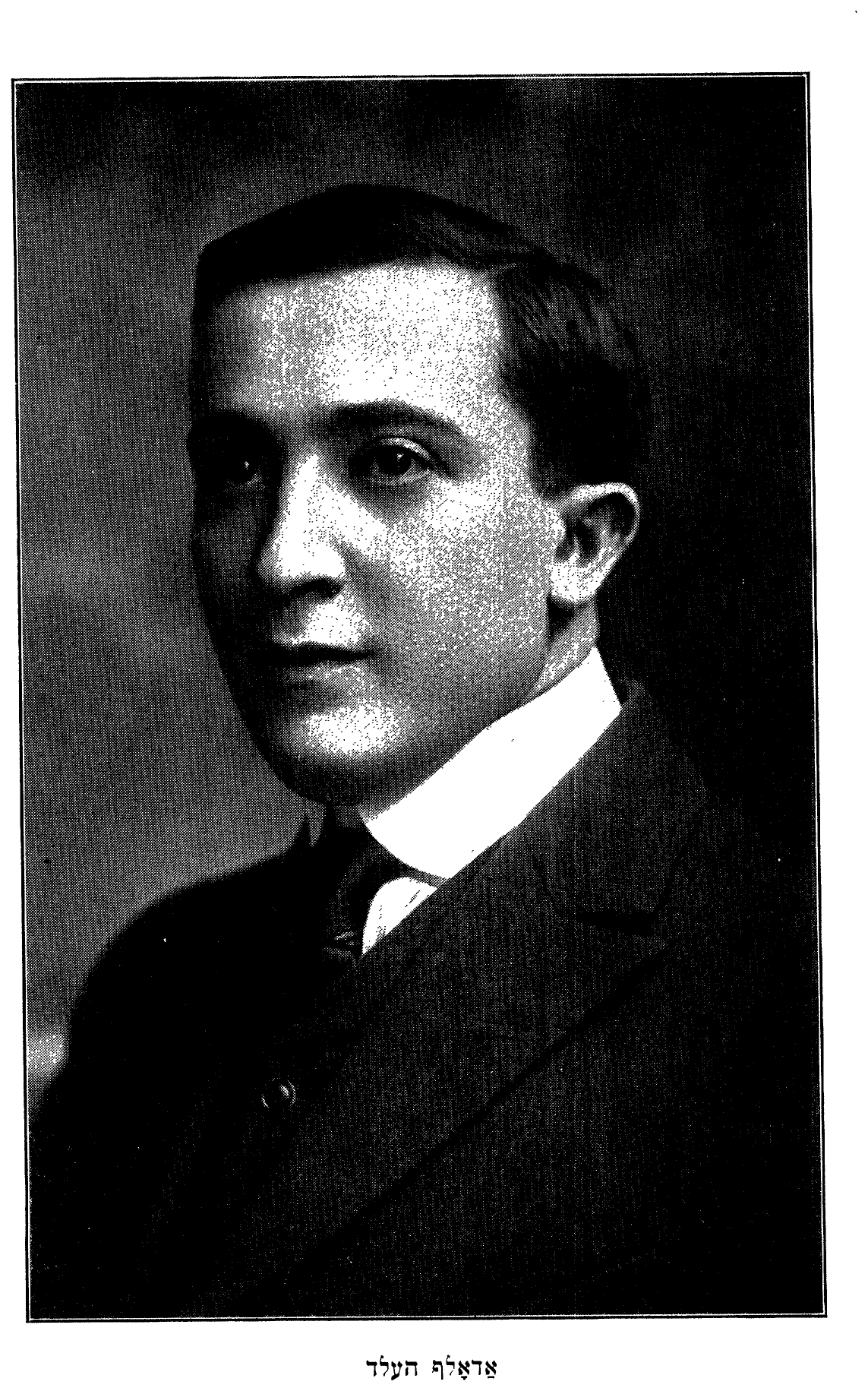
It must be mentioned that Yaffe was not in good health, and that this hampered his work not a little. Finally his illness took on such a form that he was compelled to resign. In his place the association elected a capable young member of its board of directors — Adolph Held.
Held had come to America as a child. He attended an American public school and afterwards the New York City College, which he finished in 1906. He was a clever, capable, educated young man, and with the "Forverts" business he was familiar through his connection with the board of directors.
He was still too young, and he took over the management at a time when the business found itself in a critical situation. But Yaffe was assigned to assist him.
In 1907 there was in the United States a536economic crisis. The banks and other creditors to whom the "Forverts" owed money demanded their debts.
Finally, in April 1907, a certain paper firm with which our business used to deal filed in court to have the "Forverts" declared bankrupt. From this situation, however, we were soon freed. When the banks examined the business, they convinced themselves that it was actually in a splendid condition and that it had a great financial future — that its circulation was large and kept growing * and that its income from advertisements also kept growing larger. In short: that all it lacked was a bit of capital. And so they gave the "Forverts" a possibility of paying off its debts.
The newspaper knew no more anxieties.
(plate; bound facing printed page 537)
537People began to breathe more freely. The debts grew smaller and smaller.
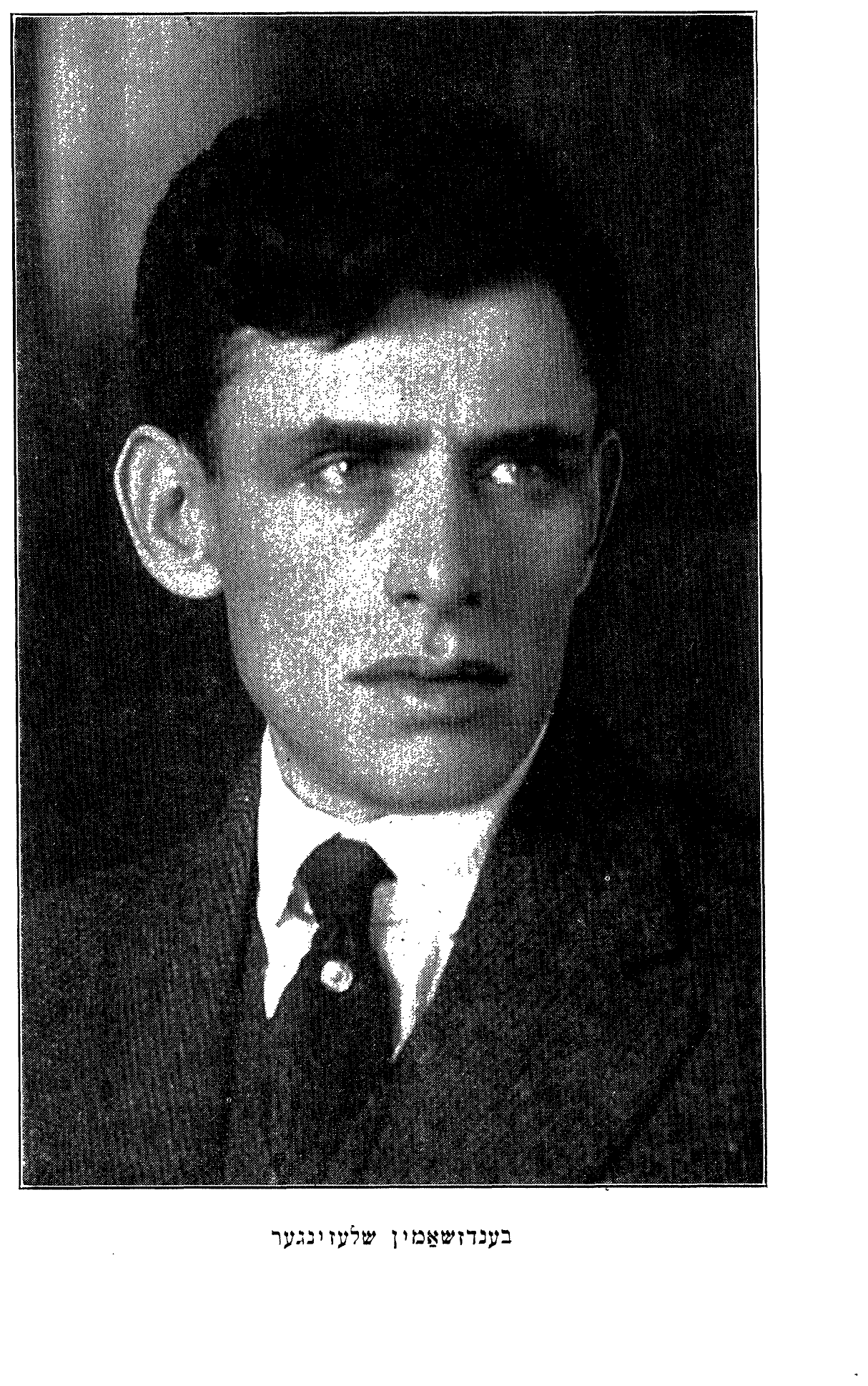
On the 7th of June, 1907, there were elections for manager, and as one of the candidates a cloakmaker named Benjamin Schlesinger was nominated. He had grown up in Chicago. There he had learned the trade and had become one of the leaders of the Chicago cloakmakers' union. Later he settled in New York and played a prominent role in the New York organization of his trade. In the spring of 1907 he was the leader of a strike of the reefer-makers (those who make cloaks for little girls), and in it he showed remarkable energy. He attracted attention, and therefore his name was put forward at the elections of the "Forverts Association." He was elected.
He worked for the business literally with all his strength — with an unusual zeal and with punctuality.
Once he acquainted me with an idea that he had been carrying around with him — to give the subscribers a premium. He asked me to recommend some book for this purpose. I recommended Alexander Harkavy's English-Yiddish dictionary (vocabulary). Schlesinger proposed the plan to the board of directors. It was adopted by the board of directors and afterwards by the "Forverts Association."
The premium had a tremendous success, and in the economic history of the "Forverts" it has an interest-538decent volume. 25 thousand copies (specimens) were sold off in a few months. Earlier the "Forverts" used to take in from subscribers seven thousand dollars a year, and from that 40 percent used to go off for the traveling collectors, as their commission and travel expenses. That year the office, thanks to the premium, received 30 thousand dollars through the mail, that is, entirely free of commissions and travel expenses. Out of this the "Forverts" was left with a clean 20 thousand dollars.
Such a sum in cash, free of interest, had under those circumstances an enormous significance.
Afterwards Schlesinger gave as a premium Harkavy's English letter-writer (model correspondence book).
How great the change was in the material situation of the newspaper, since it was saved from the aforementioned danger of bankruptcy and Schlesinger introduced the premium for the subscribers, can be seen from the following facts, which are brought here only as examples:
When Schlesinger turned in 1907 to a certain bank for a loan of a thousand dollars for the "Forverts," the vice-president of the bank demanded of him two wealthy guarantors. Two years later the same vice-president lent him 50 thousand dollars on a mere "Forverts" note, without any guarantor.
In 1910 the "Forverts" gave 17 thousand dollars to the socialist movement.
After the first premium appeared and its tremendous success became clear, Schlesinger began to persuade me to write a history of the [539United States in Yiddish — also to serve as a premium for the "Forverts." He and other comrades were convinced that such a work, with my name on the title page, would draw a large public.
Since the matter here concerns a premium that is bound up with me, I shall have to interrupt the course of the last "features" with a few details that have no connection to the finances of the "Forverts."
I set about the work, at first without zeal and only because it was important for the material fate of the "Forverts." But while working on the first chapter I became strongly interested — so strongly that I gave the subject of the first chapter — the discovery of America — involuntarily much more attention than was due to it in such a work.
I was drawn into the subject so much that I spent dozens of evenings, and countless hours which I would snatch by day, in libraries, studying the discovery of America. I read through whole mountains of works, studied, researched, filled dozens of notebooks.
My health had not improved. I suffered greatly. In the middle of the night I would get up with terrible pains. Sleep was impossible. So I would sit down at the desk. And with my left hand pressed to my aching stomach, I would write with my right hand. Three or four hours every night like that. There came out a thick work, of 669 pages, all about Columbus's discovery of America.
The book contains a sea of original research and is permeated with the Marxist idea about the economic foundation of human history.
540For it were prepared colored geographical maps with Yiddish words (it seems, the first that were ever printed) and other illustrations. It came out a rich edition. The work appeared at the beginning of 1910. Over 26 thousand copies were sold off.
Then I prepared a second volume: the history of how Mexico, Peru, Central America, North America, etc., were discovered.
I believe that the subject deserves much more space than it is possible to give it here. In a later volume, where my literary activity since I returned to the "Forverts" will be dealt with, I shall add certain details.
The second volume was also the result of much reading and research (concerning a certain scientific point, for example, I had occasion to carry on a whole correspondence with the German learned ethnologist Heinrich Cunow). The second volume is even thicker than the first (it contains 768 pages) and it was published exactly as richly, with the same kind of maps and pictures as the first. It appeared at the beginning of 1912. Of this volume over 25 thousand copies were distributed as a premium and through ordinary sale.
The second volume was also a "child of pain." When I now look at these two thick books I am reminded of those sleepless, agonizing nights, when hundreds of their pages were written.
I had reckoned to write further volumes. Together perhaps eight. But the work did not get further than the second volume. Despite my deep interest in this undertaking and despite the enormous success of the first parts, I felt that the work was, in541for me, only a matter of chance; that my true interest lay in an altogether different field; that my heart was drawn not to history, but to artistic portrayals of the present-day human world. I had already begun the third volume — the history of the English colonies in America. But I threw it aside in the middle of the work.
And so the first two volumes remained with a title that does not agree with their content. They are called "The History of the United States," whereas in truth they should have been called "The Discovery of America." *
The American press and the American magazines began to take an interest in the "Forverts." "Nothing succeeds like success," says an English saying. Nothing draws so much attention. So it is everywhere, but nowhere so much as in America.
People began to talk about our newspaper in the American papers. Reporters were sent to have interviews with me. People wrote about us.
In the November issue, 1911, of the magazine "Everybody's," which was then the most widely circulated and richest monthly in America, there appeared a large, detailed article by Ernest Poole about our "Bintel Brief" and about me personally. The542title over the article was "The Book of Life" — an expression that I used to employ in my explanations about this "feature." Parts of the article were reprinted in newspapers all over the country.
In one of the most important newspapers of Chicago the content of ten or twelve interesting letters from the "Bintel" was rendered.
There appeared articles and notices about the growth of the "Forverts." The former president Roosevelt was around that time connected with the influential semi-monthly journal "Outlook," and there, in the issue of October 28, 1911, there appeared a large article about the "Forverts" and its growth, and about its editor. A similar article, about me personally, was printed in the section "People Who Attract Attention" of the magazine "American Magazine."
Articles a full page long began to appear in the supplements to the Sunday issues of American newspapers.
Later an American professor (from the Chicago University), William I. Thomas, specially taught himself Yiddish in order to be able to read our "Bintel Brief," and he wrote about the letters.
This was a time of great revival in the Jewish unions and in the "Arbeiter Ring." The organizations grew enormously. In this the "Forverts" played a tremendous role. Its great circulation, popularity and influence made possible results543of which we could not even have dreamed in earlier years. A word from the "Forverts" acted with tremendous power.
On the other hand, the growing labor movement was an important help in the development of the "Forverts's" power. Every workers' organization was indirectly like a "Forverts" organization.
In 1909 there occurred a great strike of the waist-makers (those who make blouses), and the next year — an enormous strike of the cloakmakers (workers in women's coats). Several tens of thousands of workers took part. The whole industry came to a halt. (This cloakmakers' strike had an enormous significance for the entire industry and occupies an important place in its history.)
Both struggles ended in victories, and in both cases the organizations, as a result of the struggle, were set on a firm footing.
The "Arbeiter Ring" became a great, powerful body. Its branches (local organizations) spread over the whole country. In 1910 in the United States and Canada there was already not a single sizable city that did not have such a branch, and in 1912 the same could already be said of small towns as well.
The chief purpose of the "Arbeiter Ring" was mutual material aid. But it also developed a broad activity as a disseminator of education and of socialism.
The "Forverts" was always, and is also now, its official organ, just as it was the official organ of the Jewish unions and of their cen-544tral body, "The United Jewish Trade Unions."
In 1910 the "Arbeiter Ring" already had some 40 thousand members, and the number grew further and further (see the third volume, pages 421-423).
A great role on our socialist and trade-unionist platform was played by Meyer London (who was first mentioned in the third volume (page 490). In this fourth volume he was spoken of in connection with his active agitation for the "Bund.") He had both fire and humor. And while he was speaking before an audience, there would often burst out of him an original phrase or a short parable, at which the gathering would explode with a crash of laughter and delight.
He was active in the Jewish unions and in the socialist party. He gave speeches in English and in Yiddish. He was very popular.
In 1910, during the great cloakmakers' strike (A. Rosenberg — see the third volume, page 59 — was then the president of the union), London was a prominent figure in the struggle. He was one of the leaders of the union both as its lawyer and as a socialist agitator.
Popular already then was also Jacob Panken, who was younger than London. His ringing, thundering speeches used to draw great crowds. He was active chiefly as an agitator for our party. And some545The characteristic East Side scenes in the autumn season, in the weeks of an election campaign, used to be the following: an enormously large mass meeting on the street, with Panken as the speaker — a veritable sea of human heads around a wagon, from which a black-eyed, black-haired young man speaks to them in a voice full of temperament, which can be heard for several blocks. When he would finish in one place and go to address a second mass meeting, a great part of the crowd would run along with him.
He also used to speak in both languages.
I too used often, very often, to deliver speeches — under the open sky and in halls — but much less than in earlier years and much less than London or Panken. I was almost entirely taken up with the "Forverts."
The socialist movement, under the influence of the socialist party, blossomed during the first ten years of the new century. It began to look as if our party would in the near future play a substantial role in the political life of America.
An important beginning was made in Milwaukee, where the party in 1904 raised itself to quite a high level of political power. In the city elections, in the spring of that year, it elected nine aldermen and five supervisors, and Victor Berger, who546was the candidate for mayor, received more than 17 thousand votes, whereas two years before, in the elections in that city, the number of socialist votes had been only 8,400.
The movement in Milwaukee later made further progress, until at last they elected there a socialist mayor and several of the other important city officials.
Why was the first surge made precisely in Milwaukee? This is explained, first, by the fact that masses of Germans, or children of Germans, live there. Naturally, a great majority of the population speaks only English, but a large percentage of this part stems from German parents. They thus have the German psychology, and Germans are by nature thinkers and inclined toward a movement like the socialist one, more than Anglo-Saxon Americans.
A second cause lies in the personality of the leader of the Milwaukee movement, Victor Berger, who is one of the most gifted and energetic socialists in the country. He organized the Milwaukee Germans in the German manner, and the non-German workers of the city came under the influence of the remarkable organization that our German comrades built up there under his leadership.
Eugene V. Debs was already then famous throughout all America as a socialist leader. His idealistic speeches, his hearty tone, his pure, beautiful soul, his personal magnetism, and indeed his brilliant oratorical power had won him a popularity that did the movement much good. He used to draw enormous masses wherever he came.
547And here, among us in New York, the Jews brought into the movement the same spirit that the Germans had brought into Milwaukee.
In this connection one must always mention the enormous effect of our "Forverts." Now, with its enormously grown number of readers, its popularity and influence, it had drawn to socialism tens and tens of thousands of immigrants who, in their old homeland, had not been mastered by such an influence. But one must also always mention the new stream of immigration, which brought with it great numbers of ready-made Jewish socialists — Bundists, Poalei Zion, or young people from other groupings — who had passed through the fire of the socialist freedom struggle in Russia.
It thus turned out that New York in the East, and Milwaukee in the Midwest, became the centers of a socialist "boom."
De Leonism was rapidly going downhill. Of his Socialist Labor Party, or the "S.L.P.," as it was usually called, there remained a small handful. The meetings it used to hold occupied themselves almost entirely with reviling and besmirching our party. It too used to put up candidates, but it never got any substantial number of votes. Its agitators, instead of criticizing capital or capitalist politicians, would busy themselves with attacking our party and its leaders.
From time to time, passing by one of their meetings on the street, I would from a distance cast a glance at De Leon, as he stands on a wagon and, with the seal of defeat and disillusionment on his aged but very interest-548ing face, addresses a small group of listeners. A tragic figure it was then.
In 1906 we felt strong enough to take the candidacy for Congress in certain districts seriously. We began to regard the elections not only as a means of agitation, but actually with a prospect of a majority of votes. The most important of the congressional districts was the Twelfth, where the "Forverts" editorial office is located, that is, the central point of the old Jewish quarter.
As candidate Morris Hillquit was designated, who, next to Eugene Debs, then played the most important role in our party.
I have already told how Hillquit fought De Leonism; how a split occurred and he came to the front as a leader. A little later Debs's Social Democratic Party was united with the Socialist Party.
Hillquit developed splendidly. There ripened in him a crystal-clear logic and a remarkable ability to express thoughts in logical, beautiful sentences. You could just take and print them, word for word, as they come out of his lips. In speaking before an audience he never used written notes. He never forgot a single point, and the phrases would, of themselves, link up in logical order and so rich in words, as if he were reading from a laboriously written and polished article. This, and549his general brilliant abilities and intellect and an almost un-Jewish calm and tact, made him the head of the party, while Debs was its heart.
As these lines are being written, Hillquit is still the leader of the Socialist Party. *
In 1906, then, Hillquit "ran" as the candidate of the Twelfth Congressional District, for congressman. There blazed up a socialist campaign such as New York had never before seen.
Hillquit gave his brilliant speeches (entirely in English. Yiddish he had altogether stopped speaking). Meyer London, Jacob Panken, B. Feigenbaum, I, and our other speakers were busy every evening, going from hall to hall, from open-air meeting to open-air meeting, delivering speeches for Hillquit's candidacy.
The gatherings were packed. The enthusiasm was indescribable. The quarter blazed with socialist enthusiasm.
It goes without saying that the "Forverts" was full of the campaign and that without its participation such a scope and such ardor would have been impossible.
On "election night" (the evening of the elections) some 60 thousand people gathered before the "Forverts" building, on Seward Park. The crowd came to hear the result, or more precisely, to see it. For the figures of the votes that were cast for the various parties were thrown up by a stereopticon onto a white illuminated sheet on the street near our editorial office.
550Each time a favorable figure came in from a section of the Twelfth District, a "hurrah" broke out that echoed over the whole quarter. While they waited for the next report, the crowd was entertained with stereopticon caricatures of Tammany Hall, or with socialist witticisms. The park rang out at every moment — here with laughter, here with applause and hurrahs, and here with a "hoo-raw!" jeer against Tammany.
These election scenes became with us a permanent "election night" occurrence. Every year they used to take place, and each year the crowd grew larger. *
Hillquit was not elected. He did, however, receive a large number of votes. And two years later he
"Seward Park" was then packed with people, who kept their eyes strained on our stereopticon sheet. Every moment a storm of applause or laughter broke out. The editor of the "Forverts" told the stereopticon man to flash out an announcement: "Abraham Reisen, the writer, arrived today in New York, and he is now in the editorial office of the 'Forverts.'" When the message appeared on the sheet, there was heard an applause of thousands and thousands of hands. The Jewish workers were acquainted with Reisen through the "Forverts," and they now gave him a warm welcome. As Reisen explained to Osherowitz, that was then the first time in his life that he came face to face with such a mass of Jews.
551ran again for congressman in the same district. The scenes of enthusiasm of 1906 repeated themselves.
He again received a large number of votes, and he was again not elected.
We had to wage a struggle with the iron, almost all-powerful organization of corrupt Tammany Hall, which knew how to steal votes and took special steps to carry through its election swindles.
Later Meyer London was the candidate for congressman. He too was not elected the first time, but the number of socialist votes had grown so large in the district that finally he received enough to overcome even all the vote-thefts at which Tammany was such an expert. He was elected to Congress in 1912.
In that period there came to the Socialist Party a group of educated Americans. They were inspired by our idea, and they took part in our agitation. Among the most prominent of them in New York were: English Walling, Charles Russell, and James G. Phelps Stokes. (Chicago also had such a group.)
Walling is a child of wealthy parents in Chicago, but he lived in New York. He was an exceed-552ingly able socialist, and through his interest in our movement he became acquainted with an educated Jewish girl, a writer, named Anna Strunsky. They married.
This was not the only American who married a Jewish daughter through the socialist movement. Another was Stokes, a member of a well-known American millionaire family. In the headquarters of the University Settlement in the Jewish quarter, where several American socialists were then to be found, he became acquainted with a poor Jewish girl named Rose Pastor. She had earlier been a cigar-maker, and afterwards she was connected with the English section of the Jewish "Tageblatt."
Through her millionaire fiancé she became a member of our party and took an active part in the movement. The American newspapers were full of the match.
I then turned to her to write the answers to the "Bintel Brief." She accepted the invitation. When one leafs through the issues of the "Forverts" from 1908, one sees her name with her picture on the "Bintel Brief" in every issue.
A similar match was made in the University Settlement headquarters between an American socialist, a young writer named LeRoy Scott, and a Jewish girl named Fine, the daughter of a Vilna cantor. But Scott was not rich.
Charles Edward Russell was one of the best-known American journalists in America. For a certain time he was the editor of Hearst's "American." Of all the American socialists he was the most553most active agitator. Before the elections he always used to travel about in the Jewish quarters of New York and Brooklyn, and deliver speeches. We often used to ride to these agitation meetings together. He was very congenial as a person as well as in his socialist activity.
In Chicago there was active, as a writer and as a lecturer for our idea, an educated American couple named Simons.
I used even then to point out the difference between the American worker and the European, with regard to their capacity to respond to socialist agitation. The thought that is expressed in the following lines I used, around the time at which we are dwelling here, to put forth in writing and orally:
The European worker is class-conscious. This does not mean that this consciousness always crowds out his other feelings — the national consciousness, for example, or his local "patriotism," attachment to his family, to his social group, etc. But he is class-conscious, whereas the American worker is, for the time being, not.
In the European worker there became ingrained, over the course of centuries, the concept that there are lords and subjects. And although the place of the lord has been taken by the capitalist, and the place of the peasant has been taken by the worker, there still remains a sharp boundary between two classes — upper and low-554er. He, the worker, belongs to the lower one. And of any hope of climbing out of his class he has there almost none. Once a village peasant — forever a village peasant; once a worker — forever a worker.
This rule is eaten into the blood of the European working class. The worker may have various hopes, strivings to improve his situation. But that he will become a millionaire — of that he may perhaps dream. He knows, however, that such a dream is not realized.
It is quite different in America. In the political sense the country is already long a democracy. The American knows nothing of any born lords. He sees at every step how someone who was yesterday a pauper is today a millionaire; and so too the reverse. When he takes the list of American presidents, he sees that almost all of them were raised as poor boys, on a farm or in a small town somewhere. And when he takes the list of millionaires, he sees the same.
Yes, America is for the time being a land of unlimited possibilities, and this thought floats around in the consciousness of every American. Class feeling was therefore in America for the time being impossible; to appeal to the American worker with the expressions that were taken from the socialist movement in Europe is useless.
To socialism there came in America people, as one comes to a lofty idea, to an ideal, but not through economic need. And certainly not through the economic situation of their class. In Europe the workers are a fixed, congealed class. In America it is for the time being not so. Today one works for someone else; tomorrow one keeps555a worker himself. Today one is a poor man; tomorrow one may be rich.
With the Jewish worker of America it is also different than with the Jewish worker of Europe. The Jewish worker here also does not expect to remain a proletarian. He always thinks about a better economic situation. If he is a socialist, that is idealism, not class consciousness. And as for the workers of Milwaukee, they too are an exception to the American rule, although in a different manner than the Jewish workers.
Notes (the original’s footnotes)
[p. 531] The first issue of the "Forverts" that was printed on our own press is the issue of January 14, 1905.
[p. 532] A "plum" means, in the political life of America, a job, a position, or some other kind of earning that the government gives to people of the victorious party.
[p. 536] On the 26th of May the "Forverts" printed for the first time a report on its circulation from the Association of American Advertisers — an association of capitalist firms whose purpose is to investigate the number of readers of the various newspapers, in order to know how much the space one rents from them for advertisements is worth. A report from this association is everywhere accepted as strictly accurate. Regarding the "Forverts" its report was — on average for the whole year, up to May 1907 — over 53 thousand daily; in April — over 62 thousand daily, and in May — 72,335 daily. From then on we printed that figure every day above the masthead "Forverts"; afterwards — when it grew still more — the higher figure, and so we did continually. The "Forverts" was the only Jewish newspaper that did so, because it had the largest circulation and it surpassed all the other newspapers more and more.
[p. 541] Later Hillel Rogoff began to write a history of the United States, beginning with the colonies out of which the republic afterwards grew. As these lines are being written, three volumes have already appeared.
[p. 549] Debs died on the 20th of October, 1926.
[p. 550] In an article that M. Osherowitz wrote for the jubilee issue of the "Forverts" in 1922, he relates what Abraham Reisen once told him about his (Reisen's) arrival in New York. The writer came on the 4th of November, 1908. This was on the evening of the elections. He was brought up to the "Forverts" editorial office.