Chapter Eighteen
Various Happenings
556I sit and leaf through old volumes of the "Forverts" (Forward) — issues from the first ten years after my return as editor.
The pages have already yellowed and dried out. The aged wood-pulp paper crumbles between the fingers. Often, when one turns over a leaf, it snaps crosswise, like glass; it breaks and scatters. A few more years, and there will remain a heap of unreadable scraps and crumbs. So it is with all of today's newspapers. The present "Forverts" issues will have a better fate. The "Forward Association" goes to the expense of printing a few dozen copies of each issue on cloth paper, specially for the great libraries. That will last almost forever.
As I leaf through, I remember. Here and there my eye falls upon a headline, a word, a name, which draws me like a magnet. Some are bound up with important events, or with such as were once regarded as important and today no longer are; others never had any significance at all, and yet the recollection gives a tug at the heart. As though by a magic word there comes alive557a mood of long ago, a forgotten feeling. And together with it there comes alive a long-vanished year, a group of people, a whole chapter of life.
* * *
Here I read in the "Forverts" of January 28, 1904: "Karl Emil Franzos has died." And before my eyes there unrolls a scene in Brody, Galicia, when I was there as an emigrant, on my way to America. It is again the summer of 1882. There is that group of emigrants before whom the Jewish writer gave a speech (see the second volume, page 32). I am one of his listeners. We are waiting to set out on the long journey, off into the foreign, unknown land. Upon the heart there presses that feeling of unknowing and uncertainty, and yet of alluring hopes, of the appetite for adventure and of carefreeness. As though wrapped up, packed away, the manifold feeling had lain for some forty-odd years, and suddenly someone had unpacked it, like a Passover goblet from years gone by.
* * *
I give a shuffle one issue back. It is January 27. My eye falls upon an editorial with the headline "Johann Most's Holiday." I remember: I wrote that. The "Forverts" was greeting the leader of the anarchists on the 25th anniversary of his German newspaper "Freiheit" (Freedom), for which he had suffered so much. How strange that would have sounded some ten years earlier, when socialists and anarchists were at daggers drawn, when Johann Most used to attack us bitterly and attack me personally! In that editorial I find such words: "Reader! One of the things that the 'Forverts' preaches is respect for the honest opinions of others... On this day all must feel respect558and admiration for the brave, heroic fighter for freedom. We must forget all differences." Further on comes a remark: "We were used to going to greet Most when he came out of prison. Let us today go to greet him in New Irving Hall, on the 25th anniversary of his 'Freiheit.'"
It is pleasant for me to read this old editorial. Pleasant to see the tolerance that I had begun to preach when I came back into the "Forverts" in 1902.
There comes alive too the meeting in New Irving Hall and the warm get-together that we had with Most and his close friends after the gathering, in a café on Canal Street.
* * *
The editorial in the issue of March 25 is about the 70th anniversary (jubilee) of Alexander Jonas. Hillquit was the toastmaster. I recall the audience, the spirit of the speeches. I recall my own speech. My heart was full. I had striven to tell the man being honored how dear he is to me, how high my respect, how deep my love ever since I first saw and heard him — at that Lassalle memorial day, in 1882, in the Germania Assembly Rooms on Second Avenue (see the second volume, pages 145-146. See also the second volume, pages 289-290). But my speech did not satisfy me myself. I felt that what I wanted to express, I was not expressing.
* * *
April 17, 1894. Among the dispatches from the Russo-Japanese war there is the news that the famous painter Vereshchagin lost his life on559in order to study scenes of sea-battles for great oil paintings, and he perished together with the warship. A martyr to his art.
How vivid his Russian face appeared to me in that unforgettable afternoon at his exhibition in New York — the halls with his marvelous paintings and the tea-room, where he sang folk-songs so sympathetically, and where my wife and I ate pastry with tea instead of going to a restaurant for dinner, because we had spent our last dollar on the two tickets (see the second volume, pages 424-426).
* * *
That winter, 1904, I lay ill for over a week. (A kind of malaria and the beginning of the stomach trouble that settled in me for a good few years.) The memories of that week are, in my mind, tied up with the strong impressions I received from Orlenev's theater performances.
Orlenev had then come with Alla Nazimova and with his whole Russian troupe. My wife and I saw them in Chirikov's "Yevrei" (The Jews), in "Tsar Fyodor" and "Brothers Karamazov." There was no end to our delight. It was the highest degree of acting that I had ever seen before; the highest level of theatrical art that I could then imagine. His performances were for us a strange holiday.
* * *
That same winter New York was visited by the English writer H. G. Wells. I became acquainted with him. He, Lincoln Steffens, and I ate lunch in a Jewish restaurant on Grand Street. Wells was already famous then, though not yet as much as today.
560* * *
In the "Forverts" of March 17, 1906, barely two years after the editorial mentioned above in honor of Johann Most, I see a mourning-box, and inside it the words: "Johann Most dead."
In the eighties Most was surrounded by a sizeable crowd of anarchists, German and Jewish. In the last several years of his life he had around him only a small handful of adherents, and even they believed little in his creed. But respect was always felt for him — respect, admiration, and pity.
This remarkable man, this man of storm, was mild, naive, and childlike as a child.
At the words "Most is dead," we took off our hats and bowed our heads with a reverence mingled with a feeling of compassion that is not easy to express.
* * *
That summer I became acquainted with Upton Sinclair. His novel "The Jungle" had just made him famous. He was a member of our party. But I had not known him personally before. Now we met. We had an interesting conversation. I afterwards wrote about "The Jungle," and the novel, in a translation, was printed in the "Forverts."
A "Forverts" page from 1907 reminds me of Bentshke.
It was in the spring of that year. One day, coming into the office, I find in my mail a long en-561velope, with a letter that was written in good English, in a good but foreign handwriting. The writer wanted to know whether I was a relative of his. It concerned a distant, a hazy past. I was intrigued, and with each line the interest grew deeper.
— Is this not Bentshke? — I ask myself.
Bentshke was a cousin of my father's. And the last time I saw him was in Podbereze, when I was a child of three or four years. After that he disappeared. He had converted. My aunts used to speak of him with sighs and groans, and my father with curses. Forever there remained hanging a cloud over the family, and out of that cloud there peered a handsome young face with fresh, plump cheeks and full lips. And the name of that face, cloud and all, was Bentshke (see the first volume, pages 18-19).
Yes, the mysterious letter that I received in the "Forverts" office in 1907 was from "Bentshke."
It was by then already a story of forty-three years ago. In New York he had caught wind of my name through the smell of freshly cooked gefilte fish. He had not seen any Jews for a long time, and the Jewish fish drew him in. So he went into that house, somewhere off, and it turned out that the landlady was from Podbereze. She knew that I had been born there, and from her words the one-time Bentshke worked out that I must be a relative of his, though just who I am and whose I am he could not exactly reckon. He had been completely estranged from his family, and the old threads had become tangled together in his brain.
562I answered his letter, and one day, early in the morning, when I came into the office, I found him waiting for me. I understood at once who it was. I did not merely guess him. It may sound strange, but it is a fact: I recognized him. He was already over sixty years old. But a glimmer of his one-time youthful figure, as it had been mirrored in my childhood memory, remained.
All that he remembered about me was how my mother had once asked him to hold me on his lap while she went to the oven to take out the supper. I learned from him that he had lived with my grandfather, the rabbi, for over a year. It was in Vidz, the Novogrudok district. He used to copy out his treatises. It turned out that the manuscripts that used to lie afterward in our cupboard were in his (Bentshke's) handwriting (see the first volume, page 16).
He had been together with my grandfather in the last hours of his life, and he conveyed to me a few details of his death.
— He asked for a drink, — he related, — your grandmother gave him a glass of water with vinegar. From that he felt a little better. But within an hour he died.
In America Bentshke had already been a long time. Twenty-five years he had served in the American army. He was an intelligent, well-read man. Yet he had risen only to the rank of a sergeant (field-sergeant). The reason for that, as he explained, was that when he entered the army he was already too old to be able to take the examination for officer.
563He received a pension, and on that he lived. Married he had never been.
When I visited him in his furnished room, I found there English, German, and French books. He knew all three languages quite well.
Yiddish and Hebrew he had almost entirely forgotten. Of his past he made no mention, and I did not ask him. He made upon me the impression of a characterless man, exactly of the sort whom it is easy, with the help of a few rubles and a new suit, to convert (apostatize).
Had my father been living, I would have written to him that I had met Bentshke. The fact that I was seeing the apostate would have given him no pleasure. But the news would have been an interesting surprise for him. But my father was already dead, and the fact that I now had no one even to write to about my meeting with Bentshke spread in my heart a sharp feeling of loneliness.
Since my first meeting with Bentshke I always picture my grandfather to myself, as my grandmother gives him the glass of water with vinegar. And it seems to me that through this he became much more distinct to me than before.
January 13, 1907. A headline over an article: "He and 15 others fled underground." At the beginning there is a picture of a young man in worker's clothes. The article is the start of a whole series. All this was written down for the "Forverts" by the564young man who wears the worker's costume. His family name was Rabinovich (his first name is not mentioned).
This Rabinovich and the other fifteen, of whom he tells, were revolutionaries, exiled to Siberia, to a village by the name of Romanovka. There they had a brave clash with soldiers. Afterward they were locked up in a prison; whereupon, little by little, working in turns, they dug through a tunnel, and escaped.
It was on a winter's night. Out onto a snow-covered field they came, greeted by a bright moonlight.
The story reads like a tale from the Thousand and One Nights. In the history of the Russian struggle for freedom it is known as "the second Yakutsk affair," or as "the story of the Romanovtsy."
Rabinovich came to me with a request that I recommend him English books to read — chiefly the best works of American literature. In this way we became acquainted. He interested me, and he came up to me several times, usually in the evening.
He worked at iron, and his hands were calloused and wounded. All day long he would toil, and in the evenings he would read and study. He was not accustomed to crude physical labor. He used to come home a broken man. But with his strong will he would overcome everything, and instead of resting he would sit until late at night over a book.
— I want to become acquainted with America — he565he explained — with its economic life and with its culture.
In a short time he taught himself English. He read American newspapers and magazines and the books that I had listed for him on a slip of paper.
His aim was to remain here not more than a year; then to return to Russia and there to throw himself once again into the revolution. So every day was precious to him. He was still very young. In Odessa he had finished the Realschule; immediately became active in a kruzhok (revolutionary circle), fell into the hands of the gendarmes, and was exiled. Now that he had become free, he was drawn back into the struggle.
There was among us also another type of revolutionary immigrant — one who looked upon America with contempt and did not even want to hear of American life. Not even of our movement either. Of our unions and their struggles such immigrants made mockery. What worth can a movement have, when there are no barricades and no Siberia?...
This type did nothing at all, often went hungry, and refreshed himself with revolutionary recollections and with despising the American trade unions and socialism. There were some sympathetic people among them, but enough unsympathetic ones.
Time naturally had its effect. Little by little many of them drew themselves into the American reality, and began to look upon it with different eyes.
Such ones as Rabinovich, who at once regarded America with clear, sober eyes, I have seen few.
566In some respects he was a remarkable exception. He was very interesting to me.
In December 1907, during the time that I lay ill, there happened to me one of those little things that remain recorded in a person's memory among the noteworthy details of his life.
When the nurse ("Schwester," warterke — caretaker) came in to me, it turned out that I had once been acquainted with her father. This was in 1882, the first summer that I spent in America. He was then the secretary of the "Propaganda Union," before which I gave my first speeches (see the second volume, pages 104-109). Since then — twenty-five years — I had not seen him. Almost entirely forgotten about him.
He lived in a not-large town, far from New York. His daughter had written him a greeting from me, and a few days later she brought me a thick letter. Answering my greeting kindly, he reminded me of the speech that I had given on Suffolk Street in that summer, 1882. That is the childish-revolutionary speech in which I had called upon the workers to go with crowbars and axes to Fifth Avenue and to take away from the millionaires their palaces with their riches (see the second volume, page 108*. My one-time567union-comrade has an unusual memory. He had remembered the speech from beginning to end. And now, in his letter to me, he conveyed it to me with every detail.
In doing so he wrote that he was following my career and gave me a "dig" for not having stayed true to my one-time "anarchist" ideals, and for having gone over to the socialist camp. He himself is true to those ideals — so it ran according to his letter.
Later I learned that he is the president of a synagogue. I laughed. But I inquired and learned that he helps with a broad hand all the Bundist and other socialist speakers who come to his town, and that he himself is really anarchist in his sympathies. He is a most honest and good man, and he does everything possible for every progressive movement.
He is a synagogue president out of accommodation, friendliness, and good-fellowship with his neighbors, and as a result of the boring life that hems him in all around. Had he lived in New York, he would have changed in these 25 years. But as it is, his anarchist ideas of 1882 have congealed within him.
At the beginning of 1907 the country was literally seething with the Thaw trial. The story, in fact, did not stop stirring people up for some fifteen years.
Thaw was the son of a well-known millionaire family in Pittsburgh. He had fallen in love with a beautiful poor girl by the name of Evelyn Nesbit. She told him that the famous architect Stanford White568had ravished her. That did not stop Thaw from marrying her. But after his wedding he murdered White.
At the murder trial various sensational scenes took place, some of which had a psychological interest and some — simply the interest of "forbidden fruit." (The district attorney (prosecutor) put to Evelyn, for example, questions at which all the ladies had to be told to leave the courtroom.) Thaw's lawyers brought the most famous nerve-experts to prove that he had committed the murder in a fit of madness. (One of them, in his testimony, used the expression "brainstorm" — that is, that from agitation, after his Evelyn had told him her story, there arose in Thaw's brain a storm; and the phrase at once spread across all America as a joke.) The prosecutor, for his part, also brought experts. The upshot was that the jury declared the accused insane.*
I attended the trial in person, and I wrote in the "Forverts" my impressions of it.
569At the beginning of 1908 we again had important guests from Russia's theater world. This time there came to us the famous Komissarzhevskaya with her troupe. Their realistic acting also made a deep impression upon us.
The warmest enthusiasm was called forth by Brovich, the most important actor of the troupe. I believe that Orlenev was more original, with more "divine fire," as one calls it. But as regards naturalness and artistic truthfulness, Brovich stood higher.
A few months later the young violinist Mischa Elman appeared. In Europe he was already famous. When we heard him here among us, he literally created a furor.
Sitting at his first concert, in my mind I involuntarily tied his enormous talent to recollections of the terrible pogroms, which were then still so fresh in the Jewish memory. The fact that so many Christians had to applaud this Jewish lad presented itself to me at that moment as a kind of revenge for the murders and humiliations that Jewish children endure.
I expressed this thought in my article about Elman's first concert.
The "Forverts" did much to help make the public acquainted with Elman's talent.
Later came Efrem Zimbalist. And so began the remarkable stream of musical world-talents to America. And almost all of these570young geniuses, violinists and pianists, are Jews, our Jewish children of Russia, Poland, or Galicia!
On January 3, 1909, I received a letter from Dr. Chaim Spivak, who by then had already lived for many years in Denver, Colorado.* The letter began with warm words about our long-standing friendship.
In New York he lived only a little while — only the first months of our first summer in America. He called himself Spivakovsky, as in the old country; but afterward he changed his name to "Spivak." We at once became close friends and took to saying "du" (the familiar "thou") to each other. Then he worked in a factory in Lisbon Falls, Maine. Finally he settled in Philadelphia, where he studied to be a doctor and practiced his profession. There he married. In the nineties, when I was connected with the "Arbeiter Zeitung" and used to come often to Philadelphia for lectures, I always used to stop at his house. Later he moved to Denver, where he was one of the founders of the Denver Sanatorium for consumptives. He often came to New York, and on these visits of his we used to see each other. Over the course of several years he was a contributor to the "Forverts," where he used to print articles on medical and other subjects. But this was a side-matter for him. His main interest lay in the sanatorium, in medical science, and in communal activities. He was one of the most prominent and finest figures in our immigration, one of its most sympathetic and noble, a man with a golden soul in the true sense of the expression. The most pronounced trait in his spiritual life was his love for the Jewish people, a love which in him constantly grew.
571The content and tone of the first lines made a strange impression upon me. Why, all of a sudden, such sentimental recollections?
It was a preface to no joyful tidings. Further in the letter it stood that my brother, Isaac, had died. (See the first volume, pages 168-169, 446 and 447; the second volume, page 109, and the third volume, pages 268-272 and 412.)
Isaac had fallen ill in the lungs some three years earlier. But he was an energetic, active, and life-loving man, and he continued his activity, neglecting his weak health, until the danger had gone too far. Then he traveled with his wife and three-year-old son to Denver. In the sanatorium of which Dr. Spivak was the soul, he was never a patient. But with Dr. Spivak he used to see each other very often.
As the result of a chill, he contracted pneumonia, and we lost him.
He was my only brother, and a sister I never had. It is not easy for me to express the feeling of grief and despair that Dr. Spivak's letter called forth in me. Besides his son Emanuel, there remained from him a daughter, Sylvia. A short time later, my sister-in-law, Annie, came from Denver with the two orphans. Little Sylvia still a baby in arms.
In the "Forverts" of June 11, 1909, on the first page, in a mourning-frame, there are the words: "Jacob Gordin dead," and beneath it: "The famous572dramatist died half past twelve last night of a hemorrhage in the lungs as a result of cancer."
On the same page there is an editorial article (written by me) in two columns, where the deceased is spoken of in a tone of mourning and respect.
Mention is made of his connection with the progressive part of the immigration and with the labor movement; and it is pointed out that he had worked through the stage "for light and progress and in the interests of the Jewish masses."
Further, the thought is expressed that Gordin belonged to the Russian intelligentsia, and that means that he belonged to such a world where of literature and art there is demanded service for the better interests of humanity; that "he was raised in the spiritual atmosphere of the Dobrolyubovs and the Chernyshevskys, among whom a writer who had not devoted his talent to the freedom movement was condemned as a darmoyed (idler), as a traitor to the society which had nurtured his powers within him.
"It was with these traditions, with these feelings, that Jacob Gordin took his place in the Yiddish theater world."
The article goes on to relate that Jacob Gordin was one of the closest friends of the group that founded the "Forverts," and that in the first months of the "Forverts" existence he was a regular contributor to our editorial staff.
The article closes with a call to honor the memory of the deceased at gatherings, to go to the funeral, and to bring flowers to the grave.
573The editorial on the day of the funeral was written, at my request, by A. Liessin. A beautiful, poetically attuned eulogy it was. The writer begins with the impression that Gordin had made upon him when he saw him for the first time — in the editorial office of the "Forverts" — some twelve years earlier:
"What a noble countenance (hadras ponim)! — he says — what a fine Jewish specimen! A delightful impression. One did not feel like talking. One only felt like looking at him.
"And this too was the first impression that wrung the heart at the news of his death. And this too will be felt by many of the tens of thousands when they today accompany the last that the terrible illness has left of the one-time Jacob Gordin. One will no longer see this noble countenance, this fine Jewish specimen — never again!
"And there wants to come alive in memory once more this huge figure with the great forehead and with the kind, thoughtful eyes, this face from which there shone forth a proud and commanding but also a broad and a rich nature, and deep, deep it wants to press itself into the memory.
"From Jacob Gordin one always expected great things. And otherwise one could not expect of him. And he too expected it of himself. But he was a romantic — both in his life and in his creative work a romantic. And by this is explained much in his career — many of his misunderstandings with fate."
In closing, Liessin recalls again the time "twelve years ago, in that first highly interesting 'Forverts' period, when we worked side by side with Gordin," and he exclaims: "Bowing in mourning: honor your memory, oh, dear comrade!"
574Goldfaden had died a year and a half earlier — on January 9, 1908.
Two months after the death of Jacob Gordin, on August 14, 1909, there arrived in New York Rachel Kaminska, the famous Jewish actress from Russia, who had played in his plays. She was the most important force in the Jewish theater world of our old home, and I was curious to see her on the stage — curious to see how one acts in Yiddish in Russia.
Our Yiddish theater in America had developed, directly or indirectly, under American influences. That the American theater stood lower than the Russian — that I knew quite well. Had there been in me a doubt about it, Orlenev with his troupe and Komissarzhevskaya with her troupe would have driven the doubt away like smoke. But how is it with the Jewish theater troupes that play in Warsaw, Vilna, Kiev, or Odessa? Do they stand higher or lower than ours? Is the influence of the Russian and Polish stage felt in their acting?
When Madame Kaminska came down off the ship, she drew attention by a trait in which the actresses of the old home are different from those in America. She was very simply dressed — like a housewife, not at all the way a Jewish actress dolls herself up here among us.
Madame Kaminska's first appearance took place at the Thalia Theater on Friday night, August 27, in575Gordin's "Kreutzer Sonata." She played with David Kessler.
My review appeared in the "Forverts" of Sunday, August 29, under the headline: "Madame Kaminska in Gordin's 'Kreutzer Sonata' — two different schools of theater — the European and the local."
The essence of the article is found in the following lines, which are an excerpt from it:
"When one of our 'stars' plays this role, she does not let the quiet scenes go by without noise either. She shouts 'dramatically' where, according to the role, one should speak the words calmly; she throws 'highly dramatic' glances; she does not allow the other actors to come to the attention of the theater audience.
"These 'tricks of the star trade' (the gimmicks and stunts of the 'star' line) are unknown to Madame Kaminska. She acted with the artistic honesty and sincerity of the Russian and Polish school. There, where the role demands that she sit still, she sat still; where it fell to her to speak, or to speak without hysterics, she did so. This disappointed that audience which is used to hearing melodramatic ravings every minute.
"And the other actors on the stage took advantage of the fact that the 'greenhorn' lets her 'opportunities' pass by. They shouted so, they so 'murdered themselves,' that some of Madame Kaminska's finest moments were simply drowned in a sea of music-hall din."
"Madame Kaminska has a true talent" — I say further. When she has a dramatic moment, she too penetrates with an aesthetic tremor. The words tear themselves from her in a natural manner, with a genuine, unaffected warmth. The tears come in a true,576manufactured manner. No one can make you weep the way she can. Such moments are few in her role in the "Kreutzer Sonata," but in those that are there, she succeeded every time in the better sense of the word. Her stage personality was then highly sympathetic, and the effect was a profound one.
"There is no question that the songs of praise she received in Russia are honestly deserved. But — change of place, change of circumstances. In Russia the theater public is not accustomed to any star privileges and star 'tricks'; nor to the 'tricks' which the other actors use among us in their struggle for recognition."
"Our theater here, however, has certain merits," — I continue — "which the Yiddish theater in Russia does not have, as it seems. In the 27 years our stage has worked out a technique which it overdoes, but without which one cannot get along in a theater. Our actors know how and where to stand on the stage and how to make use of genuine artistic opportunities. The Russian actors of Russia know this too. But the Jewish actors there lack it for the time being, as it appears (and the Russian newspapers really say this about them. They praise them as artists for whom life itself is the school, but who lack a theater school).
"Madame Kaminska often gives the impression of a very talented amateur who lacks only technical experience in order to be a brilliant, complete talent.
"Only one thing: her voice for the most part rang weak, although in the important moments she pitched it high and pleasantly. The Yiddish theater in Russia is for the most part a small, narrow hall. To speak before so large a public as577the Thalia Theater audience, Madame Kaminska is probably not accustomed to."
People had longed to see the Warsaw actress in Jacob Gordin's "Mirele Efros," her most important role, as one had heard. But the play "Mirele Efros" was the property of our actress Keni Liptzin, and at first the Warsaw actress could not obtain permission to perform in it. Finally Madame Liptzin gave her the permission.
Madame Kaminska carried the role through artistically. It turned out, however, that Madame Liptzin was better suited to it. It is a brilliant role, but not a realistic one. And Madame Kaminska's natural tones of life were not as successful in it as Madame Liptzin's "elevated," but impressive declamation. To speak simply, with the natural conversational melody of living people, Madame Liptzin could not. But in a non-realistic style she was a brilliant artist, with a flaming temperament, with imaginative power, with a ringing, effective voice, and with a remarkably clear and penetrating diction. And in the technique of the stage, in the mechanical means that help in melodramatic acting — in that she was certainly more skilled than the guest-performing actress.
An outstanding realistic actress among us was Sarah Adler. David Kessler, one of our two most important dramaturges, was also nearly a complete realist in his acting. Jacob P. Adler was at bottom a "Shakespearean" artist. But that he had a great talent — about that there could be no question.
578Our Yiddish stage had broader possibilities than the Yiddish stage in Russia, and in the 27 years of its undisturbed development it made considerable progress, despite the unfavorable influence of the Anglo-Saxon school. With all its faults, and notwithstanding its "tricks," it had developed several brilliant talents.
The methods of acting in Russia were better, higher. But we had better forces.
Around that time the Jews of America were strongly interested in the name Victor D. Brenner. With that name there was an especially great stir in America.
President Roosevelt made a new cent. Earlier, on the American cent there used to be the head of an Indian. The new coin bore on it the figure of President Lincoln — the most interesting, the most sympathetic, and the most remarkable of all American presidents, the president who carried through the great war between the Northern and the Southern states and freed the American Negroes from slavery.
The artist who made the figure of Lincoln for the new cents was the aforementioned Victor D. Brenner, a Jewish immigrant from Shavel, in the Kovno province. He was born in the year 1871. His father was a stone-engraver, and he learned the trade while still a child. And as a child he had already also shown talent for higher forms of art. He immigrated to America in 1890. In New York he first studied at Cooper Union, and afterward he went to579a certain time he also spent studying art in Germany and Italy.
Roosevelt at first wanted to have Lincoln's image on the new half-dollars, and a competition was announced for it. The Shavel Jew won the competition. He made the best figure of Lincoln. Afterward Roosevelt's idea changed: instead of placing the figure on a silver half-dollar, it should be placed on the cent, for the cent is the coin of poor people, of the great masses, it is said, and Lincoln had after all been the president of the masses of the people.
The new cents thus bore on them Brenner's figure of Lincoln. Beside it stood the word "Liberty," and above was the phrase that is found on all American dollars: "In God We Trust." On the cent coin there was also found, in very tiny letters, the name of the artist, Brenner.
The cent became known as "the Lincoln penny," and that this Lincoln penny should have been made precisely by a foreigner, not an American-born — that contradicted the "patriotic feelings" of some Americans.
A fuss broke out. Some argued that it was not right that the Indian had been removed from the cent — that is, the most authentic American. A heated debate arose, and in this debate the following came to light: that the head of the Indian which used to be on the earlier cents was really the head of an American girl. An important delegation of Indians once came to Washington, and a distinguished official invited the delegates to his home. Then one of the Indians took off580his feathered "crown," and the boss's little daughter put it on herself for fun. Present there was an artist who was taken with her little face. So he made a sketch of her. And this figure, with the Indian feathers on the head, was afterward placed on the cents.
This detail was forgotten, and people always thought that the head on the cents was that of an Indian. Now, then, the question of the Indian was settled. But it boiled over with the question of the Jew, Brenner. How does a Jew, not even American-born, come to have such standing that his Lincoln should stand on the American cents? No open antisemitism was expressed about it, for the Americans are too tactful. But behind the scenes it was expressed. Above all, the anger was great over the name of the artist — why it stood on the cent. For such a thing had not been heard of before. The upshot was that when more cents were minted, Brenner's name was no longer placed on them.
His Lincoln, however, remained, and such cents circulate to this day. There are no others.
I became acquainted with Brenner at the very height of the affair over his penny. I made his acquaintance in the house of a friend of mine, Dr. Fishberg. We ate Jewish fish together, and talked about the old home — I in Vilna Yiddish, and he in Shavel Yiddish. He made a very good impression on me — a simple, tactful, sympathetic young man, and truly not an unhandsome one either — pleasant Jewish facial features framed in a soft little beard with an artist's charm in his appearance.
581to the next great "Forverts" ball we invited him to be one of the judges, to determine the most interesting masks.
In the winter of 1909-1910 we had a guest: there came over to New York for a few months the Russian revolutionary Vladimir Burtsev, who became famous as the "Sherlock Holmes of the Russian Revolution." I had become acquainted with him in Zurich in 1893. He was then quite young (see volume three, page 338; also page 336). Now he was already in his middle years. His visit, among other things, had an important connection to the question concerning Yevalenka, which was mentioned above in connection with the coming of Leo Deutsch (see this volume, pages 234-235). The matter had interested me for over ten years, and now Burtsev had just made a most important discovery about it.
But first a few words about an event that took place in 1904.
My suspicion that Yevalenka was an agent of the Russian Okhrana (secret political police) had grown stronger and stronger, and I had expressed it to acquaintances. When Yevalenka learned of this, he threatened to beat me. But instead of that he turned to Doctor Paul Kaplan, asking him to convene representatives of the Russian intelligentsia, who should investigate my accusations against him and render their verdict as to whether they were founded or not.
582Such a gathering then took place in Dr. Kaplan's house, and Dr. Kaplan, Jacob Gordin, Dr. Ingerman, Dr. Zolotarov, Louis Miller and I were among those present. Altogether there were eight persons, all according to a list which Yevalenka himself had drawn up.
Yevalenka began with a speech which he delivered in a tone of indignation and pain. He appealed to our sense of justice toward a comrade. About me he did not complain. My name he did not even mention in his speech. I was one of his invitees, simply as a member of the group from which he sought justice. So it was called.
I took the floor right after him. The essence of my speech consisted in the following:
None of us has any personal reason to be against Yevalenka. We are all on the friendliest terms with him, and he is very hospitable to us. But over him hangs a question mark. In his business undertakings and publications there are various matters which make a peculiar impression. Let him give a committee the possibility of investigating the sources of his income, the character of his businesses, chiefly of his activity as a publisher of books. If the committee becomes convinced that the suspicion is groundless, we will all with the greatest pleasure sign a declaration that he is innocent.
I added that the investigation must be conducted strictly privately and that the committee must report to us only the final result, without any details.
To this Yevalenka answered in a proud tone, with the anger of an offended man: investigate583his private affairs? That would be the greatest humiliation for him! That he would never allow.
Then others of those present spoke. Jacob Gordin was the only one who supported me more or less. The others either defended Yevalenka or kept silent. And L. Miller, who was already then unfriendly toward me, mocked my suspicion.
— Cahan builds too much on his imaginative power and on psychology — he said with an ironic smile. — I know what Cahan's proofs are like. They are chiefly psychological.
With that it ended then. Yevalenka continued his activity in our socialist organizations, chiefly in those which were connected with the revolutionary movement in Russia.
Thus several years passed. My suspicion had turned into a deep conviction. I made further attempts to convince also other members of our Russian colony, but all without success.
Yevalenka showed special friendliness to Russian revolutionaries who came from Russia. He used to keep them at his home, spend money on them and give them money to travel back. To Vladimir Burtsev, who had by then already devoted himself to the history of the revolutionary movement and who then lived in London, he gave money to compile and publish his famous revolutionary calendar "Za Sto Let" (For a Hundred Years).
Since the revolution of 1905 Burtsev had made himself famous with his detective work against Russian spies. He had already made the sensational discovery that Azef584was a spy*. Afterward he obtained information about other so-called revolutionaries who had served as informers for the Tsarist government. He made his discoveries partly through his own investigations, and partly through information that he obtained from an important official of the Okhrana itself.
On a certain day, in 1909, Burtsev let it be known that Yevalenka had for many years stood in connection with the Russian secret police as their agent in America.
In the winter, then, of 1909-1910 Burtsev visited New York. He declared what he knew about Yevalenka. And Yevalenka turned to three organizations, asking them to appoint a committee to investigate his case. The three organizations were: the Russian Social Democrats, the Russian Socialist Revolutionaries, and the editorial board of the "Forverts." A committee was appointed, and it conducted a hearing under the chairmanship of Dr. Zhitlovsky, with Morris Hillquit as one of the participants. As representative of the "Forverts," H. Burgin took part in the hearing.
The hearing lasted several days. A five-column report about it, with masses of details, was published in the "Forverts" of February 24th.
At this hearing Burtsev made the following declaration:
"I accuse Yevalenka that in 1899, 1900, 1901, 1902 and 1903, he had constant relations with the585Russian police department, to which he used to send reports about the Russian political emigrants who were in America.
"The proofs against Yevalenka were supplied to me by an official of the police department. It is the same official who supplied me with the proofs against Azef, Kaplinsky (the spy of the 'Bund'), Harting and many other provocateurs. And, as you know, his proofs were afterward fully confirmed. He cannot make any mistakes. He sits in the department itself, where he draws the information from the original documents of the department. He knows no tricks and takes out extracts from the original documents word for word, exactly as it is written there. Under his reports Yevalenka used to sign himself with the assumed names Kuznetsov, Sorov and Sergeyev."
Yevalenka admitted at the hearing that he had used the name Sergeyev. But he explained that he had done so only in his business letters. Ah, how does the Russian police department come to have reports with this name? Yevalenka cast the slander on his brother-in-law — he had had relations with the Russian secret police, and he had used his "business name" Sergeyev in his reports to it.
That he himself was an agent of the secret Russian police, Yevalenka denied.
Burtsev declared that both — both Yevalenka and his brother-in-law — sent reports to the secret police, that they used to write denunciations (informer's reports) against one another, and that finally each of them was written about from the586Petersburg police that the other was also an agent, and that he should stop writing denunciations against him.*
Further on come other of the questions which the committee members put to Yevalenka and the answers he gave them.
Yevalenka declared, for example, that he was a Social Democrat and a nationalist. He is asked: if he is a nationalist, then why did he have himself baptized? He answers to this that it has nothing to do with nationalist feelings.
To the question of how he came in Petersburg to eat dinner with Durnovo (when Durnovo was the head of the Russian police department), he answered that Durnovo had wanted to talk with him because he suspected him of being a revolutionary, and that he had honored him with breakfast because he saw that he looked hungry.
About the sums that he spends on printing revolutionary and socialist books, he answered that he was interested in spreading culture, and that he earned large sums of money from his private businesses.
The next day the committee was already ready to bring out its verdict. But it postponed this587(why, the reader will soon see). It issued its decision only in October. The document is printed in the "Forverts" of October 12th, 1910. Here it is:
"The committee of the revolutionary organizations — the Russian Social Democrats, the Socialist Revolutionaries and the 'Forverts' — to which Yevalenka turned once and for all to investigate the accusations against him that he is an agent of the Russian secret police, now publishes its final verdict.
"Actually the committee had already finished the investigation after the 25th of April, 1910.
"But since Mr. Yevalenka had declared to Burtsev, his accuser, that only in Europe would he have a possibility of proving his innocence, Burtsev, without withdrawing his accusation, asked the committee not to publish its final verdict for the time being.
"The committee then agreed with Burtsev and decided to wait until Yevalenka would appear in Paris before a court of arbitration of revolutionaries, as he had announced he would do.
"Finally the committee received from Burtsev a letter in which he explained that, since Yevalenka had been in Western Europe and in Russia and had not even tried to clear himself there of the accusations against him, he (Burtsev) withdrew his request to postpone the final verdict concerning Yevalenka.
"At its session of October 7th the committee discussed the proofs against Yevalenka, as well as his (Yevalenka's) answers which he had given at the earlier sessions, and it was unanimously decided that Yevalenka is guilty in that, being here a member of the Russian Social Democratic organization, of
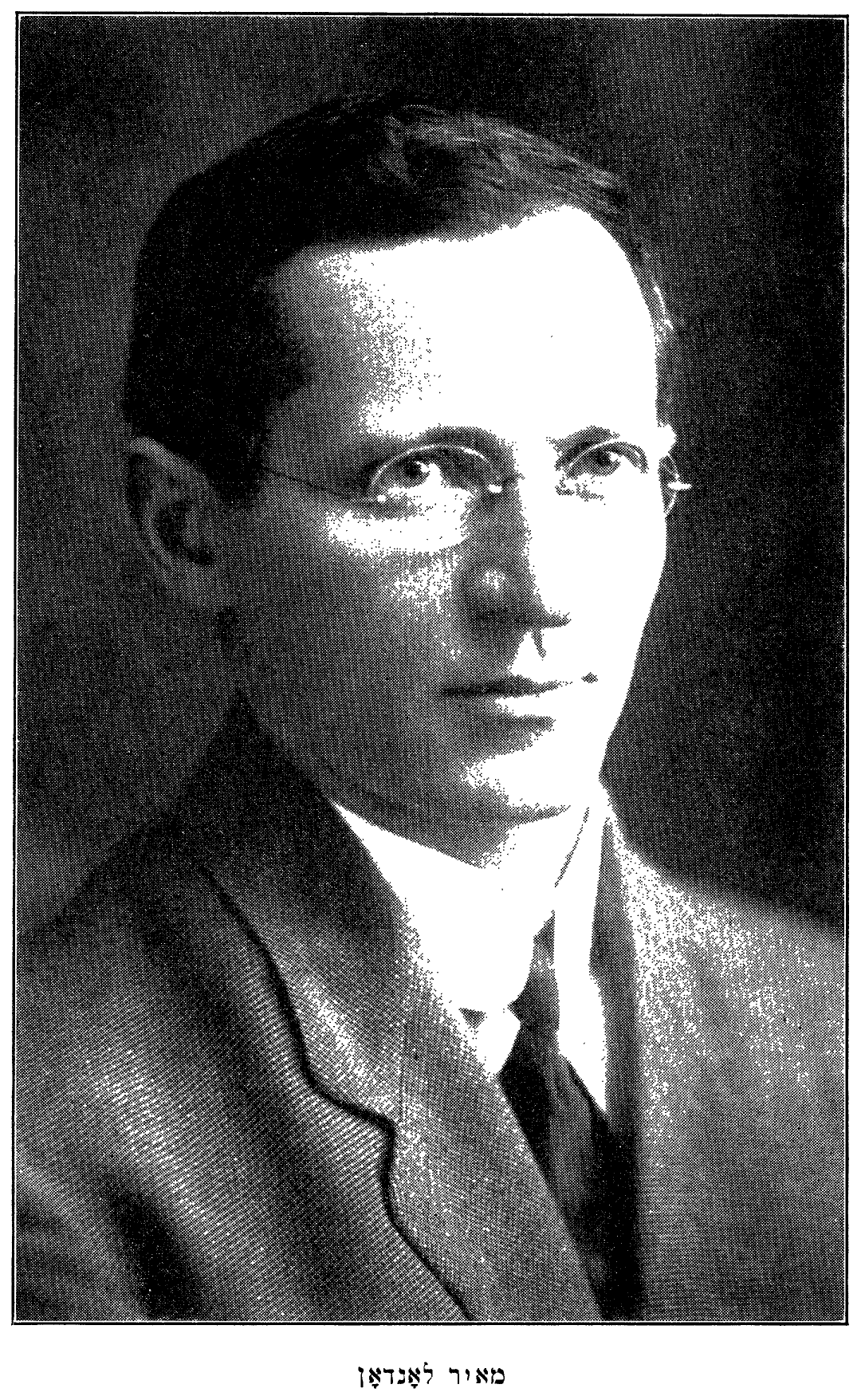
(plate; bound facing printed page 588)
588the 'Bund,' of a former Russian student club and of other Russian revolutionary organizations, he was at the same time a secret agent of the Russian police department."
In 1910 we had one of the most heated and interesting campaigns (electoral propaganda and agitation) in the history of our party. Charles Russell was our candidate for governor of the State of New York, and Meyer London for congressman from the 12th congressional district of the City of New York. The Jewish quarters — and chiefly the old Jewish East Side, where the 12th congressional district is located — stormed with our electoral propaganda, and the "Forverts" was occupied with it for many days.
Before me lies the issue of November 5th, the last Saturday before the Tuesday on which the elections were to take place. Almost the entire first page is occupied with a portrait of Meyer London. A second page is given over to articles by Charles Russell and Morris Hillquit, and a third page — to a large, interesting article by B. Feigenbaum, with the title: "The Plate of Gold and the Plate of Fire." (The gold was an allusion to Goldfogel, the Tammany candidate, who was "running" against London.)
That Russell might be elected governor we could not even dream. But on London's election we had strong hopes. We were almost certain of it. And on his campaign we strained all our forces.
589He was not elected. But he received an enormous number of votes, and in some election districts he beat Goldfogel. (As I have already said earlier, at the next congressional election, in 1912, he was elected.)
That same Saturday afternoon, November 5th, 1910, I saw for the first time an aeroplane (flying machine). In the newspapers one had naturally read about such machines before. About the two American brothers, Wright, the first men who fully lifted themselves into the air and flew, one had heard and read enough. One had also heard about the French aviator, Blériot, who a short time earlier, in 1910, had flown across the sea that separates France from England: but how one actually flies — such an experience I had only that afternoon. It was in New York, in Belmont Park.
I can never forget the impression that the scene made on me. You hear something roaring above your head, as if someone were grinding with a great coffee-mill; you jerk your head up — you see some strange-looking object moving through the air. You scarcely believe your eyes. The heart trembles with astonishment and with joy. With a similar feeling I had for the first time — in 1905 — heard Caruso's singing from a Victor "record-machine," and years earlier — words through a telephone, or seen the living figures of a moving picture (cinema). To say nothing now of the wonders of the radio, which came later.
590But the astonishment with which I watched the flying machine that Saturday afternoon in Belmont Park had in it something special, which the other mentioned experiences of mine did not contain.
Those inventions are simply wonders. But this one is a wonder which places man in a comparison with a bird.
It had always been a rule: the mightiest creature, the king of the world, cannot fly. A bird can, and even a fly too. But he, the emperor of all created beings — cannot. And so it must remain. In that lay, in my consciousness, one of the weakest points of human omnipotence. So, when they began to write that men can now fly too, I scarcely believed it. But here I saw it with my own eyes. Involuntarily, I thought of the birds. "Aha! They are no longer aristocrats above us," — I wanted to cry out. I remember the feeling quite well.
It was a race, a contest among an American aviator, a French one and an English one.
The sky was overcast. Then it began to rain a little. Johnson, the American, raised himself higher and higher and disappeared behind the cloud. People watched the other two aviators. I forgot about Johnson. Later he showed himself again; floating out of the clouds — as if from the other world.
The crowd gave a start, with a wild hurrah-cry. People sat and watched, literally as if spellbound.
Johnson won the race. But that did591not interest me. To me all three were equal wonders.
I went home enchanted. It seemed to me that all my conceptions about man and nature had been turned topsy-turvy. As soon as men can fly, like birds, there is no such thing that they will not be able to do — sooner or later.
In every socialist there flashed at this the thought: how absurd it is to think that man will not be able to introduce justice and equality into the world!
That evening, or perhaps a few evenings later, it happened that I had to deliver a speech, and this was my main thought in it. Incidentally, I used to deliver speeches on this theme already years before, when there were as yet no flying machines and I used to give other inventions as examples of man's achievements (see volume three, pages 221-223).
In the previous volume, pages 427-435, it is told how our Jewish immigrants set about settling in Harlem, a part of New York which had earlier consisted mostly of fields and rocks. Indeed, the very same sort of Jews — migrants from Russia, Poland, Galicia, Romania — were the ones who built the new edifices there. They built up Harlem with rows and rows of tenement houses.
In the same chapter, page 433, we find that afterward "the same feverish activity began592in the further region uptown, in the great Bronx"; and again a new, great city was created, far larger than Harlem; and at the same time something similar was going on in another part, in Washington Heights. Again another large region had grown up, and on the other side of the East River, in Brooklyn, in the same manner and at the same time Brownsville grew "as if on yeast."
In 1910 the Bronx, Washington Heights and new stretches in Brownsville and near Brownsville were already heavily built up with new streets, all of our Jews. New York had doubled, tripled, quadrupled; the city grew not only in all directions on the ground, but also up toward the sky. And in this our Jews played a tremendous role. With their tireless activity, enterprising spirit and capability they, in a few years, built up new gigantic regions in New York, each larger than Odessa.
The Jewish population became enormously large.
On the East Side, in the old Jewish quarter, the newer immigrants mostly lived. Those who had already been "out-greened" and had "made a better living" usually moved into the new neighborhoods.
In summer tens of thousands of Jewish families traveled to the Catskills, or to summer quarters by the sea, near the city of New York, or in New Jersey. The seashore, on Long Island, three-quarters of an hour's journey from the city, was built up with whole summer towns, from which in the morning went out dozens of long trains, each train packed with Jews traveling to their businesses or to work, and late593in the afternoon there was a throng and a rush at the railway stations of those returning to the summer places to their families.
New scenes developed, one saw new kinds of human masses. The observer noted thousands of curious traits, changes, surprises, whole upheavals. Rich summer hotels grew up. Arverne was the center of summer life by the sea. Its boardwalk (a broad wooden walkway right by the sea) streamed with summer-bedecked ladies and dandies. At first one saw there mainly "Yehudim" (German Jews), American children of earlier immigrants from Germany. In the years of which I speak here, Arverne was already full of our Jews. People built farther and farther, more and more summer quarters, one street after another...
After the crisis of 1907 better times came. "Prosperity" blossomed forth. There was work in the factories and business in the stores. People speculated, built, made money, lost money and made it again.
Together with this wave of "prosperity," there began to appear more moral freedom, — more correctly said, less Puritanical* piety in the relations between the sexes. There appeared cabarets or594large, rich restaurants, where quite respectable men and women danced in a new kind of spirit of joie de vivre. In Europe (except England), such cabarets or restaurants had always been a common thing; in America, however, a few years earlier this had been an impossibility.
Suddenly, in New York, people as it were threw off the Puritan yoke, as if from all sides one were crying: "It is now permitted!"
At first this was noticed only in New York, and the new American "all-rightniks" used to come there from the other cities and towns to enjoy a good time. Then the "moral epidemic" spread over Chicago, San Francisco and other great cities.
The American ladies too began to wear more "frivolous" clothes. To the quite short, deeply décolleté dresses, with the powdered cheeks and painted lips, it had not yet gone for the time being. But in comparison with the earlier fashions, the new ones were daring. The most respectable women used to dress up in this manner and go to eat a dinner in a fine restaurant, where an orchestra played and there was a special dance floor on which to dance with cavaliers before dozens of strangers' eyes. Such scenes one used earlier in America to imagine only as part of life in Paris.
Around that time women also began to wear lighter and more beautiful clothes than before. From Germany came new magnificent colors, and from France the freer styles. The new fashions went everywhere, but no city in the world had so richly and beautifully595shimmered and blazed with the new, brightly colored ladies' clothes as New York.
This change, however, was not the only one. There also began to appear a new sort of plays on the American stage — freer, "smellier," more open; subjects which one earlier had not allowed oneself to touch on account of the petrified Puritan morality, one now began to treat. Some of these plays were cheaply sensational and drew the public only with the sexual theme on which they were written. But there were also such as had a literary value and a value of ideas as well.
Something similar was the case with belles-lettres. The talented realistic novels of Theodore Dreiser began to attract attention.
The moral censor naturally did not sleep. He brought police to the theatrical performances; he made raids on the publishers who had put out the "permitted" works. Court trials took place. And in some cases the censor was the victor. But the number of progressive and courageous juries and judges grew, and the victory of light and progress became quite a frequent phenomenon.
In the larger cities public opinion strode forward.
Barely two years before these lines were written, Europe could not stop laughing at a trial that took place in a southern American state against a schoolteacher who had taught his class the Darwinian theory. The trial ended with a verdict against the Darwinian theory. Something similar can still even now596sirens in a small town; and even in New York itself, a few years ago, a theater was punished for performing Sholem Asch's "Got fun Nekome" (God of Vengeance) (in an English translation). But these are all exceptions, leftovers from the past.
This reminds me of the fact that when "Got fun Nekome" was staged in New York in the original, certain representatives of our Jewish intelligentsia came out against the play as immoral. A bit of a movement even developed against the performances. The "Forverts" stood up for the play. In detailed explanations we showed that not only is "Got fun Nekome" not an immoral drama, but, on the contrary, its content has a highly moral meaning. A quiet struggle took place, and we won.
A Fiftieth-Year Jubilee.
In the autumn of 1910, my comrades made preparations to celebrate my fiftieth birthday. The actual birthday fell on the 6th of July (in the Jewish calendar — the seventeenth of Tammuz). But the summer months are not a convenient time for a celebration. So it was postponed to November — after the elections.
The "Forverts Association," the Jewish unions, and the "Arbeiter Ring" (Workmen's Circle) committed themselves to the undertaking with a warmth and heartiness by which I was moved more than I could express in words. A mass meeting was arranged in Carnegie Hall on Friday evening, the 11th of November, and a great banquet on Saturday evening, the 12th of November.
For one day (Saturday, the 12th of November) it was597made "acting editor," so that the "Forverts" could devote itself to the celebration. The paper that day was run by B. Feigenbaum, with representatives of the "Forverts Association" as an informal advisory committee.
The first page contained a report of the mass meeting, with a headline running across the whole page and a portrait that took up a large part of the page. The editorial page was wholly taken up with articles relating to the jubilee.
The following is an excerpt from the report:
"Carnegie Hall was packed last evening, from the stage to the highest gallery, with thousands of people who had gathered to celebrate Comrade Ab. Cahan's fiftieth-year jubilee.
"On the stage sat the representatives of the Jewish labor movement in America, delegates of the socialist movement in New York, and many personal friends of the man being honored.
"From the boxes (loges) hung the red banners of the socialist organizations and of the unions which Cahan had helped to found and which he had helped to build up with his pen and with his speeches.
"Among the thousands assembled one could see the faces of old socialists who, ten or twenty years ago, had been in the movement on the East Side. Many of them have long since gone away from there, and they are today businessmen or professional people. Some even live in other cities. They had come from near and from far to celebrate the festival of the man whom they honor and esteem as, more than anyone, the wellspring of their intellectual life.
"Besides the thousands of people who found
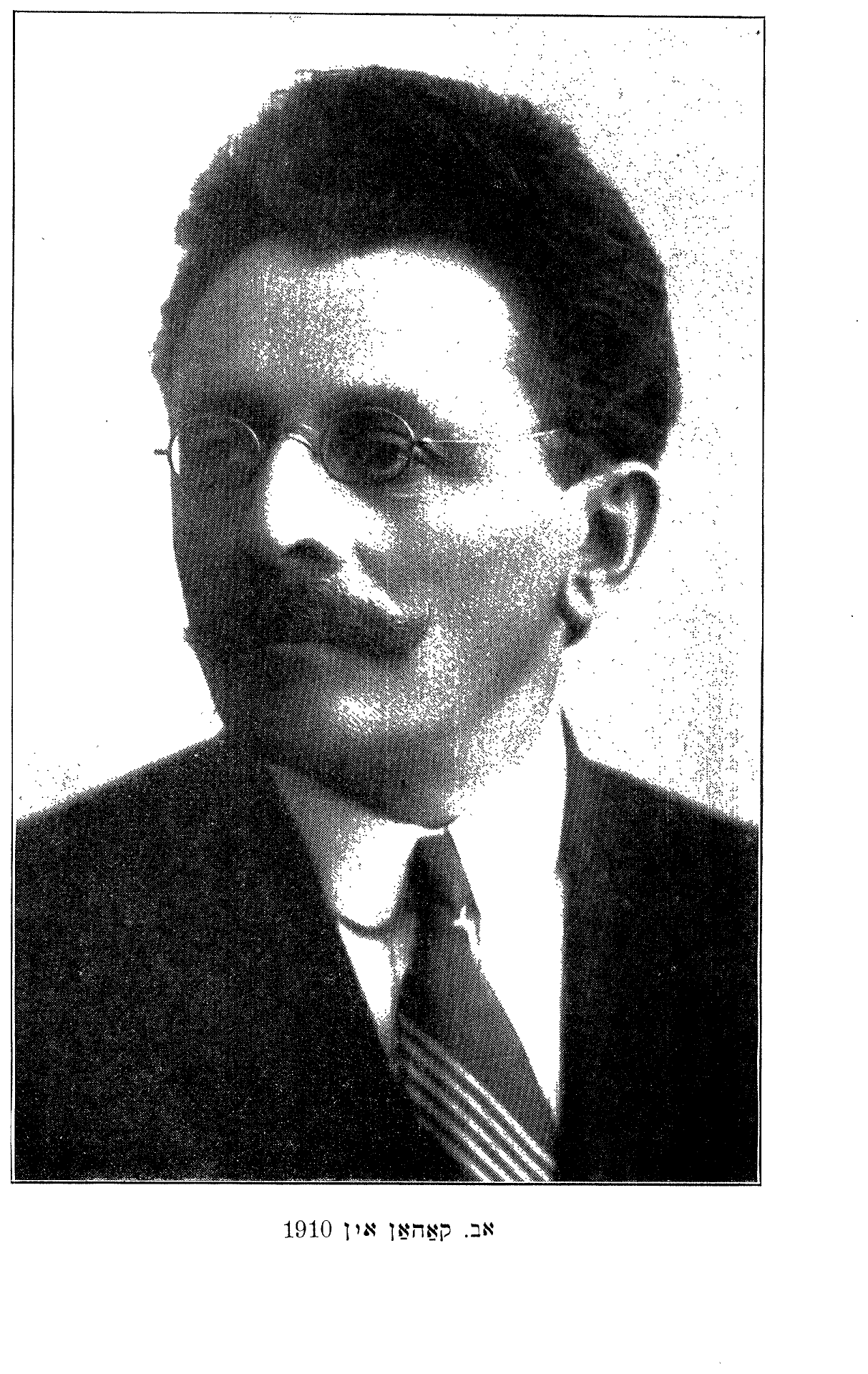
(plate; bound facing printed page 598)
598room in the hall, thousands more came to the office of the "Forverts" and to the box office of the hall, asking to be given a chance to take part in the festival. Unfortunately they had to be turned away. Ten Carnegie Halls would not have been large enough to take in all the thousands who wished to greet Ab. Cahan on his great festival.
"The celebration began exactly at 9 o'clock, when Ab. Cahan was led up onto the stage accompanied by Comrade Morris Hillquit, Comrade Russell, and Lincoln Steffens. The great orchestra struck up the 'Marseillaise,' and the assembled thousands rose from their seats and for minutes on end cheered and applauded the man being honored.
"Then began the greeting speeches by the representatives of the many organizations and by the prominent personal friends of Ab. Cahan.
"The first speaker was Dr. Halpern, who, in the name of the jubilee committee, introduced the chairman of the assembly, Comrade Alexander Jonas, the father of the socialist movement in America.
"Here follow excerpts from speeches that were delivered by the following comrades and friends: Morris Hillquit, Charles Edward Russell, B. Feigenbaum, Lincoln Steffens, B. Weinstein, Meyer London, Jacob Panken, S. Yanovsky, Edward King, Abraham Caspe, and S. Bolgatch.
Jacob Panken read out greetings from the United Hebrew Trades, from the General Executive Committee of the "Arbeiter Ring," and a list of other greeting telegrams.
The following is the address of the "Forverts599Association," which was printed on the editorial page:
The "Forverts Association" to Its Editor.
We, the members of the "Forverts Association," express our heartiest and warmest greetings to Comrade Ab. Cahan on his fiftieth-year jubilee.
As the publishers of the "Forverts," we feel ourselves, on his present festival, to be the closest of kin. Comrade Ab. Cahan, with his remarkable pen, with his ability as a journalist, and with his moral influence as a socialist and labor leader, has made the "Forverts" — in power and moral influence — the greatest Jewish newspaper in the world.
Comrade Ab. Cahan was one of the founders of our newspaper. He was its first editor in those years when one had to go around drumming up support for it every Monday and Thursday among the workers in the unions and in the shops. He stood close to it and supported it with the best material from his pen during the several years that he was occupied with writing for the English newspapers and magazines. And he came back to it nine years ago, when it was struggling along with a handful of readers, and made of it what it is today — the giant champion, the mighty socialist organ whose voice reaches a quarter of a million readers every day in every corner of America.
The Jewish workers in this land honor and esteem Comrade Ab. Cahan not only for the great services he rendered their organ. They knew him as their teacher and agitator, as their ardent and devoted friend, many, many years before the "For-600verts" was founded. Comrade Cahan's activity in the Jewish labor movement extends far beyond the bounds of our newspaper.
Yet everyone will recognize that the most important part of his work is bound up with the "Forverts." If Comrade Cahan had done nothing else in his life but build up for the Jewish workers such a giant battle-organ as this newspaper, he would for that alone have earned the honor and recognition that the whole Jewish labor world in this land bestows upon him today.
As long as the workers' struggle goes on, the "Forverts" will always stand on the battle-field in the foremost ranks, and as long as the "Forverts" lives, it will always remember its first and greatest editor, who made of it such a tremendous giant-power.
And Comrade Cahan is not only our editor. He is also our friend and comrade. In the many years that he has been bound up with us in the labor movement, he has endeared himself to us by his thoroughly democratic spirit, by his simplicity, and his truly warmhearted friendliness.
Comrade Cahan is a man with a warm heart, which beats with sympathy and love for every one of his friends and acquaintances, and this warmheartedness, this warm sympathy for his fellow men, he has carried into the "Forverts." He has made our newspaper, besides being a teacher, leader, and champion, also into the organ in which the great oppressed, suffering masses can pour out their hearts and find common cause with their fellow men who are more fortunate and can help them with counsel and deed.
We greet Comrade Ab. Cahan as our editor, teacher, leader, friend, and comrade, on his fiftieth-601year jubilee, and wish him to remain with us long still in struggle and to live to see our victory.
The following, written by B. Feigenbaum in the name of all the colleagues of the editorial board, is the editorial in the "Forverts" of the 12th of November, 1910:
For Our Editor's Jubilee Year.
On this present day we have thrown our editor out of the editorial office, and we have a world of free license. We write and print what we please.
"Behind one's back, one may tell the truth even about an emperor" — even about an editor!
With love and comradeship we send to our friend the editor, Comrade Ab. Cahan, our heartfelt congratulations on the celebration of his fiftieth birthday.
"With love and comradeship," as comrades to a comrade, because we never feel any other relationship between us and him.
It is the joy of the quarter-million readers of the "Forverts." And it is the joy of the hundred thousand Jewish working women and workers. And it is the joy of many thousands of socialists of other nationalities. And it is the joy of the masses of readers and lovers of English literature.
And for all of them it is the joy felt for a brother, friend, and comrade — for a brother, a friend, and a comrade is Ab. Cahan in everything he does. The breath of modesty and comradeship hovers over his whole broad public activity.
For 28 years he has stood at the front of our public life. Having come with the first great Jewish immigration from Russia, his activity has grown together with the whole history of "Jewish Jewry" in the new602home, in the new world, from its beginning down to the present day.
And what a wonderful, broad-ranging activity it has been! In how many roles he has distinguished himself! As a guide in literature and drama he is valued by countless thousands who owe to him their connoisseurship in these arts.
As an entertainer and instructor in popular life-philosophy, he is beloved among the masses, who cannot forget his feuilletons "Fun a Vort a Kvort" (From a Word a Quart).
His "Neshome Yeseyre" (Extra Soul) made upon thousands the impression of inspiring and ennobling moral teaching, and gave him a name as a moral preacher in the most serious and effective sense of the word.
His importance as an English writer is placed on a high level by the greatest and most significant men of letters in America and critics in Russia.
His popularization of Darwinism, elementary astronomy, natural-science subjects, the origin of human speech, how to write poetry, etc., is remembered by thousands upon thousands of readers of the former "Tsukunft" (Future) down to the present day, and they recall it as a model of light, comprehensible scientific popular instruction.
His articles on the basic principles of Marxism, his popularization of the first chapter of "Capital," and his little book "Wage Labor and Capital" have placed him in the ranks of the best popularizers of Marxism.
For us, naturally, his role is valued more than anything else as a dedicated agitator for socialism and trade-unionism in word and in writing, which was his life's task.
And as the most successful Yiddish-American603journalist, under whose editorship the "Forverts" became the greatest Jewish newspaper in the world and one of the greatest socialist newspapers in the world.
In such a many-sided, broad-ranging activity he distinguished himself and made himself popular. And this whole activity of his was always governed by a deeply democratic tone. No sign of loftiness. No trace of an exaggerated professorial tone. No hint of the patrician airs of a great man and philosopher.
His byword "Jewish Yiddish," his eternal cry about the necessity of writing very popularly for the masses, characterizes his whole activity as deeply democratic, free of any patrician tone, of any "haughtiness," of any schoolmasterly manner, of any exaggerated pretension.
One may consider exaggerated his eternal riding about on the little horse of popularity. But that shows, in any case, both modesty and an absolute freedom from lofty pretensions and aristocracy of any sort.
And this makes us feel ourselves close kin at his celebration.
We would have refused to render him the patrician "honor" due "the chief." We would have refused to deify him as the infallible authority in anything whatever. But with our whole heart and with the deepest recognition we greet him as a true and dear friend, brother, comrade — from us as comrades and colleagues and from the whole Jewish population, especially from the working class, as its faithful champion.
Colleague and comrade! Half a century you have lived through on this dark world, and with all your abilities you have helped to make it brighter. You have helped, with the lightning of your spirit, to illuminate its dull604present. You have helped, with your battle-torch, to illuminate its future doubly.
You have your reward already today. For you can see that your work has not been in vain.
When in the dark life of the tenement dwellers a little spiritual light glimmers today — that is in large part your work.
When into the bleakness and gloom of their family life there has entered a ray of cheerful conversations between husband and wife about literature, drama, nature, socialism — that is very much your merit.
When onto their tables, to their meager breakfasts and dinners, there have come bits of butter and meat — that is largely the result of your taking part in their struggles.
When precisely at your fiftieth year you have lived to see almost the whole Jewish working class well organized and successful in its brilliant struggle, international socialism in a splendid condition, and in America the first breach of socialism into Congress — that is a joy which you have honestly earned with the sweat of your brow. For to all this you have contributed your full share.
Those whom you gave the fitting name "Allrightniks" — both the boorish kind and the intellectual kind — cannot grasp it at all: a man with so many all-around abilities, already 28 years in America, and still has not even a tenement house, to say nothing of an automobile. "What does he get out of it?"
But you get out of it that which the greatest millionaire, for all his millions, cannot manage to buy: you have the true love of thousands and the gratitude of tens of thousands. You have the bliss of seeing coming on ahead the605beautiful, happy time for suffering humanity, and of feeling that you have helped so much to bring it about.
That you may live to see it yet is the ardent wish that you receive today from many thousands, among them your colleagues of the editorial board.
At the banquet (in the Murray Hill Lyceum) about five hundred persons were present — representatives of unions, socialist organizations, my personal friends (among them several American writers).
Jewish workers' organizations from the surrounding cities had sent delegates.
The hall was decorated. Speeches were delivered by representatives of organizations and by the most prominent people in the socialist movement. One of those who delivered speeches was Arthur Brisbane, the famous editor of the "Evening Journal."
A special word is due to be said about the participation of S. Yanovsky, leader of the anarchists and editor of their weekly "Di Freie Arbeiter Shtime" (The Free Voice of Labor). This former opponent of ours (once a bitter opponent) was by now one of our best friends. What was noted earlier (page 557) about Johann Most should here be noted about S. Yanovsky. He was not converted to our standpoint; into our party he did not cross over. But we were on very friendly terms, and his friendship was dear to us.
With his fine oratorical power and his peculiar, merry humor, he adorned many of those gatherings of ours that did not bear any party character. We regarded him as one of our family.
606A Ten-Story "Forverts" Building.
A few days after the jubilee, the "Society of American Advertisers" issued a certificate that the circulation of the "Forverts" was already 113,300.
Later its circulation climbed a good deal higher. It jumped past 200,000. But for a Jewish newspaper — and for a newspaper published in any other foreign language — 100,000 too is a very unusual figure. The report made an impression in the American press throughout the whole country.
The building, 175 East Broadway, had become too small. This had begun to be felt a couple of years earlier, and in 1909 the Association bought up the next house, 173 East Broadway, with the aim of tearing down both old structures and erecting on the two lots a modern building suited to the requirements of a daily newspaper.
The question was what sort of building to put up, and on this there were two opinions. Some members believed that one ought to have a four-story house — just for the newspaper. The other side, in turn, declared itself for a ten-story structure, so that, besides the editorial offices and business department of the newspaper, there should be meeting rooms (assembly chambers) and one large hall for an audience of around a thousand persons, for small mass meetings, lectures, concerts. I supported the second side. Such a building would become the center of our labor movement, and with its ten stories it would draw much attention. It would be the highest building in the great old Jewish quarter; and since in front there is an open space — Seward Park —607the word "Forverts" would be seen over a great distance all around; thus this itself would be a good means of agitation for the newspaper and for the movement.
The second proposal was adopted.
The undertaking was to cost 348 thousand dollars. For this the "Forverts" had 60 thousand dollars in cash (ready money). For the remainder, mortgages were given in part and in part loans were taken from the banks. The credit of the "Forverts" was by then already almost unlimited.
Schlesinger also, with the approval of the "Forverts Association," ordered three press machines of the largest and newest models and the latest stereotype machines and fittings. To these he also increased the number of typesetting machines.
A huge capital was required, but the income of the "Forverts" was by now very great and was growing fast.
On the 1st of January 1911 the editorial board and the business office of the "Forverts" moved temporarily into another house, at 91 East Broadway. And on the cleared site of 173 and 175 East Broadway they began to build the 10-story "Forverts" building.
The new building was to be ready in May 1912.
(End of the Fourth Volume)
Notes (the original’s footnotes)
[p. 566] In the second volume there are, in this place, the words: "Thirty years later he reminded me of it (my speech) by a letter." That is a mistake. It should have read: "Twenty-five years later."
[p. 568] Thaw was confined in a criminal asylum. From there he later escaped. But he was afterward caught. Then he began a lawsuit, pleading that he was already completely well. Meanwhile Evelyn obtained a divorce from him. The advertising that the whole affair had brought her, she exploited for a career as a dancer. There was also a money lawsuit. Thaw refused to support his former wife, declaring that her child was not his. His own struggle for release from the asylum dragged on for several years. Finally he attained his goal.
[p. 570] See the second volume, pages 40, 41, 140, and 141.
[p. 584] Then, on his visit to New York, Burtsev told me that at my lecture in Zurich, in 1893, among the listeners had been Azef (see volume three, page 336).
[p. 586] From Burtsev's statements I also learned that about the above-mentioned gathering, which took place in Dr. Kaplan's house, in 1904, Yevalenka had also reported to the police department. He had only twisted the facts a little. His main purpose was to show that socialists accuse him of espionage, but that he answers everything so cleverly that the accusations against him are turned back; he is still taken for a good revolutionary, that is, and he can continue to serve the police as their secret agent.
[p. 593] By this word is meant here the pious, strictly devout — according to the religious demands of the Puritans — the English who immigrated to America in the 17th century and founded the several states which are known as New England.