Chapter One
In 1911
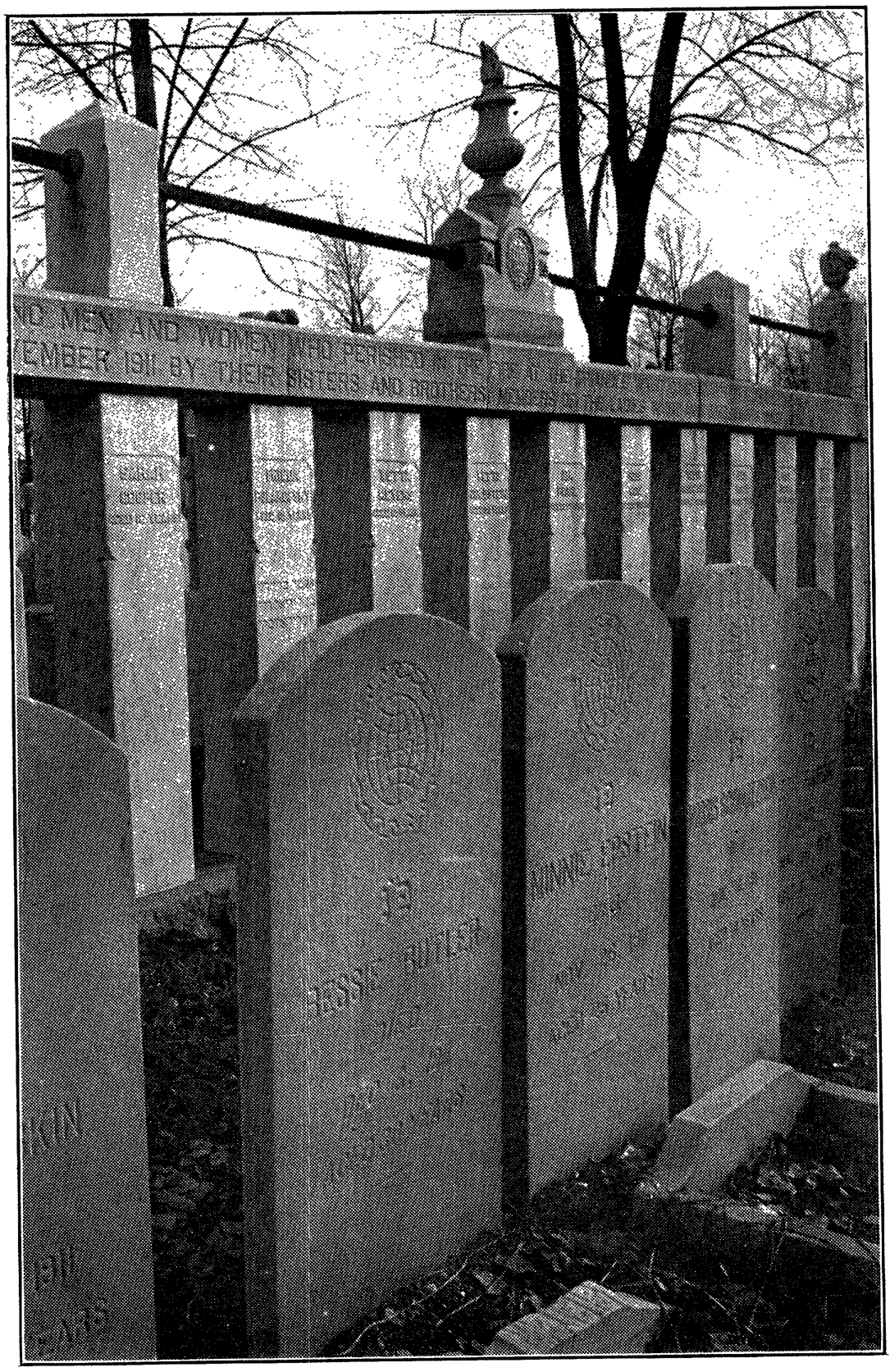
11The most striking event of the year 1911 in the life of our movement, and of the Jewish working masses in general, was a manifold tragedy at a fire (sreyfe — a conflagration). The occurrence made an enormous impression. For months on end people did not stop talking about it. And to this very day, when one utters the words "the Triangle fire," even children know that it refers to some great, terrible calamity that once befell New York.
The fire broke out in a factory of "waists" (blouses) that belonged to the "Triangle Waist Company," at 23–29 Washington Place, near Greene Street. The victims were for the most part members of our makers' union.
It happened on Saturday afternoon, March 25, 1911. In the "Forverts" (Forward) the sorrowful story was printed in the Sunday number (the number, however, appeared on Saturday evening, that is, a few hours after the fire). The entire first page and a large part of the other pages were taken up with the calamity. Across the first page ran great words: "The morning is full of our victims." Beneath that, also in great words: "175 workers lose their lives in a bur12ning Greene Street waist factory." After that came several lines, all running across the whole page, and then, again in very great words and also across the page: "The whole Jewish quarter in mourning."
The account of the calamity was written up for the "Forverts" by the poet Morris Rosenfeld. The particulars were related to him by people who had witnessed the fire.
Here are several excerpts from his report:
"The fire broke out at half past five in the late afternoon, just after the bell had rung for the workers to stop. The building is a ten-story one. The top three stories are taken up by the Triangle Waist Company, and it was in this factory that the fire started.
"The flames spread very quickly. A stream of fire shot up through the elevators (lifts) and the stairs to the upper floors. In an instant the fire showed itself in every window, and tongues of flame crept up the walls higher, toward the places where great numbers of men and women stood in despair.
"The fire grew stronger, larger, more terrible. The workers on the upper stories could no longer endure the heat, and one after another they leaped from the eighth, ninth and tenth floors down onto the sidewalk, where they remained lying dead.
"Only when a heap of corpses already lay below did the first fire engine appear. But the firemen were powerless. Their ladders reached only as far as the seventh floor. As though at a loss, they13stood and looked on as one woman after another fell, like shot birds, from above, from the burning stories. The men held on longer, wrapped in flames. And when they too could endure it no longer, they likewise leaped.
"Below stood, with wailing and weeping, thousands of workers from the surrounding factories. Moving, terrible, unforgettable scenes. On the eighth floor a young man appeared at a window with a young girl. He holds her firmly by the hand. Behind them the red fire can be seen. The young man presses the young woman tenderly to his breast, gives her a kiss on the lips, and lets her go. She gives a leap, she lands heavily on the sidewalk. The next moment he springs down after her, and his body lies close beside hers. Both dead.
"And up there the fire raged. A sea of flames and a cloud of smoke enveloped the upper floors. Now and again the wind gives a gust. The flames and the smoke surge to one side, and then masses of despairing people are seen there.
"The flames had quickly seized the stairs and filled the elevator shafts.*) One elevator tore loose and fell down with a crash. The other three managed twice to ride up and bring down about a hundred girls. To go up a third time the elevator boys were afraid to risk. The hundreds of girls wept and waited hysterically. Instead of the elevators, the flames came nearer and nearer to them. The girls saw that no rescue would reach them there; so they flung themselves toward the14call (there) of the fire escapes (rescue galleries) and to the windows.
"And then suddenly a terrible crash was heard. The seventh floor caved in. Dozens of girls who had been standing there beside the sea of flames were hurled into that sea of flames, which raged there. Later their bodies were found lying one upon another in a great heap.
"It took a full hour before the firemen could get into the burning building, and by then everything was already over. The sidewalks were strewn with the dead and the wounded. At the windows no one more was to be seen. The unfortunate girls who had remained in the building lay somewhere, burned or suffocated by the fire and smoke.
"There were not enough ambulances and patrol wagons. The grocery men, butchers, and peddlers round about lent their express wagons and pushcarts. Dozens of the surrounding stores were turned into morgues or hospitals.
"Ten minutes before we sat down to make up the paper, the door of the editorial room opened, and out burst a heartrending sobbing and weeping. A young man, a Jewish worker, came stumbling in with a hysterical cry, gesturing with his hands and bathing himself in tears.
"'I was there! I saw it!' — he stammered out, and more he could not say. With difficulty he was calmed. Then he began to tell. And as he told it, every little while he broke15down into sobs and clutched his head, recalling the scenes that he had seen."
The building was a firetrap. And the doors through which the working girls might have saved themselves were, at that terrible moment, locked.
For several days running the "Forverts" was chiefly taken up with the tragedy. Each day brought new, terrible particulars. We printed portraits of the victims. Beneath one group of such portraits stood the words: "Around these pictures tears are pouring."
By way of example, we bring here several of the other "headlines" in the "Forverts" of those days:
"Funerals instead of weddings"; "The greatest tragedy now is the 29 bodies that cannot be identified"; "If you have pictures of those who are missing, bring them to our 'Forverts'"; "A fright in wedding clothes — that is all that is left of Yetta Shapiro"; "Only a mute fiddle is left of him"; "The mother burned, the son burned, three little orphans left behind."
Beneath a large picture of a bridegroom and bride, taken some time before the tragedy, is found the caption: "Becky Keppler, the bride, was burned to death."
In the week of the tragedy there fell, as it happened, the sedre (the weekly Torah portion) Vayikra, which deals with korbones (sacrifices). And so the "proletarian magid" (preacher), in his sermon on the sedre, on Saturday, April 1, "expounded" the sacrifices of the Triangle fire.
The wrath against the owners of the factory was enormous.
The funeral of those who perished in the Triangle fire took place on April 5. The "Forverts" had,16on that morning, on the first page, in the very largest letters, the call: "Come and pay our victims the last honor!" and beneath it: "Every union man with his trade, with his union!"
In the same number is found an article by the poet Morris Rosenfeld with the heading: "The locked door." And the lead article carries the heading: "Beside the victims."
The next morning, April 6, the "Forverts" had on the first page in great words: "Half a million people in mourning," and beneath: "In a great downpour of rain a mourning march of 120 thousand people proceeds. — The masses are full of hysterical weeping. — The marchers call to mind the disaster in which so many working women lost their lives." And beneath that: "Seven unidentified victims buried in Evergreen Cemetery." On the first page is printed a poem by Morris Rosenfeld, "The march of tears."
It was impossible for me to attend the funeral. That day I had to be in Washington on a matter that will soon be related.
On April 12 Max Blanck, the owner of the factory, was arrested. A trial was begun against him and his partners. But they, the owners, hired the best and ablest lawyer in New York, Max Steuer, and the result was that in his hands an important witness became confused on certain details of the facts, and the jury brought in a verdict of "not guilty."
(plate; in the original facing p. 16)
(plate; in the original facing p. 17)
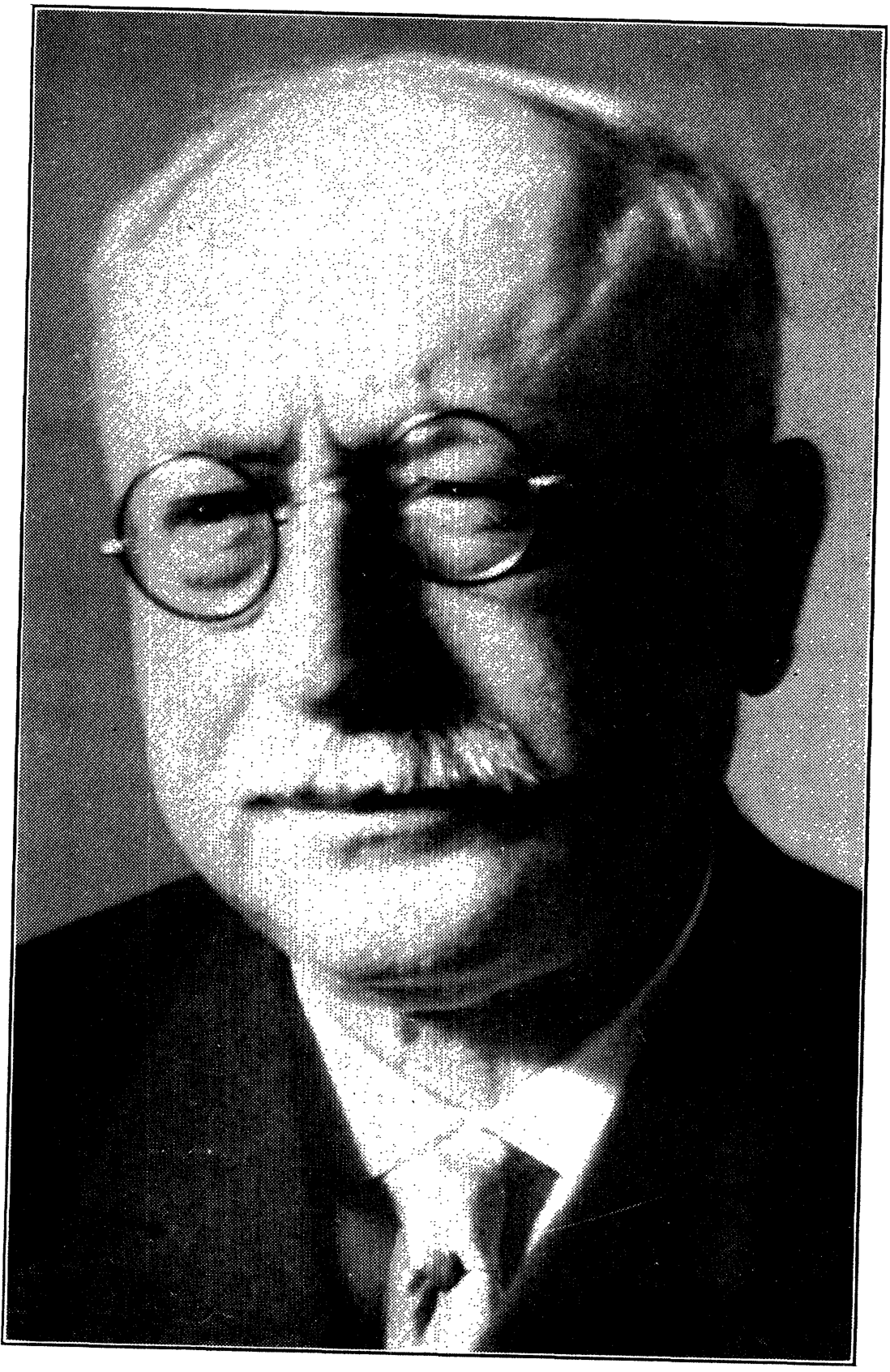
17The "Forverts" of Tuesday, April 4, contains on the first page a picture of a family group — of Victor Berger, the leader of the socialist movement in Milwaukee, his wife and children. A few months earlier, in the November elections, he had been elected representative (deputy) to Congress (the American parliament), and now he had come to Washington to take up his seat.
In the history of our movement this was a remarkable piece of news. In Europe the socialists had long had deputies in the parliaments, and in Germany, for example, they had long had a great number of such deputies. In America, however, where conditions are altogether different from those in Europe, and where the genuine American worker cannot for the time being be class-conscious and is therefore cold toward socialism — in America socialist propaganda makes very heavy going. From time to time we had elected here or there an alderman or an assemblyman (deputy to the local parliament of a particular state), and in Milwaukee we had even, that same year, had a sensational success in the city elections. Our comrade by the name of Seidel was elected mayor of that great city, and together with him a great number of our candidates for other important city offices also got in. All of this made an impression throughout the land. But the most important of the whole success in Milwaukee was the election of Victor Berger to Congress.
For us socialists this was truly a great18holiday, an enormously important chapter in the slow history of our movement in America.
The lead article in the "Forverts" of that day (April 4) had above it a heading with the words: "A historic day is today — for the first time the American Congress opens with a socialist in it."
Victor Berger was the most important personality among the socialists of Milwaukee and one of the most important in our entire movement. He was an educated man and a thinker, a man with a firm will and with a spirit of enterprise.
He was born in Hungary, of a Christian father and a Jewish mother, and his upbringing was a Hungarian-German one. In Milwaukee he was for a long time the editor of the local German socialist weekly. Later he edited an English weekly, and still later, when the Milwaukee English comrades founded the daily (English) "Milwaukee Leader," they made him its editor. He wrote English as well as German, both languages in a clear, vigorous style, with original thoughts and with humor.
Milwaukee is a German city, and although the population was by then already a fully Americanized one, and the German language had already lost its ground, the psychology of the Milwaukee workers was better suited to the socialist movement than elsewhere in the United States. Berger knew how to make use of this. With his remarkable energy and through the great personal influence that he had won among the English-speaking, as well as among the German19speaking workers, he built up the strongest socialist organization in the land.
I traveled over to Washington and witnessed the scene when Berger took his place among the congressmen. I visited his rooms in the great building that the government had specially built for the offices of congressmen. I spent three days in Washington.
In that same "Forverts" number, of April 6, in which the funeral of the Triangle victims is described, there is found a long article of mine from Washington, under the heading: "Victor Berger's first day in Congress."
I had been acquainted with Victor Berger from before. But in those three days, when we were mostly together and chatted for hours on end, we became close friends.
In the "Forverts" of April 13, 1911 (the first day of Passover), there was printed an article of mine under the title: "In honor of Passover and in honor of America." The keynote is given in the thought that "Jews have dressed themselves up in honor of Passover, and let us also say that they have dressed themselves up in honor of America." In other words: "We have no reason to be ashamed of the warm feeling toward Passover, and we have no reason to be ashamed of the friendly feeling that we have toward America."
The article begins with the following lines:
"In many progressive, educated Jewish families people sat last night at the seder. — And twenty years20ago, had it become known that a Jewish socialist was taking an interest in a Jewish holiday, such a socialist would have been called a tsvue (a hypocrite). Today it is a perfectly natural thing.
"Twenty years ago a freethinker dared not show any interest in the Jewish people. Today one may! With the blood of the pogrom victims one has bought the right.
"What a change! In hundreds of various particulars it can be observed. It is a change for the good, toward a broader understanding, toward a more human attitude toward oneself, toward one's own feelings.
"And when one thinks about this change, a second one comes to mind. The progressive, educated immigrant comes over here from Europe laden with contempt for America. With a venomous smile he comes down from the ship, and the smile remains frozen on his lips. Everything American is, to him, low. In Europe it has become rooted, a custom of looking down from above upon life in the United States. A land of skyscrapers and 'yellow' journalism, a fairground of business and of bluff — that is all one knows over there about the United States.
"America is treated in Europe in the very same manner in which antisemitic Christians treat Jews. Can anyone deny that the Jewish people have faults? But more than faults they do not see in it. Can one deny, then, that America has in it a great deal of bluff and 'yellowness'? The misfortune, however, is that more than this is not remembered in Europe about America.
"And with this one-sided impression the intelligent Jewish immigrant comes over from his old home into the new."
21I have brought in here all these lines so that the reader may have a notion of the content of the article. Further on, it points to the fine traits of the life of Americanism, to the natural strivings of the American people. It points to the growth of the socialist movement.
Here, however, what interested me especially was the point about sitting at the seder. This side of the article called forth a dissatisfaction among a considerable number of my comrades, the "Forvertsists." A considerable part of them, however, welcomed the spirit of the article.
In private houses, and also at small gatherings, heated debates took place.
What I had said — that the socialist may now sit at the seder, that for such a thing he would no longer be called a tsvue (hypocrite) — this, it turned out, was true only of a part of our comrades and friends. Another part, and perhaps a larger one, was outraged. This side regarded the article as an unpleasant surprise, as apikorsus (heresy) against the spirit of the "Forverts." The article says that twenty years ago a socialist could not have dreamed of sitting at a seder (unless at his mother's table and half in jest). It turned out that a large part of our movement still held the very same attitude toward it. People looked upon me as a man who had gone off too far "to the right."
Wherever I stood and wherever I went, comrades came up to me and expressed their displeasure that I had written the article. But there were also found enough of those who were in full agreement with me. The protest reminded me of the protests I had heard in the22"Forverts" Association and from other comrades for all the changes I had made in the "Forverts" when I became editor again after an absence of barely five years.
A short time later M. Baranov, our talented collaborator, printed in the "Forverts" an article that reflected this protest against my position on the seder. Taking the anti-nationalist standpoint, he went too far, and he expressed himself too sharply.
I answered him perhaps too sharply as well. It was a heated debate. An echo of the debate was heard in thousands of homes and shops and at almost every meeting of an Arbeiter Ring branch or of a union.
Time worked in favor of my standpoint. A few years went by. There came the war, with all its great upheavals. The nationalist feeling rose strongly, and a great, great majority of those who had been incensed by my Passover article themselves came to feel just as I did.
(plate; in the original facing p. 22)
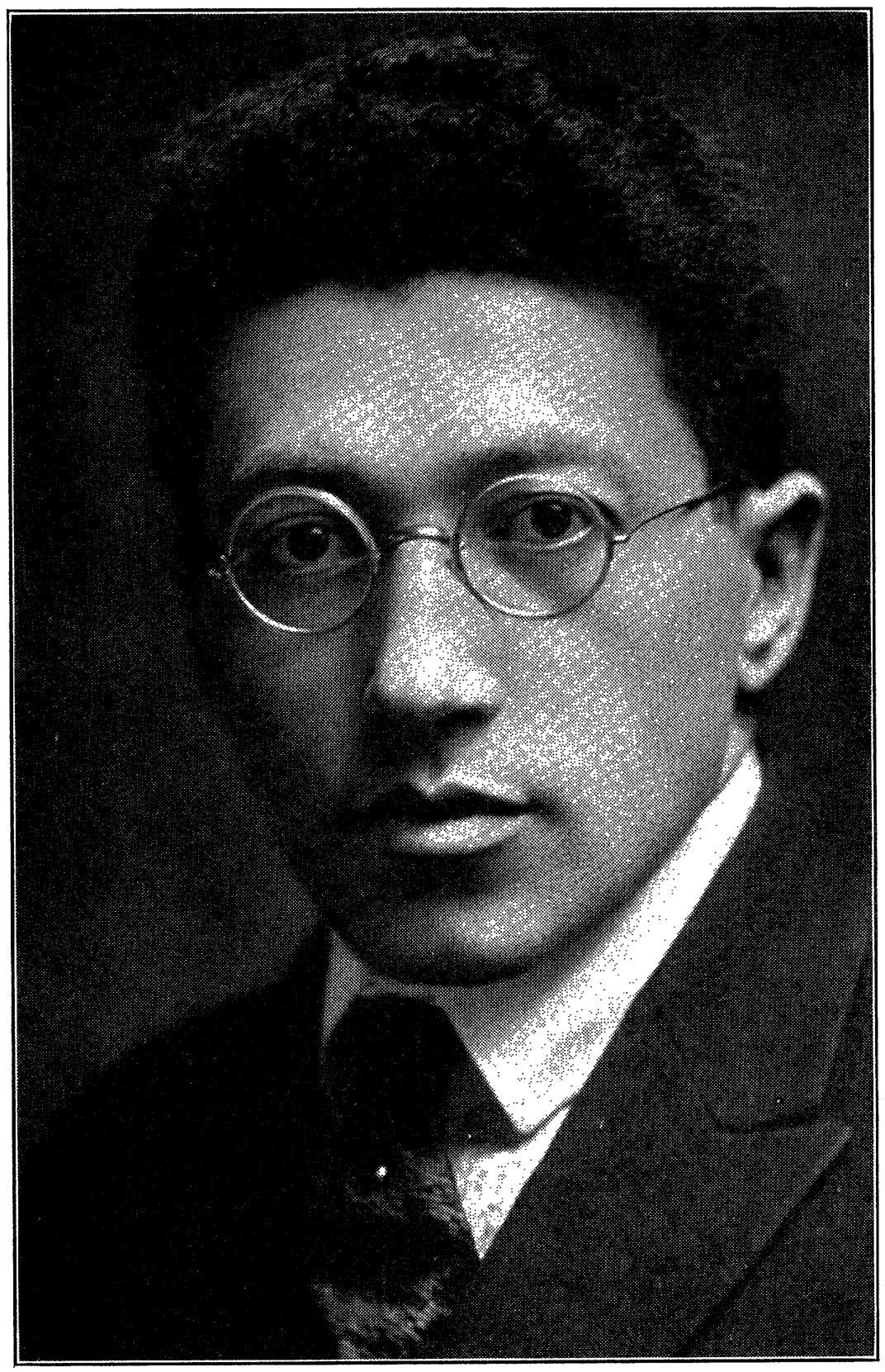
In the year 1911 the "Forverts" printed frequent correspondence from American cities, by B. Vladeck. The name was already well known in our movement, and among the Jewish socialists of Russia he was well known even earlier than among us. There B. Vladeck (his real name is Boruch Charney) had been famous among the Bundists. He was called the "young Lassalle," for his oratorical talent.
He immigrated to America in the year 1908. He was23then 22 years old, a handsome young man, a tall one, with curly, velvety hair.
With his gift as an orator he was, for our movement, a welcome guest. He at once became active, and he made a tour across the land under the direction of the then-existing Jewish Agitation Bureau of our party.
He visited a great number of cities, almost every place where there was found a society, a group, that was connected with our movement — a branch of the Arbeiter Ring, a Jewish branch of the Socialist Party, or a Jewish union. By that time there was in the United States no city, or any sizable town, that did not possess a growing Jewish population. And so almost everywhere we had an organization of ours.
Vladeck visited all these cities, and everywhere held speeches and lectures. His journey "covered" the most varied regions, from the Atlantic Ocean to the Pacific and from Canada to Mexico, Canada included. And so from every important place he sent us travel letters.
On October 9 of that year (1911) the "Forverts" printed a piece of news that called forth among us older immigrants a deep feeling of mourning. There had died Sergei Schevitsch, the Russian baron, who was one of the founders of the socialist movement in America, the wonderful orator in several languages, the handsome, talented man, who had played such a role in our intellectual life in the24in the early period in America, and whom we held in such high esteem. He died in Munich, Bavaria, where he had lived ever since he left the New World.
In the second volume of "Bleter fun mayn lebn" (Pages from My Life) an account is given of the role he played in America (see there pages 88, 89, 102, 103, 258, 263, 264, 269, 270, 271, 272, 273, 274, 275, 276, 277, 278, 435, 436). His picture is found in that same volume, at page 103.
See also, concerning the incident through which we met in Zurich, in the year 1893, the third volume of "Bleter fun mayn lebn" (pages 328, 329, 330, 331, 332, 333).
In Germany, Shevitsh founded a literary-humorous weekly, "Simplicissimus," which became famous. Later it passed into other hands. His last years were years of want.
In the report of Shevitsh's death, the "Forverts" also stated that soon afterward his wife committed suicide. In the second volume of these "Bleter" it is explained that she was none other than the famous beautiful Helene von Rakowitz, with whom Ferdinand Lassalle had been in love, and over whom he lost his life in a duel. In that same volume (page 271) it is told how Shevitsh introduced me to her, at the gathering in Miner's Theater, where the debate took place (which is for us a historic one) between Shevitsh and Henry George.
In the last period before Shevitsh's death, the couple suffered greatly. And when she was left alone, without any means of support and forlorn, she put an end to her life.
25In November of that year, 1911, the English writer Arnold Bennett came to New York. I became acquainted with him.
I considered him the finest novelist in the English language of our time. His novels, "The Old Wives' Tale" and "Clayhanger," had aroused enthusiasm in me. I invited him to lunch at the then restaurant "Café Boulevard," on Second Avenue, corner of Tenth Street. And there we — my wife, he, and I — spent four hours talking about literature, chiefly about the Russian masters, whom he idolized.
With the works of Turgenev, Tolstoy, and Dostoevsky he was acquainted through French translations (his wife is a Frenchwoman, and he knew her mother tongue thoroughly).
In my conversation with him, my attention was drawn to a certain trait in his attitude toward writers in general — a trait one finds in all the important realists in England and America, but not in the Russian ones. They, the non-Russians, are more tolerant. They are not so severe in their judgment. When a novelist has talent, he may write melodrama, and they will praise him all the same.
The work of constructing the ten-story "Forverts" building had dragged on. While digging the earth for the26foundation, we struck a powerful spring of water. It cost much effort, time, and money before it was completely stopped up and walled over. Our architects, the Boehm brothers, as well as the inspectors of the Building Department (the construction division of the city government), declared that one could now safely lay the foundation and begin building the structure.
At last, then, we began to lay the foundation. On the 25th of November, 1911, with a grand ceremony and with speeches, in the presence of twenty-five thousand of those attending, the first cornerstone was laid.
With the role of "mason" at this ceremony the "Forverts" Association honored the one who writes these lines. I "laid" the cornerstone. For this purpose the bricklayers' union (the association of masons) had, a few days earlier, officially made me a member of theirs and issued me a membership card.
Speeches were delivered by B. Feigenbaum; Wanhope, associate editor (assistant editor) of the "Workmen's Advocate"; Jacob Panken; B. Vinstein, secretary of the United Hebrew Trades; Leon Deutsch*) and others.
The real masons led me down below, to the spot where the foundation was being laid. There they gave me a silver "trowel," and a silver-plated27"level." I gave a few make-believe taps at a stone, and that was that. It meant that I had laid the first cornerstone of our ten-story building.
In the elections, in November, 1911, our party had a brilliant victory in Schenectady, an important factory city of the state of New York. There George Lunn, our candidate for mayor, was elected, and John Merrill, a candidate of ours for the Assembly — the first socialist in the Assembly at Albany (the city where the government of the state of New York is located).
At the same time, socialist candidates for mayor or assemblymen were also elected in other places.
On the first of January, when Lunn entered his office, I was in Schenectady. I had a conversation with the new mayor and also with Walter Lippmann, his private secretary, who at once made an impression on me as a capable Jewish young man*).
Three weeks later, when Lunn was in New York, the Jewish comrades held a reception for him in Clinton Hall, where I was one of the speakers.
In addition to the great socialist victory in Milwaukee, the election of Lunn and Merrill and of a whole series of other socialist candidates across the country28(although not such important ones) made a gladdening impression upon us. It began to look as though our movement was already winning a firm footing in America.
And yet our most important moral support was still, as before, the socialist movement of Germany.
We were like a poor bride from the old home who boasts to a prospective bridegroom of her dowry by pointing out that she has a rich uncle in America.
At every gathering of ours we used to point out how great German Social Democracy was.
In the period at which we are here, the beginning of the year 1912, our German comrades had stormed the world with their colossal victory in the Reichstag elections. And the "Forverts" displayed this fact with fanfare. On the 13th of January (1912) there was on our front page a headline in large letters, announcing that in the elections in Germany more than four million votes had been cast for the socialists, that sixty socialist deputies had already been elected, and that another 99 were going to the runoff elections.
And on the 26th of January we had a headline, five columns wide, with the words:
"The socialists are today the largest party in Germany. They have 110 deputies, and the conservative party only 93."
On the first of January, 1912, we announced that in the past year the circulation of our29newspaper had increased by 17 thousand. According to the official report of the "Association of American Advertisers," we now already had 130,462.
I introduced a couple of new light "features," and they had a great success. One feature consisted in our giving, every Monday, a whole page with the contents of the most interesting items in the American newspapers of the previous day — that is, of Sunday.
For the non-American readers of these "Bleter" it must be explained that an American Sunday newspaper contains many dozens of pages with articles, pictures, advertisements, and so forth. It is literally a sea of reading matter, much of it interesting to the various classes of the broad public. The heading "The most interesting articles in yesterday's American newspapers" made a "hit." The department instantly became very popular, and it runs in the "Forverts" to this day.
Much interest was aroused by the answers that readers sent in during the summer of the year 1911 to my question: "What is an 'oysgegrinter' (one who has shed his greenhornness)?" And a goodly number of the answers were apt ones.
One answer, for example, was:
"An immigrant who in the old home was a brave revolutionary and stood up courageously against spies and Cossacks, and in America spies in the shop against his fellow workers, in order to find favor with the boss."
A second answer:
"An immigrant who gets his education on a working girl's money, and then throws her away."
A third answer:
"An immigrant who rolls up his trousers so that his colored socks, which he bought from30a pushcart, may be seen, and in this consists his whole Americanness."
For ladies to paint their cheeks and lips was already then in the highest fashion. And young girls, still mere children, would already be primping themselves in this manner too. So I sent a staff member to see the principals (directors) of several high schools (middle schools) about the matter. They all complained that their female pupils painted themselves, and that when one rebukes them, they answer that it is their own "business."
We reported these conversations with the principals in the "Forverts," and this called forth letters from parents about the question.
The "Forverts" won readers with every important piece of news that stirred up the city or the world. At such a time all newspapers are, naturally, distributed better than usual, and people grab a popular paper sooner than others. We "covered" every such piece of news with a full hand, devoting much space to it, and besides all the interesting facts with all their details, we printed articles with explanations, so that everything should be intelligible, clear, and interesting.
So we did in April, 1912, when the world was thrown into a storm by the "Titanic" tragedy.*)
The "Forverts" presented the blood-curdling incidents31described with all the details, sparing neither space nor energy.
Around that same time there developed in Kiev, Russia, the shameful affair of the blood libel against Mendel Beilis, which two years later was to give rise to the Beilis trial, over which all of Russia, and the Jews of the whole world, were long in a ferment. We covered it all for our readers in an impressive manner, with all the facts and with explanations.
The "Forverts" of the 23rd of March, 1912, contained a photographic copy of a Russian antisemitic proclamation. The facsimile was illustrated with a picture of a Jew slaughtering Christian children, beneath which stood three words: "Khristiane, beregite svoikh detei" (Christians, guard your children!).
My agitation for tolerance, for decent relations toward honest opponents, I continued. I had, for example, in the "Forverts," an article under the heading "Freethinkers and free thinkers," in which32the difference is explained between true free thinkers and apikorsim (heretics), fanatics, for whom atheism is a kind of new religion. Among Jews the word "fanatic" used to be applied only to pious, religious people. So in the article the true sense of the word was explained, and it is shown that one can be a fanatic in apikorsus (heresy/freethinking) as well.
The article brought me letters from readers. Some thanked me, but others were very displeased. One letter came to me from a good acquaintance. He spoke in a tone of anguish. He regarded my article as a betrayal of my own opinion about religion. His letter reminded me of the great letter I had received some years earlier from a former anarchist from the South (see the fourth volume, pages 566 and 567). That former anarchist had read with heartache my appeal that one should relate with tolerance toward people who hold opinions different from ours.
The writer of the present letter was an interesting man. I had not seen him for some years, and with his letter he interested me so much that I specially invited him to come to me. We spent a whole afternoon together. He spoke with such earnestness, with so much spirit, that I had not the heart to debate with him. It was simply interesting for me to converse with him. With him, too, apikorsus (heresy) had become a religion.
Only once, in the old home, in his very young years, he had been a passionate zealot of piety, and when he came to his atheistic ideas, he became a passionate atheist. He is a good thinker. But he belongs to that type of deep people in whom, when they become33inspired, the intellect ceases to function and only feeling reigns.
I write here about this because we are at the time when he came to me in connection with the above-mentioned article of mine. But in my mind I cannot separate my conversations with him from a meeting I had with him some years later, when America was already in the war.
His son had fallen in the war. This had so shaken him that he nearly went out of his mind. In his despair he sought some spiritual salvation for himself, and in doing so was drawn back to religion.
— Yes, I nearly became religious again, — he once explained to me, when we met in a theater.
He wanted to intoxicate himself with whatever he could, only so that he might convince himself that his son's life had not yet entirely ended, that there existed for him a "world to come."
It was heartrending.
When we were taking leave of each other, and I pressed his hand, he says to me with a strange smile:
— Well, to convince myself that there exists a "world to come" — that I shall not be able to do. One use my misfortune does bring me. You have carried your point, Mr. Cahan. I am now tolerant. I am no longer so stubborn in my free thought. Yes, yes, you are right. Every honest idea must be esteemed. One must have patience, one must have patience.
Our department of theater criticism, which had already34long had a great influence in the Jewish quarter, grew further still in its importance. When a criticism of a new play would appear in the "Forverts," the public in general and theater people in particular read it with avidity.
We always held ourselves to a strict standard. In writing we forgot about friendship, about the question of party or side. It was quite a frequent occurrence for us to tear down a play by one of our closest friends, and conversely, to praise with our whole heart a theater piece by a playwright belonging to a hostile camp. This, and, without doubt, also the character of the criticisms themselves, won the department a great name. It became a byword that the "Forverts" could bring a play down or set it up. Such sayings are generally greatly exaggerated, for the fate of a theater piece does not depend solely on this influence. There are various circumstances that can bring a play success despite the best and strongest, the most correct and most apt unfavorable criticism. And conversely, the best and most powerful criticism is often powerless to bring the public to a performance that does not please it.
And if you take your criticisms seriously, it often comes about, as you write, that you feel you may praise a drama till you burst, and the public will still not go to see it. Or the reverse. But it would very often happen that a play which had actually already failed, and which they were preparing to take off the stage, would, through a warm, favorable criticism in the "Forverts," come back to life and afterward run for a goodly while to packed houses.
The department "Literature and Life" I continued.
35In January, 1912, H. D. Nomberg came on a visit to America. He was a frequent caller on us and wrote a few articles for the "Forverts." In one article, under the title "Thoughts of a Greenhorn," he conveyed his impressions of New York. A story with the title "Friend," which he wrote especially for us, ran in three issues of ours, beginning on the 25th of February. But it was only some years later that we became more closely acquainted.
Sholem Asch and Abraham Reisen wrote regularly in the "Forverts," and around that time Yoyne Rosenfeld began sending us his pieces from Russia. On the 6th of April, 1911, we printed his story "A Merchant."
Our own group of belletrists — I mean those who had developed around the "Forverts": David Braun, B. Botvinik, M. Adershleger, M. Osherovitsh, Yitskhok Blum — often wrote sketches.
That same year Z. Levin began to collaborate on the "Forverts." His literary activity had begun in the "Forverts" in the year 1897, when I was still its editor (see the third volume of these "Bleter," page 474). From him a fine artist developed. He is a writer who depicts people and things with convincing strokes and colors of life, one of the most important talents in Yiddish literature.
With the special aim of giving readers a sample36of the best literature, I translated in that year, for the "Forverts," Tolstoy's "Kreutzer Sonata" and printed it with critical explanations. The translation began to run around the end of the year 1911.
On the 29th of January, 1912, barely four months after we had received from Germany the sorrowful news that Sergei Shevitsh had died, we lost Alexander Jonas. I place the two losses here together, because in the early years of our life in America they were both the chief leaders of our socialist movement. Like a luminous pair of twins their figures have remained in my memory.
Jonas and Shevitsh! We were accustomed to utter the two names together.
When I came to America in the summer of 1882 and found here a dear surprise, the German socialist daily "Volkszeitung," they were its editors — Jonas as chief editor and Shevitsh as the editor of the Sunday edition. Both of them were brilliant journalists and orators, Jonas in German, and Shevitsh in German, English, and Russian (he also spoke Italian and French well). We were then very young; they were much older. A spiritual treasure they were for us. Shevitsh we respected and loved especially, because besides his great abilities and merits, he was one of ours — a Russian. His Russian lectures and speeches used to call forth in us a feeling of admiration mingled with an indescribable feeling of fellow-countrymen's kinship.
Jonas we esteemed and loved in another37much, but gave less, and in a certain sense even more than Schewitsch.
I became very closely acquainted with both of them. Schewitsch, as the reader already knows, left America in 1890, whereas Jonas lived out his years in America. After Schewitsch's departure I became even closer with Jonas. We used to see each other often. We fought together against DeLeonism. Through that struggle, at the time when we founded the "Forverts," in 1897, we became especially intimate. He often used to ask me to call him not Jonas, but simply Jonas. I would try to do so, but it was hard for me (see the third volume, pages 395, 402, 463, and 465). I was not bound to him as to a father. That I should fail to greet him as my elder I could never imagine. And very often I used to see, as though before my eyes, that great German socialist meeting at the Germania Assembly Rooms, the largest and most impressive one I had attended up to that time. I mean my great assembly, which was a memorial (anniversary) meeting for Ferdinand Lassalle in the year 1882 (see the second volume of these pages, page 89). I always saw him as he stands upon the platform beside the red-draped white bust of Lassalle, as he raises his hand upon the plaster figure, and with his rich baritone calls out: "Lassalle!" And my young heart trembled with reverence and with happiness. In that scene he was, for me, the greatest and most magnificent man in the world, a prophet-figure.
And so, that I should call that Alexander Jonas simply Jonas, as an equal — that I could not bring into my mind. My heart bled, seeing how this beloved and gifted leader of ours was attacked and38insulted (third volume, page 402). It happened that I saw him in distress. But this never showed in his appearance. He always remained the handsome, noble-looking Alexander Jonas, the neat, always elegantly dressed, remarkably tidy man with the professorial face. When the American newspapers used to describe a meeting that he had addressed, they would remark that he looked like a handsome scholar or a writer.
On a certain afternoon, a few years after we had celebrated his seventieth jubilee (anniversary), I happened to be walking with him along Fourth Street. As we strolled and talked, he says to me in English, in his deep, noble German voice:
— Cahan, things are good for you. You have a future before you. But I no longer have any future. Do you know what it means to live in this world without a future? (He meant the fact that he was already over seventy.)
And so Alexander Jonas died. To say that my heart was weighed down with grief would be too prosaic an expression.
Another feeling pursued me: Schewitsch dead and Jonas dead! My beloved leaders. When I came to America, they had both been so full of life. Now already gone from the world!... That, and the twenty-two volumes of "Byloye." Yes, the years when I was quite young are already far behind me. It is no longer what it used to be. A new world. The one to which I had been accustomed was a world of the Jonases and the Schewitsches, and there, in Russia — of a Schlüsselburg with its Morozovs, Vera Figners...
39The "Forverts" printed a large, beautiful picture of Alexander Jonas with a leading article in a mourning border, my own and other articles about him, together with detailed reports about his death and the funeral.
On the front page was the headline: "Ten thousand people accompany the old fighter for freedom to his eternal rest."
The funeral took place on the 4th of February. The funeral march and the other ceremonies lasted from nine o'clock in the morning until late afternoon. It was bitterly cold, and a thick snow was falling. Yet many thousands of Jewish and German workers left their work and marched in the funeral procession. First the eulogies were delivered at the Labor Temple, on 84th Street. The speeches were in German, in English, and in Yiddish. Then the body was carried over to the Harlem Casino Hall, on 127th Street and Second Avenue. A children's choir from the socialist Sunday schools sang a funeral march and socialist songs. Speeches were delivered by German socialists, representatives of German unions, by Jewish socialists, representatives of Jewish unions, and in English — by representatives of the Party. Victor Berger, our congressman, came up from Washington and delivered a speech in German. Hillquit spoke in English. Among other things, Hillquit recalled how Jonas and Adolf Douai had founded the socialist movement in America, how Douai had afterward left for Germany, and Jonas had remained and continued the work with Schewitsch.
I spoke in English. I tried to convey how dear Jonas had been to me, and to express the feeling that for me he had been both a comrade and40a father; and that from this feeling I could never pass over to a familiar relationship. I also said the following:
"It is hard for me to depict Jonas as one who has died. It is ingrained in me, a habit of imagining him as the embodiment of our movement. It is impossible for me to separate the one from the other."
I also spoke of Jonas's mild, kindhearted, tender nature. "I can never think of Jonas as the leader of a struggle against any single individual," I said, "not even against his worst personal enemy. He was so soft, so tender, so good. In his entire socialist activity he fought only against capitalism in general, and not against the particular individual."
One of the English-speaking orators was Frank MacDonald, the editor of the "Call." Dr. Ingerman spoke in Russian.
In the ceremony there took part the then-famous German singing society, many members of which used to sing at the socialist gatherings in my first years in America.
The body was then taken to Union Hill (on the other side of the Hudson River), where it was cremated in a crematorium.
When I recall the scene, before my eyes rise mountains upon mountains of flowers. A little door opens, the casket with the dead is pushed in, the door is closed — and the end! Of all that we call Alexander Jonas, there remains a heap of ashes...
I left the crematorium together with a41group of comrades. We talked. In everyone's heart there was a feeling of something sacred.
On Sunday, in the daytime, the 28th of April, 1912, the "Forverts" celebrated its fifteenth-year jubilee (anniversary). It was one of the finest and greatest festivals (holidays) in the history of our movement.
The celebration took place in the great, richly upholstered Hippodrome. More than seven thousand people were present. The floor and all the balconies and boxes of the enormous theater were decorated with American flags, with red flags, and with flags of various Jewish unions.
On the floor, among those present, were three important guests: our congressman, Victor Berger of Washington; the socialist mayor of Schenectady, Lunn; and the former mayor of Milwaukee, Emil Seidel. In our newspaper we then had a picture of these three invited together — a living expression of the growth of socialism in America.
It was a rich concert. Its chief "picture" (feature) consisted of the participation of the world-famous violinist Efrem Zimbalist. And one of the most famous orchestras of the city played, under the direction of Nahan Franko.
And an interesting touch of the festival (holiday) was the participation of five hundred children, pupils of our socialist Sunday schools.
The jubilee fest was conducted under the chairmanship of Morris Hillquit.
42At exactly two o'clock the orchestra struck up the "Marseillaise." The great crowd rose to its feet with stormy applause.
All the speeches dealt with the progress that the socialist movement was making in America.
"We socialists," Hillquit began, "have come together to hold protest meetings. So that it is a double pleasure to come together this way for a celebration. And we have today ample cause to rejoice. We are celebrating the fifteenth jubilee of the 'Forverts,' the founding of the strongest and most important organ of socialist propaganda in this country. And in the fifteen years that the 'Forverts' has existed, our movement has made tremendous progress. A great movement grows just as a human being does. In its childhood years it prepares itself for the struggle, in its youth it steps forth into the struggle, and in its middle years it begins to triumph. The Socialist Party in America has now reached its middle years, its years of victory; and this movement owes much to the 'Forverts.' May it grow and continue to be what it has always been — a ray of light, a voice of hope for the many thousands of Jewish workers."
His words were received with enthusiastic applause.
After him spoke Seidel, then Lunn, and then Victor Berger. Each of them was received with ovations, with ringing shouts of hurrah. The several thousand faces were shining. These were glorious moments.
The following lines I take from the report that was printed the next morning in the "Forverts."
43"When the chairman announced the next speaker, Ab. Cahan, the editor of the 'Forverts,' there broke out in the enormous theater a storm of hurrah shouts and applause that lasted for minutes on end. In vain Cahan begged the crowd with his hands to quiet down; in vain did he several times attempt to begin his speech — the applause grew stronger and stronger and spread from one side of the building to the other.
"And Cahan's speech intensified and increased the crowd's enthusiasm. He spoke of socialism as a religion, as the poetry of the oppressed, benighted worker. The practical benefits that the worker now derives from the movement are worth little. On the contrary, many a time he must even suffer for his ideal. But the spiritual gratification that this ideal affords, the poetry that it instills into the soul — that is worth more than treasures of money. That is a divine reward. That is the kind of reward that the Jewish religion promises its righteous in the world to come, but which toiling humanity will have in this world.
"The poor, withered, dried-up, religiously inspired tailor from a poor little town in Russia feels like a king when he comes Friday evening into his shul to pray," Cahan went on. "The shul is his ideal, his poetry, his soul, and his highest hope. He wishes that his shul should become bigger and more beautiful. If he ever lives to see this dream of his realized, to see a great, beautiful synagogue built on the site of his little shul — who can then measure his joy?
"We socialists do not have this shul ideal. In44stead of a paradise (gan-eden) in the world to come, we seek to make this world into a paradise. And instead of a shul, we have a socialist movement. But the feeling is the same. Our highest happiness, our greatest gratification, we have when this temple of ours, the socialist movement, grows. And it is growing! It is spreading, it sings and it gains. These are our most precious moments. We are living through such moments right now.
"Once, ten, fifteen years ago, when we used to hold our gatherings in little halls on the East Side, when there were no more than Jews and Germans in our movement, people mocked us. 'What good is your work to you? Why are you making fools of yourselves?' they said to us. 'Don't you see that the ground is petrified, that to plant socialism here is absolutely impossible?'
"But we did not lose our courage. One seed after another we planted, and we plowed the ground, and the stones we tore out of it with our fingernails. At last, at last, flowers began to appear! Here sit some of them. Here is one flower — Comrade Lunn; here is a second — Comrade Berger; here is a third — Comrade Seidel. And we have more and more and more."
The last speaker, who was also received with a great ovation, was Comrade Feinbaum. In the success of the "Forverts" he saw not only a joy for the socialists, but also an argument for socialism. The argument is that the workers are capable of managing their own enterprises themselves and of making a tremendous success of it.
Comrade B. Weinstein then greeted the "Forverts" in the name of the United Jewish Trade Unions,45and J. Gotthelf, the chairman of the executive committee of the Workmen's Circle, conveyed a greeting from the Workmen's Circle.
In the "Forverts" of the 19th of May, 1912, the following report is to be found:
"Yesterday morning, Comrade Ab. Cahan, the editor of the 'Forverts,' departed aboard the ship George Washington.
"Comrade Ab. Cahan will spend three months in Europe. He will be in France, Italy, Germany, Austria, Galicia, and England. In Paris, London, and in several cities in Galicia he will speak at socialist gatherings, which the comrades there are already preparing. In Galicia he will visit several cities in order to acquaint himself with the life of the Jewish masses there, and his impressions he will afterward describe in the 'Forverts.'
"Comrade Cahan was accompanied to the ship by a committee of the 'Forverts' Association, a committee of the United Jewish Trade Unions, all the members of the editorial staff, and many of his personal friends.
"For a few weeks Comrade Cahan will stay in Carlsbad, where the doctors have ordered him to go.
"Mrs. Cahan traveled together with Comrade Cahan.
"On Thursday evening, a farewell banquet was given for Comrade Cahan at Zeitlin's restaurant by all the employees of the 'Forverts.'"
The chief purpose of my journey was to see doctors in Vienna and to take the baths in Carlsbad.46My stomach pains had not ceased. Doctor Jacob Kaufman (see the fourth volume, page 521) had strongly recommended an operation.
He is a man of strong convictions, and when he speaks about a matter on which he has a clear opinion, he expresses it in firm, impressive tones. In this manner he advised me, demanded of me, and threatened me, that I should "not play with fire." He took a piece of paper, and with his pencil he made a few strokes to represent the stomach.
— The wall is a thin one, Mr. Cahan, a very thin one. Then with the pencil he marked the spot in the "duodenum" where the "ulcer" (sore) was then situated in me. With the pencil he began as it were to dig into the paper. And in his firm, convincing tone he said:
— It is getting deeper, deeper, deeper. And if it should break through, it will be bad. By then it will perhaps already be too late.
I had been ready for an operation several years earlier. But other doctors, close personal friends, had held me back, and so it was now as well.
— Try going to Carlsbad. What have you to lose? one doctor, a close friend, said to me. — By the way, when you are in Vienna, consult with the specialists there.
I accepted this advice.
To tell the truth, in my heart I was never quite convinced that it really was an "ulcer." I had read too much about this illness. So it always is with private individuals. When they have some ailment, they read about it in encyclopedias and in med47ical books. And on top of that they talk about it with doctors. One almost persuades oneself that, with respect to this illness, one has by now become a full-fledged doctor oneself.
In all the works that I read about my trouble, certain symptoms, signs, were indicated, and these symptoms simply did not show themselves in me. And so I had my doubts. It was explained to me how it can happen that the symptoms do not appear, but this made no impression on me. In short, I decided to travel to Vienna and Carlsbad. I cannot say that I strongly believed it would help, but really — what could I add to it?
On the first of February, 1911, there appeared in the "Forverts" a notice that the leader of the German Social Democrats, the Jew Paul Singer, had died — the good Paul Singer, with whom I became acquainted in Berlin in the year 1891, and whom I afterward also met in Zurich (see the third volume, pages 162, 300, and 333). A picture of him was printed, which he had, at my request, sent me a few years earlier together with an article. Beneath the picture stand the words: "Each for all — that is a human duty; all for each — that is a human right."
On the 19th of February, 1911, there is to be found in the "Forverts" the department, "In the American Journals of This Month." The picture had been running over the course of a few years.
On September the 14th, 1911, there was printed in the "Forverts" a notice that Stolypin, the chief minister48of Russia, had been killed by a Jewish young man by the name of Bogrov.
On the 28th of November, 1911 — a notice that the socialist thinker and writer Paul Lafargue and his wife, Karl Marx's daughter, had died (they had committed suicide).
In 1911 I used to watch how they were building the new forty-story "Municipal" Building. The beautiful old City Hall had by then become too small, and in order to make room for the various departments of the city government, this great building was erected nearby (the Municipal Building was begun in 1910 and finished in 1912).
In 1911 and in 1912 the famous Woolworth Building was under construction, which, together with its uppermost turret, stands sixty stories (without the turret, fifty-six stories). The news that such a house was being built made a stir over the whole world. And even here among us in New York it made an astonishing impression. I often used to go especially to eat lunch at a restaurant located nearby, in order to see how the house was being built. It was interesting to watch, and the whole affair lasted a little over two years, whereas in Europe famous buildings were built over the course of dozens of years, and some churches, like the "Dom" (cathedral) of Cologne, for example, several hundred years. The entire Woolworth Building was cast in a factory, and from there it was brought almost ready-made. (The building was begun in January, 1911, and finished in May, 1912.)
On the 15th of April, 1912, the tragic news was printed that Michael Mintz, the husband of the famous Yiddish ac49tress Keni Liptzin, had committed suicide (see the fourth volume, page 353).
On Tuesday evening, the 23rd of May, 1911, the new great Public Library (municipal library) in New York was opened.
Notes (footnotes from the original)
[p. 13] *) An "elevator" is a lift. A "shaft" is the empty space through which the lift moves.
[p. 26] *) the famous Russian revolutionary, who in the year 1901 escaped from Siberia and then spent a short time in New York (see the fourth volume of "Bleter," pages 232, 233, 234, 235). Now, in 1911, he came to us again, and he became editor of the Russian socialist weekly "Novy Mir."
[p. 27] *) As these words are being written, he is the chief editorial writer on the New York "World," and he has a name throughout the entire country.
[p. 30] *) The "Titanic" was a new ship of the English "White Star Company," the largest ship that had been built up to that time. It was her first voyage (from England to America). On the way she struck an iceberg. A piece of the ship was torn away, and the
[p. 31] huge engines exploded. Over two thousand people perished, among them several well-known persons. For several days running the American newspapers were full of the details — countless tragedies, scenes of marvelous rescues, of self-sacrifice, of heartrending farewells before death, faintings...