Chapter Two
Again in Europe
50One goes on learning one's whole life. The things I learned during the few months that I spent in Europe this time, in 1912, belong among the interesting and important parts of my life's course.
I had not been there for nineteen years (in some places twenty, or even twenty-one). And so I now saw the difference that those two decades had brought. Several places I now visited for the first time. But here I have in mind chiefly the cities that were already familiar to me from before, and Europe in general.
In those nineteen years, those cities had not changed outwardly, not at all in the manner of American cities. When you go away from New York for a few years and afterward come back, many of its most important parts are not to be recognized. New York is forever building and rebuilding itself. In the European cities that I now visited, certain enlargements had also taken place during the nineteen or twenty years; but they did not leap to the eye. The city centers had in any case remained absolutely the same.
51But for that reason I did notice there a change in many smaller things; and in the inner life a change had taken place in great things as well. Spiritual upheavals I found, in certain respects, quite important.
The socialist movement had in those twenty years become enormously large and strong, and this brought with it great political news, which I at once sensed. In the character of the socialist movement itself, in its inner content, changes had also taken place — great, important changes.
Then, in 1912, no one yet dreamed that two years later a world war would blaze up that would cost many millions of human lives and topple the greatest thrones. But quiet revolutions had indeed taken place in those twenty years. And now, when I again visited Europe, they leaped to my eye.
Some twenty years earlier, when I used to visit Europe from America, I used to have a strong impression that almost everything there was different from in America — the clothes, the dwellings, hundreds of details of daily life. This time I was surprised by the resemblances. The clothes, the cut, the fashions were the same as in America. The Europeans, to my American eyes, no longer looked like "greenhorns." Only, in Europe people are still as slavishly faithful to the law of fashion as we are.
In the houses, in the streetcars (cars), in masses of other things, important and unimportant, that have to do with comfort, the Europeans had adopted American inventions, arrangements, adaptations. At every step I encountered some "contrivance" that formerly only America used to have. But in Europe52this was still going slowly. For example, the largest hotels in Paris still had to announce, to advertise, that they had electric installations, and that they were heated with steam. Running water in a hotel room, salt and hot, was still also a matter of distinction.
Such a practical trifle as bent wooden or wire hangers for coats and overcoats was still a novelty. "Safety pins" ("Farzikherungs-nodlen") were already everywhere; but they were expensive, and they were regarded as a bit of a luxury.
Telephones had been, twenty years earlier, a great rarity in Europe, although in America they were by then already used as a daily necessity in every office, and in masses of private dwellings in every city and town. By 1912 they were already used everywhere in Europe too. And there they are much cheaper, because for the most part they belong to the government. The American "Hello" was by then already used at the telephone in all languages...
Of elevators (lifts), too, one used to know, twenty years earlier, only in America. Now, in 1912, they already had them everywhere in Europe too; there, however, they ran automatically, without an "elevator-man" or conductor. Only later, in the great hotels, did one begin to see large lifts with special conductors.
All in all, when I considered these changes that had taken place in those twenty years, I strongly felt how the various parts of the civilized world were becoming ever more alike, ever more equalized among themselves. As if all the countries were becoming one country.
I met with a whole series of people, old53acquaintances and new, some of them important, famous personalities. And I had a series of experiences that were recorded in my memory among the salient happenings of my life.
Among the changes that I observed on the journey there were such as showed the direction in which life had been moving during those twenty years. I have already mentioned that the socialist movement had grown enormously, and this made a strong impression on me. But still stronger was the impression I received from the new relation that I noticed between our theory and reality.
The "George Washington" was a German ship of the North German Lloyd Company. The progress that had been made in those nineteen years in the building of ships I sensed as soon as I came up onto the steamer. It was felt at every step. The "George Washington" was not the largest steamer then running between Europe and America, and yet it was incomparably larger than the largest ship on which I used to travel in the former years.
Among the notes that I jotted down then while on the ship, and which lie before me now as I write these lines, I find the following:
"The population of the 'George Washington' is so large, life upon her is so manifold, that on account of54this one forgets the sea altogether. The sea is no more than a side detail of the journey. Your attention is taken up with the floating world, of which you are a part."
On another leaf I find the following:
"An elderly German full of life, song, and merriment. The young ladies take an interest in him. They laugh at his witticisms with pleasure. And he, it seems, takes more delight in his jokes than in his success with the ladies. In himself as a gallant he takes no interest."
"Evening. The sun, a great, blood-red disk, sinks into the sea. Large groups of passengers stand and look at the scene. Suddenly it became as bright as twelve o'clock noon. The passengers are merry, their voices ring with the joy of life, but soon the sun has entirely disappeared. It quickly began to grow dark, and then it became quieter; people stopped laughing and talking with ringing voices. After a few minutes, a song was heard, a pensive, mournful melody."
"The first three days the weather was excellent. The sea was so calm that it was uninteresting."
"When a ship appears, the crowd runs from all sides to look at it; a sailing ship arouses a special interest. It is really beautiful, like a giant kind of bird with white wings spread out over the sky."
Of the seven days that I spent on the "George Washington," I remember chiefly the orchestra, our bed-room steward (the one who makes the beds and tidies the cabins), and the head steward. The orchestra played several times at dinner a certain55German melody that captivated me. A peculiar kind of rhythm beat out of it.
And when I recall that orchestra, our bed-room steward comes to life before me, for he was a member of the orchestra. All the musicians were at the same time stewards. Our bed-room steward played a trumpet. At mealtimes he used to put on the uniform of a musician, and I used to observe how he took part in the orchestra. Like many Germans, he was skillful at everything he set his hand to. And so he was an excellent musician. He made the beds excellently and kept our whole room in excellent order.
The head steward, a tall, powerful German, I remember chiefly because every time, at meals, he used to come in and greet us all with the word "Mahlzeit!" Thus he used to go from table to table, and with his shining red face he used to give a nod of the head at every table and call out "Mahlzeit!"
The ship stopped at Cherbourg, France. Small boats brought us to shore. In connection with this short journey to the French port city, there has remained in my memory the image of the famous opera singer Mary Garden, who happened to be on the same boat with us. She became famous in the opera "Thaïs," in which she created the leading role in Paris. That gave her her name. Later she performed in New York. As is the custom, a concert was given on our voyage across the sea on the last evening, and Mary Garden's contribution was the most important number of the program.
From Cherbourg a train brought us to Paris.
56We arrived at night. We took a "phaeton" and ordered to be driven to a hotel. But it was a difficult undertaking. All the hotels were occupied those few days. Some international congress of certain societies was taking place, and the city was full of delegates from various countries. We were in despair.
"Take us to the Place de la Sorbonne," I finally said to the coachman.
That is the square where I had put up twenty years earlier, the last time, when I had been nineteen years earlier, the last time that I had been in France. It lies right in the middle of the famous Latin Quarter, the district where the university is located, art schools and other high schools, the district of scholars, students, and artists, about which one reads in every novel whose hero or heroine visits Paris. It is a goodly distance from the city center, on the other side of the river Seine; there are boarding houses there, houses of furnished rooms, and small little hotels without number. I reckoned that the delegates of the congress had not lodged so far out. And so it indeed was.
We found a room in a small hotel, next to the one where I had put up nineteen years before. The name was "Select Hotel," a small little guest house, but a neat and a comfortable one.
The next morning I went out into the street and looked over the city.
So, I am again in Paris! Nothing had changed in those nineteen years.
True, in those nineteen years a few new streets had been built up there, but all that was in the farther parts of the city. The center of Paris — this57Paris, which readers of the whole world know from literature — was absolutely not altered. I went about the city with a feeling as if I had been here yesterday.
Just as these lines are being written, there is a bit of a sensation about a telephone that has been installed for the first time in the high court of Paris (Palais de Justice). Only now has one allowed oneself to do this. Formerly it was held to be a desecration of the Holy Name (a sacrilege). This old building is now almost exactly as it was in the time of the French Revolution and a good deal earlier still. It is terribly cramped and very uncomfortable. When an American comes in there, he simply cannot believe that this should be the most important court building of such a city as Paris. But its antiquity is its holiness, and to introduce new fashions is regarded as a profanation of this sanctuary.
On the street where the famous Hôtel de Ville (City Hall, town hall) is located, there stand buildings that to this day still have no plumbing. They are heavily infested with mice. But to change them, to bring in "improvements" — this occurs to no one.
For me, however, this was precisely welcome. I loved the Paris of nineteen years before, and her I found.
I set about visiting various places with which I had been familiar when I spent time in Paris in 1891 and in 1893: the famous museums, ancient churches, the famous squares, streets, and lanes; places where my former friends had lived. I found everything untouched, as if the whole city were a museum.
A beautiful, interesting city.
58One change I found in the general appearance of the city: automobiles. In the third volume of these "Pages," on page 343, it is mentioned that on my visit to Paris, in 1893, I saw an automobile for the first time in my life (in English it was called not by that name, but "horseless carriages" — wagons without horses). Only one automobile did I see then. Now the city was full of automobiles. And in the general impression that the important streets made on me, a great change resulted from this.
It will perhaps be interesting to the reader to know that Paris then (in 1912) had more automobiles than New York — a good deal more. Now this comes out comical, although nowadays Paris too lacks no automobiles, and the city now also has "traffic problems" (difficulties with the traffic).
The Paris streets again made an impression on me with their un-American colorfulness and picturesqueness. Much was contributed to this by the soldiers and the officers on the boulevards, most of them in bright-red trousers and red caps, with colored or glittering golden or silver epaulets.
Among the civilian gentlemen — neckties of all sorts of colors and all sorts of fashions, the kind that in New York would have called forth a glance of astonishment and a smile of mockery. Beards, trimmed and groomed in the most varied ways; hats of all sorts of shapes, worn with all sorts of coquetry, and walking sticks too in such a manner. Every man made with his stick a particular show — so, at least, it seemed to me.
In America the general striving is to avoid59diversity. All men wear the same sort of clothes, hats, neckties, collars, as though they would hate to draw attention to themselves. All men go about as if in a uniform. The French men are exactly the opposite: each one seeks to look entirely different from the others. He wants precisely to draw attention to himself. Is this a sin? Are the American men more modest, more moral? So one used to think once in America. Once, but not nowadays.
The women of Paris drew my attention with their charming airs and manners more than with their faces. And voices, accents, intonations, melodies in speech among the women were also full of charm. You buy a newspaper from an old, poorly dressed peddler woman who sits in a newspaper stall; you pay her a copper coin, and she thanks you with "Merci, monsieur!" (Thank you, my sir!) with a little melody that rings to you like magic music.
All this I had noticed on my visits to Paris nineteen and twenty-one years earlier. Now, however, it looked and sounded to me new, with a fresh charm.
One of my old friends whom I visited on this visit of mine was my youth-comrade from the Vilna revolutionary "kruzhok" (circle), the Pole Anton Gnatowski (see the first volume, pages 390, 393, and 397, and the third volume, page 131), who in 1887 had taken part in the conspiracy to kill Alexander the Third, for which a brother of Nikolai Lenin and four more revolutionaries were hanged. He had married60a Jewish woman, a doctor, and since both were well known in the Russian colony of Paris, it was easy for me to find out their address. I came up to them in their home. I found Anton.
I wanted to see whether he would recognize me. We used to say "thou" to each other, but this time I spoke to him as to a stranger.
"Do you recognize me?" I asked him.
He looked me over, gave a smile, and seized me by both hands.
"Kagan!" he called out, with the Russian pronunciation, naturally.
In appearance he had changed greatly. But I soon grew used to him.
A great deal of water had flowed past in those nineteen years. We talked about mutual acquaintances, about various happenings.
There came to life again in my memory the hours that we had spent together in Paris, on my second visit there, in 1893. But still more vividly there now arose before me those scenes in Vilna, in Vladimir Sokolov's house, where Anton had lived, and where I had met with Christian socialists, officers and civilians, in the first days when I was converted to socialism, when my young soul lived through so much that was new and full of heavenly anxiety.
Gnatowski was now the father of a family, very attached to his children.
Even when he was still eighteen or twenty years old, I had held him to be a clever man. In the nineteen61years he had become much developed. The conversation with him was very interesting to me.
In Paris there then lived the famous Vladimir Burtsev, with whom I had become acquainted in the old years, and with whom I had also met in New York, where he was on a visit a couple of years before my present visit to Europe. His lodging was in the Paris workers' quarter. I visited him, and we spent several hours together. He is a genuine Russian of a fine type. You may be in agreement with him or not in agreement — respect for him you must have.
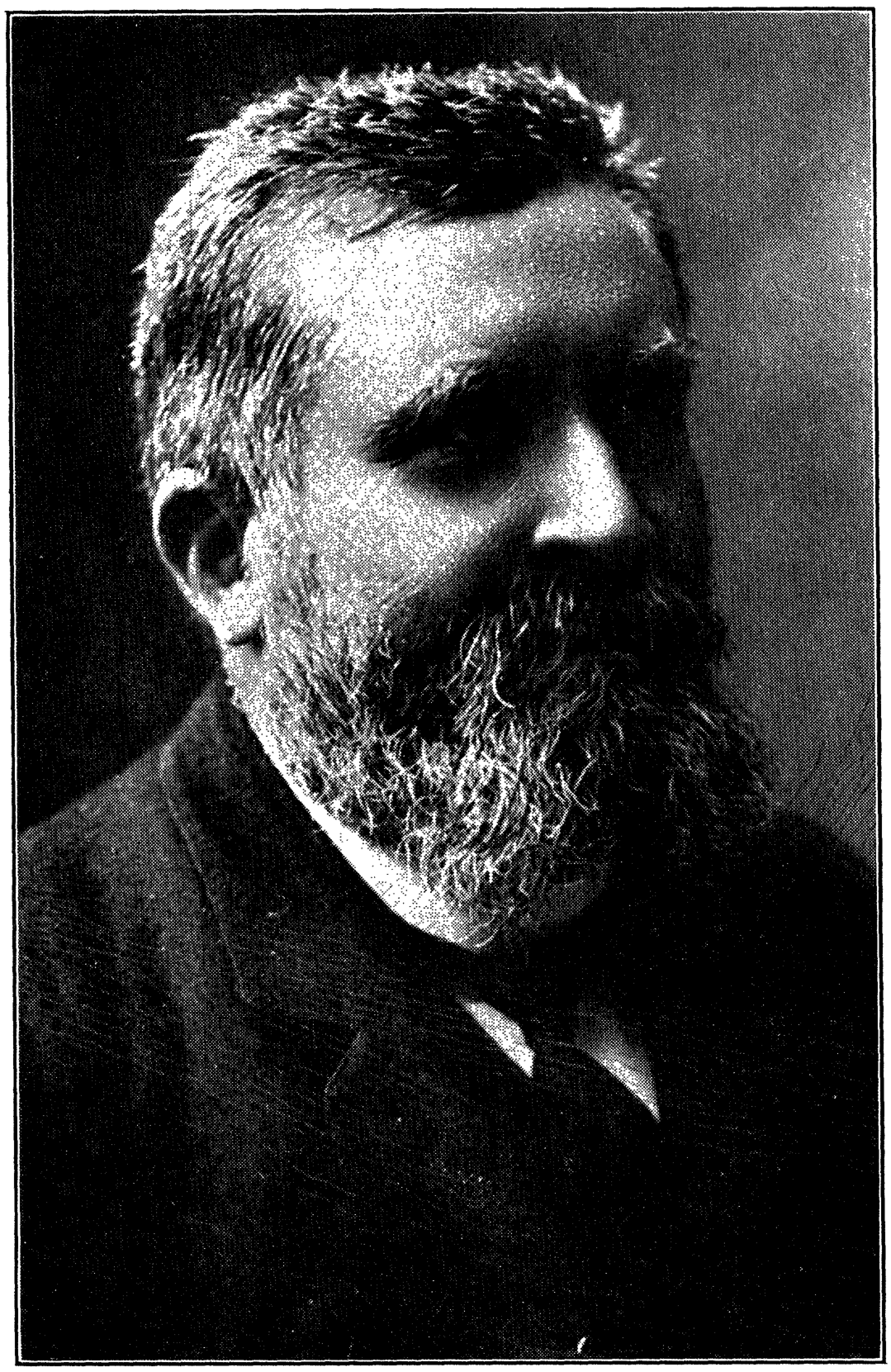
(plate; in the original facing p. 64)
On this visit of mine to Paris I became acquainted with Jean Jaurès, the leader of the French socialists and the greatest orator in France of his time. This acquaintance was for me an important experience. I met with him twice — once in the Chamber of Deputies (the French parliament), and a second time at his home.
In parliament, where he was the leader of the socialist faction, I met with him on a Saturday afternoon (the 5th of June). I came there with a double purpose: to observe a session of the French parliament and to meet with Jaurès.
The French parliament is one of the most beautiful and most impressive buildings in Paris, and it stands in a famous place. It is located by one of the bridges62that span the river Seine. On the other side of the bridge runs the great square Place de la Concorde, where in the time of the French Revolution the guillotine stood. Here, in the year 1793, they beheaded King Louis the Sixteenth.
In the Chamber of Deputies an important debate was then taking place over the high price of wine, and Jaurès was the leader of the struggle that the socialists had then organized against the government.
He received me in the great antechamber of the Chamber. But he had to run right back inside the parliament. So he first provided me with a place above, in the gallery. From there I afterward heard his famous lion's voice while he delivered his speech.
The socialists then had seventy-five deputies, and he was their leader.
I do not know why, but, judging by his pictures, I always used to imagine him as a man with a cold, stern face. In truth I found that his face is full of life. He looked older than I had pictured him to myself, and with the few words that he spoke with me (in a very labored English), as well as with the speech that he delivered from the platform, he made an impression of a man full of fire and energy.
While he was providing me with the place in the gallery, from where I could see and hear the deputies, he invited me to come to him the next morning.
He lived in the quarter that is called Passy. His study was literally packed with books. As is known, he had formerly been a professor63of philosophy at the University of Toulouse, and a great number of the books that I noticed on his shelves were on this subject.
He was then engaged in working on his famous history of the French Revolution, of which a few volumes had by then already appeared.
The conversation did not come easily to us. He spoke both German and English, but in both languages he was a good deal more skilled at reading than at speaking. Among his books I noticed many works in German and in English. He read them freely. But to speak in those languages he spoke with great difficulties. With my French it was the same as with his English or German, perhaps even a little worse. But we somehow managed to make ourselves understood. Jews are not the only ones who can help themselves out in a conversation with their hands and with their eyes. The French are also artists at this, although in a different manner. In addition, they have a third instrument for it — the shoulders.
Since reading French is a good deal easier for me than speaking, he used to write down his thought from time to time in his mother tongue. And I used to do likewise in English. In short: we so adapted to each other that the second half of our conversation went more easily, although in a few moments I was still not certain that we were understanding one another.
Concerning the wine question he told me the following:
"We socialists set as our first demand that the government should take over the entire importation of grain into its hands as a public monopoly, according to the socialist idea.
"To expect that we should be able to realize this is64for the moment there is no hope. Therefore we put forward as our next demand that the tariff on wine be abolished. We are not "free traders," but the price of wine — that is to say, of bread — is now terribly high in France, and the working masses suffer from it. And so we demand that the duty on imported wine be abolished."
I then asked him about the syndicalists, the radical union men, who at that time were fighting hard against the socialist unions. At that time, and still more a little earlier, the syndicalists had been preaching sabotage — that is, that workers should cause the manufacturers obstruction and damage, spoil the tools, ruin the goods, and so forth. The socialists fought against such methods. And so I asked him about this matter.
To this he said the following:
"This is not as dangerous as you think. Earlier we really used to have great clashes with them. But by now this has been greatly weakened. Our relations are much better. You probably know, after all, that in France we are now already a united socialist party. Earlier there were several socialist groups. Our relations have grown much closer together. I only wish to add that the spirit of solidarity and unity is now, among us, not merely on paper, but in reality."
About sabotage he told me this:
"Not long ago a congress of our building workers took place. This congress recognized as a principle that the workers must do their work honestly and conscientiously; that the self-respect of the working class demands as much. This is precisely the opposite of sabotage, and the resolution shows that the French workers understand65that their victory will come through their united strength, and that to resort to unworthy means is against their dignity. The workers are too great in their power and in their historic role to make use of such a means as sabotage. Fundamentally, sabotage never had any real significance. In a strike it happens at times that this or that worker makes use of it. But that is an individual case; it has no connection with the movement."
I spoke with him about his anti-Marxism, whereupon he made very friendly and even enthusiastic remarks about Karl Marx; but he said that the Marxist theory was too "theoretical." He explained this in a way that I found tremendously interesting. He said the following:
"The progress of mankind ought not to be divided up in such a way that each period must be narrowly and strictly bound to a particular class. It is, of course, a historical fact that the working class wages its struggle against the capitalist class. But according to Marx's theoretical system it works out that the whole advance of mankind is divided into distinctly separated parts, so that each part is bound up with the time when this or that class held sway.
"In my opinion, this is too narrow a view. We socialists ought to be broader. Boundaries cannot be drawn so strictly. Mankind as a whole has taken up and is accomplishing colossal things, quite apart from the class struggle. Human progress belongs to mankind in general. We socialists fight for the worker, and this struggle leads further along the road to progress. But when a scholar works at his science, and he has no connection with the working class —66does it then mean that he does not belong to progress? And when a capitalist does a great, fine thing, or when with his active help some great, important scientific discovery or technical improvement is made, does it then not mean that he is helping progress?
"To speak in such a way is to be blinded by fanaticism," Jaurès explained.
He spoke with enthusiasm about progress in general and about the contribution that socialism makes to it. Above all, he expressed himself with a warm tolerance, and this made a strong impression on me, for tolerance was something I had been preaching in the "Forward" from the very first day, and ever since I returned to it in the year 1902.
He expressed himself as an enthusiastic socialist about the present and about the future, but not in the same manner in which all the other socialists with whom I was accustomed to converse, whether in America or in Europe, used to speak. Something different — and this difference appealed to me strongly. I felt that deep in my heart there lay just such a kind of socialism as his.
I noted down what he said. It took up a good few little pages with me. And afterward I included it all in a dispatch to the "Forward." But afterward I reconsidered and saw that it would not be advisable to print it. It would have sounded anti-Marxist. In those days people in our movement were not yet accustomed to such ideas. I was afraid that this part of my letter would not be interpreted correctly. And so I took it all out of the letter. People had in any case already called me a heretic67on account of the way in which I conducted the "Forward."
In my mind there had already begun to swirl certain "heretical" thoughts about the socialist theory as well. But, indeed, no more than swirling. In my conversation with Jaurès these vague thoughts found a source of encouragement. His words interested me greatly.
As we shall presently see, a few weeks later, in Berlin, I had experiences which affected me in the same direction as Jaurès's words, only more distinctly and more strongly. This journey of mine in Europe in the year 1912 was destined to have an important influence on my course of thought.
We also chatted about Roosevelt and about the surprising changes that were taking place in the economic life of the United States. We spoke about the American trusts and also about the American socialist movement.
I made use of the opportunity to ask him what opinion he held of Dreyfus. (In the struggle for Dreyfus, Jaurès played a great role. There were socialists who took a hostile attitude toward Dreyfus. At the least, they did not want to take part in the struggle for him. Jaurès, however, was one of those socialist leaders who openly came out against the enemies of Dreyfus and worked actively for this martyr to be set free. In 1912, when I visited Jaurès, Dreyfus had long been free.)
"Dreyfus is a very honest and likable man," he said. "He is not a socialist; he is68but a man with a broad outlook. We meet very often, and I like him very much as a person. As for the struggle on his behalf, we did, after all, win such a complete victory. It was a great victory against the dark power of the clericals, a victory for light and progress."
I did not want to leave Paris without seeing the martyr himself. And so Jaurès gave me a warm letter to him. I visited Dreyfus a couple of days later.
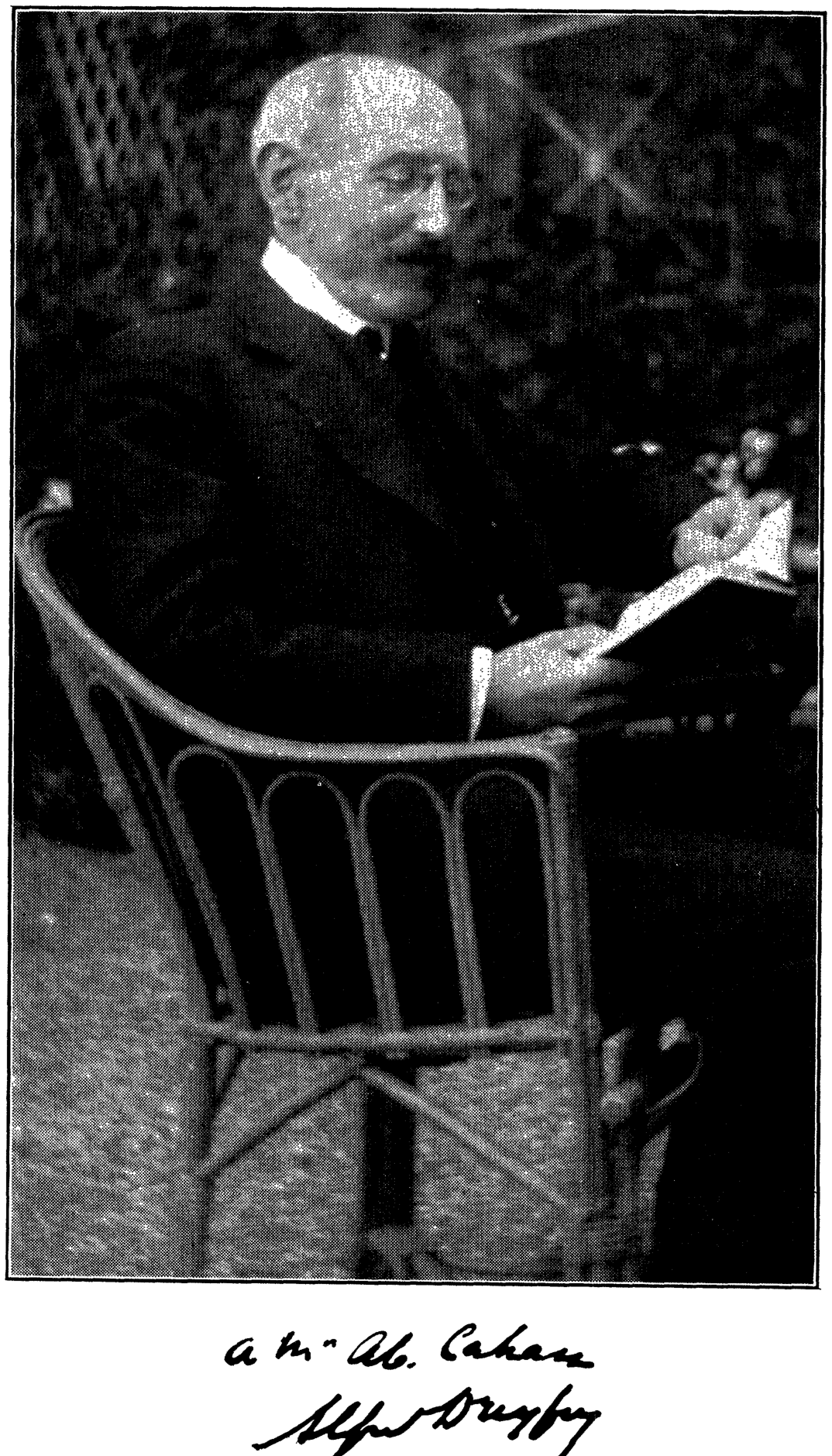
(plate; in the original facing p. 72)
One of the loveliest corners in Paris is the area around the Parc Monceau. Right beside this park there is a short little street, the Rue de la Chaussée — and at number five of this little street, only a few steps from the splendid park, there lived at that time Alfred Dreyfus, the famous martyr of Devil's Island, the former Captain Dreyfus, for whom every Jewish heart bled, and every truly human heart, whether Jewish or not Jewish.
In the time when the newspapers of the whole world were day after day full of the Dreyfus affair, the readers got the impression that Dreyfus belonged to one of the richest Jewish families in Paris. And so I had expected to find the house of a millionaire, and this expectation, too, was not borne out. Dreyfus lived like a well-to-do householder, but not like a millionaire. His apartment was on the second floor.
The dispatch that I afterward wrote to the "Forward" (it appeared on the 25th of June, 1912) contained, among other things, the following:
69"The very young readers of the 'Forward,' those who have only heard about the Dreyfus tragedy, will perhaps not understand me. But those who, thirteen or fifteen years ago, were already able to know and to understand what was going on in the world — they will distinctly picture to themselves the moments that I lived through that morning in Paris, when I went to see Dreyfus.
"I arrived there a little too early. So I spent half an hour in the lovely Monceau Park nearby. It was a beautiful morning after a rain. The park was, as it were, drenched with golden rays of sunlight. The trees, the grass, and the flowers, refreshed by the rain, caressed the eyes with soft colors. It smelled of summer.
"At exactly ten o'clock I came in to Dreyfus, and he received me very cordially in his study.
"The first glance at him took me by surprise. We are all accustomed to those portraits of his which were photographed some 18 or 20 years ago, when he was still a young man — the martyr, Captain Dreyfus. He is now already entirely gray, and his appearance does not strongly resemble the Dreyfus I had previously had in mind. On the whole, however, I soon recognized both his figure and his face.
"He is a slender, neat, clean-shaven man of over 50, with short-cropped silver-gray hair and a silver-gray mustache. He no longer wears any military clothing. He has, after all, long since left the service — with a higher rank than he had held before.
"I had read many times descriptions of his per70son, in which he was presented as a cold man who speaks measured words and always keeps to himself. The antisemitic detractors said that with his coldness and reserve he repelled them from himself. That all this is untrue was one of the first personal impressions I received of him. He did not speak in "measured words," nor did he keep to himself like a withdrawn man — but precisely the opposite. With a pleasant, almost childlike smile he spoke, and the words flowed freely from him, with a warm liveliness, without a trace of reserve. He spoke with interest and without waiting for questions. He himself put many questions about America, made various remarks, joked a little, and on the whole gave the impression of a pleasant conversation partner, one who loves to chat and speaks from the heart, neither measuring nor weighing his words. (If it is true that he was reserved with those detractors, it simply means that they behaved antisemitically, hostile toward him.)
"I asked him whether he speaks English, and he answered that he reads English easily, but that speaking is hard for him. I tried to get by with my sorry French, but with that we could make no great progress. And so we finally compromised on German — a language which Dreyfus, too, does not speak so easily, but yet fluently enough and well. My 'Germanized' Lithuanian Yiddish, on the other hand, he understood easily. Often he would throw in a French word ('question,' for example, instead of 'Frage'). Often I would make use of a generally familiar English word. Often, again, I would write a word down on paper, and so we understood each other completely. The conversation went along more briskly than with Jaurès.
71"To my question about how he was getting along and how his health was, he said:
"— Very well. I have become entirely well. Of the marks that remained on my body from those terrible years, I am now completely healed.
"We spoke about those terrible years. I described to him with what a pounding heart every reader of the 'Forward' and many millions of other inhabitants of America had read about the affair at that time in the newspapers, how we had suffered his sufferings. To this he answered, a little abashed:
"— That is, of course, always pleasant for me to hear. But it was, after all, not my personal affair. I, as a person, was, after all, merely an accident. The whole drama was a general social one, and our victory brought great benefit. The fruit of the struggle consisted in this: that the government of France was separated from the church. The French government finally separated itself from Catholicism as an official sister power. This is a gratifying, important step forward, and it is the result of that terrible struggle of ours.
"— And how is it with French antisemitism today? — I asked.
"— In other countries it is in any case much worse, — he answered. — As long as France is a republic, antisemitism cannot go far here. What does it matter that the aristocracy keeps away from Jews? With the 'high society,' with the 'Four Hundred,' as it is called among you in New York, I have never sought to make friends... I have no need of them and they do not interest me. And further, there are, after all, in France enough decent people who72are ready to fight for justice and decency. And this side won.
"I alluded to the unpleasantnesses that antisemites had a couple of times caused him in the street, after he was already free. To this he said:
"— Ah, that, too, is long since past! No one bothers me anymore. I no longer see the slightest sign of an unpleasant feeling. I go everywhere, show myself everywhere, like any other citizen. No, there are no more unpleasantnesses.
"The conversation touched on the affair with Henri Bernstein, the famous French playwright, against whom antisemitic crowds had, some time ago, made disturbances in the theater. Dreyfus remarked in this connection:
"— What could be more natural? — Bernstein has talent, and he is a Jew. And so people begrudge him. But all this comes from the worse elements, and they are not the whole French people. They have no influence. The enlightened elements of France look upon them with contempt.
"About Jaurès he spoke with great respect and love.
"— He is a man of deep sympathies, a truly noble and interesting person, as much as a man as a parliamentary leader, — he said.
"I spoke about his (Dreyfus's) book, in which he describes his sufferings on Devil's Island, and which I had read in an English translation.
"— But there only a small part of the story is described. There is still material there for several such books.
73"— Are you writing it down here? — I asked.
"— Yes, — Dreyfus answered, — but not directly for print. It will be published only after my death.
"This literary work of his takes up a goodly part of his time. But that is not all that he does. He occupies himself with other kinds of useful work as well. He reads a great deal and writes a great deal. As is well known, as an artillery officer he distinguished himself as a capable mathematician. And so he occupies himself, among other things, presumably with mathematics. Such, at least, is my impression.
"Some thirteen years ago, when things were seething with his tragic story, and everyone whom his family concerned was interested in it, a great deal was written about his wife and his two children, a little boy and a little girl. The children were then still too young to understand what was happening to their unfortunate father. And so, when he was on Devil's Island or in the military fortresses, the mother told them that their father had gone away somewhere. With bleeding hearts people used to read all this at the time. Now, talking with Dreyfus, I asked how his son was getting along (I meant to ask about the daughter, too, but only the word 'son' came out).
"— Ah, he is already twenty-one years old, — Dreyfus answered with a special gleam in his eyes, — he is already finishing his studies.
"At this he opened a drawer of his writing desk, and taking out a photographic picture of himself (the father's), he said with love:
"— He photographed me. He takes good74pictures with his camera. It is one of his favorite pastimes.
"I asked for the picture as a keepsake, and with a friendly smile he wrote his name on the picture and gave me the photograph.
"When the talk came around to Russia and the revolutionary struggle, Dreyfus displayed an acquaintance with the activity of Jewish revolutionaries, and, as it appeared, he was proud that Jews had displayed so much heroism in the liberation movement.
"We also spoke about Roosevelt, the man of the trusts and of the great change that had come about in the economic, and through it in the political, life of America. Dreyfus is familiar with all this. America interests him very much, above all. We also spoke about the Jewish population of America, about the 'Forward,' and other matters.
"Close to two hours we spent in lively conversation."
I went away with happiness in my heart. I had seen Dreyfus! For me this was like a great, unexpected gain. Years before, when they were torturing him, an innocent man, on Devil's Island, I used often to think about him. In my mind there now came alive that Sabbath afternoon when I waited with impatience for the verdict of his second trial, in the French city of Rennes; how the unfavorable result arrived, and a feeling of sharp75anguish and helpless rage tore at my heart (see the first volume, pages 129–131). Had anyone told me then that I would meet the victim of that world-famous intrigue, I would have received the prediction with an indescribable joy. And now, then, I had seen him!
I remember how, a few minutes later, riding in a taxi back to my hotel, I reflected: but this, after all, is not that Dreyfus! In my consciousness there had been rooted a Dreyfus who is being tortured on Devil's Island, or who is being held under guard by soldiers at the court, surrounded by bloodthirsty enemies who demand his destruction. The Dreyfus whom I had just visited a few minutes before is, after all, an entirely free man. I had seen him, but not behind the bars of a dreary fortress, or at the military court. I had seen him in his home, right here in Paris beside the Parc Monceau — a calm, genial, friendly, and gray man! No, this is not the Dreyfus I used to picture to myself.
My heart was full of joy that he is free, and that his hell is already over. I tried to bring together the present Dreyfus with that one...
In Paris there lived at that time Abraham Frumkin, our former co-worker in the editorial office (see the first volume, page 271, and the portrait facing page 470), who now sent to America dispatches from Paris. A Jewish group, of which he was a member, invited me to give a lecture about America. This was the first gathering that I addressed in Paris since 1891 (see the third volume, page 133). This time my speech was given under different cir-cumstances. In Paris there were then to be found more Jewish76immigrants. The hall was larger and better, the audience also larger, and my speech a greater one.
Among the questioners, after the lecture, was a young man, an anarchist, who criticized the "Forward" with peppery words. I answered him in the same tone. But no one slipped away from the bounds of parliamentary courtesy.
Of the Russian revolutionaries with whom I had become acquainted in Paris 19 and 21 years earlier, I found no one apart from Burtsev and Anton Gnatovsky. Rubanovich lived in France (see the third volume, pages 149–150 and 174 and 175), but he was then to be found somewhere else.
The famous "Uncle" Lavrov was already dead, and the tall figure of the grizzled-gray scholar with the impressive face I missed strongly. The Russian colony without him was for me like Hamlet without the Danish prince (see the third volume, pages 135, 138, and 342).
With the Louvre Museum I was already acquainted from the previous two times that I had visited Paris. Still, I went through the famous museum once again. This time I found in it a surprise. One of its smaller rooms was taken up with silver vessels which had been excavated from Pompeii, the Roman city that lay for nearly two thousand years buried under the earth, covered over with ash and lava from the nearby volcano Vesuvius. Nineteen years earlier, when I had been in the Louvre, this was not yet there.77The old silver vessels had been bought up by Baron Rothschild, and he had presented them to the museum. They are all artistically wrought. No finer silver objects could possibly be created today. There one finds spoons, goblets, vases, dishes, little bowls, all adorned with all sorts of figures of flowers, birds, human forms, and so forth. They take up a large glass cabinet.
Pompeii had always interested me. While still at the Vilna Teachers' Institute, I had once read details about this ancient city — how it was buried in those times, and how, some seventeen or eighteen hundred years later, it was found by chance and excavated. The descriptions had made a tremendous impression on me, and I had always dreamed of traveling to Italy, chiefly for the sake of two things: to see the monument that was erected in Rome to Titus a short time after his death, and to see Pompeii. Traveling to Italy I could not do at this time, in 1912. And so the case with the silver vessels was for me a very pleasant surprise.
In the same Louvre room there is also a case with golden chains, likewise from Pompeii. (This was donated by someone else.) All in all, it is one of the most important collections that any museum whatsoever possesses.
I spent a few hours in that room. When I came out of there, the thirst to visit Pompeii was stronger in me than ever.
A curious experience I had in the special little room of the Louvre where the statue of the Venus de Milo is to be found. There happened to me anew the very thing that I had gone through here when I had the wonder78that statue for the first time in the year 1891 (see Volume Three, page 140).
When I came in, I was at first disappointed again. It seemed to me that perhaps I had exaggerated the beauty of this marble goddess, that I had let myself be talked into it. So I stood for a few minutes. But the spell grew. I once again sensed the indescribable majesty that this work of art holds within it. I felt the religious mood in which the ancient Greek sculptor who had created her must have found himself, and likewise the Greeks who gazed upon her.
Stuttgart is a pleasant, lovely, hilly city. The railway station stood right in the middle, in the most beautiful and liveliest part.(*) From there, then, I began my acquaintance with the city. A beautiful park with a colossal monument to Kaiser Wilhelm the First (the grandfather of Wilhelm the Second, who six years later was to lose his throne). The monument79depicts the old Kaiser on horseback. He was gilded all over. But the rider and the horse looked as if they were alive.
On one side of the park stands the royal palace. (Stuttgart is the capital of the German kingdom of Württemberg, which is part of the German Empire — that is, of all the German states that were united in 1870. Wilhelm was the first Kaiser of the Empire, but each of these states at the same time retained its king or duke.) The palace, in the form of the letter "ḥ," was guarded from the outside by two soldiers with rifles on their shoulders and tall fur hats on their heads. (Today, when there is no longer any king, the palace is used for social purposes.)
On the other side of the park stretches a long row of tall columns, and behind them a row of the most elegant shops with the richest café in the city. Here ladies came to gaze at the beautiful things that were displayed in the windows, and at the healthy, proud, splendidly uniformed officers who strolled about here... officers wherever you turned; solidly built, broad-chested, tall young Junkers... epaulets, collars, stripes of various bright colors... In the gleam of the gilded or silvered buttons was mirrored the cruel power of the German army, which was then the greatest military force in the world.
With elegance the officers strolled here, flirting with their white gloves and flirtatiously jingling their silver spurs.
The great café stands behind the columns. Little tables inside and out, and around them officers or80well-dressed civilians. Right along the sidewalk automobiles passed by, again with officers or with prosperous civilian citizens.
In those years the scholarly socialist journal "Die Neue Zeit" was printed in Stuttgart. This was the home of the Dietz publishing house, which issued this journal and which also printed dozens of socialist books under the general title "Internationale Bibliothek" (International Library) (see Volume Three, page 300). I visited the place and spoke with the staff. Dietz himself was not at home then.
I took a stroll through the city. A few minutes' walk from the center the workers' quarter began. It stretched quite far. One could sense an endless bleakness, but everything looked tidy, in the German manner.
Stuttgart already had a socialist newspaper then, "Die Schwäbische Tagwacht," and its editorial office stood deep within the workers' quarters. I rode there on an electric tram. I had a conversation with the editor, Ganz Pflüger, a man with a large black beard and intelligent large eyes. He looked like an Arab or a Jew. But when I examined him closely, I knew that he was a genuine German. We talked about the movement in Germany and in America. Comrade Pflüger introduced me to the staff and showed me the various departments. The fixtures and the machines were of the newest kind.
The workers of Stuttgart (and of all Germany) were already well organized in unions, and the unions everywhere in Germany went hand in81hand with the socialist party. The population had elected a Reichstag deputy, and he was a Social Democrat (his name was Karl Hildenbrand). "Die Schwäbische Tagwacht" then had a circulation of 25,000, a large number for a city like Stuttgart.
When I came back from the workers' quarters, on the way to the hotel where we were staying, I spent about an hour in the great café behind the columns. The place was full of well-dressed customers, officers and civilians. As is the custom in European cafés, almost all the newspapers of the country are kept there. So I asked the head waiter for the latest issue of "Die Schwäbische Tagwacht." He brought me a different newspaper, not a socialist one. "Die Schwäbische Tagwacht," I said, "is unfortunately not available," he answered.
A few minutes later I turned to an under-waiter, and he brought me what I had demanded. As he did so, he glanced around to see whether anyone was watching, and which newspaper he was handing me. He explained to me that in this café socialist newspapers were forbidden (treyf — unkosher), that he himself was a member of the socialist party, and that the newspaper he had given me was his own.
"In a place like this, to be a Social Democrat is no honor," he confided to me as a secret, with a smile. "But we listen to them as a cat listens.
In my notebook there are several lines about this experience, written in abbreviated words.
The thought that is hinted at there consists of the following:
The city elects a socialist representative to the Reichstag of the German Empire. In the Reichstag, Stuttgart is a socialist city, a city where at the elections an enlightened working public has the upper82hand. The great mass is socialist in spirit. But when one looks at the officers with the civilian dandies who sit here in the rich café, or at those who pass by there behind the columns, and at that gilded monument of Kaiser Wilhelm, it turns out that they are the real Stuttgart. What a contradiction!
From the hour I spent in the café, two officers have also remained in my memory, as they sit and play chess. One, an older man, sat at the chessboard like a marble figure, the very expression of self-importance. To me he was comical and repellent. I studied his face, and to my chagrin it was an interesting and very intelligent face. His partner was a lean young man with too-broad shoulders and nervous eyes. It seemed to me that he was straining to sit still and could not.
Heidelberg has the most important and oldest university in Germany. It is, moreover, one of the oldest cities in the country. There, however, we planned to spend only a few hours, to walk through its quaint old castle, and to travel on.
Traveling on the road to Dresden, I had in mind that there is to be found Raphael's Sistine Madonna, which many regard as his most wondrous work of art. All my life I had heard about it. Now, then, I would see it.
When we were already in Dresden and had seen the Sistine Madonna in the local picture gallery, I was disappointed. I had seen Raphael's works of art in83the London National Gallery and in the Paris Louvre, and some of them really made a strong impression on me. But the Sistine Madonna did not move me. We remained there a good while. The impression, however, did not become more favorable.
In Dresden I saw for the first time a Zeppelin "dirigible" (a flying balloon that can be steered like a ship). It had the form of a giant cigar, and it hung quite low. It seemed as if one could reach it with one's hand.
In the hotel where we were staying, I noticed that almost all the staff spoke good English. From conversations with them I learned that such people are specially selected, with the American travelers in mind, and that two of the higher servants had deliberately traveled to London for a year in order to learn the language. Afterward I found something similar in the hotels of other German cities. In Paris a hotel employee who spoke English was, in those years, a great rarity. Since then the French too have bent in this regard. The Americans flood Paris. Without the English language it is now no longer easy for a Paris businessman to get by.
In Nuremberg, the moment I arrived at the railway station, my attention was drawn to the large proportion of Jewish faces that one sees there. And afterward, when I went through the city, the impression was confirmed. I encountered Jews in the poorer quarters as well as in the rich ones. And these84were not immigrants, but native Jewish children — great-great-grandchildren of those times when Jewish blood was shed in Nuremberg. The medieval churches of Nuremberg reeked to me of medieval antisemitic massacres.
This is one of the German cities from which Jews emigrated to Poland.
In Nuremberg, as in all of Bavaria, the Catholic Church holds sway. But the socialist party was there already then stronger than the Church. The city already had many workers (in toy factories), and the deputy whom it had elected to the Reichstag was a socialist. Südenkampf was his name.
Strolling about the city, I strongly felt the flavor of the Middle Ages. Squares, streets, alleys, mostly narrow and winding, where it seems to you that you are in the fourteenth century. Something as if you were not in a city, but in a museum.
On one small square stands a monument of three colors — gold, black, and gray. It is, properly speaking, not one of the oldest places in Nuremberg. But it dates from four hundred years ago. Remarkably interesting is this monument and the square all around. A similar impression was made on me by the square where the town hall stands in Brussels, when I visited that city in 1891 and in 1893.
With the name Prague there was bound up in me a feeling of ancient Jewishness. With this feeling I traveled there.
85Once again a piece of the Middle Ages. The main streets — the Graben and Wenceslas Square — are broad and beautiful, with modern shops, with handsome civic buildings; and the public too is a modern one, a secular one. The ladies were dressed in the latest fashion and with taste. And the slender Austrian officers wore the most beautiful uniforms of present-day Europe. But when I tried to step off a few dozen paces to the side, through one of the streets that cross over the Graben, I found myself in a world several hundred years older than the aforementioned ladies and officers. Narrow winding alleys, as in Nuremberg, again all sorts of little squares, with little form, but with much interest for the eye. Again a feeling, as if this were not a city, but a museum of a bygone city.
The old Jewish synagogue of Prague is one of the things that all the printed guidebooks advise the traveler to visit. It is located just a five-minute walk from the modern city center. When you come up to it, you see the difference between a famous old church and a famous old synagogue. The churches are tall, proud, impressive. Their pointed roofs rise toward the sky. When you come up to the Jewish synagogue, you have nothing to see. Among the group of one-story or two-story houses that are there, you cannot at first tell which is the synagogue and which an ordinary dwelling. Soon you notice an old metal plaque with Hebrew letters on the wall. This is the Jewish synagogue, the oldest in Europe. As I stood thus and tried to read over the old plaque, there came out from inside a poorly dressed little Jew. In German he invited me to come in and86showed me where the entrance was. He led me down a few steps below the sidewalk. There is the vestibule. Then he led me down still deeper, into a cellar. The synagogue is a small little shul, a kleyzl (small prayer house), as we would call it today.
It makes a peculiar impression. That it is very old, you feel at once. The lower parts of the walls are much older than the upper ones, which were added later; but the upper ones too are already several hundred years old. The lower half has already seen more than eight centuries.
Usually a shul (not a kloyz or a bes-medresh — house of study, but truly a shul) is lower than the street, in keeping with what is recited: "Out of the depths have I called unto Thee, O my God!" The literal meaning of these words is taught word for word: one must pray to God from a cellar. But the Christians, in olden times, had their own opinion about this same matter. They did not permit a Jewish synagogue to raise its head. They demanded that it "lie nine cubits in the earth," just like the Jews themselves. That the building should be tall, distinguish itself from ordinary houses, make an impression — that was left to the Catholic churches. But this particular sort of oppression, just like a thousand sorts, worked upon Jewish hearts more powerfully than the height of a bes-medresh building would have worked upon them.
Inside the synagogue I was received by a young man with a blond beard. The blond beard was neatly combed on him, and he spoke German. He looked like a Litvak (Lithuanian Jew) — like a Litvak who is a scholar. But he was a born Praguer.
People still pray there today. The synagogue is a strictly87orthodox one. Often people come in to study a page of Gemara. As the shames (beadle) told me, there were then in Prague several Jewish scholars from Galicia and from Russia. They were the chief students. But there were also Prague Jews, intellectuals, German-educated, who were likewise capable of a page of Gemara, and often a dispute would arise between a Prague scholar and a Galician or a Lithuanian one. Sometimes all three types would take part in the pilpul (intricate Talmudic argument), each in his own language, with his own accent.
In the year 1365 a bloody pogrom was carried out in this synagogue on Kol Nidre night. They slaughtered every Jew. Only the rabbi escaped with his life, and he afterward brought all the victims to Jewish burial in the cemetery (bes-oylem) that lies nearby. Today this cemetery happens to be on the other side of the street, for the streets here were laid out anew later. There lie not only the victims of that massacre. Other Jews of that time and of other times also found there their eternal rest.
I spent a couple of hours in the cemetery, looking at the various old gravestones. In all, there are twelve thousand gravestones there. The oldest is eight hundred years old. The Jew who accompanied me through the graves recounted to me several historical details and explained many of the inscriptions.
A heavy impression did the cemetery make on me.
In Prague, around the old synagogue, many Jews live. They live all over the city, but there they are more densely settled. Some Jews sat in their little shops in skullcaps; such men had beards. They looked like our Jews, only they spoke88German, and many of the skullcap-Jews sat with Czech newspapers in their hands.
The Czechs were well grown, and many of them had charming faces. Their Slavic language sounds a little like Polish and a little like Little Russian (Ukrainian) (we have plenty of Czechs in New York — around 72nd Street — but there they are not so recognizable as a distinct people). For that reason it was not hard for me to understand most of the signs on their shops.
A few hours later, on the other side of the interesting Moldau river, I visited the famous Prague "Dom" (cathedral) — the great Catholic church, which has stood for several hundred years and which is constantly being built and rebuilt. One senses a worn-out quality, a faded age. All sorts of priests walked about, stood, sat, some with sanctimonious faces. Most of them were pale and gaunt. They looked like famished ascetics. There are in the "Dom" old relics, which are regarded as important works of art. There is much that is interesting. But I had come there laden with the memories of our Jewish synagogue and of the cemetery, with the scenes of pogroms, with mass-images of Jewish martyrs. I imagined that in this "Dom" the antisemitic fire had been kindled; that from here, on that night, men had marched off into the Jewish quarters to slaughter Jewish children.
The strains of an organ began to sound. The feeling within me grew still heavier. As I was leaving, a priest offered me some sort of ticket, that I should buy it from him. He was unkempt, and his face was very pale; and his eyes were blue, child89like, with a sympathetic look in them. It was hard for me to connect this clerical beggar with the bloody crimes that his church had committed against our forefathers. Among priests and rabbis alike there are, after all, both fat and lean, lofty and lowly.
The most famous thing on another ancient church in Prague is a clock that stands on the outside. About this clock everyone who has visited the city tells you. Every three-quarters of an hour a concert begins here, and a skeleton starts to pull a cord. Then the playing begins. Then a little window opens, and there appear the figures of Jesus and of his twelve disciples (apostles). The thirteen figures come out one after another. They move this way and that. The aim is to make an impression of holiness. But the actual impression is as if the thirteen holy ones were thirteen comedians.
To conclude, an artificial rooster began to crow. A fitting end to the vaudeville.
The clock with all its trickery is very old — well advertised. So at each of its three-quarter hours there is a crowd. Usually these are travelers. When I stood there, several automobiles had gathered with Americans and Englishmen. At the clock then only English was spoken. A Jewish woman, one of our "alrightnitses" (a Jewish woman putting on airs of having "made it"), spoke English with a strong Jewish accent. She expressed admiration. But, recalling me, she remarked with a smile:
"It was worth coming all the way from America for such a wonder!..."
Old age is valued more than art. Old age is the greatest advertisement. I especially felt this when I90visited in Prague the palace of the Austro-Hungarian Kaiser. This is the most uninteresting building that I, a republican, have ever seen. It is a new structure, a palace, for a Kaiser, for a prince, for a king. It lacks everything that makes a palace interesting. Here the antiquity is missing, and the art is missing. The inhabitants of this palace are not interesting people.
I visited the editorial office of the Prague socialist newspaper "Pravo Lidu." The Czechs already had then a large socialist movement with a rich daily paper. In the editorial office I found a contributor who had lived several years in New York in the Bohemian quarter, around 72nd Street. We had mutual acquaintances in our American movement. What interested me more than anything in the conversation we had was the following. I listened to the way he spoke about America, about our American movement, and about New York, and I reflected: with him everything comes out somehow differently than with me. It seems we had been in the same movement, in the same city, ridden in the same cars and elevateds, seen the same crowds, and — when he and I were to describe all this, two quite separate worlds would emerge. Yes, every man looks at everything through his own eyes, and he sees a quite separate world.
A second strong impression was made on me by the following scene:
In the early morning. We had just finished eating breakfast in our hotel. We went out into the street. At the door stood a whole row of various servants, lackeys, waiters of all kinds, and they all greeted us. Here everyone spoke German to us: Good morning! Good91morning! Good morning! One after another bows and gives you his "good morning!"
We had the same experience almost every time we went out of the hotel; and at our departures, when it came to the tip, the scene repeated itself with a special warmth. Only instead of "good morning" they said: "Happy journey! Happy journey! Happy journey! Thank you very much! Thank you very much! Thank you very much!"...
In America one never knew of such things.
Notes (footnotes from the original)
[p. 78] *) Since then a new station has been built nearby, not far from the old one.