Chapter Three
Again in Europe (continued)
92When I arrived in Vienna and took my first stroll through the streets, the general impression was exactly the same as in Paris: no changes. The magnificent city was the same as it had imprinted itself on my memory nineteen years earlier.
This time I spent a few weeks here. One of the first places I visited was the house where I had spent eleven days with my parents, my aunt Fanny and her daughters, when I had been here in 1893. I visited the small Hotel Donau, where I had then stayed with my father, as well as the garden not far from it, where I had spent a few hours with my parents. My parents were already dead. In Vienna I had sought them out and my aunt Fanny for the last time in my life. (See Volume Three, pages 303–312 and 314–316.) Now I was lodging in an entirely different part of the city, rather far from that neighborhood.
After that, my first important visit was to the famous socialist Victor Adler, the head of the93Social-Democratic movement in Austria, with whom I had become acquainted at the socialist congresses of Brussels and Zurich, in the years 1891 and 1893. (See Volume Three, pages 161 and 313, and his picture at page 162.)
Entering his office, instead of introducing myself, I said to him in my broken German:
— How are you, Comrade Adler?
He recognized me. He fixed his clever eyes on me and said with his good-natured smile:
— Well, look at that! Where did you get the mustache?
Nineteen years earlier I had not had this sort of adornment.
I would have recognized him at once too, even had I met him on the street. He was already 60 years old (that summer his sixtieth birthday was being celebrated), not a tall man, with longish, disheveled, dark-brown hair, with nearsighted clever eyes, and a sympathetic good-humored smile.
In the nineteen years the labor movement and the socialist movement in Austria had grown enormously. When I had been in Vienna in 1893, the Vienna "Arbeiter-Zeitung" had been a poor little sheet, and its home had been in a small house on a small lane. Now it was one of the mightiest newspapers in Vienna, with the largest printing plant in the city, with a great general building, with the largest and best machinery, with the most modern installations that could then be found anywhere in Europe. Our comrades in Austria had obtained a new electoral law, which gave them far greater possibilities. Through this very thing the movement had grown strong. This was immediately felt in the spirited mood that I found94among the Vienna socialists. Nineteen, or even ten, years earlier, there had been there much less freedom of speech. There had reigned almost a Russian censorship. For the smallest thing the "Arbeiter-Zeitung" used to be confiscated, that issue not allowed to appear. And at meetings one had to speak with quite distant hints. Now, in 1912, the socialists attacked the ministers quite freely. So long as one did not speak against the person of the Kaiser, one had a great deal of freedom of assembly and freedom of speech.
And the father and leader of this wonderful movement was Victor Adler. He was one of the brightest and most lovable figures in Europe. He had enchanted me in 1891, even then, when he had opposed my proposal at the Brussels congress. This time he enchanted me still more, and this time I had the opportunity to ascertain how strongly the Vienna working masses loved him — even the opponents of socialism as well. He was the most beloved figure in all of Vienna.
Adler's office was located in the building of the "Arbeiter-Zeitung." He introduced me to Austerlitz, the editor, and afterwards to his (Adler's) son, the now famous Fritz Adler, who later, at the time of the great war, shot the Austrian minister of the interior, and who is the secretary of the Second International.
My first conversation with Austerlitz was immediately transformed into a debate about how one ought to put out a newspaper for the masses.
Austerlitz is a well-known editor, the most capable that the socialists had then, and what he said was interesting to me. Of our95"Forward" he had heard. But he read no Yiddish, and with our paper he was not acquainted. He knew only that it was a sheet put out for the Jewish masses. The German workers, for whom his newspaper existed, had all gone through a school. I had a clear concept of it, and I was able to pay it warm compliments. I expressed the opinion, however, that even in German one ought to write more popularly.
Now, as these lines are being written, the comrades in Vienna are putting out, besides the "Arbeiter-Zeitung," a second newspaper, a lighter one, a more popular one. Experience had shown them that for the quite broad public the "Arbeiter-Zeitung" is too dry and too lofty.
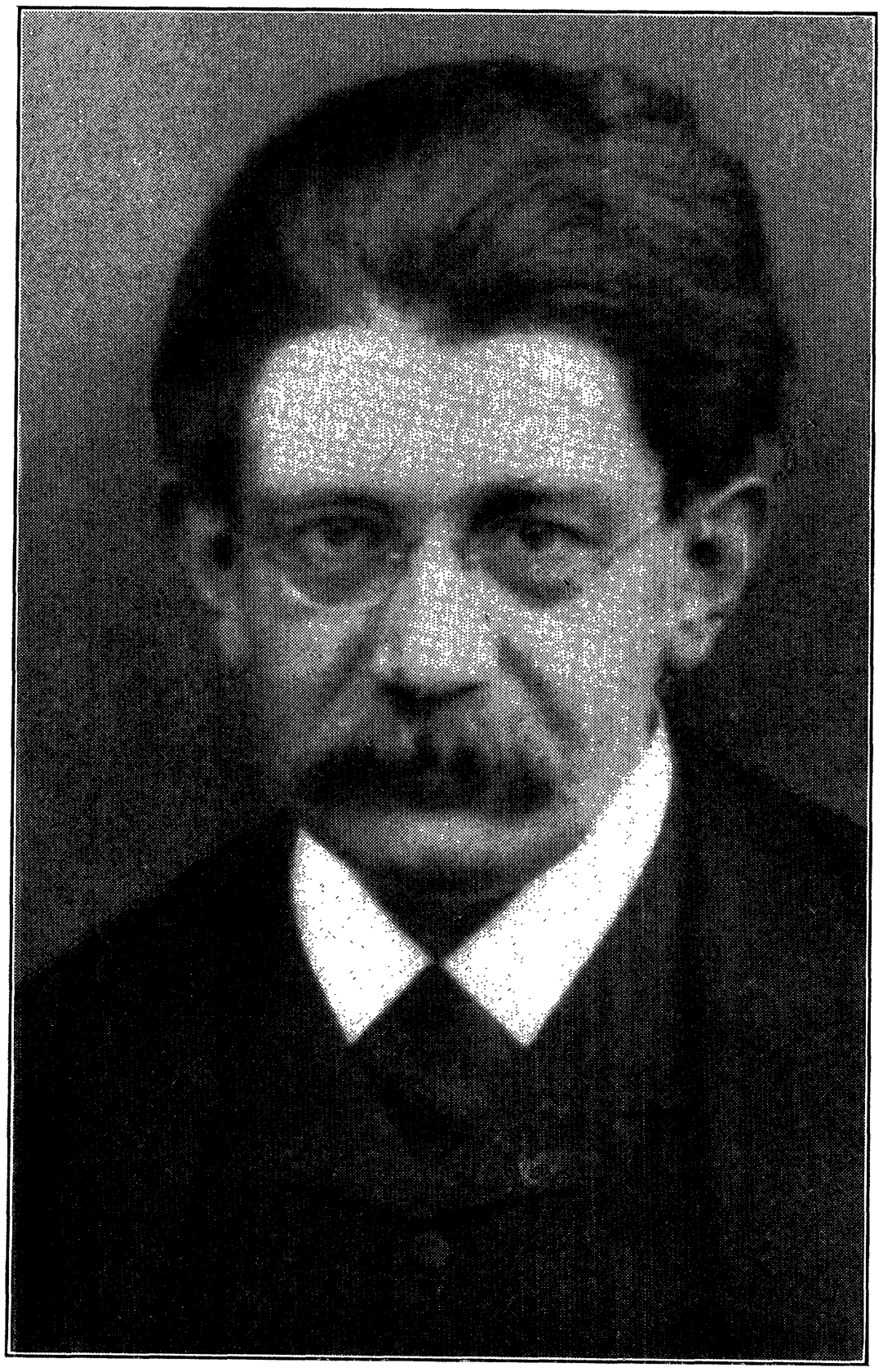
(plate; in the original facing p. 94)
With Fritz Adler I met quite often. My wife was preparing to travel to her old home in Kiev, to see her mother, brother and sister, and besides this it was important for her to have a document from a business firm stating that she was traveling to Russia as its representative. So the young Adler introduced her to a socialist who had an important business in Vienna, and he gave her the necessary document. With this paper, as a supplement to her American passport, she did indeed later travel into Russia, and there no questions were asked of her.
Fritz Adler had his office in the next room to the office of Comrade Deutsch, who was the secretary of the socialist party. We used96often to gather there. I also became acquainted with other important comrades.
Once, when I was sitting and talking thus with Deutsch about America, the door opens and in comes Fritz with a slender gray-haired man, who seemed to me very familiar. It seems I know quite well who this is, and yet I do not know. Who is this?
— August Bebel and Abraham Cahan from America! — Fritz exclaimed.
August Bebel! The world-famous August Bebel, the leader of the great Social Democracy of Germany! The Bebel with whom I had spent a week's time at the congress of Brussels, and two years later a week at the congress of Zurich!
I gave a start. I was so flustered that with my wretched German tongue it was hard for me to express what I wanted. I wanted to remind him that I was the Jewish delegate from America who had caused them trouble at the Brussels congress with a resolution about the Jewish workers. Adler helped me out. He had already heard about it from his father and from me. So he conveyed to Bebel what I could not get out. The German leader recollected. We chatted for a few minutes about the past and passed on to America. He made a few jocular remarks about the presidential elections that were to take place that year. He asked, in jest, who would be the next socialist president of America. After that other comrades came in. There was talk about the new socialist buildings, one of the Vienna "Arbeiter-Zeitung" and the other of the Berlin "Vorwärts." The latter was then,97it seems, not yet finished. We went to show him the various parts of the new building of the "Arbeiter-Zeitung."
Bebel was unusually neatly dressed and very youthful in his movements. And his voice too sounded young with him — exactly the same voice as twenty years before — a firm, a clear and a pleasant one. Were it not for the white close-cropped hair, he might from a distance perhaps have looked like a man of some thirty-odd years. When he was sitting and taking part in the conversation, one felt at moments that he was tired from the journey. But one also noticed an expression that recalled the fact that he was not some thirty-odd years old, but seventy-two.
I afterwards compared their faces with their photographs from twenty years before. Adler's portrait looked exactly as it had then. Bebel's — quite different.
Bebel had spent a certain time that summer in Switzerland. From there he had come to Vienna to visit his intimate friend Victor Adler and to take part in the celebration of Adler's sixtieth birthday jubilee, for which preparations were then being made.
The Austrian socialist party was then already the second-largest party in parliament. The number of its deputies was eighty-two. Victor Adler had invited me to come to parliament, where98a very important debate was then going on. He asked me to meet him in the club that the socialists had in the parliament building.
The reader must remember that Austria was then a land of various peoples with various languages, and that each of them fought for its national interests. So each of them had its party. (The Hungarians cannot be counted in, because Hungary was a separate kingdom with a separate parliament, although the throne was the same.) The Social-Democratic (socialist) party consisted of members of various nationalities. Usually they were all united. But there were frequent exceptions. And from this it came about that, instead of having one club for all 82 socialist deputies, they had three separate clubs, a German one, a Czech one and a Polish one. The German Social Democrats had the largest number of deputies (44), the Czechs were next (25), Polish socialists in parliament were 9, Romanians two and Italians two. Since the German socialists had the largest number of deputies, the German socialist club had the largest quarters. The two Romanians and the two Italians had no separate club rooms. They were neighbors of the Germans.
There I came on the day on which I was to visit the parliament. I found a beautiful large hall, large enough for an assembly of five or six hundred persons. A great number of windows came out onto two of the four streets that ring around the parliament building. The chairman of the club was Victor Adler. Adjoining the large hall was a separate room for the secretary. In Washington the99government gives a special secretary to each congressman. In Vienna there was one secretary for all the members of the club. The secretary of the German Social-Democratic club was then the present-day leader of the Austrian socialists, Otto Bauer.
As I have said, the Social Democrats of all nationalities in parliament usually went together. The Poles in particular were friendly with the Germans. The relations, however, between the Czechs and the Germans were then strained. It went so far that at the elections, in some places, opposition candidates were put up one against the other. The chief conflict between them used to arise through the unions. In Vienna there were then about three hundred thousand Czechs, but the German Austrians had a great majority there, so the Czech workers complained that they had less power in the unions than they ought to have. And in the Czech capital, Prague, it was the reverse. There lived a large German population. It used to complain (and complains still today) that the Czech majority lorded over it.
The national questions, national interests and national feelings were eating away at the country, as rust eats iron, and the socialist movement suffered from this beyond measure.
In the German Social-Democratic club my wife and I found Comrade Adler and Comrade Bauer, and soon more members of the club arrived. We sat and chatted until it became eleven o'clock; then we were led up to the topmost floor in the parliament proper, into one of the special100boxes that the deputies kept for their invited friends. From there we watched the parliament session. There soon came up to us the well-known leader of the Polish socialist movement, Daszyński, with whom I had already been acquainted earlier, from his visit to America. We greeted each other warmly and had a short conversation.
Victor Adler also came up to me. I expressed a wish to become acquainted with the Polish Social-Democratic deputy Hermann Diamand, the Lemberg Jew, who is now, as these lines are being written, one of the most important socialist deputies in the Warsaw Sejm. His name is to be found in the second volume of these "Pages" (pages 50–51), there where it is told about the journey of our first immigrants through Galicia to America. When the "Am Olam" had passed through Lemberg, it had been received by a committee of educated Jewish young men, children of the notables of the city. The chief leaders of the group were Diamand and Nossig (who later became known as a Zionist). They had shown the wanderers a warm hospitality. The "Am Olam" had remained there a whole week. My wife had been one of the most prominent members of the Am Olam. So it was now interesting for her to meet Diamand again.
Adler came up with him to us in the box. She seemed familiar to him, and when he was reminded of the "Am Olam," he101recognized her. The "Am Olam" had passed through Lemberg in early summer, 1882, and here we are at the summer of 1912. A history of thirty years! But the journey of the "Am Olam" had then made a great impression in Lemberg, and for the young men of the committee, who had bustled about the passing travelers, it was an unforgettable event.
A little later I also became acquainted with the deputy Lieberman from Przemyśl, likewise a member of the Social-Democratic club, and also a Jew.
Earlier the whole house had been seething like a kettle. Some Czech (non-socialist) deputy was standing and holding forth, but apart from the stenographers, who had specially seated themselves near him, and a few of his party, no one was listening. There was a buzzing and a din; the whole crowd of approximately five hundred deputies was divided into groups, and each group was chatting, quarreling, shouting, gesturing with their hands. This one was sitting, that one was standing, that one was standing with his face this way, that one with his face that way. All in all it looked not like a parliament, but like a fair or a stock exchange.
The debate was over an enlargement of the army. The government wanted that, instead of three years, one should serve two, but in return one should take about 50 percent more soldiers than before. The socialists were the opposition to the proposed law, and their speeches made an enormous impression throughout the country. The increase of the military burdens did not, naturally, call forth any satisfaction in the masses. The socialist protest expressed the will of the people.
102When the socialist Seitz, a tall, fully built man with a blond beard, with a clever, intelligent face, stood up, it became quiet. The fair came to an end. Seitz has a good voice, and one heard his every word. His remark, however, was merely on a technical point, and soon another deputy received the floor in the main debate. It again became a madhouse. Many deputies even went out.
At one point Victor Adler exclaimed to the "patriots" who had supported the bill: "With this comedy you will fool no one!" And other socialist deputies shouted: "Comedians!" "Servants of the government!" "The capitalists pay you for your loyal service!"
In all I spent four days in parliament. Of the socialist deputies I heard Diamand, Lieberman, a Czech socialist by the name of Haverman, a German comrade by the name of Winarsky and a few more (Daszyński had given a speech a day earlier. He was one of the best orators in parliament). All of them sharply criticized the government and pointed to the fact that the army is chiefly a protection for capital against the workers.
After the session, Diamand led my wife and me to show us the various halls and offices of the parliament building. Of the conversation we had while strolling thus through the corridors and rooms, I remember most clearly how Diamand depicted for us Victor Adler's popularity throughout Austria. "Foe as well as friend have the highest respect for him," — he said.
103At the time when the debate about the new law concerning military service was taking place in the Austrian parliament, and the socialist deputies were sharply criticizing the plan, the socialist party held many mass meetings about the matter, at which the question was explained from its standpoint. I attended two of these meetings. Both took place in workers' quarters in two widely separated districts. To the first of them I came an hour before the speeches and chatted with several of the workers present. I also had conversations after the assembly. The speakers were the above-mentioned Comrade Winarsky and Dr. Ellenbogen (a leader of the Austrian movement, with whom I had become acquainted at the Brussels congress and whom I had heard two years later at an assembly in Vienna (see Volume Three, page 314).
The public sat around the tables over glasses of beer, or over plates of food, with beer on the side. It looked like a poor restaurant with a platform for a chairman and a speaker. Many no longer found a place at the tables, so they stood. Waiters went about and served beer or food. The speaker stood and spoke, and his listeners drank, ate and listened.
Hardly a collar was to be seen. This was a working mass straight from the work, in "jumpers" or in poor everyday jackets, in which they go to the shop; many of them with pipes in104their mouths. The women too were dressed as at work in the shop or in the kitchen, without hats, and in simple cotton dresses and jackets, and some with aprons.
Nothing at all like a workers' meeting in America.
Many left a little beer standing in the glass, so that the waiter should not remind them about another glass. They craved another glass, but they could not afford it.
The chairman of the assembly was dressed somewhat better than the rest of the workers, in his Sunday clothes presumably. The speakers, however, were dressed quite neatly, like people of the professional classes.
Together with the chairman there sat on the platform a police commissar in his uniform. So it then usually was at most assemblies in Austria and in Germany. Should something not please the commissar, he used to call the speaker to order or close the assembly right in the middle.
In Germany it was even worse. There every assembly had to end with a "loud" cheer in honor of the Kaiser. Nineteen years earlier, however, it had also been much stricter in Vienna.
At the Vienna assembly of which we are speaking here, the police commissar conducted himself very politely. From time to time he turned to the chairman with a jest, with a friendly smile. The speakers spoke sharply, but he did not hinder them. He noted down much. But he did not interrupt them. When the speaker attacked the ministers, or the generals of the army, or the government in general, and the hall cracked with laughter or angry105shouts, he used to put on a serious expression and lower his eyes, like one ashamed.
The most interesting moment was when the speaker (Winarsky) mentioned the Austrian Kaiser. A few days earlier such a story had taken place: a Ruthenian deputy (not a socialist) had in parliament held a speech for two days in a row, but with the aim of prolonging the debate, in "obstruction" (hindering the proceedings). Then the prime minister had sent him a note from the Kaiser, with a few friendly lines about the Ruthenians, and that scrap of paper acted like a prescription from a good doctor. The Ruthenian nationalists, who had wanted to obstruct the government's bill, suddenly became its staunchest supporters. But then the Polish patriots took offense, because the Kaiser writes a greeting to the Ruthenians and not to them. So the prime minister soon brought from the Kaiser a note to the Poles as well. All this Winarsky depicted at the assembly with humor. The Kaiser himself he actually did not touch in words. But the manner in which he spoke of him, and conveyed the whole story, did not sound with any respect for him. "Between the lines" there rang mockery and ridicule, and the public gasped with laughter.
And whenever it was a matter concerning the Kaiser, there was in Austria much less freedom of speech than with regard to other matters. The Austrian ministers, the Austrian government in general, the socialists were permitted to attack almost without limit. Since universal suffrage had been granted, and Social Democracy had become a great political power, the country had106become much freer than before. The imperial family, however, was still dangerous to touch.
The above-mentioned Otto Bauer said, in a conversation I had with him a few days later: "During strikes or demonstrations the police hinder us less than the worker is hindered in Germany. For that reason the socialist newspapers of Germany can permit themselves more freedoms than our press when it is a matter concerning the Kaiser. In this respect it is much stricter with us than there."
When Winarsky began to speak about the Kaiser's note and the Kaiser's "greeting," and the public laughed out loud, I did not take my eyes off the police commissar. But all he did consisted in noting down a great deal in his notebook. He did not interrupt the speaker.
Here are a few passages of those I jotted down from Winarsky's speech.
"They tell us that we must have an army to protect the country... To protect whom? The rich? If the working people are to have protection, then let them first have something to protect (here a voice cries out: 'Quite right! Very right!'). Let the workers have a decent life; let what they create with their labor belong to them. Let them not be robbed. The robbers need the army, not the workers (a cry: What else? That's how it is! Very right!). And if an army is indeed necessary, then the people should not bleed so that masses of officers can live in splendor and comfort and pass the time on parades with ceremonies, with debauchery. Let every citizen, every worker be a soldier and indeed have a rifle at home in his house. That would be a true army, a true defense—107But that would be too dangerous for those in power! (Laughter and applause. One of the listeners shouts out: "Then everything would become exactly the reverse of today!"). Of course, the robbers of the people are afraid to give the workers weapons to take home... They must keep the soldier in the barracks, make of him an instrument against his own interests."
The next speaker, Dr. Ellenbogen, said among other things: "In our parliament there mostly reigns a tumult, a madhouse. The various groups cannot get along among themselves. But every time it is a matter of oppressing the working people, all these groups become united. Now they want an enlarged army for this purpose. So we vote, four-fifths of the deputies for it. We Social Democrats want to protect our country with our blood; but we want to be the masters over our blood (loud applause and satisfied cries). We do not want the sons of capitalists and of squires, who strut about in officers' clothes, to be the masters over our army. Let the whole people be the army, and let it itself be the master over itself. Let the people itself decide whether it wants to have a war or not."
When a speaker brought a fact that showed how those in power swindle and rob the people, the listeners cried: "Pfui, pfui!" and several times such words as these were heard: "Scoundrels! Bandits!"
The speakers are already accustomed to these interruptions. And all in all this gives the meeting a character of a homey assembly with conversation without ceremonies.
The second assembly that I attended was in a much larger hall and not in a private hall,108but in one of the four large workers' homes (labor lyceums) that the party then had in Vienna. These were large buildings, each with a restaurant, a reading room, various meeting halls and offices of the unions or of the party.
The scenes at the second meeting were similar to those mentioned above. Tables too, around which one sat with beer and with food. Beside the chairman too there sat a police commissar. The speeches were delivered by a socialist named Leitner, a former officer, and by the above-mentioned Comrade Seitz. Both speeches were rich in content. Seitz was a better orator with a better voice, and with more temperament.*) But the strongest impression on me was made by a certain passage in Leitner's speech. He demonstrated that, through the strong enlargement of the army, one would be compelled to take as recruits weak and sick young men. In doing so he depicted how the people are famished, how through capitalist robbery ever weaker children are born among the working masses, how a lean, sickly population is growing up. At this point a remarkable scene took place in the hall. With a wild fury people shouted: "Pfui!" and many of the women present cried out with hysterical voices: "Vile bandits! Murderers!"
The debate in parliament lasted four days. The government naturally carried its point. The stand and the speeches of the socialist deputies, however, made a great impression throughout the country.
109From Vienna I traveled a little way down the Danube by ship across to Budapest for a few days. The river is sung of as the "blue Danube." In truth it does not begin to be blue. It is yellow, greenish-yellow, or gray. Beautiful it is nonetheless. Its banks, certainly. Beautiful mountains, fields, meadows, forests, little woods. Here it pours itself into a lake; here — by a little wood — it branches itself into two rivers; here and there the ship is carried past a magnificent little island. A beautiful nature, a mild, a cozy one.
We arrived in Budapest, put up at a hotel, ate a good Hungarian meal, went out onto the street and tried to take a droshky to ride through and view the city. Droshkies you had here as many as you wished, but the coachmen do not answer you in German. Usually in Budapest German was spoken as much as Hungarian. But nationalism was then at its full blaze, and no other language than Hungarian was recognized. A few Jewish coachmen were even more chauvinistic than the others.
We were in despair. But an intelligent Hungarian Jew, who had been watching the scene, offered to help us. He served as our interpreter, and by this means we obtained a droshky.
A large, beautiful city, Budapest. Andrássy Street, its most beautiful street, is a long, broad, impressive avenue. There are also a few fine shopping streets with large rich shops, lively cafés, restaurants. The center110of the city was full of life. As we drove through Andrássy Street, the coachman of the droshky pointed out to us the palace of Count Széchényi, who already for some years had had an American wife, a daughter of Vanderbilt. The American dowry that he had received had made him the richest man in Hungary.
In Budapest it happened that I was there just when the Hungarian parliament was being guarded by the military, and the whole city was full of gendarmes. By every ordinary policeman stood three gendarmes with rifles. The struggle for universal suffrage, which had broken out in Hungary on account of the new bill concerning the enlargement of the army, had not yet then been quelled. The bloody means with which Count Tisza, the president of the Hungarian parliament *), had worked to push this law through were still on the agenda. So the Budapest parliament was kept guarded with foot soldiers and with cavalry. I saw the soldiers as they sat on the steps of the beautiful parliament buildings with their rifles stacked together in groups close at hand. I also saw how a squadron of dragoons rode up to the same place. By Tisza's residence I saw a group of gendarmes.
The city in general, however, had an ordinary appearance. The bitter clashes were already over.
The socialist party had played a prominent111role in the struggle. It was expected that the government would yield on important points.
We returned to Vienna. We put up at the same hotel where we had stayed earlier. In Vienna there was then to be found R. Abramovitch, who was then chiefly known as one of the most important leaders of the "Bund." About his visit to New York it has been told in the fourth volume, where his picture is also to be found (see Volume Four, page 414). He lived in Vienna with his wife and child. I visited the family several times. From the conversations with him I became acquainted with interesting features of the Social-Democratic movement in Austria and also of the life of the Russian revolutionaries who were then to be found in Vienna.
The Jewish writer A. Litvak, the Bundist, was then also in Vienna. With him I had become acquainted still earlier, in New York. Also there then lived Vladimir Medem. I met him there for the first time. The acquaintance took place in the famous University Café, where Medem, Litvak and I spent a whole evening together. About Medem I had, naturally, heard a great deal. Now we sat together for several hours and chatted, and the impression that I had received about him earlier was confirmed — a thing that does not happen often; for usually, when you see a person "in flesh and blood," you receive a quite different concept than the one that had formed itself in your112mind earlier. I had earlier pictured him to myself as a "panich" (young master), a young Christian nobleman. And so he was now in my eyes. He was handsome, with a charm that was suffused with a non-Jewish kind of self-dignity without arrogance. Sitting with him at the little table, I pondered: how does a Jew come by such an expression on his face, with this special sort of charm? The fact that his parents had converted had not, after all, changed their faces. From whom, then, had he inherited this non-Jewish expression with this non-Jewish dignity? His facial features were not strikingly non-Jewish. But it was also easy to imagine that this was a Polish face. But all this is relatively unimportant. His manners, his bearing, his way of speaking, his deportment, his temperament — everything declared that this was not a Jew. Such an impression he made on me.
The fact that he had returned to Jews (not to synagogue Jews, but to the "Bund") and had sacrificed himself for the Jewish workers gave his face a special charm — so it seemed to me when I looked at him. Had he had a genuinely Jewish face, with genuinely Jewish gestures, this special charm would not have been there. What sort of wonder is it when a Jew is a Bundist? But when a "panich" devotes his life specially to Jewish workers — that is already something else. In an article in "Forward" I once called him "the Uriel Acosta of our movement," and now, sitting with him in the Vienna café, I called him in my thoughts by the same name.
A peculiar impression on me was made by his Yiddish tongue. His pronunciation was like "a gentile speaks Yiddish." He knew our language exactly, and he expressed himself in it freely. But he spoke it113the way a foreigner speaks a foreign language that he has learned from a little book. He used more Hebrew words than I, far more. But this very thing confirmed that this was a gentile. A foreigner who speaks a foreign language uses far more lofty words than one who speaks it from birth.
During the time that we spent thus in the café, there was to be found there, at another little table, the now world-famous Leon Trotsky. I was not then acquainted with him. But I had heard of him. And I knew that he was putting out a Russian socialist newspaper in Vienna. The fact that he was then sitting in the same café Trotsky himself conveyed to me in 1917, when he was in New York and visited the "Forward" office.
— I wanted to come over to your little table and become acquainted, but I was sitting with a lady, — he explained to me.
From Litvak I learned that in Vienna there would open the next day a conference of the Territorialists (Zionists who had despaired of a Jewish home in Palestine and were seeking another place where the Jews could found an independent government). He gave me the address, and we arranged to meet. The next day we both came there. The chairman of the assembly was the famous English writer Israel Zangwill. He114chaired the session in the German language, in which he spoke with great difficulty. Since we were acquainted from New York, we greeted one another and spent a certain amount of time together (see Volume 4, pages 222-224).
Litvak introduced me to some of the delegates. On this occasion I became acquainted with S. Yatzkan, the founder and editor of "Haynt" (Today), which was then the most widely circulated Yiddish newspaper in Europe. My opinion was that he was the only Yiddish journalist in Europe who wrote Yiddish in such a way that it would be intelligible to the simple public. I believed that this was one of the most important reasons for his success. The newspaper was put out quite differently from our "Forward," but the circumstances in Russia were also quite different from those in America.
"We should have become acquainted long ago," Yatzkan said to me as we greeted each other. This was an allusion to the fact that the "Forward" had a great success in America, and his "Haynt" had a great success in Europe.
Present there too was the well-known Viennese Doctor Rotner, a leader of the "S.S.-ovtses" (Zionist Socialists). People told of a family drama in which he had been the suffering party. When I met him, he was partly paralyzed, and people who were familiar with the story explained to me that this was a result of the tragedy. He spoke very little. It was hard for him to speak. Instead, he smiled with a very sympathetic, sad smile.
115My chief purpose in coming to Vienna was to visit one of the famous doctors there. I consulted Viennese friends, and they named to me Doctor Ortner, who in Vienna was reckoned to be the most important physician for internal illnesses. It happened that I had to wait a long time for him, because that day he was late for his office hours. When he received me, he hurried me along, literally giving me no chance to tell what was wrong with me. Every sentence of mine he interrupted with an impatient remark: "Yes, that is already known." (For medical science this is nothing new, that is to say.) He spoke with a genuine Viennese dialect. The German words came out of him pointed and with "kometzes" instead of "patekhs" (vowel sounds). Many of them sounded like Yiddish. He told me to have an X-ray (Roentgen rays) photograph taken, and this was arranged in the great Viennese hospital with which he was connected.
The result of the X-ray the specialist expressed in his report so cautiously that later, when I showed it to New York doctors, they said with a smile that one could interpret it however one wished. One must keep in mind, however, that the "X-ray" practice was then still much less developed than today.
Far more satisfaction I got from a lesser doctor, a friend of Victor Adler's. He examined me quite thoroughly and explained my illness to me so convincingly that to see further special116ists I now considered superfluous. He agreed with Doctor Ortner that it was advisable for me to travel to Carlsbad — that in any case it would do no harm.
The following lines I wrote to the "Forward" from Vienna, in the year 1912, after I had there visited the famous "Burgtheater."
It used to be a rule that in spiritual matters America must take a back seat to old Europe. That this is true with regard to the theater, I made a special point of investigating on this visit of mine to Vienna and afterward to Berlin that same summer. I went with my wife to the famous "Burgtheater" to see the play "The Five Frankfurters," which deals with the Rothschild family. We took the highest pleasure from the performance.
Not a sign of the American and English "star" system. By this I do not mean to say that not a single one of the actors was better than the others. That would not be true. Herr Korff, who played the prince, displayed more talent than all the rest. But, in the first place, the others, almost every man and woman in the company, also had fine talents; in the second place, one did not for a single second notice that Korff was more important, that someone in the smallest part was being suppressed so that Korff might appear to better advantage. Each actor in his role was exactly as important as he; each played his role — no less and no more. And the playing was for the most part natural, without artificial117shouting, without false tricks. Korff moved and spoke in the simplest, most natural manner, and he created a living portrait full of charm and humor.*)
If among some of the other members of the troupe the simplicity and lifelike clarity did not always remain undisturbed, this did little to spoil the general impression of naturalness that the playing of all of them brought out. The least satisfying was the mother, who is actually the most important role in the play; yet she too displayed talent.
In New York one used to see this sort of acting only when the little German theater on Irving Place was in its former good condition, or when a good company would come over from Germany or Italy. The American stage meanwhile keeps itself quite far from this sort of art. For the time being even the American "stars" cannot yet understand that to declaim and to make play with one's eyes and on cue is not the same as portraying living human beings...**)
The theater itself is a true splendor from the inside, as well as from the outside. Its "foyer" (a broad corridor for strolling between the acts) is no less beautiful and magnificent than the famous "foyer" in the Paris118Opera. The entrance inside, to the orchestra seats and to the boxes, opens before the eye a glorious effect.
In a place of honor there stands a new bust of the long-deceased Adolf Sonnenthal (see Volume 4, page 219).
The scenery in "The Five Frankfurters" was rich, beautiful, and deceived the eye. This, together with the acting, flowed together into one artistic picture.
The following lines are based on notes in the notebook that I kept while in Vienna.
First come impressions of St. Stephen's Church, the largest church in Vienna and one of the most famous in the world.
A great choir was singing. The waves of tones from an organ rolled slowly. The choristers were not to be seen. Their voices sounded as if from very far away. Excellent voices, and the echo of the gigantic church magnified their mysteriousness.
Wax candles were burning... whole forests of light. A gilded image of the holy Mary glowed in their flames. The gigantic columns rose to the high ceiling, gray, brooding, five hundred years old. From a heavy breath of incense, from burning candles, from a half-thousand-year-old mustiness, from a dark coolness, as from an old cellar... A poor woman with a heavily laden basket in her hand threw herself down on her knees and began to cross herself with all her might.119She rose, fell upon the wire net that protects the holy image from thieves, and began to kiss the wire passionately... To Mary herself one cannot come close with one's lips...
When she had satisfied herself, with calmed glances in her eyes she lifted her basket and went off with quiet, quick steps.
And the choir, which could not be seen, went on singing. The candles went on burning. The gilded holy face went on gleaming. The echo resounded again with remoteness, and over the dozens of faces was poured a pious reverence.
The second note on the page concerns a scene in a streetcar.
I was sitting in a Viennese streetcar. There came in a mother with a little girl, one of whose hands was freshly bandaged. At once the passengers began to look the little girl over and to speak to her. One took her by the little hand, another stroked her over the little head and called her by tender names. Women from all sides began to question the mother about the misfortune. They expressed sympathy, gave advice. The mother answered everyone. The whole car was transformed into a family gathering. The mother took pleasure in the attention bestowed on her child and on her, and one could see that the little girl felt herself the heroine of the scene. The women outdid one another in displaying their sympathy, their tenderheartedness. The scene was, however, a sympathetic one. In a city like Boston or London one sees such scenes very rarely. There the public keeps itself more stiffly. People are not so open to one another.
120From Vienna I traveled to Cracow. One of the things that drew my attention when I took my first stroll through the streets of the old Polish city was a young Jewish mother with her ten- or eleven-year-old little boy. She went bareheaded (in her own hair) and wore a beautiful large hat with a rich white ostrich feather and a black velvet suit. On her face one saw money more than education. But she was dressed truly elegantly and with fine taste. The little boy, in turn, had long curled payes and wore a "bekeshe" (a long Hasidic coat) literally down to the ground, and a plush little cap, a Hasidic one.
I knew that in Warsaw one could encounter approximately such a mother with such a son, but at that time I had never yet visited Warsaw, and from hearing to seeing is far. To me the sight was a surprise. I did not believe my eyes. A mother of the twentieth century with a son of the twelfth century.
They were walking toward the square where the most important shops are. An hour later I encountered them again, walking back. The mother carried a few small parcels, and the little boy now already had a fine new cane, a curved cane of the sort carried by old-fashioned Jews. This his mama had121bought him. The picture of an eleven-year-old little Hasid was now perfected.
It was interesting to see how the little boy marched proudly, tapping with the cane, and how the payes shook at his cheeks. A Jewish mama from Russia, like this one, would have been ashamed to walk through the street with such a little boy.
Soon the eleven-year-old little Hasid began to nestle up to his mother, and she, walking, drew him close to herself. Her eyes shone with maternal pride. To me this was an unbelievable scene. In my old home I had never seen anything like it. And in America, certainly not. The elegantly dressed woman became sympathetic to me.
Later in Cracow I saw Jews with long payes and with long bekeshes, walking with modernly adorned ladies, their wives. I also saw such old-fashioned Jews walking shoulder to shoulder with dandified men of today.
But I also saw Jews with long payes and beards and in long bekeshes, sitting absorbed in a leading article of the Viennese "Neue Freie Presse" (New Free Press).
In the hotel where I was staying, I got into conversation with several such Jews. A couple of them were intelligent men. At first I absolutely could not believe that such talk came out of such beards with such payes. But within a couple of days I had already grown so accustomed to it that it almost seemed to me that the long beards and payes were also intelligent. Everything is a matter of impression and a matter of habit.
In my native city, in Vilna, this is an impossible phenomenon. In Russia the boundary between the old-fashioned generation and the modern one was not approximately as122sharp. With us an old-fashioned Jew yielded before a modern one. He was simply afraid of him. The cause of this difference between Galician Jews and Russian ones stemmed from the difference in the political situation of the Jews. The Austrian government did not persecute the Jew. So the old-fashioned Jew was more firm in himself, prouder of his Jewishness and of his old-fashioned ways. A large part of the Jewish population in Cracow had already cast off the Hasidic garments. People went about like European folk, and in the street such Jews spoke Polish. At every step I encountered Jewish gymnasium students.
A city is judged by its liveliest point. And the liveliest point in Cracow was not an impressive one. A poorly paved square with poor, ragged, provincial-looking buildings in the middle, with no large shops — this is the "main market," the center of Cracow. Not many people moved about on the sidewalks. But when I strolled through the famous old squares, a little farther from the center, my impression was quite a different one. Cracow became in my eyes then one of the most beautiful and interesting smaller cities in Europe. Cracow is the tombstone of the former Polish kingdom. There are to be found the graves of the Polish kings. Warsaw is the today of Poland, Cracow is its yesterday. And a past is more interesting than a present.
I spent several hours in the "Wawel," the castle of the former Polish kings in Cracow. I saw the graves of the kings, which lie there in123cellars, and the grave of Adam Mickiewicz, the great Polish poet, who is also to be found there; he lies in a separate cellar-chamber. If the Polish kingdom still existed today, the body of a poet would not have been laid among the coffins of the crowned ones. But here, in the heart of it, stands a monument to Mickiewicz. The same is in Lemberg (Lviv). The same is in every more important city in Galicia. There too are everywhere streets that bear his name. (Today, when Poland is again independent but without a king, you find the same in all Polish cities. But at that time it was only in Galicia.)
Are the Poles such lovers of poetry that they place a poet higher than their heroes? No, not as a poet, but as the king of the undivided language of the divided land, was he honored.
The "Kazimierz," the Jewish quarter of Cracow, is not a large district, and its population is not a large one. Poverty is to be seen here without measure. Here live mostly orthodox, old-fashioned families. You encounter in Cracow many intelligent Jews who go dressed like Europeans of today and speak almost only Polish. But those who hold to the old-fashioned Jewish garments and customs are very old-fashioned.
124The Cracow synagogue is one of the oldest in Europe. From the outside it consists of red, crumbling, five-hundred-year-old bricks. It was built in the fifteenth century, and inside it is interesting — a valuable piece of Jewish past. Unfortunately it is very neglected. It deserves to be kept cleaner and with more order. The Prague synagogue receives much more attention. (In Lemberg there is also a very old synagogue. The Cracow one, however, is much older and larger. Larger and more beautiful still is the old synagogue of Brod.)
S. Ehrlich (Yoysher), the then correspondent of the "Forward," led me up to the second floor of a poor building near the old synagogue. We came into a kloyz (small prayer-house). Long shelves with religious books with old, crumbling spines. A couple of young men and one little boy were studying, each by himself, at long tables. They were studying the same Gemara, and presumably with the same melody, as the Jews who in the 15th century had rebuilt the synagogue from a Polish library.
Walking along the same narrow Jewish street, among the indescribably poor little shops, where a herring is cut into ten parts, and in each piece is a separate item of merchandise, I noticed a Jewish gymnasium student in a torn uniform. He was standing on a threshold in one of the wretched little houses not far from that kloyz and from the old synagogue. It was clear that his parents lived there, that this was his home...
A day earlier I had, in my notebook,125recorded an electric streetcar that passes through the gate of a quite old-fashioned Polish tower. When I saw the gymnasium student who lives in this old, old-fashioned Jewish quarter, I wrote in my little book the words: "A Jewish gymnasium student in the midst of the old-fashioned Jewish poverty and Jewish piety! It reminded me of the electric streetcar that passes through the old-fashioned tower."
I visited a kheyder (religious elementary school). It was of the same sort as the kheyders of five hundred years ago. In certain details it was perhaps even more wretched. In two terribly filthy rooms I found some forty tiny little boys. The melamed and his two hired "assistants" were teaching them one at a time. Occupied, therefore, were no more than three little boys at a time. The rest sat on benches, shouting, laughing, crying, fooling about. There was a din to deafen one, and the air was filled with a breath-snatching sourness. The walls, the ceiling, and the floor were there presumably saturated with accumulated stenches of generations upon generations. Not for nothing were all the little boys pale and sickly, as if soaked through.
The assistants drilled the lessons with torment, with hoarse voices; their faces looked pale, worn out, nervous. It was a pity to look at them...
The melamed, however, was a healthy, fat man. A rosy Jew with full cheeks, with clear, calm eyes. He taught with his pupil without overstraining his heart. The terrible air, which was so thick that one could, it seemed, scoop it with a spoon,126did him no harm. On the contrary, it made the impression that he felt in it like a fish in water.
The Cracow yeshiva I visited in a late afternoon hour. I met the heads of the yeshiva at the gate. They were already going home. They gave me "sholem aleykhem" (greeted me), and the most important of them, a Jew with a large beard, got into conversation with me about yeshivas in general and about America. He passed straight from Yiddish over into German. He used many expressions and words that showed he was familiar with the language.
And this was not the first time that I heard in Galicia a quite pious, old-fashioned Jew speaking German. In the year 1912 this was there a quite ordinary thing. The old-fashioned head of the yeshiva displayed a surprising up-to-dateness. Again the story with the electric car in the old-fashioned Polish tower...
The most elegant and most charming ladies I saw were Jewish. The same I afterward found in Lemberg and in other Galician cities.
My impression is, on the whole, that among beautiful Jewish women there is a greater percentage of beauties than among the Jewish women of Russia. (See Volume 2, page 45.) Probably the same is true with the men as well.
And the old-fashioned Jewish bearing does not disturb this. I saw in Galicia many old-fashioned Jews, above all old people, on whom it was beautiful to gaze. The long garments with the beards and payes lent them "picturesqueness." To a painter they would have awakened a desire to paint their portraits.
127About payes one could write a whole book. What variety! It is said that from a person's handwriting one can recognize his character; the same one can perhaps say about payes. There are payes that point to a strong character, and payes that bear witness to a characterlessness. There are proud payes and ones "fallen in their own esteem," upright ones and hypocritical ones, good-hearted and heartless, serious and frivolous, clever payes, foolish payes, capable payes and incapable ones. Just as there are no two faces that are absolutely the same, so there are no two pairs of payes that are absolutely the same. Each pair of payes has its form, its aspect, its individuality.
The rule that I tried to lay down, that each pair of payes has a relation to the character of the one who wears them, is largely a rule. But to it I found many exceptions.
The liveliest payes I saw in Belz; the heaviest and most original in Lemberg; the most dignified in Brod. In Przemysl I encountered a pair of payes that were so tightly curled and so long that they wound themselves like two firm silk cords. While their owner walked, they whipped him on the cheeks and on the neck; and he accepted the lashes with love. He flirted with the payes, exactly as an officer with whom he walked and chatted flirted with his smooth collar and with the silvery sheen of his sword.
Often you see a thin, short little pair of payes, consumptive, poor things, of only a few little hairs. Their master walks with a pitiful face; he strokes them and pulls them, just as a young little fellow pulls his sprouting little128mustache hairs, that they should grow faster. And to another Jew fortune sends a few lucky, blessed payes, large, well-formed, beautiful tresses. Now go ask questions of the Master of the Universe!
All this pertains to Galicia in general, not specifically to Cracow. In Cracow, however, I first became interested in the subject. And it began from the fact that one of the most interesting Jews with whom I became acquainted in my hotel, as was mentioned above, had a remarkable pair of payes. They were unusually long and unusually curled. The face of this Jew was a delicate one with character, full of character and of spiritual interests.
In my first conversation with him I learned that he was a developed, well-read man, that he understood the world and had something to say about people and about political questions. His long, long payes contradicted the inner portrait that I received of him. I chatted with him a few more times. He was to me very interesting.
The old Cracow church of the holy Mary does not draw any attention by its outer appearance. Inside, however, it is beautiful and rich. It is several centuries older than the synagogue. It has by now been renovated, renewed, several times. Many parts, however, have remained as they were. The most important part of the church is full of splendor and of costly old artwork. Golden and silver adornments gleaming in masses. In part this is too garish, but on the whole — no. There is enough true beauty. Inwardly the church is one of the richest in Europe.
129Cracow has a park that runs all around the most important parts of the city. "The Planty" people call it. Perhaps the word park is too pompous. For the most part it is no more than a few avenues. In many places it is pleasant and beautiful. And through almost every quarter passes a part of it. Of the Planty Cracow may well be proud. Of any other city that has such avenues going all around, I know not.
In the afternoon a band plays in the Planty, and around the orchestra a great public gathers. I visited that place on a beautiful summer afternoon. The sun shone bright, it smelled of flowers. The orchestra played excellently. A handsome part of the strollers consisted of elegant ladies and elegant gentlemen, Jewish and Christian. And together with them moved Jews with bekeshes down to the ground and with payes down to their shoulders, and the old-fashioned Jewishness did not disturb the general impression of modern culture. Hasidim strolled together with officers, or with Jewish dandies, or with ladies dressed according to the fashion of today, as though their bekeshes and payes were a part of the same fashion. One felt a festive mood, a quiet solemnity. In that moment Cracow looked to me like a blossoming great city, like a capital of today.
Ignacy Daszynski, the leader of the Polish Socialist movement in Galicia, with whom I had seen myself in New York and now in Vienna, is a Cracovian; but he was then not at home. The Socialist130Polish "Naprzod" of Cracow then had a strong influence on the Polish workers, and Daszynski was there very popular, but the intelligentsia there was weakly developed, and of a great workers' movement there could be no talk.
In the company of the "Forward" correspondent M. Ehrlich, I visited the editorial office of "Naprzod." Emil Haecker, the chief editor (a rabbi's son), was also then not in the city. We did, however, find two staff members, and through the help of my companion, we stammered along, partly in German, partly in Polish. One of my two staff members of "Naprzod" was from a Russian family of Minsk, and he had studied at a Russian university. We were therefore able to speak in Russian, and the conversation took on a much easier and more intimate character. The Russian-Pole then confided a secret to me, that Nikolai Lenin was to be found in Cracow — a secret, because Lenin lived there "incognito," in secrecy.
I expressed a wish to visit him.
"I will let him know," the Russian-Pole answered.
The next day I was informed that Lenin was inviting me to come to him.
Lenin lived outside the city. I came to him in an afternoon, around about two o'clock. The lodging was on a second floor in one of a row of new houses. The apartment was not a large one. I found him with his wife. I spent several hours with him. He was very amiable, with a genuine Russian hospitality. I simply could not believe that this was the Lenin who is known as such a bitter and cruel fighter against his own131party comrades who do not accept his program. One had heard so much about the poison and gall with which he fought against the Mensheviks and against everyone, in general, who was not in agreement with him. In my mind there had been painted a hard, angry, bitter type, and here I found instead a man with a lovable smile and with a hearty, merry laughter.
After we had spent five minutes' time together, it seemed to me that I had been acquainted with him already for months. The bald spot on his head, his blond little beard, and the humor that often flashed up in his eyes, and the whole aspect of his genuinely Russian face made on me an impression that I was speaking here with a good-natured, clever, educated Russian of the "kupets" (merchant) class. He asked me a great deal about America. On the one hand he displayed a remarkable acquaintance with the economic life in the United States; on the other hand, however, he displayed just such a remarkable unfamiliarity with the American reality. He expressed some notions that sounded to me very strange. That this was a man full of knowledge and with an inborn good sense, I saw. I wanted to hear from him his opinions about the labor movement in general and about Russia in particular. But he was so interested in asking about America and, above all, in speaking about America, that he answered my questions in haste, as though in passing. Later, when I came to my hotel and wanted to write down in my notebook what he had said about Russia, I caught myself realizing that I had little material.
At one point in our conversation he laid his hand on my shoulder and said: "I will132give you our newspaper 'Pravda,' you will find much there."
Here it must be explained that the Bolsheviks then put out in Petersburg a daily workers' newspaper, of which Lenin was the editor. This was the "Pravda" of that time. But Lenin could not live in Russia. He would have been at once exiled to the "cold regions." So he edited the newspaper from Cracow.(*
We drank tea, had a bite, and chatted, chiefly about America. He was strongly interested in everything that I could tell him about life in the United States — more than anything, about economic life. He very much wanted to have the new American census, the official statistics of the United States.
"If you could send me that, I would be very grateful to you," he said.
I promised it to him.
When it had already grown rather dark, and I rose to go, he took a warm leave of me, and we arranged to meet a second time. He gave me the last few numbers of "Pravda." When I was in the midst of going down the stairs, he ran after me with yet another packet of "Pravda" numbers, a much larger one than I already had with me.
133"Read this when you are traveling on the trains," he said.
He made on me the best impression. I had been preparing to travel to him for a second visit, but unfortunately my time in Cracow was limited, and this was impossible.
In Cracow a beginning had then already been made of a Socialist movement among the Jews. A great Jewish workers' movement there could not be. As already said, the industries there were little developed, and for any living workers' movement there was, on the whole, no soil. The Socialism among the Jews bore a Bundist character. More precisely put, our Cracow Jewish comrades sympathized with the Russian "Bund," and as far as this accorded with the Galician conditions, which were quite different from those in Russia, they regarded themselves as Bundists.
With the representatives of this movement I became acquainted while in Cracow, and they honored me with a gathering at a supper. This took place under the open sky at a restaurant that has to itself a beautiful piece of park right next to the railway station. The leaders of the group were Comrade Shrayber and Comrade Groser.
They and the other Cracow comrades of the group who took part in the meal were educated young people of the middle (bourgeois) class. Yiddish was hard for them to speak, but our language they134understood well. Among themselves they spoke Polish or German, and through my Yiddish and their German we easily made ourselves understood to one another.
In Lemberg (Lviv) I had already been once before, although in the city itself I had then spent only some three hours. That happened in the historic summer of 1882, when the great Jewish emigration to America began. Our group, the Bialystok circle "Am Olam," had set out from Brody, and our slow emigrant train stopped in Galicia at Lemberg and afterward at Cracow. In Cracow we did not stand long. There was no time to go take a look at the city (see the second volume, page 50). In Lemberg, however, the train stopped almost for a whole day. So many of us slipped down into the city for a couple of hours (see the second volume, pages 49–50).
When I now came to Lemberg, thirty years later, everything that had been etched in my mind during my first visit came back to life in my memory with a remarkable vividness. But then I had seen only a very small part of Lemberg, whereas now I spent over a week there and became acquainted with the whole city. In those eight days I strolled about a great deal, visited various places, looked, observed.
One of the first things that struck my eye when I took my first walk through Lemberg in 1912 was the fact that the beginning135of the Jewish quarter — with its market, with its old synagogue, with its "Hester Street" — lies in the very center of the city, in its most beautiful square. The two grandest and most magnificent buildings in Lemberg are the "Sejm" (the local Galician parliament under Austrian rule) and the Polish theater, and this theater stands by the "Hester Street."
— How does it come about that the Poles built their temple of art precisely there, where the Jewish district begins? — I asked my companions. They answered me that the Jewish quarter of Lemberg begins precisely at the most central and most beautiful point. Hence, this is the most fitting place for a municipal theater.
Here, beside the theater, runs the most important street — Karl-Ludwig-Strasse. Parallel to it stretches a long, narrow park, which is called the Hetman Embankment (Wały Hetmańskie). Where the embankment ends, there is a handsome square with grass and trees. Then begins the interesting theater building. The whole expanse is open, free, beautiful. This very square I had visited exactly thirty years earlier. I recognized it now, although the theater was then not yet standing. And the square was probably a direct continuation of the embankment. The district had left in my mind a picture of beautiful meadows in the middle of the city. Here, beside these "meadows," Mashbir had introduced me to Walter, the deaf Kiev student, who was one of the founders of "Am Olam," and who had been forced to leave Russia because of his participation in the revolutionary movement (see the second volume, page 49). This is the center of Lemberg. There all the tramways (cars) come together, and there the most important shops begin. This is136on one side the theater, and on the other side runs the Jewish market.
A beautiful, lively city is Lemberg. In population it had almost twice as many people as Cracow. But in liveliness it showed perhaps three times as much. So it seemed to me.
Every evening and on Sunday after church time the sidewalk on Karl-Ludwig-Strasse was full of strollers, many tastefully dressed ladies and gentlemen — officers, uniformed students, gymnasium pupils, and civilian dandies.
Among the officers I noticed, on this beautiful sidewalk, a couple of Jewish ones. They strode with military pride. But they made the kind of impression of actors who play their role with their head and not with a born talent. Whenever I saw a Jewish officer in Austria-Hungary — in Lemberg, or in Vienna, or in Budapest — it seemed to me that he did not feel at home. Rich Jews used to spend money to provide their sons with a military career. But the career smelled more of humiliation than of grandeur. There was no lack of antisemitism in the officers' clubs. It must be noted here that on the street Austrian officers did not walk with such arrogance as the Germans. Besides everything, they were not built so "burly." They were slimmer, and the beautiful tall caps that they wore made them look taller (the German officers and soldiers wore broad forage caps). In general the Austrian officers looked more elegant. Their uniforms were the most beautiful in Europe.
The beautiful Karl-Ludwig Street is not a long one. It takes up137no more than a few New York "blocks." About half of its length — the part that is nearer to the Jewish quarter — is almost entirely a Jewish one. There one saw mostly Jews dressed in the old-fashioned way.*) The other half, again, is a modern one, and there a fashionably dressed public strolls. But it was the same as in Cracow in the Planty gardens: together with modernly dressed-up civilians and officers, there stroll here some entirely old-fashioned-dressed Hasidim.
In Cracow I had already become a little accustomed to this, and in Lemberg still more.
Once, walking about over Karl-Ludwig-Strasse and observing a neatly dressed, fair-haired Jew with very long sidelocks and shoes with white socks, a very long kapote (long coat) and a plush Hasidic hat, I thought to myself: in what way is such an appearance more tasteless than the appearance of a hundred-year-old aristocrat and dandy in his white wig with the white tail at the back, with the very short breeches and long stockings? Today that looks comical. Everything is a question of fashion, and fashion determines taste.
When you go from the Jewish quarter along Karl-Ludwig Street, and you reach its far end, you come to Mariacki Square — a beautiful spot with large rich shops. This is the continuation of the sidewalk along which the civilian public and the officers stroll. Here one still sees some Jews with sidelocks and with long kapotes. Here they still feel at home. The sidewalk of Mariacki Square turns138at once to the right. There begins a long narrow street, which is also full of well-dressed people; but there you no longer see any old-fashioned Jews. There you see, in general, very few Jews, even modern ones. This narrow, very long street, which stretches as far as the university, is called Akademicka. On it there are also large businesses, but they are not Jewish ones. And the public that walks here en masse, chiefly toward evening, is almost entirely a Polish public. But the most important place in the city, there where the main promenade takes place, lies between both districts — a "neutral" little piece of the city, where both nationalities stroll together, and both feel "at home."
In Lemberg there is a park, the Jesuit Garden, where in former years Jews used to be forbidden to enter. In 1912 one saw there more Jews than Christians. It is a fine, large park, and every evening an excellent military orchestra played there.
Opposite the entrance to the Jesuit Garden stands the above-mentioned Sejm building, a magnificent structure, of which a Paris would have had nothing to be ashamed. Here begins the street of the "Third of May" (the name is taken from Polish history), where there are rich offices — a quiet street of beautiful, not tall, masonry buildings. All in all, this place — the beginning of the street of the "Third of May," the Sejm, and the entrance to the park — is, to the eye, the most sublime corner in Lemberg.
In another district, on a hill, there is a larger park. A larger and a wilder one. But that is already farther from the center of the city. In this farther park stands a tall, round, historic mound (hillock) of earth and stones. It was once a for139tress, and in the history of Poland it is a famous place, an important monument. The mound is very tall. It is very hard to climb up it. But when one comes up, one sees before oneself the whole city with the surrounding fields, like a picture on an outspread sheet of paper. It is magically beautiful.
One block (New York) from the Polish theater is the famous old, several-hundred-year-old Lemberg synagogue. There a great congregation still prays. Yet from the outside and from the inside it is very neglected, dusty, and run-down. The shames (beadle) showed me a rusted old iron ring with a lock. This is the old-time "kune" (pillory). The shames also showed me many old silver crowns, yad-pointers, and breastplates from Torah scrolls.
All around the synagogue lies the busiest and the poorest part of the Jewish market — more correctly, markets, for they stretch over several streets and open squares. The whole district is called "Far der Shul" (In Front of the Synagogue). Picture to yourself the pushcart business with the bustling clamor of Hester Street at Norfolk and Essex Streets; add the scenes of the market under the Delancey Street bridge, and multiply the poverty by ten, and you will get the "Far der Shul." There you can buy anything from half a herring to a bit of silk, and from a rusted lock without a key to an old silver besomim-box (spice box). But the difference does not lie in the greater poverty. The general appearance is a different one from that of the American Hester Street.
I visited the place twice, and both times it happened to be on a Friday, when it is seen in its full splendor.
140I spent a goodly bit of time in that part of the market where women sit with scraps of cardboard, kerchiefs, shirts, aprons, jackets, and dozens of other things, new or used. My companions were Comrade Kissman, the editor of the "Jewish Social-Democrat," and another young Jewish writer. We arrived when a quarrel had flared up there between two of the peddler-women over a customer. Soon a third market-woman appeared, and she at once took part. It turned out that the war had from the start been a three-cornered one. The third had gone off for a while into the middle of things; now, then, she had come back, and she immediately resumed shouting and cursing those two. Each of them reviled and "branded" the other two.
I listened in, but I could not catch the words. Their Lemberg Yiddish became tangled in my Lithuanian ears into a single knot. Remarkable — in New York I understand Galician Yiddish exactly as well as Vilna Yiddish, and here, on the Lemberg "Far der Shul," I again felt that I am a "roasted Litvak" (thoroughgoing Lithuanian Jew).
I asked my friends, and they explained to me:
— That woman there, the taller one, the thin one, says: "A cancer in your belly!"
— And what did the woman with the thin lips and reddish eyes answer? — I asked.
— She said to her: "A whooping cough in your throat"...
When I only looked on and did not try to understand what they were saying, the three women were to me the very same Jewish market-women as in Vilna, absolutely the141same. Exactly the same look, exactly the same gestures. It seemed to me that they made the same motions with their hands, nodded their heads at every curse, and pursed their lips with our Lithuanian "accent"... A Lithuanian market-woman does not understand the word "krebs" (crab/cancer). To her it is called "rak," and with no "rak" does she curse. In any case this particular curse was not a current article in my time. And of a "shtok-katar" (severe catarrh, whooping cough) she certainly had no notion. But she gets along without these two curses. She lacks for none, thank God. On the Vilna fish-market, in my home-town years, one could put together a fairly rich Jewish dictionary.
Looking at the Lemberg market-women, I recalled that with us in New York, on Rivington Street, it is no rarity to hear how a Lithuanian pushcart peddler-woman gets engrossed in "language" with her Galician competitor. I once stopped at such a "debate." Both participants were talented cursers. So it flashed and thundered with the speech of rebuke, in both kinds of Yiddish. Incidentally, one could see that they also understood each other's words. In New York, where the various sorts of Jewish immigrants live together, one becomes accustomed to the foreign dialects and pronunciations. Besides that, the two Rivington Street women used in their debate a great deal of American Yiddish, which is a common tongue for them.
On the second Friday, when I was at the Lemberg "Far der Shul," I saw how a very old Jewish woman with a wrinkled face sits by a little heap of cherries and cries: "Coffee with sugar!"; she sat, her bony hands clasped together, her old face contorted, and looked off to one side. After a couple of minutes she142sat thus and was silent, and then, suddenly, she gave a start with an angry cry:
— Sugar! Coffee with sugar!
She fell silent again. A couple of minutes later she gave another start and cried out with fury:
— Sugar! Coffee with sugar!
And so on...
The taste of coffee with sugar was probably the most delicious little plate from heaven that she could imagine.
In another place there sat a young market-woman by loaves of bread, and beside her sat an older woman with little honey-cakes. The young one was darning a shirt, or a sheet, and at the same time she was speaking loudly to her neighbor. I heard the word "Philadelphia," and then "Chicago." When I came nearer, I heard that she was telling something about her husband and was comparing him with her brother-in-law. The brother-in-law, who is also in America, is a treasure, a gem, and her husband is a "charlatan" and something else as well, which was probably also no honorary title. She spoke densely and with relish, and the older woman, as she listened, sighed heavily and shook her head sadly. But thus sighing and shaking her head, she shouted all the while to the public: "Honey-cake! The best honey-cake, as I should so have a livelihood!"
Her enthusiastic songs of praise came out sighing, mournful, as though she were lamenting someone, and so it went on further: the younger woman told her story, and she, the older one, listened, and with a sighing, weeping melody she praised her honey-cakes. Not far from there, in the very middle of the Jewish143market in front of the synagogue, there stood a little stall with Polish books. What especially interested me was an old Jew with terrible long sidelocks and an old torn kapote reaching to the ground, who stood there, engrossed in one of the Polish little books. The little book was not an uninteresting one. So he read it, peering between the worn pages. One could see that the Polish text engrossed him and that he was reading with a great appetite. That a Jew of this sort should be reading a Polish book was, in my birthplace, an impossible scene.
In one spot, "in front of the synagogue," a Jewish lad sat by several baskets of greens and read a little book. Soon a girl cousin of his arrived. She tore the little book out of his hands and began to shout at him (in Polish) for neglecting his duties as a vendor. The boy put the little book away and, with a lost expression on his face, began to set up the wares that lay in his baskets. The girl scolded too, but she had a vehement voice and went at it with more zeal; the boy answered as though half asleep. Soon their father arrived, a tiny little Jew with a small black beard and large, low-hanging, faded sidelocks, and now the boy too began to shout with more zeal. The father scolded too. Such a scene with a gymnasium pupil in this role was, in my old home, also an impossible thing. With us, so poor a family would not have sent a child to gymnasium.
Another Jewish woman sat on the ground by a heap of blackberries. Her hands were entirely bluish-red from the berry juice; they looked as if dipped in blood. Her tangled hair was144full of feathers. There emerged a picture of a wild, bloodstained witch. But a tiny little girl came up to her, and the woman began to smile at her with so sympathetic a smile that out of the witch there became a sun-shining picture of mother-love.
Traveling from Cracow to Lemberg, I struck up a conversation in the railway car with a pious little Jew, a Lemberger. When I asked him about his city, he gave a wave of his hand and said:
— Lemberg has gone to ruin!
— What do you mean? — I asked. — In what way has your city gone to ruin?
— In business, in Jewishness. — The banks rob you of your money. There are so many bankruptcies that one is afraid to entrust a gulden. It is bad.
— In Jewishness?
— Jewishness in Lemberg is very weak!
When I came to the great Galician city, I learned that things had gone down in Jewishness and that it had "gone to ruin" even more than I had imagined from that Jew's words.
I came on a Friday by day. The next morning, the Sabbath, I was surprised by the great number of Jewish shops that were open. Almost every Jewish business that was not tucked away in the depths of the145Jewish quarter was open. In the Jewish part of ruined Lemberg there was a bustle of business, as in the middle of the week. The shops on the modern half of ruined Lemberg are also Jewish, and they were open, which was already, to my mind, a matter of course. On the side streets that branch off from ruined Lemberg, the mostly Jewish shops too carried on their trade.
Jewish young people with cigarettes in their mouths I saw on the streets and lanes. All this, however, was something new to me. I had imagined a pious old-fashioned Jewish town, a pious Jewish city.
At the same time I saw on the streets and lanes a little Jew in a shtreimel (fur-trimmed Sabbath hat), a satin zhupitse (long coat) with a gartel (prayer-sash), a pious old-fashioned Jew with white socks. The pious old-fashioned Jews went their way, and the modern ones with the cigarettes in their mouths went their way. The one regarded the other as a natural phenomenon.
That morning, when I went to visit the old Lemberg synagogue, I found at prayer there a goodly number of Jews with beards. It happens that the worshipers consisted of shtreimel Jews (in prayer shawls or without) — people with a "scholarly" appearance. The gymnasium pupils with the cigarettes in their mouths counted themselves as gymnasium pupils. There was there a goodly number of them. Those who were of school age, who came from a Hasidic stock, prayed there. That a Jew with immensely long sidelocks, a satin zhupitse with a gartel, should have in the synagogue beside himself a son who is a gymnasium pupil — that is a picture which in my native city I had also never seen. That a pious Russian Jew should send his child to gymnasium was, by the end of the seventies, no longer a novelty among us. But it was not the sort146of pious Jew who wears long sidelocks and a satin zhupitse. Perhaps there used to be found an exception here and there. But in Galicia this was at every step. Through the windows a hot sun looked in. The synagogue glittered with black satin kapotes, white tallises (prayer shawls), and silver crowns. Some of the householders looked very beautiful in them. Only the shtreimels did not look beautiful on them. One cannot imagine any uglier little hats. The shtreimel had become old-fashioned. There was once a time when one did not look askance at it. But when it is on a fat fellow, a thin fellow, and still worn besides, then it is, with its little tails, really repulsive. Most of the shtreimels that they had on for the Sabbath are wretched little rags, in which the wearer-Jew looks comical. And these they wear "in honor of the Sabbath."
When I had spent half an hour in the synagogue, the praying was finished. They began to fold up the tallises. The congregation divided into groups, smaller and larger. The rabbi was surrounded by two scholars who had become absorbed in a bit of Torah.
But then they came out of the synagogue together as a company of householders. They walked along from the other synagogues and kloyzn (prayer houses) too. And the two groups met one another: "Good Sabbath!" "Good Sabbath!" And through these old-world religious groups there at once passed a clean-shaven little Jew, who did not even look around.
The next Friday and Friday night I spent many hours walking about through the Jewish quarter. It is a large quarter with much masonry and with poverty beyond measure. It was a hot day and a hot evening. When it grew dark, it became147scarcely any cooler. The windows everywhere were open. By the doors sat women with children (the men were mostly in the kloyzn) or stood on the street and chatted. One could see almost the entire interior of the lighted rooms, and the whole contents of the front rooms on the lower floors.
Mostly the dwelling was no more than one room. And by the few dim lights there were in the single room two or three or as many as four lit candlesticks. I had conversations with Lembergers, and they confirmed my impression. In many single rooms there live two, three, or more families.
Rents in Lemberg were very high for me, almost as in New York; and the earnings, even when there is much work, are very small. The poverty was a frightful one.
In a tiny little room, which comes out with its window on the street, a householder pointed out to me through the window two beds with two mountains of bedding. There also stood two lit candlesticks. An old Jewish woman stood by the window, came up to the street, looked about and busied herself with something.
— Here live our two families, — a relative explained to me. — But in one apartment there are three families: my sister, who married off her daughter, and she lives here with her husband. We count them as belonging to my mother's family.
In all, in that room there lived nine persons.
And I was told that there are many worse cases.
A couple of New York blocks from this house I saw signs of still deeper poverty.
148Here I noticed a little kloyz, which opened onto the street. Since the windows were open, one could see that it was a packed little room. These little prayer houses were crammed with people, but no more could be let in; they could not push in another single one. They stood "upon heads" and were pressed together from crowdedness and heat.
Soon I caught sight of another such little kloyz, a third, a fourth, a fifth. Little kloyzn and prayer houses beyond number — everywhere people prayed and welcomed the Sabbath. And out of them the poor sang and chanted with a peculiar feeling, with a gloom, a sadness. It seemed to me that they were wretched prayer-singers. One heard a held-back lament of want, of misery, of hunger.
Coming back to my hotel that evening, I wrote in my notebook, among other things, the words:
"I will never forget the heavy impression that this kabbalat shabbat (welcoming of the Sabbath) made upon me."
In a flash this heavy impression turned into a different one. By one of the little kloyzn, or "shtiblekh," in a late hour, a band of young men sang, full of feeling and musicality. The melody was also a mournful one. But it was sung not with care and grief, but the reverse: with the highest joy and with a pleasurable dreaminess. The voices were not bad ones, and together they rang as if with a consciousness of power, of broad expectations, full of soul, of fire.
I stood and listened in like one enchanted. The whole night I would perhaps have stood there thus. To my149regret, the singing soon ceased and the crowd dispersed.
Cafés I found many in Lemberg. And the ways of conducting them were the same as in Vienna; and their coffee pleased me even better than the Viennese. "As regards the coffee question," I wrote then, "I would vote for Lemberg as the capital of Austria."
The newest and richest café was the "Warschau" — a name which to the Polish hearts of Galicia was then as dear as Jerusalem to the Zionists. There the richest and most elegant public used to gather in the evening, Jews as well as Christians. But more — and the proprietor himself was a Jew. There a gypsy orchestra of Romanians played. The conductor — a gypsy with large black eyes, who himself played the fiddle — literally blazed. He worked with all his might and with all his limbs. The whole evening his band flamed with gypsy melodies, Wallachian and Hungarian tunes, mostly gloomy. The conductor's large black eyes did not cease to spray with fiery tragedy. He did not rest at all.
Once, when I had spent part of the evening there, at a table not far from me sat a mixed company of Christians with Jews — two Christians and five Jews. It was not pleasant to see how the five behaved toward the two. They did not stop smiling at them and often burst out with a thunder of150fawning laughter over some joke that one of those had made. In general this can be said only of four of the five Jews. The fifth looked more at his own wife than at the Poles. He himself was a thin and not handsome man, and his wife was a very beautiful one, with pale yet very lively and interesting eyes, into which he gazed all the while. With a longing look he gazed. It was easy to see that this was a man who is in love with his wife and thirsts for a drop of attention from her.
His wife, the most beautiful in the company, had forgotten that he is here on the earth. Her beautiful eyes lapsed all the while toward the Christians.
The "magistracy" of the city (the city hall) is a large, old, unfashionable building. On the square that lies around it there comes every early morning a market — the chief market of Lemberg. Here come, with their carts, peasants and peasant women from around Lemberg with the products of their fields, orchards, gardens. The village women came barefoot, and so they sat on the ground, each by her wares, just like the peasant women in Lithuania. There gathered masses of Lemberg housewives. There was a bustling clamor.
The peasants with the peasant women were mostly Ruthenians (Ukrainians). But there were among them some Polish ones too. By the magistracy and the market there is a little lane which is called "Ruska Ulica" (Russian Street). There stretched a row of bookstalls with Ruthenian and Russian books, and signs of Ruthenian newspapers hung out. The Ruthenian population of Lemberg is scattered over the whole city, and here was the center of their spiritual life.
151In Galicia there were then exactly as many Ruthenians as Poles; and in the villages to the east of Cracow the Ruthenians are a great majority, only in the small towns the Polish population is stronger. The Poles had more influence in Galicia; people who were already accustomed to being the rulers of Galicia, as in former times, when Poland was a strong, independent state.
But the Ruthenians already had, even then, a lively national consciousness, and between them and the Poles a struggle was going on. For that reason the signs on the shops, railway stations, and public institutions in Lemberg were already then in two languages: in Polish and in Ruthenian with Russian letters. The Ruthenians had already then won for themselves a Ruthenian gymnasium in Lemberg and in one more city, and in 1912 they were carrying on a struggle for a Ruthenian university. In the Lemberg university there was a goodly number of Ruthenian students, and they had frequent fights with the Polish students.
That day there was in Lemberg a strike of Jewish cigarette-makers. They displayed the same courage and willingness to sacrifice as our women strikers in America.
In the first volume of these "Pages" (pages 49 and 50) it was related how I visited Lemberg in 1882, when I made my first journey to America. There it is briefly told how I slipped down from the railway station to the center of the city. Concerning our riding back to the station, there stands there the following:
152"Back to our train we rode on the horse-railway, and to this day there rings in my ears the little whistle with which the conductor gave his signals; and to this day I see the gleaming brass buttons of the strap with which the driver commanded the horses. The tramway was a brand-new one."
In 1912, when I was again in Lemberg, that little whistle had not ceased to ring in the hearing of my memory. From the very first minute when I arrived, I made ready to take the same journey as then, thirty years earlier, from the center of the city to the railway station. I felt a longing to compare the present experience with the one of that time. On a certain afternoon I made this short journey.
Instead of a horse-railway, I now found an electric one. But the conductor's little whistle had the same sound as then, thirty years earlier, and the brass buttons with which the "driver" now controlled the motor gleamed exactly like that brand-new handle of the horse-car. I was sure of it, and the resemblance afforded me a true pleasure.
The place where the tramways stop near the railway station, and a part of the surrounding district, I also recognized.
The well-known socialist Dr. Kissman was then a student in Lemberg. At the same time he edited the Jewish socialist weekly "The Social-Democrat." The movement there was young and small, and the means were very limited. The editorial office and the153private lodging of the editor were in one room.
The newspaper was published by the Jewish socialist organization of Lemberg, and it arranged a gathering. The following is the announcement about it, as it was printed in number 28 of the "Social-Democrat," July 12, 1912:
"Lecture — Ab. Cahan.
"Saturday, the 13th of July, at 8 o'clock in the evening, Comrade Ab. Cahan, editor of the New York 'Forverts,' will deliver a lecture.
"In the hall of the Yad Charutzim, Bernsteina 11.
"How does the Jew live in America?
"Admission: seat 1 grosz — standing place 1 heller.
"The Lemberg workers now have an opportunity to hear one of the most important representatives of the Jewish labor movement on a most interesting subject.
"We are therefore convinced that not a single conscious worker will be absent from the lecture."
The admission price made a heavy impression on me. One grosz — a third of a cent — for a place to sit, and half a grosz for a place to stand. Such poverty is hard for the American worker to imagine.
The executive committee of the Jewish socialist organization had as its chairman a well-known comrade by the name of Nussbrecher. He was therefore to have been the chairman of the meeting. But on the evening of the gathering it was remembered that he could not speak Yiddish well enough to conduct such a gathering. So in his place Comrade Kissman was appointed.
"Yad Charutzim" was then the largest hall that the Jewish workers of Lemberg used to use for their gatherings. A great crowd assembled.
154In the next number of the "Social-Democrat" there appeared a rather detailed report about the lecture, in which I had depicted the life of the Jews in America, our socialist movement, and our labor movement. I also told how the first emigrants had passed through Galicia on their way to America, how we had stood in Brody for several weeks, how afterward our emigrant train had stopped for a day in Lemberg and for a short time in Cracow. I also told about the larger group of Am Olam with Nikolai Aleinikov at its head; how they had passed through Lemberg and Cracow with a Torah scroll as a banner. Aleinikov and his party stood in Lemberg over a week; the intellectuals of the city showed them a warm hospitality. All this I depicted in my speech, and I also described how we had ridden out from the Lemberg railway station to the States.
The report ends with the following lines:
"With an appeal to those assembled, that if they should ever come to America, and a socialist heart beats in them, they should there, on the other side of the sea, take their place in the ranks of the struggling proletariat — the speaker ended amid stormy applause from those assembled.
"On the whole, the lecture was conducted in a genuinely American manner, now as a conversation with those assembled, almost in a tone of conversation, now with depictions of the want in the Jewish working class, in a passionate tone of high rhetoric. The lecture was very often interrupted by storms of applause from those assembled, who the whole time listened in with attentiveness and at the passionate passages were as if electrified."
155"Comrade Kissman, the chairman, thanks Comrade Cahan, in the name of the Lemberg Jewish workers, for his interesting and detailed report, and with that brings the evening to a close.
"After the lecture there took place a kommers (gathering), at which a larger group of comrades sat together late into the night with our guest."
The gathering took place in a well-known Lemberg restaurant. Yosher, in a dispatch about it in the "Forverts" on the first of August, wrote:
"Especially interesting and moving was the moment of meeting. The company sang around the guest and 'serenaded' him with revolutionary songs."
And further, on the 7th of August, Yosher writes:
"The lecture by Comrade Ab. Cahan in Lemberg made such an impression that from all the cities in Galicia invitations arrived for him to come and deliver a lecture. Everywhere people were eager to give Comrade Cahan a reception, as the teacher and inspirer of the Jewish workers for thirty years. In the ranks of the Jewish workers in Galicia there was a holiday mood because of the expectation of seeing and hearing the guest who had made such an impression in Lemberg. Unfortunately, however, no time was left him to accept the invitations."
The eight or nine days that I spent in Lemberg I passed many hours in the society of the local comrades. I spent a good deal of time strolling about alone. But most of the evenings and afternoons I had their very hospitable company. They left upon me the same sort of pleasant impression as the one I had received from the Jewish socialist group in Cracow.
Notes (footnotes from the original)
[p. 108] (*) Later, after the revolution, he was the first president of the Austrian republic, and as these lines are being written, in 1929, he is mayor of Vienna.
[p. 110] (*) In the Vienna parliament the Hungarians did not take part. Since their land was a separate state, it had its own parliament.
[p. 117] (*) Many years later I saw Korff in New York, first in German plays, and a short time afterward in English ones. Both languages seem to be mother tongues with him, and in both he acts wonderfully.
[p. 117] (**) Today the American theater too stands higher than in those years. There are always a number of good plays, and they are acted much better than people used to act here years ago.
[p. 132] In the "Pravda" editorial office in Petersburg, as active editor, he was represented by one named Chernomazov, and as leader of the Bolshevik party in Petersburg he was represented by a member named Malinovsky. Later it turned out that both had been spies of the Russian government.
[p. 137] *) When I again visited Lemberg, after the war, in the year 1923, in this part of Karl-Ludwig-Strasse the proportion of those dressed in the old-fashioned way was already much smaller.