Chapter Five
Again in Europe (third continuation)
202On my way back from Galicia, I diverted my journey to Carlsbad. I had no firm belief that the Carlsbad waters would be a cure (refuah) for my ailing stomach. But a little bit of hope I did have.
The town of Carlsbad, with its baths, of which one hears so much, made a good impression on me from the very first minute. The air there has a peculiar friendliness of its own, and the mood of the men and women around the baths, in the parks, in the streets, in the cafés, in the restaurants, was the mood of good-humored, carefree people. You forget altogether that these are sick people, each with his own bodily trouble. And the general atmosphere is permeated with a spirit of democratic friendliness. That is in fact how it is in all spa resorts. Millionaires and paupers (kabtsonim), members of princely families and subjects without lineage (yikhes) and without money, must stand together with their little cups in their hands and wait in line to fill them with the blessed water.
It is very pleasant in the early morning, when the crowd goes203into the cafés for breakfast. There, in the cafés, you order only the coffee. The baked goods you bring with you. You can obtain them there too, and butter and cheese and preserves, or ham as well, if you wish. But those who do so are an exception. The custom (minhag) is to bring the food with you. At every bakery stands a line of people. One after another in the line, patiently, comfortably, each one buys rolls (zemel) for a few kreuzer. Soon they come back out, each man and woman with a little paper bag in hand. And so they go strolling, the richly dressed and the poor. Perhaps that one over there is an all-powerful banker, or a minister, or a famous man of science, and perhaps a clerk or some little bookkeeper from somewhere who has barely scraped together enough to travel and seek rescue in Carlsbad. All without distinction, with little paper bags in their hands. At home, if one saw the man of power walking like that across the street, one would summon a nerve specialist for him. Here, however, it is natural. The fellowship of poor health reminds everyone how uncertain human life is, and how ridiculous pride (gaaveh) is. Whether that is really the cause or not — buying rolls at a bakery and walking with them across the street to a café is the fashion. So one marches with the rolls, content with oneself and with God's world, the way a householder-type (balebatish) Jew goes home from synagogue with prayer shawl (tallit) and phylacteries (tefillin).
The most important procession of this kind used to take place toward evening, going along the Eger River to the Imperial Park. This is a double avenue, one half for automobiles and one — thickly covered with sand — for pedestrians. A fine allee. Here the richest ladies' dresses would shine. Jews with long caftans and sidelocks (peyes), with various hats, whom one meets at every step on other streets and parks of Carlsbad, were seen here but little. Far204ther than the famous café "Sans Souci" they do not go. But modernly dressed Jews, not rich ones, one sees here enough. The air is a true paradise (gan-eyden). You stride along and you feel like singing. The appetite grows quickly here, and the Imperial Park, with its great café, draws you like a magnet. Still, from time to time I would stop for a while to look over the crowd. By the faces, the manners, and in many cases the clothes, one could recognize the various nationalities, classes, types. Thus there stands before my eyes a fat Russian priest in a light-blue cassock with a great golden cross on his chest. The sun played in the cross and glittered on the cassock; but the same sun also shone on the rich, white Oriental costume of a Mohammedan clergyman. A magic shimmered in the air, in the trees, off to the side, in the yellow sand, and a special magic in the little paper roll-bags.
After noon another procession takes place — simply a stroll. This too is a parade of clothes. The ladies display their costumes and hats. Yet you see in the parks and along the main streets a great many Hasidic-dressed Jews mixed in with glittering uniforms of officers, pretentious suits of frivolous dandies, and the newest fashions in women's finery.
Here goes a pious, old-fashioned Jew with his wife. Her head and her shoulders are wrapped in a pure-white silk shawl. Many eyes look them over.
— Who is that? — I ask a Hasid. — And in a tone full of reverence and of satisfaction at what I do not know and he does, he answers me that this is the Sasover Rebbe's daughter with her husband, who is a rabbi in a little town near Zloczow, Galicia. A few minutes later that same Hasid points out to me a young little wife,
205who is accompanied by a retinue of four older women. One of them is dressed quite modernly in a beautiful, large hat, and in a costume according to the latest fashion. The young woman wears a magnificent silk dress of wine color. Her head is covered with a heavy shawl of beautiful white silk. She walks both proud and bashful, and her white silk covering shimmers in the sun. Almost all the passersby stop for a moment to look.
— The Jaworow Rebbe's daughter! — the Hasid whispers into my ear, scarcely catching his breath. (Jaworow is a little town near Przemysl.)
An old Hasidic Jew and a present-day-dressed man of middle years were, as they strolled, conversing deeply about a bit of Torah. It happened that I was walking right behind them. It was actually the older one who did the talking. He was telling his companion some Talmudic anecdote, built on a convoluted bit of Gemara logic. The older one was expounding the plain meaning (pshat) with delight (nakhes). And out of delight he kept launching an attack upon his listener every little while with his hands or with a single finger. That finger he would jab into the other man's heart or into his side. Or else he would take hold of him by the lapel and reason it out (taneh) right into his face. The younger one defended himself with his hands, but only for form's sake (yotse), since he too took pleasure in the casuistic (pilpuldik) anecdote, and from time to time he would catch up some verse (posek) or bit of Gemara the other had not yet finished saying. The old man spoke in the soft Lemberg Yiddish, and the younger one in German, with a hard Hungarian pronunciation. It was evident that he had studied Gemara in the Pressburg yeshiva. Once the two stopped so long in the middle of their talking that the stream of people on the sidewalk was held up.206I remember how at a certain moment the older one was recounting how the Master of the Universe (Ribono shel Olam) had cast some angel down from his high rank.
— Degraded! — the Hungarian scholar (lamdan) caught up in German, with a rolled "r" that could be heard from afar. The old man understood the word, and he gave a smiling shake of his head.
Every afternoon, in that same spot, I used to meet a group of Hasidim of five or six men, sometimes fewer. They all wore plush hats, and under the hats long sidelocks swayed. They were all neatly and tidily dressed, and their clothes were new and of good material. The oldest Jew, of about sixty years, a stoutish man with red cheeks, made the impression of being the richest and also the greatest scholar (lamdan) of the group. A second had the look of a clever merchant, and a third was a pale young man, but also not a thin one, and he had the longest sidelocks, with the face of a householder's child (balebatish kind), a son of Torah (ben-Toyre). The rest I no longer remember. One afternoon they too were absorbed in Torah, and with them happened exactly the same thing as with those other two. They strode along expounding the plain meaning (pshat) and beaming with delight, as though the other strollers did not exist in the world. At a certain moment the group too held up the procession. This brought an old German lady out of patience, and she said something to the old Jew with annoyance. He apologized, like a cavalier, with a smile and with German words, that for the minute one simply could not believe this was a Hasid with a plush hat and with sidelocks.
The most interesting ladies in the stream of people207were not young ones. Many of them had little pouches under their eyes. They had already lived and knew how to take pleasure from life. They understood how to adorn their figures and faces so as to bring out the greatest chic from them — practiced actresses who had long since learned how to make themselves up and dress for the stage.
My wife was then in Kiev visiting her family. I was in Carlsbad entirely alone. So I used to stroll about, look, listen. One time, on my afternoon walk, I noticed a man of middle years who looked to me like G——, an old comrade of mine from the Vilna institute. I knew that he now lived in Kiev, where he had something to do with the sugar exchange. A couple of years earlier I had received a letter from him. But we had not seen each other for thirty-two years. We had parted when he was a lad of about nineteen. So now he was already fifty-one years old — no small difference! But I was convinced, or almost convinced, that this was he. He was accompanying two elegantly dressed ladies. The company spoke Russian. I followed them, turned about, until at last I took heart and stopped him. I asked him whether he was from Kiev, and whether his name was G——.
It was a mistake. I went away ashamed,208as if I had been whipped. For several days in a row I took it to heart, as though I had been caught at a crime.
The town park was wonderful, and the orchestra that played there also sounded wonderful to me. Close by, on a high little tower, is the town clock. It used to give the musicians the signal when to begin. It struck every quarter hour. At the beginning of the evening I used to sit and wait until I had counted over four quarters, and then six longer tones — calm, weighty, mysterious. And right at the sixth stroke the orchestra would strike up, mostly something cheerful, deeply melancholy and heartily cheerful at the same time. I used to sit or walk about along the avenues of the park, listening, and inside, within my heart, something tore and trembled, as though all the longings of my life had suddenly awakened and begun to pluck and pull.
One time, an hour before the evening concert, I came to the town park with a bundle of Lenin's newspaper "Pravda," which he had given me when I visited him in Cracow. They had been lying in my suitcase, and earlier I had never had time to take them up. But here in Carlsbad I had free time more than enough. So now I had brought along several numbers to the park. I sit and read; there sits down beside me a householder-type (balebatish) Jew, a Russian by appearance. He bent over toward me and took a look at the heading and read aloud the word "Pravda."
— A Russian newspaper, — he said. I209gave him a number. He began to read, but it interested him more to chat. He was from Rovno, Volhynia. He told me about the importance that his town occupies in the railroad traffic of southern Russia, and how it had grown of late. He asked me about America, and so we spent about half an hour or more. We parted in a friendly way.
The next morning, after my water-drinking, strolling along the main street, I caught sight of him walking with someone. I greeted him. When he recognized me, he nervously turned his head away. And in a minute or so he and his companion turned back around. I understood at once what was going on here. The day before, when he came to his friends and told them that he had become acquainted with an American Jew who was reading the "Pravda," someone had given him to understand what sort of newspaper that was, and he had taken fright. After all, there are Russian spies everywhere, so what will happen when he comes back home?...
And in case I was still not entirely sure of this explanation of mine, it was confirmed that same day. In the afternoon I was sitting on a bench in the town garden, and he came along in my direction, looking for a place to sit. From afar he did not notice me, and he started walking toward my bench. Now we shall see whether I am mistaken, I thought. No, I was not mistaken! When he caught sight of me, he gave a leap backward, as if from a fire.
Soon an old woman in a wig (peruke) came up. She sat down beside me and began to talk. She explained that she was from Debrecen, Hungary. She spoke German with the usual Hungarian accent. Then210her daughter arrived, and she too sat down beside us. The daughter wore an unusually large, but very beautiful and elegant, hat. The mother kept talking about Debrecen. The daughter took little part. Two more women passed by in wigs, beautifully dressed.
— Even in wigs they are interesting, — I remarked.
Then the daughter answered:
— In Debrecen I wear a wig too.
She gave a smile, as one who says: "Would you have believed it?" The old woman made a remark roughly to the same effect as our saying: as the wagon one sits on, so the little song one sings.
— My two sons graduated in Pressburg (that is, from the Pressburg yeshiva university). Among Hasidim they are Hasidim, among Christians they are like Christians, and among people who are half-and-half, they are half-and-half.
All this she said with enthusiasm for her sons, how clever they are, and how they can adapt themselves everywhere.
Then they began to speak in Hungarian. The talk streamed like water. But the only word I could understand was "glycerin." That one they both repeated perhaps a hundred times.
On this bench I used often to sit, whenever I found it free. One time there sat next to me a handsome man in modern clothes. His face, however, betrayed that not at all long ago he had worn a Hasidic costume. Beside him sat his wife, a pale little woman in a beautiful large black hat. He began to talk to me, and so we sat and211chatted about everything and nothing. Soon a woman passed by in an interesting little cape.
— Ah, how beautiful! — the woman on my bench exclaimed with enthusiasm and with envy.
— Look closely, — her husband said to her with a sugary infatuation. — Look closely, so you'll remember, and you'll find yourself exactly such a one in the shops.
I made a jesting remark about how expensive it is to be married. But he did not agree with me. He gave me arguments to prove that however much a good wife costs, it is all little. He did not cease showering attention upon her, all in that same sugary manner. On my other side sat a man who wanted to speak with me in nothing but English. By my straw hat he had recognized where I was from. He himself was from Montreal, Canada. His English was not so fluent. He assured me, however, that he speaks French "exactly as well." Soon the couple rose and went away. It turned out that she had a very ungainly figure, and was even something of a cripple besides... Her husband was a handsome young man with a fine, firm figure. I looked them over and said nothing.
— He is very devoted (tsugelozn), — the man from Montreal remarked, — don't you see what is going on here? She is probably from rich parents; the merchandise has been bought for him.
— And by the looks of it, she even wears the trousers too, — I remarked.
— Who can know? — the Canadian did not agree, — perhaps that is only for show. Perhaps she kisses the ground he walks on.
I remember a beauty contest — a competition to deter212mine who was the most beautiful woman or child. Actually, there were two or three of them together. A girl with a very long nose and her mother let no one pass through the street; one had to give her a vote that she was the most beautiful in all of Carlsbad. I also remember a mother who went about with a little boy and "canvassed" for votes for him, that he was the most beautiful in Carlsbad. She dragged the little boy around the whole day. He looked tired and sleepy, but the mother would not let him be. She gathered votes ostensibly for the little boy, but in truth for herself as the mother of the most beautiful child.
One afternoon, strolling along the street, I met Dr. Sieff, a well-known Zionist from New York. As we stood there chatting, there passed by an old couple, a man with a very large, very reddish and bushy white beard and a thin, not tall woman. Sieff ran up to them, greeted them warmly, and then introduced me to them. The old man was Max Nordau. He looked to me much older and more aged than I had imagined. We spent only a couple of minutes in conversation, and we arranged to meet again — for one evening. But this did not come to pass. Why, I do not remember.
My wife came from Kiev. We strolled together, listened to the music together, attended concerts, performances. The waters she did not drink. In the roll procession, however, she took part with as much zest213as I. The most pleasant impression upon us was made by a concert of a famous Russian woman singer. Her "Kolokolchiki bubentchiki" we cannot to this day forget.
As for the healing for which one comes to Carlsbad, I did as everyone does. I went in to a local doctor, and he prescribed me a course of water-drinking. First such and such water, so much and so much every morning, later more, and then still more, and so on. Every morning I used to stand with my little metal cup at one or another of the springs in a long line with other patients. It seemed to me that I could drink up all the waters of Carlsbad at once. I did not understand why one had to go step by step. To me the whole affair was simply interesting, and I used to look forward to the time when one had to go to the springs.
We had put up at a small hotel by the name of "The Golden Crown." Not far from there was the spring of hot water that spurts high up out of the earth. I used to sit at my window and look at the high, hot fountain with the clouds of vapor rising from it. This fountain was marked in my mind as the king of all the Carlsbad springs; so I had an odd ambition — to drink from it. My doctor, however, told me that I had no need to. I was disappointed.
The doctor explained that I was healthy as a wall, and he hoped that my stomach would trouble me no more. And indeed, the whole time I was in Carlsbad, I felt completely well and in the best of moods. I had already begun to believe that Carlsbad had cured me. In my heart a doubt pricked me, but I ig214nored it. I had already begun to imagine that in Carlsbad lies a supernatural power. In its waters I had no faith, but in its mild, friendly air I did. Something about this air had the power to drive away illnesses.
As has already been noted above, the Chortkover Rebbe (his full name was R' David Friedman) used to spend his summers in Marienbad, and it was part of my program to visit him when I would be in Carlsbad, which is not far from Marienbad. So I now traveled over there. I made inquiries, and they told me that he lived on Kaiserstrasse. They pointed out the place to me. A modest-looking house, quite a handsome one. Around New York, in such a house lives a family of the lower middle class in the summer places that lie by the sea, like Belmar, Rockaway, or Edgemere, for example. The front room was full of Hasidim. But one immediately noticed a difference between this place and the dwelling of the Belzer Rebbe. Here everything looked more well-to-do (balebatish), in a modern sense of the word.
I asked how I might see the Rebbe. To this some replied with looks of astonishment, surveying me from head to foot, and others with questions: who am I? for what do I need to see him? I do not believe that among the questioners was the Rebbe's audacious sexton (gabbai). To the questions I did not respond. I only explained that I wanted to see the Rebbe.
215— Is he here? — I asked.
— Yes, but who are you? Wait, one cannot simply go in to the rebbe like that.
I decided to try going in to him precisely "like that," and I set off into the innermost rooms. Someone ran after me, arguing that one must not go in without first asking. But I gave that fellow an angry wave of the hand, and I went into the next room. The Chassid did not chase after me any further. Perhaps he had a certain respect for my un-Chassidic appearance... From the second room I went into a third. It looked like a small parlor of a moderately well-to-do family. There was no one there.
The door of the next room was half open. I looked in and caught sight of a man of over fifty, of middling height, with blondish hair, with large eyes which gave the impression of being somewhat crossed. He was quite respectably dressed, in a silk caftan, not too long. That is how a wealthy Jewish merchant of the old-fashioned cut dresses. Who this was, I did not know. I considered: perhaps this is the rebbe's adjutant? Catching sight of me, he came into the little parlor and asked whom I needed.
— I am an American correspondent, — I said, — where can I see the rebbe?
— That is I, — he answered, a bit abashed, and asked me to sit. We both sat down and began to converse. He did not pelt me with uneasy questions, as the Belzer rebbe had done. He was composed and hospitable in a modern216manner. While he spoke I noticed that one of his eyes gave a twitch from time to time — a nervous defect of some sort.
Into his speech German words were interwoven. I later noted down several of them, and now I see them in my little notebook. These are the words "initiative," "conflict," "mutual," "unreliable," "inward," "outward." He spoke with me as an experienced Jewish merchant would speak — a Jew who is a scholar (lamdan) and a man of wealth (gvir). It was clear that in worldly matters he was more developed than the Belzer. To many questions he gave me, essentially, the same answer as the Belzer, only in a different manner. To my question, for example, for whom he advised his Chassidim to vote in the elections, for the Poles or the Ruthenians, he said:
— My opinion is that we ought to hold with the Poles, because we are very weak, and when we go with them, many favors (tovos) come to us.
— If that is so, — I asked further, — then why should you not directly support the Austrian government? Why precisely the Poles?
— By going with the Poles, we already go, of itself, with the general government, for they always go with the government.
At this his face was lit up with a smile, just like a scholarly merchant who smiles with pleasure over a clever interpretation (pshetl) with which he expounds a passage of Gemara.
— The Poles are good teachers for us, for they too are, in fact, wretched. Their homeland was taken from them, but because they hold with the government, they fare well in Austria. So then, we must learn politics from them.
217I asked about his relations with the Zionists.
— The Zionists? — he answered. — I have nothing against them. A Jew is a Jew, and why should I fight them? What significance do they have here? Here is Galicia, not Zion. Here there is no Zionist politics. Galicia is what is important here, not Zionism. They want a Zionist politics in Galicia, and on that I am absolutely not in agreement with them. But who cares about that?
I steered our conversation onto the labor question. I did not want him to know what sort of newspaper I represent, for then he would perhaps not have spoken so openly. And I wanted to obtain from him his true standpoint. I do not remember quite exactly what sort of newspaper I named as the organ which I represent. I believe I told him the same story as the Belzer rebbe — that I am a correspondent of an English newspaper in America, but that I reside in London.
About the labor question he said the following:
— When poor workers want their wages to be raised, that is no sin (aveyre). For the cost of living is high, and on small wages it is hard to live. The misfortune, however, is that all this stems from socialism. And the socialist workers are altogether against the rich. And from whom do the rich have it? From God! Therefore the socialist movement is a wicked movement. It is a movement against God. The worker has it bad? And does the small businessman have it any better? For everyone there is one hope. The hope for the Messiah (Moshiach). That is a higher thing than socialism.
218Then he became still more "modern" in his speech. He advanced an argument about capital and labor.
— The worker gives his labor, — he said with a deep interest in the matter, — and the capitalist gives his capital. The socialists, however, ignore capital entirely. As though one could get along in the world without it.
— As far as I understand, — I remarked, — the socialists do not say that one can get along without capital, but without capitalists.
— But how, then, will industry be carried on? — asked the rebbe. — Cooperatively? That is no good. The development of industry can come only when there is the interest and the initiative, the spirit of enterprise, the ability, and a reward for him who possesses all that.
I asked him what he thinks about workers who take the places of strikers.
— That is not good, — he answered. — That can spread antisemitism. People will say that Jews do not conduct themselves well. Jewish artisans (baalei-melokhe) must see to it that we have a good name.
— What is your opinion, rebbe, should Jews have trade unions or not?
— Yes, let them have them. Let them organize; but only to demand what is right, and not to incite the public against the rich. Jews must keep clear of socialism. Our duty is to make peace between labor and capital. Jews must always stand up for peace.
These words he repeated several times. I explained to him that between capital and labor one cannot219make peace, for their interests are opposed to each other.
— Well, if that is impossible, then it is bad. We cannot remake the world.
— Surely you have heard of the American president Roosevelt, how he tried to make peace between capital and labor?
— Yes, I have heard of him (to my surprise, he called Roosevelt "Rosenfeld"). But that he did promise to do when he wanted to become president.
He knew that Roosevelt had run against Taft and that he had been defeated.
I asked him who, in his opinion, would have been a better president, Roosevelt or Taft.
— For Jews it is all the same, I believe, — said the rebbe. — Before they come to the seat of office, they promise you mountains and hills (horim u-gvaos). Afterward, once they are already elected, they forget what they promised. But the main thing is, after all, the state, and not the president; and the state of the United States is, after all, good to Jews, whoever the president may be, whether Rosenfeld or Taft.
— What is your opinion about the fact that Jewish children in Galicia now attend the Polish gymnasiums and speak Polish among themselves?
— It is indeed bad, — he answered. — Jews must open an Agudath Israel to combat the bad influence that is exerted upon us. See to it that your newspaper helps in this.
Then he asked that I should make no mistake about his word "bad." He means that this is bad only insofar as it has to do with the Jewish faith.220As such, however, he had nothing at all against people learning Polish. One must know the language of the land.
— Excuse me, rebbe, I shall permit myself to pay you a personal compliment. I myself was not brought up in a Chassidic house, and my conception of a Chassidic rebbe was a quite different one from what I find in you. You are far more cultured, more modern.
He gave a smile, his nervous eye began to twitch, but it soon calmed down, and his blondish face shone as he said:
— The world is becoming different, so the rebbe too must be different. We must progress along with the world. But Jewishness (yidishkeit), Jewishness — that must not be changed. The Gentile world too has enough sages, and we can learn from them, but all that is a secondary matter, a trifle. The essence (toykh) is the wisdom that our holy books (sforim) teach us.
Among the notes that have remained with me from my visit to the Chortkover rebbe, I find the following:
"The Sochatchover, an old man, a handsome one, a pleasant one. Certainly no fool."
I saw him, and when I came out from the Chortkover's, he was sitting with other Chassidim in an anteroom, and I had a brief conversation with him. That is all I can recall. (Sochatchov is a little town in Russian Poland, and the Sochatchover rabbi had a reputation as a great scholar.)
When I was going to the train, another Chassid ran after me.
— Were you at the rebbe's? — he asked,221— I saw you come out of his house.
He accompanied me to the train. We conversed. I mentioned my visit to the Belzer rebbe.
— The Chortkover is of an altogether different sort, — he said. — The Belzer is wool, the Chortkover is silk. He is both holy and a sage of the world. When the public ceases to believe, one must know how to take it with worldly wisdom. So the Chortkover has learned this too. There is no thing that he does not know. Even what one learns at a university is a trifle to him. No Viennese professor could stand up against him.
The journey from Marienbad to Karlsbad lasts less than an hour, it seems. When I arrived there, I went on drinking the waters, went on taking part in the roll processions, went on refreshing myself with the air and with the music.
I spent in Karlsbad two of the most pleasant weeks of my life. As far as I can recall, there was not a moment there when I was not joyful at heart.
September came. It turned cold and damp... and — one night, I felt my old guest: a pinching ache in the stomach.
The next day was a terrible one. Pains without measure; the sharpest pains I had ever had. The feeling that I was freed from my illness vanished. As though someone had played222a trick on me, given me the impression that I was deceptively healthy for a few weeks, with a purpose — in order to fling me suddenly back again into Gehenna. Such was my mood. Yet it was not entirely free of humor... It seemed to me that I was laughing at myself. In my ears rang the most earnest words of my New York doctor, Jacob Kaufman, who had strongly advised me to have an operation; that the wound in the wall of the stomach was growing ever deeper, deeper; that the wall is a thin one, and that little by little it would be perforated through.
I came to Berlin with indescribable headaches — the special sort that I used often to have when I had my stomach illness. It seems to me that such a headache I had never had before, neither earlier nor later. Together with it I felt a terrible nausea. It was as though a devil were baring his teeth at me and saying: "You thought you were already well, eh? You hurried too much to rejoice?"
We put up at a small hotel near the "Wintergarten." The night was a night of torments. By morning, however, I felt better. The stomach pains showed themselves several times a day. But I soon grew accustomed to them, as to an old acquaintance.
We went to look over the city — the great shops, the palaces, the museums, the new parliament building. In the nineteen years Berlin had changed, had become noisier, more glittering.
223We visited the royal palace. Wilhelm the Second was then, naturally, still on the throne. The great world war, which flared up two years later, and which put an end to his reign, throne and all, had then not even occurred to him in a dream. He was at that time elsewhere — in Potsdam, it seems. And so one was able to go in and look over the great halls with their treasures. First we were honored with great felt overshoes. It was not very pleasant to walk in them, but for the fine parquet floors this was the more wholesome. We were led through dozens of halls. We saw masses of costly furniture, works of art — vases, sculpture, tapestries, paintings, vessels of silver, of gold, of crystal.
Not far from the royal palace, about five minutes' walk, stood the palace of the crown prince. And just then, as we came out of the royal palace, he drove up to his residence in an automobile. No great ceremonies were made over it. Not far from there is also a picture gallery. There we spent several hours.
I then took an interest in the Berlin department stores, or Warenhäuser, as they are called in German. The largest store was then Wertheim's, and the second largest — Tietz's. These were really great department stores, no smaller than those in America. Nineteen years earlier Berlin had not possessed such establishments. I spent a few hours in each of them. And the city had by then several other department stores as well. A couple of them were branches of Tietz's great business.
In general they make the same impression as the great224department stores in New York, Philadelphia, or Chicago. They are, however, different in many details. It seems to you that the shopmen and shopwomen are more harried, more flustered, than in America. On the whole something comes out as though there were no real knack to it in the Warenhäuser. But in the Parisian department stores this impression was, for me, stronger than in the Berlin ones.
In Tietz's store we spent a whole day. And with each hour this impression grew weaker. The methods are different, and once you accustom yourself to them, you find that the order and the system are excellent, marked by the famous German systematicity and precision.
At the entrance to the store I observed such a scene: a finely dressed man comes in, takes off his overcoat and his hat, hands them to an attendant, and receives a check. He holds in his hand a cigar, which is already two-thirds smoked; he carries the remainder off to a girl, and she lays it aside and gives him a separate check. When he leaves the store, he will get the bit of cigar back. Every time I later told this in America, it called forth a hearty laugh.
There I stand and observe a "floor walker." A tall German in a black, long coat, and the German has a little beard. And he and his little beard go about in such a place that I felt the urge to give the little beard a tug. But I look closely, and I see that he knows his business excellently and fulfills his duties with a remarkable knack, with energy and with intelligence.
I looked through the various departments, and everywhere I found a complete inner order and a strict system. But from the outside it made upon me225nonetheless a quite different impression than an American department store. The various customs and arrangements are there (and throughout all of Europe) quite different from those in an American store.
Another example: when you have to pay for the merchandise that you buy, the saleswoman does not take the money from you, but rather she leads you to the cashier's desk. And usually she stands there with you until you are given a receipt. So it is today as well.
With my American notions I cannot to this day understand how it pays to take up so much time of the buyers and sellers. With us the salesgirl sends the money off to the cashier over a wire, and while you wait for your change, she busies herself already with other customers. In Berlin, however, or in Paris, it often happens that you have to stand at the cashier's desk in line, waiting for your "next," and together with you stands, most often, your saleswoman.
Everything was interesting to me — chiefly everything that bore upon it signs of the changes that the nineteen years had wrought. But the greatest interest was called forth in me not by such things as newly arisen "Warenhäuser," or the increased noise and glitter of the main streets, but by a change in the socialist movement.
The city was familiar to me. I set off to my comrades, the Social Democrats.
226From the second volume of these "Pages" the reader knows that, with its socialist movement, Berlin played for American socialists, roughly, such a role as Rome plays for Catholics. In Germany was developed the first great and well-organized socialist party. And it grew up under the direct influence of Karl Marx, Engels, Lassalle — all Germans. Them, and those who led the German Social Democracy in the next generation, August Bebel, Wilhelm Liebknecht, and Paul Singer, I literally idolized. True, in later times the German influence upon us was smaller than in the eighties, when New York was full of Germans, and when our whole movement was in their hands; true also, that since 1902, when I returned to the "Forward" as editor, my life's interest was concentrated on the building up of our newspaper, and I personally was then far more Americanized and was interested chiefly in America and in our American movement. But everything that took place among our comrades in Europe was still close to us. Berlin was still the Jerusalem of our idealism. Yet my interest in the details of the German movement's life had already grown weaker than once it was. Now, however, finding myself again on Berlin soil, I threw myself into comradely circles with a greedy curiosity.
I visited the various institutions that were directly or indirectly bound up with the socialist party and with the workers' unions, and I found one surprise after another. I knew, naturally, that in the past decade great changes had taken place in the German movement, but to picture clearly227to myself what form this movement had taken, I had not been able to; and now, when I was on the spot, these tidings were for me a source of pleasant surprises.
In the nineteen years (it had begun earlier) there had grown up in Germany mighty trade unions, "Gewerkschaften," as they are called in German. In earlier years the industry there had been comparatively weakly developed; so the unions there too had been weak. Then German industry began to make enormous progress. And as a result the unions grew as on yeast. (One of the effects consisted in the fact that the emigration from Germany to America almost entirely ceased. There was enough work at home.)
Everything that the Germans do, they do with a remarkable precision and with an attention to such details as would never have occurred to the Englishman or the American. All this was now noticeable.
For example: in the enormous "Gewerkschafts-Haus," the headquarters of the trade unions, I saw a special department for young couples who are preparing to marry, to help them buy furniture tastefully and cheaply. Several rooms were beautifully furnished, just as in a furniture department of a department store. There I saw in the evening how grooms and brides come in, and one shows them the furniture. They explained everything to them, gave advice, held whole lectures for them.
Another department had the character of a guesthouse. In Germany there has been from of old a custom that, when a young man finishes learning a trade, he should afterward,228as he serves out his term, take a journey through various cities. Everywhere he stops off, works a certain time, until he earns enough for his food and lodging and to travel further. In this way he becomes acquainted with the various methods, customs, and peculiarities of his trade. "Wandering lads" (Wanderburschen) they are called. So the "Trade-Union House" had a special little hotel for these "wandering lads." The first thing that was done with the guest consisted in taking his things away from him and leaving him naked. In this way they locked him in and disinfected his clothes, steamed them out, freed them of unaccustomed little creatures. Then they returned them to him. His lodging and food cost him dirt cheap. Exactly such places were also to be found in the trade-union houses of other cities.
The chief activity of the movement was on an enormous scale. The power of the unions was great, and everything in them was organized and disciplined in the genuine German manner. Nineteen years ago, Germany's trade unions stood far behind England's, not to be compared at all. Now they had already caught up with the trade unions of England, and in some trades had overtaken them.
All these unions were permeated with the socialist spirit. The union leaders were avowed socialists and members of the Social-Democratic party — the leaders and the countless masses of the ordinary members. The central bodies of the unions issued trade organs, all in the socialist spirit. And this point brings us to a matter that was for me the most important of all that I found then in Berlin.
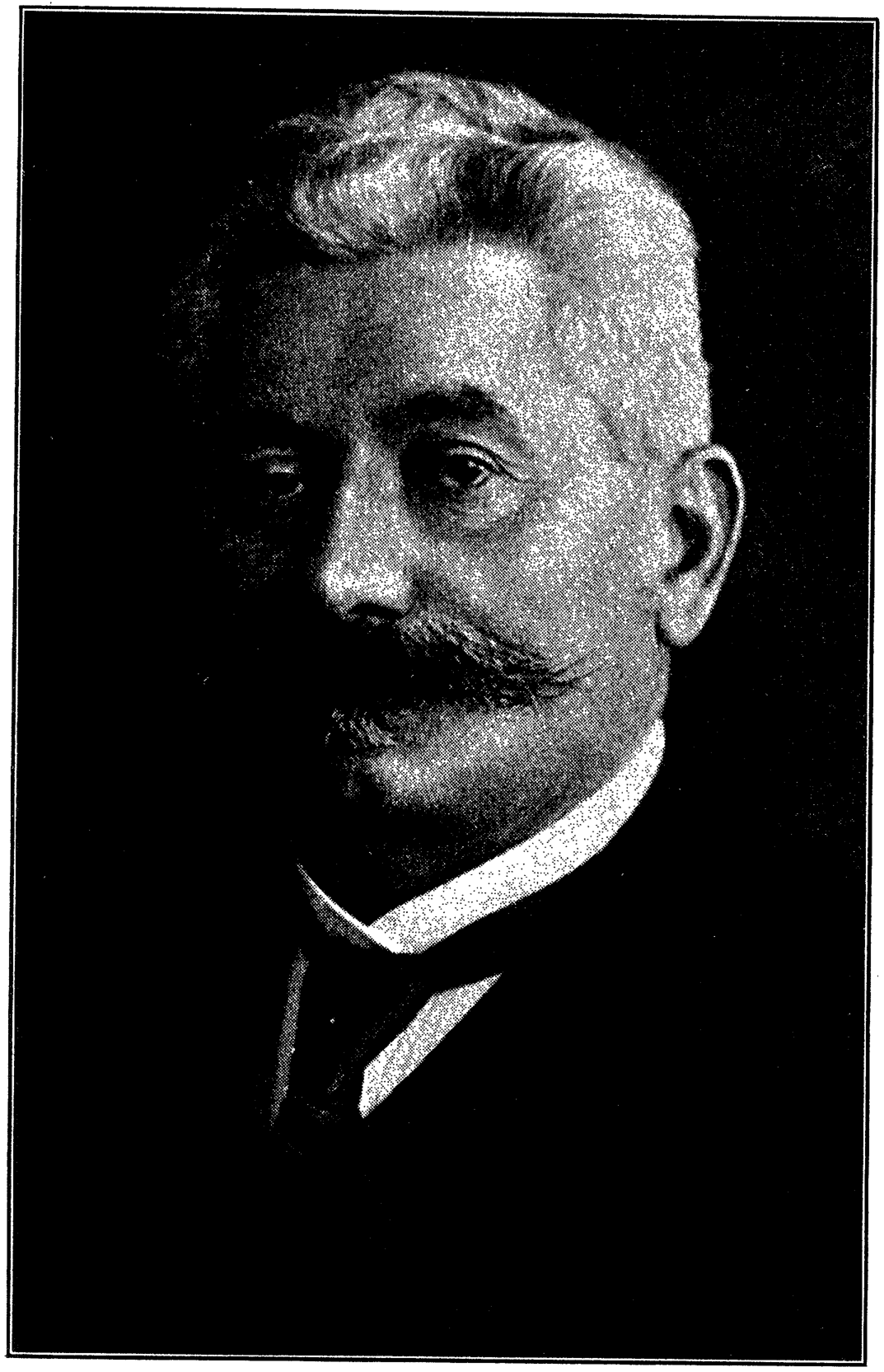
(plate; in the original facing p. 230)
229Not all socialists took satisfaction in the sort of socialism that these trade organs preached. The closer I looked, the more I noticed that in the socialist movement of Germany a split had quietly taken place.
The head of the German trade-union movement was then Carl Legien, who a few days earlier had returned from a journey to America. I visited him. He was a German of middle years, with broad shoulders, with dark-brown hair, with a heavy, stoutish figure, of middle height, with calm speech and manners and with a shrewd expression on his face. When I handed him my card, he received me with a special friendliness.
— Why, yes, I have visited your "Forward" building, — he said, — (our ten-story house had been finished while I was in Europe. So Comrade Legien had seen it before I had.) Quite interesting. With you everything goes in the American manner.
We fell into conversation. Other comrades came up, and he introduced me to them. He told them about our newspaper, how we had made it popular and built it up. He also told them about our "little skyscraper." One of the younger comrades was especially interested to know what sort of newspaper the "Forward" was, and how230it was edited. "That is exactly what we need to have here too," he then remarked. In this connection he told me that many of the German workers complain about the Berlin "Forward" — that it is too heavy; that its long, profound political and economic articles the working women, and many men too, cannot read; that they have no interest in them. And articles that would interest them and be easy for them to read they do not find in the newspaper. So the great mass is compelled to buy the bourgeois newspaper, the "Morgen-Post." Three-quarters of the readers of the "Morgen-Post" are workers, and they cast their votes for socialist candidates.
The conversation soon took another turn. People began to speak of the unfriendly feeling that exists between certain socialists who take no part in the trade-union movement and those who take an active part in it. It turned out that the latter were "revisionists" or "Bernsteinians," while the former, or most of them, were orthodox Marxists. The latter consider themselves better socialists than the "trade-unionists," and the "trade-unionists," in turn, regard them as dreamy theoreticians who cannot grasp the reality of life.
— That is, of course, self-evident, — Legien remarked. — You may dream about the realization of the highest human ideals and forget about the burning problems of the moment. But when you have before you the task of providing the workers of a certain trade with a couple of marks more, or perhaps with an hour more of free time, then you must come down from your high tower onto the hard earth.
231Another comrade, one of those who were standing by, added approximately the following:
"The growth of our industry and of our unions has sobered us. When workers suffer and want better conditions, you cannot feed them with a future social revolution. Circumstances bring us ever closer to reality. And we must, first of all, concern ourselves with the today. Well, our trade-unionists say to the fanatics: 'You call us heretics, traitors to the lofty Marxist ideals, and we say that you are dreamers, and that we do far more for the socialist ideal than you with your dreamy phrases.'"
A sizable group had gathered around us. Two of those present were editors of the trade organs mentioned. The conversation was for me uncommonly interesting. I swallowed every word of theirs.
— Judging by the way Comrade Cahan conducts the Jewish "Forward" in New York, he stands on the same ground as we do, — Legien said.
— For me that is the finest compliment, — I answered.
— With us in New York a man known as an avowed revisionist was Dr. S. Peskin. Some Bundists used to characterize me too with this word, and not in the sense of a compliment. One of them, I remember, once said to me in a friendly tone: "The 'Forward' is, after all, a revisionist newspaper, not a socialist one," and my answer was: "Well, if what the 'Forward' contains now is called revisionism, then there is nothing to be ashamed of in revisionism."
232Earlier I had been acquainted with revisionism only theoretically. I had also known that the number of its adherents was growing ever greater in Germany. All this I had heard from afar, and I had a quite nebulous notion about it. Now, however, finding myself in Berlin, I saw as if with my own eyes the quiet revolution that had taken place in the great socialist movement of Germany.
I came into the Trade-Union House almost every day and each time spent there some three or four hours. Everything I saw there made a pleasant impression on me.
Just then there came to Berlin a large workers' delegation from England, some thirty or forty socialists, men and women, who were making a journey on the Continent. The German comrades received them warmly. A lunch was made for them, and I too was invited. The chief speaker at the banquet, as representative of the whole party, was then Philipp Scheidemann (who later, in 1918, played such an important role in throwing the Kaiser from his throne).
I too gave a short speech in English. After the lunch, which was quite modest, in the European proletarian manner, the English moved into an open hall, and they let themselves go dancing. The Germans looked on and smiled in a friendly way. They regarded this as a genuinely English manner.
Observing the dancers together with the German comrades, I at the same time conducted with these comrades conversations about the two factions in their movement.
233Everything confirmed that in the socialism of Germany an enormous change had taken place over the nineteen years; that a partition had grown up between the old theoreticians and the practical men; and that the influence of the latter was spreading over broad circles. They, the "trade-unionists," had worked directly for the worker-masses, and their achievements had a more convincing force than the heavenly talk about an indistinct future. They had the public on their side.
When such a thing happens in France, with its hot temperaments, the two factions would have become two parties hostile to the knife. In Germany, however, it did not come to any open split. The unity and discipline of the party were not disturbed by the difference of opinion. The leaders of the unions were at the same time prominent in the activities of the party, and many of them were among its deputies in the Reichstag. (Such, for example, was Carl Legien.) The theoreticians, the "orthodox Marxists," gave way more and more to the practical men. Often they would hold to the letter of the theory. But they would interpret it in a new way, which turned the old meaning completely upside down.
The victory of Eduard Bernstein's "revisionism" was not confined to Germany. It also made itself felt in Holland, in Belgium, and in the Scandinavian countries. And as concerns France and England, precisely the same ideas as Bernstein's gained the upper hand there, though not through his influence. In France234Jean Jaurès, a complete anti-Marxist (see above, pages 61-68), now had the greatest influence in the socialist world; and in England, where the Marxist "Social Democratic Federation" had never won any significant role, Keir Hardie's "Independent Labour Party," also an anti-Marxist party, was now a swiftly growing power; and the essence of Jaurès's and Keir Hardie's socialism agreed completely with the ideas of Eduard Bernstein. The change of which we speak here was a complete revolution.
The essence of revisionism, its most important sum total, as Bernstein himself explained it, consists in the following:
According to the Marxist doctrine, the movement is built on a conception that capitalism must soon collapse, that its days are numbered, and that its end will come through a proletarian world revolution. The condition of the workers grows ever worse and worse, they become ever more enslaved; and the middle class must become ever smaller and smaller. Things are moving quickly toward this: that every civilized country should have only two classes — a handful of all-powerful millionaires and a mass of starved, despairing proletarians. The proletarians must rise up and destroy the power of the capitalist class. If so, then the chief aim of the movement is to bring on the revolution as quickly as possible. Therefore everything in it must be built on class hatred and direct preparation for the revolution. The movement should work not for the today, but for the tomorrow.
Socialists must not take part in any matter together with representatives of other classes, for all other classes are enemies and obstructers of the revolution.235To go together with them in a ministerial cabinet, for example, is a betrayal of the working class and of its coming revolution; to carry through a law in the interests of the peasants? That would be a crime against the whole socialist theory, according to which the peasant is a petty bourgeois, a member of the middle class, which must soon perish, and whose existence is only a hindrance to the speedy coming of the revolution.
The working class must be "a class for itself," as Karl Marx expresses it. It must stand in struggle against all other classes on every question. In parliament it must go solely in order to wage a war against all other classes, with the aim of destroying them. It must stand set apart from all other citizens. It must not mingle with them, as a Jew must not mingle with Christians at eating or at praying. All of humanity, apart from the working class, is unclean.
Many years went by. The "tomorrow" was ever postponed, the proletarian revolution did not come, the capitalist class stood firmer than ever. And the middle class did not perish. And as concerns the working class, its condition did not grow ever worse, but better, both economically and politically. Well, Bernstein came and proved all this with facts and with figures. He proved that the middle class is not diminishing, but growing larger, and that the question of the collapse of the capitalist system is a matter of an indefinite future. Therefore, in his conclusion, that —
For socialists to base their activity on a distant, indistinct tomorrow is worse than useless;236they can serve the working class only when they occupy themselves with its today.
At first glance these words may perhaps not make a strong impression. In truth, however, there lies in them a complete revolution in the spirit and character of the whole socialist movement. Since the essence is the clear "today," and not a befogged "tomorrow," since the social revolution is a matter of a distant, indefinite future, then one may indeed go together with capitalist and petty-capitalist parties in one ministry. One may and one must; for if not, it means that one hands over the whole power of the government into the enemy's hands. One may also, and it is important, adopt laws in the interests of the peasant, because the time when his class will disappear is also quite indefinite; and as a citizen, he is entitled to the attention of every socialist party. The workers must fight against the exploitation of capital; but this does not mean that they must absolutely in everything yield to anyone who does not belong to their class. Apart from being propertyless workers, they are also citizens, members of society as it exists today; they must fight, as a working class, but also as citizens — fight for freedom for all, for human rights for all, for general progress, for human happiness in the broadest sense of the words.
The change that revisionism brought into socialist thought was felt in everything that had even the least practical significance. The foundation of the movement was entirely rebuilt.
These lines are being written on the 19th of January, 1930.237Three weeks ago, in our Sunday "Forward" of the 29th of December, there was printed an article that we had received from Comrade Eduard Bernstein a short time earlier. The article is called "Socialist Agitation in Germany Then and Now." That which we say here, he expresses in this article. He points, namely, to the great change that has taken place in the Social-Democratic movement in the last thirty years. He points to the difference between the Erfurt Program, which the Social-Democratic party adopted in 1891, and the Görlitz Program, which the same party adopted in the year 1922, and the Heidelberg Program, which was adopted in 1925. Quoting from an earlier article of his, he says there:
"I was never strongly interested in the future that lies further away than the farthest socialist movements and strivings. I never painted myself any precise picture of the future. My thoughts are occupied with the present and with the near future. The distant prospects interest me only insofar as they show me the best way how to act in a purposeful direction in the present."
The essence of the article is that the socialist movement occupies itself chiefly with the today, and not with the tomorrow.
At the time when Bernstein's article was printed in our "Forward," his eightieth birthday was just being celebrated. From all of Germany and from the whole world he was greeted with heartfelt dispatches. The triumph of his ideas is today a complete one. Now they are accepted by everyone,238including also the famous Karl Kautsky, who had earlier been his sharpest opponent.
A dispatch that I sent to Comrade Bernstein from New York in honor of his 80th birthday contained, apart from my greeting and good wishes, the following words:
"You are the Martin Luther of socialist thought. Luther liberalized the Christian faith, and you — socialist idealism."
In 1912, then, the victory of revisionism was already quite clear, but not yet a complete one. Many of the old socialists still regarded it as heresy, as a betrayal of our ideal. But if the split in Germany was then not yet a very broad one, it was already a very deep one.
And the most interesting thing about it is the fact that almost every socialist who was then active in practical work went with Bernstein. Life itself had convinced him of the correctness of Bernstein's ideas.
Once, being in Berlin, in 1912, I received a letter from Karl Liebknecht, the son of the famous Wilhelm Liebknecht, who is mentioned several times in the 2nd and 3rd volumes of these "Pages" (see his portrait in the 2nd volume, page 293). He too had a short time earlier visited New York and our new "Forward" building, where he became acquainted with some of our comrades. Now, then, learning that I was in Berlin, he invited me to dinner. He was a lawyer and a deputy in the Prussian Landtag, and239the dinner took place in the restaurant of the Landtag.
In our conversation, as far as I remember, he expressed himself only in a quite mild manner as an opponent of the revisionists. He made on me altogether the impression of a very mild man. With his character he reminded me of his mother more than of his hot-tempered father. And when, six years later, at the time of the German revolution, he, together with Rosa Luxemburg, became famous as a leader of a German Bolshevism, it was for me a surprise.
For that matter, at that dinner we spoke more about America, which interested him so strongly, than about the German movement. From this conversation I became little acquainted with him.
When I told him about my acquaintance with his parents, he questioned me about my meetings with them and spoke of them like a tender son. That this loving son and mild, agreeable comrade had within himself a seething, militant spirit — of that I then had no notion.