The Frank Drama
Atlanta · 1913–1915
347The blood-libel trial of Mendel Beilis in Kiev and the murder trial (legal proceeding) of Leo M. Frank in Atlanta took place at about the same time — in the autumn of 1913. The American trial ended on the 25th of August, six weeks before the Kiev trial began.
We, here in America, at first took a far greater interest in Beilis's fate than in Frank's. Naturally far greater, comparatively. Whereas the "Forverts," for example, devoted dozens upon dozens of columns to the Kiev blood libel, it gave the Frank story very little space during the first several months. The cause of this lay in the fact that in the early period we were not acquainted with the true content of the Atlanta drama. With the exception of a narrow circle in Atlanta, people in America were mistaken about the story. They knew only that the police and the solicitor (prosecutor) were accusing a Jewish young man named Frank of murdering a fourteen-year-old Christian girl, as the result of his indecent conduct. We actually did not know more even then, when the dispatch arrived that the jury had declared Frank guilty. Doubts about the cor348-rectness of the verdict we had no reason to entertain, for we had only the official side of the trial, and to investigate for ourselves we simply took no interest. The fact that Frank was a Jew did not change the situation in our eyes. On the contrary: because the accused was a Jew, the story was unpleasant to us, and we had no desire to make too much fuss about it.
It was quite otherwise with Beilis. His trial was built directly upon an antisemitic lie, and his innocence was irresistible to everyone, with the exception of the most ignorant of the Black Hundreds. It was a medieval slander against an entire Jewish people. Beyond that: Beilis sat in prison two years and two months before the "trial" (proceeding) against him began. The sensation echoed throughout the whole world.
Mendel Beilis was to us a martyr. To pronounce his name in the same breath with Frank's name, without a "lehavdil" (an expression marking the separation of the sacred from the profane), would have meant to defile something holy.349is a victim of a vile slander. Louis Pehr, a New York journalist (a Christian), a contributor to the local "Times," yesterday circulated a statement that he had been intimately befriended with Frank during the time when both were students at Cornell University; that Frank was then a model of decency, that his thoughts were always occupied with study, and that it is impossible that he should suddenly have changed so much as to be capable of committing this murder. Pehr does not believe it. He is convinced that the entire charge against him is a conspiracy. He declares the trial in Atlanta to be a piece of cruel barbarism and injustice, and he appeals to public opinion and to influential persons to help his former comrade in his misfortune. He has sent letters to Oscar Straus and to the professors Tyck and Badgers, Frank's former teachers, and also to others."
From Atlanta itself reports began to come with details about the Frank case,*) of which the public had previously had no conception.
The case began to awaken a new interest over350an entirely different one, and the whole event took on a different face.
From the Frank case there developed one of the most dramatic occurrences in the history of criminal proceedings.
At the same time, in connection with this case, attempts were made to find grounds for charges of antisemitism. As a result, among Jews the impression grew ever deeper that Frank was a victim of incitement because he was a Jew. As we shall see, one cannot say this about the Jews of Atlanta itself. They knew that the antisemitic side of the case had sprung from circumstances that had nothing to do with antisemitism. (There accumulated enough antisemitic foul talk; but that was later.) In the Northern states, however, Jews then believed that if Frank was really innocent (of which they were for a good while still not certain), then the slander against him was probably the fruit of the usual antisemitic cultivation. Thus, he was already often compared to Beilis. Still more often one would hear the words "the American Dreyfus."
In March 1914, I set off for Atlanta with the purpose of studying the case on the spot and of finding out what was the truth in all the rumors and opinions about the case. I studied both sides. I met with people from both camps, including the solicitor general, with whom I spent several hours. I visited Frank every day in his iron cell, where he sat condemned to death.
The tragic event is now sixteen years old. Our young Jew is little known to me. After another generation, the sad story will probably be wholly for351-gotten. And as for the Jews of our old homes, they were never acquainted with it at all.
I took a deep interest in it — as a "Forverts" writer, simply as a human being and as a Jew, and also as Frank's personal friend. The impressions with which I returned from Atlanta, and those I received from his further fate, are among the deepest and most painful impressions that were ever created in me.
The Frank story must be written down, with details, in Yiddish. It belongs in Jewish libraries. Perhaps it does not belong here at all. Perhaps it would be more fitting to publish it in a separate book. But I cannot separate that which I personally saw, heard, and felt in this drama, when I was in Atlanta, from that which I felt through later, reading all the dispatches and articles that had a bearing on Frank's fate.
About the case I sent the "Forverts" telegrams from Atlanta, and I wrote a long series of articles once I was back in New York. But all of that consists of scattered, time-bound reading matter. When, in writing this volume of "The Pages," I came to the Frank drama, an old wound was reopened in me. I was drawn ever deeper and deeper into the work.
From the year 1914 there remained with me many notes, which I could not then use — partly for special reasons, which will be explained further on. Now I have sought them out. Besides that, this time I had occasion to read anew thick volumes of old official reports and other documents, and to open a correspondence with old friends from Atlanta, who352had played an important role in the Frank story. The result of all this, together with my own dispatches and articles from 1914, I organized, and I worked out the historical narrative with order and with illumination. What I wrote about the case for the "Forverts" in 1914 and in 1915 could serve me only as material.
Antisemitism in Atlanta, the capital city of the state of Georgia, and in the South* in general, had earlier been quite slight. Christians and Jews moved in the same society. In this respect the South was for Jews more favorable than the Northern states. The white Christians there are proud of themselves and set great store by lineage, but this did not prevent them from treating Jews as their own people.
Their feeling of lineage stems from those times when Negro slavery reigned there, when the blacks were the bondsmen and the whites were masters over them, as over cattle; and they bought and sold them as well like cattle. The whites felt like the lords during the time of "serfdom" (panshchina) in Russia and in Poland. And this lordly feeling and lordly pride remained with them. The Americans of the North had kept no slaves. They were no "lords." This "lordly" feeling of the Southerners had, however,
353no connection with their relations toward their Jewish fellow citizens. They know chiefly the difference between white and black; and since Jews are white, Jews were among them people equal to other people.* Of such unfavorable relations toward Jews as those one sees in the high windows of New York, Philadelphia, or Boston, they knew nothing there.
That a Jew should be the mayor of a large city in the South was no unusual thing. In the largest law offices (attorneys' bureaus), Jews and Christians were partners. The solicitor general (district attorney, prosecutor), Hugh M. Dorsey, who conducted the prosecution against Frank, had, even during the time of the trial, a Jew as a partner in his private bureau.
One must not, however, exaggerate this friendliness toward Jews either. The Southern Christian is proud. Upon a stranger he looks down from above; and a Jew, even were he a Southerner, and even of many generations, is to him still a member of a foreign race. Beyond that: a quiet, dormant antisemitic possibility lies hidden in the heart even of the most Jew-friendly Christian. Perhaps this applies in general to feelings between people of different nations. But the Jew is, after all, a member of such a far-distant foreign people, and on top of that of an eternally rejected people. Thus, when something arises that causes354an agitation, the hidden possibility can become a sharp, open reality.
So it was in the Frank case. Partly, at least.
My journey from New York to Atlanta, Georgia, lasted about a full day and night. Traveling there, I had no opinion about the case. From all that I had read about it, being in New York, I could not decide for myself whether Frank was guilty or not. I arrived there on the 10th of March (1914). That is, a year after the murder of which Frank was accused. I set to work at once, investigating the case thoroughly and absolutely impartially.
But first, a few words about the city, as it then looked, and about its population.
Atlanta is the second-largest city in the South, the second after New Orleans. It is one of the many American cities that have grown up very rapidly. Fifty years earlier it was a little town with fewer than ten thousand inhabitants. At the time of Frank's trial it had close to two hundred thousand inhabitants, among them eight thousand Jews. When I found myself in the center of its most important streets, it seemed to me that this was almost a piece of New York or Chicago. On all sides very high walls, and among them "skyscrapers" too. It streamed with people, it seethed with life.
Here it is necessary to note the following: if the population of Atlanta has in the last fifty years grown from ten thousand to two hundred thousand, it has in355the last thirteen years grown from 87 thousand to two hundred thousand. That is to say, only thirteen years before the murder, in 1900, Atlanta was still a provincial city. It became a metropolis so hastily that in many respects it had not yet had time to shake its provincialism off.
Its police, for example, was still a police of a town of 87 thousand inhabitants, not of two hundred thousand. This is one of the details which it is important to keep in mind if one wishes to understand the Frank case.
When I strolled in "Five Points," as the center of Atlanta is called, and observed the crowds, I felt that this was an altogether different people from the Americans of the Northern states. It seemed to me that I saw only tall people, with broad shoulders, healthy, robust. And when I listened to the conversations, their English sounded to me different from the speech of New York, Boston, Cleveland, or Chicago. The pronunciation is different. Earlier I had also, from time to time, happened to meet with Southerners, and I naturally always knew that the pronunciation in the South is somewhat different from that in the North. But I had never felt this so distinctly as now, when the Southern accent sounded to me everywhere.
If the Americans there are more solidly built, I did not, however, see on them the mirror-like neatness and physical precision by which the American of the Northern states distinguishes himself. The clothes did not sit on them so trimly, their whole appearance did not glisten so as among the Americans to whom I was accustomed.356And all this applies not only to the men, but to the women too. They are also taller and more solidly built than the American women of the North; and beauties one meets among them at every step. But as elegant as the American ladies in the large cities of the North they are not.
The streets were full of Negroes, mostly dirty and ragged. (They live in separate quarters, which are entirely settled by blacks, but you see a great many Negroes on the "white" streets too.) This, together with the clinging smoke of the soft coal, kept the large, rich city from having a clean appearance.
In the inhabitants of the South one does not notice the lively movements, and one does not feel the energy with which the American of the Northern cities draws your attention. This is a result of slavery, which had earlier been the foundation of the entire life in the South. The whites there did not have to work and toil. Everything was done for them by the Negroes. Their slaves spared them every serious effort.*
They also have other traits of the lordly character. It seemed to me that they were not so absorbed in making money; that they were more hospitable and not so cunning, but also not so practical as the Americans of the Northern states. In the course of several357generations as slave-drivers there remained with them also special faults, and indeed quite grave ones.
Whoever wishes to understand the Frank case must always keep in mind that the large white population there is in certain respects more primitive, cruder, and far more capable of wild outbursts than the Americans of the North.
The following "lynch" scene is there a quite ordinary occurrence to this day: they assault a prison where a Negro is locked up who is accused of a crime against a white woman, for example; before he comes to trial before a court, they drag him out, they bind him to something and douse him with kerosene; or they lay a pile of wood around him; they set it alight; and then they watch with a wild delight as he burns, and they rejoice in his blood-curdling cries. The spirit of the slave-driving grandfathers glows anew in the grandchildren. The population of a town or city is suddenly transformed into a herd of bloodthirsty wolves. Several years before the Frank case, the whites of that very city of Atlanta worked themselves up so against the blacks that they fell upon the pawnshops,*) took out all the pistols, and set out shooting — Negroes at random. Thus they shot down or killed in some other manner over fifty innocent blacks.
The whites and the blacks are separated from one another as people are separated from beasts. In the streetcars (trams) three-quarters of the benches, the front ones, are for whites, and the rear ones for blacks. When there are many whites, they occupy358the "black benches" too, and the Negroes must stand. In every courtroom the whites are on one side and the blacks on the other side. So it is in every other public place as well.
Around three before dawn, between Saturday, the 26th of April, and Sunday, the 27th, in the year 1913, the telephone rang in the headquarters of the Atlanta police. A Negro named Newt Lee reported that he had found a dead body in the dark cellar of the National Pencil Factory (a pencil factory), on Forsyth Street, and that the body was of a white girl. Newt Lee served at the factory as night watchman.
Among the policemen and the detectives there arose a nervous commotion. In Atlanta in the last year and a half nineteen murders of women had taken place, and none of the murderers had been caught. The police had acquired a bad name. They were regarded as an organization of cripples. But those nineteen murdered women had all been black, whereas this girl was white. What a difference! If now the murderer were not to be caught, things would go badly. The police would simply be in danger.
A group of policemen and detectives jumped into an automobile, and together with them a newspaperman. They drove up to a large stone building of five stories. This was the pencil factory. The policemen and the reporter knocked at the locked door. A Negro appeared, fright359-ened. This was Newt Lee, the night watchman. He led the group to show where the dead body lay. He led them down into a broad, long basement (cellar), where a small flame of gas flickered. With the exception of that corner, it was almost dark in the large basement. Lee led them to a spot not far from a back door, at the far edge of the basement, and there he pointed out to them the dead girl. The gaslight burned over a furnace, not far from there.
The murdered girl was covered in coal dust, shavings, and ordinary dust. On her head she had a long wound, a fresh one, like a cut with a knife, and from the wound half-dried blood ran into the hair. Around her neck was a cord, drawn so tight that it had cut into the flesh. Around her head was bound a piece of her dress — probably with the purpose of holding back the flow of blood. It was evident that her mouth had been stifled. Her undergarment was torn and shredded.
She was so covered with coal dust that at first glance it would have been hard to say whether this was a white girl or a Negress. One arm was scratched, and the face was scratched and scored, probably from the bits of coal over which the body had been dragged.
Over one eye was a large bruise — a black-and-blue mark of a strong blow. Under one knee was a wound.
The detectives began to search. Not far from the girl's head they noticed two leaves of paper, a brown one and a white one. On each of them were sev-
360-eral lines, written very ignorantly and in a very poor handwriting. On the brown leaf they found nine such lines, and on the white one five. The handwriting was the same.
About the content of the two notes it will for the moment be enough to say the following: they were composed in such a way that one should think that the unfortunate girl had written them before her death. They were addressed to her mother, and in them she said that she was being tormented and violated by a tall, very black and lean Negro.
Beside the two notes lay a pencil and a part of a pad (block) exactly like the paper of the white note. It was clear that the white leaf had been torn from the pad. Along one side, over the length of the basement, there stretched a long, narrow ridge of coal dust, more than a hundred feet in length. This, and the scratches on the face and on the arm, showed that the girl, already dead, and perhaps still alive, had been dragged over the length of the basement.
Her hat and one shoe (a light and flat one, like a slipper) and a blood-stained pocket handkerchief were found in three separate parts of the basement. Her umbrella and a ball of cotton lay at the bottom of the elevator shaft,*) for the elevator of the pencil factory went down to the very basement, and the bottom of its "shaft" was a part of the basement floor.
It is not pleasant to speak of such a thing; but this will be important to us for an exact consideration of the question whether Frank was guilty of the murder; on361the bottom of the elevator shaft the detectives also found a sign that someone, probably many hours earlier, had used the place as a water closet.
Also important is the fact that the back door of the basement, which led into a back alley, the detectives found open, and its catch had been torn off. This was a sliding door (a door that does not open in the usual way, but that slides into the wall). Beside it lay a bar of iron, and it was evident that with this the catch had been knocked off. Probably it had been too stiff, and the one who had to go out through the back door was in a hurry, and with the iron knocked the catch off.
When one of the detectives examined the several ignorant lines of the notes, he decided for himself that only a Negro writes like that. Thus, he gave the black night watchman an angry growl, laid his hand on his shoulder, and said:
— Nigger,*) this is your work!
Newt Lee began to deny it, to swear that he did not know what to say. But they put a steel chain on his hand and led him away to the police. Then they telephoned Leo Frank, the superintendent (manager) of the pencil factory.362house there was still no answer. The police rang again later. And again they could not get through. Only around seven o'clock in the morning did they reach Frank on the telephone. Detective Starnes spoke with him. (The content of their telephone conversation will be related further on.) And then Starnes and a couple more detectives drove over to Frank.
In the course of the three or four hours that passed before Frank answered the telephone, the detectives learned who the murdered girl was.
The chauffeur of the automobile that had taken the policemen to the factory recalled that his young sister-in-law, a girl named Grace Hicks, worked at the same factory. He reckoned that she would probably recognize the murdered girl; so he drove off at once with his automobile to the sister-in-law. He brought the girl to the factory, and she did indeed recognize the body.
— This is Mary Phagan, — she said with a stifled weeping. — She worked together with me; in the metal department we worked.
Around seven o'clock the detectives drove up in their automobile to the house where the Franks lived together with the Seligs — the parents of the young Mrs. Frank. They, the detectives, already then knew who the murdered girl was. But this they did not tell Frank. They took him away to an undertaker's shop (a place where a corpse is prepared for the funeral), for there the body of Mary Phagan already lay. After Frank had looked at her, he said to the detectives:
363— This is, after all, one of the working girls to whom I paid out their wages yesterday.
— What is her name? — a detective asked him.
— I don't remember, — Frank answered. — When I take a look in my cash book, where the wages I paid out yesterday are recorded, I will recall it.
From the girl Grace Hicks they learned where the parents of the murdered girl lived — her mother and her stepfather, a worker named Coleman. They lived in Bellwood, a suburb of Atlanta.
Mary had not been at the factory since Monday, for there was a shortage of metal.*) One had to wait until it would arrive. So she stayed at home from Monday until Saturday. That Saturday was "Decoration Day" in the South — the day when flowers are laid on the graves of the soldiers who fell in the war against the North, the struggle that took place some fifty years earlier. (In the North flowers are laid on the graves of those who fought in that war for the abolition of Negro slavery, and in the South flowers are laid on the graves of the soldiers who fought against the abolition of slavery. In the North "Decoration Day" is the 30th of May, and in the South the 26th of April.) Since it was a holiday, no one worked, and therefore the wages were paid out a day earlier, Friday. Mary Phagan had then worked only
364for one day of the previous week. But that Friday she had not been at the factory, because in her department there was no metal; so she did not even collect that little bit of wages. Saturday, half past eleven o'clock, she ate lunch at home and set off on a car to the factory. She knew that hers would be there and that she would be able to collect her envelope (an envelope with the money that was owed to her). She also had it in mind to stop and watch the Decoration Day parade — the march of the old men who had taken part in that war.
Mary was not tall, but rather plump and solidly built. Physically, for a girl of fourteen years, she was very well developed. And she had a very pretty face. A short while before the tragedy, the society of the church to which her mother belonged had chosen her for the role of a "Sleeping Beauty" at a benefit performance. In Bellwood she was a popular child.
When several hours had passed and Mary still had not come home, her mother sent her husband to look for her. Coleman visited all the "movie" theaters and the homes of acquaintances; but he did not find her anywhere. Coming back home, he explained to his wife that Mary had probably gone to her grandmother in the town of Marietta (not far from Atlanta), where she, Mary, had been born. This made sense, for she had indeed intended to visit her grandmother. Still, the mother could not fall asleep the whole night.
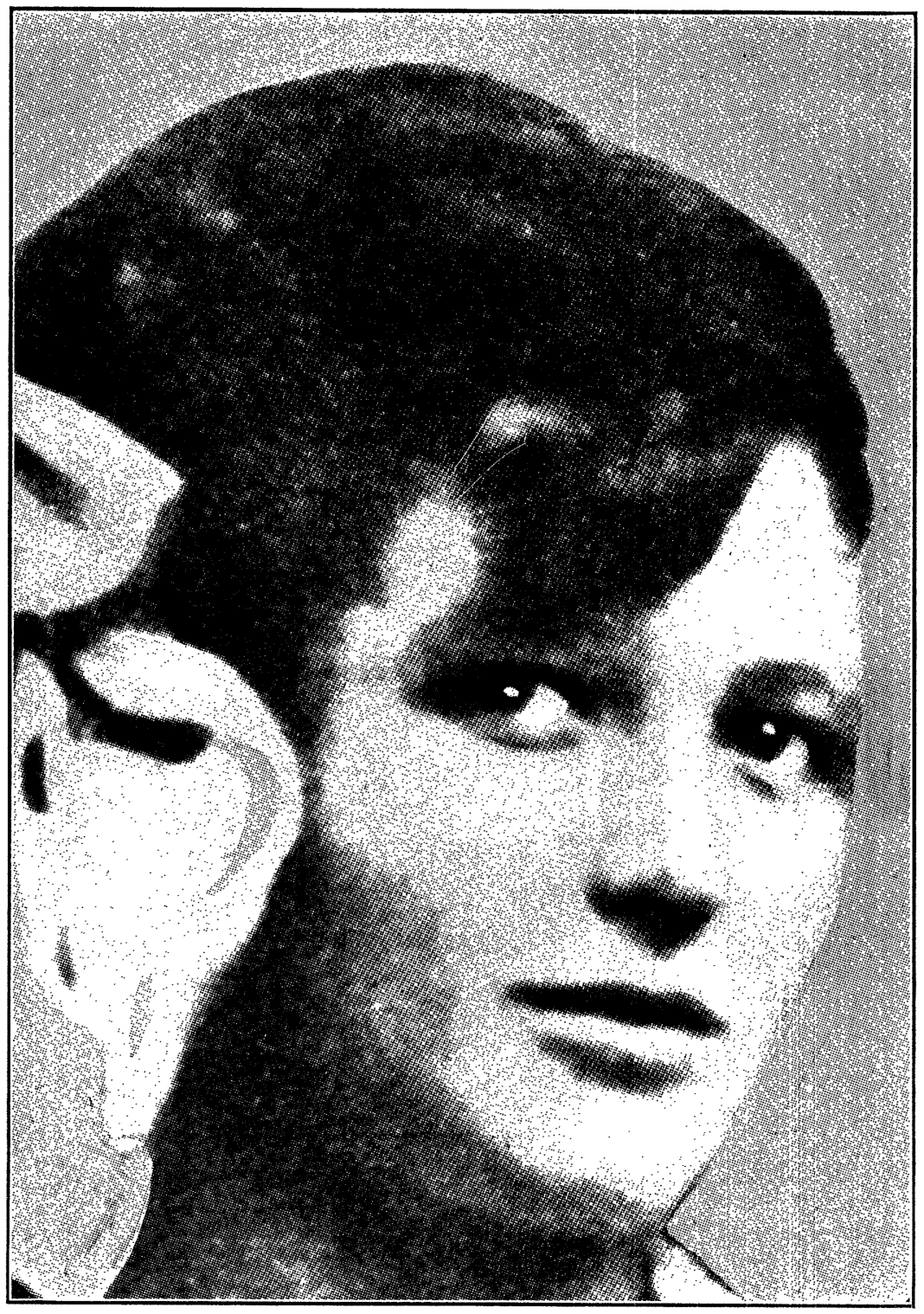
(plate; in the original facing p. 364)
The next morning, that is Sunday morning, there knocked at the Colemans' door a neighbor's girl, Mary's365friend, who also worked at the pencil factory. She already knew everything from Grace Hicks. With a tearful voice she could barely utter the words: "Mary is dead."
The Negro Newt Lee easily proved that on Saturday by day, and the whole afternoon, he had not been at the pencil factory. Leo Frank himself was one of his witnesses to this. And his handwriting bore no resemblance whatever to the two notes that had been found beside the body. About his innocence there could not be the slightest doubt; so they let him go. For the moment there was only one person about whom there could be a question regarding the murder. This was Leo Frank, for, as it then seemed, he was the last who had seen the girl alive.
As Mary's mother had reckoned, her daughter came to the factory a few minutes past twelve. And then Frank was indeed there. He said so himself. That forenoon he paid out wages to about eighteen working girls who had failed to collect their envelopes on Friday, and Mary Phagan was one of them.
The doctor of the city government examined the dead body, and his report was that he had found no signs of violation. He also stated that the mouth and nose were full of coal dust. This was important, for it showed that she had breathed the coal dust into herself; and this, again, was a proof that while the body was being dragged through the filth of the cellar, Mary Phagan was still alive.
366Leo Frank*) was then 29 years old. He was tall, lean, with an intelligent dark-complexioned face, with interesting dark eyes. He was born in Texas, but when he was three years old his parents moved with him to Brooklyn. There he grew up and finished school and college (Pratt's Institute); after that he finished studying engineering at Cornell University, Ithaca. (His father had also finished university, in Germany, from where he then emigrated to America. His mother was born in America.)
A brother of his mother's — already an older man, who had immigrated to America when he was still a young fellow — had large businesses in Atlanta, and around the time when Leo finished his studies in engineering, the elder Frank entered into an enterprise of an Atlanta Jew named Sigmund Montag, who planned to found a factory of pencils. Leo's uncle put a considerable capital into the business, and he was the largest shareholder of the company. With the pencil business, however, he was not familiar, whereas Montag, who had a large business in writing materials, was familiar with it. Thus, Montag was the active partner, the active proprietor of the "National Pencil Factory," as the new firm named itself.
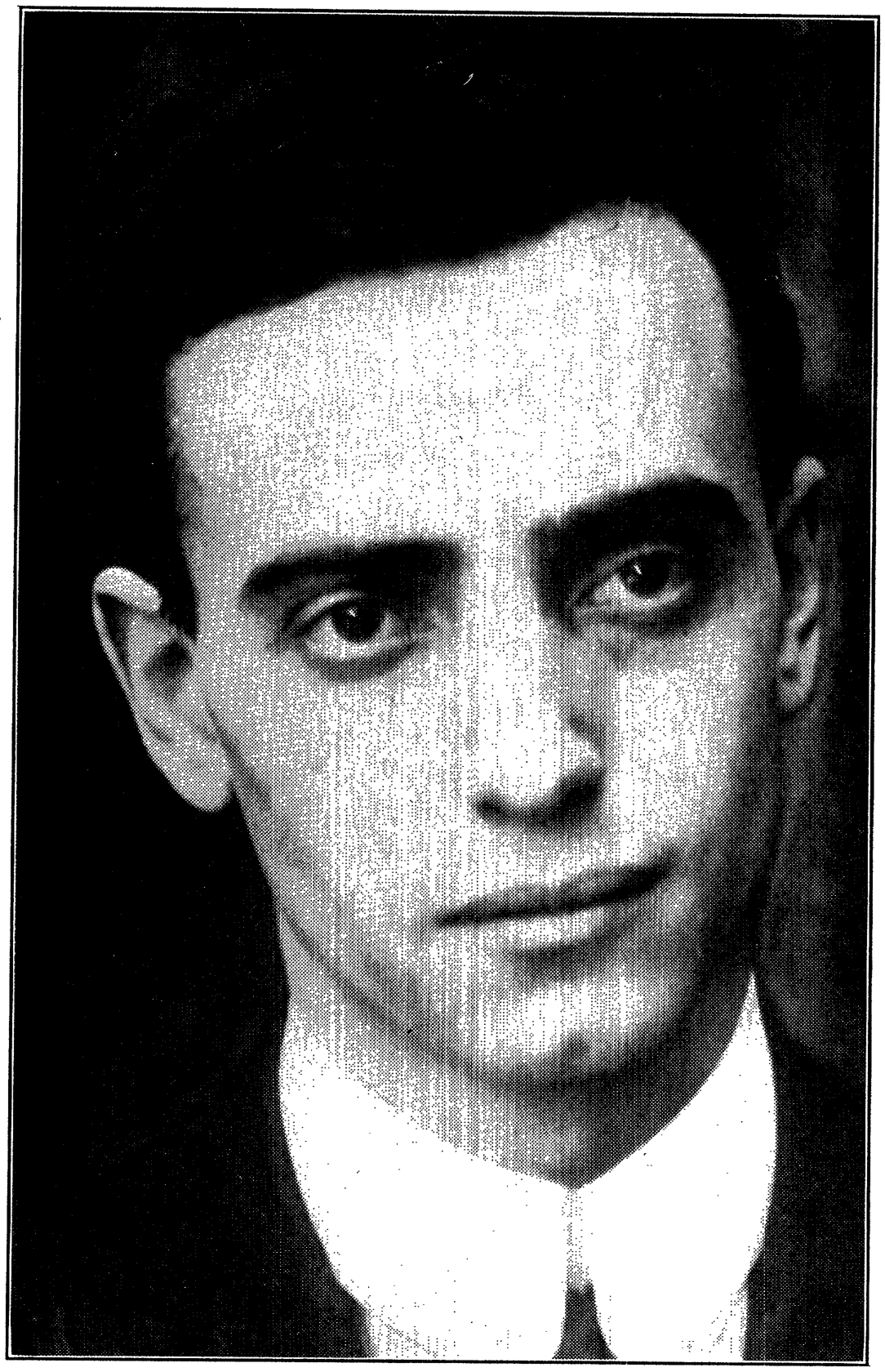
(plate; in the original facing p. 366)
At the elder Frank's wish, his nephew was invited to be the manager of the factory. And to this end he was first sent to Germany for half a year. There he became well ac367-quainted with the machinery and with the whole technique of the pencil industry; and when he was ready, he came to Atlanta with the necessary machines. Then the new factory was set up. This was some three years before the murder of Mary Phagan. Leo's uncle later fell ill. A short time before the murder he set off for New York and from there to Europe, to take a cure. On the day when the Atlanta newspapers reported that at the National Pencil Factory a murdered girl had been found, he set off from New York for Europe.
Frank thus settled in Atlanta. He devoted himself entirely to the pencil factory. He became acquainted with some of the Jewish families of Atlanta, and married a Jewish girl born there, the daughter of a respectable family named Selig. In his free hours he was active in the society of the Reform temple, and in the order "B'nai B'rith." He had a pleasant character and was capable and clever; and since he was finely educated and a brilliant speaker, he played an important role at the meetings, and he was elected as president of the order "B'nai B'rith," first of his lodge, and later of the whole district.
"He never pushed himself forward. He was not ambitious. He never lifted a finger to be elected. Everything came of itself. He is very popular and beloved for his character and for his whole personality." — So expressed himself an Atlanta Jew, of the German Jews, in the course of a conversation that I had with him about Frank.
368Mobs and a special mob psychology exist throughout the whole world. In the Southern regions of the United States, however, they have a special character, and with regard to the murder of Mary Phagan the psychology of the mob played a mighty role.
When the newspapers reported that a fourteen-year-old white girl had been murdered, and on top of that that she had been a pretty child and the darling not only of her mother but of all Bellwood, the public became agitated and demanded that the police catch the murderer on the spot. At once they lost their composure. With this it began.
The Southerners are a hot-tempered people. They become inflamed more quickly and lose their self-control more quickly than the Americans of the Northern states. The masses of the North are more civilized than the masses of the South. A large part of the public there, even of the whites, is absolutely ignorant. In the North an American who cannot read and write is a great rarity. In the South there is a not inconsiderable percentage of such people. The masses there are more ignorant and more capable of wild deeds than the common public of the North. This is, after all,369the land of "lynch" law. When they become inflamed against a black-skinned person, they lose every civilized feeling and behave like crazed ancient Asiatics.
The fact that Mary had worked at a factory poured oil on the fire of the general rage. That a white girl should go to work — this was in the South, in that backward land where Negro slavery had once existed, already no news; but they liked to regard it as news, scandalous news. There were already poor white families whose sons and daughters had to go and earn a living. But in their hearts the whites there, the "aristocrats," always regarded this as a bloody insult. To work — that is an occupation for Negroes, for a people of slaves, but not for "free-born" children. Perhaps for the whites of the North, where Negro slavery had never existed, but not for the white "aristocrats" of the South. Such a feeling the Southerners have.
The whites of the South cannot forget that the North defeated them and destroyed their slave trade. They cannot forget their former grandeur and the war by which the North took it away from them. The whites of the South regard themselves as a martyr-people. They feel it in their pockets, and their anger at the North still smolders in their hearts.
Here a fourteen-year-old white girl of the South, a girl who "should" have been a "lady" over slaves and live like a lord's daughter, had, poor thing, been forced to work at a factory; and there, at the factory, she had been murdered. The blood boiled in everyone.
To all that we have said one must add that the Southerners are great cavaliers. "Ladies' rights"370plays a great role in the North too, but not as in the South. There a white woman is a queen. The slave traders imitated the knights — the lords of the Middle Ages. And so it became rooted in them. To take the life of a male person is a murder. To take the life of a woman (a white one) is a double murder.
The undertaker's shop, where the corpse lay, was visited by twenty thousand people. And everyone came out of there with a wild look in the eyes and with wild cries for revenge on the lips. Similar masses ran to the pencil factory, where the crime had been committed. On the corners crowds stood and talked about the murder. People did not work, neglected their businesses; the city was in a confusion of horror and thirst for revenge. When a policeman would pass, people would cast crooked looks at him. Jokes circulated against the policemen. They were called "a band of good-for-nothings and parasites."
In the recent period the police had been busy closing down disreputable houses. The clergymen had forced them to do this with the speeches they delivered in the churches. The male public was not satisfied; and now they cried that the policemen were good for no more than arresting prostitutes; that to catch a murderer they had neither the ability nor the time.
On the other hand, against the police there had recently been strong accusations of corruption. The mayor of the city himself had accused them of it.
371The mass pity for the murdered girl grew, and a mass desire to take revenge on the murderer. In the North, when a similar crime occurs, the public also becomes agitated. But to such a wild rage as in the South it does not come there.
People wanted to have the murderer on the spot. So went the cry, and the newspapers outdid one another in shouting with the voices that one heard in the street. They demanded that the police find the guilty one at once, and threatened that if it did not do so soon, "the trust in it would be lost."
And in case the effect of the wild mob psychology should still be too little, a money interest was added.
Newspapers promised a thousand dollars to the one who would discover the murderer. The government of the state of Georgia promised five hundred dollars, and the city government of Atlanta a thousand; in all, 4,500 dollars were promised. And the result was that various people scrambled to earn at least a part of the sum.
People cursed the police, mourned the unfortunate girl, and again cursed the police. It boiled as in a cauldron. The public was in a hysteria. People were ready to seize whomever, to believe whatever...
The police feverishly began to search for the murderer — simply in order to save themselves. They were ready for anything, just to announce that they had caught the criminal.
It was in this very hysteria that their detectives laid hold of Frank.
372There can be no doubt that at first they worked earnestly with the purpose of finding the true murderer. But they were incompetent at their craft. As was explained above, Atlanta in thirteen years had grown from a town of 83 thousand inhabitants into a city of 200 thousand inhabitants. Its police was still a provincial police. And now, in the general agitation, in their fear of the wrath of the mob, the brains of their detectives were simply paralyzed. Thus, they climbed up the straight walls. They overlooked important clues and seized upon "evidence" that had no substance, and they overlooked such as did have substance.
For example: the two notes that had been found beside the dead girl, New York or Philadelphia detectives would have examined and investigated as thoroughly as possible. In the writer's handwriting and language they would have sought a key to the mystery. They would have taken pains to find a person who has exactly such a handwriting and writes exactly in such a manner. Or take the following, for instance:
Mary Phagan had gone for her wages with a mesh bag (a little bag of woven silvered wire). After her death they found her hat, her handkerchief, one shoe of hers, and her umbrella, but not her mesh bag. Where, then, had it gone? Perhaps it might have been found somewhere, and it would have led to a decisive clue?
With such investigations the Atlanta police did not occupy themselves.
Experienced, capable policemen would have kept the cellar where Mary's body had been found, the first days,373locked, so that the detectives could examine and investigate the place exactly. The Atlanta police, however, let thousands of curious people in at once. The public ran about over the basement, trod upon and trampled with their feet various things that lay scattered in the coal refuse. Perhaps they destroyed or carried off something that would have been important for the investigation.
On the back door of the basement they found a bloody fingerprint, which the murderer had left there, himself not knowing it, as he went out through there. The detectives who examined the cellar, as soon as the night watchman had called them, split off from this door the piece of wood where the print was. But with it they did nothing. With an experienced, capable police, such fingerprints are the best signposts; and as we shall see, the clues in this case could easily have led to the murderer. The Atlanta police, however, made no use of these fingerprints.
The only thing the detectives could grasp, and which they fastened upon, was the fact that Leo Frank was the last who had seen the girl alive. Thus, they conducted their whole investigation around this fact. In this investigation of theirs they became so absorbed that to other clues, far more important ones, they were blind, or made themselves blind. For, as we shall see, the detectives did not stop at any means to obtain testimony that would confirm their "theory," and to suppress highly important evidence that pointed in an entirely different direction.
But let us go in order.
374A few minutes past seven in the morning, Detective Starnes, and more detectives and policemen, drove up to Frank in their automobile. One of them, John Black, afterward reported:
1) that when they came, the door was opened to them both by Frank and by Mrs. Frank — a sign that they were very distracted and nervous.
2) that Frank was already dressed. Only a collar and a tie were lacking. Now, why was he dressed so early on a Sunday? From this Detective Black inferred that he had not been able to sleep.
3) Frank ran his fingers through his hair, and his voice sounded hoarse — again a proof that he was very nervous.
4) When the detectives came in, Frank asked them: "What kind of misfortune has happened?" Thus, Black gave this as a proof that he knew what had taken place at the factory.
To this one must add something more: before the police came to Frank, Detective Starnes had spoken with him from the factory on the telephone; and according to the report that Starnes afterward gave, he had only told Frank that he was speaking to him from the factory and that the police would soon come to him, to Frank. And what did Frank then say on the telephone? Did he express surprise? No, he expressed nothing, said nothing, and asked nothing. So Starnes afterward related to the chief of the detectives. This375means, then, that no one had told him that a misfortune had taken place, and that he had known of himself.
(5) The detectives related of Frank: he demanded that they first let him brew a measure of coffee (but they did not allow him this). That is, they inferred the meaning that he wanted to calm his nerves.
(6) As for their ringing on the telephone, they gave as a second point that he had understood what the police needed him for, and that he had therefore pretended not to hear that the telephone was ringing.
(7) In the undertaker's shop, the dead body had been transferred soon after the detectives had examined it in the basement, and there Frank was brought as soon as he had been taken from his dwelling.
At that same moment a strong electric light was thrown upon the dead face. The detectives reported that they saw Frank become very nervous and frightened.
For the moment they let him go free. The "evidence" that has here been enumerated, as an addition to the fact that he was the last who had seen the girl alive, was set forth as a foundation for further investigations. Upon this foundation, too, the police went on to build a case. They searched, and they discovered the following:
(8) When Newt Lee, the night watchman of the pencil factory, had been arrested, he told the police such a story: Friday, that is, a day before the murder was committed, Frank had376said to him: "Tomorrow come two hours earlier than usual. I will be at a baseball game,*) so you keep watch over the factory."
But the next day, when Newt Lee came at four o'clock, Frank said to him: "Go somewhere and have some pleasure. Come back at six o'clock."
From this the police drew the conclusion that Frank had then, on Saturday by day, needed to do something of such a kind that he did not want to have any witnesses to. Nor did he go to the baseball game. He stayed at the factory. This is a proof that he had something unexpected to attend to there.
(9) An employee at the factory, one named Gantt, came there that Saturday evening for a pair of shoes that he had left there. Frank did not let him in — a "sign" that Frank was afraid Gantt might find the murdered girl.
(10) Around seven o'clock that evening Frank telephoned Newt Lee, who was already back at the factory, and asked him whether everything was in order. Now, the police said that such a thing — telephoning him — Frank had never done before. Thus, this too is a proof that he had a special reason to be uneasy, to be afraid that something might have been noticed in the basement.
(11) When Frank was brought to the police, a lawyer (attorney) had already been arranged there for him. So he, Frank, must surely have already known beforehand that he would be arrested and that he would need a defender.
(12) Immediately after the377murder became known, Frank engaged Pinkerton detectives,*) so that they should seek out the murderer of Mary Phagan. In this the police saw an intention to deflect the accusation from himself and to entangle the investigations.
(13) A worker named Barrett, who was employed in the metal room of the pencil factory, found on Monday, that is two days after the murder, on the machine at which he worked and which stood in that room, six or seven hairs that resembled Mary Phagan's hair; Friday, he said, the hairs had not been there. And on the same corridor, near the dressing room (where the girls used to change), a little farther than the metal room, he noticed a dried bloodstain — so he reported. These two rooms and Frank's
(14) It has already been mentioned that Frank and his wife lived together with Mrs. Frank's parents — Mr. and Mrs. Selig. Now, a Negro named Albert McKnight, whose wife, Minola, was a cook at Mrs. Selig's, told such a tale: Saturday, the day of the murder, half past one o'clock, he was at the Seligs' in the kitchen, and from there he could see what was going on in the dining room (dining room), where the family was then eating lunch (midday meal); and he saw how Frank sat at the table and did not eat. That is to say, the378detectives concluded that Frank was very distracted. Eating was not on his mind. And this was, after all, a short time after he had paid out to Mary Phagan her wages at the factory.
Between the kitchen of the Seligs and the Franks and their dining room there is a swinging door (a door that swings to and fro, and if one does not pay attention, it opens and at once closes again). Through this very door, while the cook carried something over into the dining room or set something over from there, McKnight saw how Frank sat at the table and did not eat. Is Frank's place at the table located in such a spot that he sits with his back to the door? To this McKnight answered that the mirror of the dining room helped him. In this mirror he could see Frank's face with his mouth, and the mouth was closed.
All this McKnight told the detectives in an affidavit (a sworn assertion).
And as a confirmation, McKnight had something still more striking: Minola, his wife, the cook, had herself heard how Mrs. Frank told her mother that Frank had murdered a girl, and that out of distraction and fright he had that night (Saturday night) drunk himself so that she, Mrs. Frank, had been forced to sleep on the floor. McKnight confirmed this to the above-mentioned from the police, and they recorded it all.
(15) A boy named George Epps, from Bellwood, reported that he had ridden together with Mary Phagan on the car from Bellwood up to near the pencil factory; that while riding thus Mary had complained to him that Frank was making advances to her, and spoke to her in such a way that she was very much displeased by it.
(16) A friend of Mary's, a girl named Helen379Ferguson, reported that on Friday (that is, the day before the murder), she had come to Frank for Mary's envelope (pay envelope), and Frank answered her that Mary herself would come to him the next day, and that he therefore would not give her, Helen, the envelope — a proof that he expected to spend the Sabbath with Mary.
In a murder trial, one of the most important things is to prove the motive, the interest the accused had in committing the murder. That Frank had any monetary interest in it was naturally out of the question. The only motive that could here have made sense would have to be a lustful purpose. Without proof of this, the entire structure of accusation that the police had built against Frank could have no substance. And once again the same thing: "the wish is the father of the thought," and the police's thought was the "father" of all sorts of assertions that Frank was a depraved lecher. Since an official medical examination could not prove that Mary had been violated, it was necessary to "prove" that Frank had had unnatural relations with women.
Working together with the police in the investigation at that time was a certain adventurer and charlatan. And, according to reports that circulated in Atlanta, it was he who gave the police the plan for obtaining proof that Frank was a degenerate (a depraved, unnatural lecher). And so such "proof" was "found" as well.
(17) While Frank was being held in police custody, Mrs. Frank did not visit him there. And so.380This was interpreted as a proof that she wanted nothing to do with him, because she knew him to be a vile lecher. This naturally was not strong enough. But far stronger and clearer "proofs" of his degeneracy were obtained.
In almost every American city where indecent houses (brothels) have not been stamped out (as in New York, for example, at the time these lines are being written), the police are found to be in relations with them. They take regular payments from them, in return for which they do them "favors." In some cities this comes about almost openly; and in former years such was the situation in New York as well (see the third volume, pages 363–364). Around the time Mary Phagan was murdered, the Atlanta police were compelled to suppress a certain number of houses of prostitution. Some of them, however, they "overlooked." From these they drew no small amount of money, and over their proprietresses they had a strong "influence." And so, when the newspapers began to drop hints that the police had proofs that Frank was a "degenerate," from such places witnesses came forward who "confirmed" these rumors. This brings us to the next point:
(18) A "madam" of an indecent little house, named Formby, reported to the police, first, that Frank was a quite frequent customer of hers, and second, that on Saturday evening, several hours after Mary Phagan had visited Frank's office and disappeared, Frank had telephoned her, Mrs. Formby, several times. He had said that he needed to have a room; that he wanted to have it specifically in her house, because it was a matter of life or death for him, and that he had complete trust in her. These telephone conversations of theirs were—381had taken place between half past six and ten, all on that Saturday night, she said.
These were the "proofs" against Frank during the first three or four days after the dead body of Mary Phagan was found. This was the ground for the suspicion that he was the murderer.
On the 29th of April, the fourth day after the murder, was Mary's funeral. The city was indescribably agitated. The assertions we have here enumerated had been read by the public in the newspapers, and, since there was no one else to suspect, it was immediately assumed that Frank was the criminal. That day Frank was arrested.
He was placed in the "Tower." So the public of Atlanta calls the prison where men are held who are accused of grave crimes. When someone is sentenced to death, the death penalty is carried out there.
At Mary's funeral some cursed and reviled Frank and demanded that he be hanged at once. Others, again, calmer people, demanded that either the police should as quickly as possible put together a complete case against Frank, if he was really guilty, or, if that was impossible, should as quickly as possible find the one who was in fact guilty. In this sense the newspapers wrote as well.
Lanford, the head of the police detectives of Atlanta, soon announced that he had crushing proofs that Frank was the murderer and a complete case against him. The newspapers printed this in the largest letters.
What Frank had to say in answer to all these assertions, the townspeople did not know, or knew only382only in an indistinct fashion, for his lawyers had told him to keep silent, as is usual in such a case. Why should he reveal his cards to his accusers? Why should he help them prepare for the struggle that would take place in court?
The general public knew only of the sensational tales that the police had spread against him. As the most important proof that he was the murderer, people regarded the fact that he was the last to have seen Mary alive. In all the other assertions they saw a confirmation of his guilt.
The great ignorant mass was certain that he was the murderer. And many intelligent people as well, Jews as much as Christians.
Usually, when someone is arrested for a crime, the public is inclined to believe that he is guilty. In their hearts people have a bad opinion of human nature. In the hidden corners of each and every person there lies a thief and a robber and a lecher — so one supposes. In English and American jurisprudence there is a rule that "a man is innocent unless it is proved that he is guilty." In their own minds, however, people have the reverse rule: everyone is guilty unless he proves his innocence. So it was with regard to Frank, when the police arrested him.
Only his friends and good acquaintances declared the accusation against him to be a crying-out slander. Throughout the city wild rumors began to spread, with depraved details of Frank's dissolute life. Since the girl had not been violated, all sorts of tales were invented with various forms of sick lust. People told, for example, that Frank had in his factory a whole picture gallery383of indecent sexual scenes, and this report was built upon the fact that on a door of one of the factory rooms there hung an advertisement depicting a beautiful woman.
The tales about Frank's unnatural sexual passion were in fact the chief "foundation" of the case against him. For the other "proofs" were either too trifling or too little convincing.
The filthy anecdotes that were told about Frank implanted in the masses an image of a degenerate who, for the sake of his sick pleasures, had tormented and strangled an innocent fourteen-year-old girl, and the public demanded his blood.
Every little while the newspapers issued a fresh extra. People snatched them up like matzo-water (water for baking matzos, a thing in great demand on the eve of Passover), and each extra increased the mob's intoxication with the case. People stood around the street corners and reveled in details about Frank the "degenerate," the "pervert," a repulsive creature with an unnatural sexual thirst. People pictured to themselves the scenes of which the beautiful, unfortunate, fourteen-year-old girl had been a victim; they imagined how she struggled with Frank for her honor and how he choked her. With such talk people inflamed one another, and with shouts they demanded a bloody revenge.
Dr. Marx, the rabbi of the temple to which Frank belonged and who knew him intimately, specially visited the editorial office of one of the Atlanta newspapers, and asked the editor why he was printing such depraved, mendacious tales about Frank; the editor answered that if he did not384print them, the other newspapers would print them anyway, and through this he would lose readers.
For the time being, people did not speak of Frank as a Jew. They stormed about him only as a "degenerate" who had murdered the girl on account of his unnatural dissoluteness.
Two days after Frank was arrested, the day watchman of the National Pencil Company, a white man named Holloway, reported to the police that he suspected a young Negro named Jim Conley, who worked at the factory as a sweeper and porter. Holloway had seen Conley washing his shirt in the sink. He had asked him why he was doing it, and Conley answered that he had been called to the coroner,* that he had only this one shirt and it was dirty, stained with rust and sweat.
Stained with rust is reddish. Perhaps it was only blood? So Conley was arrested. He was 27 years old, of short stature, but healthy and strongly built, and his skin was brown. His dwelling was in the lowest Negro quarter of Atlanta, in a small, poor closet (a tiny room). There he lived with a young Negro woman and her two children. He was not her lawful husband, but thousands of black people live in this way. (As concerns the relations among the Ne385groes—worse off, the moral concepts among the Negroes are not so strict, and their public opinion is much more sincere than among whites.)
In the National Pencil Company, Conley had worked for two and a half years, mostly as a sweeper and partly as an elevator man.
The shirt he had washed was taken from him. But it was soon returned to him. No traces of blood were found on it. Perhaps such traces had been on it earlier, but had been washed off? With this question the detectives did not concern themselves; nor did they concern themselves with the question of whether he really had only one shirt, as he had said.
In any case, it would have been important to know whether he could write. If so, his handwriting ought to have been compared with the writing on the two notes that were found beside the murdered girl — on the "murder notes," as the newspapers came to call them.
It would also have been very important to take his fingerprints (the impressions of his fingers) and compare them with the finger-marks found on the back door in the basement of the National Pencil Company. The police of every large, or even small, town in the North would have set themselves such tasks. To the Atlanta detectives, however, such questions did not occur at all.
They had merely copied down the names of all the witnesses who were called to the coroner, and since they had indeed found Conley's name there (almost everyone who had worked at the National Pencil Company was called to the coroner), the police ruled that he was a truth-teller in general, and no further investigation concerning him did they386consider necessary to make. They asked him whether he had been at the factory on Saturday, the day the murder happened. He answered no. He told how he had spent that holiday, and he was believed on his word. Afterward it turned out that in his answers there were lies. For example, he had said that in the evening he was at his mother's, and she said that she had not seen him at all that evening.
Conley was not released for the time being, for what significance does it have, in the South, to keep a Negro in prison? The detectives did not yet definitely know what would come of the case; and Conley was not the only black man who had been detained "for the time being." He sat in prison and was almost forgotten.
Chief Lanford, of the detectives, and the solicitor-general were absorbed in finding strong proofs against Frank. They sought chiefly for proofs that he was a degenerate. As for the handwriting of the notes, the bloody finger-marks on the door, or the true reason why Conley had washed his shirt — for such matters they had no time to give thought.
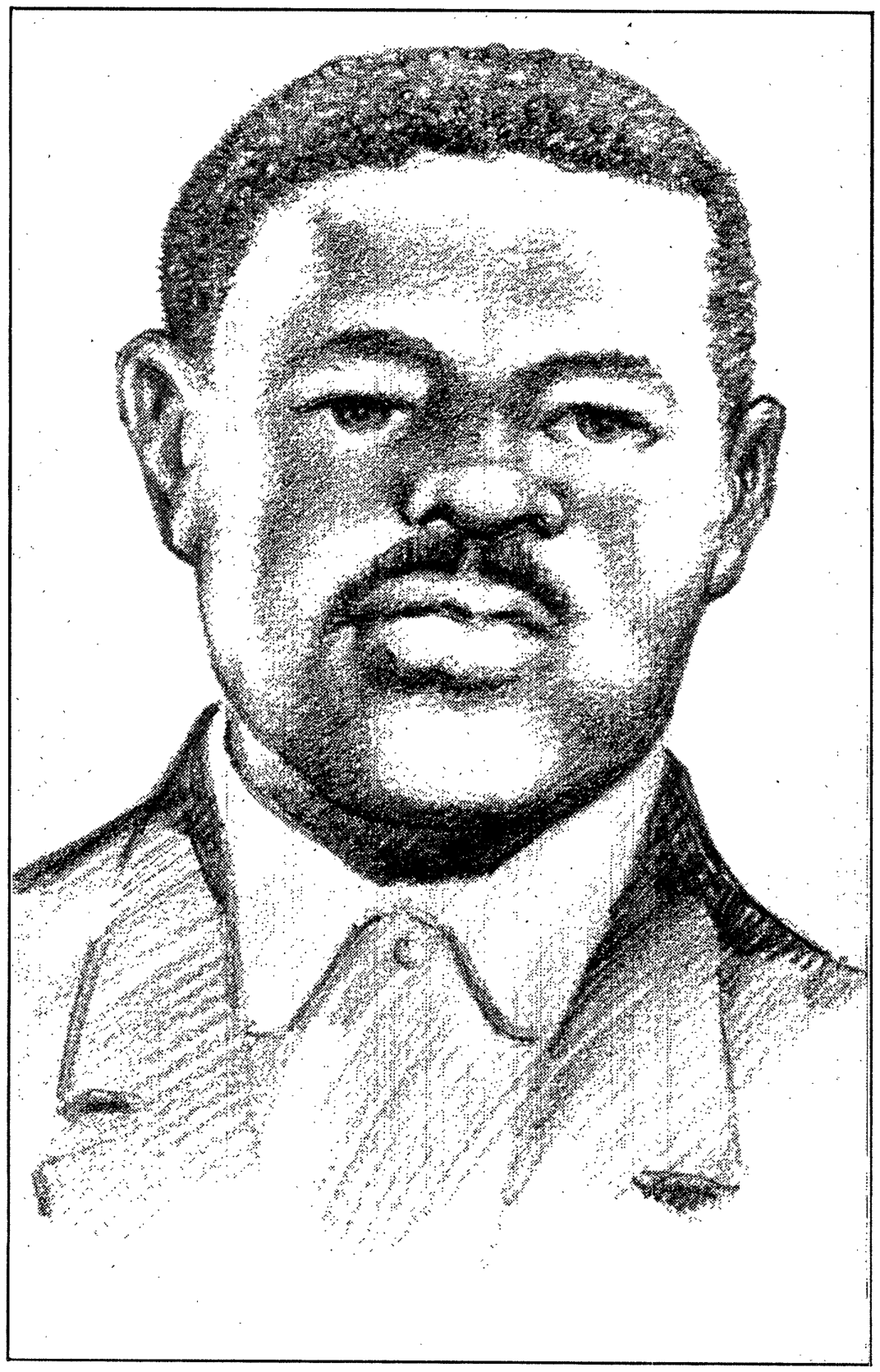
(plate (drawing); in the original facing p. 386)
The newspapers did not cease to drop hints about Frank's "degeneracy"; the mob did not cease to talk about his "unnatural dissoluteness"; to gorge themselves on details and to seethe; and there appeared the sort of witnesses who agreed with the "theory" that Frank had murdered the girl as a result of his "degeneracy." Girls who had worked at the factory told that387Frank had made vile advances to them, and that he had altogether not behaved nicely with his women workers.
One day one of the detectives — the aforementioned John Black — while visiting the prison, was thinking about the notes that had been found beside the murdered girl. This is absolutely not Frank's handwriting. Perhaps it resembles the handwriting of one of the other arrested men? The handwriting is very bad and the writing is full of errors. A Negro would write like this. Exactly so. He reflected that one ought to see whether Conley could write. What harm could it do? So he went up to the bars of the little cell where Conley was sitting and turned to him, asking him to write down a few lines. Earlier such a thing had not occurred to any of the detectives at all, and now this detective did it too, only for form's sake, as it were. Conley answered him with a smile that he could not write and asked the detective for a cigarette. So the detective gave him a cigarette and put no further questions to him.
And so it remained for a good while — that Conley could not write. He was again believed on his word. Of comparing his handwriting with the notes there could thus be no talk. To make an investigation of the matter, to ask those who knew Conley whether he could write, or to ascertain whether as a boy he had gone to school — of this Black did not think.
A few more days passed. Detective Black visited the National Pencil Company, now for the tenth time. Talk388ing with Frank's assistant, a young man named Herbert Schiff (for Frank was by then already sitting in prison), Black, in passing, put a question:
— You surely know the Negro, Jim Conley; he says he cannot write. Is that true?
As we see, this detective had not entirely relied on Conley's assertion that he could not write. But the suspicion came into his mind too slowly, too late. Had he not so easily believed him on his word and not let several days go by, the whole investigation would have taken on quite a different character. For in those few days the detectives and the solicitor-general had crept too far along the false path that they had chosen (simply because they then knew of no better one).
Schiff answered that he did not know; but that his impression was that Conley could indeed write. Black's question made an impression in Frank's office. For if Conley could write and was denying it, and he had washed "red rust" off his shirt, then the investigation would take on a very important new turn...
One of the salesmen of the National Pencil Company, a young man named Gottheimer, immediately caught the car and drove off to the jail (prison). He saw Frank and told him what had happened here.
— Of course, of course Conley can write, — said Frank with astonishment. — I thought the police knew this the whole time and that his handwriting had already been compared with the two notes. I believed that inquiries had been made, and that it was an altogether different handwriting, not Conley's.
Frank then recalled that he had often received389notes from Conley with requests that he lend him money. He also recalled that Conley used to write up the boxes of goods that he would put together. But where can one find a sample of his handwriting? Frank thought and thought, and he recalled that Conley had bought a watch on installment from a peddler and that he had signed a paper for it. In short, they sought out the peddler and found Conley's handwriting.
That Conley had been at the factory on Saturday, he, Conley himself, denied, and the whole time he himself pretended that he could not write. In the factory the detectives heard bad opinions of him from various people. It was said that he was a great liar and a drunkard, and a man's lecher. It was also said that he had already been in prison many times; and that he was a very cunning fellow, a deceiver, a swindler. It was also said that he kept begging the workers to lend him money. He was in debt to many of them, and on Saturdays, when wages were paid, he used to leave the factory not by the way everyone went, but through a back door that was located in the basement, in order to avoid them.
We are speaking here of Conley's cunning. One must not, however, forget that he was very ignorant and crude, and that in such a person cunning is mixed with a childish lack of understanding, often with plain idiocy. Logic in such a cunning man is quite a wretched thing.
The investigation with regard to Jim Conley was continued, and it brought a whole series of sur390earlier. But first let us pause for a while on the "proofs" against Frank, which were enumerated above in a certain order, with numbers. We shall here render the answers that were given to these proofs by Frank himself, or by other people, or simply what was stammered out concerning them in his defense.
(1) Yes, both of them came to the door. Mrs. Frank let the detectives in at the door, and her husband stood behind her. They were indeed agitated. But who would not have been, when police suddenly arrive?
(2) Frank came to get dressed only when the detectives had presumably notified him that they were coming to him; and when they arrived he was not yet finished dressing. (There were witnesses who confirmed this. They were present when the detectives drove up.) Mrs. Frank opened the door and—
(3) In his quiet manner, Frank was by nature a nervous man. To pass his hand through his hair and to rub his hands one against the other — this was such a habit of his. He used to do so not only when he was a bit nervous, but also when he strained his attention on something, absorbed himself in a matter. Everyone who saw him often was well acquainted with this. That he should behave in this way while the police came to him about some unusual thing that had happened at the National Pencil Company was quite natural. Anyone would have been more nervous in such a case.391(4) According to Frank's account, the telephone conversation between Detective Starnes and him consisted of the following:
Detective Starnes: — This is the police, we are telephoning you from the National Pencil Company; you are needed here. We will drive over for you right away.
Frank: — What sort of trouble is there? A fire?
Starnes: — No, a tragedy.
And so, when the detectives came for Frank, he already knew that some misfortune had occurred. He knew this from Starnes himself. Of this there were also witnesses. Besides this: if Frank had been the murderer, he would deliberately have made out that he did not know why the police needed him. Starnes, however, had no desire to admit that he himself had told Frank about the misfortune over the telephone, for this—
(5) Frank demanded that he be allowed to drink a cup of coffee, simply because he did not want to leave the house on an empty stomach. Actually it was Mrs. Frank who demanded of the detectives that they allow him to drink coffee. Then Frank too expressed this wish.
(6) The detectives rang him on the telephone for a long time, and he did not answer until some three or four hours later? This is true. The telephone at the Seligs' and the Franks' was in the dining room on the lower floor, whereas the bedrooms were located on a higher floor; and the telephone rang in the very middle of the night, when the family was in its deepest sleep. So it was not heard. It did seem to Frank that he heard something distant, faint—
392homelike sounds, as one ordinarily hears through one's sleep. The sounds, however, were not strong enough to wake him.
(7) Yes, when a strong electric light was suddenly thrown upon the corpse, and Frank caught sight of the dead face, it made a terrible impression on him. Who could have remained composed at such a moment?
(8) On Friday Frank had arranged with his brother-in-law to go to the baseball game the next day. But on the next day, Saturday, the sky was heavily overcast. It was doubtful whether the baseball game would take place. And since he had important work — to put together the financial report of the factory for a certain period — he decided to remain that afternoon at the factory and to do this work. When the night watchman, Newt Lee, came at four o'clock, as Frank had told him to, Frank no longer needed him. He himself would now keep watch that no thieves came in. He therefore told Lee that he might go and spend a few hours and come back at six o'clock, as always.
(9) Gantt, who had been one of Frank's helpers, Frank had dismissed a day earlier. At six o'clock in the evening of that Saturday, when Frank left the factory to go home, Gantt came out of a saloon (tavern) that was located across from the National Pencil Company. Gantt was a tall, strong fellow and at that moment looked a bit intoxicated, Frank related. And so, when he came up to Frank and explained that he had forgotten a pair of shoes at the factory and wanted to fetch them now, Frank did not permit him to go in. He did not want to trust him in the factory. He was afraid393that he would do some damage, out of revenge and because of his non-sober condition. But finally he permitted him to go for his shoes, accompanied by Newt Lee, who had by then already come back.
(10) As soon as Frank came home, he telephoned to Newt Lee. He could not, however, reach him on the telephone, so at seven o'clock he rang him again, and this time the night watchman answered. Frank then asked him whether everything was "all right," that is, whether Gantt had gone and he, Lee, had kept watch that he should not do any damage.
That Frank's telephoning to the night watchman was an unusual thing, Frank denied. He, and sometimes Mrs. Frank, used to do this quite often. In this way he used to check the work of a night watchman, to see whether he was really present in the building and not sleeping, but keeping watch, in case a fire should break out somewhere or a thief come in, or some stranger. Some of the machines were built on important German patents, and Frank was afraid that someone might slip in, take them apart and examine them in order afterward to copy them. Newt Lee was a new employee, only a few weeks at the factory; so he perhaps did not know that Frank used to do this very often. But Mrs. Frank recalled that she herself had once indeed telephoned Lee, and he afterward conceded that it was true.
(11) The lawyer was engaged not by Frank, but by Sigmund Montag, the proprietor of the factory. When he was telephoned that Frank had been taken to the police, he immediately telephoned a lawyer to come over. In such a matter, he thought, one must394not rely on the fairness of the police even for a minute.
(12) Frank engaged a Pinkerton detective to search for the murderer, simply because he believed that this was necessary for the good name of the factory.
(13) That the few hairs were Mary Phagan's was not proven at all. That a specialist examined those hairs under a microscope, the police did not report (not even later, at the trial). Beside the machine where Barrett had found the hairs, gas was burning, and girls used to come in there to heat their curling irons (tongs for curling the hair). That a few hairs of a girl should be found there was quite an ordinary thing.
As concerns the bloodstain that was found beside the dressing room, a microscopic examination found in it barely a part of a drop. And at the machines people often used to cut a finger. That a fair bit of blood should flow there, not just a part of one drop — this was quite a frequent occurrence there.
The microscopic trace of blood, according to the explanations of specialists, could have lain there for months. The examination could not prove whether it was a fresh trace or an old one.
By the aforementioned machine, in the metal room, there was no blood; the stain was found a fair distance from there, beside the dressing room; and if a person had been killed beside that room and beside the dressing room, much more blood than a part of one drop would have been found there.
Barrett had said that on Friday he had not seen the hairs on his machine. That is, that they had fallen there on Saturday. But the detectives had searched the factory thoroughly,395examining it Sunday at dawn and again several hours later, and they had nowhere there (on the second floor) seen any hairs or any blood. Three detectives, one after another, reported this.
Several of those who had worked at the factory related that Barrett had boasted to them that he would earn a part of the sum which the city government and the newspapers had promised to give to whoever would discover the murderer.
(14) First, Minola, the cook, the wife of the Negro Albert McKnight, denied that her husband had been at her kitchen that Saturday. Second, it is known that from the kitchen it was absolutely impossible to see whether Frank was eating or not. Third, Frank did indeed eat his lunch then. As concerns the tale that Mrs. Frank told her mother that her husband had murdered a girl, the fact that she supposedly said this in the presence of the cook lets anyone see that it is ridiculous. Such things are not told when the cook is present.
(15) That the boy George Epps was a liar soon became clear. When he was asked how he knew to the minute what time it was when he was riding with Mary, he answered that he knew this by looking at the sun (though at the time the sky was heavily overcast). His story was afterward made fun of in the city. When people wanted to call someone a liar, they would say that he was a George Epps. This, however, did not trouble the police with their case against Frank. Is one of their witnesses a bluffer? They had enough others!
(16) Several people swore, and other proofs confirmed, that what Helen Ferguson had related was without foundation, a tale396invented by a lying girl, in order to play a part in the sensation.
(17) Several friends of Mrs. Frank declared that she did indeed want to go to her husband at the police, but that they had not let her. The reporters would have photographed her there, her picture would have been printed in the newspapers, so they advised her to avoid the unpleasant publicity.
(18) The whole evening (Saturday night, after the afternoon on which the murder was committed) there were guests at the Franks'. There was a card party (a company for a game of cards). At the time when Frank, according to the "madam" Formby's story, telephoned her several times — between half past six and twelve — there were people in the dining room. There supper was eaten and there cards were played. And the telephone is located in that very room. The whole evening Frank was at home with his guests, and that means that they and Mrs. Frank would have heard all his "secret" conversations — how he ordered a room in an indecent house, and how he said that it was a matter of life and death for him. This is ridiculous enough. But that is still not all. Frank's telephone was with a different telephone company than Mrs. Formby's, and from his house he could not have spoken to her at all.
Afterward this same "madam" told the police that she was meeting Frank secretly in prison, and that she was being offered many thousands to withdraw from testifying against him. (The solicitor-general promised to bring her as a witness at Frank's trial. But when it came to the trial she was not there. She had altogether disappeared from Atlanta, and the police kept silent about her.)
397The report that Conley could write was carried in the Atlanta newspapers as a sensation, with very large letters across a whole page. The police related how they had found this out. They presented it as a wonderful piece of detective work that they had accomplished. That Frank had told the detectives that Conley could write and had indicated to them from whom they could obtain a sample of Conley's handwriting — this they kept silent about.
When it became known that Conley could write, the detectives were frightened. As soon as he can write, then how will it be if it should turn out that the handwriting on the "murder notes" is his handwriting? What will then become of their case against Frank? What will the public say?
The detectives took the bitter Negro for a strict interrogation. He kept denying that he could hold a pen in his hand. Finally they showed him the receipt that he had written. Then he said:
— White folks! I am a liar! I can write.
But he still kept swearing that of the murder he knew nothing to say, that on that Saturday he had not been at the factory at all. It was a holiday, and there was no work, so he had nothing to do there.
He was told to write down a few lines, which were dictated to him from the notes, and they were astonished: it was the same handwriting!
398But he still kept claiming that he did not know what to say about it.
A couple of days later, Conley sent to summon the detective John Black. He had seen that he was trapped; that to leave the case in such a state was too dangerous for him.
— I will now tell the whole truth — he declared. — I did indeed write one of the two notes. But I did so because Mr. Frank told me to. It was Friday, around three o'clock.
— You mean Saturday, — the detective interrupted him.
— No, Friday, — Conley stuck to his own. — Frank told me that he had rich parents in Brooklyn and that they needed to have a good Negro to serve them. So because he wanted to see whether I could write and would suit them, for they needed to have a Negro who could write, he told me to write down a few lines on a white sheet of paper. He told me to write: "A long, thin, black Negro did this himself." Mr. Frank told me that he would send this off to his mother in Brooklyn, to show her how I write. After that Mr. Frank took a brown sheet of paper and I wrote down a few lines on it myself.
This means, then, that on Friday Frank dictated the notes to Conley — ostensibly with the aim of having a sample of his writing; in truth, however, because Frank needed the notes for a fiendish murder — to make the police think that the murder had been committed by a long, thin, black Negro.
Conley himself was thickset and not tall; and not a black, but a brown Negro. So Frank, it is claimed, while dictating the note, deliberately had him399write that the murderer was exactly the opposite — tall, thin and very black — so that no suspicion should fall on Conley.
Such was Frank's intention, according to Conley's tale. And Frank himself had (according to the same tale) written the second note.
The murder was committed the next day, Saturday. But Frank, it is claimed, had prepared the notes a day earlier. Why? — because on Friday he already had in mind that the next day the girl, Mary Phagan, would come to him, and he would rape and kill her. And to that end he immediately took on as a witness a Negro whose work it was to sweep the floors in the factory!.. (That is, whose job it was to make a confusion of all the threads in the case.)
That he had been at the factory that Saturday, Conley again denied.
Note: the two notes that were found beside the dead body were written in the same handwriting. Yet Conley said that he had written only one note and Frank the second. That two people — especially one such as Conley and the other such as Frank — do not write in the same fashion, this did not occur to his uncunraveled mind. That every person has his own distinct handwriting, just as he has his own distinct appearance, of such a thing his undeveloped brain never thought.
A few days later, Conley summoned the detectives to him and told them that he wanted to make a third sworn statement,* and that now he would positively tell the whole truth. In this third statement400he conceded that the notes had been written not on Friday, but on Saturday. The rest, however, he left over for his next statement. But the detectives did not leave him in peace. They pressed him to tell the pure truth.
That his first, second and third statements were a ridiculous nonsense — this was too clear. So they wanted to extract from him a fourth statement, one that would at least lie a bit within the bounds of reason. They themselves afterward related that they had given him the "third degree" (that is, tortured him, given him no food, given him no water to drink, not let him sleep, and perhaps beaten him), until he no longer had any strength to hold out and confessed fully to them. So they reported to the solicitor-general, and later in court.
In short, Jim Conley made a new statement. This time, he assured them, he was now telling the absolute truth. He swore to them with deadly oaths about it.
In this statement number 4, Conley related that Frank had indeed spoken with him on Friday, but that then he had told him no more than a few words. He had, namely, told him to come the next day, although it would be a holiday, for he needed to talk something over with him about a certain matter. The next day, Saturday, when Conley came, Frank told him to wait on the lower floor, here where one comes in from the street. Mary Phagan would come; she should go up to him, to Frank in the office, which was upstairs, up the steps, and he, Conley, should wait below. So Conley did. Mary came. Conley did as the superintendent had told him. Afterward, when Conley came up to Frank401in the office, he found that he had murdered the girl. Frank asked him to carry the body down into the basement.
Conley related this with many details, which we skip over for the time being. For he later told it again with new details and with new changes (this was his statement number five, with a fifth version).
To this we shall come a little later. Then we shall render it in full, for this fifth statement Conley made in court, officially as a witness at the trial against Frank.
When Conley made his statement number four to the detectives, he remarked in connection with it:
"This alone I did not want to tell you earlier; I did not want Mr. Frank to be trapped, for he promised me that if I were arrested for this affair, he would get me out."
That this too is a lie is needless to say, for he threw the guilt onto Frank as soon as he was compelled to confess that he could write.
The fact that Conley had written the notes is concealed from the grand jury, and it issues an indictment against Frank. — A white woman saw, in the daytime of that Saturday, a hidden Negro in the National Pencil Company.
That Conley could write and that he had written one of the "murder notes," he confessed three weeks after the murder. In these three weeks the detectives and the solicitor-general had kept assuring the public that they had a complete case of proofs that Frank was the murderer. The whole time they had about this402drummed away in the press and kept the blood of the mob boiling against him. Suddenly to say that they had been mistaken, and to begin an honest new investigation of Conley's connection to the murder — that would mean declaring themselves bankrupt. That would have provoked mockery and wrath in the public, into which they had worked, with so much effort, a conviction that Frank was the guilty one.
That his own hands had written one of the two notes, Jim Conley confessed at seven o'clock in the morning, on May the 16th. The "grand jury"* assembled several hours later. It was the duty of the solicitor-general — Hugh M. Dorsey was his name — to communicate to it this highly important fact and to explain to it that, in issuing an indictment against Frank, one ought, under the new circumstances, not to hurry; that one ought to investigate thoroughly the notes and the circumstances under which Conley had written them. Had he done so, the wrath of the masses would have been turned away from Frank onto Conley. In any case, the public would then have been prepared to follow the investigation with a wish to reach the truth.
Dorsey, however, did not do so. He concealed the new fact from the grand jury, and it issued the indictment against Frank. Through this the anti-Frank feeling of the mob was multiplied. They demanded Frank's blood.
Instead of properly considering the notes and precisely investigating Conley's movements on the day of the murder, the police and the solicitor-general were from the outset403inclined to believe every excuse that he gave them. Instead of being his accusers, they worked as his loyal defenders. Conley's interests were their interests.
Tormenting him with their questions, they actually taught him how to "fix" his ridiculous statements. It was supposed that they were explaining to him how unbelievable was the tale he was telling, and showing him where a lie lay in it, and demanding of him that he tell the truth. But at the same time this had quite another character: whether willingly or unwillingly, whether they did it deliberately, or half-deliberately, or altogether unwillingly and through their provincial foolishness — at any rate, they taught him what to say. They led him onto a path; gave him hints how to change his lies in such a way that it should be possible to accept them as truth.
Conley read the newspapers, and the newspapers were full of tales about Frank's indecent conduct; the newspapers also printed hints and explicit statements from the police against Frank. This alone served the bitter Conley as material. It showed him what the solicitor-general needed to have, and on this basis, with the help of the lessons that the detectives had given him, Conley changed his statements in order to save himself.
He soon sniffed out that the police wanted him to save himself, that for them it was important that Frank should go to the gallows, and he was a good pupil.
The naive provincial detectives related this themselves when they were witnesses at Frank's trial.
"We explained to him that such an answer would not404do, that he would have to tell a better story" — testified a detective named Scott.
And the next time, Conley plastered over the holes that they had pointed out to him in his account, and out came a "better story," that is, one that satisfied the detectives more.
Conley himself stuck to his own that the notes had been written on Friday, a day earlier than the murder happened. It was clear that he did this because he wanted to fence himself off from any part in the murder. The murder had been committed on Saturday, and he had not been there at all.
"We gave him to understand that it is ridiculous to believe that already on Friday Frank had in mind that the next day he would murder the girl" — Scott later related at the trial.
Finally Conley changed the story and made his third sworn statement, in which he related that the notes had been written on Saturday, after the murder.
But to that he had then already also had to confess that he had indeed been at the factory that Saturday. And this too he did only then, when he was compelled to it. In this an important role was played by a white woman, named White.
The husband of this woman worked on the fourth floor of the factory. He and another man were doing some repair work there, reworking something. They did not keep the holiday and that Saturday they worked like every day. And so Mrs. White visited her husband then at his work. This was after twelve o'clock. A few days later, when she heard about the murder, she related that on Saturday in the daytime, when she came into the fac405-tory, and was going from the entrance toward the steps, there sat by the elevator, behind boxes (crates), a Negro. The fact that he had concealed himself with the crates now aroused in her a suspicion that he was perhaps connected with the crime. Who this Negro was, however, she did not know. She was taken to the prison to look over the black men who were sitting there, in case she might recognize him. But she did not recognize him, for on that Saturday she had not been able to make out his face well. He had concealed himself with the boxes, and in that corner by the steps it was altogether dark.
"When he caught sight of her in prison, he became so frightened that he began to bite his lips, and nervously to knead the cigarette that he was holding in his hand. Also for a second he did not stand still in one place." — So testified one of the prison guards who was present.
On the same day that Mrs. White was brought to look over the Negroes in prison, Conley confessed that he had been at the factory that Saturday.
A girl who had worked at the National Pencil Company related the following: once, before Conley was arrested, she had, in Conley's presence, made a remark to other women that if the police found the murderer, it would surely turn out to be the Negro whom Mrs. White had seen behind the boxes. Conley was then sweeping the floor. When he heard her words, the broom fell out of his hands, and he left the room. When he was arrested, she recalled the scene. That Conley had written only one of the murder notes, and Frank the second — to this Conley406held, in all four statements that he made before the trial. The detectives, however, pointed out to him that no one would believe this, for the handwriting was after all the same. Only afterward, in the statement that he made at the trial, as a witness, did he finally say that he had written both notes. But he claimed that Frank had dictated them to him.
When the newspapers "featured," in the largest letters, the sensation that the police had discovered that Conley could write, this naturally made an impression as a discovery in Frank's favor — that the guilty one was not he, but Conley. The police, however, used this discovery as a sensational proof against Frank — that Frank had dictated the notes to Conley in order to conceal the murder that he, Frank, had committed. The conviction that the murderer was Frank had, thanks to the police, already become so deeply rooted that of a new guilty party the police no longer dared to speak. Frank had to be the victim, and the strongest proofs of his innocence had to serve as the strongest proofs of his guilt. It may perhaps sound too astonishing, too unnatural. But the reader will soon convince himself, just as I convinced myself, that this was indeed so. Absolutely so.
The detectives did not directly teach Conley to tell a lying tale, that Frank had dictated the murder notes to him. Indirectly, however, they led him onto this tale. Indirectly they taught him what not to say, and from this he already understood what he should say. They pointed out to him where he contradicted himself, and he understood how to fix it.
The four different statements that Conley made407before he came to the trial as a witness were four lessons (lectures) that the detectives had given him. By the trial he was already "thoroughly schooled." There he told "the whole story of the murder," according to the explanations that the detectives had crammed into him.
And in case it should seem to anyone that I feel this way because I am a Jew, there have been Christians who studied the case thoroughly and felt about it exactly as I do.
For the time being it will be enough to mention a famous American journalist, C. P. Connolly, who in 1914 spent three weeks in Atlanta studying the Frank case and who afterward had about the matter two long articles in "Collier's Weekly" (the 19th and 26th of December, 1914). He was deeply convinced of Frank's innocence, just as countless other Christians were convinced of it. He wrote about the case with blood and gall instead of ink, one may say. And "Collier's Weekly" — one of the two most widespread and influential weekly magazines in America — printed his articles in spite of the fact that they presumably cost it much circulation in the South.*)
Under Frank's picture in "Collier's Weekly," on the 19th of December, 1914, where the first of Connolly's two articles was printed, there stood:
"Leo Frank, who is sentenced to death... Every investigator and newspaperman who was sent to Atlanta to investigate the case has — so far as I know — come back believing in Frank's innocence, and three detec408tives who worked on the case have resigned, because their conscience did not permit them to persecute Frank."
Frank's trial began on the 26th of July, 1913. The chief witness against him was Conley. He was, in fact, the whole case for the prosecution. He directly presented Frank as the murderer of Mary Phagan, and himself as a witness who had been almost present, but yet not present, while the crime was committed. The most important points in his story — more correctly, the fifth version of his story — consisted of the following:
Frank conducted licentious revels in the factory, and he, Conley, was his trusted man in them. On Saturday nights wanton women used to come to him in the office, on the second floor. When this used to take place, Conley used to sit below on the first floor* and watch (keep guard) that no one should come into409While he related this, sitting on the witness stand, Conley mentioned several occasions, Saturday afternoons, when Frank had spent time in his office with women. A certain scene he described with especially indecent details. It was a scene of a sick, licentious character, of the sort in which only lechers of a special unnatural type take part. And he said that in this same role he had seen Frank several times (so far had he confided in him!).
On Friday, the 25th of April, 1913, Frank told him to come to the factory the next day. True, it would be a holiday. But he needed him. On Saturday morning Frank met him on the street, on the corner of Nelson and Forsyth Street, not far from the factory. They chatted there. Later, before twelve o'clock, Conley sat down in his usual place, on the first floor of the factory, in a dark corner by the elevator. Frank had told him to sit behind boxes, for he, Frank, did not want Darley, his assistant, to see Conley and ask questions about why he was needed on such a day. So he sat and noticed several girls who came for their envelopes (envelopes with wages). Soon Mary Phagan came up, and a few minutes after her — a girl named Monteen Stover. Miss Stover soon came back down. Miss Phagan, however, remained upstairs. Conley heard footsteps above. It sounded as though two people were going from Frank's office toward the metal room, which was located about 150 or 170 feet from Frank's office. Someone there gave a scream, as if from a day of pain. Then Conley heard someone running on the "tiptoes." Then Conley dozed off. After a few410minutes passed. Frank stamped his foot up above, and Conley went over to the street door and locked it. Then Frank gave a whistle from above, and Conley unlocked the door and went up to Frank.
Frank was standing there trembling: his teeth were chattering, one against another. In his hands he was holding a long cord.
Frank then told Conley that after Mary Phagan had received her envelope, she asked whether the metal had already arrived for her work. He answered that he did not know, and he called her to come with him to have a look. He went off with her into the metal room.
"I wanted to have the girl" — Frank went on telling Conley (Conley presented all of this as a witness at Frank's trial) — "but she refused me, so I gave her a blow, and the blow must have been too hard, for she fell and her head struck against something. I don't know how serious the wound is. You know, after all, that I'm not built like other men..."
— Mister Frank said this because I had seen him with women in such a manner as one does not see men who have children, — Conley explained, and here he described details that cannot be printed.
Frank asked Conley to go have a look in the metal room, and he said that he would reward him well. So Conley went off into the metal room. There he found the girl lying on her back, dead, with a cord twisted tight around her neck. A cloth was tied around under her head to hold back the blood. No411blood, however, was there. Conley turned back to Frank and reported to him that the girl was dead.
"Shh! Keep quiet!" Frank said.
"I took a look at the clock" — Conley went on testifying — "it was then four minutes to one."
He went on to relate that Frank had told him to wrap the dead body in a piece of cloth (linen or some other sort of fabric) and to carry it out of the metal room. He (Conley) then took a piece of "bed tick" (a linen with narrow stripes, from which one makes the casings for mattresses and the inner casings for pillows), and in this he wrapped the body and carried it out. (Here it is important to note that in an earlier statement of his, Conley had said that he had laid the body into a burlap sack, and not that he had wrapped it in "bed tick." Why he made the change we shall see further on.)
Conley described how he carried the corpse out of the metal room. It was too heavy, and when he reached the dressing room, he had to set the burden down. The body fell to the floor of the corridor.
Frank then helped him carry the body into the elevator (lift). Then Frank went into his office and came back from there with a key in his hand. This was the key to the electric motor from which the elevator received its driving power. Frank turned on the motor, and he and Conley lowered the body down into the basement (cellar). There Conley took off the murdered girl412the "bed tick," took the corpse onto his shoulder, and carried it off farther into the basement. The elevator was not the only means of getting down to the basement. There was a second means as well. On the first floor, beside the elevator, a door opened up in the front, and below, beneath the door, stood a ladder. By way of this ladder one could go down into the cellar.
While Conley carried the body on his shoulder farther into the cellar, Frank climbed back up the ladder onto the first floor. The elevator was left waiting down in the basement. Conley laid the murdered girl down not far from a rear door, and then he looked about him. With the elevator he rode back up to the first floor, where Frank was waiting for him. Then Frank too got into the elevator, and Conley rode up together with him to the second floor.
They went into Frank's office. "My God!" Frank said, frightened. "Here come Emma Clarke and Corinthia Hall!" (two girls who had also come for their wages). So Frank locked Conley in his wardrobe, and when the two girls had already received their envelopes and gone away, he let him out.
— Can you write? — Frank asked.
— A little — Conley answered.
Frank sat him down at his desk, and he himself sat down beside him. He took a sheet of paper out of the desk and began dictating to him. Then he took out a second sheet and dictated further to him.
Frank gave him 200 dollars and told him to go into the basement and burn the body in413the furnace (a stove) that supplied an entire building with steam heat — "central heating"). Conley answered that he was afraid. So Frank took the two hundred dollars back from him.
— Is that how you do business? — Conley said.
— It will be all right, — Frank assured him. — Only keep your mouth shut. Why should I be hanged? I have rich parents in Brooklyn. Don't worry about this affair! Come to work on Monday as if you know nothing about anything, and keep your mouth shut. Should they arrest you, I'll get you out on bail. Can you come this evening and do it?
— I said "yes." I had made up my mind to come and get the money back.
— If you can't come, let me know — Frank said — I'll take the notes and I'll take them and lay them down beside the body.
— Good, I'll be back in about forty minutes, — I responded. I left Frank behind in the factory, and I went off to a saloon (tavern). I took a look at the clock. It was then twenty minutes to two. Mister Frank had given me a pack of cigarettes, and when I opened the pack, on my way, I found two dollars inside. From the saloon I went off home. I sent out for some sausages. After that I settled down to sleep. But I overslept until half past six; so I did not go to Mister Frank that day. We did not see each other until Tuesday. I was sweeping the factory floor. He came over to me and said: "Now remember: keep your mouth shut!" I said "all right"; he414said: "If you had come back on Saturday and gone down into the basement and done what I told you, there would have been no trouble."
In the course of his account, Conley several times acted out how Frank would jostle with him, in a comradely way, how he would give him a light shove, a nudge, in a joking manner. But none of the office staff or workers of the factory had ever seen this. So they all said when they appeared as witnesses at the trial.
Dorsey asked Conley in court whether he knew anything about Mary Phagan's torn little purse, and he answered:
— I saw it on Mister Frank's desk, after we had carried the body down into the basement. Mister Frank then took the little purse and locked it away in the safe (the iron strongbox).
This came as a surprise to everyone, for he had not mentioned it earlier in any of his statements. Not even in his fourth statement.
Afterward, a newspaperman named Harllee Branch, a reporter from the "Atlanta Journal," testified concerning a conversation he had had with Conley in prison. Conley had told him "the whole story of the murder." Harllee had asked him whether he had seen Mary Phagan's torn little purse, and he (Conley) had answered that he had never seen the little purse.
He had also told Branch that Frank had murdered Mary in the "mailet" (water closet), on the second floor (not in the metal room), and that when he, Conley, had first caught sight of the dead girl, she was already rigid and stiff (that is to say, that the murder had been committed415a good while earlier). Now, at the trial, he denied that he had told Branch all this.
The point about the little purse was one of the most important. For those who believed that Conley had committed the murder believed that the tragedy had come about through his having asked Mary for money. Where had the little purse gone? — people asked the whole time. And there was no answer. Suddenly Conley declared that he knew.
And this was not the only detail of his tale that he had not mentioned earlier — not even in his "statement number 4," when he had already "told the whole truth," as he had assured the detectives and Dorsey — not even then. For example: the detail that he had found Frank trembling with nervousness and with a long cord in his hand; or the detail about Mary's hat and slippers. Not even in his fourth statement did he mention these things. Only in his fifth tale, in court, did he relate that when he found the dead girl in the metal room, he had seen, not far from her, her hat, her slippers (boots, shoes), and a ribbon (sash), and that he had then thrown these down beside something. When Frank's lawyer asked him why he had not told all this earlier, he answered that he had not been asked, or he gave some other excuse. He twisted and turned.
All his answers on cross-examination were evasive, or such that anyone could see they were a lie. Take, for example, his denial that he had read the newspapers, and his claim that he could not read, despite the testimony of many of the working girls that they had seen him reading the ex416tras after the murder. Badly though he wrote, he did, after all, write. And writing — however laborious it may be — is always harder than reading. That a single person could write notes and little letters and yet not be able to read printed lines, not even the large words of a sensational extra — that is ridiculous.
The lawyer who conducted the cross-examination was a capable, faithful lawyer. But when one reads the long stenographic record of this cross-examination, one cannot help thinking that in New York or Chicago one could find dozens of lawyers who would have done a better job. The Atlanta police were a provincial police, and Frank's trial lawyers — the best in Atlanta — were after all provincial advocates. A good New York criminal lawyer would have made a heap of ashes out of Conley's fictional tale. He would have easily caught Conley on cross-examination in his lies and put him into such a position that the courtroom would have burst with laughter. Conley would have grown nervous and tangled himself up nervously; his "trashy fiction" would have collapsed.
New York lawyers would naturally not have neglected the notes. They would have conducted the whole case differently. But to bring in lawyers from another state, and above all from the North, would have been dangerous. That would have provoked the mob still more.
The police and the solicitor-general had trumpeted through the newspapers that Frank led a vile, immoral life: as we have already seen, this417was for them of the highest importance, in order to show the "motive" that had driven Frank to the murder. And so the embittered Conley, who had read the newspapers as he sat in his prison, inserted tales of this sort into his testimony at Frank's trial. For if it was worth the while of the police and of Dorsey, then it was surely worth the while of him too, of Conley. To make people believe that Frank was an extraordinary degenerate, and that this was why he had done it to Mary Phagan — that was for him a question of life and death. And so at the trial he made it appear that Frank had sickening, unnatural relations with women, and that he himself, as Frank's trusted man, had seen him in such scenes.
Usually these indecencies would take place on Saturday afternoon. So he testified. Mary Phagan was murdered on a Saturday in the daytime. It fit, then. But to leave such a sort of story without corroboration would have been, in the South, where to believe a Negro against a white man the public was not accustomed, impossible. And so it was important for the prosecution to obtain a white witness who would relate that he too had seen Frank amusing himself with women, and that this was a regular occurrence on a Saturday afternoon.
In Atlanta it was then easy for the police to obtain whatever testimony they wanted. In the North a solicitor-general or district attorney would not have been in a hurry to bring such testimony into a court.
In short, Solicitor-General Dorsey brought to Frank's trial a young white man named Brutus Dalton, who related that on Saturday afternoons Frank used to have carousals with women in his office, drinking beer and lighter drinks with them. He re418lated that a woman named Daisy Hopkins had been introduced to Frank in his presence, and that he, Dalton, had afterward gone down with her into the basement of the pencil factory, and that there stood a sofa.
When Frank's lawyers took Conley on cross-examination, they asked him whether he had seen Dalton in the pencil factory. In his answer Conley related the same thing as Dalton, with a great many more details besides. He described how, on a certain Saturday afternoon, Frank had called him into his office; that there a "lady" was sitting with Frank, with whom Frank was drinking beer, and that present there too were Dalton and a second "lady"; that Frank told him, Conley, to go down to the lower floor and see that no one came up to him (to Frank) in the office; that Dalton and the second "lady," together with Frank and with the first "lady," remained in Frank's office for some fifteen minutes, and that then Dalton and the second "lady" came out of Frank's office; that he, Conley, opened the basement door for them at the front of the first floor and they went down by way of the ladder; that the whole time they spent in the basement he, Conley, kept watch that no one should disturb them, and that on the second floor no one should disturb Frank with the first "lady"; that afterward, when Dalton and his "lady" came back up from the cellar, Dalton gave him a quarter (25 cents) and went away, and "lady" number two then went back up to Frank in the office; that later both "ladies" went away; that similar things took place on other Saturdays, always between three and half past three.
Dalton thus corroborated Conley, and Conley corroborated Dalton.419As witnesses for Frank's side, several inhabitants of the little town where Dalton lived appeared at the trial, and they said that he had a bad name; that he had once been in prison for a theft, and that there was no truth in him.
But there were also several witnesses who said that Dalton was an honest man and that one could believe him, although one of these witnesses said that formerly one could not believe him, but that afterward he had become better and that one could now believe him.
The main story that Conley told — how Mary Phagan was murdered — we shall examine as thoroughly as we are able. But first let us dispose of what Dalton described and Conley's corroboration of it.
That there had never been any sofa in the cellar of the pencil factory was proven with many witnesses, honest, respectable people. But this is relatively a trifle. More important are the following facts, with which everyone was familiar who was connected with the pencil factory as a worker, or as an employee in the business department — facts which I personally investigated closely when I was in Atlanta.
Herbert Schiff, Frank's assistant, used always to have on Saturday afternoon, together with Frank, the heaviest work over the books. They used then to put together their weekly financial report and other accounts, and
420this used to take some four hours. Three o'clock, half past three, four o'clock — they would then be deep in their work. Also, on Saturday afternoon, salesmen (commercial travelers) used to come in. Often Sigmund Montag, the chief proprietor of the factory, whose stationery store was nearby, used to drop in.
Especially interesting is the fact that often, on Saturday afternoon, Frank's wife used to come to his office. She used then to help him as a stenographer and typist (typewriter operator).
And precisely then, on Saturday afternoon, as Conley and Dalton testified, Frank usually had indecent women in his office!
While Frank used to be upstairs with them, the street door of the factory, the entrance, used to be locked. So the Negro related in court. Or, if not, Conley simply would not allow anyone to come up!
When the proprietor of the factory, or a salesman, or Mrs. Frank would come and find the door locked, they would naturally have asked afterward where he, Frank, had been. But he used to open it again, supposedly. No one ever came in, and no one ever asked any questions.
N. V. Darley, the second manager of the factory, assistant superintendent Schiff, the day watchman Holloway, and many others who were employed in the pencil factory, declared these stories to be a scandalous and ridiculous lie, and everyone who later read the report of the trial saw this too.
Besides all this: the door of Frank's office was made of glass, and not dark glass, but bright, as clear as the pane of a window. The writer of these lines421visited Frank's office twice. Through such a glass door one could see clearly from afar, exactly as though there were no door at all. And the window of Frank's office faced onto a busy street. And the shade (curtain) was an old and torn one. It would have had no significance in any case.
That in such a room indecent scenes should take place in the daytime is a nonsense that could only be fabricated in the brain of an ignorant and idiotically cunning liar. But the detectives asked Conley whether Frank had behaved vilely, and the newspapers were full of such things; so Conley related that which fit with the vile insinuations and gossip of the newspapers, that which the detectives wanted to have; and they, the detectives, accepted it from him with joy.
Ten of the girls who had worked for Frank testified that he had a bad name among the workgirls of the pencil factory. But all the rest of the factory girls — close to a hundred — testified that he had always conducted himself with the workgirls in the most respectable manner, and that they had the deepest respect for him. And as for the ten, seven of them, as we shall see, afterward confessed that they had testified falsely against him, and that the detectives had forced them into it.
Further: when one reads what these girls said at the trial about Frank's conduct, it makes no impression whatever in any case. To one girl he had smiled; on another he had laid his hand upon her shoulder. There were a couple who accused him of greater "liberties," but they afterward retracted this.422while several girls were changing their clothes, he had looked into that room. As regards the last point, one might think that the girls had been naked there, and that the room was a kind of bathroom. In truth they used merely to take off their jackets (coats) there and put on aprons. The door did not lock, the windows faced onto a busy street, there was no toilet there, and dozens of girls flatly denied that Frank had ever looked in there.
That a few girls should be found who would seek to gain attention with tales that this one and that one had wanted to flirt with them, or had made advances to them, had looked at them while they were half-naked — that is an ordinary thing. This sort of girl or woman is a well-known type.
Mrs. Formby did not come to the trial. And after the trial she made a sworn statement that all she had told about Frank she had invented, and that the police had forced her to it.
Conley described horrible scenes of unnatural lust, in which Frank was the chief figure. So he related, Conley. And he, the Negro, who was often, very often, drunk, had seen these scenes himself. From him Frank used to have no secrets, and before him he used not to be ashamed.
All that can be said about this part of Conley's tale is that if it were true, Frank would long ago have been in a madhouse.
The assertion that Frank had been on comradely terms with Conley and had often jostled with him, everyone denied.
About how Frank used to conduct himself, I
423spoke specially with almost every person who had known him well. All spoke of the aforementioned tales with the greatest indignation, and of his person — with full respect. I heard a great deal about him. From this, and from my personal conversations with him, I obtained a full picture of his life. It was an absolutely pure life.
"If what Conley told about Frank were true," — one of his close acquaintances said to me, — "the relations between him and his wife would be quite different. They love each other tenderly. They are a happy couple. The tale has neither rhyme nor reason. A vile, dirty lie."
That same friend of Frank's laughed with bitter sarcasm at Conley's tale about how Frank had given the girl a murderous blow because she had refused him.
— It does not fit with his character. He cannot harm a fly. It is simply ridiculous — he said. — If he had made her such a proposal, she might perhaps have given him a blow. That would have stood more to reason. And she was no weakling. Not tall in stature, but compact and strong.
Let us examine the two "murder notes."
One note was on brown paper and one on white. The brown one contained nine lines and the white one — five lines. It was easy to see that the white one was a continuation of the brown one. The brown one begins with the word "Mama!" The writer,424that is to say, addresses her mother. The nine lines reached to the edge of the paper. There was no more room to write, so the writer took a second sheet, and on it wrote the rest. (This note no longer begins with the word "Mama." It is the conclusion of the previous one.) In the descriptions and explanations concerning the Frank case, the brown note was therefore designated as the "first note" and the white one as the "second."
Now let us render the contents of the two notes. (The translation I make here is a literal one. I omit only a couple of words, and alter a couple of others, which it is not fitting to print.)
On the first note stood:
"Mama the negro who was hired here below did it I went to the toilet he pushed me down through the hole*) a long tall negro black did it a long lean tall negro I am writing this while he is playing with me."
On the second note:
"He said he would love me like the night witch did it but the long tall black negro did it himself."
The notes have no clear sense, for they are written terribly illiterately. Truly "Noah with seven errors."
The word "witch" was taken for a bad spelling of the word watchman (guard). But such a reading did not hold together; so it was construed as it stood. Later, already after the trial, a young Jewish425lawyer named Henry A. Alexander discovered the true sense of the word. He showed that by the word "witch" the writer had really meant witch (sorceress), and that together with the preceding word "night" it means "night witch." This changes the whole thought of the sentence. And this really makes sense. With this natural construal of the word, everything now reads clearly.
The words "night witch" belong to the special manner of thinking and speaking that has developed among the black people. For among them there exists, perhaps for thousands of years, a superstition about a night witch who comes to choke people in their sleep. (A similar superstition is held by many savage peoples. And the Negroes of America brought it with them from Africa, from where slave-catchers brought them.)
When one recalls that the murdered girl was found strangled with a cord around her neck, the sentence becomes quite simple and natural. There is no need at all to specially "construe" the words.
It reads thus:
"He said he would love me supposedly as the night witch would have done it, but the long tall negro did it himself." There occurs here the English word "like." Its ordinary meaning is "as." But ignorant Negroes use it a little differently too. When they want to say, for example, "supposedly as I would have done it," they also say "like." This word then means not "as," but "supposedly as."
The whole note then acquires a genuinely Negro character (the first note has such a character too). Alexander's explanations were accepted by all impartial people in the South.426At the time of the trial, however, the true sense of the word "witch" in the note was not understood, not even by Frank's lawyers. (Alexander was not yet then connected with the Frank case. He had simply taken an interest in the case and examined the murder notes.) It was thought that this meant "watchman." Alexander's explanation was enormously important, but for our present examination of the notes it is not necessary.
Can one imagine that Frank dictated the notes? Is it possible that Frank thought that with such notes he would deceive the detectives, Mary's mother, and other people?
Mary had been flung down from the first floor into the cellar, and then, while a tall, long, lean, black Negro was "playing" with her, she took a pencil and two sheets of paper, and wrote the little letter to her mama... and all this, Frank reckoned, people would believe! Does that stand to reason?
Let us imagine for a second that Mary, under such circumstances, had been capable of writing. Would the murderer have let her write?
Further: Mary writes that it was not the night witch who strangled her; "the lean long black negro did it himself" — she writes — already did it, already strangled her. In other words, she wrote after her death.
That the ignorant, idiotically cunning Negro should tangle himself up so in his own cunning, that is indeed possible. A similar "logic" one sees among ignorant Negroes at every step. But that an educated, capable, and clever man, like Frank, should think to deceive the world with such notes, that is more ridiculous than ri-
427diculous. The most ignorant white man would not have been capable of such nonsense.
Further: would Frank not have understood that the detectives would at once make inquiries and learn that this was not Mary Phagan's handwriting? Would he not have understood that sooner or later it would be discovered that this was Conley's handwriting, and that then — in order to save himself from the gallows — Conley would give him up?
As for Conley, up until the trial he had kept claiming that he had written one note, and Frank the second. The fact that both notes were in the same handwriting did not trouble him in this. That a handwriting is like the appearance of a person; that everyone has his own particular handwriting, just as he has his own particular form — this, as we have already noted above, never occurred to him at all. That a man with such a helpless, ignorant, childish brain should think he could deceive the police with such notes, that does stand to reason.
The above-mentioned journalist F. S. Connolly, of "Collier's Weekly," made in his article, in 1914, the following interesting observation about this point:
"In his dense ignorance, Conley did not know at all that a handwriting indicates who the writer is. When he laid the two notes with the pencil beside the dead body, his own cunning lured him into the trap."
One must imagine what a writer like Conley goes through when he sets about writing something. It is a difficult operation for him. Recall what nonsense for the most part comes out when a great ignoramus tries to express something with ink and pen. His thoughts get tangled. That is in ordinary times.428Now imagine that the ignoramus has to write right after he has committed a murder. The cunning Negro clearly knew only one thing: that he had to draw suspicion away from himself. And he did this just as his dark, foolishly cunning mind taught him.
It is a well-known thing that Negroes have imaginative power, a feeling for music, and fantasy. Even ignorant Negroes are often the authors of tales. Many of them are great liars, and when they tell a lie, they adorn it with details, so that it should come out realistic, as if it were true. But through the ignorance of the author there often comes out a mishmash of realism and nonsense.
It is precisely by this kind of mixture of "realistic" details and wild nonsense, of cunning and idiocy, that the tale Conley told at Frank's trial about the murder of Mary Phagan is distinguished. And a similar mixture lies in the two notes as well.
But perhaps Frank did, after all, dictate the notes, and he did all this with a purpose, simply to muddle the heads of the detectives?
In the two notes it stands three times that the murderer is a tall, lean, and black Negro. This fits neither Conley nor Newt Lee, the night watchman; for they were both neither lean, nor tall, nor black, but brown (when one says a black Negro, one means that he is very black, for simply as black one regards all Negroes, even light-brown ones too). Did Frank, then, mean by this to drag the detectives away from the right track, so that they should look for such a Negro as they could not find at all in the factory?
But could Frank have thought that the police would429immediately believe that the murderer was really a tall, lean, and very black man? A white child would have understood that the writer of the notes would not be believed at his word, and that one would suspect precisely that the Negro was not tall, not lean, and not very black.
This is the cunning of a person whose brain is in quite a primitive state. In this very primitive shrewdness lies a clear proof that the notes were not created in the brain of an intelligent, highly developed, very capable, and clever person. Frank would have understood that sooner or later one would look at the handwriting of all the Negroes of the pencil factory and compare them with the writing on the notes. Whether lean or not lean; whether a tall Negro or a short one — one would look at handwritings, and not only among Negroes, even among whites too. Sooner or later one would arrive at Conley's handwriting. And that Conley could write, Frank had always known. He would have understood, then, that in the end one would be bound to become convinced that the writing on the notes was his handwriting, and that he, Conley, would confess that he had written it and that Frank had dictated it to him...
If Frank had been the murderer, he would have devised a plan that had at least some little bit of sense.
Such an idiotically cunning plan could have been born only in such an ignorant, raw brain as Conley's. He wrote the notes all by himself. No one dictated them to him. A highly intelligent man like Frank would certainly not have devised such a plan.
In passing, it is interesting to note the difference between the first note and the second with regard to the word "black." In the first the word does not appear in the right place. It stands430at the end, tacked on: "a long tall negro black" (a long tall negro black). One can see that the idea of adding that the murderer is a black one (and not a brown one, like Conley) occurred to Conley when he had already written the words "a long, tall negro." When he wrote the same thing again in the second note, he then placed the word in the right place: "the long tall black negro did it himself."
Cunning, clever Conley was, though all in his primitive, helpless manner. I saw him (in the prison where he was still then being held, ostensibly for his "secondary part" in the murder). The cunning lay upon his face — the cunning and craftiness of a very ignorant man.
His "dense ignorance" and primitive incomprehension showed itself when it came to some delicate situation that requires a more or less developed mind. With regard to the simple egoistic instincts, the wildest man from Africa is cunning, and not seldom very crafty; and this Negro, who was born in an American city and had gone to school a couple of years, was more cunning than the average Negro.
His interests Jim Conley defended remarkably. And such provincial detectives as those of Atlanta it was not hard for him to deceive for a certain time. Recall how he deceived them for such a long time, pretending that he could not write; how nimbly he chattered away to the above-mentioned detective John Black, asking him for a cigarette, and how in doing so he took to talking with him about something else, until Black forgot his own question: whether Conley could write. In his own431way he was a good actor, this half-wild Negro.
And Frank knew him well, for besides the fact that Conley was always hanging about the factory, he often turned to him for money, and with Frank's help he had taken a watch on installments from a peddler.
Now imagine: this crafty Negro Frank takes into his office, sits him down at his desk, and dictates to him notes about the girl whom he, Frank, has murdered!
Such a thing would have been possible only if Frank had gone out of his mind.
And the cunning Negro actually writes as Frank dictates to him. Not only such a crafty Negro, but even a Negro who was a dolt would have refused to write such notes.
At the trial Conley did not say that he had put questions to Frank before he became willing to write the notes. Nor did he relate there that he had refused to write the notes and that Frank had so bewildered and muddled his mind that he, Conley, saw no danger to himself. He only said that Frank had asked him to help him carry down the murdered girl; that afterward he had dictated the notes to him; that he had asked him to tell no one, and in doing so had promised him a job in Brooklyn and to get him out of trouble, if he, Conley, should be in danger because of Mary's death. A fine piece of luck! And the Negro accepted all this, and with his own handwriting he wrote the murder notes and laid the knife to his own throat...
But let us imagine that Frank is such an idiot that he dictates the notes, and that the Negro is432such a white dolt that he actually writes and asks no questions. If so, Frank would in any case have been afraid to leave on the notes the Negro's natural handwriting, lest in the end it be discovered that this was his writing and the Negro be arrested and tell everything from beginning to end. He would in any case have tried to disguise Conley's handwriting, as one usually does in such a case.
He would, for example, have told him to write with his left hand, or he, Frank, would have held the Negro's hand and with it guided the pencil... Frank did no such thing. He simply told him to write with his ordinary handwriting, and he was not at all afraid lest it be found out that this was Conley's script...
What sense is there in the first place in dictating the murder notes to the Negro, and having a living witness against oneself with a handwriting that would lead him, Frank, to the gallows? From whatever side you regard it, it all comes out as the plan of a madman.
Consider also the following detail: when Conley at the trial described how Frank had sat him down at his desk to dictate the notes to him, he related it thus: Mister Frank asked me: Can you write? And I answered: "A little." Why did Frank need to ask? He knew, after all, that Conley could write. He had, after all, received notes from him with requests to lend him money. And he had, after all, seen how Conley signed the paper for the peddler.
Another detail: since Frank's plan was to burn the body in the great furnace that stood in a cellar, then what did he need the notes for? What did he need a handwriting for, which is such a sure guide for detectives? What did he need notes for with Conley as the writer,433that is to say, as a living witness that Frank is the murderer? He would have given no whistle and not called Conley up. He would alone have carried the body down into the cellar just as it was and burned it there, and not a cock would have crowed.
Conley related that the murder had been committed on the second floor, on the story where Frank's office was located. But there were striking proofs that this was a lie.
He described with masses of "realistic" details how Frank, with his help, had carried the body down into the basement. But there were striking proofs that the elevator did not run at all that Saturday, and the clearest proof of this was left, in fact, by Conley himself.
We must again come to the unpleasant matter that we have mentioned. Speaking of the investigation that the detectives made in the basement on Sunday before dawn. In the elevator "shaft" they found a sign that someone had used the place for a privy (see above, page 361). Now, at Frank's trial Conley related that he, Conley, was that someone. He had done it that Saturday in the morning in a drunken state, he said. He told this in a tangle of true and lying details, with which he conveyed how he had spent that day. And just as with the notes he did not understand that his handwriting was the best witness against him, so now he did not understand that the trace which he434had left in the elevator "shaft" was the best witness against him.
The elevator of the pencil factory was not one of the newest, and it was not equipped in the best manner. When it used to lower itself down and reach the bottom of its "shaft," that is to say the floor of the cellar, it used to drop down with a loud bang. If the elevator had then, on Saturday in the daytime, reached the basement, it would therefore have crushed the "sign" that Conley had left behind in the morning. And the detectives, at three o'clock on Sunday before dawn, found this sign undisturbed.
A few hours later the detectives were there again. This time they rode down to the basement on the elevator. And then it really happened. When the elevator reached the cellar, an unpleasant odor spread. Conley's "sign" had been crushed. If the elevator had gone to the basement on Saturday in the daytime, as Conley asserted, that would have happened then, and on Sunday before dawn, when the detectives examined the "shaft" for the first time, it would have been evident.
There were still further proofs that the elevator absolutely did not run on Saturday. There were good witnesses about this, and the most important were the above-mentioned two workers who had worked on Saturday on the floor (the husband of Mrs. White and his fellow-worker). On the fourth floor were located the wheels of the elevator. When the elevator used to run, the wheels used to creak and rumble, and the floor used to tremble. For them not to notice this was impossible. The next morning, when the city was seething with the murder, fresh in their memory was every detail that they had noticed that435Saturday. Now, at the trial they testified that the elevator did not run that Saturday.
When I was in Atlanta and visited the pencil factory, they took me on the elevator from the fourth floor down to the basement, and I made inquiries about everything that has been said here.
If the body had been carried down in the elevator, there would have been blood there, and no blood was found there even by the brush.
The wound that was found in Mary's head was of the kind from which a great deal of blood flows. Many dozens of drops would have run, and not just a part of a drop. To wash out entirely every trace of blood would not have been easy. And even the part of the drop that the brush found Monday morning beside the dressing room, the detectives did not see either, when they examined the factory on Sunday before dawn and several hours later.
A further word about the famous seven hairs. The solicitor-general brought girls as witnesses that it was Mary's hair. We have already noted that in such a case the hairs are turned over to a chemist, a specialist, so that he should examine them under a microscope, in a scientific manner. Why, then, did Dorsey not do this? Why did he content himself with the opinion of ordinary girls? We ask the reader to keep this question in mind, for later we shall have for it an interesting and highly important answer.
The city doctor who examined the body of the murdered girl reported that while the body was being dragged across the floor of the basement she was still breathing, alive. Deep into her mouth and her nose she had breathed in coal dust. This is436again a proof that the tale that Conley had found the girl in the metal room, lying dead, was a lie.
The doctor only reported that she had been breathing. But there were also proofs that she had screamed, and that the murderer had stifled her cry by burying her face in the coal dust, for her face was covered and pitted with the coal dust. Conley was well acquainted with the basement. He used often to spend time there with his comrades — several young Negroes who worked in the pencil factory. They used to drink beer together there, play certain games. This alone would naturally have been no proof that the murder had been committed in the basement. But it fits with the most important proofs. It adds clarity to the whole story. And the fact that Conley used often to use the rear door of the basement to escape from his creditors has an interesting connection to the bolt that was found broken off.
Conley related that when he came up to Frank, he found him standing with a long cord in his hand. Then, when Conley went into the metal room, he found there Mary Phagan dead, strangled, with a cord around her neck. Why, then, was Frank holding a second cord? In case the girl was not yet dead, so that he could strangle her once more? It is said that a liar has a short memory. In telling his "realistic" tale, Conley forgot that he would soon have to say that Mary already had a cord around437her neck, and he inserted the "realistic" details: Frank standing trembling and chattering one tooth against another and holding a cord in his hand.
Most likely what happened to Conley here was the following: at this moment he meant to relate that with the cord that Frank held in his hand he (Frank) had just then strangled the girl; and afterward he forgot this, and he assumed that the cord lay around the neck of the strangled girl.
Conley said at the trial that he had wrapped the body in bed tick. But how does bed tick come to be in the pencil factory? With the best witnesses it was proven that there had never been any such thing there. In an earlier statement Conley had said, in fact, that he had laid the body into a burlap sack. But a burlap sack is too small for such a body.
At the trial Frank's lawyer asked Conley to point to an earlier Saturday when Frank had spent time in his office with a woman employee, and he, Conley, had kept watch below. He named the previous Thanksgiving Day*); and he added the "realistic" detail that the indecent "lady" had worn white and white shoes. She was dressed in a genuinely summery way, that is.
But that Thanksgiving Day was the coldest day, and on it fell the heaviest snow that Atlanta had ever had.
On the other hand, it was proven that Frank438had then worked the whole morning until twelve o'clock in his office together with his assistant and with his stenographer, and that at twelve o'clock he had gone away together with another young man, carrying with him packages for an entertainment that took place that evening for a philanthropic purpose.
In all his earlier statements Conley had not mentioned this Thanksgiving Day "carousal" at all. Now he related it for the first time.
According to Conley's assertion, the two working girls, Emma Clarke and Corinthia Hall, came into Frank's office twenty minutes past one. But they themselves testified that this was three-quarters of an hour earlier. Besides this: Frank's office was located in such a place that if it had been possible for them to catch sight of him as they came in, it would already have been too late to lock Conley in the wardrobe. Before Conley could get into the wardrobe, the girls would already have been in the office.
That Emma Clarke and Corinthia Hall came to Frank for their wages also stood in the newspapers, just as there stood the name of Monteen Stover and of other workgirls who came that Saturday for their wages. From the newspapers, then, Conley took this material, and to it he fitted the "realistic" tale of how Frank had cried out "My God, here come Emma Clarke and Corinthia Hall!" and locked him in the wardrobe.
At the trial Conley was asked whether anyone had ever heard Frank tell him to watch the street door of the factory while he had a woman in his office. Conley answered that the Negro Gor439don Bailey, his comrade, had heard this several times. Once it was the day before Thanksgiving Day. Once — several days after New Year. Then Frank had told him that he, Conley, would receive for it a fine reward. All this Frank had told him while Bailey was standing nearby; and the young man with the two "ladies" actually came.
This was, as explained, on a Saturday, from half past 2 until 3 o'clock. A third time, when Frank told him to "watch" the door the next day (Saturday), when he would have a "lady," was on a certain day, near winter. He, Conley, was then working on the 4th floor; he came over to him and talked with him about it for an hour, and the Negro Bailey was standing nearby.
So Frank's defenders therefore brought Gordon Bailey to the trial, and he, however, absolutely denied that he had ever heard Frank say any such thing to Conley. He also declared that he had never known that Conley should watch the door; he also testified that he had never seen Frank have indecent women in his office.
When he was asked whether anyone had overheard these conversations between Frank and him, whether he could confirm it with a witness, he at once said yes. And as a witness he named his comrade Bailey. But what would Bailey say? At that hysterical moment he had no time to think. The same happened with other questions that were put to him. He at once gave an answer, and with details too. At the trial, even earlier, when he made his fourth statement before the detectives, he felt himself a powerful man, a darling of the police and of the solicitor-general — a person whom it was important for them to use. So now every lie would somehow be made right.
440At the trial Conley related how around ten o'clock in the morning, on the Saturday of the murder, he had met Frank on the street, at the corner of Nelson and Forsyth Street, and that Frank had arranged this meeting a day earlier — had agreed with him that he should wait for him there at such and such a time.
In his fourth statement Conley had said that they had met there by chance.
That Frank should stand with Conley and chat on the street — that was such an unusual thing that it was important to confirm Conley's assertions with a white witness. So such testimony was therefore obtained. A white woman related that she had then seen Frank and Conley standing and talking on that corner. But all she could say was that the white man was a Jew. How did she know this? She answered to this question that the white man stood quite close to the Negro, and a white Christian would not have stood so close to a black one. This was her only proof that Frank had been chatting with Conley on the street.
One of the most scandalous "pieces of business" that the detectives carried out concerned the question of whether Conley could write. We have already seen above how the fact that he could write, after he had so strongly denied that he could hold a pen in his hand, the police gave out as their discovery. Then it went still further: it declared, namely, that Frank, who had known that Conley could write, had pretended not to know about it. That is to say, that he had concealed it so that one should not be able to discover that he had dictated the murder notes to Conley!
441We related above how the detective Black came to Herbert Schiff, Frank's assistant, and asked him whether Conley could write; how Schiff said that he believed he could; how the salesman Goodheimer drove over to Frank in prison; how Frank said: "Of course he can write. I thought his handwriting had long since been compared with the writing on the notes." And how he directed them to a peddler who had a receipt of Conley's.
While I was in Atlanta, I spoke about this point with Schiff, and he conveyed everything to me in great detail. Frank, too, told me how it had been. Everything was so firmly established and so convincing that the police's claim was simply a sky-screaming insolence.
Conley said that Frank had told him how he had given Mary a blow and she had fallen onto a tack-machine in the metal room, and that this was the source of the wound to her head. But the wound was a long, deep cut, as from a knife, and besides she could not have gotten it from that machine. Secondly, that machine was taller than Mary Phagan, who was broad and solidly built but short of stature.
That it had been hard for him to carry the body and that he had dropped it — this Conley had not mentioned at all earlier. Only then, when he was told where Bererett had found a bloodstain, did he supply the "detail" that he had let the body fall. And where had this happened? Precisely there, where Bererett had found a bloodstain.
Employees of the pencil factory testi-
442fied that Conley was mostly half-drunk, that on one occasion he had been found lying dead-drunk in one of the corridors of the factory, and that he had been arrested several times for being drunk in the street. Some twenty persons testified that he was a depraved man, a great scoundrel and a great liar, and Negroes who knew him well testified that whatever he said could not be believed.
On the other hand, various people — respected business men, professors with whom Frank had studied, all sorts of people who knew him well — spoke of him with the deepest respect, as an honorable, highly decent and likable person.
And here is a sample of the testimony of certain detectives. The matter at issue was the question: what had been Frank's answer when Mary Phagan asked him whether the metal had come in yet and whether she could return to work on Monday. According to what Conley related, Frank had answered her: "I don't know, let's go take a look."
That is, he had answered her this way deliberately, in order to lure her into the metal room. In this manner detective Scott also testified at the trial.
Some time earlier, Scott had reported to his superior as follows:
"Frank says that Mary Phagan asked him whether the metal had come in yet, and that he answered, no."
When this same Scott was a witness at the trial, he conveyed the very same matter quite differently:443"She asked Frank whether the metal had come in yet, and Frank said, 'I don't know.'"
When Frank's lawyer reminded Scott that to the police he had reported that Frank's answer to Mary's question had in fact been "no" and not "I don't know," Scott replied that by "no" he had meant "I don't know," that this had been merely a grammatical error.
A strange sort of grammar!
And on this "grammatical error" hangs the question of whether Frank lured the girl into the metal room and murdered her there. This was not important to Scott. The only thing important to him was the fact that, for the sake of the police, it was necessary that Frank should have said not "no" but "I don't know."
Remarkable too is the system of signals about which Frank had supposedly arranged with Conley (according to Conley's testimony): a stamp of the foot was a signal that Conley should lock the door of the factory below and let no one in; a whistle — a signal that he should open the door again.
Now consider how Frank made use of these signals while committing the murder. A certain time after Conley had heard the girl's cry and had dozed off, Frank gave a stamp with his foot. Soon afterward he gave a whistle. Then Conley opened the door and came up to Frank. There he found him trembling and with a cord in his hand. The girl had already been murdered, but not yet removed. She still lay in the metal room. If so, then why did Frank hurry to give a whistle? Did he want everyone now to be able to come in and see the murdered girl and him, Frank, with a cord in his hand?
444Here the matter will turn on differences of several, or of two or three, minutes. The reader will think: how is it possible for people to remember to the minute when a certain thing occurred? But, in the first place, Americans are far more punctual in such matters than we Jews from the old country. Secondly, when an impressive event is closely bound up with a definite time on the clock, then everyone remembers it to the minute. For example: exactly at twelve o'clock the whistle blows for noon in the factories, and if something then happened to a worker, he remembers exactly that it was a few minutes after that whistle, for instance.
Mary Phagan came into Frank's office that Saturday a few minutes past twelve o'clock. How many minutes? Over this question a fierce dispute arose between Solicitor-General Dorsey and Frank's lawyers. On it depended a question that was very important. Dorsey was certain (so he argued before the jury) that Mary had come in between two minutes past twelve and five minutes past twelve. Frank's lawyers, on the other hand, declared that it was then at least twelve minutes past twelve.
According to Conley's assertion, it turned out that Dorsey was right.
The most important thing in this was actually not so much the minute when Mary Phagan came in, as the minute when another white working-girl came in there — the above-mentioned Monteen Stover, who was at the
445trial a witness for Dorsey's side. Miss Stover made a good impression. One could see that she was a decent, honest child, and that what she said was the truth. The Negro Conley could not have made such a good impression, so Dorsey laid the greatest weight on her testimony. With this white girl he sought to corroborate what his black chief witness had related.
Monteen Stover was certain that she had come into Frank's office (also for wages) precisely at five minutes past twelve, and Dorsey expressed in court a firm conviction that Miss Stover had come into the office afterward, when Miss Phagan had already left the room.
Further: Miss Stover testified that she had not found Frank in his office at all. Frank, on the other hand, argued that from twelve until half past twelve he had not left his office that Saturday. Does this mean that he had told a lie, and that he had a special reason for it? Does it mean that, while Miss Stover came in to him, he and Mary Phagan were in the metal room, and that he was then strangling her?
So it turned out according to Conley's account, and in this consisted one of the most important points of Dorsey's case.
The defense, however, was certain that Monteen Stover had come into the office not after Mary Phagan, but earlier, before her. But let us leave this aside for the moment. Let us suppose that Conley's and Dorsey's assertions are correct. What, then, happened according to Dorsey's contention?
Mary Phagan came in to Frank at two minutes past twelve; he looked into his book, gave her her envelope; she asked whether the metal had come in yet; he answered that he did not know and called her to go with him to take a look; the two of them went off into446the metal room, which was located over 150 feet from his office; there he attacked her; she began to scream and he strangled her, and then he ran on tiptoe into the office (after a cord?) and back from the office into the metal room. And all this lasted less than three minutes, for at five minutes past twelve Miss Stover had already come into the office, and she saw no one and heard nothing.
During the time that she was standing in his office, waited a minute and went home, Frank — so it is claimed — was 150 feet away from there, finishing off Mary with a cord. And this "nonsense" the Solicitor-General laid before the jury in his explanation of why Frank should be hanged!
That he had seen Monteen Stover going up the stairs toward the office — this Conley had not mentioned in any of his earlier statements. Nor had he mentioned that he had heard a scream. At the trial he said this for the first time. About Miss Stover he had read in the newspapers. And only then, at the trial, did he supply this detail.
As for the scream, it is, naturally, ridiculous that just then he should have fallen asleep. Did the despairing cries lull him like music? But this detail was important to him, so that it should be seen that at the murder he had not even been present, in order that not the slightest accusation in the matter should fall upon him. While Frank attacked and strangled the girl, he, Conley, was sitting below and dozing...
As absurd nonsense, the only thing that can be compared to this is Conley's assertion that the "murder notes" had been dictated to him by Frank.
As for Miss Stover's statement that she had not found Frank in his office, it is one of two things:447either he had stepped out for a minute to the toilet and afterward forgotten about it, or — and this is the most likely of all — he was indeed sitting at his desk and she did not see him.
When I visited Frank's office, I saw how natural this would have been. His desk stood with its back to the door; Miss Stover came into the anteroom of the office, and if Frank was just then sitting at his desk, it was impossible for her to see him. And he, in turn, would not have heard her come in, for she was then wearing tennis shoes (shoes of cloth with soft soles).
Mary's mother and stepfather testified that their daughter had left home that Saturday at about a quarter to twelve, and that five minutes later she had boarded a streetcar (tram). It did not take her all the way to the factory itself. Mary had a little way to go on foot. According to the calculation of the streetcar company, that car was due to arrive at that place at five and a half minutes past twelve. And the conductor swore that the car had run without delay. Several witnesses who lived in that neighborhood testified that the walk from that point to the factory took them five minutes.
It therefore turns out that Mary Phagan arrived at the factory not a second earlier than twelve minutes past twelve, that is, seven minutes later than Monteen Stover.
Three witnesses declared that at seven minutes past twelve they had seen Mary on the street, a few blocks from the factory (one of them was actually a witness for the prosecution. But Frank's lawyers took her on cross-examination, and to one of their questions she answered,448that when she saw Mary on the street, a few blocks from the factory, it was seven minutes past twelve).
When Miss Stover came into Frank's office and went away from there, Mary was therefore not yet at the factory at all. But Dorsey needed to show that when Monteen came into Frank's office, she did not find him there, because he was then "busy" in the metal room with his murder. Therefore Dorsey stuck to his position that Mary had come earlier than Monteen. And Conley knew what Dorsey needed. So he related that he had seen Mary Phagan go up the stairs to Frank, and that only afterward did Monteen Stover go up to him.
Frank's stenographer left his office that Saturday at four minutes past twelve. She had a sign by which to remember: she had begun to put on her things when the whistle blew for the noon hour. She left, but in about four minutes she returned for her umbrella, and she saw Frank in his office. According to Conley's tale, however, he was then in the metal room with Mary Phagan.
And a foreman, a Christian by the name of Lemmie Quinn, saw Frank in his office twenty minutes past twelve. He spoke with him, spent five minutes with him, and noticed on him no signs of agitation such as in a person who had just committed a murder.
And after Quinn had spoken with him, the aforementioned Mrs. White spoke with him — she who was going to her husband, the Mrs. White who had noticed a Negro below behind some boxes. She, too, saw nothing unusual about Frank.
About half an hour later — that is, around ten minutes to one — while Mrs. White was on the fourth floor, where her husband was then working,449Frank came up there to warn them that he had to go home soon for lunch, and that he would have to lock up the factory. So they too should go home. Otherwise he would have to lock them in until he came back. Mrs. White therefore did indeed leave in about four minutes. When, coming down from the fourth floor, she reached the second, she saw Frank in passing in the anteroom of his office.
Mrs. White and her husband, as witnesses, gave an excellent impression. No one could doubt that what they said was the truth.
Now, Conley relates that when he returned from the metal room to Frank and reported to him that Mary Phagan lay dead, he glanced at the clock and it was then ten minutes to one — that is, at the very time when Frank was up on the fourth floor talking with the Whites.
At twenty minutes past one Frank really did lock up the factory and went home. Twelve people testified that they had seen him on his way there. Conley, however, related that when he had left the factory and gone into a nearby saloon (bar), Frank had remained in his office. And that he, Conley, had come into that bar at twenty minutes to two.
Interesting too is the question of how Frank spent the time that afternoon. Where was he then? What did he do? With what were his thoughts occupied?
At three o'clock he was back in his office, where he drew up the weekly financial report of the factory — the report that he used to send450to the stockholders (shareholders) of the company. So he used to do every Saturday, mostly with the help of his assistant, and so he did that Saturday afternoon, on the day when the murder was committed. Since it was a holiday, the assistant was not in the office. Frank did the work alone. But there was good proof of this: the police found his financial report on his desk on Sunday morning.
The report was in his own handwriting, and bookkeeping experts who examined it thoroughly declared that it must have taken more than two hours.
In the masses of figures and accounts that the report contained, they found only a single error, not a second one. A man who three or four hours earlier had murdered a person could absolutely not have done this. This in itself was a striking proof that Conley's tale was a tissue of lies. What, then, did Dorsey answer to this? That presumably Frank had drawn up the financial report not in the afternoon but in the morning — before the murder. But in the morning various people had been with Frank. Of working-women alone who had come for wages, there had been eighteen. And they were not the only ones. All this was demonstrated with all these persons as witnesses and with the books. He had been busy. With such important and delicate work he had had no time to occupy himself in the morning.
After Frank had finished the financial report, he wrote a letter to his uncle (the letter was kept and was read aloud at the trial. But of this further on). Then he went home, where guests had come to him that evening, and they ate, played cards and amused themselves.
451Conley's tale is so full of contradictions and plainly ludicrous, lying details that in the North, and even in Atlanta, only under other circumstances, the Solicitor-General himself would have been laughed out of court over it. The notes, which were written in Conley's handwriting, would have been accepted as a screaming proof that he was the murderer; and his assertion that Frank had dictated them to him would have been thrown out, together with all the rest of the lies of his idiotic-bitter tale.
That Frank is innocent was demonstrated as clearly as it was demonstrated in Kiev that Mendel Beilis is innocent.
How, then, was Mary Phagan murdered?
From everything that Conley related — from his wild lies, as well as from the bits of truth that were interwoven into his trashy tale — one sees, as before one's eyes, the following scenes:
Conley the drunkard had gotten himself drunk in honor of the holiday. He wanted still more whiskey. He knew that some of the working girls would come into the factory office for their envelopes, so he came there. Perhaps he would beg something, as he often used to do. So that Frank should not see him, and ask him what he was doing there on a holiday, he sat hidden behind some boxes.
This was at the foot of the stairs, in a dark place near the elevator.
Down the stairs came Mary Phagan with her wire handbag. She could not see him, because she came from a light place and he was sitting in a dark one. But he did see her, and he
452had probably been waiting for her. He turned to her, asking her to lend him a quarter or a half-dollar. And she, who had received only a dollar and twenty cents (for a whole day's work), refused him. Had he been sober, perhaps it would have ended there. But he was drunk, and instead of letting her go on, he seized her and tore the handbag from her hand. She began to scream; he shut her mouth and began to choke her.
And then the fear of the police with the criminal courts forced him to go all the way to the end. Probably he indeed threw her down into the cellar, through the trapdoor, and went down into the cellar himself, by way of the ladder.
As I picture the dreadful scene to myself, he went on strangling her and with his little knife made the wound in her head. Thinking that she was already dead, he began to drag her across the basement. But she was still alive and screamed again, so, dragging her, he choked her, and finally, to be absolutely certain that she would no longer be able to testify against him, he sought out a cord (such cords were plentiful in the factory) and shut off her breath forever.
It is possible that the girl was alive for some time after Conley thought that she was already dead, and that only then, when he became aware of it, did he draw the cord tight around her neck.
While all this was happening, Frank was sitting up in his office attending to his business, not knowing that a murder was taking place below. He did indeed hear something — the voice of a woman; but he did not know where it was coming from; and since the453voice was not heard again, he paid no attention to it. Only the next morning, when he learned of the murder, did he remember it.
This was actually not a speech, but a statement that he made at his trial. In speaking, he did not stand and address the jury, as an advocate does. He sat in the witness chair. But not as a witness. In the state of Georgia an accused man has the right that the judge and the jury should hear what he wishes to relate in connection with the accusation made against him. And the prosecutor cannot take him on cross-examination about it. So Frank simply made a statement. No one put any questions to him — neither his lawyers nor the Solicitor-General.
After he had quite briefly conveyed his past, he dwelt on that Saturday when Mary Phagan was murdered. He related with every detail what he had done, where he had been, with whom he had seen himself. He gave an account of almost every minute. And when he reached the time when Mary Phagan came to him for her wages, he related how she came into his office, how he gave her her envelope, how, going out, she stopped at the door and asked whether the metal had come in yet; how he answered, no, and she left; how he heard her steps, and "several minutes later" he "heard a woman's voice say something," though from where the voice came he could not determine.454In this manner, taking it minute by minute and question by question, he depicted what had happened to him that night and evening. And then he related how the detectives had come to him and what happened further.
With his account he had thereby, in passing, already answered every point and all the assertions of all the witnesses that the Solicitor-General had set up against him.
He spoke for four hours — two hours before noon and two hours after noon. He was a good speaker. And several months later, standing before another judge, he expressed his feelings in elevated language and with solemnly ringing tones. In this case, however, at his trial, he spoke quite simply, without the slightest sign of oratorical manner. He related, explained, dwelt on all sorts of details, and in passing he here and there made a remark — all in plain language. But in his voice one often felt the ache of his heart. From time to time an expression of bitter mockery broke out of him. So it was then, for example, when he recalled how the detectives had quibbled over every word of his and twisted and distorted every word as suited them.
In a few places his statement contained details that showed not only that he, Frank, had no connection whatever with the murder, but also that the murder had been committed in the basement. For example: relating how he had gone with detective Scott to inspect the basement, he said:
"He picked up several things from the floor and put them in his pocket. One of them was
455a cord, exactly like the one that was found around Mary Phagan's neck."
"Gentlemen, I know absolutely nothing about the death of Mary Phagan" — he said, when he was near the end of his statement — "I took no part in causing her death and I do not know how she came to her death after she had picked up her money and left my office. On the twenty-sixth of February I did not lay eyes on Mary Phagan, neither in the factory nor anywhere else.
"The statement of the witness Dalton, that he came to my office and that the woman Daisy Hopkins was introduced to me by him, is utterly a lie. If Dalton was ever with a woman in the factory building, I knew nothing of it. Until this murder occurred I had never seen Dalton.
"The statement of the Negro Conley is from beginning to end a tissue of lies. I know absolutely nothing of the cause of Mary Phagan's death, and Conley's assertion that he came up to me, that I helped him remove the dead body, or that I had anything to do with her that day, or with him, is an astounding, disgusting lie.
"The tale that women used to come to me at the factory for immoral purposes is a peddler's lie, and what Conley says, that he saw me several times in indecent positions with women, is such a vile lie that I can find no words to condemn it."
What kind of impression Frank's statement made, the reader can see from the remark that the "Atlanta Constitution," a newspaper that456had agitated against him the entire time, contained the next morning. "Frank's statement" — it said — "rang with the ring of truth in every one of its sentences, and many of those present, people who had previously had no fixed opinion, left the court convinced that the man is innocent."
While Frank was near the end of his plain statement, tears glistened in the eyes of many of his listeners — including some of the jurors.
I read the statement through, and when I was in Atlanta, in 1914, I felt with my whole being that every word breathed truth and sincerity. Now, sixteen years later, when I read the statement through again, I was penetrated by the same feeling. And a similar impression the stenographic report of Frank's words made on everyone who read it with impartial eyes.
Champ Clark, the then Speaker of the House of Representatives (chairman of the American parliament), pasted a newspaper report of Frank's statement into his "scrapbook" (album), as a rare pearl. "This is one of the most remarkable, convincing statements that I have ever read" — he said, conversing about the matter with F. S. Conley.
If the twelve jurors had determined their opinion about Frank's statement right after they had heard Frank out, their verdict would have been either "not guilty," or they would not have been able to agree. There would have come a new trial. The poisonous power of the police's agitation would have been broken. The new trial would have457come under better circumstances. The truth would probably have triumphed. But before it came to their final deliberation, several days passed. The effect that Frank's words had had on them was weakened, and the last word still belonged to Dorsey, a man who had set himself only one question: should Frank come out of the trial with his freedom, or he, Dorsey — or the reverse, should Frank lose his life and Dorsey come out with a brilliant victory.
Dorsey worked for Dorsey.
I was not present at Frank's trial. I came to Atlanta several months later. But being there, I became acquainted with masses of details of this extraordinary trial. I read through every word in the long, long official stenographic record of the trial and the reports in the Atlanta newspapers of those days. But no less instructive and interesting to me were the many conversations that I had in Atlanta about the scenes that took place in court*) and in the city while the trial was going on.
There has been mentioned here the opinion of an Atlanta newspaper about the impression that Frank's speech made on his listeners. That newspaper was cautious enough to note that a strongly favorable impression Frank made on such people as had not had their opinion fixed458beforehand. With a fixed opinion — against Frank — there came into court, however, many of his listeners, perhaps more than half. On them his words had no effect. And as for his other listeners, the good impression that his speech had on them was soon drowned in the hostile matter that came from those who demanded his death.
Being in Atlanta, I spoke about Frank's statement with an American Christian, an intelligent man from the North, who had been in court when Frank made his address.
"While he was speaking, the impression was strong on everyone — he said — so it looked. People sat and listened as though spellbound. A man fighting for his life! One must literally be without a heart not to be moved. And Frank is no ordinary man. He makes a remarkable impression personally and he speaks well. And his speech rang with such deep sincerity!"
But when he finished his statement, the influence of his words was quickly blocked off.
The people outside, on the streets, or in the houses, in the shops, in the bars, followed the trial not merely out of curiosity. They were poisoned in the case. They had been assured that Frank was a disgusting scoundrel and that, owing to his unrestrained dissoluteness, he had murdered a tender white girl. This had been instilled in them, and they had been constantly incited against him. So they were inflamed.
What Frank said in court they did not hear from him himself. They read it in the newspapers together with masses of assertions that poisoned their minds and hearts.459Among the notes that I wrote while in Atlanta, I find the following:
"When one is told that so-and-so is an extraordinary lecher and behaves disgustingly with women, this is welcome slander (lashon hara, evil gossip). When a company tells one another indecent anecdotes, such a report is a tasty morsel.
"When Frank, with a convincing speech, denied this tale, and when other witnesses presented him as a highly decent man, there were people who had no desire to believe it; no desire to part with the tasty morsel.
"'The wish is the father of the thought,' and tens of thousands of people blindly believed that the filthy stories must be true. They wanted this Frank, whom they held to be the murderer of Mary Phagan, to indeed be the murderer. One has no desire to discover that one's opinion is a false one.
"In the representation of an accused man, one becomes accustomed to seeing the face of guilt. The notion gets melted into his eyes, into his nose. One begins to imagine that this face contains something murderous in it.
"When you become strongly accustomed to someone whom they call Bezalel, for instance, it seems to you that the name indeed suits his face. In a similar manner the mass of Atlanta became accustomed to Frank's face, which they saw every day in the newspapers, as to the face of a scoundrel who had committed a murder. Thousands and thousands of people probably believed with their whole heart that the accused was guilty. You could
460have proved to them from now until tomorrow that they were mistaken — it would all have had no effect on them."
The mob-feeling against Frank grew and grew. It penetrated into the courtroom while the trial was going on. The court room was not a large one, but in reality the whole city was the court room, and Solicitor Dorsey knew this, and he had it in mind every minute that he conducted the trial. And in case he might perhaps forget it for a moment, those present reminded him at every turn that they were a part of the thousand-headed mob that thirsted for Frank's blood and was outside.
Often, when Dorsey made a remark or addressed some demand to the judge, or expressed a protest against the defense, the listeners applauded him; and when Frank's lawyer demanded something or protested against Dorsey over whatever it might be, people jeered.
A whole series of Jewish ladies testified that they knew Frank, and that he was a highly decent and moral man; their words were met with hisses.
Judge L. S. Roan, the judge of the trial, again and again struck with his little hammer and demanded order. But he did this only for form's sake, without courage. One could see that he himself was afraid of the mob. So he was not obeyed.
The trial took place on the hottest summer days, and the windows of the courtroom were open. The hall was on a lower floor; a mass of people stood outside by the wall, almost reaching the windows with their shoulders. And on another side, in an alley, people sat on the roof of a little shed461and looked into the courtroom, behind the judge and the witness chair.
The jury heard the howling of this crowd, it felt its agitation, it was permeated with its enmity toward Frank, just as it was permeated with the enmity of the courtroom crowd toward him. And it knew that the whole city was against him.
Yes, it really turned out that the whole city was the court room, and this court room was electrified with a bloodthirsty hatred toward the young man whom the Solicitor-General had accused of the murder of Mary Phagan.
When the defense had finished with its evidence and it had come to the closing speeches, one of Frank's lawyers made a formal motion that the judge should declare a "mistrial" (an improper, failed trial), on the ground that the crowd in the courtroom had somehow expressed partiality and had thereby perhaps influenced the jury. When the lawyer uttered this, there broke out in the hall a wild laughter and a hissing tumult.
We have here used the word "formal," because such a motion lawyers make at almost every criminal trial, and usually it is not taken seriously. In this case, however, the motion was fully justified. A trial where such scenes take place is no trial at all. Under normal circumstances a judge would on such a ground really have annulled the trial, and Judge Roan would perhaps also have done so. But knowing that Frank had against him not merely the little crowd of the courtroom, but almost the whole city, he immediately rejected the lawyer's motion.
462It was no more than natural that the hatred toward Frank as the accused should sooner or later evoke hatred toward Jews as a people. When one hates a person, one hates everything that he is, and, as we noted in an earlier place, one should not exaggerate the Jew-friendliness of the Southerners. At certain times they really did behave very decently toward the Jews. Socially, Christians and Jews were mixed among them.
Yet, that every possibility of an antisemitic feeling among them was excluded — this one could never say. And now, in the epidemic of hatred against Frank, whom people imagined as the murderer of Mary Phagan, there broke out a poisonous feeling against Frank the Jew as well.
This came of itself. But special causes also had a hand in it — special interests, of which the police made use.
The police regarded Frank as their dangerous opponent, for his interests were the opposite of theirs. So, on his account, they also regarded Jews in general as their enemies. They spread lies, and some of them had a distinct antisemitic character.
To the question of antisemitism in connection with the Frank story, I will return when I come to my personal conversations with Frank on the subject.
463The closing speeches of Frank's lawyers contained clear, indisputable arguments. They demonstrated how ridiculous it would be to accept what Conley had related; how plain it is that he himself is the murderer. They did not speak merely as lawyers who had been hired to defend their client. They were deeply convinced of Frank's innocence, and Conley's testimony aroused in them the bitterest indignation. When I spoke with them I felt this.
The most important speech for the defense was delivered by an advocate by the name of R. R. Arnold, a capable man, the best criminal lawyer in the state.
His speech was really a brilliant one. But his arguments and contentions were addressed to people who had a hostile feeling in their hearts and a fixed hostile opinion in their minds.
For the prosecution, an assistant of Dorsey's spoke first. His chief task was to destroy the impression made by the many respected people who had testified that they knew Frank as a quiet, highly moral man. Dorsey, the Solicitor-General, was alarmed by these witnesses. In case their words should have an effect on the jury, his explanation of Frank's motive for the murder would collapse. That is, the entire foundation of his case would collapse.
His assistant told the jury about the hero of Stevenson's novel "Doctor Jekyll and Mister Hyde" — a man with a double personality. Here he is Doctor Jekyll, a highly honest and decent
464man, and here he becomes Mister Hyde, a depraved soul who commits the most horrible crimes. The fact that Frank has an excellent name among his acquaintances — the speaker argued — is no proof that he is not a base scoundrel and murderer. He is two creatures in one, the one exactly the opposite of the other.
With the crowd in the courtroom, the speaker had a great success. And when the undeveloped, incited masses of the city read in the newspapers the parable with its application, this poured much oil on their anti-Frank fire. With the double personality of "Dr. Jekyll and Mister Hyde" people masked themselves, and they imagined "the double personality" of Leo Frank; they gnashed their teeth at the "Mister Hyde" that sits within him, and with impatience they waited for a verdict that Frank was guilty.
Solicitor-General Dorsey's closing speech lasted three days. I read it in the stenographic record. It is dreadful to read. The blood boils up in you too. The speech is full of ridiculous passages, which might perhaps have been able to work on children or on grown people with childish minds, but not on listeners with understanding and intelligence.
Among the twelve jurymen there were indeed intelligent members — a few at least. But Dorsey knew that they would be carried along by the others. Or, more simply, that they would not risk setting themselves against the general mood.
As an example of the spirit that permeated Dorsey's speech, F. S. Connolly points to a certain passage in it, where the matter concerns the letter that465Frank wrote to his uncle on the Saturday of the murder. Frank speaks there about the business situation in the pencil factory, about the holiday and the parade of the old soldiers (the word "holiday" Frank wrote in the Yiddish-Hebrew manner — "yontif" — and so Dorsey pronounced it). Frank remarks in his letter that no important news had occurred in the few days that had passed since the uncle had departed from Atlanta, and he expresses it thus:
"The time is too short for anything surprising to have happened."
Out of these few insignificant and quite natural words Dorsey made a whole affair. He read them aloud to the jury in a melodramatic manner, and read them aloud a second time, exactly as though there were lodged in them a striking proof that Frank had on that day murdered a person.
— You understand? — "Anything surprising!" — he cried, pointing with his finger at the "terrible" lines. Frank — this was supposed to mean — had used these very words because his mind was full of the surprising event of that day, of the murder of Mary Phagan, which he had just then committed...
As for the parade of the patriots of the South, in honor of the "yontif," Dorsey made out of this an antisemitic job.
— What interest can Frank's uncle have in the patriotic parade of our Confederates?*)466"He is interested only in the question of how much profit the pencil factory brings him in!" — he cried out.
The truth is that Frank's uncle had himself been a Confederate. In the year 1861 he had joined the army of the South and had been on the battlefield. Of this, of course, Dorsey happened not to know. The whole bit of antisemitism that he inserted here was simply a piece of nonsense and an even greater piece of demagoguery. Besides making out Frank's uncle to be a Jew who can be no patriot and knows only of money, he presented Frank as "an apple that falls not far from the tree"...
This was not the only part of Dorsey's speech that reeked of antisemitic poison. There were others as well, though there he smuggled in his antisemitism under the mask of Jew-friendliness.
R. R. Arnold, the chief speaker for Frank, had in his closing word touched on the Jewish question (he had, namely, accused the police and Dorsey of persecuting Frank because he is a Jew). This was an ill-considered step on Mr. Arnold's part. It gave Dorsey an opportunity to make a sly counter-declaration, which helped him befog the heads of the jury. When Dorsey had the floor, he repelled this accusation, and with great show he set forth the fact that his own partner is a Jew, that his intimate friend in college, with whom he had always shared one room, had been a Jew; that among his best friends, and his wife's best friends, there are Jews. He praised the Jewish people in general and pointed to their great and fine virtues. He declared that Frank is being judged not because he is a Jew, but only because he467[committed] a disgusting murder. But in doing so he also enumerated Jewish criminals, chiefly such whose crimes were known throughout the entire country, the crimes against the New York gangsters whom Police Captain Becker had hired to murder Rosenthal (see above, page 244) and others. And he did this in such a way that it should turn out that Jews are after all a people of criminals, people who for money are ready to commit the worst that can be found in the criminal records.
The argument intensified the antisemitic poison that had been poured into the case. Jews are bad people. It came to mean: a Negro against a white Christian one indeed cannot believe, but against a Jew one can!
While Frank was making his statement in court, Dorsey saw the tears that glistened in the eyes of some of the jurymen. So he dwelt a little on Frank's speech. But he characterized it as a false pretense.
— Frank is a brilliant actor! — he cried.
Every time Dorsey came out into the street, in the noon hour or later, when people were already going home, the mob greeted him with resounding hurrahs.
When in his speech he came to the scene of how Frank had attacked Mary Phagan (according to his assertion), he made it highly dramatic. He depicted how Frank stifled her mouth with her own little garment.
— Thus he silenced the unfortunate girl, who died defending her honor! — he cried out. And holding up high Mary Phagan's bloodstained little garment, he said to the jury in a tone of entreaty:468— I beg you to look at this! I beg you to look at this!
At these words there was heard a hysterical scream from Mary's mother. She screamed for three minutes on end. Frank's wife and her mother covered their eyes. They sat trembling with weeping. Those present sprang up, and many of them grabbed for their pistol pockets (the pockets where one keeps a pistol). The court guards took fright and began to shout: "Order! Order!" Judge Roan turned pale as the walls. It reeked of an assault on Frank. At any moment they would tear him to pieces...
But it did not come to that.
In those days the hearts of the Jews of Atlanta must have been beating frantically. They saw that the innocent young Jewish man was in terrible danger of falling as a victim to the inflamed mob-lust of the masses. Many of them were ready to put their own lives in danger in order to save Frank. For example: fifty young Jewish men deliberately took up fifty seats in court, so that the hostile crowd should be smaller and the shouts with which the listeners gave Dorsey courage should not ring out so strongly. But this was not noticed. Only one thing was felt — that the court was holding with Dorsey against Frank.
The editors of all the Atlanta newspapers signed a petition to Judge Roan that Dorsey's
469speech should be interrupted for a few days. He was due to finish speaking on Saturday; but on such a day it would have been a great danger to hand the case over to the jury. On Saturday many people come to Atlanta from the surrounding towns, and many of the city people are then free from work. The mob of Atlanta and this outside mass were incited against Frank. They waited with impatience for the verdict. So there was fear that Frank would be lynched, whether the verdict were against him or for him. The mob literally burned with a craving for his blood. And there was fear of an assault not only on him but on all the Jews.
The "Atlanta Constitution," the most important newspaper in the city, related afterward:
"It was known that a verdict of 'not guilty' would call forth such a reaction that the country would have been shaken by it. The streets of Atlanta would have been flooded with blood."
The truth is that there was also fear of bloody scenes even if Frank should be found guilty. People trembled at the thought of an armed attack on the prison, the jail where he was being held, and on the street where many Jews live.
The Governor and the city mayor were uneasy. The whole city was uneasy.
So Judge Roan called the Chief of Police (police commissioner) and the captain of the militia to him in the courtroom, and there, in his presence, they took counsel as to how to protect Frank and all the Jews.
Then the judge called the Solicitor-General and the lawyers of the other side into the next room and made them a proposal that, while the470jury would bring in its verdict, Frank should not be in the courtroom. This is quite an unusual thing, for according to the law the accused must then be in court. But it was a question of saving Frank from a lynching, and his lawyers signed that they were agreeable to it.
The conclusion of Dorsey's speech was put off until Monday.
On Monday, when Dorsey finished his three-month agitation, his last words were:
"There can be only one opinion, only one verdict: 'We, the jury, find this prisoner guilty! Guilty! Guilty!'"
He uttered this with a slow tempo, with a strange dramatic effect.
Not far from the court there is a Catholic church. It was then exactly twelve o'clock, and in the church the bells were ringing. The Solicitor-General ended his speech beneath their coppery, solemnly mournful sounds, and as though the bells were accompanying his words:
"Guilty! Guilty! Guilty!"
The effect was a tremendous one. The superstitious mob saw in the religious accompaniment a confirmation from heaven that Frank was "guilty! guilty! guilty!"
Through the open windows there came in from outside an excited howling, an angry roar of thousands of voices.
Frank's friends sat in the courtroom with trembling hearts.
Judge Roan, too, was frightened.
In his "charge" to the jury (the lecture that a471judge delivers to the twelve sworn men after the closing speeches of the two sides) he held strictly to abstract questions of law. At an important trial the judge usually touches also on what the witnesses have related. He does not tell the jury that they should believe this or that witness or not. He merely indicates wherein their duty consists and speaks in regard to the points over which the two sides contradict one another. But in this manner he dwells on the statements of the witnesses, and not seldom his personal opinion, too, is felt in it, more or less, though not openly, not distinctly. Judge Roan avoided the assertions of the witnesses, as though he were afraid to touch them. And as later turned out, he did so not out of impartiality, but quite simply because he was afraid that his personal opinion about the case might be noticed, which was not favorable to a verdict of "guilty."
We related above that several years earlier the whites of Atlanta had fallen upon all the pawnshops (places where one borrows money on pledges) and set off across the city shooting Negroes. This happened after a Negro had violated a white girl. In the course of several days there then took place a bloody pogrom; over fifty blacks were shot or slaughtered (the wretched number was never determined, for the life of a black is worth no more in the South than the life of a cat). So now people recalled that bloody turmoil. They were afraid that the wild mob might now make a similar bloodbath on Washington Street, where many Jews live. The police therefore now sent their men into the pawnshops, and from there they472had collected all the pistols. This was one of the measures taken to safeguard the Jews against a pogrom. The crowd had been yearning for a "guilty" verdict against Frank. But pogroms and lynchings would not have profited the city. They would have given the city of Atlanta an ugly name throughout the country, and the police, too, would have licked no honey from it.
At thirteen minutes to one o'clock on Monday, August 25, 1913, the jury was taken off to a restaurant for lunch. A few minutes later Dorsey came out of the court. When the crowd caught sight of him, a wild cry went up: "Hurrah for Dorsey! Hurrah for Dorsey!"
The Tower was guarded by fifty armed deputy sheriffs, and in the city barracks the militia was held in readiness.
In about an hour the jury was brought back into court. They were led up to the third floor, into a deliberation room. There the twelve men were to discuss the question: is Frank guilty or not?...
The windows were open. Below, the streets were packed with frenzied, feverishly impatient people... The twelve jurymen heard, through the open windows, their thirsty cries for Frank's blood. Under these circumstances they "deliberated." Under this influence they "considered" what the witnesses had told in court against Frank or in his favor.473At four o'clock in the afternoon the jury was finished with its deliberation. The judge returned to the courtroom. Soon the twelve men were brought in. It was a strange scene. The courtroom was empty. No public was admitted. And the accused, the chief "principal party" of the trial, was also not present.
The foreman of the jury announced the verdict: "Guilty!"
As is the custom, each juror was then questioned separately as to whether this was his verdict, and he answered that it was, yes! While this was taking place, the noise penetrating from the street was so great that it was hard to hear the "yes" that the jurors gave. And the noise consisted of wild hurrah-cries. For a few dozen of the swarming mass, those who stood right at the windows, had heard the word "Guilty!" and they repeated it to the others. A shout went up.
— Guilty! Guilty! Guilty! Hurrah! Hurrah!
Not far from there a reporter telephoned the verdict to his newspaper. The window of the room was open, and when from outside they heard him say "Guilty!" the word passed from mouth to mouth on that street. A hurrah-cry spread. Something similar happened in other places. The cries from various places merged into one enormous wave of wild voices.
The wave went from quarter to quarter until the whole city was raving madly:
"Guilty! Hurrah! Hurrah! Hurrah!"
Conductors and motormen jumped down from their cars (streetcars), joined the crowd, and
474the rapidly swelling mass, and together with the others they shouted "Hurrah" with all their might. In the shops the saleswomen and the customers applauded and shouted "Hurrah!"
Dorsey appeared once more on the street. The mob again carried him aloft, passing him from shoulder to shoulder. The hurrah-cries in honor of the "hero of the day" rose even higher than the earlier voices.
And the "hero of the day" took off his hat, and tears of joy and gratitude streamed down his cheeks.
A part of the crowd set off for the pencil factory, and there they marched back and forth and sang in a triumphal parade.
In the afternoon the verdict was announced at the baseball game. And for a few minutes the thousands of passionate baseball "devotees" forgot about the game and filled the surroundings with hysterical cries of jubilation.
The city's telephones did not stop ringing. "What is the verdict?" "What is the verdict?" people asked over the wires. The number of telephone connections made that Monday afternoon was more than three times as many as on an ordinary Monday afternoon.
Frank had awaited the verdict in prison. Together with him were his wife and Dr. Marx, the rabbi of the Atlanta Reform temple. Frank's intimate friends — Dr. Wildauer and Samuel Boorstein — had come from the court. They tried to put off the tragic news. But soon the street began to ring with the cries of the newsboys (newspaper sellers). Then475Dr. Marx took Frank by the hand, and with love and deep compassion in his eyes he said:
— Leo, the verdict is against us. Have courage, my child.
Frank went over to his wife and gave her a hard kiss. She pressed him to herself, and for a few minutes they stood thus, gazing tenderly into each other's eyes.
At last Mrs. Frank could bear it no longer. She broke into loud weeping, with a bitter, hysterical wail, and fainted.
This scene was described to me by Dr. Wildauer, Samuel Boorstein, and Dr. Marx.
The next day, Tuesday, Frank was brought into court to hear the judge's sentence. Naturally this could not take place without the accused. He was brought under a heavy guard. Around the court building, too, there was a strong guard.
Judge Roan sentenced him to death, and as the day on which he should die he set the 10th of October.
One of Frank's lawyers made a motion (a proposal, a demand) that Frank be granted a new trial, because the mob had been hostile to the accused and had, through its demonstrations against him and in favor of Dorsey, influenced the jury. Judge Roan rejected the motion, and in doing so he made an astonishing statement.
"I have thought a great deal about this matter," he476said to Frank's lawyers. "This question has caused me more worry than any other case I have ever had. And I must say that, although for thirty days I listened to the witnesses and to the speeches of both sides, I still do not know to this day whether Frank is innocent or guilty. But I am not the one who must be convinced. What matters is that the jury be convinced, and it is convinced that Frank is guilty. I therefore feel that it is my duty to deny the motion for a new trial."
These words of his were afterward much discussed among lawyers and judges throughout the country. His statement was sharply criticized, for it is everywhere acknowledged that when a judge is not convinced of the correctness of a verdict, he has the right to annul the verdict and to order a new trial. This happens quite often and everywhere.
Judge Roan simply lacked the courage to stand against the inflamed public opinion. He was terrorized by the mob just as the jury was terrorized by the mob. And so he cast the responsibility for the crying injustice upon the twelve jurors.
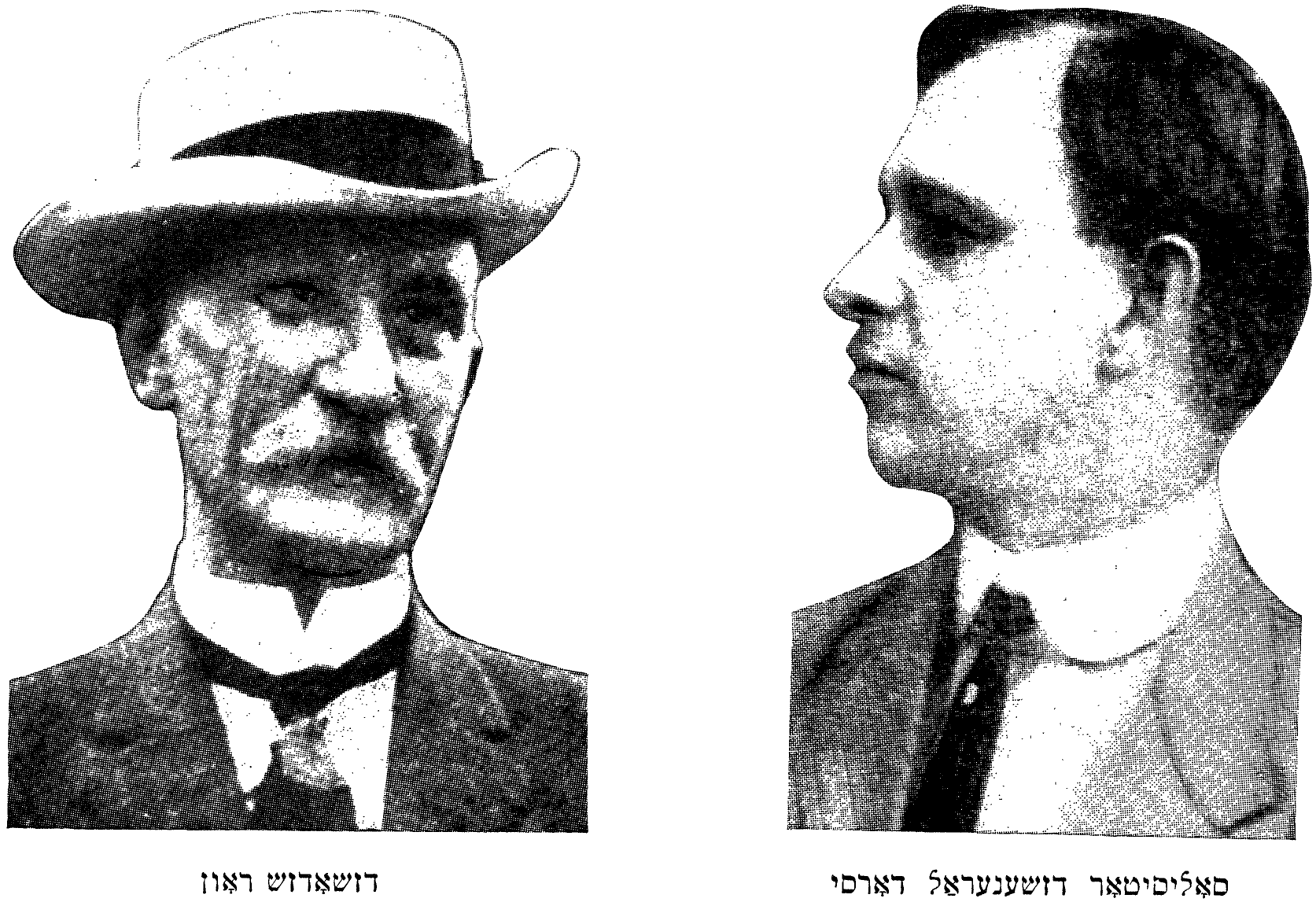
(plate; in the original facing p. 476)
Frank's lawyers appealed to the Supreme Court of Georgia, the highest court in the state. The appeal rested on the fact that Judge Roan had refused to grant Frank a new trial, despite the statement he had made in doing so, that he477was not convinced that Frank was guilty. The appeal also pointed to the hostile attitude of the crowd at the trial. The defense argued that, with this attitude, those present had influenced the jury, and that under such circumstances no impartial verdict could have resulted. The appeal contained several further points.
It took nearly six months before the high court came to the Frank case and issued its decision.
The decision was announced on February 17, 1914. The appeal was rejected; but not unanimously. The Supreme Court of Georgia consists of six judges, and two of them — the presiding judge and one other — voted that the fact that Judge Roan was not convinced Frank was guilty was an important reason to grant Frank a new trial. In their statement they pointed to a further point and gave another reason why the trial ought not to be upheld: at this trial witnesses had been allowed to testify that Frank had behaved disgracefully earlier, before Mary Phagan was murdered. And surely Frank was not being tried for earlier deeds.
But the main thing that made an impression was the opinion of the two judges that the very fact that Judge Roan himself did not believe in the verdict was a good reason to set the verdict aside and grant Frank a new trial. The majority of the six judges, however, was against a new trial.
As concerns the appeal and the decision, it must be noted that the Supreme Court of Georgia can consider only whether a trial was conducted le478gally. In questions of truth or falsehood, of whether this or that witness may be believed or not — in such questions it may not intervene. So it is laid down in the state constitution of Georgia. Such questions are only for the jury or for the judge who conducts the trial. If the judge believes that the verdict is not a just one, he may invalidate it and order a new trial.
It also meant that the Court of Appeals of Georgia found that the trial had been conducted entirely lawfully.
At the end of February 1914, Conley was tried — not for murder, but only on the charge that he was an "accessory" (a side, non-active helper) in the murder of Mary Phagan. Dorsey, as solicitor-general, demanded that he be entirely freed. The judge, however, sentenced him to one year in prison.
Because of the appeal, the sentence against Frank was not carried out on the appointed day, and since he had lost the appeal, he was again sentenced to death, and a day for it was again set. Judge Roan had meanwhile fallen ill, and he had gone off to rest in the Berkshire Hills, in Massachusetts (the state to which Boston belongs). His place was taken by a judge named Ben M. Hill; so479Frank was brought before him. This was on March 7, 1914.
Before the judge pronounced his sentence, Frank made a short speech in which he again declared himself innocent.
"I wish to say, in your presence and in the presence of God, whose eye now looks upon us," he began, "that I am innocent of the murder of the girl, Mary Phagan, and do not know how it came about."
He declared that he was being made a victim; that in the name of the law great, sorrowful errors are committed, and that sooner or later it would be proven that such an error was being committed against him.
"If the state and the law say that I must give up my life, I must lose my life as a blood-sacrifice," he said in closing. "I repeat, I am innocent, and the future will prove it. Your Honor! I am now ready to hear your sentence."
The correspondent of the New York Times, who telegraphed a report of the scene, said in his dispatch:
"The solemn ceremony was made especially impressive by the remarkable speech of Leo Frank. It was a finely spoken, feeling statement. One could see that those who were in the courtroom were moved. His speech sounded calm and firm. At the words that he was innocent and was a blood-sacrifice, his voice rose to a higher tone and his speech became more solemn. But he did not lose his self-control.
"When Frank had finished speaking, Judge Hill paused for a moment, as if he had no courage480to pronounce the terrible sentence. Then he drew out his spectacles, drew toward himself a paper on which the death-sentence was written, and read it out dryly, formally. As the day on which it should be carried out he named the 17th of April.
— That is my birthday. — Frank remarked to a friend who was standing beside him.
That evening Frank issued an appeal to the population of Atlanta. This appeal was longer than the speech he had made before Judge Hill. The following lines are an excerpt:
". . . . Must I be sacrificed as a victim to political expediencies? Must I perish because people who were earlier accused of crimes have gone unpunished, and someone must therefore be condemned for something?
"If I am really guilty, and my guilt was really proven, it would surely be easy to prove it again by the same evidence. Why then are they so afraid to give me a new trial?
"If I am not permitted to show the world the vile conspiracy in which I have been entangled, and on account of which they are preparing to hang me, the truth will come out all the same, for sooner or later every truth comes out; and then everyone's conscience will be his witness.
"People! Can you indeed take this responsibility upon yourselves? Do you not see, then, that by giving me a chance to prove my innocence, you give yourselves a chance to free yourselves of your pangs of conscience?
"The Formby woman has confessed that everything481she had told about me was utterly groundless. She retracted her sworn statement, which had condemned me before the world. Her second statement, in which she declares that all of it is a lie, is the truth, despite the excuses and quibbling explanations made about it. Why was her first terrible statement, which was given to the public through the newspapers, not read out at the trial? Why was this statement allowed to circulate and poison public opinion against me? And why were the people who obtained the lying statement from the woman not compelled to come out openly and prove that what stands there is correct? I know, and you know, that if they had tried to prove that statement of the Formby woman to be true, their assertions would at once have been refuted, and everyone would see how ridiculous they are.
"Why is no one allowed near Conley who wishes to get at the truth? Why is he hidden from everyone except those who taught him what to tell against me? Their aim is to keep him hidden until I am already dead. Those who read these words of mine understand why this is necessary for them.
"I believe that I have a right to a new trial, and I believe that I will obtain it. I do not ask that my life be granted me as a gift; I ask only for justice, I ask for a new trial, without special favors but also without spite. Leo Frank."
While Frank was writing this letter to the public, the defense had remarkable new evidence that he was innocent and that Conley alone was the guilty one. On the basis of this evidence his lawyers were preparing to demand a new trial for him, and they were then en482gaged in preparing the papers for it. They were certain that they would obtain a new trial. But to say this in advance would not have been practical. Frank therefore did not mention it. His firm hope, however, that he would have a new trial, he did express.
For several weeks now I had been preparing to travel to Atlanta about the Frank case. But I was very busy with other editorial duties and kept putting off the journey. At last, a few days before the report of Frank's speech before Judge Hill reached New York, the Forward announced that I was going there. But there was again a delay, and my journey was again to be put off for a few days. When, however, I read this speech and Frank's appeal to the public, I could no longer think of any other matter, and the next day, March 9, 1914, I set off for Atlanta. The journey by the fastest train takes a full day and night. I arrived in Atlanta on March 10.
There our Atlanta comrades awaited me at the station — Bundists from the old country, Yampolsky and his son-in-law Michael J. Merlin. They and other Jewish socialists, members of our party and of the Workmen's Circle, showed me the warmest hospitality.
I went over to the Tower, the prison where Frank was kept. For a newspaperman it was not hard to get in there. I showed my483card; my card was carried up to Frank, and soon I was led up to him. His cell (little chamber) was on an upper floor. Behind iron bars stood a slender, dark-haired young man with impressive, intelligent eyes, and beside him, inside the cell, a tall, beautiful young lady. This was Frank and his wife. The portraits of him that I had seen in the newspapers were very like the original. I recognized him at once.
We greeted each other through the bars, and he introduced me to Mrs. Frank.
The surrounding cells — six of them — were empty. As I soon learned, the sheriff*) had deliberately placed no prisoners in them, so that Frank should feel more comfortable, and that it should be more pleasant for him to receive his friends; for the sheriff, an elderly man named Wheeler Mangum, was convinced that Frank was innocent, and he did everything he could to ease his life in prison. He even allowed him to bring his bed and bedding from home.
One of the cells was larger than the others, and the Franks and their guests used it as a parlor (hall); people would stand or sit and chat through the bars. Only Mrs. Frank did the sheriff permit to come inside his little chamber. The other visitors would stand outside in the open "parlor." Mrs. Frank used to spend whole days here.
I made a jesting remark about the484"seven-room apartment" (a dwelling of seven rooms) that Frank was renting here, and he laughed merrily.
He told me how loyal the sheriff was to him. During the time of the trial he would most often lead Frank himself to the court and back to the Tower. Once, when the trial had already drawn near its end, an angry crowd began to press toward the automobile in which they were riding. Sheriff Mangum grew uneasy. Frank was sitting beside him, and in order to protect him better, he told him to seat himself behind him, and he himself took his pistol in hand.
— If they try to do you harm, they will have to get to you over my dead body, — he said. — I am already an old man, in any case. But you are young.
That Frank was an educated, capable man one saw at once, from the very first conversation one had with him. One also saw at once that this was a person who had been raised in a refined, cultured family: fine manners, a noble way of speaking, intelligence, sympathetic gestures, a sympathetic tact. Not a trace of any urge to talk about himself, to boast, to put himself forward.
I visited him every day, and we had long conversations.
I also had many conversations with his closest friends and acquaintances and with people who had been employed in the pencil factory under his management. I believe that in the seven days I spent in Atlanta I obtained a true character-portrait of him. We mainly spoke a485bout his case, but not only about that. We chatted about various other matters as well.
He was a genuine Jew of the American-born type, an altogether different sort of person from a Jewish young man born of our immigrants. He was religious, and this too in the manner of the German Jews (Yehudim), not of our Jews. His piety was not a deep one, not a flaming one, but a sincere one. I thought to myself: perhaps this inclination developed in him since his misfortune befell him? But I soon heard that he had always been an active member of the Atlanta temple, and that on Sundays he used to conduct a Sunday-school class there — teaching boys and girls the Bible and the "principles of the Jewish faith," as he once expressed it in one of our conversations.
Social questions did not interest him. He believed in the present order simply because it exists. Incidentally, the word "believed" is perhaps not the right one here. He simply did not think about it. As he had found the world, so would he leave it — this is the feeling of the average person, and it was the feeling of Leo M. Frank.
In short, he was a conservative person, and his chief interest in life was to fulfill his daily duties properly — to pay his debts punctually, to be a good son to his parents, a good, faithful husband to his wife, a diligent, faithful officer in the pencil factory that had been entrusted to him, and a respected member of the social circle to which he belonged.
He showed no great deal of temperament. He was a calm, though inwardly a nervous, man.486He very seldom lost his equilibrium and self-control. In the most tragic moments of his trial his voice sounded clear and calm.
I have said here that one of his ideals was to be industriously diligent for those who had employed him as manager of their business. He was altogether a diligent person. In school and in the two colleges that he completed, he was one of the greatest students. Perseverance and punctuality — these were two of the most prominent traits of his character.
In the discussions I had about him with others, I was naturally very much interested in the question of his character with regard to women. For the chief foundation of the accusation against him was, after all, the assertion, set up on the testimony of various witnesses prompted to it, that he had a sickly lust and led a disgusting, immoral life. From all the discussions I had with his friends and acquaintances, I became deeply convinced that there was not a nutshell, not a spark, of truth in these assertions. He had lived happily with his wife, and he had absolutely no unusual sexual instincts. For such inclinations a quite different sort of blood is required, and a quite different sort of character.
From all that has been said here, one can picture a prosaic, everyday person. And yet it was interesting to talk with Frank. He had learned and read a great deal, and he knew a great deal. Thanks to his perseverance and his innate abilities, his mind was richly stocked with knowledge and with a power to make use of it. He had understanding and a fine logic. And through this, together with his sympathetic487personality and oratorical talent, he was a very pleasant companion. I loved to talk with him, and when we chatted about his case, and he answered my questions, or explained and recounted things with the smallest details, I felt that I was hearing the pure truth. Exactly the same feeling was had by every listener of his while he made his four-hour statement in court.
When someone speaks with caution and with "politics," straining to make an impression on you, you feel it. You feel that he conceals certain things from you and embellishes certain others, that he underscores this or that too strongly; that here he speaks somewhat too dramatically and there he labors to make a certain point of nothing; that his smile is often too sweet, or that his expression of enthusiasm and anger rings more with the tones of professional oratory than with sincerity. Listening to Frank, I never felt this. His words sounded to me with absolute sincerity.
F. M. Connally wrote:
"In Leo M. Frank I found one of that class of intellectual young men who are the hope of America. Judging from my observations, which extended over three weeks, I can say that I know of no finer type. I am convinced that in a moral respect his conscience and his conduct are just as pure as he is fine in a spiritual respect. And this is the opinion, I believe, of everyone who comes into personal contact with him. He is a remarkable young man, and the wrongs that have been committed against him in the name of law and justice are indescribable."
488A part of my first conversation with Frank was devoted to the bearing that antisemitism had on his case. His answer to a question of mine was:
"Antisemitism was absolutely not the cause of the false accusation that was built up against me. It is not the source but a result of the sorrowful affair. The police fastened on me because they could find no one else to accuse at the time. Then, since I am a Jew, they began in their agitation to make capital of my descent as well. And it was important to them to attack Jews in general. Do not forget that this is the South, where a Negro has no worth. A Negro is not believed; against a Negro people are always ready to believe the worst crimes. Now, how were people to believe Conley against a white man? A Jew is indeed not a Southern Christian, but he is still a white man. And so it was necessary to lower the Jews; it had to turn out that a Negro can after all be believed against a Jew.
"If I had been an Italian, they would have agitated against me as an Italian," he added in a tone of firm conviction.
Mrs. Frank, who was born and raised in Atlanta, supported her husband's opinion. She gave me examples to show that Jews in Atlanta had always felt themselves among Christians as among their own people.489— We were close, intimate companions, Jewish and Christian girls, — she said. — We often visited one another, and our families, too, were close friends. We went to one another as guests, to weddings and to parties. No one knew of any distinction. In the North it is not so. But here, in the South, it was always different from there.
I heard similar things from other Jews in the city. But the Frank case, through the agitation that the police circulated against the Jewish superintendent of the pencil factory, kindled evil feelings against all Jews — among the common masses, at least.
For the police it was a question of either Frank or themselves. If they had let the public become convinced that they were fastening on an innocent white man and that the real guilty one was a black man, the detectives might perhaps have been lynched. And so they made Frank their scapegoat.
One of the educated American Jews (Yehudim) of Atlanta, with whom I often met, said about the question:
— You ask whether it hindered Frank that he is a Jew? I believe not. But it did not help him either. If a Christian had fallen into such a misfortune, his Christian connections, his friends, and his church would have helped him. A Negro would not so easily have been believed against a white man in the South. But the synagogue to which Frank belongs — our Reform temple — and we Jews in general, could not help him here.
The man who said this then made a remark,
490part of which contained exactly the same thing that I had heard from Frank.
— Once the masses had been incited, simply made mad with thirst for revenge, — he said, — then even a Negro was believed against a Jew, although in ordinary times the word of a Negro against the word of a Jew in Atlanta would not have been accepted. A Jew is, after all, a white man.
Many of the Christians, chiefly the more intelligent ones, kept up their usual friendliness toward Jews in general, whether or not they went along with the anti-Frank current. There were cases such as the following, for example:
In a streetcar a young Jewish woman is sitting. A Christian woman comes in, her school companion and constant friend. The Christian woman makes toward the little Jewish woman with a friendly smile, as usual. But the Jewish woman lowers her eyes.
The other sits down beside her and begins to appeal to her.
— Why are you angry with me? I cannot bear it.
— It is no longer what it once was, — answers the Jewish woman. — They are fastening on an innocent man, one of the noblest and finest, because he is a Jew. I too am a Jewish child. — And she weeps.
Similar scenes occurred in various parts of Atlanta. In one of them the Christian woman was the wife of one of the twelve jurors who had found Frank guilty. She argued that the Frank case was a question for the court, that it had no bearing on the re-
491lations between them, the two intimate companions, that she, the Jewish daughter, was as dear and beloved to her, the juror's wife, as ever...
In one of my later conversations with Frank I asked him whether he had heard of the Beilis trial.
— Yes, I read about it, — he answered, and he named one of the Jewish weeklies that are published in English. — But I assure you that my case has nothing in common with it.
— And yet, once the antisemitic poison has been poured in, there is after all a certain similarity between your tragedy and Beilis's. There a false accusation and here a false accusation.
— Yes, a false accusation! — he responded. — But against Beilis a genuinely antisemitic accusation was made, the ridiculous charge that Jews need Christian blood in their matzos (unleavened Passover bread). My case is simply an unfortunate accident. What troubles do not befall one! Later, out of this trouble there grew up a bitterness against me as a Jew and as a Brooklynite, as superintendent of a factory, and as anything else you like.
My impression was that Frank would not want too much being made of the antisemitism question in his case. He did not say this to me in plain words; but I felt that this was his wish, and several notes that I had made, and even longer parts of a few articles that I had drawn up, I then did not use. Now, however, when I write these "Pages," they are a part of my material.
492A certain lawyer applied various means to push himself into the case as one of Frank's defenders. Having no success in this, he began to help the police against Frank. It was he who gave them the plan to spread a rumor that Frank was an unnatural debauchee. From the same source a second rumor was also spread, that the Jews were collecting a fund of a million dollars to save Frank. It was hinted that this money was needed in order to try to bribe witnesses and judges.
While I was in Atlanta, several Jews told me of the experiences they had had as a result of this fabricated rumor.
To one of them came a Christian acquaintance and told him about a poor Jewish storekeeper, that the poor fellow must contribute five hundred dollars to the Frank fund. "Where is he to get it? But if he does not bring in the sum, they will ruin him. Such a pity!" the Christian said.
The Jew denied the story about the fund. The Christian, however, remained unmoved. He was certain that the Jew was concealing it from him.
To a second of the Jews who spoke with me about the matter, a Christian neighbor turned with the question: "Have you already given the thousand dollars?" The other asks: "What thousand dollars?" And the answer is: "The sum that has been imposed on every well-to-do Jew as his share of the Frank493defense fund." The Jew explains that no such fund exists in the world, that it is a scandalous lie. But the Christian listens with an ironic smile.
— You don't trust me? — he says. — You need not be afraid of me. I assure you that I will tell no one.
On a certain day Oscar Straus, the Jewish millionaire and philanthropist of New York, passed through Atlanta; and a report spread that he had brought a large sum to bribe the judges of the Supreme Court.
The tale about the "Frank fund" quickly spread not only over Atlanta but over the whole state; and it had its harmful effect.
The police with their detectives and various other assistants leaped, literally, out of their skins to befuddle the minds of the masses with agitation against Frank and Jews in general. And so they cursed him not only as the murderer of Mary Phagan, but as the "debauched Jew" or simply as the "accursed Jew."
"Hang the Jew!" people shouted. Formerly this would have been an unusual question in the South.*)
Frank's lawyers received masses of anonymous letters with threats that, if their client were not hanged, they would be lynched.
One often used to hear such a remark: "Guilty or
494not guilty, we will send the accursed Jew to the other world."
The mob lost its patience and was simply wild with rage that it could not carry this out so quickly. How does the accursed Jew dare to fight against it?
A quibbling notion went around, that among themselves the Jews are moral, but that their religion permits them to violate a Christian woman.
One of the Atlanta Jews (Yehudim) told me about a Christian friend of his who had heard this notion from another Christian, who expressed it in the following manner:
That Jews need Christian blood for Passover is ridiculous; but that they hold it a religious duty (mitzvah) to violate a Christian girl — that is probably true. Their religion permits them liberties with women of a foreign race, so that it should be easier for them to leave in peace the foreign women of their own people.
The following fact is interesting in a double sense:
Two young Jewish men were standing outside, by the window of a Jewish store, and chatting. Three Christians passed by, and one of them said in a loud voice:
"All the Jews ought to be wiped out."
The two young Jews heard this.
— What did you say? — they asked, going up to the one who had called out the antisemitic phrase. The fellow repeated his words, and then one of the two Jews — a healthy young man — gave him such a blow that he fell down bloodied. The three Christians called a policeman, and all of them, the three Christians as well as the two Jews —495were led off to a police court. The end was that the judge fined the bloodied antisemite fifty dollars.
I say that it is "interesting in a double sense," because the story shows: 1) that antisemitic poison had been spread among the masses, and 2) that despite this, the spirit of decency toward Jews, which had always prevailed in the South, had not yet been extinguished.
I must interrupt my narrative of my meetings with Frank. I must first acquaint the reader with new evidence of his innocence, which his lawyers obtained before my journey to Atlanta.
In an earlier place there was talk of the six or seven hairs that the worker Barrett of the metal room had found on his machine. A few of the working girls said that they were Mary's. Above we posed the question: why did the solicitor-general not turn the hairs over to a specialist to examine and compare them under a microscope? Why did he content himself with the opinion of a few working girls?
The answer is that he did indeed turn the hairs over to a specialist — namely, to Dr. Harris, the official chemist of the Health Board (health department) of the state of Georgia. And as Frank's lawyers learned (already after Frank's trial), Dr. Harris's report to the solicitor-general was496that he did not believe the hairs were Mary's.
At the trial Dr. Harris was a witness on quite another matter, namely, on the condition of the food found in Mary's stomach (from this one could infer how much time had passed from her midday meal to the murder). About Mary's hairs Dorsey then put no questions to him; and so he had no opportunity to express his opinion about them.
Frank's lawyers, in turn, did not ask Dr. Harris about the hairs, because the detectives had made an impression on them that the examination had proven the hairs to be Mary's. Only later did they learn of the report that Dr. Harris had given about the hairs.
Dorsey did not ask Dr. Harris about this matter at the trial, because his answer would have shattered the case, for the seven hairs, Dorsey cried at the trial, were one of the strongest pieces of evidence that Frank had murdered the girl. (After he had lured her into the metal room, where Barrett later found the hairs.)
Dorsey's assertion in court, that the few hairs had been lost, is explained by the fact that for his examination Dr. Harris had cut the hairs into little pieces. Had the cut-up pieces been seen in court, it would have become clear that a specialist had examined the hairs, and then Harris's report would have come out, that the hairs were not Mary's. Now, then, when Frank's defenders already knew of this fact, they prepared to put it forward as one of the grounds why their client should be granted a new trial.
A second point in the new appeal, which they497were now engaged in preparing, was a remarkable discovery that the above-mentioned Lemmie Quinn*) — a Christian — had made after the trial in one of the two murder notes.
On a certain afternoon, already after Frank had been sentenced to death, Quinn was standing and examining a photographic copy of note "number 1." He was employed at the pencil factory as foreman over the metal department. He looked closely at the photograph, for he had noticed black spots in it; and the more he looked, the more he saw in them.
But one must first explain on what sort of paper the note was written.
The paper of "note number 1" was brown, and at the top there were a few printed lines, which showed that this was an "order blank" (a form on which a business writes orders for tools, material, or some other article).
Of every order that a firm sends out, it keeps a copy, so as to be able to compare the bills sent to it with the orders for which it has to pay. And in case some dispute later arises, it should have something to show. As the reader knows, the copy need not be written at all. It comes out by itself when the order is written. Beneath the blank lies another such blank, and between them is laid a sheet of thin, black carbon paper. And so, while one498writes on the upper blank, each letter is printed off on the lower blank as well. Such a copy is called a "carbon copy."
On every order blank a number is printed, and the same number is found on the lower sheet as well. Also, on every order blank, and on the lower sheet, is printed the name of the city (Atlanta) and a part of the date (the remaining part is written in by hand).
When Quinn looked more closely at the black spots, which appeared between the second and third written lines of the murder note, he began to notice something familiar, until at last he recognized the signature of a man named Becker, who had earlier been connected with the factory as master mechanic (he left there at the end of December 1912, two and a half months before the murder).
All this was visible between the lines on a photograph of the note. Now, how clear must Becker's signature have been on the original of the note, which was then in the possession of the solicitor-general?
Quinn's heart gave a tremble. He sensed that in this signature lay an iron proof that the note had been written in the cellar and not in Frank's office, as Conley had said.
Conley had told in court that when Frank was about to dictate the notes to him, he reached his hand into his desk, took out a "pad" ("block"), tore off a sheet, and told him to write. But the said note was not written on a fresh sheet of paper, but on a carbon copy of an old order of Becker's; now, how does that come to be in Frank's desk?499The number of the order blank on which this note was written was 1018. They took a look in the old books and found out the name and address of the store to which the order had been sent. From this they obtained the order and saw the date on which the order had been issued. It was about a year before the murder!
Then Becker was found, and he confirmed everything — that "note number 1" had been written on a carbon copy of an old order of his, and that the name Becker was indeed his signature.*)
"Note number 1" was therefore an old rag with carbon letters, a carbon copy of an old order. It is simply ridiculous to imagine that in Frank's desk there should be found carbon copies of old orders that a former master mechanic had once issued. But let us assume for a moment that this is indeed possible. Frank would surely have noticed at once that the sheet bore traces of written lines, for, according to Conley's testimony, this took place in broad daylight, at the noon hour, when Frank's office used to be full of sunshine. He would have thrown the "rag" away and taken a fresh sheet, a clean one.
It is altogether different when one imagines that the500notes were written in the basement. First, such old copies were always lying about there in the rubbish. Second, in the basement it was never bright; and at the spot where the dead body was found, and near which an old writing-desk stood, it was always quite dark. To one side, above the great furnace, a little gas-pipe used to burn, and through a little hole in the back door a faint bit of light used to penetrate by day. Truly bright it was not there, in any case. The murderer therefore could not notice that on the paper there were traces of carbon-writing. When he wanted to write the note, he took this old sheet, which lay near the spot where he had laid down his victim, and on it — on the writing-desk — he wrote with a pencil. He wrote nine lines; and when he ran out of room, he sought out an old "pad" of quite cheap paper, which he also found right nearby (such things were always to be found there), and he added the other five lines.
It is clear as day that the notes were written there in the basement, beside the corpse.
If, before the trial or during the trial, the lawyers had known what Quinn discovered later, everything might perhaps have taken a different direction. Frank might perhaps have been freed, and he might still be alive today. I keep saying "perhaps," because the mob was then so excited, and the jury was so strongly influenced by the mob, that God alone perhaps could not have convinced the twelve men that Frank was innocent. It was no question of convincing them. Frank's fate was then sealed. And yet, if Frank's lawyers
501had then known that "note number 1" had been written on an old carbon copy, they would naturally have brought it forward in court. They worked on his case with all their strength. But to examine and study the notes, as one would surely have done in such a case in New York, such a thing simply did not occur to them. Conley had confessed that he had written the notes; he argued that Frank had dictated them to him, and Frank denied it. But as to the fact that Conley had written them, there was no dispute. And so the lawyers took no further interest in the notes.
The explanation made by the above-mentioned young Jewish lawyer, Henry A. Alexander, with regard to the meaning of the notes, was also a most important discovery. For, as he showed, the language is genuinely Negro: the two words "night witch," which had earlier been interpreted quite falsely, represent a superstition rooted among the Negroes from very ancient times. Frank, the white young man from Brooklyn, could not have thought of these words.
Alexander is the son of one of the oldest Jewish families in the South. He stems from a Portuguese-Jewish family and is an educated, thoughtful man. He noticed that the notes were not receiving the proper attention — that during the investigation the solicitor-general had considered them quite superficially, that they had not been examined and studied with enough attention, and the result was that he had at once interpreted them with their correct meaning.
The explanations that Alexander gave502drew general attention. In Atlanta I spoke with a Christian lawyer and with other intelligent Christians, and they admitted that "night witch" undoubtedly means just as it is written in the note, and that among the Negroes there is indeed such a superstition. (Later, traveling back to New York, I chatted about it in my railway car with a white Southerner from another state. He too knew of this superstition. He wondered that no one in Atlanta had earlier thought of it, that "witch" really means "witch" (sorceress) and not a "watchman.")
Alexander also made a few other important explanations about the notes and about other points in the Frank case. He issued a special brochure about the case. I read it through and spent much time with him in conversations about the trial.
While the case was being prepared for the appeal to the higher court, Alexander was invited to take part in the defense. He took part in the work for further appeals as well. And in this he played an important role.*)
When it became known that Judge Roan, the trial judge, doubted Frank's guilt, the announcement made a strong impression, chiefly on the intel503-ligent part of the population. A considerable number of people had, the whole time, felt in their hearts that Conley's story did not stand to reason. But they had suppressed this within themselves, for to utter a word in Frank's favor was dangerous. Once the public learned, however, that Judge Roan himself also held such a feeling, people took greater courage, and with close friends, at least, the question of a new trial for Frank was discussed in a new tone. People dissected the story, asked hard questions, pointed to contradictions, to incredible details.
In the Northern states, the interest in the Frank case after the trial grew strong, for a rumor had grown that the superintendent of the pencil factory was innocent. From this his case took on an entirely different face. And the attitude toward the case became an altogether different one. The press of those states began to give the matter far more space than before; there one was not terrorized by an anti-Frank mob and by an anti-Frank police; and so people were not afraid to pose openly the question: was Frank not the victim of a conspiracy?
The newspapers of the North, chiefly of New York, were read in the South as well, and through them people learned what kind of impression the Frank case made upon people who held an impartial opinion about the case.
This, together with Judge Roan's declaration that he himself was not convinced that Frank was the murderer, had504gradually created a quiet upheaval in many Atlanta minds.
In March 1914, when I came to Atlanta, this upheaval had already reached a fairly high degree, and precisely in the week that I spent there, a few local newspapers had already allowed themselves to come out with open statements that Frank's trial had been conducted under circumstances that made an impartial verdict impossible; prominent clergymen had preached sermons in their churches to the same effect, and the question of whether Frank ought to have a new trial was openly discussed.
All this created a new mood, and a whole series of witnesses who at the trial had served the police against Frank took courage to confess that they had lied at the trial. They so declared in an affidavit (a sworn statement) that they brought before Frank's lawyers.
The other camp, the camp of the police and the solicitor-general, did not, however, sit with folded hands; and some of those who had confessed that they had recited at the trial a lesson which the detectives had drilled into them then "confessed" back again. They made new affidavits stating that everything in their first affidavits was a lie, and that their testimony at the trial had been true. Some of this sort of affidavit-maker even denied that they had ever spoken with Frank's lawyers at all.
There were, however, some who withdrew their anti-Frank assertions, and who held firm to this. The detectives were no longer able to "talk them around" again.505New witnesses for Frank also appeared, people who during the time of the trial had kept silent, simply because they were afraid of the police. But of these, too, not all stood firm by the affidavits they had made for Frank. The police extracted from them a sworn retraction of their Frank-favorable affidavits. In some such cases, however, by far not everyone who confessed that his testimony against Frank had been false, or who came forward after the trial as a new witness for Frank, was a person of an unblemished reputation. But a considerable number of such old or new witnesses consisted of fully respectable and trustworthy people.
There emerged a tangle of sworn truths and sworn lies; of confessions and of a "second confession" that the first "confession" had been falsehood and deceit. In some cases it was hard to judge whether the affidavit-maker had sworn falsely when he "confessed" that he was a liar, or when he repented of having confessed.
At this point a remark is required concerning the ignorant portion of the population in the South. First, as we have already noted when we spoke about mob psychology there, the South has a greater percentage of ignorant people than the North; and it even has a fair number of whites who cannot read and write — a phenomenon which in the Northern states is almost an impossibility. (We write the word "whites" because Negroes who cannot read and write are in the South a common thing.) Second, among the ignorant Southerners one finds a greater percentage506of frivolous people than among the masses of the North. And this, again, refers to the whites. As for the blacks, they are for the most part as frivolous and as accustomed to giving their fancy free rein as small children.
Among the witnesses in the Frank case there was a great number of this type. To frighten and talk such a witness around is not difficult. He may say one thing today and exactly the opposite tomorrow, and the day after that turn himself over once more.
But there were also such cases where the witness who falsely "did penance" was by nature neither a liar nor a frivolous, characterless person. He was simply forced to deny what he had said a few days earlier. It was a question of either obeying the police and denying the truth, or holding to the truth and being persecuted by it.
One more thing: the frivolous masses are easily incited by publicity. To have one's name in the newspapers, to play a role in the sensational case that was talked about in every house — to this hundreds of people were drawn, just as children are drawn to the stage. For the police, therefore, it was not hard to obtain witnesses; and not a few people, chiefly women, for the same reason offered after the trial to make statements for Frank.
What was then taking place in the camp of Frank's enemies? When Dorsey and the detectives saw that public opinion was leaning in the direction of a new
507trial, they grew alarmed. If Frank were granted a new trial, and instead of the bloodthirsty mood that had surrounded the first trial there reigned a genuine desire to arrive at the truth, it would be easy enough for the lawyers to obtain a verdict of "not guilty."
That would mean that Conley was the murderer and that this blood-stained Negro had the whole time led the detectives and Dorsey by the nose. For the police and the solicitor-general this was almost a question of life and death.
As an antidote, they then with fresh energy spread the lie that Jews from all over America were giving enormous sums to save Frank. They began to insinuate that every Christian who raised his voice for a new trial was bribed.
When Dorsey's office learned that many of his witnesses had confessed they had told lies, and that the defense had important new witnesses as well, the city detectives became "busy." With the various means at the police's disposal, they sought to work upon those who had made affidavits for the defense, and with cruel threats, or with friendly promises, or with both means together, they succeeded in many cases. Where the affidavit-giver was a characterless, undeveloped person, ready for a lie and for a false oath, the detectives certainly had no difficult task. And such people, as we have seen, were many.
Besides this: through the tireless agitation of the police, there grew up among the masses of Atlanta a feeling that to testify against Frank, even when it was a lie, was a good deed (mitzvah); that this was important for the good name of the city. Let no one think that Atlanta508sends an innocent man to the gallows! And let no one think, either, that a Negro can turn the heads of the people of Atlanta!
The Southerners are sensitive to the opinion that other regions hold of them. Since the Frank case had drawn attention throughout the whole country, it was construed into the "local patriotism" of Atlantans that the honor of the city and of the entire state of Georgia demanded that there should be no doubt about Frank's guilt.
The accusation had divided into two hostile camps — "pro-Frank" and "anti-Frank." It was similar to the situation in France during the time of the Dreyfus affair, when that country was divided into two bitterly opposed sides — "anti-Dreyfusards" and "Dreyfusards." We have said above that the anti-Frank masses regarded Frank simply as a hostile force.
For them the question of whether he was guilty or not was no longer important. For them it was enough that there was the hatred fighting against them and against the good name of the South in general. Not for nothing did the saying become popular: "Guilty or innocent, the Jew must be sent to the next world."
The rumor that Jews were collecting an enormous fund to save him from the gallows created among the ignorant masses an impression that all the Jews of America were united against all the white Christians of the South. If so, then Frank must surely be hanged, whether he was guilty or not — hang him and thereby "prove" that he was indeed guilty.
When I expressed this thought in one of my conversations with Frank, he said with a melancholy smile:509— So it appears. Are you intending to write this?
I could see that he did not want me to write it. In his opinion it could do more harm than good.
— Well, then I will not write it, I replied.
— Later, when you are entirely free and we recall these times fondly, then I will write it. He gave a friendly smile.
The "Daily Telegraph," a newspaper that appears in the city of Macon, Georgia, said on March 26th, eight days after my departure from Atlanta — in an editorial about the Frank case:
"If a mistake should be made with respect to a human life, that would be regrettable. It is better, however, that such a mistake be made than that our legal system should acquire a bad name."
The native needs no commentary. Its plain meaning is clear and simple: if Frank is innocent, he must still be hanged; ... for that will confirm the verdict of our court that he is the murderer of Mary Phagan. ... If he were to go free, people would say that here we condemn an innocent man.
Several of Frank's acquaintances among the businessmen invited the then-famous detective William J. Burns of New York to come to Atlanta and investigate510the murder of Mary Phagan. The agreement was that he should conduct an impartial investigation. If he should find that Frank was the murderer, he was to report this to the public.
They believed that since Burns was not from Georgia, he would not be afraid of the mob there and would do his work honestly, fearlessly, and thoroughly.
Some years earlier, Burns had been the head of the detective division of the New York police. He had made a name for himself throughout the whole country, and later, when he gave up his official post, he had founded a private detective bureau.
He came to Atlanta with a number of his best detectives, and he set to work. One of the first things he did was to advertise a prize (a reward, a gift) of five thousand dollars to whoever would bring convincing proof that Frank had led an indecent life.
The Atlanta police had brought endless testimony about Frank's immorality. Yet to the five thousand dollars that Burns offered, no one responded. People knew that Burns demanded truly genuine proofs — facts and not lies — and that one would not be able to fool this seasoned detective. And of facts about Frank's debauchery there were none in the world.
In his investigation Burns at every step ran up against obstacles that the Atlanta police placed before him. And the police were not the only ones who hindered him. Thousands of private people, from the mob, did so as well. He was regarded as an enemy of the entire state of Georgia. And when he had nonetheless investigated the case and had
511announced that he was absolutely convinced that Conley was the murderer and Frank innocent, this provoked a storm of fury and hatred against him. A foreign detective, and one from the North no less, has the audacity to come and prove that the police of Atlanta, the jury that found Frank guilty, and all the Georgians who had to do with the case had not acted rightly!
They not only hindered him in his investigations, but they simply made his life bitter. When he came to Marietta, the little town where Mary Phagan was born, he barely escaped from there with his life. A few minutes more and he would have been lynched.
The whole plan of inviting Burns was not a clever one. It was easy to foresee that this would only pour oil on the fire.
Incidentally, Burns, for his part, exploited the whole undertaking too strongly to advertise (publicize) himself.
These sensational advertisements of his, his boasts throughout all of America that he could easily prove Frank was innocent, made no good impression. For Frank they did more harm than good.
I will here mention some of those who after the trial made affidavits that at the trial they had told lies; and also some who after the trial came forward as new witnesses for Frank.
I will begin with Brutus Dalton, the young man who at the trial recounted that Frank used to512hold dirty orgies together with him in his (Frank's) office. As we have seen above, he was Dorsey's most important witness for corroborating what Conley had recounted about Frank's immoral life.
A few months after the trial, Dalton gave Frank's lawyers an affidavit that everything he had said at the trial was utterly without foundation, and that police detectives had talked him into telling the whole story.
A few more months passed, and the police detectives got Dalton into their hands. They obtained from him an affidavit that what he had said in that affidavit was a lie, and that what he had recounted at the trial was true. And why had he given Frank's lawyers such a lying affidavit? Because they had forced him to testify in corroboration of Conley's filthy tale! And Conley corroborated him!
Now, given that he was such a man, that he was ready to make a false sworn statement for a hundred dollars, then what substance could his testimony in court have had? (As for his statement that the lawyers had bribed him to tell lies, they made a convincing statement that he had himself volunteered to tell them the truth, and that they had promised him no money for it.)
It was plain to everyone that there was really not a true word in him, as the above-mentioned people from his town had said. To believe what he had recounted at the trial and what he had now repeated in his brand-new affidavit would be ridiculous. And this citizen was Dorsey's most important witness for corroborating Conley's filthy tale! And Conley corroborated him! A child could see that both were "bluffing."513A curious affidavit was made for the defense by a Negro woman named Annie Carter. She swore, namely, that Conley had confessed to her that it was he and not Frank who had murdered the girl Mary Phagan, and she handed the lawyers several little letters that she had received from him. She explained that his confession and the correspondence between them had taken place while Conley was in prison in connection with the Frank case.
She, too, was there then — for theft. But she worked in the laundry of the prison and moved about freely in the building; she would often come up to Conley's cell, and they would chat through a grating. He took a liking to her, and he begged her to promise to marry him.
After she had made the affidavit, the lawyers sent her away to New Orleans, so that the Atlanta police should not torment her and force her to deny everything. But the Atlanta police finally learned where she was, brought her back to Atlanta, and extracted from her an affidavit in which she did indeed deny everything and even added such a detail: that one of Frank's lawyers had given her in prison a little bottle of poison and ordered her to administer it to Conley.
The little letters were so full of such filthy, debauched words that later, when they were read aloud in court, the reading had to be interrupted.
That Annie found it not hard to tell a lie, one could not doubt. But some things that were contained in her first affidavit still rang true; just as some parts of her second affidavit — the story of the little bottle of poison, for example — read like an old-time trashy novel. The letters that she514showed were certainly from Conley. Of this, too, one could not doubt. And, as we shall see in a later place, they contained excellent proofs that Frank had not dictated the murder notes.
Annie made her affidavit in favor of Frank in the presence of three lawyers, two Christians and one Jew, all highly honorable men, and they afterward swore that she had done it voluntarily, and that in the affidavit she gave them there stood absolutely what she had told them and about which she had sworn to them that it was the "truth, the whole truth, and nothing but the truth."
A white girl named Cutchins swore after the trial that at the trial she had not been allowed to speak as she wished. She had been interfered with in her answers, and against her will she had said that Frank came into the dressing room (the room where the factory's working girls used to change their clothes) while the girls were there half-naked. In truth she had wanted to say that there were no half-naked girls in that room and that Frank had always conducted himself toward the girls in a decent manner. But she was so twisted about with the questions that she became confused and, without herself noticing, said exactly the opposite.
Another working girl from the pencil factory, one named Ruth Robinson, testified at the trial that Frank was a depraved man and that he used to behave abominably with women. Later she made an affidavit for the defense that the solicitor-general had demanded that she say so, and that when she refused, because it was not true, he took to shouting at her. He even insulted her and
515insinuated that she did not want to tell the truth about Frank because she, too, had had relations with him. She was so taken aback by his words and so frightened that she became willing to say what he ordered her. All this was contained in the affidavit that she gave to Frank's lawyers.
Afterward Miss Robinson gave Dorsey an affidavit that she had never made that affidavit, that she knew nothing of what to say. But a notary public issued a sworn declaration that she had made that affidavit in his presence; that she had dictated to him the words and afterward sworn that everything was true, and that present at the time was a private detective named Burke.
One named Mary Korst swore that she had been coached on what to say about Frank. At the trial she had answered "yes" to questions that she did not understand. She had been taught that as a good Southern girl she must corroborate that Frank had a depraved character, and therefore she said "yes" to everything.
Another working girl from the pencil factory, a Miss Jewell, testified at the trial that Frank used to make advances to Mary Phagan. Afterward she swore that she had then been persuaded to testify against the superintendent of the pencil factory. She was even taught what to say, and was rehearsed to see whether she answered as she was told. In her "affidavit" she explained that one of the persons who had taught her what to recount was Mennie Griffin, who was also a witness against Frank.
An elderly white woman, named Simmons, who516lived in Birmingham, Alabama, was on the day of the murder visiting her daughter in Atlanta. That Saturday afternoon she happened to pass by the pencil factory, and she heard a desperate scream from the basement. She stopped. A little while later she heard from the basement another scream, a half-
"Her voices she probably heard," he said.
[Then] from the basement she heard yet another scream, a half-stifled one, as if someone had stopped the screams of his victim with his hand. The scream reached her a third time. Mrs. Simmons tried to get into the cellar. But this was impossible, because the cellar was locked shut with a wire.
When she came home and told her son-in-law that it had troubled her, her son-in-law said that she had probably imagined it. The next morning he reported to her about the murder of Mary Phagan.
"Her voices she probably heard," he said.
Then Mrs. Simmons reported to the police about the screams that she had heard there. Her story did not, however, agree with the accusation against Frank. For she had heard the screams at two o'clock, when Frank was no longer in the factory but at home, at lunch. With Conley as the murderer it did, however, fit together.
Mary Phagan was attacked at about a quarter past twelve. It is possible, however, that the murderer thought she was already dead while she was still alive, and that he made a real end of her only later. While he was attacking her, he stifled her breath with her little dress, and then he probably strangled her with his hands around her throat, and perhaps with the cord that was found on her. Believing that she was already dead, he threw her down through the517hole into the basement. Afterward he dragged her through the basement. When this was, how long she lay beneath the hole, is not known. It is possible that only later did he conclude it would be better to drag the body far into the cellar.
We already know that the murderer dragged her over the whole length of the long cellar while she was still breathing. Those who examined the dead body believed that while she was being dragged she screamed and that the murderer probably stifled her cries by pressing her face down into the coal dust. Only then did he probably really finish her off. Whether it was then that he gave her the deep, long wound in the head, or earlier; whether here at the end of the basement, not far from the back door, he finally killed her with the cord, or whether with the cord he had strangled her still earlier — this will never be known.
Why, then, did he not at once make a complete end of the unfortunate girl? Why did he drag her so far while she was still breathing and able to scream? To this there can be only one answer: he thought she was already dead. Her screams were for him an uncanny surprise.
These very screams, on which the murderer had not reckoned, Mrs. Simmons probably heard. And this could have taken place a couple of hours after Mary was attacked.
After the murderer had strangled her and thrown her down into the cellar, thinking she was already dead, he probably remained in the factory a certain time. Perhaps he tried to wash the blood off her and off himself, and off the place where she had been bloodied.518The screams Mrs. Simmons heard in the basement, and this agrees with the account that the murderer tried to stifle the girl's voice in the coal dust. This does not at all agree with Conley's story that Mary was murdered up above on the second floor.
The solicitor-general tried to persuade Mrs. Simmons that she had heard the cries only a few minutes after twelve, so that it should agree with his accusation against Frank. But she stuck to her version. He said that he would call her as a witness at the trial. But he did not call her. Then, after the trial, she wondered about it to Frank's lawyers.
An interesting story concerned a Mrs. Mary Ritch, a Negro woman who kept a little restaurant on a small alley that lay on the back side of the pencil factory. After the trial she made an affidavit that Jim Conley came in to her at a quarter past two in the afternoon, on the Saturday of the murder, from the pencil factory, bought himself something to eat, and with that returned to the factory. She said that Conley had come to her through the back door of the factory basement, and that he had returned with his food also through the back door.
This agreed with Mrs. Simmons's statement; and it also agreed with the fact that the detectives had found the bolt of the back door broken off, and that on the back door they had also found bloody finger-marks. According to Mrs. Ritch's assertion, one could imagine that the murderer still had "work" then, to remove the traces of his murder.
Dorsey, however, afterward extracted from Mrs. Ritch a retraction of her affidavit. She signed for519him a second affidavit, in which she swore that she had never given the defense any affidavit at all, and that she knew only what she had gleaned about the case from a newspaper.
That she had indeed given Frank's lawyers such an affidavit goes without saying. But where she told a lie — whether in the first affidavit or in the second — is not easy to determine. Perhaps she invented the whole story in order to play a role in the sensational case. But it is just as possible that what she recounted in her first affidavit was true.
Dorsey also tried to discredit Mrs. Simmons. To this end he got a woman who said that Mrs. Simmons was a liar. But the defense found as a witness a Mrs. Elizabeth Cohen, who corroborated Mrs. Simmons's story. She had met her a short time after the latter had heard the voices, and Mrs. Simmons had told her about it. Mrs. Cohen was also present in the house of Mrs. Simmons's son-in-law when he came with the news that in the pencil factory a girl had been murdered. He said to her: "You were right, mother (mother-in-law). They really did murder a girl there."
That Mrs. Simmons was no liar — to this there were other witnesses too. But Dorsey found a father and a son who said that on that Saturday, when they passed by the pencil factory, they heard voices on the second floor, and that this was a few minutes after twelve.
Samuel Fordy and W. Green swore that a short time after one o'clock they had seen Frank on the street; that then, when, according to Conley's testimony, Frank had returned with him from the basement, where they had dragged down
520the body of Mary Phagan, and they had gone into Frank's office, and Frank had locked him, Conley, in the wardrobe, and so on — that then they had in fact seen Frank on the corner of Alabama and Whitehall Streets — a place that lies far from the pencil factory. He was standing there reading a newspaper, and they greeted him.
That this was a short time after one o'clock was easy for them to prove, for they had spent that entire forenoon in a certain office (which they specified in their affidavit), and that office closed at one o'clock. Then they left it, and the corner of Alabama and Whitehall Streets lies not far from there.
A third witness, too, a Miss Miller, made an affidavit that she had seen Frank then on that corner.
These three affidavits agreed with what a girl named Helen Curran had testified at Frank's trial: she recounted, namely, that on Saturday, March 26th, 1913, she had seen Frank on the corner of Alabama and Whitehall Streets and that this was after one o'clock (whatever happened just before one o'clock is easy to remember, because that is the beginning of the lunch hour; and on Saturday most businesses close at one o'clock).
Now, Fordy afterward made an affidavit for the solicitor-general that he had not been at all on the said corner at that hour, that he had been far from there.
To an acquaintance of his, however, he afterward stated that he had made this statement simply because the detectives Starns and Campbell had badgered him521for years until he agreed to swear falsely, just to be rid of them.
Green left Atlanta, and Miss Curran and Miss Miller did not withdraw their statements.
The reader is already acquainted with the cabin of Mrs. Frank's mother, the Negro woman Minola McKnight and her husband, the Negro Albert McKnight. He already knows that Albert testified that on the Saturday of the murder, during the lunch hour, he was at his wife's in the kitchen, and that she declared that this was a lie. But afterward the police, with cruel threats, forced her to withdraw her statement and corroborate everything that her husband had recounted, and even to add that she had heard Mrs. Frank tell her mother that her husband had committed a murder.
Now, both of them, Minola and Albert, afterward made affidavits that what they had earlier said was without foundation. But this did not pass off smoothly for them: a short time afterward someone attacked him and beat him so badly that he was found lying in the street unconscious, and then for many weeks he lay in the hospital, gravely ill between life and death. A certain time after that, Minola was slashed with a knife. She did, however, remain alive.
Later the police published in the newspapers that Albert McKnight had come to them and asked of his own accord to be arrested; and that then he had again sworn that everything he had earlier recounted against Frank was true.
About one of the detectives who had worked on the Frank case, a girl named Lula, the daughter of a worker named Jenkins,522recounted the following after the trial: this detective pressed her to testify against Frank. He ordered her to recount that on the day of the murder she had come with Mary Phagan into Frank's office and that Frank had ordered her to leave and not wait for Mary, because Mary still had certain work to do in the office. To this Lula answered the detective that she had never been with Mary in Frank's office at all. The same detective came to her a second time, threatened her with prison, and then offered ten dollars for her to say what he ordered her. But she refused. Her parents knew of this, and while I was in Atlanta, they and their daughter were intending to recount it at a second trial. About the same detective, a boy also recounted that he had taught him to testify falsely against Frank.
The detectives were then in despair. The public scolded them, laughed at them, and demanded that they find the murderer.
A former forelady of the pencil factory, a woman named Nellie Wood, made a sworn statement that three detectives had tried to force her to testify falsely that Frank had behaved abominably. A certain woman recounted that an agent of the police had offered her a large sum if she would testify that Frank had committed with her "astonishing indecencies," as the journalist Connolly expresses it.
In the course of the week that I spent in523Atlanta, several developments took place there which were, for the friends of justice, a source of comfort.
The "Atlanta Journal," one of the largest newspapers in the city, came out on March 11th with a two-column editorial in which it demanded a new trial for Frank. At the time of the trial it had poured pitch and brimstone on him like everyone else. Now, however, it began to speak in entirely different words.
"Leo Frank did not have an impartial trial," the article said. "He was condemned in an unjust manner; and to execute a man without a lawful and honest trial is a judicial murder. We assert that under the circumstances in which the Frank trial was conducted, the judge and the jury had no human possibility of reflecting and of impartially determining whether the accused was guilty or not.
"The air in the courtroom at that time was full of the electricity of excitement; it flashed, as it were, sparkled, and dazzled the eyes of the jury. The courtroom and the surrounding streets were filled with angry, agitated crowds, who were ready to attack the accused if the jury should declare him innocent. The crowds in the courtroom itself gave the prosecutor (Dorsey) ovations which the judge was unable to suppress. And from the street there penetrated into the court the condemnatory shouts of demonstrations against Frank. The judge and the jury would be deafened by these shouts. The judge could not control the feelings of the public in the courtroom, and the police could not cope with the crowds on the street.524"So great was the excitement that on the last night of the trial the dark regiment of our National Guard stood armed in the barracks the entire night, expecting that at any moment it would be called upon to tear Frank away from the agitated masses.
"The press of the city even found it necessary then to ask the judge to arrange that the jury should defer their verdict until after Saturday and Sunday, for a bloody pogrom was expected if the verdict should be a favorable one for Frank. Under just such circumstances Frank was tried and condemned! Could one then expect that the trial and the verdict should be considered and impartial? Can an accused man receive justice when an agitated mass stands beside the court, beside the jury, and beside the judge, and threatens, growls, and demands revenge?"
These are merely excerpts from the editorial in question.
I telegraphed its contents to the "Forward," and the next day, March 12th, I dispatched the following:
"The sharp editorial of the 'Atlanta Journal,' about which I telegraphed yesterday and which demands a new trial for Leo Frank, has found an echo in the press of the state of Georgia and in society in general. The demand for a second trial has also been taken up by other newspapers. The 'Albany Herald,' which appears in the southern part of Georgia, and the 'Rome Tribune,' which comes out in the north of the state, today print articles in which they point out that, given the general excitement that prevailed in Atlanta, Frank could not have had an impartial trial.525"Reverend Wilmer, the clergyman of a local Protestant church, a prominent man as a thinker, today published a statement in which he praises the present stance of the 'Atlanta Journal' toward the case and supports its demand for a new trial.
"I had a conversation with the managing editor of another daily newspaper of Atlanta. He did not permit me to mention his name, for he spoke to me as a private citizen and not officially in the name of his newspaper. As a private person, however, he expressed a firm conviction that Frank is innocent and that he will have a new trial, where this will be proven."
Once, when I was standing and chatting with Frank through the iron grating of his "cell," one of the guards appeared and said that four men from a nearby town were asking whether he had any objection to their coming in to see him. He answered that he had not, and the four visitors — all Christians — came in.
— Mr. Frank, — one of them turned to him — we wanted to see you, because we have heard and read so much about your case, and we have become convinced that you did not get a fair trial.
They looked him over with bashful, very friendly smiles, and then they bowed, took their leave, and went out.
— Is that not characteristic? — Frank said to me, a little excited by the pleasant experience he had just had. — The public is already sobering up. The masses are beginning to understand.
526Mrs. Frank was standing beside him in his cell. At these words she leaned her head on his shoulder. Comfort and hope radiated from her eyes. It was evident that she was straining to hold back her tears. Frank gave her a kiss on the brow and began to caress her tenderly. His black, intelligent eyes too glistened with a hint of a tear.
Together with me, there sat then beside his cell another visitor, a powerfully built man of a certain age, a Christian, one of those who had become convinced of Frank's innocence ever since they had become more closely acquainted with the facts. This man was a complete stranger to Frank. He had come only to express his sympathy, and at the moving scene that here took place between the condemned man and his devoted wife, this broad-shouldered American began to bite his lips; he too nearly burst into tears.
The next morning there came to Frank in prison a whole stream of visitors. 164 persons greeted him and looked him over. I stood by. It was a remarkable scene.
To the editorial office of the "Atlanta Journal" there came a stream of letters expressing satisfaction with its stance toward the Frank case.
Still more clergymen preached sermons about the case. They too demanded a new trial for Frank. On one Sunday, March 15th, 1914, when I was in Atlanta, five clergymen from five different churches preached such sermons. One of them — Reverend Curry, of the Methodist church — declared, among other things, that to hang Frank on the testimony of such a person as Conley would be a scandal.
527The clergyman of the First Universalist Church, Reverend F. A. Lines, said in the course of his sermon: "The fact that Frank is a Jew is a favorable proof for him. If he is guilty, it is not because he is a Jew, but in spite of it." He demanded a new trial; and the following Sunday he devoted his entire sermon to the case. He mentioned that great psychologists who had studied the case said that Frank was innocent.
I met with two intelligent Christians who were convinced that Frank was guilty. I had been directed to them as people who were well acquainted with the case and with whom "one can talk." They were really very courteous and friendly in a sincere way. Both assured me that the Frank case had no bearing on their relations with Jews; that Jews were among their best friends. I, for my part, assured them that I wanted only to arrive at the truth.
They explained to me why they were convinced that what Conley had recounted at the trial could be believed.
I heard them out attentively. But their arguments were merely words. And to my counter-arguments they answered in such a way that I could not take their talk seriously. It was easy to see that they were under the influence of the anti-Frank agitation. They themselves had no conviction in the Frank case. They simply believed that Frank was guilty because their acquaintances believed so, or said that they believed so.
One of these two repeated several times in the course of our conversation that Jews in general are fine
528people; that there are bad exceptions in every people and that Frank is a bad exception. He said this a few times when he could not answer one of my "hard questions." This Christian made a very good impression on me as a man. He was simply frozen in his opinion, too strongly under the influence of his acquaintances and too weak in character and as a thinker.
I also met with two intelligent Christians who told me openly that the story did not stand to reason for them. One of them characterized Conley with sharp words:
— I do not believe a single word that the Negro recounts — he said.
He did not, however, want to say much about the case.
It is characteristic that none of these four Christians permitted me to record his name.
— The safest thing is not to be drawn into the public eye, — one of the two who were against Frank expressed himself.
About the anti-Frank side I heard a fair amount from several American Jews of Atlanta. Among their Christian acquaintances, customers, or neighbors, there were such as those with whom they often chatted and debated about the matter. So they conveyed to me what those people said.
All these conversations that I had about the case were for me a supplement to what I had read in the thick stenographic report of the trial. But I did not content myself with that. I
529resolved to meet with Solicitor-General Dorsey personally.
In his official bureau I did not find him. He was then in the criminal court. So I went over there.
The hall was half-empty. There were some three dozen arrested persons who were waiting to be tried. All of them were Negroes, and they sat on the "black" side of the hall. The "white" side was almost empty. There were no arrested whites at all. Several lawyers sat and chatted. Among them I was directed to a thin, not tall young man with a pleasant, not unhandsome face.
This was Dorsey. I went up to him.
— I am the editor of the Jewish daily "Forward" of New York, — I introduced myself. — I have come to Atlanta with the special purpose of studying the Frank case. I want to arrive at the truth. I want to hear your side from yourself.
I had expected that he would puff himself up, speak to me with a cold formality. I was mistaken. He received me quite cordially, and with a simple, even amiable smile, he said:
— Will you treat me with fairness?
— Positively! — I answered. — I assure you that I want only to know the truth.
— I ask this because here there was a reporter from another New York newspaper. (Dorsey named one of the largest English newspapers.) He too assured me that he would be fair and treat me with justice; and afterward he did exactly the opposite.530— If I leave Atlanta with the conviction that Frank is innocent, I will naturally write so, — I said.
— That goes without saying, — he responded. — I demand only that our side of the case be conveyed correctly.
He invited me to come after lunch to his private office.
It was a rather narrow, oblong room, full of law books and papers. It did not have the sober, tidy appearance of an important New York law office.
For some three hours we sat and talked about the case. I put questions to him, hard questions, and he answered. Several times a heated dispute arose between us, but everything in a friendly manner. When we came to the "murder notes" and I pointed out how striking the proofs were that Frank had not dictated them, Dorsey combated this energetically. I attacked his counter-explanations. I demolished (so at least I felt) the edifice of arguments that he tried to build up. Then he pointed with his finger to the bottom shelf of an open cabinet that stood directly opposite us.
It was entirely filled with papers.
— This is the case, — he said, still friendly and still with a pleasant voice. — One must read through all of this, for one thing is bound up with the other. You have only read the report of the trial. Had you been at the trial itself, you would have received living impressions, then you would have had quite a different opinion. But if you are going to read, you would need to read through this stack of material, which I have531accumulated. Then masses of details would convince you that Frank is the murderer.
— But here it is chiefly a matter of questions of plain common sense and of everything that the experiences of human life show us — I answered. And again I began to demonstrate how ridiculous it is to imagine that Frank dictated the notes.
To this Dorsey once more pointed to the bottom shelf of the open cabinet. In doing so he made a face as if to say: "It is a sin to talk like this. If you knew the case as I know it, you would know that it is as I say."
To this he added in words:
— Conley's testimony is not all that we have. Even if we did not have Conley as a witness, our case against Frank would still be strong enough.
At these words Dorsey did not look me straight in the eyes, as if he were embarrassed, feeling himself a little uncomfortable. Perhaps it only seemed so to me. But such an impression it made on me. His words took me aback. Conley's testimony was the most important part of his case — his entire case, really. Under proper circumstances, Conley with his story would at once convince a jury that what he recounts comes from his own fancy, and that he is the real and the only murderer. And I was convinced that Dorsey knew this even better than I.
The same remark, that without Conley he would also have won the case, Dorsey made several weeks later at a hearing that took place before the Prison Commission.
We parted as politely as we had conversed. Walking away from him, I thought to myself: already
532more than a year that he has been working to convince the world that Frank is the murderer. Has this so affected him that he has talked himself into it? But such things one cannot talk oneself into. In his heart he knows that the guilty one is absolutely Conley and no other.
A strange impression was made on me by his saying that without Conley he could also prove Frank's guilt. I was by then thoroughly acquainted with the entire stenographic report of the trial, and I knew how ridiculous this was. In these words of Dorsey's I felt his awareness that no intelligent person would believe Conley's filthy story. I afterward recalled this remark of his many times, and each time I would see in my mind how, while he utters the words, he cannot look me straight in the eyes.
The next morning after my conversation with Dorsey, when I paid Frank my daily visit, he asked me:
— What will you telegraph today to the "Forward"?
— I would like to telegraph how a man feels who has been condemned to death and is absolutely innocent.
I asked him to write down an answer to this question. He gave a smile, took out of his pocket a lead pencil and a card, and wrote: "The whole story seems to me like a dream. It seems to me that I am only a momentary observer, that it pertains to others, not to me. For the time being I have felt no fear whatever."
That I had been at Dorsey's I did not tell him.533I simply struck up a conversation with him about the solicitor-general.
— He has great political ambitions, — Frank said. — He obtained his post not through elections, but through an appointment to fill the place of the previous solicitor-general, who had not finished his term; and he wants to show that he can be elected too. But as solicitor-general he has little luck. He has lost two sensational cases. The public is not satisfied with him. He wants to improve his name. He thirsts for a success. Well, this murder happened. And so he put together a case against me, and he was ready for anything in the world to win the case.
In the last few days of my visit to Atlanta, the press printed two comforting reports about the Frank case.
On March 17th, Sam Olive, a member of the legislature (local parliament) of Georgia, made a public declaration that, in his opinion, Frank ought to be given a new trial.
This was a very pleasant sign. A member of a legislature is usually a professional politician. When such a man comes out with such a demand, it is a sign that one already may; a sign that there is no longer any danger that with such a step he will provoke displeasure among the public.
The next morning came a second surprise of the same534Ben Sort, but an even greater and more important one as well: E. H. Maxmeixel, the Speaker (chairman) of the Georgia legislature, had a letter printed in a newspaper in which he expressed the opinion that Frank had not had a fair trial and that he ought to be granted a new trial.
No less important was an editorial that appeared that same day in the newspaper "Atlanta Georgian," likewise in favor of a new trial for Frank. This was already, then, the second prominent Atlanta newspaper to take such a stand.
The editorial expressed a warm sympathy toward the Jewish people and assured the world that Atlanta knew nothing of any antisemitism. "If there was antisemitism at the time of the trial," the writer of the editorial declared, "it came not from the population as a whole, but from individual people, from thoughtless, irresponsible ones. Jews produce far fewer criminals than other nationalities."
The author of the article further declared his conviction that "four-fifths, if not nine-tenths, of the thinking population of Atlanta would count themselves happy if Frank were to receive a new trial."
Through the Frank case the Jews of Atlanta became like one family.
Alexander was not the only American Jew of Atlanta who took the Frank tragedy so to heart; nor the only one who spent much time on the case. In several intelligent Jewish families people were occupied with this matter535literally for entire days. Through the case, people who had barely known one another became close friends; they met often, and when they came together they spoke chiefly about the Frank case. When it became known that an editor of a Jewish newspaper had come specially on account of the Frank case, almost all the Jews of Atlanta took an interest.
About our comrades in Atlanta — Socialists and members of the "Workmen's Circle" — it is superfluous to speak. In their company I spent a great deal of time. I was their guest and stayed with their leaders, Yampolsky and Merlin.*) Naturally we spoke a great deal about the Frank affair (blood-libel). But we also chatted about our movement, about the "Forward," and about mutual acquaintances. There was also a special gathering at which I gave a lecture, and afterward — a comradely get-together.
Here I mean chiefly the "Yehudim" (genteel, established Jews) of Atlanta, children of German-Jewish immigrants or of Portuguese Jews, the oldest Jewish families in America. They invited me to them throughout, on account of our common interest in Frank's fate; and since the time was too short for me to be able to accept all the invitations, they finally made one large "party." They were all deeply convinced of Frank's innocence. He was dear to them as a martyr; and on account of his martyrdom they felt themselves more than ever as Jews. I shall never forget the expressions of feeling that I heard from them.
536When, before my departure, I came to take my leave of Frank, I found beside him in the prison his wife and his two intimate friends, Dr. Wildauer and Samuel Burstein. They were all in good spirits. Everything looked favorable. The prospects for a new trial seemed to be brilliant. And so we joked.
One of those present — Dr. Wildauer, it seems — paid Frank a compliment for his courage.
"Even then, when everything looked so dark, he held himself bravely," he said.
"I hold myself this way because the whole time it seems to me that it is some kind of evil joke, nothing more," Frank responded. "The story is such nonsense, and I cannot take it seriously. At first I could not for a single second imagine that a tragedy would come of it. When I was arrested, I was sure that within a few days I would be released. But they kept holding me and holding me, until the grand jury indicted me. That was, naturally, a terrible surprise. But I did not take it altogether seriously. It simply could not be believed. And now you see! The public is finally sobering up. The current has taken a turn in the proper direction!"
We took our leave of one another. I said that for the new trial I would again come to Atlanta.
"And then we will all celebrate your liberation! Oh, what a holiday that will be!" I added.
I felt the urge to kiss him in our "old-fashioned" manner. But in America men do not537take leave of one another that way, and I barely restrained myself from it.
We all warmly pressed one another's hands and, with a warmth in my heart, I went down the iron stairs.
I did not leave the prison building right away. First I went down into the basement. There, in cells, sat several prisoners — all Black. Two of them, still quite young fellows, of seventeen or eighteen years, had been sentenced to death for a murder. In three days' time they were to be hanged. On that same basement floor sat Conley.
I had already visited the place once and had already seen, from a distance, both Conley and the two fellows condemned to death. Before my departure, however, I wanted to take another look at them. To the fellows I went up quite close this time; I greeted them.
"Mister, give me a cigarette; on Friday they're going to hang me!" one of them said to me.
I got him a cigarette from one of the guards, and we got to talking. That is, I got to talking. He was so undeveloped that he did not know how old he was. I tried to ask him how he felt, but all I could get out of him was "Yes, sir," or "No, sir." To make any sense of what was happening in his heart and in his mind now, when he found himself in the shadow of death, was impossible.
The two boys did not look frightened or
538broken, even. How they really felt could not be read in their faces.
The very same gallows that stood ready to execute them in three days' time (and their death sentence was indeed carried out then) was to serve for carrying out the death sentence against Frank. But I was sure that it would not come to that.
Conley I again observed from a distance. I had been warned not to try to speak with him. The solicitor-general and the police could have construed that as an attempt to extract evidence against him from him. He too observed me. That he had cunning eyes was easy to see from a distance.
On the 27th of March, nine days after I had returned from Atlanta to New York, Frank's lawyers made a motion (a proposal, a demand) that Frank be granted a new trial, on the ground that important new evidence had been found that he was innocent. Such a step is called, in Georgia and in some other states, an "extraordinary motion." According to the law, they presented this demand to Judge Ben Hill, the new judge of the court where Frank's trial had taken place. Judge Hill held a hearing, where Frank's lawyers brought forward their new evidence and read out the affidavits of their new witnesses, and of earlier witnesses who now declared that at the trial they had told lies. The solicitor-general, for his part, read out counter-affidavits and strove to nullify everything that the defense brought forward.539The end of it was that Judge Hill denied the motion.
The lawyers then filed an appeal to the Supreme Court of Georgia. But they lost the appeal. Then Frank's attorneys made before Judge Hill a second motion for a new trial. This time they put forward as their ground the fact that Frank had not been in court when the jury brought in its verdict. Dorsey's answer was that Frank had voluntarily concluded an agreement with the other side that he should not then be in court. But his lawyers argued that this made no difference, since the law requires that the accused must be present when the verdict is announced.
Judge Hill denied the second motion as well. The lawyers again appealed and again lost.
The decision of the higher court was always built upon purely technical foundations. In this case the Supreme Court gave the following explanation: the argument that the accused was not in court when the jury announced its verdict the lawyers ought to have raised when they filed their earlier motion for a new trial.
With this, all the means that the defense could have tried in the courts of the state were exhausted. The next step was to turn to the courts of the United States.
In the lower courts of the United States Frank also lost. There remained, then, only one more door on which his lawyers could knock — the door of the Supreme Court of the United States — the highest court in the land.
540There came the 17th of April, the date which was Frank's birthday and which had been fixed as the day of his death. His execution, however, was postponed — on account of his new appeals.
Frank received that day warm greeting-letters and greeting-telegrams from acquaintances and strangers from various parts of the country. He also received gifts. All day long various people visited him.
One of the telegrams was from me. In my personal name and in the name of the "Forward" readers, I wished him complete liberation and good health. To this he answered with a dispatch:
"Atlanta, Georgia, April 18th, 1914. Ab. Cahan, editor of the 'Forward,' 175 East Broadway, New York. I spent a pleasant birthday in the company of my relatives and friends, near and far. The friendly good wishes from you and your readers afford me great joy. The truth is already marching, and the day of justice is approaching. Leo Frank."
A few days later there took place in Atlanta the annual convention (gathering) of the district lodge "B'nai B'rith" of that region. Frank had been the president of the united local lodges there. And now, while he was sitting
541in prison with a death sentence upon him, he was unanimously re-elected president. He was respected and beloved. And he would have been elected in any case. This time, however, the delegates, by his re-election, also meant to show the city what a high opinion they held of him.
Many of the delegates to the convention afterward visited Frank in prison.
Our Eugene Debs, the beloved leader of the Socialist Party and its candidate for president of the United States, at the end of December 1914 published a statement about the Frank case which, among other passages, contained the following:
"I followed the Frank case in the newspapers on account of its extraordinary character, and I came to the conviction that Frank's trial was an empty comedy. The prejudice against him was so strong that, however innocent he might be, his life had not the slightest chance.
"No one now pretends that the Frank trial was conducted with fairness and integrity. From the very beginning his fate was sealed. The courthouse where the comedy was played out was surrounded by an excited, wild mob, and everything that was used against the innocent victim was received with an outburst of joy, which the court did not even make an attempt to suppress. When the terrorized jury finally brought in the verdict 'guilty,' there took place a wild victory demonstra-
542tion. Even if Frank had been guilty, that too would have been a disgrace to a civilized society.
"Not a single editor of a newspaper then dared to protest; not a single clergyman in a church then said a word, although it was well known that the lawyers who defended Frank, and the jury, were threatened the whole time that if Frank were not convicted, they would be made to answer for it.
"Had the young man been the child of some aristocratic, wealthy Christian family, instead of being the son of an immigrant Jew, he would not even have been arrested on the evidence of a Negro who was himself suspected of the crime. The whole story would probably have ended with the lynching of the Negro.
"The prosecution combed and sifted through Frank's entire past and could not find the slightest stain upon his character; and as far as the real evidence concerning the murder is concerned, he stands absolutely innocent before the whole world.
"If it were permitted that Frank be executed, it would be an eternal disgrace and shame for the country.
"The South is blinded by racial prejudice — that is one of the inheritances that have remained with it from the former slavery. In that part of our country there is for Black people no law and no justice. I have traveled there enough to know this. When against a Negro there is merely a suspicion that he is guilty, he is lynched there. It is in this very atmosphere that, through special circumstances, it came about that Leo Frank, 'the damned Jew,' was wrongfully convicted.543"Let public opinion be roused until every sort of 'lynch law' in Georgia is condemned and Leo Frank receives a proper trial and a just verdict."
One of the most important and best-known personalities among the thinking women of America was (and still is, as these words are being written) Jane Addams, the founder and leader of Hull House — the famous "University Settlement" of Chicago. (A sympathetic institution for the spreading of culture, education, and good habits and aspirations among poor children.) When in the United States the agitation for women's suffrage began, Miss Addams was one of the most important leaders of the movement.
In 1914 it came about that, in connection with this movement, she spent a certain time in the South. She took an interest in the Frank case, studied through both sides of the trial, and came to the conviction that Frank had received no justice. She then wrote a letter to Mrs. Emily McDonald, the leader of the women's suffrage movement in Georgia, in which she expressed the opinion that to hang Frank would be a judicial murder. She appealed to Mrs. McDonald and all the other thinking women of the state to demand a new trial for Frank.
Louis Marshall, the communal worker and leader of the American Yehudim (genteel, established Jews), was one of the most important lawyers544in the land, and he took a strong interest in the Frank case. He read through the official stenographic report of Frank's trial, and the result was a complete conviction that Frank was the victim of a blood libel. "One's hair stands on end when one sees on what grounds the jury found him guilty" — so, more or less, he used to say each time he had occasion to speak about the case.
When it came to appealing to the Supreme Court of the United States, he entered into the case. In such appeals he was a specialist. To him people generally turned with cases that went not in a court of a particular state, but to the courts of the United States, or "federal courts," and chiefly with appeals for cases that had to be ruled upon by the highest court. And so he set to work on this appeal.
First, one had to find a justice of this court (in all there are nine of them) who would declare that the Supreme Court could hear such an appeal. And so Louis Marshall traveled to Washington, where he visited Justice Lamar — one of the nine justices. Justice Lamar accepted Marshall's arguments that there were grounds for an appeal to the full Supreme Court of the United States, and he issued a permission for such an appeal. This was on the 28th of December, 1914.
The case thus came before the nine high justices. The result was that, by seven against two, they ruled that the case had nothing to do with the Constitution of the
545United States.*) The decision became known on the 18th of April, 1915.
It is interesting that the two justices who voted for a new trial were Justice Holmes and Justice Hughes, both of whom are known as sympathetic and courageous men. The first is a liberal,546the second a conservative, but both always gave their vote for justice and showed love of humankind and a deep sense of fairness.
The argument that Frank had not been in court when the jury brought in the verdict made no impression, neither on the seven justices nor on the two. There had been an agreement between both sides, and once Frank had consented to it, he could not complain.
The difference of opinion between the majority and the minority of the nine high justices related solely to the question of whether the mob influenced the jury and the circumstances concerning which the anti-Frank cries were made.
The representatives of the State of Georgia, who fought against Frank's appeal to the highest court in the land, argued that the jury had not been influenced by the mob; that this was a question of facts, and that with respect to such questions the Supreme Court of the United States has no say over a state court. What a state court regards as a truth, the United States court must also regard as a truth.
When Frank's lawyers appealed to the Supreme Court of the State of Georgia, Dorsey put forward the same contention, namely, that the mob had not hindered the jury from considering the case impartially and fairly; and that state Supreme Court recognized this as a fact; therefore the Supreme Court of the United States must now also recognize it as such. And so it follows that Frank did indeed receive "due process of law" (according to the laws of Georgia).
The seven of the nine high justices accepted this argument. The two, on the other hand, did not accept it, and from their side they put forward evidence that the547trial had taken place under such circumstances that a fair, impartial trial had been impossible. They pointed out that Judge Roan, the trial judge, had himself advised Frank's lawyers that their client should not be in court at the verdict, because he, the trial judge, was afraid that a violent assault would be made upon him; the two justices also mentioned the applause and hurrahs with which the crowd had greeted Dorsey and the foreman when each juror was asked whether his verdict was "guilty." These are facts which the solicitor-general did not deny.
And so the two high justices declared, on the ground of these facts:
"It presses itself upon the mind with enormous force that the jury responded to the wrath of the mob" (put more simply, that the inflamed anti-Frank mob, with its cries, must have had an effect upon the jury).
The opinion of the two justices contains interesting and powerful passages.
"The essence of the argument that the representatives of Georgia put forward — they say — consists in this: that the trial court is a lawful court, even if it should be dominated by a mob; that once a state court has issued a decision with respect to the facts (namely, that the mob did not dominate the court), a federal court cannot alter that decision. . . But the words 'due process of law' contain a clear requirement that the accused receive a fair trial. . . Mob law cannot be transformed into 'due process of law' through the fact that a terrorized jury is compelled to accept it. We are speaking here548not of some disorder in court or of an irregularity in the course of the trial. Here it is a matter of a case where justice is really obstructed and perverted. In such a case the federal court has the power to annul a verdict...
"There is no cause to be afraid that, by quashing the verdict, one will weaken the authority of the state to punish criminals. We believe that in our country there is no region where it is impossible to ensure that a trial be free from any outside control. If there really is such a corner, it is certainly important to know it; if a case is such as this one, it cannot be allowed to go against the Constitution of the United States...
"It is our duty to declare that when 'lynch law'(*) is practiced by a regular jury, it is just as unlawful as when it is practiced by a committee that a mob elects from among itself for the purpose of committing a murder."
Coming from Washington, Marshall spoke with grief of his failure and of the fate of Frank, in whose innocence he had, through his thorough acquaintance with the case, become even more deeply convinced.
And so the last hope for a new trial vanished. The whole mountain of compelling evidence and logical arguments that Frank was innocent remained lying there. To use it for a jury and for a judge was already impossible, though one might cry to the heavens.
549The next step was a petition to the prison commission of Atlanta to recommend to the governor that he pardon Frank. In most states there are such official commissions. They have the power to "pardon" a convicted person entirely or to "commute" (make lighter) his punishment. In the State of Georgia, when the prison commission comes to the conviction that the prisoner who has been sentenced to death deserves that instead of this he be given life imprisonment, it sends the governor a recommendation about it.
The hearing before the prison commission in the Frank case took place at the end of May, 1915. The most important of everything that Howard, Frank's lawyer, brought forward before the members of the commission was a letter from the judge L. S. Roan, who had conducted Frank's trial, and who by now was already dead. "This is a voice from the grave that Frank's life must not be taken," Howard said.
The letter had been written by Judge Roan when he was seriously ill and was in a sanitarium in Berkshire Hills, North Adams, Massachusetts. He had sent it to Frank's lawyers. Here is the letter:
"To Leo Frank's lawyers:
"I have considered your request concerning recommending a pardon for Leo M. Frank, and I will do it later, when the prison commission has an opportunity to examine and consider Frank's case.
"It is possible that I do not show enough respect for the opinion of the jury, which found him guil550ty. But I have all along been in a state of uncertainty regarding his guilt. I tried very diligently and earnestly to get at the truth in this matter. But, as it appears, I was not successful. For months I kept turning the whole case over, and I am still not sure whether Frank is guilty. This comes chiefly from the fact that the Negro Conley's evidence is not convincing enough.
"I reckon, therefore, that the chief magistrate of the state(*) ought in such a case to apply all his powers to establish the truth. To execute a person whose guilt has not been convincingly proved to the higher officials is too terrible. I do not believe that a person should receive the highest punishment unless the court, the jury, and the governor are all clearly convinced that the accused is surely guilty. And so, when the time for it comes, I will express and more fully demonstrate this opinion to the governor and to the state prison commission.
"In case, however, it should happen that I am unable to do it, you have the right to make use of this letter at the hearing.
Most devotedly yours,
L. Roan."
Judge Roan did not live to appear before the prison commission.
When Dorsey learned that there was such a letter, he declared that the signature was a forgery (the letter had been written on a typewriter). Before the prison commission, however, it was proved that the letter and the signatures were genuine.
After Judge Roan's letter there was submitted a
551letter from Judge Roan's brother, T. Roan. The judge had visited him soon after Frank's trial. They had spoken at length about the case; and upon the impression that the conversations with his brother had made upon him, he now grounded his plea that the death penalty for Frank be commuted to imprisonment.
"I do not undertake to convey our conversations in full," he said, "but my impression is that at the time of the trial the entire population of Atlanta was under the influence of the agitated masses. The air was saturated with this mood, and it penetrated also into the courtroom. The mood showed itself there in various ways. Under these unusual circumstances the trial was conducted.
"My brother also told me that Frank, as the investigation showed, had put all his books in order the entire day on which the murder was committed; Frank demonstrated what he had done and where he had been every minute. Except for a few minutes before the murder. It is incomprehensible how such a man could have committed this crime.
"Conley, on the other hand, it is known, was there the whole forenoon and kept drinking continuously. When the girl came, he could easily have killed her and hidden her body. This is very probable. In general it does not look like a murder committed by a knowing person; all the circumstances indicate that this is the work of a Negro.
"That my brother himself did not wish to grant a second trial was, I know, not in accord with his feelings and convictions; he simply did not wish to go against the verdict of the jury. But the evidence had left in him a strong doubt of Frank's guilt.552"As far as my own opinion is concerned, which I have formed from the entire trial, I believe that it would be a misfortune and a disgrace for the State of Georgia to hang Frank; an eternal stain would remain upon everyone."
At the hearing of the prison commission there was then read out an affidavit of Frank's wife, in which she told briefly the history of their married life, and then she demonstrated where her husband had been and what he had done the entire day on which the murder was committed.
After that, in Frank's favor, there appeared several prominent persons, such as Eugene Foss, the former governor of Massachusetts, and some judges and congressmen. Delegates from various organizations were heard. They all expressed themselves to the effect that it would be a great injustice to execute Frank.
The prison commission issued its decision within a week, and the decision was not to recommend a pardon for Frank to the governor. Here again it was the same as in the courts to which Frank had appealed: a minority of the commission voted for Frank.
The only one who could now save Frank from the gallows was Governor John M. Slaton, the553head of the State of Georgia government. Tens upon tens of thousands of letters and telegrams reached him. They came from all parts of the country, all with the plea that he not allow the death sentence on Leo Frank to be carried out. From Georgia itself a huge mass of letters also reached him. But these were divided; many of the writers pleaded for Frank, and many demanded his death, even threatening the governor that if he let Frank live, vengeance, revenge, would be taken upon him.
One telegram with a plea that he not allow Frank to be executed the governor received from Vice-President Marshall of the United States (Wilson was then president and Marshall vice-president).
A second dispatch reached the governor from Federal Justice Lindsey of Denver, Colorado, who was one of the radical judges and generally known personalities in the country. (He had had the courage to attack the multimillionaire Rockefeller, and to declare himself against the old marriage customs. He had come out in favor of trial marriages.) His dispatch to Governor Slaton contained the following:
"I can say that I express the opinion of the whole country when I demand that Frank's sentence be at least commuted to life imprisonment."
Judge Powell, the former justice of the Supreme Court of the State of Georgia, said expressly that he believed Frank was innocent, and he added the fact that the former Judge Roan, who had conducted the trial against Frank, had also not believed in Frank's guilt.
"Judge Roan was astonished at the verdict against Frank," Judge Powell wrote.
554"I personally am not convinced that the accused committed the murder," he said expressly after the trial. "But my conviction is not important. What is important is the fact that the jury is convinced." Judge Roan had had the right to quash the verdict, and if he did not do so, it was probably because he found himself under the influence of the excited crowds, just like the jury. It is also possible that he was sure Frank would obtain a second trial from the higher courts.
"Frank's death sentence lay upon his conscience like a stone, and this stone he carried with him into the grave. It took a year before the broad public reflected upon the case, and then his conscience awoke."
The movement for Frank spread across the entire country. In many churches of many states, pastors delivered sermons in which they appealed to the governor of Georgia not to allow Frank to be hanged. Dozens of newspapers conducted an agitation in the same sense. Everywhere signatures were collected for a petition to Governor Slaton that he save Frank from the gallows. The petition was signed by governors, senators, congressmen, college professors, judges, and countless well-known men and women.
The legislature (local parliament) of the State of Louisiana adopted a resolution to send a similar plea to the governor of Georgia.
In Georgia itself several thousand signatures were collected under such a petition.
This petition was read out to the governor by the555above-mentioned clergyman Dr. Wilmer. In a speech that he delivered on that occasion, Dr. Wilmer, with expressions of indignation and regret, declared that the Frank case incites Christians against Jews. Frank is a victim of three feelings, he said:
1) Of the feelings of Christians against Jews.
2) Of the feeling of cheap politicians who want to make themselves popular with the masses.
3) Of a feeling against Frank because he is a manufacturer.*)
In Georgia, under the Frank petition there had signed more than a hundred judges, former judges, clergymen, professors, lawyers, bankers, and a large number of prominent women and thousands of other citizens, men and women.
On the other hand, there were enough people, some influential, who did everything possible to influence the governor not to take Frank away from the Angel of Death (the angel who takes life). Over the Jewish young man the city of Atlanta and the entire State of Georgia were still divided into two camps. One camp had
556fought for his life and one for his death. The great unintelligent mass belonged to the second camp.
Friends of truth and justice worked for Frank. But the police and the solicitor-general also did not rest, and neither did demagogues who make their career through mob-incitement. There were enough politicians and plain "cord-lapels" who through this agitation sought to become popular; and journalists who saw in it a means to gain circulation were also to be found. People agitated against Frank as the accused, and people agitated against him as a Jew. The stronger the agitation for Frank became, the more it provoked the local patriotism of the other side, and the fact that in other states a feeling rapidly grew that Frank was a victim infused into this patriotism a new fire.
While Governor Slaton was considering the question whether Frank should die or whether he should remain alive, there took place in Atlanta stormy mass meetings of those who demanded Frank's death. The assemblies were held in the street, beside the Capitol (the government building of the State of Georgia). With wild, bloodthirsty voices the speakers demanded that the governor not take Frank from the gallows. And the heated mass answered each such outcry with deafening applause and jubilant shouts.
These were mostly mob people, ignorant, incited. Together with them there also took part in the assemblies enough more intelligent people — but557almost entirely of the sort indicated above: politicians or such as posed as politicians, and plain "cord-lapels" who throw themselves into every fairground.
The citizens, the intelligent ones and also a great number of simple workers or businessmen, hoped with their whole heart that Governor Slaton would have the courage to commute the death penalty for Frank to life imprisonment. More than that, for the time being, could not be expected.
The general thought among such people was: let Frank at least remain alive. With time, when the bloody hysteria passes over, perhaps there will be a possibility of freeing him from prison as well.
That Sunday, clergymen in many churches in Atlanta and other cities and towns of Georgia prayed to God concerning the governor's decision.
Some in these prayers openly expressed themselves for a pardon. The majority, however, simply prayed to God that He bless the governor's deliberation and help him come to a right decision. This meant: "I do not interfere. I leave everything to the Master of the Universe (God)." To pray to God that the governor not interfere and that Frank go to the gallows — such a prayer not a single clergyman said.
The 22nd of June was finally fixed as the date when Frank was to be executed. The time went quickly. It was already drawing quite close to that black early morning.
Governor Slaton worked on the case literally day and night. He studied through every word in the stenographic report of the trial and of the558all the appeals; every crumb of new evidence that Frank's lawyers had gathered and the answers that the solicitor-general had given to them. And with this he was still not content. He twice visited the pencil factory and attentively examined and considered every little corner that had any bearing on the story of the murder, as Conley had told it, on the contentions of the other witnesses, from both sides, and on all, all the arguments and contentions that had been brought forward against Frank and for him, at the trial and after the trial.
It was not a pleasant undertaking. Should he come to the decision that he must let Frank live, that would call forth a storm of mass fury. It would be an end to his political career, and it even smelled of a serious danger to his life.
Tuesday before dawn, the 22nd of June, 1915, was thus the time fixed for Frank's execution, after all his appeals had failed. Governor Slaton had finished with his decision three days earlier, that is, Saturday the 19th. But he had held it necessary to announce his decision a few days later.
His decision was that the death penalty be commuted for Frank to life imprisonment.
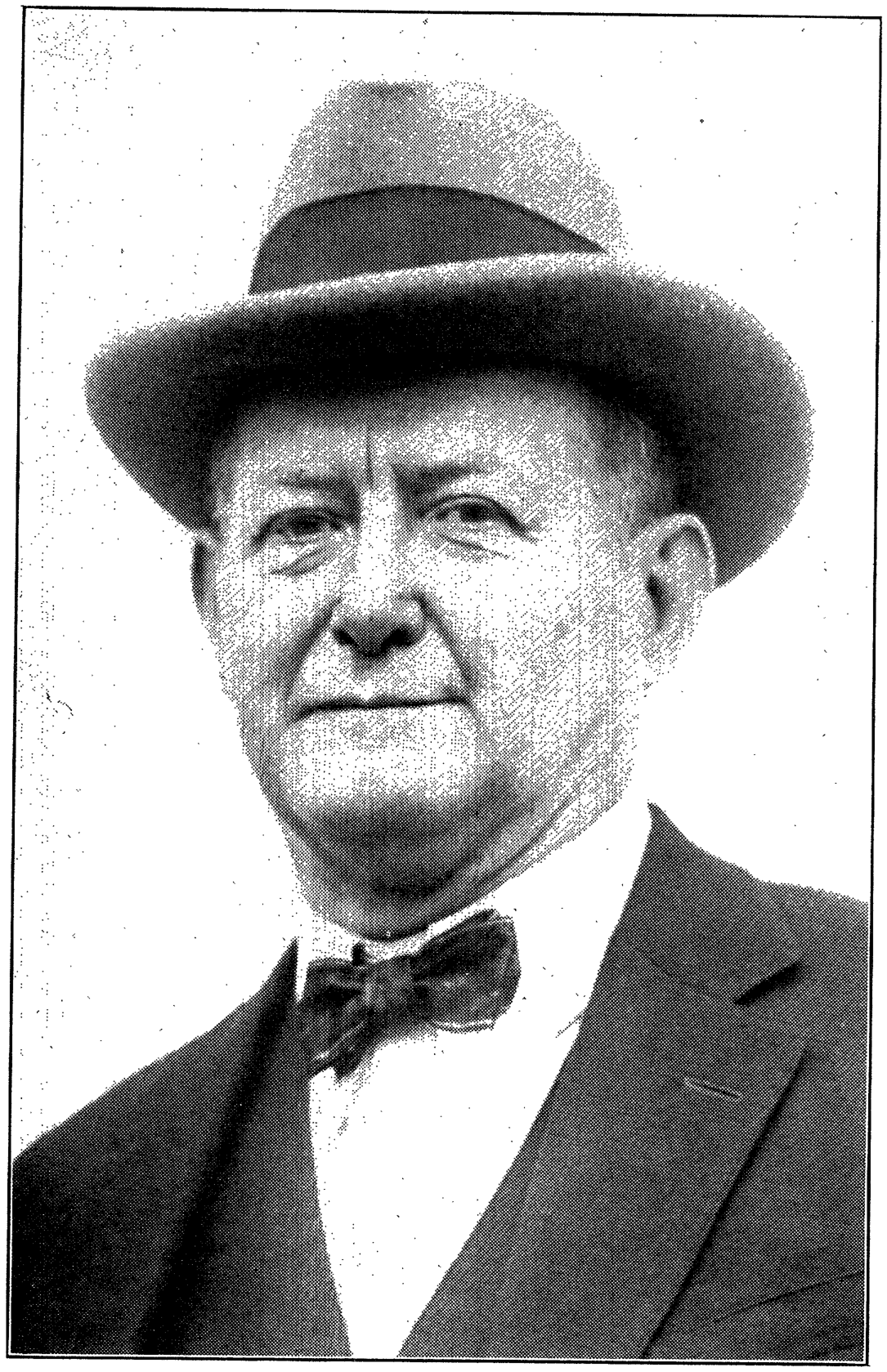
(plate; in the original facing p. 558)
From the official statement that he afterward issued, it was easy to see that, had it been possible for him, he would have freed Frank entirely; for in it there is found a remark that he hopes the public will in time also become convinced that Frank559is innocent. If that came to pass, Frank would sooner or later receive full justice.
The governor did not wish to make his pardon known on the spot, because there was a danger that a mob might try to break into the Tower and lynch Frank, or do so when he was being taken from there. He wished to give the sheriff time to outwit the bloodthirsty mass.
That Sunday (the 20th of June) Frank spent the entire day and evening in the Tower together with his wife and with his old parents, who had come to him from Brooklyn. The whole time they had no notion of what his fate would be. Only around half past eleven at night did they learn of it.
The hangman also did not know. And so he proceeded with his "work": the gallows already stood in its place, and in order to be sure that the rope would be strong enough, he tied to it a sack with two hundred pounds of sand. With this load it hung the entire day. It withstood the test.*)
Sheriff Mangum the governor let know his decision on Sunday during the day, and he, the sheriff, confided the secret to his deputies (helpers).
The sheriff had assured the governor that he had enough men and weapons to protect the Tower. But560who can know? More than one jail in the South had already been stormed by a mob.
The plan was therefore that Frank be taken out quietly and before the pardon became known. When the mass should learn of the governor's decision and begin to rage, Frank should already be behind the firm walls and bars of the state prison (a penal prison where convicted criminals are held), which is located in a town by the name of Milledgeville, about three hours' travel from Atlanta. There Frank was to remain for his whole life. Unless he should be freed.
A whole day, Sunday, there stood at the door of the Tower a group of reporters and correspondents from various newspapers of Atlanta and of other cities. In case Sheriff Mangum should receive a telephone call from the governor, it would be "hot stuff" for the newspapers.
A whole day and a whole evening, until two or three before dawn, they stood and waited. And meanwhile, while they had not taken their eyes off the main door, the sheriff with several deputies, around a quarter to twelve, "stole" Frank out through a side door.
Frank's face was almost entirely covered with a kerchief, so that he should look like a sick man; the sheriff and his under-sheriffs got into an ambulance with the "invalid."
In this way the pardoned prisoner was brought to the station (the railroad depot). The group attracted no attention. No one suspected who the "invalid" was. The group seated themselves in a railroad car. The train departed one minute past twelve. A quite ordinary "local train" that stops at every station. For more than two hours561it traveled before it reached Macon, Georgia. From there the company went on to Milledgeville, which lies about thirty miles from Macon.
In Milledgeville Sheriff Mangum handed over the famous prisoner to the warden of the state prison and received from him a receipt. When he had put the receipt away in his breast pocket, he breathed more easily. He admitted that he had been nervous the whole time.
A strong guard was set up around the prison, in case a dangerous mob should gather.
Frank did not sleep that night. How it was for him in his heart — joy at his rescued life, mixed with bitter thoughts about the sort of life that awaited him here, mixed with the hope that he might already have for his deliverance — that the reader can imagine for himself.
The news spread sometime before dawn. And soon it was confirmed. The morning papers that appeared that early hour already contained the official statement of Governor Slaton.
Quite early, even before it became fully light, a crowd began to gather in the streets. People bought the newspapers as fast as they appeared. It began to seethe. By the time the workers were already going to work or to business, a mass of several thousand had gathered around the City Hall (town hall), and several speeches were held. They attacked the governor. And some of the shouters threw in several curses and threats against the Jews.562There arrived a force of police, with several dozen mounted men among them. But they had received no instructions to take measures to keep the mob in check. They passed through the dense mass. That, however, was all. They did not say a single word.
The second great demonstration was held in a hall in the courthouse (the building where the courts are located). Bloodthirsty speeches were held against the governor. At the assembly, resolutions of condemnation against him were adopted. A mass of several thousand people then marched over to the Capitol (the building of the Georgia state government), where the residence of the governor is also located. But Slaton was not there.
There they again held speeches, also on the steps of the Capitol, and also inside, in the Senate hall.
Similar demonstrations took place in other parts of Georgia. A collection was opened to erect a monument to Mary Phagan.
In Marietta, the town where Mary Phagan was born, a huge "indignation meeting" was held, where bitter curses were heaped upon the governor. And then a huge effigy was made, tied to a telegraph pole, and to the figure was pinned a paper with the words "John M. Slaton, the King of the Jews and the murderer of Georgia."
Afterward the figure was burned on the public square.
In other towns similar things were done with figures of Slaton and Frank.
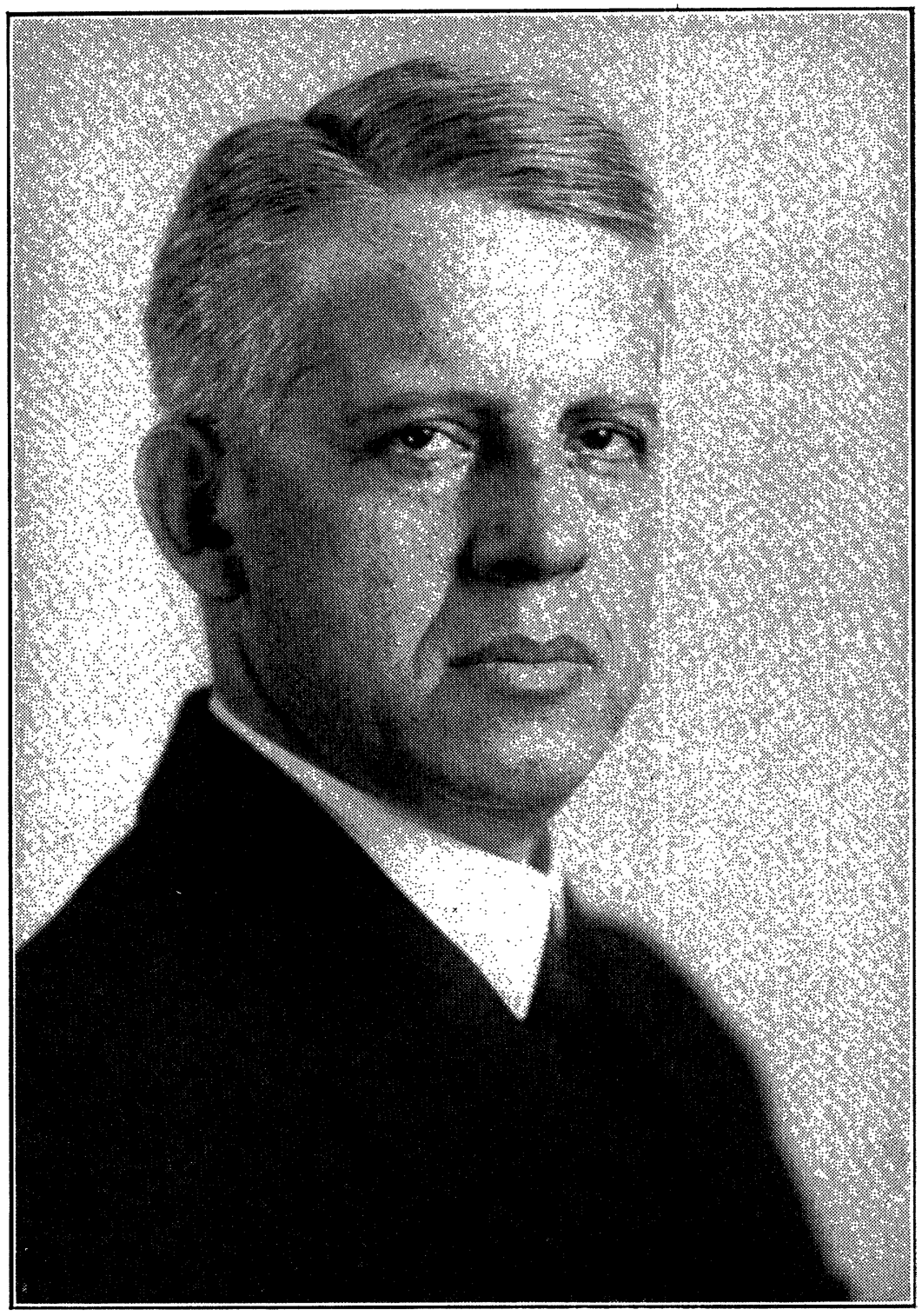
(plate; in the original facing p. 562)
Governor Slaton was then already at his summer residence, a few miles from Atlanta. There came a563crowd of a few thousand people. Before they reached the place it had become evening. They went along shouting: "Let John M. Slaton come out! Let the treacherous governor of Georgia come out!"
Among those gathered, several at his summer place, the newspapermen called out the name of the young Jewish lawyer Henry Alexander.
No soldiers were yet at the governor's house. Still, the mob did not dare to approach closely. The further it went, the bolder and wilder the mob became, but soon, around eleven o'clock in the evening, there arrived by automobiles a detachment of the fifth regiment of the National Guard (state militia).
The officers shouted to the crowd: "We give you five minutes' time to disperse." At the same moment the soldiers began to advance upon the mob with fixed bayonets. People from Marietta shouted to the crowd not to let themselves be frightened and to make for the governor's house. But the gleam of the bayonets had more effect. People scattered; still, while running, some of the mass threw stones at the soldiers. Several soldiers were lightly wounded, and one of the officers was seriously wounded. For this, however, the soldiers thrust their bayonets into several hooligan bodies. In the case of one fellow, a soldier split his head open with the broad side of his rifle.
Around twelve minutes past midnight everything became quiet. As an answer to questions from newspapermen, the governor then said:
"They may tear me to pieces. I know that I have done what is right. I know that I have pro564tected the honor of Georgia. Had I let Frank be hanged, I would have been a murderer. No, I do not want my conscience to be stained with blood."
The governor declared martial law over an area of half a mile around his summer residence.
Solicitor-General Dorsey published a statement in which he accused Governor Slaton of having granted Frank his life on account of a family reason: one of Frank's lawyers, Rosser, was the governor's partner — the chief lawyer of the law firm to which Governor Slaton belonged.
The accusation was that Slaton and all knew of it, Dorsey as well as others. It is ridiculous even for a minute to imagine that, on account of a few thousand dollars that his partner received for the trial, he, Slaton, risked his entire future. And not only his future, as the saying usually goes, but literally his life. We shall soon see from Governor Slaton's own statements how deeply he believed in Frank's innocence. The statement that accompanied his decision to "commute" Frank's sentence breathes with conviction and sincerity.
Governor Slaton was no radical. No advanced views on political and social questions could be ascribed to him. There was therefore no self-interest in his attitude toward the Frank case. In this case he acted like a most noble man.
565Together with Slaton's decision that Frank's death penalty be commuted, the governor's statement was also published, in which he explained why he had decided as he had. The statement was a fairly long one (it contained eleven thousand words, and in a Yiddish translation it would have taken up even more). In the great American newspapers the statement was printed almost in its entirety. In the "New York Times," for example, it took up more than a page and a half in very dense type. The explanation made a sensational impression all across America.
The governor went through the entire Frank case. He set out all the important details and several of the smaller ones, and it showed how alive he was to the conviction that Frank was not the murderer, and that Conley was the murderer.
"I have received more than a hundred thousand letters," says Governor Slaton in the introduction to his statement.
"They came to me from various states, all with a plea that I should not allow Frank's execution to take place. In Georgia itself I likewise received masses of letters, many with similar content, but many with a demand that I should not hinder the carrying out of the death sentence." Here the governor brings an excerpt from the Declaration of Independence,(*) that "one must have respect for the opinions of mankind." And then he says:566"Many newspapers and masses of individual people have sharply criticized our state of Georgia because Frank was sentenced to death. They have all declared that this was the result of such a condition that the mob dominated the court. They believe that it was not proven that Frank was guilty. People express the conviction that the judge and the jury were terrorized at the trial by the mob."
He passes over to the question of antisemitism. He declares that in Georgia there is no antisemitism.
"A Jewish family in Georgia is descended from the first white people who settled in Georgia at the time the colony was founded. Jews have been presidents of our school board (the administration of our schools); Jews have been mayors in our towns, and Jews occupy a high place in the business life of our state."
The governor continues his introduction for a few more lines, and then he comes to the Frank trial. He concerns himself with almost all the evidence and arguments with which the reader of this volume has become acquainted in the earlier chapters. He does this, however, often in an original manner. He says, for example:
Conley told the detectives that, in order to wrap the dead body of Mary Phagan, he took a crocus sack; but a crocus sack is too small for such a purpose. He then said that he had wrapped Mary's body in bed-cloth. Here he poses the question that we have already posed: How does bed-cloth come567to be in a pencil factory? Such an item was never to be found in the factory in question. But even granting this point of his: are we to say that Conley took a crocus sack, which was too narrow for the body? Well, yes, he then said he had cut it open and wrapped it in bed-cloth. Well, yes, this conflicts with the said wound that was found on Mary's head, a wound which could only have been made with a sharp instrument such as a small knife.
Speaking about the two "murder notes," the governor makes the following remark: the two notes contain 58 words. Conley swore that he had written them in two and a half minutes. But the detective said in his cross-examination testimony that when he dictated to Conley, in order to see his handwriting, the latter wrote so slowly that eight words took him six minutes.(*)
Governor Slaton dwells on the highly important question of the elevator. In order to convince himself thoroughly on this point, the governor visited the basement twice. Once together with Solicitor-General Dorsey and in the presence of Frank's lawyers, and a second time together with his (the governor's) secretary. Both times the elevator came down with a crash, striking against the bottom of the elevator shaft.568Governor Slaton thereby points to the following contradiction between Conley's accusation and the official report of the detectives and of the state's expert doctor, who had examined the dead body in the basement. Conley testified that when he came down with the elevator into the basement, he took the corpse up onto his shoulder and carried it to that place in the basement, not far from the back door. The official examination, however, showed that the body had been dragged across the floor, which was full of coal-dust and little pieces of coal. The face, from being dragged in this manner, had become scratched and smeared with black dust, and black dust was also found in the mouth and in the nose.
The governor gave special attention to the little letters that Conley, while sitting in prison, wrote to the negro girl Annie Maud. Since the handwriting in them was Conley's, and this was at once acknowledged, there could be no doubt that the little letters were from Conley. Now, the governor pointed to a whole series of expressions that they contained. "Highly indecent, lecherous words and phrases. The most indecent and disgusting lustful expressions that I have ever heard in my life." (It turns out that what Conley described as Frank's character is in truth only his own character.)
And the governor shows that the indecent words of Conley's that are addressed to Annie agree with the obscene expressions found in the "murder notes."
The governor also dwelt on indecent expressions, and not indecent ones, which Conley was accustomed to use, and on other characteristic ha-
569bits in his manner of speech. For example, he liked to repeat a certain word or idea in various ways. When he says "store," he will say the same thing about "story." In both notes, a high stack, a long stack; and several repeated expressions are present in the stenographic record of his testimony at the trial.
The solicitor-general made much of a few words found in the "murder notes." When Conley speaks of a negro, he writes that one needs "nigger," a word that is used by intelligent people. The governor finds the word "nigger" three times. Another thing: the negro does not say "I done" instead of "I did" (I have done). "I did" is a grammatical form for a writer like Conley. Now, the governor shows that precisely such words as "nigger" and "did" are found often in the little letters that Conley wrote to the negro girl. It is well known that negroes are particularly fond of using "colored" words, often saying such things whose meaning does not match the first one they understand—[...] It is therefore no wonder that Conley should use "nigger" and "did." And this is seen from his manner of speech at the trial. In the official stenographic report of Conley's testimony at the trial the word "did" is found fifty times.
To the points made by Frank's lawyers concerning the elevator and the little letters that the negro girl received from Conley, Governor Slaton lends great weight. He sees in them, however, a convincing proof that the murder notes—that Frank had written them himself, that Frank wrote the murder notes, that Frank did not dictate them to him.
Likewise, the governor lends much weight to the story of the few hairs which the solicitor-general
570made so much of. Dr. Harris spoke about these hairs, and the governor took apart the "proofs" that the solicitor-general had drawn from these few hairs. These three points—concerning the elevator, Conley's little letters to Annie, and Dr. Harris's opinion about the seven hairs—Governor Slaton establishes with complete clarity.
Governor Slaton devotes several dozen lines to the proof that "murder note number 1" was written on a carbon copy of one of Becker's old orders (see above, page 499). His explanation refers, among other things, to the printed part of the date found on the note. This was "190." And this is an outdated date:
Governor Slaton says:
"By the time Becker had left the pencil factory, the order blanks marked '190' had already run out, and they had brought blanks on which was printed '191.'* Becker made an affidavit after the murder,571that before his departure from Atlanta he had with his own hands gathered together all the carbon copies of the orders that had already been filled and were useless, and he sent them down into the basement so that they should be burned there. Whether his order was carried out he did not know.
"As an answer to this, the solicitor-general, at the extraordinary motion for a new trial (before Judge Hill), submitted an affidavit from Philip Chambers (a boy who had worked in Frank's office, but who in the basement had been connected with the factory). Chambers swears that unused order blanks on which was printed 'Atlanta, Georgia, 191' were found in a cabinet near Frank's office, and that he, Chambers, had visited the basement, and that old paper and blanks or separate sheets never remained lying there. They were burned."
After the governor brings this statement of Chambers's, he says:
"The proof that the note was written on a carbon copy of an order is a strong confirmation of the defense's theory that the murder notes were written in Frank's office, and not in the basement. This becomes especially strong when one adds the report of the policemen who visited the basement Sunday morning, after the murder had been discovered. Police-sergeant Dobbs reported that the paper (from which it was assumed that the sheet for note 'number 2' had been taken) was lying near the two murder notes. They all lay close together. Near the spot where the girl's hat was found there was a heap of trash, and there too lay paper and pencils. (And another policeman reported something similar.)
572Here the governor brings the words of Jerry Frank's affidavit:—
"I saw all kinds of papers in the basement," Jerry declared. "Such paper (like the carbon copy of an order) can be found throughout the entire building of the factory." And here is the reason for this: when one writes out an order, it sometimes happens that the carbon paper is not placed underneath as it should be, or that one changes the order entirely. Then one throws the copy away; one takes another copy, and the first one goes into the trash.
Chambers's statement the governor leaves without comment. He does not consider it very important. In the first place, Chambers says that near Frank's office there were found order blanks with the figures "191," not the old blanks with the figures "190" that appear on note "number 1." And this agrees with what Becker said. The blanks that were found there were not used ones, and note number 1 was, after all, written on a used copy. As for the question of burning old books and papers, Chambers's statement has no value whatsoever. A part was from time to time burned. Old papers were always around. They all testified that there was always trash in the basement. If everything had been burned at once, there would have been no trash. And not single papers were lying about there, but whole quantities. Indeed, the detectives found such papers there, including paper. And Jerry's explanation about the papers that are swept out as refuse makes everything clear.
The most important thing, however, which the governor especially underscores, is the report of police-sergeant573Dobbs that the paper lay near the notes—the paper which the prosecution adduced as a supposed proof that note number 2 was written in the basement, near the place where the hair was, and which therefore means that note number 1 was also written there. For "number 2" is, after all, a continuation of "number 1," and they were written together, in one piece, with the same pencil and on the same sheet.
Speaking about the back door of the basement, the governor remarks: "Through this door Conley used to leave the factory, in order to avoid the workers to whom he owed money."
This is, first, a trait of Conley's character; second, an indication that he used to drink up his earnings; and, third, a proof that after the murder the murderer went out through this back door, for the door was found open and the latch broken off.
The governor describes how Mary Phagan went back from Frank's office with the bit of wages she had received from him. He shows that she had to pass by Conley, for he was sitting in his dark, hidden place near the stairs by which she came down. To avoid him would have been impossible for her. From the governor's description the reader already pictures for himself the terrible scene that then took place there.
One of the strongest passages in Governor Slaton's statement consists of a few lines in which it is shown how the newspaper reports magnified the case against Frank. People read, for example, that574Frank had made the girl an indecent proposal, that she had refused him, and that he had therefore murdered her. One can easily imagine how aroused the public became at all this.
The most important and most impressive part of Governor Slaton's statement is that in which he speaks about Judge L. S. Roan, who conducted Frank's trial, and who was now already dead. It is needless to say that he dwells on the fact that Judge Roan himself had doubted Frank's guilt. He says that Judge Roan had wrongly understood his duties and rights. He thought that the fact that he doubted Frank's guilt was not important; that what was important was only that the jury had the conviction that he was guilty; and this is an entirely false conception of the law.
For this reason alone the whole case that he had put together against Frank is characterized as a case built on "circumstantial evidence" (not direct proofs but indirect ones, side facts from which one infers that the accused committed the crime). Now, the law in Georgia says that if a case of "circumstantial evidence" brings the jury to a verdict of guilt, but the judge does not believe it, and the proofs are not convincing, then the judge has the right to set aside the verdict and to order a new trial.
Such a case occurred in Georgia some time ago. A judge by the name of [name] set aside the verdict in a matter that concerned money. In doing so he made a remark that—575"In the state of Georgia it is required that thirteen men be in agreement before one takes away from anyone his property." This means not only the twelve jurymen, but the judge as well. Now, if this is so when it is merely a matter of money, then this principle must surely apply when it is a matter of taking away from a person his life.
Therefore, says Governor Slaton, Judge Roan ought to have set the verdict aside, and he had the right to set it aside. He knew that Frank should have a new trial.
"But the crowds raging around the court took his courage from him. Perhaps he believed that the higher court would in any case grant Frank a new trial."
"Judge Roan fell ill," the governor stated, "and when the time came that he believed his case would have to appear before a higher judge, before God, his conscience compelled him, and he wrote the letter to the lawyers. From this letter we see that he intended to appear before the prison commission and ask that Frank be pardoned. But he did not live to do it, and now I hear his voice from the other world, telling me to do what he had to do.
"I can endure having my name dragged through the mire," the governor continues. "I can endure contempt and mockery. But the painful awareness of a conscience that should accuse me—that I cannot endure.
"This case is full of signs of doubt." The trial judge doubted, two judges of the Supreme Court of Georgia doubted, two judges
576of the Supreme Court of the United States doubted, and one member of the prison commission doubted."
The press of all America, outside the South, received Slaton's decision with expressions of the highest satisfaction and with the warmest compliments. A hope was thereby expressed that Frank would finally become entirely free. And even in the South, even in Georgia, a goodly number of the newspapers also spoke of Governor Slaton's step in a tone of warm satisfaction.
That Jews rejoiced is needless to say. American newspapers sent reporters to Louis Marshall for an interview about the matter, and he gave them a long statement. With words of joy he spoke of Frank's rescue, and Governor Slaton he warmly congratulated for his brave deed. He also spoke about the arguments and the closing speech of Solicitor-General Dorsey, who had obtained from the jury the verdict of "guilty." About the "proofs" against Frank he spoke with bitterness and scorn.
The morning after the governor had pardoned Frank, a movement began in Marietta to577boycott the Jews. In the morning, when people had risen from sleep, they found Jewish houses and stores pasted over with warnings that they should not buy at Jewish businesses in Marietta. Boycott cards were distributed among Christians. Even on these cards it was not stated openly that Jews were meant. But it was clear enough.
"Carry these cards in your pocket," it was written there. "Before you buy anything, consider whether the money you are about to spend will not go to help support a [name]. Now is the time to know whether true American blood flows in your veins. Do you therefore buy your clothes and other articles from Americans? Do your duty!"
In Marietta, in the middle of the night, a group of masked hooligans attacked a Jewish house and dragged from his bed a Jew by the name of J. Rosenthal. Dragging and beating him, they cried:
"Not a single Jew may remain in Marietta!" Rosenthal was taken to the hospital in an unconscious condition.
John M. Slaton's term as governor came to an end on Saturday, June 26, four days after he had pardoned Frank. To the ceremony, when he was to hand over his office to the new governor, a great crowd gathered from all parts of the state. Everyone understood that what was meant was not the ceremony, but a plan to make a scandal against Slaton, and perhaps simply a bloody assault. But two regiments of the militia arrived. And everything passed off quietly.
578The sensation and notoriety that gathered around Frank's execution came about thanks to Tom Watson, a fire-spitting demagogue who played a role ostensibly as a radical and a friend of the masses, and who as such was known all over America.
Watson was a capable man, a good writer and speaker. His three thick volumes—one volume on the most important causes and history of France before the revolution, a second a history of the French Revolution, and a third a history of Napoleon the First—are the best popular works that were written on these subjects in America.
To protest movements and attacks he probably had an inclination by nature. This accorded with his fiery temperament. But he was by nature a conscienceless demagogue. When his personal interests were at stake, he stopped at no means. In politics he had joined the People's Party, and on its ticket he was at one point elected as one of the two United States senators from Georgia.
He published a weekly with the name "The Jeffersonian." It did not have any great success. So he sensed that to agitate against Frank and demand his execution was a good means of gaining readers. This means he adopted, and he was not mistaken: the circulation of the weekly began to grow as if by leaps. Then, in his unlawful attacks on Frank and on Governor Slaton (for which
579he had let Frank live) he poured in still more dynamite. Every line of his he soaked with bloodthirstiness. About Governor Slaton he wrote that he had set aside Frank's death sentence because he had a personal interest in it, and Frank he smeared not only as an immoral man and a murderer, but also as a capitalist. His "radicalism" and "democratic feeling toward the masses" took, in regard to Frank, a strange form. Pretending to cry out that the pencil factory had brutally exploited its workers as "factory tyrants" and "descendants of slave-owners," as thousands of whites had expressed themselves in their pent-up hearts, this cunning demagogue, in keeping with his pretended friendship for poor people, shed crocodile tears over the fourteen-year-old girl who had earned a pittance from the "Jewish exploiter."
Watson of course knew that the pencil factory belonged only to Frank's uncle and his deputy. He knew that Frank earned only fourteen dollars a week, that he had very few shares in the factory, and that his income from them was a trifle. He earned fourteen dollars, worked like every other worker. But he made himself out as not knowing this.
He was a fervent devourer of socialists, this demagogue. Yet in his anti-Frank agitation he brought in the socialist class struggle. He felt that this was effective material for his brimstone-and-pitch baiting of Frank. And into this raging class-hatred he mixed a healthy dose of shameless antisemitism. The Jews were only good at making money, at robbing workers; they were a depraved people, and Frank,580the Jewish exploiter, Frank, the Jewish libertine, had out of his vile lust murdered the girl who had baked her bread in slave labor for him... It was in this vein that he framed his attack-material, as one would have done with them in Russia. And the circulation of his weekly grew and grew.
One of Watson's arguments was that the South has chivalrous feelings toward woman, that Frank's crime was a double murder. Here is one of his contentions, word for word, as he wrote it:
"This filthy, unnatural, dissolute New York Jew pursued our girl, brought her to a loathsome death and into a bloody grave."
Frank was now confined in the state prison for life, and one would think he could now rest in peace. But Watson's circulation-appetite was not at rest. The more readers he gained, the wilder grew the attacks he made on his victim.
Watson's agitation brought bloody results. The first of them consisted in the following:
A murderer by the name of Creen, who had been sentenced to life imprisonment and was in the same prison with Frank, drove a butcher's cleaver into his throat. In doing so the "chivalrous" hooligan reviled and cursed Frank for having murdered a woman (the cleaver-wielding hero himself had killed a man). In his hooligan deed he was acting under the influence of Watson's agitation.
Frank was bathed in blood, and for several weeks he lay in the prison hospital, on the threshold of death. But he finally came out of danger.
581A few more weeks passed. It was the middle of August, 1915. My wife and I had gone away on our vacation. One afternoon, the 16th of August, we were traveling on a train through the White Mountains, in New Hampshire. At a certain station we got out of our car to take a stroll on the platform. As we were about to go back into the car, we heard from a distance that extras of afternoon newspapers were being sold. My wife ran over to the peddler and hastily bought a couple.
We returned to our car.
"What is the extra about?" I asked.
"It's nothing," she answered, folding the sheets so that the big "headlines" came on the inside.
I suspected that it was some unpleasant news. At first she denied it. But finally she let me see the Frank story.
"Leo Frank Kidnapped" stood in the largest letters.
It was reported that men with masks on their faces had broken into the Milledgeville prison and carried him off from there. More details were not yet available. One had to imagine what it meant. We were terribly frightened. She wanted to leave the train and talk about the dreadful news. At a further station I saw on the platform Dr. Nostir, a sympathetic Jew, an educated man and idealist, who had been active in the Henry George movement. We were
582acquainted; so I hurried over to him. He too had read the extra. But about the tragedy he knew no more than we did.
We waited at a station. Then the morning papers gave us further details.
A few minutes after twelve at night, twenty-five men entered the prison, each with a mask on his face and each with a weapon hanging from him. Five of them, with pistols in their hands, surrounded a group of the chief officials, and another five did the same with the head of the guards. The remaining fifteen overpowered the guard with weapons. Then they went into the hospital, where Frank was, and dragged out the captain of the guards.
The place where they took their victim was a hundred miles (some ninety versts) from the prison, but not far from Marietta, the town where Mary Phagan had been born, and where her grandmother still lived at that time (see page 364).
All that the American newspapers found out was that the lynchers were all from that583town. They had wanted their victim near the birthplace of the murdered girl. Therefore they brought him to that little wood.
When the innocent, sympathetic young man was already dead, his murderers tore off the sleeve of his shirt, and each of them took a piece as a keepsake. Then they went away, leaving the body hanging.
Around his eyes a white handkerchief was tied; the hands were bound together; the rope was fastened around the neck, somewhat higher than the place where the lifer Creen had earlier cut Frank with the cleaver. The lower part of his body was wrapped in a sack, and the sack was bound with a rope, but the crowds that gathered around the gallows and the hanging corpse cut the rope, and people took a piece as a memento and a charm for long life.
When the body was discovered, it was still quite early. Yet a goodly number of people soon gathered around the tree, and the crowd grew quickly. Among those assembled were women with babies in their arms. Some of them could not bear to look at the hanged man; it was terrible to see. Others, on the contrary, pressed in closer in order to observe him well.
The crowd grew larger with every minute. From the town of Marietta, men, women, and children came to see Frank's body, and from the surrounding little towns as well. The news spread like lightning, and from all sides people drove to the shed where the lynchers had done their gruesome work. Along the roads584stretched rows of automobiles, bicycles, wagons, and pedestrians.
The mob grew wilder with every minute. Especially distinguished was one of the very first who had come running from Marietta. Without a hat and without a coat he stood, gripped by fury, raising a constant reviling and cursing of the dead man. His shouts and curses fell upon the others, and many of those assembled repeated his cries after him, as one says a prayer after a priest.
"We will tear you to pieces!" he ranted. "We will not allow a gravestone to be set up over your grave! There will be nothing to set it up for. Not a whole bone will remain in your body, not a scrap of flesh will we leave of you. Not even one as big as a finger!"
"Yes, like a finger!" the mob repeated, pressing ever closer to the tree.
A few more minutes and they would indeed have torn the body to pieces. But one of those standing nearby, a certain judge, held them back from it. He appealed to them not to desecrate the corpse. At first his words took effect. But when the body had been taken down from the tree, one of the mob ran up and with his boot, with all his might, trod upon the dead man until he had crushed the face entirely.
The trampled corpse was carried away to Atlanta.
Frank's body was brought to Brooklyn. There he was buried in a Jewish cemetery (bes-oylem). Present at the burial were only
585Leo Frank's mother, his wife, and a few close relatives. Everything took place in the middle of the night and in secret, in order to avoid a demonstration. Had it been known when and where the last ceremony would take place, a crowd of tens of thousands of Jews would have come.
From the cemetery Frank's widow went with her mother-in-law to 152 Underhill Avenue, Brooklyn. There lived the old couple, the parents of the unfortunate Leo M. Frank.
Who the murderers were was never discovered, although all of Marietta knew well each of the twenty-five lynchers. They were well-known men in the town, and not only did the other inhabitants of Marietta not give them up, but they were ready to defend them with weapons in case anyone should try to take them.
Tom Watson applauded the lynching. With an allusion to the "Jewish fund," he wrote:
"The Jews of Atlanta, New York, and Chicago did not allow their Frank to be hanged 'lawfully.' There was therefore no other choice but to dispose of him in another manner."
Three weeks after the lynchers had murdered Frank, on the 12th of September, the "Augusta Chronicle," a newspaper that appeared in Augusta, Georgia, contained a sensational article about the tragic fate of the young Brooklyn man. The article bore the signature of Thomas Loveless, the e586ditor, and its content was a sharp attack on the lynchers and on those who had incited them to their savage deed. Loveless chiefly attacked Tom Watson for the agitation that he had carried on in his "Jeffersonian" against Frank and against Slaton.
The article took up three columns.
"My task is to tear off the mask of Tom Watson," Loveless wrote. "I will prove that the former governor, John M. Slaton,*) acted rightly when he commuted Frank's death penalty to life imprisonment."
He went on to say that he knew how Watson would attack him, befoul him, and persecute him. But that "someone must tell the man that he will not be allowed to go on inciting to unrest and murder.
"I am well acquainted with the whole case, with all its details," Loveless says further. "Also well known to me is Watson's past."
He shows how Watson always takes an opportunity, on every other587Loveless mentions the masses of citizens of Georgia, over ten thousand, who had begged Governor Slaton to set aside Frank's death penalty, and he reprints several letters that important persons had written to the governor. One of those who urged that Frank not be hanged was Foreman, the foreman of Dorsey's jury. (He had two foremen, one of whom was a Jew, as has already been mentioned above. The other was a Christian.) In his letter to the governor the foreman declared that Frank's guilt was not beyond doubt, that the proofs against him were too weak, and that one ought not to hang him. A similar letter Loveless brought from people who, fearing for their lives, felt their consciences too troubled.
Especially interesting is the part of Loveless's article that referred to a letter that Governor Slaton had received from the brother of Judge Roan, the judge who had conducted Frank's trial and sentenced him to death. He too urged the governor not to allow Frank to be executed.
This letter Judge Roan had written while ill, and by the time Governor Slaton commuted Frank's sentence, Judge Roan was already dead. It was clear that his conscience had tormented him, and feeling himself near the end of his life, he wished to relieve his conscience.
Watson—just like Dorsey—had cried out that Roan's letter was a forgery. This thesis Loveless condemned with indignation in his article of the 12th of September, and he brought statements from people who had been present when Judge Roan dictated the letter and signed it.
Remarkably interesting is also the following fact,588which Loveless underlined in his article: Judge Hill, the judge who had taken over Roan's trial and who had also denied Frank a new trial and had set a new day on which he was to be hanged—he afterwards begged Governor Slaton to let Frank live.
Among the prominent persons of Georgia who had demanded that Frank not be hanged was Mrs. Slaton. So Loveless mentioned in his article, and he thereby pointed out that she was a sister of the former governor Brown, who had demanded that Frank's death should indeed be carried out.
Characteristic is a certain fact which the editor Loveless pointed to as a proof that Tom Watson was not sincere in his agitation. As we have already indicated, Tom Watson played, in his demagogic articles, upon the local patriotism in the South, upon the pride with which its white citizens speak of their chivalry and tenderness toward woman. Now, Mr. Loveless related that some time earlier this same Tom Watson had urged a former governor to spare the life of a murderer whose victim was also a woman. That murderer was a personal friend of Watson's, and so he then made nothing of the matter. But now, when that same matter served his purpose for circulation, he ranted about why Frank had not been hanged.
In Marietta it was at that time dangerous for a stranger to walk across the street. Thousands of eyes scanned him with bloodlust. Perhaps he is a detective seeking those who had hanged Frank. Actually, the popu589lation had no one to fear, for the police of their town and of the whole region around sympathized with them.
The mayor of Atlanta happened at that time to be in San Francisco, where he visited an exposition, and there, before reporters, he made a statement in which he approved the lynching of Leo Frank.
Frank's wedding ring was afterwards given by someone to a writer for an Atlanta newspaper who lived in Marietta. A mysterious messenger—perhaps one of the lynchers—brought the ring to the journalist's house. He handed it to him together with a note on which stood the following:
"Frank's last wish, when he had death before his eyes, was that his wedding ring should be given to his wife. Be so good as to see that this wish of his is fulfilled. This note will also be given to you by a man whom you do not know and who also does not know you. You must not try to find out who this man is. Destroy this note at once, as soon as you have read it through. We expect that you will do so."
At the beginning of the "Frank Drama," where we spoke about the aristocratic descent of the Marietta people, we said that they boasted greatly of chivalrous honor and of [...] In this chivalrous spirit the murderers fulfilled Frank's last wish. They regarded it, without a doubt, as a fine bit of their cavalier culture.
590In the "Jewish Year Book"—an American yearbook that a certain society publishes among other things—the Frank case was never mentioned.
The editorial board considered the case from the standpoint of: was it a Jewish affair like Frank's? It was convinced that one could not count it together with the affairs that arise from antisemitism. When, on the ground of Frank's blood, demagogues and the mob raged against Frank as a Jew and his own people made a great outcry over a boycott called against all Jews and threatened with a [fund], this was only a temporary incident that arose from the agitation—so the editorial board of the "Year Book" presumably argued.
Louis Marshall was the chairman of the Jewish Publication Society, the society that publishes the "Jewish Year Book."
About fifteen years after these lines were written, on the 21st of July, 1930, the "Forverts" printed a dispatch from Atlanta, which carried with it an echo of the Frank tragedy. The former governor of Georgia, John M. Slaton, who for the whole fifteen years had been withdrawn and had not taken part in political life, had now made an attempt to come forward again as a candidate for an important office—namely, for member of Georgia in the Senate of the United States. The first three or four
591years after he had pardoned Frank, he had even avoided showing himself on the street. His life was in danger; to mix in public affairs he could not afford for a long time.
Now, then, when fifteen years had already passed, he attempted to show himself again on the field of political ambition.
From various parts of the state he was then called upon to explain why he had pardoned Frank. To this he answered with a speech on the radio.
"I only fulfilled my duty," he said: "the duty that the constitution and the laws of our state laid upon me. I acted according to my honest opinion; had I not acted so, I could not have maintained my self-respect and would have had no right to the respect of others.
"The judge who conducted Frank's trial recommended to me that the death sentence be commuted to imprisonment, on the ground that he himself doubted that Frank was guilty. I had no right to take upon myself a role that belongs only to God alone; I mean the role of looking into the heart of a man who had confessed that he was a manifold liar, and of determining when he had lied and when, and when he had told the truth. I know of no case where any government has taken upon itself the responsibility for the execution of a man when the trial judge asks that he be allowed to live.
"The path of my duty is not always an easy one. Had I followed those who advised me to play politics in this question, where the life of a man was592weighed on the scales, I would have avoided ill feeling and slander. But then I would not have been worthy to stand before you. I would not be able to look you straight in the eyes with a clear conscience, as I do now.
"Between Frank and the certain man in whose guilt I had strongly doubted, namely Conley, whose guilt had made a deep impression on me, I took Frank's side, and I sentenced him to imprisonment for his whole life.
"This is the Frank case."
Hardwick, Slaton's opposing candidate for senator, attacked him with fiery speeches, all about the "impudence" that he had had in 1915 to spare Frank's life. He knew that this was the best campaign material in Atlanta.
Slaton had no prospects whatever, and the final result confirmed this. He received 46 thousand votes and his opponent 162 thousand votes, three and a half times more.*)593Among the masses of Georgia, Slaton's brave deed had made him permanently unpopular as well. His political career is, as it seems, closed.
But one cannot make light of the 46 thousand citizens who voted for Slaton. One must not forget that this is the South, the region where a year earlier (in the state of Alabama, next to Georgia) a schoolteacher was convicted as a criminal for having explained in his class the "Epicurean" Darwinian theory. When one bears such things in mind, the 46 thousand persons who had enough intelligence and courage to vote for Slaton are quite a fine minority.
What of Frank's widow, the beautiful, sympathetic woman whom I used to find beside him in his cell, every time I visited him?
As these words are being written, she leads a quiet, withdrawn life. She lives in Atlanta, as always, and she is connected with a business that belongs to a close relative of hers. So she makes a living. She has not remarried. The memory of her dearly beloved Leo is sacred to her.
That Judge Roan, Frank's trial judge, died a short time after the trial, the reader already knows. He ended his life in Berkshire, Massachusetts, where he had gone to refresh himself. In certain circles a view was spread that his death was, at least in part, a result of the heavy pangs of conscience that he
594had, for having sentenced Frank to death.
A short time later there also died Frank's lawyer, Rosser, Slaton's former partner, the very fact that Dorsey and Tom Watson had held up as the reason why Slaton pardoned Frank. The circumstances of the trial had a heavy effect upon Slaton's conscience.
Dorsey, after the trial, was rewarded with a candidacy and election to Slaton's place as governor of Georgia. Usually a governor there is elected for a two-term tenure. Dorsey, however, did not succeed in being elected a second time. The cause of this was the fact that as governor he had shown too little capacity. (And this agrees with what I have shown about him: that as Georgia's [solicitor] he had shown himself, in the Frank case, exerting all his powers in order to better his further political prospects.)
He tried to practice law. But he had no success. He tried to "run" for United States senator, and failed. His private practice did not improve; so he was finally given a job as one of the judges in the "City Court"—a judicial post of an unimportant grade. One hears so little of him that my Atlanta friend, who supplied me with this information, could scarcely find out what his occupation is now.
The National Pencil Factory went under. Soon after Frank was hanged, it lost its appeal. Sigmund Mont[ag], the active proprietor of the factory, still carries on his old business today, however: he manufactures various writing595articles, pencils included. Perhaps he has a pencil factory elsewhere.
Tom Watson died in 1922.
How do things stand in Atlanta today with antisemitism? Did the Frank case leave its mark on the city in this respect?
I addressed this question to several friends and acquaintances who live in Georgia, people of various callings and of various backgrounds. Here is the sum total that I draw from all the answers I received:
The sharp forms of antisemitism that showed themselves in the dramatic days surrounding the Frank affair have long since passed away. The relations between Jews and Christians are in general no worse than they were before the Frank case.
Characteristic is the cautious answer that I received from an American Jew in Atlanta: "There is no more antisemitism felt here than in other parts of the United States."
End of the Fifth Volume.
Notes (footnotes from the original)
[p. 349] *) A "case," a proceeding. It means the entire proceeding, on both sides. The word is, however, also used regarding each side separately. One says, for example: "The prosecution finished with its case, and the defense began its own"; or: "The lawyers have a strong case," for instance.
[p. 352] "South" means south in English. Here the word means specifically the southern part of the United States. "North" means north — the northern part of the United States. "Southerner" (so the word is roughly pronounced) means a white person of the South.
[p. 353] When a Russian peasant was a serf to a Russian landowner, the two of them were both of the same human race, of the same color, of the same appearance. Quite otherwise was the difference between the white "lord" and his Negro slave. The former looked upon the latter literally as upon a beast. The question of white and black therefore played an enormous role.
[p. 356] Somewhat later a change began to develop in this. The South, at least in certain parts of it, began to build industry. There an enterprising spirit began to be felt. Active people moved there from the North, and together with them the inhabitants of certain Southern regions also became active.
[p. 357] *) Places where money is lent on pledges.
[p. 360] *) The empty space or "shaft" through which an elevator (lift) moves up and down, from above downward and from below upward.
[p. 361] *) "Negro" is "Negro" in English. The word "nigger" instead of "Negro" expresses contempt. So Americans speak of a black person in their ordinary language. But so the blacks too mostly speak of themselves. When a Southerner speaks to a black, he calls him "nigger." And he pronounces the word with the tone of a master to a servant, unless he knows him well. Then he calls him by his name.
[p. 363] *) In the metal department they made the metal rims of the pencils, where the piece of rubber (gum) is set in that serves as an eraser.
[p. 366] The name is F-r-a-n-k, and so it is written in English too. In English, however, it is pronounced "Frenk," and so the name is pronounced in American Yiddish.
[p. 368] "Mob" means a mass of people, chiefly undeveloped ones, a multitude. Specifically it refers to an agitated multitude. The psychology of the individual no longer exists. No one thinks for himself, feels for himself, acts for himself. There is no logic, no "I," there is only a "we," a collective craving, a wild collective rage and hunger for revenge. In a mob every individual is a demagogue. He jumps out of his skin to show that he burns with the general flame.
[p. 376] *) The American game of ball.
[p. 377] *) A well-known firm of private detectives, which has branches throughout all of America.
[p. 384] *) An elected official whose duty is to determine whether a person who has died an unnatural death is the victim of a murder.
[p. 399] *) An assertion, a declaration, a communication; a formal answer to a question; everything that one says, relates or declares, whether it contains a fact, a denial, an assurance, a wish, an opinion, a thought, a feeling, and so forth.
[p. 402] *) 24 jurors, who consider whether a trial can be begun against an accused. If so, they issue an "indictment" (act of accusation), and the case goes to court.
[p. 407] *) Connolly afterward reprinted his articles in a small book, a brilliant work, the best that exists about the case in the English language.
[p. 408] *) Here is meant the lower story, which is either level with the street, or a bit higher, up a few steps. In New York this is usually called the "ground floor," and what is here designated as the "second floor" is called in New York Yiddish the "first floor."
[p. 424] *) The door at the front, through which one used to reach the ladder that led to the basement.
[p. 437] *) A day of thanksgiving, an American non-religious holiday, which is celebrated on the last Thursday in November.
[p. 457] (*) "Court" means the tribunal and "court-room" — the court hall.
[p. 465] *) The republic that the South founded when it seceded from the United States in 1861 was called the "Confederate States," and its army, which fought in that war, is known as the "Confederate Army."
[p. 483] *) An important elected official over a county (a district, a part of a state), whose duty it is to carry out the sentence that a judge hands down. In Atlanta the sheriff is also the master over the prisons (jails).
[p. 493] *) In the Northern states, chiefly in New York, there is a word "sheeny," which is used, just like the Russian word "zhid," as an expression of contempt for a Jew. In the South this word is not used (and in England it is not used either).
[p. 497] *) He testified that on the Saturday of the murder he saw Frank in his office and spoke with him at half past twelve. The time when, according to Conley's assertion, he (Conley) and Frank carried the body down into the cellar.
[p. 499] *) Becker was then living in Irvington, New Jersey, not far from New York. To the New York newspaper reporters who visited him, he confirmed everything. He also said the following: "I know Frank quite well. He is a most decent and good man. When I heard that he had been arrested, I wrote to him and expressed my indignation and my conviction that he would be free. To accuse him of the murder is ridiculous."
[p. 502] *) While I was working on this part of the 5th volume of "Pages," that is, sixteen years later, I renewed my acquaintance with him by letter, and he was
[p. 503] kindly enough assisted me in answering a series of questions, with explanations and with important materials. Thanks to his support, several difficulties that had earlier stood in my way were removed.
[p. 535] *) To Mr. Merlin a warm thanks is due from me also for the help that he so willingly gave me now, in the preparation of this "Frank Drama."
[p. 545] *) For the non-American reader the following explanation is perhaps required here: Each state has its own constitution and its own laws. The United States — that is, all of them together as one whole country — has its constitution, and the constitutions and laws of the individual states may not go against it. The federal government, that is the government of the United States, may not interfere in the laws and in the trials of the individual states, unless they break its federal constitution, the country's constitution, the Constitution of the United States. A point of this federal constitution says that every citizen has a "right to life, liberty, and due process of law." (That is, to a proper, fair, lawful trial.) When in a state a citizen is sentenced to death and it can be shown that he has not had "due process of law," the Supreme Court of the United States has a right to interfere, to annul the death sentence and to declare the whole trial invalid. Then the state in question must grant the accused a new trial. Each state holds its independence dear, and the federal courts are not eager to interfere in trials that take place in the state courts. (There are special questions over which the United States courts always have a say in the individual states, and with which the individual states do not concern themselves at all. But that does not belong to our matter. We are speaking here of those affairs over which each state has its own laws and its courts conduct trials. In such affairs the United States courts seldom interfere. They seek to avoid it, unless the federal constitution has been broken.)
[p. 548] (*) This is, properly speaking, an ironic expression. It means the rule of lawlessness, of a murderous mob.
[p. 550] (*) That is, the governor.
[p. 555] *) As we shall see further on, this sort of agitation was conducted especially by Tom Watson, a famous demagogue who mixed venomous antisemitism with a sham radicalism. But Dr. Wilmer knew nothing of such shameful things. His church was an aristocratic one (the wife of Governor Slaton, who was very rich, was a member of his congregation). He was a conservative man, Dr. Wilmer, but a man with a noble, feeling character. From the Frank case he suffered genuine torment as a human being and as a citizen. It was painful for him to imagine that the city of Atlanta should commit such a bloody injustice. He worked for Frank tirelessly.
[p. 559] *) When it became known that the gallows would not have Frank for a victim, it was not taken apart. There was another offering for it: a Negro who had been sentenced to death for a murder. His execution was fixed for the 16th of July. And then he was indeed hanged on the gallows that had been prepared for Frank.
[p. 565] The Declaration of Independence, the document in which the thirteen American colonies declared themselves independent of the English government in 1776. In the his-
[p. 566] tory of the United States it is the principal document. The Declaration was a revolutionary statement to England.
[p. 567] In Governor Slaton's statement it says that the notes contain 138 words. I inquired about this contradiction by letter from lawyer Alexander, and his answer was: "Simply a misprint. It is also possible, however, that the governor had in mind a doubled number of words, since in one of his earlier statements Conley said that Frank had written or dictated four notes."
[p. 570] * On an order blank the first three figures of the year are usually printed. The fourth is written in. In this way the same blanks can be used for more than one year. After the New Year one begins to add a new figure, and perhaps one must also change the third of the printed figures. When "190" is printed, for example, the same blanks can then be valid for 1905, for 1906, for 1907, and so forth, and even for 1911 or 1912. If in 1911, for example, the blanks run out and one orders new ones, then instead of "190" there is printed on them "191." When one adds one figure it then becomes 1911, 1912, 1913, and so forth. It only remains to remind the reader that the same figures are also printed on the lower sheets, that is, on those on which the carbon copy is marked.
[p. 586] *) The governor's term was only for one year, and Slaton's office had of course already ended.
[p. 592] *) This was not at the general election itself, but at the "primaries," where the citizens vote to determine who shall be the candidate. In the South the "primaries" are actually the final elections. Of the two great American parties, the Republican and the Democratic, the first there has no power whatever. (This is the party of Frank's Lincoln, who in the eighteen-sixties waged the war against the South and put an end to its negro slavery.) Only the Democrats have any strength there. The one, therefore, who is chosen at the primaries as the Democratic candidate is sure of a victory at the final elections; for the Republican candidate can muster few votes there. Of late, exceptions have begun to appear. In general, however, the rule still stands as a rule.