Front Matter
Title, Contents & List of Illustrations
New York, 1926
Up-to-Date Printing Co., 195 Canal St., N.Y.
Foreword
With the exception of the first volume, the “Bleter” (Pages) are written in American Yiddish — the Yiddish in which I have been accustomed to speak and write for more than forty years.
In the first volume such a language would have been unfitting, because in it the old home is described. So I have left out the English words that were a part of American Yiddish. In the other volumes, however, the Americanisms were impossible to avoid. They have entered into the very heart of the Yiddish spoken here, just as the hundreds of Polish and Russian words have entered into the heart of our old-home Yiddish.
To say, for example, dire (apartment), dire-gelt (rent), sofit (ceiling), rog (corner), biblyotek (library), vetshere (supper), tramvay (tram), stolyar (carpenter) when telling about the United States or Canada would have sounded just as unnatural as to say “room,” “rent,” “ceiling,” “corner,” “library,” “supper,” “car,” “carpenter” when speaking about Vilna, Warsaw, or Lemberg.
A word about the orthography in this work. A part of the reforms that people have been making in the spelling of Yiddish are logical and practical. But about a large part of them this cannot, for the present, be said. Some of the proposed changes simply make no sense, and others, which do make sense, are not practical. It is desirable to adopt them, but one cannot carry them through by force. In time, perhaps, they will pass into local usage. For now, however, it is still far from that. In the “Bleter” only some of the reforms have been adopted.
For readers who are not accustomed to American Yiddish, a word-book, or “glossary,” of the Americanisms found in this work is given at the end of the second volume.
Contents
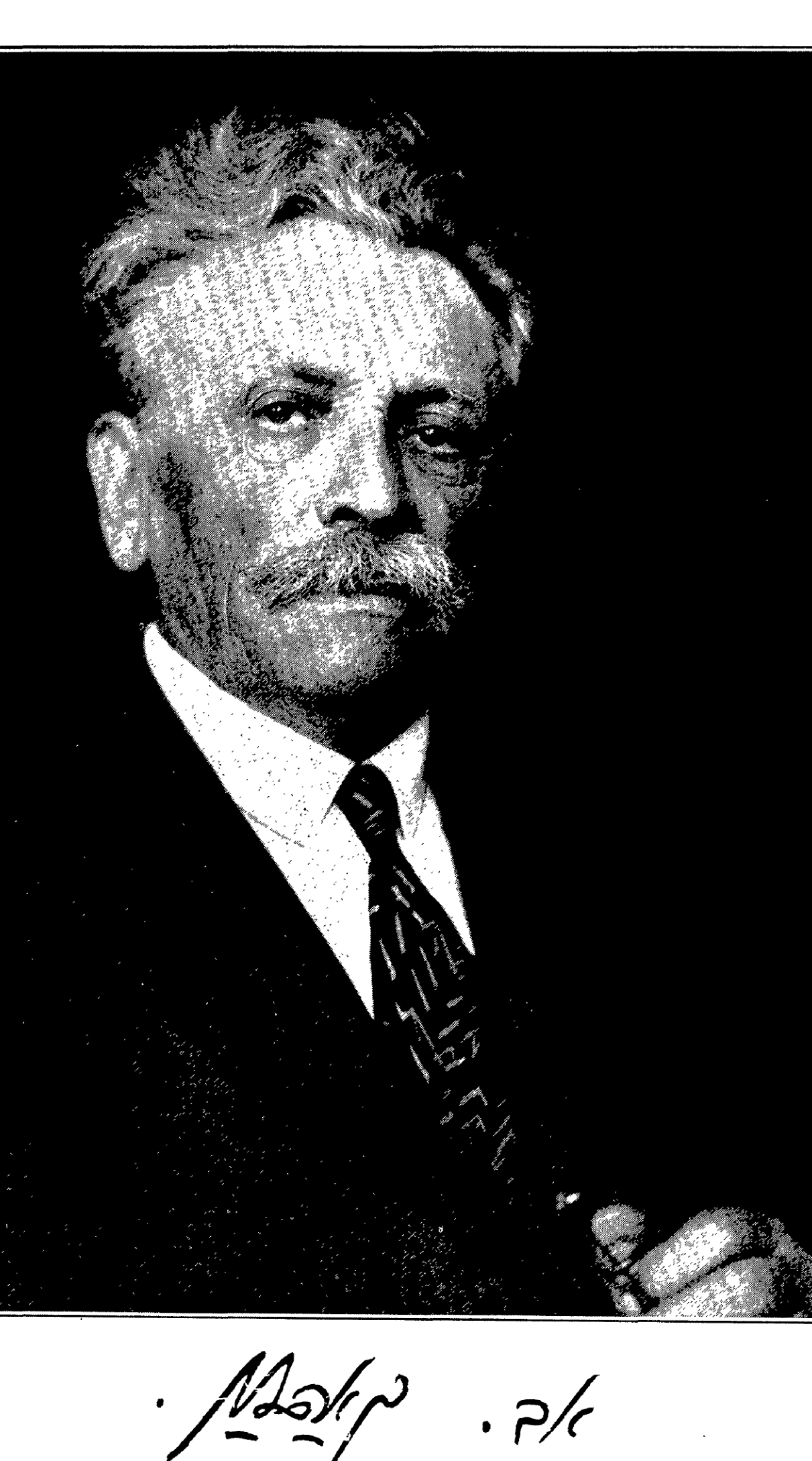
A Few Words About the Pictures in This Work
For the first volume I was able to obtain only a small number of pictures of the persons who are mentioned in it and who played a role in my life of those years. That time is already far receded, and either the persons mentioned never had themselves photographed, or their photographs are long gone.
The same was easier for the second volume, and for the third easier still. But even for these two volumes it was impossible to obtain all the desired pictures; and those that I did obtain did not always reach me without difficulties.
Many of the persons mentioned in the second and third volumes are long dead, and in some cases it was even hard to find their relatives or friends. One had to work through post, telegraph, and long-distance telephone, or even make a special journey, before one obtained an old photograph, or merely permission to make a copy of it.
In these undertakings to find the desired pictures, I had the cooperation of many friends and comrades in various cities in America and in Europe, chiefly in Vilna. To them all I wish here to express my heartfelt thanks.
Most of the pictures were taken approximately around the time to which the passages refer where the persons concerned are mentioned. In some cases, however, such photographs were impossible to obtain. These are pictures of buildings with which the history of my childhood and early youth is bound up. These buildings are little changed (the signs, for example, are present-day).